




Reproductive Health is where students lose easy marks by confusing the many contraceptive methods.
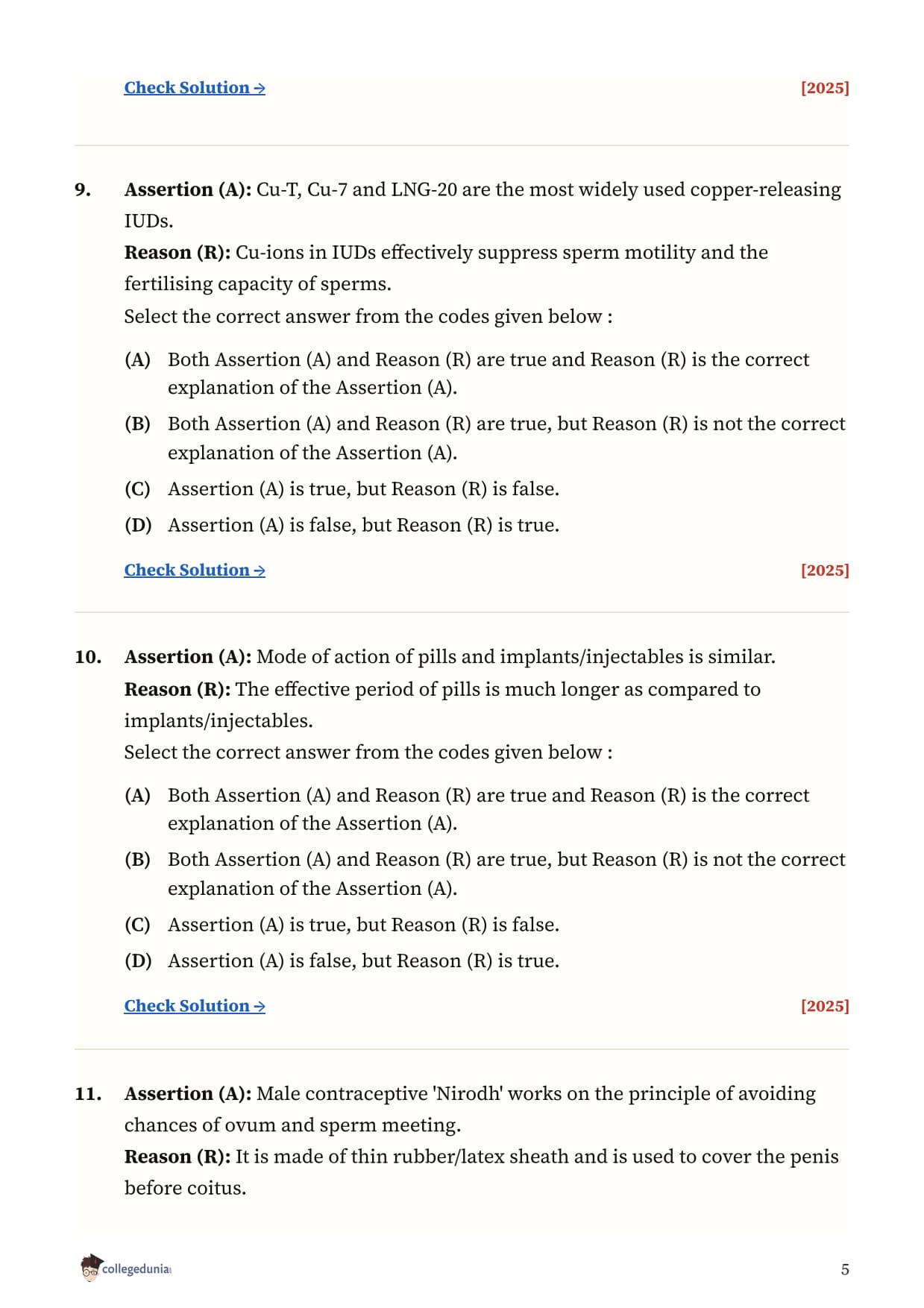
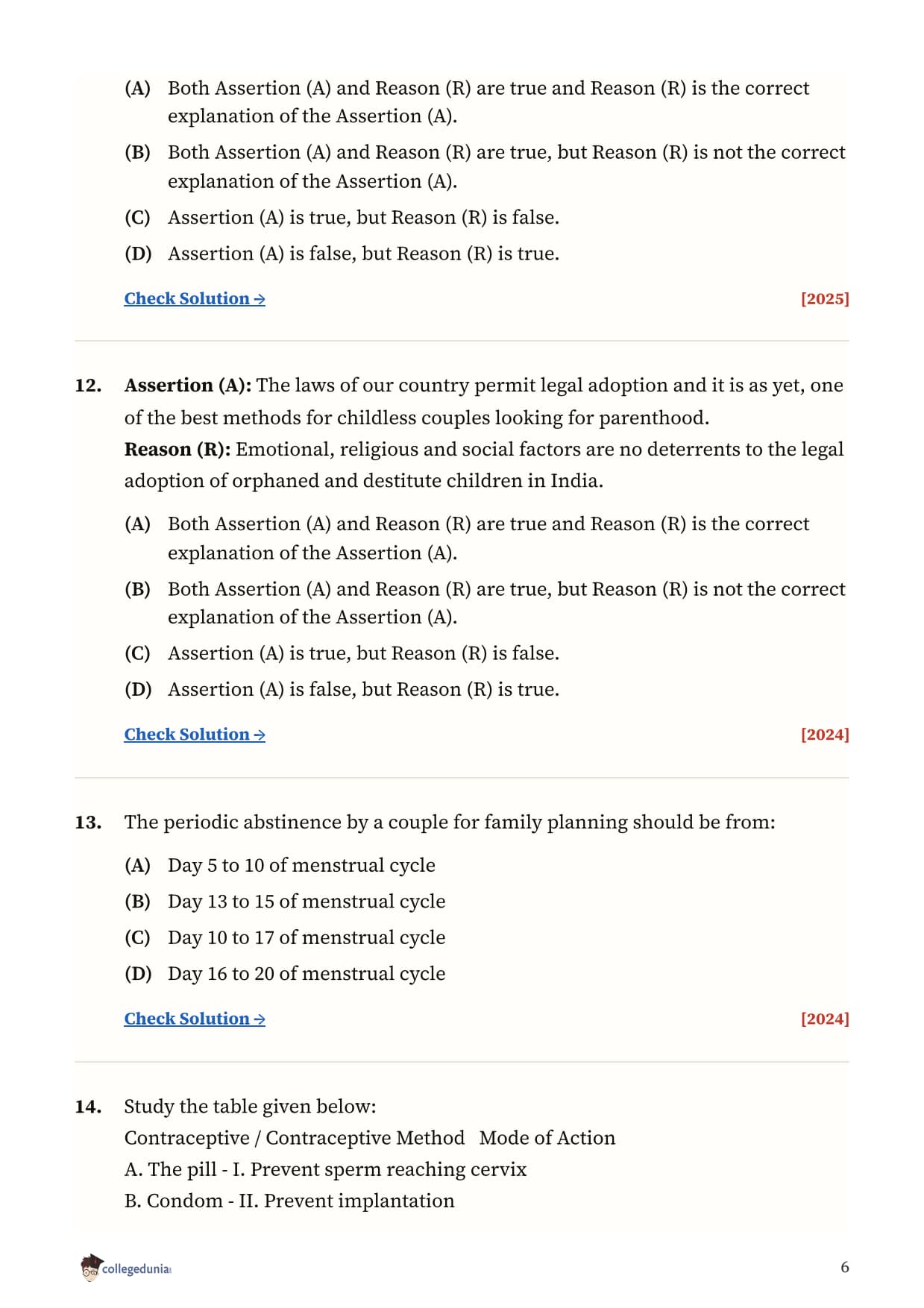
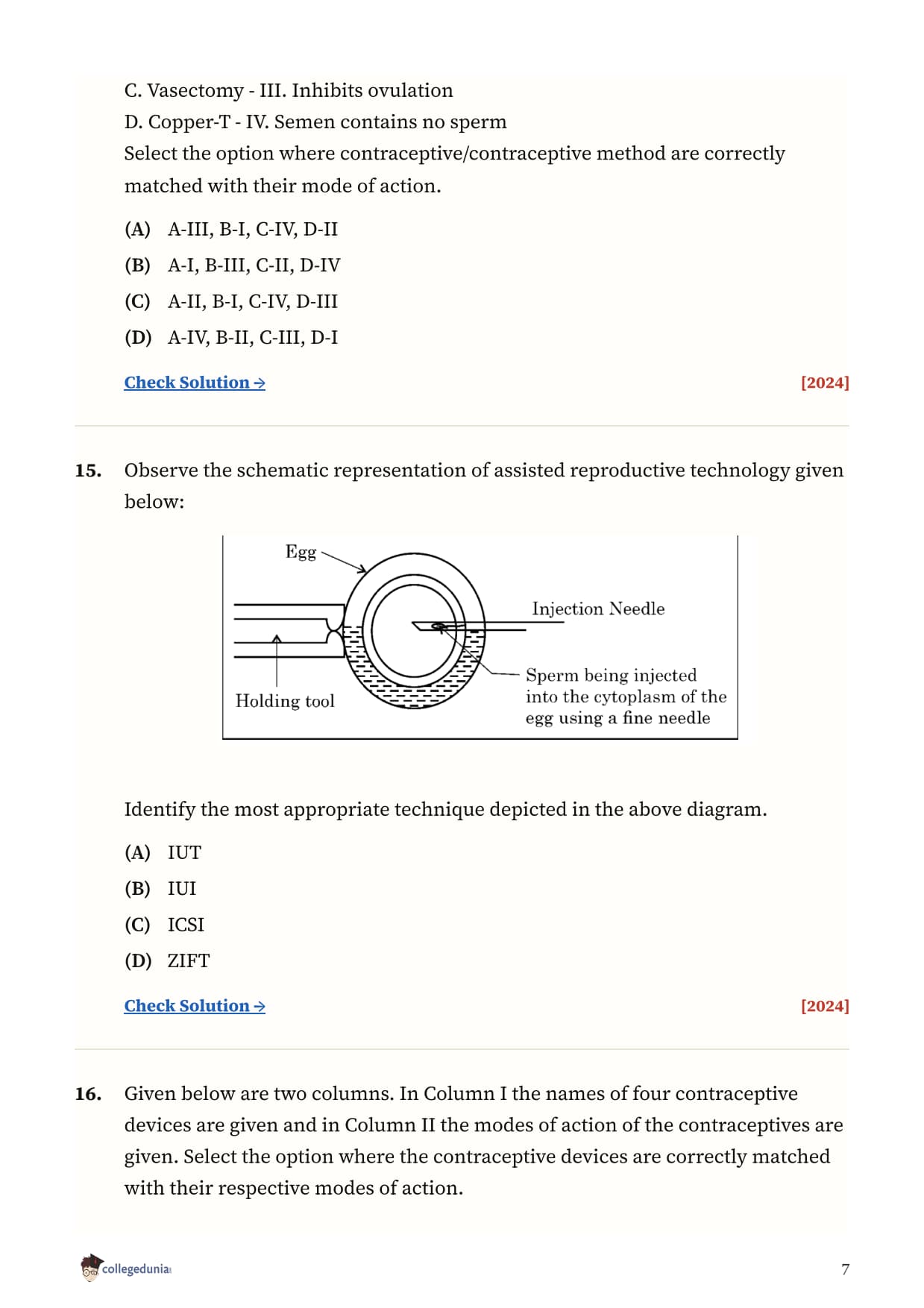
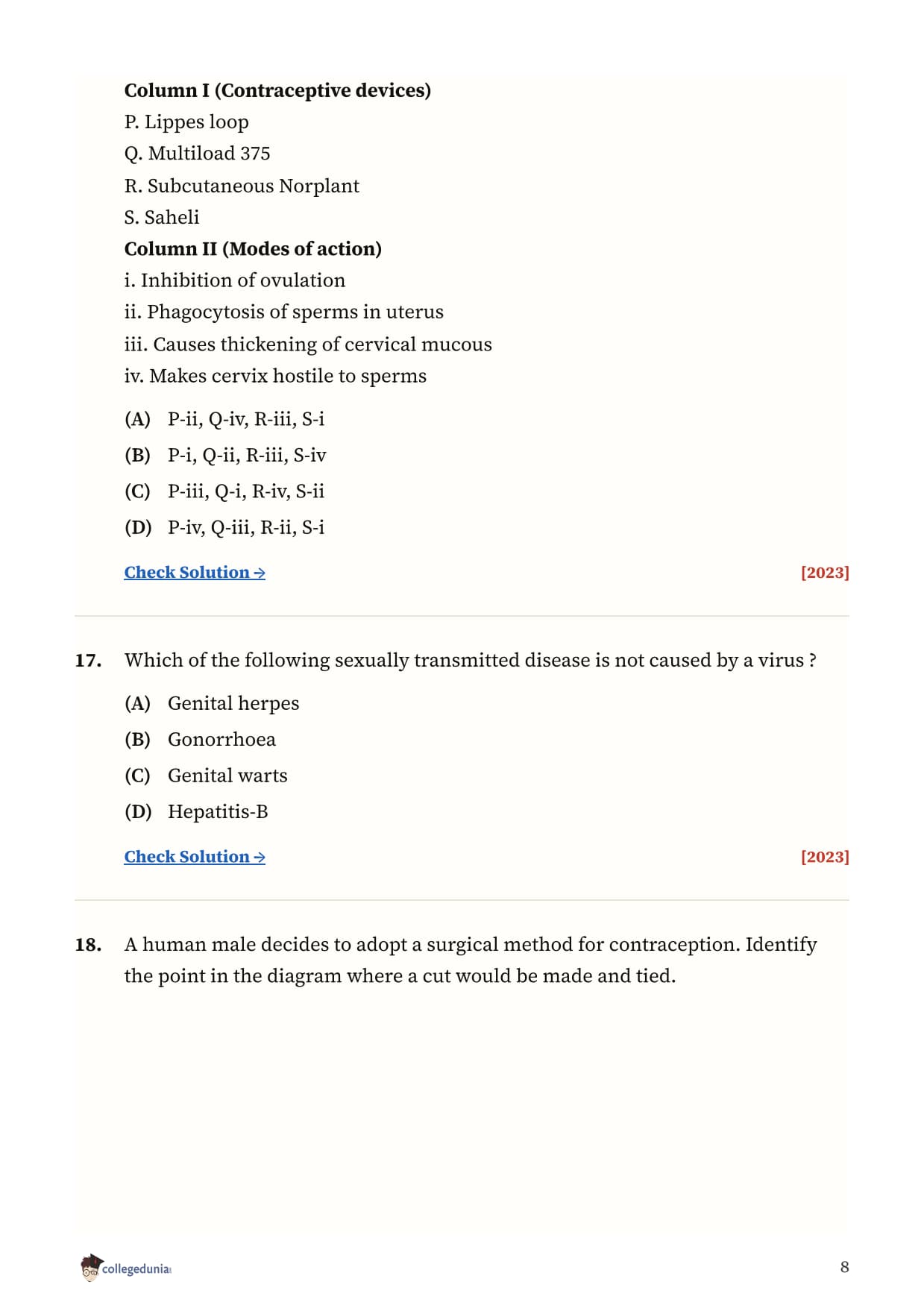

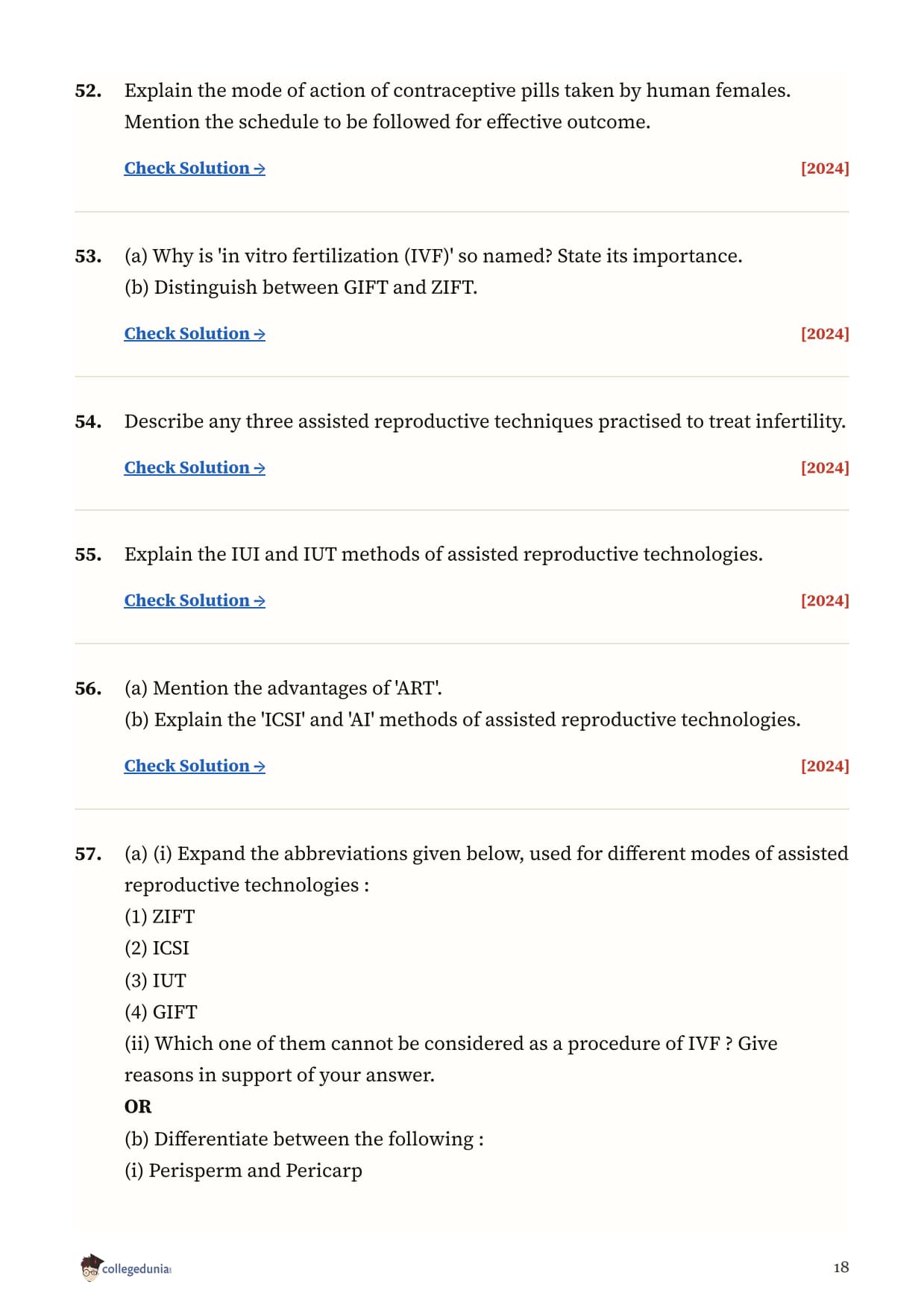
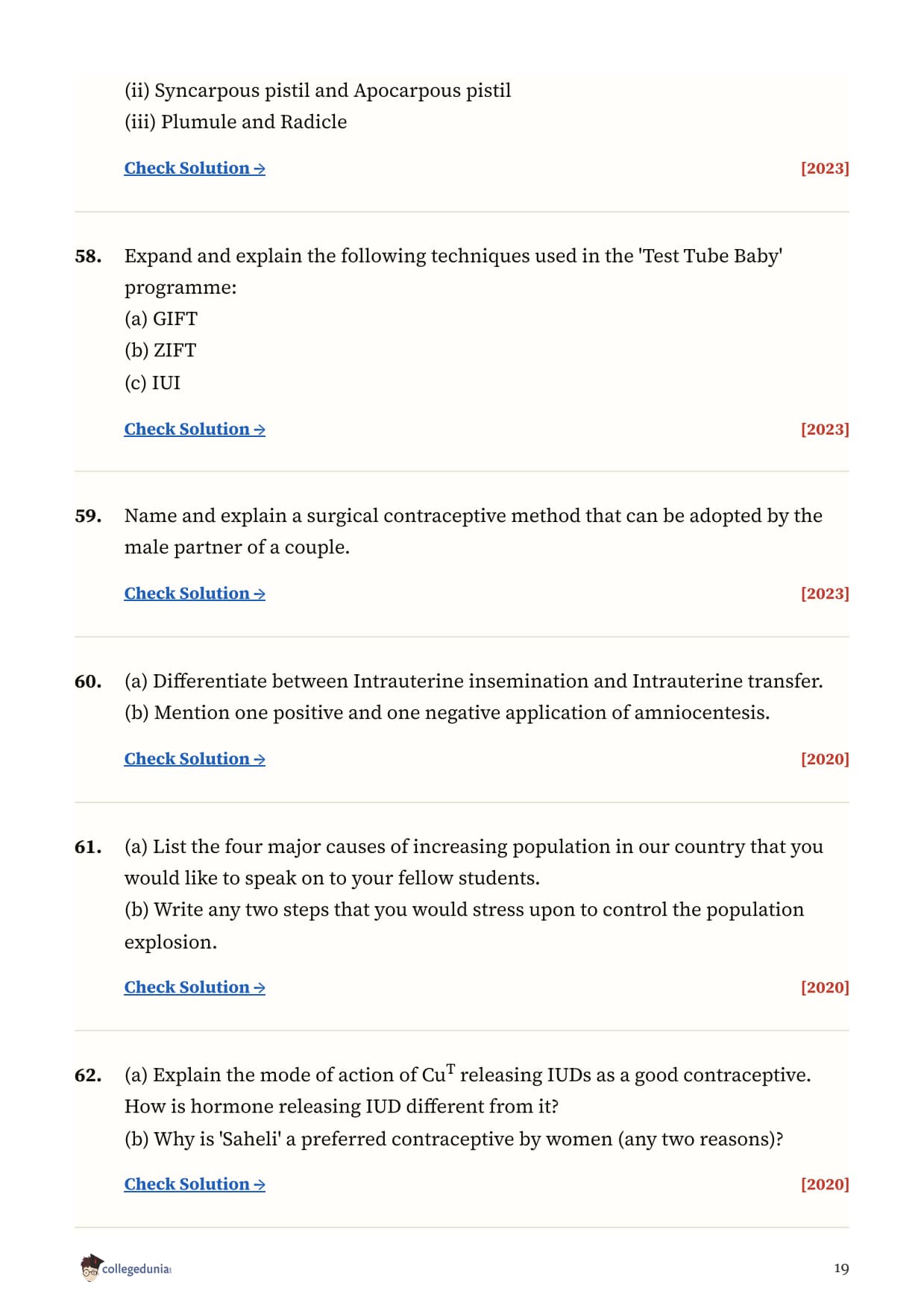
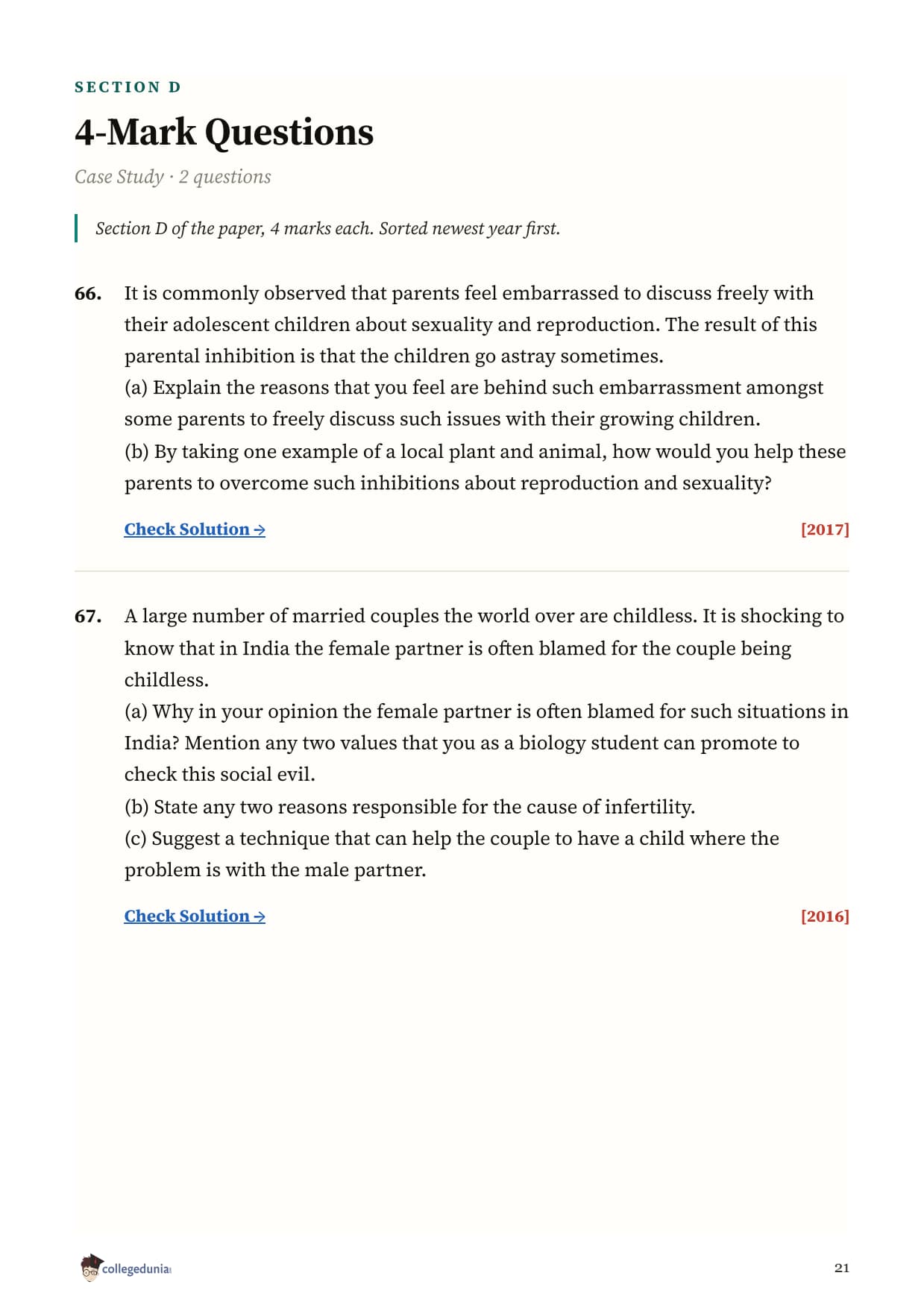
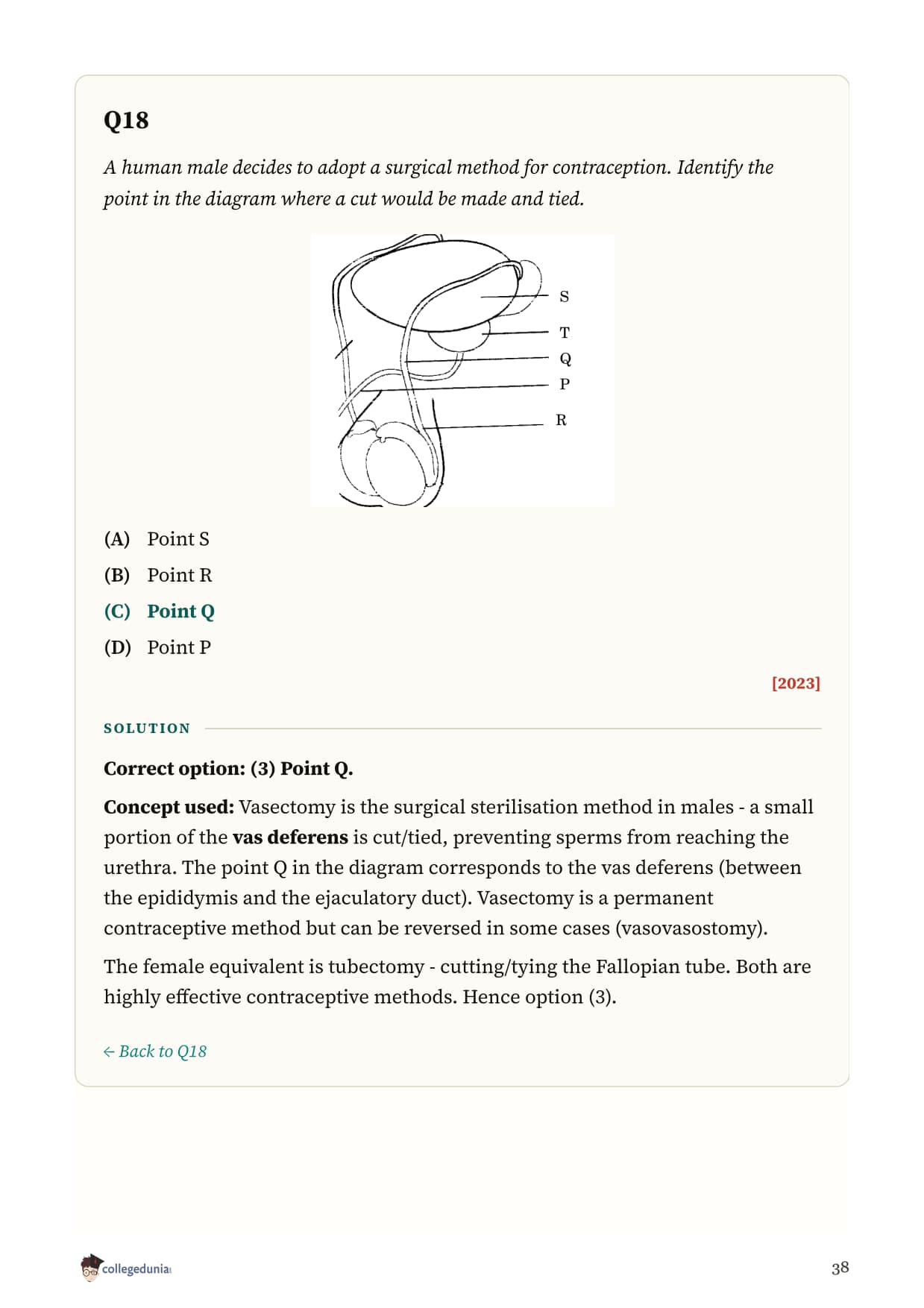
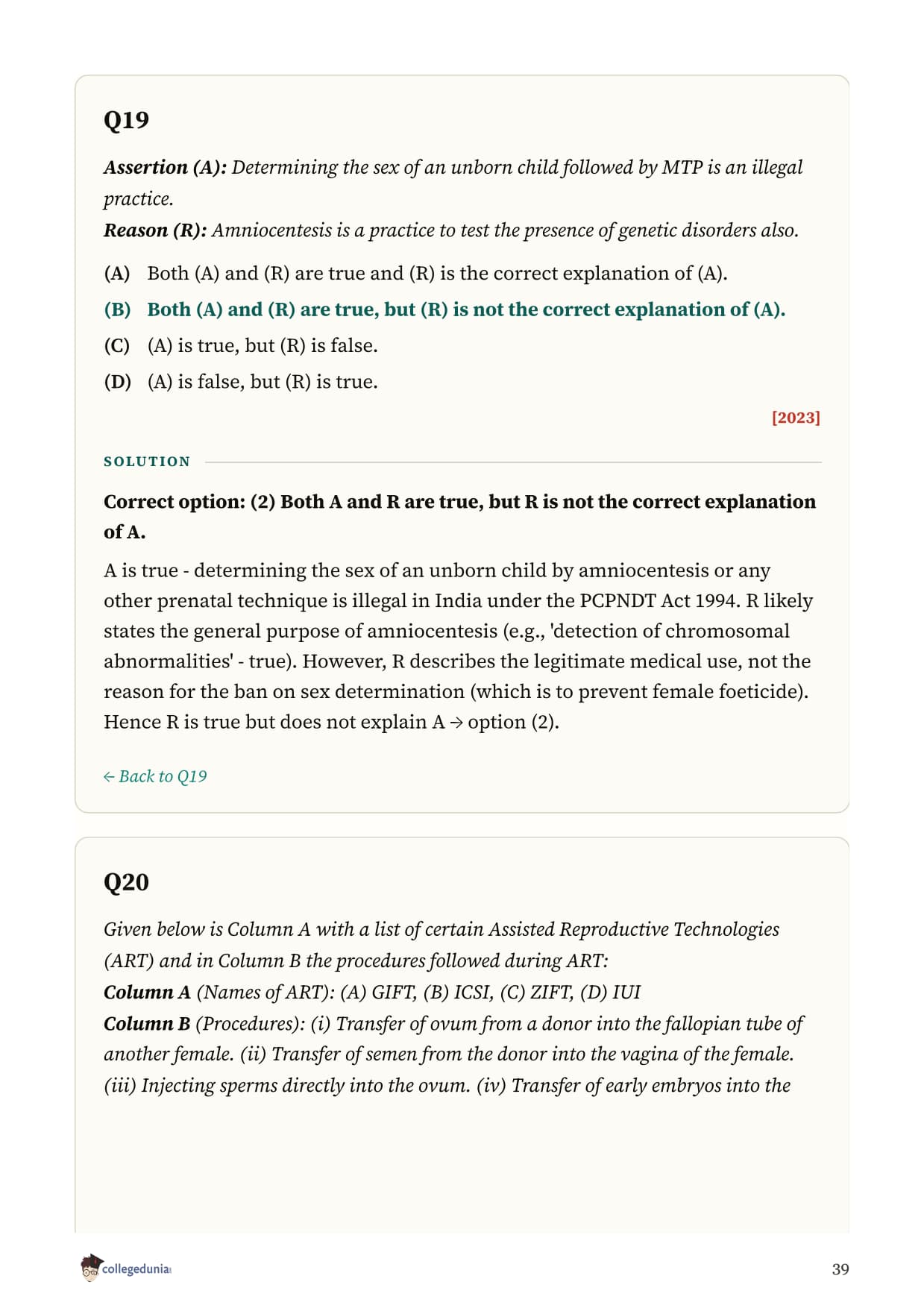
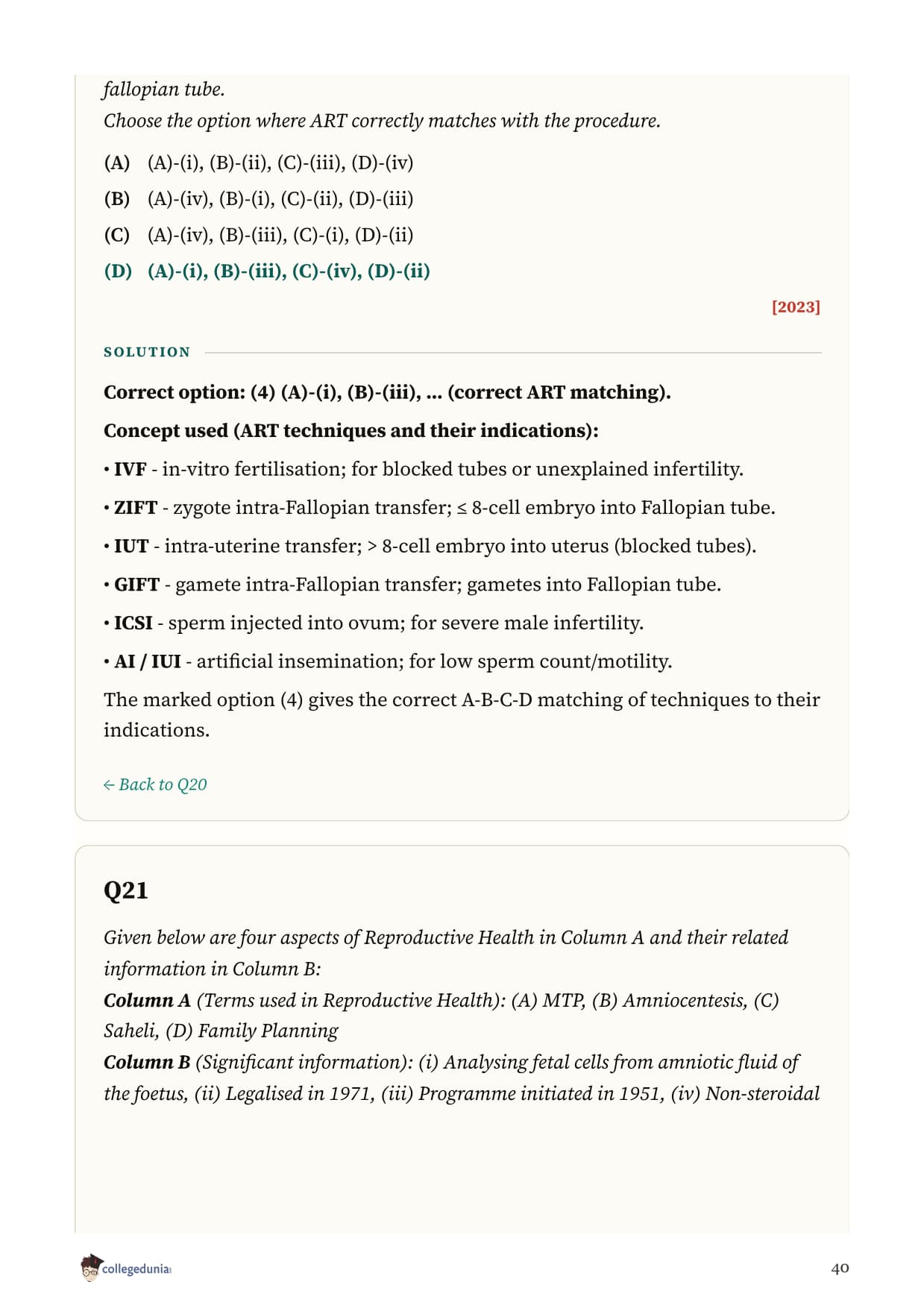
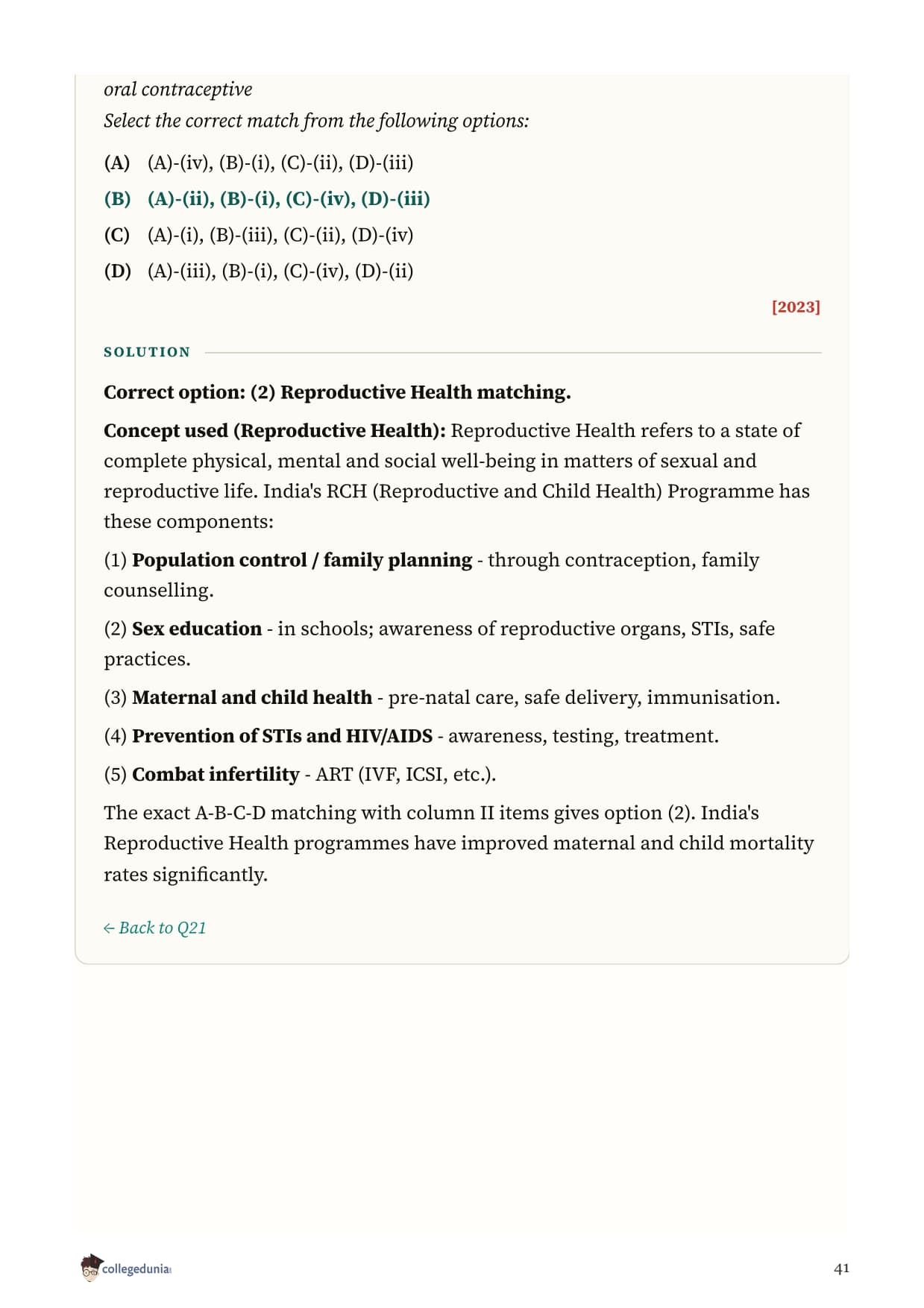
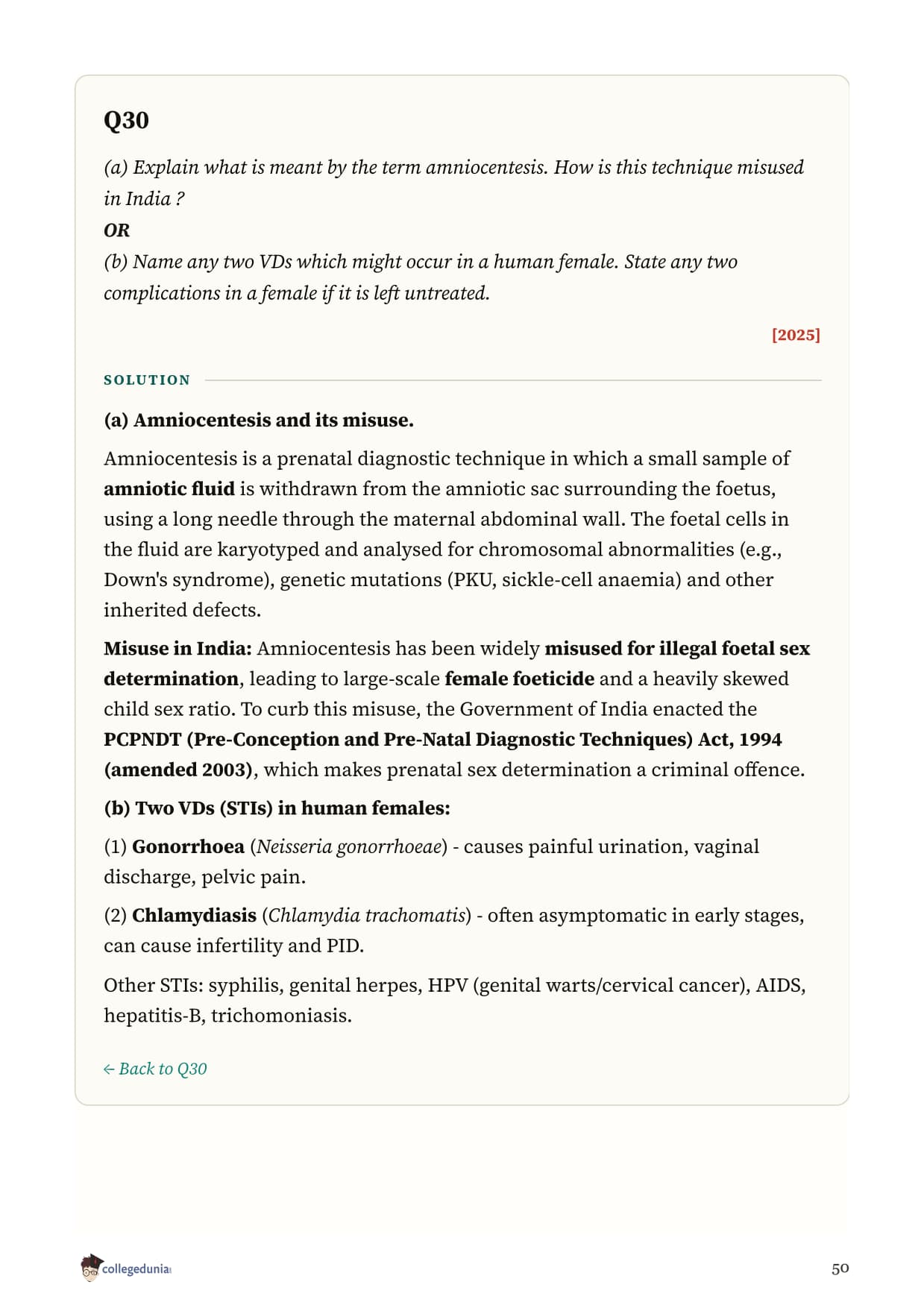
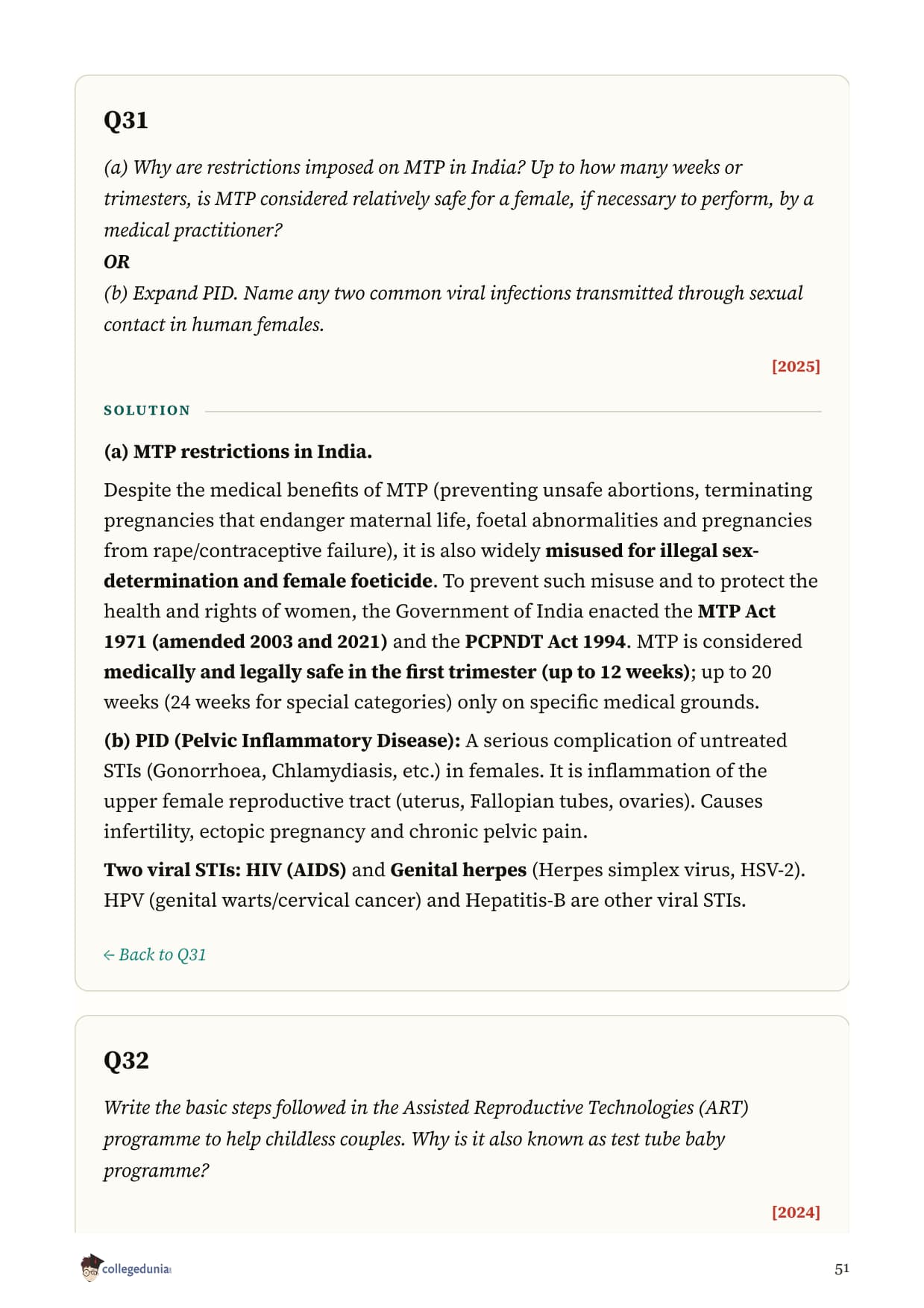
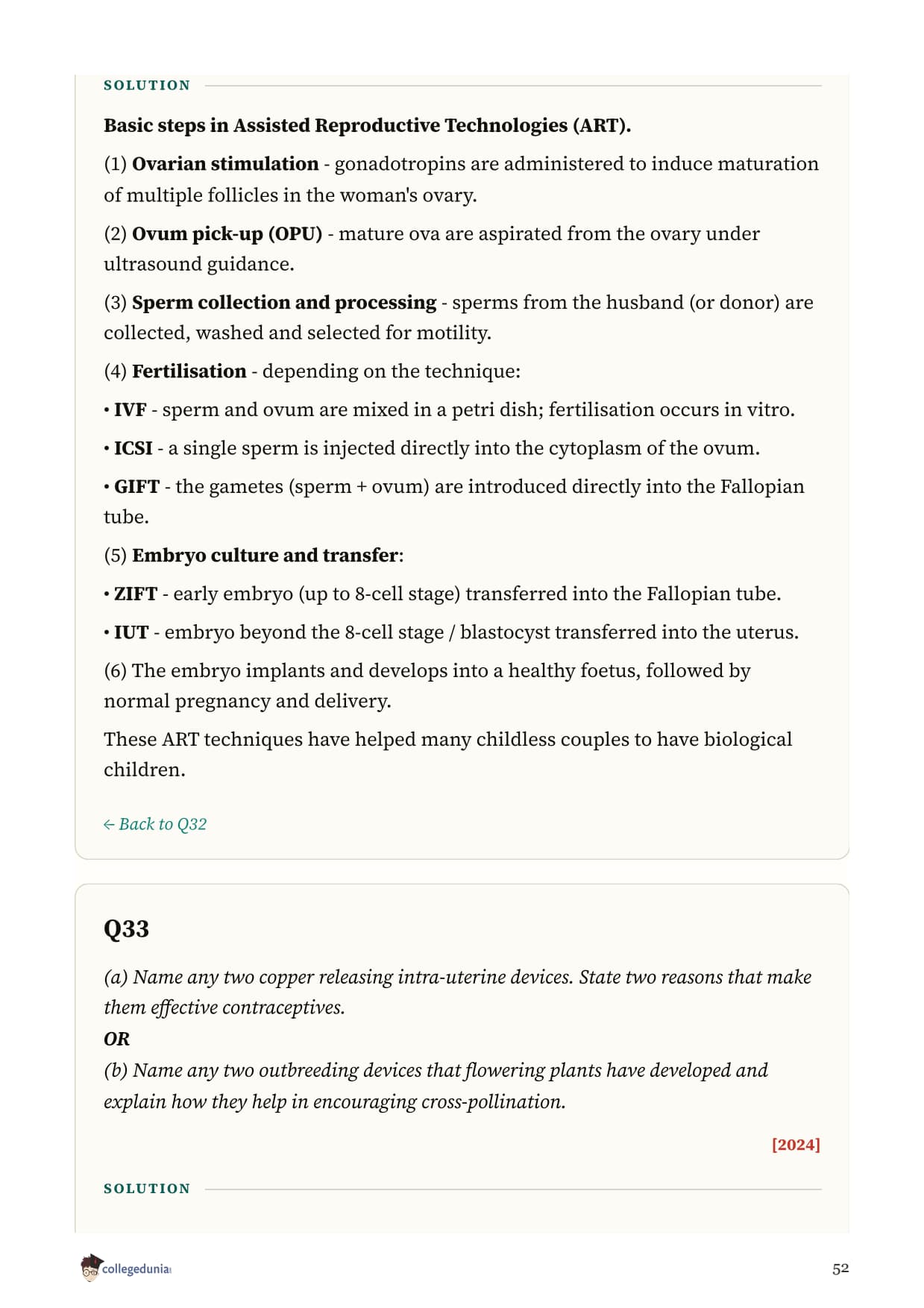
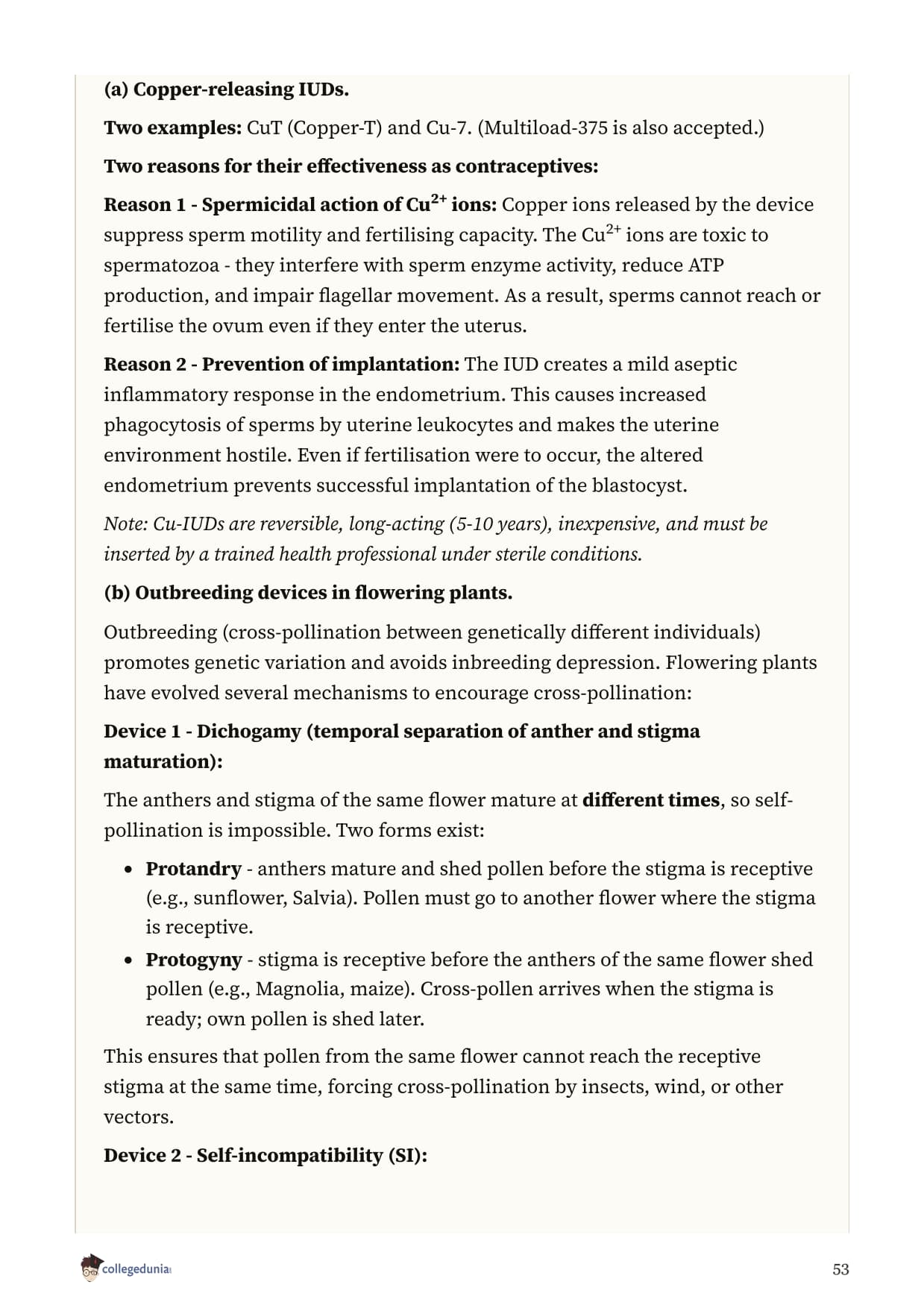
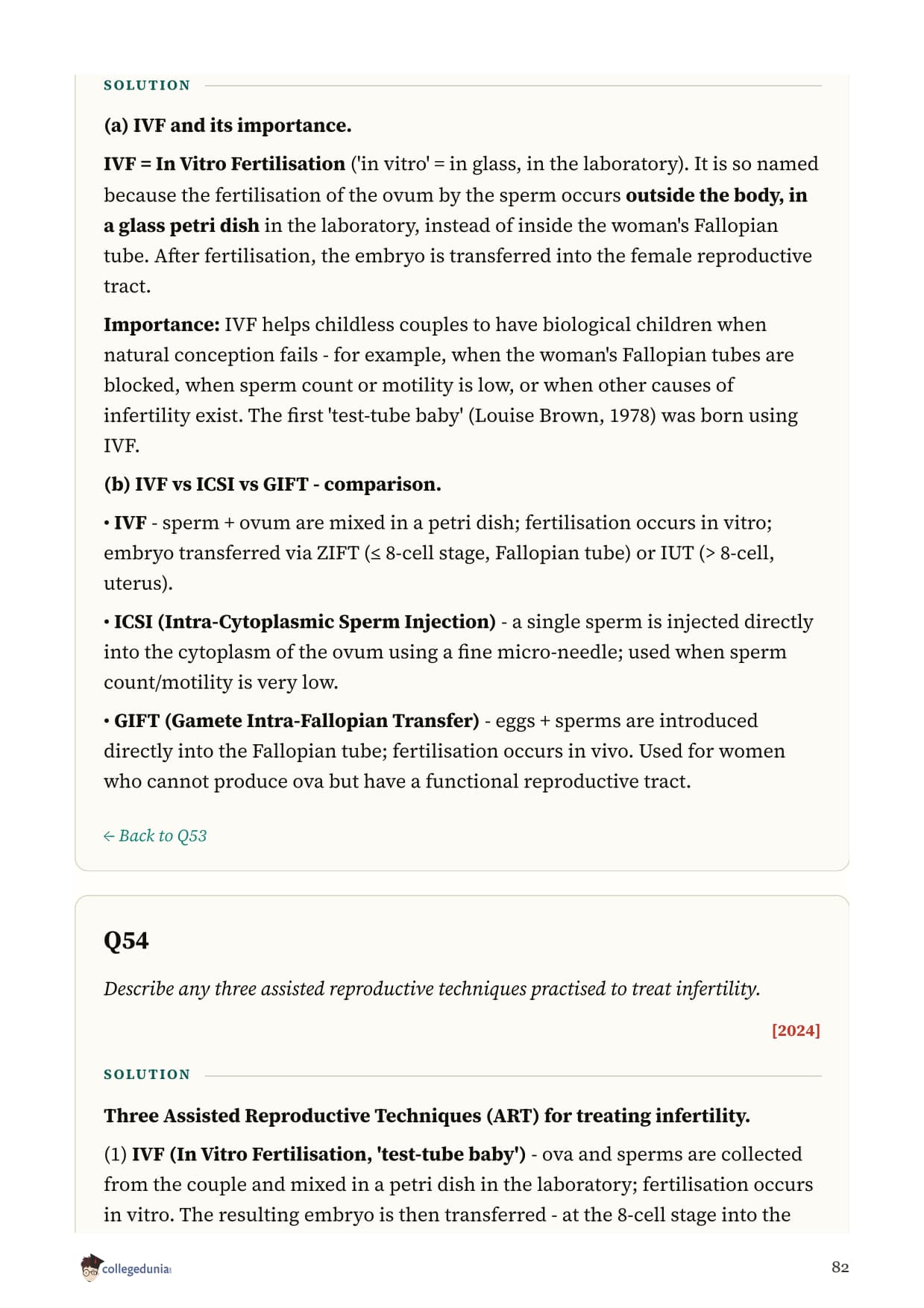
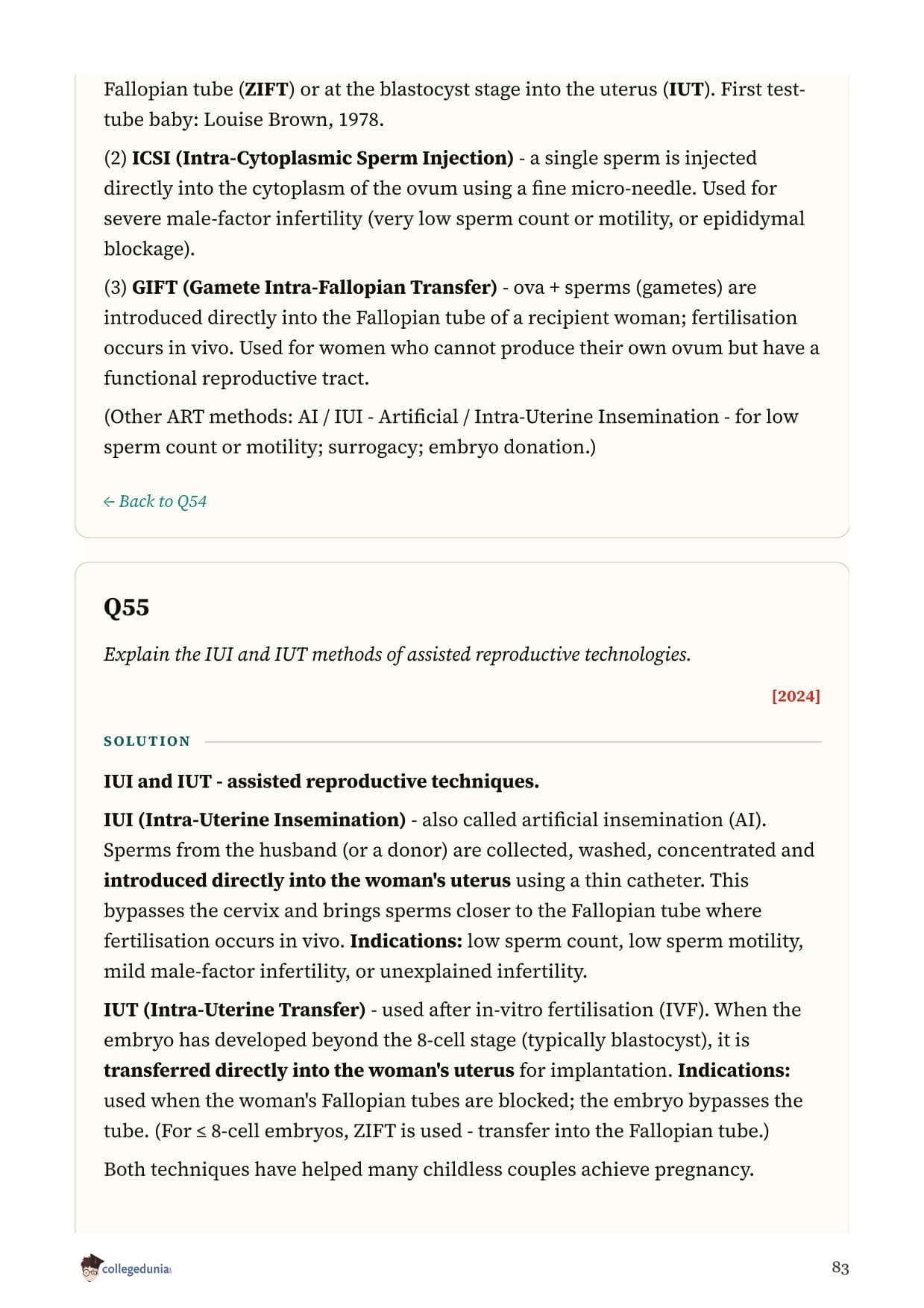
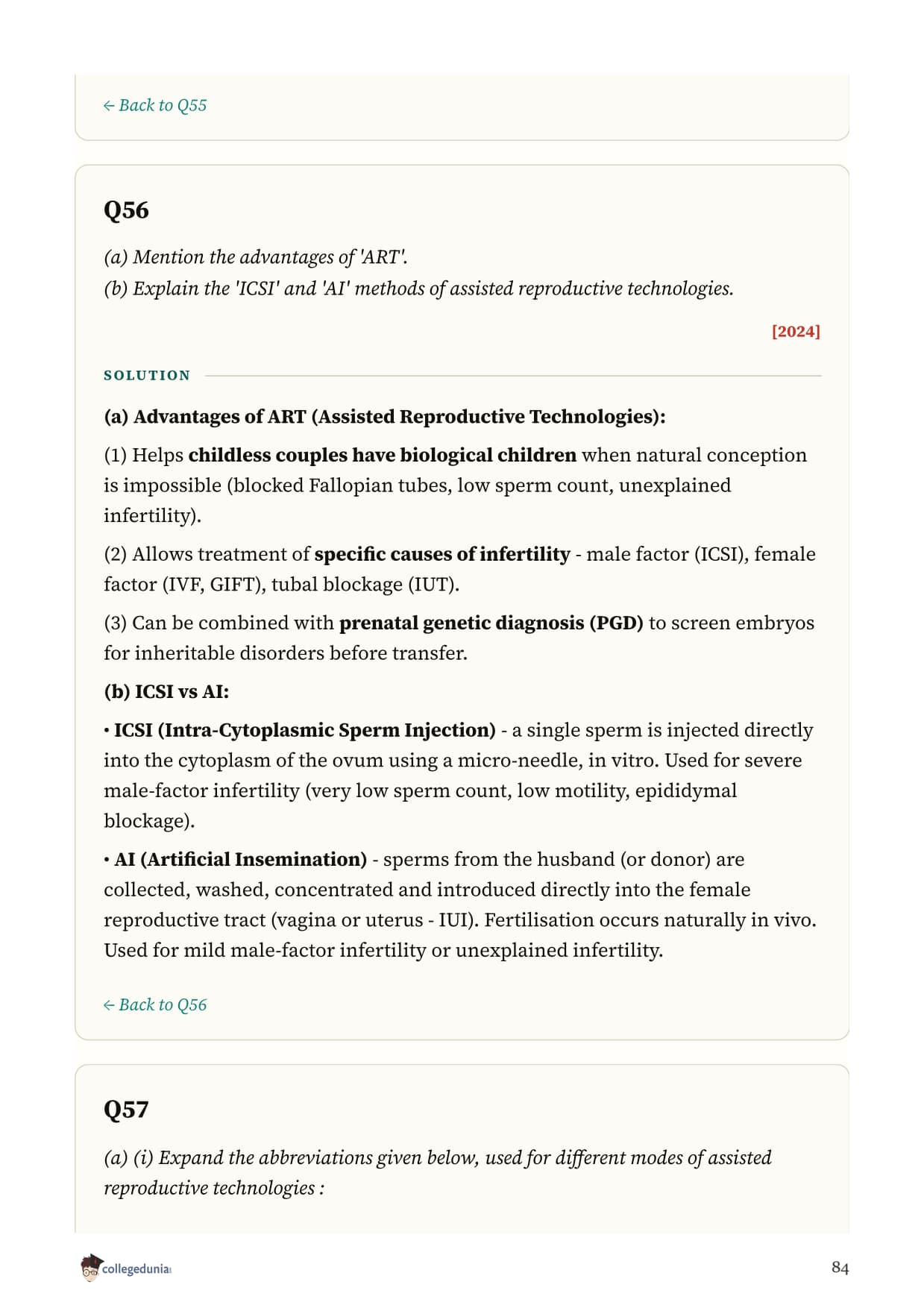
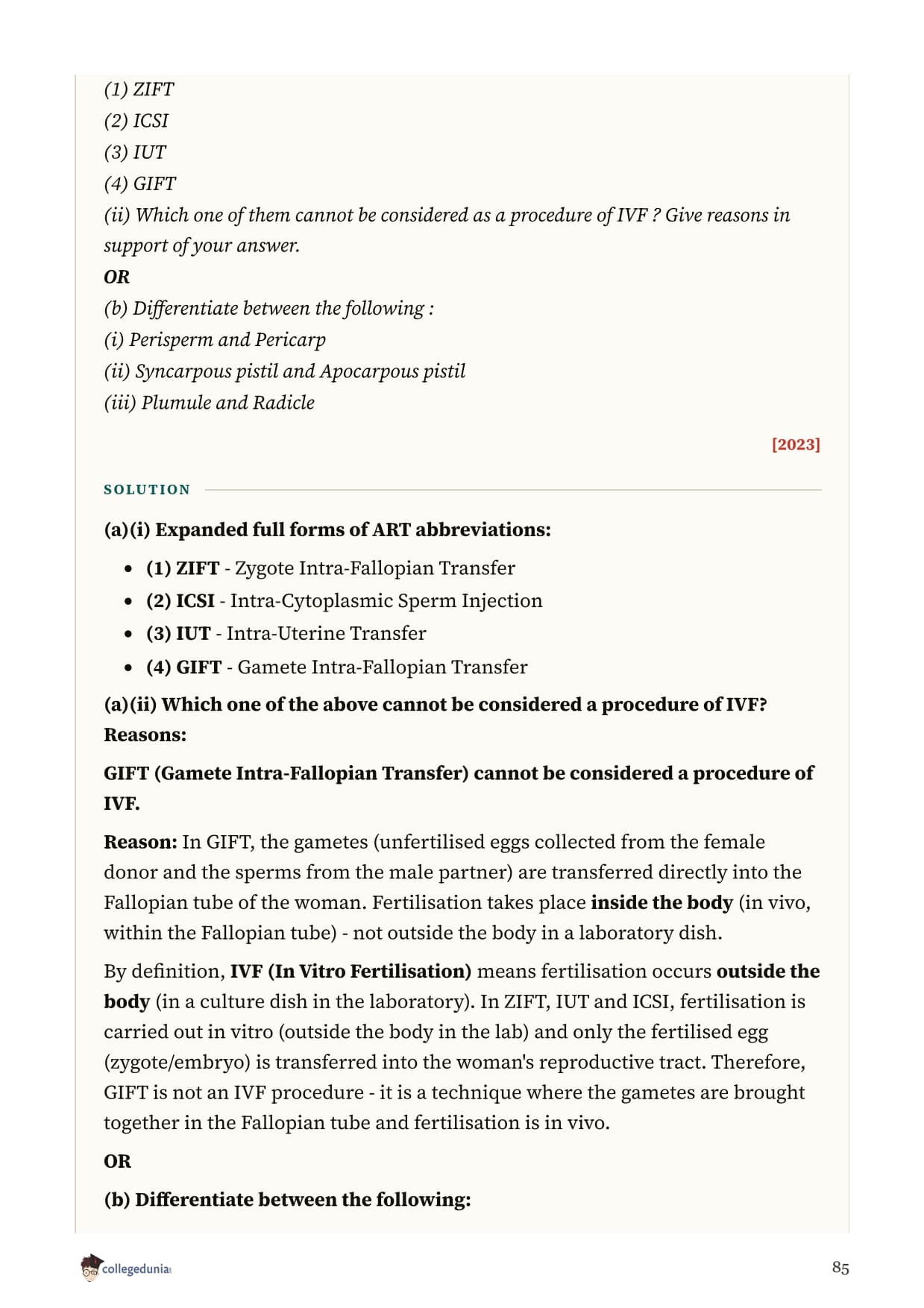
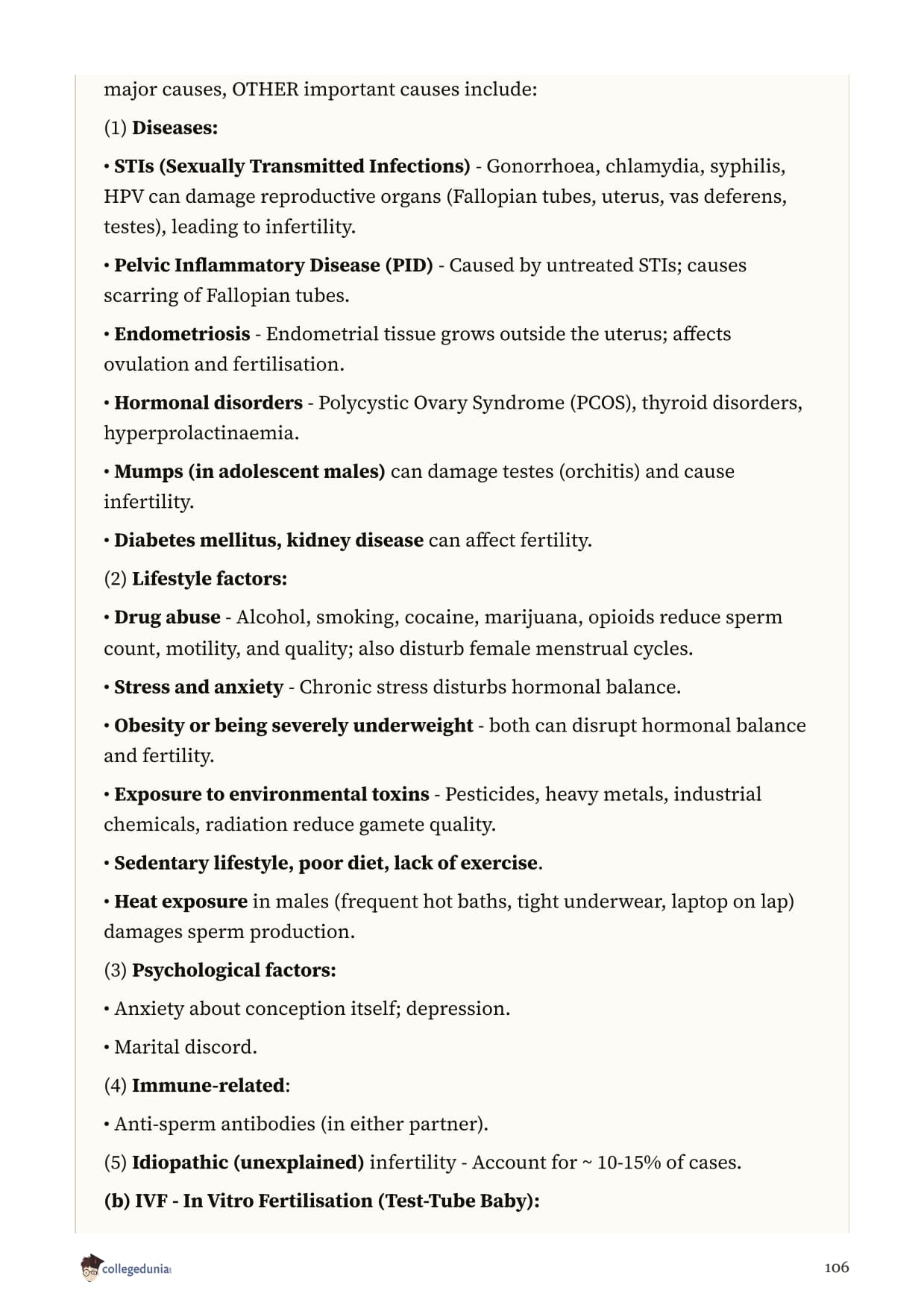
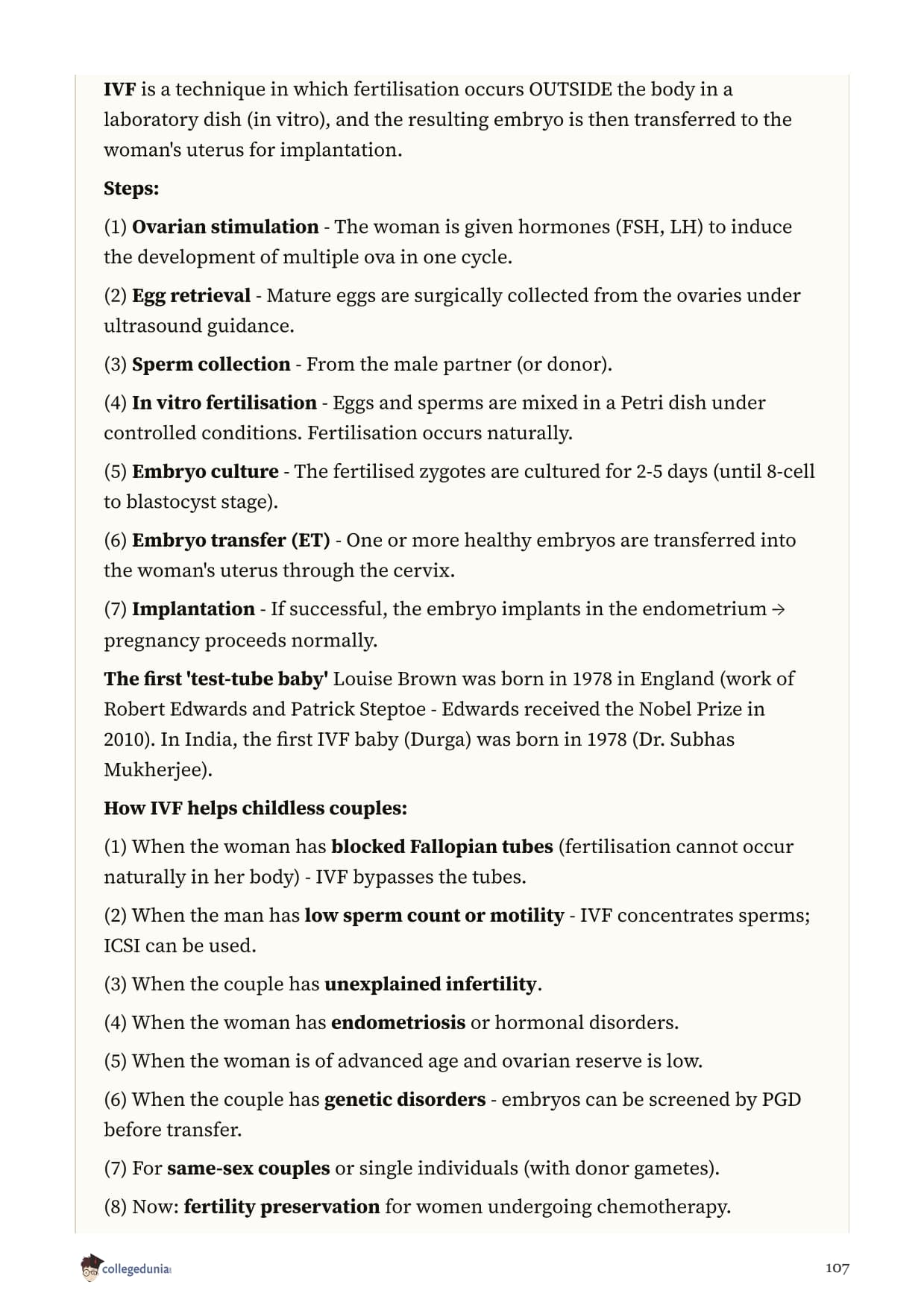
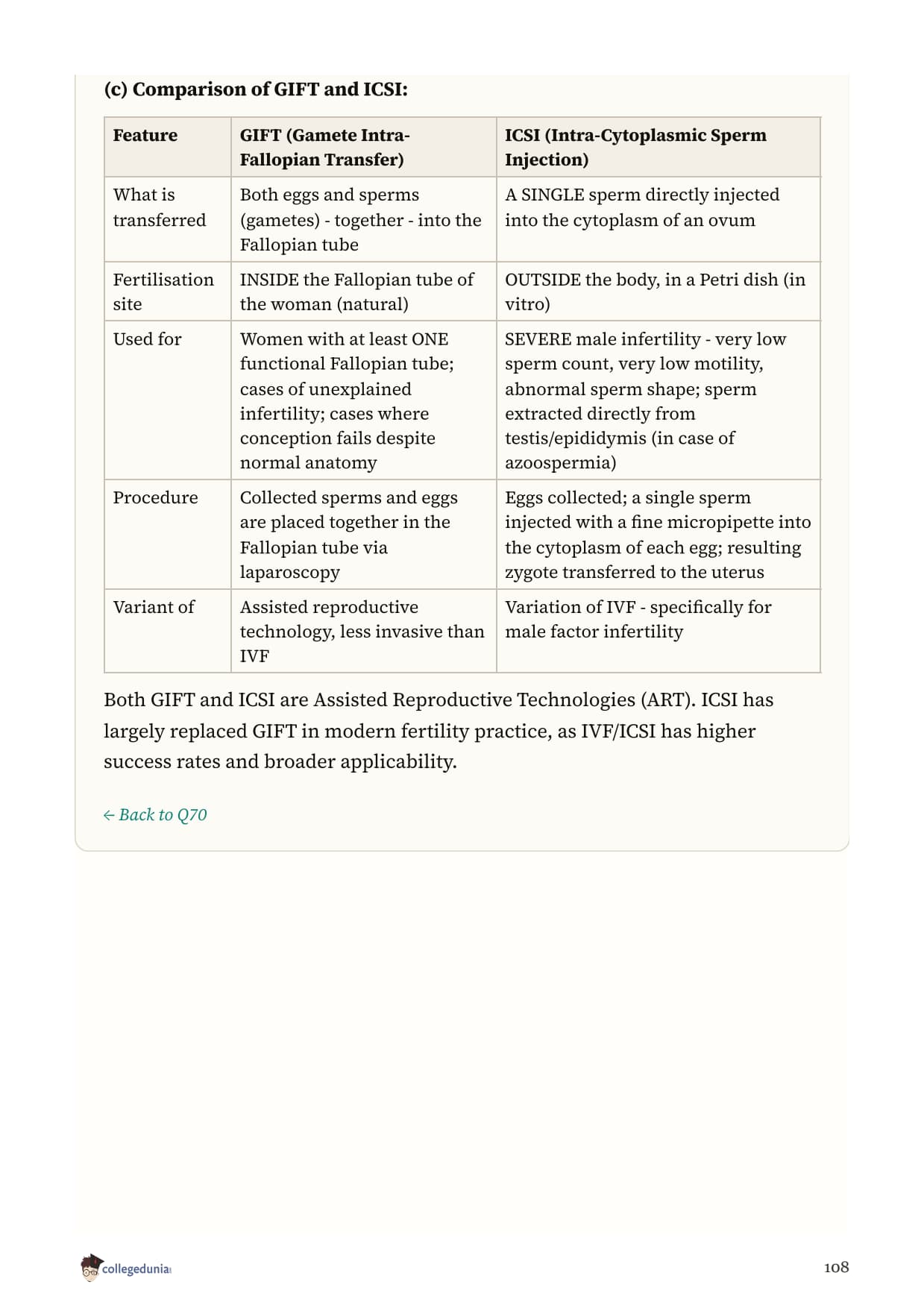
- 1-mark questions: 24 questions, mostly MCQ and assertion-reason on contraceptives, IUDs and ART terms.
- 2 and 3-mark questions: 21 and 20 questions, the core of this chapter, built around contraceptive methods and assisted reproduction.
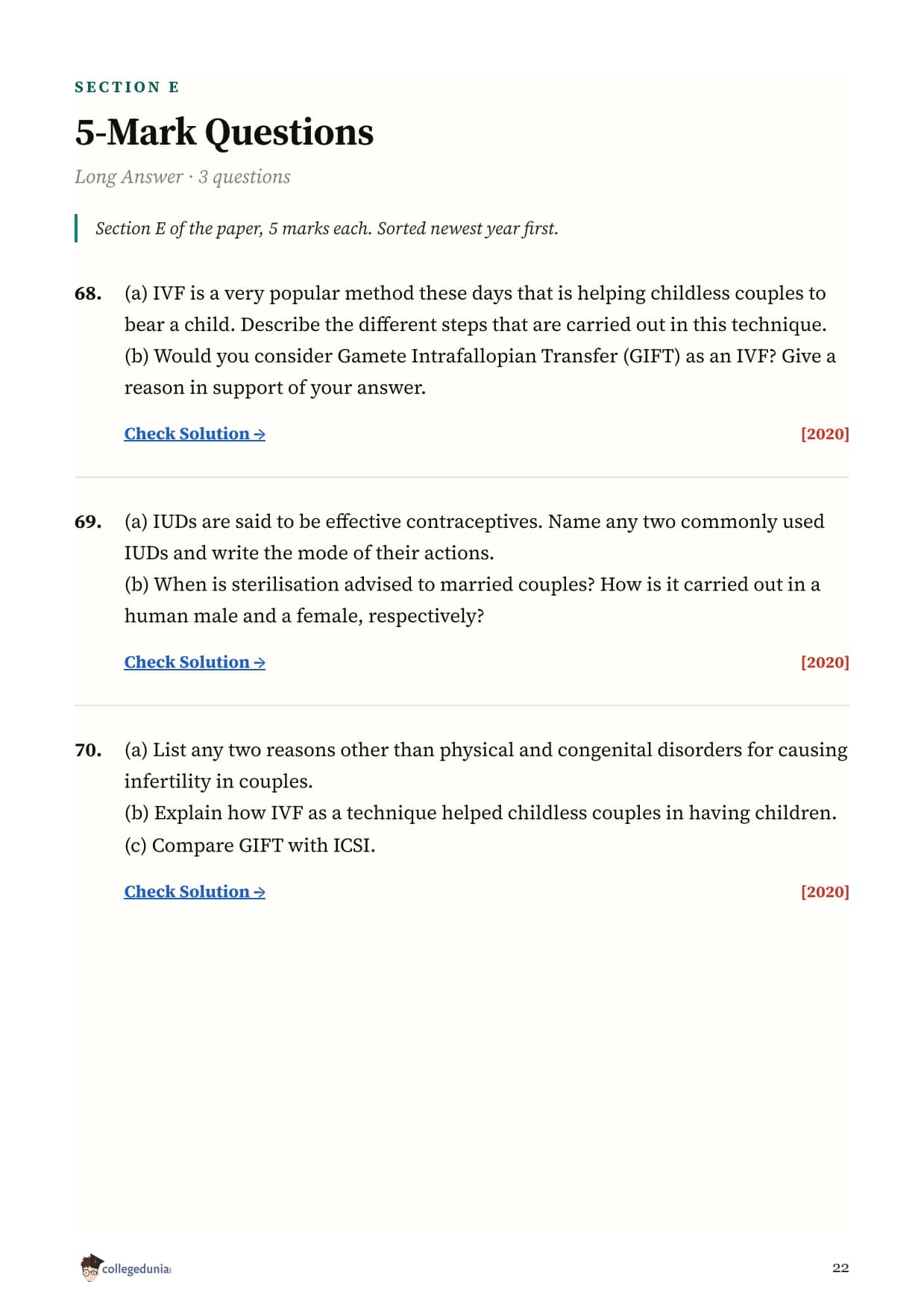
- 5-mark long answers: 3 questions, the rarest band here, usually a detailed ART or population-control answer.
The Class 12 Biology Reproductive Health PYQ set gathers 70 board-paper questions across 2005 to 2026, sorted by marks and by year, so you can sort out every method and ART term in one focused practice round for CBSE and NEET.
Every question in this Class 12 Biology Reproductive Health PYQ compilation is sourced from CBSE board papers (Delhi, Outside Delhi, Foreign and Compartment) and cross-checked against the official mark scheme, with near-duplicate questions removed.
What the Reproductive Health Previous Year Questions Cover
The 70-question set maps every concept the NCERT chapter introduces. Contraceptive methods (barrier, IUDs, oral pills, implants and surgical methods) drive most of the 2 and 3-mark band. Assisted reproductive technologies like IVF, ZIFT, GIFT and ICSI carry many short and value-based questions. Total fertility rate, MTP and amniocentesis appear as 1 and 2-mark reasoning, and the role of programmes like RCH fills the rest.
Marks-wise Distribution of the Reproductive Health PYQs
The table below shows how the 70 questions split across the CBSE marks bands. Note how heavily this chapter leans on the 2 and 3-mark bands.
| Marks | Questions | Total Marks | CBSE Section | Type |
|---|---|---|---|---|
| 1 mark | 24 | 24 | Section A | MCQ / Assertion-Reason |
| 2 mark | 21 | 42 | Section B | VSA (Very Short Answer) |
| 3 mark | 20 | 60 | Section C | SA (Short Answer) |
| 4 mark | 2 | 8 | Section D | Case Study |
| 5 mark | 3 | 15 | Section E | Long Answer |
Year-wise Spread of Class 12 Biology Reproductive Health PYQs
The compilation draws from 14 CBSE board years. Roughly 70% of the questions come from 2023 onwards, the highest recent share of any Biology chapter, because contraceptive and ART MCQs filled the new Section A block.
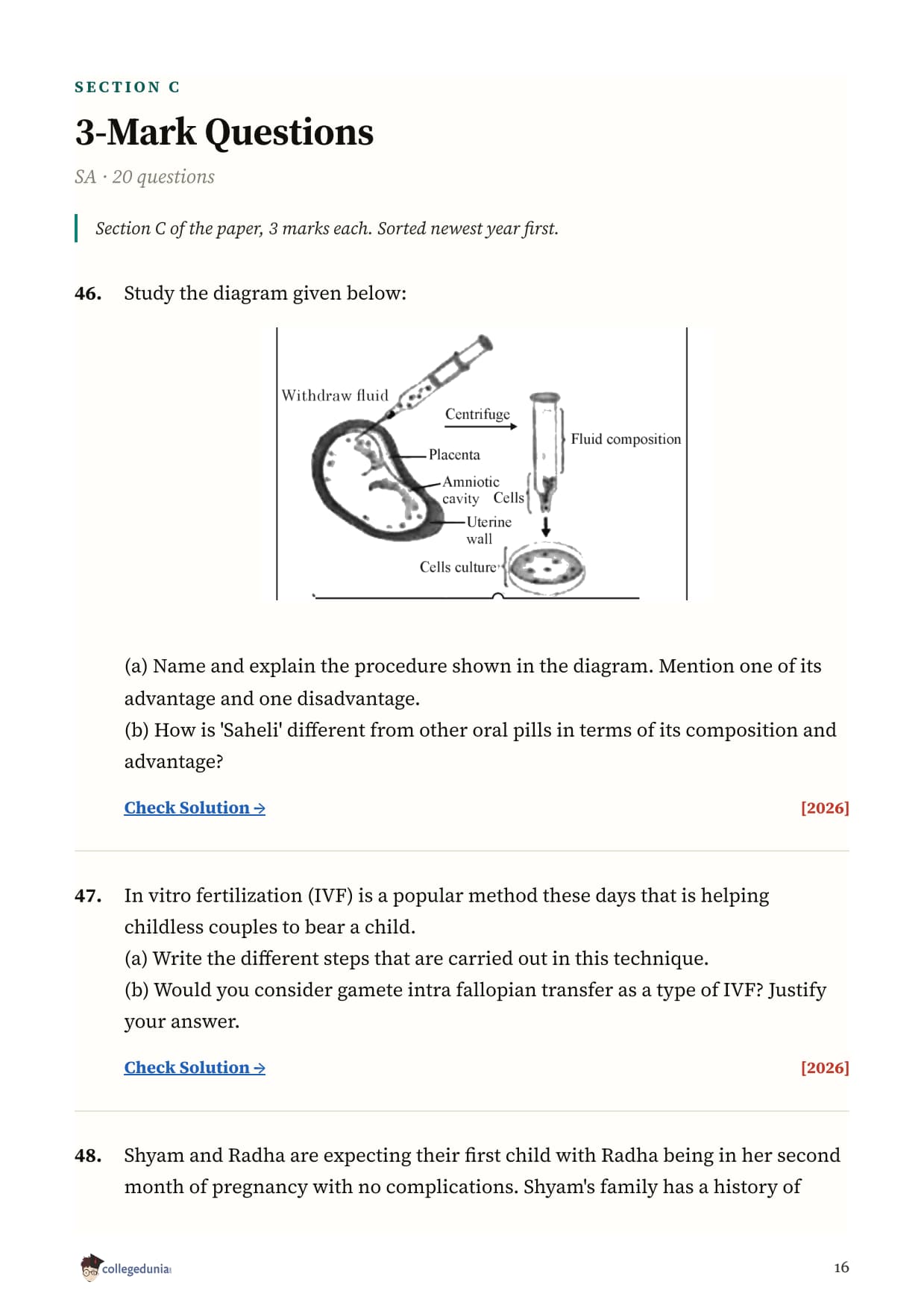
- 2026: The procedure shown in a contraceptive diagram with one advantage and one disadvantage, how 'Saheli' works, and how implants act as a contraceptive.
- 2024 to 2025: The largest contribution years, with MCQ banks on IUDs, ART terms and lactational amenorrhea.
- 2020 to 2023: Reduced-syllabus papers, yet contraceptive methods and infertility treatment still feature.
- 2005 to 2019: Value-based and reasoning questions on MTP, amniocentesis misuse and population control, all still in the current syllabus.
Topic Frequency in the Reproductive Health Board Paper Questions
The 70 questions cluster into the six topic buckets below, ranked by how often CBSE has set them between 2005 and 2026.
| Rank | Topic Cluster | Frequency | Typical Marks Band |
|---|---|---|---|
| 1 | Contraceptive methods (barrier, IUDs, oral pills, implants, surgical methods) | ~27 per cent | 1, 2, 3 mark |
| 2 | Assisted reproductive technologies (IVF, ZIFT, GIFT, ICSI, artificial insemination) | ~23 per cent | 2, 3, 5 mark |
| 3 | Infertility and ART value-based (causes, ethical and value-based scenarios) | ~16 per cent | 2 and 3 mark |
| 4 | Population and fertility (total fertility rate vs replacement level, RCH programme) | ~14 per cent | 1 and 2 mark |
| 5 | MTP and amniocentesis (medical termination, statutory ban on sex determination) | ~11 per cent | 1, 2, 3 mark |
| 6 | STIs and reproductive health awareness (transmission, prevention, sex education) | ~9 per cent | 1 and 2 mark |
Marks-Band Attempt Strategy for the Reproductive Health PYQs
The 70 PYQs are arranged marks-ascending inside the PDF so you can attempt them in the same order the CBSE paper presents them.
- 1-mark questions: Spend no more than 45 seconds each. Many ask you to name a method or pick the correct ART abbreviation.
- 2-mark questions: The most common band here, usually a method plus one advantage. Memorise one merit and one demerit for each contraceptive.
- 3-mark questions: Usually an ART technique explained step by step, or a contraceptive diagram. Aim for 5 minutes.
- 5-mark long answers: Rare here, but cover the full ART list and population-control measures. Allocate 12 minutes if one appears.
Recent CBSE Trend: 2024 to 2026 Pattern Shift in Reproductive Health
Three things have changed in the recent CBSE cycles that the Reproductive Health previous year questions now reflect:
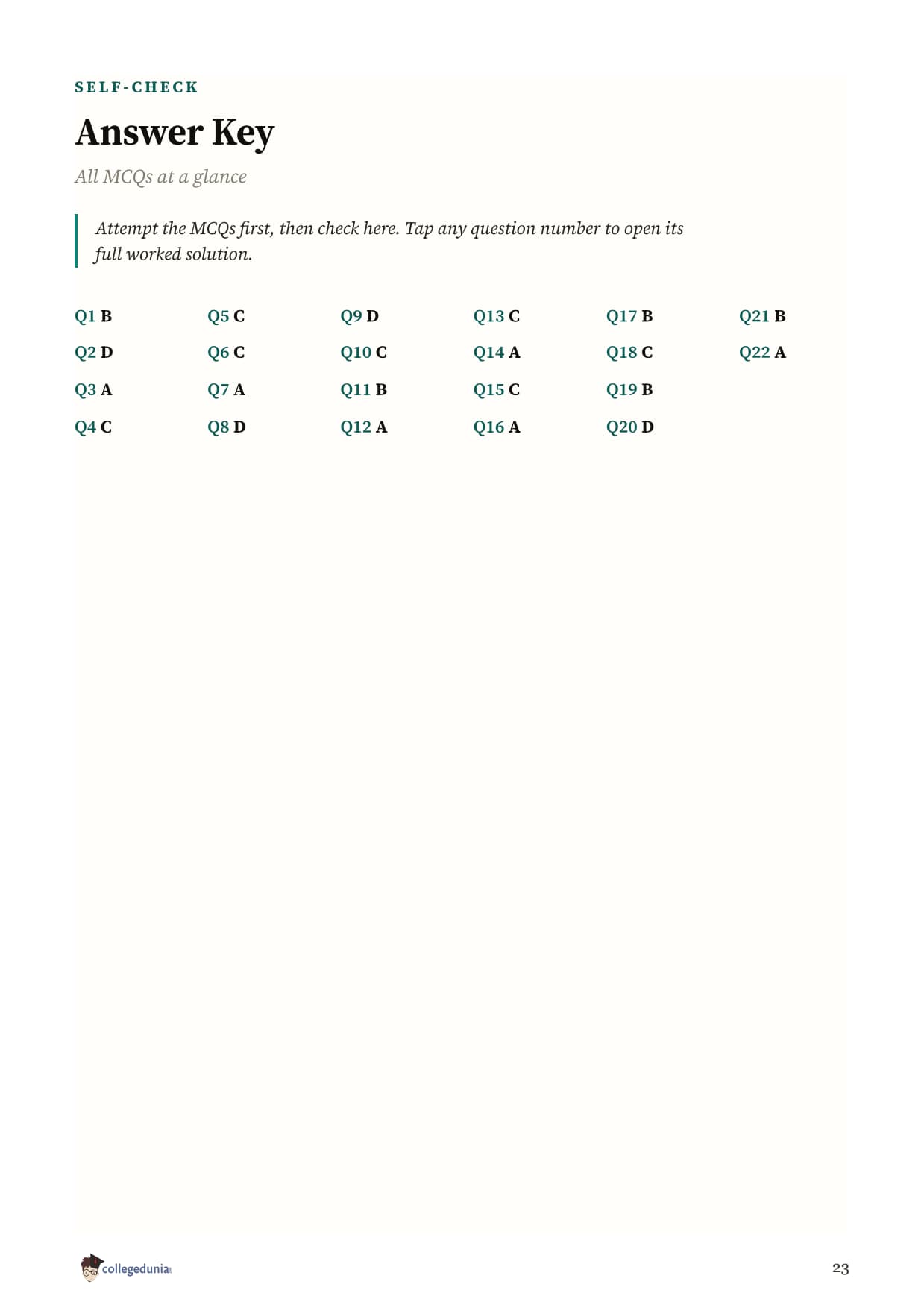
- Section A now carries a fixed block of 1-mark MCQ and assertion-reason questions on contraceptives and ART. The compilation includes 24 such questions, most from 2023 onwards.
- Diagram-based questions are rising, for example the 2026 question that showed a contraceptive procedure and asked for one advantage and one disadvantage.
- Value-based and applied questions on infertility, MTP and 'Saheli' appear often, so the PDF keeps these context-rich items for practice.
Sample Previous Year Questions from Reproductive Health
Here are a few real previous year questions from the Reproductive Health board papers, taken straight from the compilation. The full set is in the downloadable PDF.
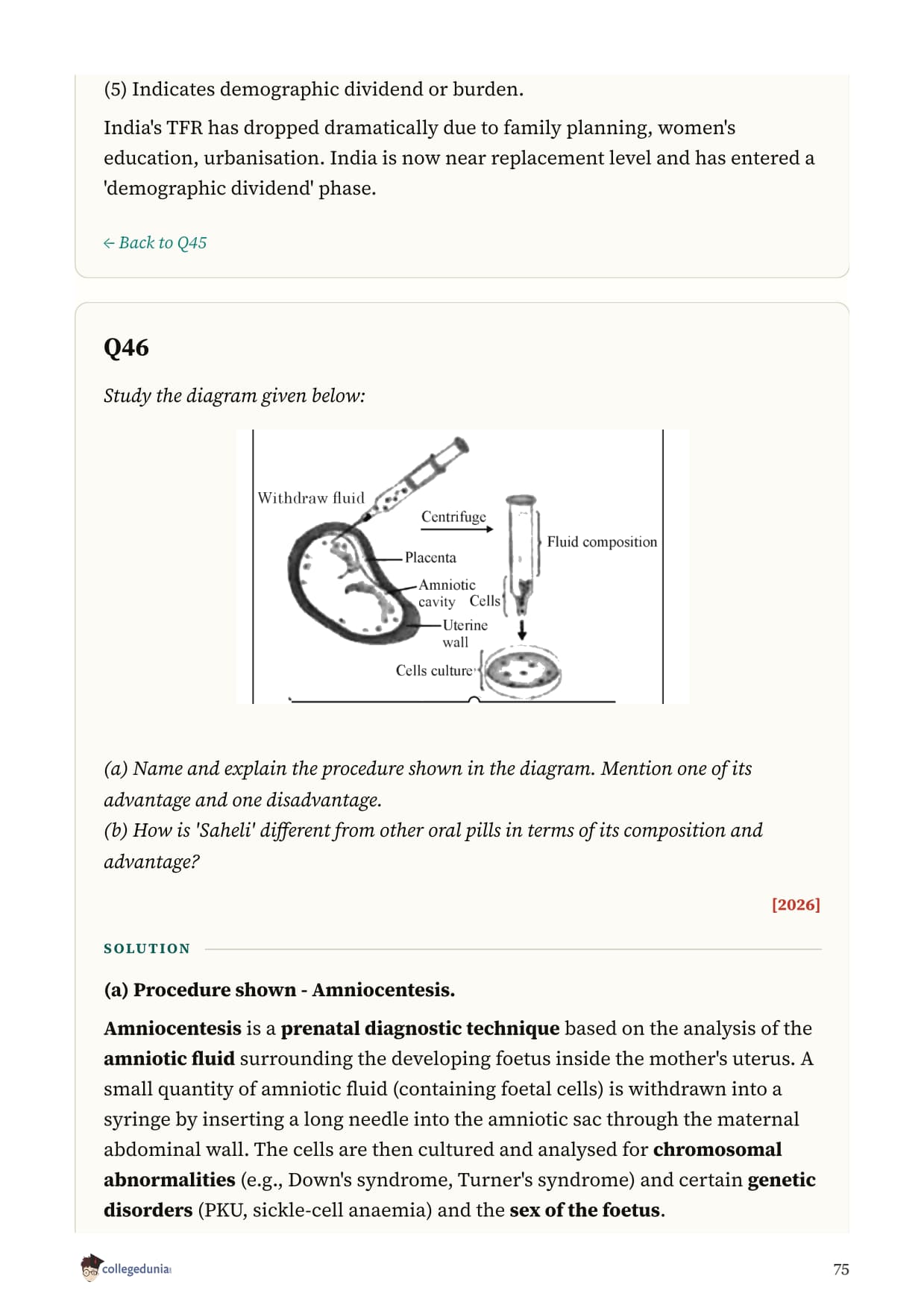
Study the diagram given below: (a) Name and explain the procedure shown in the diagram. Mention one of its advantage and one disadvantage. (b) How is 'Saheli' different from other oral pills in terms of its composition and advantage?
[2026 • 3 mark]
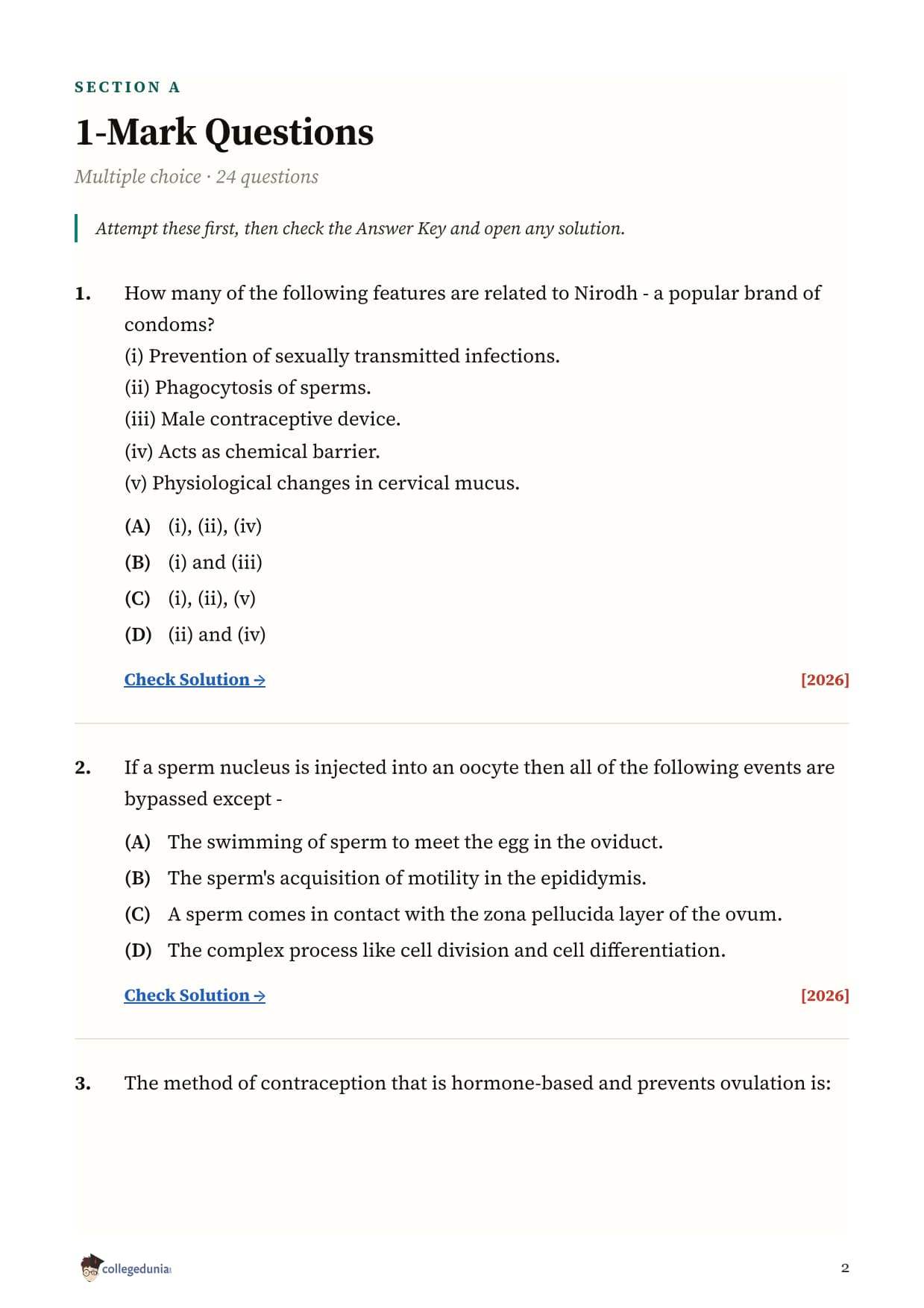
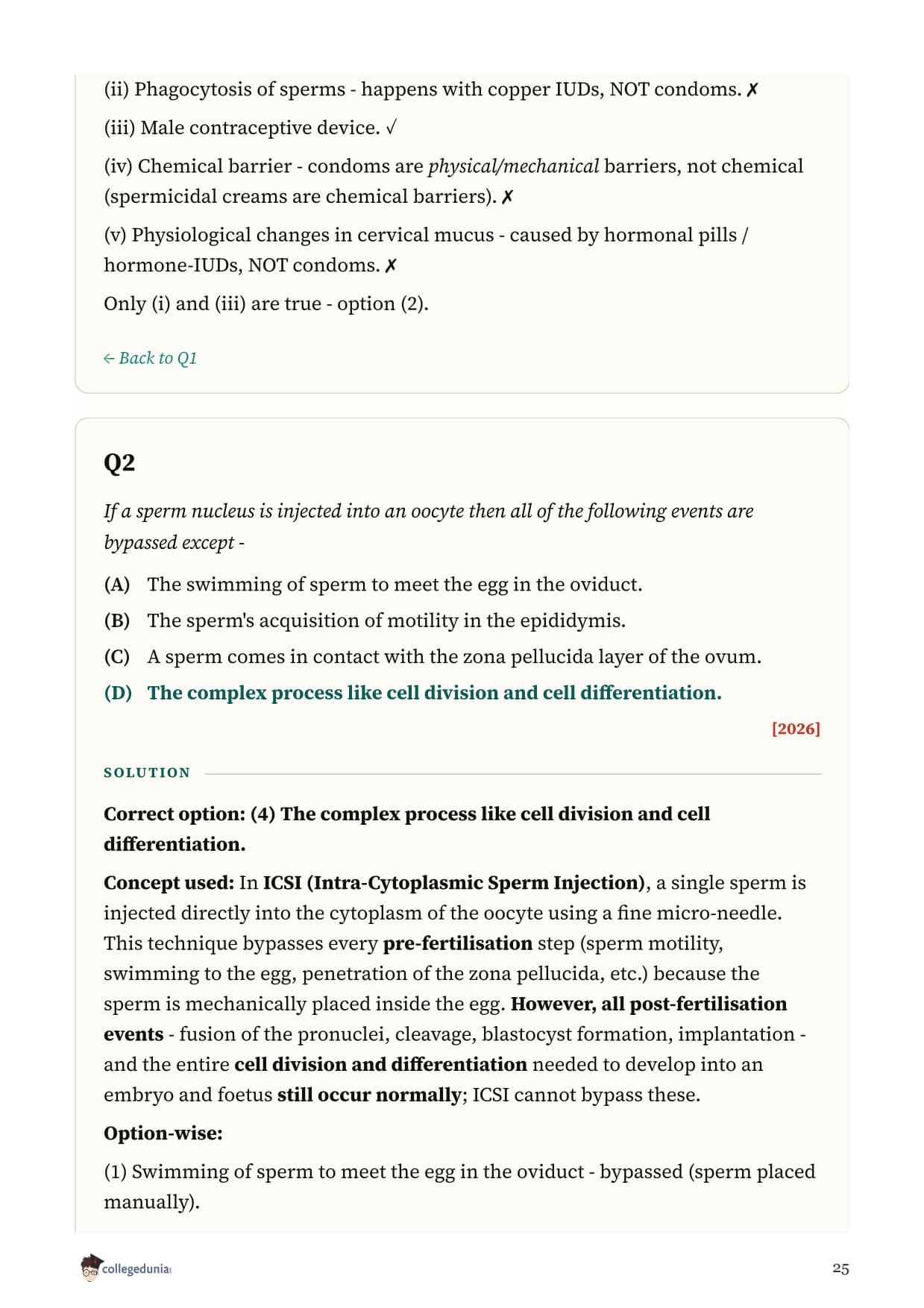
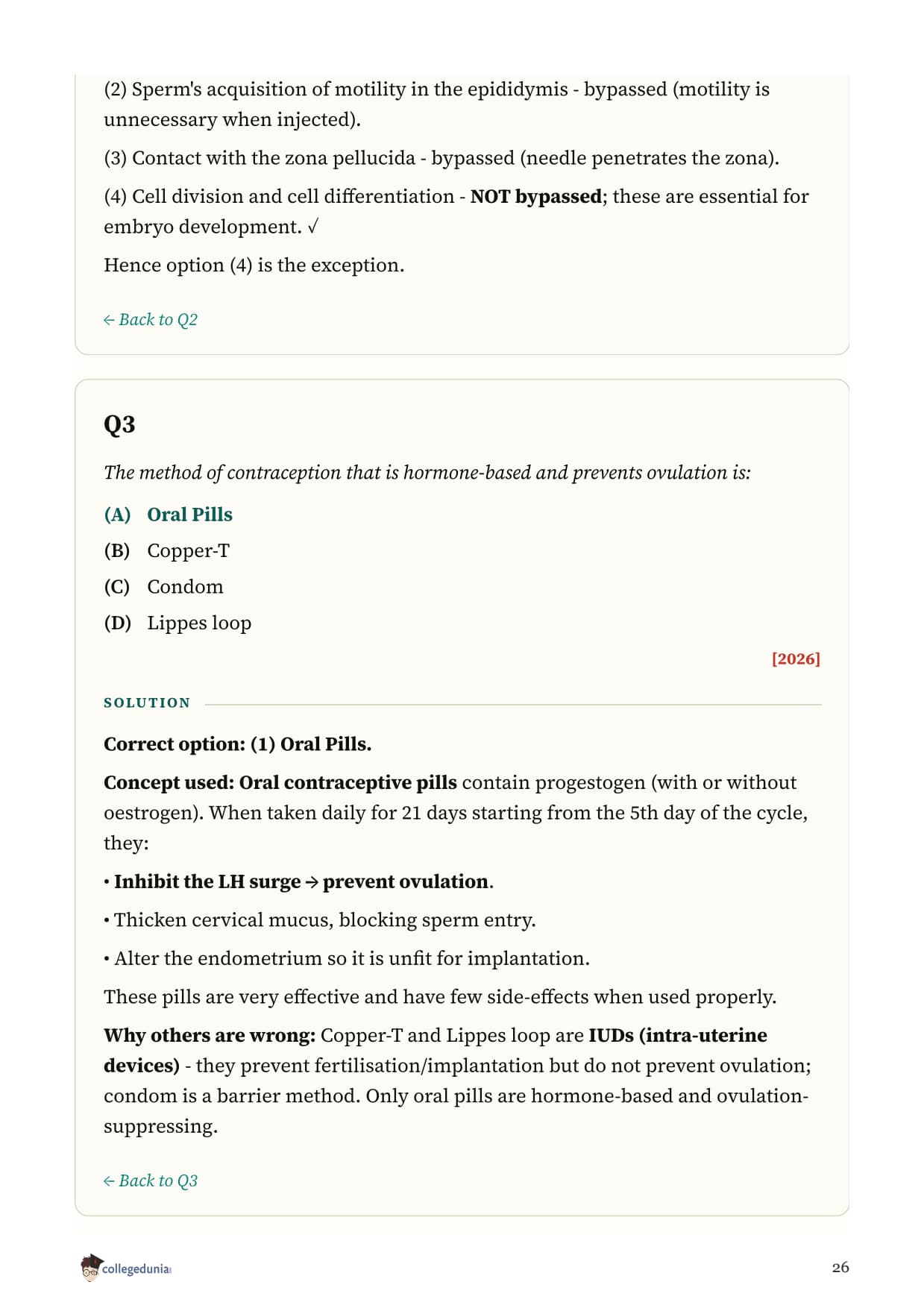
If a sperm nucleus is injected into an oocyte then all of the following events are bypassed except -
- The swimming of sperm to meet the egg in the oviduct.
- The sperm's acquisition of motility in the epididymis.
- A sperm comes in contact with the zona pellucida layer of the ovum.
- The complex process like cell division and cell differentiation.
[2026 • 1 mark]
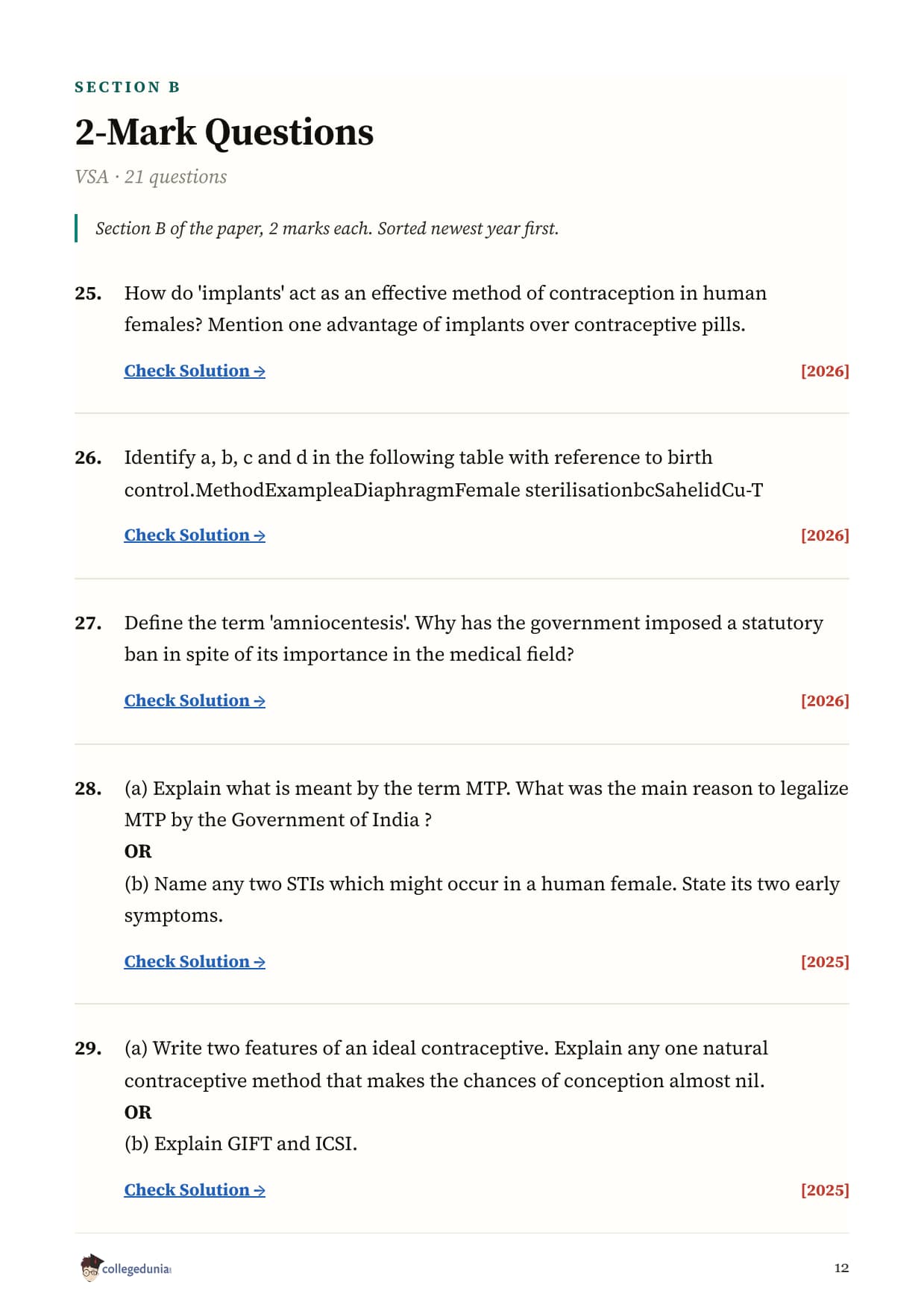
How do 'implants' act as an effective method of contraception in human females? Mention one advantage of implants over contraceptive pills.
[2026 • 2 mark]
Common Mistakes in the Reproductive Health Board Questions
- Mixing up the ART abbreviations, for example writing ZIFT when the answer is GIFT, or confusing IVF with ICSI.
- Calling all IUDs the same, when copper-releasing and hormone-releasing IUDs work by different mechanisms.
- Confusing total fertility rate with replacement level fertility in population questions.
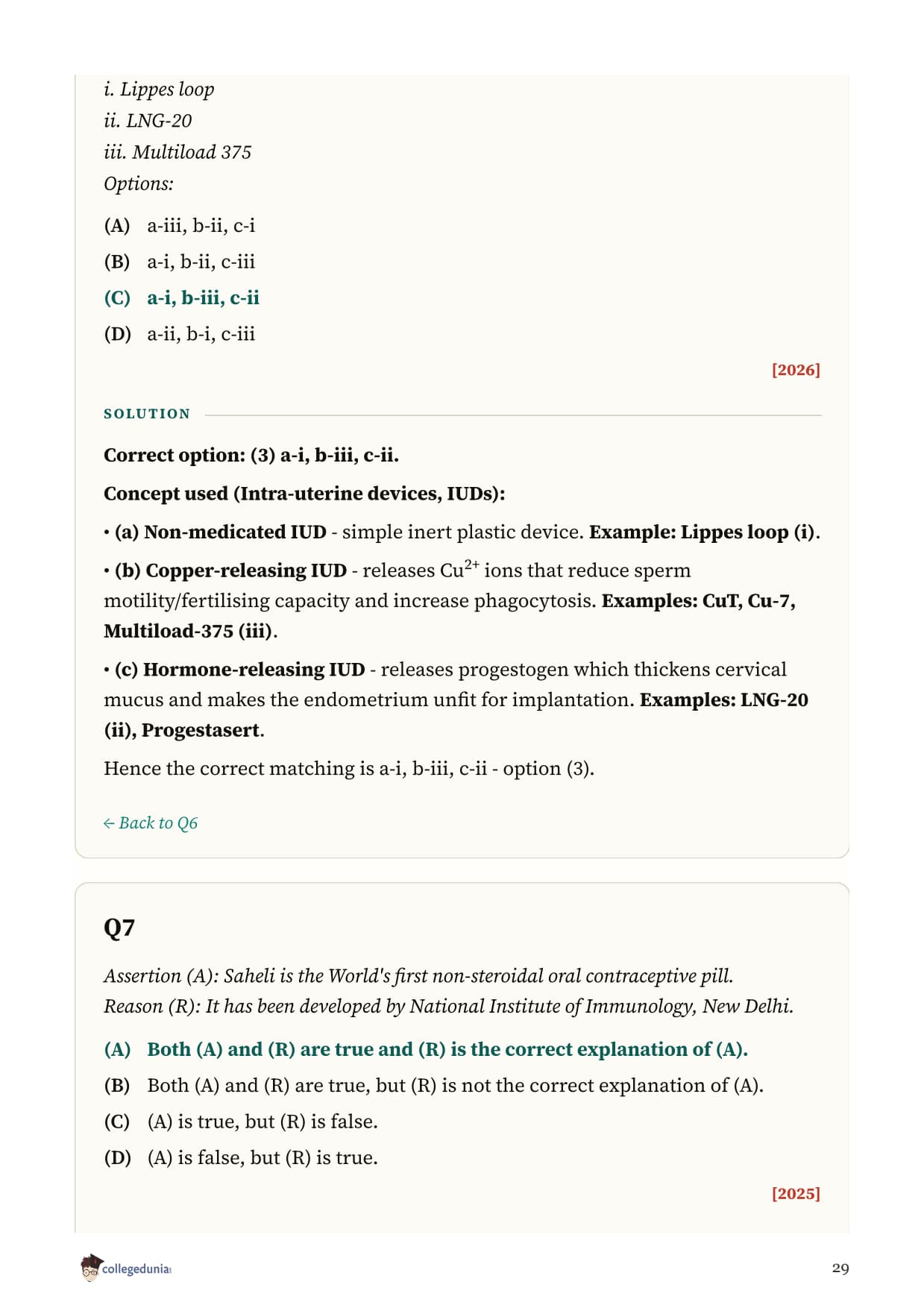
- Forgetting that 'Saheli' is a non-steroidal oral pill taken once a week, not a daily steroidal pill.
- Listing only the merit of a method when the question asks for both an advantage and a disadvantage.
Student Feedback on Reproductive Health PYQ Practice
- 64 per cent said keeping the ART abbreviations and IUD types apart was the hardest part of this chapter.
- 59 per cent reported gaining 3 to 5 marks after solving all the 2 and 3-mark PYQs from this PDF before the boards.
- 43 per cent said a contraceptive method or ART question appeared in their actual 2026 paper.
- Average time to finish all 70 PYQs: about 6 hours across 4 study sessions.
How These PYQs Pair with the Other Reproductive Health Resources
Solving previous year questions alone gives you only half the prep. Pair the PYQ PDF with the matching concept, formula and solution resources for Reproductive Health.
| Resource | What It Gives You | Open |
|---|---|---|
| NCERT Solutions | Step-by-step worked answers to every NCERT back-exercise question of Reproductive Health | NCERT Solutions for Reproductive Health |
| Notes | Concept revision notes covering every topic in the Reproductive Health chapter | Reproductive Health Class 12 Notes |
| Formula Sheet | All key formulas and results of Reproductive Health on one page for last-day revision | Reproductive Health Formula Sheet |
| Handwritten Notes | Scanned handwritten notes of Reproductive Health for quick one-shot revision | Reproductive Health Handwritten Notes |
| Exemplar Solutions | NCERT Exemplar problems of Reproductive Health solved in full for extra practice | NCERT Exemplar Solutions for Reproductive Health |
| NCERT Book | Official NCERT Reproductive Health chapter PDF for free download | Reproductive Health NCERT Book PDF |
| Exemplar Book | NCERT Exemplar Reproductive Health problem book PDF for free download | Reproductive Health Exemplar Book PDF |
How to Use the Reproductive Health PYQ PDF Most Effectively
The 70 questions are sequenced for a three-pass revision plan:
- Pass 1 (Day 1): Attempt all 24 one-mark questions. Mark every wrong answer and re-read the relevant NCERT paragraph on contraceptives and ART.
- Pass 2 (Day 2 to 3): Solve the 21 two-mark and 20 three-mark questions, the heart of this chapter. Note one merit and one demerit per method.
- Pass 3 (Day 4 to 5): Work through the 3 five-mark long answers and the value-based items, writing the full ART list and population-control measures.
All Class 12 Biology Chapter PYQ PDFs
Every Class 12 Biology chapter has its own PYQ compilation built the same way, sorted by marks and tagged by year.
| Chapter | Topic | Previous Year Questions |
|---|---|---|
| Chapter 1 | Sexual Reproduction in Flowering Plants | PYQ PDF |
| Chapter 2 | Human Reproduction | PYQ PDF |
| Chapter 3 | Reproductive Health | PYQ PDF |
| Chapter 4 | Principles of Inheritance and Variation | PYQ PDF |
| Chapter 5 | Molecular Basis of Inheritance | PYQ PDF |
| Chapter 6 | Evolution | PYQ PDF |
| Chapter 7 | Human Health and Disease | PYQ PDF |
| Chapter 8 | Microbes in Human Welfare | PYQ PDF |
| Chapter 9 | Biotechnology: Principles and Processes | PYQ PDF |
| Chapter 10 | Biotechnology and its Applications | PYQ PDF |
| Chapter 11 | Organisms and Populations | PYQ PDF |
| Chapter 12 | Ecosystem | PYQ PDF |
| Chapter 13 | Biodiversity and Conservation | PYQ PDF |
Also Check: NCERT Solutions for Class 12 Biology
Class 12 Biology Reproductive Health PYQ FAQs
Ques. How many previous year questions are in the Class 12 Biology Reproductive Health PYQ PDF?
Ans. The PDF has 70 previous year questions from CBSE board papers between 2005 and 2026, sorted by marks (1 to 5) and then by year, latest first. Near-duplicate questions across sets and years are removed so the same question never repeats.
Ques. Are the Reproductive Health PYQs based on the 2026-27 CBSE syllabus?
Ans. Yes. Every question follows the 2026-27 CBSE Class 12 Biology syllabus. Older value-based questions are kept because the core ideas, like contraceptive methods, ART and population control, are unchanged in the current syllabus.
Ques. Which topics of Reproductive Health appear most often in CBSE board papers?
Ans. From the 70-question set: contraceptive methods (about 27 per cent), assisted reproductive technologies (about 23 per cent), infertility and value-based ART (about 16 per cent), total fertility rate and population control (about 14 per cent), and short reasoning on MTP and amniocentesis.
Ques. How is this PYQ PDF different from a CBSE sample paper?
Ans. A sample paper gives you one paper. This PDF stitches together 14 years of questions across every set and region (Delhi, Outside Delhi, Foreign and Compartment) for Reproductive Health alone, so you can see which methods and ART terms CBSE repeats and how each is usually phrased.
Ques. Does the Reproductive Health PYQ PDF include MCQs?
Ans. Yes. 24 of the 70 questions are 1-mark questions, mostly MCQ and assertion-reason on contraceptives and ART from 2023 onwards, when CBSE introduced the Section A objective block.
Ques. Where can I download the Reproductive Health Class 12 PYQ PDF for free?
Ans. The full Reproductive Health PYQ PDF is free to download from the PDF button at the top of this page. No sign-up is needed.
Ques. How should I use these PYQs to revise Reproductive Health in the last 10 days?
Ans. Use the three-pass plan: Day 1 attempt all 24 one-mark questions, Day 2 to 3 solve the 2 and 3-mark questions (the bulk of this chapter), Day 4 to 5 attempt the value-based and 5-mark items. Keep a one-merit, one-demerit note for each contraceptive.
Ques. Does the PDF give answers or only the questions?
Ans. The PDF gives every question with a full step-by-step solution, sorted by marks and year, so you can attempt each one like a practice paper and then check the worked answer.
Ques. Are contraceptive methods the most important part of the CBSE Reproductive Health questions?
Ans. Yes. Contraceptive methods account for over a quarter of all the questions in this PDF, mostly in the 2 and 3-mark bands. Knowing one advantage and one disadvantage for each method is the single best use of your time for this chapter.
Ques. What are assisted reproductive technologies?
Ans. Assisted reproductive technologies (ART) are special methods that help infertile couples have a child. They include IVF (test-tube baby), ZIFT, GIFT, ICSI and artificial insemination. In IVF, fertilisation happens outside the body and the early embryo is then transferred to the uterus.
Ques. How is total fertility rate defined?
Ans. Total fertility rate is the average number of children a woman would have over her lifetime. Replacement level fertility is the rate at which a population exactly replaces itself, about 2.1 children per woman. A total fertility rate above this means the population is growing.
Ques. What is medical termination of pregnancy?
Ans. Medical termination of pregnancy (MTP) is the deliberate ending of a pregnancy before the foetus can survive on its own. It is legal in India under defined conditions and is generally safe in the first trimester. It is also used to control population and to end unwanted or risky pregnancies.



Comments