



Study Abroad Content Specialist
Choosing the right university is a crucial decision for Indian students going to study in USA. If chosen right, it can help you to fulfill your ‘American Dream’. The universities in USA can be broadly divided into two categories:
- The Public Universities
- The Private Universities
These two types of institutions differ in funding, tuition fees, admission requirements, academic focus, and more. The main difference lies in funding; public or state universities are funded by the public through the state's government and private universities are funded by the students (in the form of tuition fees), ventures from donors (endowments), and private donations.
Oftentimes, students move by the reputation and ranking of a university, ignoring the post-study scope and opportunities of their intended major/ program. On the other side of the coin, there are students who analyze all the possible aspects before choosing a university. Hence, there is no definite answer for: private university vs public university, which is better? It depends on the students’ needs.
This guide provides a comprehensive overview to help students make an informed choice for their US study experience.
What is a Private University
The private universities are funded by endowments, donations from private individuals or organizations and tuition fees paid by the students. The world-famous Ivy League Universities are listed under the private universities.
Here, we have added a list of top 10 private universities in USA as per the US News and World Report 2025 ranking.
| US News and World Report ranking, 2025 | University | Location |
|---|---|---|
| #1 | Princeton University | Princeton, NJ |
| #2 | Massachusetts Institute of Technology | Cambridge, MA |
| #3 | Harvard University | Cambridge, MA |
| #4 | Stanford University | Stanford, CA |
| #5 | Yale University | New Haven, CT |
| #6 | California Institute of Technology | Pasadena, CA |
| #7 | Duke University | Durham, NC |
| #8 | Johns Hopkins University | Baltimore, MD |
| #9 | Northwestern University | Evanston, IL |
| #10 | University of Pennsylvania | Philadelphia, PA |
What is a Public University
Funded largely by state governments, the public universities in USA receive substantial financial support from taxpayers. As a result, they offer lower tuition rates for in-state students, with out-of-state and international students paying higher fees.
Check out the top 10 public universities in USA as per the US News and World Report’s public school ranking 2025.
| US News and World Report ranking, 2025 | University | Location |
|---|---|---|
| #1 | University of California, Los Angeles | Los Angeles, CA |
| #2 | University of California, Berkeley | Berkeley, CA |
| #3 | University of Michigan, Ann Arbor | Ann Arbor, MI |
| #4 | University of Virginia | Charlottesville, VA |
| #5 | University of North Carolina at Chapel Hill | Chapel Hill, NC |
| #6 | University of California, San Diego | La Jolla, CA |
| #7 | University of Florida | Gainesville, FL |
| #8 | The University of Texas at Austin | Austin, TX |
| #9 | Georgia Institute of Technology | Atlanta, GA |
| #10 | University of California, Davis | Davis, CA |
Difference Between Private and Public University in USA
Public or private university, which is better for international students? It is a dependable variable on student specific needs. Before choosing a university, consider the following.
Tuition Fees
- At Public Universities, the Out-of-state and international students face higher tuition fees, but these are often still less than those at private universities. For example, the average annual tuition at public universities for international students is approximately 25,000–40,000 USD, although this varies by institution.
- Private Universities are more expensive, with average annual tuition ranging from 35,000 to 55,000 USD. However, private institutions often have more endowments and may provide extensive financial aid packages, including scholarships for international students, which can help offset costs.
Also read: Cost of Studying in USA
Admission Requirements
- Public universities: Some public universities like University of California, Berkeley, University of Michigan have easy achievable admission requirements for international students. Additionally, they often have rolling admissions to ease the admission process.
- Private universities: Given their reputation, academic excellence, and the limited number of available spots, they only accept a small percentage of students and are overall the most competitive ones. Like, getting an admission to an Ivy League school is highly competitive.
Note: Competitiveness of a university is determined by students’ academic and personal profile. Even meeting the requirements, students fail to get admission to a public university, but get admission to a private university.
Also read: US Universities with High Acceptance Rate
Class Size, Campus Size and Diversity
- Public universities are often bigger and have multiple campuses across the nation. As these are ‘public’, these are open to a larger number of students. Public universities have a larger student population, student-to-teacher ratio, campus size, class sizes.
- On the other hand, private universities have a more diverse demographic than public universities. This is because private universities attract more residents from the state and emphasize on creating a diverse student population.
Also read: Why Study in USA
Academic Programs and Research Opportunities
- Public universities offer a broad range of programs across diverse fields to meet the needs of a large student population. Due to their extensive financial support from the government, many public universities are classified as research institutions.
- Many private universities are known for their specialized programs or focus on liberal arts education. While smaller private universities may not have as extensive research facilities, well-endowed private research universities (e.g., Harvard, MIT) are highly competitive and offer excellent research opportunities.
Also read: Top Programs and Universities in USA
Private vs Public University Pros and Cons
There is no single answer to which type of university offers a "better" education. Here's a breakdown to help you decide:
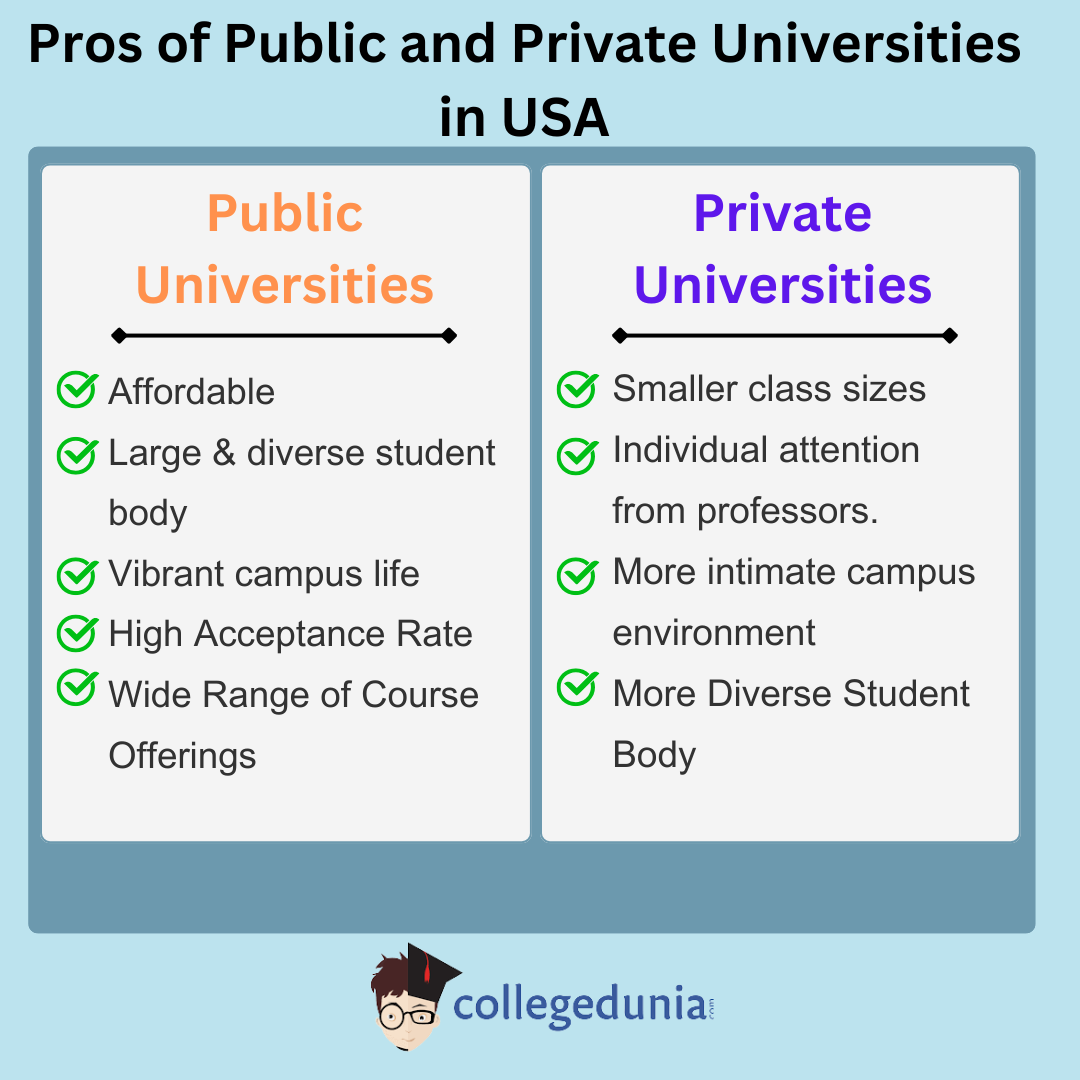
Public universities are generally more affordable, offer broad programs, and provide a dynamic campus life with research opportunities, especially in STEM fields. Private universities, on the other hand, are known for smaller class sizes, personalized attention, and prestigious reputations that can open doors to competitive, global opportunities.
FAQs
Ques: Which is better, private or public university in the USA?
Ans: The choice between private and public universities depends on factors like budget, desired class size, academic goals, and career aspirations. Public universities are often more affordable, larger, and offer diverse programs, while private universities typically offer smaller classes, personalized attention, and robust financial aid options.
Ques: What is the difference between private and public school USA?
Ans: Public schools in the USA are government-funded and typically have lower tuition fees, especially for in-state students. Private schools rely on tuition fees, donations, and endowments, usually making them more expensive but also known for smaller class sizes and potentially more selective admissions.
Ques: Which is better, public college or private university?
Ans: Public colleges are generally more accessible and affordable, especially for local students, while private universities may provide a more tailored, intimate academic environment. Private institutions often have higher tuition but may offer significant financial aid, and many top-ranked schools in the U.S. are private.
Ques: What are public and private universities in the USA?
Ans: Public universities in the U.S. are funded by state governments and generally have lower in-state tuition. Private universities do not receive state funding and rely on tuition, donations, and endowments, often leading to higher tuition fees but with potential financial aid and scholarships.



Comments