


Education Journalist | Study Abroad Strategy Lead
What's New?
- Application Window: 6 months before the course start
- Processing Time: Avg. 3 weeks (standard), 1–5 days (priority)
- Base Visa Fee: £524
- IHS (per year): £776
- Stay Duration:
- Up to 5 years (Degree level or above)
- Up to 2 years (Below degree level)
A UK Student Visa is the essential gateway for Indian students aspiring to pursue higher education in the United Kingdom. The country is globally renowned for its high-quality education system and top-ranked UK universities. The UK remains a top study destination for Indian students. Recent statistics show nearly 98,000 Indian students were granted UK study visas in a year, making them one of the largest international groups on UK campuses.
To successfully secure a student visa via the Student Route, applicants must meet specific requirements, including proof of sufficient funds, English language ability, and an offer (CAS) from a licensed institution. UK student visa applications can be made up to 6 months before the course start date, with most decisions given in about 3 weeks if applied from India.
This visa permits students to reside and study in the UK for the duration of their course. The entire visa process has become fully digital with the introduction of the UKVI eVisa system. Alongside this, authorities have also tightened financial requirements and introduced more rigorous genuineness checks – including additional checks for many applicants.
The current cost of applying for a UK Student Visa is £524, which is the base fee. This does not include the mandatory Immigration Health Surcharge (IHS), which is currently £776 per year and is also required as part of the application process.
Check Out:
Table of Content
- UK Student Visa Types
- Latest Rules & Updates
- UK Student Visa Requirements
- Student Visa UK Application Process
- UK Student Visa Processing Time
- UK Student Visa Validity & Extension
- UK Student Visa Rejection Reasons
- UK Student Visa Cancellation Process
UK Student Visa Types
There are three main visa categories for students coming to the UK in 2026:
| Visa Type | Age | Validity | Who It's For | Visa Application Fee |
|---|---|---|---|---|
| Student Visa (General Student Route) | 16+ | Up to 5 years | Full-time UG/PG students | £524 (approx. ₹56,000) |
| Child Student Visa | 4–17 | Varies | Independent school students | £524 (approx. ₹56,000) |
| Short-term Study Visa | Any | 6-11 months (non-extendable) | English language courses only | £214 (approx. ₹23,000) for courses up to 11 months Applicants for this specific visa type are usually exempt from the IHS. |
Note: All the above visa applications also incur an additional Immigration Health Surcharge (IHS) for access to the UK’s National Health Service. For student visas, the IHS is £776 per year of stay (approximately ₹80,000).
Check: Full List of UK Student Visa Types and Find Out the Right One for Your Course (Updated 2026)
Latest UK Student Visa Rules and Updates 2025-26
Recent years have seen important changes to UK student visa policies. Here are the key updates Indian students should know when planning for 2026 intakes:
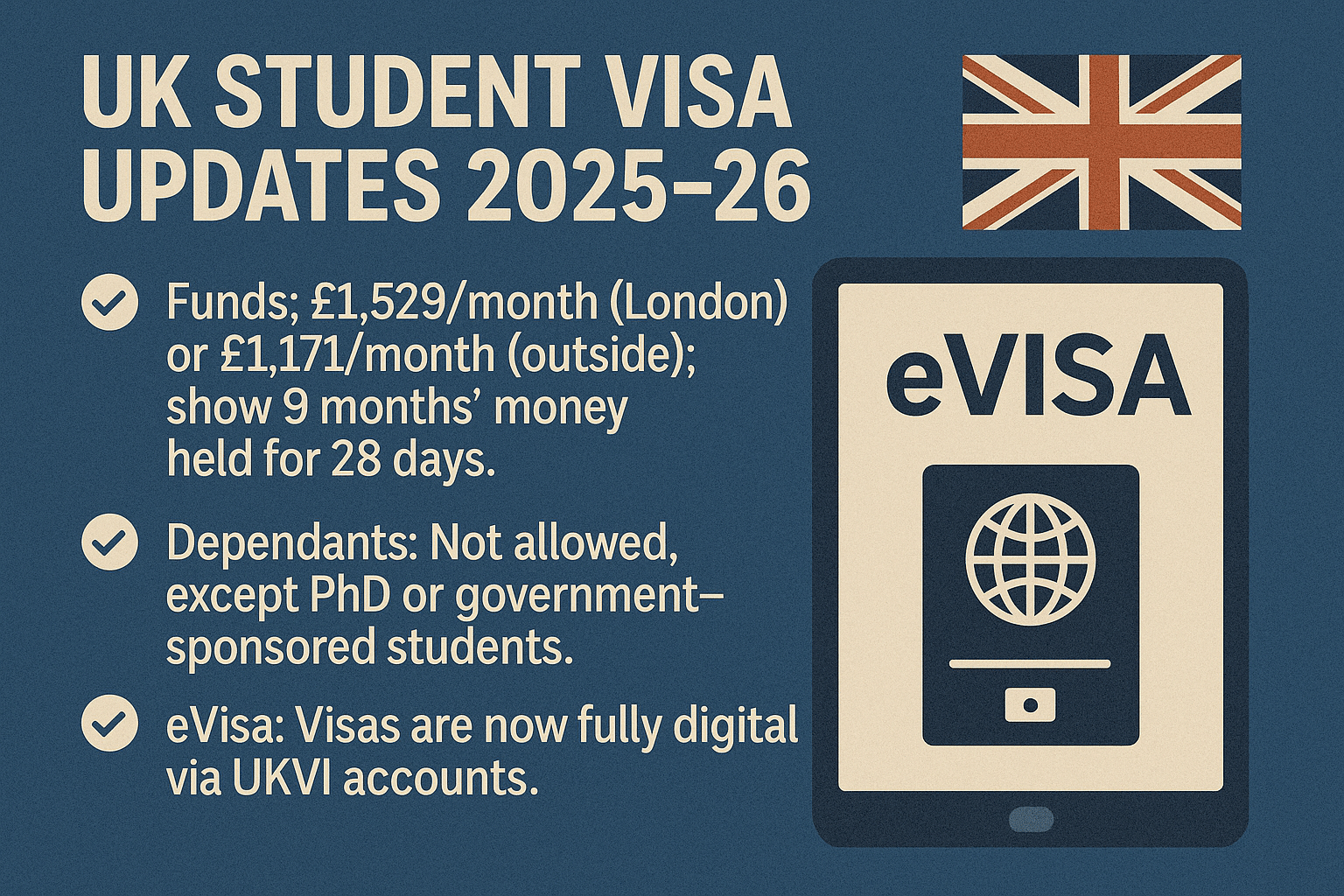
- Higher Financial Requirements:
The UK has raised the required maintenance funds for student visa applicants.- £1,529 per month (INR 1.8 Lakhs) if in London
- £1,171 per month (INR 1.4 Lakhs) if outside London.
You need to demonstrate this for up to 9 months (£13,761 or INR 16.6 Lakhs for London or £10,539 INR 12.7 Lakhs for outside). You must hold the required funds in your account for at least 28 consecutive days before applying.
- Restrictions on Dependants:
Most new international students are no longer allowed to bring family members (spouse/partner or children) as dependents on their student visa. The only exceptions are students enrolled in a PhD or on government-sponsored scholarships.
- Fully Digital Visas (eVisa system):
The UK has transitioned to digital immigration status records. Successful student applicants receive an eVisa linked to their online UKVI account instead of a visa stamp or BRP card.
Read More: New Rules for UK Student Visa
UK Student Visa Eligibility/Requirements
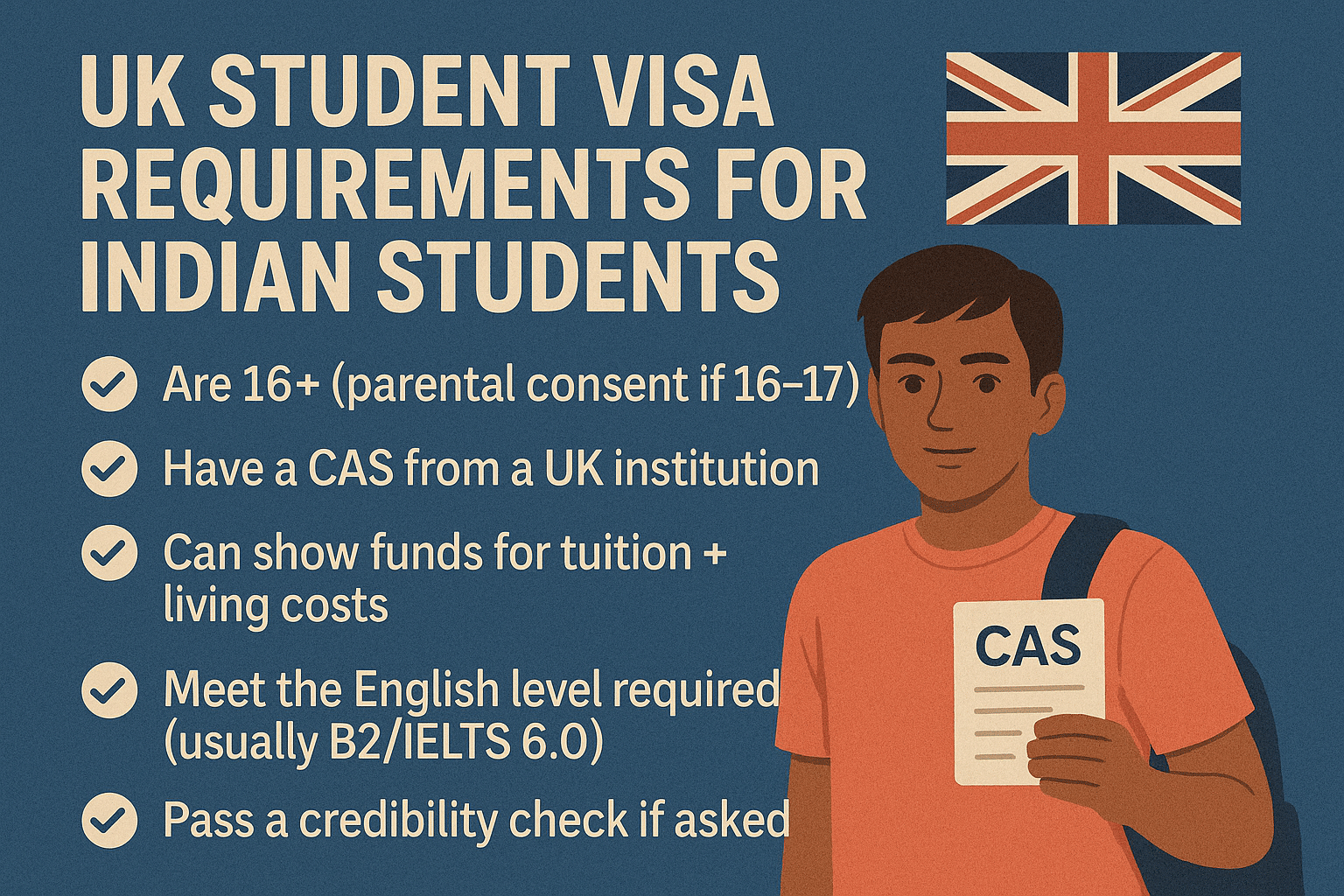
You can apply for a Student visa to study in the UK if you meet all of the following requirements:
- Age: You are 16 or older. (If you are 16 or 17, you’ll need a letter of consent from your parent or guardian to apply.)
- Course Acceptance: Your university or college will issue you a Confirmation of Acceptance for Studies (CAS), a unique reference number and an electronic document confirming your admission.
- Financial Capacity: You have enough money to support yourself and pay your tuition fees for the first year of your course. Acceptable financial evidence includes personal or parents’ bank statements, student loan letters, or official sponsorship letters.
- English Proficiency: You must show English proficiency at the level your course requires.
- Degree-level courses: CEFR B2 (about IELTS 6.0).
- Exemptions: If you already have a degree taught in English, or your university confirms your English level.
- Genuine Intentions: UK Visas and Immigration may require you to attend a brief interview after your application is submitted. In this interview, you’ll be asked about your study plans, course knowledge, funding, and post-study intentions.
Read More: Requirements for study visa in UK
Documents Required for a UK Student Visa
When preparing your student visa application, you should gather the following supporting documents:
- Passport: Must be valid for the full duration of your course.
- CAS: Your university’s Confirmation of Acceptance for Studies (electronic reference number).
- Proof of Funds: Recent bank statements, a bank letter, or an official loan/scholarship letter.
- If using a parent’s account, include your birth certificate and a signed letter from your parent confirming you can use their funds.
- Photo: A digital photo (uploaded online or taken during biometrics).
- TB Test Certificate: Get tested at a UKVI-approved clinic and upload the TB clearance certificate.
- ATAS Certificate: Required for certain postgraduate courses in sensitive science/engineering/technology fields. Your university will tell you if your programme needs ATAS (common for research Master’s and PhDs). You must obtain it before your visa application.
- Academic Documents: Most degree-level applicants at recognised universities don’t need to upload certificates (the CAS confirms this). If your CAS or the form asks for prior qualifications, be prepared to submit degree certificates, transcripts, or mark sheets used in your offer.
- English Test Result: If your CAS states you meet the English requirement, you usually don’t need to upload IELTS/TOEFL. If the document checklist asks for it, include your test report.
- Consent Letters (Under 18): Applicants under 18 must provide a parental consent letter plus a document (e.g., birth certificate) showing the parent(s)/guardian.
- CAS Statement (Optional): The CAS email/letter from your university is not required for upload but is helpful when completing the application form.
Always review the document checklist generated by the online visa application form at the end. Different applicants might have slightly different requirements. If any document is not in English, you must provide an official translation that includes the translator’s name, signature, date, and confirmation that it’s an accurate translation. This is crucial – improperly translated documents are a common pitfall for visa refusals.
Check out all the UK student visa documents
UK Student Visa Cost for Indian Students
| Fee Type | Amount (GBP) | Notes |
|---|---|---|
| Base Student Visa Fee | £524 (₹56,000) | Mandatory for all applicants |
| Immigration Health Surcharge | ~£776/year (₹80,000) | Mandatory if course is longer than 6 months |
| Priority Services | £500–£1,000 (₹60,496 to 1,20,000) | Optional, faster processing |
Student Visa UK Application Process
Applying for a UK Student Visa from India is a multi-step process. It’s best to start early – you can apply up to 6 months before your course begins.
- Apply to a UK University and Secure an Offer: Apply to universities, meet any conditions (grades, IELTS, etc.), and receive an unconditional offer.
- Receive and Check Your CAS: Get your CAS and confirm that all details (passport number, course info, fees) are correct. You’ll need the CAS number for your application.
- Complete the Online Visa Application Form: Create an account, fill in personal details, travel history, CAS information, and financial evidence. Upload your documents, pay the £524 visa fee, and book your VFS appointment (unless using the ID Check app).
- Pay the Immigration Health Surcharge (IHS): The system calculates the fee (£776 per year) based on your course length. Payment is mandatory and linked automatically to your application.
- Prove Your English Proficiency (if required): If your CAS confirms the university assessed your English, select that option. Otherwise, provide SELT details (e.g., IELTS UKVI). Follow your CAS instructions carefully.
- Submit the Application and Biometrics: After uploading documents, submit your application.
- ID Check app: Verify identity on your phone—no visa centre visit.
- Otherwise: Attend your VFS appointment for fingerprints and a photo. Bring your passport and appointment confirmation. VFS centres are official partners of UK Visas & Immigration
After biometrics, UKVI processes your case—now you wait. Important: Don’t travel or change your passport until a decision is issued. You’ll receive an email decision, and your visa will appear as an eVisa in your UKVI account. If you receive a refusal or a request for more information, contact your university’s international office promptly.
Read More: UK Student Visa TimelineCheck Out:
| Study in UK Guide | ||
|---|---|---|
| IELTS Score for UK | Intakes in UK | Part Time Jobs in UK |
| UK Work Visa | SOP for UK | LOR for UK |
UK Student Visa Processing Time
The standard processing time for Student visa applications is fairly quick, but it can vary seasonally. According to UKVI:
- Normal processing: About 3 weeks (15 working days) for decisions on student visas applied from outside the UK. If you need a faster decision, the UK offers paid priority services.
- Priority Service: Get a decision in 5 working days. This costs around £500 extra (approximately ₹52,000) on top of your regular fees.
- Super Priority Service: Get a decision by the next working day (24 hours). This costs about £1,000 extra (approximately ₹1.05 lakh).
In practice, many Indian students see decisions in 2–3 weeks, but during the peak period (July–August, before the Autumn intake), it can take the full 3 weeks or sometimes longer.
These faster services only speed up the decision by UKVI; you still need to attend biometrics, and then the countdown starts. Keep in mind that visa processing only begins after you’ve given biometrics (or verified identity via app). If you submit your online form, but the earliest biometrics slot is 2 weeks later, those 2 weeks don’t count as processing time. So, try to schedule your appointment as soon as possible.
DO NOT make non-refundable travel arrangements (flights, etc.) before getting your visa. If your application is delayed or refused, you would incur losses. Additionally, if a visa is refused, the application fee is generally not refunded – only the IHS is refunded automatically. If you are in a hurry and can afford it, the priority services are very helpful.
Standard student visa = ~3 weeks. Priority = 5 days. Super priority = 24 hours. After you get the decision email and your eVisa, you’re set to fly to the UK!
Read More: Processing of UK Student Visa
How Long Can You Stay in the UK on a Student Visa?
The validity of a UK Student visa depends on the length and level of your course. The rules are:
- Degree level (age 18+): Granted for your full course plus extra time (usually 2–4 months), capped at 5 years.
Examples:
– 3-year bachelor’s: ~3 years + 4 months
– 1-year master’s: ~1 year + 2–4 months
– 4-year integrated master’s: fits within the 5-year cap - Below degree level: Stay for your course length, up to 2 years.
- Child Student visa (age 16–17): Up to 3 years + ~4 months. Younger students can stay longer (up to 6 years for under-16s).
- PhD students: Count as degree level, so fall under the 5-year student visa limit, with extensions possible. After completing a PhD, the Graduate visa lasts 3 years.
UKVI adds a “wrap-up” period to your visa: typically 4 months for courses ≥12 months, 2 months for 6–12 months, and about 7 days for courses under 6 months.
Extending Your Student Visa
You can extend your Student visa from inside the UK if you still meet the rules. Common reasons: starting a new course, progressing to a higher degree, or needing more time for research/resits. Key requirements:
- Apply before your current visa expires and while you’re still in the UK.
- Your new course must start within 28 days of your current visa expiry.
- You need a new CAS and must show required funds (unless exempt after 12+ months in the UK).
- Your new course should usually show academic progression (normally a higher level).
- If you change course or university, you must apply for a new visa.
Process:
- Apply online from inside the UK.
- Pay £524 plus the IHS for the extra visa period.
- Standard processing: ~8 weeks; priority (5 days): ~£500 extra.
- Do not leave the UK while the application is pending.
- If you applied on time, you can stay legally while waiting for a decision.
Costs:
- £524 application fee
- IHS £470–£776 per year
- No separate biometric fee for most in-UK applicants (biometrics can often be reused).
Read More: UK visa sponsorship requirements
Graduate Route – Student Visa
One of the biggest pros of studying in the UK is the opportunity to stay and work after graduation under the Graduate Visa, also known as the Post-Study Work (PSW) visa.
- The Graduate visa allows eligible students to remain in the UK after completing a degree to work or job-hunt, without requiring a work sponsor.
- To qualify, you must be in the UK with a valid Student visa and have completed your course as per your CAS.
- You do not need a job offer to apply for the Graduate visa. It effectively gives you time to find work. During the Graduate visa, you can work in almost any job (no cap on hours), be self-employed, or even start a business. The only work not allowed is as a professional sportsperson or coach.
Note: The Graduate Route cannot be extended (and is non-renewable). It’s a one-time post-study period. By the end of it, you should switch to a different visa (e.g., Skilled Worker if you get a qualifying job, or a spouse visa, etc.) or you must leave the UK.
**The government has announced plans to reduce the standard duration of the Graduate Route (PSW) from 2 years to 18 months for Bachelor's and Master's graduates from January 2027.
Check Out:
UK Student Visa Rejection Reasons
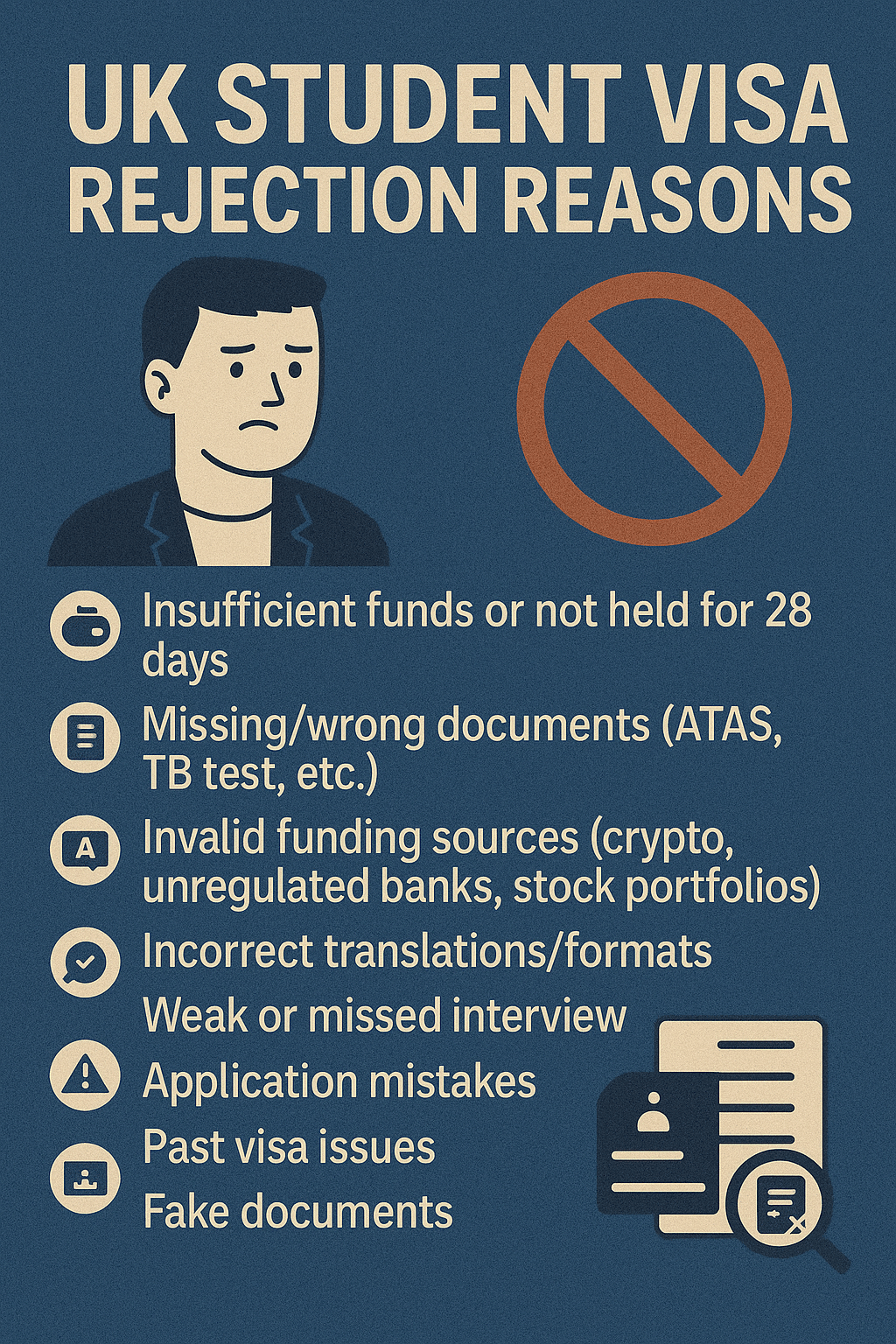
A UK student visa is not typically “hard” to get if you meet the requirements, but applications can be rejected for mistakes or shortcomings such as:
- Insufficient Financial Evidence: The #1 most common reason for UK student visa refusals. Errors include showing less than the required amount, not keeping funds for 28 days, using statements older than 31 days, or missing parental consent/birth certificate when using a parent’s account.
- Missing or Incorrect Documents: All documents specified in the guidance must be provided in the required format. Forgetting items like ATAS (if required), TB test results, or other mandatory documents leads to refusal. Always follow the checklist.
- Unacceptable Financial Sources: UKVI won’t accept crypto, non-regulated institutions, stock portfolios, or incomplete loan letters. Use valid bank accounts or approved educational loans.
- Document Format and Translation Issues: Any non-English document needs a certified translation with the translator’s name, signature, date, and contact details.
- Additional checks (“genuine student” test) Failure: Missing the interview or giving weak, unclear answers about your course, funding, or intentions can result in refusal.
- Errors on the Application Form: Incorrect details (e.g., passport info, answers about family) can lead to rejection. Review your form carefully.
- Previous Visa or Immigration Issues: Previous refusals or overstays increase scrutiny. Always declare past issues truthfully.
- Using False Documents: Submitting fake or altered documents results in refusal and can trigger a 10-year ban.
How to avoid refusal: Follow UKVI guidance closely, ensure all documents meet requirements, and have someone knowledgeable review your application. If refused, you may request an Administrative Review or correct the issues and reapply. Most refusals stem from financial or documentation mistakes.
Read More:
UK Student Visa Cancellation Process
You can withdraw your UK student visa application while it’s being processed. If you only need your passport back, you may request it without withdrawing the application (though this can sometimes trigger a withdrawal—check UKVI guidance). Important: Once UKVI receives your withdrawal request, it cannot be undone. How to Withdraw? The process differs slightly based on how you proved your identity in the application:
- If you were asked to attend a biometric appointment (outside the UK):
- Log in to your visa application portal, go to Section 6: Further actions, and select Cancel/Withdraw application.
- If you already booked a biometric appointment, cancel it separately. - If you used the UK Immigration: ID Check app:
Log in to your UKVI account dashboard and select Withdraw this application for the relevant case.
After you’ve cancelled, UKVI will email you confirmation of withdrawal (usually) and then process any refunds you might be entitled to.
Refund of Fees After Cancellation:
- Application fee: Fully refunded if you cancel before providing biometrics/ID Check submission; not refunded afterwards.
- Immigration Health Surcharge (IHS): Fully refunded if the application is withdrawn before a decision.
Priority service fees: Usually refunded if no decision has been made (may need a separate request).
Refunds may take up to 28 days.
After Cancellation:
You can apply again at any time. Remember, withdrawing an application does not affect your ability to apply again in the future. It’s not a black mark. It’s certainly better than getting a refusal on record if you know something is wrong with the pending application. In summary: Cancel only if you’re sure, follow the official online process, and be aware of the consequences. When done correctly, withdrawing an application is straightforward and you’ll get most fees refunded if done early enough.
When you arrive in the UK with your student visa (now an eVisa linked to your passport), a UK Border Force officer will check your passport and may ask a couple of questions at the entry airport. This is normally quick – they just verify that your visa is valid and may inquire about your study plans. Have a printout or screenshot of your visa decision email and CAS letter handy in your carry-on, just in case.
FAQs
Ques. What are the main requirements for a UK Student Visa?
Ans. The key requirements are:
- An unconditional offer & CAS from a UK university
- Proof of sufficient funds (e.g., bank statements)
- Evidence of English language ability
Additionally, you’ll need to provide supporting documents like your passport, TB test result (for countries like India), and possibly an ATAS certificate if your field of study requires it.
Ques. Is IELTS compulsory for a UK Student Visa for Indian Students?
Ans. Not always, but usually, you must prove English proficiency.
- Generally, degree-level students need an English level equivalent to IELTS 6.0 (with no band under 5.5) to satisfy visa conditions.
- However, if your university has assessed your English (through IELTS or other means) and states on your CAS that you meet the requirement, you don’t need to provide a separate IELTS to the visa officer.
- In some cases, students can get a visa without IELTS by using an alternative, like a Medium of Instruction letter for a prior degree or another test accepted by the university.
Ques. Is getting a UK Student Visa “easy”?
Ans. The UK visa process is rigorous – you must have the finances in place, complete all paperwork correctly, and convincingly demonstrate you are a genuine student.
- The majority of Indian students who apply with proper documentation do get the visa, as the UK is keen to welcome international students.
- But if you cut corners (insufficient funds, improper documents, etc.), your visa can be refused.
- Also, UKVI may call some applicants for a credibility interview, and a poor performance there could lead to refusal.
Ques. Can I use my father’s bank statement to show funds for my student visa?
Ans. Yes, you can – showing a parent’s bank account is allowed, with conditions. You must include a letter from your father (or mother) that confirms they consent to you using their funds for your education. You also need to prove your relationship, typically with your birth certificate naming your parent.
Ques. How much does a UK Student Visa cost?
Ans. The UK visa application fee is £524 for a Student visa submitted from outside the UK. In Indian Rupees, that’s roughly ₹55,000–₹56,000. This fee is paid online when you apply. In addition, you must pay the Immigration Health Surcharge, which is £776 per year of visa granted (approximately ₹80,000/year).
Ques. Can I work in the UK while on a Student Visa?
Ans. Yes, most students on a degree-level course can work part-time up to 20 hours per week during term-time, and full-time during vacations. The exact allowance is usually stated on your visa conditions
Many students do part-time jobs in retail, hospitality, or as research assistants, which is a great way to get experience and income, just manage your time so it doesn’t exceed 20 hours in any given week (Monday–Sunday).














Comments