



Study Abroad Content Specialist
MBA in Finance in the UK is offered by globally ranked institutions, with several featuring in the QS World University Rankings 2026 and QS WUR–Masters in Finance. Top Universities include Hariot-Watt University (QS Rank #287) and Coventry University (QS Rank #558). Edinburgh Business School, holds a #33 QS WUR–Masters in Finance ranking, highlighting its global standing. Tuition fees range from £11,565 to £22,800 per year (₹13.69 Lakh – ₹26.99 Lakh), with living costs between £6,090 and £14,904 annually (₹7.21 Lakh – ₹17.64 Lakh) depending on location.
Admission typically requires a bachelor’s degree with 55%–65%, IELTS 6.0–6.5 (or equivalent TOEFL/PTE/Duolingo scores), and in many cases, 2–5 years of work experience. Some universities waive GMAT requirements for experienced candidates. Scholarships such as the GREAT Scholarship (£10,000) and International Scholarship (£4,500) are available for eligible students.
The UK offers strong post-MBA career outcomes, with graduates earning £25,000–£72,000 (₹30 Lakh – ₹85 Lakh) annually in roles like Assistant Vice President, Financial Controller, and Finance Manager. With direct access to global finance hubs like London and Edinburgh, the UK provides a high ROI for finance professionals.
Top Universities for MBA in Finance in UK
MBA in Finance in UK is offered by globally recognized universities ranked across the QS World University Rankings 2026. Application deadlines range from January 2025 to April 2026. Among the universities, Edinburgh Business School stands out with a #33 QS WUR–Masters in Finance ranking, reflecting its global reputation in the MBA in Finance.
Below is a list of top universities for MBA in Finance in UK, arranged by increasing QS ranking, along with their locations and upcoming deadlines.
| QS Rankings | University | Location | Top Programs | Application Deadlines |
|---|---|---|---|---|
| =287 | Heriot-Watt University | Edinburgh, Scotland | MBA Finance | Nov 15, 2025 |
| =558 | Coventry University | London, England | MBA Finance | Sep 12, 2025 |
| =566 | Bangor University | Bangor, Wales | MBA Finance | Oct 31, 2025 |
| =609 | Nottingham Trent University | Nottingham, England | MBA Finance | Nov 25, 2025 |
| #801–850 | University of Greenwich | London, England | MBA Finance | Nov 1, 2025 |
| #1001–1200 | Sheffield Hallam University | Sheffield, England | MBA Finance | Sep 22, 2025 |
| #1201–1400 | University of Northampton | Northampton, England | MBA Finance | Apr 15, 2026 |
| — | University of Bedfordshire | Luton, England | MBA Finance | Sep 12, 2025 |
| — | Edge Hill University | Ormskirk, England | MBA Finance | Jan 31, 2025 |
| — | University of Sunderland | Sunderland, England | MBA Finance | Oct 13, 2025 |
| — | Edinburgh Business School | Edinburgh, Scotland | MBA Finance | Nov 15, 2025 |
| — | University of the West of Scotland | London, England | MBA with Banking and Finance | — |
Why Study MBA in Finance in the UK?
Following reasons make MBA in Finance in UK a popular option among international students:
- Globally Ranked Institutions – Universities like the University of Edinburgh rank #33 in QS WUR–Masters in Finance 2026.
- High ROI – Graduates earn £25,000–£72,000 (₹30 Lakh – ₹85 Lakh) annually in finance roles.
- Shorter Duration – Most programs complete in 12–18 months, reducing tuition and living costs.
- Scholarship Opportunities – Awards like the GREAT Scholarship (£10,000) and International Scholarship (£4,500) lower expenses.
- Prime Finance Hubs – Access to London, Edinburgh, and Manchester—global centers for banking, investment, and fintech.
- Work Rights & Post-Study Visa – Eligible for the UK Graduate Route offering up to 2 years of work authorization after graduation.
Admission Requirements for MBA in Finance in UK
While specific criteria vary by university, most MBA in Finance in UK programs follow a common set of academic, language, and documentation requirements. Below is a summary of the general eligibility and application expectations based on top UK institutions offering MBA Finance courses.
Academic Requirements:
- A bachelor’s degree (honors) or equivalent from a recognized institution, typically with:
- Second-class honors (2:2) or above in the UK system, OR
- 55%–65% in an Indian bachelor’s degree (lower thresholds may apply for work-experienced candidates).
- Some universities accept professional qualifications (e.g., ACCA, CIMA) or significant managerial work experience as alternatives.
- Candidates with a Diploma in Management Studies (DMS) or PgD in Management from the same institution may qualify for accelerated routes.
English Language Proficiency:
Applicants from non-English-speaking countries must provide proof of proficiency through one of the following:
- IELTS: 6.0 – 6.5 overall (minimum 5.5 in each skill)
- TOEFL iBT: 72 – 88 overall (section minimums vary by university)
- PTE Academic: 56 – 63 overall (some require minimum scores per skill)
- Duolingo: 105 – 110 overall (accepted by select institutions)
Standardized Tests (If Required):
- Some universities request a GMAT score (typical range: 500–590).
- Work experience may offset the GMAT requirement at certain schools.
Documents Required:
Most universities require the following during application:
- Completed online application form
- Academic transcripts and degree certificates
- Proof of English language proficiency
- Resume/CV (professional format)
- Statement of Purpose (SOP) or personal statement
- Letters of Recommendation (usually one or two academic/professional)
- Copy of passport
- Additional documents where applicable: portfolio, immigration history, visa refusal documents, or ATAS clearance
MBA in Finance in UK Fees
The MBA in Finance in UK fees vary by university, program length, and location. One-year MBA Finance courses generally cost between £18,000 and £22,800, while two-year programs can be as low as £11,565 per year. Scotland offers some of the most affordable options, such as Heriot-Watt University and Edinburgh Business School. London and Nottingham have higher average fees but come with strong industry links.
Tuition Fees for MBA in Finance in UK:
| University | Course Name | Tuition Fee (GBP) | Tuition Fee (INR) |
|---|---|---|---|
| Heriot-Watt University, Edinburgh | MBA Finance | 11,565 | 13.69 Lakh |
| Edinburgh Business School, Edinburgh | MBA Finance | 11,565 | 13.69 Lakh |
| Bangor University, Bangor | MBA Finance | 20,500 | 24.27 Lakh |
| University of Greenwich, London | MBA Finance | 20,000 | 23.68 Lakh |
| Nottingham Trent University, Nottingham | MBA Finance | 22,800 | 26.99 Lakh |
| Sheffield Hallam University, Sheffield | MBA Finance | 20,360 | 24.10 Lakh |
| University of Bedfordshire, Luton | MBA Finance | 18,000 | 21.31 Lakh |
| University of Northampton, Northampton | MBA Finance | 18,000 | 21.31 Lakh |
| Edge Hill University, Ormskirk | MBA Finance | 21,000 | 24.86 Lakh |
| University of Sunderland, Sunderland | MBA Finance | 19,000 | 22.49 Lakh |
| Coventry University, London | MBA Finance | 20,350 | 23.9 Lakh |
Cost of Living for MBA in Finance in UK
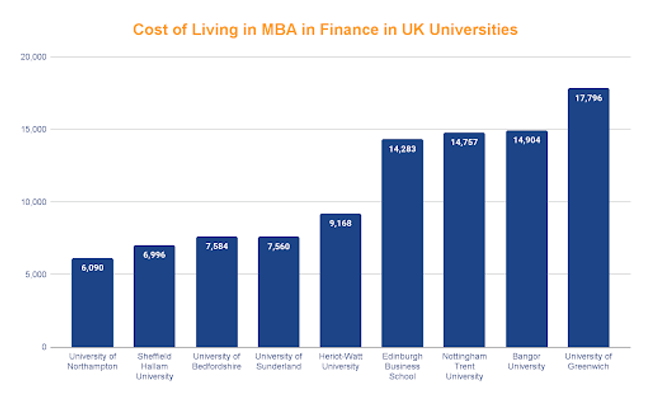
The cost of living in UK for MBA Finance students depends on the city, lifestyle, and university location. Large cities like London and Edinburgh tend to have higher expenses, while smaller towns like Northampton and Sunderland are more budget-friendly. Annual living costs typically range from £6,090 (₹7.21 Lakh) to £14,904 (₹17.64 Lakh). Expenses usually cover accommodation, food, transport, utilities, and personal spending.
Average Annual Living Costs for MBA in Finance Students:
| University | Location | Living Cost (GBP) | Living Cost (INR) |
|---|---|---|---|
| University of Northampton | Northampton, England | 6,090 | 7.21 Lakh |
| Sheffield Hallam University | Sheffield, England | 6,996 | 8.28 Lakh |
| University of Bedfordshire | Luton, England | 7,584 | 8.98 Lakh |
| University of Sunderland | Sunderland, England | 7,560 | 8.95 Lakh |
| Heriot-Watt University | Edinburgh, Scotland | 9,168 | 10.85 Lakh |
| Edinburgh Business School | Edinburgh, Scotland | 14,283 | 16.91 Lakh |
| Nottingham Trent University | Nottingham, England | 14,757 | 17.47 Lakh |
| Bangor University | Bangor, Wales | 14,904 | 17.64 Lakh |
| University of Greenwich | London, England | 17,796 | 20.96 Lakh |
Read More: Cost of Living in UK
Scholarships of MBA in Finance in UK
Several UK universities offer scholarships to help international students offset tuition costs. Awards are typically based on academic excellence, nationality, or payment timelines.
| Scholarship Name | Award Amount | Eligibility |
|---|---|---|
| GREAT Scholarship | £10,000 | Outstanding international applicants with excellent academic background, typically equivalent to a UK first-class bachelor's degree. |
| International Scholarship | £4,500 | Available to new applicants for 2025/26 entry who have not yet made a deposit payment. |
| Postgraduate Global Merit Scholarship | £3,000 | International students with strong academic performance (at least 75% GPA or equivalent). |
| Vice Chancellor's Scholarship | £1,000 | Applicants must be classed as International/Overseas fee-payer status. |
| Prompt Payment Discount | £500 | Available for prompt payment of each year’s fees in full before or at registration, for both programs. |
Check Out: Popular Scholarships in UK
MBA in Finance in UK Job Opportunities
Graduates of an MBA in Finance in the UK are well-positioned for leadership roles in financial services, consulting, corporate finance, and investment banking. The UK’s status as a global financial hub—especially cities like London, Edinburgh, and Manchester—offers a wealth of career prospects.
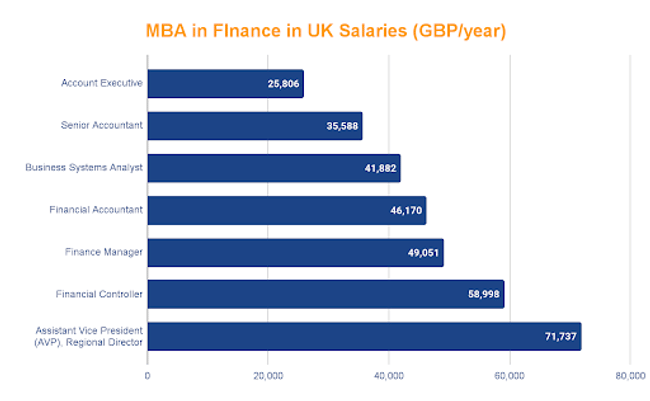
Below is a snapshot of average salaries for key finance-related roles:
| Job Title | Average Salary (GBP) | Average Salary (INR) |
|---|---|---|
| Account Executive | 25,806 | 3,044,929 |
| Senior Accountant | 35,588 | 4,193,066 |
| Business Systems Analyst | 41,882 | 4,939,144 |
| Financial Accountant | 46,170 | 5,444,828 |
| Finance Manager | 49,051 | 5,784,584 |
| Financial Controller | 58,998 | 6,957,634 |
| Assistant Vice President (AVP), Regional Director | 71,737 | 8,459,944 |
Also Read: Job Opportunities in UK for Indian Students
Pursuing an MBA in Finance in the UK offers students a blend of world-class education, globally recognized rankings, and strong industry connections. With diverse university options, flexible entry requirements, competitive fees, and multiple scholarship opportunities, the UK remains a top destination for finance professionals. Graduates benefit from high-earning career paths across banking, corporate finance, and consulting, making it an excellent investment for long-term professional growth.
FAQs
Ques: What is the average salary after an MBA in Finance in the UK?
Ans: Graduates of MBA in Finance in the UK can expect salaries ranging from £25,000 to £72,000 per year (₹30 Lakh to ₹85 Lakh), depending on job role, experience, and location. High-paying positions include Assistant Vice President (AVP) and Financial Controller.
Ques: Which are the top universities for MBA in Finance in the UK?
Ans: Some leading universities for MBA in Finance in the UK include London Business School, University of Oxford, University of Cambridge, Imperial College London, and the University of Edinburgh. These institutions are globally ranked and offer strong placement opportunities in finance hubs like London.
Ques: What is the cost of an MBA in Finance in the UK for international students?
Ans: The tuition fees for MBA in Finance in the UK range between £25,000 and £65,000 (₹29 Lakh – ₹75 Lakh), depending on the university. Students should also budget for living expenses of around £12,000 – £15,000 per year.
Ques: Are scholarships available for MBA in Finance in the UK?
Ans: Yes, many UK universities offer scholarships such as the Vice-Chancellor’s Scholarship, International Scholarship, and Global Merit Scholarships. Awards typically range from £500 to £10,000 and are based on academic excellence or early application.
Ques: Is work experience required for MBA in Finance in the UK?
Ans: Most top business schools require 2–5 years of professional work experience for admission to an MBA in Finance program. However, some universities may accept students with less experience if they have exceptional academic or leadership backgrounds.
Ques: Can I work in the UK after completing an MBA in Finance?
Ans: Yes, graduates can apply for the UK Graduate Route visa, allowing them to stay and work in the UK for up to 2 years after completing their degree, or 3 years for doctoral graduates.
1720766750.png?tr=w-305,h-145,c-force?h=40&w=40&mode=stretch)


1721885767.png?tr=w-305,h-145,c-force?h=40&w=40&mode=stretch)


1720766750.png?tr=w-305,h-145,c-force?h=175&w=350&mode=stretch)


1721885767.png?tr=w-305,h-145,c-force?h=175&w=350&mode=stretch)



Comments