



| Updated On - Aug 5, 2026
IISc Bengaluru welcomed its first BTech Aerospace Engineering batch of 25 students on August 4, 2026. Admissions were held through JoSAA counselling. The programme marks the department's first undergraduate cohort in 84 years since 1942.
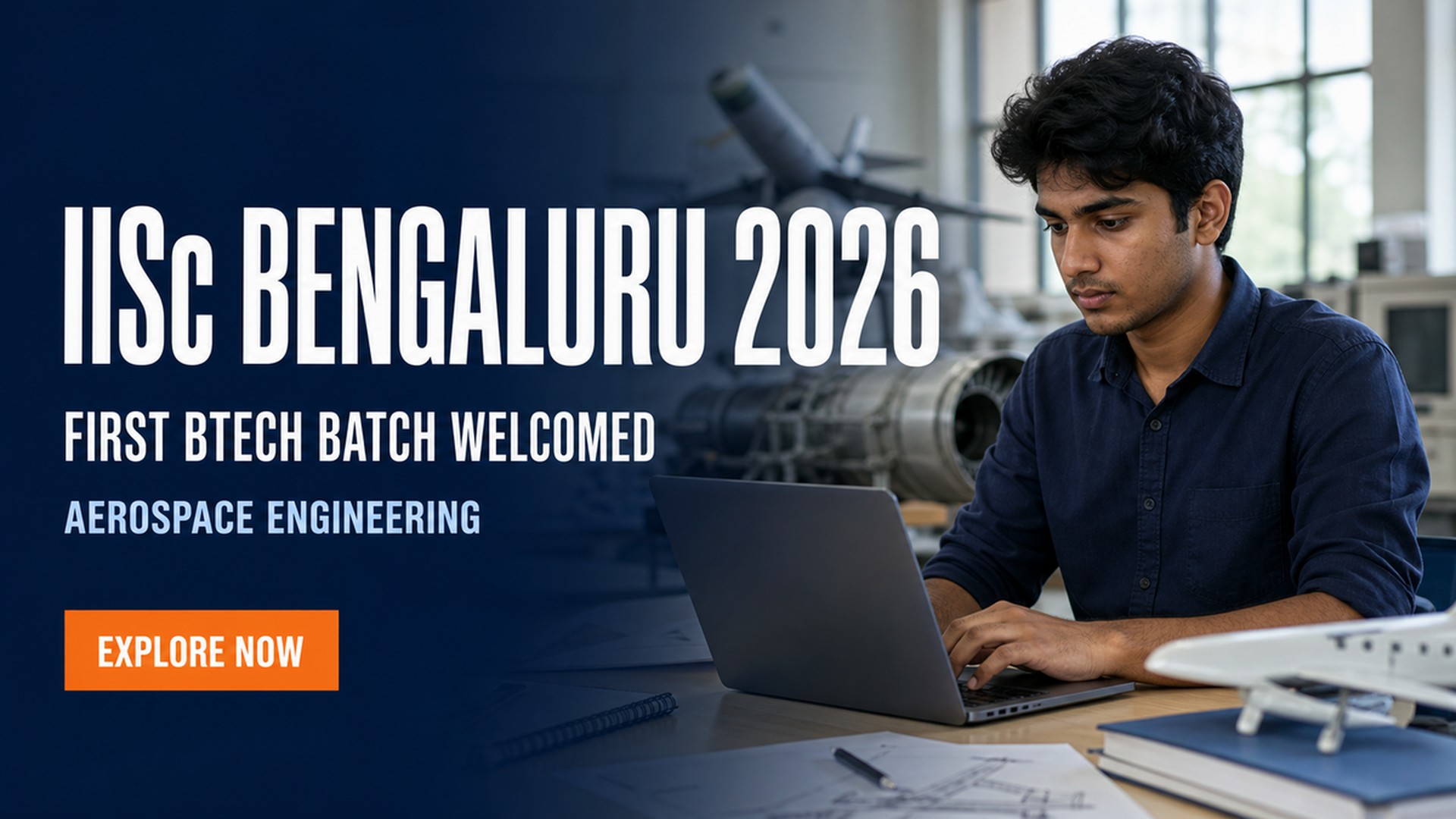
The Indian Institute of Science, Bengaluru (IISc) has admitted 25 aerospace students. This is the first BTech batch in its Department of Aerospace Engineering. The cohort joined the department on August 4, 2026.
Admissions were conducted through the Joint Seat Allocation Authority (JoSAA) counselling process. The programme is one of three new BTech tracks at IISc.
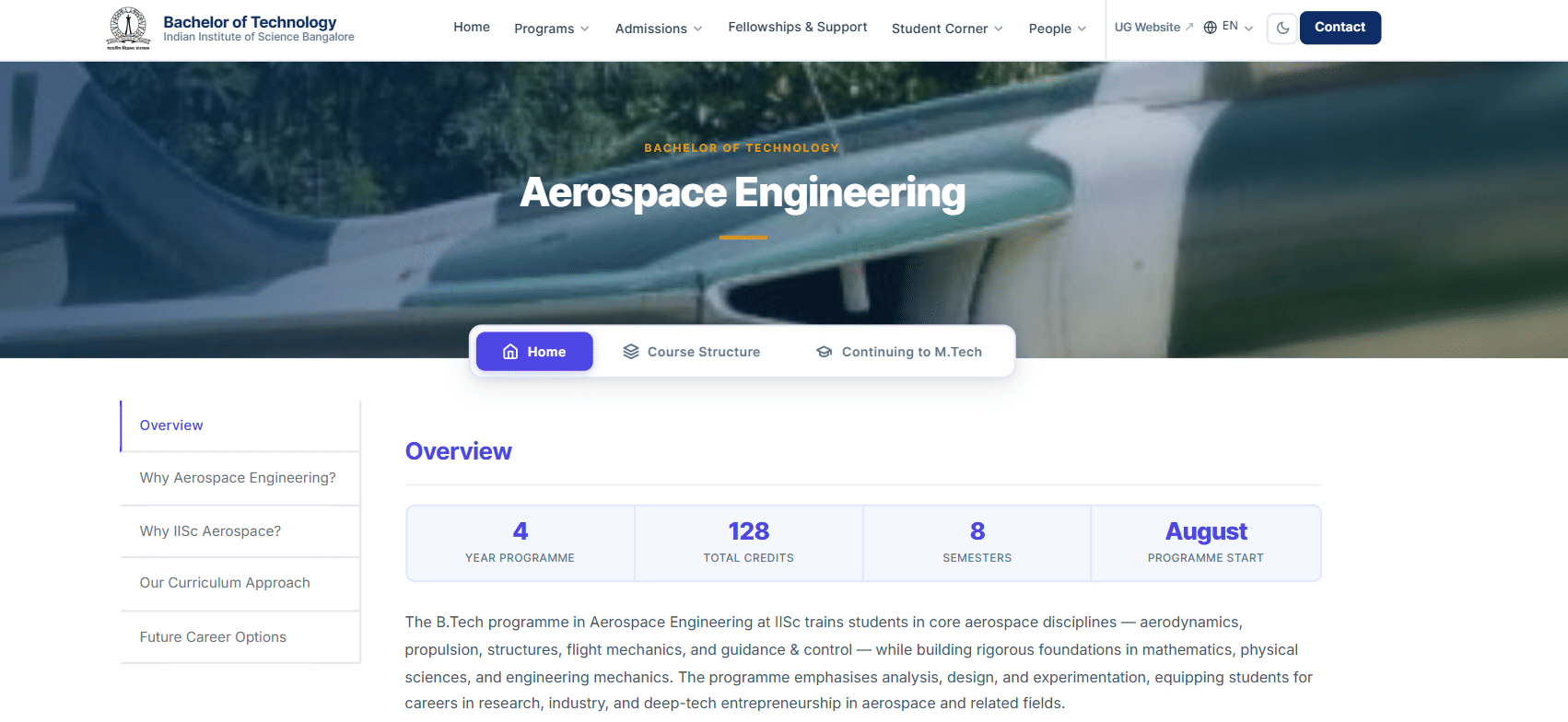
The BTech Aerospace Engineering programme runs for four years across eight semesters. It carries a total of 128 academic credits. These credits cover core courses, humanities, projects, and electives.
The curriculum begins with foundational teaching in physics, mathematics, and engineering. Full programme details are available on the official portal at btech-ug.iisc.ac.in.
Also Check: JoSAA 2026 Round 5 Opening and Closing Ranks Out at josaa.nic.in
What Does the BTech Aerospace Engineering Curriculum Cover?
The four-year curriculum builds core aerospace engineering skills across eight semesters. It moves from foundational courses to advanced specialisations and design projects.
The programme covers the following core areas:
- Aerodynamics
- Propulsion
- Structures and materials
- Flight mechanics
- Space mechanics
- Guidance and control systems
Aerodynamics teaches how air flows over aircraft and other vehicles. Propulsion covers the science of engines and thrust generation.
Structures and materials focus on aircraft body strength and design. Flight mechanics covers how aircraft move through the atmosphere.
Space mechanics deals with orbits, trajectories, and spacecraft motion. Guidance and control systems train students in the direction and control of autonomous vehicles.
The learning process shifts from theoretical concepts in the early years to hands-on design and research work in the later years. Each academic year adds new layers of aerospace training.
| Year | Focus Area |
| Year 1 | Physics, mathematics, and engineering foundations |
| Year 2 | Core aerospace subjects and mechanics |
| Year 3 | Elective specialisations and research projects |
| Year 4 | Design Build Fly capstone project |
Students will use the Aerospace Engineering X Lab for hands-on projects. Research work begins in the third year of the programme.
The final year includes a Design Build Fly capstone project. During this capstone, students will design, build, and fly unmanned aerial vehicles.
The capstone connects theoretical training with real-world engineering practice.
Also Check: JoSAA 2026 Round 5 Seat Allotment Released at josaa.nic.in
IISc BTech Aerospace Engineering Programme Snapshot
| Detail | Information |
| Programme Name | BTech Aerospace Engineering |
| Duration | Four years across eight semesters |
| Total Academic Credits | 128 |
| Inaugural Batch Size | 25 students |
| First Batch Start Date | August 4, 2026 |
| Admission Route | JoSAA counselling |
| Host Department | Department of Aerospace Engineering |
How Are Students Admitted to the BTech Aerospace Programme?
Admissions are conducted through the JoSAA counselling process each year. Candidates must qualify for JEE Advanced to become eligible for admission.
Aspirants do not need to submit a separate application to IISc. Seats are allotted based on the candidate’s rank, category, and choices filled during counselling.
The official JoSAA portal is available at josaa.nic.in.
Also Check: IIT Bombay Autumn Semester Fee Structure 2026 Released
Where Does IISc Sit Among Aerospace BTech Options?
IISc joins a small group of institutes offering a BTech in Aerospace Engineering.
Similar programmes are offered by:
All these institutes admit students through JoSAA counselling using JEE Advanced ranks.
Also Check: IIT Delhi Opens Applications for Advanced Certificate in Agentic AI
IISc’s inaugural batch of 25 students is smaller than the intake at most IITs. The smaller cohort may allow students to receive closer faculty guidance and better access to laboratories.
The BTech programme will run alongside the department’s existing research and PhD programmes.
The IISc campus in Bengaluru houses the department’s aerospace facilities and laboratories. Students will receive classroom instruction, laboratory training, and research exposure at the same location.
BTech students will study alongside senior researchers and doctoral scholars. This combination of research and undergraduate teaching is expected to shape the department’s academic approach.
The 2026 batch is the first BTech cohort in the department's 84-year history. The launch signals a shift from IISc's research-focused past. School leavers can now enter IISc aerospace through the JEE Advanced route.
Department Background and Notable Alumni
The Department of Aerospace Engineering was established in 1942, during the pre-independence period.
It was set up in collaboration with Hindustan Aircraft Limited (HAL). This makes it one of India’s oldest aerospace teaching and research departments.
Until 2026, the department admitted only postgraduate and PhD candidates. IISc previously offered only the BS Research programme at the undergraduate level.
The department has trained several prominent figures in India’s space and aerospace sectors.
Former ISRO chairmen K. Sivan and S. Somanath are among its alumni. Founders of aerospace startups such as OrbitAID and Guerin Technologies have also studied at the department.
Its alumni have contributed to several major Indian space missions. This established network can provide BTech students with access to experienced researchers, industry professionals, and aerospace entrepreneurs.
Watch for JoSAA 2027-28 counselling schedules and IISc aerospace cutoffs. Official JEE Advanced cutoff data for 2026-27 is also awaited.
Also Check
- IIT Kanpur Launches 4 New Online M.Tech Programs for Admission 2026
- IITs to Offer Cross-Campus Study Option to Students from 2026; Credit Transfer Facility Introduced
- QS Rankings 2027: IIT Delhi Achieves India's Best-Ever Rank, 52 Indian Universities Feature in Global List
- IIT Bombay to Launch First US Sub-Campus by 2027 at SUNY Old Westbury


.jpeg?h=127&w=254&mode=stretch)

.png?h=127&w=254&mode=stretch)


.jpeg?h=40&w=40&mode=stretch)



Comments