



Swatantra Khandelwal Content Curator
Content Curator | Updated On - Dec 12, 2025
The Teacher Eligibility Test (TET) has become a mandatory qualification for aspiring teachers across India, serving as the gateway to teaching careers in government schools. Introduced by the Government of India in 2011 to improve standards in teaching, the TET is now a mandatory qualification for incoming teachers for Classes I through VIII. With both central and state-level examinations conducted throughout the year, understanding the TET landscape is crucial for anyone pursuing a teaching career in 2025.
What is Teacher Eligibility Test?
The Teacher Eligibility Test is a standardized examination that assesses the aptitude and proficiency of prospective educators seeking to teach in primary and upper primary schools across India. According to the National Council for Teacher Education (NCTE) notifications dated 23rd August 2010 and 29th July 2011, one of the essential qualifications for a person to be eligible for appointment as a teacher in schools is that they should pass the Teacher Eligibility Test conducted by the appropriate Government.
The TET framework operates at two levels-the Central Teacher Eligibility Test (CTET) for central government schools and various State TETs for state-run institutions. This dual system ensures uniform teaching standards while accommodating state-specific requirements.
CTET December Result Declared
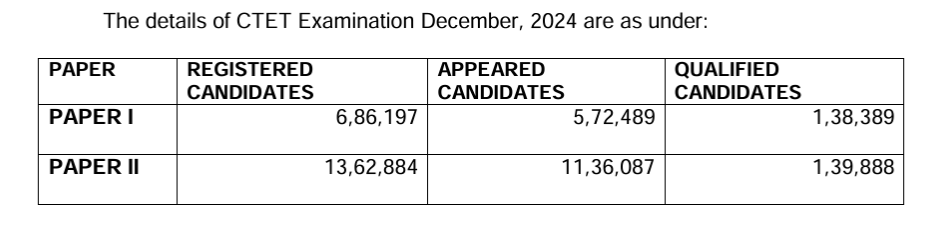
In a recent development, the Central Board of Secondary Education (CBSE) declared the CTET December 2024 Result on 9 January 2025. The examination was held on the 14th and 15th of December 2024, with candidates now able to download their scorecards from the official website ctet.nic.in.
According to official statistics shared in the result notification, for Paper I, 6,86,197 candidates registered, 5,72,489 appeared, and 1,38,389 qualified; while for Paper II, 13,62,884 registered, 11,36,087 appeared, and 1,39,888 qualified. These numbers reflect the competitive nature of the examination and the high standards maintained in teacher selection.
An important update for all qualified candidates: qualified candidates will receive their CTET Certificate via Digilocker, with an SMS notification sent to their registered mobile number, and the CTET certificate now holds lifetime validity.
Types of TET Exams in India
Central Teacher Eligibility Test (CTET)
The Ministry of Education, Government of India has entrusted the responsibility of conducting the Central Teacher Eligibility Test to the Central Board of Secondary Education Delhi. The CTET is conducted twice annually and applies to schools of the Central Government (KVS, NVS, Central Tibetan Schools, etc.) and schools under the administrative control of Union Territories.
Video Analysis: Supreme Court Verdict on TET/CTET Mandatory for All Teachers
This video explains the Supreme Court's September 1st order making TET/CTET mandatory for all teachers across India. The presenter breaks down the 110-page verdict and its implications for serving and aspiring teachers.
Key Points:
- Two-year deadline: Teachers with more than 5 years of service remaining must qualify TET/CTET within 2 years or face compulsory retirement
- Exemption clause: Teachers with less than 5 years until retirement can continue without TET, but won't be eligible for promotions
- Universal application: Applies to all schools—government, private, aided, unaided, and minority institutions
- Exam details: No negative marking, 60% qualifying marks required, achievable with 20 days to 2 months of focused preparation
- Exception: Secondary level teachers (9th-12th grade) currently exempt as TET not yet applicable for these grades
The presenter acknowledges the decision may seem harsh for experienced teachers but emphasizes it's mandated to improve education quality standards nationwide. Essential viewing for current and aspiring teachers across all educational institutions.
State-Level TET Examinations
Each state conducts its own Teacher Eligibility Test with specific requirements and schedules. Some prominent state TETs include:
- UPTET (Uttar Pradesh): The Uttar Pradesh Basic Education Board holds its TET examinations once a year to select primary and junior teachers. The exam comprises two papers for different teaching levels.
- MAHA TET (Maharashtra): Conducted by the Maharashtra State Council of Examination annually for teachers of classes 1 to 8.
- TN TET (Tamil Nadu): The Teachers Recruitment Board released the Tamil Nadu Teacher Eligibility Test notification on August 11, 2025, with the exam held on November 15 and 16, 2025.
- TS TET (Telangana): The Telangana State Teachers Eligibility Test January 2026 application dates were from November 15 to 29, 2025.
- AP TET (Andhra Pradesh): The Andhra Pradesh TET application was available from October 24 to November 23, 2025, with the exam scheduled for December 10, 2025.
- Karnataka TET (KARTET): The Education Department of Karnataka has released the notification for Karnataka Teachers Eligibility Test 2024, inviting applications for eligible candidates aspiring to be teachers for primary and upper primary schools.
TET Exam Pattern and Structure
The Teacher Eligibility Test comprises two distinct papers designed for different teaching levels:
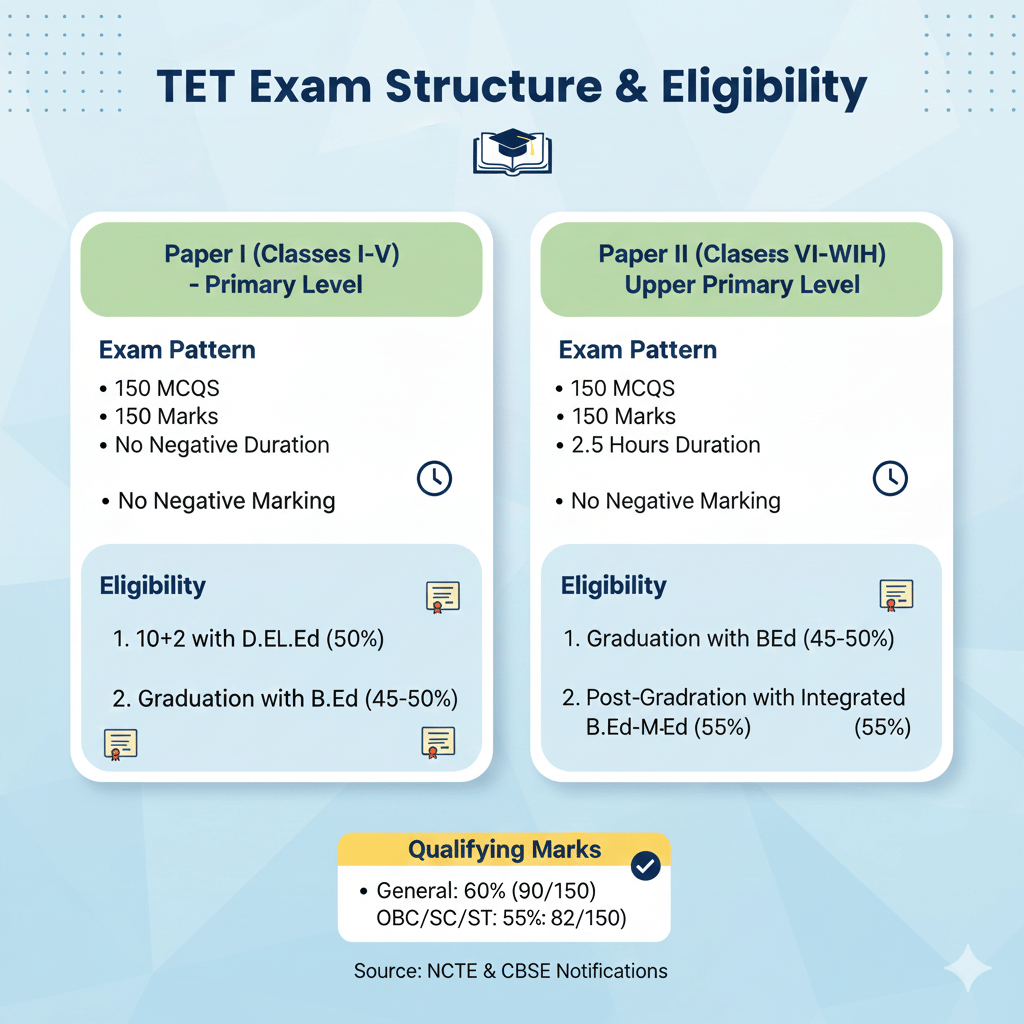
Paper I: For candidates aspiring to teach Classes I to V (Primary Level)
- Total Questions: 150 Multiple Choice Questions
- Total Marks: 150 (1 mark per question)
- Duration: 2 hours 30 minutes
- No negative marking
Paper II: For candidates aspiring to teach Classes VI to VIII (Upper Primary Level)
- Total Questions: 150 Multiple Choice Questions
- Total Marks: 150 (1 mark per question)
- Duration: 2 hours 30 minutes
- No negative marking
Candidates can appear for both papers if they wish to be eligible to teach across both levels. The minimum qualifying marks for General Category is 60% (90 marks out of 150), while for other categories (OBC/SC/ST) the minimum qualifying marks is 55% (82 marks out of 150).
Educational Qualifications Required for TET
For Paper I (Classes I-V)
To appear for TET Paper I, candidates must possess one of the following qualifications:
- Senior Secondary with D.El.Ed: Candidates must have 12th with D.El.Ed/B.El.Ed for Paper 1. Specifically, candidates should have passed Senior Secondary (Class 12) or equivalent with at least 50% marks along with a 2-year Diploma in Elementary Education (D.El.Ed) or equivalent.
- The Diploma in Elementary Education (D.El.Ed) is a foundational course for aspiring primary teachers. The D.El.Ed is a professional diploma-level program designed to train candidates to become teachers at the elementary school level, typically from Class I to Class VIII, and is of two years duration, divided into four semesters.
- D.El.Ed Eligibility: Candidates must have passed 10+2 (Intermediate/Senior Secondary) with a minimum of 50% marks, with the minimum age requirement of 17 years.
- After completing D.El.Ed, candidates must also qualify for CTET (Central Teacher Eligibility Test) or State TET to get government jobs as primary teachers teaching Classes 1-5.
Also Read: DElEd Admission 2026
- Graduation with B.Ed: Candidates who possessed Graduation with at least 45% to 50% marks and passed or appearing in 2-year Bachelor of Education (B.Ed) are now eligible for becoming Teacher for Classes I-V: Primary Stage.
Also Read: BEd Admission 2026
For Paper II (Classes VI-VIII)
To appear for TET Paper II, candidates must have:
- Graduation with B.Ed: Graduation with B.Ed/B.El.Ed for Paper 2. Candidates should have completed graduation in any discipline with at least 45-50% marks along with a 2-year Bachelor of Education (B.Ed) degree from a recognized university.
- Bachelor of Education (B.Ed) is the primary qualification for teaching at the upper primary and secondary levels. B.Ed is a degree program in teaching which makes you eligible to teach a class from 6th to 12th, with a duration of two years.
- B.Ed graduates who clear TET become eligible to teach Classes VI to VIII in government schools. For teaching higher classes (IX to XII), additional qualifications and separate recruitment processes apply.
- Post-Graduation with Integrated B.Ed-M.Ed: Candidates with post-graduation must have a minimum of 55% marks or an equivalent grade and a three-year integrated B.Ed.-M.Ed Course.
Important Eligibility Points
- The candidate's degree or diploma must be recognized by the National Council for Teacher Education (NCTE), and candidates holding a Diploma or Degree in Special Education must have completed programs accredited by the Rehabilitation Council of India.
- Candidates wishing to apply must be of minimum 17 years and there is no maximum age limit for CBSE CTET Exam, with no restriction on the number of attempts a person can take for acquiring a TET Certificate.
TET Application Process 2025-26
CTET 2026 Registration
The Central Board of Secondary Education released the CTET 2026 notification on 27th November 2025, with candidates able to submit their applications online from November 27, 2026, to December 18, 2026, and the exam scheduled to be held on 8th February 2026.
Step-by-Step Application Process
- Visit Official Website: Go to the official TET website (ctet.nic.in for CTET or respective state TET portals)
- Registration: Click on the registration link and create login credentials
- Fill Application Form: Enter personal details, educational qualifications, and exam preferences
- Upload Documents: Upload scanned photograph, signature, and required certificates
- Pay Application Fee: Complete fee payment through online mode
- Submit and Download: Submit the form and download the confirmation page for future reference
Application Fees
Application fees vary by category and typically range from INR 700-1000 for general candidates, with concessions available for reserved categories as per government norms.
Career Scope After Clearing TET
Teaching Opportunities
- Government Schools: TET-qualified candidates can apply for teaching positions in Kendriya Vidyalayas (KVS), Navodaya Vidyalayas (NVS), State Government Schools, and other government-run educational institutions.
- Salary Structure: In Government Schools, starting salary can range between INR 25,000 to INR 40,000 per month, while in Private Schools it is usually between INR 12,000 to INR 25,000 per month initially, with scope for growth.
Additional Career Paths
Beyond classroom teaching, TET-qualified candidates with D.El.Ed or B.Ed degrees can explore:
- Curriculum Developer: Creating educational content and teaching materials
- Education Consultant: Advising schools on pedagogy and teaching methods
- Special Educator: Working with students with special learning needs (with additional training)
- Content Writer: Developing educational content for ed-tech companies
- Academic Coordinator: Managing academic activities in schools
- Teacher Trainer: Training aspiring teachers in pedagogy and subject matter
Upcoming State TET Examinations
- UPTET 2026: The Uttar Pradesh TET exam is scheduled for January 29 and 30, 2026.
- TS TET 2026: Applications were accepted from November 15-29, 2025, with the exam expected in January 2026.
- AP TET 2025: The exam is scheduled to be conducted on December 10, 2025.
Candidates should regularly check official state education department websites for updated notifications and schedules.
Important Points to Remember
- Lifetime Validity: The TET certificate is valid for lifetime, eliminating the need for renewal.
- No Appointment Guarantee: Qualifying for the CTET does not guarantee appointment rights to the candidate. The CTET only serves as a qualifying exam, and the final eligibility for any teaching recruitment will be verified by the concerned authority.
- Multiple Attempts: There is no restriction on the number of times a candidate can attempt the TET examination.
- Score Improvement: Candidates who have already obtained the TET qualification may resit the test in order to improve their score.
- Paper Selection: Candidates can appear for Paper I, Paper II, or both papers depending on their career aspirations and educational qualifications.
Preparing for TET: Essential Tips
- Understand the Syllabus: Familiarize yourself with the complete syllabus covering Child Development and Pedagogy, Language I and II, Mathematics (for Paper I)/Science and Social Studies (for Paper II), and Environmental Studies.
- Study NCERT Books: The TET is based on the National Curriculum Framework, making NCERT textbooks from Classes I to VIII essential study materials.
- Practice Previous Papers: Solving previous years' question papers helps understand the exam pattern and difficulty level.
- Take Mock Tests: Regular mock tests improve time management and identify weak areas requiring more attention.
- Focus on Pedagogy: Understanding teaching methodologies and child psychology is crucial for the Child Development and Pedagogy section, which carries significant weightage.
Why Pursue D.El.Ed and B.Ed for TET?
D.El.Ed Course Benefits:
- D.El.Ed provides the right entry point for students who genuinely love teaching and working with children, making candidates eligible for various government teaching exams like CTET, UPTET, and other state-level teacher eligibility tests
- Shorter duration compared to degree programs (2 years vs 3-4 years for graduation plus B.Ed)
- Direct pathway to primary teaching careers
- Foundation for pursuing B.Ed later for career advancement
B.Ed Course Benefits:
- Comprehensive training in teaching methodologies and classroom management
- Eligibility to teach higher classes (up to Class XII with relevant subject expertise)
- Higher salary prospects and career growth opportunities
- Pathway to administrative and leadership roles in education
Both courses are NCTE-approved and provide the essential pedagogical training required not just to clear TET but to become effective educators who can positively impact students' lives.
Conclusion
The Teacher Eligibility Test stands as a crucial milestone for anyone aspiring to build a career in teaching. With the recent CTET December 2024 results declared and multiple state TETs scheduled throughout 2025-26, this is an opportune time for aspiring teachers to begin their preparation journey.
Whether you're considering the D.El.Ed course for primary teaching or pursuing B.Ed for upper primary and secondary education, clearing the TET opens doors to stable government teaching positions and a fulfilling career in shaping young minds. The lifetime validity of the TET certificate, absence of attempt restrictions, and the ability to improve scores make it accessible to all dedicated individuals committed to the teaching profession.
For those starting their teaching career journey, the first step is securing the right educational qualification-D.El.Ed for primary teaching aspirants or B.Ed for those targeting upper primary and secondary levels. With proper preparation, dedication, and the right qualifications, success in the Teacher Eligibility Test is well within reach.
Key Takeaways:
- TET is mandatory for teaching Classes I-VIII in government schools across India
- CTET December 2024 results declared on January 9, 2025
- Paper I requires Class 12 with D.El.Ed or Graduation with B.Ed
- Paper II requires Graduation with B.Ed
- TET certificate has lifetime validity
- Starting salary ranges from INR 25,000-40,000 in government schools
- CTET 2026 scheduled for February 8, 2026
- Multiple state TETs scheduled throughout 2025-26
Official Links:
- CTET Official Website: https://ctet.nic.in/
- NCTE Official Website: https://ncte.gov.in
.jpeg?h=40&w=40&mode=stretch)
%20-%202026-02-19T183817.353%20(1).png?h=40&w=40&mode=stretch)
.png?h=40&w=40&mode=stretch)
.jpeg?h=40&w=40&mode=stretch)
.png?h=40&w=40&mode=stretch)
%20-%202026-02-19T171423.750%20(1).png?h=40&w=40&mode=stretch)








Comments