




The JK Board 2026 Class 12 Biology Question Paper with Solution PDF is available for download here. The JKBOSE Biology exam took place on March 3, 2026, during the morning session.
The paper was moderately challenging, emphasizing Plant and Human Physiology, Reproduction, Genetics, and Ecology. While objective questions on Mendelian inheritance and basic taxonomy were high-scoring, long-answer questions on complex physiological cycles and ecological case studies required a strong grasp of NCERT-based concepts and technical terminology. Top candidates should aim for 85–95 marks by providing structured answers with well-labeled diagrams and precise scientific definitions.
JK Board 2026 Class 12 Biology Question Paper with Solution PDF
| JK Board 2026 Class 12 Biology Question Paper with Solution PDF | Download PDF | Check Solution |

Which of the following is a method of contraception?
View Solution
Step 1: Understanding contraception methods.
Contraception methods are used to prevent pregnancy. There are different types, including permanent and temporary methods.
Step 2: Analysis of options.
(A) IVF: Incorrect. In vitro fertilization (IVF) is a method used to assist conception, not a contraceptive method.
(B) Vasectomy: Correct. Vasectomy is a permanent method of contraception for men where the vas deferens is surgically cut or blocked to prevent sperm from entering the ejaculate.
(C) Amniocentesis: Incorrect. Amniocentesis is a prenatal test used to check for genetic conditions in a fetus, not a contraception method.
(D) ZIFT: Incorrect. Zygote intrafallopian transfer (ZIFT) is an assisted reproduction method, not a contraceptive method.
Step 3: Conclusion.
The correct answer is vasectomy, as it is a method of contraception.
Final Answer: Vasectomy. Quick Tip: Vasectomy is a permanent male contraception method. It prevents the release of sperm during ejaculation by cutting or blocking the vas deferens.
In which of the following human disorders is there a defect in the X chromosome?
View Solution
Step 1: Understanding X-linked genetic disorders.
X-linked disorders are caused by mutations in genes located on the X chromosome. These conditions typically affect males more than females because males have only one X chromosome.
Step 2: Analysis of options.
(A) Hemophilia: Correct. Hemophilia is an X-linked genetic disorder where the blood does not clot properly, caused by a mutation on the X chromosome.
(B) Down's syndrome: Incorrect. Down's syndrome is caused by an extra copy of chromosome 21 (trisomy 21), not a defect in the X chromosome.
(C) Klinefelter’s syndrome: Incorrect. Klinefelter’s syndrome is caused by the presence of an extra X chromosome in males (XXY), but it is not caused by a defect in the X chromosome itself.
(D) Thalassemia: Incorrect. Thalassemia is a blood disorder caused by mutations in the genes of chromosomes 11 and 16, not the X chromosome.
Step 3: Conclusion.
Hemophilia is the disorder among the options that is caused by a defect in the X chromosome.
Final Answer: Hemophilia. Quick Tip: X-linked disorders are those where the gene causing the disorder is located on the X chromosome. Hemophilia is one such disorder, causing problems with blood clotting.
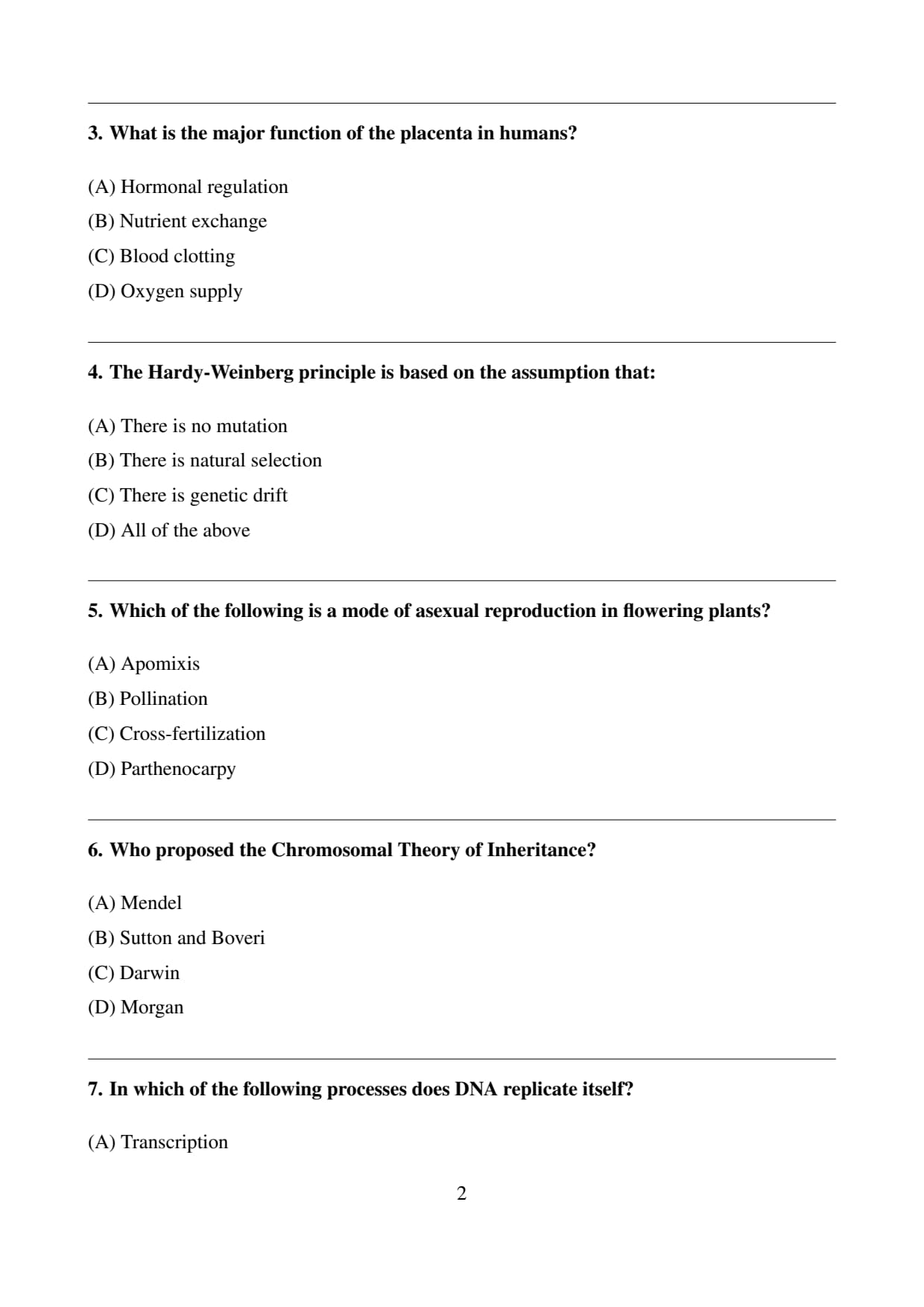
What is the major function of the placenta in humans?
View Solution
Step 1: Understanding the placenta's role.
The placenta is a vital organ during pregnancy that connects the developing fetus to the mother's uterine wall, enabling nutrient and waste exchange, and supporting fetal growth.
Step 2: Analysis of options.
(A) Hormonal regulation: Incorrect. The placenta does secrete hormones (such as hCG), but its primary role is nutrient and gas exchange, not just hormonal regulation.
(B) Nutrient exchange: Correct. The placenta is primarily responsible for exchanging nutrients, oxygen, and waste products between the mother and the fetus.
(C) Blood clotting: Incorrect. Blood clotting is not the primary function of the placenta; this function is more related to the body’s circulatory system.
(D) Oxygen supply: Incorrect. While the placenta supplies oxygen to the fetus, its main function is broader, including nutrient exchange and waste removal, not just oxygen supply.
Step 3: Conclusion.
The placenta’s major function is nutrient exchange between the mother and fetus.
Final Answer: Nutrient exchange. Quick Tip: The placenta is crucial for supplying oxygen and nutrients to the fetus, as well as removing waste products. Its main function is nutrient and gas exchange.
The Hardy-Weinberg principle is based on the assumption that:
View Solution
Step 1: Understanding the Hardy-Weinberg principle.
The Hardy-Weinberg principle describes a genetic equilibrium in a population that remains constant over time unless disturbed by external factors like mutations, natural selection, or genetic drift.
Step 2: Analysis of options.
(A) There is no mutation: Correct. The Hardy-Weinberg principle assumes that there are no mutations in the population, meaning allele frequencies remain unchanged.
(B) There is natural selection: Incorrect. The principle assumes no natural selection, meaning all individuals in the population have equal reproductive success.
(C) There is genetic drift: Incorrect. The principle assumes no genetic drift, meaning allele frequencies are not altered by random sampling effects.
(D) All of the above: Incorrect. The Hardy-Weinberg principle assumes no mutations, no natural selection, and no genetic drift, so this option is not correct.
Step 3: Conclusion.
The Hardy-Weinberg principle is based on the assumption that there are no mutations in the population, and no other evolutionary factors are at play.
Final Answer: There is no mutation. Quick Tip: The Hardy-Weinberg equilibrium assumes that no evolutionary forces (mutation, natural selection, genetic drift, etc.) are acting on the population, leading to constant allele frequencies.
Which of the following is a mode of asexual reproduction in flowering plants?
View Solution
Step 1: Understanding asexual reproduction.
Asexual reproduction involves the production of offspring without the involvement of gametes. In flowering plants, apomixis is the process of asexual reproduction where seeds are produced without fertilization.
Step 2: Analysis of options.
(A) Apomixis: Correct. Apomixis is an asexual mode of reproduction in plants where the seed develops without fertilization.
(B) Pollination: Incorrect. Pollination is the process of transferring pollen from male to female parts for fertilization; it is not a form of asexual reproduction.
(C) Cross-fertilization: Incorrect. Cross-fertilization involves the fusion of gametes from two different plants, which is sexual reproduction.
(D) Parthenocarpy: Incorrect. Parthenocarpy refers to the formation of fruit without fertilization, but it does not involve asexual reproduction.
Step 3: Conclusion.
Apomixis is the only option that describes a mode of asexual reproduction in plants.
Final Answer: Apomixis. Quick Tip: In asexual reproduction, new plants are produced without the fusion of gametes. Apomixis is one such example in flowering plants.
Who proposed the Chromosomal Theory of Inheritance?
View Solution
Step 1: Understanding the Chromosomal Theory of Inheritance.
The Chromosomal Theory of Inheritance suggests that genes are located on chromosomes and that chromosomes are the carriers of genetic information. It was proposed by Sutton and Boveri in the early 20th century.
Step 2: Analysis of options.
(A) Mendel: Incorrect. Mendel is known for his foundational work on the principles of heredity but did not propose the Chromosomal Theory of Inheritance.
(B) Sutton and Boveri: Correct. They jointly proposed the Chromosomal Theory of Inheritance based on their work on chromosomes and genetics.
(C) Darwin: Incorrect. Darwin is known for his theory of evolution, not the Chromosomal Theory of Inheritance.
(D) Morgan: Incorrect. Morgan's work on fruit flies contributed to our understanding of genetics, but he did not propose the Chromosomal Theory of Inheritance.
Step 3: Conclusion.
The Chromosomal Theory of Inheritance was proposed by Sutton and Boveri.
Final Answer: Sutton and Boveri. Quick Tip: The Chromosomal Theory of Inheritance, proposed by Sutton and Boveri, forms the basis of our modern understanding of genetics and heredity.
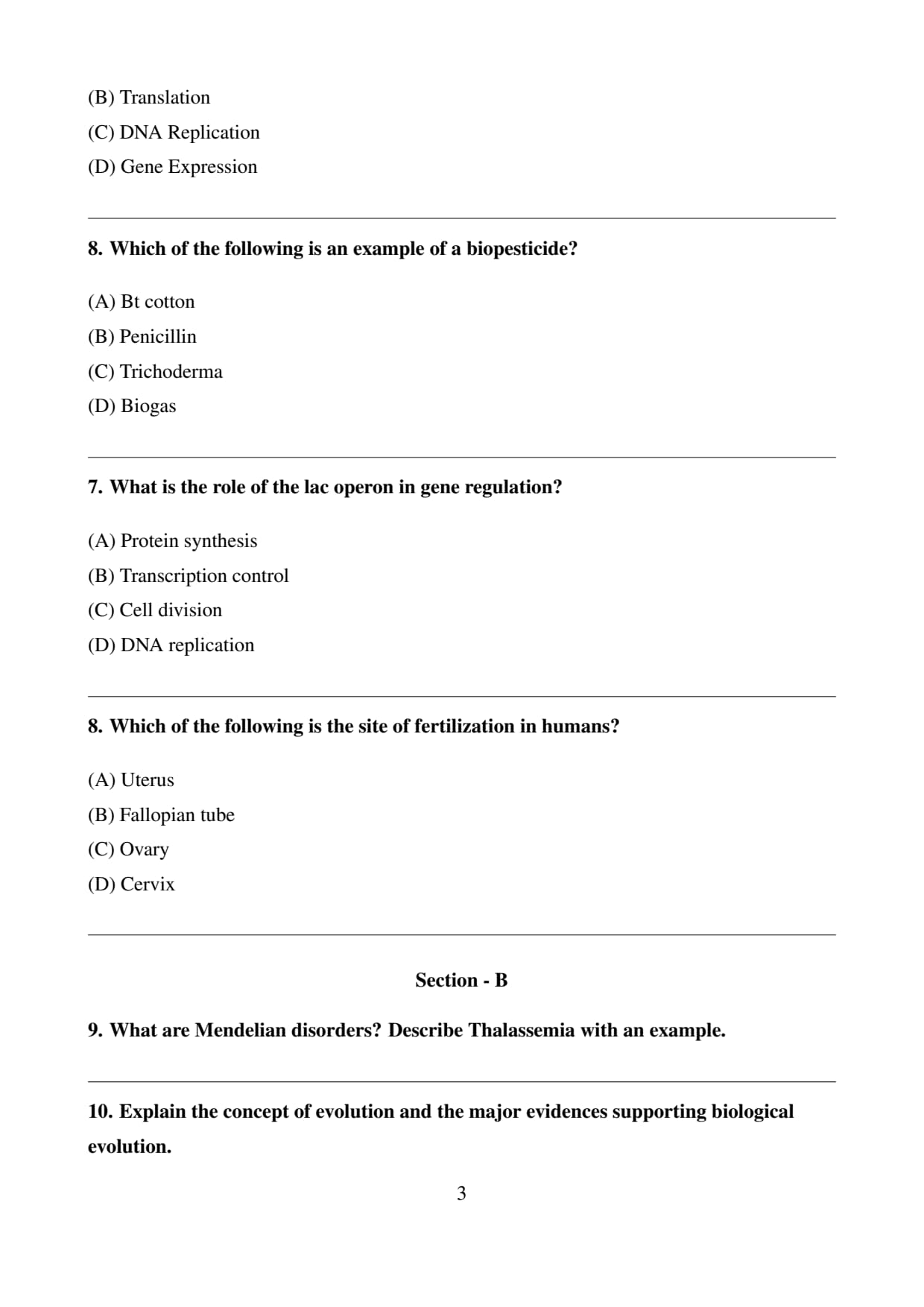
What is the role of the lac operon in gene regulation?
View Solution
Step 1: Understanding the lac operon.
The lac operon is a segment of DNA involved in the regulation of gene expression in prokaryotes, specifically in E. coli. It is responsible for controlling the transcription of genes involved in the metabolism of lactose.
Step 2: Analysis of options.
(A) Protein synthesis: Incorrect. While the lac operon indirectly affects protein synthesis, its primary role is in controlling the transcription of genes involved in lactose metabolism, not in protein synthesis itself.
(B) Transcription control: Correct. The lac operon regulates the transcription of genes necessary for the breakdown of lactose in the cell. It controls whether certain genes are expressed or not in response to the presence or absence of lactose.
(C) Cell division: Incorrect. The lac operon does not directly control cell division. Its role is in gene regulation, not cell division.
(D) DNA replication: Incorrect. The lac operon does not have a direct role in DNA replication; its function is in transcription regulation, not replication.
Step 3: Conclusion.
The lac operon primarily controls the transcription of genes involved in lactose metabolism in response to environmental conditions.
Final Answer: Transcription control. Quick Tip: The lac operon is a classic example of gene regulation in prokaryotes. It helps the cell respond to the availability of lactose by controlling gene transcription.
Which of the following is the site of fertilization in humans?
View Solution
Step 1: Understanding the fertilization process.
Fertilization in humans occurs when the sperm meets the egg. The egg is released from the ovary and enters the fallopian tube, where fertilization takes place.
Step 2: Analysis of options.
(A) Uterus: Incorrect. The uterus is where the fertilized egg implants and develops into a fetus, but fertilization occurs in the fallopian tube, not in the uterus.
(B) Fallopian tube: Correct. The fallopian tube is the site of fertilization in humans. It is where the sperm meets the egg after ovulation.
(C) Ovary: Incorrect. The ovary is where the egg is produced, but fertilization occurs in the fallopian tube, not in the ovary.
(D) Cervix: Incorrect. The cervix serves as a passage for sperm to enter the uterus, but it is not the site of fertilization.
Step 3: Conclusion.
Fertilization in humans occurs in the fallopian tube, where the sperm meets the egg.
Final Answer: Fallopian tube. Quick Tip: The fallopian tube is the location where fertilization occurs in humans, while the uterus is where the fertilized egg implants and grows.
What are Mendelian disorders? Describe Thalassemia with an example.
View Solution
Step 1: Define Mendelian Disorders.
Mendelian disorders are genetic disorders caused by mutations in a single gene, following the principles of inheritance established by Gregor Mendel. These disorders can be dominant or recessive.
Step 2: Thalassemia Overview.
Thalassemia is an inherited blood disorder characterized by the reduced production of hemoglobin. This leads to anemia, fatigue, and other health problems.
Step 3: Example of Thalassemia.
An example of thalassemia is Beta-thalassemia, where there is a mutation in the beta-globin gene. This results in reduced or absent production of beta-globin chains, leading to an imbalance in hemoglobin production.
Step 4: Inheritance Pattern of Thalassemia.
Thalassemia follows an autosomal recessive inheritance pattern, meaning a person must inherit two copies of the mutated gene (one from each parent) to develop the disease. Quick Tip: Mendelian disorders are caused by single-gene mutations and follow predictable inheritance patterns. Thalassemia is a recessive genetic disorder that affects hemoglobin production.
Explain the concept of evolution and the major evidences supporting biological evolution.
View Solution
Step 1: Define Evolution.
Evolution is the process by which populations of organisms change over time due to variations in traits, natural selection, and genetic inheritance. It leads to the development of new species.
Step 2: Key Mechanisms of Evolution.
The key mechanisms of evolution are:
- Natural selection: Organisms with traits that are advantageous for survival in their environment are more likely to reproduce.
- Genetic drift: Random changes in the frequency of alleles in a population.
- Gene flow: The movement of genes between populations due to migration.
Step 3: Major Evidences Supporting Evolution.
- Fossil record: Shows a chronological sequence of life forms and their changes over time.
- Comparative anatomy: Similarities in the structure of different species suggest a common ancestor.
- Embryology: Similar embryonic development stages in different species suggest evolutionary relationships.
- Molecular biology: Genetic similarities between species indicate common ancestry.
Step 4: Conclusion.
The concept of evolution is supported by various scientific disciplines, all of which provide evidence that species evolve over time due to genetic and environmental factors. Quick Tip: The concept of evolution is supported by fossil evidence, comparative anatomy, embryology, and molecular biology, showing how species adapt and change over time.
Explain the process of implantation in humans and its significance in pregnancy.
View Solution
Step 1: Definition of Implantation.
Implantation is the process by which a fertilized egg (embryo) attaches itself to the uterine wall. After fertilization in the fallopian tube, the embryo travels to the uterus, where it attaches to the endometrial lining to start developing.
Step 2: Process of Implantation.
The process begins about 6-7 days after fertilization. The embryo secretes enzymes that allow it to burrow into the uterine wall. The cells of the embryo then start to develop into different parts of the body, and the placenta begins to form.
Step 3: Significance of Implantation.
Implantation is crucial as it marks the beginning of pregnancy. The embryo needs to be firmly anchored in the uterus to receive nourishment from the mother. It also ensures the release of hormones like human chorionic gonadotropin (hCG) to support pregnancy. Quick Tip: Implantation is a vital stage for the successful continuation of pregnancy, ensuring that the embryo has access to the mother’s blood supply for proper development.
Discuss the different methods of birth control and explain their importance in reproductive health.
View Solution
Step 1: Introduction to Birth Control Methods.
Birth control refers to methods used to prevent pregnancy. It involves various techniques, ranging from hormonal methods to barrier methods and permanent solutions like sterilization.
Step 2: Types of Birth Control Methods.
1. Hormonal Methods: These include birth control pills, patches, injections, and intrauterine devices (IUDs), which release hormones to prevent ovulation and make the cervical mucus impenetrable to sperm.
2. Barrier Methods: These include condoms, diaphragms, and cervical caps, which physically block sperm from entering the uterus.
3. Permanent Methods: Sterilization procedures like tubectomy for women and vasectomy for men provide permanent solutions to prevent pregnancy.
4. Natural Methods: Methods such as the rhythm method or withdrawal involve monitoring fertility and avoiding sex during fertile periods.
Step 3: Importance in Reproductive Health.
Birth control methods play a crucial role in reproductive health by enabling individuals to plan and space pregnancies, prevent unintended pregnancies, and reduce the spread of sexually transmitted infections (STIs). They also empower people to make choices about their reproductive health and future. Quick Tip: Birth control methods are essential for family planning and maintaining reproductive health. Choosing the right method depends on individual needs and health conditions.
Define genetic drift and explain its importance in evolution.
View Solution
Step 1: Define Genetic Drift.
Genetic drift is a random change in the frequency of alleles in a population due to chance events. It occurs more prominently in small populations.
Step 2: How Genetic Drift Works.
In a small population, some individuals may not reproduce by chance, and their alleles may not be passed on to the next generation. Over time, this can lead to the loss of alleles, even if they were beneficial.
Step 3: Importance in Evolution.
Genetic drift contributes to the process of evolution by introducing genetic variation in populations. In small populations, it can lead to significant changes in allele frequencies, even without natural selection.
Step 4: Types of Genetic Drift.
- Bottleneck effect: A drastic reduction in population size leads to a loss of genetic diversity.
- Founder effect: When a small group of individuals starts a new population, they carry only a subset of the genetic variation from the original population. Quick Tip: Genetic drift is especially important in small populations, where random events can significantly alter allele frequencies, contributing to evolutionary change.
What is IVF and how does it help in treating infertility?
View Solution
Step 1: Define IVF.
In Vitro Fertilization (IVF) is a medical procedure in which an egg is fertilized by sperm outside the body, in a laboratory dish. The fertilized egg (embryo) is then implanted into the uterus for pregnancy to occur.
Step 2: IVF Procedure.
IVF involves several steps:
- Ovarian Stimulation: Hormones are used to stimulate the ovaries to produce multiple eggs.
- Egg Retrieval: Mature eggs are collected from the ovaries.
- Fertilization: The eggs are fertilized with sperm in the laboratory.
- Embryo Transfer: The best quality embryos are selected and transferred into the woman's uterus.
Step 3: Role of IVF in Treating Infertility.
IVF helps treat infertility by overcoming various reproductive challenges, such as blocked fallopian tubes, low sperm count, or issues with ovulation. It provides an option for couples who have not been successful with other fertility treatments.
Step 4: Success Rates and Considerations.
While IVF offers a high chance of success, the success rate depends on factors like the woman’s age, the cause of infertility, and the health of the uterus. Quick Tip: IVF can help individuals and couples who struggle with infertility by bypassing natural conception methods, offering a chance at pregnancy.





Comments