




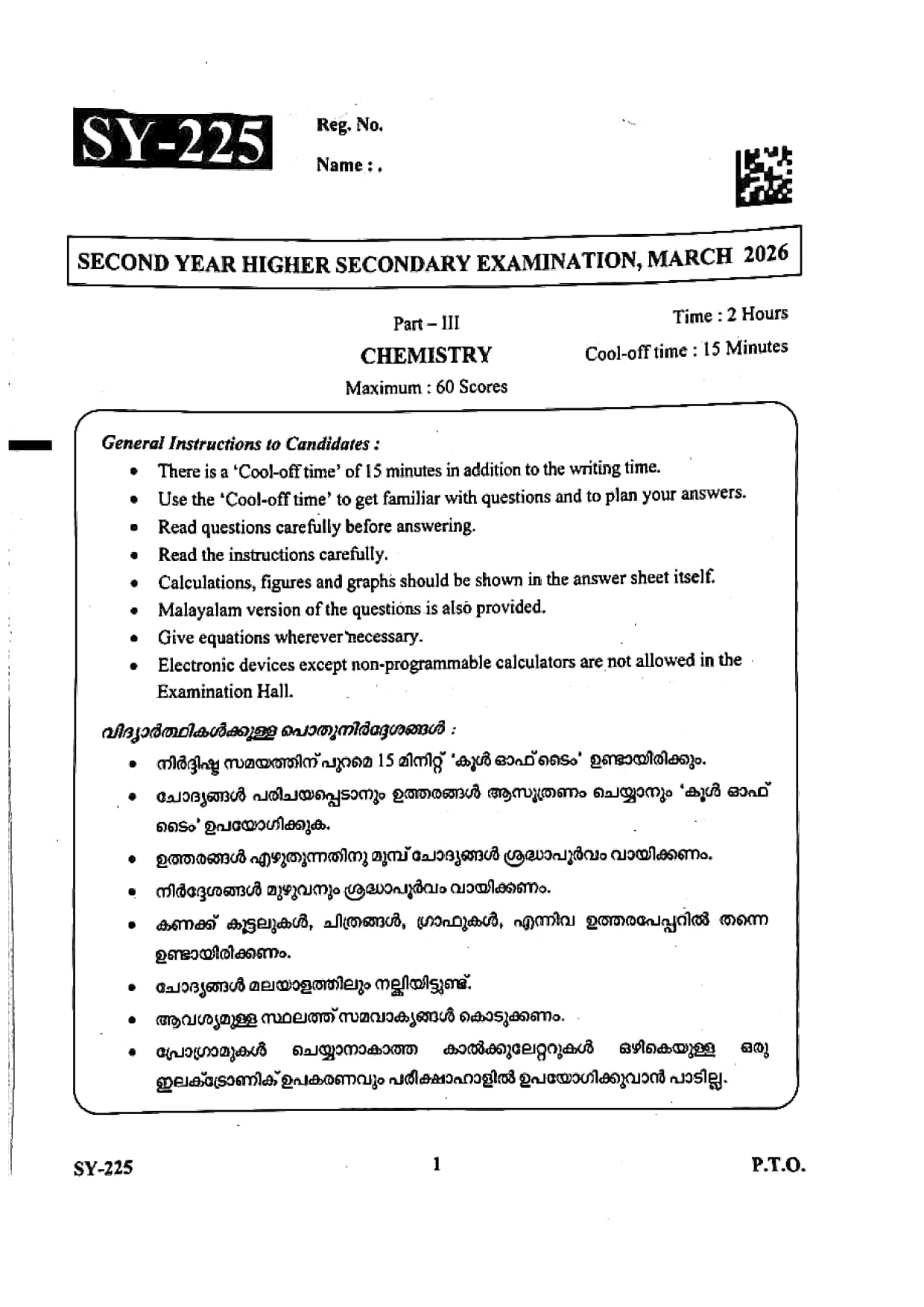
The Directorate of General Education (DGE), Kerala, successfully conducted the DHSE Plus Two Chemistry Exam 2026 on March 10, 2026. To assist students in verifying their coding logic and technical answers, the complete Kerala Board Class 12 Chemistry Question Paper with Solution PDF is now available for download.
The Kerala Board Class 12 Chemistry paper covered key topics from organic chemistry, inorganic chemistry, and physical chemistry.The official question paper of Kerala Board Class 12 Chemistry Board Exam 2026 is provided below. Students can download the official paper in PDF format for reference.
Kerala Board Class 12 2026 Chemistry Question Paper with Solution PDF
| Kerala Board Class 12 2026 Chemistry Question Paper with Solution PDF | Download PDF | Check Solution |
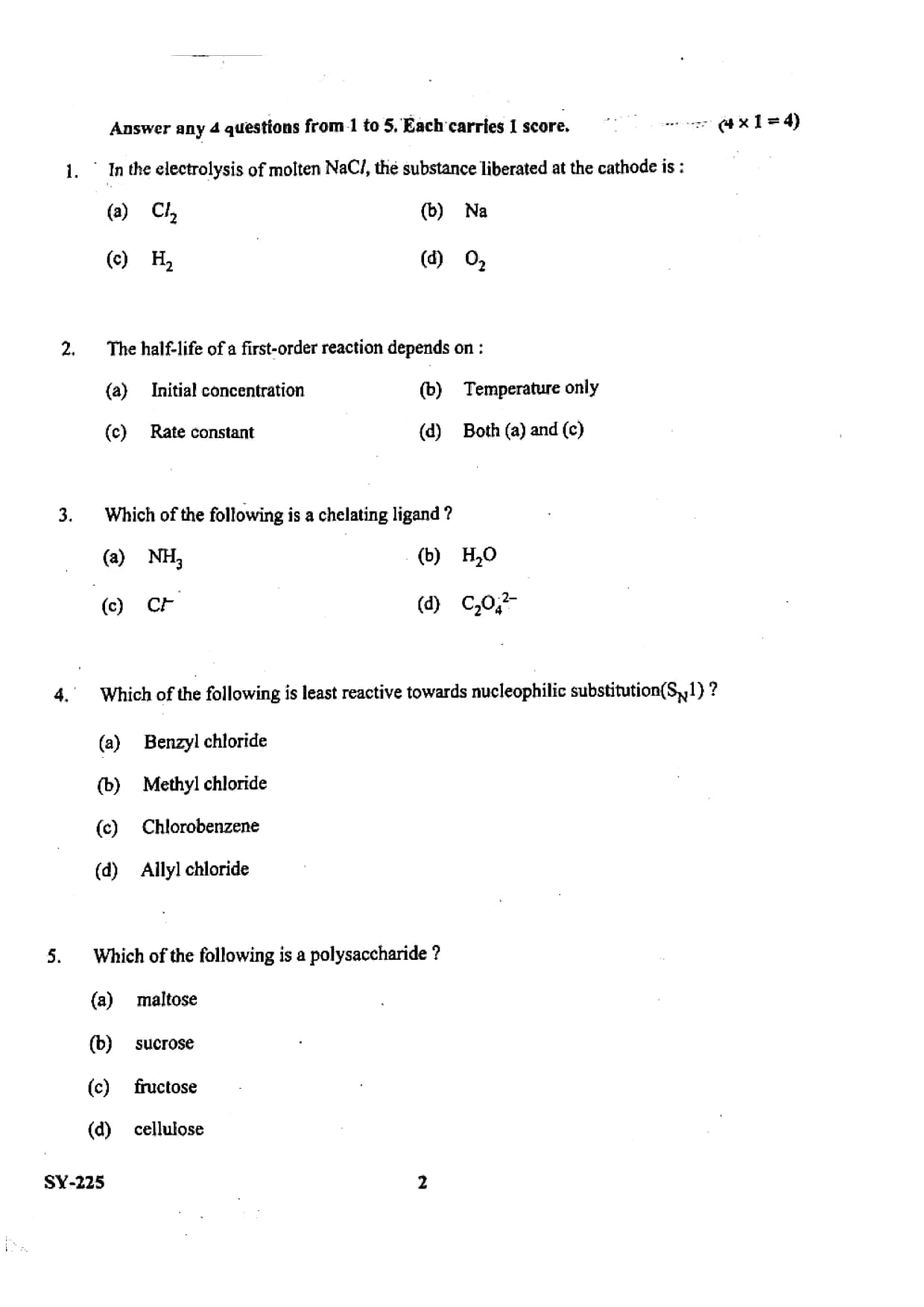
In the electrolysis of molten NaCl, the substance liberated at the cathode is:
View Solution
Concept:
Electrolysis is the process of decomposing ionic compounds into their elements by passing a direct electric current through the compound in a fluid form.
Cathode: The negative electrode where reduction (gain of electrons) occurs.
Anode: The positive electrode where oxidation (loss of electrons) occurs.
Step 1: {Identify the ions present in molten \( NaCl \).
In the molten state, Sodium Chloride dissociates into Sodium ions (\( Na+ \)) and Chloride ions (\( Cl- \)).
Step 2: {Determine the reaction at the cathode.
The positively charged cations (\( Na+ \)) migrate towards the negative electrode (cathode). At the cathode, they gain electrons (reduction) to form sodium metal: \[ Na+ + e- \rightarrow Na(l) \] Quick Tip: Remember: \textbf{An Ox} and \textbf{Red Cat}. - \textbf{An}ode = \textbf{Ox}idation (Loss of electrons) - \textbf{Red}uction = \textbf{Cat}hode (Gain of electrons) In molten salts, the metal cation always reduces to the metal at the cathode.
The half-life of a first-order reaction depends on:
View Solution
Concept:
The half-life (\( t_{1/2} \)) is the time required for the concentration of a reactant to decrease to half of its initial value.
Step 1: {Recall the formula for the half-life of a first-order reaction.
For a first-order reaction, the integrated rate law leads to the expression: \[ t_{1/2} = \frac{\ln(2)}{k} \approx \frac{0.693}{k} \]
where \( k \) is the rate constant.
Step 2: {Analyze dependencies.
From the formula, it is clear that \( t_{1/2} \) is inversely proportional to the rate constant \( k \). Notably, the initial concentration \( [A]_0 \) does not appear in the equation, meaning the half-life is independent of the starting amount. Quick Tip: For first-order reactions, the half-life is constant regardless of how much material you start with. If it takes 10 minutes for 100g to become 50g, it will also take 10 minutes for 2g to become 1g.
Which of the following is a chelating ligand?
View Solution
Concept:
A chelating ligand is a polydentate ligand that can bond to a single central metal atom through two or more donor atoms simultaneously, forming a ring structure (chelate ring).
Step 1: {Identify the denticity of the options.
\( NH_3 \) (Ammonia): Unidentate (one donor N atom).
\( H_2 O \) (Water): Unidentate (one donor O atom).
\( Cl- \) (Chloride): Unidentate (one donor Cl atom).
\( C_2 O_4{2-} \) (Oxalate): Didentate (two donor O atoms).
Step 2: {Determine the chelating agent.
Because the oxalate ion (\( C_2 O_4{2-} \)) has two donor atoms that can coordinate to the same metal ion to form a five-membered ring, it is classified as a chelating ligand. Quick Tip: Chelation generally increases the stability of a complex. Look for molecules with multiple lone pairs on different atoms that are positioned to "grab" a metal like a claw.
Which of the following is least reactive towards nucleophilic substitution (\( S_N1 \))?
View Solution
Concept: \( S_N1 \) reactivity depends on the stability of the carbocation intermediate formed after the leaving group departs.
Step 1: {Evaluate carbocation stability for each option.
Benzyl chloride: Forms a benzyl carbocation (\( C_6H_5CH_2+ \)), which is highly resonance-stabilized.
Allyl chloride: Forms an allyl carbocation (\( CH_2=CH-CH_2+ \)), which is resonance-stabilized.
Methyl chloride: Forms a methyl carbocation (\( CH_3+ \)), which is unstable but can still undergo substitution (usually via \( S_N2 \)).
Chlorobenzene: The \( C-Cl \) bond has partial double bond character due to resonance, and the phenyl carbocation (\( C_6H_5+ \)) is extremely unstable.
Step 2: {Identify the least reactive species.
Chlorobenzene is inert to nucleophilic substitution under ordinary conditions because the \( sp2 \) hybridized carbon holds the chlorine more tightly, and the resulting phenyl cation is not stabilized by resonance. Quick Tip: Aryl halides and vinyl halides are generally very unreactive toward nucleophilic substitution because the lone pair on the halogen delocalizes into the \( \pi \) system, strengthening the bond.
Which of the following is a polysaccharide?
View Solution
\
Concept:
Carbohydrates are classified into three main groups based on their complexity and the number of sugar units they contain:
Monosaccharides: The simplest form of sugar (e.g., glucose, fructose).
Disaccharides: Formed by the union of two monosaccharides (e.g., sucrose, maltose, lactose).
Polysaccharides: Complex carbohydrates made of long chains of monosaccharide units joined by glycosidic bonds (e.g., starch, glycogen, cellulose).
Analyzing the given options.\
Fructose: It is a simple sugar with the formula \(C_6H_{12}O_6\). It cannot be hydrolyzed further, making it a monosaccharide.
Maltose: It consists of two glucose units linked together. Since it is composed of two units, it is a disaccharide.
Sucrose: Common table sugar, composed of one glucose and one fructose unit. It is also a disaccharide.
Cellulose: It is a linear polymer of hundreds to thousands of D-glucose units. Because it is a long-chain macromolecule, it is classified as a polysaccharide. Quick Tip: Remember the "Big Three" polysaccharides often tested in biology and chemistry: \textbf{Starch} (Energy storage in plants) \textbf{Glycogen} (Energy storage in animals) \textbf{Cellulose} (Structural component of plant cell walls)
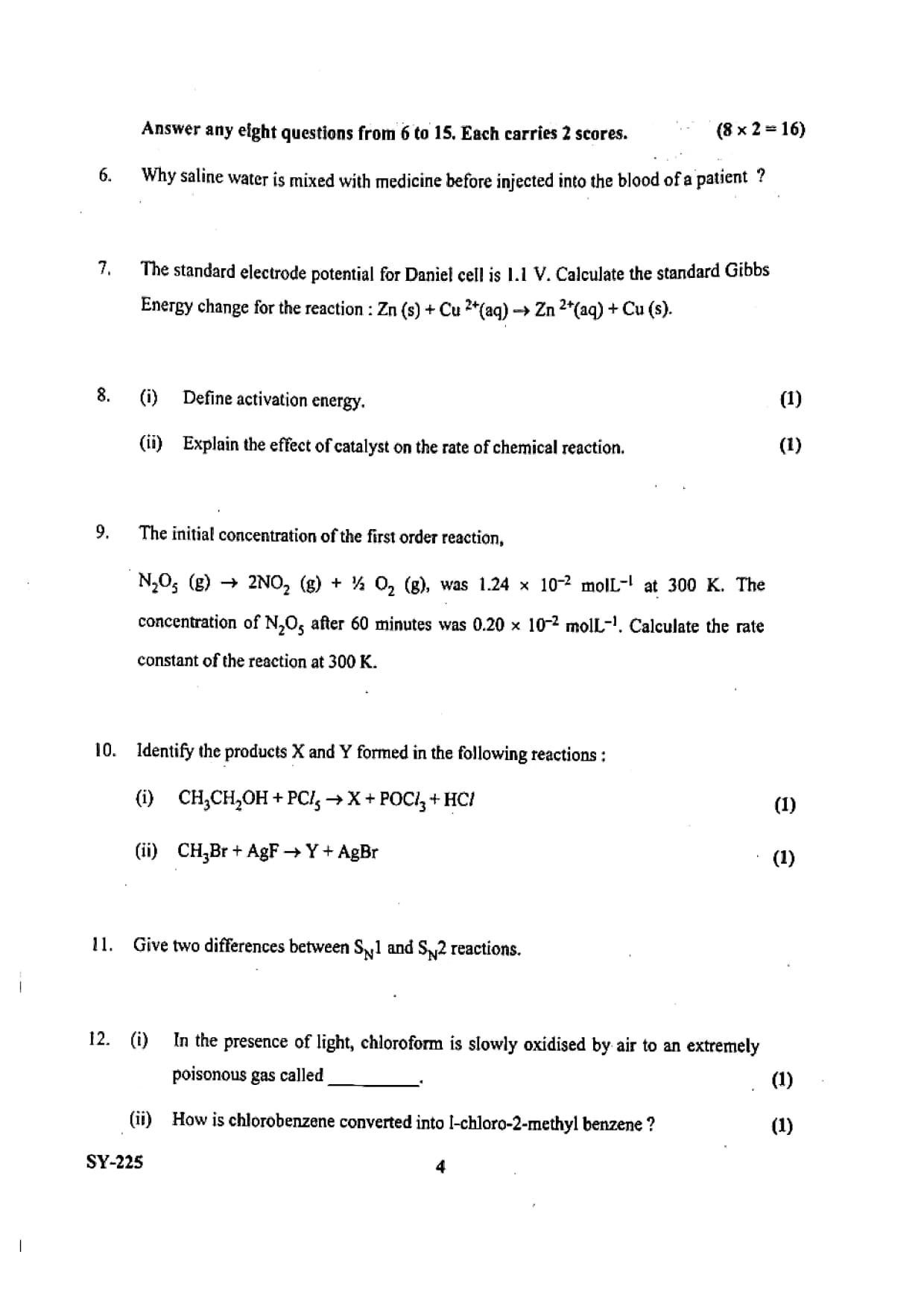
Why saline water is mixed with medicine before injected into the blood of a patient?
View Solution
\
Concept:
The process is based on the principle of Osmosis. Osmosis is the movement of solvent molecules through a semi-permeable membrane from a region of lower solute concentration to a region of higher solute concentration. For medical injections:
Isotonic Solutions: Have the same osmotic pressure as blood (\(0.9%\) w/v \(NaCl\)).
Hypotonic Solutions: Lower concentration than blood; causes cells to swell and burst (hemolysis).
Hypertonic Solutions: Higher concentration than blood; causes cells to shrink (plasmolysis).
Step 1: {Matching Osmotic Pressure.\
Human blood cells have an osmotic pressure equivalent to a \(0.9%\) (mass/volume) sodium chloride solution, commonly known as normal saline. When medicine is mixed with this saline, the resulting solution remains isotonic with the fluid inside the red blood cells.
Step 2: {Preventing Cell Damage.\
If pure water (hypotonic) were injected, water would enter the red blood cells by osmosis, causing them to swell and potentially burst. Conversely, if a highly concentrated solution (hypertonic) were injected, water would leave the cells, causing them to shrivel. Mixing with saline ensures the cells maintain their normal shape and function. Quick Tip: Normal saline (\(0.9% NaCl\)) is the "gold standard" for IV fluids because it creates an osmotic balance that prevents damage to blood cells.
The standard electrode potential for Daniell cell is 1.1 V. Calculate the standard Gibbs Energy change for the reaction: \( Zn(s) + Cu{2+}(aq) \rightarrow Zn{2+}(aq) + Cu(s) \).
View Solution
\
Concept:
The relationship between the standard Gibbs free energy change (\(\Delta G\circ\)) and the standard electromotive force (EMF) of a cell (\(E\circ_{cell}\)) is given by the formula:
\(\)\Delta G\circ = -nFE\circ_{cell\(\)
Where:
\(n\) = Number of moles of electrons transferred in the balanced chemical equation.
\(F\) = Faraday's constant (\(\approx 96487 \, \text{C/mol\) or \(96500 \, C/mol\) for simplicity).
\(E\circ_{cell}\) = Standard electrode potential of the cell.
Step 1: {Determine the number of electrons transferred (\(n\)).\
The cell reaction is: \(\) Zn(s) + \text{Cu{2+(\text{aq) \rightarrow \text{Zn{2+(\text{aq) + \text{Cu(s) \(\)
The half-reactions are:
Oxidation: \(\text{Zn(s) \rightarrow Zn{2+}(aq) + 2e-\)
Reduction: \(Cu{2+}(aq) + 2e- \rightarrow Cu(s)\)
Thus, the number of moles of electrons transferred, \(n = 2\).
Step 2: {Calculate the standard Gibbs Energy change (\(\Delta G\circ\)).\
Given: \(E\circ_{cell} = 1.1 \, V\) and \(F = 96487 \, C/mol\).
Substituting the values into the formula: \(\) \Delta G\circ = -2 \times 96487 \, C/mol \times 1.1 \, \text{V \(\) \(\) \Delta G\circ = -212271.4 \, \text{J/mol \(\)
Converting to kJ/mol: \(\) \Delta G\circ \approx -212.27 \, \text{kJ/mol \(\) Quick Tip: Always check the sign! A spontaneous redox reaction (like in a galvanic cell) must have a \textbf{positive \(E\circ_{cell}\) and a \textbf{negative} \(\Delta G\circ\). Ensure your units are consistent—usually, the formula gives Joules, so divide by 1000 to get kiloJoules.
(i) Define activation energy.
(ii) Explain the effect of catalyst on the rate of chemical reaction.
View Solution
\
Concept:
According to the Collision Theory, for a chemical reaction to occur, reactant molecules must collide with a certain minimum energy called Threshold Energy.
Activation Energy (\(E_a\)): The difference between the threshold energy and the average kinetic energy of the reactant molecules.
Catalysis: A process where a substance (catalyst) alters the reaction speed without being consumed.
Step 1: {Understanding Activation Energy.\
Reactants do not automatically turn into products upon contact. They must overcome an energy barrier.
Mathematically: \(\) Activation Energy (E_a) = \text{Threshold Energy - \text{Average energy of reactants \(\)
Step 2: {Effect of Catalyst.\
A catalyst increases the rate of a chemical reaction by participating in the reaction mechanism to provide a new "shortcut." This new pathway has a lower activation energy (\(E_{a'\)) than the uncatalyzed pathway.
Because the energy barrier is lower, a larger fraction of reactant molecules possess enough energy to cross the barrier at a given temperature, thereby increasing the reaction rate. It is important to note that a catalyst does \textit{not change the enthalpy (\(\Delta H\)) or the equilibrium constant of the reaction. Quick Tip: Think of activation energy as a "hill" that reactants must climb. A catalyst doesn't push the reactants harder; it simply lowers the height of the hill!
The initial concentration of the first order reaction, \( N_2O_5 (g) \to 2NO_2 (g) + \frac{1}{2} O_2 (g) \), was \( 1.24 \times 10{-2} mol L{-1} \) at \( 300 K \). The concentration of \( N_2O_5 \) after \( 60 minutes \) was \( 0.20 \times 10{-2} mol L{-1} \). Calculate the rate constant of the reaction at \( 300 K \).
Ro = Initial concentration of the reactant.
Rt = Concentration of the reactant at time t.
t = Time elapsed.
\textbf{Step 1:} {Identify the given values.}\ Initial concentration \( [R]_0 = 1.24 \times 10{-2} \text{ mol L}{-1} \) \ Final concentration \( [R]_t = 0.20 \times 10{-2} \text{ mol L}{-1} \) \ Time \( t = 60 \text{ minutes} \)
\textbf{Step 2:} {Apply the first-order rate equation.}\ Substituting the values into the formula: \(\) k = \frac{2.303}{60} \log \left( \frac{1.24 \times 10{-2}}{0.20 \times 10{-2}} \right) \(\) \(\) k = \frac{2.303}{60} \log (6.2) \(\)
\textbf{Step 3:} {Solve for \( k \).}\ Using \( \log(6.2) \approx 0.7924 \): \(\) k = \frac{2.303 \times 0.7924}{60} \(\) \(\) k = \frac{1.8249}{60} \(\) \(\) k = 0.030415 \text{ min}{-1} \(\)
View Solution
\
Concept:
For a first-order reaction, the rate constant \( k \) is determined by the integrated rate law: \(\) k = \frac{2.303{t \log \left( \frac{[R]_0{[R]_t \right) \(\)
Where:
Ro = Initial concentration of the reactant.
Rt = Concentration of the reactant at time t.
t = Time elapsed.
Step 1: {Identify the given values.\
Initial concentration \( [R]_0 = 1.24 \times 10{-2} mol L{-1} \) \
Final concentration \( [R]_t = 0.20 \times 10{-2} mol L{-1} \) \
Time \( t = 60 minutes \)
Step 2: {Apply the first-order rate equation.\
Substituting the values into the formula: \(\) k = \frac{2.303{60 \log \left( \frac{1.24 \times 10{-2{0.20 \times 10{-2 \right) \(\) \(\) k = \frac{2.303{60 \log (6.2) \(\)
Step 3: {Solve for \( k \).\
Using \( \log(6.2) \approx 0.7924 \): \(\) k = \frac{2.303 \times 0.7924{60 \(\) \(\) k = \frac{1.8249{60 \(\) \(\) k = 0.030415 min{-1 \(\) Quick Tip: The units of the rate constant for a first-order reaction are always \( \text{time{-1} \). Ensure your concentrations are in the same units so they cancel out inside the log term!
Identify the products X and Y formed in the following reactions:
(i) \( CH_3CH_2OH + PCl_5 \to X + POCl_3 + HCl \) \
(ii) \( CH_3Br + AgF \to Y + AgBr \)
View Solution
\
Concept:
The reactions involve the substitution of functional groups in organic compounds:
Reaction (i): Conversion of alcohols to alkyl halides using Phosphorus pentachloride (\( PCl_5 \)). The \( -OH \) group is replaced by a chlorine atom.
Reaction (ii): The Swarts Reaction, which is the standard method for synthesizing alkyl fluorides. It involves the exchange of a halogen (usually Br or Cl) with a metal fluoride (like \( AgF, Hg_2F_2, CoF_2 \)).
Step 1: {Identifying Product X.\
When ethanol (\( CH_3CH_2OH \)) reacts with \( PCl_5 \), the hydroxyl group is substituted by a chloride ion. The balanced chemical equation is: \(\) CH_3\text{CH_2\text{OH + \text{PCl_5 \to \text{CH_3\text{CH_2\text{Cl + \text{POCl_3 + \text{HCl \(\)
Thus, X is Chloroethane (Ethyl chloride).
Step 2: {Identifying Product Y.\
Methyl bromide (\( \text{CH_3Br \)) reacts with Silver fluoride (\( AgF \)) in a halogen exchange reaction. The fluorine atom replaces the bromine atom. \(\) \text{CH_3\text{Br + \text{AgF \to \text{CH_3\text{F + \text{AgBr \(\)
Thus, Y is Fluoromethane (Methyl fluoride). Quick Tip: To remember the Swarts reaction, think of it as the "F-exchange." It is specifically used because direct fluorination of alkanes is often too violent to control!
Give two differences between \( S_{N}1 \) and \( S_{N}2 \) reactions.
View Solution
\
Concept:
Nucleophilic substitution reactions (\( S_{N} \)) are classified based on their kinetics and mechanism:
\( S_{N}1 \) (Substitution Nucleophilic Unimolecular): The rate depends only on the concentration of the substrate.
\( S_{N}2 \) (Substitution Nucleophilic Bimolecular): The rate depends on the concentration of both the substrate and the nucleophile.
Step 1: {Comparing the mechanism and kinetics.\
The key differences can be summarized as follows:
\begin{table[h]
\centering
\begin{tabular{|l|l|l|
\hline
Feature & \( S_{N}1 \) Reaction & \( S_{N}2 \) Reaction \ \hline
Number of Steps & Two-step process. & Single-step (concerted) process. \ \hline
Intermediate & Involves a carbocation intermediate. & Involves a transition state only. \ \hline
Kinetics (Order) & First order: Rate = \( k[RX] \). & Second order: Rate = \( k[RX][Nu-] \). \ \hline
Stereochemistry & Results in racemization. & Results in Walden Inversion. \ \hline
\end{tabular
\end{table
Step 2: {Reactivity order.\
Due to the stability of intermediates and steric hindrance:
\( S_{N}1 \) preference: Tertiary (\(3\circ\)) > Secondary (\(2\circ\)) > Primary (\(1\circ\)).
\( S_{N}2 \) preference: Primary (\(1\circ\)) > Secondary (\(2\circ\)) > Tertiary (\(3\circ\)). Quick Tip: To remember which is which: \( S_{N}1 \) has 1 reactant in the rate-determining step but 2 steps. \( S_{N}2 \) has 2 reactants in the rate-determining step but only 1 step!
(i) In the presence of light, chloroform is slowly oxidised by air to an extremely poisonous gas called ________.
(ii) How is chlorobenzene converted into 1-chloro-2-methyl benzene?
View Solution
\
Concept:
The question covers the chemical stability of haloalkanes and the electrophilic substitution of haloarenes:
Oxidation of Chloroform: Chloroform (\(CHCl_3\)) is sensitive to light and air, undergoing a radical reaction to form a toxic gas.
Friedel-Crafts Alkylation: An electrophilic substitution reaction where an alkyl group is introduced into the benzene ring in the presence of a Lewis acid catalyst.
Step 1: {Oxidation of Chloroform.\
Chloroform reacts with atmospheric oxygen in the presence of light to produce Phosgene (\(COCl_2\)), which is highly toxic. \(\) 2CHCl_3 + \text{O_2 \xrightarrow{\text{light 2\text{COCl_2 + 2\text{HCl \(\)
To prevent this, chloroform is stored in dark-colored bottles and often mixed with a small amount of ethanol, which converts phosgene into harmless diethyl carbonate.
Step 2: {Conversion of Chlorobenzene.\
To convert chlorobenzene into 1-chloro-2-methyl benzene (o-chlorotoluene), we use methyl chloride in the presence of anhydrous \(\text{AlCl_3\). Since the chlorine atom on the ring is ortho-para directing, a mixture of ortho and para isomers is formed. \(\) C_6\text{H_5\text{Cl + \text{CH_3\text{Cl \xrightarrow{\text{anh. AlCl_3 \text{o-chlorotoluene + \text{p-chlorotoluene \(\)
1-chloro-2-methyl benzene is the ortho product. Quick Tip: Remember: Friedel-Crafts reactions require a \textbf{Lewis acid catalyst like anhydrous \(AlCl_3\) to generate the electrophile (\(CH_3+\) in this case).
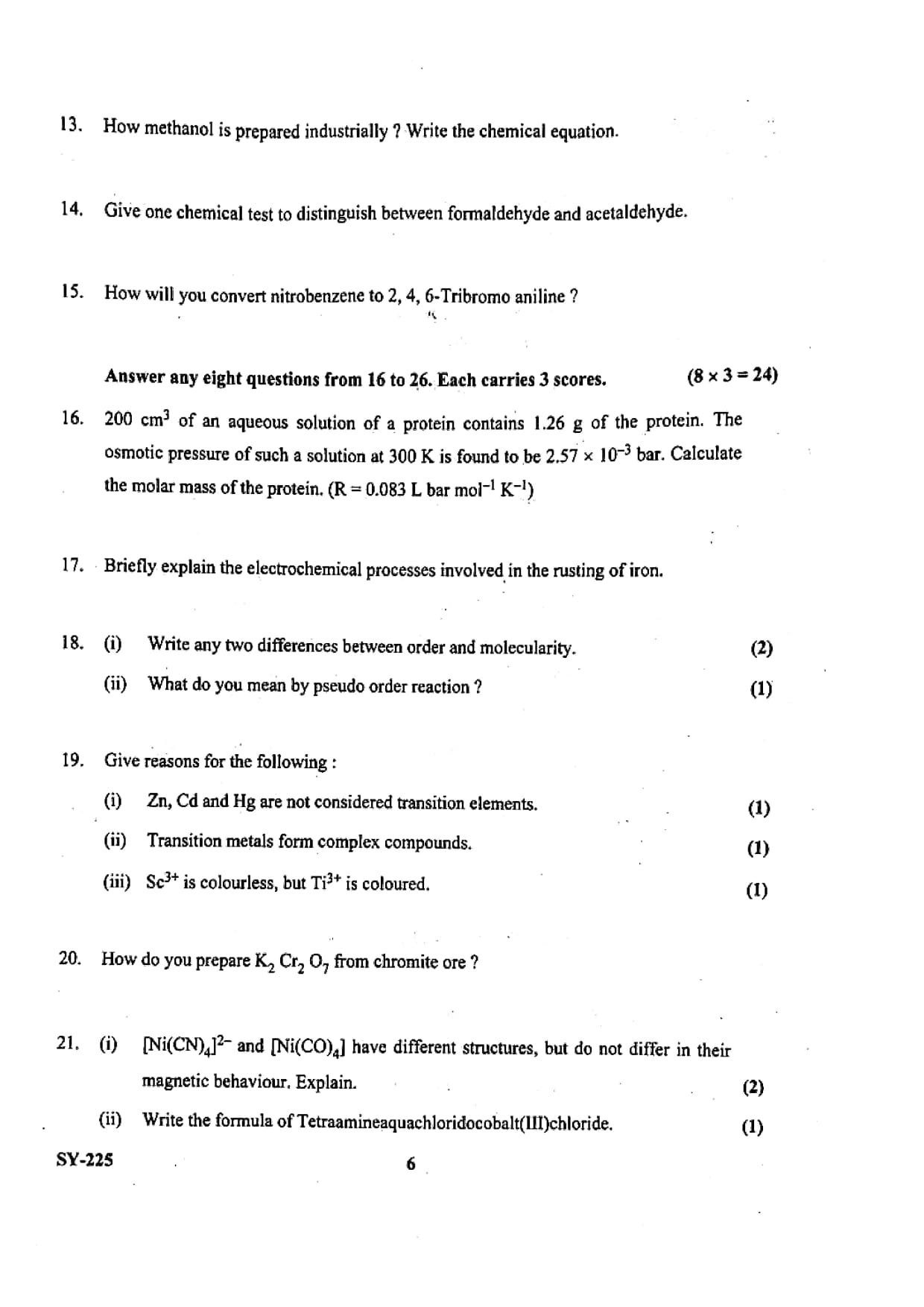
How methanol is prepared industrially? Write the chemical equation.
View Solution
\
Concept:
The industrial production of methanol (\(CH_3OH\)), also known as wood spirit, involves a high-pressure, high-temperature reaction between synthesis gas (\(CO + H_2\)).
Chemical Equation.\
Carbon monoxide reacts with hydrogen gas in the presence of a specific catalyst: \(\) CO + 2\text{H_2 \xrightarrow[\text{200--300 atm]{\text{ZnO--Cr_2\text{O_3, \text{ 573--673 K \text{CH_3\text{OH \(\) Quick Tip: Remember the catalyst: Zinc oxide and Chromium oxide (\(\text{ZnO--Cr_2O_3\)) are essential for this reaction to proceed efficiently at industrial scales.
Give one chemical test to distinguish between formaldehyde and acetaldehyde.
View Solution
\
Concept:
The iodoform test is specific to compounds containing a methyl ketone group (\(CH_3CO-\)) or an alcohol that can be oxidized to one.
Formaldehyde (\(HCHO\)): Does not have a methyl group attached to the carbonyl carbon.
Acetaldehyde (\(CH_3CHO\)): Contains the required methyl group.
Performing the Test.\
When reacted with iodine (\(I_2\)) in the presence of sodium hydroxide (\(NaOH\)):
Acetaldehyde gives a yellow precipitate of iodoform (\(CHI_3\)). \(\) CH_3\text{CHO + 3\text{I_2 + 4\text{NaOH \to \text{CHI_3 \downarrow (\text{yellow) + \text{HCOONa + 3\text{NaI + 3\text{H_2\text{O \(\)
Formaldehyde does not react and gives no precipitate. Quick Tip: Acetaldehyde is the \textbf{only aldehyde that gives a positive iodoform test!
How will you convert nitrobenzene to 2, 4, 6-Tribromo aniline?
View Solution
\
Concept:
This conversion requires two distinct chemical transformations:
Reduction of the nitro group (\(-NO_2\)) to an amino group (\(-NH_2\)).
Electrophilic aromatic substitution to add three bromine atoms.
Step 1: {Reduction to Aniline.\
Nitrobenzene is reduced using tin and hydrochloric acid (\(Sn/HCl\)) or iron and hydrochloric acid (\(Fe/HCl\)). \(\) C_6\text{H_5\text{NO_2 + 6[\text{H] \xrightarrow{\text{Sn/HCl \text{C_6\text{H_5\text{NH_2 + 2\text{H_2\text{O \(\)
Step 2: {Bromination of Aniline.\
Aniline is highly reactive due to the resonance effect of the \(\text{-NH_2\) group. Treating it with bromine water (\(Br_2/H_2O\)) results in instantaneous substitution at all available ortho and para positions. \(\) \text{C_6\text{H_5\text{NH_2 + 3\text{Br_2 \xrightarrow{\text{H_2\text{O \text{2,4,6-Tribromoaniline \downarrow (\text{white ppt) + 3\text{HBr \(\) Quick Tip: The amino group is such a strong activator that you don't need a Lewis acid catalyst for bromination; bromine water alone is enough to triple-substitute!
\(200 cm3\) of an aqueous solution of a protein contains \(1.26 g\) of the protein. The osmotic pressure of such a solution at \(300 K\) is found to be \(2.57 \times 10{-3} bar\). Calculate the molar mass of the protein. (\(R = 0.083 L bar mol{-1} K{-1}\))
\textbf{Step 1:} {Convert units to match the Gas Constant.}\ Volume \(V = 200\text{ cm}3 = 0.200\text{ L}\) \ Pressure \(\pi = 2.57 \times 10{-3}\text{ bar}\)
\textbf{Step 2:} {Calculate Molar Mass (\(M_2\)).}\ Rearranging the formula: \(M_2 = \frac{w_2 \times R \times T}{\pi \times V}\)
\(\) M_2 = \frac{1.26 \times 0.083 \times 300}{2.57 \times 10{-3} \times 0.200} \(\) \(\) M_2 = \frac{31.374}{0.000514} \approx 61,038.9\text{ g/mol} \(\)
View Solution
\
Concept:
Osmotic pressure (\(\pi\)) is a colligative property related to the molarity of the solution. The formula is: \(\) \pi = CRT = \frac{n{VRT = \frac{w_2 \times R \times T{M_2 \times V \(\)
Where:
\(w_2\) = mass of solute (\(1.26 g\))
\(V\) = volume of solution in Litres
\(M_2\) = molar mass of solute
\(R\) = gas constant (\(0.083 L bar mol{-1} K{-1}\))
\(T\) = temperature (\(300 K\))
Step 1: {Convert units to match the Gas Constant.\
Volume \(V = 200 cm3 = 0.200 L\) \
Pressure \(\pi = 2.57 \times 10{-3} bar\)
Step 2: {Calculate Molar Mass (\(M_2\)).\
Rearranging the formula: \(M_2 = \frac{w_2 \times R \times T}{\pi \times V}\)
\(\) M_2 = \frac{1.26 \times 0.083 \times 300{2.57 \times 10{-3 \times 0.200 \(\) \(\) M_2 = \frac{31.374{0.000514 \approx 61,038.9\text{ g/mol \(\) Quick Tip: Osmotic pressure is the preferred method for determining the molar mass of macromolecules like proteins because the pressure changes are measurable even at very low molar concentrations.
Briefly explain the electrochemical processes involved in the rusting of iron.
View Solution
\
Concept:
Rusting occurs at the surface of iron when it comes into contact with moisture and oxygen, forming an electrochemical cell.
Step 1: {At the Anode.\
Iron atoms lose electrons and are oxidized to ferrous ions: \(\) Anode: \text{Fe(s) \to \text{Fe{2+(aq) + 2e- \quad (E\circ = -0.44\text{ V) \(\)
Step 2: {At the Cathode.\
Electrons move through the metal to another spot where they reduce oxygen in the presence of \(H+\) ions (from \(\text{H_2CO_3\) formed by dissolved \(CO_2\)): \(\) \text{Cathode: \text{O_2(g) + 4H+(aq) + 4e- \to 2\text{H_2\text{O(l) \quad (E\circ = 1.23\text{ V) \(\)
Step 3: {Formation of Rust.\
The ferrous ions are further oxidized by atmospheric oxygen to ferric ions, which deposit as hydrated ferric oxide (rust): \(\) 2\text{Fe{2+ + 2\text{H_2\text{O + \frac{1{2\text{O_2 \to \text{Fe_2\text{O_3 + 4H+ \(\) \(\) \text{Rust: \text{Fe_2\text{O_3 \cdot x\text{H_2\text{O \(\) Quick Tip: Rusting is accelerated by the presence of electrolytes (like salt in seawater) because they increase the conductivity of the aqueous film on the metal surface.
(i) Write any two differences between order and molecularity. \
(ii) What do you mean by pseudo order reaction?
View Solution
\
Concept:
Order and molecularity describe different aspects of a reaction's mechanism. Pseudo-order reactions occur when the concentration of one reactant remains effectively constant.
Step 1: {Differences between Order and Molecularity.\
\begin{table[h]
\centering
\begin{tabular{|l|l|
\hline
Order of Reaction & Molecularity \ \hline
Sum of powers of concentration in rate law. & Number of reacting species in elementary step. \ \hline
Determined experimentally. & Theoretical concept. \ \hline
Can be zero or fractional. & Always a natural whole number (\(1, 2, 3\)). \ \hline
\end{tabular
\end{table
Step 2: {Pseudo First Order Reaction.\
Consider the hydrolysis of cane sugar: \(\) C_{12\text{H_{22\text{O_{11 + \text{H_2\text{O \xrightarrow{H+ \text{C_6\text{H_{12\text{O_6 + \text{C_6\text{H_{12\text{O_6 \(\)
Although the molecularity is \(2\), water is present in such large excess that its concentration does not change significantly. The rate depends only on the sugar concentration: \(\) \text{Rate = k[\text{C_{12\text{H_{22\text{O_{11] \(\)
Such reactions are called pseudo first order reactions. Quick Tip: Molecularity is only defined for \textbf{elementary (single-step) reactions, whereas order applies to both elementary and complex reactions.
Give reasons for the following:
(i) Zn, Cd and Hg are not considered transition elements.
(ii) Transition metals form complex compounds.
(iii) Sc({3+}) is colourless, but Ti({3+}) is coloured.
View Solution
\
Concept:
Transition elements are defined as elements which have incompletely filled \(d\)-orbitals in their ground state or in any of their oxidation states. The presence of unpaired electrons in \(d\)-orbitals governs their color and complex-forming ability.
Step 1: {Electronic configuration of Group 12 elements.\
Zn, Cd, and Hg have the general electronic configuration \((n-1)d{10} ns2\). Since their \(d\)-orbitals are completely filled in both their atomic state and their common ionic state (\(M{2+}\)), they do not fit the definition of transition elements.
Step 2: {Complex formation.\
Transition metals form complexes because:
They have small ionic sizes and high nuclear charges, which attract ligands.
They possess vacant \(d\)-orbitals of appropriate energy to accept lone pairs of electrons from ligands.
Step 3: Color in \( Sc{3+} \) vs \( Ti{3+} \).
The color of transition metal ions is typically due to **\( d-d \) transitions**. When ligands approach the central metal ion, the degenerate \( d \)-orbitals split into different energy levels (typically \( t_{2g} \) and \( e_g \) in octahedral fields).
\( Sc{3+} \): The electronic configuration is \( [Ar] 3d0 \). Since there are no electrons in the \( d \)-orbitals, no electron can be promoted to a higher energy \( d \)-level. Therefore, no light is absorbed in the visible region, making the ion colourless.
\( Ti{3+} \): The electronic configuration is \( [Ar] 3d1 \). The single electron occupies a lower energy \( d \)-orbital. It can absorb a photon of visible light and be excited to a higher energy \( d \)-orbital.
This absorption of specific wavelengths (green and yellow) results in the transmitted light appearing purple or violet. Quick Tip: To have a colored ion via \( d-d \) transitions, the metal must have a partially filled \( d \)-subshell (\( d1 \) to \( d9 \)). Ions with \( d0 \) (like \( Sc{3+}, Ti{4+} \)) or \( d{10} \) (like \( Zn{2+}, Cu+ \)) configurations are generally colourless.
How do you prepare K(_2)Cr(_2)O(_7) from chromite ore?
View Solution
\
Concept:
The industrial preparation involves three main steps:
Preparation of Sodium Chromate.
Conversion of Sodium Chromate to Sodium Dichromate.
Conversion of Sodium Dichromate to Potassium Dichromate.
Step 1: {Preparation of Sodium Chromate.\
Chromite ore (\(FeCr_2O_4\)) is fused with sodium carbonate in free access of air: \(\) 4FeCr_2\text{O_4 + 8\text{Na_2\text{CO_3 + 7\text{O_2 \to 8\text{Na_2\text{CrO_4 + 2\text{Fe_2\text{O_3 + 8\text{CO_2 \(\)
Step 2: {Conversion to Sodium Dichromate.\
The yellow solution of sodium chromate is filtered and acidified with sulphuric acid: \(\) 2\text{Na_2\text{CrO_4 + \text{H_2\text{SO_4 \to \text{Na_2\text{Cr_2\text{O_7 + \text{Na_2\text{SO_4 + \text{H_2\text{O \(\)
Step 3: {Conversion to Potassium Dichromate.\
Sodium dichromate is treated with potassium chloride. Potassium dichromate, being less soluble, crystallizes out: \(\) \text{Na_2\text{Cr_2\text{O_7 + 2\text{KCl \to \text{K_2\text{Cr_2\text{O_7 + 2\text{NaCl \(\) Quick Tip: Remember the color changes as a guide for the steps: \textbf{Chromite Ore (Brown/Black) \(\to\) \textbf{Chromate} (Yellow) \(\to\) \textbf{Dichromate} (Orange).
Also, note that the conversion of chromate to dichromate is a reversible pH-dependent process: chromate is stable in basic medium, while dichromate is stable in acidic medium.
(i) [suspicious link removed] and [Ni(CO)(_4)] have different structures, but do not differ in their magnetic behaviour. Explain. \
(ii) Write the formula of Tetraamineaquachloridocobalt(III)chloride.
View Solution
\
Concept:
Valence Bond Theory (VBT) explains the geometry and magnetic properties based on hybridization. Strong field ligands (CN(-), CO) cause pairing of electrons.
Step 1: {Analyzing [suspicious link removed].\
2-]
Ni is in +2 state (\(3d8\)). CN(-) is a strong field ligand and pairs the \(3d\) electrons, leaving one \(3d\) orbital vacant. Hybridization is \(dsp2\) (Square Planar). Since all electrons are paired, it is diamagnetic.
Step 2: {Analyzing [Ni(CO)(_4)].\
]
Ni is in 0 oxidation state (\(3d8 4s2\)). Strong field ligand CO forces \(4s\) electrons into \(3d\) orbitals, resulting in a \(3d{10}\) configuration. Hybridization is \(sp3\) (Tetrahedral). Since all electrons are paired, it is also diamagnetic.
Step 3: {Writing the Coordination Formula.\
Central metal: Cobalt (Co)
Ligands: 4 Ammine (\(NH_3\)), 1 Aqua (\(H_2O\)), 1 Chlorido (\(Cl\))
Oxidation state of Co is +3. Total charge inside bracket: \(+3 + 4(0) + 1(0) + 1(-1) = +2\).
To balance \(+2\), we need 2 Chloride ions outside.
Formula: \([Co(NH_3)_4(H_2O)Cl]Cl_2\) Quick Tip: Strong field ligands like CN(-) and CO almost always result in diamagnetic complexes with Nickel by forcing electron pairing!
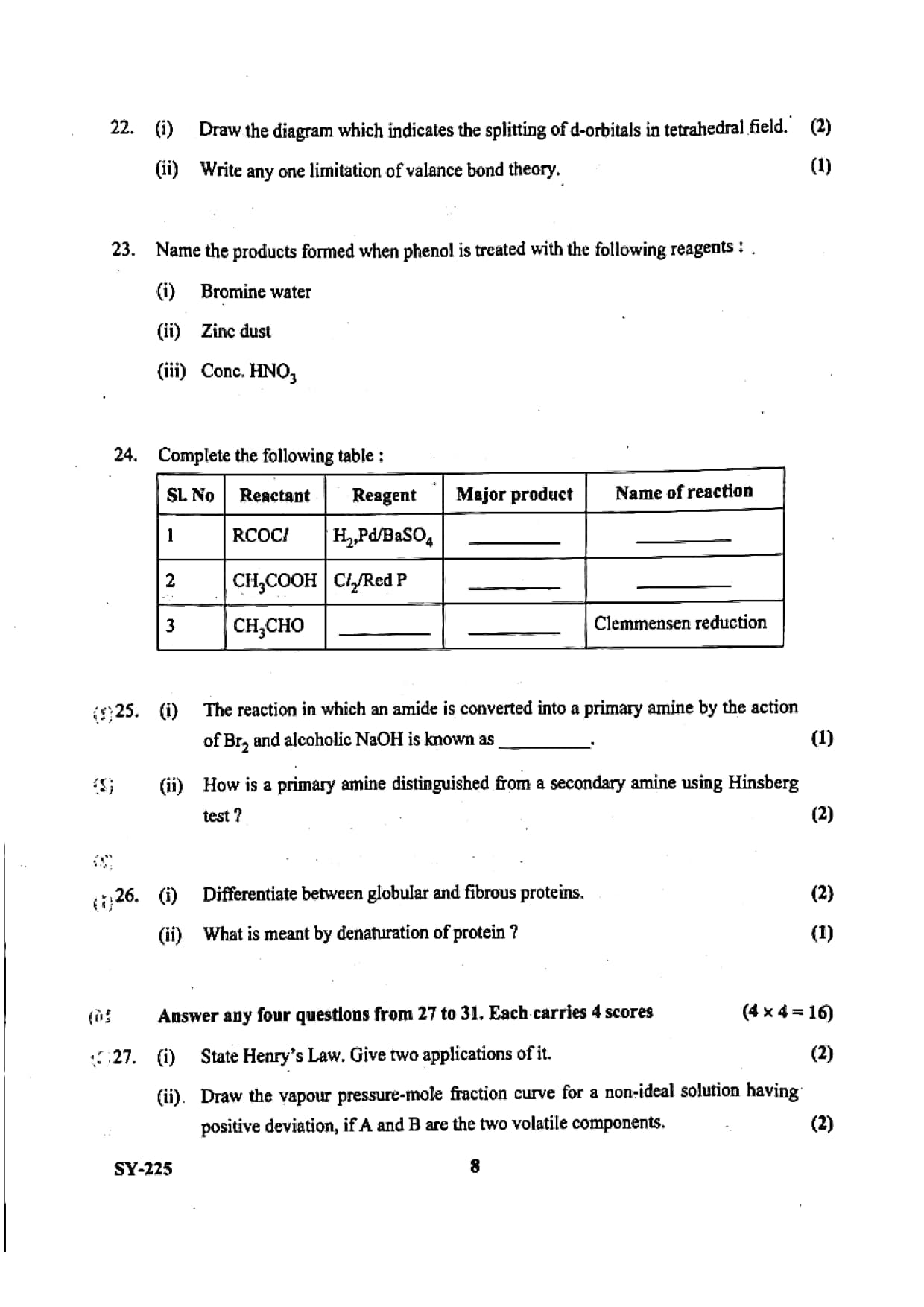
(i) Draw the diagram which indicates the splitting of d-orbitals in tetrahedral field. \
(ii) Write any one limitation of valence bond theory.
(i) In a tetrahedral field, the five \(d\)-orbitals split into two groups: lower energy \(e\) set (\(d_{x^2-y^2}, d_{z^2}\)) and higher energy \(t_2\) set (\(d_{xy}, d_{yz}, d_{zx}\)).
(ii) One limitation of Valence Bond Theory is that it fails to explain the colour exhibited by coordination compounds.
View Solution
Concept:
According to Crystal Field Theory (CFT), when ligands approach a metal ion, the degeneracy of the \(d\)-orbitals is removed due to electrostatic interactions between ligands and the \(d\)-electrons.
In a tetrahedral complex, ligands approach between the coordinate axes, resulting in a specific pattern of orbital splitting.
Step 1: {\color{redSplitting of d-orbitals in Tetrahedral Field.
In a tetrahedral field, the orbitals pointing between the axes experience greater repulsion and therefore have higher energy.
\[ \begin{array}{c} t_2 \,(d_{xy}, d_{yz}, d_{zx})
\hline \Delta_t
\hline e \,(d_{x^2-y^2}, d_{z^2}) \end{array} \]
The \(t_2\) orbitals (\(d_{xy}, d_{yz}, d_{zx}\)) experience greater repulsion and are raised in energy.
The \(e\) orbitals (\(d_{x^2-y^2}, d_{z^2}\)) experience less repulsion and remain at lower energy.
Thus, the splitting results in a higher energy \(t_2\) set and a lower energy \(e\) set.
Step 2: {\color{redLimitation of Valence Bond Theory (VBT).
Valence Bond Theory explains the geometry and magnetic properties of coordination compounds but has certain limitations.
One important limitation is:
It cannot explain the colour of coordination compounds.
This limitation arises because VBT does not account for the splitting of \(d\)-orbitals and electronic transitions responsible for colour. Quick Tip: \textbf{Key Points:} Tetrahedral splitting: \(e\) (lower energy) and \(t_2\) (higher energy). In tetrahedral complexes: \(\Delta_t < \Delta_o\). VBT explains geometry and magnetism but fails to explain colour and spectra of complexes.
Name the products formed when phenol is treated with the following reagents: \
(i) Bromine water \
(ii) Zinc dust \
(iii) Conc. \( HNO_3 \)
(i) 2,4,6-Tribromophenol
(ii) Benzene
(iii) 2,4,6-Trinitrophenol (Picric acid)
View Solution
Concept:
Phenol is highly reactive towards electrophilic substitution reactions because the hydroxyl group activates the benzene ring and directs incoming groups to the ortho and para positions.
Step 1: {\color{redReaction with Bromine Water.
Phenol reacts readily with bromine water at room temperature to form a white precipitate of 2,4,6-tribromophenol.
\[ C_6H_5OH + 3Br_2 \rightarrow C_6H_2Br_3OH + 3HBr \]
Thus, the product formed is 2,4,6-tribromophenol.
Step 2: {\color{redReaction with Zinc Dust.
When phenol is heated with zinc dust, the oxygen atom is removed and phenol is reduced to benzene.
\[ C_6H_5OH + Zn \xrightarrow{\Delta} C_6H_6 + ZnO \]
Hence, the product formed is benzene.
Step 3: {\color{redReaction with Concentrated Nitric Acid.
Phenol undergoes nitration with concentrated nitric acid to form 2,4,6-trinitrophenol, commonly known as picric acid.
\[ C_6H_5OH + 3HNO_3 \rightarrow C_6H_2(NO_2)_3OH + 3H_2O \]
Thus, the product obtained is 2,4,6-trinitrophenol (picric acid). Quick Tip: \textbf{Important Reactions of Phenol:} Bromine water → 2,4,6-Tribromophenol (white precipitate) Zinc dust → Benzene Conc. \(HNO_3\) → 2,4,6-Trinitrophenol (Picric acid) The \textbf{–OH group activates the benzene ring} and directs substitution mainly to \textbf{ortho and para positions}.
Complete the following table:
\begin{table[h]
\centering
\begin{tabular{|l|l|l|l|l|
\hline
Sl. No & Reactant & Reagent & Major product & Name of reaction
\hline
1 & \(RCOCl\) & \(H_2, Pd/BaSO_4\) & \(RCHO\) & Rosenmund Reduction
\hline
2 & \(CH_3COOH\) & \(Cl_2/Red P\) & \(Cl-CH_2COOH\) & HVZ Reaction
\hline
3 & \(CH_3CHO\) & \(Zn-Hg/conc. HCl\) & \(CH_3CH_3\) & Clemmensen Reduction
\hline
\end{tabular
\end{table
View Solution
Concept:
Several named reactions are used in organic chemistry to convert functional groups into other useful compounds. The given reactions represent important transformations of carboxylic acid derivatives and carbonyl compounds.
Step 1: {\color{redRosenmund Reduction.
In this reaction, an acid chloride is reduced to an aldehyde using hydrogen gas in the presence of a poisoned palladium catalyst (\(Pd/BaSO_4\)).
\[ RCOCl \xrightarrow{H_2, Pd/BaSO_4} RCHO \]
Step 2: {\color{redHell–Volhard–Zelinsky (HVZ) Reaction.
Carboxylic acids containing an \(\alpha\)-hydrogen react with chlorine in the presence of red phosphorus to form \(\alpha\)-halogenated carboxylic acids.
\[ CH_3COOH \xrightarrow{Cl_2/Red P} Cl-CH_2COOH \]
Step 3: {\color{redClemmensen Reduction.
In this reaction, aldehydes or ketones are reduced to hydrocarbons using zinc amalgam (\(Zn-Hg\)) and concentrated hydrochloric acid.
\[ CH_3CHO \xrightarrow{Zn-Hg/conc. HCl} CH_3CH_3 \] Quick Tip: \textbf{Important Named Reactions:} Rosenmund Reduction: Acid chloride → Aldehyde HVZ Reaction: \(\alpha\)-Halogenation of carboxylic acids Clemmensen Reduction: Aldehyde/Ketone → Hydrocarbon These reactions are widely used in organic synthesis to modify functional groups.
(i) The reaction in which an amide is converted into a primary amine by the action of \( Br_2 \) and alcoholic \( NaOH \) is known as ________. \
(ii) How is a primary amine distinguished from a secondary amine using Hinsberg test?
View Solution
\
Step 1: {Hinsberg Test Principle.\
Amines react with benzenesulphonyl chloride (\(C_6H_5SO_2Cl\)).
Primary Amines: Form N-alkylbenzenesulphonamide. The hydrogen attached to nitrogen is strongly acidic due to the electron-withdrawing sulphonyl group, making it soluble in alkali.
Secondary Amines: Form N,N-dialkylbenzenesulphonamide. There is no acidic hydrogen on the nitrogen, so it remains insoluble in alkali. Quick Tip: In Hoffmann Bromamide Degradation, the resulting amine always has \textbf{one carbon atom less} than the starting amide!
(i) Differentiate between globular and fibrous proteins. \
(ii) What is meant by denaturation of protein?
(i) Fibrous proteins are long, thread-like and generally insoluble in water, whereas globular proteins are spherical and usually soluble in water.
(ii) Denaturation of protein is the process in which a protein loses its native structure and biological activity due to physical or chemical changes.
View Solution
Concept:
Proteins are macromolecules made up of amino acids linked by peptide bonds.
Based on their molecular shape and structure, proteins are mainly classified into fibrous proteins and globular proteins.
The biological activity of proteins depends on their specific three-dimensional structure called the native structure.
Step 1: {\color{redDifference between Fibrous and Globular Proteins.
\begin{tabular{|l|l|l|
\hline
Feature & Fibrous Proteins & Globular Proteins
\hline
Shape & Long, thread-like structure & Spherical or globular structure
\hline
Solubility & Insoluble in water & Usually soluble in water
\hline
Function & Structural role & Functional or metabolic role
\hline
Examples & Keratin, Collagen, Myosin & Insulin, Albumin, Hemoglobin
\hline
\end{tabular
Step 2: {\color{redDenaturation of Proteins.
Denaturation refers to the loss of the natural structure and biological activity of a protein when it is subjected to physical or chemical changes such as:
High temperature
Change in pH
Presence of chemicals or heavy metal ions
During denaturation:
The secondary and tertiary structures of the protein are destroyed.
The primary structure remains intact.
The protein loses its biological activity.
Example: Coagulation of egg white when heated. Quick Tip: \textbf{Key Points:} Fibrous proteins → Structural and insoluble. Globular proteins → Functional and soluble. Denaturation destroys secondary and tertiary structures but not the primary structure.
(i) State Henry’s Law. Give two applications of it. \
(ii) Draw the vapour pressure-mole fraction curve for a non-ideal solution having positive deviation, if A and B are the two volatile components.
View Solution
Step 1: {Henry's Law Definition and Formula.
Henry's Law states that at a constant temperature, the solubility of a gas in a liquid is directly proportional to the partial pressure of the gas present above the surface of the liquid or solution.
\(\) p = K_H \cdot x \(\)
Where \(p\) is the partial pressure, \(x\) is the mole fraction of the gas in solution, and \(K_H\) is the Henry's law constant.
Step 2: {Applications of Henry's Law.\
Soft Drinks: To increase the solubility of \(CO_2\) in soft drinks and soda water, the bottle is sealed under high pressure.
Scuba Diving: To avoid "the bends" (painful nitrogen bubbles in blood), scuba divers use tanks filled with air diluted with Helium, which is less soluble in blood.
Step 3: {Positive Deviation Curve.\
In solutions showing positive deviation, A-B interactions are weaker than A-A or B-B interactions. This causes the vapour pressure of each component, and the total vapour pressure, to be higher than that expected from Raoult's Law. Quick Tip: Positive deviation usually leads to the formation of a minimum boiling azeotrope, where the solution boils at a lower temperature than either pure component!
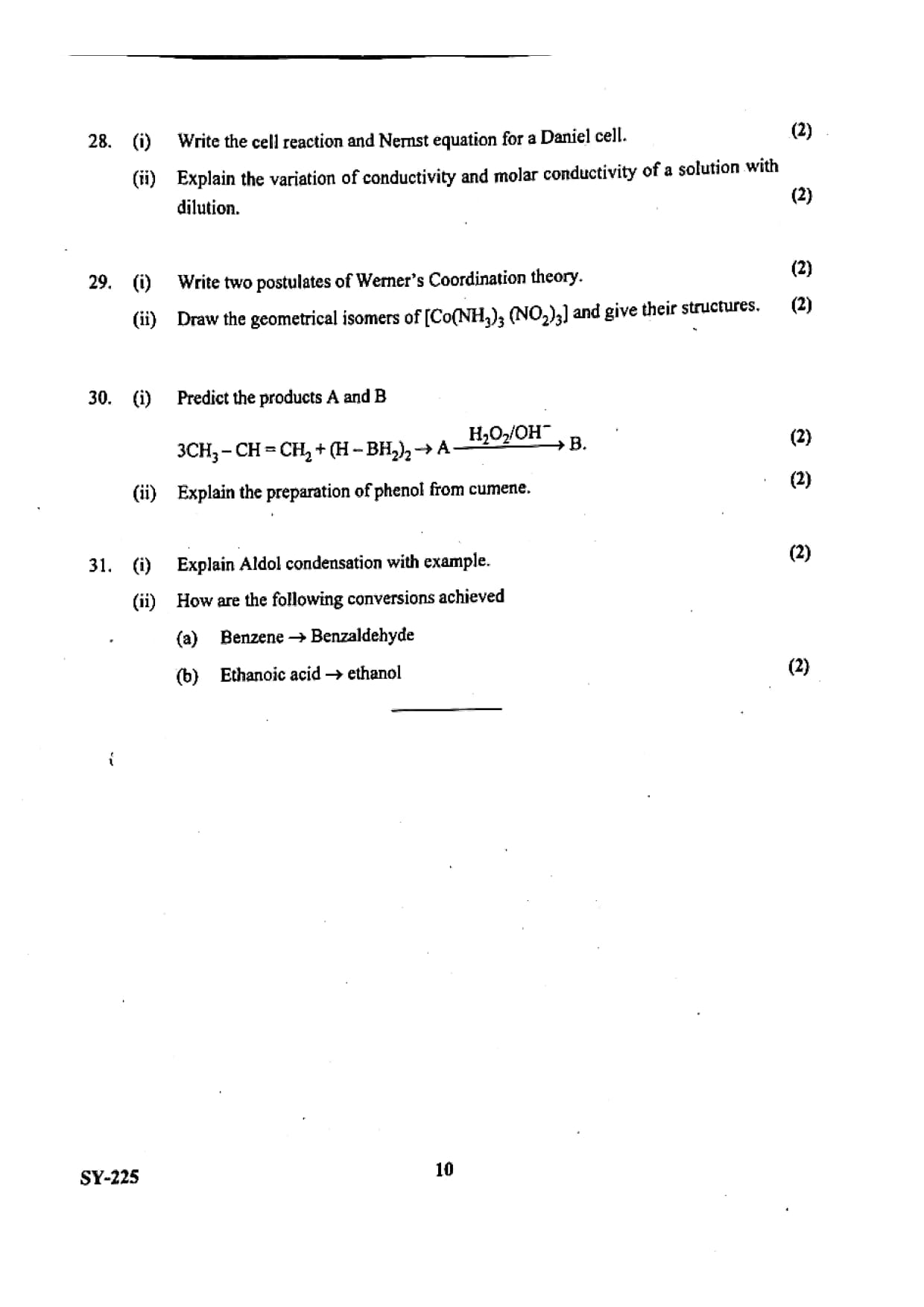
(i) Write the cell reaction and Nernst equation for a Daniel cell. \
(ii) Explain the variation of conductivity and molar conductivity of a solution with dilution.
(i) Cell reaction: \[ \text{Zn}(s) + \text{Cu}^{2+}(aq) \rightarrow \text{Zn}^{2+}(aq) + \text{Cu}(s) \] (ii) Conductivity decreases with dilution, whereas molar conductivity increases with dilution.
View Solution
Concept:
A Daniell cell is a galvanic cell in which chemical energy is converted into electrical energy through a redox reaction between zinc and copper ions.
The Nernst equation helps determine the cell potential under non-standard conditions.
Conductivity and molar conductivity describe how well an electrolyte solution conducts electricity and how they change with dilution.
Step 1: {\color{redDaniell Cell Reaction and Nernst Equation.
A Daniell cell consists of a zinc electrode in \( ZnSO_4 \) solution and a copper electrode in \( CuSO_4 \) solution.
Anode (Oxidation): \[ Zn(s) \rightarrow Zn^{2+}(aq) + 2e^- \]
Cathode (Reduction): \[ Cu^{2+}(aq) + 2e^- \rightarrow Cu(s) \]
Overall Cell Reaction: \[ Zn(s) + Cu^{2+}(aq) \rightarrow Zn^{2+}(aq) + Cu(s) \]
The Nernst equation for the Daniell cell at \(298\,K\) is:
\[ E_{cell} = E^\circ_{cell} - \frac{0.0591}{2} \log \frac{[Zn^{2+}]}{[Cu^{2+}]} \]
Step 2: {\color{redVariation of Conductivity and Molar Conductivity with Dilution.
Conductivity (\(\kappa\)):
It is the conductance of ions present in a unit volume of solution.
When a solution is diluted, the number of ions per unit volume decreases, therefore conductivity decreases.
Molar Conductivity (\(\Lambda_m\)):
It is defined as the conductance of all the ions produced by one mole of electrolyte in solution.
\[ \Lambda_m = \frac{\kappa \times 1000}{C} \]
On dilution, the ions move more freely and the volume containing one mole increases.
Hence molar conductivity increases with dilution. Quick Tip: \textbf{Key Points:} Daniell cell reaction: \( Zn + Cu^{2+} \rightarrow Zn^{2+} + Cu \) Nernst equation: \( E = E^\circ - \frac{0.0591}{n}\log Q \) Conductivity decreases with dilution. Molar conductivity increases with dilution.
(i) Write two postulates of Werner's Coordination theory. \
(ii) Draw the geometrical isomers of \( [Co(NH_3)_3(NO_2)_3] \) and give their structures.
(i) According to Werner’s coordination theory, metals exhibit \textbf{primary valency} and \textbf{secondary valency}. Primary valency is ionizable and corresponds to oxidation state, whereas secondary valency is non-ionizable and corresponds to coordination number.
(ii) The geometrical isomers of \( [\text{Co}(\text{NH}_3)_3(\text{NO}_2)_3] \) are \textbf{fac (facial) isomer} and \textbf{mer (meridional) isomer}.
View Solution
Concept:
Werner’s coordination theory explains the bonding and structure of coordination compounds.
It distinguishes between ionizable and non-ionizable valencies and also explains geometrical arrangements of ligands around the central metal ion.
Step 1: {\color{redPostulates of Werner’s Coordination Theory.
A metal atom or ion in a coordination compound exhibits two types of valencies:
primary valency and secondary valency.
Primary valency corresponds to the oxidation state of the metal and is usually satisfied by negative ions. These are ionizable.
Secondary valency corresponds to the coordination number of the metal ion and is satisfied by neutral molecules or negative ions called ligands. These are non-ionizable and have definite spatial arrangement.
Step 2: {\color{redGeometrical Isomers of \(MA_3B_3\) Type Complex.
The complex \( [Co(NH_3)_3(NO_2)_3] \) is an octahedral complex of the type \(MA_3B_3\).
It shows two geometrical isomers:
fac-isomer (Facial):
The three identical ligands occupy adjacent positions at the corners of one triangular face of the octahedron.
\[ fac-[Co(NH_3)_3(NO_2)_3] \]
mer-isomer (Meridional):
The three identical ligands lie along a meridian of the octahedron, forming a plane that passes through the central metal atom.
\[ mer-[Co(NH_3)_3(NO_2)_3] \]
Thus, the complex exhibits two geometrical arrangements known as facial and meridional isomers. Quick Tip: \textbf{Key Points:} Werner explained coordination compounds using \textbf{primary and secondary valencies}. Octahedral complexes of type \(MA_3B_3\) show two geometrical isomers: \textbf{fac (facial)} and \textbf{mer (meridional)}. fac → three identical ligands on one face; mer → arranged along a meridian.
(i) Predict the products A and B in the hydroboration-oxidation reaction. \
(ii) Explain the preparation of phenol from cumene.
(i) \(A = (\text{CH}_3\text{CH}_2\text{CH}_2)_3\text{B}\), \quad \(B = \text{CH}_3\text{CH}_2\text{CH}_2\text{OH}\).
(ii) Cumene is oxidized to \textbf{cumene hydroperoxide}, which on acid cleavage produces \textbf{phenol} and \textbf{acetone}.
View Solution
Concept:
Hydroboration–oxidation is an important reaction of alkenes that gives alcohols through anti-Markovnikov addition.
Phenol can also be prepared industrially from cumene (isopropyl benzene) through oxidation followed by acid cleavage.
Step 1: {\color{redHydroboration–Oxidation Reaction.
In the first step, propene reacts with diborane \((BH_3)_2\) to form
tripropylborane (A).
\[ 3CH_3CH=CH_2 \xrightarrow{(BH_3)_2} (CH_3CH_2CH_2)_3B \]
In the second step, oxidation with alkaline hydrogen peroxide \((H_2O_2/OH^-)\) converts it into
propan-1-ol (B).
\[ (CH_3CH_2CH_2)_3B \xrightarrow{H_2O_2/OH^-} 3CH_3CH_2CH_2OH \]
This reaction follows anti-Markovnikov rule, where the OH group
attaches to the less substituted carbon atom.
Step 2: {\color{redPreparation of Phenol from Cumene.
Cumene (isopropyl benzene) is oxidized with oxygen from air to form
cumene hydroperoxide.
\[ Cumene \xrightarrow{O_2} Cumene Hydroperoxide \]
The hydroperoxide undergoes acid-catalysed cleavage to give
phenol and acetone.
\[ Cumene Hydroperoxide \xrightarrow{H^+/H_2O} Phenol + Acetone \]
This method is widely used industrially for the large-scale production of phenol. Quick Tip: \textbf{Important Points:} Hydroboration–oxidation gives alcohols by \textbf{anti-Markovnikov addition}. Cumene process is an important industrial method for preparing \textbf{phenol}. Products of cumene process: \textbf{Phenol + Acetone}.
(i) Explain Aldol condensation with example. \
(ii) How are the following conversions achieved: (a) Benzene \(\to\) Benzaldehyde, (b) Ethanoic acid \(\to\) ethanol.
View Solution
\
Step 1: {Aldol Condensation.\
Aldehydes or ketones containing at least one \(\alpha\)-hydrogen undergo a reaction in the presence of dilute alkali to form \(\beta\)-hydroxy aldehydes (aldols).
Example: \( 2CH_3CHO \xrightarrow{dil. NaOH} CH_3CH(OH)CH_2CHO \)
Step 2: {Specific Conversions.\
(a) Benzene to Benzaldehyde: Gatterman-Koch reaction. Benzene is treated with \( CO \) and \( HCl \) in the presence of anhydrous \( AlCl_3 \).
\(\) C_6\text{H_6 + \text{CO + \text{HCl \xrightarrow{\text{anh. AlCl_3 \text{C_6\text{H_5\text{CHO \(\)
(b) Ethanoic acid to Ethanol: Reduction using a strong reducing agent like Lithium Aluminium Hydride.
\(\) \text{CH_3\text{COOH \xrightarrow{\text{(i) LiAlH_4/\text{ether, (ii) H_3\text{O+ \text{CH_3\text{CH_2\text{OH \(\) Quick Tip: For the cumene process, remember that \textbf{acetone is a valuable by-product, making this the most economical industrial route to phenol.



Comments