




The Directorate of General Education (DGE), Kerala, successfully conducted the DHSE Plus Two Business Studies Exam 2026 on March 10, 2026. To assist students in verifying their coding logic and technical answers, the complete Kerala Board Class 12 Business Studies Question Paper with Solution PDF is now available for download.
The Kerala Board Class 12 Business Studies paper covered key topics from business environment, management principles, and organizational behavior. The official question paper of Kerala Board Class 12 Business Studies Board Exam 2026 is provided below. Students can download the official paper in PDF format for reference.
Kerala Board Class 12 2026 Business Studies Question Paper with Solution PDF
| Kerala Board Class 12 2026 Business Studies Question Paper with Solution PDF | Download PDF | Check Solution |
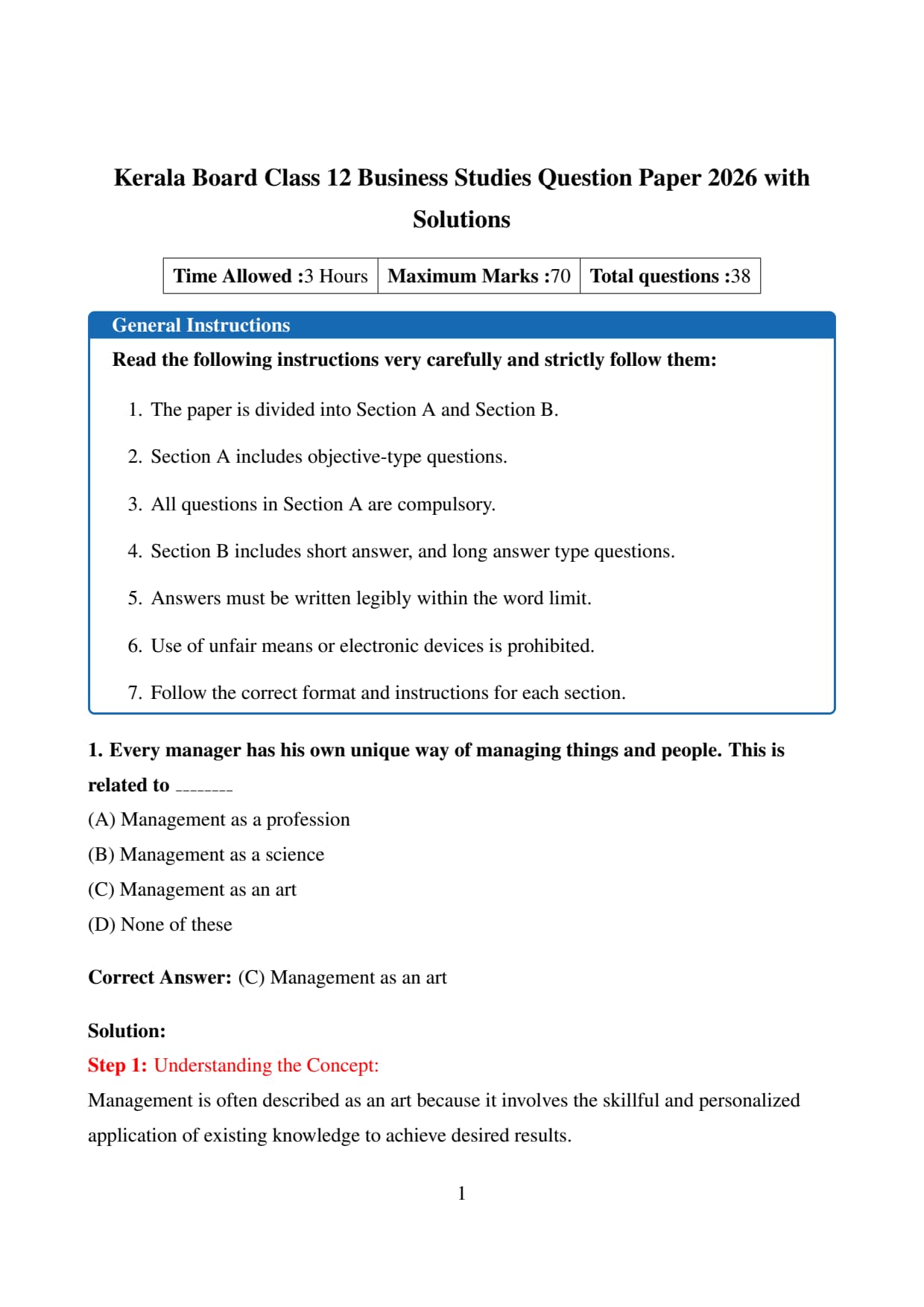
Every manager has his own unique way of managing things and people. This is related to ________
View Solution
\textcolor{red{Step 1: Understanding the Concept:
Management is often described as an art because it involves the skillful and personalized application of existing knowledge to achieve desired results.
Art requires inherent talent, creativity, and regular practice to master.
\textcolor{red{Step 2: Detailed Explanation:
In any art form, such as music or painting, two artists may have the same theoretical knowledge but their performance will differ based on their personal style and creativity.
Similarly, every manager learns the same management theories and principles, but how they apply these principles to handle people and situations depends on their individual personality, intuition, and experience.
This "unique way" mentioned in the question refers to the personalized application of knowledge, which is a core characteristic of an art.
\textcolor{red{Step 3: Final Answer:
\
Since the statement emphasizes the individualistic and unique approach of a manager, it is related to Management as an art.
Quick Tip: Keywords like "unique way", "personalized", "creativity", or "practice" are always indicators of management being treated as an \textbf{Art}.
Keywords like "universal truth", "experimentation", or "systematized body of knowledge" indicate \textbf{Science}.
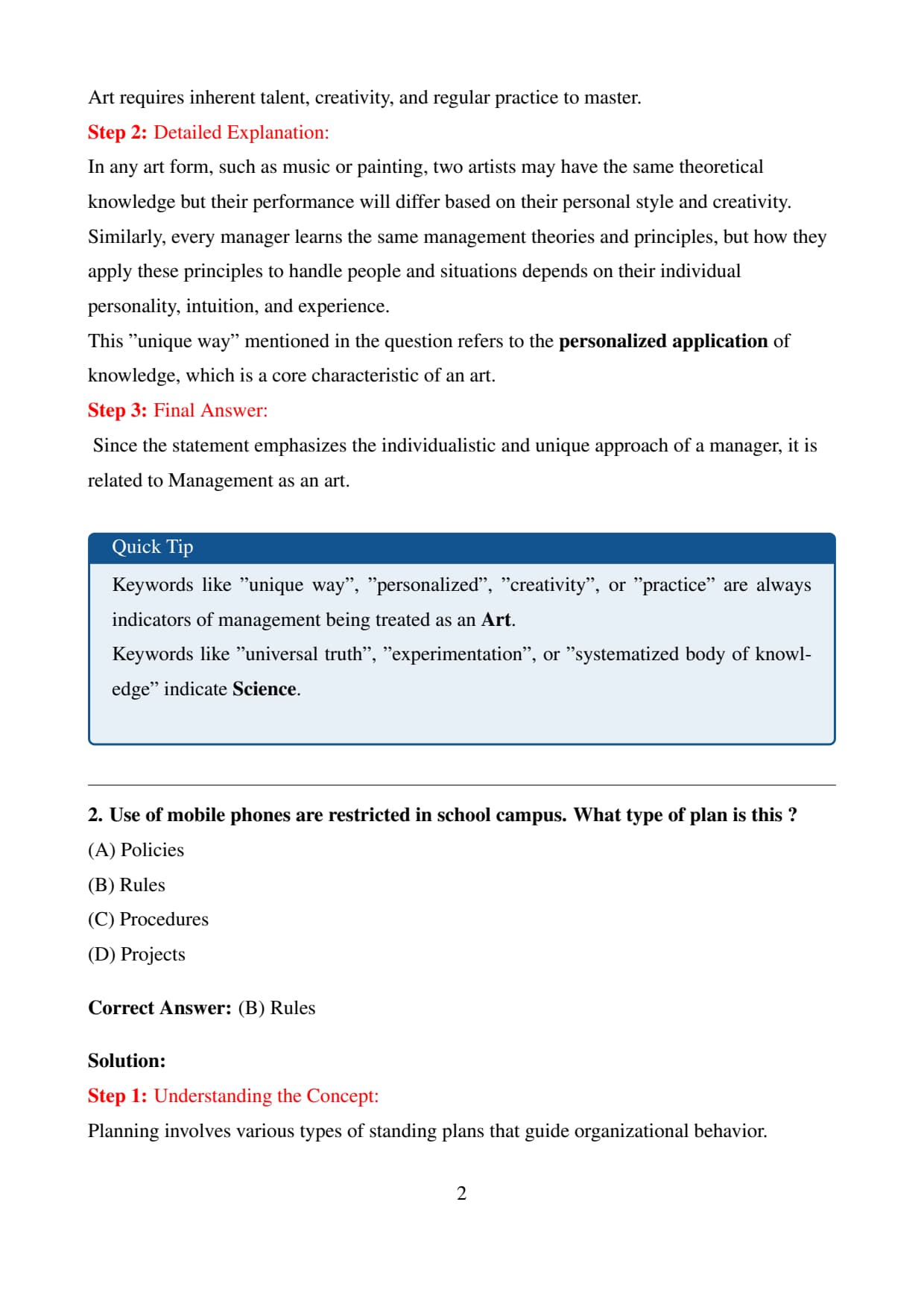
Use of mobile phones are restricted in school campus. What type of plan is this ?
View Solution
\textcolor{red{Step 1: Understanding the Concept:
Planning involves various types of standing plans that guide organizational behavior.
Rules are the most specific type of standing plans.
\textcolor{red{Step 2: Detailed Explanation:
A Rule is a specific statement that informs what is to be done or what is not to be done.
Rules are rigid in nature and do not allow for any discretion or personal judgment by the employees or students.
In this case, the restriction on mobile phones is a clear directive: "Do not use mobile phones".
There is no flexibility in this statement, making it a classic example of a rule.
A policy, on the other hand, would be a general guideline (e.g., "The school encourages focused learning"), which allows for some interpretation.
\textcolor{red{Step 3: Final Answer:
\
Because the restriction is a specific "do or do not" directive with no room for compromise, it is a Rule.
Quick Tip: If a plan is rigid and carries a penalty for non-compliance (implied or stated), it is a \textbf{Rule}.
Rules are the simplest form of plans as they involve no decision-making.
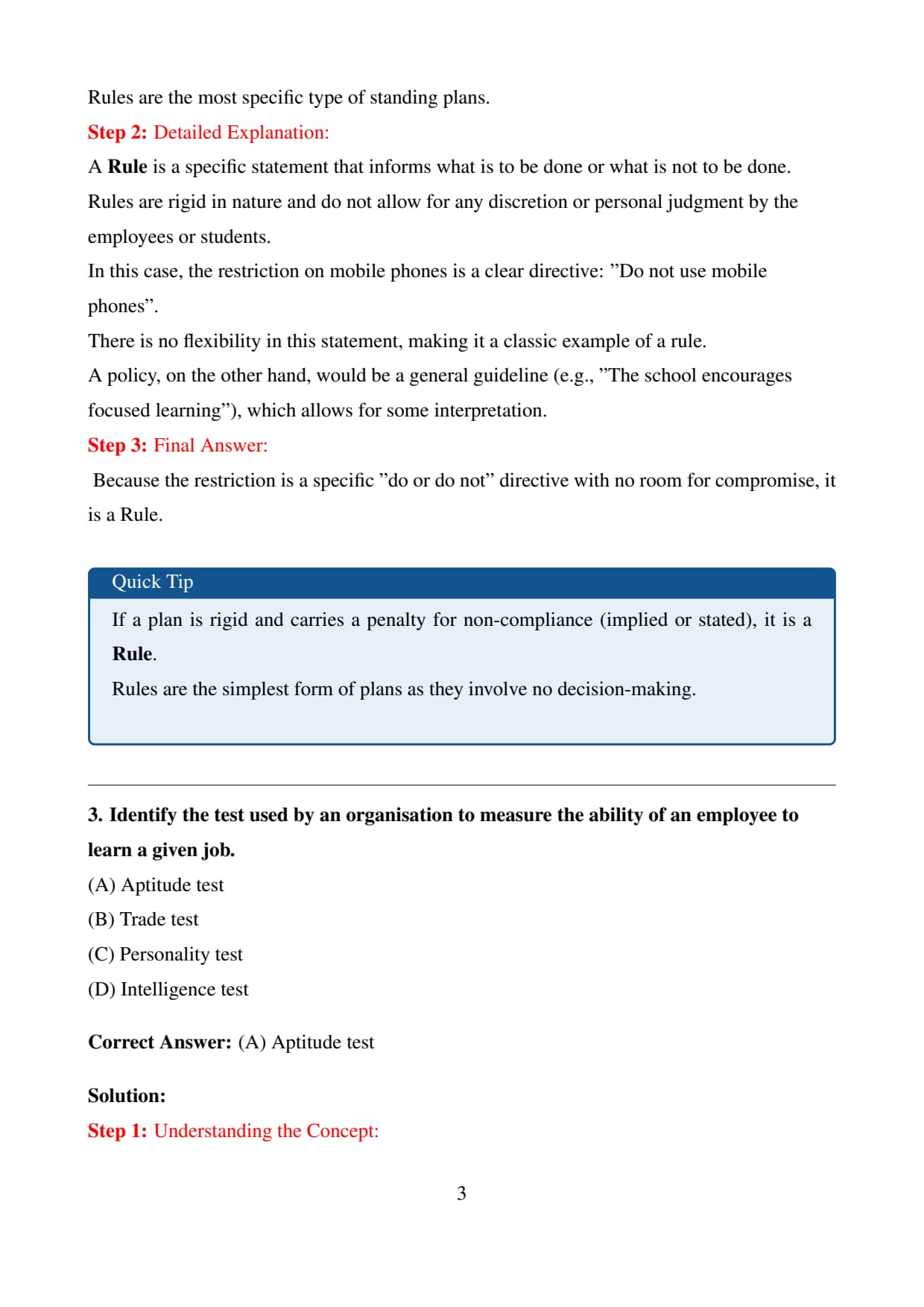
Identify the test used by an organisation to measure the ability of an employee to learn a given job.
View Solution
\textcolor{red{Step 1: Understanding the Concept:
Selection tests are objective tools used during the recruitment process to measure specific characteristics of candidates that cannot be identified through interviews alone.
\textcolor{red{Step 2: Detailed Explanation:
Different tests serve different purposes:
1. Aptitude Test: This measures a person's potential to acquire new skills or knowledge. It indicates their capacity to grow within the organization.
2. Trade Test: This measures the existing skills and knowledge of an individual in a specific field.
3. Personality Test: This provides clues to a person's emotions, reactions, and maturity level.
4. Intelligence Test: This measures the IQ and psychological traits like memory and reasoning.
\textcolor{red{Step 3: Final Answer:
\
The question asks for the measure of the "ability to learn", which directly relates to a candidate's future potential or Aptitude.
Quick Tip: Remember: \textbf{Trade Test} = Current Skill level; \textbf{Aptitude Test} = Learning Potential for future skills.
Don't confuse the two!
Maslow's Need Hierarchy Theory is based on certain assumptions. Identify the incorrect statement with respect to these assumptions.
View Solution
\textcolor{red{Step 1: Understanding the Concept:
Abraham Maslow's theory suggests that human needs follow a specific hierarchy from basic physiological needs to self-actualization.
\textcolor{red{Step 2: Detailed Explanation:
Let's analyze the assumptions of Maslow's theory:
1. Behavior is indeed driven by the desire to satisfy needs. (Statement A is correct).
2. Once a need is satisfied, it ceases to be a motivator; the individual then looks toward the next level. (Statement B is correct).
3. Needs follow a strict order: Physiological \(\rightarrow\) Safety \(\rightarrow\) Social \(\rightarrow\) Esteem \(\rightarrow\) Self-actualization. (Statement C is correct).
4. The actual assumption regarding movement is that a person moves to a higher level need only when the lower level need is satisfied.
\textcolor{red{Step 3: Final Answer:
\
Statement (D) is incorrect because it reverses the logic of the hierarchy by suggesting people move to "lower" levels when "higher" levels are met.
Quick Tip: Think of the hierarchy as a ladder. You must step on the \textbf{bottom} rung (Basic Needs) before you can reach the \textbf{top} rung (Self-actualization).
The flow is always \textbf{Upward}.
Which of these is not a part capital structure ?
View Solution
\textcolor{red{Step 1: Understanding the Concept:
Capital structure refers to the specific mix of long-term debt and equity used to finance a company's permanent assets and operations.
\textcolor{red{Step 2: Detailed Explanation:
Capital structure is composed of Long-term funds only.
1. Equity shares represent owners' funds and are permanent.
2. Debentures and Bonds are forms of long-term borrowed funds (Debt).
Short-term borrowings (like bank overdrafts or trade credit) are part of current liabilities and relate to the management of Working Capital, not the long-term capital structure.
\textcolor{red{Step 3: Final Answer:
\
Because capital structure deals with the long-term financing mix, short-term borrowings are excluded.
Quick Tip: Capital Structure = Long-term Debt + Equity.
If it is "short-term", it belongs to the \textbf{Liquidity} or \textbf{Working Capital} analysis, not Capital Structure.
Large scale production done to reduce the average cost of production is the essence of ________ concept of Marketing Management.
View Solution
\textcolor{red{Step 1: Understanding the Concept:
Marketing management philosophies guide how a firm approaches its target market. There are five main concepts.
\textcolor{red{Step 2: Detailed Explanation:
1. Production Concept: Focuses on large-scale production and distribution to make products widely available and affordable (low cost).
2. Product Concept: Focuses on high quality, performance, and innovative features.
3. Selling Concept: Focuses on aggressive promotion and sales tactics to push existing products.
4. Marketing Concept: Focuses on identifying and satisfying customer needs better than competitors.
The phrase "Large scale production to reduce average cost" describes Economies of Scale, which is the core objective of the Production Concept.
\textcolor{red{Step 3: Final Answer:
\
The focus on cost reduction through mass production identifies the Production concept.
Quick Tip: Associate these keywords:
- Production = Availability \& Low Cost
- Product = Quality \& Features
- Selling = Aggressive promotion
- Marketing = Customer Satisfaction
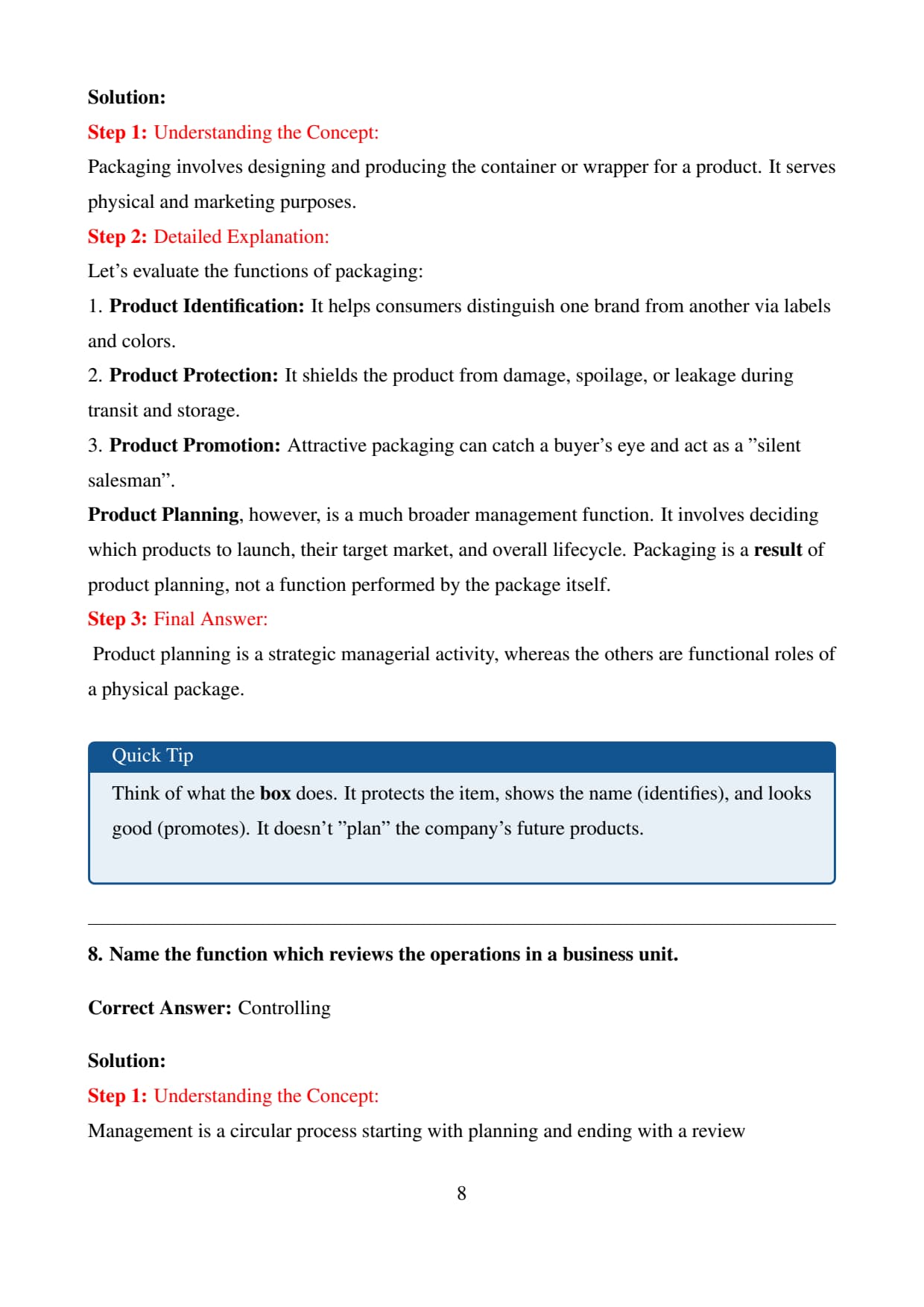
Which one of the following is not a function of packaging ?
View Solution
\textcolor{red{Step 1: Understanding the Concept:
Packaging involves designing and producing the container or wrapper for a product. It serves physical and marketing purposes.
\textcolor{red{Step 2: Detailed Explanation:
Let's evaluate the functions of packaging:
1. Product Identification: It helps consumers distinguish one brand from another via labels and colors.
2. Product Protection: It shields the product from damage, spoilage, or leakage during transit and storage.
3. Product Promotion: Attractive packaging can catch a buyer's eye and act as a "silent salesman".
Product Planning, however, is a much broader management function. It involves deciding which products to launch, their target market, and overall lifecycle. Packaging is a result of product planning, not a function performed by the package itself.
\textcolor{red{Step 3: Final Answer:
\
Product planning is a strategic managerial activity, whereas the others are functional roles of a physical package.
Quick Tip: Think of what the \textbf{box} does. It protects the item, shows the name (identifies), and looks good (promotes). It doesn't "plan" the company's future products.
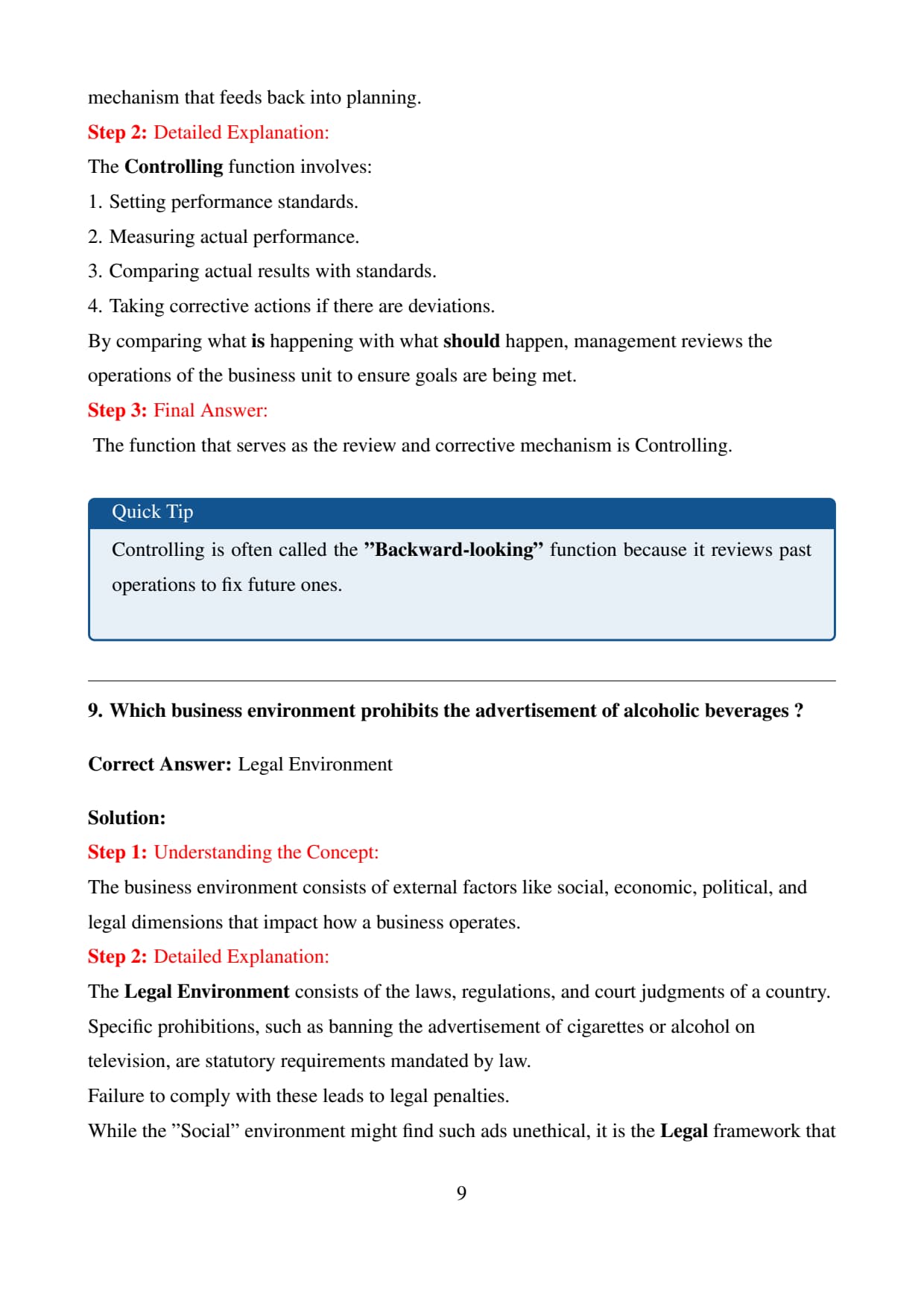
Name the function which reviews the operations in a business unit.
View Solution
\textcolor{red{Step 1: Understanding the Concept:
Management is a circular process starting with planning and ending with a review mechanism that feeds back into planning.
\textcolor{red{Step 2: Detailed Explanation:
The Controlling function involves:
1. Setting performance standards.
2. Measuring actual performance.
3. Comparing actual results with standards.
4. Taking corrective actions if there are deviations.
By comparing what is happening with what should happen, management reviews the operations of the business unit to ensure goals are being met.
\textcolor{red{Step 3: Final Answer:
\
The function that serves as the review and corrective mechanism is Controlling.
Quick Tip: Controlling is often called the \textbf{"Backward-looking"} function because it reviews past operations to fix future ones.
Which business environment prohibits the advertisement of alcoholic beverages ?
View Solution
\textcolor{red{Step 1: Understanding the Concept:
The business environment consists of external factors like social, economic, political, and legal dimensions that impact how a business operates.
\textcolor{red{Step 2: Detailed Explanation:
The Legal Environment consists of the laws, regulations, and court judgments of a country.
Specific prohibitions, such as banning the advertisement of cigarettes or alcohol on television, are statutory requirements mandated by law.
Failure to comply with these leads to legal penalties.
While the "Social" environment might find such ads unethical, it is the Legal framework that actually prohibits or bans them through legislation.
\textcolor{red{Step 3: Final Answer:
\
Mandatory restrictions and bans on commercial activities are categorized under the Legal Environment.
Quick Tip: Keywords: If it involves "laws", "acts", "legislation", "prohibition by law", or "court orders", the answer is always \textbf{Legal Environment}.
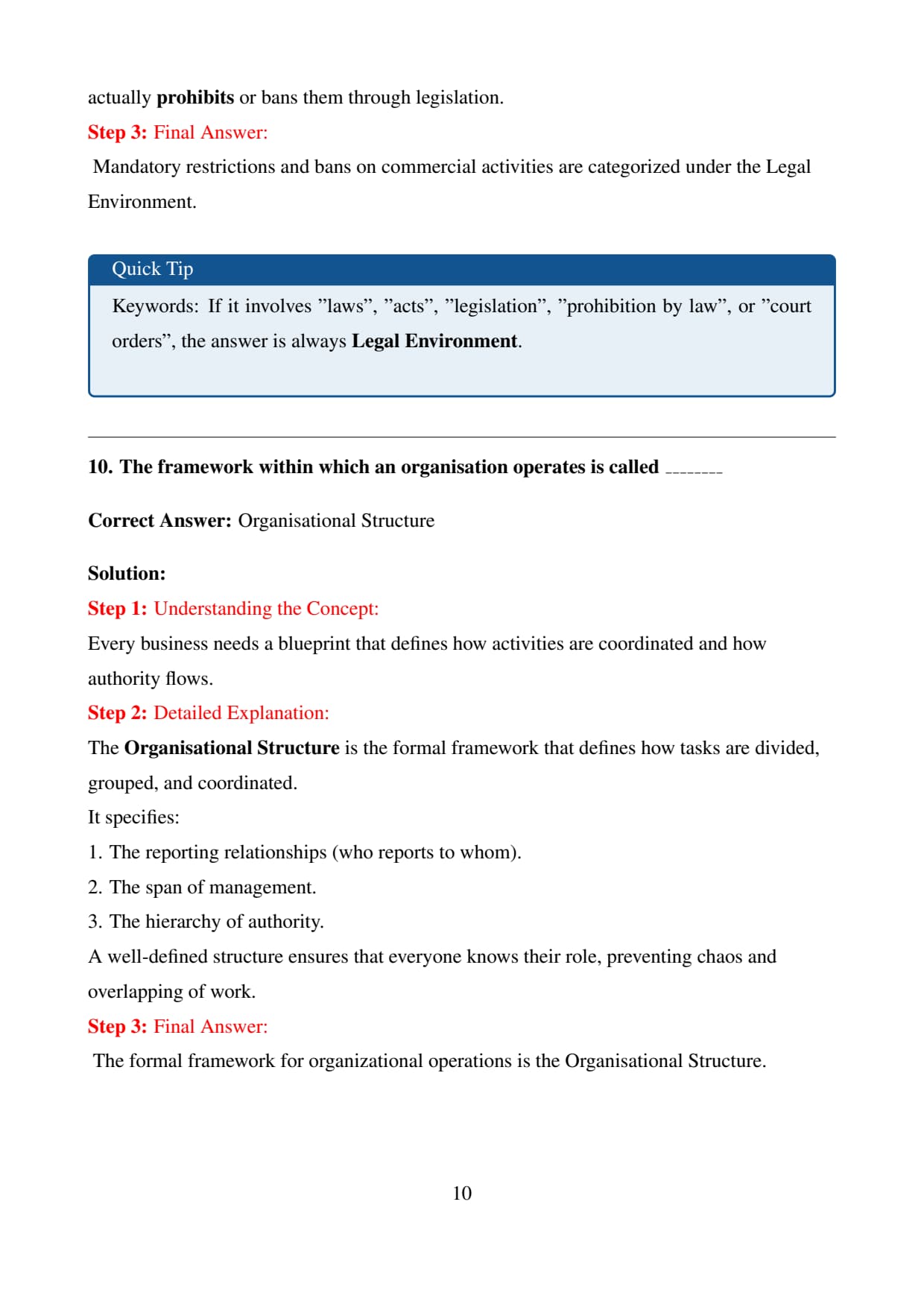
The framework within which an organisation operates is called ________
View Solution
\textcolor{red{Step 1: Understanding the Concept:
Every business needs a blueprint that defines how activities are coordinated and how authority flows.
\textcolor{red{Step 2: Detailed Explanation:
The Organisational Structure is the formal framework that defines how tasks are divided, grouped, and coordinated.
It specifies:
1. The reporting relationships (who reports to whom).
2. The span of management.
3. The hierarchy of authority.
A well-defined structure ensures that everyone knows their role, preventing chaos and overlapping of work.
\textcolor{red{Step 3: Final Answer:
\
The formal framework for organizational operations is the Organisational Structure.
Quick Tip: Think of the structure as the \textbf{"Skeleton"} of the organization. It gives shape and defines the connections between different parts.
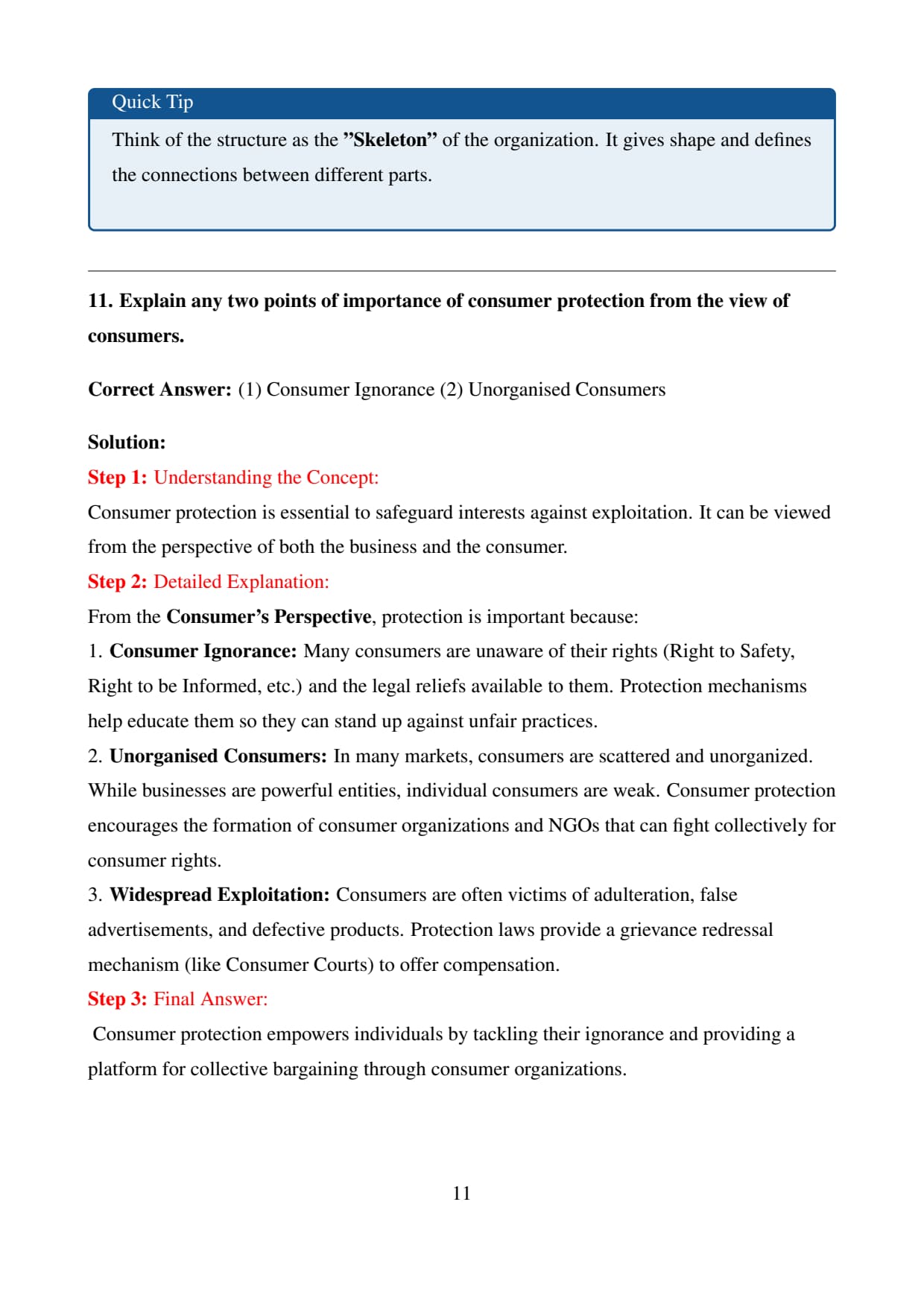
Explain any two points of importance of consumer protection from the view of consumers.
View Solution
\textcolor{red{Step 1: Understanding the Concept:
Consumer protection is essential to safeguard interests against exploitation. It can be viewed from the perspective of both the business and the consumer.
\textcolor{red{Step 2: Detailed Explanation:
From the Consumer's Perspective, protection is important because:
1. Consumer Ignorance: Many consumers are unaware of their rights (Right to Safety, Right to be Informed, etc.) and the legal reliefs available to them. Protection mechanisms help educate them so they can stand up against unfair practices.
2. Unorganised Consumers: In many markets, consumers are scattered and unorganized. While businesses are powerful entities, individual consumers are weak. Consumer protection encourages the formation of consumer organizations and NGOs that can fight collectively for consumer rights.
3. Widespread Exploitation: Consumers are often victims of adulteration, false advertisements, and defective products. Protection laws provide a grievance redressal mechanism (like Consumer Courts) to offer compensation.
\textcolor{red{Step 3: Final Answer:
\
Consumer protection empowers individuals by tackling their ignorance and providing a platform for collective bargaining through consumer organizations.
Quick Tip: When the question asks for the "Consumer's view", focus on \textbf{Weaknesses} of consumers (Ignorance, lack of organization).
When it asks for the "Business view", focus on \textbf{Long-term Profitability} and \textbf{Social Responsibility}.
Explain the following function of marketing: Transportation
View Solution
\textcolor{red{Step 1: Understanding the Concept:
Marketing isn't just selling; it involves all activities that get a product to the user. Physical distribution is a key part of this.
\textcolor{red{Step 2: Detailed Explanation:
Transportation involves the physical movement of goods from the place where they are produced (factories) to the place where they are consumed (markets).
Since consumption centers are often geographically separated from production sites, transportation bridges this gap.
It creates Place Utility by making the product available where it is needed.
Marketing managers must analyze factors like the nature of the product (perishable vs durable), cost, and speed when selecting a mode of transport (Road, Rail, Air, Water).
\textcolor{red{Step 3: Final Answer:
\
Transportation is the logistics function that ensures goods are physically accessible to the target audience.
Quick Tip: Remember: \textbf{Transportation} = Place Utility (Location).
\textbf{Storage/Warehousing} = Time Utility (Availability when needed).
Explain the following function of marketing: Product designing and development
View Solution
\textcolor{red{Step 1: Understanding the Concept:
A product is more than just a physical object; it's a bundle of benefits. Designing these benefits is a core marketing function.
\textcolor{red{Step 2: Detailed Explanation:
Product Designing and Development involves making decisions about the product's shape, size, features, performance, and appearance.
A good design does two things:
1. It makes the product more attractive and useful for the customer (Customer Satisfaction).
2. It gives the product a competitive advantage over rival products.
For example, designing a smartphone that is more durable or has an intuitive user interface is a result of successful product development based on market research.
\textcolor{red{Step 3: Final Answer:
\
This function ensures that the final product aligns with consumer expectations and stands out in a crowded market.
Quick Tip: Design isn't just aesthetics (how it looks). It's also functionality (how it works) and reliability (how long it lasts).



Comments