




Haryana Board is conducting the Class 12 Economics Board Exam 2026 on March 2, 2026. Class 12 Economics Question Paper with Solution PDF is available here for download.
The official question paper of Haryana Board Class 12 Economics Board Exam 2026 is provided below. Students can download the official paper in PDF format for reference.
Haryana Board Class 12, 2026 Economics Question Paper with Solution PDF
| Haryana Board Class 12 Economics Question Paper 2026 | Download PDF | Check Solution |

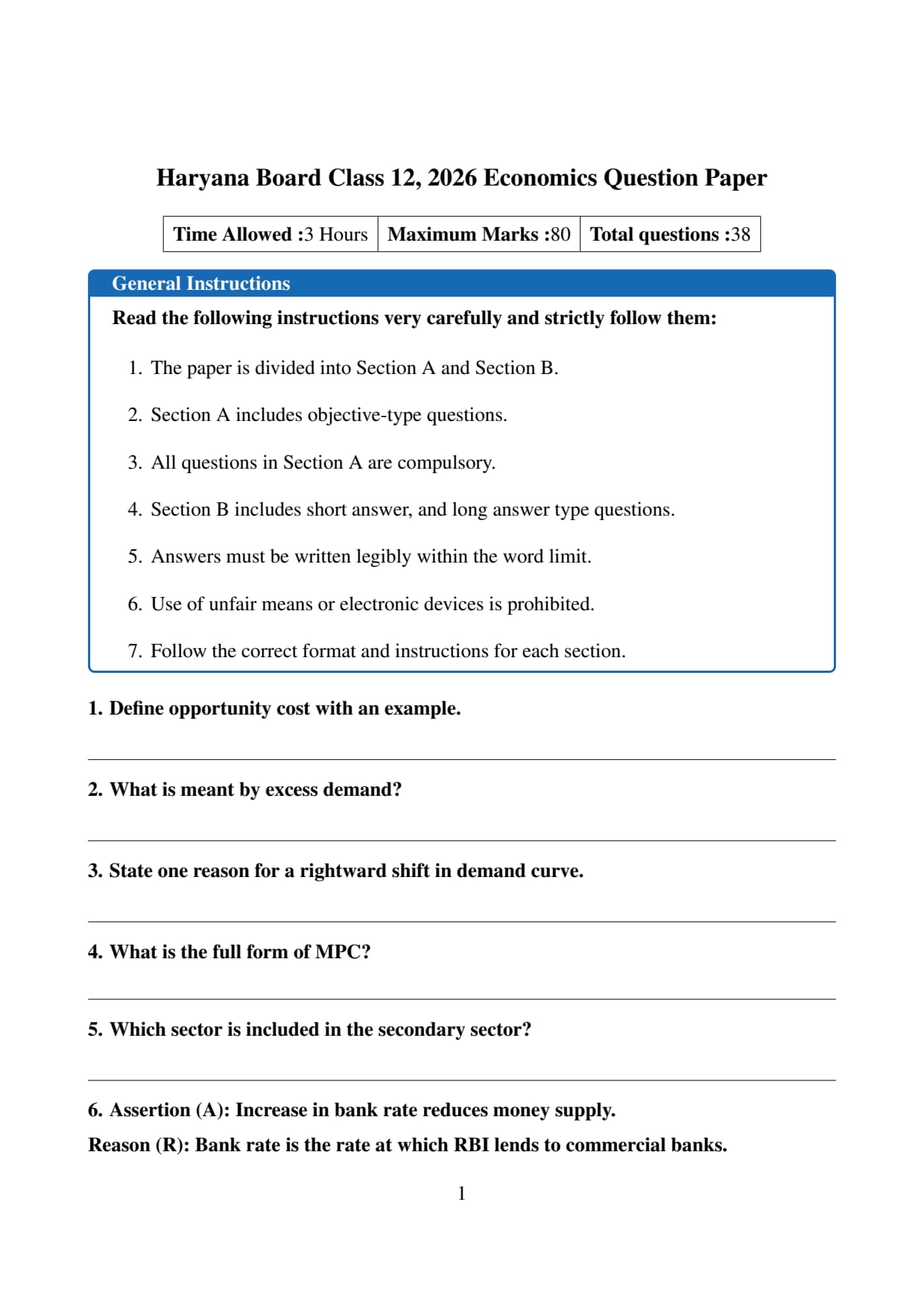
Define opportunity cost with an example.
View Solution
Step 1: Conceptual Understanding:
In economics, resources are limited, meaning that choosing one option often requires forgoing another. Opportunity cost refers to the value of the best alternative that is sacrificed when a particular choice is made.
Step 2: Definition:
Opportunity cost is the value of the next best alternative that is given up. It specifically pertains to the most valuable option not chosen, rather than the total value of all other alternatives.
Step 3: Example:
Consider a farmer with a piece of land who can grow either Wheat or Rice. If the farmer decides to grow Wheat, the opportunity cost is the potential Rice yield and the profit that could have been earned from it.
Step 4: Conclusion:
Opportunity cost represents the value of the next best alternative that is forgone. For example, if you spend
(10 on a movie ticket instead of buying a book, the enjoyment you would have gotten from reading the book is the opportunity cost. Quick Tip: Opportunity cost is often called the "real cost" of a decision because it considers what you lose, not just what you spend.
What is meant by excess demand?
View Solution
Step 1: Concept Overview:
Market equilibrium is achieved when Market Demand equals Market Supply. Excess demand arises when this balance is disturbed at a particular price level. \
Step 2: Technical Explanation:
Excess demand, or shortage, occurs when the quantity demanded of a good or service exceeds the quantity supplied at the current market price.
Step 3: Understanding the Condition:
This situation typically arises when the market price is set below the equilibrium price. At a lower price, sellers are unwilling to supply a large quantity, while consumers desire more of the good or service.
Step 4: Conclusion:
Excess demand occurs when the Quantity Demanded (\(Q_d\)) is greater than the Quantity Supplied (\(Q_s\)) at a specific price. Quick Tip: Excess demand usually leads to an upward pressure on prices, as buyers compete for the limited goods, eventually pushing the market back toward equilibrium.
State one reason for a rightward shift in demand curve.
View Solution
Step 1: Concept Explanation:
A shift in the demand curve occurs due to factors other than the price of the good itself. A rightward shift signifies an increase in demand, meaning that more of the good is demanded at each price level.
Step 2: Key Influencing Factors:
The shift can be influenced by changes in consumer income, preferences, the prices of related goods (substitutes or complements), or expectations about the future.
Step 3: Identifying a Key Reason:
A primary cause for a rightward shift is an increase in consumer income, particularly for normal goods. When consumers have more money, they are more willing and able to purchase more of a product, even if its price remains constant.
Step 4: Conclusion:
An increase in consumer income (for normal goods) is a significant factor leading to a rightward shift in the demand curve. Quick Tip: Remember: A change in the price of the good causes movement along the curve, but a change in other factors causes a shift of the curve.
What is the full form of MPC?
View Solution
Step 1: Understanding the Concept:
In macroeconomics (Keynesian theory), MPC is a ratio that explains how consumption changes when income changes.
Step 2: Defining the Term:
The full form is Marginal Propensity to Consume.
Step 3: Explaining the Formula:
It is calculated as the change in consumption (\(\Delta C\)) divided by the change in income (\(\Delta Y\)): \[ MPC = \frac{\Delta C}{\Delta Y} \]
Step 4: Final Answer:
The full form of MPC is Marginal Propensity to Consume. Quick Tip: The value of MPC always lies between 0 and 1 (\(0 < MPC < 1\)), meaning people usually spend a portion of their extra income and save the rest.
Which sector is included in the secondary sector?
View Solution
Step 1: Understanding the Concept:
The economy is divided into Primary (extraction), Secondary (transformation), and Tertiary (services) sectors.
Step 2: Defining the Secondary Sector:
The secondary sector covers activities that finish or manufacture raw materials into products. It is often referred to as the Manufacturing or Industrial sector.
Step 3: Examples:
This includes industries like automobile manufacturing, textile production, construction, and food processing.
Step 4: Final Answer:
The Manufacturing (or Industrial) sector is included in the secondary sector. Quick Tip: The secondary sector acts as a bridge, taking raw materials from the primary sector and turning them into goods for consumers or the tertiary sector.
Assertion (A): Increase in bank rate reduces money supply.
Reason (R): Bank rate is the rate at which RBI lends to commercial banks.
View Solution
Step 1: Understanding the Concept:
The Bank Rate is a tool of monetary policy used by the Central Bank (RBI) to control the volume of credit and money supply in the economy.
Step 2: Evaluating the Reason (R):
The reason correctly defines the Bank Rate. It is the standard rate at which the RBI is prepared to buy or rediscount bills of exchange or other commercial papers, effectively lending to commercial banks. So, (R) is true.
Step 3: Evaluating the Assertion (A) and Connection:
When the RBI increases the Bank Rate, the cost of borrowing for commercial banks increases. Consequently, commercial banks increase their lending rates for the public. This discourages borrowing and reduces the money supply. So, (A) is true.
Step 4: Final Answer:
Since the definition of the Bank Rate (R) explains why its increase affects the cost of credit and thus the money supply (A), Option (a) is correct. Quick Tip: To solve Assertion-Reason questions, read the assertion, then add the word "BECAUSE" before the reason to see if it makes logical sense.
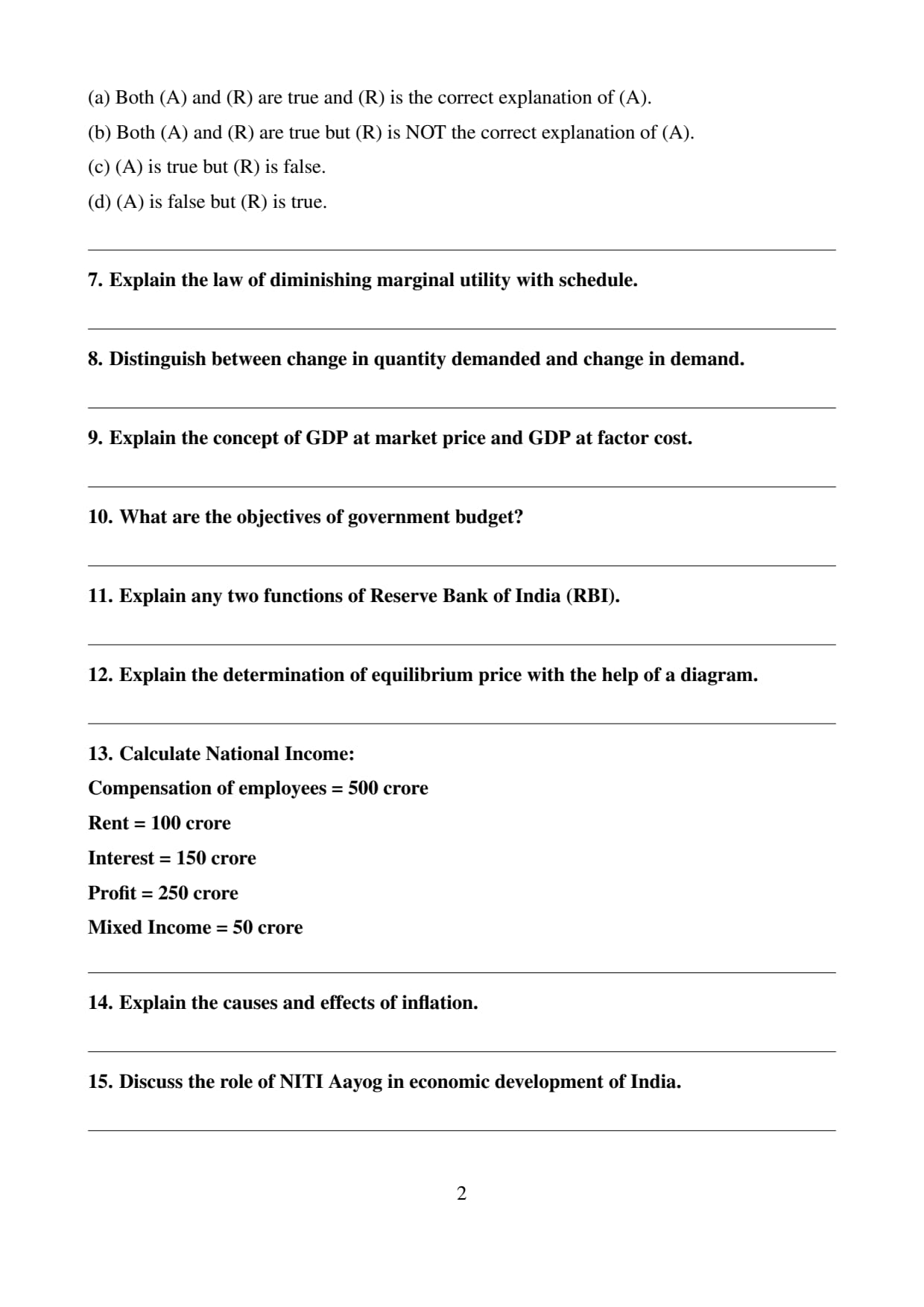
Explain the law of diminishing marginal utility with schedule.
View Solution
Step 1: Understanding the Concept:
The Law of Diminishing Marginal Utility (DMU) is a fundamental law of consumption. It states that as a consumer consumes more and more units of a specific commodity, the utility derived from each successive unit goes on declining.
Step 2: Presenting the Schedule:
Consider a hungry consumer eating units of chocolate:
\begin{table[h]
\centering
\begin{tabular{|c|c|c|
\hline
Units of Chocolate & Total Utility (TU) & Marginal Utility (MU)
\hline
1 & 20 & 20
\hline
2 & 35 & 15
\hline
3 & 45 & 10
\hline
4 & 50 & 5
\hline
5 & 50 & 0
\hline
6 & 45 & -5
\hline
\end{tabular
\end{table
Step 3: Explanation of the Law:
As shown in the schedule, the first unit gives 20 units of satisfaction (MU). By the 4th unit, the satisfaction drops to 5. At the 5th unit, the consumer is fully satisfied (\(MU = 0\)). If they continue to eat (6th unit), the utility becomes negative, meaning it causes dissatisfaction.
Step 4: Final Answer:
The law states that Marginal Utility declines as consumption increases, assuming constant tastes and continuous consumption. Quick Tip: The point where \(MU = 0\) is called the "Point of Satiety," where Total Utility is at its maximum.
Distinguish between change in quantity demanded and change in demand.
View Solution
Step 1: Understanding the Concept:
The primary difference lies in the cause of the change. One is caused by the price of the product itself, while the other is caused by external factors.
Step 2: Key Differences Table:
\begin{table[h]
\centering
\begin{tabular{|l|l|l|
\hline
Basis & Change in Quantity Demanded & Change in Demand
\hline
Cause & Change in own price of the good. & Change in factors other than price.
\hline
Effect & Movement along the demand curve. & Shift of the demand curve.
\hline
Terms & Extension or Contraction. & Increase or Decrease.
\hline
Other factors & These remain constant. & Price of the good remains constant.
\hline
\end{tabular
\end{table
Step 3: Illustration:
In "Change in Quantity Demanded," the curve stays in place, but we move to a different point on it. In "Change in Demand," the entire curve moves to a new position (left or right).
Step 4: Final Answer:
Change in Quantity Demanded is a movement due to price; Change in Demand is a shift due to other factors (like income or tastes). Quick Tip: Remember: "Price changes Quantity," but "Factors change Demand."
Explain the concept of GDP at market price and GDP at factor cost.
View Solution
Step 1: Understanding the Concept:
Gross Domestic Product (GDP) can be valued either at the stage of production (Factor Cost) or at the stage of sale in the market (Market Price).
Step 2: GDP at Factor Cost (\(GDP_{FC}\)):
It refers to the sum total of factor incomes (compensation of employees, rent, interest, and profit) generated within the domestic territory of a country during a year. It excludes taxes and includes subsidies.
Step 3: GDP at Market Price (\(GDP_{MP}\)):
It is the market value of all final goods and services produced within the domestic territory. It includes Indirect Taxes (which increase price) and excludes Subsidies (which decrease price).
Step 4: The Relationship Formula:
The two concepts are linked by Net Indirect Taxes (NIT): \[ GDP_{MP} = GDP_{FC} + Net Indirect Taxes (NIT) \]
Where, \(NIT = Indirect Taxes - Subsidies\).
Final Answer:
\(GDP_{FC}\) is the production cost; \(GDP_{MP}\) is the retail price including taxes. Quick Tip: If Net Indirect Taxes are positive, \(GDP_{MP}\) will always be higher than \(GDP_{FC}\).
What are the objectives of government budget?
View Solution
Step 1: Understanding the Concept:
A government budget is an annual financial statement showing estimated receipts and expenditures. Its primary goal is to promote economic growth and social welfare.
Step 2: Identifying Key Objectives:
The government uses the budget to intervene in the economy for several reasons:
Reallocation of Resources: Using taxes and subsidies to encourage social goods (like schools) and discourage harmful goods (like tobacco).
Reducing Inequalities: Implementing progressive taxation (taxing the rich more) and spending on the poor to redistribute income.
Economic Stability: Managing inflation or deflation by adjusting spending and tax rates.
Management of Public Enterprises: Providing funds for the operation of government-owned industries (PSUs).
Step 3: Economic Growth:
By increasing the rate of savings and investment through tax rebates, the budget aims to increase the overall GDP of the country.
Step 4: Final Answer:
The main objectives are resource reallocation, income redistribution, economic stability, and growth. Quick Tip: Through the budget, the government acts as a stabilizer to prevent the economy from extreme "boom" or "bust" cycles.
Explain any two functions of Reserve Bank of India (RBI).
View Solution
Step 1: Understanding the Concept:
The RBI is the Central Bank of India. Unlike commercial banks, it does not deal directly with the public but controls the entire banking system.
Step 2: Function 1 - Currency Authority (Bank of Issue):
The RBI has the sole right to issue currency notes in the country (except one-rupee notes and coins, which are issued by the Ministry of Finance). This ensures uniformity in the monetary system and allows the RBI to control the money supply.
Step 3: Function 2 - Banker's Bank and Supervisor:
The RBI acts as a banker to all commercial banks. It holds a part of their cash reserves (CRR) and provides them with financial assistance in times of need (Lender of the Last Resort). It also regulates and inspects banks to ensure they follow guidelines.
Step 4: Final Answer:
Two key functions are issuing currency and acting as a banker and supervisor to commercial banks. Quick Tip: As the "Lender of the Last Resort," the RBI guarantees that the banking system remains solvent even during a financial crisis.
Explain the determination of equilibrium price with the help of a diagram.
View Solution
Step 1: Understanding the Concept:
In a free market, the equilibrium price is the price at which the quantity demanded by consumers exactly equals the quantity supplied by producers. At this price, there is neither a shortage nor a surplus.
Step 2: Interaction of Market Forces:
Demand: Shows an inverse relationship with price (downward sloping).
Supply: Shows a direct relationship with price (upward sloping).
Step 3: The Equilibrium Point:
The intersection of the Demand Curve (D) and Supply Curve (S) is the equilibrium point (E). The corresponding price is the Equilibrium Price (\(P_e\)), and the corresponding quantity is the Equilibrium Quantity (\(Q_e\)).
If Price > \(P_e\), there is Excess Supply (Surplus), leading to a price drop.
If Price < \(P_e\), there is Excess Demand (Shortage), leading to a price rise.
Step 4: Final Answer:
The equilibrium price is determined at the point where Market Demand = Market Supply. Quick Tip: Equilibrium is a "state of rest." Once the market reaches this price, there is no incentive for buyers or sellers to change it unless external factors shift the curves.
Calculate National Income:
Compensation of employees = ₹500 crore
Rent = ₹100 crore
Interest = ₹150 crore
Profit = ₹250 crore
Mixed Income = ₹50 crore
View Solution
Step 1: Understanding the Concept:
National Income (\(NNP_{FC}\)) can be calculated using the Income Method. The first step is to find the Net Domestic Product at Factor Cost (\(NDP_{FC}\)), also known as Domestic Income.
Step 2: Formula for Domestic Income:
\(NDP_{FC} = Compensation of Employees (COE) + Operating Surplus (Rent + Interest + Profit) + Mixed Income\)
Step 3: Calculation:
\(COE = 500\)
\(Operating Surplus = 100 + 150 + 250 = 500\)
\(Mixed Income = 50\)
\(NDP_{FC} = 500 + 500 + 50 = 1050 crore\)
Step 4: Final Answer:
Since no "Net Factor Income from Abroad" (NFIA) is provided in the data, we assume it is zero. Therefore, National Income (\(NNP_{FC}\)) = \(NDP_{FC} + NFIA\). \(National Income = 1050 + 0 = \textbf{₹1050 crore}\). Quick Tip: "Operating Surplus" is a collective term for property and entrepreneurial income (Rent + Interest + Profit). Always group them together if they are listed separately.
Explain the causes and effects of inflation.
View Solution
Step 1: Understanding the Concept:
Inflation is a sustained increase in the general price level of goods and services in an economy over a period of time, which reduces the purchasing power of money.
Step 2: Causes of Inflation:
Demand-Pull Inflation: Occurs when the total demand for goods exceeds the total supply ("too much money chasing too few goods").
Cost-Push Inflation: Occurs when production costs (like wages or raw materials) rise, forcing producers to increase prices.
Monetary Growth: An excessive increase in the money supply by the central bank.
Step 3: Effects of Inflation:
Reduces Purchasing Power: People can buy fewer goods with the same amount of money.
Hurts Fixed-Income Groups: Pensioners and salaried workers suffer as their income doesn't rise as fast as prices.
Encourages Hoarding: People buy goods now to avoid higher prices later, causing artificial shortages.
Step 4: Final Answer:
Inflation is caused by excess demand or rising costs and results in the erosion of the value of money. Quick Tip: Mild inflation (2-3%) is often considered healthy for an economy as it encourages production and investment.
Discuss the role of NITI Aayog in economic development of India.
View Solution
Step 1: Understanding the Concept:
NITI Aayog (National Institution for Transforming India) replaced the Planning Commission in 2015. It serves as the premier policy "Think Tank" of the Government of India.
Step 2: Key Role - Cooperative Federalism:
Unlike the old Planning Commission, NITI Aayog follows a "Bottom-Up" approach. It ensures that State Governments are active partners in the national development process, fostering a spirit of cooperative federalism.
Step 3: Strategic Functions:
Policy Design: It designs long-term strategic policies and monitors their implementation.
Innovation and Knowledge: Through initiatives like the "Atal Innovation Mission," it promotes an ecosystem of entrepreneurship.
Monitoring and Evaluation: It uses indices (like the SDG India Index) to rank states, encouraging healthy competition for development.
Step 4: Final Answer:
NITI Aayog drives development by providing strategic direction, fostering state participation, and promoting innovation through evidence-based policy. Quick Tip: The Prime Minister serves as the Chairperson of NITI Aayog, highlighting its importance in the country's top-level decision-making.



Comments