




The Haryana Board 2026 Class 12 Physical Education Question Paper with Solution PDF is available here. The BSEH Physical Education exam was held on March 3, 2026, during the afternoon session.
The paper was relatively easy, focusing on Physical Fitness, Sports Nutrition, Yoga, Biomechanics, Sports Psychology, and Training Methods. While the objective questions on yoga asanas and basic nutrition were straightforward, the descriptive sections on biomechanical principles and psychological factors in sports required a logical explanation of concepts. Candidates aiming for top-tier results should target a score between 90–95 marks by providing well-structured answers supported by practical examples and benefits of various training methods.
Haryana Board 2026 Class 12 Physical Education Question Paper with Solution PDF
| Haryana Board 2026 Class 12 Physical Education Question Paper with Solution PDF | Download PDF | Check Solutions |
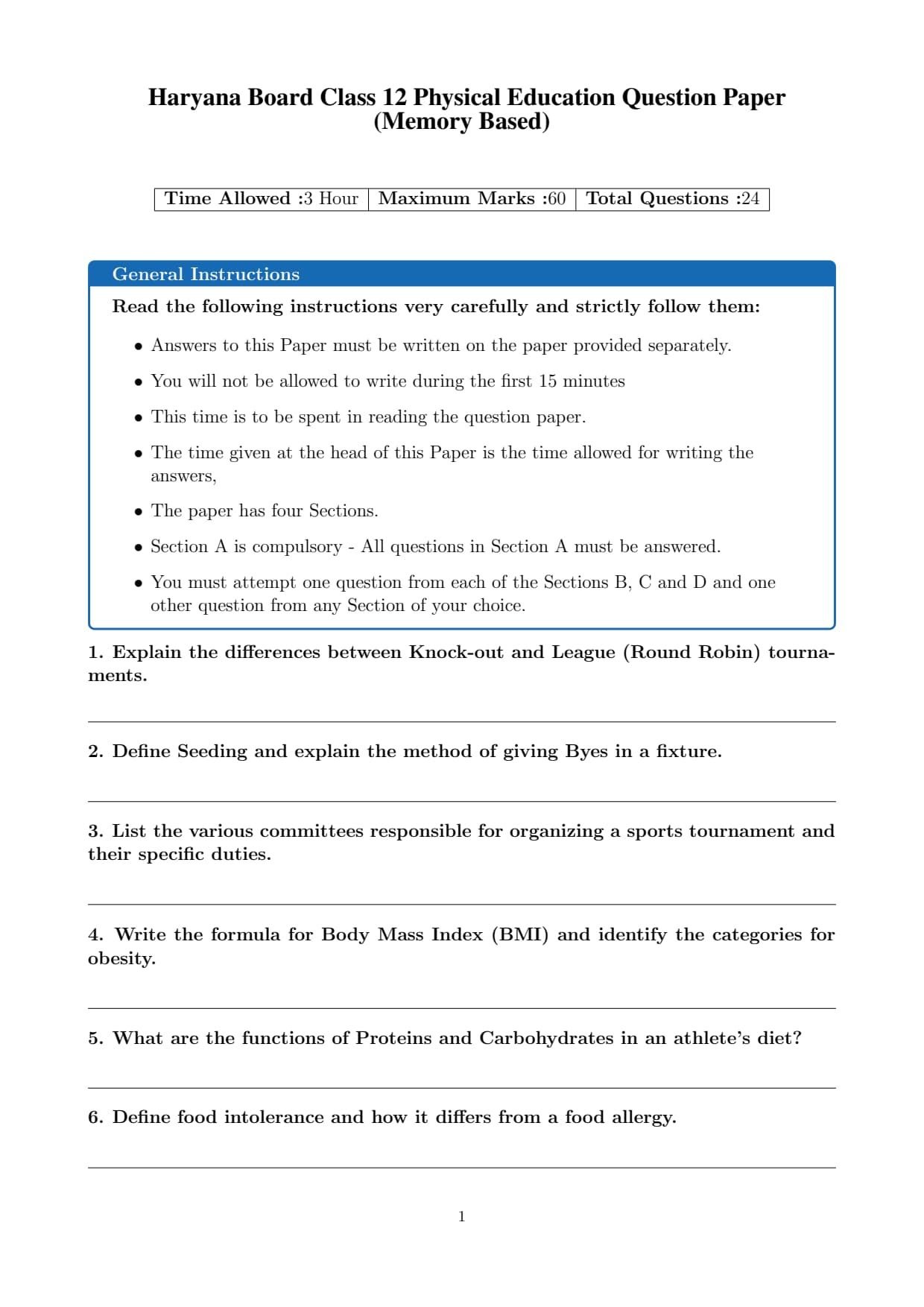
Explain the differences between Knock-out and League (Round Robin) tournaments.
View Solution
Concept:
Tournaments are organized competitions to determine the best team or player. Two common types are the Knock-out (Elimination) tournament and the League (Round Robin) tournament. They differ in structure, number of matches, fairness, and opportunity given to teams.
Step 1: {\color{redKnock-out Tournament.
In a Knock-out tournament, a team is eliminated after losing one match. Only the winning teams move to the next round. The competition continues until one team remains unbeaten and is declared the winner. This format requires fewer matches and is completed in a shorter time.
\medskip
Step 2: {\color{redLeague (Round Robin) Tournament.
In a League tournament, each team plays against every other team. A team is not eliminated after one loss. Points are awarded for wins and draws, and the team with the highest points at the end is declared the winner. This format ensures that all teams get equal opportunities.
\medskip
Step 3: {\color{redMajor Differences.
Elimination: In Knock-out, a team is eliminated after one loss; in League, teams play all matches.
Number of Matches: Knock-out requires fewer matches; League requires more matches.
Time Required: Knock-out takes less time; League takes more time.
Fairness: League is considered more fair because all teams play against each other.
Excitement Level: Knock-out creates high tension as every match is decisive.
\medskip
Final Answer:
A Knock-out tournament eliminates a team after one defeat and requires fewer matches, making it quicker but less comprehensive. A League (Round Robin) tournament allows each team to play against all others, providing equal opportunity and fairness, though it takes more time and matches to complete. Quick Tip: While comparing two systems, mention differences based on structure, number of matches, time, and fairness.
Define Seeding and explain the method of giving Byes in a fixture.
View Solution
Concept:
In tournament organization, proper arrangement of teams ensures fairness and balance. Two important concepts in fixtures are Seeding and Byes. These help in systematic scheduling, especially in Knock-out tournaments.
Step 1: {\color{redDefinition of Seeding.
Seeding is the process of placing strong or outstanding teams/players in different positions of the fixture so that they do not meet each other in the early rounds. It is done based on past performance, ranking, or reputation. The main objective of seeding is to ensure that the best teams reach the final stages of the tournament.
\medskip
Step 2: {\color{redMeaning of Byes.
A Bye is the privilege given to a team to enter the next round of a tournament without playing a match in the first round. Byes are given when the number of teams is not a power of two (e.g., 6, 10, 12 teams) in a Knock-out tournament.
\medskip
Step 3: {\color{redMethod of Giving Byes.
First, find the next higher power of 2 (such as 2, 4, 8, 16, 32).
Subtract the actual number of teams from that power of 2.
The result gives the number of Byes.
Formula: \[ Number of Byes = (Next Power of 2) - (Total Number of Teams) \]
Example:
If there are 10 teams:
Next power of 2 = 16
Byes = 16 – 10 = 6 Byes
Usually, byes are given to seeded or stronger teams to maintain balance in the fixture.
\medskip
Final Answer:
Seeding is the method of placing strong teams in different parts of a fixture to prevent early clashes. A Bye is a free entry into the next round when the total number of teams is not a power of two. The number of byes is calculated by subtracting the total teams from the next higher power of 2. Quick Tip: In Knock-out tournaments, always calculate Byes using the next higher power of 2 and distribute them systematically in the fixture.
List the various committees responsible for organizing a sports tournament and their specific duties.
View Solution
Concept:
For the successful organization of a sports tournament, different committees are formed. Each committee is assigned specific duties to ensure smooth planning, coordination, and execution of the event.
Step 1: {\color{redImportant Committees and Their Duties.
Organizing Committee:
Overall supervision of the tournament, planning, coordination among committees, and decision-making.
Finance Committee:
Prepares the budget, manages funds, maintains accounts, and handles income and expenditure.
Technical Committee:
Prepares fixtures, rules and regulations, appoints officials, and ensures proper conduct of matches.
Ground and Equipment Committee:
Arranges playgrounds, marking of fields, equipment, and ensures proper maintenance.
Reception Committee:
Welcomes guests, teams, and officials; arranges seating and hospitality.
Accommodation Committee:
Arranges lodging facilities for players, officials, and guests.
Refreshment Committee:
Provides food and drinking water for participants and officials.
Medical Committee:
Provides first aid, medical assistance, and emergency care during the tournament.
Publicity Committee:
Publicizes the event through posters, banners, media, and announcements.
Transport Committee:
Arranges transportation for teams, officials, and equipment.
Discipline Committee:
Maintains discipline among players and spectators and handles disputes.
\medskip
Final Answer:
Various committees such as the Organizing, Finance, Technical, Ground and Equipment, Reception, Accommodation, Refreshment, Medical, Publicity, Transport, and Discipline Committees work together to ensure the smooth and successful conduct of a sports tournament. Each committee has specific responsibilities to manage different aspects of the event. Quick Tip: In long-answer questions, list committees systematically and briefly mention one or two key duties of each.
Write the formula for Body Mass Index (BMI) and identify the categories for obesity.
View Solution
Concept:
Body Mass Index (BMI) is a measure used to assess whether a person has a healthy body weight in relation to their height. It helps in identifying underweight, normal weight, overweight, and obesity levels.
Step 1: {\color{redFormula of BMI.
\[ BMI = \frac{Weight in kilograms (kg)}{Height in meters (m)^2} \]
\medskip
Step 2: {\color{redCategories of BMI (Obesity Levels).
Underweight: BMI less than 18.5
Normal Weight: BMI 18.5 – 24.9
Overweight: BMI 25.0 – 29.9
Obesity Class I: BMI 30.0 – 34.9
Obesity Class II: BMI 35.0 – 39.9
Obesity Class III (Severe Obesity): BMI 40.0 and above
\medskip
Final Answer:
The formula for BMI is:
\[ BMI = \frac{Weight (kg)}{Height (m)^2} \]
Obesity is classified into Class I (30–34.9), Class II (35–39.9), and Class III (40 and above) based on BMI values. Quick Tip: Always remember that BMI is calculated using height in meters squared and weight in kilograms.
What are the functions of Proteins and Carbohydrates in an athlete's diet?
View Solution
Concept:
A balanced diet is essential for athletes to maintain energy, strength, endurance, and recovery. Proteins and carbohydrates are two major nutrients that play vital roles in athletic performance.
Step 1: {\color{redFunctions of Proteins.
Help in growth and repair of body tissues.
Essential for muscle building and recovery after exercise.
Aid in the formation of enzymes and hormones.
Strengthen the immune system.
Support maintenance of body cells and tissues.
\medskip
Step 2: {\color{redFunctions of Carbohydrates.
Primary source of energy for the body.
Provide fuel for muscles during training and competition.
Help maintain blood glucose levels.
Prevent fatigue and improve endurance.
Spare protein from being used as an energy source.
\medskip
Final Answer:
Proteins are mainly responsible for muscle growth, repair, and recovery, while carbohydrates serve as the main source of energy for athletes. Both nutrients are essential for maintaining strength, endurance, and overall performance. Quick Tip: Athletes need carbohydrates for energy and proteins for recovery and muscle repair.
Define food intolerance and how it differs from a food allergy.
View Solution
Concept:
Food-related adverse reactions are mainly classified into food intolerance and food allergy. Though both involve unpleasant reactions to certain foods, they differ in causes, symptoms, and severity.
Step 1: {\color{redDefinition of Food Intolerance.
Food intolerance is a non-immunological reaction that occurs when the body is unable to properly digest or process a particular food. It is usually caused by the absence of certain enzymes or sensitivity to food components. For example, lactose intolerance occurs due to the lack of the enzyme lactase.
\medskip
Step 2: {\color{redDefinition of Food Allergy.
Food allergy is an immune system reaction that occurs when the body mistakenly identifies a certain food as harmful. The immune system releases chemicals such as histamine, leading to symptoms that can range from mild to severe.
\medskip
Step 3: {\color{redDifferences between Food Intolerance and Food Allergy.
Cause: Intolerance is due to digestive issues; allergy involves the immune system.
Severity: Intolerance is usually mild; allergy can be severe and life-threatening.
Symptoms: Intolerance causes bloating, gas, or stomach pain; allergy may cause rashes, swelling, breathing difficulty, or anaphylaxis.
Quantity: Small amounts of food may trigger an allergy, while intolerance often depends on the quantity consumed.
\medskip
Final Answer:
Food intolerance is a digestive problem where the body cannot properly process certain foods, whereas a food allergy is an immune system reaction to specific foods. Allergies are generally more serious and can be life-threatening, while intolerances are usually less severe and limited to digestive discomfort. Quick Tip: Remember: Food allergy involves the immune system and can be dangerous, while food intolerance mainly affects digestion.
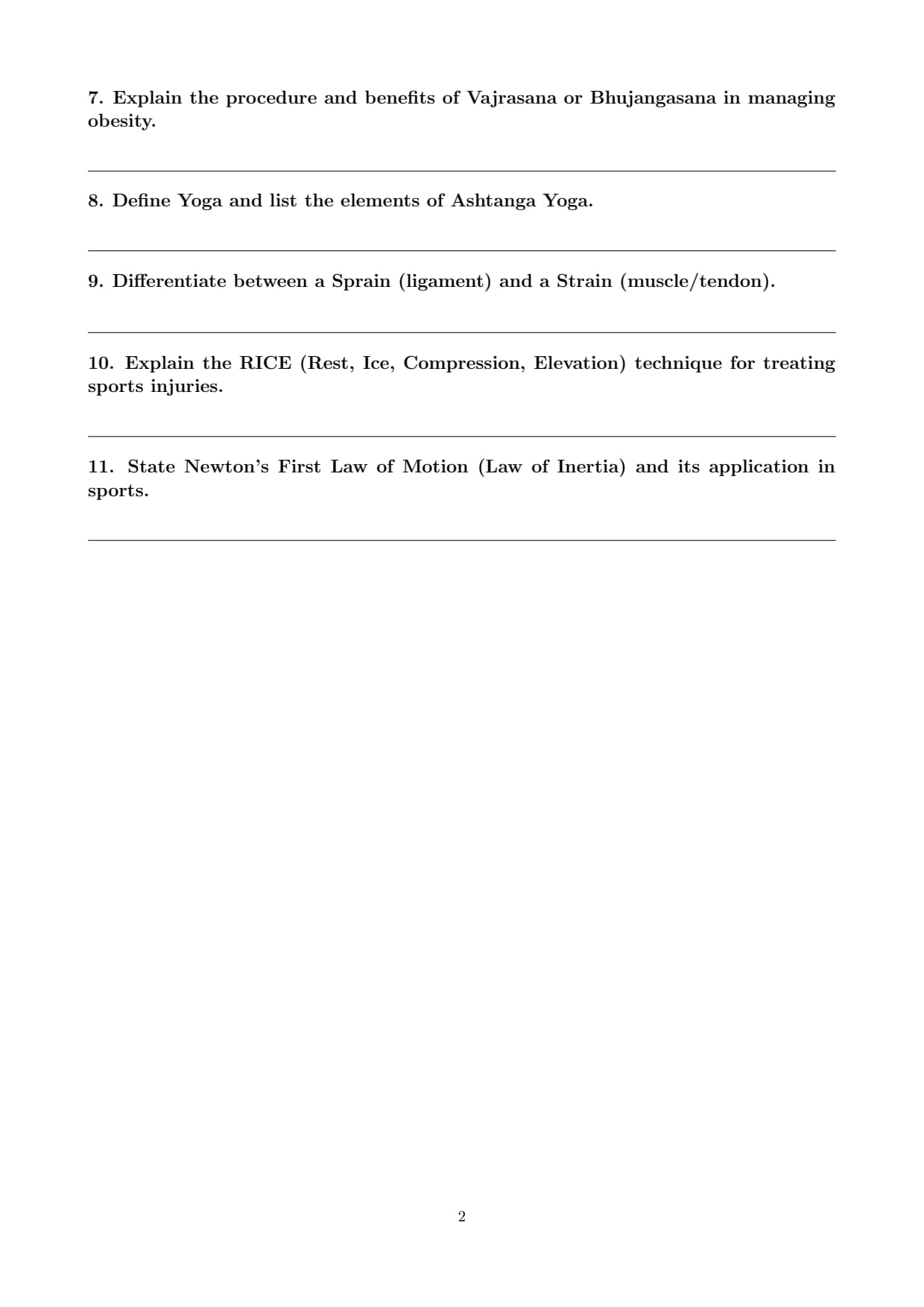
Explain the procedure and benefits of Vajrasana or Bhujangasana in managing obesity.
View Solution
Concept:
Yoga plays an important role in weight management and improving metabolism. Vajrasana and Bhujangasana are effective asanas that help in digestion, fat reduction, and overall fitness, which are essential in managing obesity.
Step 1: {\color{redProcedure of Vajrasana (Thunderbolt Pose).
Sit on the floor with legs stretched forward.
Fold the legs at the knees and sit back on the heels.
Keep the knees together and place hands on the thighs.
Keep the back straight and look forward.
Breathe normally and remain in this position for 5–10 minutes.
\medskip
Step 2: {\color{redBenefits of Vajrasana in Managing Obesity.
Improves digestion and metabolism.
Reduces fat around the abdomen.
Helps control overeating.
Strengthens lower body muscles.
Can be performed even after meals.
\medskip
(OR)
\medskip
Step 3: {\color{redProcedure of Bhujangasana (Cobra Pose).
Lie flat on the stomach with legs stretched and feet together.
Place palms under the shoulders.
Inhale and slowly raise the chest upward.
Keep the elbows slightly bent and shoulders relaxed.
Hold the position for 15–30 seconds and breathe normally.
Exhale and return to the original position.
\medskip
Step 4: {\color{redBenefits of Bhujangasana in Managing Obesity.
Reduces belly fat.
Strengthens abdominal muscles.
Improves digestion.
Enhances flexibility of the spine.
Stimulates metabolism and burns calories.
\medskip
Final Answer:
Vajrasana and Bhujangasana are effective yoga postures for managing obesity. Vajrasana improves digestion and metabolism, while Bhujangasana strengthens abdominal muscles and helps reduce belly fat. Regular practice of these asanas supports healthy weight management. Quick Tip: Regular yoga practice combined with a balanced diet is essential for effective obesity management.
Define Yoga and list the elements of Ashtanga Yoga.
View Solution
Concept:
Yoga is an ancient Indian system of physical, mental, and spiritual practices aimed at achieving harmony between body and mind. The term “Yoga” is derived from the Sanskrit word \textit{‘Yuj’, which means union or joining. It promotes physical fitness, mental peace, and spiritual growth.
Step 1: {\color{redDefinition of Yoga.
Yoga is a discipline that integrates body, mind, and soul through various practices such as asanas, pranayama, and meditation to attain overall well-being and self-realization.
\medskip
Step 2: {\color{redElements of Ashtanga Yoga.
Ashtanga Yoga, propounded by Maharishi Patanjali, consists of eight limbs (Ashta = eight, Anga = limbs):
Yama – Moral restraints
Niyama – Personal observances
Asana – Physical postures
Pranayama – Control of breath
Pratyahara – Withdrawal of senses
Dharana – Concentration
Dhyana – Meditation
Samadhi – State of deep absorption or enlightenment
\medskip
Final Answer:
Yoga is a discipline that aims at the union of body, mind, and soul to achieve overall well-being. The eight elements of Ashtanga Yoga are Yama, Niyama, Asana, Pranayama, Pratyahara, Dharana, Dhyana, and Samadhi. Quick Tip: Ashtanga Yoga consists of eight limbs that guide a person from moral discipline to ultimate spiritual realization.
Differentiate between a Sprain (ligament) and a Strain (muscle/tendon).
View Solution
Concept:
Sprain and strain are common sports injuries, but they affect different tissues of the body. A sprain involves ligaments, whereas a strain involves muscles or tendons.
Step 1: {\color{redDefinition of Sprain.
A sprain is an injury to a ligament (the tissue that connects bones to bones). It occurs due to sudden twisting, falling, or overextension of a joint. Common areas affected include the ankle, wrist, and knee.
\medskip
Step 2: {\color{redDefinition of Strain.
A strain is an injury to a muscle or tendon (the tissue that connects muscle to bone). It usually occurs due to overstretching, excessive force, or improper lifting.
\medskip
Step 3: {\color{redDifferences between Sprain and Strain.
Tissue Affected: Sprain affects ligaments; Strain affects muscles or tendons.
Cause: Sprain is caused by joint twisting; Strain is caused by muscle overuse or overstretching.
Common Areas: Sprain commonly occurs in ankles and wrists; Strain commonly occurs in hamstrings and lower back.
Symptoms: Sprain causes swelling, bruising, and joint instability; Strain causes muscle pain, spasms, and weakness.
\medskip
Final Answer:
A sprain is an injury to a ligament caused by twisting of a joint, while a strain is an injury to a muscle or tendon caused by overstretching or overuse. Though both cause pain and swelling, they affect different tissues of the body. Quick Tip: Remember: \textbf{Sprain = Ligament (joint)} and \textbf{Strain = Muscle or Tendon}.
Explain the RICE (Rest, Ice, Compression, Elevation) technique for treating sports injuries.
View Solution
Concept:
RICE is a first-aid treatment method used immediately after a soft tissue injury such as a sprain, strain, or minor muscle tear. It helps reduce pain, swelling, and further damage to the injured area.
Step 1: {\color{redRest.
The injured part should be given complete rest. Avoid movement or activities that may worsen the injury. Rest prevents further damage and allows healing to begin.
\medskip
Step 2: {\color{redIce.
Apply an ice pack to the injured area for 15–20 minutes every 2–3 hours during the first 24–48 hours. Ice helps reduce swelling, inflammation, and pain by constricting blood vessels.
\medskip
Step 3: {\color{redCompression.
Wrap the injured area with an elastic bandage to provide support and reduce swelling. The bandage should be snug but not too tight to avoid restricting blood circulation.
\medskip
Step 4: {\color{redElevation.
Keep the injured limb raised above the level of the heart whenever possible. Elevation helps reduce swelling by allowing excess fluid to drain away from the injured area.
\medskip
Final Answer:
The RICE technique stands for Rest, Ice, Compression, and Elevation. It is an effective first-aid method used immediately after sports injuries to reduce pain, swelling, and promote faster recovery. Quick Tip: RICE should be applied immediately after injury for the first 24–48 hours to control swelling and pain.
State Newton's First Law of Motion (Law of Inertia) and its application in sports.
View Solution
Concept:
Newton’s First Law of Motion is also known as the Law of Inertia. It explains the behavior of objects when no external force acts upon them. Inertia is the tendency of a body to resist any change in its state of rest or motion.
Step 1: {\color{redStatement of Newton’s First Law.
Newton’s First Law states that:
\textit{“An object remains at rest or continues to move with uniform velocity in a straight line unless acted upon by an external unbalanced force.”
\medskip
Step 2: {\color{redApplication in Sports.
A football remains at rest until a player kicks it.
A moving cricket ball continues to move until friction or a fielder stops it.
A sprinter at the starting block remains at rest until force is applied at the start signal.
A hockey player must apply force to stop or change the direction of a moving ball.
\medskip
Final Answer:
Newton’s First Law of Motion states that an object remains at rest or in uniform motion unless acted upon by an external unbalanced force. In sports, this law explains why a ball does not move until kicked and why force is required to stop or change the motion of a moving object. Quick Tip: Inertia is the resistance of a body to change its state of rest or motion.



Comments