




VITEEE 2025 27 April Shift 1 Question Paper is available here with solutions pdf. Vellore Institute of Technology is conducting VITEEE 2025 from April 20 to April 27. VITEEE 2025 Question Paper includes 40 questions from Mathematics/Biology, 35 questions from Physics, 35 questions from Chemistry, 5 questions from English, and 10 questions from Aptitude to be attempted in 150 minutes.
Related Links:
VITEEE 2025 April 27 Shift 1 Question Paper PDF Download
| VITEEE 2025 April 27 Shift 1 Question Paper With Answer Key | Download | Check Solution |

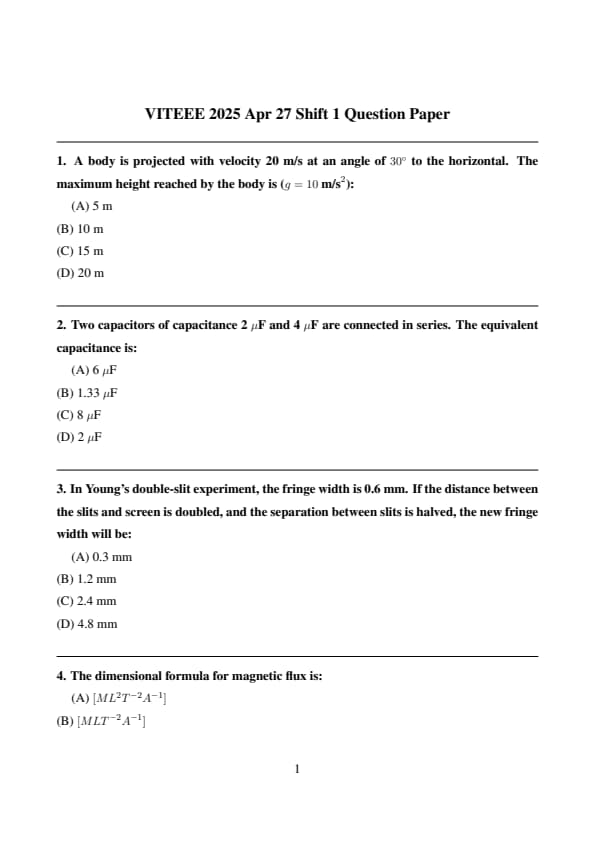
A body is projected with velocity 20 m/s at an angle of \(30^\circ\) to the horizontal. The maximum height reached by the body is (\(g = 10\ m/s^2\)):
View Solution
Step 1: Vertical component of velocity \[ u_y = 20\sin30^\circ = 10\ m/s \]
Step 2: Maximum height, \[ H = \frac{u_y^2}{2g} = \frac{10^2}{2\times10} = 5\ m \] Quick Tip: Maximum height depends only on vertical velocity component.
Two capacitors of capacitance 2 \(\mu\)F and 4 \(\mu\)F are connected in series. The equivalent capacitance is:
View Solution
For series combination, \[ \frac{1}{C}=\frac{1}{2}+\frac{1}{4}=\frac{3}{4} \Rightarrow C=\frac{4}{3}=1.33\ \muF \] Quick Tip: Series capacitors reduce overall capacitance.
In Young's double-slit experiment, the fringe width is 0.6 mm. If the distance between the slits and screen is doubled, and the separation between slits is halved, the new fringe width will be:
View Solution
Fringe width, \[ \beta \propto \frac{D}{d} \]
Doubling \(D\) and halving \(d\) increases \(\beta\) by factor 4. \[ \beta' = 4 \times 0.6 = 2.4\ mm \] Quick Tip: Fringe width increases with screen distance and decreases with slit separation.
The dimensional formula for magnetic flux is:
View Solution
Magnetic flux \(\Phi = BA\). \[ [B]=\frac{F}{IA}=\frac{MLT^{-2}}{AT} \Rightarrow [\Phi]=ML^2T^{-2}A^{-1} \] Quick Tip: Magnetic flux = magnetic field × area.
The IUPAC name of CH\(_3\)-CH(OH)-COOH is:
View Solution
The parent chain has three carbons with OH on second carbon. Quick Tip: Number the chain giving priority to COOH group.
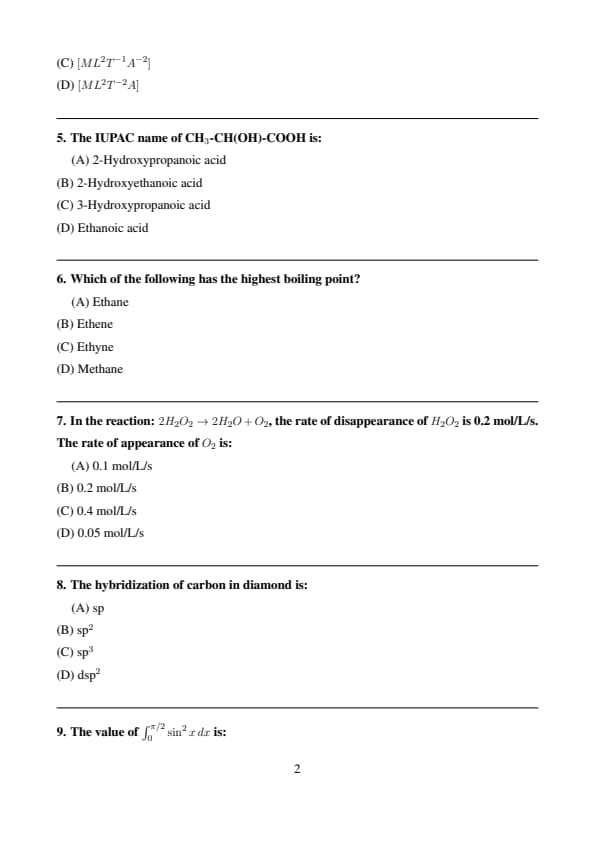
Which of the following has the highest boiling point?
View Solution
Ethyne has strongest intermolecular attractions due to linear structure. Quick Tip: Higher molecular interaction means higher boiling point.
In the reaction: \(2H_2O_2 \rightarrow 2H_2O + O_2\), the rate of disappearance of \(H_2O_2\) is 0.2 mol/L/s. The rate of appearance of \(O_2\) is:
View Solution
From stoichiometry, \[ Rate of O_2 = \frac{1}{2}\times0.2 = 0.1\ mol/L/s \] Quick Tip: Use coefficients to relate reaction rates.
The hybridization of carbon in diamond is:
View Solution
Each carbon atom forms four sigma bonds in tetrahedral geometry. Quick Tip: Tetrahedral geometry implies sp\(^3\) hybridization.
The value of \( \int_0^{\pi/2} \sin^2 x \, dx \) is:
View Solution
\[ \int_0^{\pi/2} \sin^2x dx = \frac{\pi}{4} \] Quick Tip: Use identity \(\sin^2x = \frac{1-\cos2x}{2}\).
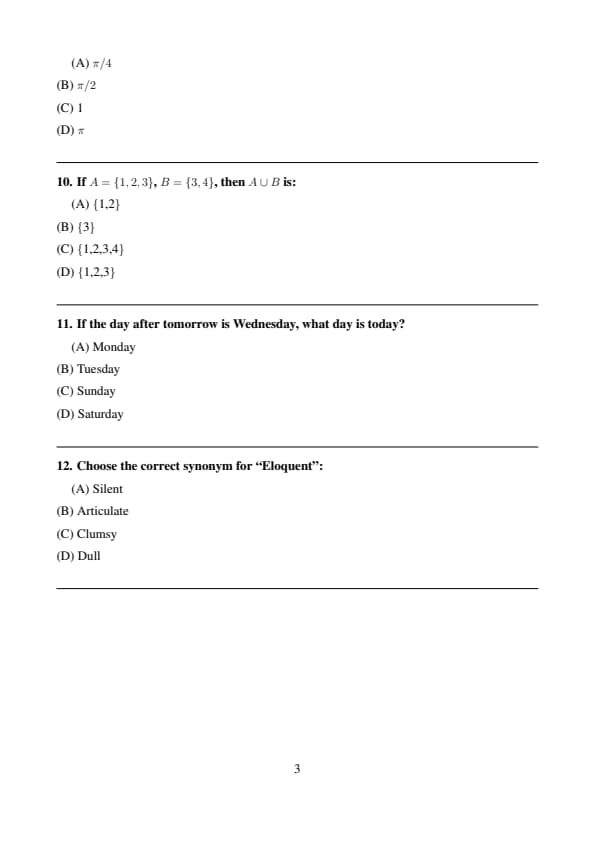
If \(A=\{1,2,3\}\), \(B=\{3,4\}\), then \(A\cup B\) is:
View Solution
Union contains all distinct elements of both sets. Quick Tip: Union combines all unique elements.
If the day after tomorrow is Wednesday, what day is today?
View Solution
Day after tomorrow = Wednesday
Tomorrow = Tuesday
Today = Monday Quick Tip: Work backward step by step in day problems.
Choose the correct synonym for ``Eloquent'':
View Solution
Eloquent means fluent and expressive in speech. Quick Tip: Synonyms convey similar meanings.
VITEEE 2025 Expected Difficulty Level
According to the exam pattern, candidates must attempt 125 questions in 150 minutes across 5 major sections: Mathematics/Biology, Physics, Chemistry, English, and Aptitude.
As per the past year's trends, this is the expected difficulty level of VITEEE 2025:
| Section | No. of Questions | Expected Difficulty Level | Remarks |
|---|---|---|---|
| Mathematics / Biology | 40 | Moderate to Difficult | Maths will have more application-based questions, and biology will have more NCERT-based questions. |
| Physics | 35 | Moderate | It will be conceptual and related to formulas with few calculations. |
| Chemistry | 35 | Easy to Moderate | Questions will be direct theory-based, with a focus on NCERT and a few tricky numerical problems |
| English | 5 | Easy | This section will focus on Grammar and comprehension-based questions. |
| Aptitude | 10 | Moderate | Basic logical reasoning and pattern questions |
VITEEE 2025: Expected Section-Wise Weightage
Below is the expected section-wise topic weightage for VITEEE 2025:
Mathematics (40 Questions) – For PCM Candidates
| Important Topics | Expected No. of Questions |
|---|---|
| Calculus | 8–10 |
| Coordinate Geometry | 5–6 |
| Algebra (Quadratic, Complex No.) | 6–7 |
| Trigonometry | 4–5 |
| Probability & Statistics | 4–5 |
| Matrices and Determinants | 3–4 |
| Vectors and 3D Geometry | 4–5 |
Physics (35 Questions)
| Important Topics | Expected No. of Questions |
|---|---|
| Mechanics | 6–8 |
| Electrostatics & Current Electricity | 5–6 |
| Optics | 4–5 |
| Thermodynamics & Heat Transfer | 4–5 |
| Modern Physics | 4–5 |
| Waves & Oscillations | 3–4 |
| Magnetism & EMI | 4–5 |
Chemistry (35 Questions)
| Important Topics | Expected No. of Questions |
|---|---|
| Organic Chemistry (Reactions, Mechanisms) | 10–12 |
| Physical Chemistry (Thermo, Equilibrium) | 10–12 |
| Inorganic Chemistry (p/d/f block, Coordination) | 8–10 |
| Environmental Chemistry, Biomolecules | 2–3 |
English (5 Questions)
| Type of Questions | Expected questions |
|---|---|
| Reading Comprehension | 1–2 |
| Grammar (Tense, Voice, Error Spotting) | 2–3 |
| Vocabulary (Synonyms/Antonyms) | 1 |
Aptitude (10 Questions)
| Important Topics | Expected No. of Questions |
| Number Series & Coding-Decoding | 2–3 |
| Data Interpretation | 2–3 |
| Syllogism & Logical Reasoning | 2–3 |
| Basic Arithmetic | 2 |



Comments