




VITEEE 2025 26 April Shift 1 Question Paper is available here with solutions pdf. Vellore Institute of Technology is conducting VITEEE 2025 from April 20 to April 27. VITEEE 2025 Question Paper includes 40 questions from Mathematics/Biology, 35 questions from Physics, 35 questions from Chemistry, 5 questions from English, and 10 questions from Aptitude to be attempted in 150 minutes.
Related Links:
VITEEE 2025 April 26 Shift 1 Question Paper PDF Download
| VITEEE 2025 April 26 Shift 1 Question Paper With Answer Key | Download | Check Solution |

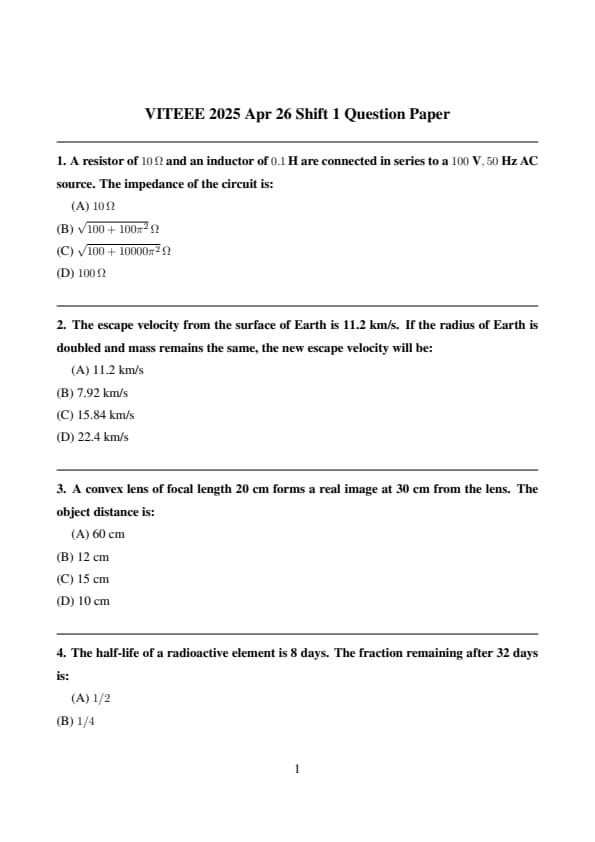
A resistor of \(10\,\Omega\) and an inductor of \(0.1\,H\) are connected in series to a \(100\ V, 50\ Hz\) AC source. The impedance of the circuit is:
View Solution
\[ X_L = 2\pi f L = 2\pi(50)(0.1)=10\pi \] \[ Z=\sqrt{R^2+X_L^2}=\sqrt{10^2+(10\pi)^2}=\sqrt{100+100\pi^2} \] Quick Tip: Impedance in RL circuit: \(Z=\sqrt{R^2+X_L^2}\).
The escape velocity from the surface of Earth is 11.2 km/s. If the radius of Earth is doubled and mass remains the same, the new escape velocity will be:
View Solution
\[ v_e \propto \frac{1}{\sqrt{R}} \] \[ v'=\frac{11.2}{\sqrt{2}}=7.92\ km/s \] Quick Tip: Escape velocity varies inversely with square root of radius.
A convex lens of focal length 20 cm forms a real image at 30 cm from the lens. The object distance is:
View Solution
\[ \frac{1}{f}=\frac{1}{v}+\frac{1}{u} \Rightarrow \frac{1}{20}=\frac{1}{30}+\frac{1}{u} \] \[ \frac{1}{u}=\frac{1}{60}\Rightarrow u=60\ cm \] Quick Tip: Use lens formula carefully with sign convention.
The half-life of a radioactive element is 8 days. The fraction remaining after 32 days is:
View Solution
\[ 32\ days = 4\ half-lives \Rightarrow \left(\frac12\right)^4=\frac1{16} \] Quick Tip: Remaining fraction = \((1/2)^n\).
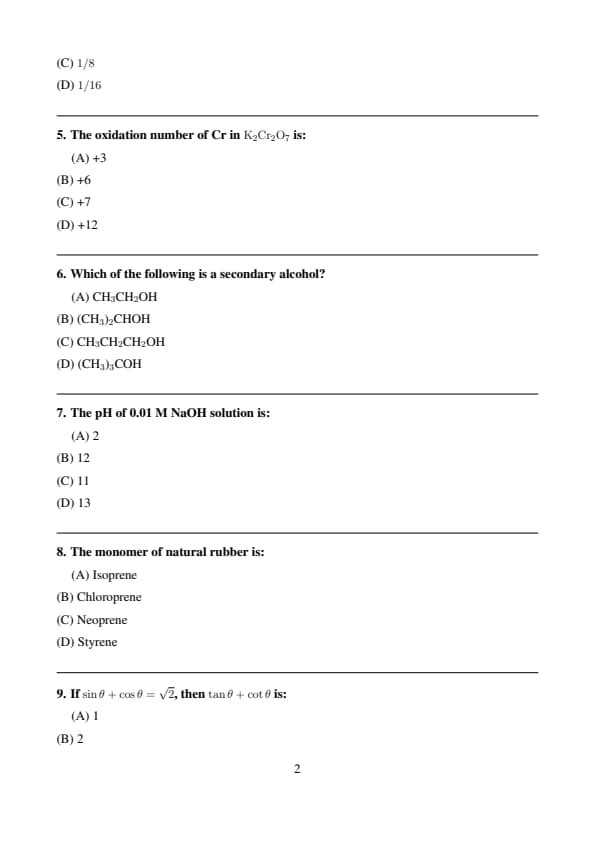
The oxidation number of Cr in \( \mathrm{K_2Cr_2O_7} \) is:
View Solution
Oxidation state of Cr in dichromate ion is +6. Quick Tip: Chromium shows +6 oxidation state in dichromates.
Which of the following is a secondary alcohol?
View Solution
In (CH\(_3\))\(_2\)CHOH, the carbon bearing –OH is attached to two other carbons. Quick Tip: Secondary alcohol: –OH on a carbon attached to two carbons.
The pH of 0.01 M NaOH solution is:
View Solution
\[ pOH=-\log(0.01)=2 \Rightarrow pH=14-2=12 \] Quick Tip: Strong bases completely dissociate.
The monomer of natural rubber is:
View Solution
Natural rubber is cis-1,4-polyisoprene. Quick Tip: Isoprene is the building block of natural rubber.
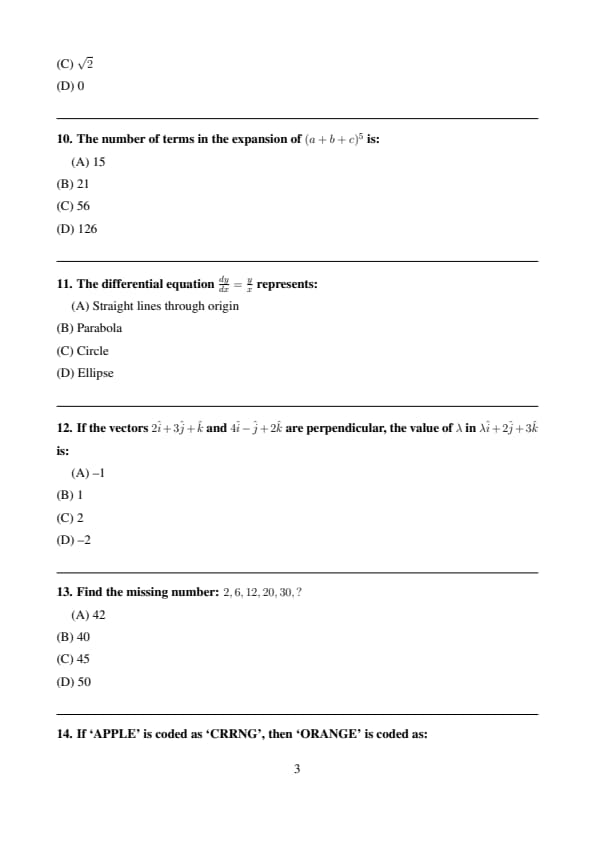
If \(\sin\theta+\cos\theta=\sqrt{2}\), then \(\tan\theta+\cot\theta\) is:
View Solution
\[ \sin\theta=\cos\theta=\frac{1}{\sqrt{2}}\Rightarrow \theta=45^\circ \] \[ \tan\theta+\cot\theta=1+1=2 \] Quick Tip: Equality of sine and cosine implies \(45^\circ\).
The number of terms in the expansion of \((a+b+c)^5\) is:
View Solution
\[ Number of terms=\frac{(n+1)(n+2)}{2}=\frac{6\times7}{2}=21 \] Quick Tip: Applies to multinomial expansions.
The differential equation \(\frac{dy}{dx}=\frac{y}{x}\) represents:
View Solution
\[ \frac{dy}{y}=\frac{dx}{x}\Rightarrow y=Cx \] Quick Tip: Solution of first-order DE gives family of curves.
If the vectors \(2\hat{i}+3\hat{j}+\hat{k}\) and \(4\hat{i}-\hat{j}+2\hat{k}\) are perpendicular, the value of \(\lambda\) in \(\lambda\hat{i}+2\hat{j}+3\hat{k}\) is:
View Solution
For perpendicular vectors, \[ (\lambda,2,3)\cdot(4,-1,2)=0 \Rightarrow 4\lambda-2+6=0 \Rightarrow \lambda=-1 \] Quick Tip: Perpendicular vectors have zero dot product.
Find the missing number: \(2,6,12,20,30,?\)
View Solution
Sequence follows \(n(n+1)\): \(1\cdot2,2\cdot3,\dots,6\cdot7=42\). Quick Tip: Look for quadratic patterns.
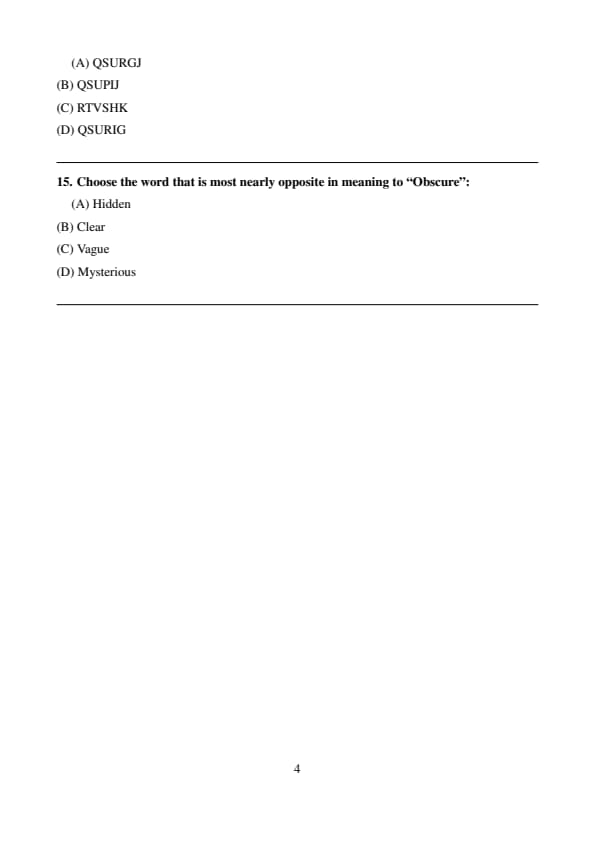
If `APPLE' is coded as `CRRNG', then `ORANGE' is coded as:
View Solution
Each letter is shifted forward by two positions in the alphabet. Quick Tip: Alphabet coding often uses fixed shifts.
Choose the word that is most nearly opposite in meaning to ``Obscure'':
View Solution
Obscure means unclear or hidden; its opposite is clear. Quick Tip: Antonyms convey opposite meanings.
VITEEE 2025 Expected Difficulty Level
According to the exam pattern, candidates must attempt 125 questions in 150 minutes across 5 major sections: Mathematics/Biology, Physics, Chemistry, English, and Aptitude.
As per the past year's trends, this is the expected difficulty level of VITEEE 2025:
| Section | No. of Questions | Expected Difficulty Level | Remarks |
|---|---|---|---|
| Mathematics / Biology | 40 | Moderate to Difficult | Maths will have more application-based questions, and biology will have more NCERT-based questions. |
| Physics | 35 | Moderate | It will be conceptual and related to formulas with few calculations. |
| Chemistry | 35 | Easy to Moderate | Questions will be direct theory-based, with a focus on NCERT and a few tricky numerical problems |
| English | 5 | Easy | This section will focus on Grammar and comprehension-based questions. |
| Aptitude | 10 | Moderate | Basic logical reasoning and pattern questions |
VITEEE 2025: Expected Section-Wise Weightage
Below is the expected section-wise topic weightage for VITEEE 2025:
Mathematics (40 Questions) – For PCM Candidates
| Important Topics | Expected No. of Questions |
|---|---|
| Calculus | 8–10 |
| Coordinate Geometry | 5–6 |
| Algebra (Quadratic, Complex No.) | 6–7 |
| Trigonometry | 4–5 |
| Probability & Statistics | 4–5 |
| Matrices and Determinants | 3–4 |
| Vectors and 3D Geometry | 4–5 |
Physics (35 Questions)
| Important Topics | Expected No. of Questions |
|---|---|
| Mechanics | 6–8 |
| Electrostatics & Current Electricity | 5–6 |
| Optics | 4–5 |
| Thermodynamics & Heat Transfer | 4–5 |
| Modern Physics | 4–5 |
| Waves & Oscillations | 3–4 |
| Magnetism & EMI | 4–5 |
Chemistry (35 Questions)
| Important Topics | Expected No. of Questions |
|---|---|
| Organic Chemistry (Reactions, Mechanisms) | 10–12 |
| Physical Chemistry (Thermo, Equilibrium) | 10–12 |
| Inorganic Chemistry (p/d/f block, Coordination) | 8–10 |
| Environmental Chemistry, Biomolecules | 2–3 |
English (5 Questions)
| Type of Questions | Expected questions |
|---|---|
| Reading Comprehension | 1–2 |
| Grammar (Tense, Voice, Error Spotting) | 2–3 |
| Vocabulary (Synonyms/Antonyms) | 1 |
Aptitude (10 Questions)
| Important Topics | Expected No. of Questions |
| Number Series & Coding-Decoding | 2–3 |
| Data Interpretation | 2–3 |
| Syllogism & Logical Reasoning | 2–3 |
| Basic Arithmetic | 2 |



Comments