




VITEEE 2025 25 April Shift 1 Question Paper is available here with solutions pdf. Vellore Institute of Technology is conducting VITEEE 2025 from April 20 to April 27. VITEEE 2025 Question Paper includes 40 questions from Mathematics/Biology, 35 questions from Physics, 35 questions from Chemistry, 5 questions from English, and 10 questions from Aptitude to be attempted in 150 minutes.
Related Links:
VITEEE 2025 April 25 Shift 1 Question Paper PDF Download
| VITEEE 2025 24 April Shift 1 Question Paper With Answer Key | Download | Check Solution |

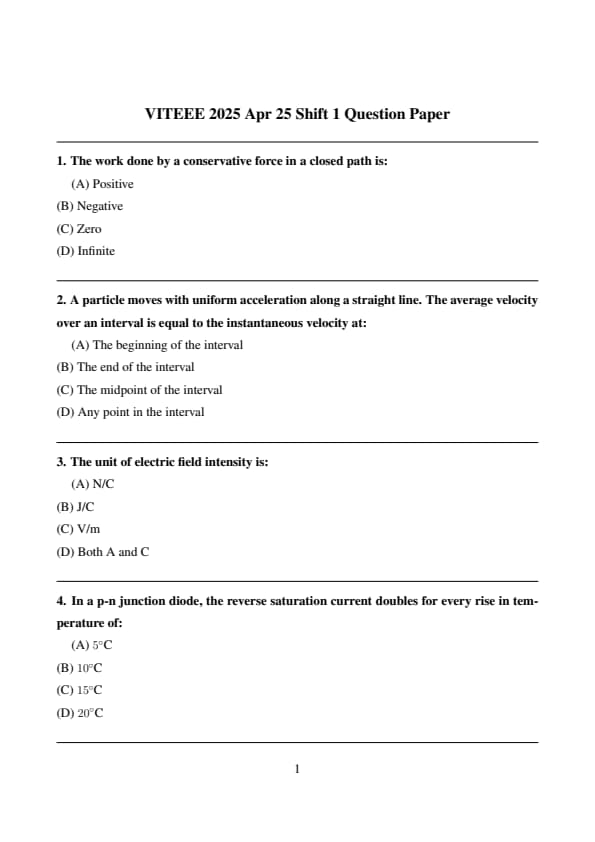
The work done by a conservative force in a closed path is:
View Solution
For a conservative force, work done depends only on initial and final positions.
In a closed path, these positions are the same, hence work done is zero. Quick Tip: Work done by conservative forces over a closed loop is always zero.
A particle moves with uniform acceleration along a straight line. The average velocity over an interval is equal to the instantaneous velocity at:
View Solution
For uniform acceleration, \[ v_{avg}=\frac{u+v}{2} \]
This equals the instantaneous velocity at the midpoint of the time interval. Quick Tip: For uniform acceleration, average velocity equals velocity at mid-time.
The unit of electric field intensity is:
View Solution
Electric field can be expressed as force per charge (N/C) or potential gradient (V/m).
Both units are equivalent. Quick Tip: \(1\ N/C = 1\ V/m\).
In a p-n junction diode, the reverse saturation current doubles for every rise in temperature of:
View Solution
For semiconductor diodes, reverse saturation current approximately doubles for every \(10^\circC\) rise in temperature. Quick Tip: Reverse current in diodes is highly temperature dependent.
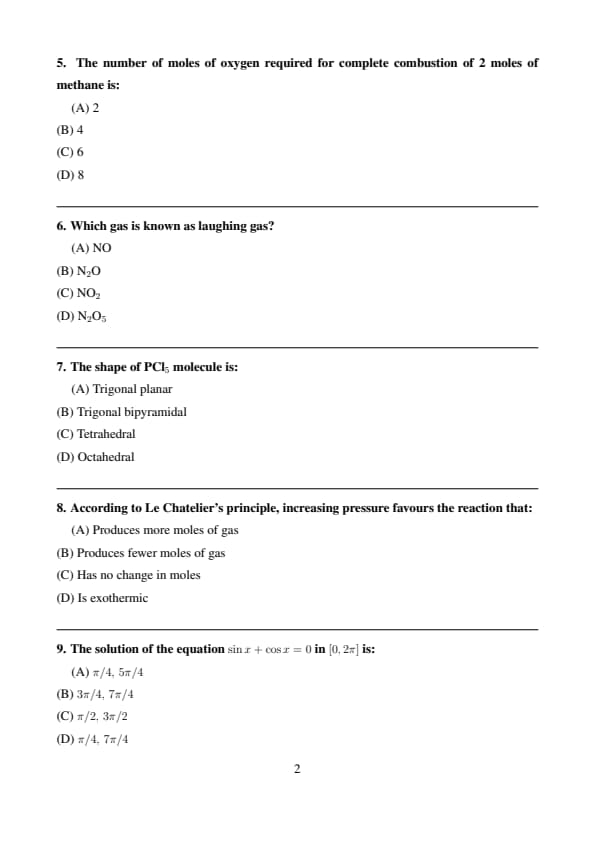
The number of moles of oxygen required for complete combustion of 2 moles of methane is:
View Solution
\[ \mathrm{CH_4 + 2O_2 \rightarrow CO_2 + 2H_2O} \]
1 mole of methane needs 2 moles of oxygen.
So, 2 moles need 4 moles of oxygen. Quick Tip: Always balance the chemical equation first.
Which gas is known as laughing gas?
View Solution
Nitrous oxide (N\(_2\)O) produces a laughing sensation when inhaled. Quick Tip: N\(_2\)O is also used as an anesthetic.
The shape of PCl\(_5\) molecule is:
View Solution
Phosphorus in PCl\(_5\) has five bond pairs and no lone pair, giving a trigonal bipyramidal geometry. Quick Tip: Five bond pairs around central atom give trigonal bipyramidal shape.
According to Le Chatelier’s principle, increasing pressure favours the reaction that:
View Solution
Increasing pressure shifts equilibrium towards the side with fewer moles of gas to reduce pressure. Quick Tip: Pressure affects equilibrium only for gaseous reactions.
The solution of the equation \(\sin x + \cos x = 0\) in \([0,2\pi]\) is:
View Solution
\[ \sin x = -\cos x \Rightarrow \tan x = -1 \] \[ x = \frac{3\pi}{4},\ \frac{7\pi}{4} \] Quick Tip: Use \(\tan x = \frac{\sin x}{\cos x}\) to simplify.
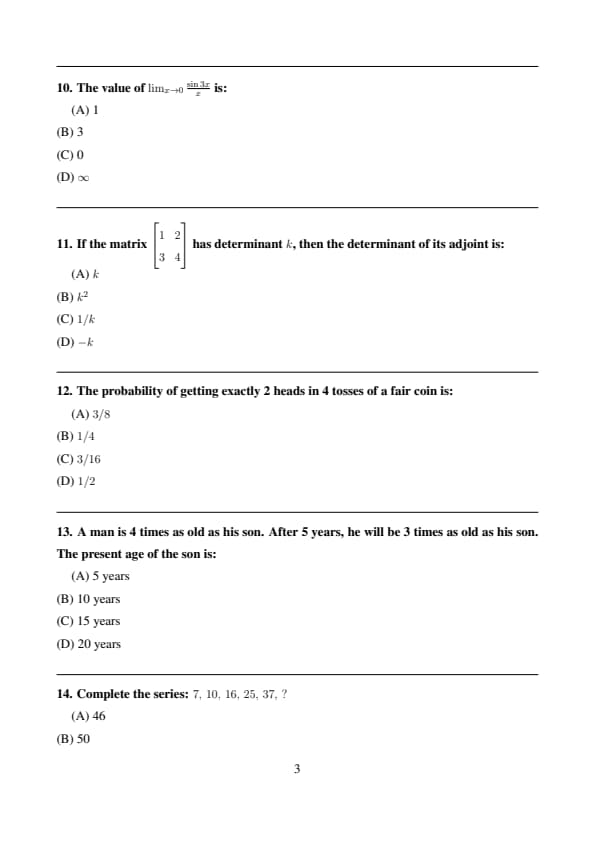
The value of \(\lim_{x\to0}\frac{\sin 3x}{x}\) is:
View Solution
\[ \lim_{x\to0}\frac{\sin 3x}{x}=3\lim_{x\to0}\frac{\sin 3x}{3x}=3 \] Quick Tip: \(\displaystyle \lim_{x\to0}\frac{\sin x}{x}=1\).
If the matrix \(\begin{bmatrix}1 & 2
3 & 4\end{bmatrix}\) has determinant \(k\), then the determinant of its adjoint is:
View Solution
For an \(n\times n\) matrix, \[ \det(adj A) = (\det A)^{n-1} \]
Here \(n=2\), so \(\det(adj A)=k\). Quick Tip: For 2×2 matrices, determinant of adjoint equals determinant.
The probability of getting exactly 2 heads in 4 tosses of a fair coin is:
View Solution
\[ P = \frac{\binom{4}{2}}{2^4}=\frac{6}{16}=\frac{3}{8} \] Quick Tip: Use combinations for fixed number of outcomes.
A man is 4 times as old as his son. After 5 years, he will be 3 times as old as his son. The present age of the son is:
View Solution
Let son’s age = \(x\).
Man’s age = \(4x\). \[ 4x+5 = 3(x+5)\Rightarrow x=10 \] Quick Tip: Translate word problems into equations.
Complete the series: \(7,\,10,\,16,\,25,\,37,\,?\)
View Solution
Differences: \(3,6,9,12\).
Next difference = \(15\). \[ 37+15=52 \] Quick Tip: Check differences to identify number patterns.

VITEEE 2025 Expected Difficulty Level
According to the exam pattern, candidates must attempt 125 questions in 150 minutes across 5 major sections: Mathematics/Biology, Physics, Chemistry, English, and Aptitude.
As per the past year's trends, this is the expected difficulty level of VITEEE 2025:
| Section | No. of Questions | Expected Difficulty Level | Remarks |
|---|---|---|---|
| Mathematics / Biology | 40 | Moderate to Difficult | Maths will have more application-based questions, and biology will have more NCERT-based questions. |
| Physics | 35 | Moderate | It will be conceptual and related to formulas with few calculations. |
| Chemistry | 35 | Easy to Moderate | Questions will be direct theory-based, with a focus on NCERT and a few tricky numerical problems |
| English | 5 | Easy | This section will focus on Grammar and comprehension-based questions. |
| Aptitude | 10 | Moderate | Basic logical reasoning and pattern questions |
VITEEE 2025: Expected Section-Wise Weightage
Below is the expected section-wise topic weightage for VITEEE 2025:
Mathematics (40 Questions) – For PCM Candidates
| Important Topics | Expected No. of Questions |
|---|---|
| Calculus | 8–10 |
| Coordinate Geometry | 5–6 |
| Algebra (Quadratic, Complex No.) | 6–7 |
| Trigonometry | 4–5 |
| Probability & Statistics | 4–5 |
| Matrices and Determinants | 3–4 |
| Vectors and 3D Geometry | 4–5 |
Physics (35 Questions)
| Important Topics | Expected No. of Questions |
|---|---|
| Mechanics | 6–8 |
| Electrostatics & Current Electricity | 5–6 |
| Optics | 4–5 |
| Thermodynamics & Heat Transfer | 4–5 |
| Modern Physics | 4–5 |
| Waves & Oscillations | 3–4 |
| Magnetism & EMI | 4–5 |
Chemistry (35 Questions)
| Important Topics | Expected No. of Questions |
|---|---|
| Organic Chemistry (Reactions, Mechanisms) | 10–12 |
| Physical Chemistry (Thermo, Equilibrium) | 10–12 |
| Inorganic Chemistry (p/d/f block, Coordination) | 8–10 |
| Environmental Chemistry, Biomolecules | 2–3 |
English (5 Questions)
| Type of Questions | Expected questions |
|---|---|
| Reading Comprehension | 1–2 |
| Grammar (Tense, Voice, Error Spotting) | 2–3 |
| Vocabulary (Synonyms/Antonyms) | 1 |
Aptitude (10 Questions)
| Important Topics | Expected No. of Questions |
| Number Series & Coding-Decoding | 2–3 |
| Data Interpretation | 2–3 |
| Syllogism & Logical Reasoning | 2–3 |
| Basic Arithmetic | 2 |



Comments