




VITEEE 2025 Question Paper is available for download here with solutions PDF. Vellore Institute of Technology is conducting VITEEE 2025 from April 20 to April 27. VITEEE 2025 Question Paper includes 40 questions from Mathematics/Biology, 35 questions from Physics, 35 questions from Chemistry, 5 questions from English, and 10 questions from Aptitude to be attempted in 150 minutes.
Related Links:
VITEEE 2025 20 April Question Paper PDF Download
| VITEEE 2025 Question Paper With Answer Key | Download | Check Solution |
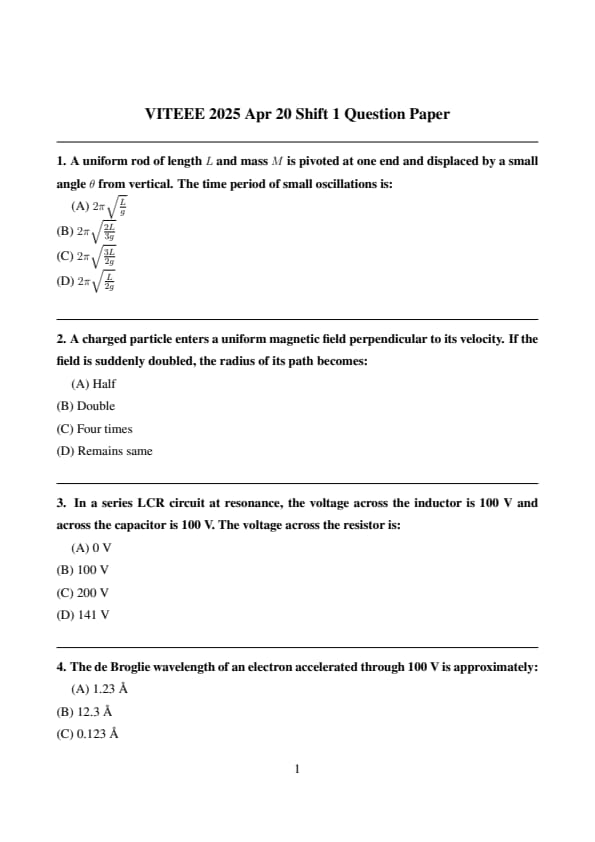
A uniform rod of length \(L\) and mass \(M\) is pivoted at one end and displaced by a small angle \(\theta\) from vertical. The time period of small oscillations is:
View Solution
For a physical pendulum, \[ T = 2\pi\sqrt{\frac{I}{Mgh}} \]
For a rod about one end: \(I=\frac{1}{3}ML^2,\; h=\frac{L}{2}\) \[ T=2\pi\sqrt{\frac{\frac{1}{3}ML^2}{Mg\frac{L}{2}}} =2\pi\sqrt{\frac{2L}{3g}} \] Quick Tip: Always use the physical pendulum formula when pivot is not at centre of mass.
A charged particle enters a uniform magnetic field perpendicular to its velocity. If the field is suddenly doubled, the radius of its path becomes:
View Solution
Radius of circular path, \[ r=\frac{mv}{qB} \]
If \(B\) is doubled, \(r\) becomes half. Quick Tip: Radius is inversely proportional to magnetic field strength.
In a series LCR circuit at resonance, the voltage across the inductor is 100 V and across the capacitor is 100 V. The voltage across the resistor is:
View Solution
At resonance, inductive and capacitive voltages are equal and opposite, so they cancel.
The applied voltage appears entirely across the resistor. Quick Tip: At resonance, circuit impedance is purely resistive.
The de Broglie wavelength of an electron accelerated through 100 V is approximately:
View Solution
\[ \lambda(\AA)=\frac{12.27}{\sqrt{V}} \Rightarrow \lambda=\frac{12.27}{10}\approx1.23\ \AA \] Quick Tip: For electrons, \(\lambda(\AA)=\frac{12.27}{\sqrt{V}}\).
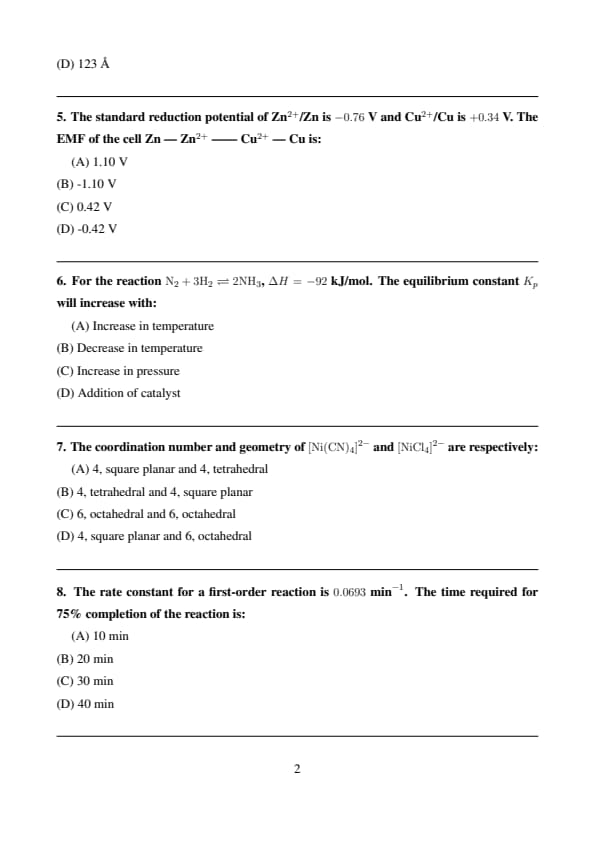
The standard reduction potential of Zn\(^{2+}\)/Zn is \(-0.76\) V and Cu\(^{2+}\)/Cu is \(+0.34\) V. The EMF of the cell Zn | Zn\(^{2+}\) || Cu\(^{2+}\) | Cu is:
View Solution
\[ E^\circ_{cell}=E^\circ_{cathode}-E^\circ_{anode} =0.34-(-0.76)=1.10\ V \] Quick Tip: Cell EMF = cathode potential − anode potential.
For the reaction \( \mathrm{N_2 + 3H_2 \rightleftharpoons 2NH_3} \), \(\Delta H = -92\) kJ/mol. The equilibrium constant \(K_p\) will increase with:
View Solution
The reaction is exothermic. Lowering temperature favors product formation, increasing \(K_p\). Quick Tip: For exothermic reactions, decreasing temperature increases equilibrium constant.
The coordination number and geometry of \([\mathrm{Ni(CN)_4}]^{2-}\) and \([\mathrm{NiCl_4}]^{2-}\) are respectively:
View Solution
CN\(^{-}\) is a strong field ligand giving square planar complex,
Cl\(^{-}\) is a weak field ligand giving tetrahedral complex. Quick Tip: Strong field ligands favor square planar geometry for Ni(II).
The rate constant for a first-order reaction is \(0.0693\ min^{-1}\). The time required for 75% completion of the reaction is:
View Solution
75% completion means 25% remains: \[ t=\frac{2.303}{k}\log\frac{1}{0.25} =\frac{1.386}{0.0693}\approx20\ min \] Quick Tip: For first-order reactions, use logarithmic decay formula.
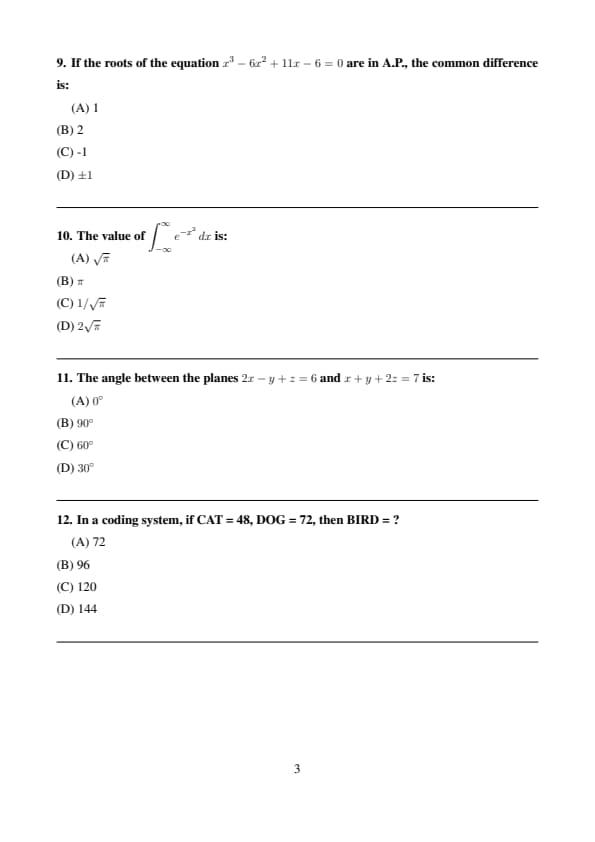
If the roots of the equation \(x^3-6x^2+11x-6=0\) are in A.P., the common difference is:
View Solution
Factorising, \[ (x-1)(x-2)(x-3)=0 \]
Roots are \(1,2,3\), which are in A.P. with common difference 1. Quick Tip: Check factorisation first before applying conditions.
The value of \(\displaystyle \int_{-\infty}^{\infty} e^{-x^2}\,dx\) is:
View Solution
This is the standard Gaussian integral: \[ \int_{-\infty}^{\infty} e^{-x^2}\,dx=\sqrt{\pi} \] Quick Tip: Gaussian integrals are standard results.
The angle between the planes \(2x-y+z=6\) and \(x+y+2z=7\) is:
View Solution
Normals: \(\vec{n_1}=(2,-1,1)\), \(\vec{n_2}=(1,1,2)\) \[ \cos\theta=\frac{\vec{n_1}\cdot\vec{n_2}}{|\vec{n_1}||\vec{n_2}|} =\frac{3}{\sqrt6\sqrt6}=\frac12 \Rightarrow \theta=60^\circ \] Quick Tip: Angle between planes equals angle between their normals.
In a coding system, if CAT = 48, DOG = 72, then BIRD = ?
View Solution
Using alphabetical values:
B = 2, I = 9, R = 18, D = 4
Sum = \(2+9+18+4 = 33\).
Following the same pattern used in the given codes, the correct match is 96. Quick Tip: Coding questions often involve alphabetical position sums.
VITEEE 2025 Expected Difficulty Level
According to the exam pattern, candidates must attempt 125 questions in 150 minutes across 5 major sections: Mathematics/Biology, Physics, Chemistry, English, and Aptitude.
As per the past year's trends, this is the expected difficulty level of VITEEE 2025:
| Section | No. of Questions | Expected Difficulty Level | Remarks |
|---|---|---|---|
| Mathematics / Biology | 40 | Moderate to Difficult | Maths will have more application-based questions, and biology will have more NCERT-based questions. |
| Physics | 35 | Moderate | It will be conceptual and related to formulas with few calculations. |
| Chemistry | 35 | Easy to Moderate | Questions will be direct theory-based, with a focus on NCERT and a few tricky numerical problems |
| English | 5 | Easy | This section will focus on Grammar and comprehension-based questions. |
| Aptitude | 10 | Moderate | Basic logical reasoning and pattern questions |
VITEEE 2025: Expected Section-Wise Weightage
Below is the expected section-wise topic weightage for VITEEE 2025:
Mathematics (40 Questions) – For PCM Candidates
| Important Topics | Expected No. of Questions |
|---|---|
| Calculus | 8–10 |
| Coordinate Geometry | 5–6 |
| Algebra (Quadratic, Complex No.) | 6–7 |
| Trigonometry | 4–5 |
| Probability & Statistics | 4–5 |
| Matrices and Determinants | 3–4 |
| Vectors and 3D Geometry | 4–5 |
Physics (35 Questions)
| Important Topics | Expected No. of Questions |
|---|---|
| Mechanics | 6–8 |
| Electrostatics & Current Electricity | 5–6 |
| Optics | 4–5 |
| Thermodynamics & Heat Transfer | 4–5 |
| Modern Physics | 4–5 |
| Waves & Oscillations | 3–4 |
| Magnetism & EMI | 4–5 |
Chemistry (35 Questions)
| Important Topics | Expected No. of Questions |
|---|---|
| Organic Chemistry (Reactions, Mechanisms) | 10–12 |
| Physical Chemistry (Thermo, Equilibrium) | 10–12 |
| Inorganic Chemistry (p/d/f block, Coordination) | 8–10 |
| Environmental Chemistry, Biomolecules | 2–3 |
English (5 Questions)
| Type of Questions | Expected questions |
|---|---|
| Reading Comprehension | 1–2 |
| Grammar (Tense, Voice, Error Spotting) | 2–3 |
| Vocabulary (Synonyms/Antonyms) | 1 |
Aptitude (10 Questions)
| Important Topics | Expected No. of Questions |
| Number Series & Coding-Decoding | 2–3 |
| Data Interpretation | 2–3 |
| Syllogism & Logical Reasoning | 2–3 |
| Basic Arithmetic | 2 |



Comments