




CMAT 2018 Logical Reasoning Question paper with answer key pdf conducted on January 20 in Afternoon Session 2:30 PM to 5:30 PM is available for download. The exam was successfully organized by All India Council for Technical Education (AICTE). The question paper comprised a total of 25 questions. (PDF Source: cracku.in)
CMAT 2018 Logical Reasoning Question Paper with Answer Key PDFs Afternoon Session
| CMAT 2018 Logical Reasoning Question Paper with Solutions PDF | Download PDF | Check Solutions |
Looking at Sweety, Raj says to his friend, ``Sweety is the grand-daughter of the elder brother of my father''. How is Sweety related to Raj?
View Solution
Step 1: Identify the elder brother of Raj's father.
Raj's father's elder brother is Raj's uncle.
Step 2: Identify Sweety's relation with Raj's uncle.
Sweety is the grand-daughter of Raj's uncle.
Step 3: Convert that into relation with Raj.
Grand-daughter of Raj's uncle would be the daughter of Raj's cousin (or close family line), which is considered as Raj's niece.
Step 4: Conclusion.
Hence, Sweety is Raj's niece.
Quick Tip: In blood relation questions, first convert the statement into direct family terms like uncle, aunt, cousin etc., then map it to the required person.
Seven experts N, G, M, W, J, K and I give expert advice sessions to the XII class students. These sessions can take place either before the school, during lunch period or after the school. In scheduling these sessions the following conditions are followed.
At least two experts must hold the sessions before school.
At least three experts must hold their sessions after school.
M is not available after school and J is available only after school.
W always takes extra sessions during lunch.
G will take session before school only if N is also scheduled before school.
All the following statements could be true except:
View Solution
Step 1: List the fixed conditions.
- At least 2 experts must be before school.
- At least 3 experts must be after school.
- \(M\) cannot be after school.
- \(J\) is only after school.
- \(W\) is always during lunch.
- If \(G\) is before school, then \(N\) must also be before school.
Step 2: Check minimum allocations.
Since \(J\) is compulsory after school and at least 3 experts must be after school, minimum after-school sessions = 3.
Also, before-school sessions must be at least 2.
Step 3: Reason why option (4) is not possible.
The given constraints force after school to have a minimum of 3 experts.
But lunch sessions have \(W\) fixed and may not reach the same count as after-school under valid distributions because at least 2 must be before school and \(M\) cannot be after school.
This makes it impossible for lunch and after-school counts to be equal.
Step 4: Conclusion.
Hence, statement (4) cannot be true and is the correct answer.
Quick Tip: In scheduling problems, first satisfy minimum constraints, then check which option violates the possibility of distribution.
Six male friends A, B, C, D, E and F are married to R, S, U, V, T and W, not necessarily in the same order. Following facts are known about them:
R and S are A's sisters.
Neither R nor T are wives of C.
W is wife of E and V is wife of B.
D is not married to R, S or T.
Who is A's wife?
View Solution
Step 1: Use given fixed pairs.
\(W\) is wife of \(E\).
\(V\) is wife of \(B\).
Step 2: Use the statement about sisters.
R and S are A's sisters.
So A cannot be married to R or S.
Step 3: Apply restriction on C.
Neither R nor T is wife of C.
So C cannot be married to R or T.
Step 4: Apply restriction on D.
D is not married to R, S or T.
So D cannot be married to T also.
Step 5: Final elimination.
Since A cannot marry R or S, and the given pairing eliminates others, the only valid choice left for A's wife is T.
Step 6: Conclusion.
Therefore, A's wife is T.
Quick Tip: In marriage-arrangement puzzles, fix confirmed pairs first, then eliminate impossible options systematically.
If southeast becomes east and northwest becomes west and all the other directions are changed in the same direction. Then what will be the direction for north?
View Solution

Step 1: Understand the direction change.
Given: Southeast becomes East.
That means the whole compass has shifted 45° clockwise (to the right).
Step 2: Verify with second condition.
Northwest becomes West.
Northwest shifting 45° clockwise becomes West, which matches.
Step 3: Apply the same shift to North.
North shifted 45° clockwise becomes Northeast.
Step 4: Conclusion.
So the new direction for North will be Northeast.
Quick Tip: If one direction changes to another, check the angle shift (clockwise/anticlockwise) and apply the same shift to all directions.
Inspector arrested three persons - Kalia, Raza, Shera - on suspicion, in a theft case. It was found the one among these three was the thief. During the interrogation their replies were as follows:
Kalia: I am not the thief. Raza is the thief.
Raza: I am not the thief. Either Kalia or Shera is the thief.
Shera: I am not the thief. Raza is not the thief.
If exactly one person among them always speaks the truth, another always speaks lies and the third alternates between truth and lies, then who is the thief?
View Solution
Step 1: Assume Raza is the thief.
Then Kalia's statement: ``Raza is the thief'' becomes true, but ``I am not thief'' is also true.
So Kalia would be speaking truth twice, hence Kalia could be the truth-teller.
Step 2: Check Raza's statements.
If Raza is thief, then statement ``I am not thief'' is false.
Second statement ``Either Kalia or Shera is thief'' is also false.
So Raza can be the liar.
Step 3: Check Shera's statements.
If Raza is thief:
Shera says ``I am not thief'' (true) and ``Raza is not thief'' (false).
So Shera alternates between truth and lie, which matches the condition.
Step 4: Conclusion.
All three roles fit correctly only when Raza is the thief.
Hence, the thief is Raza.
Quick Tip: In truth-lie puzzles, test each person as thief and verify who becomes truth-teller, liar and alternator consistently.
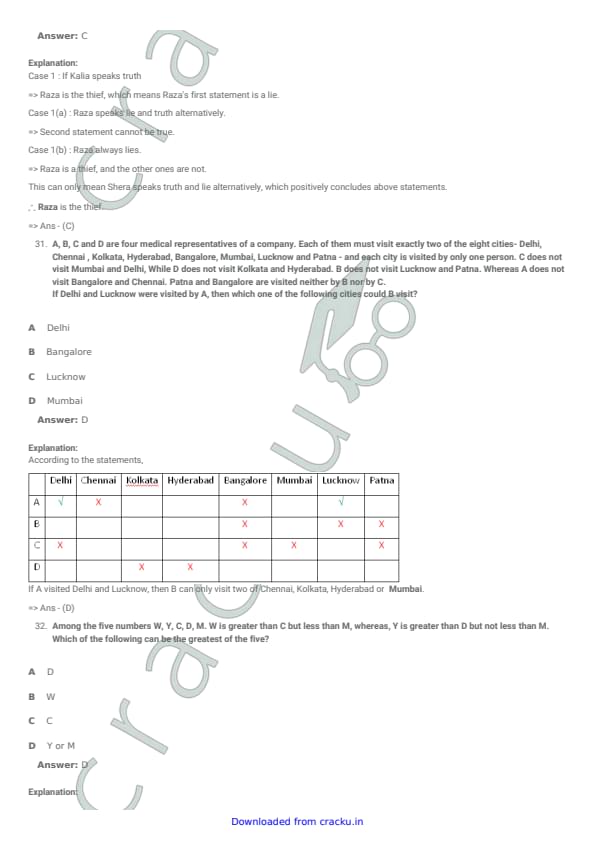
A, B, C and D are four medical representatives of a company. Each of them must visit exactly two of the eight cities - Delhi, Chennai, Kolkata, Hyderabad, Bangalore, Mumbai, Lucknow and Patna - and each city is visited by only one person. C does not visit Mumbai and Delhi, while D does not visit Kolkata and Hyderabad. B does not visit Lucknow and Patna, whereas A does not visit Bangalore and Chennai. Patna and Bangalore are visited neither by B nor by C. If Delhi and Lucknow were visited by A, then which one of the following cities could B visit?
View Solution

Step 1: Use the given condition for A.
A visits Delhi and Lucknow.
Step 2: Apply restrictions.
- B cannot visit Lucknow, Patna.
- C cannot visit Mumbai, Delhi.
- D cannot visit Kolkata, Hyderabad.
- A cannot visit Bangalore, Chennai (already fixed).
Also Patna and Bangalore are visited neither by B nor by C.
Step 3: Check which city B can visit.
Since A already visited Delhi and Lucknow, B cannot visit Delhi or Lucknow.
Also B cannot visit Bangalore, Patna.
Thus B can only visit among remaining cities like Chennai, Kolkata, Hyderabad, Mumbai.
Step 4: Conclusion.
Among options given, only Mumbai is possible for B.
Quick Tip: In city-allocation puzzles, first fix forced visits, then remove restricted cities for each person and match possible options.
Among the five numbers W, Y, C, D, M. W is greater than C but less than M, whereas Y is greater than D but not less than M. Which of the following can be the greatest of the five?
View Solution
Step 1: Convert statements into inequalities.
W is greater than C but less than M:
\[ M > W > C \]
Y is greater than D but not less than M:
\[ Y > D \quad and \quad Y \ge M \]
Step 2: Combine comparisons.
From above:
\[ Y \ge M > W > C \]
and also
\[ Y > D \]
Step 3: Identify the greatest.
Since \(Y \ge M\) and \(Y\) can be equal to or greater than \(M\), either \(Y\) can be greatest or \(M\) can be greatest.
Step 4: Conclusion.
Thus, Y or M can be the greatest.
Quick Tip: Convert word statements into inequalities and then chain them together to find possible greatest/smallest values.
A tutor has 10 students - A, B, C, D, E, F, G, H, I and J - to form four groups for tutorials. No group can have more than four students. No two groups can have the same number of students; and G must be in the same group. A and F must be in the same group. I should be alone and is in one group. B and E cannot be in the same group. F and E must be in different groups. If A, D, F and J form a group, then the other two groups can be -
View Solution
Step 1: Determine group sizes.
There are 10 students and 4 groups.
No two groups can have the same size and max size is 4.
So the only possible sizes are: 1, 2, 3, 4.
Step 2: Place I alone.
Since I must be alone:
Group 1 = {I}.
Step 3: Given A, D, F, J form a group.
Group 4 = {A, D, F, J}.
Step 4: Remaining students.
Remaining = {B, C, E, G, H}.
These must be divided into groups of size 2 and 3.
Step 5: Apply conditions.
- B and E cannot be together.
- F and E must be in different groups (already satisfied since F is in group 4).
- C and G must be in same group.
So group of size 3 can be: {B, C, G}.
Group of size 2 will be: {E, H}.
Step 6: Conclusion.
Thus the two groups can be:
{E, H} and {B, C, G}.
Quick Tip: When group sizes are restricted uniquely, first assign the fixed groups, then distribute remaining students according to constraints.
A bookie has to inspect five horses A, B, C, D and E. If he inspects B, he cannot inspect C immediately. If he inspects A, he cannot go to E after that. Which of the following can be the correct order of his inspection?
View Solution
Step 1: Write the conditions.
- If B is inspected, C cannot be inspected immediately after B.
So pattern B,C is not allowed.
- If A is inspected, E cannot come after A.
So pattern A,E is not allowed.
Step 2: Check each option.
Option (1): A, B, C, D, E
Here B is immediately followed by C, violates condition.
Option (2): D, B, C, E, A
Here B is immediately followed by C, violates condition.
Option (3): D, C, B, A, E
Here A is followed by E, violates condition.
Option (4): D, C, B, E, A
Here B is followed by E, not C. Also A is last so E is not after A. Valid.
Step 3: Conclusion.
Thus, option (4) is the correct order.
Quick Tip: In ordering problems, first identify forbidden adjacent pairs and forbidden sequences, then verify options one-by-one quickly.
Below given question contains six statements labelled A, B, C, D, E and F followed by four combinations of three statements. Choose the set in which the statements are logically related i.e. the third statement can be deduced from the first two statements together.
Read the information carefully and answer the question.
(A) All honest persons are good natured.
(B) Some good natured persons are not honest.
(C) Some honest persons are good natured.
(D) All honest person are obese.
(E) All obese person are good natured.
(F) Some good natured person are honest.
View Solution
Step 1: Understand option (4) DEA.
(D) All honest persons are obese.
(E) All obese persons are good natured.
(A) All honest persons are good natured.
Step 2: Deduce logically.
From (D): Honest \(\Rightarrow\) Obese.
From (E): Obese \(\Rightarrow\) Good natured.
So by transitivity:
\[ Honest \Rightarrow Good natured \]
This is exactly statement (A).
Step 3: Check other options (brief).
Other combinations contain contradictory or non-deducible statements, so they cannot logically lead to the third statement.
Step 4: Conclusion.
Hence, DEA is the correct logically related set.
Quick Tip: If two universal statements form a chain like A \(\Rightarrow\) B and B \(\Rightarrow\) C, then A \(\Rightarrow\) C is a valid conclusion.
R1, R2, R3, R4, R5, R6, R7 are seven places on a map. The following places are connected by two-way roads: R1 and R2; R1 and R6; R3 and R6; R3 and R4; R6 and R7; R4 and R5; R2 and R3; R5 and R7. No other road exists. The shortest route (the route with the least number of intermediate places) from R1 to R7 is:
View Solution

Step 1: List all direct connections from R1.
From R1, we can go directly to R2 and R6.
Step 2: Check if R6 connects to R7 directly.
Given roads include R6 and R7.
So, R1 \(\rightarrow\) R6 \(\rightarrow\) R7 is possible.
Step 3: Count intermediate places.
Route R1 - R6 - R7 has only one intermediate place (R6).
All other routes have more intermediate places.
Step 4: Conclusion.
Hence, the shortest route is R1 - R6 - R7.
Quick Tip: For shortest route with least intermediate places, always check for direct links first and then 2-step connections.
A, B, C, D and E are five rods. E is longer than A which is longer than C and lighter than C, which is lighter than D. B is shorter than D, and heavier than it. E is longer than D, and heavier than it. If B is the heaviest of all, then which of the following can be the lightest of all the five rods?
View Solution
Step 1: Write the weight relations clearly.
A is lighter than C, and C is lighter than D:
\[ D > C > A \]
B is heavier than D:
\[ B > D \]
E is heavier than D:
\[ E > D \]
Step 2: Combine all relations.
Since B is the heaviest, we have:
\[ B > E > D > C > A \]
Step 3: Identify the lightest.
From the chain, A is at the bottom.
So A is the lightest.
Step 4: Conclusion.
Hence, the lightest rod can be A only.
Quick Tip: For comparison problems, convert statements into inequality chains and then identify top (heaviest) and bottom (lightest).
A, B and C are three films that are screened by three theatres PVR, DT and Regal in three consecutive slots. No film should be screened in the same slot by any two theatres. If DT screens film B in the first slot and PVR exhibits film C in the third slot, then which of these must be TRUE?
View Solution
Step 1: Write the given fixed placements.
DT screens film B in Slot 1.
PVR screens film C in Slot 3.
Step 2: Use rule: no two theatres can show same film in same slot.
So in Slot 1, neither PVR nor Regal can show B.
In Slot 3, neither DT nor Regal can show C.
Step 3: Identify the only remaining placement for Regal.
Since Regal cannot show B in Slot 1 and cannot show C in Slot 3, Regal must show A in Slot 2.
Step 4: Conclusion.
Thus, Regal exhibits A in the second slot must be true.
Quick Tip: In slot-based arrangement questions, place the fixed items first, then eliminate conflicts slot-by-slot to find forced placements.
Five capitals A, B, C, D and E are connected by different modes of transport as follows:
A and B are connected by roads as well as by rail.
D and C are connected by bus and by boat.
B and E are connected only by air.
A and C are connected only by boat.
E and C are connected by rail and by bus.
Which of the following pair of capitals are connected by any of the routes directly (without going through any other capital)?
View Solution
Step 1: We get the following:

Step 2: Check each option.
(A, E): Not directly connected. Only A connects to C and C connects to E.
(E, D): Not directly connected. E connects to C, and C connects to D.
(B, C): Not directly connected. B connects to A and E, but not C directly.
Step 3: Conclusion.
Hence, none of the given pairs are directly connected.
Quick Tip: Always write all direct links first. If a pair requires going through another node, then it is not directly connected.
Insert the missing number.

View Solution
Step 1: Observe the pattern.
The middle number is the sum of alphabetical positions of all letters in the two groups.
(A=1, B=2, ..., Z=26)
Step 2: Verify with first row.
EJO = 5 + 10 + 15 = 30
TYE = 20 + 25 + 5 = 50
Total = 30 + 50 = 80
Step 3: Verify with second row.
DHL = 4 + 8 + 12 = 24
PTX = 16 + 20 + 24 = 60
Total = 24 + 60 = 84
Step 4: Apply to third row.
CFI = 3 + 6 + 9 = 18
LOR = 12 + 15 + 18 = 45
Total = 18 + 45 = 63
Step 5: Conclusion.
So the missing number is 63.
Quick Tip: Whenever letters are involved with numbers, try converting letters into alphabetical positions and check sum/difference patterns.
P, Q, R, S and T are the five corners of a table with five sides. Chairs A, B, C, D and E are placed along the sides joining the angular corners. Neither P, Q, R, S, T nor A, B, C, D and E are necessarily in that order. Chair A is along the side joining the corner P and R. S is the immediate right of P, and R is between P and T. Chair B is along the side of Q and T. Chairs D and E are next to B on either side. The corners that join the side where the chair C is placed are:
View Solution
Step 1: Use given position relations among corners.
Chair A is on the side joining P and R.
S is immediate right of P and R is to the left of P.
Also, R is between P and T.
Step 2: Place chair B and neighbours.
Chair B is along the side of Q and T.
Chairs D and E are next to B on either side.
Step 3: Determine placement of chair C.
After placing all conditions and arranging chairs on edges, chair C comes on the side whose endpoints are P and S.

Step 4: Conclusion.
Hence, chair C is placed on the side joining P and S.
Quick Tip: In polygon seating/edge problems, draw a rough figure and place fixed relations first, then locate remaining chairs by elimination.
Eight persons Jai, Kabir, Lakshaya, Mannu, Neetu, Om, Punita and Surbhi sit in two parallel rows with four seats in each row facing each other. Jai and Kabir are not in the same row. Neetu sits to the immediate left of Lakshaya in the same row but opposite to Om. Punita and Kabir have only two persons between them. Jai and Neetu have only one person between them. Which of these pairs of persons can sit diagonally opposite each other?
View Solution
Step 1: Use fixed condition of Neetu and Lakshaya.
Neetu sits immediately left of Lakshaya in the same row.
Also Neetu is opposite to Om.
Step 2: Use condition about Jai and Neetu.
Jai and Neetu have exactly one person between them.
Step 3: Use condition about Punita and Kabir.
Punita and Kabir have two persons between them, meaning they sit at extreme ends.
Step 4: Determine diagonal opposites from valid arrangement.
From the valid seating arrangement shown in the explanation, the diagonal opposite pairs possible are:

Quick Tip: For two-row seating, diagonal opposite means one person is not directly opposite but shifted one seat left/right. Always test using a row diagram.
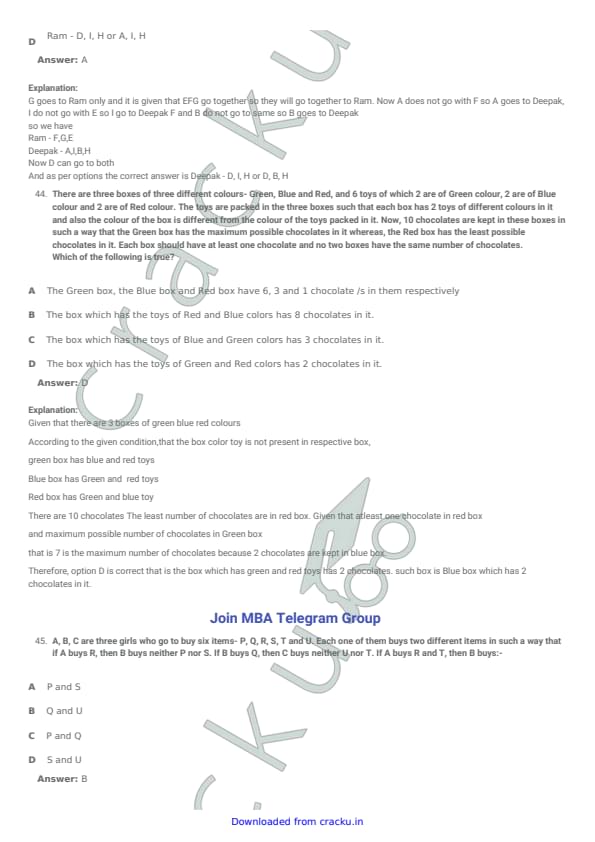
A, B, C, D, E, F, G, H and I are nine employees in a company, who go to meet two managers Ram and Deepak to talk to them about their project. Each manager has time for only three employees. D has a priority and must be given preference by Ram or Deepak. F and B do not wish to go to the same manager. G goes to Ram only and H goes to Deepak only. C comes back saying that neither of the two managers has time to see him. A does not go with F and I does not go with E. B and I do not go together. If E, F and G go together and are seen by one of the managers, then which manager sees whom, assuming that C has opted out of the talks?
View Solution
Step 1: Use fixed conditions.
G goes only to Ram.
H goes only to Deepak.
C is not seen by any manager.
Each manager can meet only 3 employees.
Step 2: Use condition E, F and G go together.
Since G goes only to Ram, the group E, F, G must go to Ram.
So Ram meets: E, F, G.
Step 3: Place priority employee D.
D must be assigned to either Ram or Deepak.
Ram is already full (E, F, G), so D must go to Deepak.
Step 4: Place H.
H goes only to Deepak, so Deepak already has D and H.
Step 5: Decide third person for Deepak.
Now, remaining people include A, B, I.
But restrictions:
A does not go with F (F is with Ram, so A can go to Deepak).
I does not go with E (E is with Ram, so I can go to Deepak).
B and F cannot be with same manager (F is with Ram, so B can go to Deepak).
But B and I cannot go together.
So Deepak's third employee can be either B or I.
Step 6: Conclusion.
Thus Deepak meets: D, H, I or D, H, B.
Quick Tip: In manager-allocation puzzles, fill forced-only members first (like G only Ram, H only Deepak), then use exclusions to finalize remaining slots.
There are three boxes of three different colours - Green, Blue and Red, and 6 toys of which 2 are of Green colour, 2 are of Blue colour and 2 are of Red colour. The toys are packed in the three boxes such that each box has 2 toys of different colours in it and also the colour of the box is different from the colour of the toys packed in it. Now, 10 chocolates are kept in these boxes in such a way that the Green box has the maximum possible chocolates in it whereas, the Red box has the least possible chocolates in it. Each box should have at least one chocolate and no two boxes have the same number of chocolates. Which of the following is true?
View Solution
Step 1: Arrange toys as per color restrictions.
Each box color must not match any toy color inside it.
So, Green box cannot contain Green toys.
Blue box cannot contain Blue toys.
Red box cannot contain Red toys.
Thus, one valid toy placement is:
Green box: Blue + Red toys
Blue box: Green + Red toys
Red box: Green + Blue toys
Step 2: Distribute chocolates with constraints.
Total chocolates = 10.
Each box has at least 1 chocolate.
No two boxes have same chocolates.
Green box must have maximum possible chocolates.
Red box must have minimum possible chocolates.
So the only possible distribution is:
Green box = 7 chocolates
Blue box = 2 chocolates
Red box = 1 chocolate
Step 3: Identify which box contains Green and Red toys.
Green and Red toys are in the Blue box.
And Blue box has 2 chocolates.
Step 4: Conclusion.
Hence, the box having toys of Green and Red colors has 2 chocolates in it.
Quick Tip: When maximum and minimum distribution is required with all distinct counts, assign minimum = 1 to least box and then distribute remaining to maximize the required box.
A, B, C are three girls who go to buy six items - P, Q, R, S, T and U. Each one of them buys two different items in such a way that if A buys R, then B buys neither P nor S. If B buys Q, then C buys neither U nor T. If A buys R and T, then B buys:
View Solution
Step 1: Apply condition when A buys R.
If A buys R, then B cannot buy P or S.
Step 2: Given A buys R and T.
So B cannot buy P and S.
So B must choose from remaining items: Q and U.
Step 3: Check second rule for validity.
If B buys Q, then C cannot buy U or T.
Since A already bought T, C cannot buy T anyway.
So this does not affect B's choice.
Step 4: Conclusion.
Hence, B buys Q and U.
Quick Tip: In selection constraint problems, first eliminate disallowed items, then allocate remaining items logically.
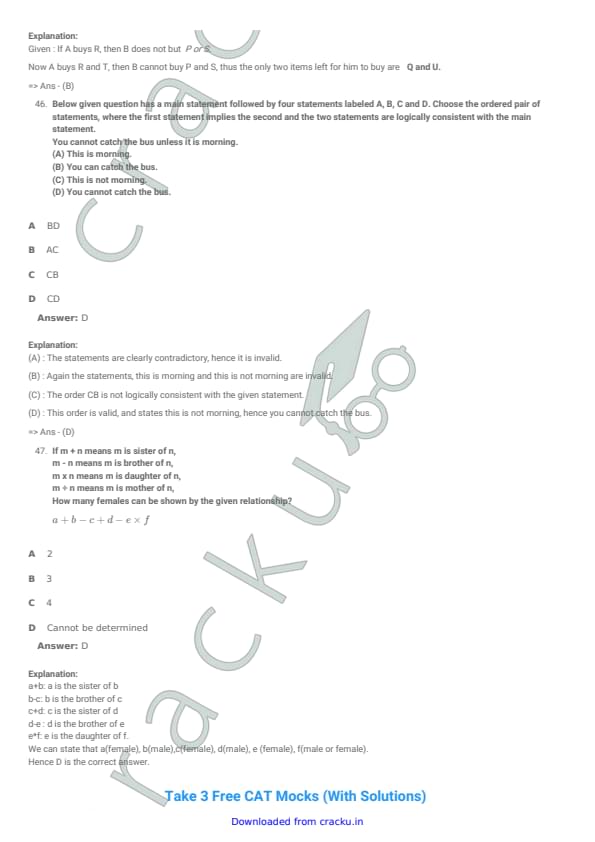
Below given question has a main statement followed by four statements labeled A, B, C and D. Choose the ordered pair of statements, where the first statement implies the second and the two statements are logically consistent with the main statement.
You cannot catch the bus unless it is morning.
(A) This is morning.
(B) You can catch the bus.
(C) This is not morning.
(D) You cannot catch the bus.
View Solution
Step 1: Convert the main statement into logical form.
Main statement: ``You cannot catch the bus unless it is morning.''
This means:
\[ If you catch the bus, then it must be morning. \]
Symbolically:
\[ B \Rightarrow M \]
Step 2: Understand what the ordered pair must satisfy.
We need two statements such that:
- The first implies the second.
- Both should be consistent with the main statement.
Step 3: Check option (4) CD.
(C): This is not morning.
So \(M\) is false.
If it is not morning, then catching the bus is not possible (because bus can be caught only when it is morning).
So (C) implies (D).
\[ \neg M \Rightarrow \neg B \]
Step 4: Verify consistency.
This does not contradict the main statement and follows logically from it.
Step 5: Conclusion.
Hence, the correct ordered pair is CD.
Quick Tip: Statement “X unless Y” means “If X happens, Y must be true.” Convert to implication form to solve quickly.
If \(m+n\) means \(m\) is sister of \(n\),
\(m-n\) means \(m\) is brother of \(n\),
\(m\times n\) means \(m\) is daughter of \(n\), and
\(m\div n\) means \(m\) is mother of \(n\),
How many females can be shown by the given relationship?
\(a+b-c+d-e\times f\)
View Solution
Step 1: Decode each relation one by one.
Expression: \(a+b-c+d-e\times f\)
\[ a+b \Rightarrow a is sister of b \Rightarrow a is female \]
\[ b-c \Rightarrow b is brother of c \Rightarrow b is male \]
\[ c+d \Rightarrow c is sister of d \Rightarrow c is female \]
\[ d-e \Rightarrow d is brother of e \Rightarrow d is male \]
\[ e\times f \Rightarrow e is daughter of f \Rightarrow e is female \]
Step 2: Identify the gender of f.
Since \(e\) is daughter of \(f\), \(f\) can be either male or female.
So gender of \(f\) is not fixed.
Step 3: Count confirmed females.
Confirmed females: \(a, c, e\) = 3 females.
But \(f\) may also be female, which would make total females = 4.
Step 4: Conclusion.
Since \(f\) can be male or female, the exact number of females cannot be determined.
Quick Tip: If any person’s gender is not fixed (like parent in “daughter of”), then total females cannot be uniquely determined.
Three coins are tossed in the air and two of the coins land with tails face upwards. What are the chances that on the next toss of the coins at least two of the coins will land with the tails facing upwards?
View Solution
Step 1: Understand independence of coin tosses.
The result of the first toss does not affect the next toss.
So we treat the next toss as a fresh toss of 3 coins.
Step 2: Total outcomes for 3 coins.
Each coin has 2 outcomes (H or T).
\[ Total outcomes = 2^3 = 8 \]
Step 3: Count outcomes with at least 2 tails.
At least 2 tails means either 2 tails or 3 tails.
Outcomes with exactly 2 tails:
\[ TTH,\ THT,\ HTT \Rightarrow 3 outcomes \]
Outcome with 3 tails:
\[ TTT \Rightarrow 1 outcome \]
Total favorable outcomes = \(3+1=4\).
Step 4: Find probability.
\[ P = \frac{4}{8} = \frac{1}{2} = 50% \]
Quick Tip: Previous toss results do not change probabilities of the next toss. Always treat coin tosses as independent events.
A family of three generation comprises of seven members - A, B, C, D, E, F and G. There are two married couples - one each of first and second generation respectively. They travel in three different cars - Audi, BMW and Honda so that now one has more than three members and there is at least one female in each car. C, who is a grand-daughter, does not travel with her grandfather and grandmother. B travels with his father E in BMW. F travels with her grand-daughter T in Audi. A travels with her daughter in Honda. Which of the following is one of the married couples?
View Solution
Step 1: Identify family roles from statements.
B travels with his father E.
So E is male and is father of B.
Step 2: Identify grandparent role.
F travels with her grand-daughter in Audi.
So F is a grandmother (female).
Step 3: Identify the married couple in first generation.
Since F is a grandmother and E is a father, the most logical first generation married couple is E and F.
Step 4: Validate with remaining condition.
A travels with her daughter in Honda, confirming A is female and belongs to second generation.
Thus EF being the older generation married pair fits correctly.
Step 5: Conclusion.
Hence, one of the married couples is EF.
Quick Tip: In family puzzles, first fix direct relations like “father of” and “grandmother of”. Married couples often come from same generation and are inferred from parent-grandparent roles.
P, Q, R, S, T and U are six members of a family. R is not the mother of Q but Q is the son of R. P and R are a married couple. T is the brother of R. U is the brother of Q. S is the daughter of P. T is S's ____________.
View Solution
Step 1: Identify gender of R.
R is not the mother of Q, but Q is the son of R.
So R must be the father of Q.
Step 2: Use marriage relation.
P and R are a married couple.
So P is Q's mother.
Step 3: Use sibling relations.
T is brother of R.
So T is the paternal uncle of R's children.
U is brother of Q (so U is also child of P and R).
Step 4: Use relation of S.
S is daughter of P, so S is also child of P and R.
Step 5: Determine relation of T to S.
T is brother of R and S is daughter of R.
So T is S's uncle.
Quick Tip: If X is brother of someone’s father, then X is the uncle of that person. Always map relations step-by-step.






Comments