




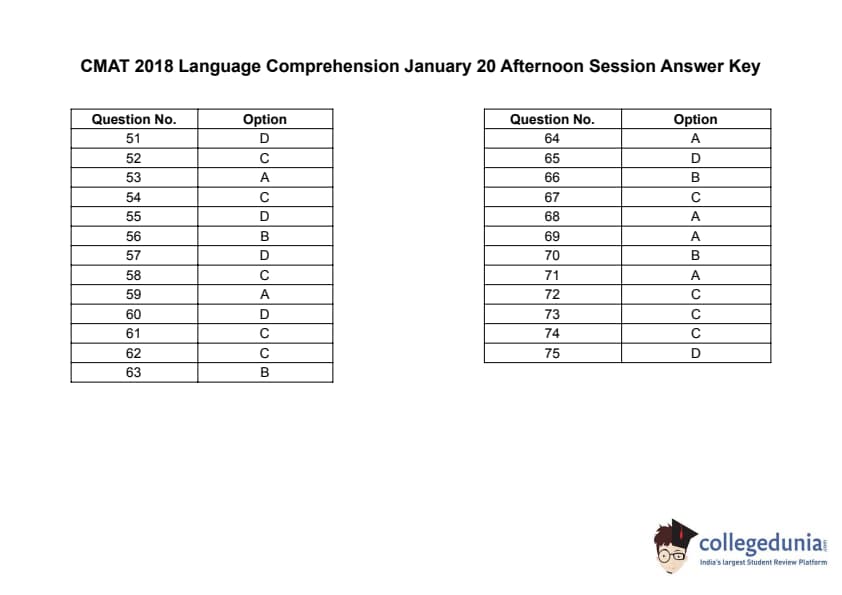
CMAT 2018 Language Comprehension Question paper with answer key pdf conducted on January 20 in Afternoon Session 2:30 PM to 5:30 PM is available for download. The exam was successfully organized by All India Council for Technical Education (AICTE). The question paper comprised a total of 25 questions. (PDF Source: cracku.in)
CMAT 2018 Language Comprehension Question Paper with Answer Key PDFs Afternoon Session
| CMAT 2018 Language Comprehension Question Paper with Solutions PDF | Download PDF | Check Solutions |
Read the passage carefully and answer the questions that follows.
Passage I
All of us play but we are not athletes. We are homo ludens (Latin for play) and our playfulness is unproductive. But athletes play for profit and contest for prizes. It is the transformation of our play and games into athletics that leads to medals. What makes Haryana such a fine place for athletics? In the barely 2% of India’s population, people from Haryana won around 40% of the gold medals in the recently concluded CWG 2010.
People in Haryana tend to count the gold medals of the Hyderabadi shutter, Saina Nehwal and the Delhi wrestler, Sushil Kumar, in their tally. This is because both of them are Jats. People of this dominant caste form more than 20% of Haryana’s population and, therefore, in popular perception, Haryana is Jat-land.
All sports are oriented towards the Olympic slogan ‘higher, faster, and stronger’. But the ones in which Haryana got medals stand for plain force and aggression: like wrestling, boxing and shooting. Anthropologists call them contact sports because the opponents have body contact in them. Shooting is a combative sport because opponents use a combat weapon. Such sports are a substitute of war or training for it.
Haryana is India’s pre-industrial and combative age. I can think of three reasons for it. Firstly, the province has a volatile history of continuous aggression due to its geographical location on the frontier. Secondly, the people of Haryana have valued physical strength and perseverance due to its peasant culture. Thirdly, the sports policy since 2006 has honed the killer athletic spirit in Haryana. The half-hearted policy does not create achievers but supports the successful ones among them. Punjab was divided on religious lines in 1947. The non-Sikh majority parts of this truncated Punjab were constituted as Haryana in 1966. Like a horseshoe, Haryana encircles Delhi from three sides and the culture of both is similar. At the popular level, people are rough and tough - meaning hardy to endure and tough in body.
In the medieval times, Haryana flourished when weak rulers ruled Delhi. Most of the area remained under Delhi’s tutelage but small principalities also dotted the and were ruled. The landscape of Haryana. Mostly, people of the region joined the Mughals and Marathas in repulsing invaders. But the same locals did not mind plundering Delhi or looting the retreating armies of soldiers. The British colonialists expanded from the east. They conquered most of India with the help of soldiers from western UP and Bihar. But, in the late 19th century, the colonial strategists honored ordinary peasant castes by calling them ‘martial races’ in united Punjab. This was a clever way of taming the aggression in this frontier region. This smart move was also to recruit rural Punjabis in the colonial army so that they could be used to thwart the southward expansion of Tsarist Russia. There is a family resemblance between military/hunting traditions and wrestling, shooting, racing and archery. For the military service and population of Haryana, therefore, such sports come easily. Secondly, before the advent of machinery, agriculture was a backbreaking occupation. The size of agricultural income had a direct relation with the quantity of sweat produced during one’s toil.
Question 1:
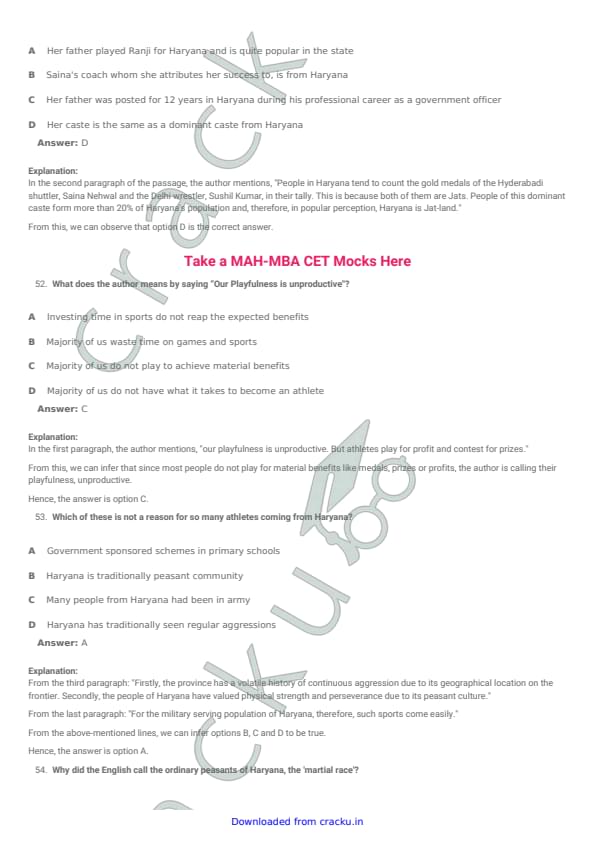
Why do people of Haryana tend to count the medals bagged by Saina Nehwal in the tally of their own state, though she is a Hyderabadi?
View Solution
Step 1: Locate the relevant line in the passage.
The passage says that people in Haryana count Saina Nehwal’s medals in their tally because she is a Jat.
Step 2: Understand why this matters.
Jats form more than 20% of Haryana’s population and Haryana is popularly perceived as Jat-land.
Step 3: Conclusion.
Therefore, Haryanvis associate her success with their dominant caste identity.
Quick Tip: For passage-based questions, always locate the exact supporting sentence in the passage and match it to the closest option.
What does the author mean by saying ``Our playfulness is unproductive''?
View Solution
Step 1: Understand the contrast given by the author.
The author says ordinary people play but are not athletes, while athletes play for profit and prizes.
Step 2: Interpret “unproductive”.
Unproductive means normal play does not result in material output like profit, medals, or prizes.
Step 3: Match with correct option.
Option (3) directly matches this meaning: people do not play for material benefits.
Quick Tip: Always interpret words like “unproductive” using the contrast provided in the passage instead of using personal assumptions.
Which of these is not a reason for so many athletes coming from Haryana?
View Solution
Step 1: Identify reasons listed by the author.
The author provides three main reasons:
1) Continuous aggression due to frontier location
2) Peasant culture valuing strength
3) Sports policy supporting successful athletes
Step 2: Match with given options.
Options (2), (3), and (4) align with the author’s listed reasons.
But option (1) is not mentioned anywhere in the passage.
Step 3: Conclusion.
Hence, the correct answer is option (1).
Quick Tip: If a question asks “NOT a reason”, pick the option that is not explicitly mentioned or supported by the passage.
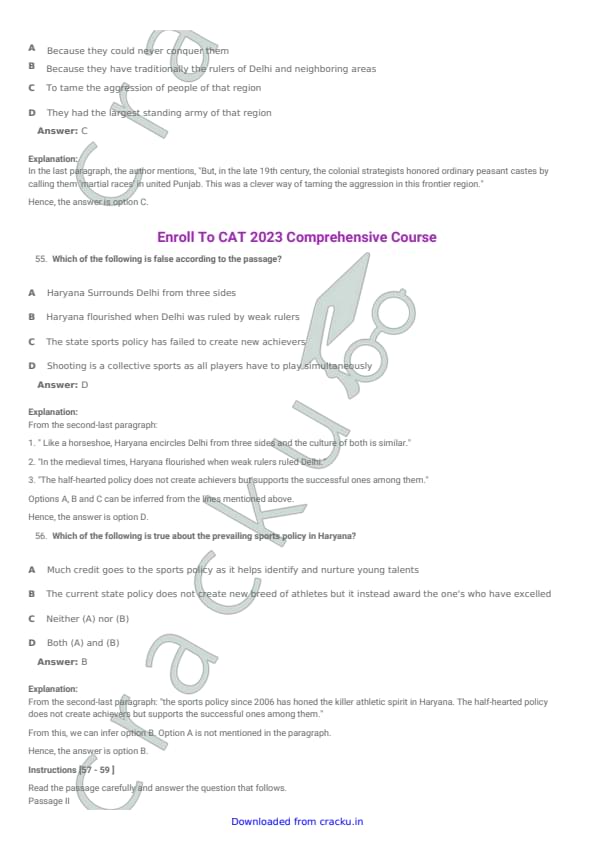
Why did the English call the ordinary peasants of Haryana, the ``martial race''?
View Solution
Step 1: Locate the passage line about “martial races”.
The passage mentions that colonial strategists honored peasant castes by calling them martial races.
Step 2: Identify the purpose given.
The author clearly states: it was a clever way of taming the aggression in this frontier region.
Step 3: Conclusion.
Thus, the English called them martial race to tame their aggression.
Quick Tip: When “why” is asked in RC, the answer is usually explicitly stated in the passage near the relevant keyword.
Which of the following is false according to the passage?
View Solution
Step 1: Check each statement with passage facts.
(1) Passage says Haryana encircles Delhi from three sides. True.
(2) Passage says Haryana flourished when weak rulers ruled Delhi. True.
(3) Passage says sports policy does not create achievers but supports successful ones. True.
Step 2: Verify option (4).
The passage calls shooting a combative sport and a substitute for war.
It does not describe it as a collective sport or simultaneous play.
Step 3: Conclusion.
Hence, statement (4) is false.
Quick Tip: For “false according to passage” questions, eliminate the options that are directly stated in the passage and pick the one that contradicts or is not supported.
Which of the following is true about the prevailing sports policy in Haryana?
View Solution
Step 1: Locate the sports policy line in the passage.
The passage states:
“The sports policy since 2006 has honed the killer athletic spirit in Haryana. The half-hearted policy does not create achievers but supports the successful ones among them.”
Step 2: Match the meaning to the given options.
This directly means that policy does not create new athletes, but supports those who have already succeeded.
Step 3: Conclusion.
Therefore, option (2) is true.
Quick Tip: When a question asks “true about policy”, locate the exact policy statement in the passage and match the closest paraphrased option.
Read the passage carefully and answer the questions that follows.
Passage II
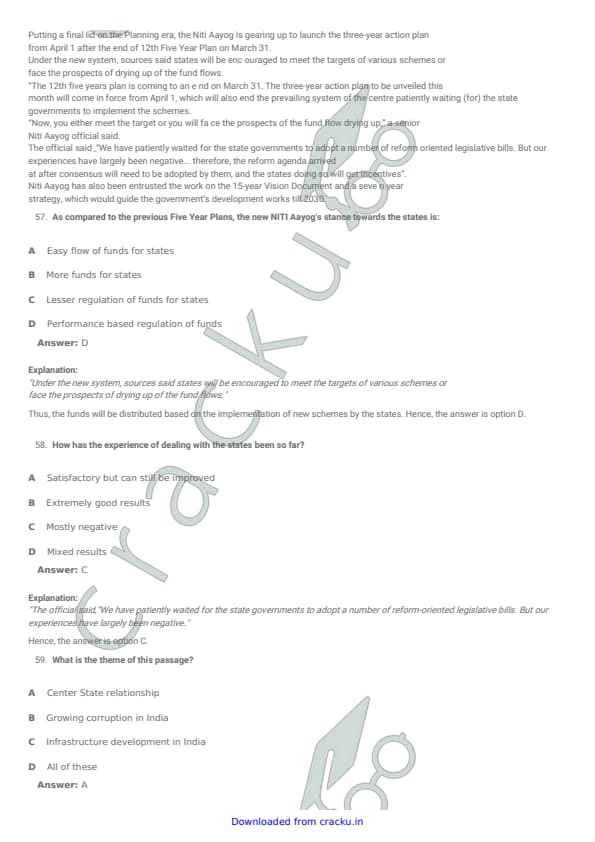
Putting a final lid on the Planning era, the Niti Aayog is gearing up to launch the three-year action plan from April 1 after the end of 12th Five Year Plan on March 31.
Under the new system, sources said states will be encouraged to meet the targets of various schemes or face the prospects of drying up of the fund flows.
“The 12th five years plan is coming to an end on March 31. The three-year action plan to be unveiled this month will come in force from April 1, which will also end the prevailing system of the centre patiently waiting (for) the state governments to implement the schemes.
“Now, you either meet the targets or you will face the prospects of the fund flow drying up,” a senior Niti Aayog official said.
The official said, “We have patiently waited for the state governments to adopt a number of reform-oriented legislative bills. But our experiences have largely been negative. Therefore, the reform agenda arrived at after consensus will need to be adopted by them, and the states doing so will get incentives”.
Niti Aayog has also been entrusted the work on the 15-year Vision Document and a seven year strategy, which would guide the government’s development works till 2030.
Question 7:
As compared to the previous Five Year Plans, the new NITI Aayog's stance towards the states is:
View Solution
Step 1: Identify the major change mentioned in the passage.
The passage states that under the new system, states will be encouraged to meet targets or face drying up of fund flows.
Step 2: Interpret the meaning.
This means the release of funds will depend on whether states achieve the required performance targets.
So, funding becomes conditional and linked to outcomes.
Step 3: Match with the correct option.
Option (4) exactly describes this as performance based regulation of funds.
Step 4: Conclusion.
Hence, the correct answer is option (4).
Quick Tip: In RC questions, focus on keywords like “targets”, “fund flows”, and “drying up” as they often indicate policy shifts.
How has the experience of dealing with the states been so far?
View Solution
Step 1: Locate the line about experience.
The passage says:
“Our experiences have largely been negative.”
Step 2: Match with the option.
This directly matches option (3) “Mostly negative”.
Step 3: Conclusion.
Therefore, the correct answer is option (3).
Quick Tip: For direct fact questions, pick the option that matches the exact wording in the passage.
What is the theme of this passage?
View Solution
Step 1: Identify what the passage mainly discusses.
The passage talks about the NITI Aayog three-year action plan and how states will now be accountable for targets.
Step 2: Check which central idea best represents it.
The key focus is on how the Centre will deal with states through funding incentives and penalties.
This is clearly about Centre-State relationship.
Step 3: Eliminate irrelevant themes.
No mention is made about corruption or infrastructure development as the main subject.
Step 4: Conclusion.
Hence, the theme is option (1).
Quick Tip: To find the theme, summarize the passage in one line. The option that matches that summary is usually correct.
Read the passage carefully and answer the questions that follows.
Passage III
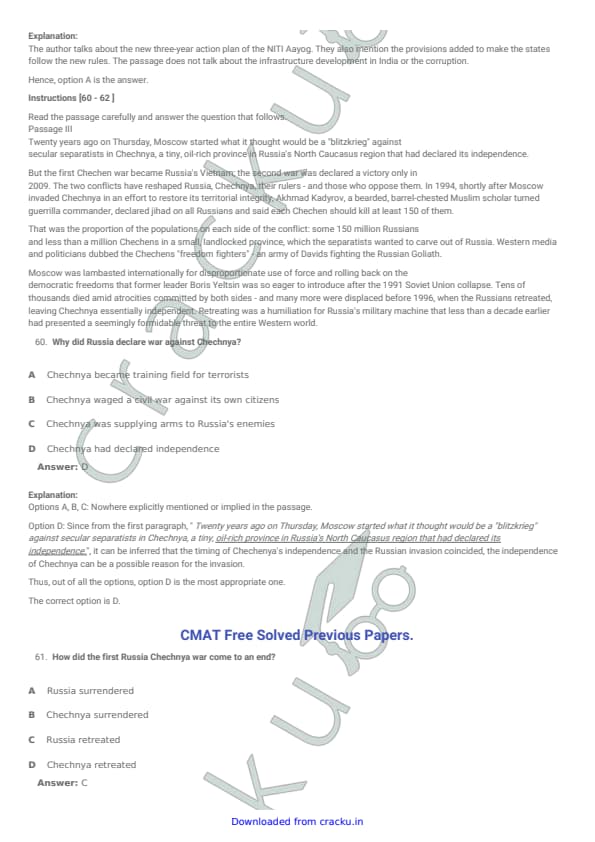
Twenty years ago on Thursday, Moscow started what it thought would be a “blitzkrieg” against secular separatists in Chechnya, a tiny, oil-rich province in Russia’s North Caucasus that had declared its independence.
But the first Chechen war became Russia’s Vietnam; the second war was declared a victory only in 2009. The two conflicts have reshaped Russia, Chechnya, their rulers and the people. In 1994, shortly after Moscow invaded Chechnya in an effort to restore its territorial integrity, Akhmad Kadyrov, a bearded, barrel-chested Muslim scholar turned guerrilla commander, declared jihad on all Russians and said each Chechen should kill at least 150 of them.
That was the proportion of the populations on each side of the conflict: some 150 million Russians and less than a million Chechens in a small, landlocked province, whose separatists wanted to carve out of Russia. Western media and politicians dubbed the Chechens “freedom fighters” - an army of Davids fighting the Russian Goliath.
Moscow was lambasted internationally for disproportionate use of force and rolling back on the democratic freedoms that former leader Boris Yeltsin was so eager to introduce after the 1991 Soviet Union collapse. Tens of thousands died amid atrocities committed by both sides and many more were displaced before 1996, when the Russians retreated, leaving Chechnya essentially independent. Retreating was a humiliation for Russia’s military machine that less than a decade earlier had presented a seemingly formidable threat to the entire Western world.
Question 10:
Why did Russia declare war against Chechnya?
View Solution
Step 1: Locate the reason mentioned in the passage.
The first line of the passage clearly states that Chechnya “had declared its independence.”
Step 2: Interpret why war was declared.
Russia attacked separatists to restore territorial integrity, which implies the war began because Chechnya wanted independence.
Step 3: Match with correct option.
Option (4) directly matches this stated reason.
Quick Tip: For “why” questions in RC, first check the opening lines of the passage because authors often mention the main trigger there.
How did the first Russia Chechnya war come to an end?
View Solution
Step 1: Find how the war ended in the passage.
The passage says: “before 1996, when the Russians retreated, leaving Chechnya essentially independent.”
Step 2: Match with correct option.
This directly indicates that Russia retreated.
Quick Tip: Look for phrases like “ended”, “finally”, “retreated”, “surrendered” in the concluding lines to answer war-outcome questions.
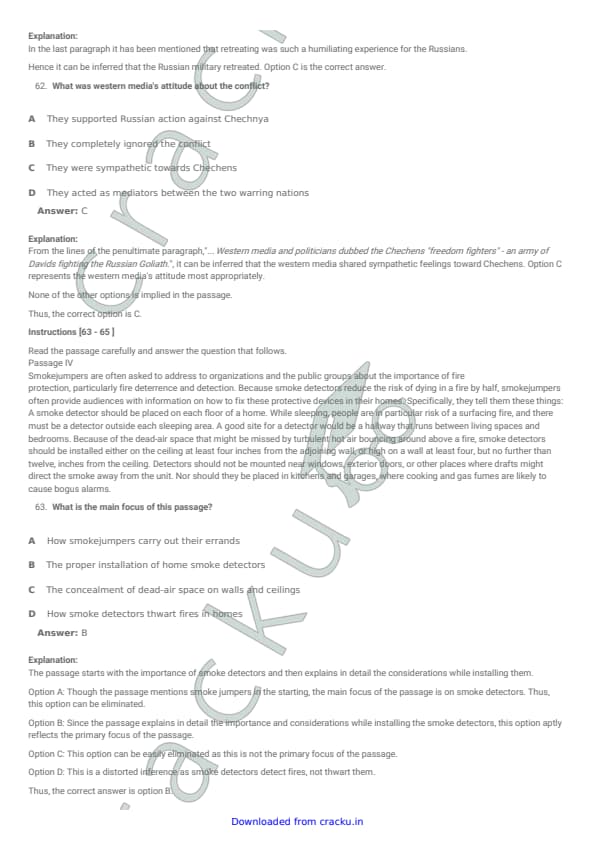
What was western media's attitude about the conflict?
View Solution
Step 1: Find the relevant statement.
The passage says:
“Western media and politicians dubbed the Chechens ‘freedom fighters’ - an army of Davids fighting the Russian Goliath.”
Step 2: Interpret the tone.
Calling them freedom fighters shows support and sympathy toward Chechens.
Step 3: Match with option.
This aligns with option (3).
Quick Tip: Words like “freedom fighters”, “hero”, “victim” indicate sympathy, whereas “terrorists” or “rebels” indicate criticism.
Read the passage carefully and answer the questions that follows.
Passage IV
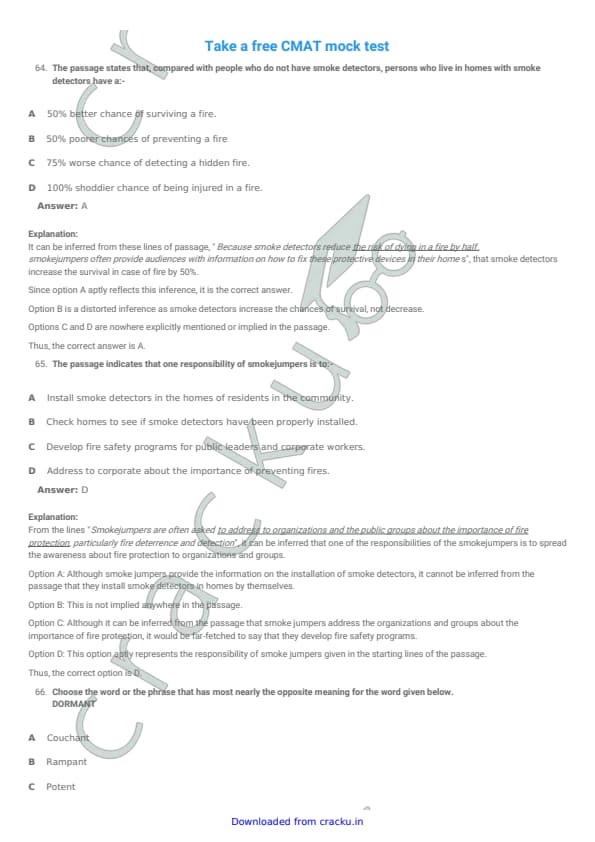
Smokejumpers are often asked to address to organizations and the public groups about the importance of fire protection, particularly fire deterrence and detection. Because smoke detectors reduce the risk of dying in a fire by half, smokejumpers often provide audiences with information on how to fix these protective devices in their homes. Specifically, they tell them these things:
A smoke detector should be placed on each floor of a home. While sleeping, people are particularly at risk of a fire, and there must be a detector outside each sleeping area. A good site for a detector would be a hallway that runs between living spaces and bedrooms. Because of the dead-air space that might be missed by turbulent air rushing around above a fire, smoke detectors should be installed either on the ceiling at least four inches from the adjoining wall, or high on a wall at least four inches but no farther than twelve inches from the ceiling. Detectors should not be mounted near windows, exterior doors, or other places where drafts might direct the smoke away from the unit. Nor should they be placed in kitchens and garages, where cooking and gas fumes are likely to cause bogus alarms.
Question 13:
What is the main focus of this passage?
View Solution
Step 1: Identify what the passage explains in detail.
After briefly mentioning smokejumpers, the passage mostly explains where and how to install smoke detectors properly.
Step 2: Eliminate irrelevant options.
- It is not about errands of smokejumpers.
- It is not mainly about dead-air space.
- It is not about how detectors stop fires, but about installation and placement.
Step 3: Conclusion.
Hence, the main focus is proper installation of home smoke detectors.
Quick Tip: The main focus of a passage is what is explained most in detail, not what is briefly introduced at the start.
The passage states that, compared with people who do not have smoke detectors, persons who live in homes with smoke detectors have a:
View Solution
Step 1: Locate the exact claim in the passage.
The passage states: “smoke detectors reduce the risk of dying in a fire by half.”
Step 2: Convert this into survival probability form.
If the risk of dying is reduced by half, survival chances improve significantly.
So, it implies a 50% better chance of surviving compared to not having detectors.
Step 3: Conclusion.
Thus, option (1) is correct.
Quick Tip: When a passage states “risk reduced by half,” it directly implies survival chances are improved by 50%.
The passage indicates that one responsibility of smokejumpers is to:
View Solution
Step 1: Locate what smokejumpers are asked to do.
The passage begins with:
“Smokejumpers are often asked to address organizations and the public groups about the importance of fire protection...”
Step 2: Interpret responsibility.
This shows their responsibility includes speaking to organizations and public groups to spread awareness.
Step 3: Match with correct option.
Option (4) matches this role of addressing organizations about fire protection.
Step 4: Conclusion.
Hence, option (4) is correct.
Quick Tip: If a passage begins with a role/responsibility statement, questions asking “responsibility” often directly use those opening lines.
Choose the word or the phrase that has most nearly the opposite meaning for the word given below.
DORMANT
View Solution
Step 1: Understand the meaning of the word “Dormant”.
Dormant means inactive, sleepy, not active, or at rest.
Step 2: Look for the opposite meaning.
The antonym of dormant should mean active, lively, or growing strongly.
Step 3: Analyze the options.
(1) Couchant = lying down, resting
(2) Rampant = active, spreading fast, flourishing
(3) Potent = powerful (not directly opposite of dormant)
(4) Prostrate = lying flat, inactive
Step 4: Conclusion.
The best opposite of dormant is rampant.
Quick Tip: Dormant means inactive; the best antonym will always suggest strong activity or rapid growth (like “rampant”).
Choose the word or the phrase that has most nearly the opposite meaning for the word given below.
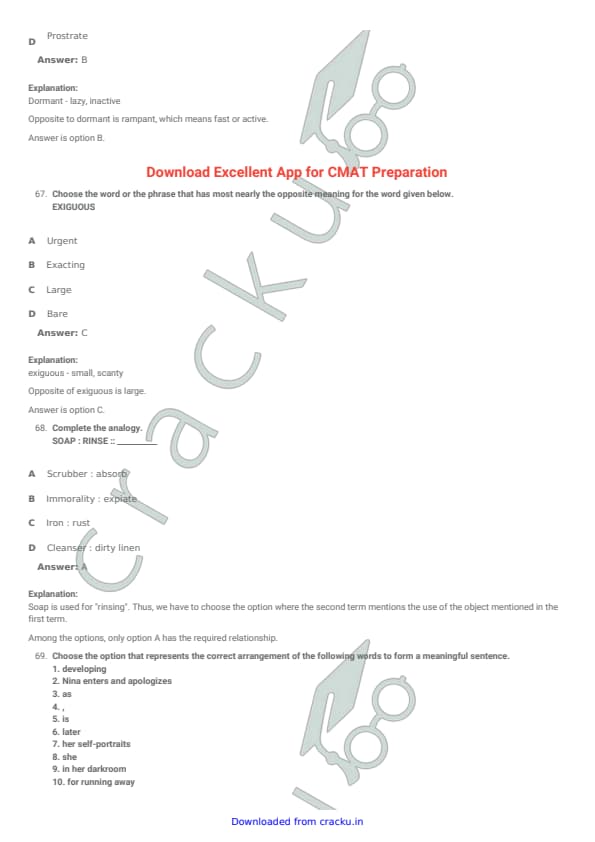
EXIGUOUS
View Solution
Step 1: Understand the meaning of “Exiguous”.
Exiguous means very small in amount, scanty, meagre.
Step 2: Find the opposite meaning.
Opposite should mean large, abundant, or extensive.
Step 3: Analyze the options.
(1) Urgent = needing immediate attention
(2) Exacting = demanding
(3) Large = big, extensive
(4) Bare = empty, plain
Step 4: Conclusion.
Thus, the antonym of exiguous is large.
Quick Tip: Exiguous = scanty; always choose an option that directly means “big or abundant.”
Complete the analogy.
SOAP : RINSE :: _______
View Solution
Step 1: Identify the relationship in the given pair.
SOAP is used for rinsing / cleaning.
So, the relationship is:
Object : its function/use.
Step 2: Apply the same logic to the options.
We need an option where the first term is an object and the second term is what it is used for.
Step 3: Check each option.
(1) Scrubber : absorb (scrubber/sponge is used to absorb and clean)
(2) Immorality : expiate (not object-function; concept-action)
(3) Iron : rust (this is cause-effect, not usage)
(4) Cleanser : dirty linen (this is object-target, not direct function format)
Step 4: Conclusion.
Only option (1) best matches the object-use relationship.
Quick Tip: In analogies, first identify the exact relationship type (use, cause-effect, part-whole). Then match only that relation.
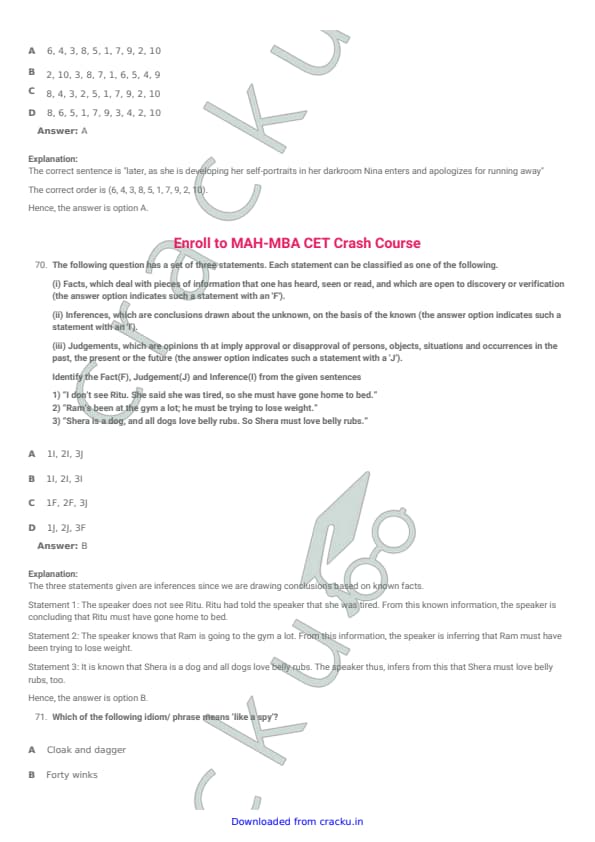
Choose the option that represents the correct arrangement of the following words to form a meaningful sentence.
1. developing
2. Nina enters and apologizes
3. as
4. ,
5. is
6. later
7. her self-portraits
8. she
9. in her darkroom
10. for running away
View Solution
Step 1: Identify the main structure of the sentence.
The sentence should describe an action happening “later”, and also include a dependent clause beginning with “as”.
Step 2: Arrange the parts logically.
The best meaningful sentence is:
“Later, as she is developing her self-portraits in her darkroom, Nina enters and apologizes for running away.”
Step 3: Match this structure with the given sequence.
Later (6) , (4) as (3) she (8) is (5) developing (1) her self-portraits (7) in her darkroom (9) Nina enters and apologizes (2) for running away (10)
Step 4: Conclusion.
Hence, the correct order is option (1).
Quick Tip: For sentence arrangement, first identify the opening time marker (like “Later,”) and then place dependent clauses (like “as”) before the main action.
The following question has a set of three statements. Each statement can be classified as one of the following.
(I) Facts, which deal with pieces of information that one has heard, seen or read, and which are open to discovery or verification (the answer option indicates such a statement with an 'F').
(II) Inferences, which are conclusions drawn about the unknown, on the basis of the known (the answer option indicates such a statement with an 'I').
(III) Judgements, which are opinions that imply approval or disapproval of persons, objects, situations and occurrences in the past, the present or the future (the answer option indicates such a statement with a 'J').
Identify the Fact(F), Judgement(J) and Inference(I) from the given sentences.
1) ``I don't see Ritu. She said she was tired, so she must have gone home to bed.''
2) ``Ram's been at the gym a lot; he must be trying to lose weight.''
3) ``Shera is a dog, and all dogs love belly rubs. So Shera must love belly rubs.''
View Solution
Step 1: Understand what an inference is.
Inference means drawing a conclusion using given information (known facts).
Step 2: Analyze each statement.
Statement 1: Speaker concludes Ritu went home to bed based on “she was tired” and not seeing her. This is an inference.
Statement 2: Speaker concludes Ram is trying to lose weight based on his gym visits. This is also an inference.
Statement 3: Speaker concludes Shera loves belly rubs based on general rule about dogs. This is also an inference.
Step 3: Conclusion.
All three are inferences. Hence, option (2) is correct.
Quick Tip: If a statement uses words like “must”, “so”, “therefore”, it is usually an inference because it draws a conclusion from known information.
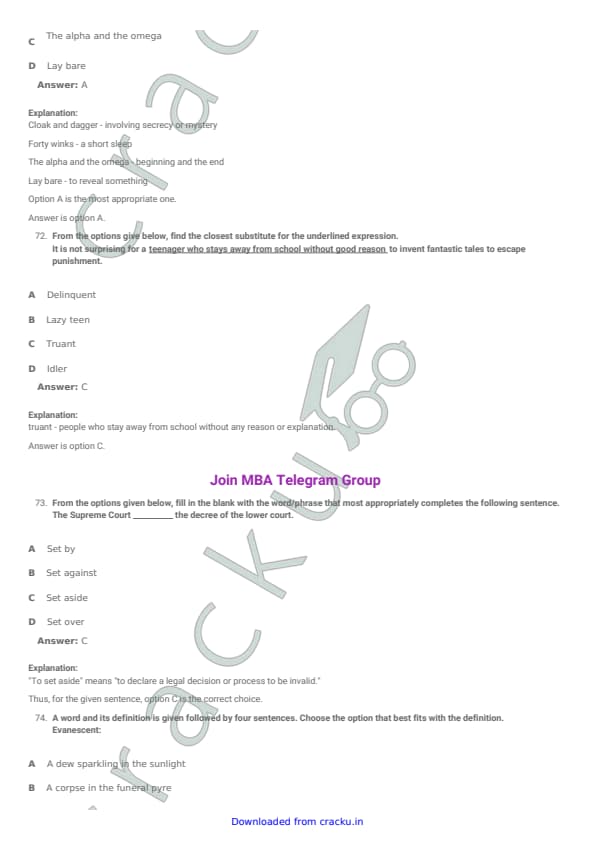
Which of the following idiom/ phrase means ``like a spy''?
View Solution
Step 1: Understand the meaning asked.
“Like a spy” implies secrecy, hidden activity, and mystery.
Step 2: Analyze each idiom.
(1) Cloak and dagger = secretive activities, spying, mystery
(2) Forty winks = a short nap
(3) Alpha and omega = beginning and end
(4) Lay bare = reveal completely
Step 3: Conclusion.
Thus, the correct idiom is cloak and dagger.
Quick Tip: “Cloak and dagger” is directly connected with spying and secret operations.
From the options given below, find the closest substitute for the underlined expression.
It is not surprising for a teenager who stays away from school without good reason to invent fantastic tales to escape punishment.
View Solution
Step 1: Understand the underlined phrase.
A teenager who stays away from school without good reason is someone who plays truant.
Step 2: Check which option matches this meaning.
(1) Delinquent = involved in minor crime
(2) Lazy teen = not a precise word
(3) Truant = one who is absent from school without permission
(4) Idler = lazy person
Step 3: Conclusion.
Hence, the closest substitute is Truant.
Quick Tip: “Truant” is the exact word used for someone who stays away from school without permission.
From the options given below, fill in the blank with the word/phrase that most appropriately completes the following sentence.
The Supreme Court _______ the decree of the lower court.
View Solution
Step 1: Understand the legal phrase.
“To set aside” means to cancel, nullify, or declare a legal decision invalid.
Step 2: Apply in the sentence.
“The Supreme Court set aside the decree of the lower court” means the higher court cancelled it.
Step 3: Conclusion.
Hence, option (3) is correct.
Quick Tip: In legal contexts, “set aside” is a standard phrase meaning “overturn or cancel a judgement.”
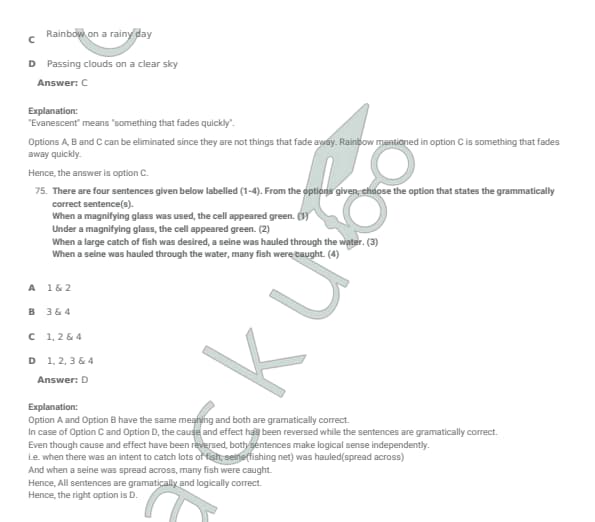
A word and its definition is given followed by four sentences. Choose the option that best fits with the definition.
Evanescent:
View Solution
Step 1: Understand the meaning of “Evanescent”.
Evanescent means something that fades away quickly, short-lived.
Step 2: Find the option that best represents “fades quickly”.
A rainbow appears briefly and disappears soon.
So it is a perfect example of something evanescent.
Step 3: Conclusion.
Hence, option (3) is correct.
Quick Tip: Evanescent = short-lived. Choose examples that appear briefly and vanish (like rainbow, mist, glow).
There are four sentences given below labelled (1-4). From the options given, choose the option that states the grammatically correct sentence(s).
When a magnifying glass was used, the cell appeared green. (1)
Under a magnifying glass, the cell appeared green. (2)
When a large catch of fish was desired, a seine was hauled through the water. (3)
When a seine was hauled through the water, many fish were caught. (4)
View Solution
Step 1: Check sentence (1).
It is grammatically correct and meaningful.
Step 2: Check sentence (2).
It is also grammatically correct and conveys the same meaning as sentence (1).
Step 3: Check sentence (3).
It is grammatically correct: it describes an action taken to achieve a desired result.
Step 4: Check sentence (4).
It is grammatically correct and logically follows cause-effect: hauling a seine results in catching many fish.
Step 5: Conclusion.
All four sentences are grammatically correct. Hence, option (4) is correct.
Quick Tip: If sentences are clear, complete, and logically meaningful, they are grammatically correct even if they express similar ideas differently.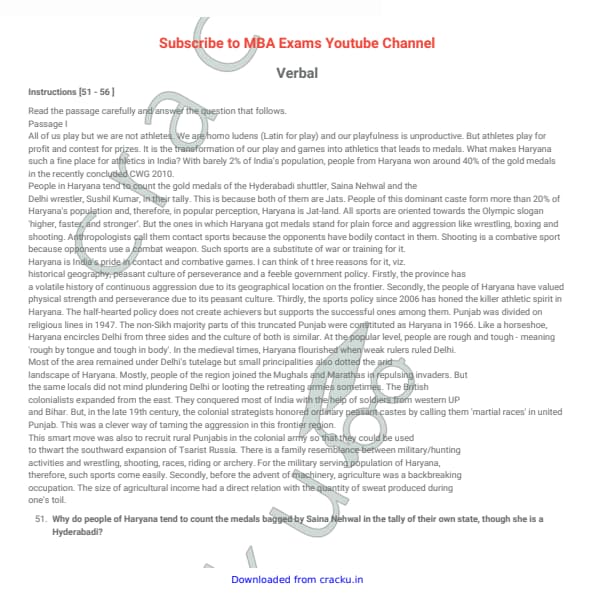



Comments