




CLAT PG 2024 Question Paper with Answer Key PDF Set C is available for download. The exam was conducted by the Consortium of NLUs on December 3, 2023. Candidates were required to answer a total of 120 objective-type questions carrying 1 mark each covering two major sections: Constitutional Law and Other Law Subjects.
CLAT PG 2024 Question Paper with Answer Key PDF Set C
| CLAT PG 2024 Question Paper with Answer Key PDF Set C | Download PDF | Check Solutions |
CLAT PG 2024 Questions with Solution
| Q.No. | Question | Correct Answer | Solution |
|---|---|---|---|
| 1 | The decision in A.K. Kraipak is considered a landmark authority for which of the following propositions? (A) There is no application of the principles of natural justice to purely administrative functions. (B) The principles of natural justice are in an ever-evolving state of flux. (C) The principles of natural justice do not differentiate between administrative and quasi-judicial functions. (D) There is no application of the principles of natural justice to quasi-judicial functions. |
(C) | The A.K. Kraipak decision emphasized that the principles of natural justice apply to both quasi-judicial and administrative functions, wherever rights may be affected. |
| 2 | The Court in A.K. Kraipak stated, “if the purpose of the rules of natural justice is to prevent miscarriage of justice one fails to see why those rules should be made inapplicable to administrative enquiries.” Which interpretative approach does this statement reflect? (A) Literal interpretation (B) Constructive interpretation (C) Strict interpretation (D) All of the above |
(B) | The statement reflects constructive interpretation, where the purpose of the statute is interpreted broadly to promote justice. |
| 3 | The Court states in A.K. Kraipak, that ‘... in the course of years many more subsidiary rules came to be added to the rules of natural justice.’ Which of the following is a later entrant to the principles of natural justice? (A) No one shall be a Judge in their own cause. (B) Duty to hear. (C) Duty to give reasons. (D) None of the above. |
(C) | The ”duty to give reasons” is a later development in the principles of natural justice, added to ensure transparency and accountability in decision-making processes. |
| 4 | The Supreme Court has recognised in several decisions that in cases requiring urgent administrative action or in exigencies, it may not always be possible to give full effect to the principles of natural justice without rendering the administrative action redundant in the circumstances. Which of the following is true for the requirements of natural justice in such cases? (A) The administrator may choose to not follow principles of natural justice in case of emergency scenarios, where time does not permit such compliance, without recording their reasons in writing. (B) The administrator may choose to not follow principles of natural justice in case of emergency scenarios, where time does not permit such compliance, but must record their reasons in writing. (C) The administrator may provide for a post-decisional remedial hearing wherever pre-decisional hearing is not possible. (D) None of the above. |
(C) | In cases of urgency where pre-decisional hearing is not feasible, administrators may provide a post-decisional remedial hearing to fulfill the requirements of natural justice. |
| 5 | In testing whether the rule against bias has been violated, courts often invoke, which of the following standards: (A) Likelihood of bias as perceived by a fair-minded and informed observer. (B) Likelihood of bias as perceived by a fair-minded and uninformed observer. (C) Likelihood of bias as perceived by a third person. (D) Likelihood of bias as perceived by persons involved in similar trade. |
(A) | Courts often use the standard of likelihood of bias as perceived by a fair-minded and informed observer to ensure that decisions are not only impartial but also appear to be so in the eyes of a reasonable observer. |
| 6 | The decision in Shree Sidhbali Steels carves out the ‘public interest’ exception in cases of promissory estoppel against Government. To which kind of cases have courts routinely applied this exception in favour of Governments? (A) Fiscal matters (B) Service matters (C) Labour matters (D) All of the above |
(A) | The courts have commonly applied the public interest exception in fiscal matters, allowing the government to retract from promises when public welfare and financial stability are at stake. |
| 7 | Which of the following is a landmark decision governing the law on promissory estoppel against Governments? (A) Sarat Chander Dey v. Gopal Chander Laha, (1892) 19 IA 203 (B) Motilal Padampat Sugar Mills Co. Ltd. v. State of U.P., (1979) 2 SCC 409 (C) Carlill v. Carbolic Smoke Ball Company, [1892] EWCA Civ 1 (D) Tej Bhan Madan v. II Additional District Judge and Others, (1988) 3 SCC 137 |
(B) | The case of Motilal Padampat Sugar Mills Co. Ltd. v. State of U.P. is a landmark decision on promissory estoppel, setting a precedent for holding governments accountable to their promises under certain conditions. |
| 8 | Which of the following statements reflect the correct position of law for promissory estoppel against Governments? (A) Government would be held bound by the promise and the promise would be enforceable against the Government at the instance of the promisee, provided that there is consideration for the promise and the promise is recorded in the form of a formal contract as required by Article 299 of the Constitution. (B) Government would be held bound by the promise and the promise would be enforceable against the Government at the instance of the promisee, notwithstanding that there is no consideration for the promise and the promise is not recorded in the form of a formal contract as required by Article 299 of the Constitution. (C) Government would be held bound by the promise and the promise would be enforceable against the Government at the instance of the promisee, provided that there is consideration for the promise, but notwithstanding that the promise is not recorded in the form of a formal contract as required by Article 299 of the Constitution. (D) Government would be held bound by the promise and the promise would be enforceable against the Government at the instance of the promisee, notwithstanding that there is no consideration for the promise, but provided that the promise is recorded in the form of a formal contract as required by Article 299 of the Constitution. |
(B) | The correct position of law is that the government can be held to its promises under promissory estoppel, even without formal consideration or a formal contract, as long as it serves justice and is not contrary to law. |
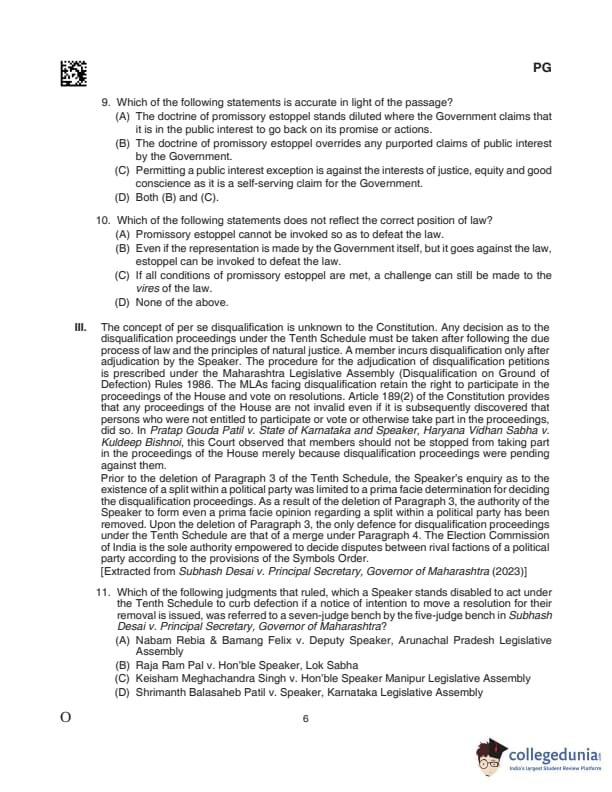
| 9 | Which of the following statements is accurate in light of the passage? (A) The doctrine of promissory estoppel stands diluted where the Government claims that it is in the public interest to go back on its promise or actions. (B) The doctrine of promissory estoppel overrides any purported claims of public interest by the Government. (C) Permitting a public interest exception is against the interests of justice, equity and good conscience as it is a self-serving claim for the Government. (D) Both (B) and (C). |
(A) | The doctrine of promissory estoppel may allow the government to withdraw its promise if it is in the public interest, recognizing that public welfare can take precedence over individual claims. |
| 10 | Which of the following statements does not reflect the correct position of law? (A) Promissory estoppel cannot be invoked so as to defeat the law. (B) Even if the representation is made by the Government itself, but it goes against the law, estoppel can be invoked to defeat the law. (C) If all conditions of promissory estoppel are met, a challenge can still be made to the vires of the law. (D) None of the above. |
(B) | Promissory estoppel cannot be invoked to defeat statutory provisions or laws, even if the representation is made by the government. The doctrine is subordinate to existing law. |
| 11 | Which of the following judgments that ruled, which a Speaker stands disabled to act under the Tenth Schedule to decide on defection if a notice of intention to move a resolution for their removal is issued, was referred to a seven-judge bench by the five-judge bench in Subhash Desai v. Principal Secretary, Governor of Maharashtra? (A) Nabam Rebia Bamang Felix v. Deputy Speaker, Arunachal Pradesh Legislative Assembly (B) Raja Ram Pal v. Hon’ble Speaker, Lok Sabha (C) Keisham Meghachandra Singh v. Hon’ble Speaker Manipur Legislative Assembly (D) Shrimanth Balasaheb Patil v. Speaker, Karnataka Legislative Assembly |
(A) | The case of Nabam Rebia Bamang Felix v. Deputy Speaker, Arunachal Pradesh Legislative Assembly was referred for reconsideration to a seven-judge bench in Subhash Desai for determining the Speaker’s role under the Tenth Schedule during removal proceedings. |
| 12 | Srinivasan, J. in Mayawati v. Markandeya Chand held that “Political Party” cannot be read as ‘Legislature Party’. Which among the following was not a reason provided by the Hon’ble Judge? (A) The phrase ‘Political Party’ in Paragraph 2(1)(b) of the tenth schedule cannot be interpreted to mean ‘Legislative Party’ while the same phrase in Paragraph 2(1)(a) of the Tenth Schedule retains its original meaning. (B) Such an interpretation would render explanation (a) to Paragraph 2(1) of the Tenth Schedule obsolete because a legislative party cannot set up a person as a candidate for election. (C) Disqualification from membership of the assembly is a serious consequence. Such a consequence can only ensue from voting contrary to the direction of the political party. (D) In Kuldeep Nayar v. Union of India, it was held that to balance the competing considerations of the anti-defection law and intra-party dissent, a direction to vote (or abstain from voting) can only be given if the vote would alter the status of the government formed if it is on a policy on which the political party that set up the candidate went to polls. Only the political party and not the legislature party can issue directions concerning issues of this nature. |
(D) | The ruling emphasized that only the political party has the authority to issue binding directions under the anti-defection law, not the legislative party. Option (D) does not address this distinction directly. |
| 13 | Which of the following was not challenged by the petitioners in the case of Subhash Desai v. Principal Secretary, Governor of Maharashtra? (A) Invitation extended to thirty-four MLAs (B) Invitation extended to Mr. Shinde as the Chief Minister (C) Appointment of a whip by the House, which included the thirty-four MLAs who are leaving disqualification notices (D) The legality of the floor test held on July 4, 2022 |
(A) | The petitioners did not challenge the invitation extended to the thirty-four MLAs. They contested other procedural and legal aspects related to the formation and conduct of the government. |
| 14 | A violation of the anti-defection law will not result in a member of the House being: (A) Disqualified from the House (B) Disqualified from holding any election campaign for the duration of the period commencing from the date of their disqualification till the date on which the term of their office as a member of the House would expire or till the date on which they contest election to a House and are declared elected, whichever is earlier. (C) Disqualified from holding any remunerative political post for the duration of the period commencing from the date of their disqualification till the date on which the term of their office as a member of the House would expire or till the date on which they contest election to a House and are declared elected, whichever is earlier. (D) Disqualified from being appointed as a Minister for the duration of the period commencing from the date of their disqualification till the date on which the term of their office as a member of the House would expire or till the date on which they contest election to a House and are declared elected, whichever is earlier. |
(B) | Under the anti-defection law, disqualification generally affects a member’s ability to hold political office and certain other roles, but it does not disqualify them from participating in election campaigns. |
| 15 | The Tenth Schedule specifies five defenses that a member may take recourse to shield themselves from the consequences of the anti-defection law. Which among the following is not a defense? (A) In cases where the original political party of a member is found to have merged with another political party under Paragraph 4(1)(a), members of the original political party are protected from being disqualified if they have not accepted such merger and have opted to function as a separate group. (B) Members who have been elected to the office of the Speaker or the Deputy Speaker (or the Chairman or the Deputy Chairman as the case may be) in Parliament or in the Legislative Assemblies of States are exempted from disqualification under the Tenth Schedule if they voluntarily give up the membership of their political party by reason of election to such office and do not re-join the political party or become a member of another political party so long as they continue to hold such office. Further, they are exempted if they re-join the political party which they gave up membership of, after ceasing to hold office. (C) Disqualification on the ground of defection not to apply in cases of split where a member claims that he or she and any other members of his or legislative party constitute the group representing a faction, which has arisen as a result of a split in his original political party and such group consists of not less than one-third of the members of such legislature party. (D) A member is protected from being disqualified if the political party to which they belong has condoned their actions in voting or abstaining from voting contrary to the directions issued by such political party, within fifteen days from such voting or abstention. |
(C) | The provision for protection against disqualification due to splits was removed by the 91st Amendment to the Constitution, so it no longer serves as a defense under the Tenth Schedule. |
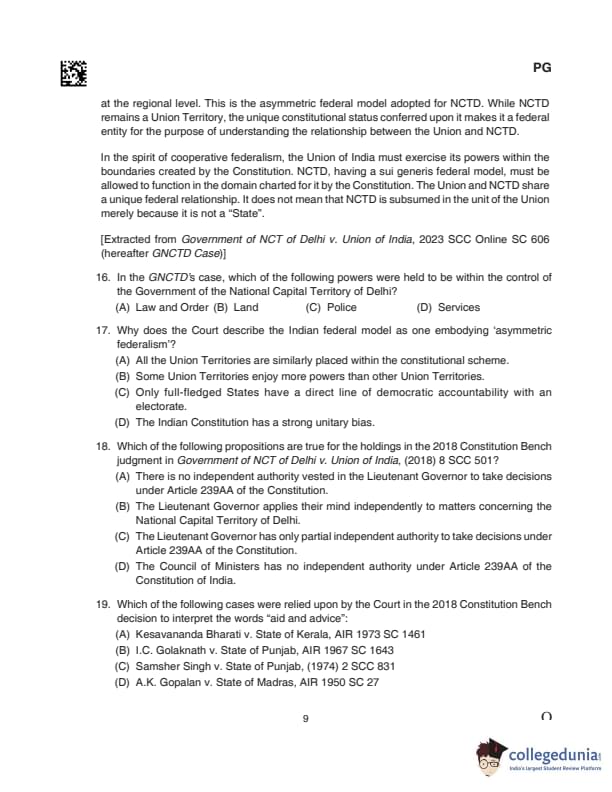
| 16 | In the GNCTD’s case, which of the following powers were held to be within the control of the Government of the National Capital Territory of Delhi? (A) Law and Order (B) Land (C) Police (D) Services |
(D) | In the GNCTD’s case, the Supreme Court held that the Government of NCT of Delhi has control over "services," excluding certain areas like land, police, and law and order, which remain with the central government. |
| 17 | How does the Court describe the Indian federal model as one embodying ‘asymmetric federalism’? (A) All the Union Territories are similarly placed within the constitutional scheme. (B) Some Union Territories enjoy more powers than other Union Territories. (C) Only full-fledged States have a direct line of democratic accountability with an electorate. (D) The Indian Constitution has a strong unitary bias. |
(B) | Asymmetric federalism in India means that some Union Territories have greater autonomy and powers than others, reflecting a tailored approach to governance. |
| 18 | Which of the following propositions are true for the holdings in the 2018 Constitution Bench judgment in Government of NCT of Delhi v. Union of India, (2018) 8 SCC 501? (A) There is no independent authority vested in the Lieutenant Governor to take decisions under Article 239AA of the Constitution. (B) The Lieutenant Governor applies their mind independently to matters concerning the National Capital Territory of Delhi. (C) The Lieutenant Governor has only partial independent authority to take decisions under Article 239AA of the Constitution. (D) The Council of Ministers has no independent authority under Article 239AA of the Constitution of India. |
(A) | The 2018 judgment clarified that the Lieutenant Governor of Delhi does not have independent decision-making authority but must act in coordination with the Council of Ministers, except in specific circumstances. |
| 19 | Which of the following cases were relied upon by the Court in the 2018 Constitution Bench decision to interpret the words ‘aid and advise’? (A) Kesavananda Bharati v. State of Kerala, AIR 1973 SC 1461 (B) U.P. Golaknath v. State of Punjab, AIR 1967 SC 1643 (C) Samsher Singh v. State of Punjab, (1974) 2 SCC 831 (D) A.K. Gopalan v. State of Madras, AIR 1950 SC 27 |
(C) | The Court in the GNCTD case referenced Samsher Singh v. State of Punjab to interpret the meaning of ‘aid and advise’ in the context of the powers of the Lieutenant Governor. |
| 20 | Following the ratio of the GNCTD’s case, which of the following propositions would be true: (A) The Government of NCTD shall not have legislative power to make laws on “services”, because “services” is not expressly excluded in Article 239AA(3)(a). (B) The Government of NCTD shall not have the legislative power to make laws on “services” as it is impliedly a part of the entry on “law and order”, which in turn is expressly excluded in Article 239AA(3)(a). (C) The Government of NCTD shall have legislative power to make laws on “services” only if it is expressly authorized by the Union Parliament to do so. (D) None of the above. |
(A) | According to the Supreme Court’s interpretation in the GNCTD case, the Government of NCTD does not have legislative power over “services” because “services” falls under the purview of the Union as it is not explicitly granted to NCTD in Article 239AA(3)(a). |
| 21 | The above-mentioned case deals with the power of magistrate to take cognizance on police report under which provision of the Code of Criminal Procedure, 1973? (A) Section 190(1)(b) (B) Section 159 (C) Section 190(1)(a) (D) Section 173(8) |
(A) | Section 190(1)(b) of the Code of Criminal Procedure, 1973, empowers a Magistrate to take cognizance of any offence based on a police report. |
| 22 | If the Court is not satisfied with the police report, does the Code of Criminal Procedure allow for direction of further investigation? (A) No, the role of court is limited to adjudication. (B) Yes, court can direct further investigation with specific instruction for a desired result. (C) Yes, court can direct further investigation at pre-cognizance stage. (D) None of the above. |
(C) | The court can direct further investigation at the pre-cognizance stage if it finds the initial police report unsatisfactory. |
| 23 | If police submit a final report, does the Code of Criminal Procedure, allow Magistrate to take cognizance on the final report? (A) Yes, magistrate can take cognizance on final report despite no charges listed in it. (B) No, Magistrate cannot take cognizance till the time chargesheet is filed. (C) Magistrate can take cognizance provided an order under section 156 has been given for investigation. (D) None of the above. |
(A) | The Magistrate has the authority to take cognizance on a final report submitted by the police, even if no charges are listed. |
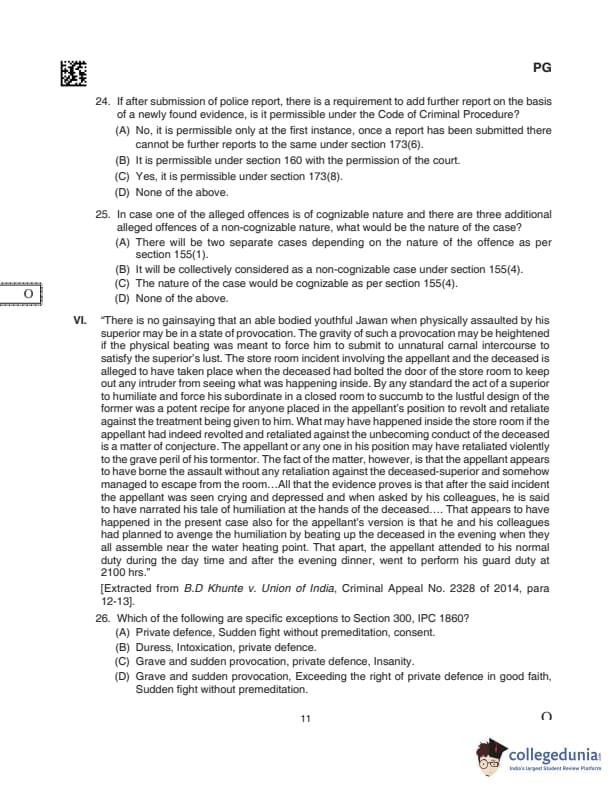
| 24 | If after submission of police report, there is a requirement to add further report on the basis of a newly found evidence, is it permissible under the Code of Criminal Procedure? (A) No, it is permissible only at the first instance, once a report has been submitted there cannot be further reports to the same under section 173(6). (B) It is permissible under section 160 with the permission of the court. (C) Yes, it is permissible under section 173(8). (D) None of the above. |
(C) | Section 173(8) of the Code of Criminal Procedure permits the filing of supplementary reports based on new evidence after the initial report has been submitted. |
| 25 | In case one of the alleged offences is of cognizable nature and there are three additional allegations of a non-cognizable nature, what would be the nature of the case? (A) There will be two separate cases depending on the nature of the offence as per section 155(1). (B) The entire case would be treated as a non-cognizable case under section 155(4). (C) The nature of the case would be cognizable as per section 155(4). (D) None of the above. |
(C) | According to Section 155(4) of the Code of Criminal Procedure, if one of the offences is cognizable, the entire case is treated as cognizable. |
| 26 | Which of the following are specific exceptions to Section 300, IPC 1860? (A) Private defence, Sudden fight without premeditation, consent. (B) Duress, Intoxication, Private defence. (C) Grave and sudden provocation, private defence, Insanity. (D) Grave and sudden provocation, Exceeding the right of private defence in good faith, Sudden fight without premeditation. |
(D) | Section 300 of IPC 1860 includes specific exceptions such as grave and sudden provocation, exceeding the right of private defence in good faith, and sudden fight without premeditation, which mitigate culpability for murder. |
| 27 | What is the difference between general and specific defences in IPC 1860? (A) There is no difference, they both apply to all kinds of offences in all chapters of IPC. (B) General defences apply to all kinds of offences and covered in Chapter III of IPC 1860 while specific defences are specific to the respective offence. (C) General defences are applied to all kinds of offences and covered in Chapter-IV of IPC 1860 while specific defences are specific to the respective offence. (D) None of the above. |
(C) | In IPC 1860, general defences are covered in Chapter IV and apply universally across offences, whereas specific defences are tailored to particular offences. |
| 28 | Under which exception, it is expressly stated that it is immaterial which party offered the provocation? (A) Sudden Fight without premeditation (B) Grave and sudden provocation (C) Duress (D) Consent |
(A) | In the case of sudden fights without premeditation, it is immaterial which party initiated the provocation, as the law focuses on the unplanned nature of the altercation. |
| 29 | Which of the following is a proviso to the exception of Grave and Sudden Provocation? (A) Provocation has to be grave and sudden. (B) Provocation has to be enough to lose self-control. (C) Provocation is not given by anything done in obedience to the law, or by a public servant in the lawful exercise of the powers of such public servant. (D) All of the above. |
(C) | The proviso to the exception of Grave and Sudden Provocation specifies that provocation should not come from lawful actions by public servants or anything done in obedience to the law. |
| 30 | Which of the following was stated in K.M. Nanavati v. State of Maharashtra case? (A) The test of “grave and sudden” provocation is whether a reasonable man, belonging to the same class of society as the accused, placed in the situation in which the accused was placed would be so provoked as to lose his self-control. (B) In India, words and gestures may also, in certain circumstances, cause grave and sudden provocation to an accused so as to bring his act within the first Exception to s. 300 of the Indian Penal Code. (C) The mental background created by the previous act of the victim may be taken into consideration in ascertaining whether the subsequent act caused grave and sudden provocation for committing the offence. (D) All of the above. |
(D) | The K.M. Nanavati v. State of Maharashtra case laid down principles regarding grave and sudden provocation, including the reasonable man test, impact of words and gestures, and the mental background of the accused. |
| 31 | The standard of proof referred to as the “prudent man” standard in the excerpt and in Section 4 of the Indian Evidence Act, 1872 would correspond to which of the following explanations? (A) Preponderance of probabilities standard. (B) Beyond reasonable doubt. (C) Clear and convincing. (D) Prima facie. |
(A) | The “prudent man” standard in Section 4 of the Indian Evidence Act, 1872 aligns with the preponderance of probabilities standard, which is generally applied in civil cases. |
| 32 | In common parlance, the terms “onus of proof” and “burden of proof” are used interchangeably. However, in accurate usage in evidence law, the terms correspond to which of the following? (A) Burden of proof refers to an evidential burden whereas onus of proof refers to a legal burden. (B) Onus of proof refers to evidential burden whereas burden of proof refers to legal burden. (C) Onus of proof may refer to both evidential and legal burdens whereas burden of proof refers only to the evidential burden. (D) Burden of proof and onus of proof are the same concept. “Burden” is used in Indian law, whereas “onus” is used in the common law system. |
(B) | In legal terminology, ”onus of proof” often refers to the evidential burden, while ”burden of proof” relates to the overall legal burden required to establish a case. |
| 33 | Section 4 of the Indian Evidence Act, 1872 also refers to the concept of “conclusive proof.” In simple terms, the concept can be explained as: (A) The proof of a fact through persuasive evidence which cannot be considered false. (B) The proof of a fact by the doctrine of judicial notice, and therefore not requiring any further proof. (C) The declaration of a fact as conclusively proved by the statute, and then not allowing any evidence to disprove it. (D) The presumption that a fact need not be proved when admitted as true by both parties to a suit or proceeding. |
(C) | Conclusive proof under Section 4 means a fact is established by law as true, barring any contradictory evidence. |
| 34 | With reference to the above excerpt, which of the following propositions emerges true in a criminal trial? (A) Where the defence raises a plea of insanity under S.84, IPC, the prosecution must disprove this by leading evidence. (B) Where the defence raises a plea of insanity under S.84, IPC, the prosecution has no additional burden, but the defence assumes the burden of proving insanity. (C) Where the defence raises a plea of insanity under S.84, IPC, the prosecution must disprove the mens rea by disproving the plea of insanity. (D) All of the above are true. |
(B) | Under Section 84 of the IPC, the burden of proving insanity lies with the defence. The prosecution does not have an added burden to disprove it. |
| 35 | Section 105 of the Indian Evidence Act, 1872 applies in which of the following circumstances? (A) Where circumstances are pleaded by the accused bringing the case within a General Exception in the IPC. (B) Where circumstances are pleaded by the accused bringing the case within a special exception, a special exception or proviso in the IPC or in any law defining the offence. (C) Where circumstances are pleaded by the accused bringing the case within a special exception that is recognised by the law. (D) Where circumstances are pleaded by the accused bringing the case within a special exception that is recognised by the law. |
(B) | Section 105 places the burden on the accused to prove circumstances that fall within a General Exception, special exception, or proviso in the IPC. |
| 36 | A person may be liable in respect of wrongful acts or omissions of another in the following ways: (A) As having ratified or authorised the particular acts. (B) As standing towards the other person in a relation entailing responsibility for wrongs done by that person. (C) As having abetted the tortious acts committed by others. (D) All the above. |
(D) | A person can be held liable for another’s wrongful acts if they have ratified, abetted, or bear a legal responsibility due to their relationship with the wrongdoer. |
| 37 | In order to succeed in fixing vicarious liability on the master (defendant), the plaintiff has to establish: (A) That the relationship of master and servant subsisted between the defendant and the actual wrongdoer. (B) That the wrongful act was done by the actual wrongdoer whilst he was engaged in the course of employment of the defendant. (C) Both (A) and (B). (D) None of the above. |
(C) | For vicarious liability, it must be shown that the wrongdoer was a servant of the defendant and acted within the scope of employment. |
| 38 | In India, which of the following enactments govern(s) the liability of the State for the tortious acts of its servants? (A) The Crown Proceedings Act, 1947. (B) The Federal Tort Claims Act, 1946. (C) Both (A) and (B). (D) Neither (A) nor (B). |
(D) | India does not have a direct equivalent of the Crown Proceedings Act or the Federal Tort Claims Act to govern State liability for torts. |
| 39 | In which of the following cases, the Supreme Court of India dealt extensively with the concept of ‘constitutional tort’? (A) Shyam Sunder v. State of Rajasthan, AIR 1964 SC 890. (B) Common Cause (A Registered Society) v. Union of India, (2018) 5 SCC 1. (C) Municipal Corporation of Delhi v. Uphaar Tragedy Victims Association, (2011) 14 SCC 481. (D) All the above. |
(C) | The case of Municipal Corporation of Delhi v. Uphaar Tragedy Victims Association is a significant Supreme Court case where the concept of constitutional tort was extensively addressed in the context of state accountability for fundamental rights violations. |
| 40 | Whether a statement by a Minister, inconsistent with the rights of a citizen under Part-III of the Constitution, constitutes a violation of such constitutional rights and is actionable as a ‘constitutional tort’: (A) Yes, every statement made by a Minister, inconsistent with the rights of a citizen under Part-III of the Constitution, will constitute a violation of the constitutional rights and becomes actionable as a constitutional tort. (B) Yes, if as a consequence of such a statement, any act of omission or commission is done by the officers resulting in harm or loss to a person/citizen, then the same may be actionable as a constitutional tort. (C) No, in no case a statement by a Minister is actionable as a constitutional tort. (D) No, because it will hamper the functioning of the government and ministers. |
(B) | A minister’s statement may lead to a constitutional tort if it causes an action or omission by officials that harms a citizen. |
| 41 | Negligence, as a tort, is said to have been committed when the following is/are established: (A) The existence of a duty to take care, which is owed by the defendant to the complainant; and that there is a failure to attain that standard of care, as prescribed by the law, thereby committing a breach of such duty. (B) Damage, which is both causally connected with such breach and recognised by the law, has been suffered by the complainant. (C) Both (A) and (B). (D) None of the above. |
(C) | Negligence requires establishing a duty of care, a breach of that duty, and damages causally connected to the breach suffered by the complainant. |
| 42 | Which of the following propositions is incorrect as regards negligence? (A) The test for determining medical negligence, as laid down in Bolam case [Bolam v Friern Hospital Management Committee, (1957) 1 WLR 582], holds good in its applicability in India. (B) The jurisprudential concept of negligence is the same in civil and criminal law, and anything that may be negligence in civil law is necessarily a negligence in criminal law. (C) A professional may be held liable for negligence, and the standard to be applied for judging whether the person charged has been negligent or not, would be that of an ordinary competent person exercising ordinary skill in that profession. (D) It is not possible for every professional to possess the highest level of expertise or skills, which is not the test in negligence; a highly skilled professional may be possessed of better qualities, but that cannot be made the basis or the yardstick for judging the performance of the professional proceeded against on incident of negligence. |
(B) | Negligence in civil law does not automatically imply negligence in criminal law, as the standards and consequences differ. |
| 43 | Which of the following propositions is correct as regards the liability of medical practitioners: (A) Medical practitioners are immune from a claim for damages on the ground of negligence, as they belong to the medical profession. (B) Medical practitioners are immune from a claim for damages on the ground of negligence, as they are governed by the National Medical Commission Act, 2019. (C) Medical practitioners are immune from a claim for damages on the ground of negligence, as the Ethics and Medical Registration Board has the power to regulate professional conduct and practice of medical practitioners. (D) Medical practitioners, though belonging to the medical profession, are not immune from a claim for damages on the ground of negligence. |
(D) | Medical practitioners can be held liable for negligence if they fail to meet the standard of care expected in their profession. |
| 44 | Which of the following is a seminal judgment on medical negligence in India? (A) M.C. Mehta v. Union of India, AIR 1987 SC 1086. (B) Municipal Corporation of Delhi v. Subhila Devi, AIR 1999 SC 1299. (C) Jacob Mathew v. State of Punjab, (2005) 6 SCC 1. (D) All the above. |
(C) | Jacob Mathew v. State of Punjab is a landmark case in India regarding the liability of medical professionals for negligence. |
| 45 | Now, a large number of private hospitals, nursing homes and clinics have emerged. In view of the good reputation they have built, patients go there for treatment in large numbers. These hospitals provide the medical treatment to those patients through doctors employed by those hospitals, though there on some arrangement. These hospitals hold out to the public that the treatment would be given by doctors provided to those patients by all such doctors. In such cases, if the patient suffers injury due to negligence of the doctors, then: (A) The hospitals would be equally liable for damages, on the principles of vicarious liability as they have held out the doctors as their employees, and those hospitals cannot show off their responsibility and liability to pay compensation for the damages suffered by the patients due to negligence of the doctors provided by these very hospitals. (B) The hospitals would not at all be held liable for damages. (C) The hospitals would not at all be held liable for damages; but the doctors could not show off their liability for negligence. (D) Neither the hospitals nor the doctors are held liable, as no one can guarantee the desired results in medical treatment. |
(A) | Hospitals are vicariously liable for the negligence of doctors they employ or present as their employees, as they are responsible for the care provided to patients. |
| 46 | ‘Environmental rule of law’ found its reference and recognition for the first time in which of the following? (A) Earth Summit, 2002. (B) UNEP’s Governing Council Decision 27/9, 2013. (C) 1st Africa Colloquium at Nairobi, 2015. (D) Earth Summit+5 |
(B) | The concept of ‘Environmental rule of law’ was first recognized by UNEP’s Governing Council Decision 27/9 in 2013, highlighting its importance in guiding environmental governance. |
| 47 | Which of the following principles of Rio Declaration deal with precautionary approach? (A) Principle 14 (B) Principle 15 (C) Principle 16 (D) Principle 17 |
(B) | Principle 15 of the Rio Declaration incorporates the precautionary approach, advocating for preventative action in the face of environmental risk. |
| 48 | In Environmental Pollution history, Three-Mile Island is referred to for which of the following? (A) Water Pollution (B) Air Pollution (C) Radioactive pollution (D) Noise Pollution |
(C) | The Three-Mile Island incident is associated with radioactive pollution due to a nuclear accident in Pennsylvania, USA, in 1979. |
| 49 | In which of the following cases, Precautionary principle was used for the first time in Indian Environment Law Jurisprudence? (A) Vellore Citizens Welfare Forum v. Union of India. (B) Rural Litigation and Entitlement Kendra v. State of UP. (C) Municipal Corporation, Ratlam v. Vardhichand. (D) Narmada Bachao Andolan v. Union of India. |
(A) | The case of Vellore Citizens Welfare Forum v. Union of India is credited with introducing the precautionary principle into Indian environmental law, setting a precedent for proactive environmental protection. |
| 50 | In which of the following cases, Doctrine of Public Trust was first used in Indian Environmental Law Jurisprudence? (A) Vellore Citizens Welfare Forum v. Union of India. (B) Rural Litigation and Entitlement Kendra v. State of UP. (C) Municipal Corporation, Ratlam v. Vardhichand. (D) M.C. Mehta v. Kamal Nath. |
(D) | The Doctrine of Public Trust was first applied in Indian environmental law in the case of M.C. Mehta v. Kamal Nath, where the court held that natural resources are held by the government in trust for public use. |















Comments