



Mumbai: A Living Classroom
The first glimpse of Mumbai's skylines got the students at Parul University wide-eyed with wonder. The city wasn't a backdrop; it seemed alive with ambition and innovation and cranes swaying, skyscrapers going up and streets thrumming with purpose, nothing could have been a better classroom than Mumbai itself.
Bold Career Lessons from MSRDC
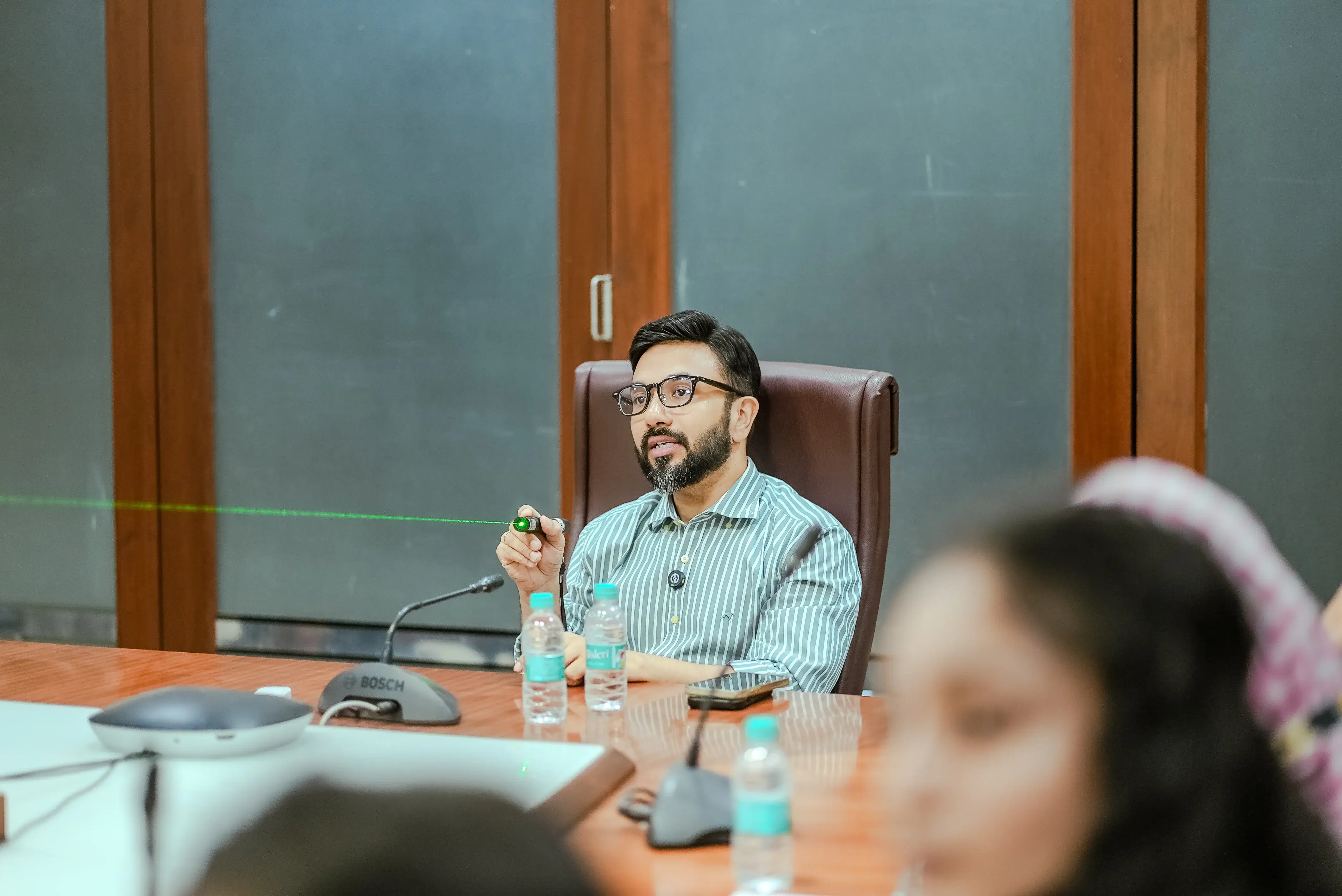
They first met Shri Manuj Jindal, IAS officer and Joint MD of MSRDC, who walked them through projects such as the Shakti Peak highway from Nagpur to Goa, the Samruddhi highway up to Mumbai, and the proposed Inland Coastal Expressway. The infrastructure scale was gigantic, but words that had the greatest effect were these: "You need not be future Manuj Jindal; just be yourself." Students came away thinking that taking risks in terms of career decisions, keeping everything at stake, and going ahead without having each step mapped out was not only okay, but the need of the hour.
Vision, Passion, and Career Foundations in the Early Period
The similar spirit came up with Yashodhan Tere of Wadhwa Group to address this session.
He talked about vision, hard work, and breaking big goals into small milestones. "There are no mistakes, only experiences," he said, again emphasizing early years of a career as laying the foundation for everything that follows. His energy was contagious, and students could almost think of giving it a try, learning, and owning things with confidence.
Innovation on the Ground: Mumbai Coastal Roads
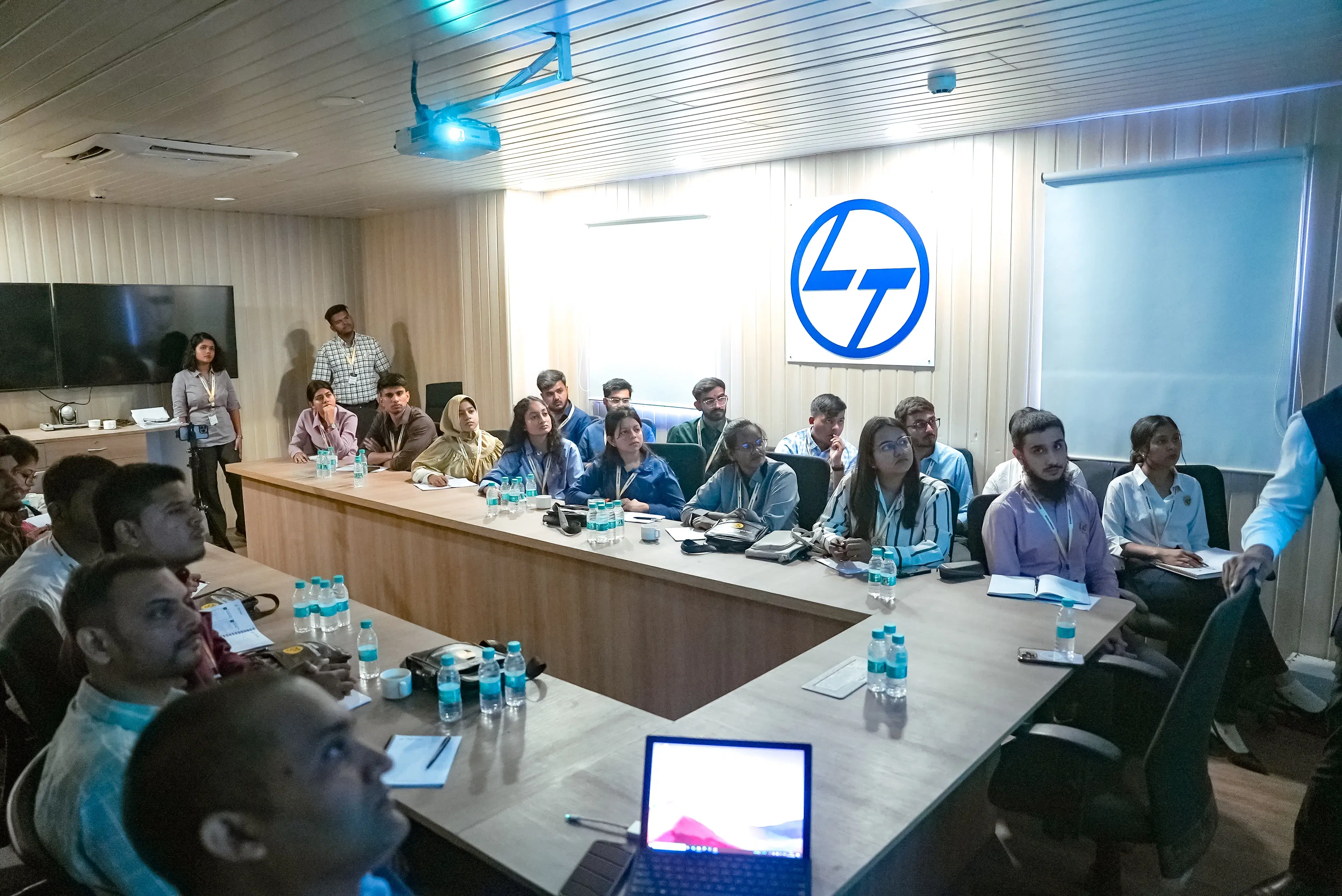
The tour thereafter proceeded to Larsen & Toubro, where Sandeep Singh and Gopinath Alla presented the wonders of the Mumbai Coastal Roads. From small cylindrical tubes balancing on the surface of monopiles to advanced tunneling methods adapted from global projects, innovation was on display for students to see. The lesson was more than just engineering, though: planning, environmental awareness, and a professional attitude were as much a part of the equation as engineering competence. Experiencing those three precepts on a "live" project was an exercise in detail, accountability, and attitude.
Architecture Beyond Buildings
Architecture added another dimension. P.K. Das reminded the students that architecture is not buildings alone; it's about relationships and the environment and the human beings that use and inhabit spaces. He wanted the students to consider buildings in relation to human beings and the environment. Rahul Kadri of IMK Architects embraced sustainable urbanism and biophilic design and presented examples of how conscious architecture educates society and improves lives. For the students, the ideas provided dimension for the abstract ideas of design, ethics, and functionality; they cannot be distinguished.
People-Centric Construction and Leadership
The people aspect of construction was cemented by Aditya Nayan Shah of MayFair Housing. Through input about mentoring, parental reinforcement, and a focus on stakeholders, students learned that good work is grounded in a commitment to people—rather than projects. Santosh Rai of Hindustan Construction Company also shared lesson from his 23 years in the infrastructure industry: you can turn every adversity to your advantage, you are always learning, and effective teams create success. It was evident that skills are only half the story, with the rest made up of stamina, ethics, and a vision.
Seeing It All in Action: Hiranandani Powai
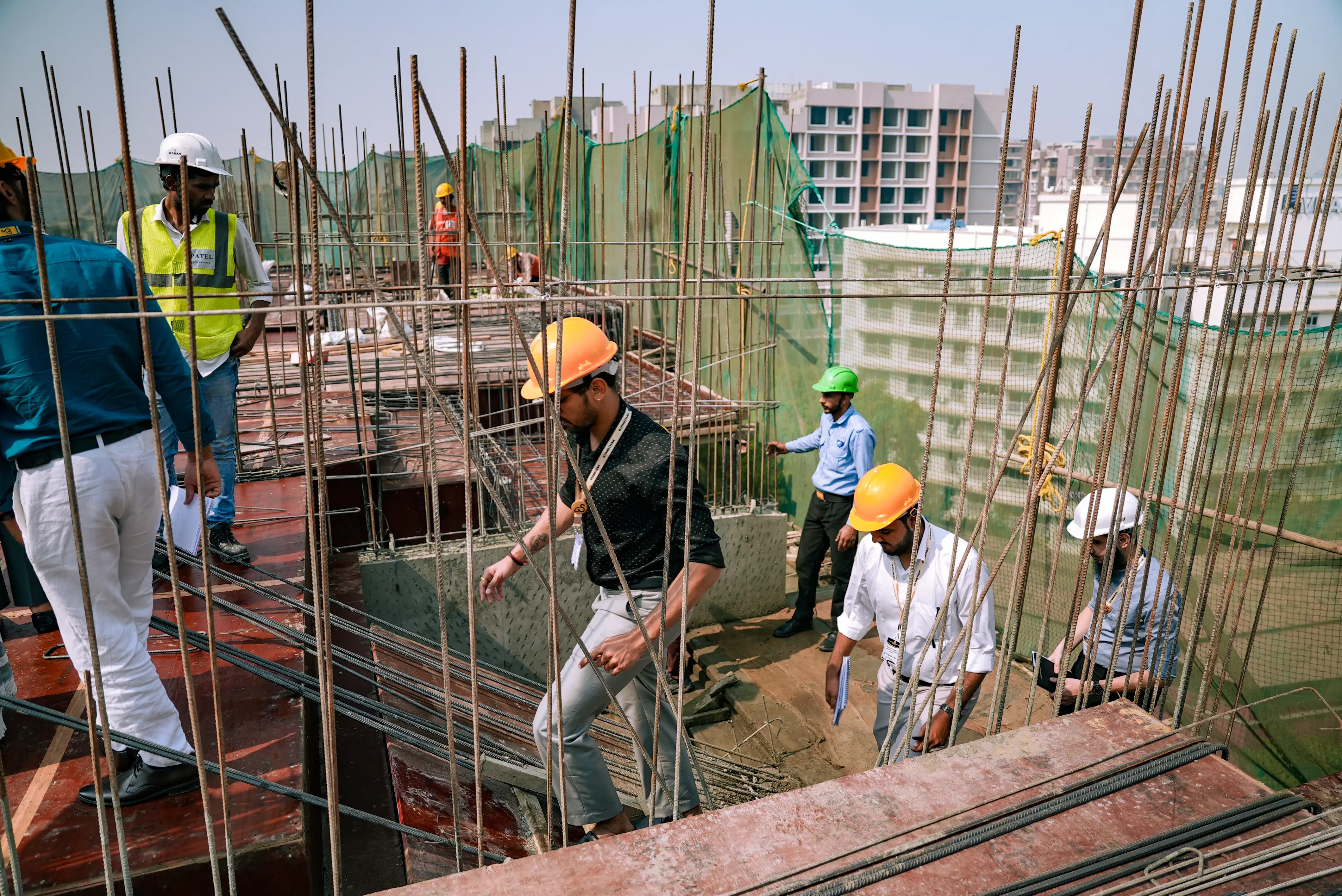
Finally, they transitioned to the Hiranandani construction site at Powai where everything came into focus. High-rises went up consistently as the workers worked with finesse, safety gear in place and provisions for their well-being. Students observed quality control checking going on, use of equipment and live project handling. But what came as a reminder by itself was the fact that infrastructure is not just about concrete and steel but also about people and sensitivity.
Perspective Beyond the Classroom
By the close of the tour, students were no longer memorizing facts, they were inventing a tale. Revolutionary career decisions, visionary projects, innovation, mentoring, and sustainability were not separate lectures but a continuum. One experience led to another, and out of that came a very strong and lucid reality: civil engineering is not math and construction by itself, but construction with curiosity, courage, teamwork, and commitment.
Standing and looking out over Mumbai from this final spot, the students carried with them more than technical competence. They carried perspective: an eye for how the city, the inhabitants, and the projects all intersected. From highways that covered states to green skyscrapers and skyscraping marvels, the tour had instilled in them that influence happens brick by brick, choice by choice, and that the future was theirs for the making, if they came at it with awareness, integrity, and a willingness to do so.





![Navrachana University - [NUV]](https://image-static.collegedunia.com/public/college_data/images/appImage/25501_nav.png?h=111.44&w=263&mode=stretch)

![TeamLease Skills University - [TLSU]](https://image-static.collegedunia.com/public/college_data/images/appImage/1595678131unnamed2.jpg?h=111.44&w=263&mode=stretch)

![National Rail and Transportation Institute - [NRTI]](https://image-static.collegedunia.com/public/college_data/images/appImage/152906470620180615.png?h=111.44&w=263&mode=stretch)

![Government Science College - [GSC]](https://image-static.collegedunia.com/public/college_data/images/appImage/1594717191gsccover.png?h=111.44&w=263&mode=stretch)

![Pramukh Swami Science and H. D. Patel Arts College - [PSSHDA]](https://image-static.collegedunia.com/public/college_data/images/appImage/1594720724pssdhacover.jpg?h=111.44&w=263&mode=stretch)







![Ahmedabad Physiotherapy College - [APC]](https://image-static.collegedunia.com/public/college_data/images/logos/1573713731Annotation20191109160050.jpg?h=72&w=72&mode=stretch)

![Parul Institute of Engineering and Technology - [PIET]](https://image-static.collegedunia.com/public/college_data/images/logos/1573708947Annotation20191109160050.jpg?h=72&w=72&mode=stretch)

![Parul Institute of Management - [PIM]](https://image-static.collegedunia.com/public/college_data/images/logos/1498805228Logo.jpg?h=72&w=72&mode=stretch)
![Parul Institute of Technology - [PIT]](https://image-static.collegedunia.com/public/college_data/images/logos/1573710315Annotation20191109160050.jpg?h=72&w=72&mode=stretch)

![Rajkot Homoeopathic Medical College - [RHMC]](https://image-static.collegedunia.com/public/college_data/images/logos/1701142617logo.png?h=72&w=72&mode=stretch)


![Vivekananda Global University - [VGU]](https://image-static.collegedunia.com/public/college_data/images/logos/17470451591674801681vgucombinelogonew.png?h=72&w=72&mode=stretch)
![Maharaja Sayajirao University of Baroda - [MSU]](https://image-static.collegedunia.com/public/college_data/images/logos/1743002254Screenshot20250326204427.png?h=72&w=72&mode=stretch)


![Chandigarh University - [CU]](https://image-static.collegedunia.com/public/college_data/images/logos/1613996461logo1.jpg?h=72&w=72&mode=stretch)

![Ganpat University - [GUNI]](https://image-static.collegedunia.com/public/college_data/images/logos/1747459995648ad7b7fea840001d4193531.jpg?h=72&w=72&mode=stretch)
![Rai University - [RU]](https://image-static.collegedunia.com/public/college_data/images/logos/1619851671ssLogoupdated1.png?h=72&w=72&mode=stretch)

![Galgotias University - [GU]](https://image-static.collegedunia.com/public/college_data/images/logos/1593772670logo.jpg?h=72&w=72&mode=stretch)
![Lovely Professional University - [LPU]](https://image-static.collegedunia.com/public/college_data/images/logos/1744630559Screenshot20250414at16.47.48.png?h=72&w=72&mode=stretch)


![Marwadi University - [MU]](https://image-static.collegedunia.com/public/college_data/images/logos/1623319738mulogo2.png?h=72&w=72&mode=stretch)



Comments