




The TG LAWCET exam pattern 2027 consists of 120 questions that need to be attempted in 90 minutes.
The TS LAWCET will be conducted in online mode, and the exam is MCQ-based. You will be awarded 1 mark for every correct answer. There will be no negative marking for any incorrect answers or unanswered questions in the TS LAWCET exam.
As per the TS LAWCET exam pattern, the GK & Mental Ability and Current Affairs sections consist of 30 questions each, while the Aptitude for the Study of Law section consists of 60 questions.
- The Aptitude for the Study of Law has the highest weightage of 50% (60 out of 120 questions) in the TG LAWCET syllabus. In this section, the Indian Constitution / Constitutional Law has the highest focus, with 20+ questions. Law of Contracts and Law of Torts contribute 15-20 questions.
- GK & Mental Ability and Current Affairs each contribute 25% to the TS LAWCET exam pattern. Static GK contributes the majority (18–20 questions) every year. Mental ability/reasoning contributes 8–12 questions.
- In Current Affairs, you must focus on recent 1-2 years updates with increasing emphasis on legal current affairs. Topics mostly include National & International events, Government schemes & policies, and Legal development.
The TS LAWCET 2027 exam paper will be available in English, Telugu, and Urdu. The difficulty level of the TS LAWCET 2027 exam is expected to be moderately difficult, which is consistent over the years. Difficulty differs slightly between the 3-year LLB (graduation level) and 5-year LLB (intermediate level), but the structure and section weightage are the same.
Check:
- TG LAWCET Syllabus 2027: Subject-Wise Topics, Weightage and PDF Download
- TS LAWCET Question Paper (Available): Download Previous Year Question Paper with Answer Key PDF
What is the TG LAWCET Exam Pattern 2027?
The TS LAWCET exam comprises 3 sections mentioned below:
Section A: General Knowledge & Mental Ability — topics and typical question count
- Static GK (history, polity, geography, economy), basic science, art & culture
- Mental ability: This section includes topics like syllogism, coding-decoding, blood relations, series, analogies, directions, clocks, calendars, basic arithmetic reasoning
Section B: Current Affairs — topics and typical question count
- National/international events, awards, appointments, government schemes, judicial news, sports, books/authors, environment
Section C: Aptitude for Study of Law / Legal Reasoning — topics and typical question count
- Legal terms, legal maxims, constitutional basics, fundamental rights, landmark cases (conceptual), principle‑fact reasoning, contracts/torts basics (aptitude, not deep law)
| Exam Features | Details |
|---|---|
| Difficulty level of the exam |
|
| Exam mode | Computer-based test (CBT) |
| Test duration | 1 hour 30 minutes |
| TS LAWCET 2027 Subjects | THREE Subjects
|
| Type of questions | Multiple choices questions- Each question will have four responses- Out of four responses, only one will be the correct option |
| Total questions | 120 questions |
| TS LAWCET 2027 Marking scheme |
|
| Total marks | 120 marks |
| Language options | English and Telugu or English and Urdu |
TS LAWCET 2027 Sectional Weightage
Part A and Part B of the TS LAWCET exam 2027 have 30 questions each with 30 marks. Part C has 60 questions with the same amount of marks allocated.
| Section | Number of Questions | Maximum Marks | Exam Duration |
|---|---|---|---|
| Part A- General Knowledge and Mental Ability | 30 | 30 | 90 minutes |
| Part B- Current Affairs | 30 | 30 | |
| Part C- Aptitude for the Study of Law | 60 | 60 | |
| Total | 120 | 120 |
Is There a Sectional Time Limit in TG LAWCET 2027?
No, there ia There is no sectional time limit in TG LAWCET 2027. The total time duration to complete the exam is 90 minutes (1 hour and 30 minutes)
You can move freely between sections and spend as much time as you prefer on any part of the paper.
- Total Questions: 120 multiple-choice questions.
- Sections: General Knowledge and Mental Ability (30 questions), Current Affairs (30 questions), and Aptitude for the Study of Law (60 questions).
TS LAWCET Subject-Wise Exam Pattern 2027: Check Syllabus
TS LAWCET syllabus expands around a range of diverse topics.
- The General Knowledge and Mental Ability section covers topics like Indian History, Geography, Events, etc.
- Current affairs can range across Economy, Business, Sports, Science and Environment. You must cover all genres to excel in this section.
| Subjects | Number of questions | Important Topics |
|---|---|---|
| General Knowledge and Mental Ability | 30 questions |
|
| Current Affairs | 30 questions |
|
| Aptitude for the Study of Law | 60 questions |
|
Check:
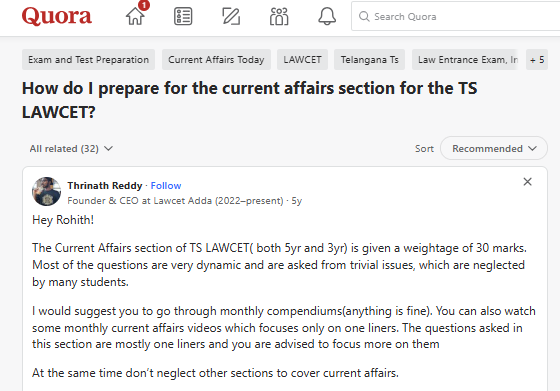
If you are wondering “How do I prepare for the current affairs section for the TS LAWCET?”
A Quora user, Thrinath Reddy answered: I would suggest you to go through monthly compendiums(anything is fine). You can also watch some monthly current affairs videos which focuses only on one liners. The questions asked in this section are mostly one liners and you are advised to focus more on them.
TS LAWCET Exam Pattern: High Weightage Topics
These high-weightage topics are estimates based on past papers and competitor analysis. You must always verify with official past papers once the TG LAWCET 2027 Syllabus is confirmed.
| Area | Estimated Weightage | High‑Yield Sub‑topics with number of Questions |
|---|---|---|
| Legal reasoning & aptitude | 35–40% |
|
| General knowledge & mental ability | 30–35% |
|
| Current affairs | 25–30% |
|
Check: Top TS LAWCET Current Affairs Questions
- Which of the following represents the absolute zero temperature?
- The organization which released the Annual Groundwater Quality Report 2025 is:
- The Indian Army has declared 2026 as:
- Which Port in India is set to be the Green Hydrogen Hub Port?
- Which State Government issued guidelines for the elimination of Corporal Punishment at schools in 2024?
- S Vijayalakshmi is famous for which of the following sports?
- The first wicket keeper to record 300 dismissals in T20 cricket is ___ .
- Which public sector enterprise was granted Navratna status?
TS LAWCET Exam Pattern: Changes in 2027 vs Previous Year
The TS LAWCET exam pattern has been highly stable over the past several years. The 2026 cycle introduced one notable change
- Hindi was added as a medium option alongside the existing English and Telugu choices, expanding access for students who prefer Hindi-medium preparation.
- The 2027 official notification has not been released yet (expected February 2027).
The table below compares confirmed 2026 data with 2027 projections based on the pattern’s historical consistency.
| Parameter | 2026 (Confirmed) | 2027 (Expected) |
|---|---|---|
| Total Questions | 120 | 120 (Expected) |
| Total Marks | 120 | 120 (Expected) |
| Exam Duration | 90 Minutes | 90 Minutes (Expected) |
| Exam Mode | Computer-Based Test (CBT) | CBT (Expected) |
| Negative Marking | No | No (Expected) |
| Medium of Exam | English, Hindi, Telugu | English, Hindi, Telugu (Expected) |
| Number of Parts | 3 | 3 (Expected) |
| Part A — No. of Questions | 30 | 30 (Expected) |
| Part B — No. of Questions | 30 | 30 (Expected) |
| Part C — No. of Questions | 60 | 60 (Expected) |
| Qualifying Marks — General | 42 / 120 (35%) | 42 / 120 (35%) (Expected) |
| Qualifying Marks — SC/ST | No minimum | No minimum (Expected) |
If further changes are introduced, they will appear in the official 2027 notification at lawcet.tgche.ac.in in February 2027.
TS LAWCET Exam Pattern 2027: Difficulty Level (2021 - 2025)
The section-wise number of questions and weightage remained unchanged every year. No major structural changes occurred in recent years.
| Year | Overall Difficulty | Key Observations on Difficulty Level |
|---|---|---|
| 2021 | Moderate | Standard pattern; Legal Aptitude moderate-difficult |
| 2022 | Moderate | GK/Mental Ability easier-moderate; Legal moderate |
| 2023 | Moderate | Consistent distribution; focus on Constitution & legal principles |
| 2024 | Moderate | GK relatively easier; Current Affairs easy-moderate; Legal moderate |
| 2025 | Moderate (3-yr slightly tougher in places) | GK: Static GK + reasoning; CA: Events/Books/Awards; Legal: Maxims, FR, Judgments, new criminal laws (BNS), principle-fact questions, passages |
A TS LAWCET aspirant asked on Quora: How tough is the TS LAWCET? What are some tips for preparing for it (especially from whoever has taken it or even prepared for it)?
Another Quora user Sudhagoni Raja Rajeshwari answered: It's not tough. If you prepare well in advance you can crack it. Refer to Aditya lawcet books available in market. If you are options for 5years course the test will be easy to pass and you have to put more effort in the process of Learning law.
TG LAWCET 2027 Marking Scheme
TS LAWCET 2027 uses a simple +1 marking scheme with no negative marking across all three parts.
- Every correct answer awards 1 mark.
- Wrong answers and unattempted questions both score 0 marks.
- The marking is uniform — no differential weighting exists between Part A, Part B, or Part C questions.
| Question Type | Marks for Correct Answer | Marks for Wrong Answer | Marks for Unattempted |
|---|---|---|---|
| MCQ — Part A (General Knowledge and Mental Ability) | +1 | 0 | 0 |
| MCQ — Part B (Current Affairs) | +1 | 0 | 0 |
| MCQ — Part C (Aptitude for the Study of Law) | +1 | 0 | 0 |
There is no negative marking in TS LAWCET 2027 — attempt every question, because a wrong answer and a blank answer both score zero.
TS LAWCET Preparation Tips 2027
You need to have a thorough knowledge of the TS LAWCET syllabus and Exam pattern before preparing. This will help you cover high-weightage topics in TS LAWCET exam. .
- Create a schedule that allocates enough time to each section of the test, covers each subject, and prioritizes weaker areas.
- Watch the news and read Newspapers for daily updates on recent events.
- Solve the TS LAWCET 2026 previous year question papers and TS LAWCET mock tests to improve speed, accuracy, and familiarity with the syllabus.
- Make notes on important events, awards, honours, and dates for quick revision during the last phase of preparation.
Students were seen asking “How do I prepare for the TS LAWCET?” on Quora
To this, Thrinath Reddy, a Quora user answered: Try to cover any static gk book , Focus more on miscellaneous GK.
TS LAWCET Previous Year Question Papers
TS LAWCET Question Paper 2026
| Paper/Subject | Question Paper PDF | Solution PDF |
|---|---|---|
| LLB (3 Years) Shift 1 | Download PDF | Check Solutions |
| LLB (3 Years) Shift 2 | Download PDF | Check Solutions |
| LLB (5 Years) | Download PDF | Check Solutions |
TS LAWCET Question Paper 2025
| Paper/Subject | Question Paper PDF | Solution PDF |
|---|---|---|
| LLB (3 Years) Shift 1 | Download PDF | Check Solutions |
| LLB (3 Years) Shift 2 | Download PDF | Check Solutions |
| LLB (5 Years) | Download PDF | Check Solutions |
TS LAWCET 2024 Question Paper
| Paper/Subject | Question Paper PDF | Solution PDF |
|---|---|---|
| LLB (3 years) Shift 1 | Download PDF | Check Here |
| LLB (3 years) Shift 2 | Download PDF | Check Here |
| LLB (5 years) | Download PDF | Check Here |
TS LAWCET Exam Pattern 2027 FAQs
Ques. Which part carries the highest marks in TS LAWCET 2027?
Ans. Part C — Aptitude for the Study of Law carries the highest marks, with 60 out of 120. It accounts for 50% of the total paper and is the most important section for improving your rank.
Ques. Is the TS LAWCET 2027 pattern the same for 3-year LLB and 5-year LLB?
Ans. Yes, the structure — three parts, 120 questions, 120 marks, 90 minutes — is identical for both 3-year LLB and 5-year LLB. The difficulty level differs: questions are at degree level for 3-year LLB and at intermediate (12th) level for 5-year LLB applicants.
Ques. In which languages can I attempt TS LAWCET 2027?
Ans. TS LAWCET 2027 is expected to be available in three languages — English, Hindi, and Telugu. You can select your preferred medium at the time of filling the application form. Hindi was added as a new option in 2026 alongside the existing English and Telugu choices.
Ques. What types of questions are asked in TS LAWCET 2027?
Ans. All 120 questions are objective-type MCQs with four options and a single correct answer. Part C additionally includes 10 questions based on comprehension of a legal passage. There are no numerical, integer, or descriptive questions in TS LAWCET.
Ques. Has the TS LAWCET exam pattern changed for 2027?
Ans. The 2027 official notification has not been released yet (expected February 2027). Based on the exam’s consistent history, the core structure — 120 questions, 90 minutes, three parts, no negative marking — is expected to remain unchanged. The only recent change was the addition of Hindi as a medium in 2026, which is expected to continue. Confirm at lawcet.tgche.ac.in once the 2027 notification is out.



Comments