




SAT Math is an important section of the SAT exam, alongside Evidence-Based Reading and Writing (EBRW). The Math section includes questions from 3 main areas: Heart of Algebra, Problem Solving and Data Analysis, and Passport to Advanced Math. These cover key concepts like algebra, geometry, data interpretation, and advanced math skills.
Practicing with SAT 2026 Math practice tests and maths SATs questions will help you strengthen these skills, improve your problem-solving speed, and prepare effectively for the digital SAT format.
SAT Math Sample Questions 2026
Q1. (Algebra) If 3x − 7 = 2x + 5, what is the value of x?
A) 2 B) 5 C) 12 D) 14
Answer: C. Adding 7 and subtracting 2x from both sides gives x = 12.
Q2. (Algebra) A phone plan charges a flat fee of $20 plus $0.10 per minute of calls. Which equation represents the total monthly cost, C, for m minutes?
A) C = 20 + 0.10m B) C = 0.10 + 20m C) C = 20m + 0.10 D) C = 20-0.10m
Answer: A. The flat fee is a constant, and the per-minute charge scales with m.
Q3. (Advanced Math) If f(x) = 2x² − 3x + 1, what is f(2)?
A) 3 B) 5 C) 7 D) 9
Answer: A. f(2) = 2(4) − 3(2) + 1 = 8 − 6 + 1 = 3.
Q4. (Advanced Math) Which value of x satisfies x² − 5x + 6 = 0?
A) 1 B) 2 C) 4 D) 5
Answer: B. Factoring gives (x − 2)(x − 3) = 0, so x = 2 or x = 3.
Q5. (Problem-Solving & Data Analysis) A survey of 200 students found that 60% prefer online classes. How many students prefer online classes?
A) 60 B) 100 C) 120 D) 140
Answer: C. 60% of 200 = 0.6 × 200 = 120.
Q6. (Problem-Solving & Data Analysis) The average of five numbers is 18. If one number is removed, the average of the remaining four is 20. What was the removed number?
A) 8 B) 10 C) 12 D) 15
Answer: B. Total of 5 numbers = 90. Total of remaining 4 = 80. Removed number = 90 − 80 = 10.
Q7. (Geometry & Trigonometry) A right triangle has legs of length 6 and 8. What is the length of the hypotenuse?
A) 9 B) 10 C) 12 D) 14
Answer: B. By the Pythagorean theorem, √(6² + 8²) = √100 = 10.
Q8. (Geometry & Trigonometry) A circle has a radius of 5. What is its area, in terms of π?
A) 10π B) 15π C) 20π D) 25π
Answer: D. Area = πr² = π(5²) = 25π.
Q9. (Algebra – systems) If x + y = 10 and x − y = 4, what is the value of x?
A) 3 B) 6 C) 7 D) 8
Answer: C. Adding both equations: 2x = 14, so x = 7.
Q10. (Data Analysis) A store increases the price of an item from $50 to $60. What is the percent increase?
A) 10% B) 15% C) 20% D) 25%
Answer: C. Increase = $10. Percent increase = 10/50 × 100 = 20%.
How the Digital SAT Math Modules Work 2026
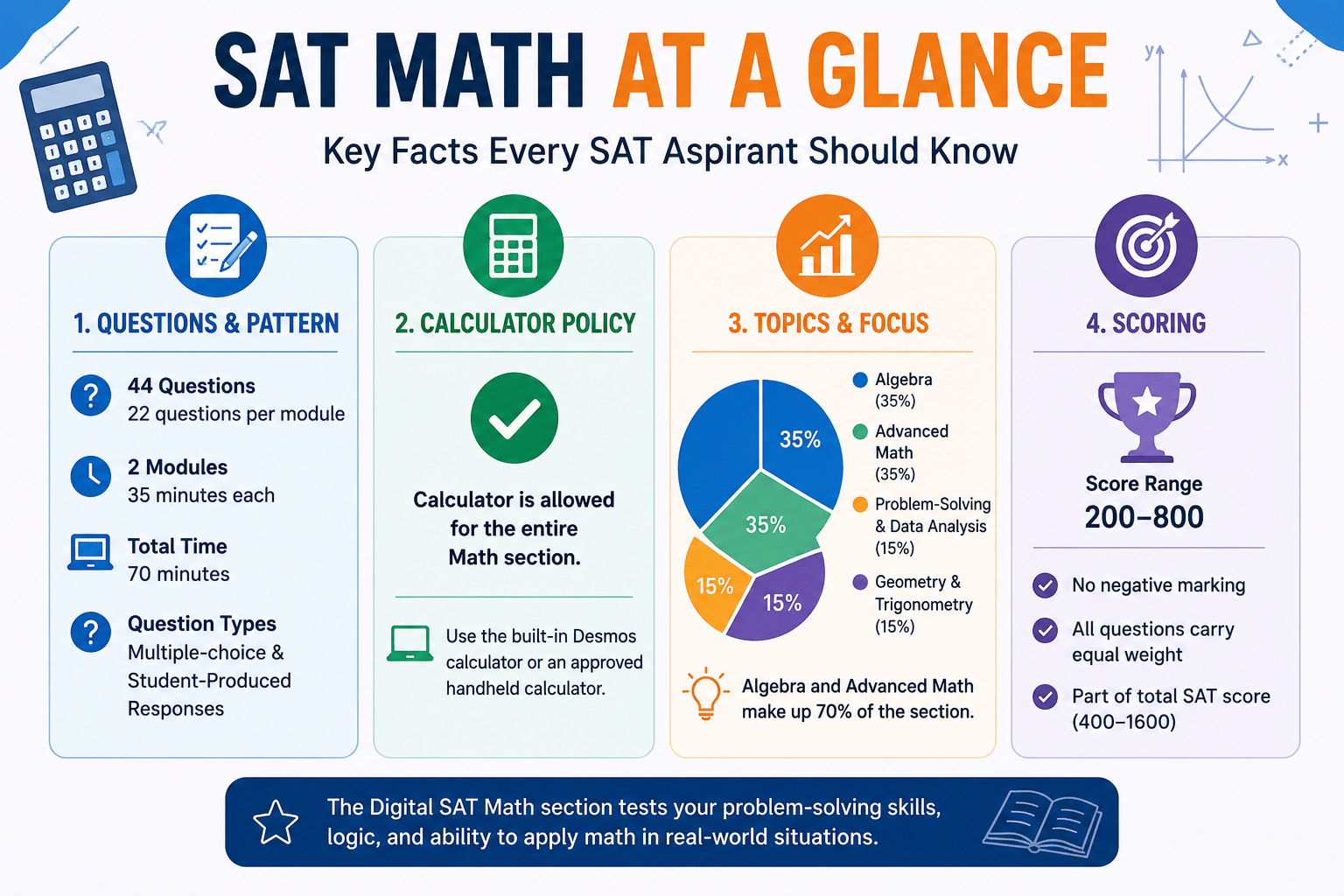
The Math section is split into 2 modules of 22 questions each, with 35 minutes per module, 70 minutes total.
- Module 1 gives every student a mix of easy, medium, and hard questions.
- Module 2 adjusts in difficulty based on how you performed in Module 1. Score well, and you'll get a harder second module with access to a higher score ceiling. Struggle in Module 1, and Module 2 will be comparatively easier - which also caps how high your final score can go.
This is why accuracy in Module 1 matters more than speed: a slower, more careful first module can unlock a higher-scoring second module. You cannot go back to Module 1 once you move to Module 2, and you cannot skip between modules.
Both modules allow a calculator throughout, and the on-screen Desmos calculator plus a formula reference sheet are available for the entire section.
SAT 2026 Math Practice Papers
Preparing for the SAT Math section requires consistent practice with questions that reflect the latest exam format. SAT 2026 Math practice papers are designed to help you improve your problem-solving skills across key topics like algebra, geometry, and data analysis. These papers follow the digital SAT pattern and include a mix of calculator and no-calculator questions, helping you get exam-ready with confidence.
SAT 2026 Math Preparation Books
Choosing the right preparation books is essential for mastering the SAT Math section. SAT 2026 Math prep books offer comprehensive coverage of all tested topics, including algebra, advanced math, and data analysis. Many of these SAT preparation books include practice questions, full-length tests, detailed explanations, and tips tailored to the digital SAT format, making them a valuable resource for effective self-study.
- Steve Warner’s SAT Math Series - Check PDF
- Barron’s SAT Math Workbook – Check PDF
- PWN the SAT Math Guide – Check PDF
- Peterson’s New SAT Math Workbook - Check PDF
- McGraw-Hill SAT Math - Check PDF
- The SAT-10 Dailies – Check PDF
Consistent practice with high-quality SAT Math tests and trusted prep books is key to scoring well in the 2026 digital SAT. Use the practice papers and resources above to strengthen your math skills, track your progress, and build confidence. Start early, stay consistent, and you’ll be well-prepared for test day.
Tips and Strategies for SAT Math 2026
Indian students appearing for the SAT exam in August 2026 should follow these tips and suggestions to score well in the SAT Math section.
- Nail Module 1, as its difficulty decides how high Module 2 (and your score) can go, so accuracy beats speed there.
- Plug in answer choices for algebra problems instead of solving from scratch — it's often faster.
- Use Desmos only when needed, for graphing or systems, not simple arithmetic.
- Reread the question before answering, most missed points are misreads, not math errors.
- Budget time unevenly as bank time on easy algebra to spend more on geometry/trig.
- Practice grid-ins separately, as there are no answer choices to guess from, so format and precision matter.
- Review your mistakes by type (careless vs. concept gap) after every practice test.
- Retake old tests a few weeks later to check if concepts actually stuck.
FAQs
Ques. What topics are covered in the SAT 2026 Math section?
Ans. The SAT Math section covers Algebra, Advanced Math, Problem-Solving and Data Analysis, and Geometry and Trigonometry. Topics include linear and quadratic equations, functions, ratios and percentages, and circle/triangle geometry.
Ques. How many questions are there in the SAT Math section?
Ans. The digital SAT includes 44 math questions split across two 22-question modules, with 35 minutes per module. Most are multiple-choice, with some student-produced response (grid-in) questions.
Ques. Is a calculator allowed in the entire SAT Math section?
Ans. Yes. Unlike the older paper SAT, the digital SAT allows a calculator for the entire Math section - no calculator/no-calculator split exists anymore. You can use the built-in Desmos calculator in Bluebook or bring your own approved calculator.
Ques. How does Digital SAT Math scoring work?
Ans. Your raw score (number of correct answers) is converted to a scaled score between 200 and 800 for the Math section. Module 2's difficulty - which depends on your Module 1 performance - affects the score range you can reach. Use our SAT Score Calculator to estimate your scaled score.
Ques. What's the difference between Digital SAT Math and the old paper SAT Math?
Ans. The digital SAT is shorter (70 minutes vs. 80), allows a calculator throughout instead of splitting into calculator/no-calculator sections, and is adaptive - Module 2's difficulty depends on how you do in Module 1. The old paper SAT was fixed-difficulty and non-adaptive.
Ques. How should I practice for SAT Math 2026?
Ans. Start with topic-wise practice to identify weak areas, then move to timed, module-style practice tests. Review every mistake and re-attempt similar questions until the concept is solid - don't just check the answer key.
Ques. Which books are best for SAT Math preparation?
Ans. Popular choices include Barron's SAT Math Workbook, Steve Warner's SAT Math series, and PWN the SAT Math Guide. Since these predate the digital format, pair them with digital SAT-format practice tests like the ones above.
Ques. What is a good SAT Math score?
Ans. A Math score of 650+ is generally considered strong. For highly selective US universities, aim for 700+; check your target schools' SAT score ranges for specifics.
*The article might have information for the previous academic years, which will be updated soon subject to the notification issued by the University/College.



Comments