




RBSE Syllabus for 12th class has not changed for the academic year 2025-2026. It is the same according to last year's syllabus. The Rajasthan Board of Secondary Education syllabus has a different exam structure for each of the courses it provides for class 12th. The RBSE class 12 exam has a total of 100 marks, out of which 80 is for the written exam and 20 for the practical exam. A total time of 3 hours and 15 minutes is given to complete the exam.
- In the RBSE class 12 exam syllabus, it has majorly 3 streams: Arts, Science, and Commerce.
- To pass the exam, students have to secure at least 33% marks in each subject.
- Passing in practical exams is also necessary as it carries an important weightage in the RBSE exam structure.
- Hindi and English are the compulsory subjects for all the streams' students. Other than this, there are many optional subjects offered by RBSE that students can choose according to their interests.
You can directly download the official RBSE 12th syllabus PDF from the link mentioned below.

Key Summary
-
In this article, we have shared the RBSE syllabus for class 12th, different subjects, exam pattern, and weightage.
- The RBSE class 12 exam is held for 100 marks. 80 for the written exam and 20 for the practical exam.
- Students have been given the choice of selecting optional subjects according to them from the elective subjects offered by RBSE.
- The paper is based on objective-type, short-answer, and long-answer questions.
- RBSE recommends the NCERT books for the RBSE Class 12 syllabus.
Also Check:
- RBSE Syllabus 12th Class & Exam Structure
- RBSE Syllabus 12th Class & Exam Structure FAQs
- RBSE Syllabus for 12th Class: Stream-Wise Subjects 2026
- What is RBSE Syllabus for 12th Class 2026?
4.1 RBSE Syllabus for Class 12 English
4.2 RBSE Syllabus for Class 12 History
4.3 RBSE Syllabus for Class 12 Political Science
4.4 RBSE Syllabus for Class 12 Geography
4.5 RBSE Syllabus for Class 12 Mathematics
4.6 RBSE Syllabus for Class 12 Biology
4.7 RBSE Syllabus for Class 12 Chemistry
4.8 RBSE Syllabus for Class 12 Physics
4.9 RBSE Syllabus for Class 12 Economics
- Rajasthan Board Class 12 Model Question Papers
- Frequently Asked Questions
RBSE Syllabus 12th Class & Exam Structure
RBSE conducts its class 12 exam for different streams annually.
- The total marks for each subject are 80 + 20 for the written exam and the practical.
- Students must secure a score of 33% to pass the exam.
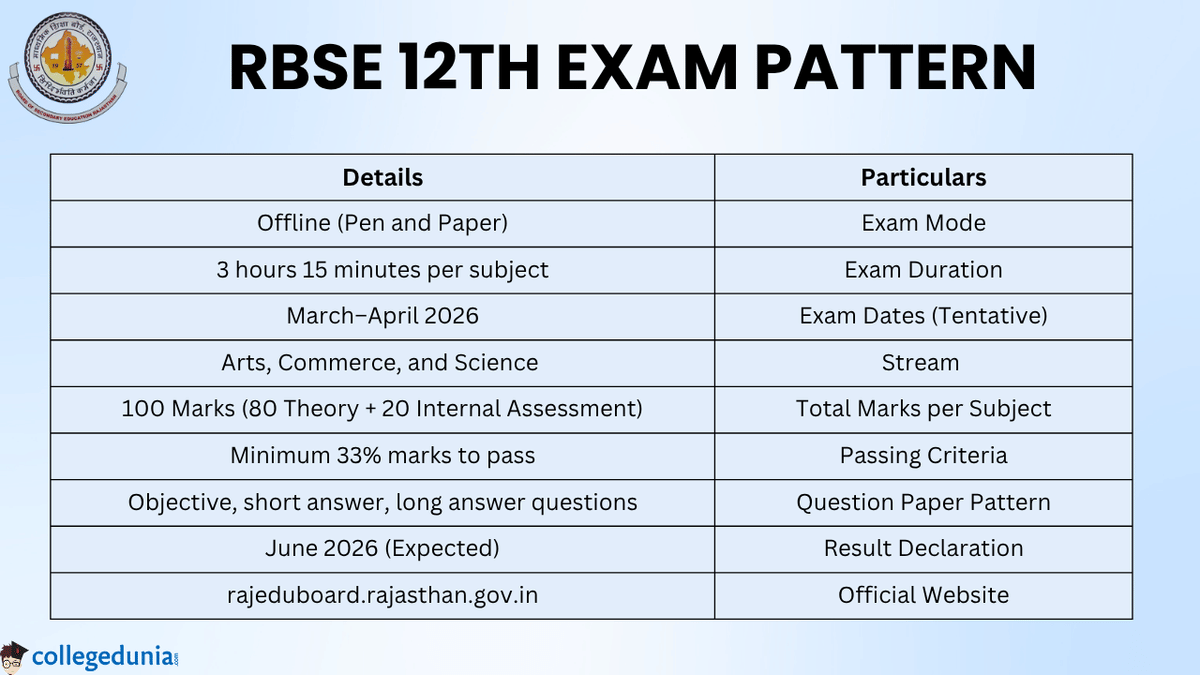
All the important details related to the RBSE exam structure are mentioned below:
| Details | Particulars |
|---|---|
| RBSE Class 12 Exam 2025-2026 | Exam Name |
| Board of Secondary Education Ajmer (RBSE) | Conducting Authority |
| RBSE Class 12 Syllabus 2025-26 | Syllabus Name |
| Offline (Pen and Paper) | Exam Mode |
| 3 hours 15 minutes per subject | Exam Duration |
| March–April 2026 | Exam Dates (Tentative) |
| Arts, Commerce, and Science | Stream |
| 100 Marks (80 Theory + 20 Internal Assessment) | Total Marks per Subject |
| Minimum 33% marks to pass | Passing Criteria |
| Objective, short answer, long answer questions | Question Paper Pattern |
| June 2026 (Expected) | Result Declaration |
| rajeduboard.rajasthan.gov.in | Official Website |
Also Read: RBSE 12th Preparation Tips
Ques: What is the format of the RBSE paper?
Ans: The RBSE Class 12th exam is conducted in the offline mode and includes objective, short-answer, and long-answer questions.
Ques: What are the total marks for RBSE Class 12?
Ans: The total marks for RBSE Class 12 are 100. This includes 80 marks for the written exam and 20 marks for the practical.
Ques: What are the passing marks for the Class 12 RBSE exam?
Ans: For passing the RBSE Class 12 exam, students need to secure at least 33 marks in each subject. Marks must be obtained separately in theory and practical, if the subject has a practical part.
Ques: What will happen if the student fails in the practical exam?
Ans: If a student fails in the practical exam, they cannot pass the subject and may have to reappear for the practical to clear the exam.
Ques: What is the grading system for RBSE 2025?
Ans: The RBSE grading system gives grades from A1 (highest) to E (fail) based on marks in each subject, with points reflecting overall performance.
| Grade | Marks Range (%) | Grade Point | Performance |
|---|---|---|---|
| A1 | 91 – 100 | 10 | Excellent |
| A2 | 81 – 90 | 9 | Very Good |
| B1 | 71 – 80 | 8 | Good |
| B2 | 61 – 70 | 7 | Above Average |
| C1 | 51 – 60 | 6 | Average |
| C2 | 41 – 50 | 5 | Below Average |
| D | 33 – 40 | 4 | Pass |
| E | 0 – 32 | 0 | Fail |
RBSE Syllabus for 12th Class: Stream-Wise Subjects 2026
In RBSE 2026, there are different streams like science, arts, commerce, and agriculture. Each stream has some compulsory and some optional subjects. Preparing according to the core subject and elective subjects is important for the exam. The table below shows the core and optional subjects for each stream:
RBSE Class 12 Main Subjects
Here are the main subjects students of each stream have to study. They are compulsory subjects for the exam and carry more weightage.
| Stream | Main Subjects |
|---|---|
| Commerce | Accountancy, Business Studies, Economics, English, Hindi |
| Agriculture | Agriculture, Physics, Chemistry, Biology, Mathematics, Hindi |
| Arts | English Literature, History, Political Science, Geography, Hindi |
| Science | Physics, Chemistry, Biology, Mathematics, Hindi |
RBSE Class 12 Optional Subjects
These are the optional subjects offered in the RBSE 12th class. Student choose these subjects according to their liking.
| Stream | Optional / Elective Subjects |
|---|---|
| Commerce | Mathematics, Computer Science / Information Practices, Multimedia & Web Technology, Shorthand & Typing (Hindi/English) |
| Agriculture | Computer Science / Information Practices, Multimedia & Web Technology |
| Arts | Psychology, Sociology, Economics, Public Administration, Philosophy, Home Science, Sanskrit Literature, Drawing, Music, Regional Literature (Hindi, Punjabi, Urdu, Prakrit, Sindhi, Gujarati, Rajasthani, Persian), Mathematics, Computer Science / Information Practices, Multimedia & Web Technology |
| Science | Geology, Computer Science / Information Practices, Multimedia & Web Technology |
What is RBSE Syllabus for 12th Class 2026?
There are two compulsory subjects for each stream: Hindi and English. Apart from them, every stream has some different subjects, specifically means for the same stream. Here is the syllabus for different subjects:
RBSE Syllabus for Class 12 English
The RBSE class 12 English syllabus consists of 3 sections: reading comprehension, writing & grammar, and textbooks. The textbook section has the highest weightage of 42 marks.
| Section | Topic | Marks |
|---|---|---|
| Reading |
| 15 |
| Writing & Grammar |
| 15 |
| Textbooks (Flamingo & Vistas) |
| 42 |
Prescribed Text Books for RBSE class 12 syllabus 2026 English
- Flamingo—NCERT’s Book
- Vistas—NCERT’s Book
RBSE Syllabus for Class 12 History
The RBSR class 12 history syllabus has 3 parts: Ancient, medieval, and modern. Each section has a different weightage and maps work to do.
| Theme | Topics | Marks |
|---|---|---|
| Themes in Indian History – Part I (c. 600 BCE – 600 CE) | ||
| Harappan Civilization |
| 6 |
| Early States & Economies |
| 6 |
| Early Societies |
| 6 |
| Thinkers, Beliefs & Buildings |
| 7 |
| Themes in Indian History – Part II (c. 8th – 17th Century) | ||
| Travelers’ Accounts |
| 6 |
| Bhakti-Sufi Traditions |
| 7 |
| Vijayanagara |
| 6 |
| Peasants, Zamindars & Mughal Agrarian Society |
| 6 |
| Themes in Indian History – Part III (Colonial & Modern India) | ||
| Colonialism & Countryside |
| 6 |
| Rebels & the Raj (1857) |
| 6 |
| Gandhi & Nationalist Movement |
| 7 |
| Framing the Constitution |
| 6 |
| Map Work | 5 | |
Prescribed Text Books for RBSE class 12 syllabus 2026 History
- Themes in Indian History, Part I - NCERT's Book
- Themes in Indian History, Part II - NCERT's Book
- Themes in Indian History, Part III -NCERT's Book
RBSE Syllabus for Class 12 Political Science
Here is the Class 12 political science syllabus. It is divided into 2 parts: contemporary world politics and Politics in India since Independence. The table mentioned below shows the topics and weightage:
| Title | Key Topics | Marks |
|---|---|---|
| Contemporary World Politics | ||
| The End of Bipolarity |
| 6 |
| Contemporary centers of power |
| 6 |
| Contemporary South Asia |
| 6 |
| International Organizations |
| 6 |
| Security in the Contemporary World |
| 5 |
| Environment and Natural Resources |
| 5 |
| Globalization |
| 6 |
| Part B: Politics of India Since Independence | ||
| Challenges of Nation Building |
| 5 |
| Era of One-Party Dominance |
| 4 |
| Politics of Planned Development |
| 5 |
| India’s External Relations |
| 5 |
| Challenge to and Restoration of the Congress System |
| 5 |
| The Crisis of the Democratic Order |
| 5 |
| Regional Aspirations |
| 5 |
| Recent Developments in Indian Politics |
| 6 |
Prescribed Text Books for RBSE class 12 syllabus 2026 Political Science
- Contemporary World Politics - NCERT's Book
- Politics of India Since Independence - NCERT's Book
RBSE Syllabus for Class 12 Geography
The RBSE Syllabus for class 12th Geography has 2 parts. Human development, primary, secondary, tertiary, and quaternary have the highest weightage in the syllabus.
| Unit Name | Topics | Marks |
|---|---|---|
| Human Geography: Nature and Scope |
| 03 |
| The World Population: Distribution, Density, and Growth |
| 05 |
| Human Development |
| 18 |
| Primary, Secondary, Tertiary & Quaternary Activities |
| 18 |
| Transport and Communication |
| 04 |
| International Trade |
| 02 |
| Map Work | Map exercises based on the above units (World map) | 02 |
| India: People and Economy | ||
| Population: Distribution, Density, Growth, and Composition |
| 03 |
| Human Settlements |
| 02 |
| Land Resources and Agriculture |
| 14 |
| Water Resources |
| 04 |
| Mineral and Energy Resources |
| 03 |
| Planning and Sustainable Development |
| 03 |
| Transport and Communication |
| 04 |
| International Trade |
| 03 |
| Geographical Perspective on Selected Issues & Problems |
| 03 |
| Map Work | Map exercises based on the above units (India map) | 02 |
Prescribed Text Books for RBSE class 12 syllabus 2026 Geography
- Fundamentals of Human Geography - NCERT's Book
- India - People and Economy- NCERT's Book
- Practical Work in Geography II - NCERT's Book
RBSE Syllabus for Class 12 Mathematics
Calculus has the highest weightage in the RBSE Syllabus for Class 12th Math, followed by vectors and three-dimensional geometry. Students should understand the syllabus clearly and focus more on the high-weightage topics.
| Unit Name | Topics | Marks |
|---|---|---|
| Relations and Functions |
| 07 |
| Algebra |
| 10 |
| Calculus |
| 30 |
| Vectors and Three-Dimensional Geometry |
| 16 |
| Linear Programming |
| 04 |
| Probability |
| 07 |
Prescribed Text Books for RBSE class 12 syllabus 2026 Math
- Mathematics Part I - Text Book for class XII NCERT's
- Mathematics Part II - Text Book for class XII NCERT's
RBSE Syllabus for Class 12 Biology
The table mentioned below shows the detailed syllabus of the RBSE Class 12 Biology. It shows the unit-wise topics and marks carried by each topic for the better understanding of the students.
| Unit | Topics | Marks |
|---|---|---|
| Reproduction |
| 14 |
| Genetics and Evolution |
| 18 |
| Biology and Human Welfare |
| 14 |
| Biotechnology and Its Applications |
| 10 |
| Ecology and Environment |
| 14 |
RBSE Syllabus for Class 12 Chemistry
The table mentioned below shows the detailed syllabus of the RBSE Syllabus for Class 12th Chemistry.
| Units | Topics |
|---|---|
| Unit 1: Solid State | Electrical and magnetic properties, Packing efficiency, voids, number of atoms per unit cell in a cubic unit cell, point defects, etc. |
| Unit 2: Solutions | Osmotic pressure, determination of molecular masses using colligative properties, Elevation of boiling point, depression of freezing point, abnormal molecular mass, etc |
| Unit 3: Electrochemistry | Kohlrausch’s Law, lead accumulator, Conductance in electrolytic solutions, specific, variations of conductivity with concentration, etc. |
| Unit 4: Chemical Kinetics | Integrated rate equations and half-life, the concept of collision theory (elementary idea, no mathematical treatment), etc |
| Unit 5: Surface Chemistry | Brownian movement, electrophoresis, Lyophobic multimolecular and macromolecular colloids; properties of colloids; Tyndall effect, coagulation, emulsion-types of emulsions, etc. |
| Unit 6: General Principles and Processes of Isolation of Elements | Occurrence and principles of extraction of aluminium, copper, zinc and iron, Principles and methods of extraction – concentration, oxidation, reduction – electrolytic method and refining; etc. |
| Unit 7: p-block Elements | Halides PCl3, Ozone, Sulphur-allotropic forms; Phosphorus – allotropic forms, Preparation properties and uses of sulphur-dioxide, etc. |
| Unit 8: d and f-block elements | Magnetic properties, interstitial compounds, Metallic character, ionization enthalpy, preparation and properties of K2Cr2O7 and KMnO4, etc |
| Unit 9: Coordination Compounds | IUPAC nomenclature of mononuclear coordination compounds. Bonding, Introduction, ligands, coordination number, Werner’s theory, VBT, and CFT; structure and stereoisomerism, etc |
| Unit 10: Haloalkanes and Haloarenes | Nomenclature, nature of C-X bond, physical and chemical properties, substitution reactions, etc |
| Unit 11: Alcohols, Phenols, and Ethers | Mechanism of dehydration, physical and chemical properties, uses, uses with special reference to methanol and ethanol, etc |
| Unit 12: Aldehydes, Ketones, and Carboxylic Acids | Nomenclature, nature of carbonyl group, methods of preparation, physical, uses, methods of preparation, etc |
| Unit 13: Amines (Organic Compounds containing Nitrogen) | Classification, structure, methods of preparation, secondary and tertiary amines, etc |
| Unit 14: Biomolecules | Monosaccharides (glucose and fructose), polysaccharides (starch, cellulose, glycogen), etc |
| Unit 15: Polymers | Biodegradable and non-biodegradable polymers, etc Some important polymers: natural and bakelite, rubber, etc |
| Unit 16: Chemistry in Everyday Life | Tranquilizers, antiseptics, disinfectants, antacids, antihistamines, artificial sweetening agents, etc. |
RBSE Syllabus for Class 12 Physics
Here is the table for the RBSE Syllabus for Class 12 Physics. It shows the unit-wise topics. This will help the students in understanding which unit consists of which topics and prepare accordingly.
| Units | Topics |
|---|---|
| Electrostatics | Electric Charges, Conservation of charge, Coulomb’s law-force between two point charges, forces between multiple charges, the electrical potential energy of a system of two point charges and of electric dipole in an electrostatic field, etc. |
| Current Electricity | Ohm’s law, electrical resistance, V-I characteristics (linear and nonlinear), electrical energy and power, electrical resistivity and conductivity, Kirchhoff’s laws and simple applications. Wheatstone bridge, metre bridge, etc. |
| Magnetic Effect of Current and Magnetism | Torque on a magnetic dipole (bar magnet) in a uniform magnetic field; bar magnet as an equivalent solenoid, Force on a moving charge in a uniform magnetic and electric fields, Earth’s magnetic field and magnetic elements, etc. |
| Electromagnetic Induction and Alternating Currents | Electromagnetic induction; Faraday’s law, induced emf and current; Lenz’s Law, peak and RMS value of alternating current/voltage; reactance and impedance, etc. |
| Electromagnetic Waves | Electromagnetic waves, their characteristics, their transverse nature, Electromagnetic spectrum, including elementary facts about their uses, etc. |
| Optics | Refraction of light, total internal reflection and its applications, lensmaker’s formula. Magnification, power of a lens, Reflection of light, spherical mirrors, mirror formula, a combination of thin lenses in contact, etc. |
| Dual Nature of Matter | Matter waves-wave nature of particles, de Broglie relation, Photoelectric effect, Hertz and Lenard’s observations; Einstein’s photoelectric equation-particle nature of light, Davisson-Germer experiment, etc. |
| Atoms and Nuclei | Bohr model, energy levels, hydrogen spectrum, Composition and size of nucleus, Alpha-particle scattering experiment; Rutherford’s model of atom; atomic masses, isotopes, radioactive decay law, etc. |
| Electronic Devices | transistor as a switch, I-V characteristics of the transistor, transistor as an amplifier (common emitter configuration), the basic idea of analog and digital signals, etc. |
| Communication Systems | Propagation of electromagnetic waves in the atmosphere, amplitude modulation.Production and detection of an amplitude-modulated wave, etc. |
RBSE Syllabus for Class 12 Economics
RBSE Syllabus for class 12 Economics is divided into two sections: Introductory Macroeconomics and Introductory Microeconomics. Each section has its own units and separate mark distribution for each unit.
| Unit Name | Topics | Marks |
|---|---|---|
| Part A: Introductory Macroeconomics | ||
| Introduction |
| 8 |
| National Income Accounting |
| 8 |
| Money and Banking |
| 8 |
| Determination of Income and Employment |
| 8 |
| Government Budget and the Economy |
| 8 |
| Open Economy Macroeconomics |
| 8 |
| Part B: Introductory Microeconomics | ||
| Introduction to Microeconomics |
| 6 |
| Theory of Consumer Behavior |
| 12 |
| Production and Costs |
| 12 |
| Perfect Competition |
| 10 |
| Market Equilibrium |
| 10 |
Prescribed Text Books for RBSE class 12 syllabus 2026 Economics
- Microeconomics - NCERT's Book
- Macroeconomics - NCERT's Book
Also Check: RBSE 12th Preparation Tips
Rajasthan Board Class 12 Model Question Papers
Solving the model paper will help the students in understanding the exam pattern, difficulty level of the exam, what types of questions are asked, and how much preparation they have done. We have provided the model question paper of the previous year; you can download and practice.
Frequently Asked Questions
Ques: Does RBSE use NCERT books?
Ans: Yes, RBSE (Rajasthan Board of Secondary Education) uses NCERT books for many classes and subjects.
Ques: How many chapters are in Chemistry Class 12 RBSE?
Ans: There are 16 chapters in the Class 12th Chemistry syllabus. Each chapter has its own subtopics.
Ques: Is Hindi compulsory in RBSE class 12?
Ans: Yes, Hindi is a compulsory subject in the RBSE class 12. It is listed under the mandatory subjects for all streams-Arts, Science, and Commerce.
Ques: What are the passing marks for the RBSE 12th exam?
Ans: To pass RBSE Class 12, a student generally needs to get at least 33% marks in each subject (theory + practical).
Ques: Is RBSE more difficult than CBSE?
Ans: RBSE is considered easier than CBSE because its syllabus and exams are more direct, while CBSE focuses more on conceptual and application-based questions.
Ques: How to download the RBSE class 12 syllabus?
Ans: To download the RBSE class 12 syllabus, you need to follow these steps:
- Go to the official RBSE website: rajeduboard.rajasthan.gov.in
- On the homepage, look for the menu item named 2025-2026 (syllabus/curriculum)
- Click that link, then select “Class 12” from the list of classes.
- You will see subject-wise syllabus PDFs. Click on the subject you want.
- Download the PDF file to your device.



Comments