




Rajasthan Board is conducting the Class 12 Biology Board Exam 2026 on February 28, 2026. Class 12 Biology Question Paper with Solution PDF is available here for download.
The official question paper of Rajasthan Board Class 12 Biology Board Exam 2026 is provided below. Students can download the official paper in PDF format for reference.
Rajasthan Board Class 12 2026 Biology Question Paper with Solution PDF
| Rajasthan Board Class 12 2026 Biology Question Paper with Solution PDF | Download PDF | Check Solutions |
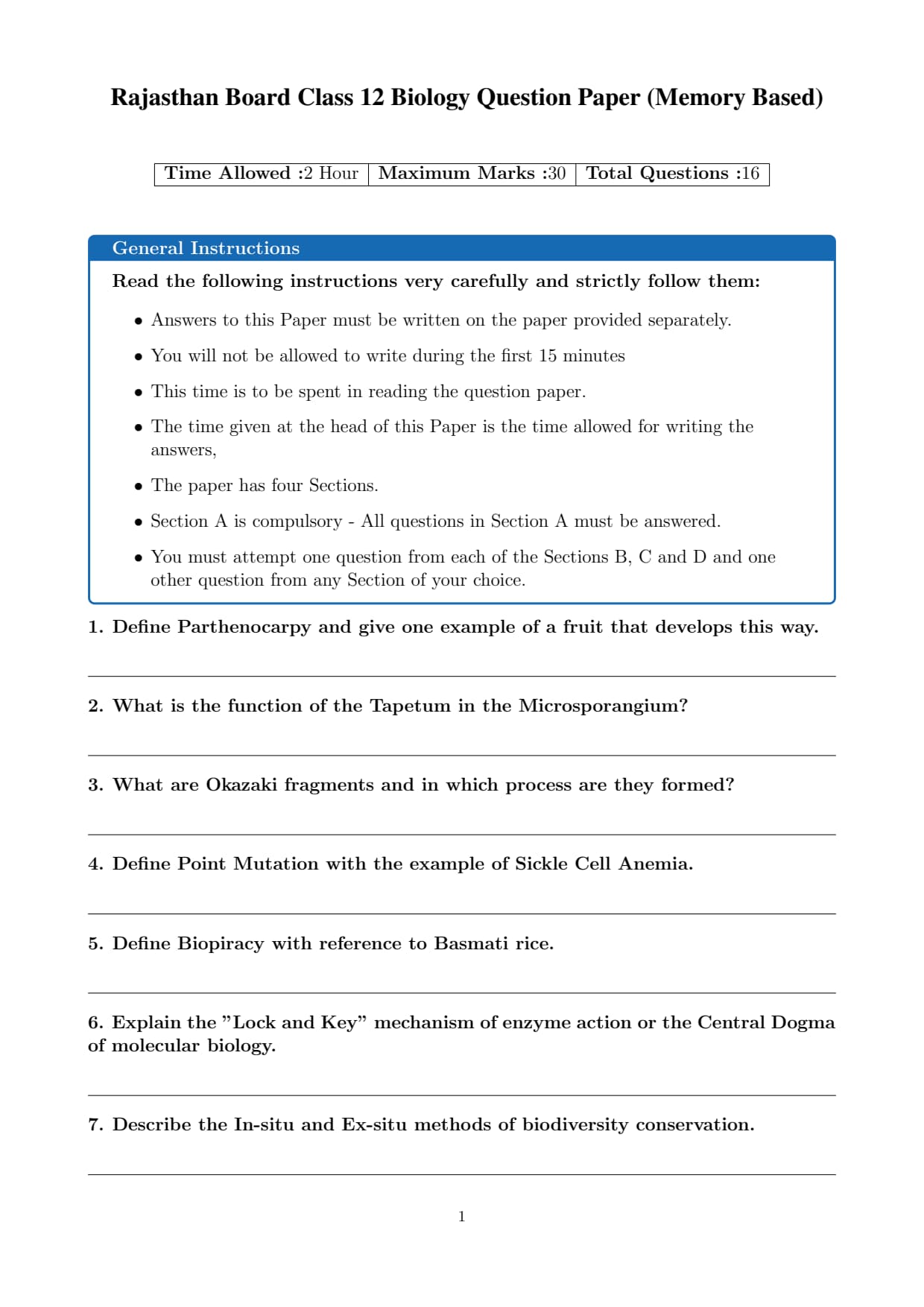
Define Parthenocarpy and give one example of a fruit that develops this way.
View Solution
Concept:
Parthenocarpy is a biological phenomenon related to fruit development without fertilization.
Definition:
Parthenocarpy refers to the development of fruit without fertilization of the ovule.
As a result, the fruit formed is usually seedless.
Key Features:
No fertilization occurs
Ovary develops into fruit directly
Produces seedless fruits
Example:
Banana (common natural example)
Seedless grapes (commercial example)
Importance:
Improves fruit quality
Preferred in commercial horticulture
Can be induced artificially using plant hormones Quick Tip: Parthenocarpy = “Fruit without fertilization” Seedless fruit Banana is the classic example Often induced by auxins or gibberellins
What is the function of the Tapetum in the Microsporangium?
View Solution
Concept:
The tapetum is the innermost layer of the microsporangium (anther) wall and plays a vital role in pollen development.
Function of Tapetum:
Nourishment of Developing Microspores:
Provides essential nutrients and metabolites required for the growth and maturation of pollen grains.
Formation of Pollen Wall:
Secretes sporopollenin precursors that help in the formation of the exine (outer layer) of pollen.
Production of Enzymes and Proteins:
Synthesizes enzymes and proteins that regulate pollen development.
Secretion of Pollenkitt:
Produces sticky substances (pollenkitt) that help pollen adhere to pollinators.
Importance:
Essential for viable pollen formation
Abnormal tapetum leads to male sterility Quick Tip: Tapetum = “Nurse layer of anther” Feeds developing pollen Helps form pollen wall (sporopollenin) Critical for pollen viability
What are Okazaki fragments and in which process are they formed?
View Solution
Concept:
Okazaki fragments are short DNA segments formed during DNA replication.
Definition:
Okazaki fragments are short, newly synthesized DNA fragments produced discontinuously on the lagging strand during DNA replication.
Process in Which They Are Formed:
They are formed during: \[ DNA Replication \]
Specifically on the lagging strand.
Reason for Formation:
DNA polymerase can synthesize DNA only in the 5' \(\rightarrow\) 3' direction.
The lagging strand runs in the opposite direction.
Hence, DNA is synthesized discontinuously in small fragments.
Formation Steps:
RNA primer is laid down.
DNA polymerase extends the fragment.
Multiple short fragments are formed.
DNA ligase joins them into a continuous strand.
Key Enzymes Involved:
DNA polymerase
Primase
DNA ligase Quick Tip: Okazaki fragments = Lagging strand fragments Found only in DNA replication Discontinuous synthesis Joined by DNA ligase Leading strand = continuous, Lagging strand = fragmented.
Define Point Mutation with the example of Sickle Cell Anemia.
View Solution
Concept:
Mutations are changes in the DNA sequence. A point mutation is the simplest type of mutation involving a single nucleotide change.
Definition:
A point mutation is a genetic mutation in which a single nucleotide base is altered, inserted, or deleted in the DNA sequence.
Most commonly, it involves substitution of one base for another.
Example: Sickle Cell Anemia
Sickle cell anemia is a classic example of a point mutation affecting hemoglobin.
Cause:
Mutation occurs in the gene encoding the \(\beta\)-chain of hemoglobin.
A single base substitution changes the codon.
Molecular Change: \[ Normal codon: GAG \rightarrow Glutamic acid \] \[ Mutated codon: GTG \rightarrow Valine \]
This substitution changes one amino acid in the hemoglobin protein.
Effect:
Hemoglobin becomes abnormal (HbS).
RBCs become sickle-shaped under low oxygen conditions.
Leads to anemia, pain, and reduced oxygen transport.
Significance:
Demonstrates how a single nucleotide change can cause a major disorder.
Example of a missense mutation. Quick Tip: Point mutation = Single base change Sickle cell: GAG \(\rightarrow\) GTG Glutamic acid \(\rightarrow\) Valine One base change, big impact Remember: Small mutation, serious disease.
Define Biopiracy with reference to Basmati rice.
View Solution
Concept:
Biopiracy refers to the unethical or illegal use of biological resources and traditional knowledge without proper permission or compensation.
Definition:
Biopiracy is the unauthorized exploitation of biological materials (plants, animals, microbes) and indigenous knowledge by individuals or corporations for commercial gain without sharing benefits with the original owners or communities.
Example: Basmati Rice Case
Basmati rice is a traditional aromatic rice variety grown mainly in India and Pakistan for centuries.
What Happened?
A foreign company attempted to patent certain varieties of Basmati rice and related processing methods.
The patent claimed rights over lines derived from traditional Indian Basmati.
This raised concerns about ownership of indigenous genetic resources.
Why It Was Considered Biopiracy:
Traditional knowledge of farmers was used without consent.
No benefit-sharing with original cultivators.
Attempt to monopolize a culturally significant crop.
Outcome:
Legal challenges were raised by India.
Several patent claims were withdrawn or rejected.
Highlighted need for protection of biodiversity and traditional knowledge.
Importance:
Promotes awareness of intellectual property rights in biodiversity.
Supports laws like Biodiversity Act and Geographical Indications (GI). Quick Tip: Biopiracy = Stealing bio-resources + traditional knowledge No permission No benefit sharing Example: Basmati patent controversy Protect biodiversity through GI tags and laws.
Explain the "Lock and Key" mechanism of enzyme action or the Central Dogma of molecular biology.
View Solution
(A) Lock and Key Mechanism of Enzyme Action:
Concept:
The lock and key model explains how enzymes interact specifically with substrates to catalyze biochemical reactions.
Explanation:
Proposed by Emil Fischer.
The enzyme has a specific active site.
The substrate fits exactly into this active site like a key fits into a lock.
Steps:
Substrate binds to enzyme's active site.
Enzyme-substrate complex is formed.
Reaction occurs and products are formed.
Products are released; enzyme remains unchanged.
Key Features:
High specificity
Enzyme not consumed in reaction
Explains substrate selectivity
(OR)
(B) Central Dogma of Molecular Biology:
Concept:
The central dogma explains the flow of genetic information in living organisms.
Statement: \[ DNA \rightarrow RNA \rightarrow Protein \]
Steps:
1. Replication:
DNA makes an identical copy of itself.
Ensures genetic continuity.
2. Transcription:
DNA is transcribed into messenger RNA (mRNA).
Occurs in nucleus (eukaryotes).
3. Translation:
mRNA is translated into protein at ribosomes.
Amino acids are assembled into polypeptide chains.
Importance:
Explains gene expression
Basis of molecular genetics
Foundation of biotechnology Quick Tip: Two memory aids: Lock and Key = Enzyme specificity Central Dogma = DNA \(\rightarrow\) RNA \(\rightarrow\) Protein Structure determines function in biology.
Describe the In-situ and Ex-situ methods of biodiversity conservation.
View Solution
Concept:
Biodiversity conservation involves protecting species, ecosystems, and genetic diversity.
It is mainly achieved through two approaches: In-situ and Ex-situ conservation.
1. In-situ Conservation:
Definition:
Conservation of species in their natural habitats or ecosystems.
Features:
Protects entire ecosystems
Maintains natural evolutionary processes
Conserves flora and fauna together
Methods/Examples:
National parks
Wildlife sanctuaries
Biosphere reserves
Sacred groves
Advantages:
Maintains ecological balance
Allows natural adaptation and evolution
2. Ex-situ Conservation:
Definition:
Conservation of biodiversity outside its natural habitat under controlled conditions.
Features:
Artificial conservation methods
Focuses on individual species
Methods/Examples:
Zoos
Botanical gardens
Seed banks
Tissue culture and cryopreservation
Advantages:
Useful for endangered species
Allows scientific management and breeding
Key Differences:
\[ \begin{array}{|c|c|c|} \hline \textbf{Basis} & \textbf{In-situ} & \textbf{Ex-situ}
\hline Location & Natural habitat & Outside natural habitat
\hline Focus & Whole ecosystem & Individual species
\hline Examples & National parks & Zoos, seed banks
\hline Natural Interaction & Present & Limited
\hline \end{array} \]
Conclusion:
Both methods are complementary.
In-situ preserves ecosystems, while Ex-situ provides backup conservation for rare and endangered species. Quick Tip: Conservation memory trick: In-situ = In natural site Ex-situ = Exit natural site Nature parks vs Zoos comparison.
Explain the DNA Double Helix structure as proposed by Watson and Crick.
View Solution
Concept:
The double helix model of DNA was proposed by James Watson and Francis Crick in 1953.
It explains the molecular structure of DNA and the basis of heredity.
Key Features of the Double Helix Structure:
1. Double-Stranded Helix:
DNA consists of two long polynucleotide chains.
The strands coil around each other forming a right-handed double helix.
2. Antiparallel Strands:
The two strands run in opposite directions.
One strand runs 5' \(\rightarrow\) 3' and the other 3' \(\rightarrow\) 5'.
3. Sugar-Phosphate Backbone:
The outer part of each strand is made of alternating deoxyribose sugar and phosphate groups.
Forms the structural framework of DNA.
4. Nitrogenous Bases Inside:
Bases project inward and pair with bases of the opposite strand.
Four bases: Adenine (A), Thymine (T), Guanine (G), Cytosine (C).
5. Complementary Base Pairing:
Adenine pairs with Thymine (A=T) via two hydrogen bonds.
Guanine pairs with Cytosine (G\(\equiv\)C) via three hydrogen bonds.
This ensures Chargaff’s rule: \[ A = T, \quad G = C \]
6. Helical Dimensions:
Distance between two base pairs: 0.34 nm
One complete turn: 3.4 nm
About 10 base pairs per turn
7. Stability of DNA:
Hydrogen bonds between bases
Hydrophobic stacking of bases
Strong covalent backbone
Significance:
Explains DNA replication mechanism
Basis of genetic inheritance
Foundation of molecular biology and biotechnology Quick Tip: Watson–Crick memory keys: Double helix, antiparallel strands A=T (2 bonds), G\(\equiv\)C (3 bonds) 10 base pairs per turn DNA = Blueprint of life.



Comments