



Education Content Expert
Hermaphroditism is a condition where both male and female reproductive organs are present in the same parent. It is also referred to as Intersex and is found both in plants and animals. It is treated as a disorder of sex development (DSD) along with other conditions. Though true hermaphroditism does not exist in humans, a similar condition called pseudohermaphroditism exists in which an individual has both male and female external genitalia.
Hermaphroditism is seen in animals such as earthworms, pulmonate snails, and plants like Cannabis sativa and pea plants. Four different types of hermaphroditism exist based on hermaphrodite genitalia namely 46, XX Hermaphroditism, 46, XYHermaphroditism, True Gonadal Hermaphroditism, and Complex Hermaphroditism.
Read More: NCERT Solutions For Class 12 Biology Reproduction In Organisms
| Table of Content |
Key Terms: Hermaphroditism, Reproductive Organs, Pseudohermaphroditism, Genitalia, Embryo, Hormones, Ovary, Chromosomes, Penis
What is Hermaphroditism?
[Click Here for Sample Questions]
Hermaphroditism is a condition present in most plants and a few animals in which both male and female reproductive organs are present in the same individual.
- Also called intersex, hermaphroditic species undergo self-fertilization.
- Disorder of sex development mainly contributes to this condition.
- A similar condition called pseudohermaphroditism is found in a few individuals where both male and female external genitalia exists in the same individual.
- In this case, female embryos are exposed to a high level of male hormones resulting in female internal organs and male external genitalia.
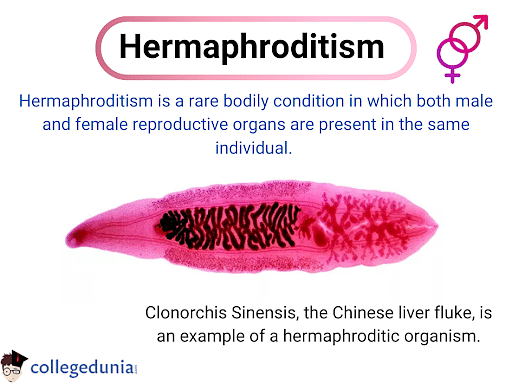
Hermaphroditism
Read More:
Types of Hermaphroditism
[Click Here for Sample Questions]
There are four different types of hermaphroditism, which are as follows:
46, XX Hermaphroditism
- In this type, two XX chromosomes and the ovaries of a woman exist in an individual with the external genitalia of a male.
- Excessive exposure of the female fetus to male hormones in the womb results in this type of hermaphroditism.
- Thus, the fusion of the labia, and the clitoris results in a structure that resembles a penis while internally uterus and fallopian tubes have the normal structure of a woman.
46, XY hermaphroditism
- In this type, an individual has one X and one Y chromosome of a male but the external genitalia is either not completely formed, or resemble those of females.
- Common causes of such type of hermaphroditism are the imbalance of female and male hormones, reduced ability to produce testosterone, abnormal function of the testes, and difficulty in utilizing the testosterone produced in the body.
True Gonadal Hermaphroditism
- In this type of hermaphroditism, an individual has both ovarian and testicular tissue either in the same gonad or one in the testis and one in the ovary.
- In such cases, an individual has either XX chromosomes or XY chromosomes or a combination of both.
- The causes of this type are not yet clear but some animal studies have revealed that exposure to agricultural pesticides is one of the main causes of this abnormality.
Complex Hermaphroditism
- This type of hermaphroditism involves sexual development disorders arising out of 45, XO or 47, XXY or 47, XXX.
- Abnormal levels of sex hormones and incomplete sexual development are the results of this type of hermaphroditism.
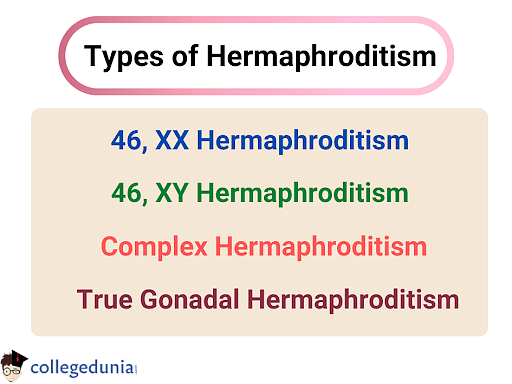
Types of Hermaphroditism
Read More: Reproduction in Organism Important Questions
Signs and Symptoms of Hermaphroditism
[Click Here for Sample Questions]
Depending on the type of condition, signs, and symptoms of hermaphroditism include the following:
- Micropenis: This is a health condition where the penis is 2.5 standard deviations shorter than the average stretched penis length caused due to hormonal or genetic factors.
- Undescended Testes: In this, the testicle hasn't moved into its proper position in the bag of skin hanging below the penis (scrotum) before birth due to hormonal or maternal health.
- Ambiguous genitalia: This is a health disorder in which a newborn's external genitals aren't clearly defined caused by hormonal irregularities during pregnancy.
- Clitoromegaly: In this situation, the clitoris enlargement is abnormal and caused by exposure to an excess of androgens in fetal life, infancy, or adolescence.
- Hypospadias: This is a health condition found in infant males in which the opening of the urethra is not located at the tip of the penis due to hormonal disorder.
- Labial fusion: A health condition found in females where the small inner lips around the entrance to the vagina become sealed together caused due to low levels of estrogen.
- Electrolyte Abnormalities: A health condition where an individual has increased or decreased levels of certain minerals in their body.
Read More: Reproduction in Organisms MCQs
Diagnosis of Hermaphroditism
[Click Here for Sample Questions]
Several diagnostic tests are available to identify the condition of hermaphroditism and decide upon the course of action which are listed below:
- Analysis of Chromosome
- Hormone stimulation tests
- Endoscopic exam
- Blood tests to investigate hormone and electrolyte levels.
- Ultrasound imaging (USG)
- Molecular testing
- Magnetic resonance imaging (MRI)
Read More: Reproduction in Organisms
Treatment of Hermaphroditism
[Click Here for Sample Questions]
Children suffering from hermaphroditism usually require care from a multidisciplinary healthcare team to address various needs. Significant stigma and controversy still exist regarding the treatment of this disorder. In earlier days, a gender was assigned to an individual based on the external genitalia, followed by surgery and hormonal therapy.
The complexity of gender and sexuality has been identified recently, and this has resulted in the more individualized and less standardized treatment of patients.
- To date, the most effective treatment of hermaphroditism is plastic surgery which is conducted after the sex determination assignment.
- This is achieved by surgical intervention with stable gender identity and minimal complications.
- Some improvements have been found by clitoral reduction, clitoroplasty, vaginoplasty, etc during surgical resection.
Still, not much improvement has been found in treating patients suffering from hermaphroditism, and patients suffering from such a disorder require adequate support from family and friends to deal with such an issue.
Also Check:
| Related Topics | ||
|---|---|---|
| Chromosomal Abnormalities | Difference between Haploid and Diploid | Sexual Reproduction in Flowering Plants |
| Asexual Reproduction | Chromosomes and Genes | Gamete |
Things to Remember
- Hermaphroditism is a disorder where both male and female reproductive organs are present in the same parent.
- There are four types of hermaphroditism namely 46, XX Hermaphroditism, 46, XY Hermaphroditism, True Gonadal Hermaphroditism, and Complex Hermaphroditism.
- Common indicators of hermaphroditism are micropenis, labial fusion, ambiguous genitalia, undescended testes, and abnormal pubertal changes.
- It can be detected by hormone stimulation tests, analysis of chromosomes, ultrasound imaging, magnetic resonance imaging, etc.
- Plastic surgery is the primary option for the correction of hermaphroditism after the determination of sex assignment.
Sample Questions
Ques. Explain Hermaphroditism with examples. (3 Marks)
Ans. Hermaphroditism is a disorder found in plants and animals where the same individual has both male and female organs in their body. It is also called intersex. This condition is categorized as a disorder of sex development. Earthworms and pulmonate snails are examples of animals having hermaphroditism while cannabis sativa and pea plants are plants in which hermaphroditism is found.
Ques. What are the different types of hermaphroditism? (3 Marks)
Ans. There are four different types of hermaphroditism:
- 46, XX Hermaphroditism
- 46, XY Hermaphroditism
- True gonadal Hermaphroditism
- Complex Hermaphroditism
Ques. What are the different disorders related to complex hermaphroditism? (3 Marks)
Ans. Some of the common disorders associated with complex hermaphroditism are as follows:
- 45, XO
- 47, XXY
- 47, XXX
Individuals do not have any difference in the internal or external genitalia in this case, but they have abnormal levels of sex hormones and incomplete sexual development.
Ques. Can hermaphroditism be cured? (2 Marks)
Ans. Though few hormonal therapies exist in treating hermaphroditism, plastic surgery is still the primary option for the correction of hermaphroditism after the determination of sex assignment. In such cases, surgical intervention with stable gender identity and minimal complications gives a satisfactory result.
Ques. What is pseudohermaphroditism? (3 Marks)
Ans. Pseudohermaphroditism is a condition somewhat similar to true hermaphroditism in which an individual has both male and female genitalia. This condition is found in humans where the embryo is exposed to high levels of male hormones, or excess maternal androgen leading to the development of female internal organs and male external genitalia. Common causes are drug intake or maternal ovarian tumors.
Ques. What is the primary cause of hermaphroditism? (2 Marks)
Ans. Hermaphroditism is mainly caused due to an imbalance of male and female hormones. Other probable causes are a reduced ability to produce testosterone, abnormal function of the testes, or difficulty in utilizing the testosterone produced in the body.
Ques. What is the intersex variation? (3 Marks)
Ans. Intersex variation is found in people born with physical, hormonal, or genetic features that are neither wholly female nor wholly male; or a combination of female and male; or neither female nor male. For example, a person born with a female appearance might have male-typical anatomy on the inside, viz. no womb, or with a micropenis. Typically 30 different variants of intersex exist.
Ques. What type of DNA do intersex people have? (3 Marks)
Ans. Normally individuals born as males have XY chromosomes while individuals born as females have XX chromosomes which they inherit from their parents. Thus individuals born as intersex would be having XX chromosomes, XY chromosomes, or a combination of both such as XXY. Thus an individual with true gonadal hermaphroditism has both testicular and ovarian tissue, either in the same gonad or in one testis and in one ovary.
Ques. Can humans also suffer from Hermaphroditism? (2 Marks)
Ans. Hermaphroditism is found in humans as well. Some common symptoms of humans suffering from such disorders are micropenis, labial fusion, ambiguous genitalia, delayed, absent, or abnormal pubertal changes, etc.
Ques. What is Intersex? (2 Marks)
Ans. Intersex is a condition where an individual is born with reproductive or sexual anatomy that doesn’t belong to either female or male. Some common characteristics are chromosome patterns, gonads, or genitals.
Ques. What is meant by protogynous? (3 Marks)
Ans. Protogynous is a condition found in hermaphrodite plants or animals. In the case of plants, the female reproductive organs come to maturity before the male. While in the case of animals, the individual functions first as a female and later as a male. An example of protogyny is reef fishes such as Labridae while apples, figs, pears, etc. are examples of protogyny found in plants.
Ques. How to distinguish between hermaphrodites and pseudo-hermaphrodites? (2 Marks)
Ans. A hermaphrodite is an organism with both male and female genitalia, while a pseudohermaphrodite is an organism whose gonads are consistent with the chromosomal sex but who has external genitalia of the opposite sex.
Ques. How ultrasound imaging can be used to identify hermaphroditism? (3 Marks)
Ans. In ultrasound imaging, an ultrasound of the abdomen and pelvis is conducted to check for undescended testes, uterus, or vagina. And if any such disorder is identified it is treated by hermaphroditism. In addition, sonography of the fetal genitalia identifies X-linked disorders or gender-specific fetal anomalies.
Ques. What is hypospadias? (2 Marks)
Ans. Hypospadias is a congenital condition found in infants (boys) where the opening of the urethra is not located at the tip of the penis and is identified as a common symptom of hermaphroditism.
Check-More:



Comments