




GPAT is a computer-based test conducted by the National Board of Examinations in Medical Sciences (NBEMS) for admission to MPharm courses. The GPAT exam pattern 2027 comprises 125 MCQs across five pharmacy subjects.
- GPAT total marks are 500. Candidates are required to select the most appropriate response out of the 4 response options provided in each question.
- To solve 125 MCQs, you will have 3 hours (180 minutes) without a sectional time limit.
- According to GPAT marking scheme, each question is worth 4 marks, with negative marking of 1 mark for an incorrect response.
- GPAT covers five 5 subject areas: Pharmaceutical Chemistry, Pharmaceutics, Pharmacology, Pharmacognosy, and Other BPharm Subjects.
- Pharmaceutical Chemistry (38 questions) and Pharmaceutics (38 questions) subjects carry the highest weightage, contributing approximately 60.8% of the paper. These are the high-priority topics while preparing for GPAT 2027.
- Pharmacology (28 questions) subjects such as ANS, CNS, Chemotherapy, and General Pharmacology contribute nearly 22.4% weightage in the GPAT paper pattern.
- Pharmacognosy (10 questions) and the remaining B.Pharm subjects account for 84 marks, so you shouldn't ignore them.
Related Articles: GPAT Syllabus: Download PDF, Check Changes, Exam Pattern & Topic-Wise Weightage
GPAT Exam Pattern 2027: Highlights
Graduate Pharmacy Aptitude Test pattern, question format and duration are crucial to know for your preparation. The following table highlights the detailed GPAT paper pattern 2027:
| Particular | GPAT 2027 Exam Pattern Details |
|---|---|
| Exam Mode | Computer-Based Test (CBT)- Online |
| Exam Medium | English (Only) |
| Duration | 3 hours (180 minutes) |
| Total Questions | 125 |
| Question Type | Multiple Choice Questions (MCQs)- 4 options each |
| Total Marks | 500 |
| Marking Scheme | +4 marks for each correct answer-1 mark per wrong answer |
Also Check:
- GPAT Application Form, Check Dates, Direct Link, Steps to Edit
- GPAT Exam Dates: Check Registration Dates, Admit Card, and Result Schedule
Ques. Is GPAT very difficult?
Ans. The Graduate Pharmacy Aptitude Test (GPAT) is generally considered a moderate exam rather than very difficult. It requires solid knowledge of your core Bachelor of Pharmacy (BPharm) subjects with conceptual clarity.
GPAT Exam Pattern 2027: Subject-wise Question Distribution
As per the latest update, the GPAT Exam pattern asks questions from 5 Pharma subjects.
- Pharmaceutical Chemistry and Pharmaceutics contribute 60.8% weightage in the GPAT 2027 exam pattern.
- As per the GPAT question paper pattern, Pharmacology contributes around 22.4% weightage.
- Pharmacognosy and the remaining B.Pharm subjects account for 84 marks, so you shouldn't ignore them.
Tips: A preparation strategy focused only on high-weightage subjects can be risky. So, start with high-weightage to low-weightage topics to score maximum marks in GPAT 2027.
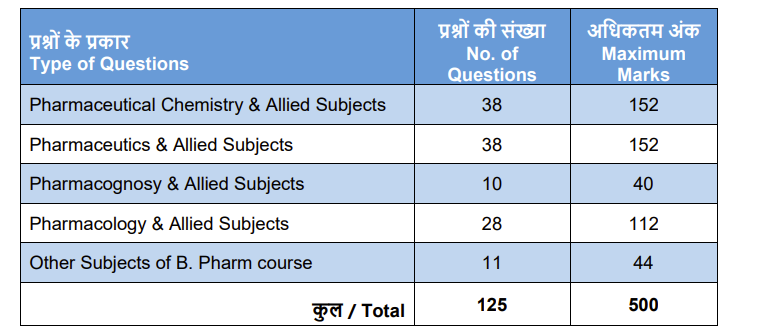
| Type of Questions | Number of Questions | Maximum Marks | Approx. Weightage (%) |
|---|---|---|---|
| Pharmaceutical Chemistry & Allied Subjects | 38 | 152 | 30.4 |
| Pharmaceutics & Allied Subjects | 38 | 152 | 30.4 |
| Pharmacognosy & Allied Subjects | 10 | 40 | 8.0 |
| Pharmacology & Allied Subjects | 28 | 112 | 22.4 |
| Other Subjects of BPharm course | 11 | 44 | 8.8 |
| Total | 125 | 500 | 100 |
Source: natboard.edu.in
Also Check:
- GPAT Question Paper 2026: Download GPAT Question Paper with Answer Key and Solutions PDF
- GPAT Question Paper 2025: Download GPAT Question Paper with Answer Key and Solutions PDF
- GPAT Eligibility Criteria: Check Age Limit, and Educational Qualification
Ques. What is the GPAT question paper pattern?
Ans. The GPAT question paper pattern comprises 125 MCQs carrying 500 marks. Each question has four options, out of which you need to choose only one. Candidates get 3 hours (180 minutes) to complete the exam. Each correct answer carries 4 marks, while 1 mark is deducted for every incorrect answer. The paper is conducted in English only.
GPAT Exam Pattern 2027: Marking Scheme
GPAT is an online CBT exam. Since the paper contains only MCQs, the marking scheme applies to every question without exception.
Tip: Avoid guessing on questions where you cannot eliminate at least two options.
| Particulars | GPAT Marking Scheme |
|---|---|
| Correct Answer | +1 |
| Incorrect Answer | -1 |
| Unattempted Question | 0 |
Related Link: GPAT Photograph & Signature Upload Guidelines: Check Size, Format and Other Details
Ques. Is there negative marking in GPAT 2027?
Ans. Yes, as per the GPAT marking scheme, there is negative marking of 1 mark for every incorrect answer. Unattempted questions score zero and carry no penalty.
GPAT Exam Pattern 2027: Exam Duration
GPAT Paper Pattern contains MCQ-type questions only. The GPAT exam duration is 3 hours (180 minutes) only. Candidates can navigate freely across all questions within the allotted 180 minutes.
| Particulars | Details |
|---|---|
| Exam Duration | 3 hours (180 minutes) |
| GPAT Paper Pattern | 125 MCQs; 500 marks |
| Medium | English Only |
Ques. What are the qualifying marks for GPAT?
Ans. The qualifying marks for GPAT were 213 marks for the General (UR) category in 2026. The National Board of Examinations in Medical Sciences (NBEMS) sets distinct cut-off marks for each category based on exam difficulty, total applicants, and seat availability.
GPAT Total Marks for 2027
GPAT total marks are 500. According to the GPAT 2027 Exam Pattern, Pharmaceutical Chemistry and Pharmaceutics subjects carry the highest marks of 152 each, accounting for 304 marks.
| Type of Questions | Maximum Marks |
|---|---|
| Pharmaceutical Chemistry & Allied Subjects | 152 |
| Pharmaceutics & Allied Subjects | 152 |
| Pharmacognosy & Allied Subjects | 40 |
| Pharmacology & Allied Subjects | 112 |
| Other Subjects of BPharm course | 44 |
| GPAT Total Marks | 500 |
Also Read: GPAT Recommended Books for Preparation
Ques. Is GPAT harder than NEET?
Ans. GPAT is generally considered less competitive than NEET, based on candidates' preparation. NEET covers a broader range of PCB subjects and has a huge number of applicants, making competition significantly tougher. GPAT focuses specifically on B.Pharm-level subjects, so for a B.Pharm graduate, GPAT may feel easier than NEET.
GPAT Exam Syllabus 2027: Important Topics Based on Past Years’ Trends
The GPAT exam pattern 2027 asks questions across Pharma and allied subjects. Based on past years' trend analysis, the important topics with the expected number of questions are discussed below.
- Medicinal Chemistry, Pharmaceutical Analysis and Organic Chemistry are the most frequent topics in Pharmaceutical Chemistry.
- Your highest priority topics for preparation include SAR, Dosage Forms, Physical Pharmacy, General and Systemic Pharmacology, and Chemotherapy.
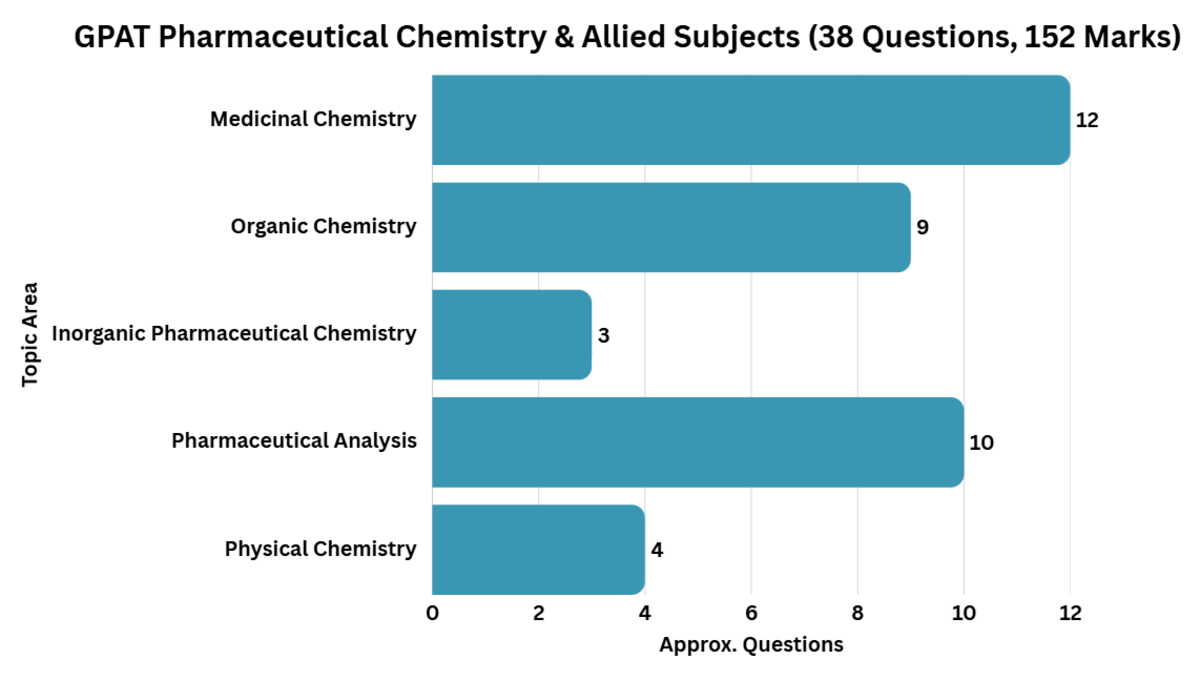
GPAT Exam Syllabus 2027: Pharmaceutical Chemistry & Allied Subjects (38 Questions, 152 Marks)
According to GPAT exam pattern, Pharmaceutical Chemistry have 38 questions and 152 marks. It covers organic, inorganic, and physical chemistry applied to drug design and pharmaceutical analysis.
It is one of the highest-weighted topics, contributing 30.4% of the paper.
| Topic Area | Key Sub-topics | Approx. Questions |
|---|---|---|
| Medicinal Chemistry | Structure-Activity Relationships (SAR), Drug design, Stereochemistry | 8- 12 |
| Organic Chemistry | Reaction mechanisms, Functional groups, Organic synthesis | 7- 9 |
| Inorganic Pharmaceutical Chemistry | Metals, Inorganic compounds, Monographs, Preparation and uses | 2- 3 |
| Pharmaceutical Analysis | Chromatography, Spectroscopy, Titrations, Quality control methods | 6- 10 |
| Physical Chemistry | Solutions, Colloids, Surface tension, Thermodynamic principles | 2- 4 |
GPAT Exam Syllabus 2027: Pharmaceutics & Allied Subjects (38 Questions, 152 Marks)
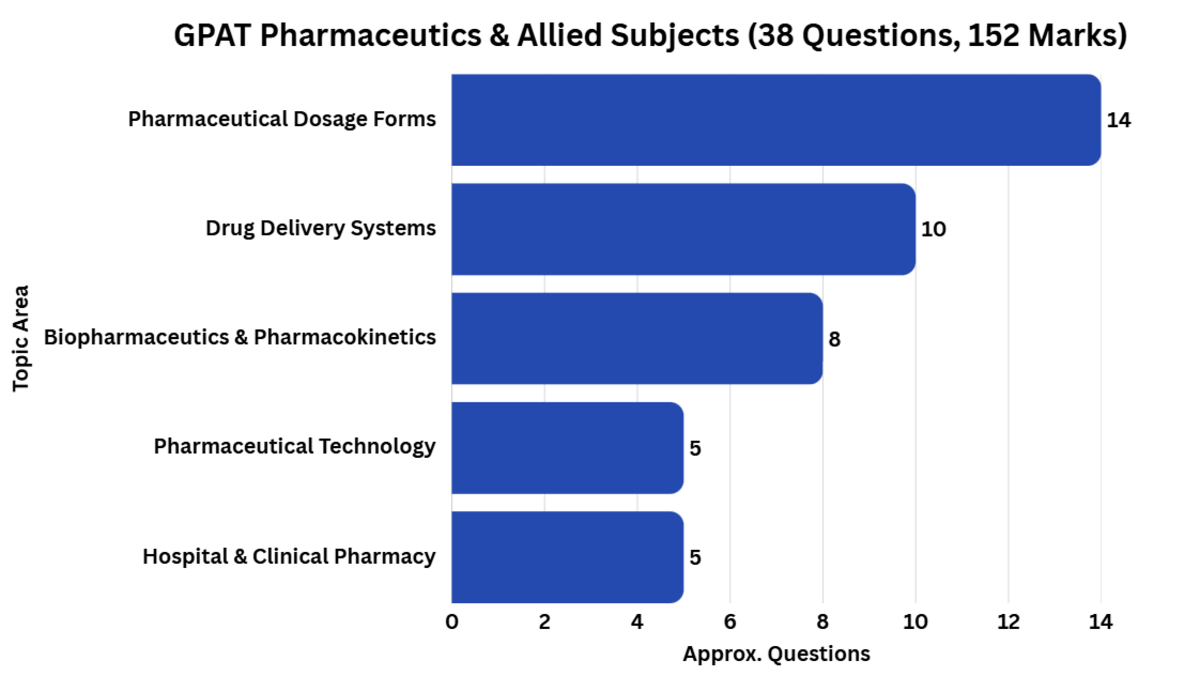
Based on GPAT question paper pattern, Pharmaceutics and allied subjects have 38 questions and 152 marks. Pharmaceutics covers core areas of M.Pharm specialisation: drug formulation, delivery systems, and pharmacokinetics. It shares the same weightage as Pharmaceutical Chemistry, and together they account for approximately 60.8% of the total.
| Topic Area | Key Sub-topics | Approx. Questions |
|---|---|---|
| Pharmaceutical Dosage Forms | Tablets, Capsules, Suspensions, Emulsions, Aerosols | 10- 14 |
| Drug Delivery Systems | Controlled release, Transdermal patches, Nanoparticles, Liposomes | 7- 10 |
| Biopharmaceutics & Pharmacokinetics | Absorption, Distribution, Metabolism, Excretion (ADME) | 5- 8 |
| Pharmaceutical Technology | Mixing, Filtration, Drying, Sterilisation, Good Manufacturing Practice (GMP) | 4- 5 |
| Hospital & Clinical Pharmacy | Drug information services, Patient counselling, Medication management | 3- 5 |
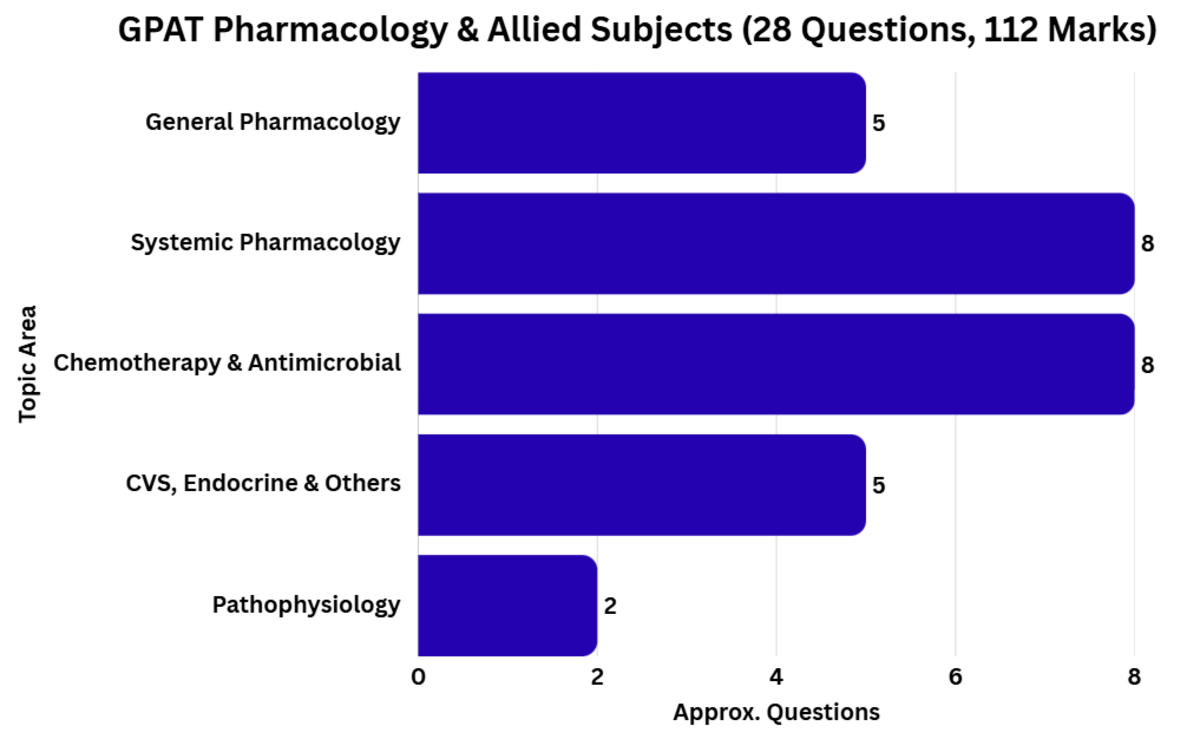
GPAT Exam Syllabus 2027: Pharmacology & Allied Subjects (28 Questions, 112 Marks)
Pharmacology is the third-largest section in GPAT paper pattern, having a weightage of around 22.4%. Systematic Pharmacology, Chemotherapy, Antimicrobial, and CVS are important topics in Pharmacology.
| Topic Area | Key Sub-topics | Approx. Questions |
|---|---|---|
| General Pharmacology | Pharmacokinetics, Pharmacodynamics, Receptors, ADRs | 4- 5 |
| Systemic Pharmacology | CNS, CVS, Respiratory, GIT, and Endocrine | 6- 8 |
| Chemotherapy & Antimicrobial | Antibiotics, Anticancer, Antitubercular, Antiviral | 5- 8 |
| CVS, Endocrine & Others | Cardiovascular drugs, Hormones, Autacoids, Toxicology | 4- 5 |
| Pathophysiology | Disease mechanisms, Human Anatomy & Physiology related | 2 |
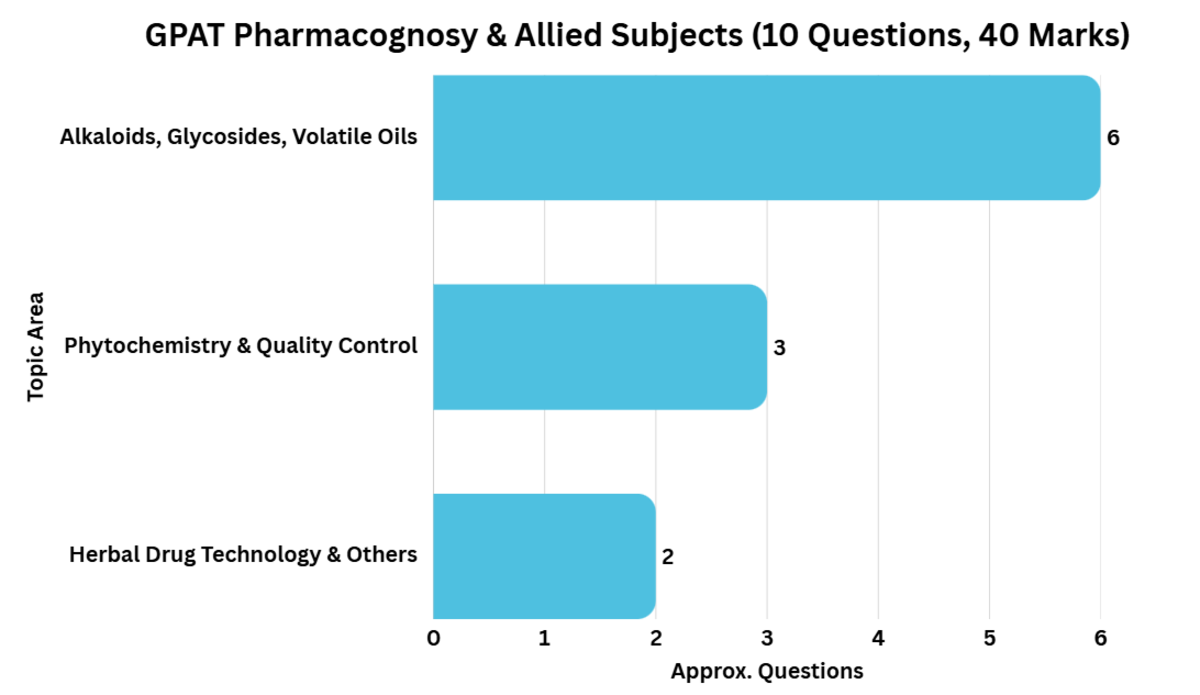
GPAT Exam Syllabus 2027: Pharmacognosy & Allied Subjects (10 Questions, 40 Marks)
Pharmacognosy is a smaller but scoring topic, contributing nearly 8% weightage. So you should not avoid it.
| Topic Area | Key Sub-topics | Approx. Questions |
|---|---|---|
| Alkaloids, Glycosides, Volatile Oils | Classification, Sources, Chemical tests, Isolation | 4- 6 |
| Phytochemistry & Quality Control | Extraction, TLC/HPTLC, Standardization of herbal drugs | 2- 3 |
| Herbal Drug Technology & Others | Traditional systems, Plant constituents, Adulteration | 1- 2 |
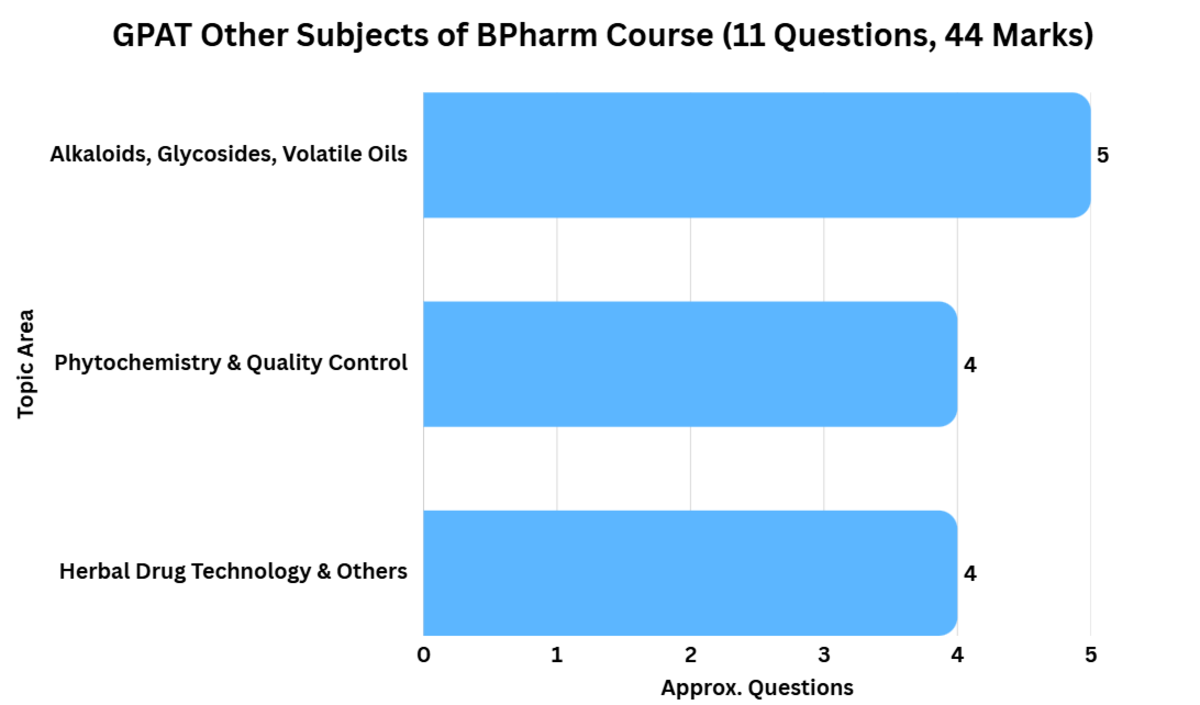
GPAT Exam Syllabus 2027: Other Subjects of B.Pharm Course (11 Questions, 44 Marks)
It covers foundational BPharm subjects including biochemistry, microbiology, and pharmacy law. It contributes nearly 8.8% weightage, and the questions asked are easy to solve.
| Topic Area | Key Sub-topics | Approx. Questions |
|---|---|---|
| Biochemistry | Biomolecules, Enzymes, Metabolism, Vitamins | 3- 5 |
| Microbiology & Biotechnology | Sterilization, Immunology, Fermentation, DNA | 2- 4 |
| Pharmaceutical Jurisprudence / Pharmaceutical Management | Acts, Schedules, Quality Assurance, Biostatistics | 2- 4 |
Related Articles:
- GPAT Preparation: Check Best Books for Preparation and Subject-Wise Preparation Tips
- GPAT Mock Test, Attempt Free Topicwise, Subjectwise and Full Mock Test, Download PDF
You can watch a YouTube video by “PW Pharma” to learn about the GPAT 2027 exam pattern, syllabus, and Important topics to help you score well.
Ques. How much time is required to prepare for GPAT?
Ans. Generally, 4- 6 months of consistent preparation is sufficient for most candidates. Students with strong fundamentals may prepare effectively in 3- 4 months, but beginners may need 6- 8 months. A good strategy is to divide the preparation into syllabus coverage, revision, PYQs, mock tests, analysis and final revision rather than studying all subjects at the same pace.
GPAT Exam Pattern Difficulty Trend Analysis
Understanding the difficulty level of the GPAT exam helps you prepare strategically by identifying key areas to focus on. Based on trend analysis, the overall GPAT difficulty level is moderate.
Tips: Conceptual questions remained consistent rather than memory-based. So, focus on concept clarity to crack GPAT 2027. Practice PYQs and mocks to increase your speed and accuracy.
| Year | Difficulty level of GPAT | Key Highlights |
|---|---|---|
| 2026 | Moderate | Conceptual and application-based questions from Pharmaceutics and Pharmacology. |
| 2025 | Moderate | Pharmacology was direct. Pharmaceutics was tricky, and Pharmaceutical Chemistry was lengthy |
| 2024 | Easy to Moderate | Direct Questions |
| 2023 | Moderate | Balanced difficulty with conceptual questions |
| 2022 | Moderate to Difficult | Comparatively tricky questions and time-consuming. |
Also check: GPAT Question Paper: Download GPAT Question Paper with Solutions PDF (2025-1988)
In discussion forums such as Reddit, a user wanted to know whether 8 months is sufficient to prepare for the GPAT exam. Many suggested to the user that 8 months is enough time to prepare for GPAT with a consistent study plan. Study at least 3- 4 hours daily for GPAT preparation and, most importantly, stay consistent. Revise daily before starting a new topic. The GPAT exam is manageable by staying consistent and dedicated.
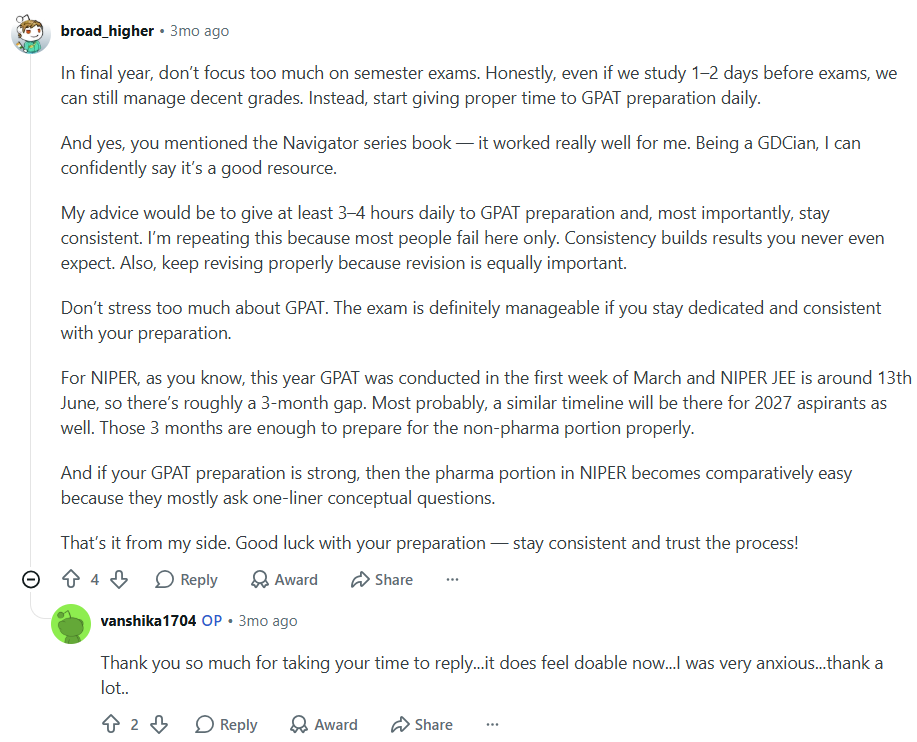
Source: Reddit
How to Prepare Based on GPAT 2027 Exam Pattern
Your preparation strategy should go from most important and heavily weighted to low-weightage topics.
- Know the exam structure first: Understand the GPAT question paper pattern, marking scheme, duration and section-wise weightage before starting preparation. So that you can prepare accordingly.
- Prioritise high-weightage subjects: Give more study time to Pharmaceutics and Pharmaceutical Chemistry, as they account for 60.8% weightage, followed by Pharmacology. Though Pharmacognosy and other subjects in BPharm courses have low weightage, do not skip them to score maximum marks.
- Follow a subject-wise study plan: Complete concepts first, then move to PYQs, MCQs and mock tests for each subject.
- Practise with the marking scheme: Since GPAT has negative marking, avoid random guessing and focus on accuracy along with speed.
- Solve timed practice sets: Practise questions under timed conditions to improve your speed and accuracy.
- Analyse PYQs and Mocks: After every test analyze them to understand your strengths and weaknesses.
- Revise regularly: Maintain short notes for classifications, formulas, mechanisms, important facts and frequently asked concepts. Revise your common mistakes daily to master them.
Also Check: Top Coaching Centers to Prepare for GPAT
GPAT Exam Pattern 2027 FAQs
Ques. How many questions are asked in GPAT 2027?
Ans. GPAT 2027 has 125 multiple-choice questions. These questions are distributed across five subject areas: 38 each in Pharmaceutical Chemistry and Pharmaceutics, 28 in Pharmacology, 10 in Pharmacognosy, and 11 in Other BPharm Subjects.
Ques. What is the total duration of GPAT 2027?
Ans. GPAT 2027 is a 3-hour (180-minute) exam. There is no section-wise time limit so you can freely allocate your time across all five subject sections as you choose.
Ques. What is the total marks for GPAT 2027?
Ans. The GPAT total marks are 500. Each of the 125 questions carries 4 marks for a correct answer, giving a maximum possible score of 500.
Ques. Which subject carries the highest weightage in GPAT 2027?
Ans. Pharmaceutical Chemistry and Pharmaceutics have the highest weightage, with 38 questions each and 152 marks each. Together, these two sections account for over 60.8% of the total GPAT paper.
Ques. What are the most important topics for GPAT 2027?
Ans. Candidates should prioritise areas such as medicinal chemistry, SAR, dosage forms, biopharmaceutics, pharmacokinetics, NDDS, general pharmacology, CNS/ANS drugs, natural products and pharmaceutical analysis for GPAT 2027.
Ques. Is GPAT conducted online?
Ans. Yes. The GPAT paper is a computer-based test (CBT) examination. The questions are only in English. You need to solve 125 MCQS within 3 hours (180 minutes).



Comments