




DU B.Ed Exam Pattern 2027 is expected to have 75 questions with 300 marks with duration of 90 minutes which is to be conducted in CBT format. NTA has not yet released the CUET PG 2027 information bulletin.
- The DU B.Ed Exam tests teaching aptitude along with school level subjects and general awareness.
- Each correct answer carries 4 marks while 1 mark is deducted for every incorrect response in DU B.Ed Exam Pattern 2027 Marking Scheme.
- An unattempted question in DU B.Ed Exam pattern 2027 carries 0 marks which makes accuracy important because the paper has negative marking.
- DU B.Ed Exam 2027 will use different CUET PG paper codes based on the selected teaching subject from COQP03 to COQP07.
- The duration of DU B.Ed 2026 has been reduced from 105 minutes to 90 minutes thus increasing time pressure per question from 84 seconds to 72 seconds.
Related Links:
- DU B.Ed Entrance Exam: Admission via CUET PG, Eligibility, Cutoff and Counselling
- DU B.Ed Eligibility: Qualification, Age, Percentage
- DU B.Ed Entrance Exam Practise Papers, Questions Papers

Key Summary
- DU B.Ed 2027 preparation should begin with the correct CUET PG paper code, as each code has a different subject coverage.
- Previous year question papers can help candidates identify repeated topics and understand the question pattern for the selected B.Ed paper.
- Mock tests should be followed by analysis of wrong answers to identify topics that need more preparation.
- DU B.Ed 2027 preparation should move from syllabus coverage to MCQ and mock test practice, followed by revision of weak areas.
- NTA normalization may apply when a CUET PG paper is conducted in multiple sessions, with percentile scores used for the normalized result.
DU B.Ed Exam Pattern 2027: Overview
| Particulars | Details |
|---|---|
| Exam Name | DU B.Ed Entrance Exam (via CUET PG) |
| Conducting Body | National Testing Agency (NTA) |
| Exam Platform | CUET PG |
| Paper Codes | COQP03 – B.Ed. / B.Ed.-M.Ed. Integrated / B.Ed. (HI/ID/VI) etc.COQP04 – B.Ed. Humanities & Social SciencesCOQP05 – B.Ed. LanguagesCOQP06 – B.Ed. ScienceCOQP07 – B.Ed. Mathematics |
| Mode of Exam | Computer-Based Test (CBT) |
| Duration | 90 minutes |
| Total Questions | 75 |
| Question Type | Multiple Choice Questions (MCQs) |
| Total Marks | 300 |
| Marking Scheme | +4 for each correct answer−1 for each incorrect answer0 for unattempted |
| Negative Marking | Yes (−1 mark per wrong answer) |
| Medium of Exam | Bilingual (English and Hindi) |
| Official Website | exams.nta.nic.in/cuet-pg |
DU B.Ed Exam Pattern: Year-Wise Changes
The DU B.Ed Exam Pattern has undergone a major structural shift with the move from the standalone DU entrance examination to CUET PG. The change reduced the paper from 100 to 75 questions and later shortened the duration making the latest format more time intensive.
| Year | Exam Name / Conducting Body | Duration | Total Questions | Total Marks | Marking Scheme | Key Changes / Notes |
|---|---|---|---|---|---|---|
| Up to 2023 | DUET B.Ed (Delhi University / NTA) | 2 hours (120 min) | 100 | 400 | +4 correct−1 wrong | Standalone university entrance exam. Sections typically included Language Proficiency, Reasoning, General Awareness & Teaching Aptitude, and Subject Knowledge. |
| 2024 | CUET PG (NTA) | ~105 minutes | 75 | 300 | +4 correct−1 wrong | Major shift: DU discontinued its standalone exam. Admission now through CUET PG. Paper codes introduced (COQP03, COQP04 etc.). |
| 2025 | CUET PG (NTA) | 105 minutes | 75 | 300 | +4 correct−1 wrong | Same structure as 2024. ~84 seconds per question. |
| 2026 | CUET PG (NTA) | 90 minutes | 75 | 300 | +4 correct−1 wrong | Duration reduced by 15 minutes. Time pressure increased (~72 seconds per question). Pattern otherwise unchanged. |
Three Distinct Phases in DU B.Ed Exam Pattern:
1) The Standalone DUET Phase (Up to 2023)
DU B.Ed Exam pattern followed a standalone entrance format in which there are 100 questions in 120 minutes. The paper carried 400 marks with +4 and -1 marking covering aptitude and subject based areas.
2) The CUET PG Transition Phase (2024–2025)
DU shifted from its own entrance test to CUET PG entrance test for admission to the B.Ed programme. The number of questions and marks were decreased to 75 and 300 respectively while keeping the same time limit of 105 minutes.
3) The Compressed CUET PG Phase (2026 onwards)
In the DU B.Ed Exam pattern, the number of questions remained at 75 but the duration was reduced from 105 to 90 minutes.
Also Check:
- DU B.Ed Entrance Exam 2023 Question Paper (Available Soon) Download with Solutions PDF
- DU B.Ed Entrance Exam 2021 Question Paper (Available) Download with Solutions PDF
Ques. What is the DU B.Ed exam pattern?
Ans. DU B.Ed. admission is based on CUET PG. Candidates have to appear for the subject-specific CUET PG paper based on their teaching subject. For example, COQP06 is used for B.Ed. Science, COQP07 for B.Ed. Mathematics, COQP05 for B.Ed. Languages and COQP04 for B.Ed. Humanities and Social Science. The exact number of questions, duration and marking scheme are mentioned in DU B.Ed exam pattern by NTA for the respective CUET PG examination.
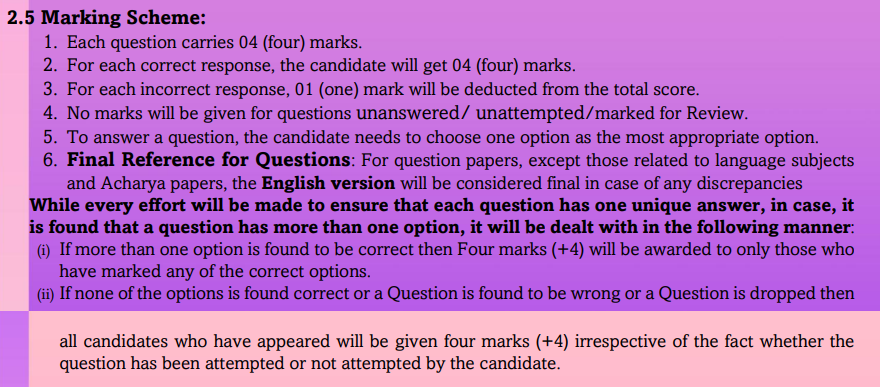
DU B.Ed Exam Pattern 2027 Marking Scheme
The DU B.Ed Exam Pattern 2027 marking scheme follows the CUET PG evaluation rules.
- Each question is expected to carry 4 marks while an incorrect response deducts 1 mark in DU B.Ed Exam pattern 2027 marking scheme.
- NTA also specifies separate rules for unanswered, multiple correct and dropped questions in DU B.Ed Exam Pattern 2027 Marking scheme.
| Answer Type | Marks |
|---|---|
| Correct Answer | +4 |
| Incorrect Answer | -1 |
| Unattempted Questions | 0 |
| Marked for Review without answer | 0 |
| More than one correct option | +4 (For candidates choosing any correct option) |
| Question is wrong or dropped or has no correct option | +4 to all candidates who appeared |
Source: Information Bulletin (CUET PG) - NTA
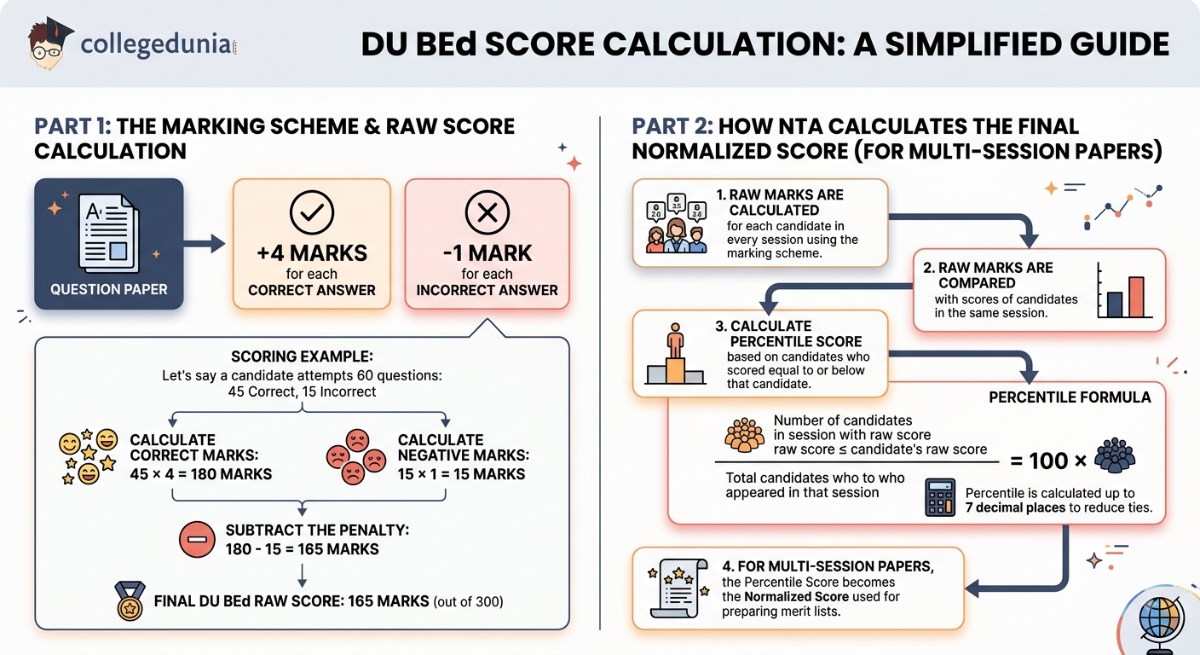
How is the DU B.Ed Score Calculated?
The DU B.Ed score is calculated using the number of correct and incorrect responses, with +4 marks for a correct answer and −1 mark for an incorrect answer.
Example: If a candidate attempts 60 questions, with 45 correct and 15 incorrect:
- Calculate marks for correct answers: 45 × 4 = 180 marks
- Calculate the negative marks: 15 × 1 = 15 marks
- Subtract the penalty: 180 − 15 = 165 marks
- Final DU B.Ed score: 165 marks out of 300.
How NTA Calculates the Final Score
If the CUET PG paper is conducted in multiple sessions, NTA applies its normalization procedure based on percentile score to account for differences in difficulty across sessions.
- NTA first calculates the candidate's raw marks using the marking scheme.
- The raw marks are then compared with the scores of candidates in the same session.
- NTA calculates the percentile score based on candidates who scored equal to or below that candidate.
- The percentile is calculated as:
100 × Number of candidates in the session with raw score ≤ candidate's raw score ÷ Total candidates who appeared in that session
- The percentile is calculated up to 7 decimal places to reduce ties.
- For multi-session papers, the percentile score becomes the normalized score used for preparing merit lists.
Source: Information Bulletin (CUET PG) - NTA
Key Insights in DU B.Ed Exam Pattern 2027 Marking Scheme for Candidates
- The +4/−1 ratio makes accuracy important because every wrong answer reduces the score by one mark in DU B.Ed Exam.
- Unattempted questions in DU B.Ed exam pattern carry no penalty so candidates can leave questions where they have no reasonable basis for an answer.
- A question with multiple correct options in DU B.Ed Exam can still award four marks when a candidate selects any one of the correct options.
- Marked for Review alone does not earn marks if the question remains unanswered.
Also Check:
- DU B.Ed Entrance Exam 2020 Question Paper (Available) Download with Solutions PDF
- DU B.Ed Entrance Exam Question Paper 2019 Download with Solutions PDF
Ques. What is the marking scheme for the B.Ed. entrance exam?
Ans. For DU B.Ed. admission, candidates appear for the relevant CUET PG paper. The CUET PG exam follows +4 marks for every correct answer and -1 mark for every incorrect answer.
DU B.Ed 2027 Detailed Exam Pattern
In DU B.Ed Exam pattern, all 75 questions remain compulsory across COQP03–COQP07 with no sectional time limit or optional question blocks.
- DU B.Ed 2027 Detailed Exam Pattern will continue to use paper codes COQP03 to COQP07 based on the given pattern.
- Candidates must match the graduation subject with the required eligibility for the chosen DU B.Ed specialisation.
- NTA has not disclosed the exact topic wise question distribution so candidates should cover all listed topics.
Candidates can check this youtube video for more information:
DU B.Ed Exam Pattern 2027: COQP03 (B.Ed. / B.Ed.-M.Ed. Integrated / B.Ed. (HI/ID/VI) etc.)
| Topic Area | Key Subjects Covered | Marks per Question | Total Marks | Total Marks | Duration |
|---|---|---|---|---|---|
| Teaching Aptitude | Pedagogy, learning theories, classroom management, educational psychology, assessment, inclusive education | Distributed across all areas (exact split not disclosed) | 4 marks each question | 300 | 90 minutes (shared) |
| General Knowledge (Education-focused) | NEP 2020, education policies, institutions, books/authors, awards, school systems | ||||
| Mathematics | Number systems, algebra, geometry, mensuration, data interpretation, basic arithmetic | ||||
| Science & Environment | Physics, Chemistry, Biology, Environmental Studies | ||||
| Social Sciences | History, Geography, Political Science/Civics, Economics | ||||
| Arts, Music, Yoga, Theatre, Sports | Performing & visual arts, classical music, yoga, theatre, sports awareness | ||||
| Total | — | 75 | — | 300 | 90 minutes |
DU B.Ed Exam Pattern 2027: COQP04 (B.Ed. Humanities & Social Sciences)
| Topic Area | Key Subjects Covered | Marks per Question | Total Marks | Total Marks | Duration |
|---|---|---|---|---|---|
| History | Ancient, Medieval & Modern Indian History; World History | Distributed across all areas (exact split not disclosed) | 4 marks each question | 300 | 90 minutes (shared) |
| Political Science | Indian Constitution, governance, democracy, polity | ||||
| Geography | Physical, Human & Economic Geography | ||||
| Economics | Micro/Macro economics, Indian economic development | ||||
| Commerce | Accountancy, Business Studies, Financial management | ||||
| Home Science | Nutrition, Family Resource Management, Child Development | ||||
| Total | — | 75 | — | 300 | 90 minutes |
DU B.Ed Exam Pattern 2027: COQP05 (B.Ed. Languages)
| Topic Area | Key Subjects Covered | Marks per Question | Total Marks | Total Marks | Duration |
|---|---|---|---|---|---|
| Hindi | Language proficiency, grammar, comprehension, literature | Distributed across all areas (exact split not disclosed) | 4 marks each question | 300 | 90 minutes (shared) |
| English | Language proficiency, grammar, comprehension, literature | ||||
| Sanskrit | Language proficiency, grammar, comprehension, literature | ||||
| Total | — | 75 | — | 300 | 90 minutes |
DU B.Ed Exam Pattern 2027: COQP06 (B.Ed. Science)
| Topic Area | Key Subjects Covered | Marks per Question | Total Marks | Total Marks | Duration |
|---|---|---|---|---|---|
| Botany | Plant kingdom, physiology, genetics, ecology, reproduction | Distributed across all areas (exact split not disclosed) | 4 marks each question | 300 | 90 minutes (shared) |
| Zoology | Animal kingdom, human physiology, genetics, evolution, health | ||||
| Chemistry | Basic concepts, reactions, periodic table, acids-bases, fundamentals | ||||
| Physics | Motion, force, energy, light, sound, electricity, magnetism | ||||
| Home Science | Nutrition, resource management, child development | ||||
| Computer Science | Fundamentals of computers and applications | ||||
| Total | — | 75 | — | 300 | 90 minutes |
DU B.Ed Exam Pattern 2027: COQP07 (B.Ed. Mathematics)
| Topic Area | Key Subjects Covered | Marks per Question | Total Marks | Total Marks | Duration |
|---|---|---|---|---|---|
| Mathematics | Algebra, geometry, trigonometry, calculus basics, number systems, mensuration, coordinate geometry | Distributed across all areas (exact split not disclosed) | 4 marks each question | 300 | 90 minutes (shared) |
| Statistics | Basic statistics, data interpretation, probability concepts | ||||
| Computer Science | Fundamentals of computers and applications | ||||
| Total | — | 75 | — | 300 | 90 minutes |
Also Check:
- DU B.Ed Entrance Exam Question Paper 2018 Download with Solutions PDF
- DU B.Ed Entrance Exam Question Paper 2017 Download with Solutions PDF
Ques. What is the B.Ed cutoff for Delhi University?
Ans. The DU B.Ed cutoff varies by teaching subject, category, college, and admission round. For 2026, expected cutoff ranges are around 198–212 for Science, 205–220 for Languages, 162–175 for Social Science, and 225–240 for Mathematics.
DU B.Ed Exam Pattern 2027 Previous Year Questions Distribution
Previous year papers show a recurring distribution of questions across the CUET PG B.Ed paper codes although NTA does not publish an official topic wise quota. The analysis below tracks the observed range across 2024, 2025 and 2026 papers.
- COQP03 shows the highest concentration around Teaching Aptitude followed by education related GK and Social Sciences.
- COQP04 maintains a broad distribution across History, Political Science, Geography and Economics.
- COQP05 shows a relatively balanced distribution across Hindi, English and Sanskrit.
- COQP06 gives substantial weight to Botany and Zoology followed by Chemistry and Physics.
- COQP07 remains heavily concentrated around Mathematics with Statistics and Computer Science forming the remaining areas.
DU B.Ed Exam Pattern 2027 Previous Year Questions Distribution: COQP03 General B.Ed
| Topic Area | 2024 | 2025 | 2026 |
|---|---|---|---|
| Teaching Aptitude | 20–24 | 18–23 | 20–24 |
| G.K related to School/ Education/ Books / Films / Institutions / Awards | 11–14 | 10–13 | 10–14 |
| Mathematics | 08–11 | 09–12 | 08–12 |
| Science & Environment | 08–11 | 08–11 | 08–12 |
| Social Sciences | 09–12 | 10–13 | 09–13 |
| Arts, Music, Yoga, Theatre, Sports | 06–10 | 06–10 | 06–10 |
| Total | 75 | 75 | 75 |
Note: The topic-wise ranges are based on analysis of previous-year question papers. NTA does not officially prescribe a fixed number of questions for each topic.
DU B.Ed Exam Pattern 2027 Previous Year Questions Distribution: COQP04 B.Ed Humanities and Social Sciences
| Topic Area | 2024 | 2025 | 2026 |
|---|---|---|---|
| History | 12–16 | 12–15 | 12–16 |
| Political Science | 10–14 | 10–14 | 10–14 |
| Geography | 09–13 | 10–13 | 10–14 |
| Economics | 10–14 | 09–13 | 09–13 |
| Commerce | 08–12 | 08–11 | 08–12 |
| Home Science | 06–10 | 06–10 | 06–10 |
| Teaching/Pedagogy (integrated) | 08–12 | 08–12 | 08–12 |
| Total | 75 | 75 | 75 |
Note: The topic-wise ranges are based on analysis of previous-year question papers. NTA does not officially prescribe a fixed number of questions for each topic.
DU B.Ed Exam Pattern 2027 Previous Year Questions Distribution: COQP05 B.Ed Languages
| Topic Area | 2024 | 2025 | 2026 |
|---|---|---|---|
| Hindi | 23–28 | 22–27 | 22–28 |
| English | 22–27 | 23–28 | 22–28 |
| Sanskrit | 20–25 | 20–26 | 20–26 |
| Total | 75 | 75 | 75 |
Note: The topic-wise ranges are based on analysis of previous-year question papers. NTA does not officially prescribe a fixed number of questions for each topic.
DU B.Ed Exam Pattern 2027 Previous Year Questions Distribution: COQP07 B.Ed Mathematics
| Topic Area | 2024 | 2025 | 2026 |
|---|---|---|---|
| Botany | 12–15 | 12–16 | 12–16 |
| Zoology | 12–15 | 12–16 | 12–16 |
| Chemistry | 10–14 | 10–13 | 10–14 |
| Physics | 10–14 | 10–13 | 10–14 |
| Home Science | 06–09 | 06–10 | 06–10 |
| Computer Science | 05–08 | 05–08 | 05–08 |
| Total | 75 | 75 | 75 |
Note: The topic-wise ranges are based on analysis of previous-year question papers. NTA does not officially prescribe a fixed number of questions for each topic.
DU B.Ed Exam Pattern 2027 Previous Year Question Distribution : COQP07 – Mathematics
| Topic Area | 2024 | 2025 | 2026 |
|---|---|---|---|
| Mathematics | 42–50 | 40–48 | 40–50 |
| Statistics | 14–18 | 15–20 | 15–20 |
| Computer Science | 08–12 | 08–12 | 08–12 |
| Total | 75 | 75 | 75 |
Note: The topic-wise ranges are based on analysis of previous-year question papers. NTA does not officially prescribe a fixed number of questions for each topic.
Also Check:
- DU B.Ed Entrance Exam 2016 Question Paper Download with Answer Key PDF
- DU B.Ed Entrance Exam 2015 Download Question Paper with Answer Key PDF
Ques. What is the syllabus for the DU B.Ed. entrance exam in 2026?
Ans. DU B.Ed. admission uses different CUET PG papers based on the teaching subject. The syllabus includes B.Ed. Common, Humanities and Social Science, Languages, Science, and Mathematics papers under codes COQP03 to COQP07.
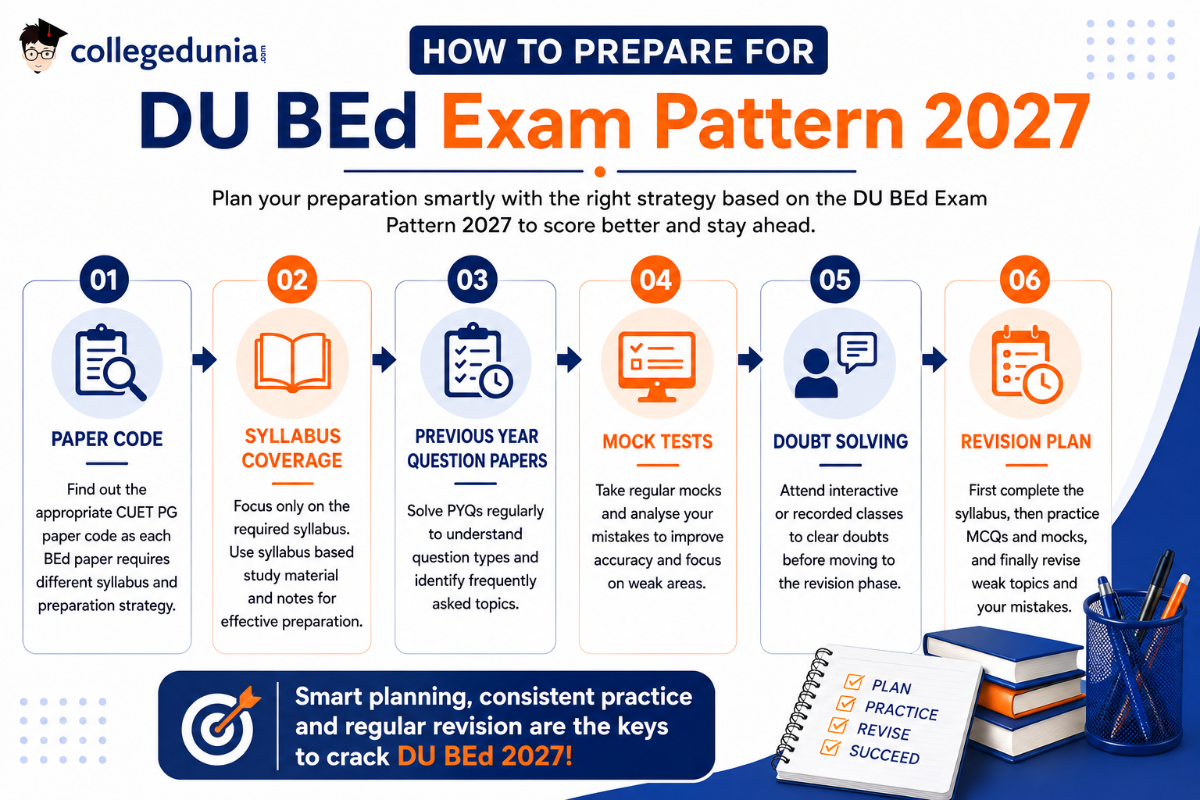
How to Prepare for DU B.Ed Exam Pattern 2027
Candidates should plan preparation according to the DU B.Ed Exam Pattern 2027 with emphasis on the applicable CUET PG paper, syllabus coverage, previous year questions, mock tests and repeated revision.
- Paper Code: Find out the appropriate paper code of CUET PG first as each B.Ed paper requires different syllabus and preparation strategy.
- Syllabus Coverage: Cover the required syllabus thoroughly and take help of syllabus based study material and notes instead of studying unrelated topics.
- Previous Year Question Papers: Solve the previous year’s papers on a regular basis to familiarize with the type of questions being asked and to identify repeating topics.
- Mock Tests: Do regular mock tests and analyse the wrong questions to identify the areas which need more preparation.
- Doubt Solving: Take interactive or recorded classes to clarify the doubts about any concept before starting the revision phase.
- Revision Plan: Complete syllabus coverage first then move to MCQ and mock test practice next and use the final phase for revision of weak topics and mistakes.
Also Check:
- DU B.Ed Entrance Exam 2021 B.Ed Special Education Mental Retardation Question Paper with Answer Key PDFs (September 27 - Shift 1)
- DU B.Ed Entrance Exam 2021 B.Ed. Special Education (Visual Impairment) Question Paper with Answer Key PDFs (January 10 - Shift 1)
Ques. How to prepare for the B.Ed. entrance exam 2026?
Ans. Candidates should first identify the CUET PG paper required for the B.Ed. programme, such as COQP03 to COQP07. Preparation should focus on the prescriB.Ed syllabus, core concepts, PYQs, mock tests, and regular revision. Candidates should follow the latest NTA syllabus for the selected paper.
DU B.Ed Exam Pattern 2027: Frequently Asked Questions (FAQs)
Ques. Is B.Ed. 1 year or 2 year in 2026?
Ans. DU B.Ed. is a 2-year programme. Candidates seeking admission in 2026 have to meet the programme-specific eligibility criteria and appear for the relevant CUET PG paper.
Ques. How to prepare for B.Ed. Entrance exam 2026?
Ans. Candidates should first understand the CUET PG paper and syllabus applicable to the chosen teaching subject. Preparation should focus on core subject concepts, topic-wise practice, PYQs, mock tests, and regular revision. NTA provides the official CUET PG syllabus for each test paper.
Ques. Is B.Ed. a competitive exam?
Ans. Yes. DU B.Ed. admission is competitive because candidates are selected through CUET PG scores, and the cutoff varies by teaching subject, category, and seat availability.
Ques. Is B.Ed. easy or difficult?
Ans. DU B.Ed. admission is competitive because candidates are selected through CUET PG scores and seats are limited. The difficulty of the entrance preparation depends mainly on the candidate's chosen subject and familiarity with the syllabus.
Ques. Which DU college is best for B.Ed.?
Ans. Department of Education, University of Delhi (Central Institute of Education) is the main DU department offering the B.Ed. programme and is considered a leading choice for B.Ed. admission in Delhi.
Ques. How many seats are in DU B.Ed.?
Ans. The latest available DU information lists 63 seats for the B.Ed. programme at the Department of Education, including 25 UR, 10 SC, 5 ST, 17 OBC and 6 EWS seats. The seat matrix may change according to the university's updated intake.
Ques. Is there minus marking in B.Ed.?
Ans. Yes. There is negative marking in the CUET PG B.Ed. entrance exam. Candidates lose 1 mark for each incorrect answer, while an unanswered question carries no negative marking.



Comments
Found 2 Comments
Having a B.Ed degree is an advantage and boost in your teaching profile. The minimum educational qualification required to pursue the B.Ed program of Delhi University is to have a bachelor’s degree with at least 50% marks from a recognized university. You must also be between the age of 21 years and 28 years of age.
If you have the intentions of teaching at the elementary level you can pursue a D.El.Ed course, but if you want to teach at the higher level you must apply for B.Ed. The knowledge that you will gather while pursuing a B.Ed is more vast than the knowledge you will get from a D.El.Ed degree.