




Online registration and choice filling for DASA (UG) 2026 and CSAB Special Rounds 2026 have been opened by the Central Seat Allocation Board (CSAB) on July 28, 2026, on the official portal, csab.nic.in. This comes after the conclusion of the JoSAA 2026 counselling rounds, with vacant seats across the NIT+ system, comprising NITs, IIITs, IIEST Shibpur, SPAs, and other Government Funded Technical Institutes, being displayed on the same day.
Direct Admission of Students Abroad (DASA) 2026 candidates and CSAB Special Round aspirants have been brought under a single counselling umbrella this year. Candidates are required to complete registration, fee payment, and document upload by August 3, 2026, followed by choice filling and locking by August 5, 2026. The counselling cycle has been scheduled to be conducted in two rounds this year, with the Round 1 seat allotment result expected to be declared on August 6, 2026.

Source: csab.nic.in/csab-special/
DASA & CSAB Special 2026 Latest Updates
- Registration, fee payment, and choice filling for DASA (UG) 2026 and CSAB Special Rounds 2026 have begun on July 28, 2026 (10:00 hrs), following the display of vacant seats after the JoSAA 2026 rounds.
- The window for online requests for category and PwD restoration had earlier closed on July 24, 2026 (12:00 hrs), after opening on July 22, 2026.
- A mock seat allocation, based on choices filled until July 30, 2026 (17:00 hrs), is expected to be displayed on July 31, 2026 (10:00 hrs).
- Registration, fee payment, and document upload are scheduled to close on August 3, 2026 (10:00 hrs), while choice filling and locking are set to end on August 5, 2026 (14:00 hrs).
- The Round 1 seat allotment result is expected to be declared on August 6, 2026 (17:00 hrs), to be followed by the Round 2 result on August 12, 2026 (17:00 hrs).
- Compared with the 2025 cycle, when DASA-CSAB registration had opened on July 30, 2025, and counselling had run across three rounds, this year's process has started two days earlier and has been compressed into two rounds, with participating institutes expanded to 114 (up from 105 in 2025) and total seats increased to around 48,000.
DASA & CSAB Special Counselling 2026 Important Dates
| Event | Date |
|---|---|
| Category/PwD Restoration Window | July 22, 2026 to July 24, 2026 |
| Display of Vacancies after JoSAA Rounds | July 28, 2026 |
| Registration, Fee Payment & Choice Filling Begins | July 28, 2026 |
| Mock Seat Allocation Display | July 31, 2026 |
| Registration & Document Upload Ends | August 3, 2026 |
| Choice Filling & Locking Ends | August 5, 2026 |
| Round 1 Seat Allotment Result | August 6, 2026 |
| Round 2 Seat Allotment Result | August 12, 2026 |
| Physical Reporting at Allotted Institutes (Tentative) | August 13, 2026 to August 18, 2026 |
CSAB Special Opening and Closing Ranks (2025-2021)
| Years | Round 1 | Round 2 | Round 3 |
|---|---|---|---|
| 2025 | Download PDF | Download PDF | Download PDF |
| 2024 | Download PDF | Download PDF | - |
| 2023 | Download PDF | Download PDF | - |
| 2022 | Download PDF | Download PDF | - |
| 2021 | Download PDF | Download PDF | - |
What is CSAB Counselling 2026?
CSAB Counselling 2026 is conducted by the Central Seat Allocation Board to fill the seats that stay vacant in the NIT+ system after JoSAA counselling is over. The NIT+ system means the National Institutes of Technology (NITs), the Indian Institutes of Information Technology (IIITs) and the Government Funded Technical Institutes (GFTIs). Admission in CSAB is based only on your JEE Main 2026 rank, not JEE Advanced.
Every year, JoSAA runs six rounds of joint counselling for the IITs and the NIT+ system. After these rounds, some seats are still left empty because candidates withdraw, do not report, or upgrade to other institutes. CSAB steps in to fill these leftover seats through its own special rounds. This gives you one more chance to get a seat in a top engineering college if you missed out in JoSAA.
So CSAB is the last counselling stage in the JEE Main admission cycle. It is important because it opens up seats in NITs, IIITs and GFTIs that would otherwise go unused. In 2025, the CSAB special rounds offered around 13,727 vacant seats, which shows how many opportunities open up at this stage.
Here is a quick snapshot of CSAB Counselling 2026:
| Particulars | Details |
|---|---|
| Counselling Name | CSAB Counselling 2026 (Central Seat Allocation Board) |
| Conducting Body | Central Seat Allocation Board (CSAB) |
| Based On | JEE Main 2026 Rank |
| Participating Institutes | 31 NITs, 26 IIITs, around 45 GFTIs |
| Purpose | To fill vacant seats left after JoSAA 2026 |
| Counselling Mode | Online |
| Official Website | csab.nic.in |
| Expected Start | Late July 2026 (after JoSAA final round) |
CSAB 2026: JoSAA to Special Rounds Timeline
The CSAB 2026 timeline is linked directly to JEE Advanced and JoSAA. The JEE Advanced 2026 result was declared on 1 June 2026 by IIT Roorkee. This result kicks off the full NIT+ and IIT admission cycle, and JoSAA 2026 counselling begins right after it.
JoSAA 2026 registration and choice filling start on 2 June 2026. The first round of JoSAA seat allotment is expected on 13 June 2026. JoSAA will then run all six rounds across June and July 2026. CSAB special rounds begin only after this — you cannot register for CSAB while JoSAA is still going on.
CSAB 2026 special round registration has not started yet. The CSAB schedule will be released on csab.nic.in only after the final JoSAA 2026 round is over.
Here is how the cycle flows from JEE Advanced to CSAB:
- JEE Advanced 2026 Result: Declared on 1 June 2026. This starts the IIT and NIT+ admission season.
- JoSAA 2026 Registration: Begins 2 June 2026 for IITs, NITs, IIITs and GFTIs.
- JoSAA 2026 Rounds: Six rounds across June and July 2026.
- CSAB Special 2026: Begins after the last JoSAA round, expected in late July 2026.
So as of today, the JEE Advanced result is out and JoSAA is about to begin. CSAB is still a few weeks away. You should first take part in JoSAA, and then move to CSAB if you do not get a seat you are happy with.
CSAB NEUT 2026 Important Dates
The CSAB 2026 important dates have been released officially.
| S. No. | Event | Duration |
|---|---|---|
| 1 | Online provisional Registration and uploading of documents [Engineering, Architecture & Pharmacy] | July 17 (FRI) 10:00 h – July 25 (SAT) 17:00 h, 2026 |
| 2 | Verification of documents including domicile and category certificates by NERIST and the DTEs of respective North Eastern States/UTs, response by candidate to query (if required), finalization of registration | July 17 (FRI) 10:00 h – July 27 (MON) 17:00 h, 2026 |
| 3 | Filling up of choices | July 18 (SAT) 10:00 h – July 28 (TUE) 17:00 h, 2026 |
| 4 | Reconciliation of data, verification and validation of allocated seats (by NIC, CSAB, NERIST, DTEs of states/UTs) | July 28 (TUE) – July 31 (FRI), 2026 |
| 5 | First Round of Seat Allotment | Aug 01 (SAT) 17:00 h, 2026 |
| 6 | Online reporting (Round 1): • Online payment of seat acceptance fee (SAF) of Rs. 5,000/- • Exercising willingness options (Float/Slide/Freeze) by the candidates who have been allotted seats against the first round of allotment. • Candidates can download Provisional Admission Letter (PAL) and proceed for final admission at allotted Institute as per schedule. | Aug 02 (SUN) 10:00 h – Aug 05 (WED) 17:00 h, 2026 |
| 7 | Reconciliation of data, verification and validation of allotted seats (by NIC, CSAB, DTEs of states/UTs/NERIST) | Aug 06 (THU) – Aug 08 (SAT), 2026 |
| 8 | Second Round of Seat Allotment | Aug 09 (SUN) 17:00 h, 2026 |
| 9 | Online reporting (Round 2): • Online payment of seat acceptance fee (SAF) of Rs. 5,000/- only for the candidates who have been allotted seats for the first time. • Candidates can download Provisional Admission Letter (PAL) and proceed for final admission at allotted Institute as per schedule. | Aug 10 (MON) 10:00 h – Aug 12 (WED) 17:00 h, 2026 |
| 10 | Seat Withdrawal | Aug 13 (THU) 10:00 h – Aug 14 (FRI) 17:00 h, 2026 |
| 11 | Reporting at the allotted Institute for admission | Aug 06 (THU) – Aug 21 (FRI), 2026 |
| 12 | Spot Round (if any) to be Declared by the States/UTs/NERIST | Aug 24 (MON) – Aug 28 (FRI), 2026 |
| 13 | Reporting centre to report admission data to CSAB | Aug 02 (SUN) – Aug 31 (MON), 2026 |
Source: csab.nic.in
Types of CSAB Counselling 2026
CSAB Counselling 2026 is not a single process. The Central Seat Allocation Board runs different counselling streams for different types of seats. You should know which one fits your case before you apply.
There are three main types of CSAB counselling:
- CSAB-Special Rounds: This is the most common one. It fills the seats that stay vacant in NITs, IIITs and GFTIs after JoSAA ends. Admission is based on your JEE Main 2026 rank.
- CSAB-NEUT (North Eastern States and Union Territories): This handles seat allocation for candidates from the North Eastern states and Union Territories under special nominee quotas. It covers seats reserved for these regions in NITs and other institutes.
- CSAB Supernumerary: This covers supernumerary seats, such as the female supernumerary seats created to improve gender balance and other extra seats in the NIT+ system.
For most JEE Main 2026 candidates, the CSAB-Special rounds matter the most. The DASA (Direct Admission of Students Abroad) scheme is also handled through the CSAB portal, but that is meant for foreign nationals and NRI candidates, not regular Indian JEE Main aspirants.
CSAB 2026 Eligibility Criteria
The CSAB 2026 eligibility criteria are mostly the same as JoSAA, because both use the JEE Main rank. You must have a valid JEE Main 2026 score and rank to take part. Without a JEE Main rank, you cannot register for the CSAB special rounds.
Here are the main eligibility points you should check:
- JEE Main 2026 Rank: You must have a valid rank in JEE Main 2026.
- Class 12 Marks: You should have at least 75% aggregate marks in Class 12 for the General category. For SC, ST and PwD candidates, the requirement is 65%. As an option, you can also be in the top 20 percentile of your board.
- Number of Subjects: You must have passed Class 12 with Physics and Mathematics as compulsory subjects, along with one of Chemistry, Biology, Biotechnology or a technical vocational subject.
- Age Limit: There is generally no upper age limit for NIT+ admissions, but you should check the latest information bulletin for any change.
One good thing about CSAB is that it is open to many types of candidates. You can register for CSAB special rounds whether or not you took part in JoSAA. This includes candidates who got a seat in JoSAA, those who did not, and those who skipped JoSAA fully. So even if you missed JoSAA, you still get a chance through CSAB.
The Class 12 marks rule is set by the NITs and is the same as JoSAA. Always confirm your category eligibility on the official CSAB portal before paying any fee.
CSAB 2026 Registration Process
The CSAB 2026 registration is fully online and is done on csab.nic.in. You will use your JEE Main 2026 application number and password to log in, so you do not need a fresh account. The registration window will open only after JoSAA 2026 ends.
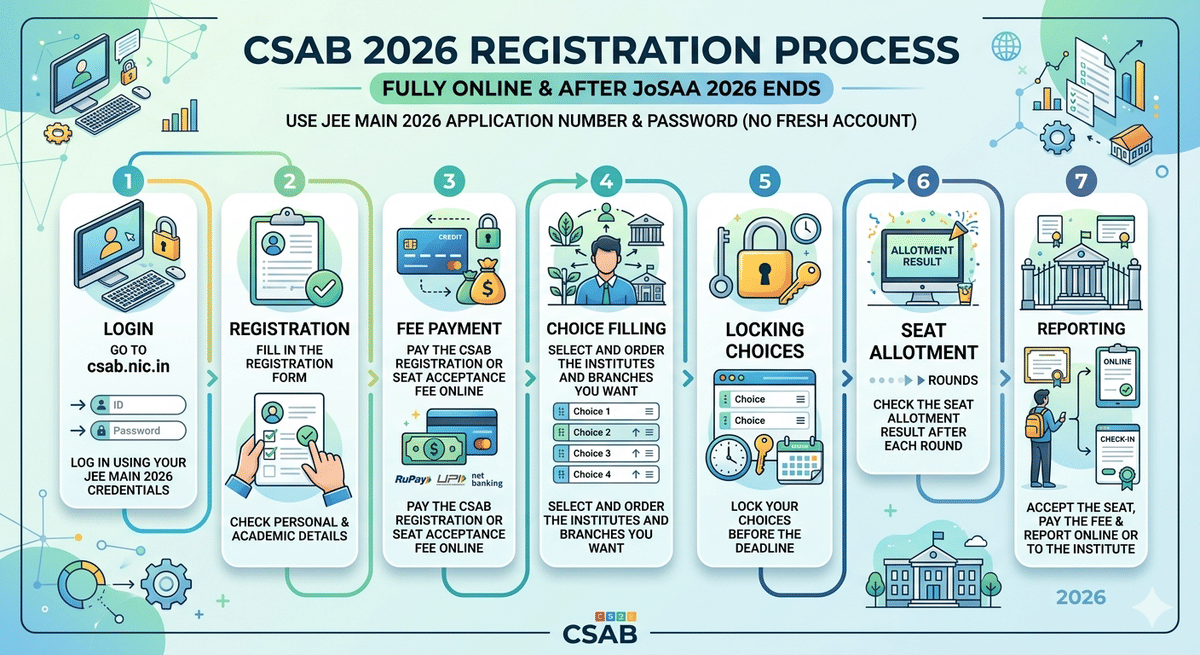
You should complete each step carefully and within the deadline. Many candidates lose their seat because they forget to lock their choices or miss the reporting date. So keep a close watch on the official schedule once it is out.
CSAB 2026 Fees
The CSAB 2026 fees include the seat acceptance fee that you pay to confirm your seat. The exact 2026 fee will be shown on the portal when registration opens. Based on the CSAB-Special 2025 cycle, the fees are expected to stay close to the figures below.
| Category | Seat Acceptance Fee (2025 Reference) |
|---|---|
| General / OBC-NCL / EWS | Rs. 45,000 |
| SC / ST / PwD | Rs. 19,000 |
A part of this fee, around Rs. 5,000, is a non-refundable processing charge. The rest is adjusted later against your college admission fee. If your category changes during the process — for example, from SC/ST to General because of a missing valid certificate — you may have to pay the fee difference of around Rs. 15,000.
The fees shown above are from CSAB-Special 2025 and are for reference only. Confirm the exact 2026 amounts on csab.nic.in before you pay.
CSAB 2026 Choice Filling and Locking
Choice filling is the most important part of CSAB 2026 counselling. This is where you tell the system which institute and branch you want. Your seat is allotted based on these choices, your JEE Main 2026 rank, and the seats available.
Here is how you should approach choice filling:
- Add more choices: Fill in as many genuine choices as you can. More choices give you a better chance of getting a seat.
- Order by preference: Put your most wanted college and branch at the top. The system tries to give you the highest possible choice you are eligible for.
- Check vacant seats: CSAB releases a vacant-seat list before choice filling. Use it to add realistic options based on your rank.
- Lock your choices: Once you are sure, lock the choices. If you do not lock, the system may auto-lock your last saved choices at the deadline.
You should be careful while ordering your choices. If you place a branch high up, you must be willing to join it. Once a seat is allotted in CSAB special rounds and you accept it, you have to follow the rules for upgrade or withdrawal set by the board.
CSAB 2026 Seat Allotment Rounds
The CSAB 2026 seat allotment will be done in multiple rounds, just like JoSAA. After each round, the board releases a seat allotment result. You can then accept the seat, wait for an upgrade, or withdraw based on the rules.
In 2025, the CSAB special rounds had three main rounds of seat allotment. The 2026 rounds are expected to follow a similar pattern. Here is how the rounds usually work:
- Round 1: First seat allotment based on your locked choices and JEE Main rank. Last year this was on 9 August 2025.
- Round 2: Seats are upgraded and freshly vacant seats are filled. Last year this was on 14 August 2025.
- Round 3: Final round of seat allotment. Last year this was on 19 August 2025.
After you are allotted a seat, you must pay the seat acceptance fee and report online within the deadline. If you do not report, your seat is cancelled and given to another candidate in the next round. The seat allotment is fully based on merit, which means your JEE Main 2026 rank decides your seat.
If a seat is allotted in the last round, you usually have to accept it. Floating and sliding options that exist in JoSAA may work differently in CSAB, so read the round-wise business rules carefully.
CSAB 2026 Participating Institutes and Seat Intake
The CSAB 2026 participating institutes include all the NITs, IIITs and most GFTIs in the country. These are the same institutes that take part in JoSAA. CSAB only deals with the seats that are left vacant in these institutes after JoSAA ends.
The participating institutes are grouped as follows:
- NITs: 31 National Institutes of Technology across India.
- IIITs: 26 Indian Institutes of Information Technology.
- GFTIs: Around 45 Government Funded Technical Institutes.
The number of vacant seats changes every year and is only known after JoSAA is over. The table below shows the CSAB-Special 2025 vacant seats as a reference for what to expect in 2026.
| Institute Type | Number of Institutes | Vacant Seats (2025 Reference) |
|---|---|---|
| NITs | 31 | Around 4,500 |
| IIITs | 26 | Around 3,087 |
| GFTIs | Around 45 | Around 6,060 |
| Total | Around 100+ | Around 13,727 |
Source: csab.nic.in
So around 13,000 to 14,000 seats may open up in the CSAB special rounds in 2026. GFTIs usually have the most vacant seats, which gives you a real chance to get into a government technical institute even with a moderate rank.
CSAB 2026 Cutoff: Opening and Closing Ranks
The CSAB 2026 cutoff is the opening and closing rank at which seats are allotted in each institute and branch. The cutoff depends on the JEE Main 2026 rank, the category, the institute and the branch. The CSAB cutoff is usually higher (a larger rank number) than JoSAA, because only leftover seats are filled.
This is good news for candidates with a lower rank. Branches and colleges that closed at a sharp rank in JoSAA may stay open at a higher rank in CSAB. So a candidate who could not get a seat in JoSAA still has a fair chance in CSAB.
The CSAB cutoff depends on a few key factors:
- Number of vacant seats: More vacant seats in a branch usually means a more relaxed closing rank.
- Category: Reserved category cutoffs differ from the General category.
- Institute popularity: Top NITs and core branches still close at sharp ranks.
- Home state vs other state: NITs follow a home-state and other-state quota, so cutoffs differ.
The official CSAB 2026 opening and closing ranks will be released round-wise on csab.nic.in. You should check the previous year’s closing ranks to set realistic choices. You can find the past opening and closing ranks on the official CSAB portal.
Documents Required for CSAB 2026
You should keep all your documents ready before CSAB 2026 counselling starts. Missing or wrong documents can lead to your seat being cancelled at the reporting stage. Keep both soft copies and original documents handy.
Here is the list of documents usually required for CSAB counselling:
- JEE Main 2026 Admit Card
- JEE Main 2026 Scorecard or Rank Card
- Class 10 Certificate (for date of birth proof)
- Class 12 Marksheet and Passing Certificate
- Category Certificate (SC, ST, OBC-NCL, EWS) if applicable
- PwD Certificate if applicable
- Photo ID Proof (Aadhaar, PAN, Passport or Voter ID)
- Passport-size Photographs
- Seat Allotment Letter from CSAB
- Medical Fitness Certificate (if asked by the institute)
You must make sure your category certificate is in the correct format and valid for the current year. The EWS and OBC-NCL certificates often need to be from the latest financial year. So check the validity date carefully to avoid problems during verification.
CSAB vs JoSAA Counselling
Many students get confused between CSAB and JoSAA. Both fill engineering seats based on JEE Main rank, but they are not the same. JoSAA is the main joint counselling, while CSAB is the extra counselling held later to fill the leftover seats.
The table below shows the key differences between CSAB and JoSAA:
| Point | JoSAA Counselling | CSAB Counselling |
|---|---|---|
| Institutes Covered | IITs, NITs, IIITs and GFTIs | Only NITs, IIITs and GFTIs (no IITs) |
| Based On | JEE Main and JEE Advanced ranks | Only JEE Main rank |
| When It Happens | First, in June and July | After JoSAA, in late July and August |
| Number of Rounds | Six rounds | Usually three special rounds |
| Purpose | Main seat allocation | Fill vacant seats left after JoSAA |
So if you want an IIT seat, you must go through JoSAA. CSAB does not give IIT seats. But for NITs, IIITs and GFTIs, CSAB gives you a second chance after JoSAA. This makes CSAB very useful if you missed a good seat in the main counselling.
CSAB 2026 Reporting and Seat Withdrawal
After you are allotted a seat in CSAB 2026, you must complete the reporting step to confirm your admission. Reporting means you accept the seat, pay the fee and submit your documents. If you skip reporting, your seat is cancelled.
Here is what you should know about reporting and withdrawal:
- Online Reporting: After each round, you accept the seat online and upload the required documents.
- Fee Payment: You must pay the seat acceptance fee within the deadline to hold your seat.
- Freezing or Upgrade: Depending on the round and rules, you may freeze your seat or wait for an upgrade in the next round.
- Seat Withdrawal: If you no longer want the seat, you can withdraw within the allowed window. The refund follows the board’s withdrawal rules.
Do not miss your reporting deadline. A seat that is not reported on time is cancelled and given to the next candidate in line.
You should read the CSAB business rules for each round carefully. The rules for upgrade, freeze and withdrawal can change between the special rounds and the final round. So always check the latest instructions on csab.nic.in before taking any action.
Tips for CSAB 2026 Counselling
CSAB 2026 is your last chance to get a seat in the NIT+ system through JEE Main. A few smart steps can help you make the most of it. These tips are based on how the CSAB special rounds have worked in past years.
Here are some useful tips for CSAB 2026:
- Take part in JoSAA first: Always go through all JoSAA rounds before CSAB. CSAB only fills what JoSAA leaves behind.
- Check the vacant-seat list: Study the official vacant-seat list before choice filling. It tells you which branches are really open.
- Fill many choices: Add as many genuine choices as you can to improve your chances.
- Be realistic with ranks: Use previous-year closing ranks to pick options that match your JEE Main 2026 rank.
- Keep documents ready: Have all certificates ready in the correct format to avoid last-minute trouble.
- Track every deadline: Note the registration, locking and reporting dates so you do not miss any step.
You should also keep some money ready for the seat acceptance fee, as the deadlines are short. With good planning, CSAB can help you turn a missed JoSAA chance into a confirmed seat in a good government engineering college.
FAQs
Ques. When will CSAB 2026 counselling start?
Ans. CSAB 2026 counselling will start only after the final JoSAA 2026 round is over. It is expected to begin in late July 2026. Last year, CSAB-Special 2025 registration began on 30 July 2025.
Ques. Is CSAB 2026 based on JEE Main or JEE Advanced?
Ans. CSAB 2026 special rounds are based only on your JEE Main 2026 rank. JEE Advanced rank is used for IIT admission through JoSAA, not for CSAB. CSAB does not offer any IIT seats.
Ques. Can I apply for CSAB 2026 if I did not take part in JoSAA?
Ans. Yes, you can. CSAB special rounds are open to candidates who took part in JoSAA, those who did not get a seat, and even those who skipped JoSAA fully. You only need a valid JEE Main 2026 rank.
Ques. What is the difference between CSAB and JoSAA?
Ans. JoSAA is the main joint counselling for IITs, NITs, IIITs and GFTIs and runs first. CSAB is held later to fill the vacant seats left in the NIT+ system after JoSAA. CSAB does not give IIT seats and uses only the JEE Main rank.
Ques. How many seats are available in CSAB 2026?
Ans. The exact number is known only after JoSAA ends. As a reference, CSAB special rounds offered around 13,727 vacant seats in 2025 across NITs, IIITs and GFTIs.
Ques. What is the CSAB 2026 registration fee?
Ans. The exact fee will be shown when registration opens. In 2025, the seat acceptance fee was Rs. 45,000 for General, OBC-NCL and EWS, and Rs. 19,000 for SC, ST and PwD candidates. A part of around Rs. 5,000 is non-refundable.
Ques. What is the eligibility for CSAB 2026 special round?
Ans. You must have a valid JEE Main 2026 rank. You also need at least 75% marks in Class 12 for the General category, or 65% for SC, ST and PwD candidates, or be in the top 20 percentile of your board.
Ques. Does CSAB 2026 offer IIT seats?
Ans. No, CSAB 2026 does not offer any IIT seats. CSAB only fills vacant seats in NITs, IIITs and GFTIs. IIT seats are allotted only through JoSAA based on the JEE Advanced rank.
Ques. How many rounds are there in CSAB 2026?
Ans. CSAB special counselling usually has around three rounds of seat allotment. In 2025, the rounds were held on 9, 14 and 19 August. The 2026 rounds are expected to follow a similar pattern.
Ques. What are the three types of CSAB counselling?
Ans. The three types are CSAB-Special rounds, CSAB-NEUT for North Eastern states and Union Territories, and CSAB Supernumerary for supernumerary seats. For most JEE Main candidates, the CSAB-Special rounds are the most important.
Ques. Where can I check CSAB 2026 dates and seat allotment?
Ans. You can check all CSAB 2026 dates, schedules and seat allotment results on the official website, csab.nic.in. The schedule will be released there after JoSAA 2026 ends.



Comments
Found 4 Comments
With around 398000 rank in JEE Main, getting a seat in National Institutes of Technology (NITs) or Indian Institutes of Information Technology (IIITs) is highly unlikely through regular counseling. Such ranks exceed cutoffs. You may explore private colleges and state quota institutes.
To participate in the Central Seat Allocation Board, register on the official portal using your JEE Main details, pay the counseling fee, and fill in college choices. Seats are allotted based on rank and preferences. If allotted, complete document verification and report to the institute within the given timeline to confirm admission.
In CSAB special rounds, seat allotment for all reserved categories, including General-EWS, is based on your Common Rank List (CRL) rank, not your category rank. While your EWS status ensures you are eligible for the specific seats reserved for your category, CSAB prepares its merit list and official closing cutoffs using the CRL.