




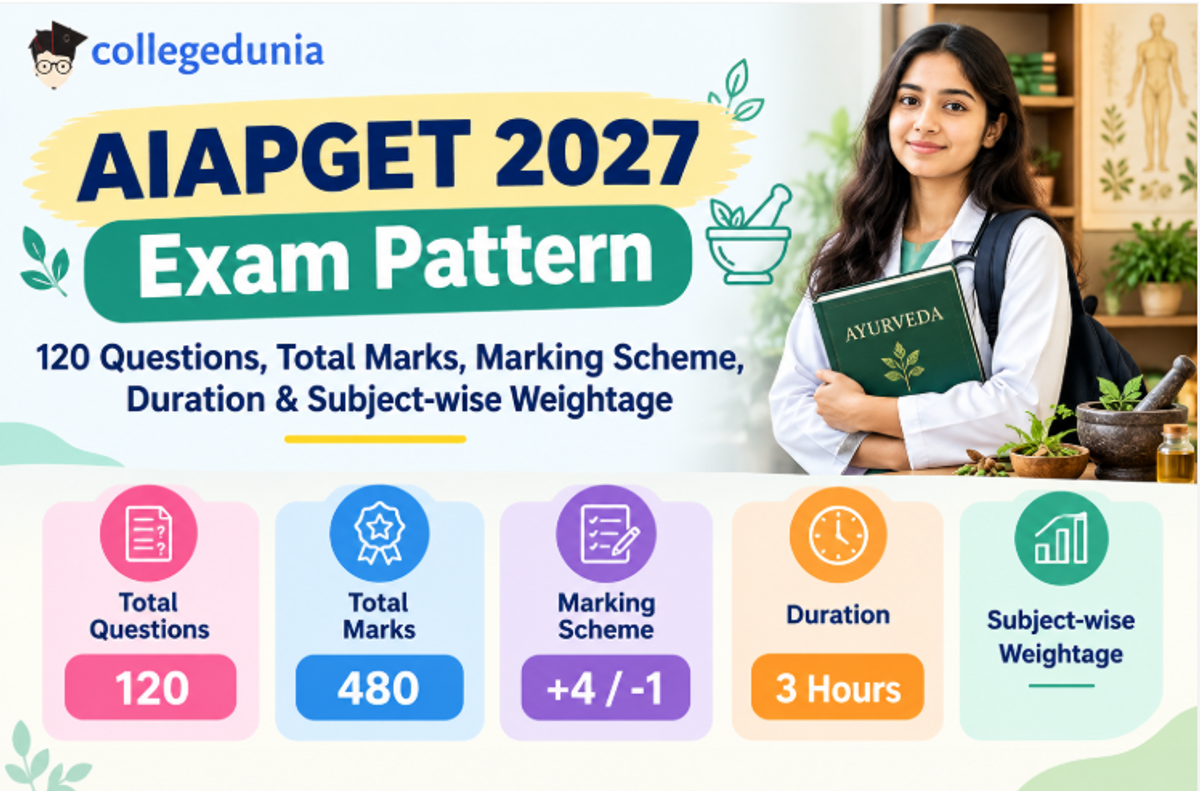
The AIAPGET exam pattern 2027 consists of 120 multiple-choice questions for 480 marks. Each question carries 4 marks, and each wrong response carries a negative mark of -1. The AIAPGET 2027 exam is conducted online, in computer-based mode for 120 minutes (2 hours).
The National Testing Agency (NTA) will conduct the AIAPGET exam 2027. The AIAPGET exam pattern 2027 is expected to remain unchanged.
- The AIAPGET exam is conducted for admissions into MD / MS / PG Diploma in AYUSH disciplines. The disciplines included are Ayurveda, Unani, Siddha, Homeopathy, Yoga & Naturopathy, and Sowa-Rigpa.
- The AIAPGET exam pattern 2027 includes different exam mediums, such as English & Hindi (Ayurveda); English & Urdu (Unani); English & Tamil (Siddha); English only (Homeopathy, Yoga & Naturopathy).
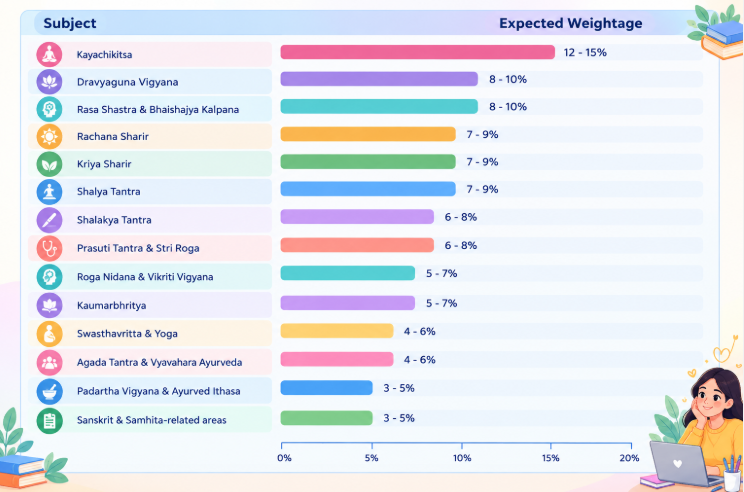
- The AIAPGET Ayurveda syllabus high-weightage topics are Kayachikitsa with 12 - 15%, Dravyaguna Vigyana, and Rasa Shastra & Bhaishajya Kalpana with 8 - 10% each.
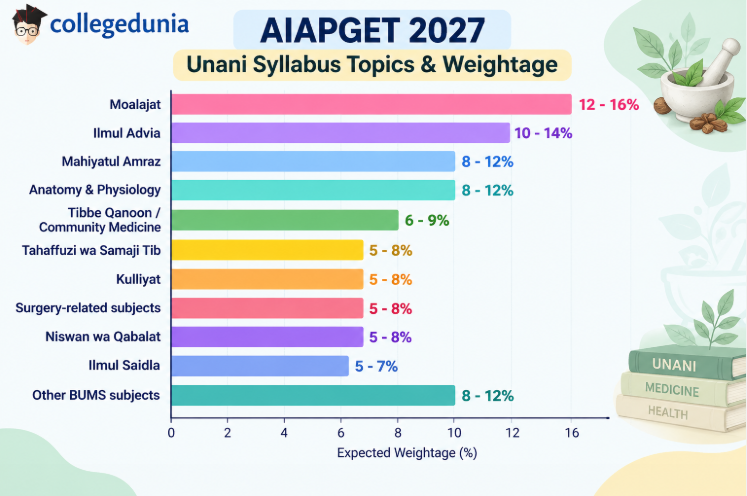
- Studying Moalajat, Ilmul Advia, Anatomy & Physiology, and Mahiyatul Amraz topics for the AIAPGET Unani subject will help students cover around 38 - 54% of the syllabus.
Related Links:
- AIAPGET 2026 Preparation Strategy to Score 300+ in AYUSH PG
- AIAPGET 2026 Best Books: Subject-Wise Recommendations for AYUSH Streams
Key Summary
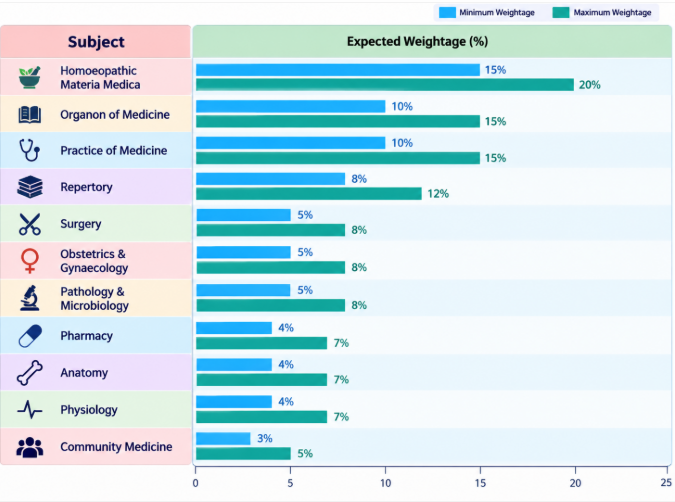
- The AIAPGET syllabus 2027 important topics for Homoeopathy cover Materia Medica, Organon of Medicine, Practice of Medicine, and Repertory.
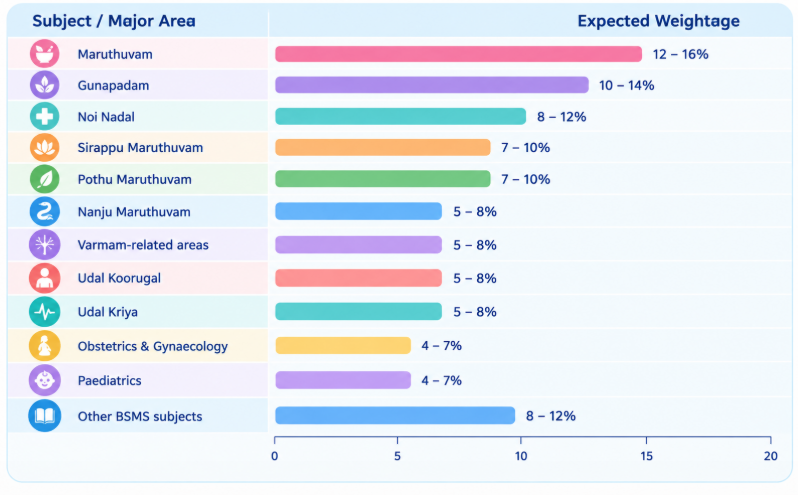
- The AIAPGET high-weightage topics for the Siddha paper are Maruthuvam with 12 - 16%, Gunapadam with 10 - 14%, and Noi Nadal with 7 - 10% weightage.
- The AIAPGET Ayurveda discipline includes Hindi and English medium of question papers. Further, the Unani discipline includes English and Urdu papers.
- Moreover, the AIAPGET Siddha discipline includes English and Tamil question papers, and the Homoeopathy discipline includes only English.
AIAPGET Exam Pattern 2027: Overview
The AIAPGET exam pattern 2027 has not been released officially by the authority. However, the exam pattern is expected to remain the same. The AIAPGET question paper will consist of multiple-choice questions with 4 options, and students need to choose the correct one.
| Particulars | AIAPGET 2027 Details |
|---|---|
| Exam Name | All India AYUSH Post Graduate Entrance Test (AIAPGET) |
| Conducting Authority | National Testing Agency (NTA) |
| Exam Mode | Computer-Based Test (CBT) |
| Type of Questions | Multiple Choice Questions (MCQs) |
| Total Questions | 120 |
| Total Marks | 480 |
| Exam Duration | 120 minutes / 2 hours |
| Marks for Correct Answer | +4 |
| Negative Marking | -1 |
| Unanswered Question | 0 marks |
| Exam Level | National-level postgraduate entrance examination |
| Streams | Ayurveda, Unani, Siddha and Homoeopathy |
| Question Paper Medium | Depends on the selected AYUSH discipline |
AIAPGET 2027 Section-Wise Marks and Questions Distribution
The AIAPGET exam 2027 includes a single-paper, discipline-specific format. Students need to register for one AYUSH discipline at the time of application. The questions cover the complete undergraduate curriculum of that discipline.
| Stream / Discipline | UG Degree Required | No. of Questions | Marks per Question | Total Marks | Duration |
|---|---|---|---|---|---|
| Ayurveda | BAMS | 120 | 4 | 480 | 120 minutes |
| Homeopathy | BHMS | 120 | 4 | 480 | 120 minutes |
| Unani | BUMS | 120 | 4 | 480 | 120 minutes |
| Siddha | BSMS | 120 | 4 | 480 | 120 minutes |
| Yoga & Naturopathy | BNYS | 120 | 4 | 480 | 120 minutes |
| Sowa-Rigpa | Sowa-Rigpa (UG) | 120 | 4 | 480 | 120 minutes |
| Per Paper Total | — | 120 | — | 480 marks | 120 minutes |
A video by “InReado Gov. Exams” will help students learn about the AIAPGET exam pattern, syllabus, and eligibility.
What is the AIAPGET Marking Scheme 2027?
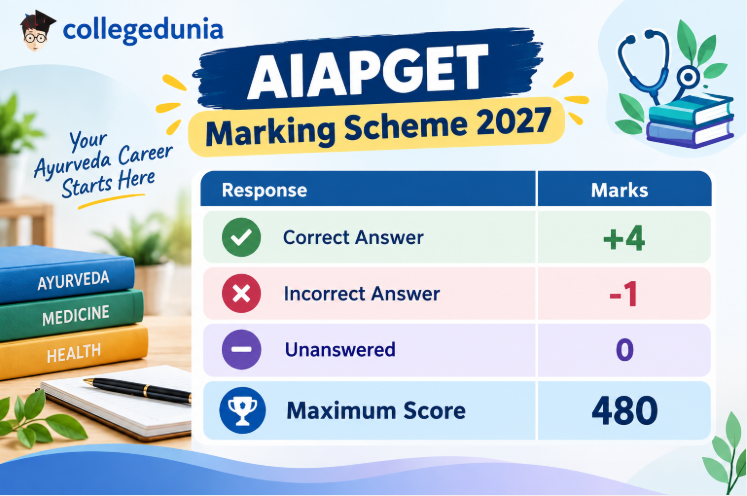
The AIAPGET 2027 marking scheme states that for each correct answer, students will be given +4 marks; for each wrong answer, there will be a deduction of -1 mark. Further, there will be no mark deduction for unanswered/unattempted questions.
| Response | Marks |
|---|---|
| Correct Answer | +4 |
| Incorrect Answer | -1 |
| Unanswered | 0 |
| Maximum Score | 480 |
How to Calculate Scores Using AIAPGET Exam 2027 Marks?
To calculate the AIAPGET exam score 2027, students need to apply this formula:
| AIAPGET 2027 Score = (4 × Correct Answers) − (1 × Wrong Answers) |
For example, if a candidate answers:
- 90 questions correctly
- 20 questions incorrectly
- 10 questions are left unanswered
The score would be:
90 × 4 − 20 × 1 = 360 − 20 = 340 marks
Read More:
- AIAPGET 2026 Question Paper PDF Download Link with Solutions
- AIAPGET 2025 Question Paper PDF Download Link with Solutions
Ques. What is a good score in AIAPGET?
Ans. A good score in AIAPGET is considered to be securing 300+ marks out of 480. Applicants who secure 300 or more in the examination get the best further opportunities for career development. Getting 300+ marks will help students get a seat in government colleges.
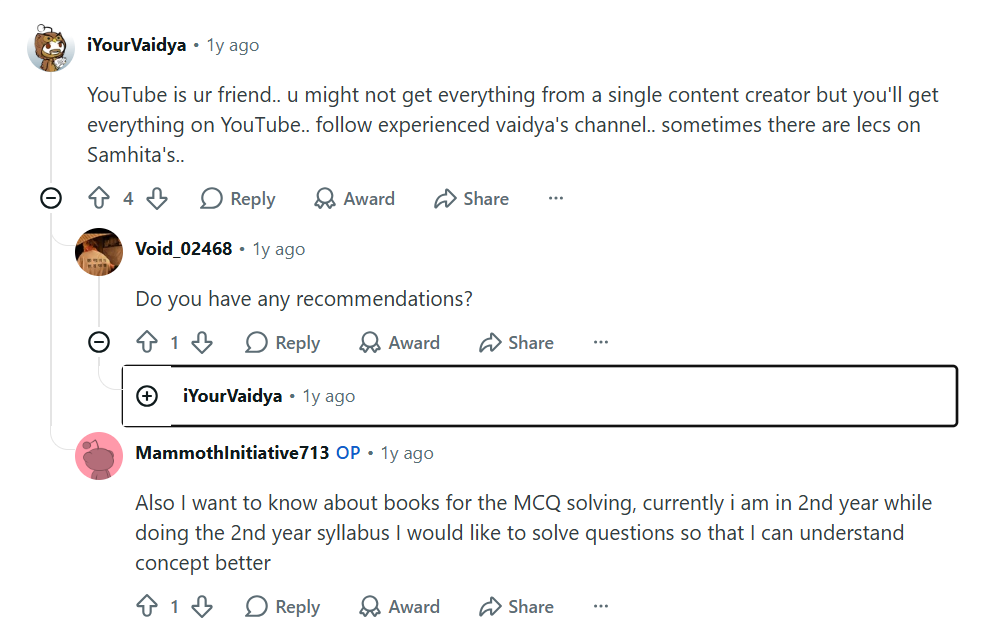
A Reddit user asked about pathways to prepare for the AIAPGET exam.

Replying to that, another user said that you should refer to different pages available on YouTube for better guidance.
Source: Reddit
AIAPGET Syllabus 2027: Check Subject-Wise Weightage
The AIAPGET 2027 exam syllabus 2027 includes Ayurveda, Unani, Siddha, Homeopathy, Yoga & Naturopathy, and Sowa-Rigpa disciplines. The detailed syllabus topics and expected weightage of all are provided here.
AIAPGET 2027 Ayurveda Syllabus Topics & Weightage
| Subject | Expected Weightage |
|---|---|
| Kayachikitsa | 12 - 15% |
| Dravyaguna Vigyana | 8 - 10% |
| Rasa Shastra & Bhaishajya Kalpana | 8 - 10% |
| Rachana Sharir | 7 - 9% |
| Kriya Sharir | 7 - 9% |
| Shalya Tantra | 7 - 9% |
| Shalakya Tantra | 6 - 8% |
| Prasuti Tantra & Stri Roga | 6 - 8% |
| Roga Nidana & Vikriti Vigyana | 5 - 7% |
| Kaumarbhritya | 5 - 7% |
| Swasthavritta & Yoga | 4 - 6% |
| Agada Tantra & Vyavahara Ayurveda | 4 - 6% |
| Padartha Vigyana & Ayurved Itihasa | 3 - 5% |
| Sanskrit & Samhita-related areas | 3 - 5% |
AIAPGET Exam 2027 Homoeopathy Syllabus Topics
| Subject | Expected Weightage |
|---|---|
| Homoeopathic Materia Medica | 15 - 20% |
| Organon of Medicine | 10 - 15% |
| Practice of Medicine | 10 - 15% |
| Repertory | 8 - 12% |
| Surgery | 5 - 8% |
| Obstetrics & Gynaecology | 5 - 8% |
| Pathology & Microbiology | 5 - 8% |
| Pharmacy | 4 - 7% |
| Anatomy | 4 - 7% |
| Physiology | 4 - 7% |
| Community Medicine | 3 - 5% |
AIAPGET 2027 Unani Syllabus Topics: Check Expected Weightage
| Subject | Expected Weightage |
|---|---|
| Moalajat | 12 - 16% |
| Ilmul Advia | 10 - 14% |
| Mahiyatul Amraz | 8 - 12% |
| Anatomy & Physiology | 8 - 12% |
| Tibbe Qanoon / Community Medicine | 6 - 9% |
| Tahaffuzi wa Samaji Tib | 5 - 8% |
| Kulliyat | 5 - 8% |
| Surgery-related subjects | 5 - 8% |
| Niswan wa Qabalat | 5 - 8% |
| Ilmul Saidla | 5 - 7% |
| Other BUMS subjects | 8 - 12% |
AIAPGET Siddha Syllabus 2027 Topics
| Subject | Expected Weightage |
|---|---|
| Maruthuvam | 12 - 16% |
| Gunapadam | 10 - 14% |
| Noi Nadal | 8 - 12% |
| Sirappu Maruthuvam | 7 - 10% |
| Pothu Maruthuvam | 7 - 10% |
| Nanju Maruthuvam | 5 - 8% |
| Varmam-related areas | 5 - 8% |
| Udal Koorugal | 5 - 8% |
| Udal Kriya | 5 - 8% |
| Obstetrics & Gynaecology | 4 - 7% |
| Paediatrics | 4 - 7% |
| Other BSMS subjects | 8 - 12% |
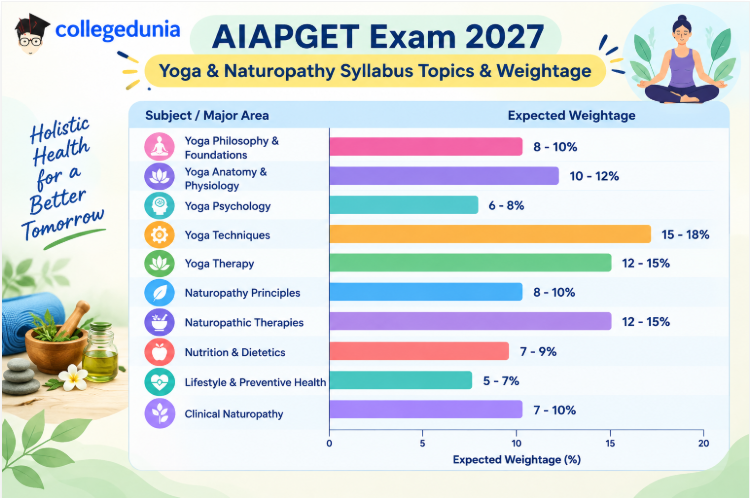
AIAPGET Exam Yoga & Naturopathy Syllabus 2027
| Subject / Major Area | Expected Weightage |
|---|---|
| Yoga Philosophy & Foundations | 8 - 10% |
| Yoga Anatomy & Physiology | 10 - 12% |
| Yoga Psychology | 6 - 8% |
| Yoga Techniques | 15 - 18% |
| Yoga Therapy | 12 - 15% |
| Naturopathy Principles | 8 - 10% |
| Naturopathic Therapies | 12 - 15% |
| Nutrition & Dietetics | 7 - 9% |
| Lifestyle & Preventive Health | 5 - 7% |
| Clinical Naturopathy | 7 - 10% |
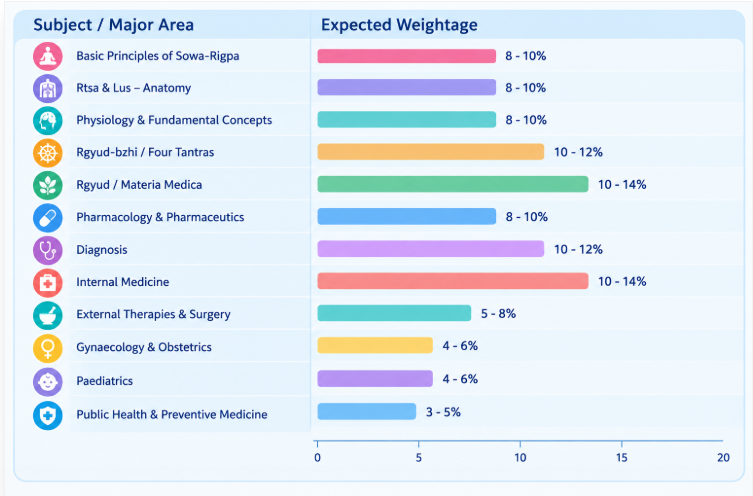
AIAPGET Exam Sowa-Rigpa Syllabus 2027
| Subject / Major Area | Expected Weightage |
|---|---|
| Basic Principles of Sowa-Rigpa | 8 - 10% |
| Rtsa & Lus – Anatomy | 8 - 10% |
| Physiology & Fundamental Concepts | 8 - 10% |
| Rgyud-bzhi / Four Tantras | 10 - 12% |
| Rgyud / Materia Medica | 10 - 14% |
| Pharmacology & Pharmaceutics | 8 - 10% |
| Diagnosis | 10 - 12% |
| Internal Medicine | 10 - 14% |
| External Therapies & Surgery | 5 - 8% |
| Gynaecology & Obstetrics | 4 - 6% |
| Paediatrics | 4 - 6% |
| Public Health & Preventive Medicine | 3 - 5% |
Ques. Is the AIAPGET exam difficult?
Ans. The difficulty level of the AIAPGET exam is considered to be moderate to difficult. Due to high competition and a vast syllabus, test takers generally rate the difficulty level as moderate. However, it also depends on the preparation and topic understanding of the applicant.
AIAPGET Exam Pattern 2027: Year-Wise Subject Difficulty Level
The subject-wise previous year’s subject difficulty level of the AIAPGET exam is provided below.
| Year | Ayurveda | Homoeopathy | Unani | Siddha | Overall Trend |
|---|---|---|---|---|---|
| 2026 | Moderate | Moderate | Moderate | Moderate | Moderate to Difficult |
| 2025 | Moderate to Difficult | Moderate to Difficult | Moderate | Moderate | Moderate to Difficult |
| 2024 | Moderate | Moderate | Moderate | Moderate | Moderate |
| 2023 | Moderate to Difficult | Moderate | Moderate to Difficult | Moderate | Moderate to Difficult |
| 2022 | Moderate to Difficult | Moderate | Moderate to Difficult | Moderate | Moderate |
| 2021 | Easy to Moderate | Moderate | Moderate | Moderate | Moderate |
| 2020 | Moderate to Difficult | Moderate | Moderate | Moderate | Moderate to Difficult |
How to Prepare for AIAPGET 2027 Based on Exam Pattern?
The AIAPGET 2027 exam preparation strategy is shared below.
- Understand the Exam Pattern: Learn about the exam structure, question count, marking scheme, question type, etc in detail.
- Prioritize High-Weightage Topics: Focus more on high-weightage topics and frequently tested subjects. Divide your preparation time accordingly.
- Follow a Three-Phase Preparation Strategy: Divide your preparation timing strategically. At first focus on concept building and syllabus completion then prepare notes and revise the formulas.
- Prepare Your Own Notes: You should make your own notes for all the learned topics. It will help during revision and understand the tricky formulas or concepts easily.
- Solve Previous Year Question Papers: Practice past year’s question papers for better understanding and concept clarity. It will help you understand the exam structure and subject weightage.
- Practice Mock Tests: You should appear for mock tests as well as it will help you analyse your performance and learn about your weaker areas.
Download AIAPGET Subject-Wise Question Papers:
AIAPGET Exam Pattern 2027 FAQs
Ques. Is AIAPGET 2027 conducted online or offline?
Ans. The AIAPGET exam is conducted online, in computer-based mode only. Applicants will have their own system on which the questions will be displayed with four options. Students need to choose the correct option and click on the submit option for each question.
Ques. How many questions are asked in AIAPGET 2027?
Ans. The AIAPGET exam paper 2027 will consist of 120 multiple-choice questions. Each question will have four options, out of which students need to choose the correct answer. The AIAPGET total marks 2027 are 480.
Ques. What is the AIAPGET marking scheme 2027?
Ans. The official pattern or marking scheme of the AIAPGET 2027 has not been shared yet. However, based on previous years' records, for each correct answer, +4 marks will be given, -1 mark will be deducted for each wrong answer, and 0 marks will be awarded for unanswered questions.
Ques. What is the AIAPGET 2027 Unani syllabus?
Ans. The AIAPGET Unani syllabus includes basic sciences, Unani principles, pharmacy, medicine, and clinical subjects. The important areas or topics are Kulliyat, Ilmul Advia, Mahiyatul Amraz, and Moalajat.
Ques. What topics should I study in Ilmul Advia?
Ans. For the AIAPGET Ilmul Advia paper, applicants should study Unani drugs and their properties and therapeutic applications. The important areas of Ilmul Advia are drug classification, temperament, actions, indications, and dosage.



Comments