



Education Journalist | Study Abroad Lead
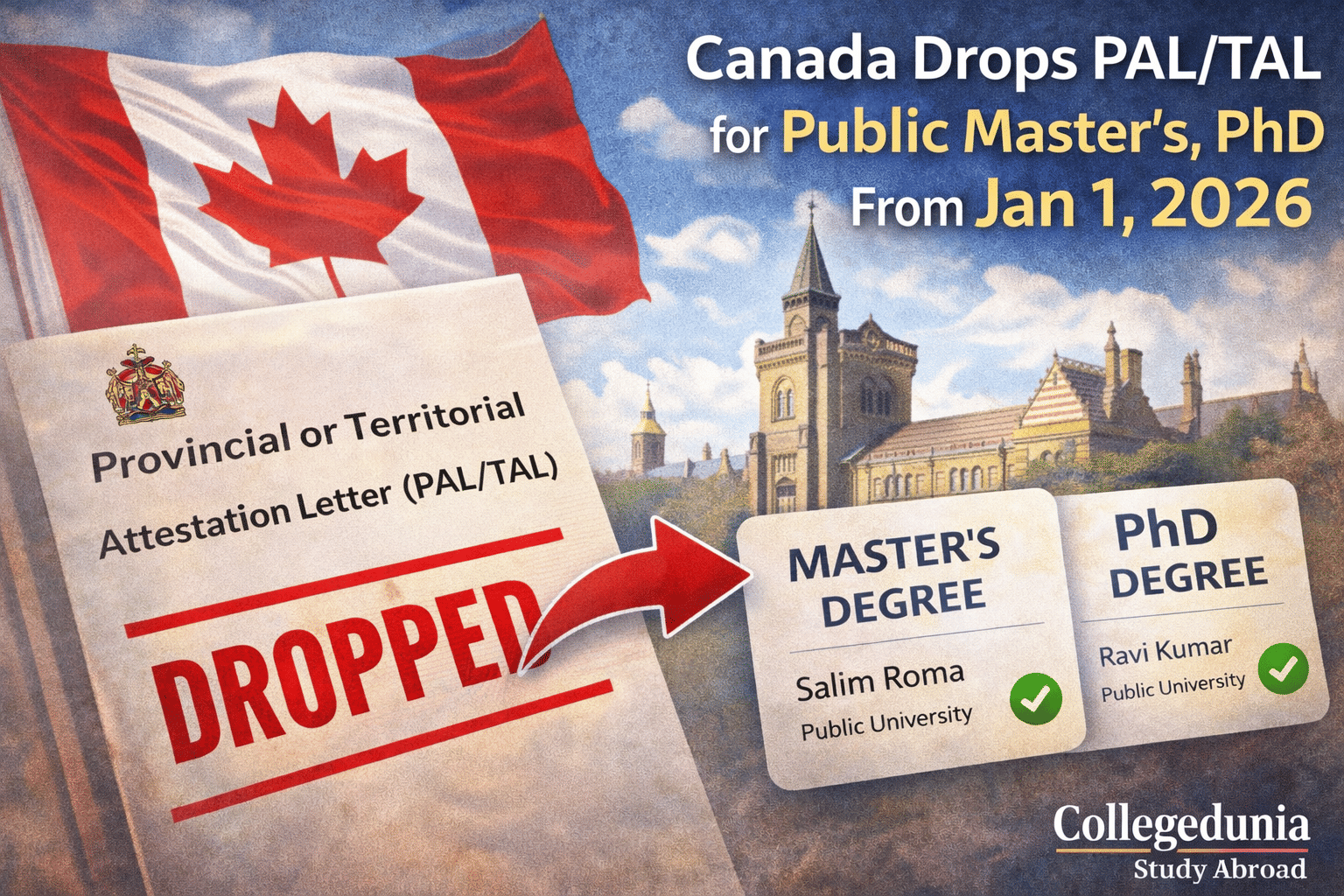
International students applying to Master’s or doctoral (PhD) degree programs at public institutions in Canada no longer need to submit a Provincial or Territorial Attestation Letter (PAL/TAL) with their study permit application, effective January 1, 2026, Immigration, Refugees and Citizenship Canada (IRCC) has confirmed.
For Indian applicants targeting Canada for Fall 2026 or Winter 2027 intakes, this is a material easing of the paperwork pipeline: it removes the extra “province attestation” step that many students have had to wait for before filing a study permit application.
What changed
IRCC’s notice on the 2026 international student cap states that Master’s and doctoral level students enrolled at a public designated learning institution (DLI) are exempt from the PAL/TAL requirement starting January 1, 2026. IRCC says the exemption recognises the “unique contributions” of graduate students and supports Canada’s talent and innovation goals.
IRCC has also published a dedicated “apply as a graduate student” guide that repeats the key rule: if you’re planning to attend a degree-granting Master’s or doctoral program at a public institution, you don’t need a PAL/TAL when applying for a study permit.
Who benefits and who doesn’t
Eligible for PAL/TAL exemption (from Jan 1, 2026):
- Applicants to Master’s degree programs at public institutions (public DLI)
- Applicants to Doctoral (PhD) degree programs at public institutions (public DLI)
Still need to check provincial rules:
- Quebec-bound students: IRCC states that if you plan to study in Quebec, you still must meet the province’s requirements, even though the federal PAL/TAL rule is waived for eligible public graduate programs.
- Important limitation: IRCC has signalled it will publish a full list of public DLIs offering eligible programs for this exemption “soon.” Until then, students should verify their institution’s public status and program level carefully.
Why this matters for Indian students
PAL/TAL requirements have been a major friction point for Canada-bound applicants because they add:
- an additional document dependency outside IRCC (issued at the provincial/territorial level), and
- potential timing risk during peak filing windows.
By removing PAL/TAL for public Master’s and PhD applicants, IRCC is effectively creating a clearer channel for Indian students pursuing research and advanced training, even as Canada continues to manage overall study permit volumes under the cap framework.
Next steps for 2026–27 applicants
- Confirm your program level is Master’s or PhD and is degree-granting.
- Confirm your institution is public (public DLI). Watch for IRCC’s forthcoming list of eligible public DLIs/programs.
- If studying in Quebec, check provincial requirements in addition to the federal study permit checklist.
- Apply with your Letter of Acceptance (LOA) and standard documentation; you should not be asked for PAL/TAL if you meet the exemption criteria.
Canada’s PAL/TAL process is linked to the federal government’s move to manage international student volumes by limiting the number of study permit applications processed/approved in certain cohorts. IRCC’s 2026 notice explicitly carves out public graduate programs from this PAL/TAL requirement starting January 1, 2026.



Comments