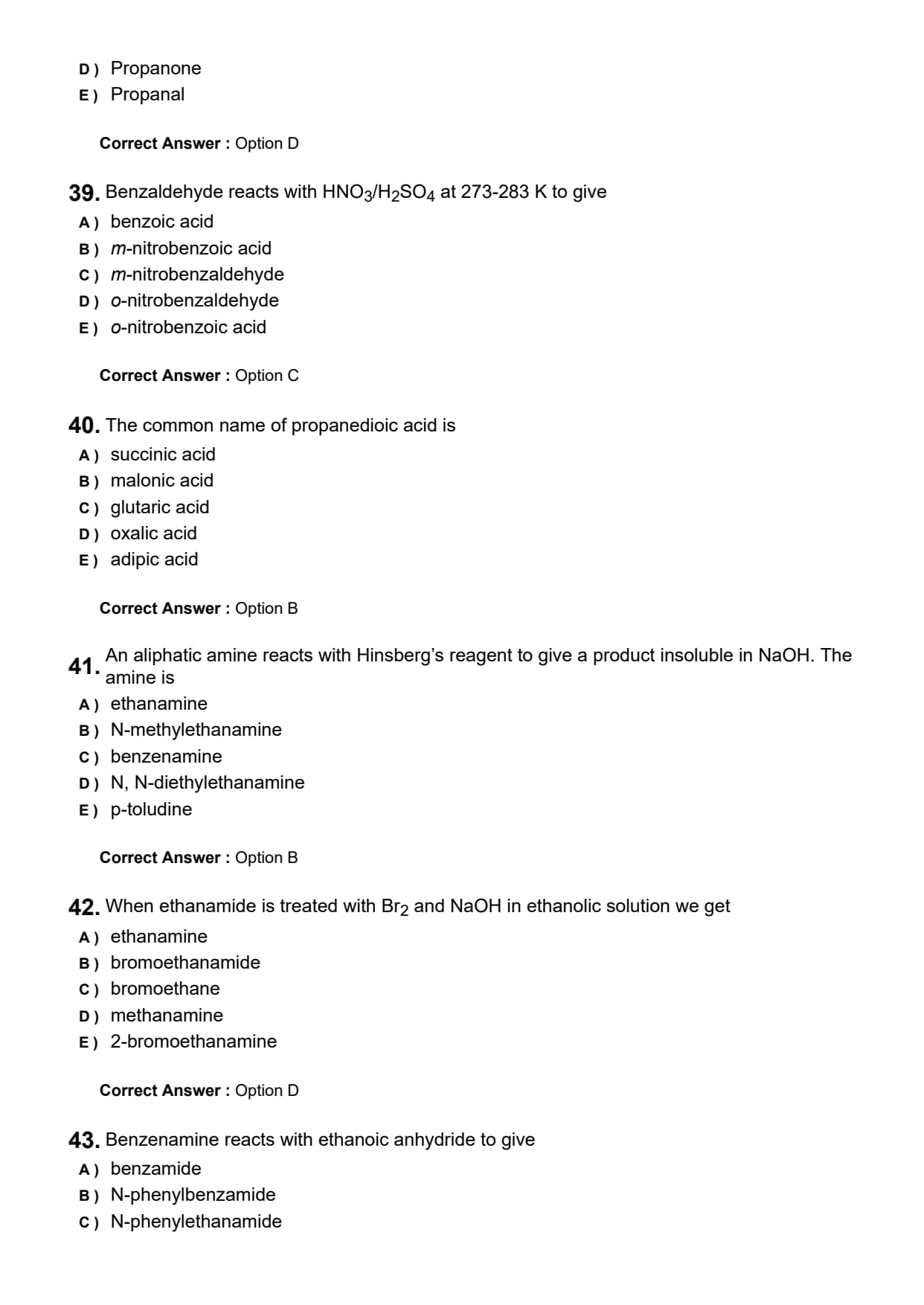
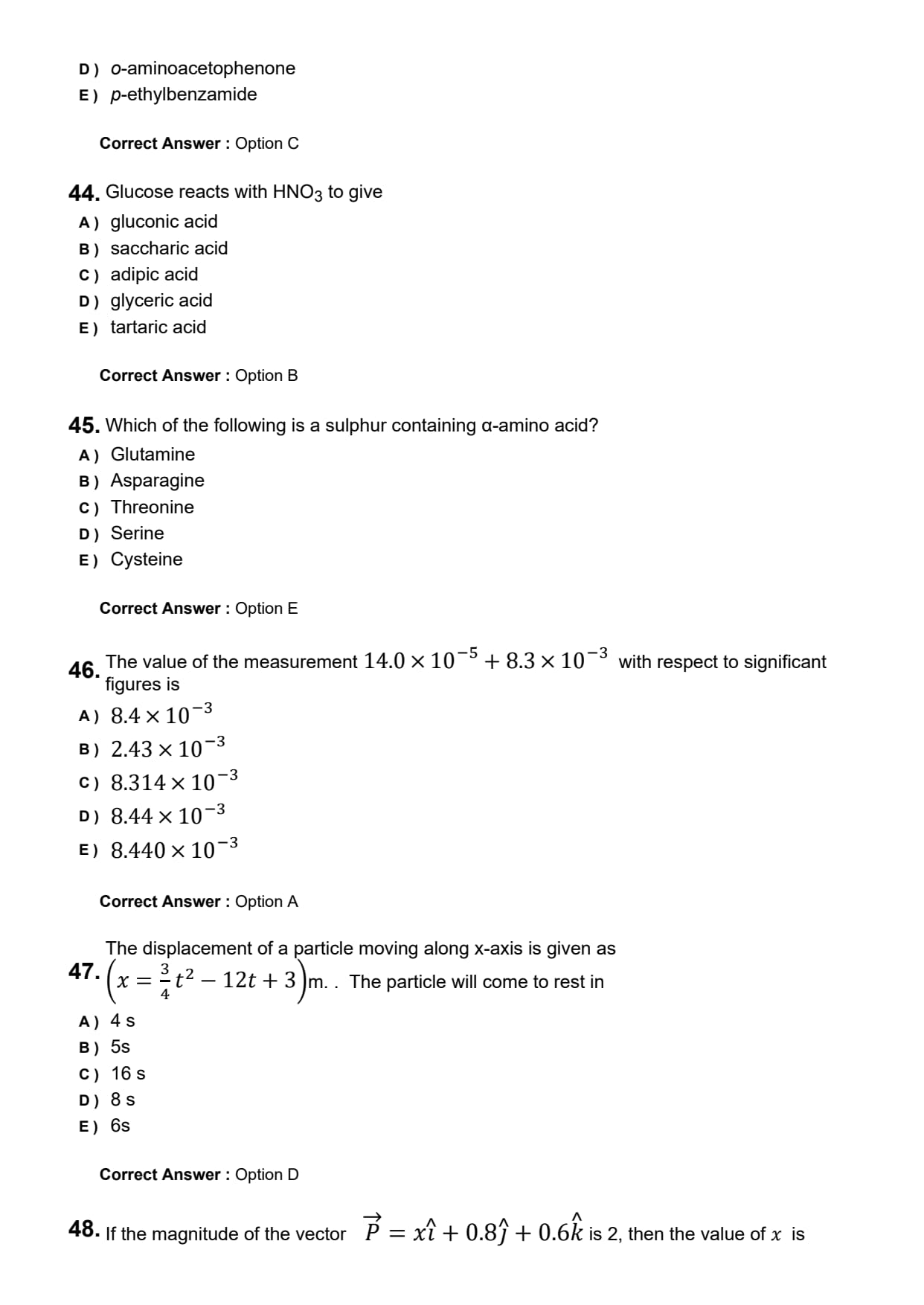
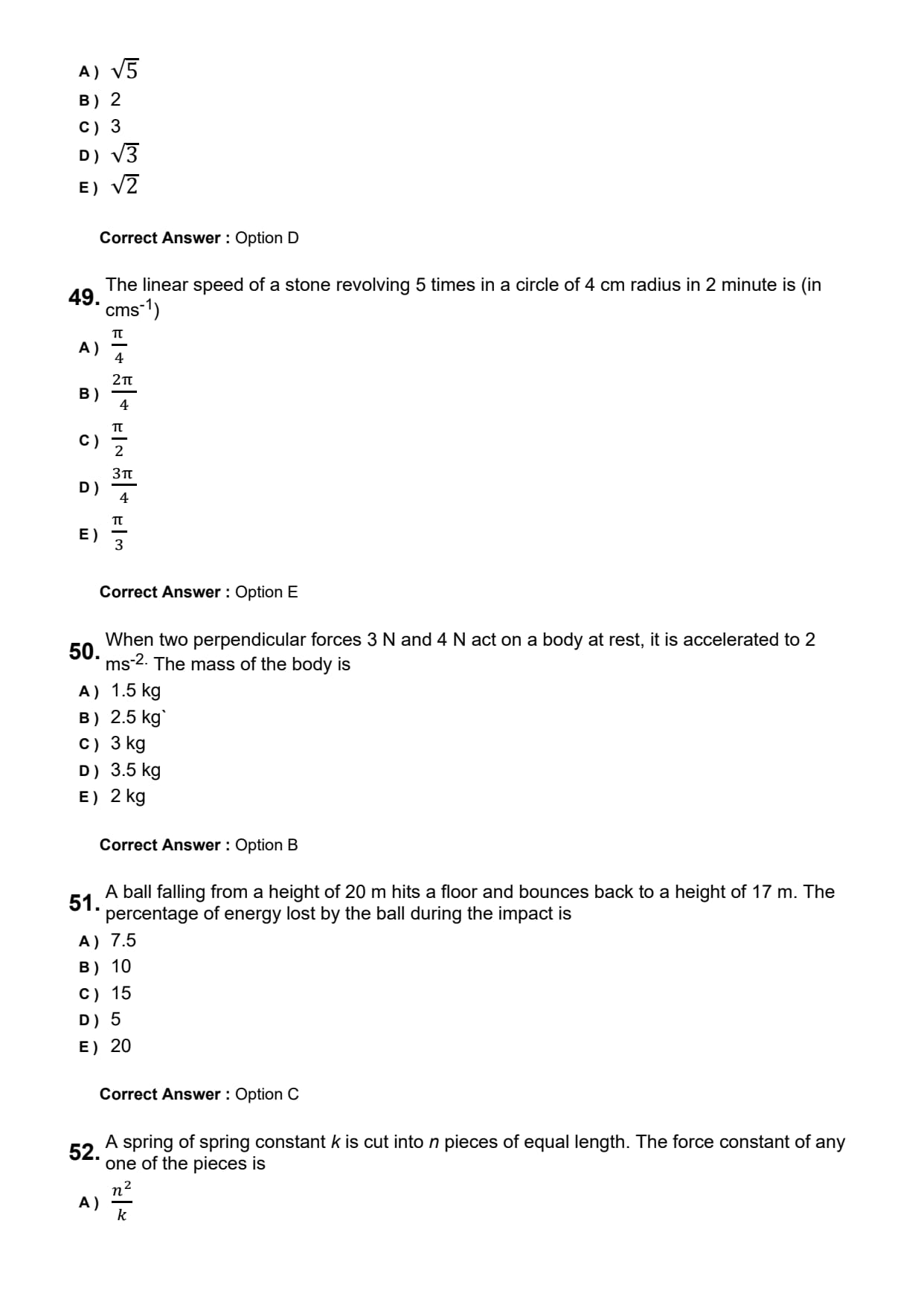
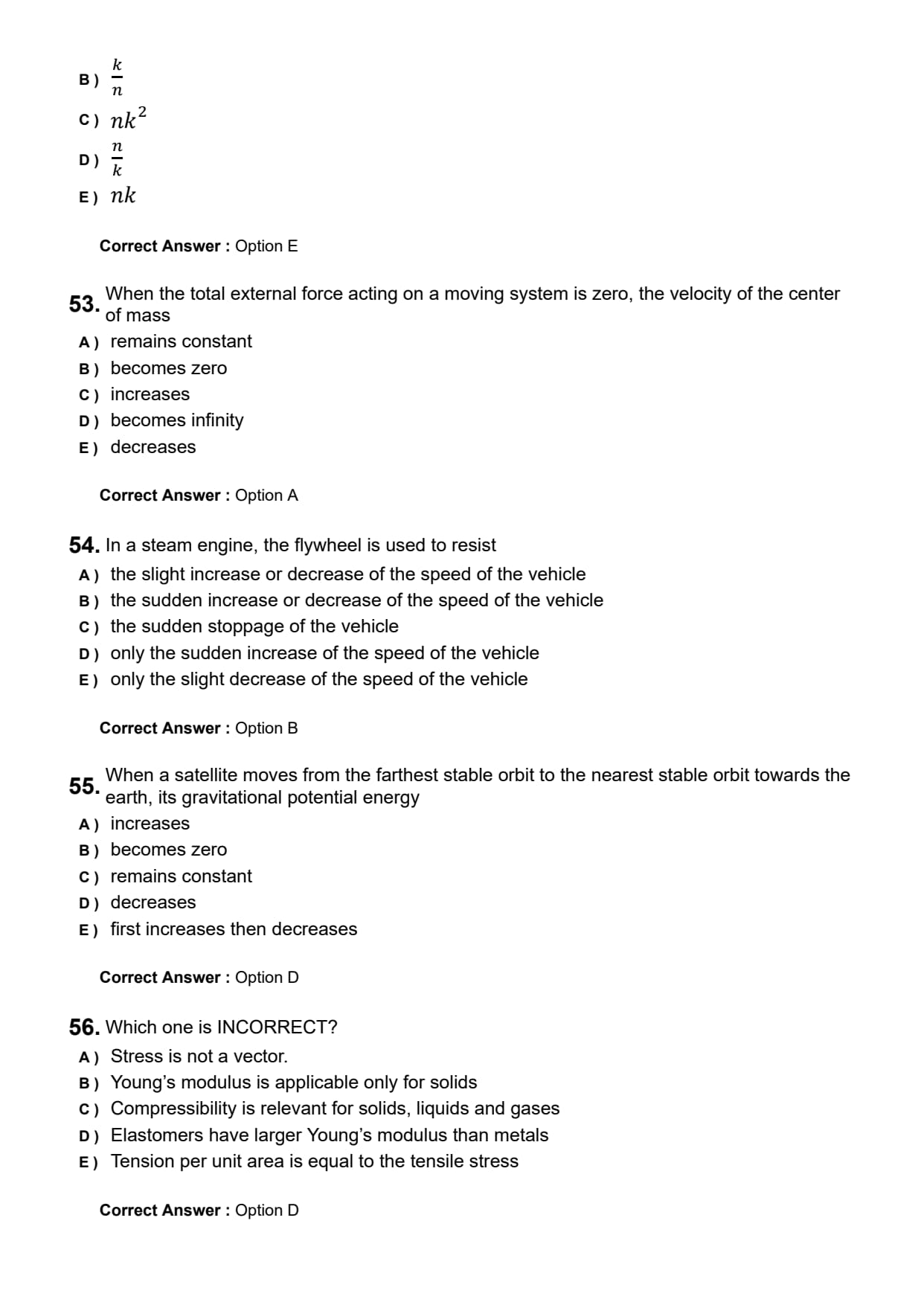
KEAM 2026 Pharmacy Question Paper for April 19 is available for download here. CEE Kerala conducted KEAM 2026 Pharmacy exam on April 19 in session 1 from 10 AM to 11.30 PM. KEAM 2026 Pharmacy exam is an online CBT with a total of 75 questions carrying a maximum of 300 marks.

  • The KEAM Pharmacy exam is divided into 2 subjects- Physics (30 questions) and Chemistry (45 questions).
  • 4 marks are given for every correct answer and 1 mark is deducted for every incorrect answer

Candidates can download KEAM 2026 April 19 Pharmacy Question Paper with Solution PDF from the links provided below.

KEAM 2026 Pharmacy April 19 Question Paper with Solution PDF

KEAM 2026 Pharmacy Question Paper April 19 Download PDF Check Solution
KEAM 2026 Pharmacy April 19 Question Paper with Solutions

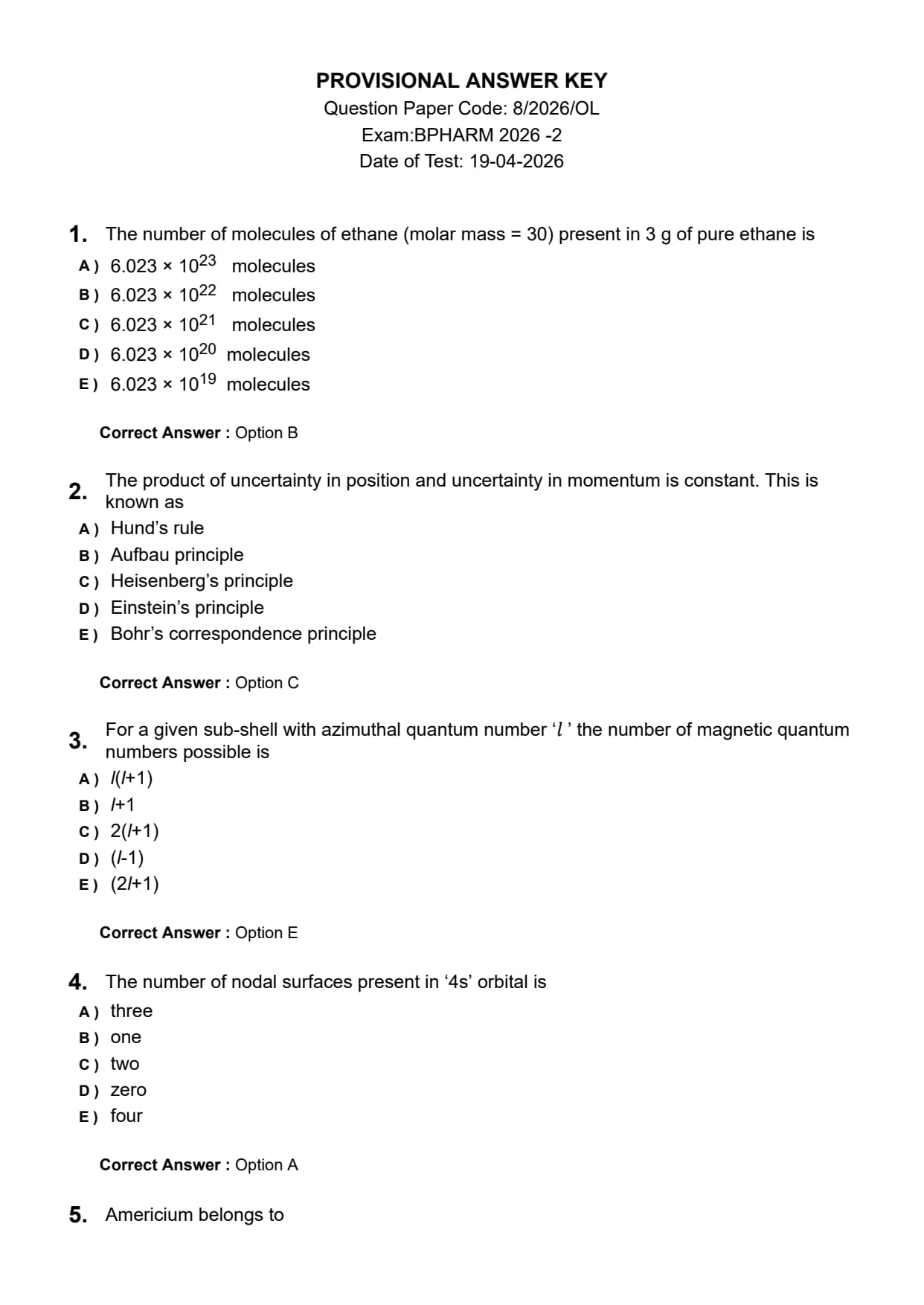
Question 1:

The number of molecules of ethane (molar mass \(=30\)) present in 3 g of pure ethane is

  • (A) \(6.023\times10^{23}\) molecules
  • (B) \(6.023\times10^{22}\) molecules
  • (C) \(6.023\times10^{21}\) molecules
  • (D) \(6.023\times10^{20}\) molecules
  • (E) \(6.023\times10^{19}\) molecules

Question 2:

The product of uncertainty in position and uncertainty in momentum is constant. This is known as

  • (A) Hund's rule
  • (B) Aufbau principle
  • (C) Heisenberg's principle
  • (D) Einstein's principle
  • (E) Bohr's correspondence principle

Question 3:

For a given sub-shell with azimuthal quantum number 'l' the number of magnetic quantum numbers possible is

  • (A) \(l(l+1)\)
  • (B) \(l+1\)
  • (C) \(2(l+1)\)
  • (D) \((l-1)\)
  • (E) \((2l+1)\)

Question 4:

The number of nodal surfaces present in '4s' orbital is

  • (A) three
  • (B) one
  • (C) two
  • (D) zero
  • (E) four

Question 5:

Americium belongs to

  • (A) representative elements
  • (B) chalcogens
  • (C) lanthanoids
  • (D) transition elements
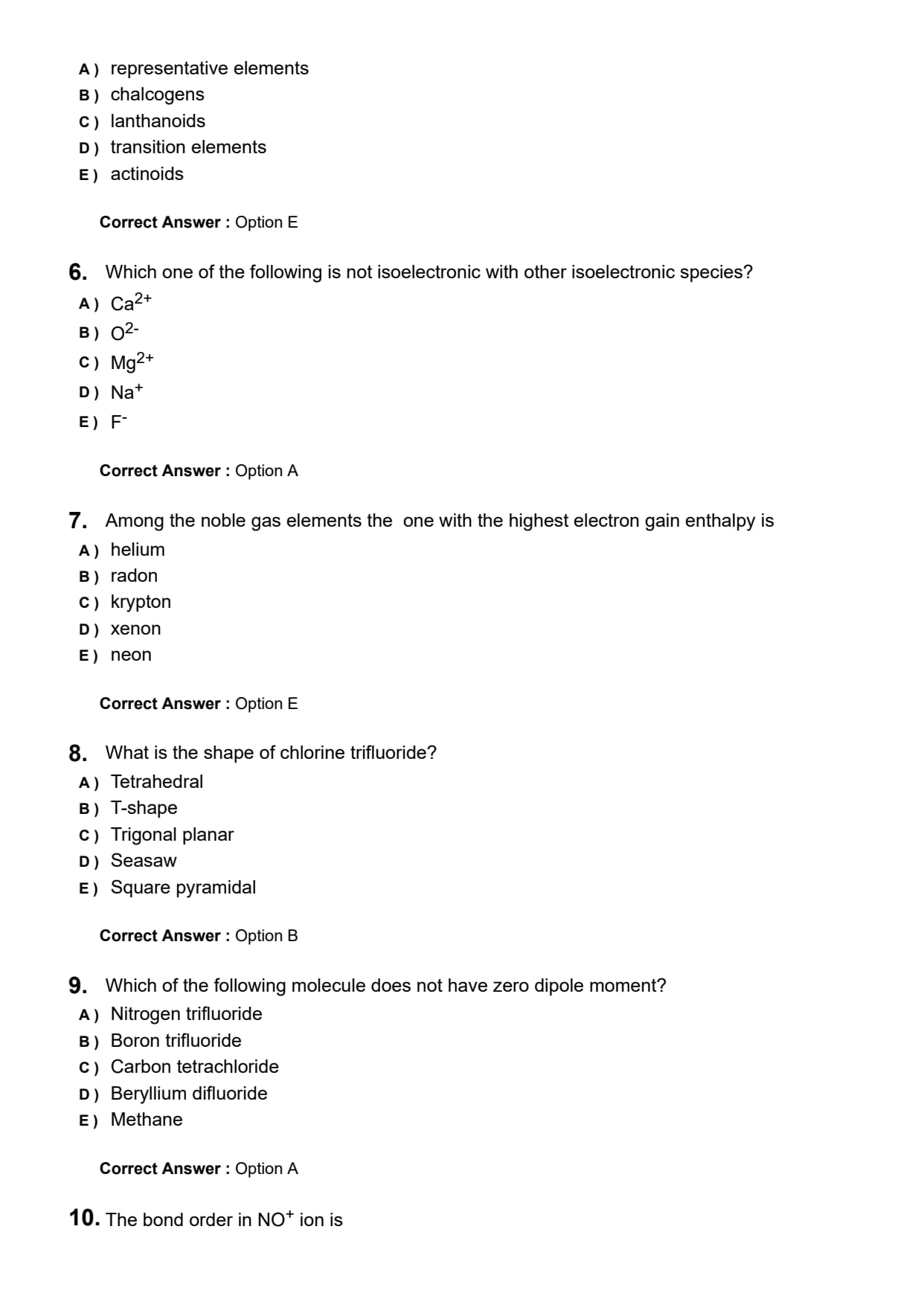
  • (E) actinoids

Question 6:

Which one of the following is not isoelectronic with other isoelectronic species?

  • (A) \(Ca^{2+}\)
  • (B) \(O^{2-}\)
  • (C) \(Mg^{2+}\)
  • (D) \(Na^{+}\)
  • (E) \(F^{-}\)

Question 7:

Among the noble gas elements the one with the highest electron gain enthalpy is

  • (A) helium
  • (B) radon
  • (C) krypton
  • (D) xenon
  • (E) neon

Question 8:

What is the shape of chlorine trifluoride?

  • (A) Tetrahedral
  • (B) T-shape
  • (C) Trigonal planar
  • (D) Seasaw
  • (E) Square pyramidal

Question 9:

Which of the following molecule does not have zero dipole moment?

  • (A) Nitrogen trifluoride
  • (B) Boron trifluoride
  • (C) Carbon tetrachloride
  • (D) Beryllium difluoride
  • (E) Methane

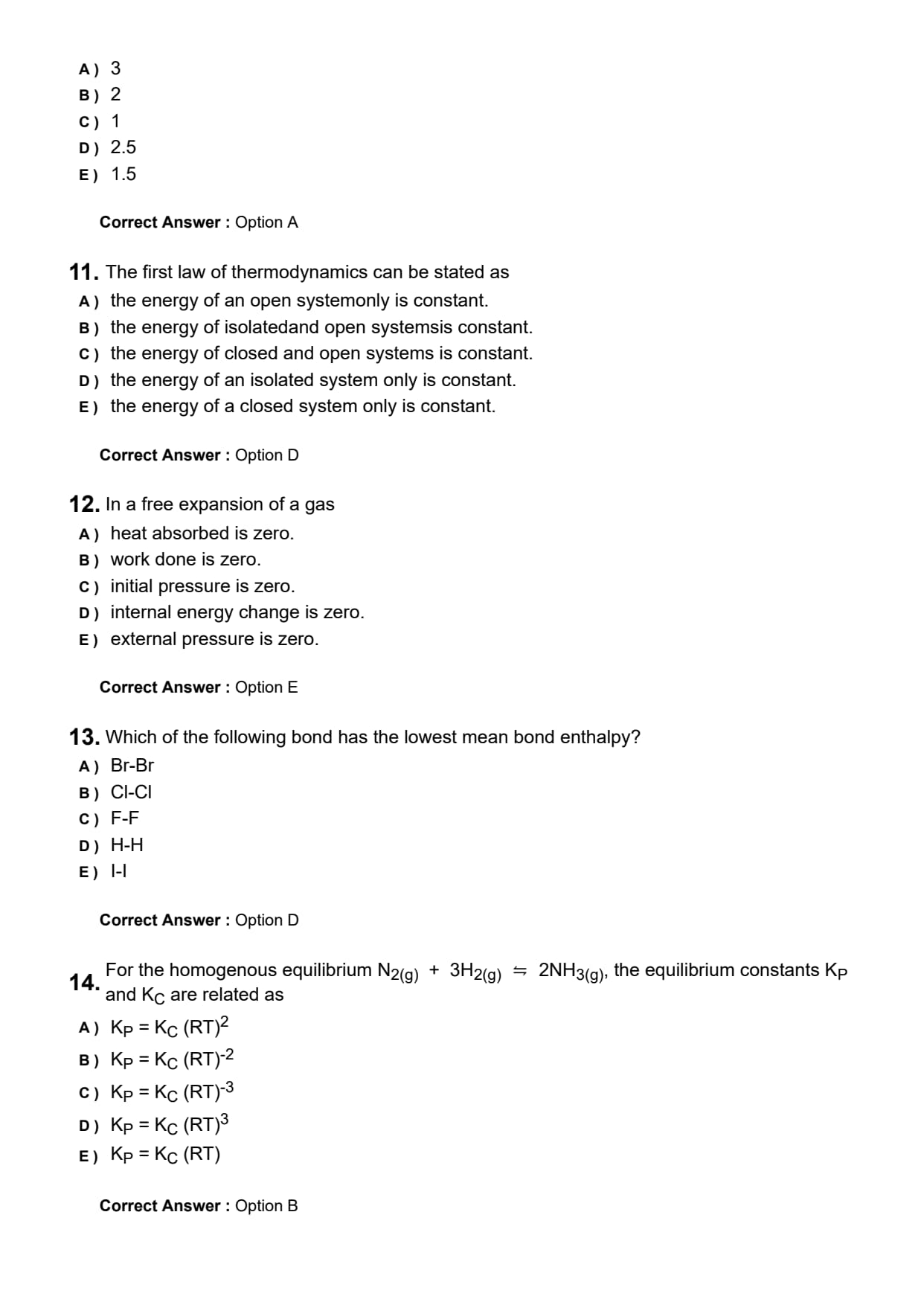
Question 10:

The bond order in \((NO^{+}\) ion is

  • (A) 3
  • (B) 2
  • (C) 1
  • (D) 2.5
  • (E) 1.5

Question 11:

The first law of thermodynamics can be stated as

  • (A) the energy of an open system only is constant.
  • (B) the energy of isolated and open systems is constant.
  • (C) the energy of closed and open systems is constant.
  • (D) the energy of an isolated system only is constant.
  • (E) the energy of a closed system only is constant.

Question 12:

In a free expansion of a gas

  • (A) heat absorbed is zero.
  • (B) work done is zero.
  • (C) initial pressure is zero.
  • (D) internal energy change is zero.
  • (E) external pressure is zero.

Question 13:

Which of the following bond has the lowest mean bond enthalpy?

  • (A) Br-Br
  • (B) Cl-Cl
  • (C) F-F
  • (D) H-H
  • (E) I-I

Question 14:

For the homogenous equilibrium \(N_{2(g)}+3H_{2(g)}=2NH_{3(g)}\), the equilibrium constants \(K_P\) and \(K_C\) are related as

  • (A) \(K_{P}=K_{C}(RT)^{2}\)
  • (B) \(K_{P}=K_{C}(RT)^{-2}\)
  • (C) \(K_{P}=K_{C}(RT)^{-3}\)
  • (D) \(K_{P}=K_{C}(RT)^{3}\)
  • (E) \(K_{P}=K_{C}(RT)\)

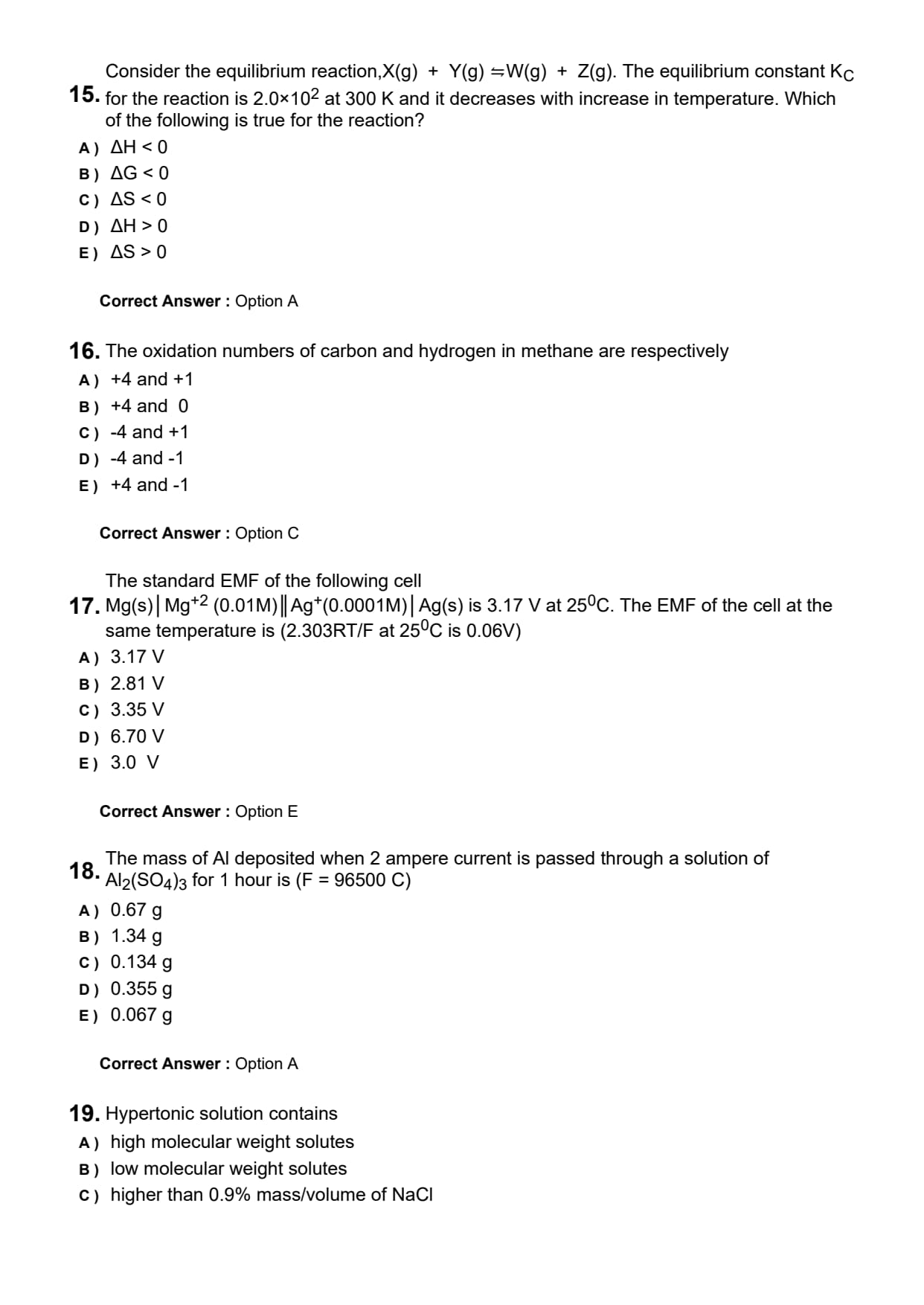
Question 15:

Consider the equilibrium reaction, \(X(g)+Y(g)=W(g)+Z(g)\). The equilibrium constant \(K_C\) for the reaction is \(2.0\times10^2\) at 300 K and it decreases with increase in temperature. Which of the following is true for the reaction?

  • (A) \(\Delta H<0\)
  • (B) \(\Delta G<0\)
  • (C) \(\Delta S<0\)
  • (D) \(\Delta H>0\)
  • (E) \(\Delta S>0\)

Question 16:

The oxidation numbers of carbon and hydrogen in methane are respectively

  • (A) +4 and +1
  • (B) +4 and 0
  • (C) -4 and +1
  • (D) -4 and -1
  • (E) +4 and -1

Question 17:

The standard EMF of the cell \(Mg(s)|Mg^{+2}(0.01M)||Ag^{+}(0.0001M)|Ag(s)\) is 3.17 V at \(25^{\circ}C\). The EMF of the cell at the same temperature is (2.303RT/F at \(25^{\circ}C\) is 0.06V)

  • (A) 3.17 V
  • (B) 2.81 V
  • (C) 3.35 V
  • (D) 6.70 V
  • (E) 3.0 V

Question 18:

The mass of Al deposited when 2 ampere current is passed through a solution of \(Al_2(SO_4)_3\) for 1 hour is (F = 96500 C)

  • (A) 0.67 g
  • (B) 1.34 g
  • (C) 0.134 g
  • (D) 0.355 g
  • (E) 0.067 g

Question 19:

Hypertonic solution contains

  • (A) high molecular weight solutes
  • (B) low molecular weight solutes
  • (C) higher than 0.9% mass/volume of NaCl
  • (D) less than 0.9% mass/volume of NaCl
  • (E) high osmotic pressure

Question 20:

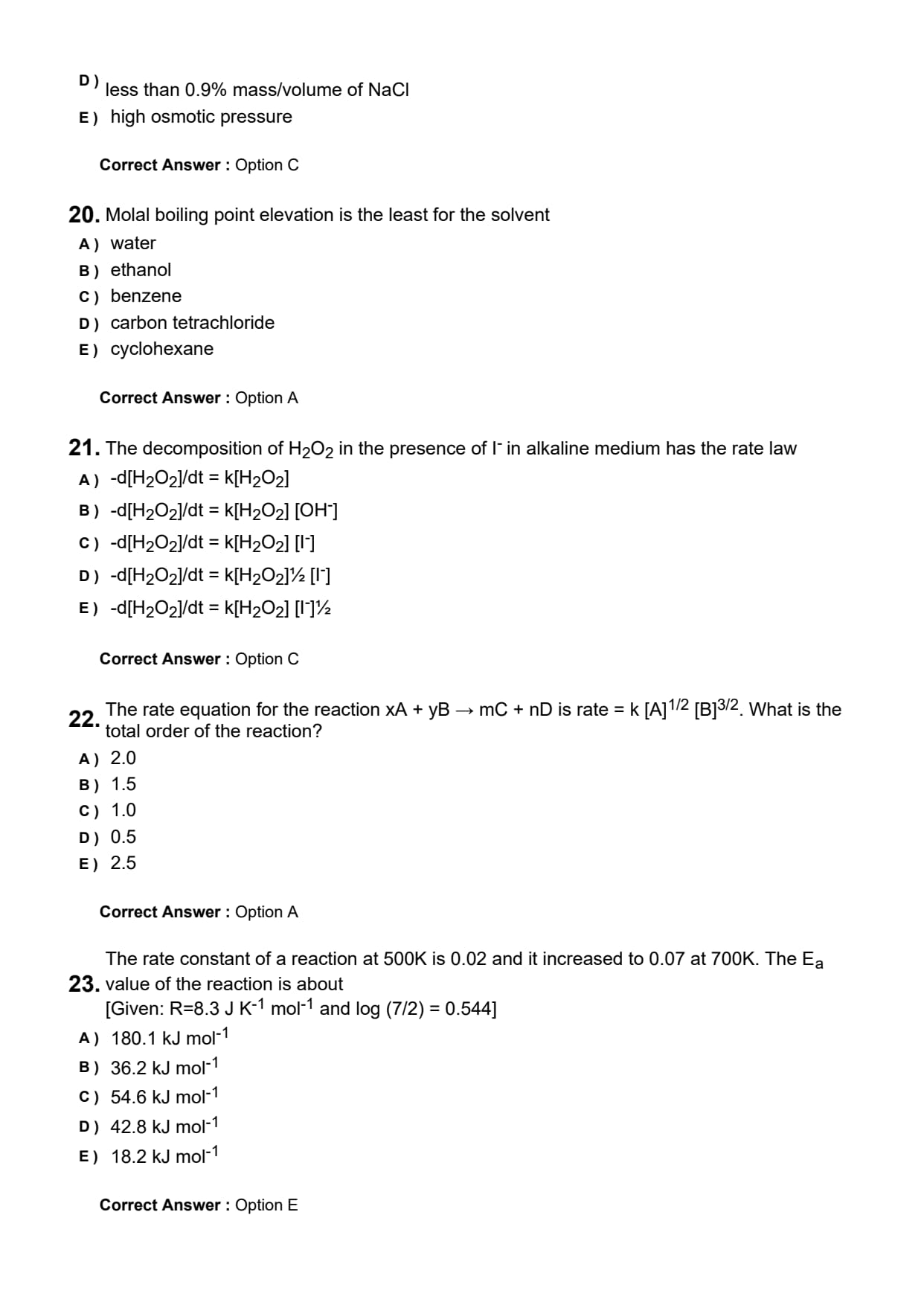
Molal boiling point elevation is the least for the solvent

  • (A) water
  • (B) ethanol
  • (C) benzene
  • (D) carbon tetrachloride
  • (E) cyclohexane

Question 21:

The decomposition of \(H_{2}O_{2}\) in the presence of \(I^{-}\) in alkaline medium has the rate law

  • (A) \(-d[H_{2}O_{2}]/dt=k[H_{2}O_{2}]\)
  • (B) \(-d[H_{2}O_{2}]/dt=k[H_{2}O_{2}][OH^{-}]\)
  • (C) \(-d[H_{2}O_{2}]/dt=k[H_{2}O_{2}][I^{-}]\)
  • (D) \(-d[H_{2}O_{2}]/dt=k[H_{2}O_{2}]^{1/2}[I^{-}]\)
  • (E) \(-d[H_{2}O_{2}]/dt=k[H_{2}O_{2}][I^{-}]^{1/2}\)

Question 22:

The rate equation for the reaction \(xA+yB\rightarrow mC+nD\) is rate \(=k[A]^{1/2}[B]^{3/2}\) What is the total order of the reaction?

  • (A) 2.0
  • (B) 1.5
  • (C) 1.0
  • (D) 0.5
  • (E) 2.5

Question 23:

The rate constant of a reaction at 500K is 0.02 and it increased to 0.07 at 700K. The \(E_{a}\) value of the reaction is about [Given: \(R=8.3~J~K^{-1}mol^{-1}\) and \(\log(7/2)=0.544\)]

  • (A) \(180.1~kJ~mol^{-1}\)
  • (B) \(36.2~kJ~mol^{-1}\)
  • (C) \(54.6~kJ~mol^{-1}\)
  • (D) \(42.8~kJ~mol^{-1}\)
  • (E) \(18.2~kJ~mol^{-1}\)

Question 24:

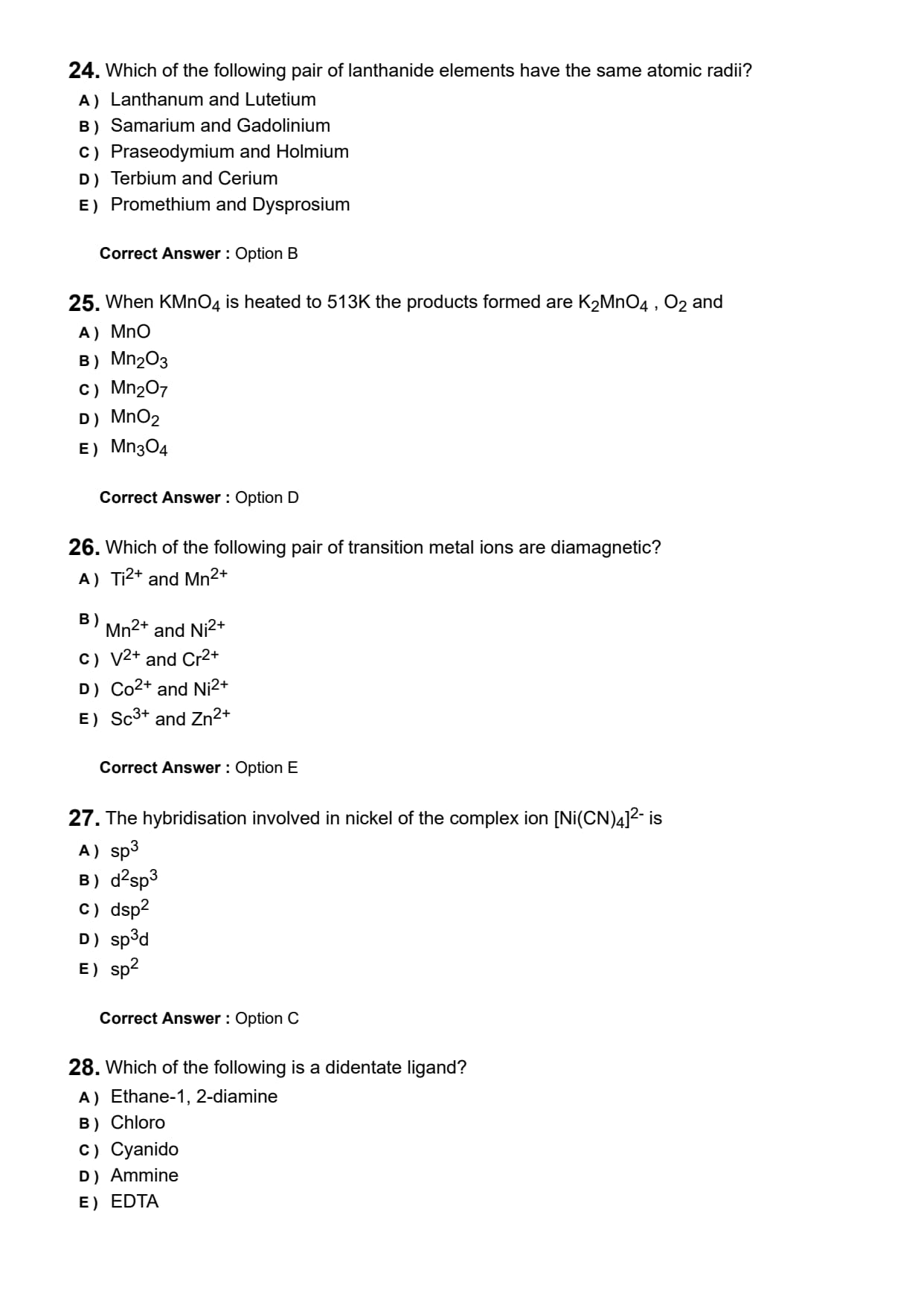
Which of the following pair of lanthanide elements have the same atomic radii?

  • (A) Lanthanum and Lutetium
  • (B) Samarium and Gadolinium
  • (C) Praseodymium and Holmium
  • (D) Terbium and Cerium
  • (E) Promethium and Dysprosium

Question 25:

When \(KMnO_{4}\) is heated to 513K the products formed are \(K_{2}MnO_{4}\), \(O_{2}\) and

  • (A) MnO
  • (B) \(Mn_{2}O_{3}\)
  • (C) \(Mn_{2}O_{7}\)
  • (D) \(MnO_{2}\)
  • (E) \(Mn_{3}O_{4}\)

Question 26:

Which of the following pair of transition metal ions are diamagnetic?

  • (A) \(Ti^{2+}\) and \(Mn^{2+}\)
  • (B) \(Mn^{2+}\) and \(Ni^{2+}\)
  • (C) \(V^{2+}\) and \(Cr^{2+}\)
  • (D) \(Co^{2+}\) and \(Ni^{2+}\)
  • (E) \(Sc^{3+}\) and \(Zn^{2+}\)

Question 27:

The hybridisation involved in nickel of the complex ion \([Ni(CN)_{4}]^{2-}\) is

  • (A) \(sp^{3}\)
  • (B) \(d^{2}sp^{3}\)
  • (C) \(dsp^{2}\)
  • (D) \(sp^{3}d\)
  • (E) \(sp^{2}\)

Question 28:

Which of the following is a didentate ligand?

  • (A) Ethane-1, 2-diamine
  • (B) Chloro
  • (C) Cyanido
  • (D) Ammine
  • (E) EDTA

Question 29:

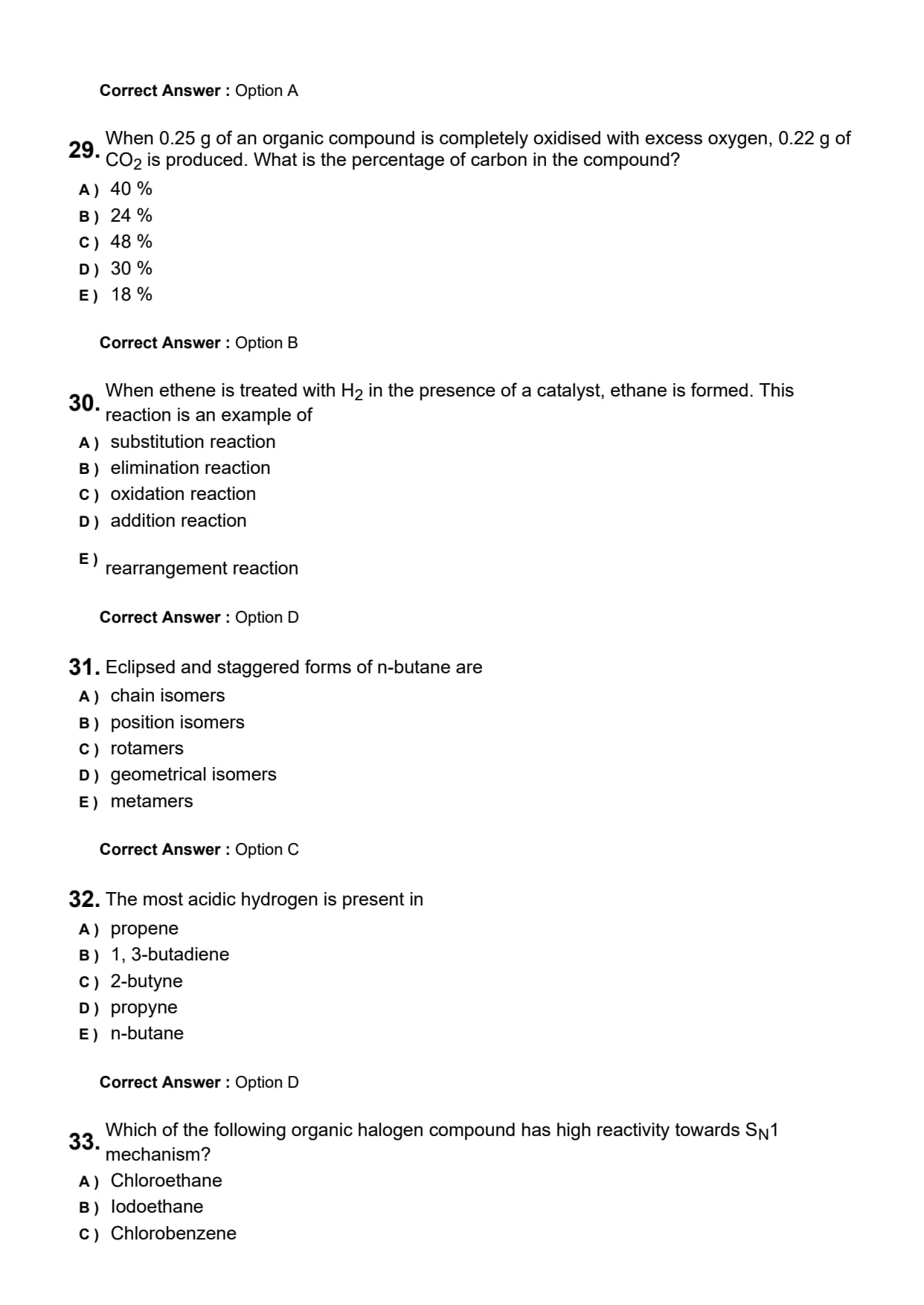
When 0.25 g of an organic compound is completely oxidised with excess oxygen, 0.22 g of \(CO_{2}\) is produced. What is the percentage of carbon in the compound?

  • (A) 40%
  • (B) 24%
  • (C) 48%
  • (D) 30%
  • (E) 18%

Question 30:

When ethene is treated with \(H_{2}\) in the presence of a catalyst, ethane is formed. This reaction is an example of

  • (A) substitution reaction
  • (B) elimination reaction
  • (C) oxidation reaction
  • (D) addition reaction
  • (E) rearrangement reaction

Question 31:

Eclipsed and staggered forms of n-butane are

  • (A) chain isomers
  • (B) position isomers
  • (C) rotamers
  • (D) geometrical isomers
  • (E) metamers

Question 32:

The most acidic hydrogen is present in

  • (A) propene
  • (B) 1, 3-butadiene
  • (C) 2-butyne
  • (D) propyne
  • (E) n-butane

Question 33:

Which of the following organic halogen compound has high reactivity towards \(S_{N}1\) mechanism?

  • (A) Chloroethane
  • (B) Iodoethane
  • (C) Chlorobenzene
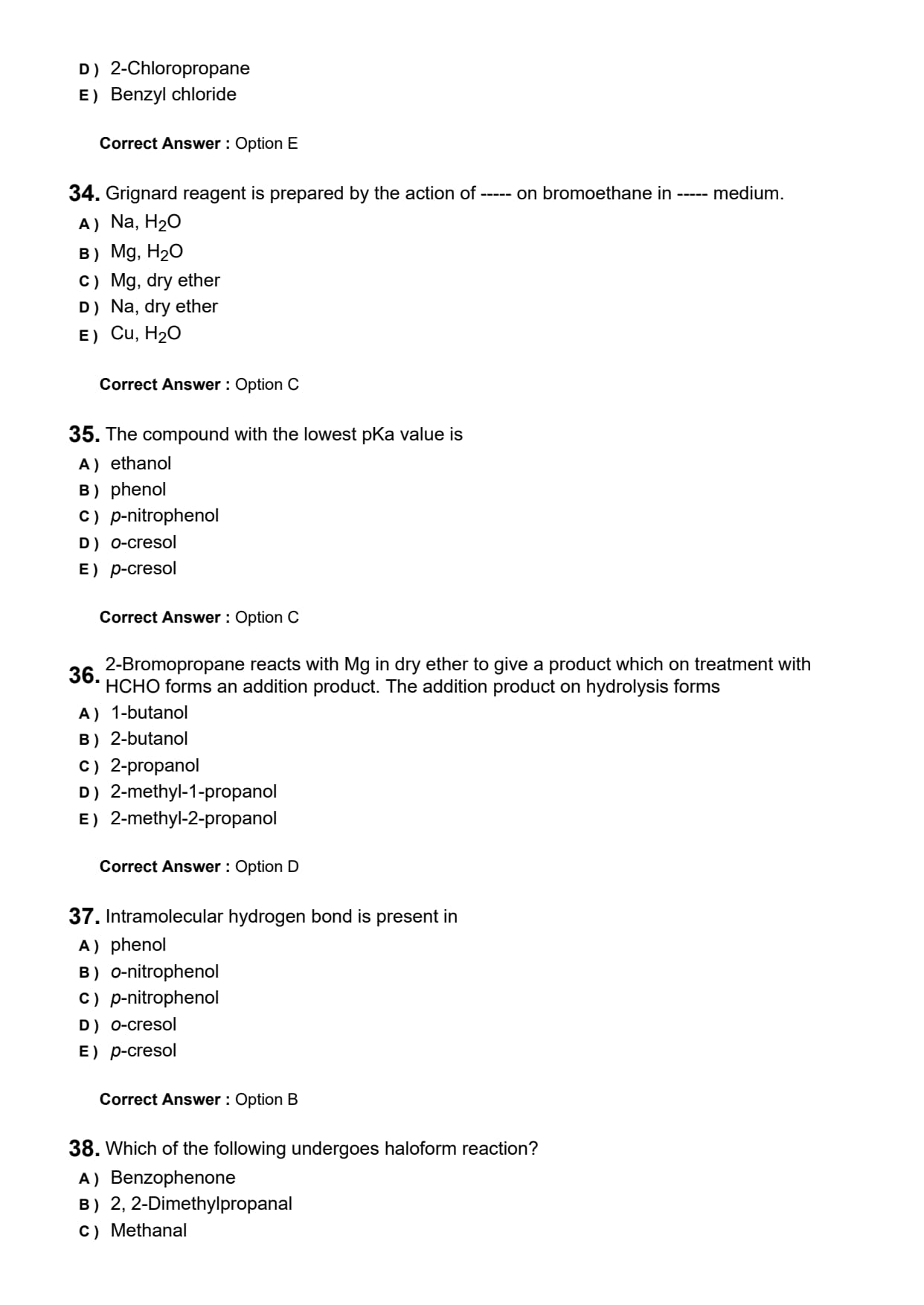
  • (D) 2-Chloropropane
  • (E) Benzyl chloride

Question 34:

Grignard reagent is prepared by the action of

  • (A) Na, \(H_{2}O\)
  • (B) Mg, \(H_{2}O\)
  • (C) Mg, dry ether
  • (D) Na, dry ether
  • (E) Cu, \(H_{2}O\)

Question 35:

The compound with the lowest pKa value is

  • (A) ethanol
  • (B) phenol
  • (C) p-nitrophenol
  • (D) o-cresol
  • (E) p-cresol

Question 36:

2-Bromopropane reacts with Mg in dry ether to give a product which on treatment with HCHO forms an addition product. The addition product on hydrolysis forms

  • (A) 1-butanol
  • (B) 2-butanol
  • (C) 2-propanol
  • (D) 2-methyl-1-propanol
  • (E) 2-methyl-2-propanol

Question 37:

Intramolecular hydrogen bond is present in

  • (A) phenol
  • (B) o-nitrophenol
  • (C) p-nitrophenol
  • (D) o-cresol
  • (E) p-cresol

Question 38:

Which of the following undergoes haloform reaction?

  • (A) Benzophenone
  • (B) 2, 2-Dimethylpropanal
  • (C) Methanal
  • (D) Propanone
  • (E) Propanal

Question 39:

Benzaldehyde reacts with \(HNO_{3}/H_{2}SO_{4}\) at 273-283 K to give

  • (A) benzoic acid
  • (B) m-nitrobenzoic acid
  • (C) m-nitrobenzaldehyde
  • (D) o-nitrobenzaldehyde
  • (E) o-nitrobenzoic acid

Question 40:

The common name of propanedioic acid is

  • (A) succinic acid
  • (B) malonic acid
  • (C) glutaric acid
  • (D) oxalic acid
  • (E) adipic acid

Question 41:

An aliphatic amine reacts with Hinsberg's reagent to give a product insoluble in NaOH. The amine is

  • (A) ethanamine
  • (B) N-methylethanamine
  • (C) benzenamine
  • (D) N, N-diethylethanamine
  • (E) p-toludine

Question 42:

When ethanamide is treated with \(Br_{2}\) and NaOH in ethanolic solution we get

  • (A) ethanamine
  • (B) bromoethanamide
  • (C) bromoethane
  • (D) methanamine
  • (E) 2-bromoethanamine

Question 43:

Benzenamine reacts with ethanoic anhydride to give

  • (A) benzamide
  • (B) N-phenylbenzamide
  • (C) N-phenylethanamide
  • (D) o-aminoacetophenone
  • (E) p-ethylbenzamide

Question 44:

Glucose reacts with \(HNO_{3}\) to give

  • (A) gluconic acid
  • (B) saccharic acid
  • (C) adipic acid
  • (D) glyceric acid
  • (E) tartaric acid

Question 45:

Which of the following is a sulphur containing \(\alpha\)-amino acid?

  • (A) Glutamine
  • (B) Asparagine
  • (C) Threonine
  • (D) Serine
  • (E) Cysteine

Question 46:

The value of the measurement \(14.0\times10^{-5}+8.3\times10^{-3}\) with respect to significant figures is

  • (A) \(8.4\times10^{-3}\)
  • (B) \(8.314\times10^{-3}\)
  • (C) \(2.43\times10^{-3}\)
  • (D) \(8.44\times10^{-3}\)
  • (E) \(8.440\times10^{-3}\)

Question 47:

The displacement of a particle moving along x-axis is given as \((x=\frac{3}{4}t^{2}-12t+3)m\). The particle will come to rest in

  • (A) 4 s
  • (B) 5 s
  • (C) 16 s
  • (D) 8 s
  • (E) 6 s

Question 48:

If the magnitude of the vector \(\vec{P}=x\hat{i}+0.8\hat{j}+0.6\hat{k}\) is 2, then the value of x is

  • (A) \(\sqrt{5}\)
  • (B) 2
  • (C) 3
  • (D) \(\sqrt{3}\)
  • (E) \(\sqrt{2}\)

Question 49:

The linear speed of a stone revolving 5 times in a circle of 4 cm radius in 2 minute is (in \(cm s^{-1}\))

  • (A) \(\frac{\pi}{4}\)
  • (B) \(\frac{2\pi}{4}\)
  • (C) \(\frac{\pi}{2}\)
  • (D) \(\frac{3\pi}{4}\)
  • (E) \(\frac{\pi}{3}\)

Question 50:

When two perpendicular forces 3 N and 4 N act on a body at rest, it is accelerated to \(2 ms^{-2}\). The mass of the body is

  • (A) 1.5 kg
  • (B) 2.5 kg
  • (C) 3 kg
  • (D) 3.5 kg
  • (E) 2 kg

Question 51:

A ball falling from a height of 20 m hits a floor and bounces back to a height of 17 m. The percentage of energy lost by the ball during the impact is

  • (A) 7.5
  • (B) 10
  • (C) 15
  • (D) 5
  • (E) 20

Question 52:

A spring of spring constant k is cut into n pieces of equal length. The force constant of any one of the pieces is

  • (A) \(\frac{n^{2}}{k}\)
  • (B) \(\frac{k}{n}\)
  • (C) \(nk^{2}\)
  • (D) \(\frac{n}{k}\)
  • (E) \(nk\)

Question 53:

When the total external force acting on a moving system is zero, the velocity of the center of mass

  • (A) remains constant
  • (B) becomes zero
  • (C) increases
  • (D) becomes infinity
  • (E) decreases

Question 54:

In a steam engine, the flywheel is used to resist

  • (A) the slight increase or decrease of the speed of the vehicle
  • (B) the sudden increase or decrease of the speed of the vehicle
  • (C) the sudden stoppage of the vehicle
  • (D) only the sudden increase of the speed of the vehicle
  • (E) only the slight decrease of the speed of the vehicle

Question 55:

When a satellite moves from the farthest stable orbit to the nearest stable orbit towards the earth, its gravitational potential energy

  • (A) increases
  • (B) becomes zero
  • (C) remains constant
  • (D) decreases
  • (E) first increases then decreases

Question 56:

Which one is INCORRECT?

  • (A) Stress is not a vector.
  • (B) Young's modulus is applicable only for solids
  • (C) Compressibility is relevant for solids, liquids and gases
  • (D) Elastomers have larger Young's modulus than metals
  • (E) Tension per unit area is equal to the tensile stress

Question 57:

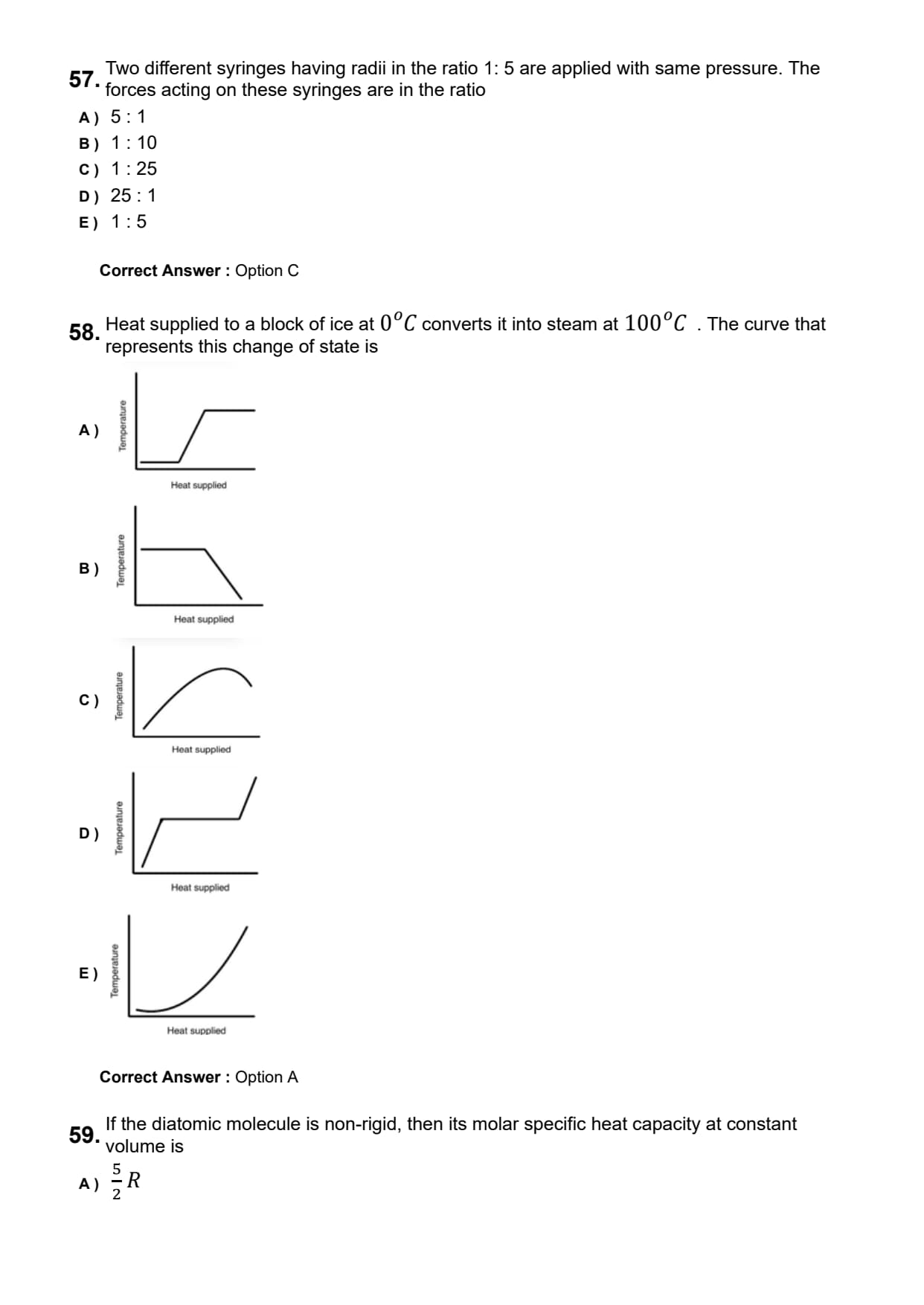
Two different syringes having radii in the ratio 1: 5 are applied with same pressure. The forces acting on these syringes are in the ratio

  • (A) 5:1
  • (B) 1:10
  • (C) 1:25
  • (D) 25:1
  • (E) 1:5

Question 58:

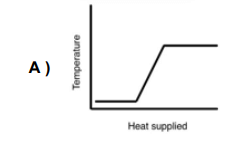
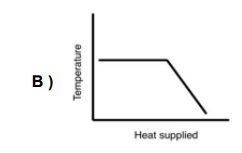
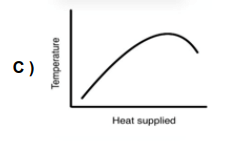
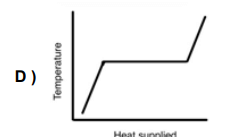
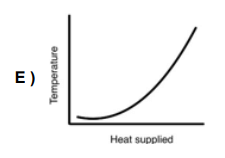
Heat supplied to a block of ice at \(0^{\circ}C\) converts it into steam at \(100^{\circ}C\). The curve that represents this change of state is

  • (A)
  • (B)
  • (C)
  • (D)
  • (E)

Question 59:

If the diatomic molecule is non-rigid, then its molar specific heat capacity at constant volume is

  • (A) \(\frac{5}{2}R\)
  • (B) \(\frac{7}{2}R\)
  • (C) \(\frac{1}{2}R\)
  • (D) \(\frac{9}{2}R\)
  • (E) \(\frac{3}{2}R\)

Question 60:

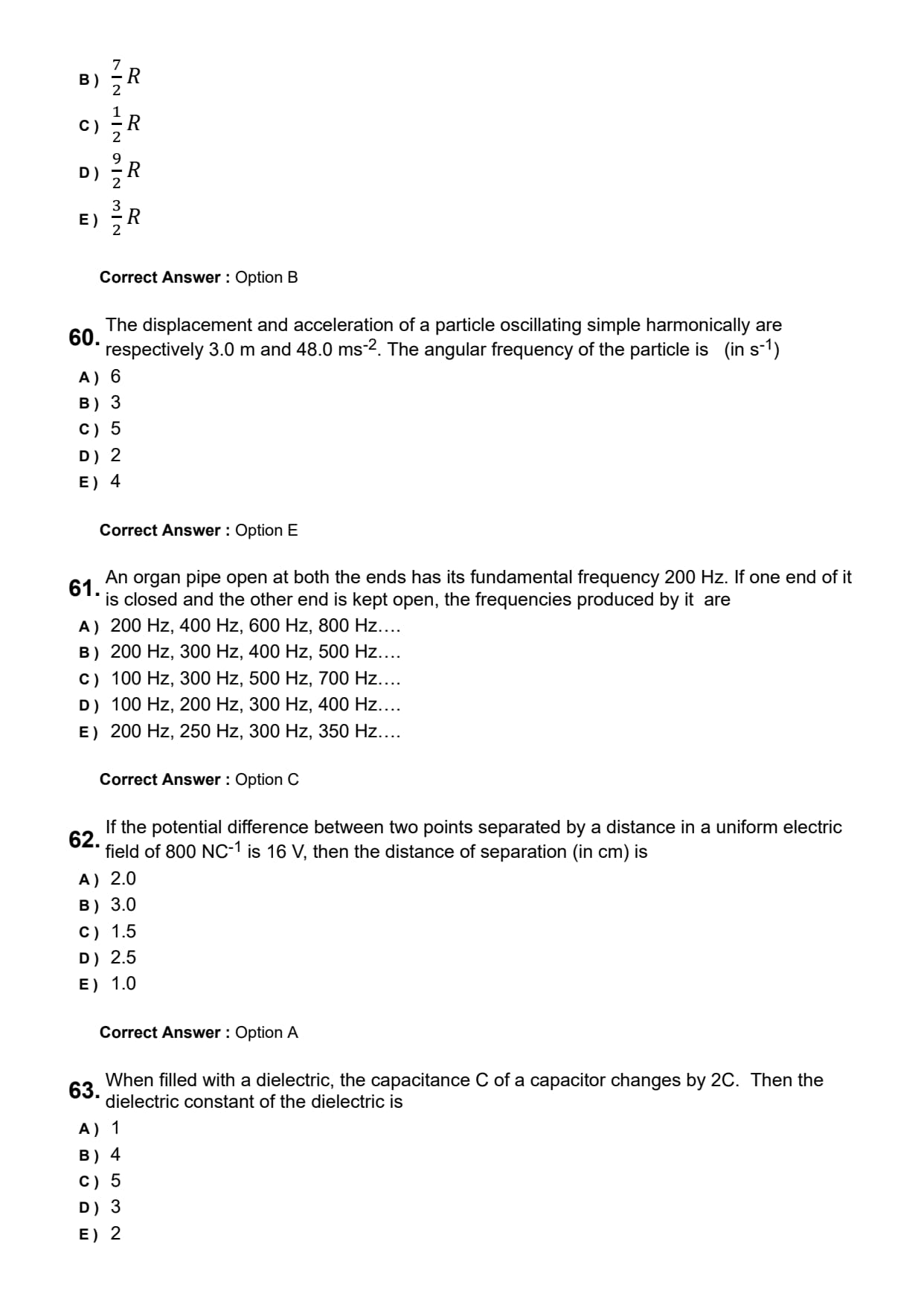
The displacement and acceleration of a particle oscillating simple harmonically are respectively 3.0 m and \(48.0~ms^{-2}\). The angular frequency of the particle is (in \(s^{-1}\))

  • (A) 6
  • (B) 3
  • (C) 5
  • (D) 2
  • (E) 4

Question 61:

An organ pipe open at both the ends has its fundamental frequency 200 Hz. If one end of it is closed and the other end is kept open, the frequencies produced by it are

  • (A) 200 Hz, 400 Hz, 600 Hz, 800 Hz....
  • (B) 200 Hz, 300 Hz, 400 Hz, 500 Hz....
  • (C) 100 Hz, 300 Hz, 500 Hz, 700 Hz....
  • (D) 100 Hz, 200 Hz, 300 Hz, 400 Hz....
  • (E) 200 Hz, 250 Hz, 300 Hz, 350 Hz....

Question 62:

If the potential difference between two points separated by a distance in a uniform electric field of 800 \(NC^{-1}\) is 16 V, then the distance of separation (in cm) is

  • (A) 2.0
  • (B) 3.0
  • (C) 1.5
  • (D) 2.5
  • (E) 1.0

Question 63:

When filled with a dielectric, the capacitance C of a capacitor changes by 2C. Then the dielectric constant of the dielectric is

  • (A) 1
  • (B) 4
  • (C) 5
  • (D) 3
  • (E) 2

Question 64:

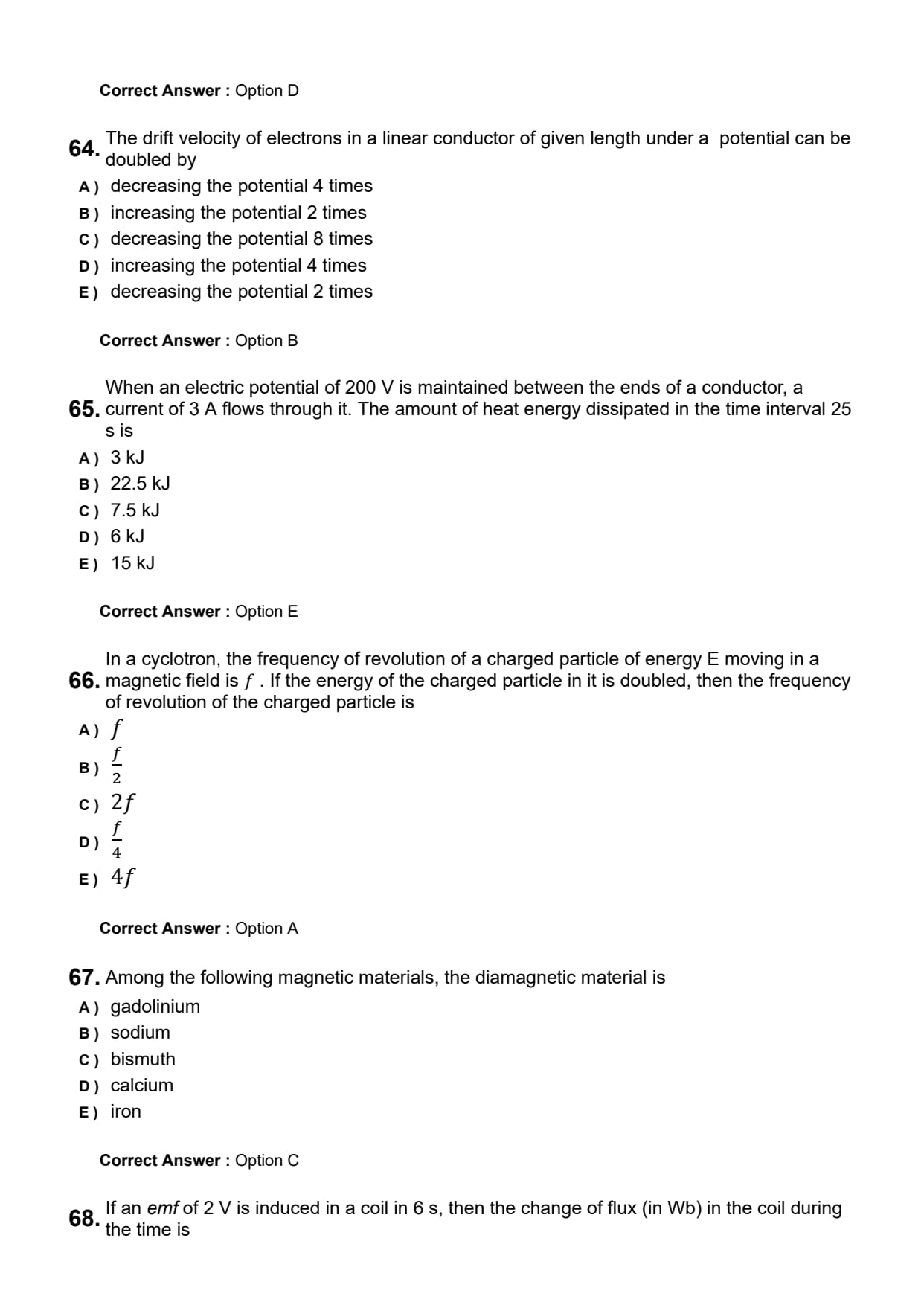
The drift velocity of electrons in a linear conductor of given length under a potential can be doubled by

  • (A) decreasing the potential 4 times
  • (B) increasing the potential 2 times
  • (C) decreasing the potential 8 times
  • (D) increasing the potential 4 times
  • (E) decreasing the potential 2 times

Question 65:

When an electric potential of 200 V is maintained between the ends of a conductor, a current of 3 A flows through it. The amount of heat energy dissipated in the time interval 25 s is

  • (A) 3 kJ
  • (B) 22.5 kJ
  • (C) 7.5 kJ
  • (D) 6 kJ
  • (E) 15 kJ

Question 66:

In a cyclotron, the frequency of revolution of a charged particle of energy E moving in a magnetic field is f. If the energy of the charged particle in it is doubled, then the frequency of revolution of the charged particle is

  • (A) f
  • (B) \(\frac{f}{2}\)
  • (C) 2f
  • (D) \(\frac{f}{4}\)
  • (E) 4f

Question 67:

Among the following magnetic materials, the diamagnetic material is

  • (A) gadolinium
  • (B) sodium
  • (C) bismuth
  • (D) calcium
  • (E) iron

Question 68:

If an emf of 2 V is induced in a coil in 6 s, then the change of flux (in Wb) in the coil during the time is

  • (A) 3
  • (B) 24
  • (C) 6
  • (D) 18
  • (E) 12

Question 69:

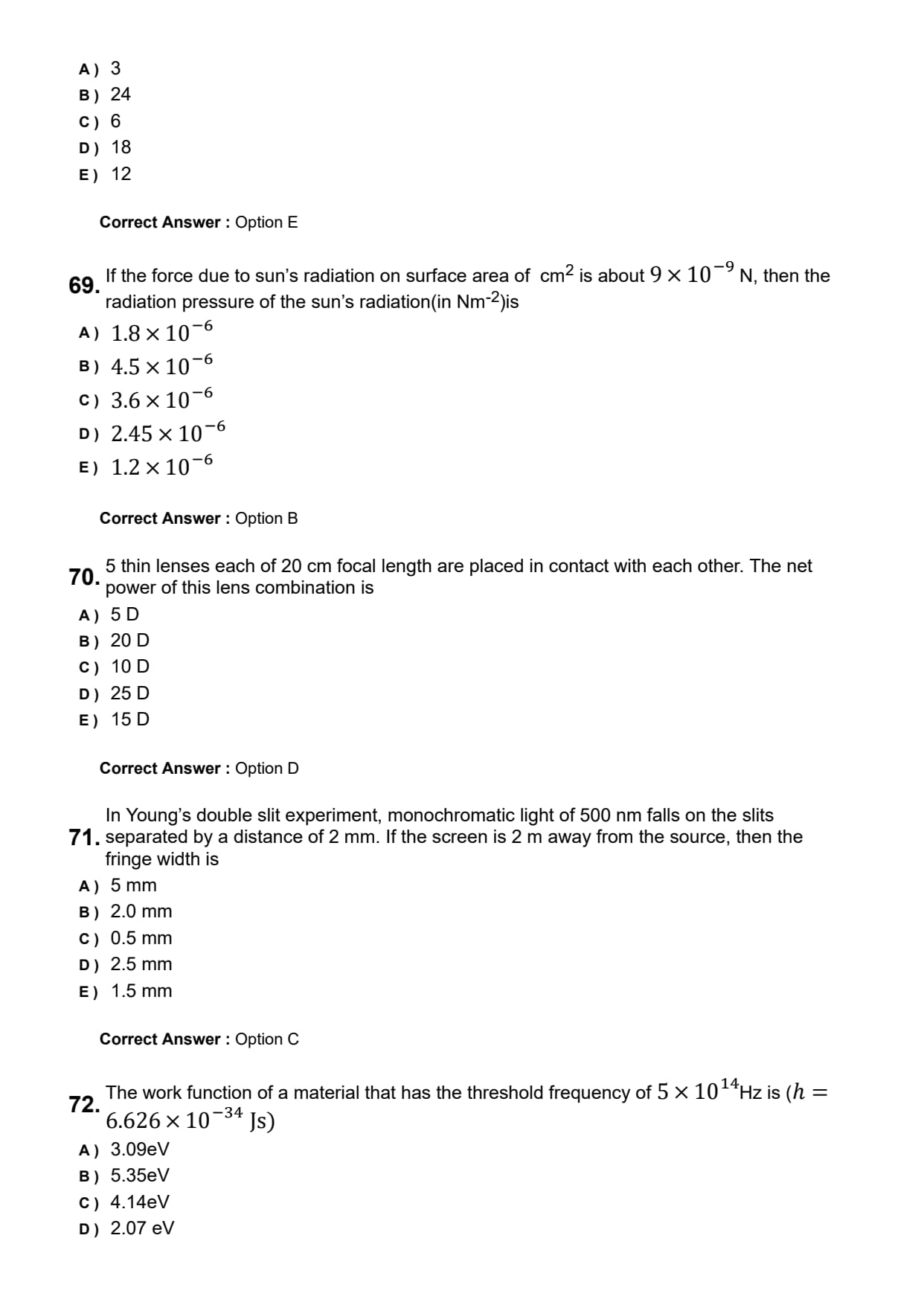
If the force due to sun's radiation on surface area of \(cm^{2}\) is about \(9\times10^{-9}N\), then the radiation pressure of the sun's radiation (in \(Nm^{-2}\)) is

  • (A) \(1.8\times10^{-6}\)
  • (B) \(4.5\times10^{-6}\)
  • (C) \(3.6\times10^{-6}\)
  • (D) \(2.45\times10^{-6}\)
  • (E) \(1.2\times10^{-6}\)

Question 70:

5 thin lenses each of 20 cm focal length are placed in contact with each other. The net power of this lens combination is

  • (A) 5D
  • (B) 20 D
  • (C) 10 D
  • (D) 25 D
  • (E) 15 D

Question 71:

In Young's double slit experiment, monochromatic light of 500 nm falls on the slits separated by a distance of 2 mm. If the screen is 2 m away from the source, then the fringe width is

  • (A) 5 mm
  • (B) 2.0 mm
  • (C) 0.5 mm
  • (D) 2.5 mm
  • (E) 1.5 mm

Question 72:

The work function of a material that has the threshold frequency of \(5\times10^{14}Hz\) is (\(h = 6.626\times10^{-34}\) Js)

  • (A) 3.09eV
  • (B) 5.35eV
  • (C) 4.14eV
  • (D) 2.07 eV
  • (E) 1.03eV

Question 73:

The energy of the electron in third excited state of the hydrogen atom is

  • (A) -0.54 eV
  • (B) -1.51 eV
  • (C) -13.6 eV
  • (D) -3.4 eV
  • (E) -0.85 eV

Question 74:

The expected mass of \({}_{6}^{12}C\) nucleus is (Mass of neutron is 1.00866 u; Mass of proton is 1.00727 u)

  • (A) 8.0637 น
  • (B) 12.0956 u
  • (C) 6.0478 u
  • (D) 2.0159 น
  • (E) 10.0797 u

Question 75:

If the voltage applied to a diode having forward bias resistance of 1 \(\Omega\) is changed from 0.6 V to 0.9 V, the change in current in it is

  • (A) 300 mA
  • (B) 250 mA
  • (C) 400 mA
  • (D) 450 mA
  • (E) 750 mA

KEAM 2026 Exam Pattern

Particulars Details
Paper Pharmacy
Mode of Exam Online CBT
Subjects Physics- 30 questions
Chemistry- 45 questions
Type of Question Objective Type
Total Number of questions 75
Marks are awarded for each correct answer 4 marks
Marks are awarded for each incorrect answer 1 marks
KEAM total marks for Pharmacy 300 marks
Duration of KEAM Pharmacy exam 90 minutes

KEAM 2026 Final Revision