KEAM 2026 Pharmacy Question Paper for April 18 is available for download here. CEE Kerala conducted KEAM 2026 Pharmacy exam on April 18 in session 1 from 10 AM to 11.30 PM. KEAM 2026 Pharmacy exam is an online CBT with a total of 75 questions carrying a maximum of 300 marks.
- The KEAM Pharmacy exam is divided into 2 subjects- Physics (30 questions) and Chemistry (45 questions).
- 4 marks are given for every correct answer and 1 mark is deducted for every incorrect answer
Candidates can download KEAM 2026 April 18 Pharmacy Question Paper with Solution PDF from the links provided below.
KEAM 2026 Pharmacy April 18 Question Paper with Solution PDF
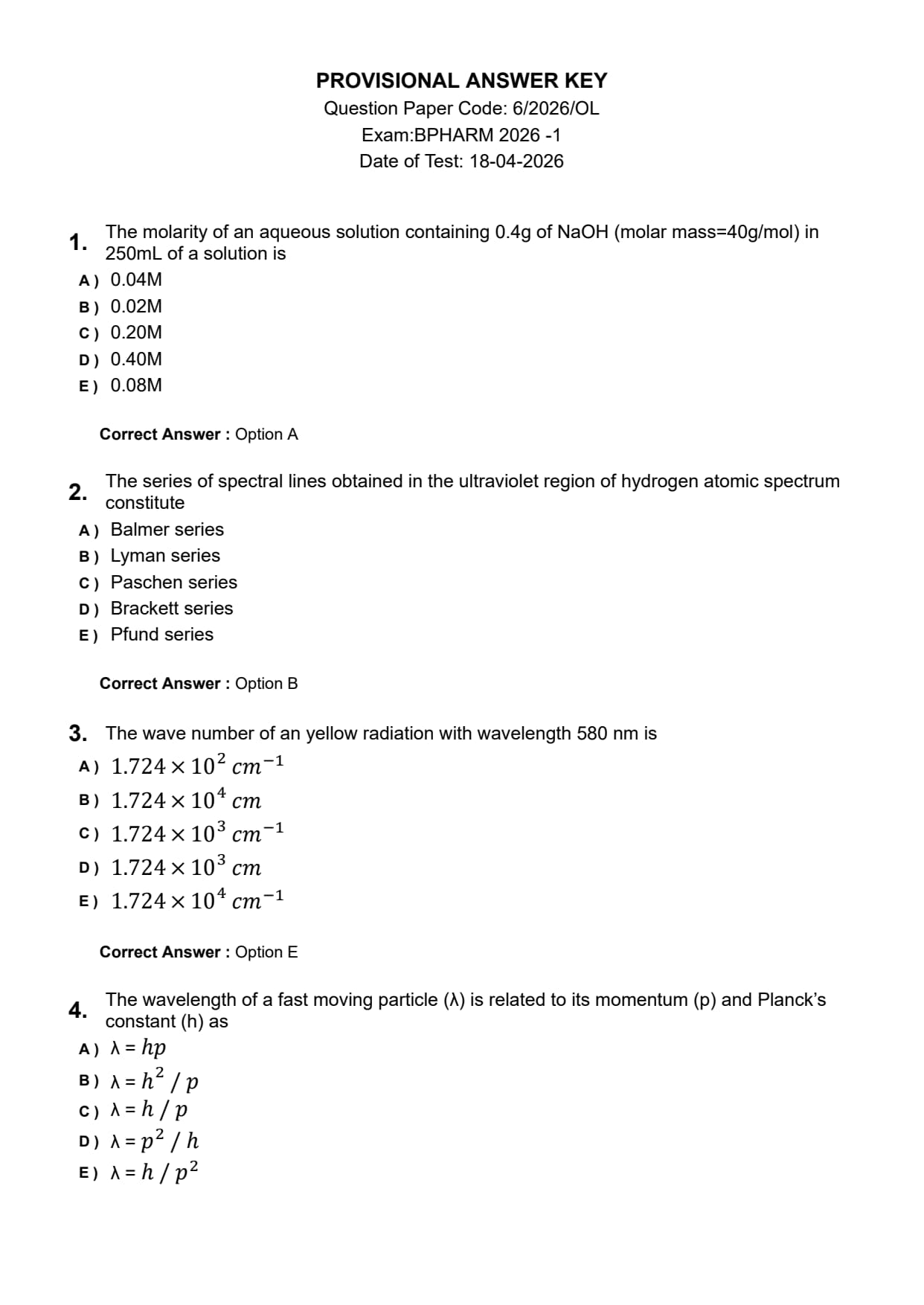
Question 1:
The molarity of an aqueous solution containing 0.4g of NaOH (molar mass=40g/mol) in 250mL of a solution is
- (A) 0.04M
- (B) 0.02M
- (C) 0.20M
- (D) 0.40M
- (E) 0.08M
Question 2:
The series of spectral lines obtained in the ultraviolet region of hydrogen atomic spectrum constitute
- (A) Balmer series
- (B) Lyman series
- (C) Paschen series
- (D) Brackett series
- (E) Pfund series
Question 3:
The wave number of an yellow radiation with wavelength 580 nm is
- (A) \(1.724 \times 10^2 cm^{-1}\)
- (B) \(1.724 \times 10^4 cm\)
- (C) \(1.724 \times 10^3 cm^{-1}\)
- (D) \(1.724 \times 10^3 cm\)
- (E) \(1.724 \times 10^4 cm^{-1}\)
Question 4:
The wavelength of a fast moving particle (\(\lambda\)) is related to its momentum (p) and Planck’s constant (h) as
- (A) \(\lambda = hp\)
- (B) \(\lambda = h^2 / p\)
- (C) \(\lambda = h / p\)
- (D) \(\lambda = p^2 / h\)
- (E) \(\lambda = h / p^2\)
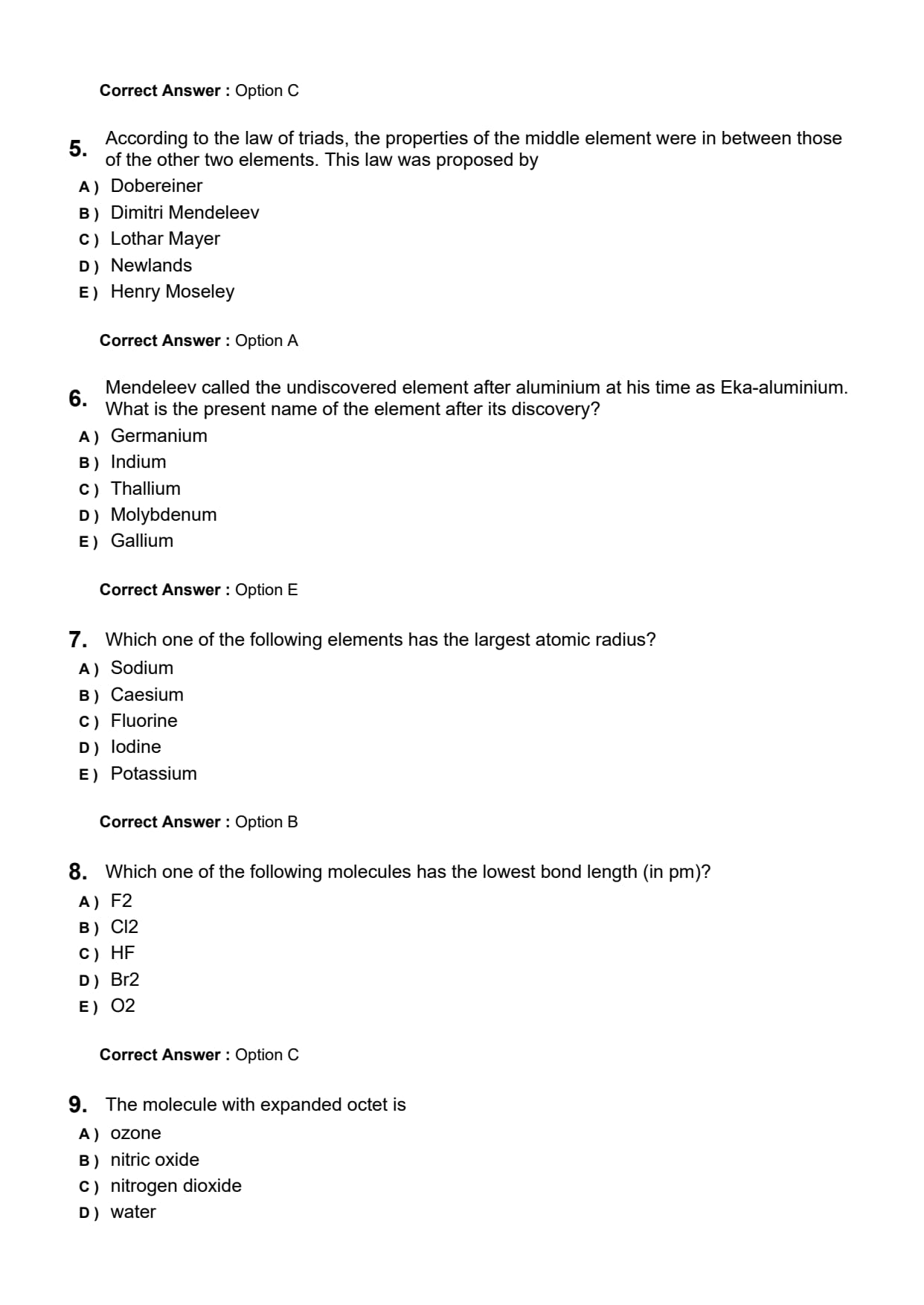
Question 5:
According to the law of triads, the properties of the middle element were in between those of the other two elements. This law was proposed by
- (A) Dobereiner
- (B) Dimitri Mendeleev
- (C) Lothar Mayer
- (D) Newlands
- (E) Henry Moseley
Question 6:
Mendeleev called the undiscovered element after aluminium at his time as Eka-aluminium. What is the present name of the element after its discovery?
- (A) Germanium
- (B) Indium
- (C) Thallium
- (D) Molybdenum
- (E) Gallium
Question 7:
Which one of the following elements has the largest atomic radius?
- (A) Sodium
- (B) Caesium
- (C) Fluorine
- (D) Iodine
- (E) Potassium
Question 8:
Which one of the following molecules has the lowest bond length (in pm)?
- (A) \(F_2\)
- (B) \(Cl_2\)
- (C) HF
- (D) \(Br_2\)
- (E) \(O_2\)
Question 9:
The molecule with expanded octet is
- (A) ozone
- (B) nitric oxide
- (C) nitrogen dioxide
- (D) water
- (E) sulphur hexafluoride
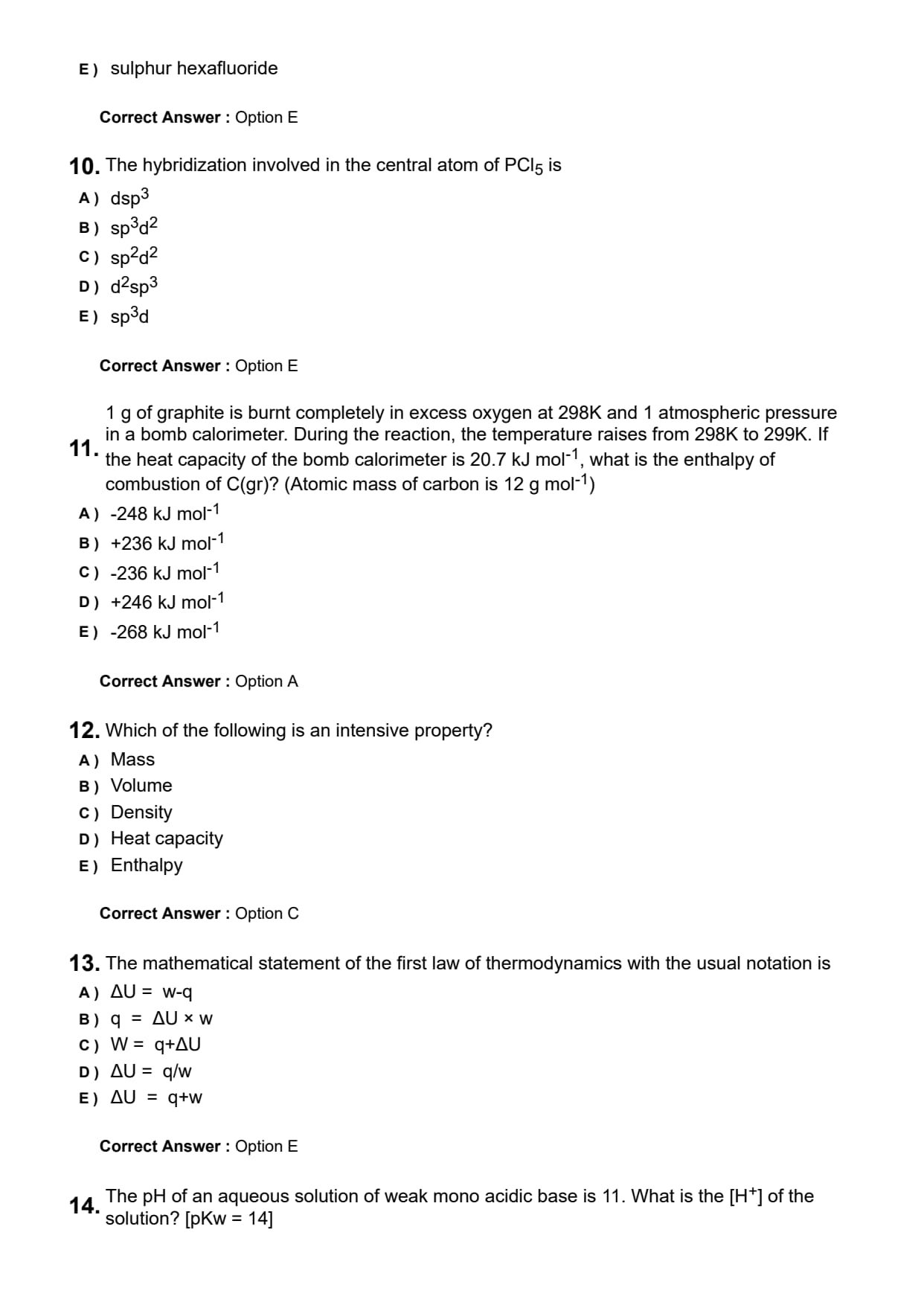
Question 10:
The hybridization involved in the central atom of \(PCl_5\) is
- (A) \(dsp^3\)
- (B) \(sp^3d^2\)
- (C) \(sp^2d^2\)
- (D) \(d^2sp^3\)
- (E) \(sp^3d\)
Question 11:
1 g of graphite is burnt completely in excess oxygen at 298K and 1 atmospheric pressure in a bomb calorimeter. During the reaction, the temperature raises from 298K to 299K. If the heat capacity of the bomb calorimeter is 20.7 kJ K\(^{-1}\), what is the enthalpy of combustion of C(gr)? (Atomic mass of carbon is 12 g mol\(^{-1}\))
- (A) -248 kJ mol\(^{-1}\)
- (B) +236 kJ mol\(^{-1}\)
- (C) -236 kJ mol\(^{-1}\)
- (D) +246 kJ mol\(^{-1}\)
- (E) -268 kJ mol\(^{-1}\)
Question 12:
Which of the following is an intensive property?
- (A) Mass
- (B) Volume
- (C) Density
- (D) Heat capacity
- (E) Enthalpy
Question 13:
The mathematical statement of the first law of thermodynamics with the usual notation is
- (A) \(\Delta U = w - q\)
- (B) \(q = \Delta U \times w\)
- (C) \(W = q + \Delta U\)
- (D) \(\Delta U = q / w\)
- (E) \(\Delta U = q + w\)
Question 14:
The pH of an aqueous solution of weak mono acidic base is 11. What is the [H\(^+\)] of the solution? [pKw = 14]
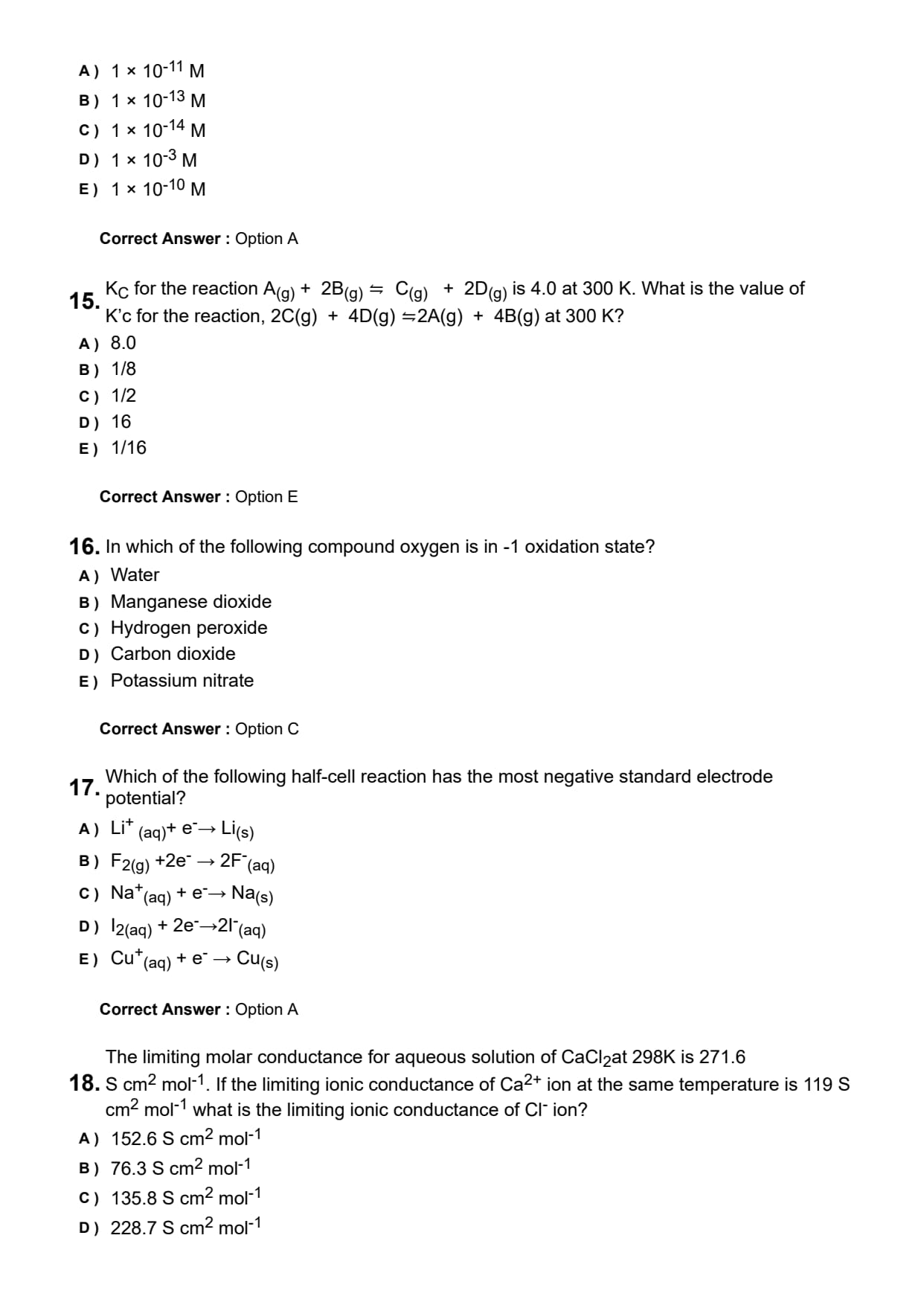
- (A) \(1 \times 10^{-11}\) M
- (B) \(1 \times 10^{-13}\) M
- (C) \(1 \times 10^{-14}\) M
- (D) \(1 \times 10^{-3}\) M
- (E) \(1 \times 10^{-10}\) M
Question 15:
Kc for the reaction A(g) + 2B(g) \(\rightleftharpoons\) C(g) + 2D(g) is 4.0 at 300 K. What is the value of K'c for the reaction, 2C(g) + 4D(g) \(\rightleftharpoons\) 2A(g) + 4B(g) at 300 K?
- (A) 8.0
- (B) 1/8
- (C) 1/2
- (D) 16
- (E) 1/16
Question 16:
In which of the following compound oxygen is in -1 oxidation state?
- (A) Water
- (B) Manganese dioxide
- (C) Hydrogen peroxide
- (D) Carbon dioxide
- (E) Potassium nitrate
Question 17:
Which of the following half-cell reaction has the most negative standard electrode potential?
- (A) Li\(^+\)(aq)+ e\(^-\) \(\to\) Li(s)
- (B) F\(_2\)(g) +2e\(^-\) \(\to\) 2F\(^-\)(aq)
- (C) Na\(^+\)(aq) + e\(^-\) \(\to\) Na(s)
- (D) I\(_2\)(aq) + 2e\(^-\) \(\to\) 2I\(^-\)(aq)
- (E) Cu\(^+\)(aq) + e\(^-\) \(\to\) Cu(s)
Question 18:
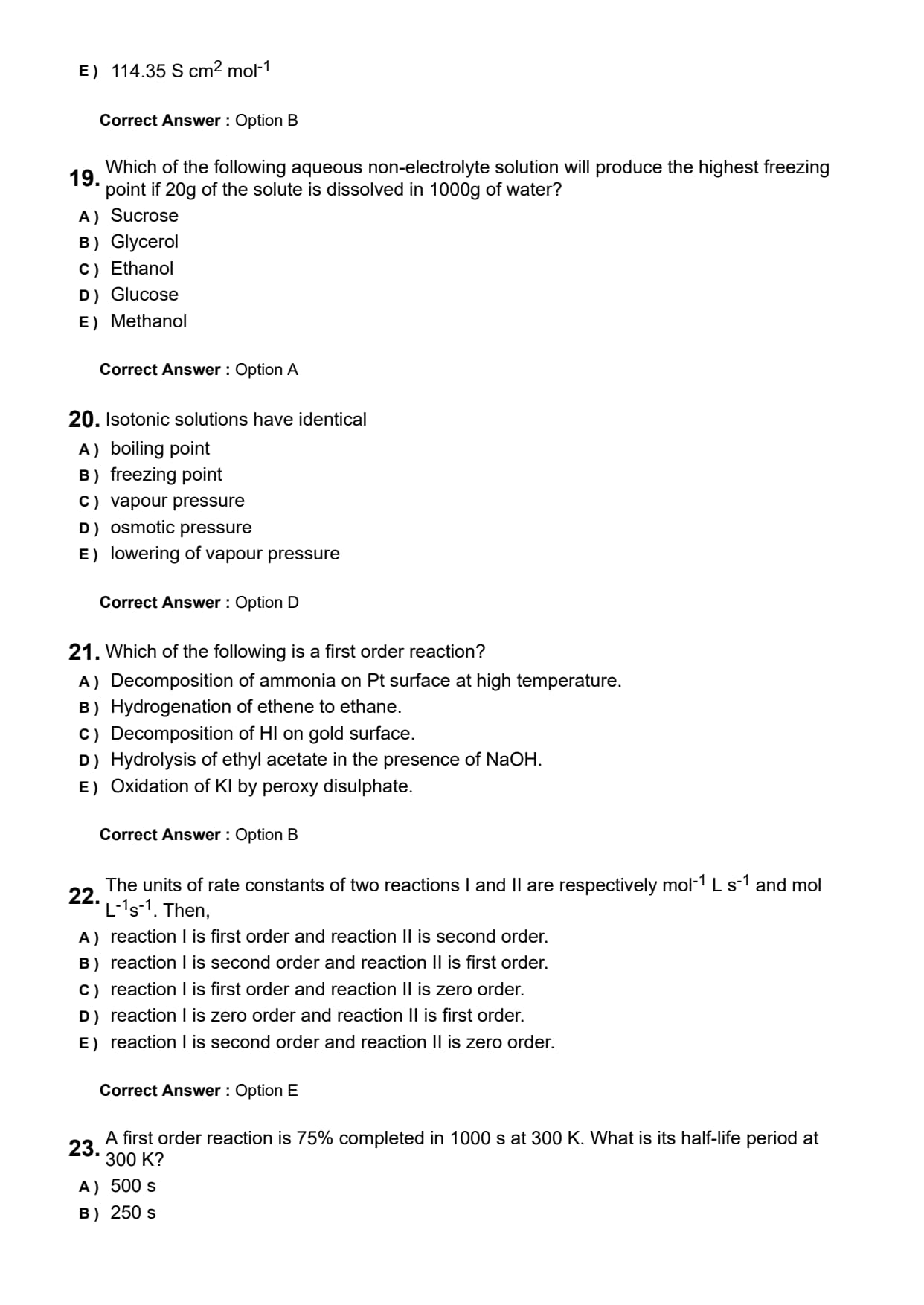
The limiting molar conductance for aqueous solution of CaCl\(_2\) at 298K is 271.6 S cm\(^2\) mol\(^{-1}\). If the limiting ionic conductance of Ca\(^{2+}\) ion at the same temperature is 119 S cm\(^2\) mol\(^{-1}\) what is the limiting ionic conductance of Cl\(^-\) ion?
- (A) 152.6 S cm\(^2\) mol\(^{-1}\)
- (B) 76.3 S cm\(^2\) mol\(^{-1}\)
- (C) 135.8 S cm\(^2\) mol\(^{-1}\)
- (D) 228.7 S cm\(^2\) mol\(^{-1}\)
- (E) 114.35 S cm\(^2\) mol\(^{-1}\)
Question 19:
Which of the following aqueous non-electrolyte solution will produce the highest freezing point if 20g of the solute is dissolved in 1000g of water?
- (A) Sucrose
- (B) Glycerol
- (C) Ethanol
- (D) Glucose
- (E) Methanol
Question 20:
Isotonic solutions have identical
- (A) boiling point
- (B) freezing point
- (C) vapour pressure
- (D) osmotic pressure
- (E) lowering of vapour pressure
Question 21:
Which of the following is a first order reaction?
- (A) Decomposition of ammonia on Pt surface at high temperature.
- (B) Hydrogenation of ethene to ethane.
- (C) Decomposition of HI on gold surface.
- (D) Hydrolysis of ethyl acetate in the presence of NaOH.
- (E) Oxidation of KI by peroxy disulphate.
Question 22:
The units of rate constants of two reactions I and II are respectively mol\(^{-1}\) L s\(^{-1}\) and mol L\(^{-1}\)s\(^{-1}\). Then,
- (A) reaction I is first order and reaction II is second order.
- (B) reaction I is second order and reaction II is first order.
- (C) reaction I is first order and reaction II is zero order.
- (D) reaction I is zero order and reaction II is first order.
- (E) reaction I is second order and reaction II is zero order.
Question 23:
A first order reaction is 75% completed in 1000 s at 300 K. What is its half-life period at 300 K?
- (A) 500 s
- (B) 250 s
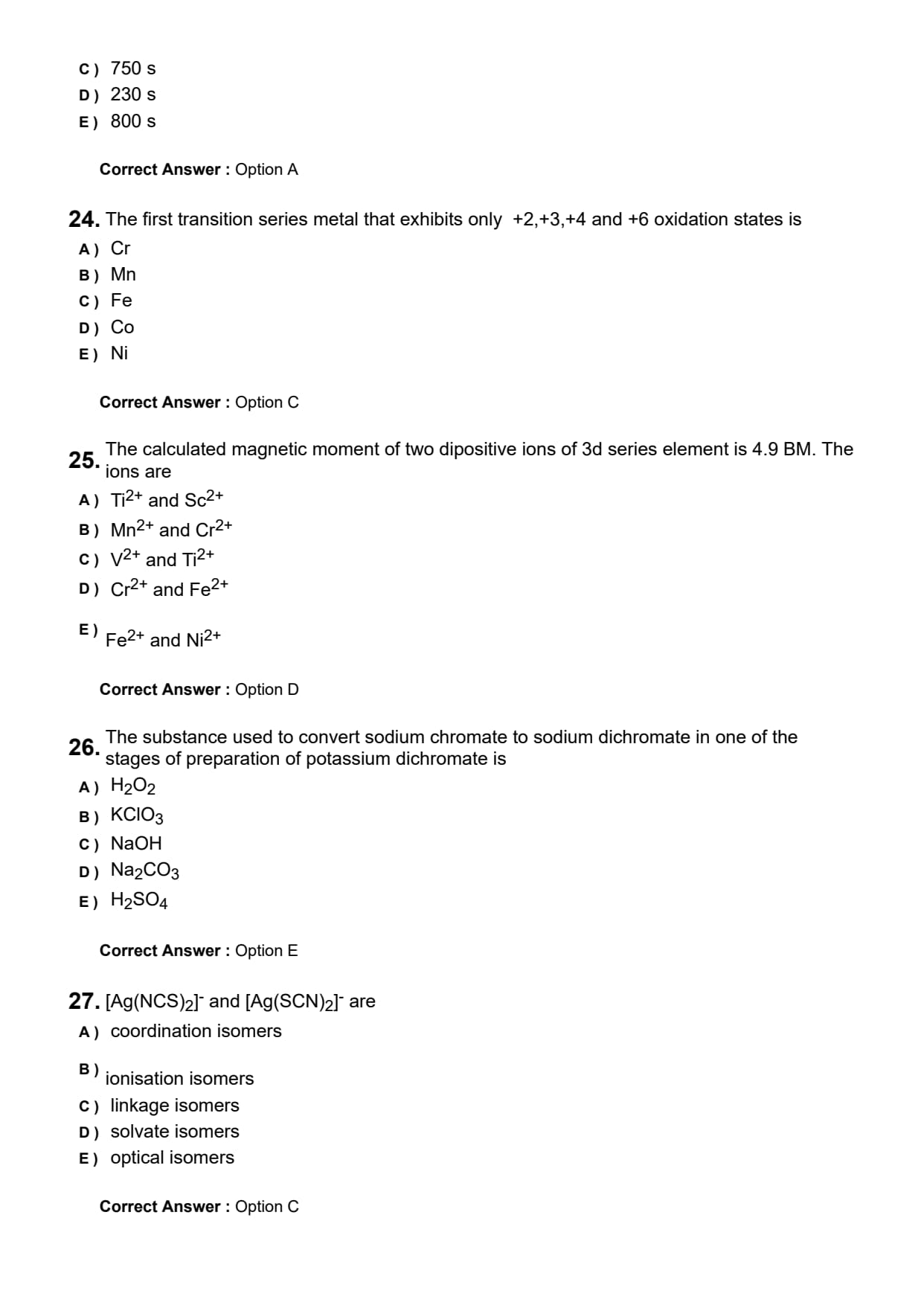
- (C) 750 s
- (D) 230 s
- (E) 800 s
Question 24:
The first transition series metal that exhibits only +2, +3, +4 and +6 oxidation states is
- (A) Cr
- (B) Mn
- (C) Fe
- (D) Co
- (E) Ni
Question 25:
The calculated magnetic moment of two dipositive ions of 3d series element is 4.9 BM. The ions are
- (A) \(Ti^{2+}\) and \(Sc^{2+}\)
- (B) \(Mn^{2+}\) and \(Cr^{2+}\)
- (C) \(V^{2+}\) and \(Ti^{2+}\)
- (D) \(Cr^{2+}\) and \(Fe^{2+}\)
- (E) \(Fe^{2+}\) and \(Ni^{2+}\)
Question 26:
The substance used to convert sodium chromate to sodium dichromate in one of the stages of preparation of potassium dichromate is
- (A) \(H_2O_2\)
- (B) \(KClO_3\)
- (C) \(NaOH\)
- (D) \(Na_2CO_3\)
- (E) \(H_2SO_4\)
Question 27:
\([Ag(NCS)_2]^-\) and \([Ag(SCN)_2]^-\) are
- (A) coordination isomers
- (B) ionisation isomers
- (C) linkage isomers
- (D) solvate isomers
- (E) optical isomers
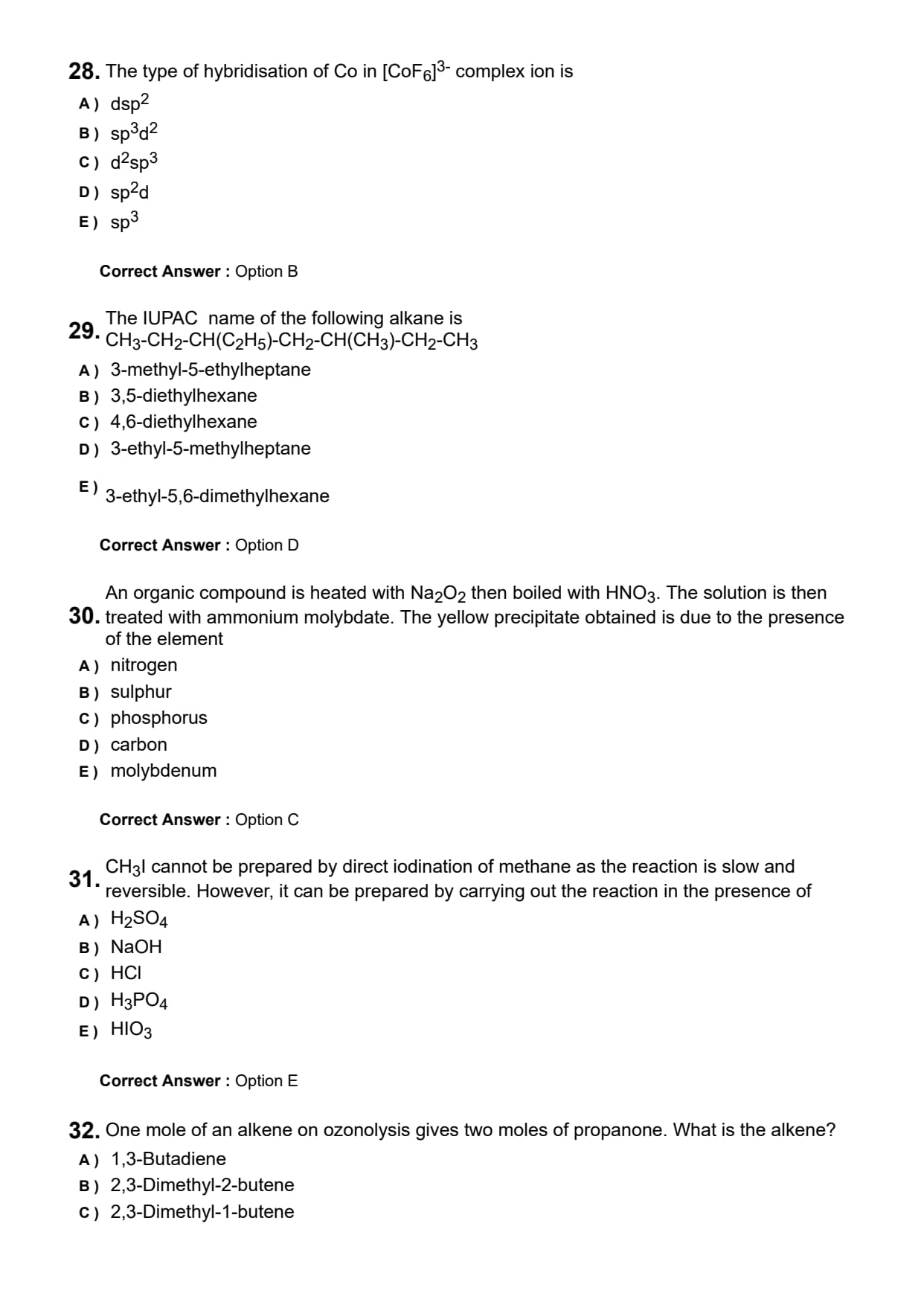
Question 28:
The type of hybridisation of Co in \([CoF_6]^{3-}\) complex ion is
- (A) \(dsp^2\)
- (B) \(sp^3d^2\)
- (C) \(d^2sp^3\)
- (D) \(sp^2d\)
- (E) \(sp^3\)
Question 29:
The IUPAC name of the following alkane is \(CH_3-CH_2-CH(C_2H_5)-CH_2-CH(CH_3)-CH_2-CH_3\)
- (A) 3-methyl-5-ethylheptane
- (B) 3,5-diethylhexane
- (C) 4,6-diethylhexane
- (D) 3-ethyl-5-methylheptane
- (E) 3-ethyl-5,6-dimethylhexane
Question 30:
An organic compound is heated with \(Na_2O_2\) then boiled with \(HNO_3\). The solution is then treated with ammonium molybdate. The yellow precipitate obtained is due to the presence of the element
- (A) nitrogen
- (B) sulphur
- (C) phosphorus
- (D) carbon
- (E) molybdenum
Question 31:
CH3I cannot be prepared by direct iodination of methane as the reaction is slow and reversible. However, it can be prepared by carrying out the reaction in the presence of
- (A) \(H_2SO_4\)
- (B) \(NaOH\)
- (C) \(HCl\)
- (D) \(H_3PO_4\)
- (E) \(HIO_3\)
Question 32:
One mole of an alkene on ozonolysis gives two moles of propanone. What is the alkene?
- (A) 1,3-Butadiene
- (B) 2,3-Dimethyl-2-butene
- (C) 2,3-Dimethyl-1-butene
- (D) 2-Methyl-1-butene
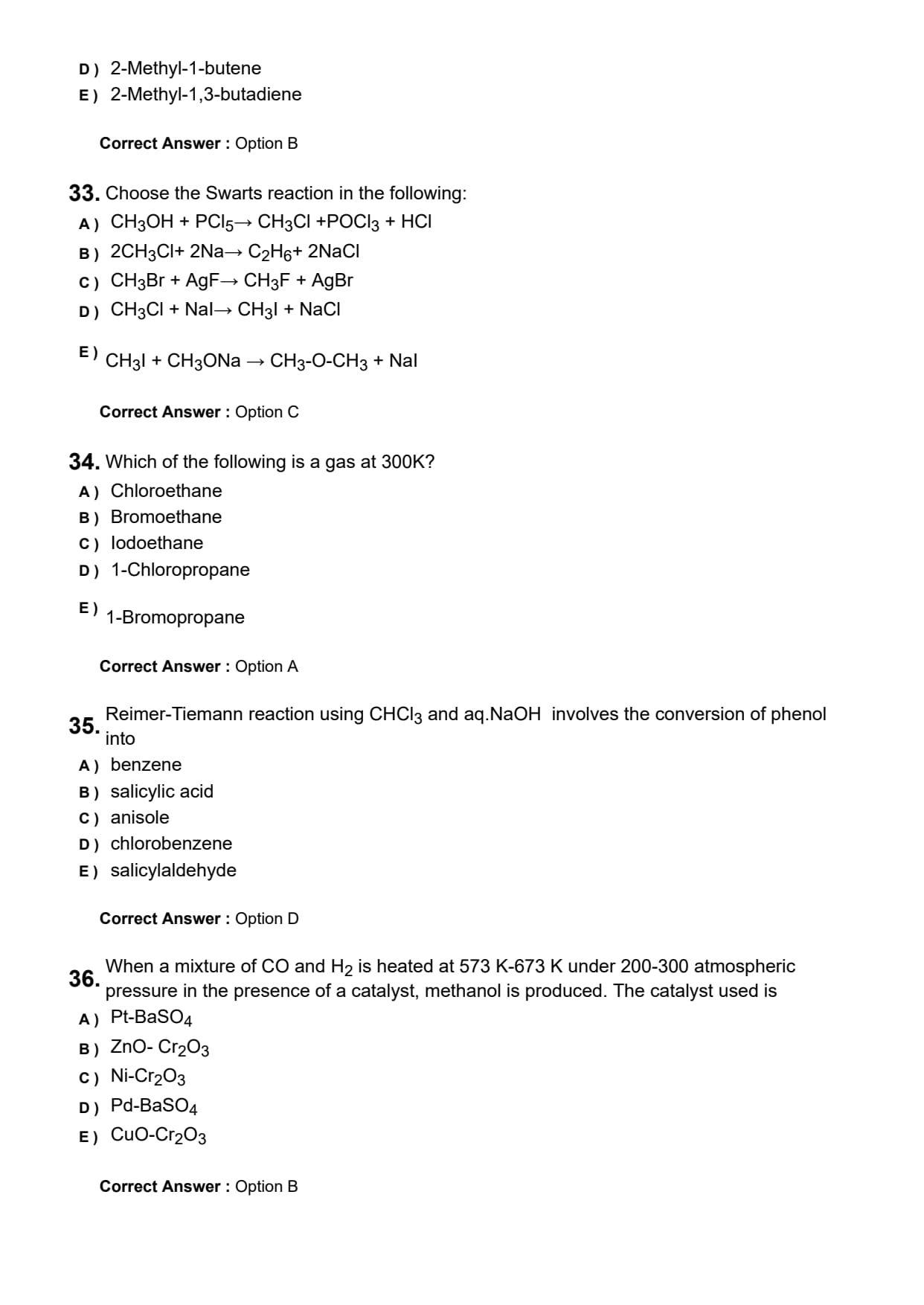
- (E) 2-Methyl-1,3-butadiene
Question 33:
Choose the Swarts reaction in the following:
- (A) \(CH_3OH + PCl_5 \to CH_3Cl + POCl_3 + HCl\)
- (B) \(2CH_3Cl + 2Na \to C_2H_6 + 2NaCl\)
- (C) \(CH_3Br + AgF \to CH_3F + AgBr\)
- (D) \(CH_3Cl + NaI \to CH_3I + NaCl\)
- (E) \(CH_3I + CH_3ONa \to CH_3-O-CH_3 + NaI\)
Question 34:
Which of the following is a gas at 300K?
- (A) Chloroethane
- (B) Bromoethane
- (C) Iodoethane
- (D) 1-Chloropropane
- (E) 1-Bromopropane
Question 35:
Reimer-Tiemann reaction using CHCl3 and aq.NaOH involves the conversion of phenol into
- (A) benzene
- (B) salicylic acid
- (C) anisole
- (D) chlorobenzene
- (E) salicylaldehyde
Question 36:
When a mixture of CO and H2 is heated at 573 K-673 K under 200-300 atmospheric pressure in the presence of a catalyst, methanol is produced. The catalyst used is
- (A) \(Pt-BaSO_4\)
- (B) \(ZnO-Cr_2O_3\)
- (C) \(Ni-Cr_2O_3\)
- (D) \(Pd-BaSO_4\)
- (E) \(CuO-Cr_2O_3\)
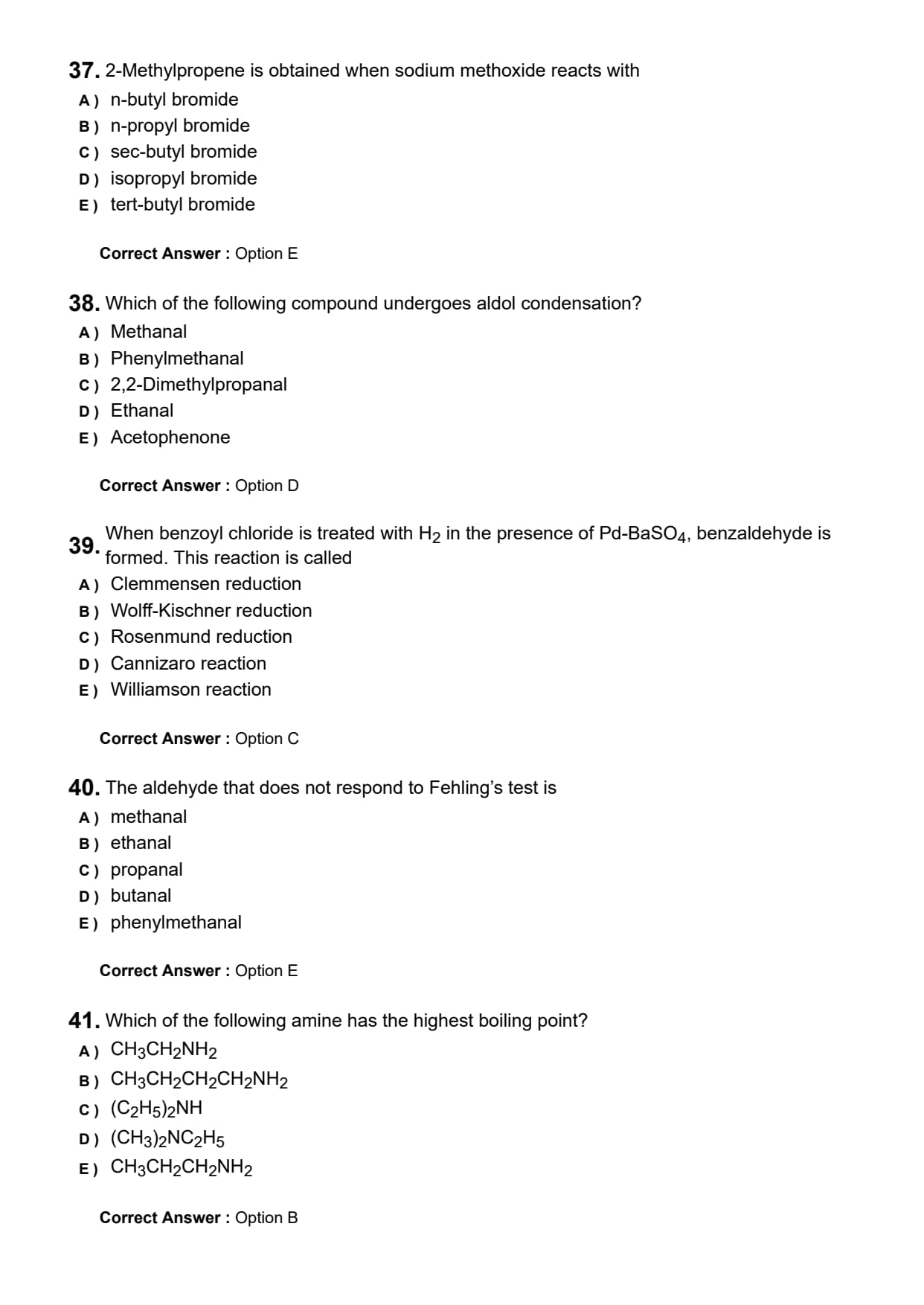
Question 37:
2-Methylpropene is obtained when sodium methoxide reacts with
- (A) n-butyl bromide
- (B) n-propyl bromide
- (C) sec-butyl bromide
- (D) isopropyl bromide
- (E) tert-butyl bromide
Question 38:
Which of the following compound undergoes aldol condensation?
- (A) Methanal
- (B) Phenylmethanal
- (C) 2,2-Dimethylpropanal
- (D) Ethanal
- (E) Acetophenone
Question 39:
When benzoyl chloride is treated with \(H_2\) in the presence of \(Pd-BaSO_4\), benzaldehyde is formed. This reaction is called
- (A) Clemmensen reduction
- (B) Wolff-Kischner reduction
- (C) Rosenmund reduction
- (D) Cannizaro reaction
- (E) Williamson reaction
Question 40:
The aldehyde that does not respond to Fehling’s test is
- (A) methanal
- (B) ethanal
- (C) propanal
- (D) butanal
- (E) phenylmethanal
Question 41:
Which of the following amine has the highest boiling point?
- (A) \(CH_3CH_2NH_2\)
- (B) \(CH_3CH_2CH_2CH_2NH_2\)
- (C) \((C_2H_5)_2NH\)
- (D) \((CH_3)_2NC_2H_5\)
- (E) \(CH_3CH_2CH_2NH_2\)
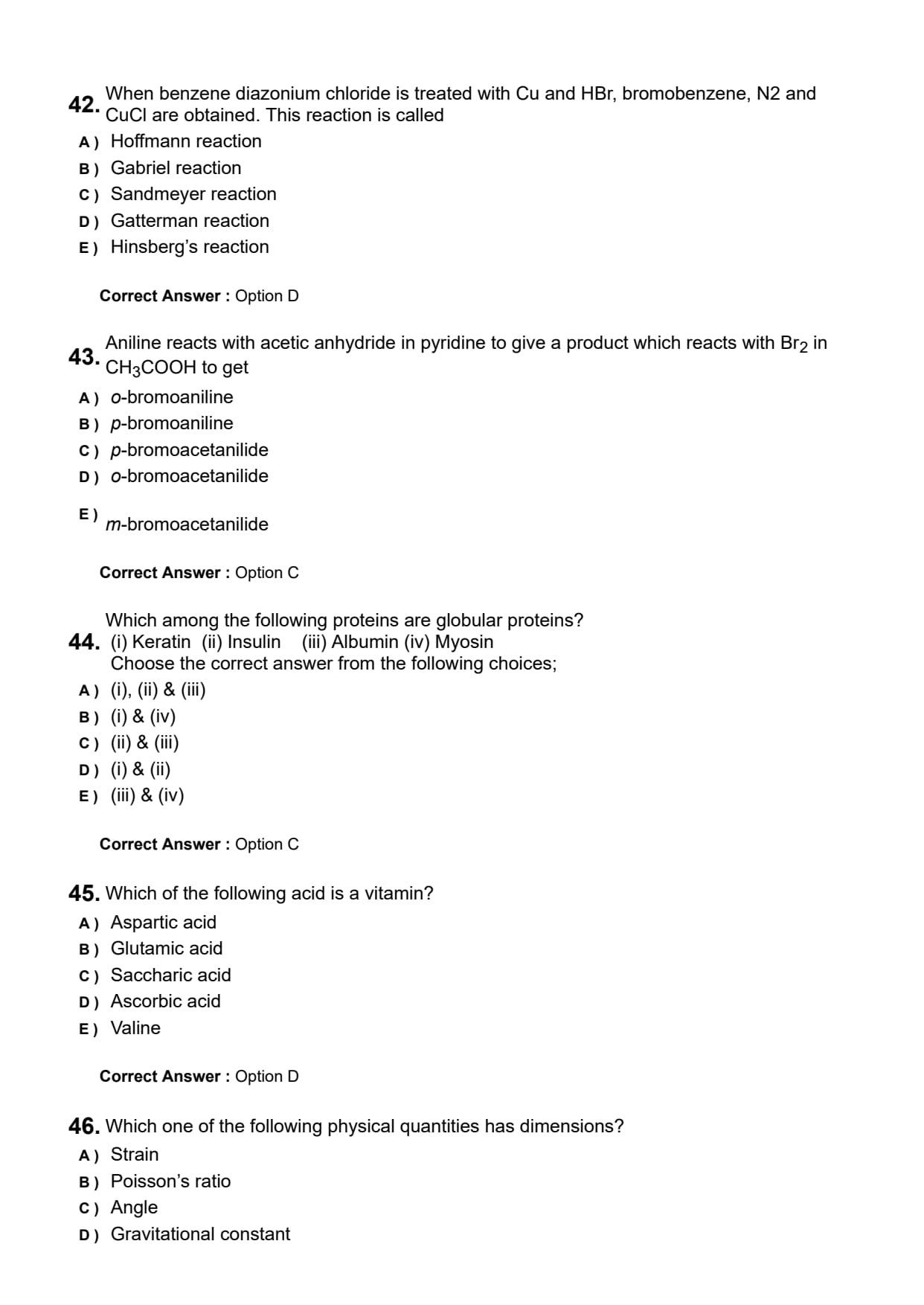
Question 42:
When benzene diazonium chloride is treated with Cu and HBr, bromobenzene, N2 and CuCl are obtained. This reaction is called
- (A) Hoffmann reaction
- (B) Gabriel reaction
- (C) Sandmeyer reaction
- (D) Gatterman reaction
- (E) Hinsberg’s reaction
Question 43:
Aniline reacts with acetic anhydride in pyridine to give a product which reacts with Br2 in CH3COOH to get
- (A) o-bromoaniline
- (B) p-bromoaniline
- (C) p-bromoacetanilide
- (D) o-bromoacetanilide
- (E) m-bromoacetanilide
Question 44:
Which among the following proteins are globular proteins? (i) Keratin (ii) Insulin (iii) Albumin (iv) Myosin Choose the correct answer from the following choices;
- (A) (i), (ii) \& (iii)
- (B) (i) \& (iv)
- (C) (ii) \& (iii)
- (D) (i) \& (ii)
- (E) (iii) \& (iv)
Question 45:
Which of the following acid is a vitamin?
- (A) Aspartic acid
- (B) Glutamic acid
- (C) Saccharic acid
- (D) Ascorbic acid
- (E) Valine
Question 46:
Which one of the following physical quantities has dimensions?
- (A) Strain
- (B) Poisson’s ratio
- (C) Angle
- (D) Gravitational constant
- (E) Relative density
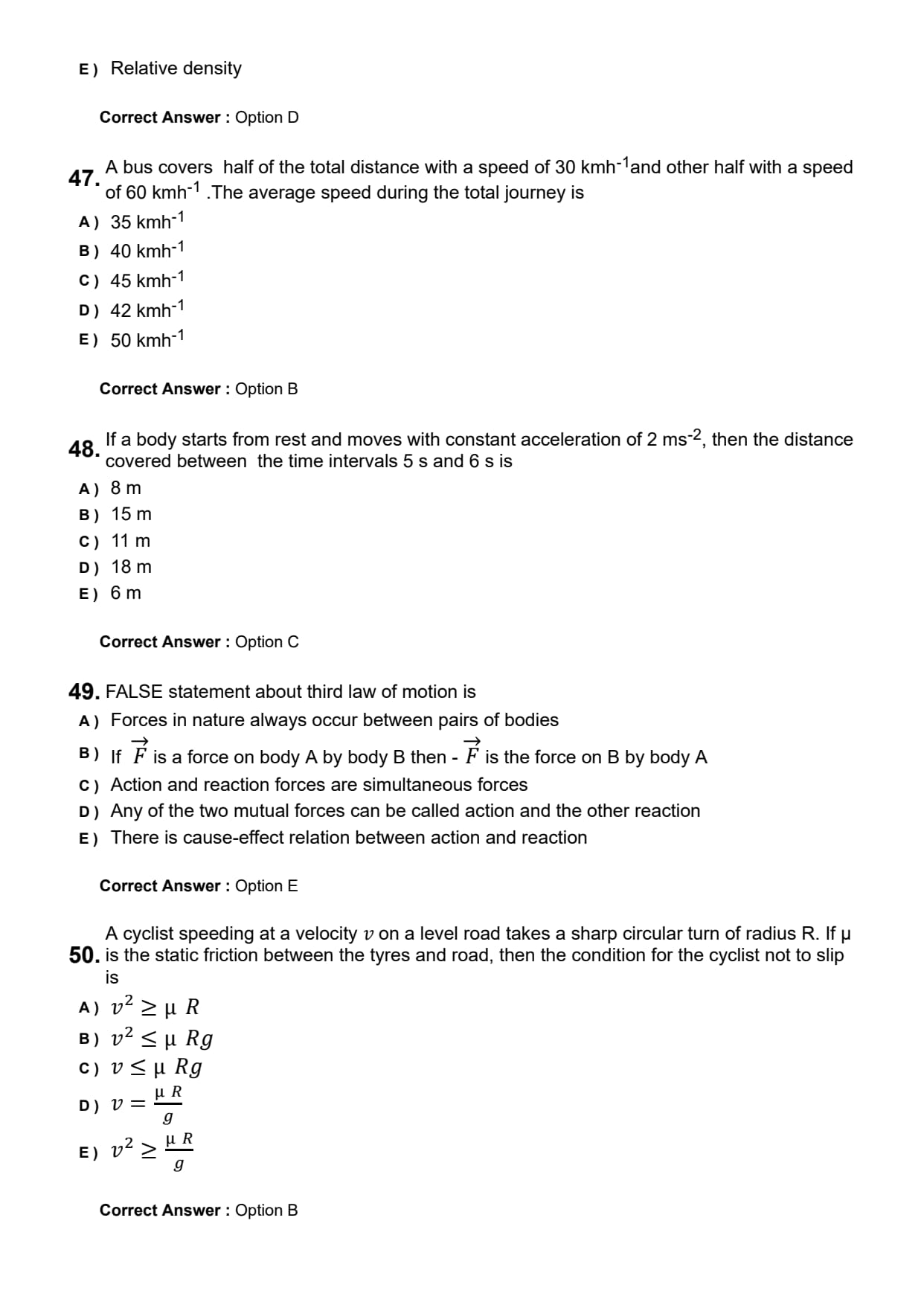
Question 47:
A bus covers half of the total distance with a speed of 30 kmh\(^{-1}\) and other half with a speed of 60 kmh\(^{-1}\). The average speed during the total journey is
- (A) 35 kmh\(^{-1}\)
- (B) 40 kmh\(^{-1}\)
- (C) 45 kmh\(^{-1}\)
- (D) 42 kmh\(^{-1}\)
- (E) 50 kmh\(^{-1}\)
Question 48:
If a body starts from rest and moves with constant acceleration of 2 ms\(^{-2}\), then the distance covered between the time intervals 5 s and 6 s is
- (A) 8 m
- (B) 15 m
- (C) 11 m
- (D) 18 m
- (E) 6 m
Question 49:
FALSE statement about third law of motion is
- (A) Forces in nature always occur between pairs of bodies
- (B) If \(\vec{F}\) is a force on body A by body B then -\(\vec{F}\) is the force on B by body A
- (C) Action and reaction forces are simultaneous forces
- (D) Any of the two mutual forces can be called action and the other reaction
- (E) There is cause-effect relation between action and reaction
Question 50:
A cyclist speeding at a velocity \(v\) on a level road takes a sharp circular turn of radius R. If \(\mu\) is the static friction between the tyres and road, then the condition for the cyclist not to slip is
- (A) \(v^2 \ge \mu R\)
- (B) \(v^2 \le \mu Rg\)
- (C) \(v \le \mu Rg\)
- (D) \(v = \frac{\mu R}{g}\)
- (E) \(v^2 \ge \frac{\mu R}{g}\)
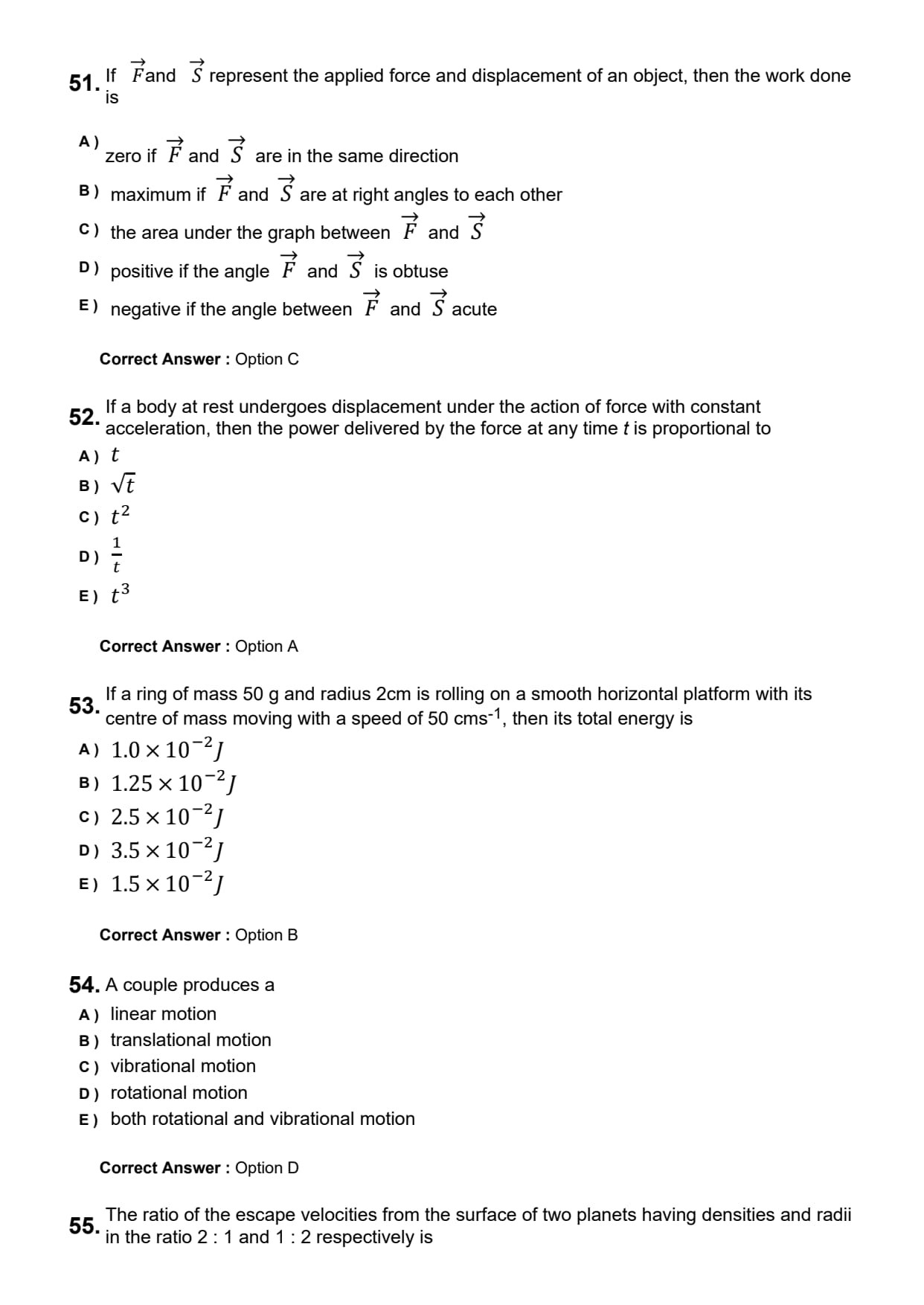
Question 51:
If \(\vec{F}\) and \(\vec{S}\) represent the applied force and displacement of an object, then the work done is
- (A) zero if \(\vec{F}\) and \(\vec{S}\) are in the same direction
- (B) maximum if \(\vec{F}\) and \(\vec{S}\) are at right angles to each other
- (C) the area under the graph between \(\vec{F}\) and \(\vec{S}\)
- (D) positive if the angle between \(\vec{F}\) and \(\vec{S}\) is obtuse
- (E) negative if the angle between \(\vec{F}\) and \(\vec{S}\) is acute
Question 52:
If a body at rest undergoes displacement under the action of force with constant acceleration, then the power delivered by the force at any time t is proportional to
- (A) \(t\)
- (B) \(\sqrt{t}\)
- (C) \(t^2\)
- (D) \(1 / t\)
- (E) \(t^3\)
Question 53:
If a ring of mass 50 g and radius 2cm is rolling on a smooth horizontal platform with its centre of mass moving with a speed of 50 cms\(^{-1}\), then its total energy is
- (A) \(1.0 \times 10^{-2}\) J
- (B) \(1.25 \times 10^{-2}\) J
- (C) \(2.5 \times 10^{-2}\) J
- (D) \(3.5 \times 10^{-2}\) J
- (E) \(1.5 \times 10^{-2}\) J
Question 54:
A couple produces a
- (A) linear motion
- (B) translational motion
- (C) vibrational motion
- (D) rotational motion
- (E) both rotational and vibrational motion
Question 55:
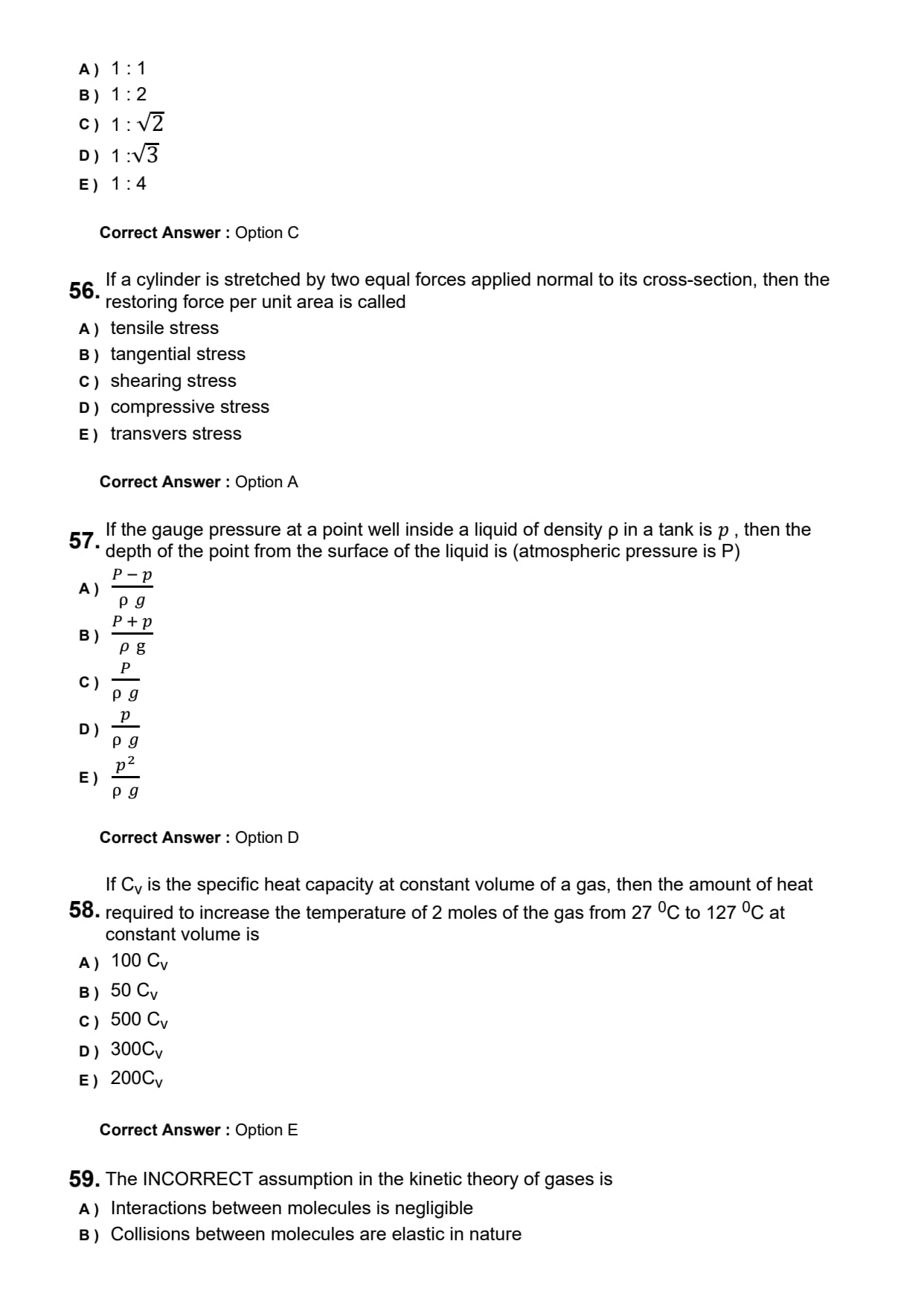
The ratio of the escape velocities from the surface of two planets having densities and radii in the ratio 2 : 1 and 1 : 2 respectively is
- (A) 1 : 1
- (B) 1 : 2
- (C) 1 : \(\sqrt{2}\)
- (D) 1 : \(\sqrt{3}\)
- (E) 1 : 4
Question 56:
If a cylinder is stretched by two equal forces applied normal to its cross-section, then the restoring force per unit area is called
- (A) tensile stress
- (B) tangential stress
- (C) shearing stress
- (D) compressive stress
- (E) transvers stress
Question 57:
If the gauge pressure at a point well inside a liquid of density \(\rho\) in a tank is \(p\), then the depth of the point from the surface of the liquid is (atmospheric pressure is P)
- (A) \(\frac{P - p}{\rho g}\)
- (B) \(\frac{P + p}{\rho g}\)
- (C) \(\frac{P}{\rho g}\)
- (D) \(\frac{p}{\rho g}\)
- (E) \(\frac{p^2}{\rho g}\)
Question 58:
If \(C_v\) is the specific heat capacity at constant volume of a gas, then the amount of heat required to increase the temperature of 2 moles of the gas from \(27^\circC\) to \(127^\circC\) at constant volume is
- (A) \(100 C_v\)
- (B) \(50 C_v\)
- (C) \(500 C_v\)
- (D) \(300 C_v\)
- (E) \(200 C_v\)
Question 59:
The INCORRECT assumption in the kinetic theory of gases is
- (A) Interactions between molecules is negligible
- (B) Collisions between molecules are elastic in nature
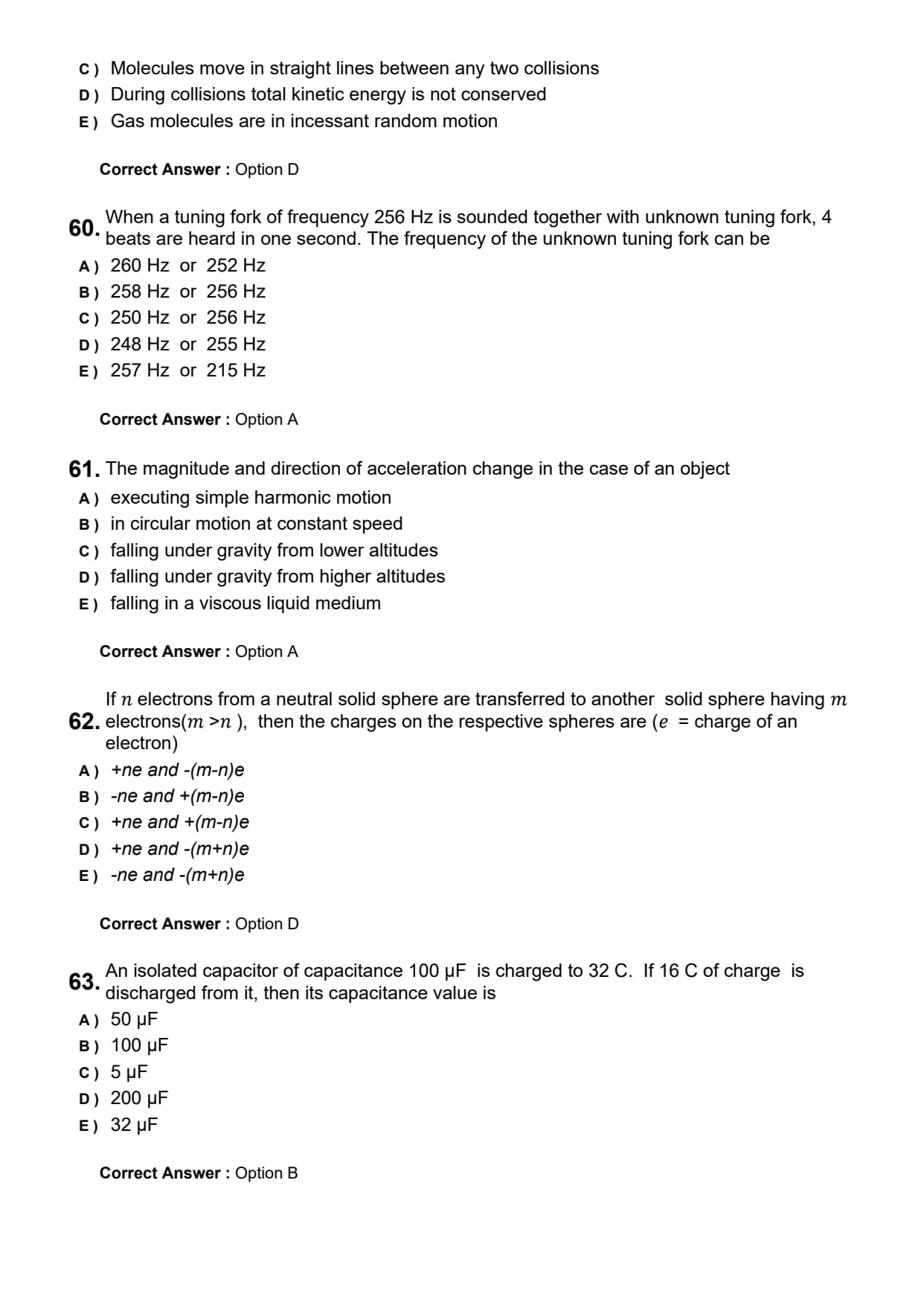
- (C) Molecules move in straight lines between any two collisions
- (D) During collisions total kinetic energy is not conserved
- (E) Gas molecules are in incessant random motion
Question 60:
When a tuning fork of frequency 256 Hz is sounded together with unknown tuning fork, 4 beats are heard in one second. The frequency of the unknown tuning fork can be
- (A) 260 Hz or 252 Hz
- (B) 258 Hz or 256 Hz
- (C) 250 Hz or 256 Hz
- (D) 248 Hz or 255 Hz
- (E) 257 Hz or 215 Hz
Question 61:
The magnitude and direction of acceleration change in the case of an object
- (A) executing simple harmonic motion
- (B) in circular motion at constant speed
- (C) falling under gravity from lower altitudes
- (D) falling under gravity from higher altitudes
- (E) falling in a viscous liquid medium
Question 62:
If n electrons from a neutral solid sphere are transferred to another solid sphere having m electrons (m \(>\) n), then the charges on the respective spheres are (e = charge of an electron)
- (A) +ne and -(m-n)e
- (B) -ne and +(m-n)e
- (C) +ne and +(m-n)e
- (D) +ne and -(m+n)e
- (E) -ne and -(m+n)e
Question 63:
An isolated capacitor of capacitance 100 \(\mu\)F is charged to 32 C. If 16 C of charge is discharged from it, then its capacitance value is
- (A) 50 \(\mu\)F
- (B) 100 \(\mu\)F
- (C) 5 \(\mu\)F
- (D) 200 \(\mu\)F
- (E) 32 \(\mu\)F
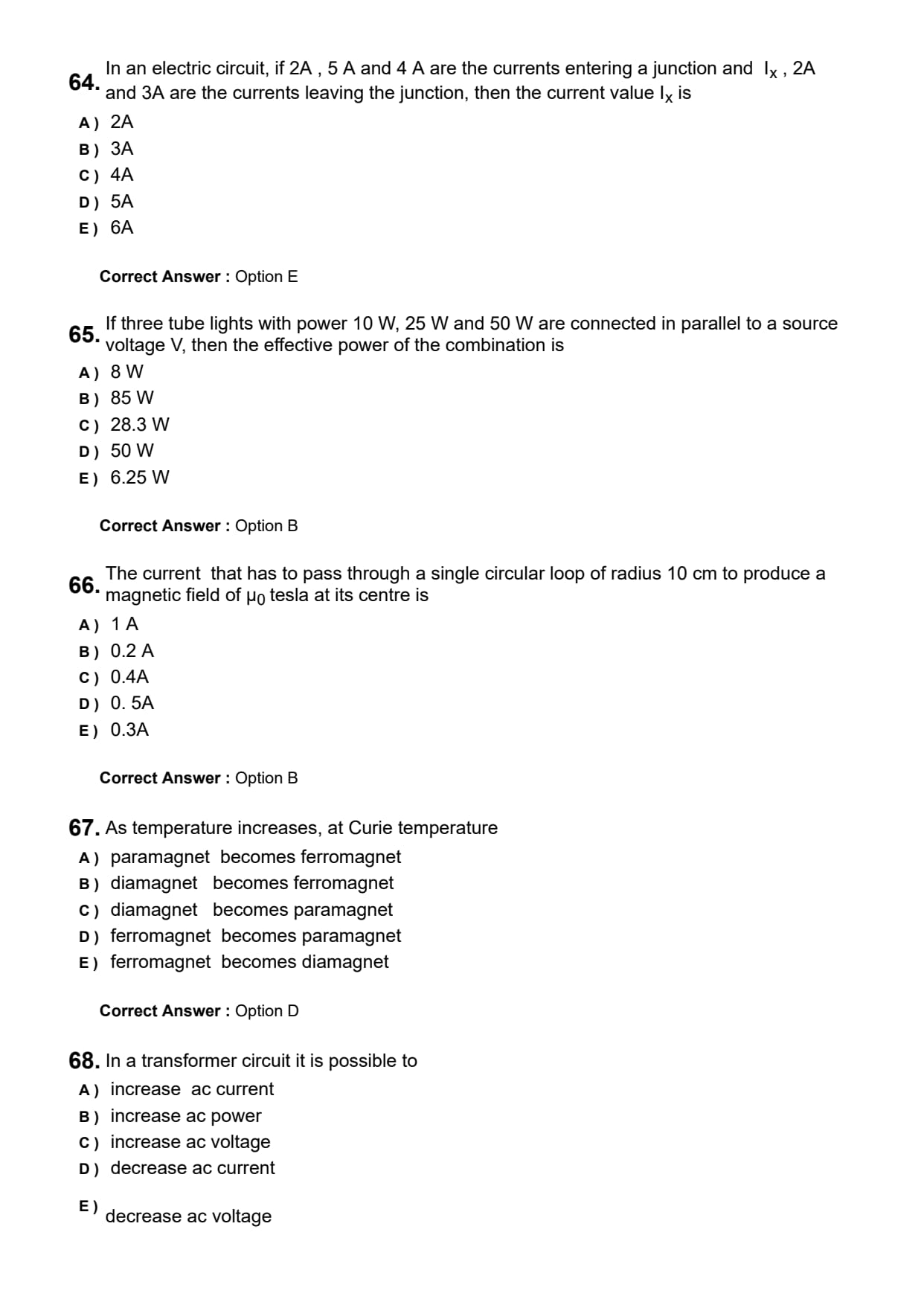
Question 64:
In an electric circuit, if 2A , 5 A and 4 A are the currents entering a junction and Ix , 2A and 3A are the currents leaving the junction, then the current value Ix is
- (A) 2A
- (B) 3A
- (C) 4A
- (D) 5A
- (E) 6A
Question 65:
If three tube lights with power 10 W, 25 W and 50 W are connected in parallel to a source voltage V, then the effective power of the combination is
- (A) 8 W
- (B) 85 W
- (C) 28.3 W
- (D) 50 W
- (E) 6.25 W
Question 66:
The current that has to pass through a single circular loop of radius 10 cm to produce a magnetic field of \(\mu_0\) tesla at its centre is
- (A) 1 A
- (B) 0.2 A
- (C) 0.4A
- (D) 0. 5A
- (E) 0.3A
Question 67:
As temperature increases, at Curie temperature
- (A) paramagnet becomes ferromagnet
- (B) diamagnet becomes ferromagnet
- (C) diamagnet becomes paramagnet
- (D) ferromagnet becomes paramagnet
- (E) ferromagnet becomes diamagnet
Question 68:
In a transformer circuit it is possible to
- (A) increase ac current
- (B) increase ac power
- (C) increase ac voltage
- (D) decrease ac current
- (E) decrease ac voltage
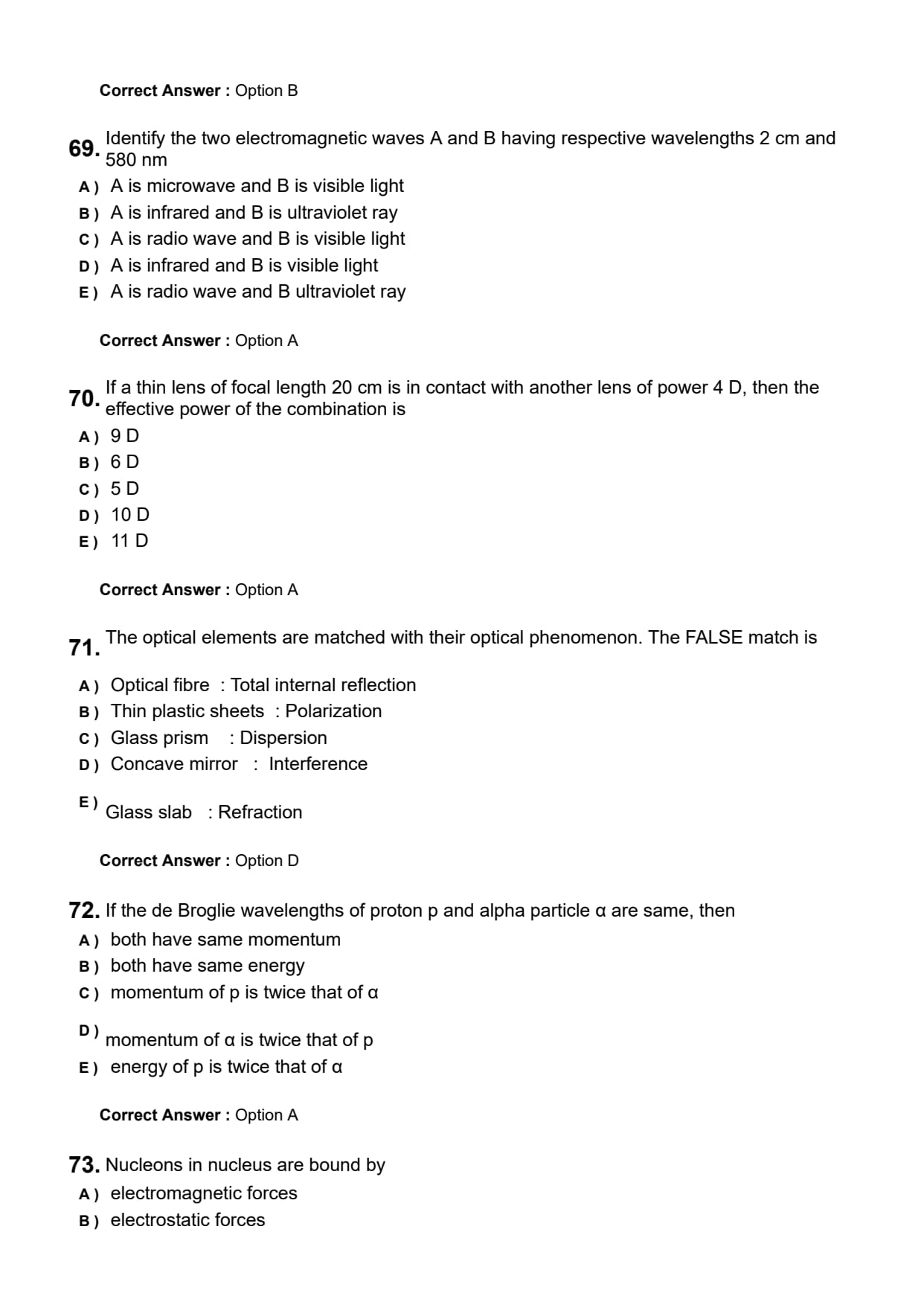
Question 69:
Identify the two electromagnetic waves A and B having respective wavelengths 2 cm and 580 nm
- (A) A is microwave and B is visible light
- (B) A is infrared and B is ultraviolet ray
- (C) A is radio wave and B is visible light
- (D) A is infrared and B is visible light
- (E) A is radio wave and B ultraviolet ray
Question 70:
If a thin lens of focal length 20 cm is in contact with another lens of power 4 D, then the effective power of the combination is
- (A) 9 D
- (B) 6 D
- (C) 5 D
- (D) 10 D
- (E) 11 D
Question 71:
The optical elements are matched with their optical phenomenon. The FALSE match is
- (C) Glass prism : Dispersion
- (A) Optical fibre : Total internal reflection
- (B) Thin plastic sheets : Polarization
- (D) Concave mirror : Interference
- (E) Glass slab : Refraction
Question 72:
If the de Broglie wavelengths of proton p and alpha particle \(\alpha\) are same, then
- (A) both have same momentum
- (B) both have same energy
- (C) momentum of p is twice that of \(\alpha\)
- (D) momentum of \(\alpha\) is twice that of p
- (E) energy of p is twice that of \(\alpha\)
Question 73:
Nucleons in nucleus are bound by
- (A) electromagnetic forces
- (B) electrostatic forces
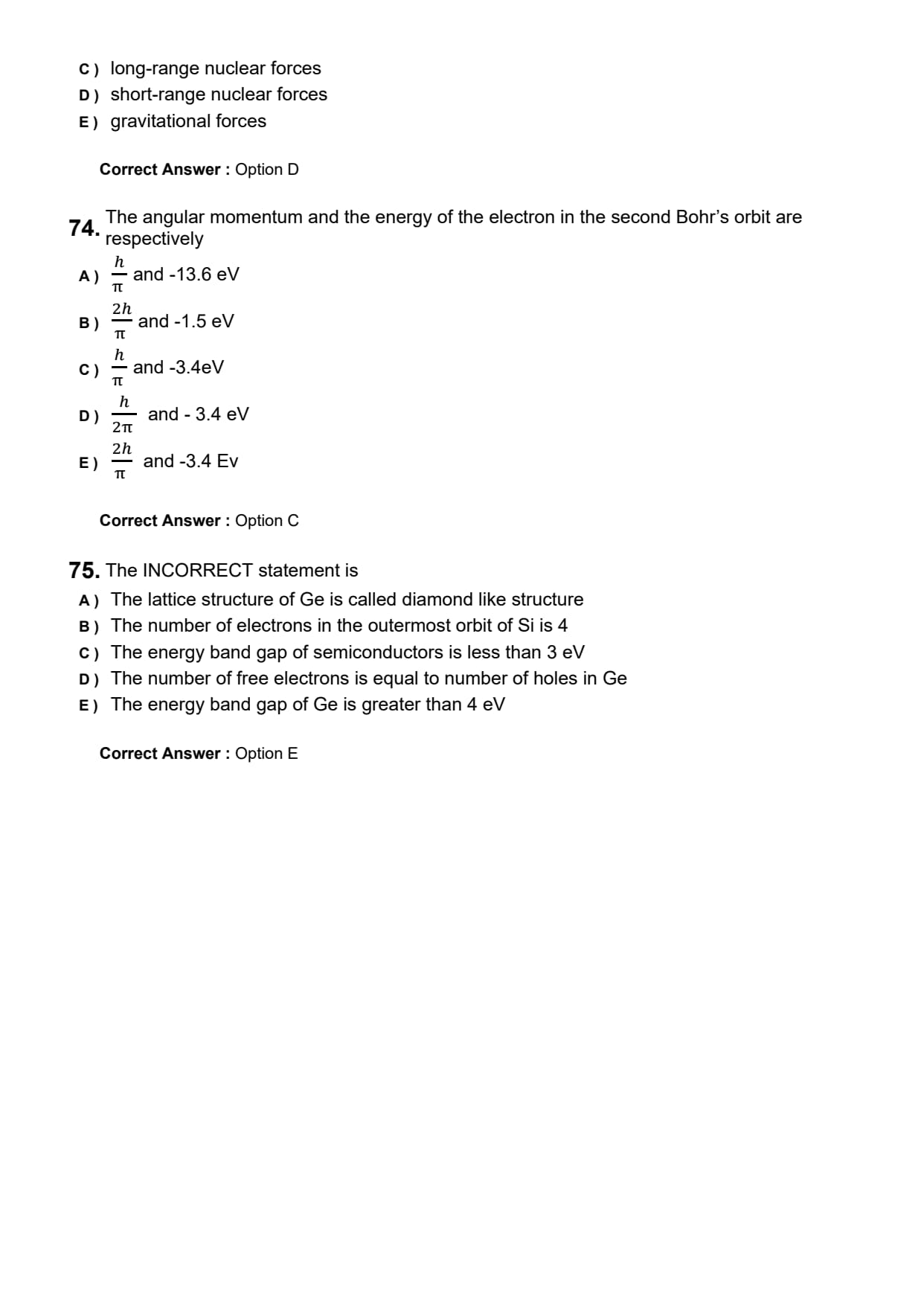
- (C) long-range nuclear forces
- (D) short-range nuclear forces
- (E) gravitational forces
Question 74:
The angular momentum and the energy of the electron in the second Bohr’s orbit are respectively
- (A) \( \frac{h}{\pi} \) and -13.6 eV
- (B) \( \frac{2h}{\pi} \) and -1.5 eV
- (C) \( \frac{h}{\pi} \) and -3.4eV
- (D) \( \frac{h}{2\pi} \) and - 3.4 eV
- (E) \( \frac{2h}{\pi} \) and -3.4 Ev
Question 75:
The INCORRECT statement is
- (A) The lattice structure of Ge is called diamond like structure
- (B) The number of electrons in the outermost orbit of Si is 4
- (C) The energy band gap of semiconductors is less than 3 eV
- (D) The number of free electrons is equal to number of holes in Ge
- (E) The energy band gap of Ge is greater than 4 eV
KEAM 2026 Exam Pattern
| Particulars |
Details |
| Paper |
Pharmacy |
| Mode of Exam |
Online CBT |
| Subjects |
Physics- 30 questions
Chemistry- 45 questions |
| Type of Question |
Objective Type |
| Total Number of questions |
75 |
| Marks are awarded for each correct answer |
4 marks |
| Marks are awarded for each incorrect answer |
1 marks |
| KEAM total marks for Pharmacy |
300 marks |
| Duration of KEAM Pharmacy exam |
90 minutes |
KEAM 2026 Final Revision


.jpg?h=56&w=56&mode=stretch)






Comments