KEAM 2025 Pharmacy exam in two days, on April 24, and April 29, 2025. The KEAM 2025 Pharmacy exam was conducted on April 24, 2025 in two sessions: Session I from 11:30 AM to 1 PM and Session II from 3:30 PM to 5 PM.

The KEAM 2025 Pharmacy exam is an online CBT exam with a total of 75 questions divided between the two subjects. Physics (45 questions) and Chemistry (30 questions). As per the KEAM 2025 marking scheme, +4 marks will be given for every correct answer and 1 mark is deducted for every incorrect answer. The KEAM 2025 exam has a total of 300 marks. The candidates have 90 minutes to complete the exam.

The question paper PDF and solution PDF is available here with solution pdf.

Related Links:

KEAM 2025 Pharmacy April 24 Shift 1 Question Paper with Solution PDF

KEAM 2025 Pharmacy Question Paper with Answer Key  Download Check Solutions

Question 1:

A solution contains \(9.8 \, g\) of \(H_2SO_4\). How much NaOH is required to completely neutralize it? (molar mass of NaOH = \(40 \, g mol^{-1}\))

  • (A) \(0.4 \, g \)
  • (B) \(0.2 \, g \)
  • (C) \(8 \, g \)
  • (D) \(1.2 \, g \)
  • (E) \(1.6 \, g \)

Question 2:

Which of the following statements are correct about canal rays?


[(i)] They carry positively charged particles.
[(ii)] The mass of the particles of these rays does not depend upon the gas present in the cathode ray tube.
[(iii)] The particles behave in a different manner in electric field as those of cathode rays.
[(iv)] The charge to mass ratio of the particles does not depends on the gas present in the cathode ray tube.

  • (A) (ii) and (iv)
  • (B) (i) and (iv)
  • (C) (i) and (ii)
  • (D) (ii) and (iii)
  • (E) (i) and (iii)

Question 3:

A sub-atomic particle of mass \(2.2 \times 10^{-2} \, kg\) is moving with a velocity of \(3.0 \times 10^5 \, ms^{-1}\). What is its de Broglie wavelength? (Planck's constant \(h = 6.6 \times 10^{-34} \, Js\))

  • (A) 1 pm
  • (B) 0.1 pm
  • (C) 2 pm
  • (D) 0.2 pm
  • (E) 0.5 pm

Question 4:

Which of the following is a metalloid?

  • (A) Antimony
  • (B) Aluminium
  • (C) Magnesium
  • (D) Phosphorus
  • (E) Calcium

Question 5:

Main group elements are

  • (A) s-block elements only
  • (B) p-block elements only
  • (C) both s- and p-block elements
  • (D) d-block elements only
  • (E) 4f and 5f-block elements

Question 6:

In which of the following compounds there is an expanded octet around the central atom?

  • (A) \(SCl_2\)
  • (B) \(NO_2\)
  • (C) \(NH_3\)
  • (D) \(PCl_3\)
  • (E) \(H_2SO_4\)

Question 7:

Which of the following molecule has tetrahedral geometry?

  • (A) \(SF_6\)
  • (B) \(PCl_5\)
  • (C) \(BF_3\)
  • (D) \(BeCl_2\)
  • (E) \(NH_4^+\)

Question 8:

Enthalpy change is always negative for which one of the following processes?

  • (A) Enthalpy of ionisation
  • (B) Enthalpy of sublimation
  • (C) Enthalpy of vapourisation
  • (D) Enthalpy of bond dissolution
  • (E) Enthalpy of combustion

Question 9:

What are the thermodynamic conditions for a reaction to be spontaneous at low temperature and non-spontaneous at high temperature?

  • (A) \( \Delta H > 0, \Delta S > 0 \)
  • (B) \( \Delta H < 0, \Delta S > 0 \)
  • (C) \( \Delta H > 0, \Delta S < 0 \)
  • (D) \( \Delta H < 0, \Delta S < 0 \)
  • (E) \( \Delta H > 0, \Delta S = 0 \)

Question 10:

A monobasic acid HA has pH of 3 in 0.1 M solution at 298 K. What is the pKa of the acid at 298 K?

  • (A) 3
  • (B) 4
  • (C) 5
  • (D) 6
  • (E) 2

Question 11:

The ion with the highest limiting molar conductance at 298 K is

  • (A) \(H^+\)
  • (B) \(Na^+\)
  • (C) \(K^+\)
  • (D) \(Ca^{2+}\)
  • (E) \(Mg^{2+}\)

Question 12:

What is the quantity of current required to deposit one mole of metallic magnesium from fused magnesium chloride? (1F = 96500 C)

  • (A) \(1.93 \times 10^4 \, C\)
  • (B) \(1.93 \times 10^3 \, C\)
  • (C) \(9.65 \times 10^3 \, C\)
  • (D) \(9.65 \times 10^4 \, C\)
  • (E) \(1.93 \times 10^5 \, C\)

Question 13:

Which of the following gas has highest solubility in water at 298 K?

  • (A) Formaldehyde
  • (B) Methane
  • (C) \(CO_2\)
  • (D) Vinyl chloride
  • (E) Argon

Question 14:

What is the unit of rate constant for a second order reaction?

  • (A) \(mol^2 \, L^{-1} s^{-1}\)
  • (B) \(mol^{-1} L^{-1} s^{-1}\)
  • (C) \(mol^{-1} L \, s^{-1}\)
  • (D) \(mol \, L^2 s^{-1}\)
  • (E) \(mol \, L^{-1} s^{-1}\)

Question 15:

Which of the following is an incorrect statement?

  • (A) For a zero order reaction the rate of the reaction is independent of reactant concentration.
  • (B) In a first order reaction the half-life period does not depend on the initial reactant concentration.
  • (C) For a chemical reaction the rate constant increases with increase in temperature.
  • (D) In a zero order reaction plot of reactant concentration against time is a straight line with negative slope.
  • (E) In a first order reaction, the time required for 75% completion of the reaction is thrice the half-life period.

Question 16:

Which of the following is a colourless transition metal ion?

  • (A) \(Ca^{2+}\)
  • (B) \(Cr^{3+}\)
  • (C) \(Ti^{4+}\)
  • (D) \(Fe^{2+}\)
  • (E) \(Fe^{3+}\)

Question 17:

The \(3d\) metal that forms fluoride in +6 oxidation state is

  • (A) Titanium
  • (B) Chromium
  • (C) Vanadium
  • (D) Manganese
  • (E) Cobalt

Question 18:

The transition metal oxide used as a catalyst in the manufacture of sulphuric acid is

  • (A) Nickel (II) oxide
  • (B) Vanadium (III) oxide
  • (C) Chromium (III) oxide
  • (D) Chromium (II) oxide
  • (E) Vanadium (V) oxide

Question 19:

The transition metal ion with the least ionic radius (in pm) is

  • (A) \(Sc^{3+}\)
  • (B) \(Ti^{3+}\)
  • (C) \(V^{3+}\)
  • (D) \(Cr^{3+}\)
  • (E) \(Mn^{3+}\)

Question 20:

\(KMnO_4\) is prepared from Mn(II) ion salts by oxidizing it with

  • (A) \(KClO_3\)
  • (B) \(K_2S_2O_8\)
  • (C) \(KNO_3\)
  • (D) \(KClO_4\)
  • (E) \(KOH\)

Question 21:

The lanthanoid with the outer electronic configuration \(4f^7 5d^1 6s^2\) is

  • (A) Neodymium
  • (B) Samarium
  • (C) Europium
  • (D) Gadolinium
  • (E) Holmium

Question 22:

The IUPAC name of the complex \([Co(NH_3)_3(H_2O)_3]Cl_3\) is

  • (A) triaquatrianminecobalt(III) chloride
  • (B) triammine triaquacobalt(III) chloride
  • (C) triaquatrianminecobalt(II) chloride
  • (D) triammine triaquacobalt(II) chloride
  • (E) triaquatriamminecobalt(III) trichloride

Question 23:

The complexes \([Co(NH_3)_5Br]SO_4\) and \([Co(NH_3)_5SO_4]Br\) are examples of

  • (A) Linkage isomerism
  • (B) Solvate isomerism
  • (C) Coordination isomerism
  • (D) Ionization isomerism
  • (E) Geometrical isomerism

Question 24:

The metal ion present in the Wilkinson’s catalyst is

  • (A) Nickel
  • (B) Platinum
  • (C) Iron
  • (D) Rhodium
  • (E) Chromium

Question 25:

Which of the following is a spin free complex?

  • (A) \([Ni(CO)_4]\)
  • (B) \([Co(NH_3)_6]^{3+}\)
  • (C) \([Ni(CN)_4]^{2-}\)
  • (D) \([CoF_6]^{3-}\)
  • (E) \([Mn(CN)_6]^{3-}\)

Question 26:

The type of hybridization of the carbon atoms from left to right in \(CH_3 - CH = CH - CN\) is

  • (A) \(sp^3, sp, sp, sp^2\)
  • (B) \(sp^3, sp^2, sp, sp\)
  • (C) \(sp^3, sp^2, sp^2, sp\)
  • (D) \(sp^3, sp^2, sp^2, sp^2\)
  • (E) \(sp^3, sp^2, sp, sp^2\)

Question 27:

Which of the following group shows \(-R\) effect?

  • (A) \(-OH\)
  • (B) \(-OCOR\)
  • (C) \(-NH_2\)
  • (D) \(-CN\)
  • (E) \(-OR\)

Question 28:

The hydrocarbon with molecular formula \(C_{20}H_{42}\) is

  • (A) Didodecane
  • (B) Didecane
  • (C) Dodecane
  • (D) Didocene
  • (E) Eicosane

Question 29:

When n-hexane is passing over \(Mo_2O_3\) catalyst at 773 K and 10–20 atm pressure, the product formed is

  • (A) 1-hexene
  • (B) 3-hexene
  • (C) cyclohexane
  • (D) benzene
  • (E) cyclohexene

Question 30:

One mole of an alkene on ozonolysis gives one mole of propan-2-one and one mole of formaldehyde. What is the alkene?

  • (A) 2-Butene
  • (B) 1-Butene
  • (C) Isobutene
  • (D) 2-Methyl-2-butene
  • (E) 2,3-Dimethyl-2-butene

Question 31:

The correct decreasing order of acidity of alkynes is

  • (A) \(CH \equiv CH > CH_3 - C \equiv CH > CH_3 - C \equiv C - CH_3\)
  • (B) \(CH_3 - C \equiv C - CH_3 > CH \equiv CH > CH_3 - C \equiv CH\)
  • (C) \(CH_3 - C \equiv CH > CH \equiv CH > CH_3 - C \equiv C - CH_3\)
  • (D) \(CH \equiv CH > CH_3 - C \equiv C - CH_3 > CH_3 - C \equiv CH\)
  • (E) \(CH_3 - C \equiv CH > CH_3 - C \equiv C - CH_3 > CH \equiv CH\)

Question 32:

When toluene is treated with \(Cl_2\) in the presence of \(Fe\) in dark, the product formed is

  • (A) Benzyl chloride
  • (B) mixture of o- & p-Chlorotoluene
  • (C) 2,4,6-Trichlorotoluene
  • (D) 2,4-Dichlorotoluene
  • (E) Benzal dichloride

Question 33:

Which of the following compound is used for the manufacture of phenol in large scale?

  • (A) Chlorobenzene
  • (B) Benzene
  • (C) Aniline
  • (D) Cumene
  • (E) Cyclohexane

Question 34:

When aryl halide is treated with \(Na\) in dry ether, biphenyl is formed. This reaction is called

  • (A) Fittig reaction
  • (B) Wurtz-Fittig reaction
  • (C) Swarts reaction
  • (D) Williamson’s synthesis
  • (E) Kolbe’s reaction

Question 35:

Aspirin is

  • (A) methyl salicylate
  • (B) sodium benzoate
  • (C) acetyl salicylic acid
  • (D) 2-methyl salicylic acid
  • (E) ethyl salicylate

Question 36:

Phenol is converted into benzene by heating with

  • (A) \(Na/Hg\)
  • (B) Zn dust
  • (C) \(Cr_2O_3\)
  • (D) \(LiAlH_4\)
  • (E) \(NaBH_4\)

Question 37:

Intramolecular hydrogen bonding is present in

  • (A) Water
  • (B) Methanol
  • (C) Phenol
  • (D) o-Nitrophenol
  • (E) p-Nitrophenol

Question 38:

Which of the following is the weakest acid?

  • (A) \(FCH_2COOH\)
  • (B) \(NC-CH_2COOH\)
  • (C) \(Cl_2C-COOH\)
  • (D) \(O_2N-CH_2COOH\)
  • (E) \(Cl_2CHCOOH\)

Question 39:

Benzaldehyde reacts with acetophenone in the presence of \(NaOH\) at 293 K to give benzalacetophenone. This reaction is an example of

  • (A) Cannizzaro reaction
  • (B) aldol condensation
  • (C) Wolf-Kishner reduction
  • (D) Clemmensen reduction
  • (E) cross aldol condensation

Question 40:

Which of the following carboxylic acid is used in rubber, textile, dyeing, leather and electroplating industries?

  • (A) Methanoic acid
  • (B) Ethanoic acid
  • (C) Benzoic acid
  • (D) Salicylic acid
  • (E) Butanoic acid

Question 41:

Acetanilide is prepared by treating acetic anhydride/pyridine with

  • (A) Ethanamine
  • (B) Methanamine
  • (C) Benzenamine
  • (D) N-Methylaniline
  • (E) N-Methylethanamine

Question 42:

Which of the following amine does not react with Hinsberg’s reagent?

  • (A) Methanamine
  • (B) N-Methylethanamine
  • (C) N,N-Dimethylethanamine
  • (D) 1-Propanamine
  • (E) 2-Propanamine

Question 43:

Aryl fluorides are prepared from diazonium salts using

  • (A) \(NaF\)
  • (B) \(KF\)
  • (C) \(BF_3\)
  • (D) \(AlF_3\)
  • (E) \(HBF_4\)

Question 44:

Which of the following amino acid can be synthesized in the body?

  • (A) Proline
  • (B) Leucine
  • (C) Valine
  • (D) Arginine
  • (E) Histidine

Question 45:

Match the following;

a) Aldohexose                                 i) Maltose

b) Ketohexose                                ii) Glycogen

c) Non-reducing disaccharide      iii) Glucose

d) Reducing disaccharide             iv) Sucrose

e) Polysaccharide                          v) Fructose


  • (A) a-(iii), b-(v), c-(iv), d-(i), e-(ii)
  • (B) a-(iii), b-(ii), c-(i), d-(v), e-(iv)
  • (C) a-(i), b-(ii), c-(iii), d-(v), e-(iv)
  • (D) a-(iii), b-(iv), c-(v), d-(i), e-(ii)
  • (E) a-(iii), b-(ii), c-(iv), d-(i), e-(v)

Question 46:

The dimensional formula for the product of the decay constant \(\lambda\) and the mean life of a radioactive substance is

  • (A) \(LMT^2\)
  • (B) \(L^0MT^{-2}\)
  • (C) \(LMT\)
  • (D) \(L^0M^0T^0\)
  • (E) \(L^2M^2T^2\)

Question 47:

An object when dropped from a height \(h\) from the ground, reaches the ground in \(t\) s. The time after which the object was passing through a point at a height \(h/2\) from the ground is

  • (A) \(\sqrt{2}t\)
  • (B) \(\frac{t}{\sqrt{2}}\)
  • (C) \(\frac{t}{2}\)
  • (D) \(2t\)
  • (E) \(\frac{t}{4}\)

Question 48:

The angle between two unit vectors \(\vec{A}\) and \(\vec{B}\) is \(60^\circ\). The value of \(|\vec{A} - \vec{B}|\) is

  • (A) \(\frac{1}{2}\)
  • (B) \(\frac{1}{3}\)
  • (C) \(\frac{1}{4}\)
  • (D) \(1\)
  • (E) \(\frac{1}{8}\)

Question 49:

A person standing on the platform of a lift will experience weight loss, when the lift moves

  • (A) downward with uniform velocity
  • (B) upward with constant acceleration
  • (C) downward with constant acceleration
  • (D) upward with uniform velocity
  • (E) upward with variable acceleration

Question 50:

Three forces \(F_1, F_2\) and \(F_3\) acting on a body of mass \(m\) keep the body stationary. If the forces \(F_1\) and \(F_2\) are mutually perpendicular, the acceleration of the body when the force \(F_3\) is removed is

  • (A) \(\frac{F_3}{m}\)
  • (B) \(\frac{F_1F_2}{m}\)
  • (C) \(\frac{(F_1 - F_2)}{m}\)
  • (D) \(\frac{F_1}{m}\)
  • (E) \(\frac{F_2}{m}\)

Question 51:

A body initially at rest undergoes linear motion with constant acceleration under the action of a constant force. Then the power delivered to the body at time \(t\) is proportional to

  • (A) \(t^{1/2}\)
  • (B) \(t\)
  • (C) \(t^3\)
  • (D) \(t^2\)
  • (E) \(t^{3/2}\)

Question 52:

Pick out the INCORRECT statement from the following

  • (A) Work done in uniform circular motion is zero
  • (B) When a body is in dynamic equilibrium, work done is zero
  • (C) Work done is positive for a freely falling body under gravity
  • (D) Work done in a stretched string is positive
  • (E) Work done depends on the time taken to complete the work

Question 53:

A shell travelling along a parabolic path in the gravitational field of the earth undergoes explosion in mid air. The centre of mass of the fragments will move

  • (A) horizontally and then vertically down
  • (B) along the original parabolic path
  • (C) vertically down
  • (D) vertically up and then vertically down
  • (E) horizontally and then in the parabolic path

Question 54:

The ratio of radius of gyration of a circular ring to that of a circular disc, each of same mass and same radius about their respective central axes is

  • (A) \(\sqrt{2} : \sqrt{3}\)
  • (B) \(1 : \sqrt{2}\)
  • (C) \(\sqrt{3} : \sqrt{2}\)
  • (D) \(\sqrt{2} : 1\)
  • (E) \(1 : 1\)

Question 55:

Two bodies of masses \(m\) and \(4m\) are kept at a distance of \(x\). The distance on the axial point from \(m\) at which the gravitational field is zero is

  • (A) \(\frac{x}{3}\)
  • (B) \(\frac{x}{4}\)
  • (C) \(\frac{x}{8}\)
  • (D) \(\frac{x}{2}\)
  • (E) \(\frac{x}{5}\)

Question 56:

Work done in a stretched wire is

  • (A) Load \(\times\) strain
  • (B) \(\frac{1}{2} \times\) load \(\times\) strain
  • (C) Young's modulus \(\times\) strain
  • (D) \(\frac{1}{4} \times\) load \(\times\) extension
  • (E) \(\frac{1}{2} \times\) load \(\times\) extension

Question 57:

The total pressure \(P\) inside an air bubble of radius \(r\) at a depth \(h\) below the surface of liquid of density \(\rho\) is (T = surface tension of liquid, \(P_0\) = atmospheric pressure)

  • (A) \(P_0 - h\rho g - \frac{2T}{r}\)
  • (B) \(P_0 + h\rho g + \frac{2T}{r}\)
  • (C) \(P_0 + h\rho g + \frac{4T}{r}\)
  • (D) \(h\rho g + \frac{2T}{r}\)
  • (E) \(P_0 + \frac{2T}{r}\)

Question 58:

If the value of \(C_p/C_v\) is unity in the equation \(PV^\gamma = constant\), then the process is

  • (A) adiabatic
  • (B) isochoric
  • (C) isothermal
  • (D) isobaric
  • (E) irreversible

Question 59:

The temperature at which the r.m.s. velocity of oxygen molecule is equal to that of hydrogen molecule at 20 K is

  • (A) 300 K
  • (B) 320 K
  • (C) 330 K
  • (D) 400 K
  • (E) 375 K

Question 60:

A particle executes linear simple harmonic motion and its potential energy (P.E.), kinetic energy (K.E.), total energy (T.E.) are measured as functions of displacement \(x\) from the mean position at the origin. Then

  • (A) K.E. is minimum when \(x = 0\)
  • (B) T.E. is zero when \(x = 0\)
  • (C) P.E. is maximum when \(x = 0\)
  • (D) K.E. is maximum when \(x\) is maximum
  • (E) P.E. is maximum when \(x\) is maximum

Question 61:

A closed organ pipe and an open organ pipe have the same length. The ratio of the frequencies in their third mode of vibrations is

  • (A) \(3:1\)
  • (B) \(2:3\)
  • (C) \(5:6\)
  • (D) \(4:5\)
  • (E) \(3:5\)

Question 62:

A point charge \(-q\) is placed at a distance \(x\) from an isolated conducting plane. The electric field at any point \(P\) on the other side of the plane is directed

  • (A) radially away from the point charge
  • (B) towards the plane perpendicularly
  • (C) radially towards the point charge
  • (D) away from the plane perpendicularly
  • (E) parallel to the surface of the conducting plane

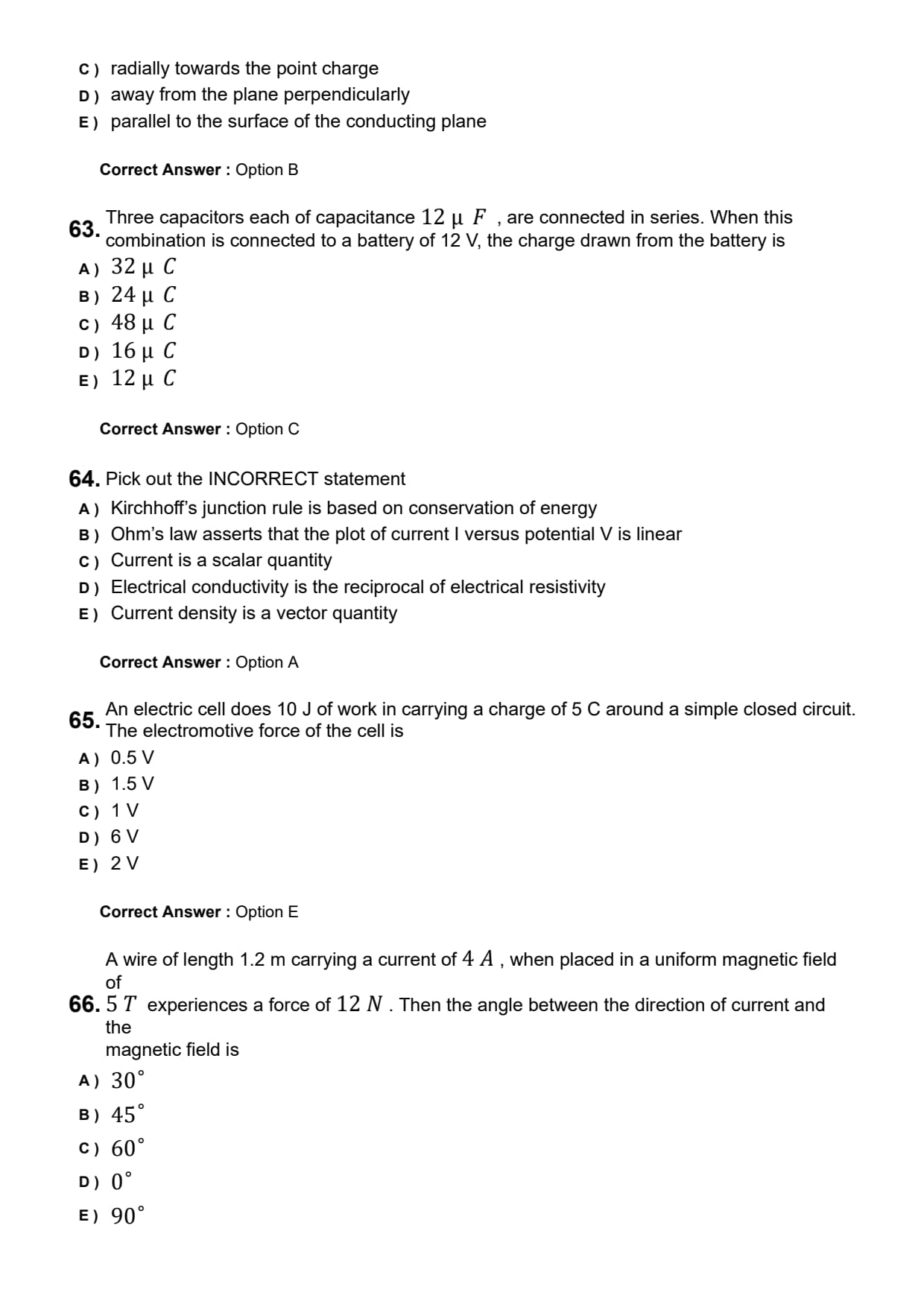
Question 63:

Three capacitors each of capacitance \(12\,\mu F\), are connected in series. When this combination is connected to a battery of \(12\,V\), the charge drawn from the battery is

  • (A) \(32\,\mu C\)
  • (B) \(24\,\mu C\)
  • (C) \(48\,\mu C\)
  • (D) \(16\,\mu C\)
  • (E) \(12\,\mu C\)

Question 64:

Pick out the INCORRECT statement

  • (A) Kirchhoff's junction rule is based on conservation of energy
  • (B) Ohm's law asserts that the plot of current \(I\) versus potential \(V\) is linear
  • (C) Current is a scalar quantity
  • (D) Electrical conductivity is the reciprocal of electrical resistivity
  • (E) Current density is a vector quantity

Question 65:

An electric cell does 10 J of work in carrying a charge of 5 C around a simple closed circuit. The electromotive force of the cell is

  • (A) 0.5 V
  • (B) 1.5 V
  • (C) 1 V
  • (D) 6 V
  • (E) 2 V

Question 66:

A wire of length 1.2 m carrying a current of 4 A, when placed in a uniform magnetic field 5 T experiences a force of 12 N. Then the angle between the direction of current and magnetic field is

  • (A) \(30^\circ\)
  • (B) \(45^\circ\)
  • (C) \(60^\circ\)
  • (D) \(0^\circ\)
  • (E) \(90^\circ\)

Question 67:

When a proton moves in a uniform magnetic field such that its velocity has a component along the direction of magnetic field, its trajectory will be a

  • (A) circle
  • (B) straight line
  • (C) helix
  • (D) parabola
  • (E) ellipse

Question 68:

An iron ring is held horizontally and a bar magnet is dropped gently through the ring with its length coinciding with the axis of the ring. The acceleration of the freely falling magnet (\(g\) = acceleration due to gravity) is

  • (A) is less than g
  • (B) is equal to g
  • (C) is greater than g
  • (D) depends on the radius of the ring
  • (E) depends on the length of the magnet

Question 69:

In a plane electromagnetic wave, the magnetic field is given by \(B = 400 \times 10^{-6}\sin[(4.0 \times 10^{-4})(t - x/c)]\). The peak value of electric field (in V m\(^{-1}\)) is

  • (A) \(8 \times 10^4\)
  • (B) \(6 \times 10^4\)
  • (C) \(4 \times 10^4\)
  • (D) \(3 \times 10^4\)
  • (E) \(12 \times 10^4\)

Question 70:

A convex lens having power \(P\) is cut into two halves perpendicular to the principal axis. Then the power of each piece is

  • (A) \(P\)
  • (B) \(\frac{P}{2}\)
  • (C) \(2P\)
  • (D) \(\frac{P}{4}\)
  • (E) \(4P\)

Question 71:

In Young’s double slit experiment performed in air medium, the fringe width observed is 1.4 mm. If the entire arrangement is kept in a liquid medium of refractive index 1.4, then the fringe width (in mm) will be

  • (A) 1.4
  • (B) 1.0
  • (C) 0.7
  • (D) 2.8
  • (E) 0.5

Question 72:

When blue light is incident on a certain metal surface, photoelectrons are emitted. When green light is incident on the same metal surface, no electrons are emitted. If the same metallic surface is exposed to yellow light,

  • (A) less energetic electrons will be emitted
  • (B) no electrons will be emitted
  • (C) more energetic electrons will be emitted
  • (D) electron emission depends on the intensity of light
  • (E) electron emission depends on the time of exposure

Question 73:

Ionization potential of hydrogen atom is 13.6 eV. Hydrogen atom in the ground state initially is excited by monochromatic radiation of photon energy 12.75 eV. The number of spectral lines emitted by the hydrogen atom, according to Bohr’s theory will be

  • (A) 2
  • (B) 4
  • (C) 3
  • (D) 6
  • (E) 5

Question 74:

When a radioactive material emits an \(\alpha\)-particle, its position in the periodic table

  • (A) is lowered by three places
  • (B) is increased by two places
  • (C) remains unchanged
  • (D) is lowered by two places
  • (E) is increased by one place

Question 75:

The band gap energy of silicon is

  • (A) \(1.1 \, eV\)
  • (B) \(0.7 \, eV\)
  • (C) \(1.7 \, eV\)
  • (D) \(2.1 \, eV\)
  • (E) \(0.5 \, eV\)

KEAM 2025 Pharmacy Subject Wise Weightage

Physics carries the highest weightage of 60% in the KEAM 2025 exam. A total of 45 questions are asked from this section.

Chemistry carries the least weightage of 40%. Easy questions are asked from this section as compared to Physics.

Subject No. of Questions Total Marks Weightage (%)
Physics 45 180 60%
Chemistry 30 120 40%
Total 75 300 100%

KEAM 2025 Pharmacy Exam Difficulty Level (Expected)

Based on the previous year KEAM difficulty level data, the following can be expected for KEAM 2025:

Physics is expected to be tough and lengthy due to the numerical problems. Thorough conceptual knowledge and good time management are required.

Chemistry will be of easy to moderate difficulty level. Candidates can maximize their overall scores in this section.

Subject Expected Difficulty
Physics Moderate to Difficult
Chemistry Easy to Moderate