KEAM 2025 Engineering exam in multiple days, starting from April 23 to April 28, 2025. The KEAM 2025 April 23 Engineering exam was conducted from 2:00 PM to 5:00 PM.
The KEAM 2025 Engineering exam is an online CBT with a total of 150 questions divided between the three subjects. Physics (45 questions), Chemistry (30 questions) and Mathematics (75 questions). As per the KEAM 2025 marking scheme, +4 marks will given for every correct answer and 1 mark is deducted for every incorrect answer. The KEAM 2025 exam is a total of 600 marks. The candidates have 180 minutes (3 hours) to complete the exam.
The question paper PDF and solution PDF is available to download here.
Related Links:
KEAM 2025 23 April Question Paper PDF Download
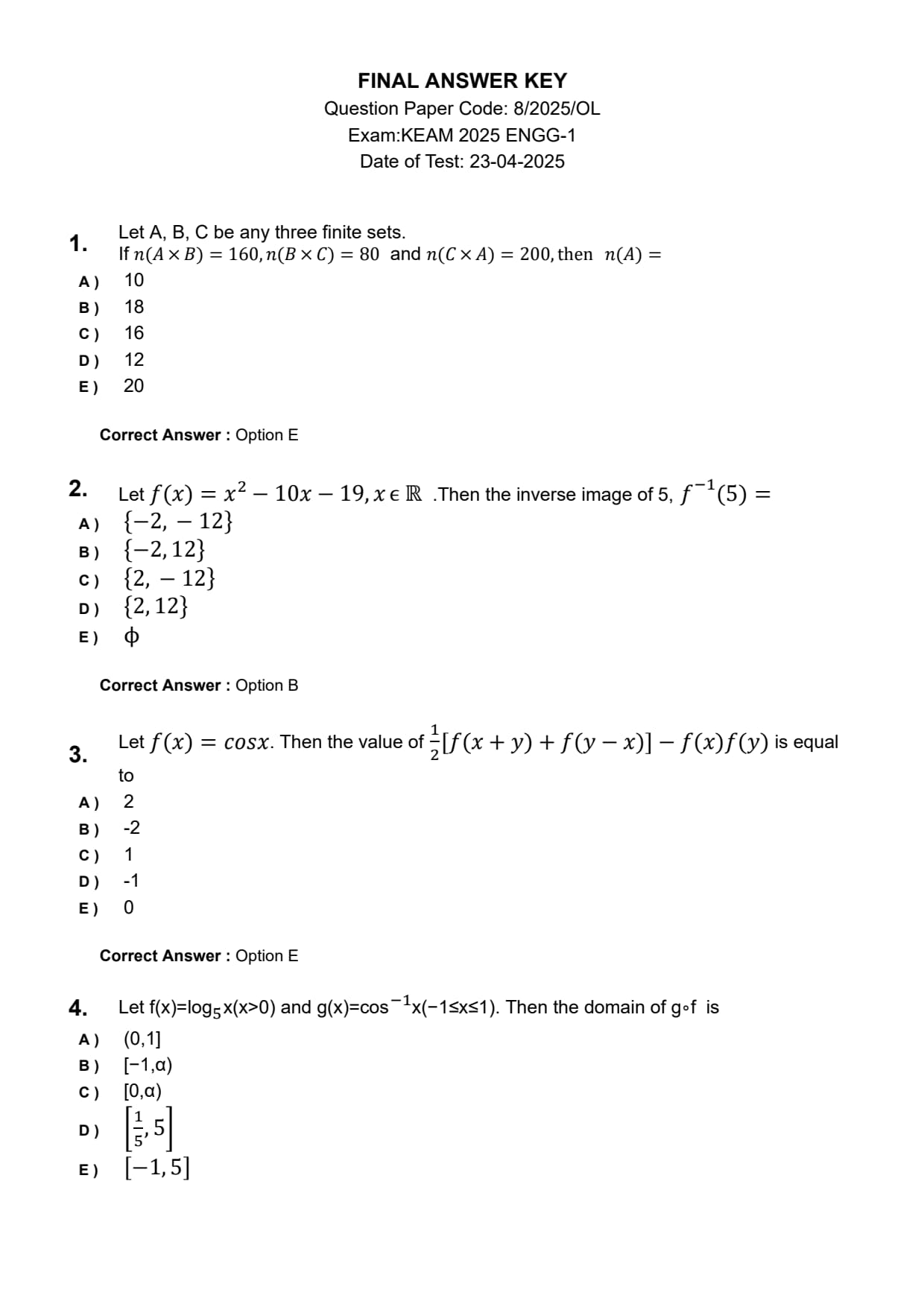
Question 1:
Let \( A, B, C \) be any three finite sets. If \( n(A \times B) = 160\), \( n(B \times C) = 80 \) and \( n(C \times A) = 200\), then \( n(A) = \)
- (A) \(10 \)
- (B) \(18 \)
- (C) \(16 \)
- (D) \(12 \)
- (E) \(20 \)
Question 2:
Let \( f(x) = x^2 - 10x - 19, \, x \in \mathbb{R} \). Then the inverse image of 5, \( f^{-1}(5) = \)
- (A) \( \{-2, -12\} \)
- (B) \( \{-2, 12\} \)
- (C) \( \{2, -12\} \)
- (D) \( \{2, 12\} \)
- (E) \( \phi \)
Question 3:
Let \( f(x) = \cos x \). Then the value of \( \frac{1}{2}[f(x+y) + f(y-x)] - f(x)f(y) \) is equal to
- (A) \(2 \)
- (B) \(-2 \)
- (C) \(1 \)
- (D) \(-1 \)
- (E) \(0 \)
Question 4:
Let \( f(x)=\log_5 x \, (x>0) \) and \( g(x)=\cos^{-1}x \, (-1\le x \le 1) \). Then the domain of \( g \circ f \) is
- (A) \( (0,1] \)
- (B) \( [-1,a) \)
- (C) \( [0,a) \)
- (D) \( \left[\frac{1}{5},5\right] \)
- (E) \( [-1,5] \)
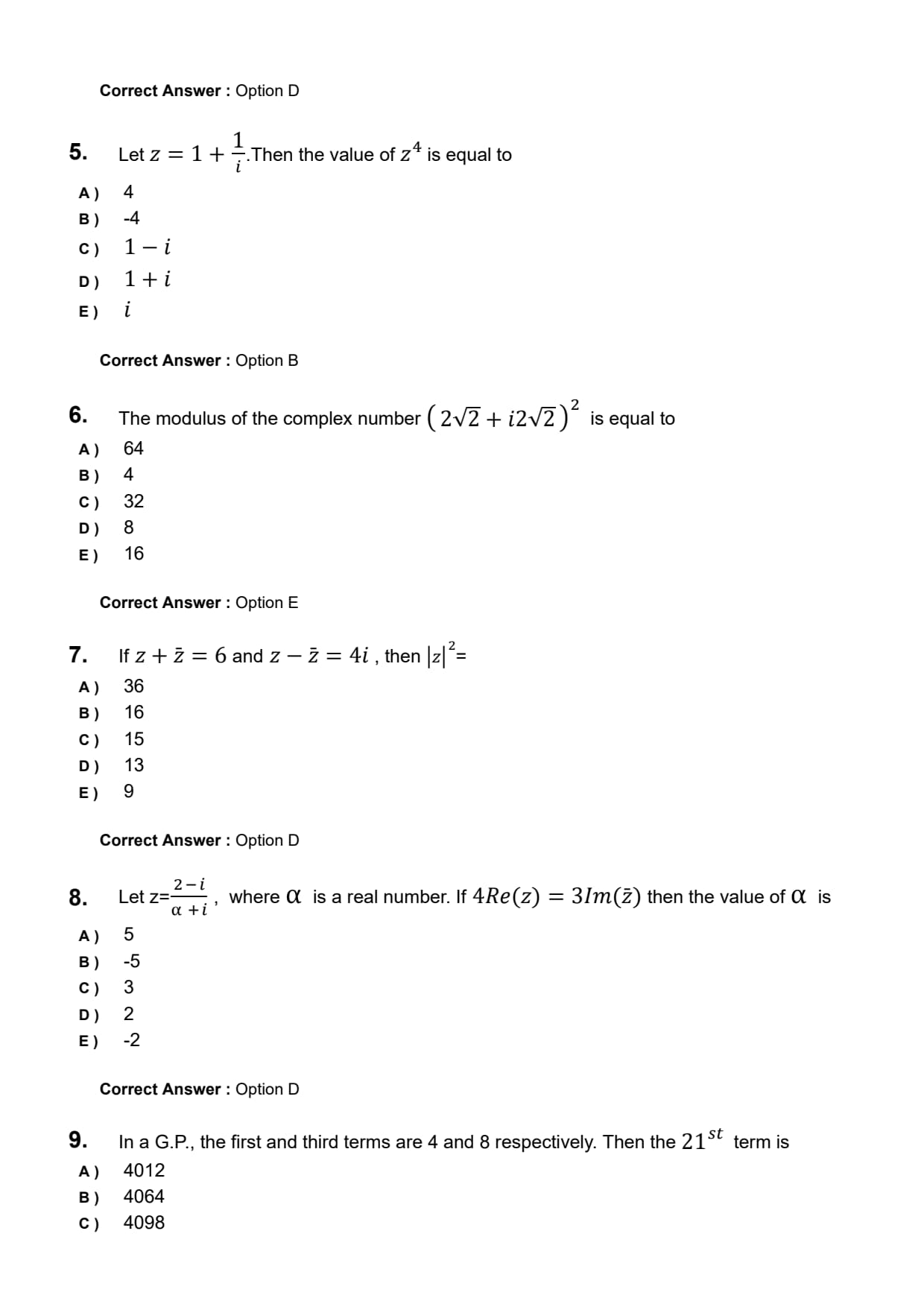
Question 5:
Let \( z = 1 + \frac{1}{i} \). Then the value of \( z^4 \) is equal to
- (A) \(4 \)
- (B) \(-4 \)
- (C) \(1 - i \)
- (D) \(1 + i \)
- (E) \( i \)
Question 6:
The modulus of the complex number \( (2\sqrt{2} + i2\sqrt{2})^2 \) is equal to
- (A) \(64 \)
- (B) \(4 \)
- (C) \(32 \)
- (D) \(8 \)
- (E) \(16 \)
Question 7:
If \( z + \bar{z} = 6 \) and \( z - \bar{z} = 4i \), then \( |z|^2 = \)
- (A) \(36 \)
- (B) \(16 \)
- (C) \(15 \)
- (D) \(13 \)
- (E) \(9 \)
Question 8:
Let \( z = \frac{2 - i}{\alpha + i} \), where \( \alpha \) is a real number. If \( 4Re(z) = 3Im(\bar{z}) \), then the value of \( \alpha \) is
- (A) \(5 \)
- (B) \(-5 \)
- (C) \(3 \)
- (D) \(2 \)
- (E) \(-2 \)
Question 9:
In a G.P., the first and third terms are 4 and 8 respectively. Then the \(21^{st}\) term is
- (A) \(4012 \)
- (B) \(4064 \)
- (C) \(4098 \)
- (D) \(2048 \)
- (E) \(4096 \)
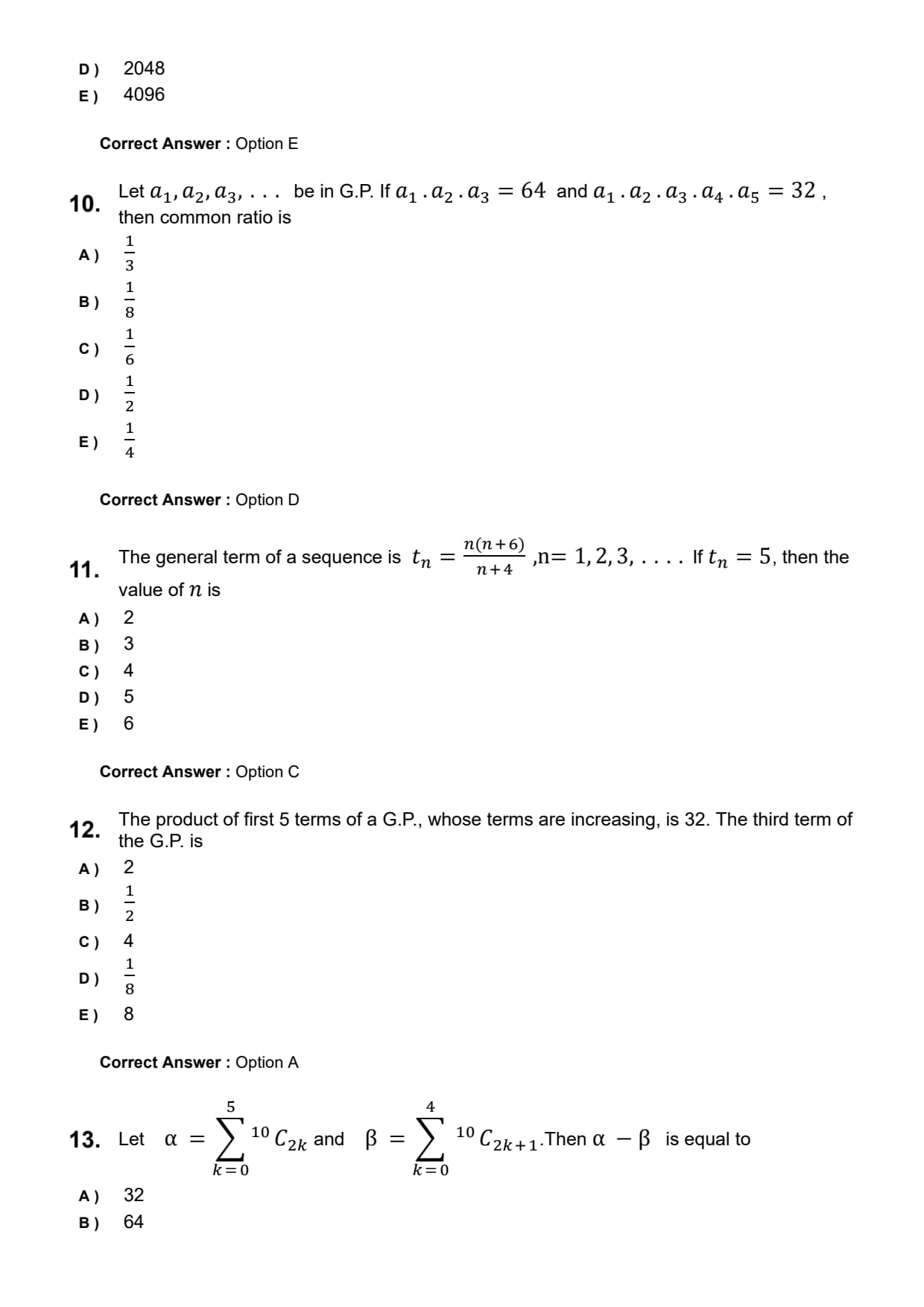
Question 10:
Let \( a_1, a_2, a_3, \ldots \) be in G.P. If \( a_1 \cdot a_2 \cdot a_3 = 64 \) and \( a_1 \cdot a_2 \cdot a_3 \cdot a_4 \cdot a_5 = 32 \), then common ratio is
- (A) \( \frac{1}{3} \)
- (B) \( \frac{1}{8} \)
- (C) \( \frac{1}{6} \)
- (D) \( \frac{1}{2} \)
- (E) \( \frac{1}{4} \)
Question 11:
The general term of a sequence is \( t_n = \frac{n(n+6)}{n+4}, \, n = 1,2,3,\ldots \). If \( t_n = 5 \), then the value of \( n \) is
- (A) \(2 \)
- (B) \(3 \)
- (C) \(4 \)
- (D) \(5 \)
- (E) \(6 \)
Question 12:
The product of first 5 terms of a G.P., whose terms are increasing, is 32. The third term of the G.P. is
- (A) \(2 \)
- (B) \( \frac{1}{2} \)
- (C) \(4 \)
- (D) \( \frac{1}{8} \)
- (E) \(8 \)
Question 13:
Let \( \alpha = \sum_{k=0}^{5} {^{10}C_{2k}} \) and \( \beta = \sum_{k=0}^{4} {^{10}C_{2k+1}} \). Then \( \alpha - \beta \) is equal to
- (A) \(32 \)
- (B) \(64 \)
- (C) \(128 \)
- (D) \(256 \)
- (E) \(0 \)
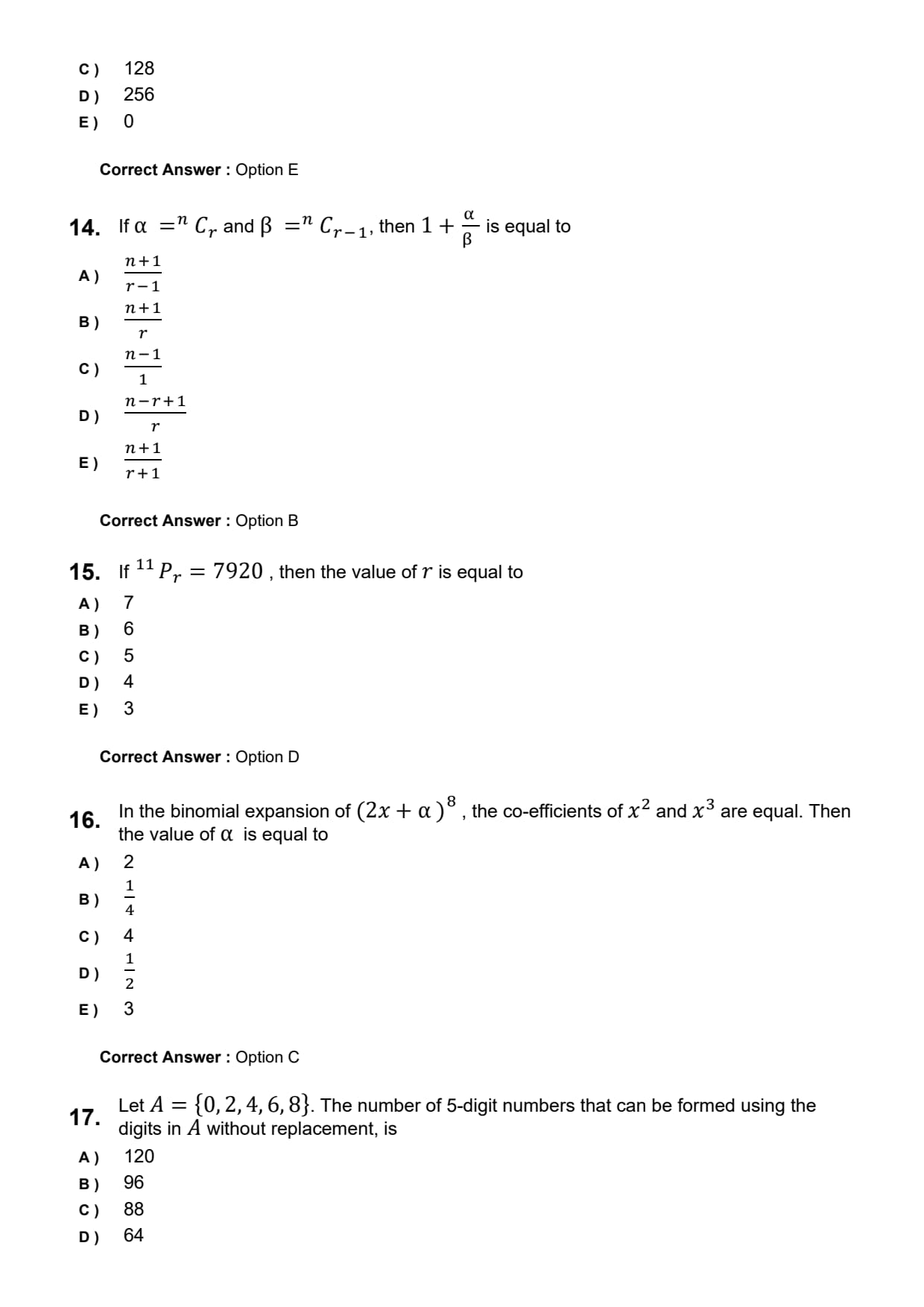
Question 14:
If \( \alpha = {^nC_r} \) and \( \beta = {^nC_{r-1}} \), then \( 1 + \frac{\alpha}{\beta} \) is equal to
- (A) \( \frac{n+1}{r-1} \)
- (B) \( \frac{n+1}{r} \)
- (C) \( \frac{n-1}{1} \)
- (D) \( \frac{n-r+1}{r} \)
- (E) \( \frac{n+1}{r+1} \)
Question 15:
If \( ^{11}P_r = 7920 \), then the value of \( r \) is equal to
- (A) \(7 \)
- (B) \(6 \)
- (C) \(5 \)
- (D) \(4 \)
- (E) \(3 \)
Question 16:
In the binomial expansion of \( (2x + \alpha)^8 \), the co-efficients of \( x^2 \) and \( x^3 \) are equal. Then the value of \( \alpha \) is equal to
- (A) \(2 \)
- (B) \( \frac{1}{4} \)
- (C) \(4 \)
- (D) \( \frac{1}{2} \)
- (E) \(3 \)
Question 17:
Let \( A = \{0,2,4,6,8\} \). The number of 5-digit numbers that can be formed using the digits in \( A \) without replacement, is
- (A) \(120 \)
- (B) \(96 \)
- (C) \(88 \)
- (D) \(64 \)
- (E) \(32 \)
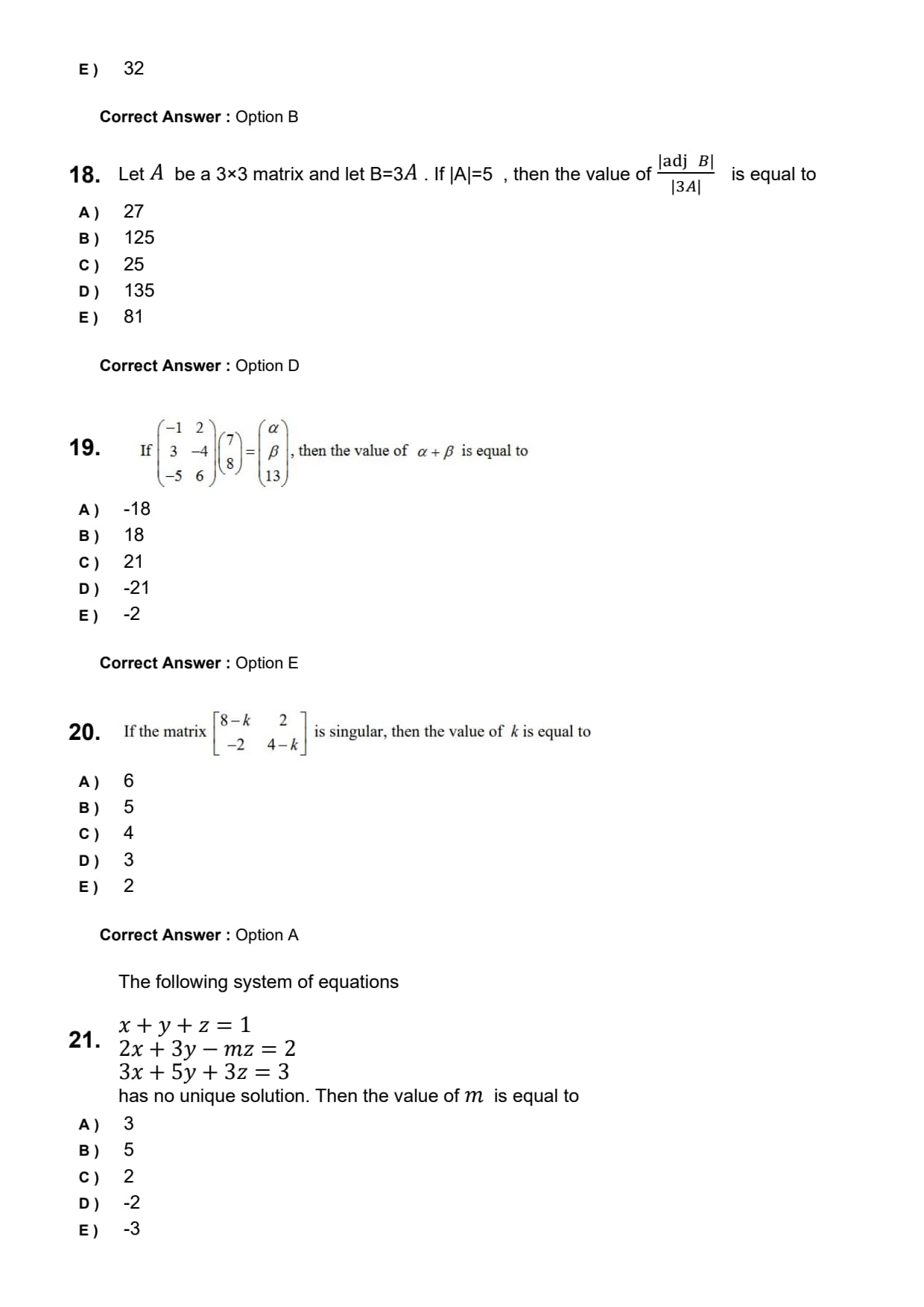
Question 18:
Let \( A \) be a \(3 \times 3\) matrix and let \( B = 3A \). If \( |A| = 5 \), then the value of \( \frac{|adj B|}{|3A|} \) is equal to
- (A) \(27 \)
- (B) \(125 \)
- (C) \(25 \)
- (D) \(135 \)
- (E) \(81 \)
Question 19:
If \( \begin{pmatrix} -1 & 2 \\
3 & -4 \\
-5 & 6 \end{pmatrix} \begin{pmatrix} 7 \\
8 \end{pmatrix} = \begin{pmatrix} \alpha \\
\beta \\
13 \end{pmatrix} \), then the value of \( \alpha + \beta \) is equal to
- (A) \(-18 \)
- (B) \(18 \)
- (C) \(21 \)
- (D) \(-21 \)
- (E) \(-2 \)
Question 20:
If the matrix \( \begin{pmatrix} 8-k & 2 \\
-2 & 4-k \end{pmatrix} \) is singular, then the value of \( k \) is equal to
- (A) \(6 \)
- (B) \(5 \)
- (C) \(4 \)
- (D) \(3 \)
- (E) \(2 \)
Question 21:
The following system of equations \[ x + y + z = 1 \] \[ 2x + 3y - mz = 2 \] \[ 3x + 5y + 3z = 3 \]
has no unique solution. Then the value of \( m \) is equal to
- (A) \(3 \)
- (B) \(5 \)
- (C) \(2 \)
- (D) \(-2 \)
- (E) \(-3 \)
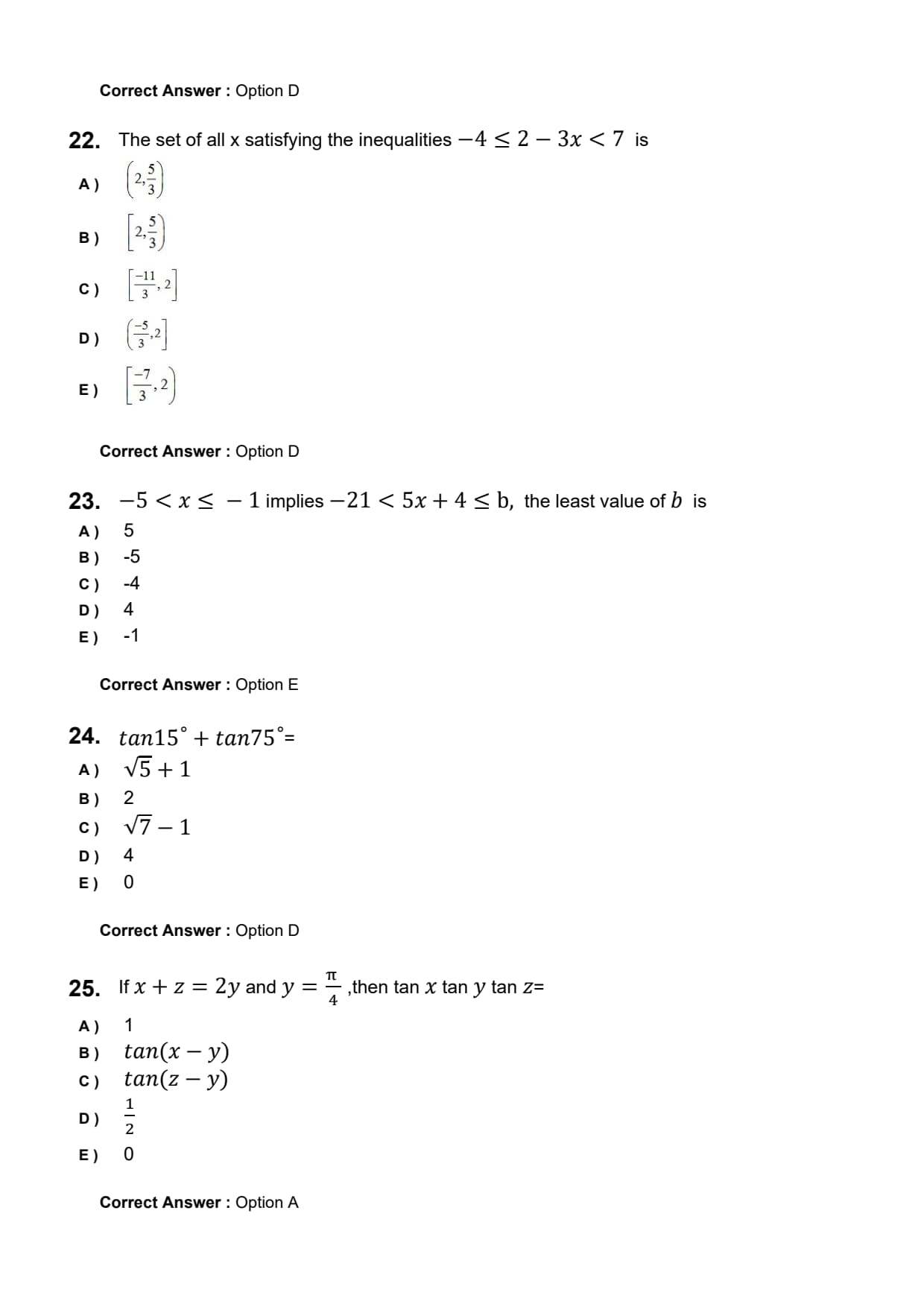
Question 22:
The set of all \( x \) satisfying the inequalities \( -4 \le 2 - 3x < 7 \) is
- (A) \( (2, \frac{5}{3}) \)
- (B) \( [2, \frac{5}{3}) \)
- (C) \( [-\frac{11}{3}, 2] \)
- (D) \( [-\frac{5}{3}, 2] \)
- (E) \( (-\frac{7}{3}, 2) \)
Question 23:
\( -5 < x \le -1 \) implies \( -21 < 5x + 4 \le b \), the least value of \( b \) is
- (A) \(5 \)
- (B) \(-5 \)
- (C) \(-4 \)
- (D) \(4 \)
- (E) \(-1 \)
Question 24:
\( \tan 15^\circ + \tan 75^\circ = \)
- (A) \( \sqrt{5} + 1 \)
- (B) \(2 \)
- (C) \( \sqrt{7} - 1 \)
- (D) \(4 \)
- (E) \(0 \)
Question 25:
If \( x + z = 2y \) and \( y = \frac{\pi}{4} \), then \( \tan x \tan y \tan z = \)
- (A) \(1 \)
- (B) \( \tan(x-y) \)
- (C) \( \tan(z-y) \)
- (D) \( \frac{1}{2} \)
- (E) \(0 \)
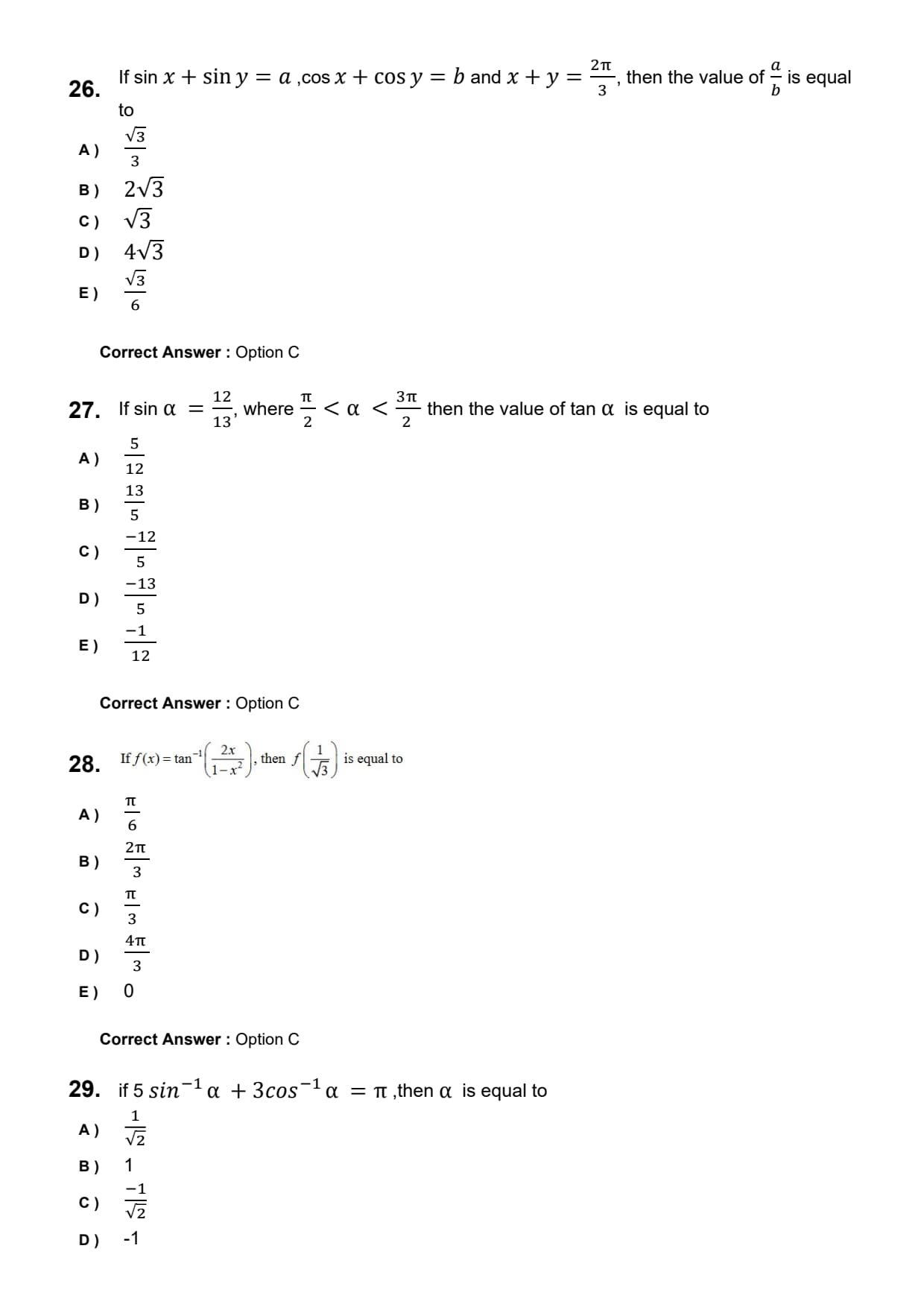
Question 26:
If \( \sin x + \sin y = a \), \( \cos x + \cos y = b \) and \( x + y = \frac{2\pi}{3} \), then the value of \( \frac{a}{b} \) is equal to
- (A) \( \frac{\sqrt{3}}{3} \)
- (B) \( 2\sqrt{3} \)
- (C) \( \sqrt{3} \)
- (D) \( 4\sqrt{3} \)
- (E) \( \frac{\sqrt{3}}{6} \)
Question 27:
If \( \sin \alpha = \frac{12}{13} \), where \( \frac{\pi}{2} < \alpha < \frac{3\pi}{2} \), then the value of \( \tan \alpha \) is equal to
- (A) \( \frac{5}{12} \)
- (B) \( \frac{13}{5} \)
- (C) \( -\frac{12}{5} \)
- (D) \( -\frac{13}{5} \)
- (E) \( -\frac{1}{12} \)
Question 28:
If \( f(x) = \tan^{-1}\left(\frac{2x}{1 - x^2}\right) \), then \( f\left(\frac{1}{\sqrt{3}}\right) \) is equal to
- (A) \( \frac{\pi}{6} \)
- (B) \( \frac{2\pi}{3} \)
- (C) \( \frac{\pi}{3} \)
- (D) \( \frac{4\pi}{3} \)
- (E) \( 0 \)
Question 29:
If \( 5\sin^{-1}\alpha + 3\cos^{-1}\alpha = \pi \), then \( \alpha \) is equal to
- (A) \( \frac{1}{\sqrt{2}} \)
- (B) \(1 \)
- (C) \( -\frac{1}{\sqrt{2}} \)
- (D) \(-1 \)
- (E) \(0 \)
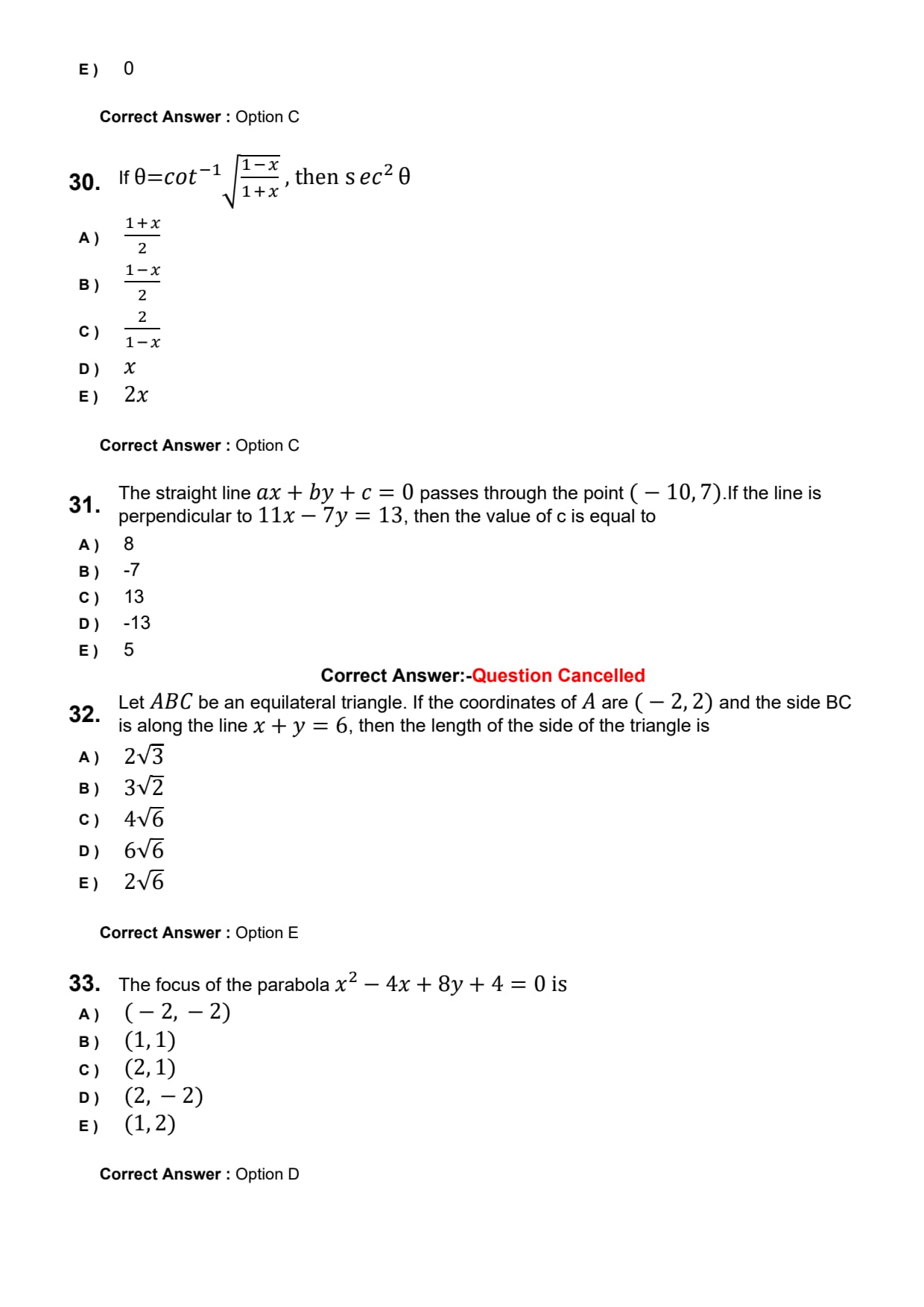
Question 30:
If \( \theta = \cot^{-1}\sqrt{\frac{1-x}{1+x}} \), then \( \sec^2 \theta \) is equal to
- (A) \( \frac{1+x}{2} \)
- (B) \( \frac{1-x}{2} \)
- (C) \( \frac{2}{1-x} \)
- (D) \( x \)
- (E) \( 2x \)
Question 31:
The straight line \( ax + by + c = 0 \) passes through the point \( (-10,7) \). If the line is perpendicular to \( 11x - 7y = 13 \), then the value of \( c \) is equal to
- (A) \(8 \)
- (B) \(-7 \)
- (C) \(13 \)
- (D) \(-13 \)
- (E) \(5 \)
Question 32:
Let \( ABC \) be an equilateral triangle. If the coordinates of \( A \) are \( (-2,2) \) and the side \( BC \) is along the line \( x + y = 6 \), then the length of the side of the triangle is
- (A) \(2\sqrt{3} \)
- (B) \(3\sqrt{2} \)
- (C) \(4\sqrt{6} \)
- (D) \(6\sqrt{6} \)
- (E) \(2\sqrt{6} \)
Question 33:
The focus of the parabola \( x^2 - 4x + 8y + 4 = 0 \) is
- (A) \( (-2,-2) \)
- (B) \( (1,1) \)
- (C) \( (2,1) \)
- (D) \( (2,-2) \)
- (E) \( (1,2) \)
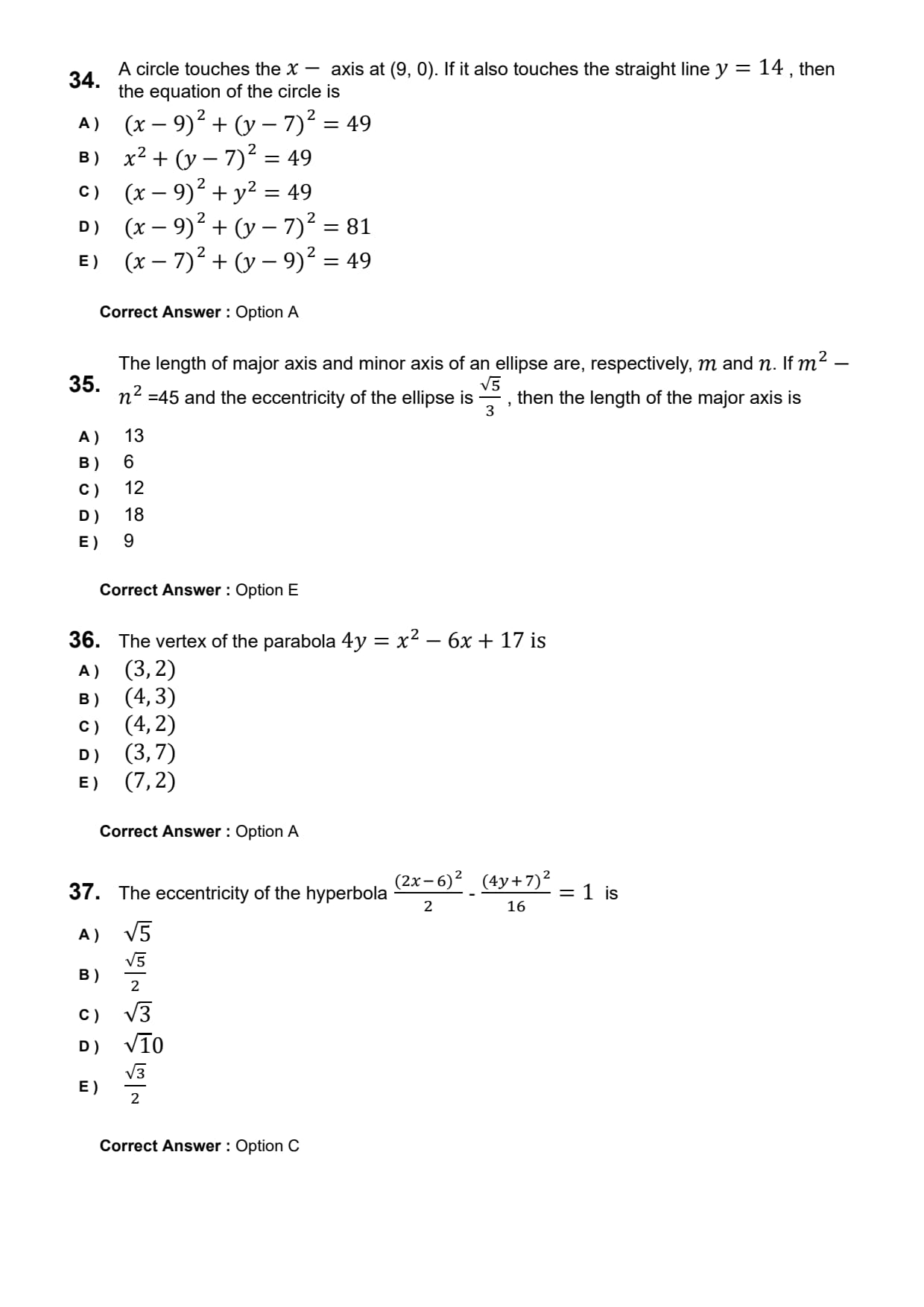
Question 34:
A circle touches the \( x \)-axis at \( (9,0) \). If it also touches the straight line \( y = 14 \), then the equation of the circle is
- (A) \( (x-9)^2 + (y-7)^2 = 49 \)
- (B) \( x^2 + (y-7)^2 = 49 \)
- (C) \( (x-9)^2 + y^2 = 49 \)
- (D) \( (x-9)^2 + (y-7)^2 = 81 \)
- (E) \( (x-7)^2 + (y-9)^2 = 49 \)
Question 35:
The length of major axis and minor axis of an ellipse are, respectively, \( m \) and \( n \). If \( m^2 - n^2 = 45 \) and the eccentricity of the ellipse is \( \frac{\sqrt{5}}{3} \), then the length of the major axis is
- (A) \(13 \)
- (B) \(6 \)
- (C) \(12 \)
- (D) \(18 \)
- (E) \(9 \)
Question 36:
The vertex of the parabola \( 4y = x^2 - 6x + 17 \) is
- (A) \( (3,2) \)
- (B) \( (4,3) \)
- (C) \( (4,2) \)
- (D) \( (3,7) \)
- (E) \( (7,2) \)
Question 37:
The eccentricity of the hyperbola \( \frac{(2x-6)^2}{2} - \frac{(4y+7)^2}{16} = 1 \) is
- (A) \( \sqrt{5} \)
- (B) \( \frac{\sqrt{5}}{2} \)
- (C) \( \sqrt{3} \)
- (D) \( \sqrt{10} \)
- (E) \( \frac{\sqrt{3}}{2} \)
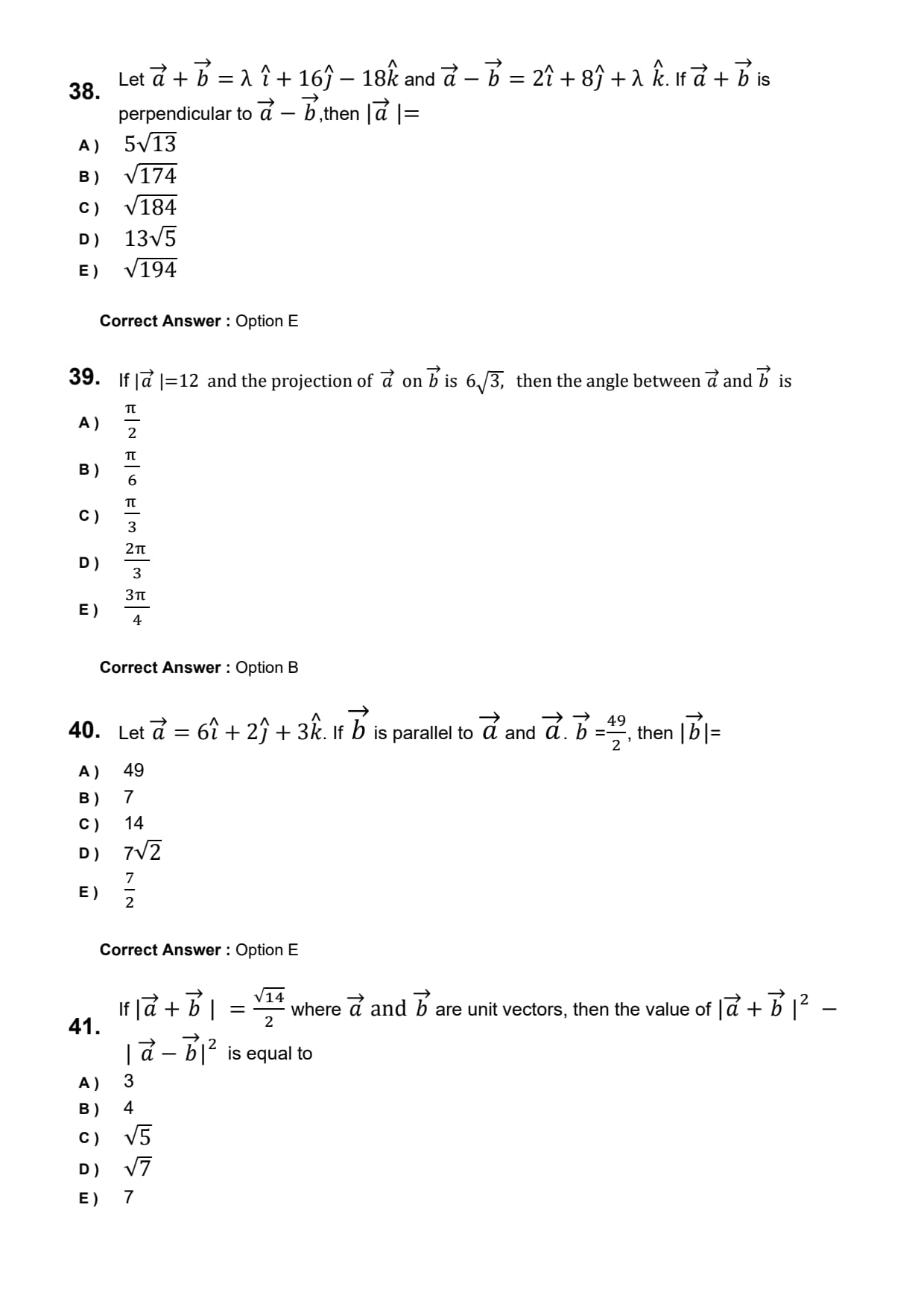
Question 38:
Let \( \vec{a} + \vec{b} = \lambda \hat{i} + 16\hat{j} - 18\hat{k} \) and \( \vec{a} - \vec{b} = 2\hat{i} + 8\hat{j} + \lambda \hat{k} \). If \( \vec{a} + \vec{b} \) is perpendicular to \( \vec{a} - \vec{b} \), then \( |\vec{a}| = \)
- (A) \(5\sqrt{13} \)
- (B) \( \sqrt{174} \)
- (C) \( \sqrt{184} \)
- (D) \( 13\sqrt{5} \)
- (E) \( \sqrt{194} \)
Question 39:
If \( |\vec{a}| = 12 \) and the projection of \( \vec{a} \) on \( \vec{b} \) is \( 6\sqrt{3} \), then the angle between \( \vec{a} \) and \( \vec{b} \) is
- (A) \( \frac{\pi}{2} \)
- (B) \( \frac{\pi}{6} \)
- (C) \( \frac{\pi}{3} \)
- (D) \( \frac{2\pi}{3} \)
- (E) \( \frac{3\pi}{4} \)
Question 40:
Let \( \vec{a} = 6\hat{i} + 2\hat{j} + 3\hat{k} \). If \( \vec{b} \) is parallel to \( \vec{a} \) and \( \vec{a} \cdot \vec{b} = \frac{49}{2} \), then \( |\vec{b}| = \)
- (A) \(49 \)
- (B) \(7 \)
- (C) \(14 \)
- (D) \( 7\sqrt{2} \)
- (E) \( \frac{7}{2} \)
Question 41:
If \( |\vec{a} + \vec{b}| = \frac{\sqrt{14}}{2} \) where \( \vec{a} \) and \( \vec{b} \) are unit vectors, then the value of \( |\vec{a} + \vec{b}|^2 - |\vec{a} - \vec{b}|^2 \) is equal to
- (A) \(3 \)
- (B) \(4 \)
- (C) \( \sqrt{5} \)
- (D) \( \sqrt{7} \)
- (E) \(7 \)
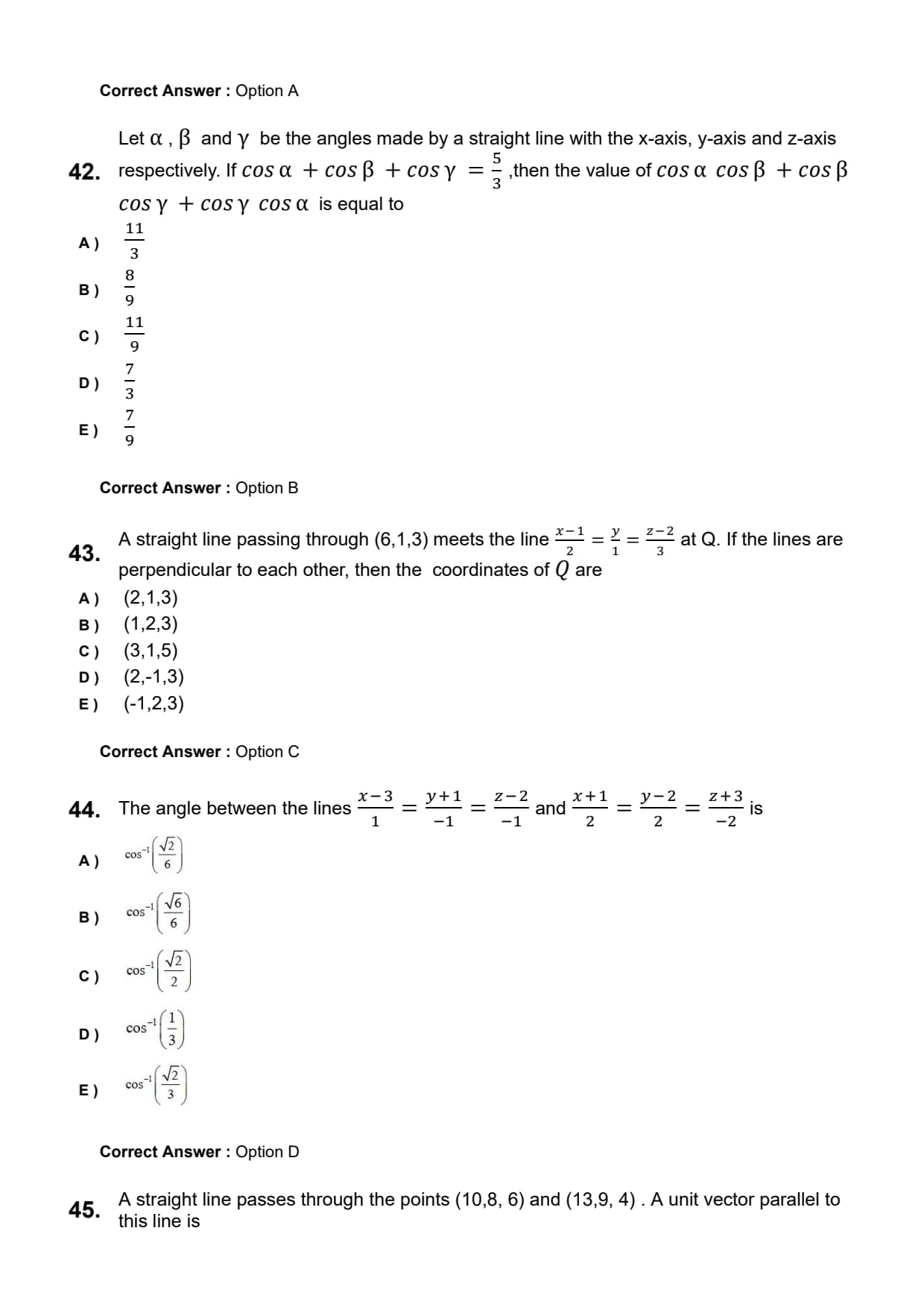
Question 42:
Let \( \alpha, \beta \) and \( \gamma \) be the angles made by a straight line with the x-axis, y-axis and z-axis respectively. If \( \cos\alpha + \cos\beta + \cos\gamma = \frac{5}{3} \), then the value of \( \cos\alpha \cos\beta + \cos\beta \cos\gamma + \cos\gamma \cos\alpha \) is equal to
- (A) \( \frac{11}{3} \)
- (B) \( \frac{8}{9} \)
- (C) \( \frac{11}{9} \)
- (D) \( \frac{7}{3} \)
- (E) \( \frac{7}{9} \)
Question 43:
A straight line passing through \( (6,1,3) \) meets the line \( \frac{x-1}{2} = \frac{y}{1} = \frac{z-2}{3} \) at \( Q \). If the lines are perpendicular to each other, then the coordinates of \( Q \) are
- (A) \( (2,1,3) \)
- (B) \( (1,2,3) \)
- (C) \( (3,1,5) \)
- (D) \( (2,-1,3) \)
- (E) \( (-1,2,3) \)
Question 44:
The angle between the lines \( \frac{x-3}{1} = \frac{y+1}{-1} = \frac{z-2}{-1} \) and \( \frac{x+1}{2} = \frac{y-2}{2} = \frac{z+3}{-2} \) is
- (A) \( \cos^{-1}\left(\sqrt{\frac{2}{6}}\right) \)
- (B) \( \cos^{-1}\left(\sqrt{\frac{6}{6}}\right) \)
- (C) \( \cos^{-1}\left(\frac{\sqrt{2}}{2}\right) \)
- (D) \( \cos^{-1}\left(\frac{1}{3}\right) \)
- (E) \( \cos^{-1}\left(\frac{\sqrt{2}}{3}\right) \)
Question 45:
A straight line passes through the points \( (10,8,6) \) and \( (13,9,4) \). A unit vector parallel to this line is
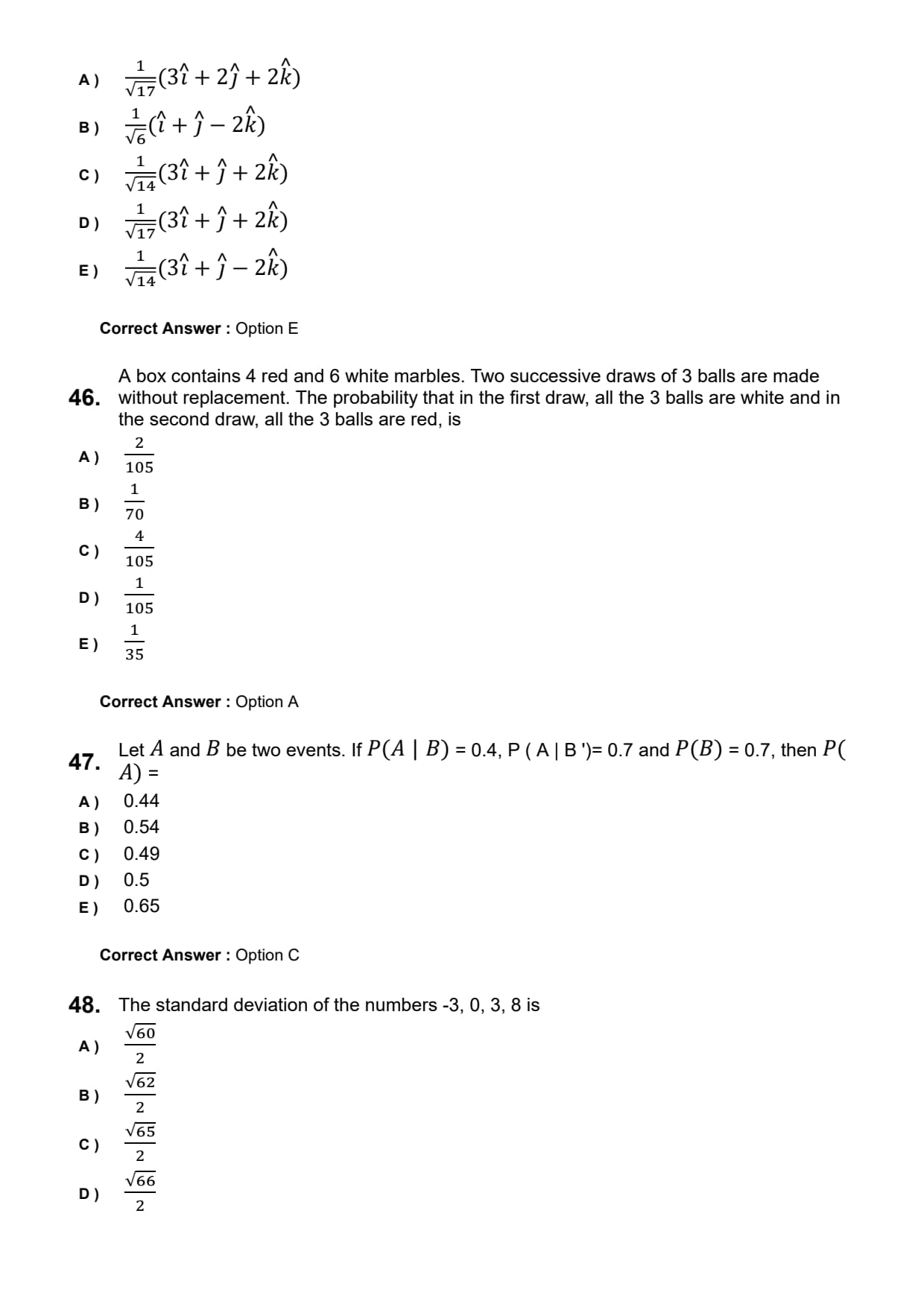
- (A) \( \frac{1}{\sqrt{17}}(3\hat{i} + 2\hat{j} + 2\hat{k}) \)
- (B) \( \frac{1}{\sqrt{6}}(\hat{i} + \hat{j} - 2\hat{k}) \)
- (C) \( \frac{1}{\sqrt{14}}(3\hat{i} + \hat{j} + 2\hat{k}) \)
- (D) \( \frac{1}{\sqrt{11}}(3\hat{i} + \hat{j} + 2\hat{k}) \)
- (E) \( \frac{1}{\sqrt{14}}(3\hat{i} + \hat{j} - 2\hat{k}) \)
Question 46:
A box contains 4 red and 6 white marbles. Two successive draws of 3 balls are made without replacement. The probability that in first draw all the 3 balls are white and in second draw all the 3 balls are red, is
- (A) \( \frac{2}{105} \)
- (B) \( \frac{1}{70} \)
- (C) \( \frac{4}{105} \)
- (D) \( \frac{3}{105} \)
- (E) \( \frac{1}{35} \)
Question 47:
Let \( A \) and \( B \) be two events. If \( P(A|B)=0.4 \), \( P(A|B')=0.7 \) and \( P(B)=0.7 \), then \( P(A) \) is
- (A) \(0.44 \)
- (B) \(0.54 \)
- (C) \(0.49 \)
- (D) \(0.5 \)
- (E) \(0.65 \)
Question 48:
The standard deviation of the numbers \( -3, 0, 3, 8 \) is
- (A) \( \frac{\sqrt{60}}{2} \)
- (B) \( \frac{\sqrt{62}}{2} \)
- (C) \( \frac{\sqrt{65}}{2} \)
- (D) \( \frac{\sqrt{66}}{2} \)
- (E) \( \frac{\sqrt{67}}{2} \)
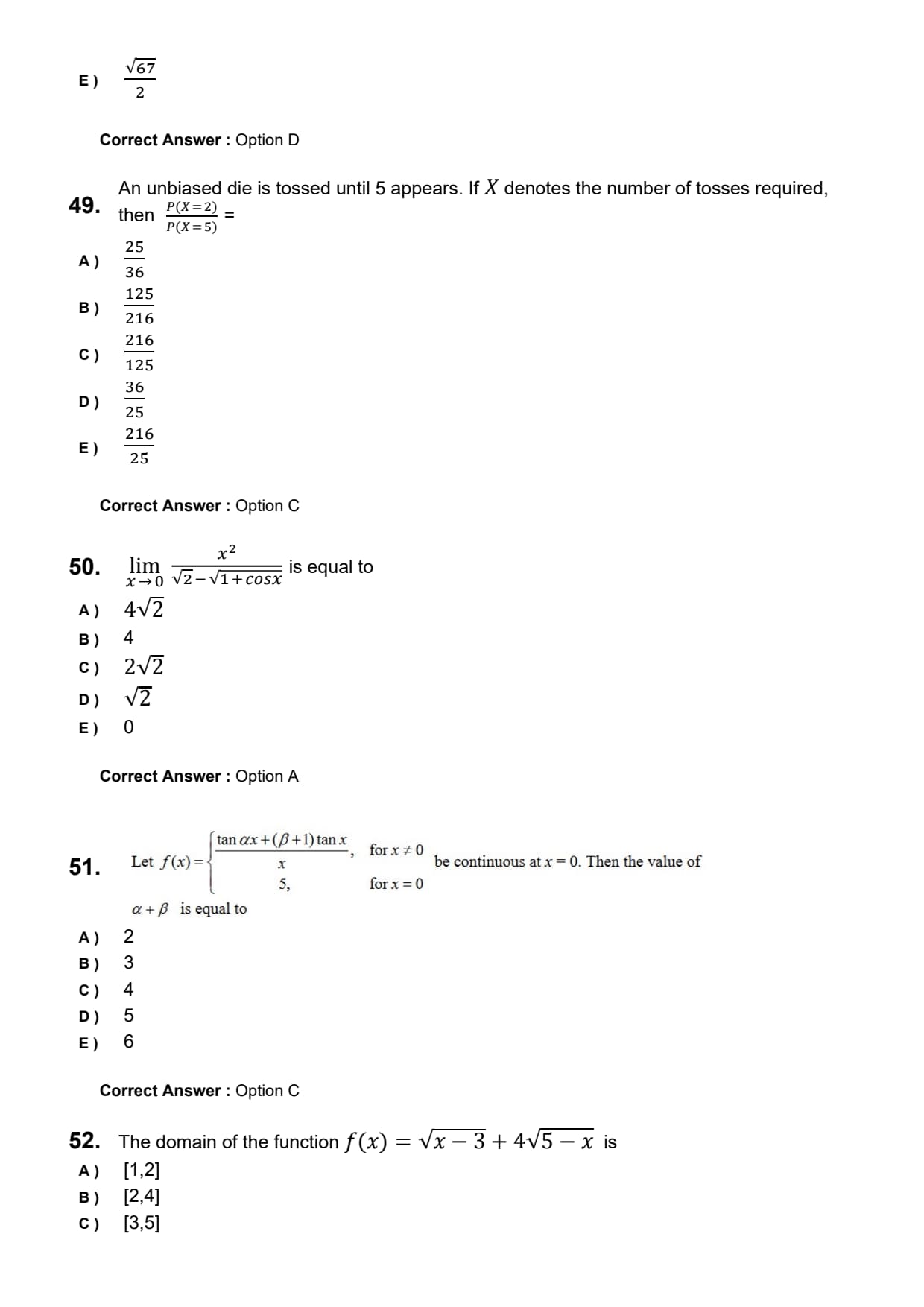
Question 49:
An unbiased die is tossed until 5 appears. If \( X \) denotes the number of tosses required, \( \frac{25}{P(X=5)} \) is equal to
- (A) \( \frac{25}{36} \)
- (B) \( \frac{125}{216} \)
- (C) \( \frac{216}{125} \)
- (D) \( \frac{36}{25} \)
- (E) \( \frac{216}{25} \)
Question 50:
\( \lim_{x \to 0} \frac{x^2}{\sqrt{2} - \sqrt{1 + \cos x}} \) is equal to
- (A) \( 4\sqrt{2} \)
- (B) \(4 \)
- (C) \( 2\sqrt{2} \)
- (D) \( \sqrt{2} \)
- (E) \(0 \)
Question 51:
Let \( f(x) = \begin{cases} \frac{\tan ax + (b+1)\tan x}{x}, & x \neq 0 \\
5, & x = 0 \end{cases} \) be continuous at \( x=0 \). Then the value of \( a + b \) is equal to
- (A) \(2 \)
- (B) \(3 \)
- (C) \(4 \)
- (D) \(5 \)
- (E) \(6 \)
Question 52:
The domain of the function \( f(x) = \sqrt{x-3} + 4\sqrt{5-x} \) is
- (A) \( [1,2] \)
- (B) \( [2,4] \)
- (C) \( [3,5] \)
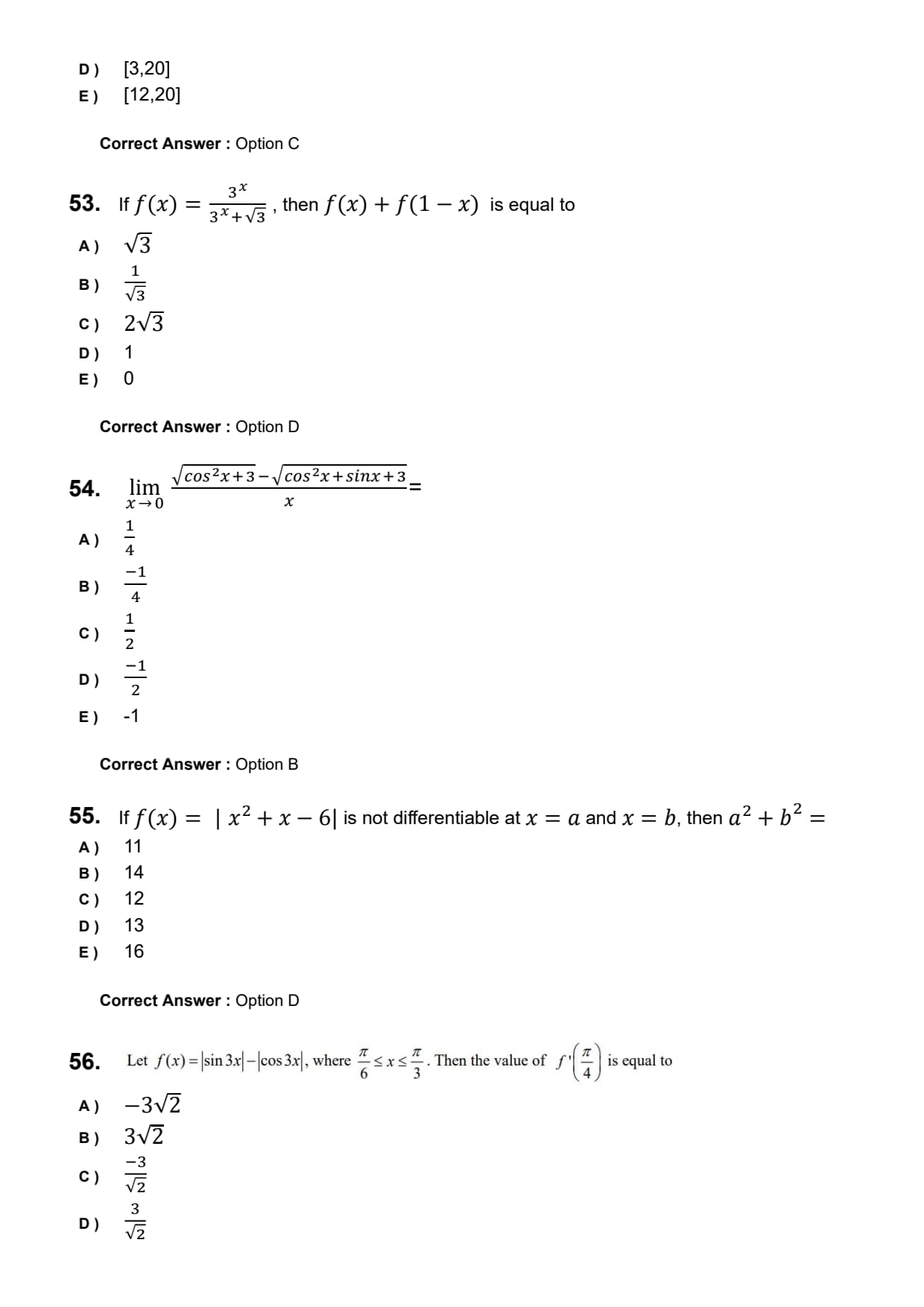
- (D) \( [3,20] \)
- (E) \( [12,20] \)
Question 53:
If \( f(x) = \frac{3^x}{3^x + \sqrt{3}} \), then \( f(x) + f(1-x) \) is equal to
- (A) \( \sqrt{3} \)
- (B) \( \frac{1}{\sqrt{3}} \)
- (C) \( 2\sqrt{3} \)
- (D) \( 1 \)
- (E) \( 0 \)
Question 54:
\( \lim_{x \to 0} \frac{\sqrt{\cos 2x + 3} - \sqrt{\cos^2 x + \sin x + 3}}{x} \) is equal to
- (A) \( \frac{1}{4} \)
- (B) \( -\frac{1}{4} \)
- (C) \( \frac{1}{2} \)
- (D) \( -\frac{1}{2} \)
- (E) \( -1 \)
Question 55:
If \( f(x) = |x^2 + x - 6| \) is not differentiable at \( x = a \) and \( x = b \), then \( a^2 + b^2 = \)
- (A) \(11 \)
- (B) \(14 \)
- (C) \(12 \)
- (D) \(13 \)
- (E) \(16 \)
Question 56:
Let \( f(x) = |\sin 3x| - |\cos 3x| \), where \( \frac{\pi}{6} \le x \le \frac{\pi}{3} \). Then the value of \( f\left(\frac{\pi}{4}\right) \) is
- (A) \( -3\sqrt{2} \)
- (B) \( 3\sqrt{2} \)
- (C) \( -\frac{3}{\sqrt{2}} \)
- (D) \( \frac{3}{\sqrt{2}} \)
- (E) \( 0 \)
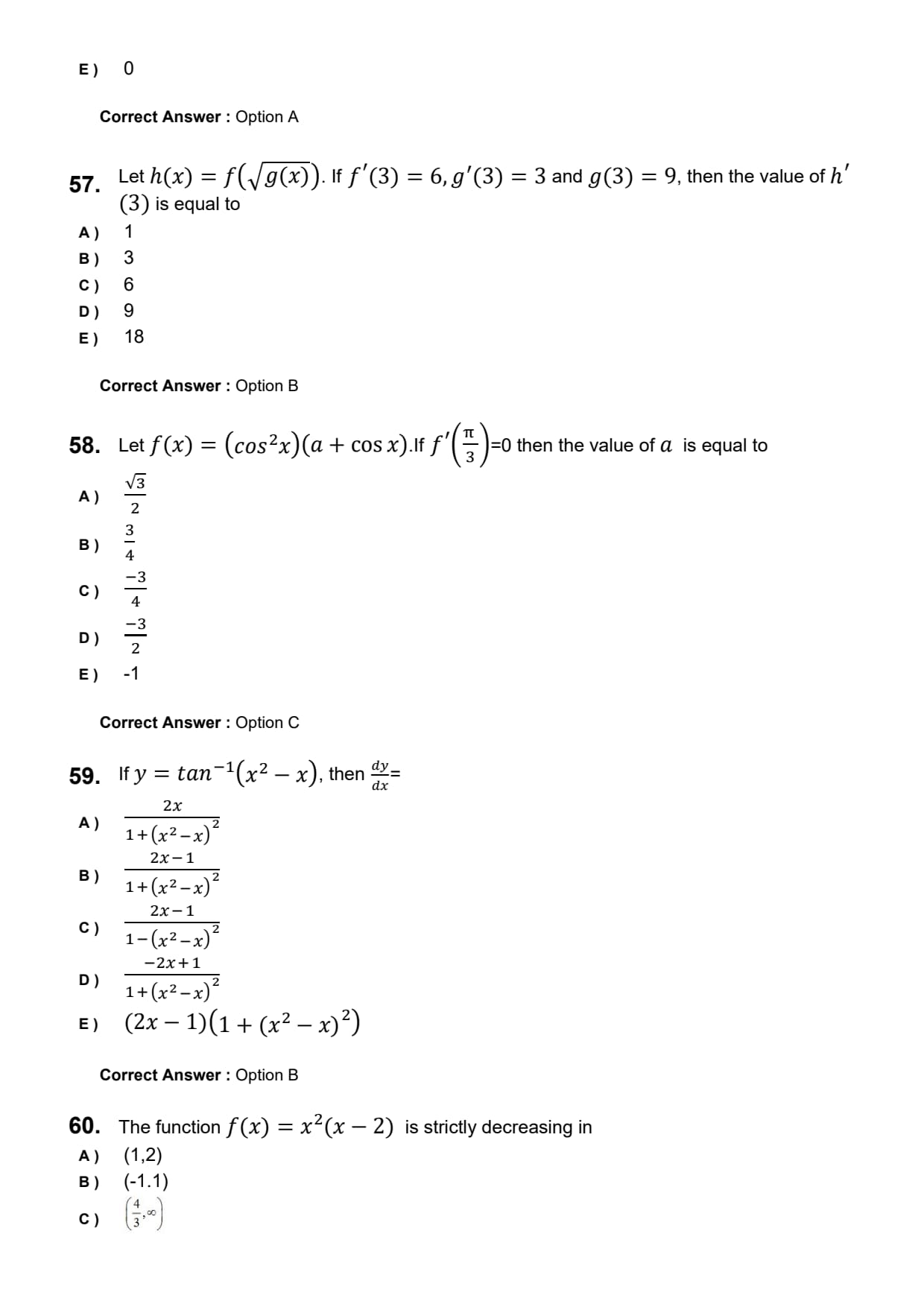
Question 57:
Let \( h(x) = f(\sqrt{g(x)}) \). If \( f'(3) = 6 \), \( g'(3) = 3 \) and \( g(3) = 9 \), then the value of \( h'(3) \) is equal to
- (A) \(1 \)
- (B) \(3 \)
- (C) \(6 \)
- (D) \(9 \)
- (E) \(18 \)
Question 58:
Let \( f(x) = (\cos^2 x)(a + \cos x) \). If \( f'\left(\frac{\pi}{3}\right) = 0 \), then the value of \( a \) is equal to
- (A) \( \frac{\sqrt{3}}{2} \)
- (B) \( \frac{3}{4} \)
- (C) \( -\frac{3}{4} \)
- (D) \( -\frac{3}{2} \)
- (E) \( -1 \)
Question 59:
If \( y = \tan^{-1}(x^2 - x) \), then \( \frac{dy}{dx} = \)
- (A) \( \frac{2x}{1+(x^2-x)^2} \)
- (B) \( \frac{2x-1}{1+(x^2-x)^2} \)
- (C) \( \frac{2x-1}{1-(x^2-x)^2} \)
- (D) \( \frac{-2x+1}{1+(x^2-x)^2} \)
- (E) \( (2x-1)(1+(x^2-x)^2) \)
Question 60:
The function \( f(x) = x^2(x-2) \) is strictly decreasing in
- (A) \( (1,2) \)
- (B) \( (-1,1) \)
- (C) \( \left(\frac{4}{3},\infty\right) \)
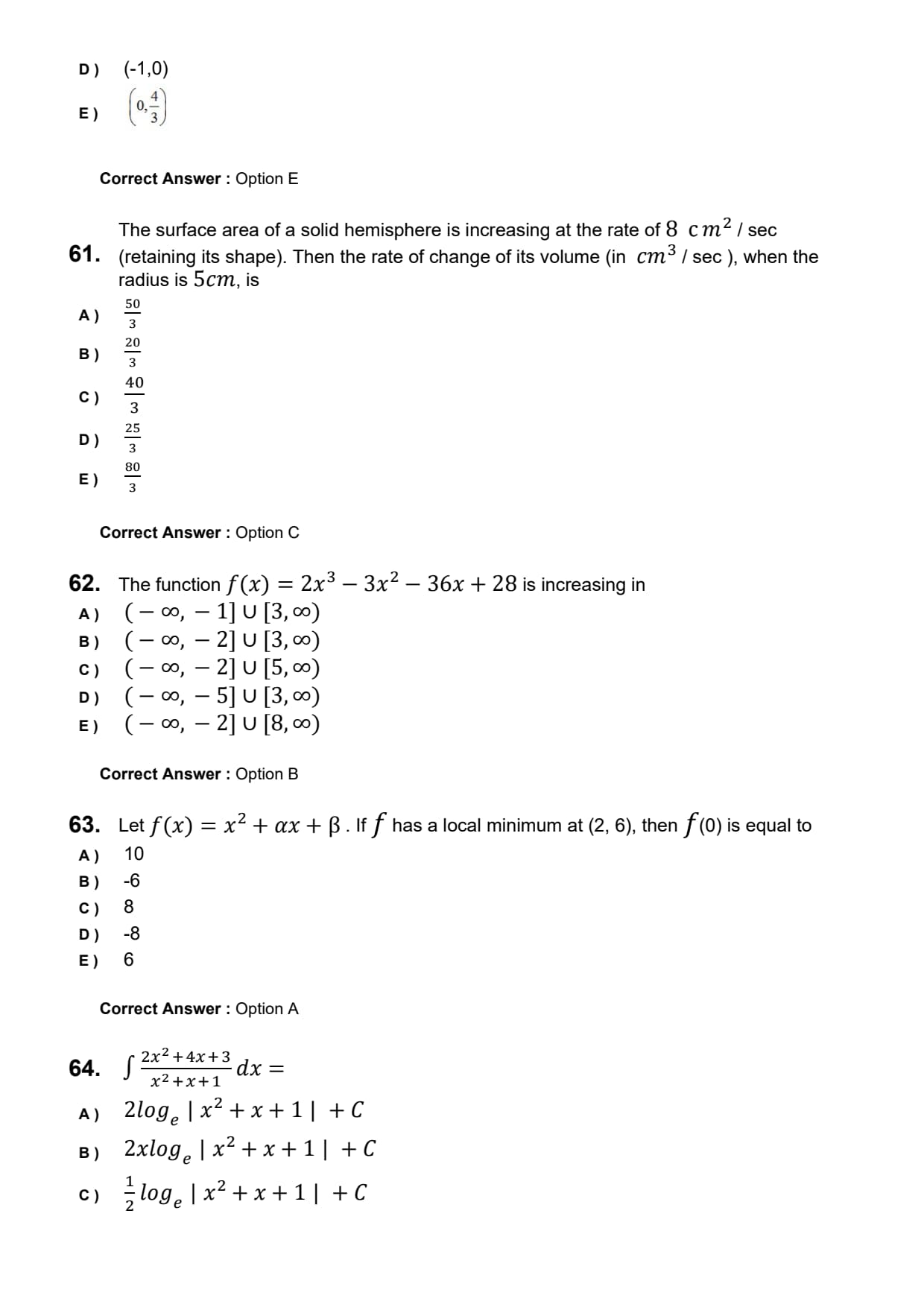
- (D) \( (-1,0) \)
- (E) \( \left(0,\frac{4}{3}\right) \)
Question 61:
The surface area of a solid hemisphere is increasing at the rate of \( 8 \, cm^2/sec \) (retaining its shape). Then the rate of change of its volume (in \( cm^3/sec \)), when the radius is \( 5 \,cm \), is
- (A) \( \frac{50}{3} \)
- (B) \( \frac{20}{3} \)
- (C) \( \frac{40}{3} \)
- (D) \( \frac{25}{3} \)
- (E) \( \frac{80}{3} \)
Question 62:
The function \( f(x) = 2x^3 - 3x^2 - 36x + 28 \) is increasing in
- (A) \( (-\infty,-1] \cup [3,\infty) \)
- (B) \( (-\infty,-2] \cup [3,\infty) \)
- (C) \( (-\infty,-2] \cup [5,\infty) \)
- (D) \( (-\infty,-5] \cup [3,\infty) \)
- (E) \( (-\infty,-2] \cup [8,\infty) \)
Question 63:
Let \( f(x) = x^2 + ax + \beta \). If \( f \) has a local minimum at \( (2,6) \), then \( f(0) \) is equal to
- (A) \(10 \)
- (B) \(-6 \)
- (C) \(8 \)
- (D) \(-8 \)
- (E) \(6 \)
Question 64:
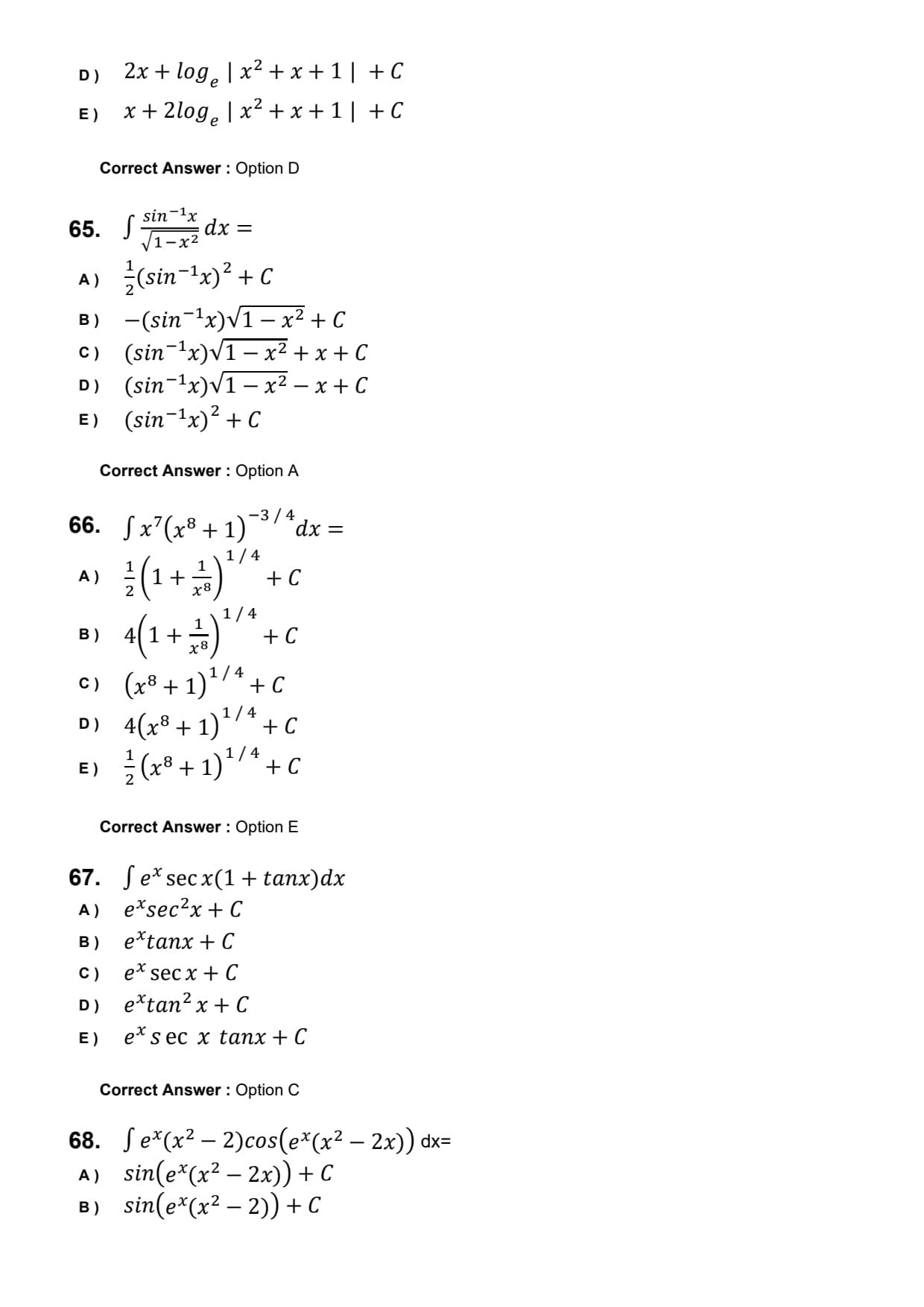
\( \int \frac{2x^2 + 4x + 3}{x^2 + x + 1} \, dx = \)
- (A) \( 2\log_e|x^2+x+1| + C \)
- (B) \( x\log_e|x^2+x+1| + C \)
- (C) \( \frac{1}{2}\log_e|x^2+x+1| + C \)
- (D) \( 2x + \log_e|x^2+x+1| + C \)
- (E) \( x + 2\log_e|x^2+x+1| + C \)
Question 65:
\( \int \frac{\sin^{-1}x}{\sqrt{1-x^2}} \, dx = \)
- (A) \( \frac{1}{2}(\sin^{-1}x)^2 + C \)
- (B) \( -(\sin^{-1}x)\sqrt{1-x^2} + C \)
- (C) \( (\sin^{-1}x)\sqrt{1-x^2} + x + C \)
- (D) \( (\sin^{-1}x)\sqrt{1-x^2} - x + C \)
- (E) \( (\sin^{-1}x)^2 + C \)
Question 66:
\( \int x^7(x^8+1)^{-3/4} dx = \)
- (A) \( \frac{1}{2}\left(1+\frac{1}{x^8}\right)^{1/4} + C \)
- (B) \( 4\left(1+\frac{1}{x^8}\right)^{1/4} + C \)
- (C) \( (x^8+1)^{1/4} + C \)
- (D) \( 4(x^8+1)^{1/4} + C \)
- (E) \( \frac{1}{2}(x^8+1)^{1/4} + C \)
Question 67:
\( \int e^x \sec x (1+\tan x) dx = \)
- (A) \( e^x \sec^2 x + C \)
- (B) \( e^x \tan x + C \)
- (C) \( e^x \sec x + C \)
- (D) \( e^x \tan^2 x + C \)
- (E) \( e^x \sec x \tan x + C \)
Question 68:
\( \int e^x(x^2-2)\cos(e^x(x^2-2x)) dx = \)
- (A) \( \sin(e^x(x^2-2x)) + C \)
- (B) \( \sin(e^x(x^2-2)) + C \)
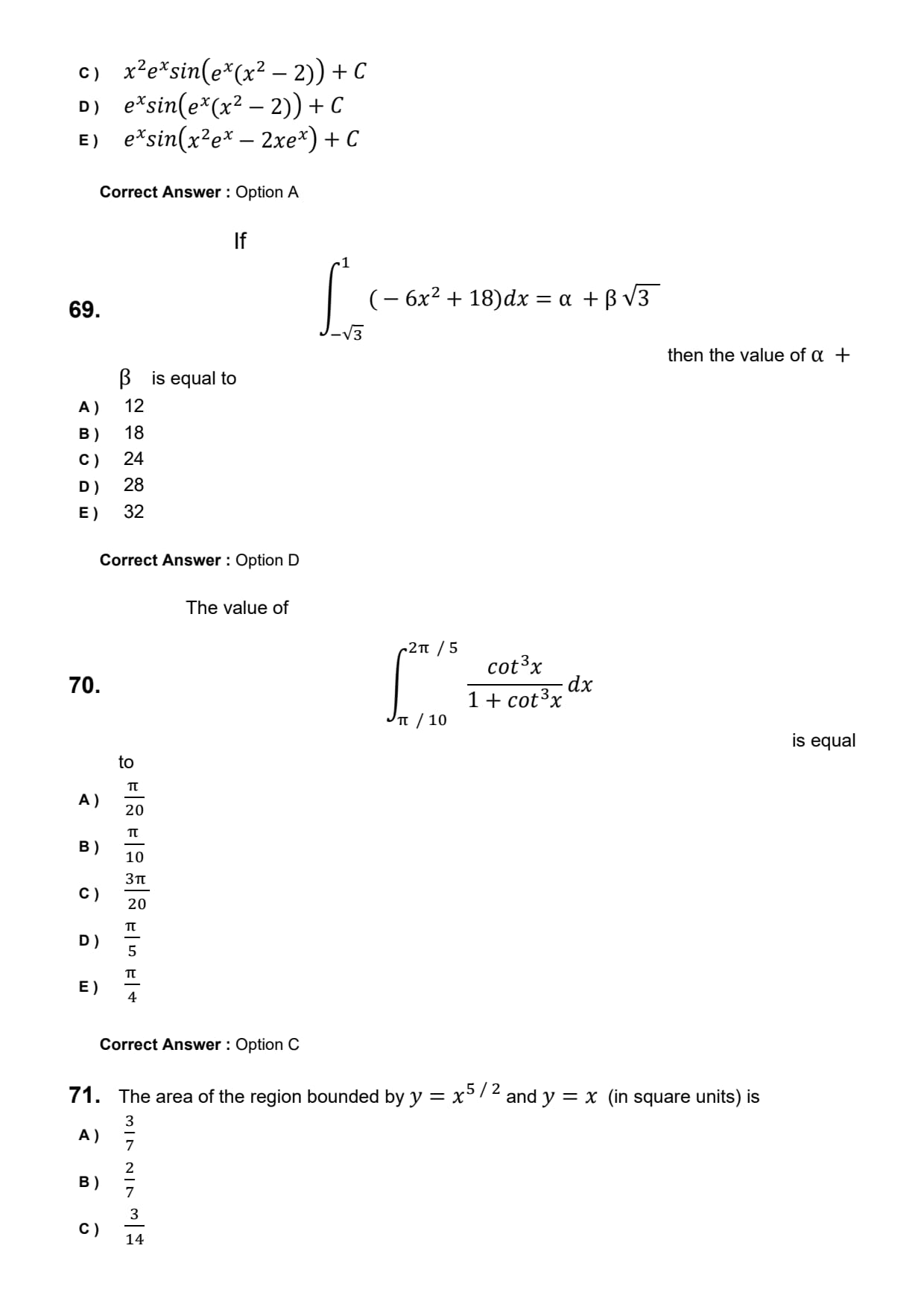
- (C) \( x^2e^x\sin(e^x(x^2-2)) + C \)
- (D) \( e^x\sin(e^x(x^2-2)) + C \)
- (E) \( e^x\sin(x^2e^x-2xe^x) + C \)
Question 69:
If \( \int_{-\sqrt{3}}^{1} (-6x^2 + 18)\,dx = \alpha + \beta\sqrt{3} \), then the value of \( \alpha + \beta \) is equal to
- (A) \(12 \)
- (B) \(18 \)
- (C) \(24 \)
- (D) \(28 \)
- (E) \(32 \)
Question 70:
The value of \( \int_{\pi/10}^{2\pi/5} \frac{\cot^3 x}{1+\cot^3 x}\,dx \) is equal to
- (A) \( \frac{\pi}{20} \)
- (B) \( \frac{\pi}{10} \)
- (C) \( \frac{3\pi}{20} \)
- (D) \( \frac{\pi}{5} \)
- (E) \( \frac{\pi}{4} \)
Question 71:
The area of the region bounded by \( y = x^{5/2} \) and \( y = x \) (in square units) is
- (A) \( \frac{3}{7} \)
- (B) \( \frac{2}{7} \)
- (C) \( \frac{3}{14} \)
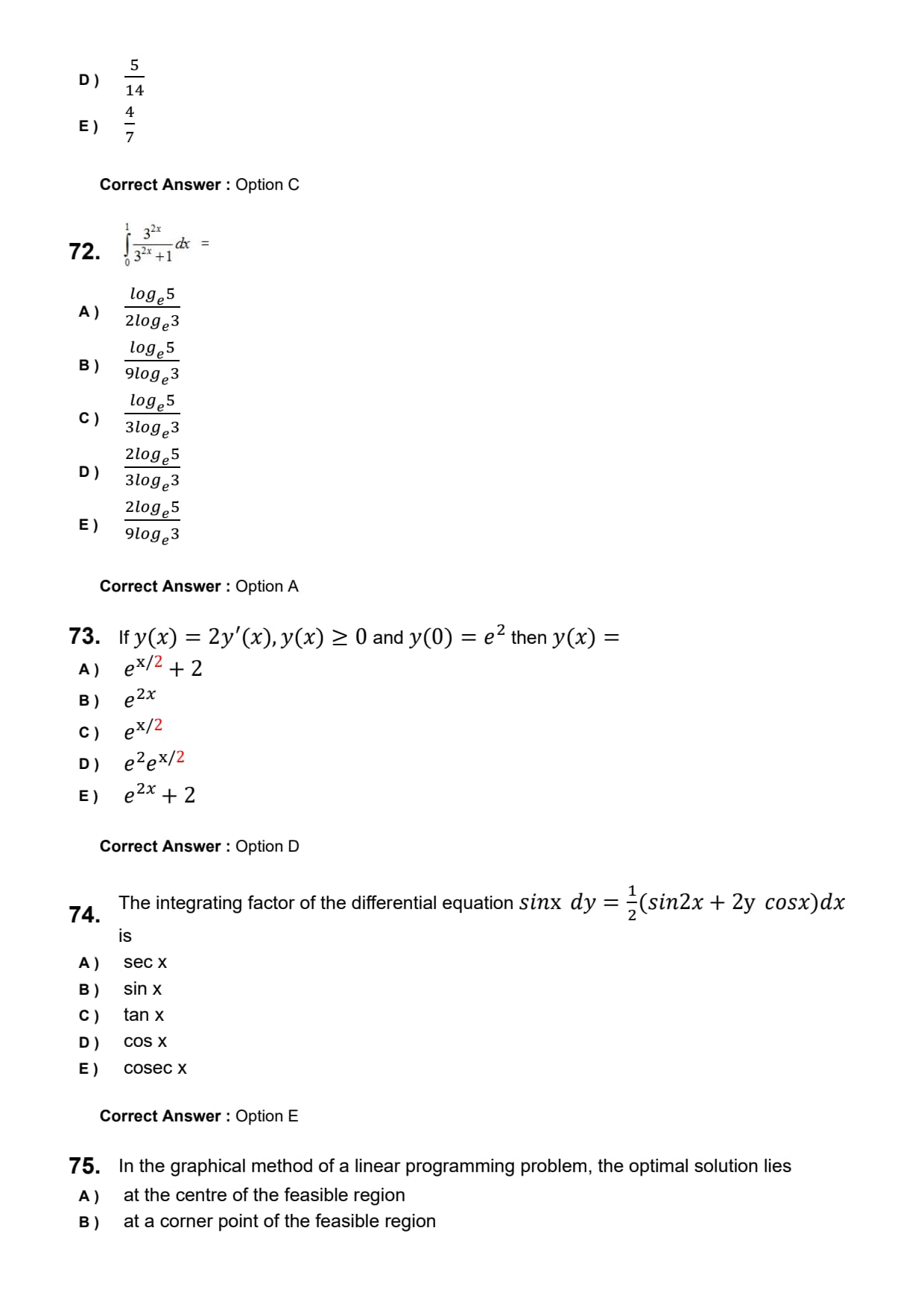
- (D) \( \frac{5}{14} \)
- (E) \( \frac{4}{7} \)
Question 72:
\( \int_{0}^{1} \frac{3^{2x}}{3^x + 1}\,dx = \)
- (A) \( \frac{\log_e 5}{2\log_e 3} \)
- (B) \( \frac{\log_e 5}{9\log_e 3} \)
- (C) \( \frac{\log_e 5}{3\log_e 3} \)
- (D) \( \frac{2\log_e 5}{3\log_e 3} \)
- (E) \( \frac{2\log_e 5}{9\log_e 3} \)
Question 73:
If \( y'(x) = 2y \), \( y(x) \ge 0 \) and \( y(0) = e^2 \), then \( y(x) = \)
- (A) \( e^{x/2 + 2} \)
- (B) \( e^{2x} \)
- (C) \( e^{x/2} \)
- (D) \( e^2 e^{2x} \)
- (E) \( e^{2x} + 2 \)
Question 74:
The integrating factor of the differential equation \( \sin x\, dy = \frac{1}{2}(\sin2x + 2y\cos x)\,dx \) is
- (A) \( \sec x \)
- (B) \( \sin x \)
- (C) \( \tan x \)
- (D) \( \cos x \)
- (E) \( \csc x \)
Question 75:
In the graphical method of a linear programming problem, the optimal solution lies
- (A) at the centre of the feasible region
- (B) at a corner point of the feasible region
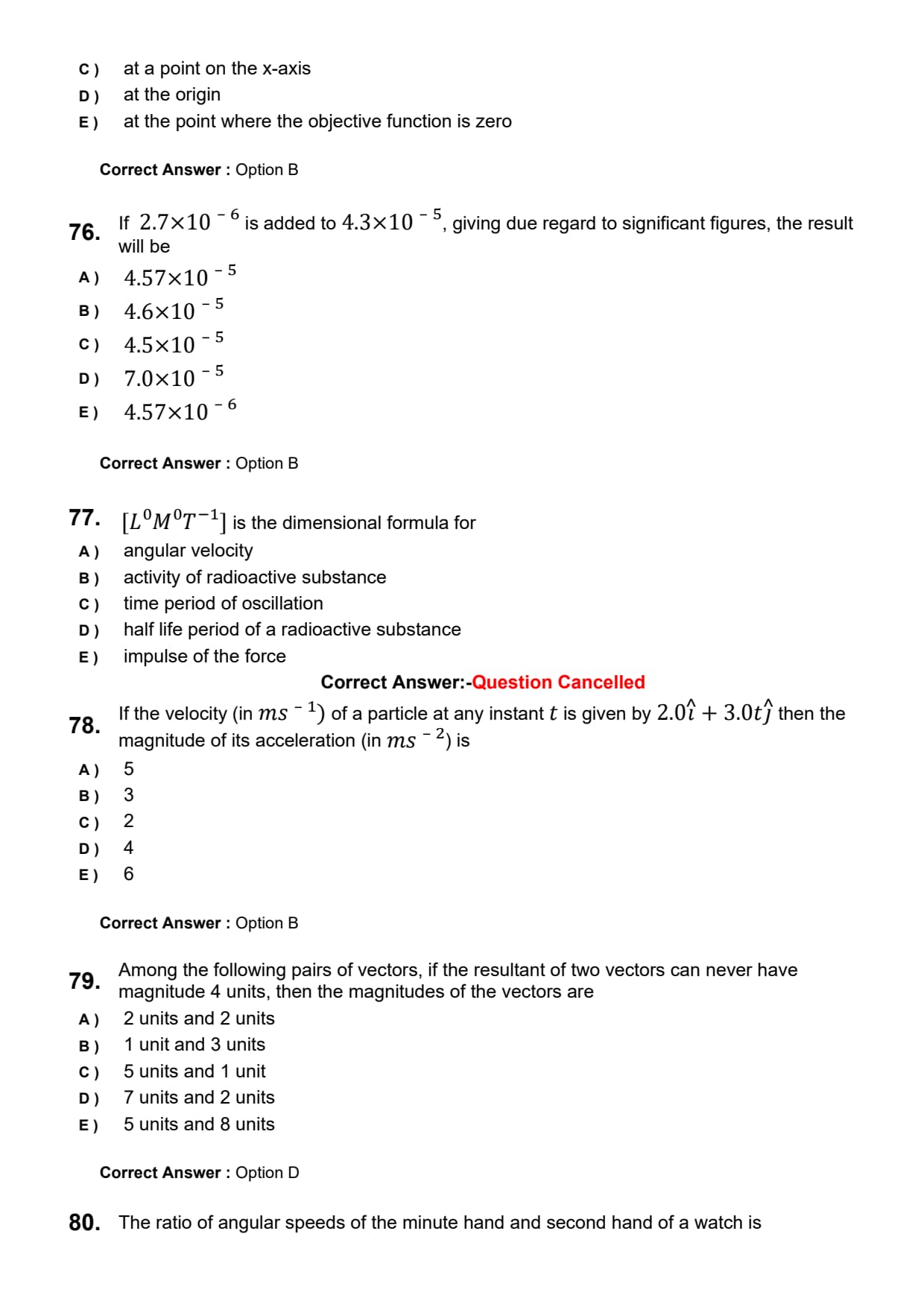
- (C) at a point on the x-axis
- (D) at the origin
- (E) at the point where the objective function is zero
Question 76:
If \( 2.7\times10^{-6} \) is added to \( 4.3\times10^{-5} \), giving due regard to significant figures, the result will be
- (A) \( 4.57\times10^{-5} \)
- (B) \( 4.6\times10^{-5} \)
- (C) \( 4.5\times10^{-5} \)
- (D) \( 7.0\times10^{-5} \)
- (E) \( 4.57\times10^{-6} \)
Question 77:
\( [L^0 M^0 T^{-1}] \) is the dimensional formula for
- (A) angular velocity
- (B) activity of radioactive substance
- (C) time period of oscillation
- (D) half life period of a radioactive substance
- (E) impulse of the force
Question 78:
If the velocity (in \( m s^{-1} \)) of a particle at any instant \( t \) is given by \( 2.0\hat{i} + 3.0t\hat{j} \), then the magnitude of its acceleration (in \( m s^{-2} \)) is
- (A) \(5 \)
- (B) \(3 \)
- (C) \(2 \)
- (D) \(4 \)
- (E) \(6 \)
Question 79:
Among the following pairs of vectors, if the resultant of two vectors can never have magnitude 4 units, the magnitudes of the vectors are
- (A) 2 units and 2 units
- (B) 1 unit and 3 units
- (C) 5 units and 1 unit
- (D) 7 units and 2 units
- (E) 5 units and 8 units
Question 80:
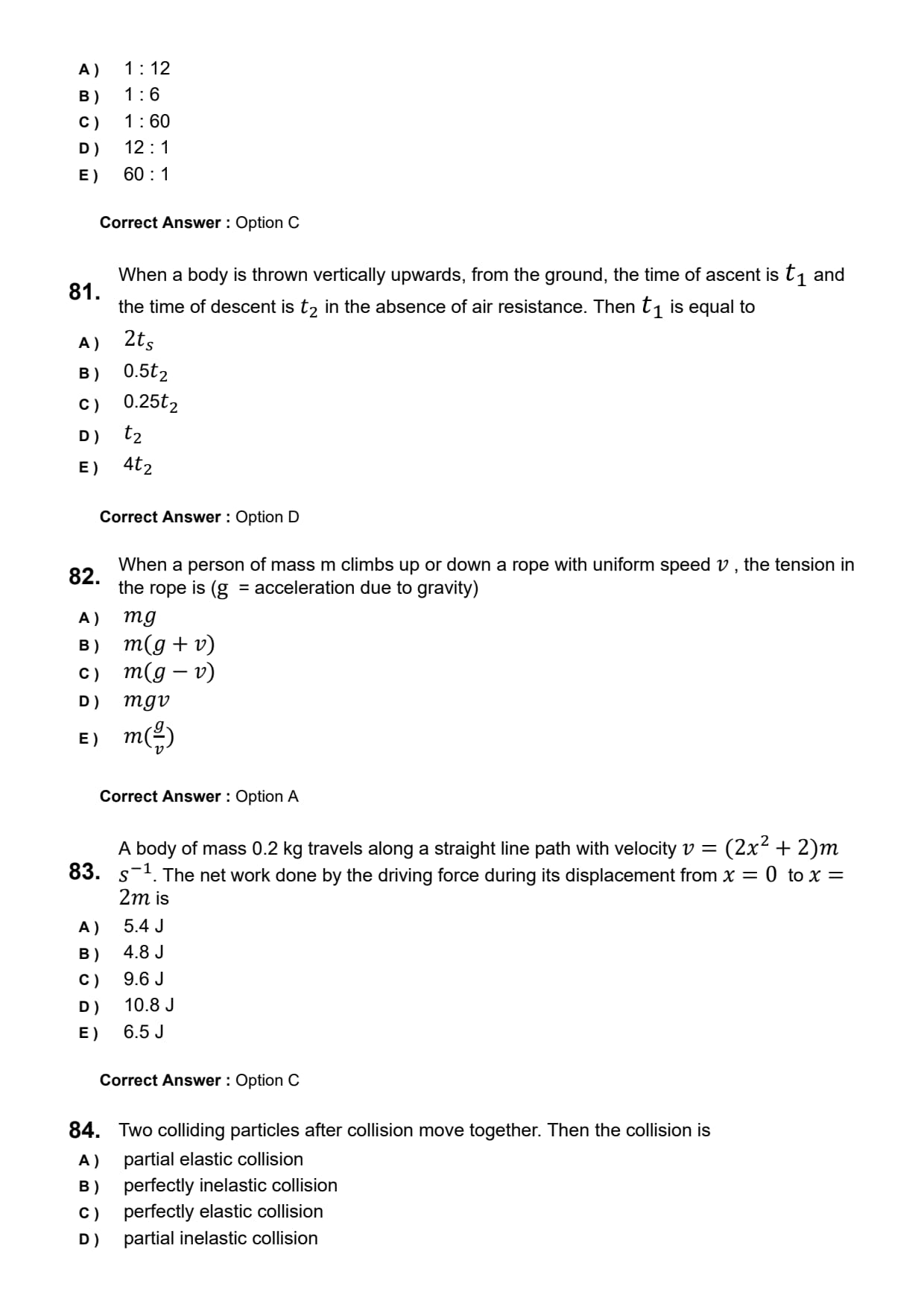
The ratio of angular speeds of the minute hand and second hand of a watch is
- (A) \(1:12 \)
- (B) \(1:6 \)
- (C) \(1:60 \)
- (D) \(12:1 \)
- (E) \(60:1 \)
Question 81:
When a body is thrown vertically upwards, from the ground, the time of ascent is \( t_1 \) and the time of descent is \( t_2 \) in the absence of air resistance. Then \( t_1 \) is equal to
- (A) \( 2t_2 \)
- (B) \( 0.5t_2 \)
- (C) \( 0.25t_2 \)
- (D) \( t_2 \)
- (E) \( 4t_2 \)
Question 82:
When a person of mass \( m \) climbs up or down a rope with uniform speed \( v \), the tension in the rope is ( \( g \) = acceleration due to gravity)
- (A) \( mg \)
- (B) \( m(g+v) \)
- (C) \( m(g-v) \)
- (D) \( mgv \)
- (E) \( m\left(\frac{g}{v}\right) \)
Question 83:
A body of mass \( 0.2\,kg \) travels along a straight line with velocity \( v = (2x^2 + 2)\,m s^{-1} \). The net work done by the driving force during its displacement from \( x=0 \) to \( x=2 \,m \) is
- (A) \(2\,J \)
- (B) \(5.4\,J \)
- (C) \(9.6\,J \)
- (D) \(10.8\,J \)
- (E) \(6.5\,J \)
Question 84:
Two colliding particles after collision move together. Then the collision is
- (A) partial elastic collision
- (B) perfectly inelastic collision
- (C) perfectly elastic collision
- (D) partial inelastic collision
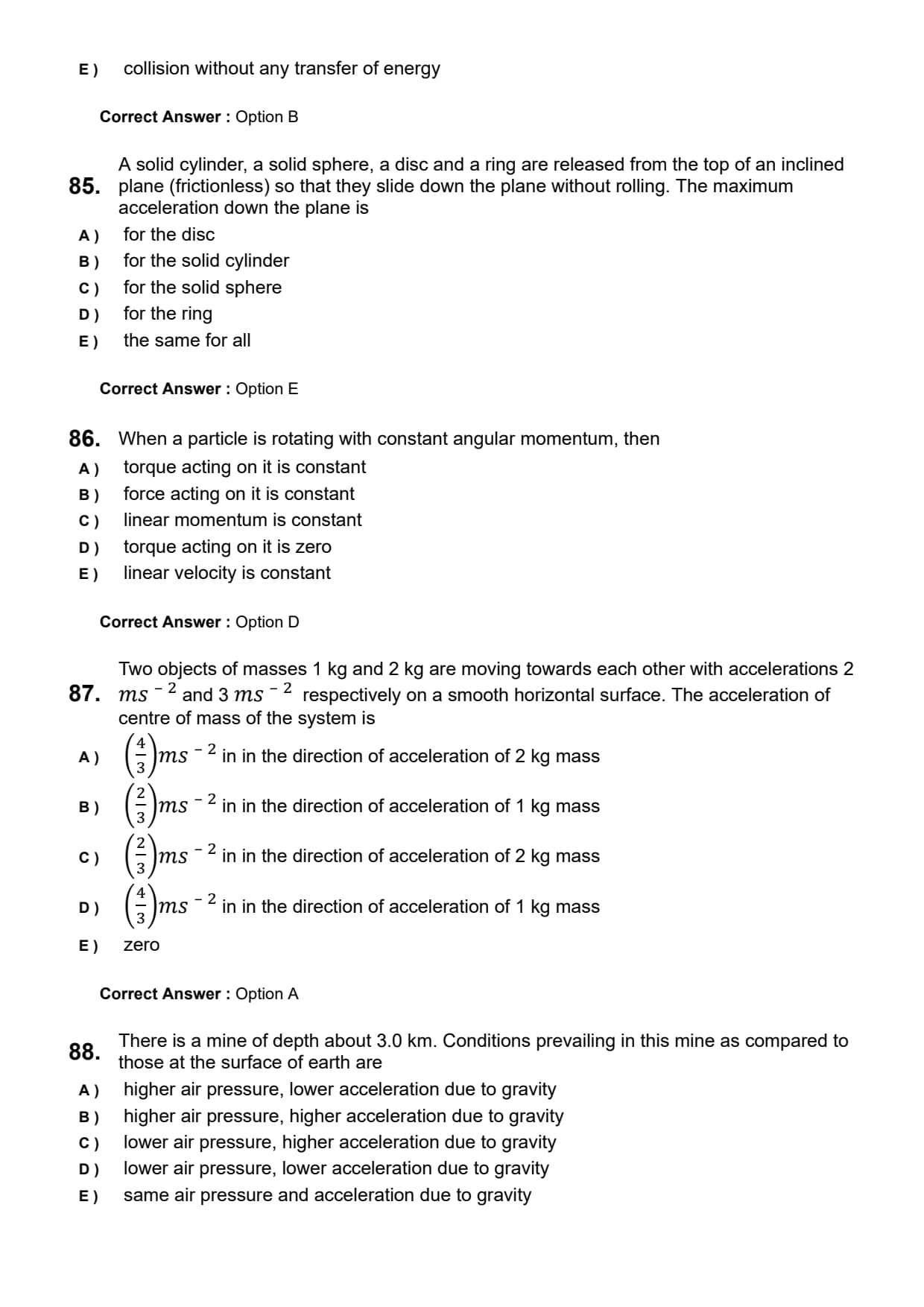
- (E) collision without any transfer of energy
Question 85:
A solid cylinder, a solid sphere, a disc and a ring are released from the top of an inclined plane (frictionless) so that they slide down the plane without rolling. The maximum acceleration down the plane is
- (A) for the disc
- (B) for the solid cylinder
- (C) for the solid sphere
- (D) for the ring
- (E) the same for all
Question 86:
When a particle is rotating with constant angular momentum, then
- (A) torque acting on it is constant
- (B) force acting on it is constant
- (C) linear momentum is constant
- (D) torque acting on it is zero
- (E) linear velocity is constant
Question 87:
Two objects of masses \( 1\,kg \) and \( 2\,kg \) are moving towards each other with accelerations \( 2\,m s^{-2} \) and \( 3\,m s^{-2} \) respectively on a smooth horizontal surface. The acceleration of centre of mass of the system is
- (A) \( \frac{4}{3}\,m s^{-2} \) in the direction of acceleration of 2 kg mass
- (B) \( \frac{2}{3}\,m s^{-2} \) in the direction of acceleration of 1 kg mass
- (C) \( \frac{2}{3}\,m s^{-2} \) in the direction of acceleration of 2 kg mass
- (D) \( \frac{4}{3}\,m s^{-2} \) in the direction of acceleration of 1 kg mass
- (E) zero
Question 88:
There is a mine of depth about \( 3.0 \,km \). Conditions prevailing in this mine as compared to those at the surface of earth are
- (A) higher air pressure, lower acceleration due to gravity
- (B) higher air pressure, higher acceleration due to gravity
- (C) lower air pressure, higher acceleration due to gravity
- (D) lower air pressure, lower acceleration due to gravity
- (E) same air pressure and acceleration due to gravity
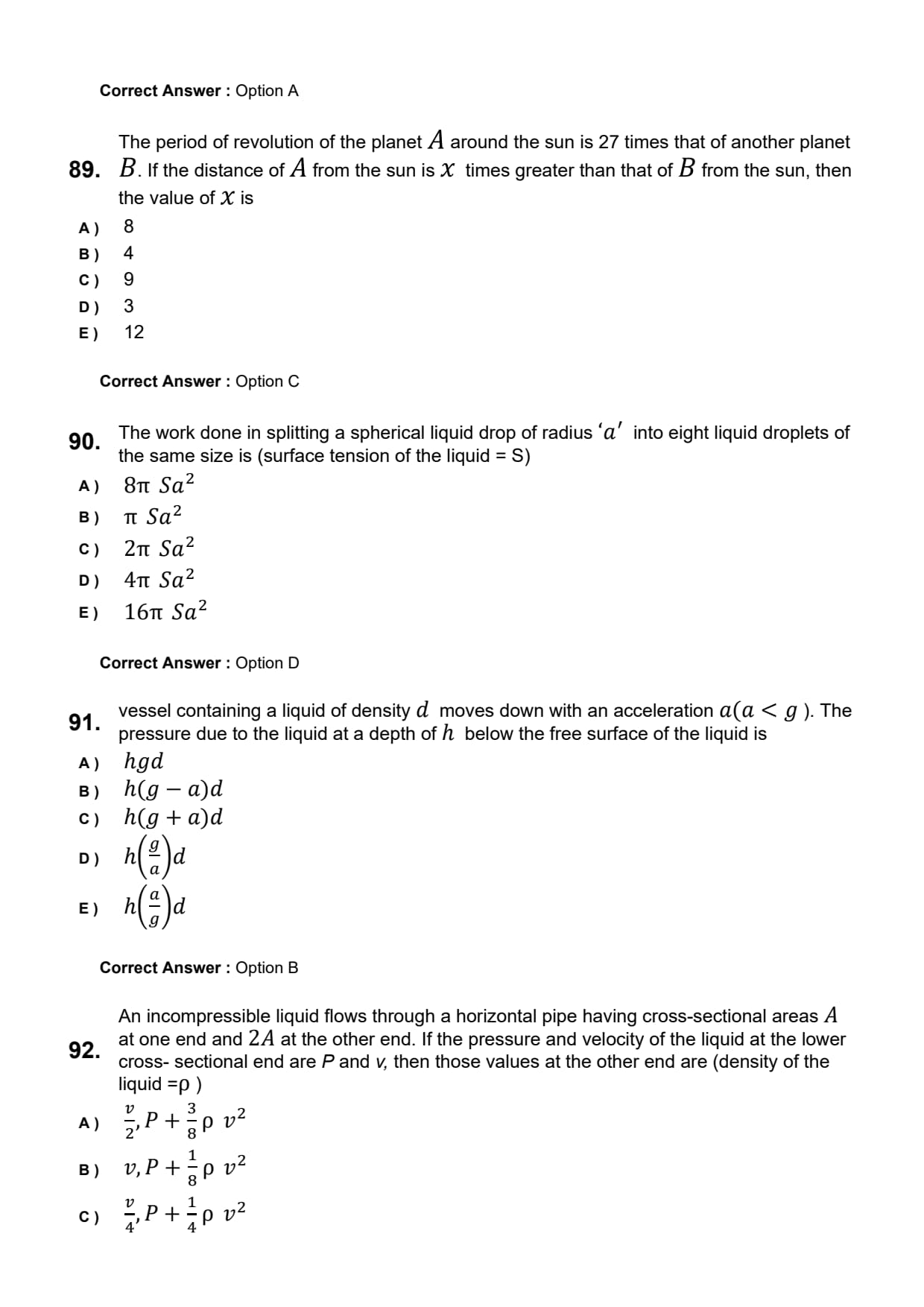
Question 89:
The period of revolution of the planet A around the sun is 27 times that of another planet B. If the distance of A from the sun is \( X \) times greater than that of B from the sun, then the value of \( X \) is
- (A) \(8 \)
- (B) \(4 \)
- (C) \(9 \)
- (D) \(3 \)
- (E) \(12 \)
Question 90:
The work done in splitting a spherical liquid drop of radius \( a \) into eight liquid droplets of the same size (surface tension of the liquid = \( S \)) is
- (A) \( 8\pi Sa^2 \)
- (B) \( \pi Sa^2 \)
- (C) \( 2\pi Sa^2 \)
- (D) \( 4\pi Sa^2 \)
- (E) \( 16\pi Sa^2 \)
Question 91:
A vessel containing a liquid of density \( d \) moves down with an acceleration \( a \,(a
- (A) \( hgd \)
- (B) \( h(g-a)d \)
- (C) \( h(g+a)d \)
- (D) \( h\left(\frac{g}{a}\right)d \)
- (E) \( h\left(\frac{a}{g}\right)d \)
Question 92:
An incompressible liquid flows through a horizontal pipe having cross-sectional areas \( A \) at one end and \( 2A \) at the other end. If the pressure and velocity of the liquid at the lower cross-section are \( P \) and \( v \), then these values at the other end are
- (A) \( \frac{v}{2},\, P + \frac{3}{8}\rho v^2 \)
- (B) \( v,\, P + \frac{1}{8}\rho v^2 \)
- (C) \( \frac{v}{4},\, P + \frac{1}{4}\rho v^2 \)
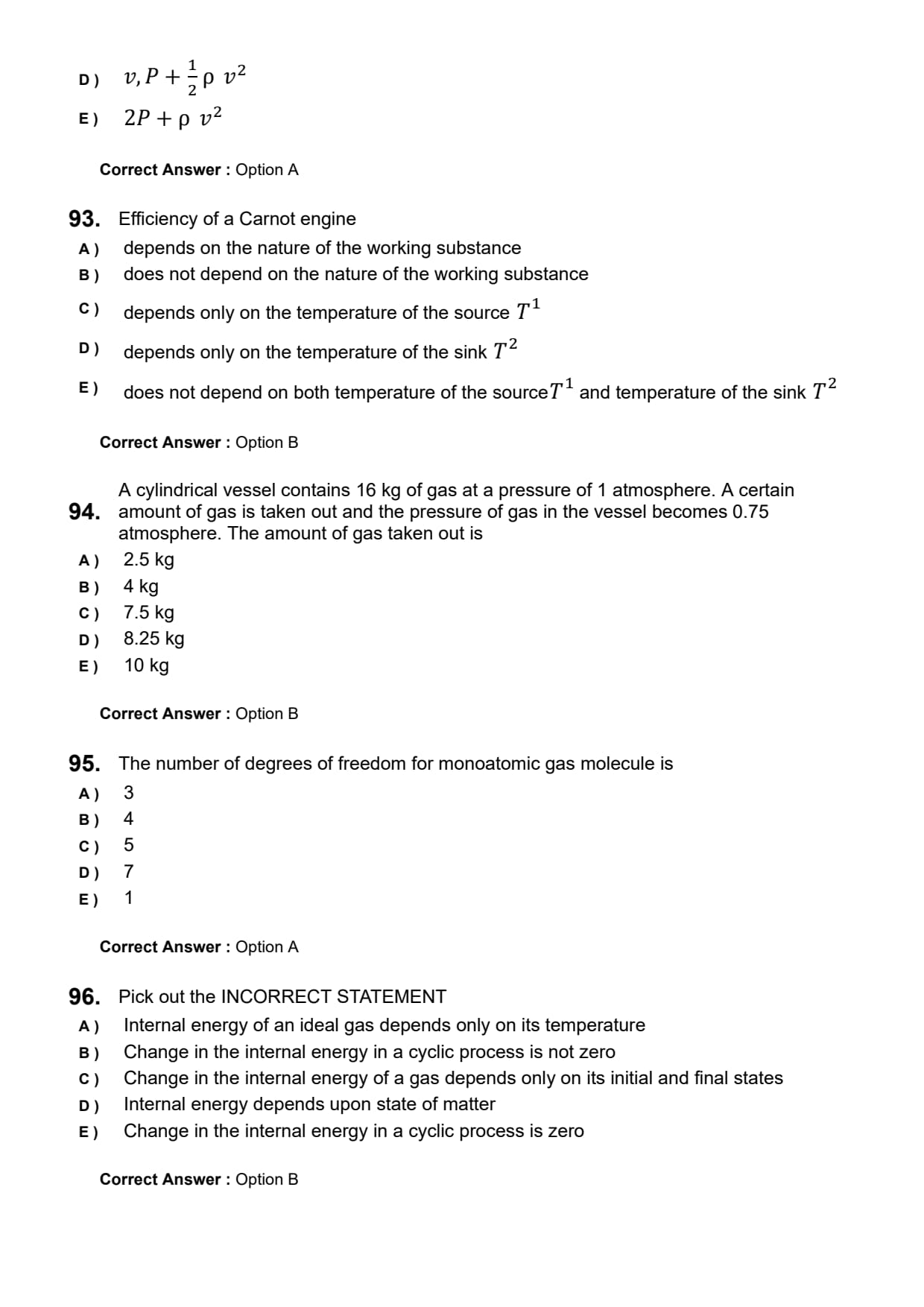
- (D) \( v,\, P + \frac{1}{2}\rho v^2 \)
- (E) \( 2P + \rho v^2 \)
Question 93:
Efficiency of a Carnot engine
- (A) depends on the nature of the working substance
- (B) does not depend on the nature of the working substance
- (C) depends only on the temperature of the source \( T_1 \)
- (D) depends only on the temperature of the sink \( T_2 \)
- (E) does not depend on both temperature of the source \( T_1 \) and temperature of the sink \( T_2 \)
Question 94:
A cylindrical vessel contains 16 kg of gas at a pressure of 1 atmosphere. A certain amount of gas is taken out and the pressure of gas in the vessel becomes 0.75 atmosphere. The amount of gas taken out is
- (A) \(2.5\,kg \)
- (B) \(4\,kg \)
- (C) \(7.5\,kg \)
- (D) \(8.25\,kg \)
- (E) \(10\,kg \)
Question 95:
The number of degrees of freedom for monoatomic gas molecule is
- (A) \(3 \)
- (B) \(4 \)
- (C) \(5 \)
- (D) \(7 \)
- (E) \(1 \)
Question 96:
Pick out the INCORRECT STATEMENT
- (A) Internal energy of an ideal gas depends only on its temperature
- (B) Change in the internal energy in a cyclic process is not zero
- (C) Change in the internal energy of a gas depends only on its initial and final states
- (D) Internal energy depends upon state of matter
- (E) Change in the internal energy in a cyclic process is zero
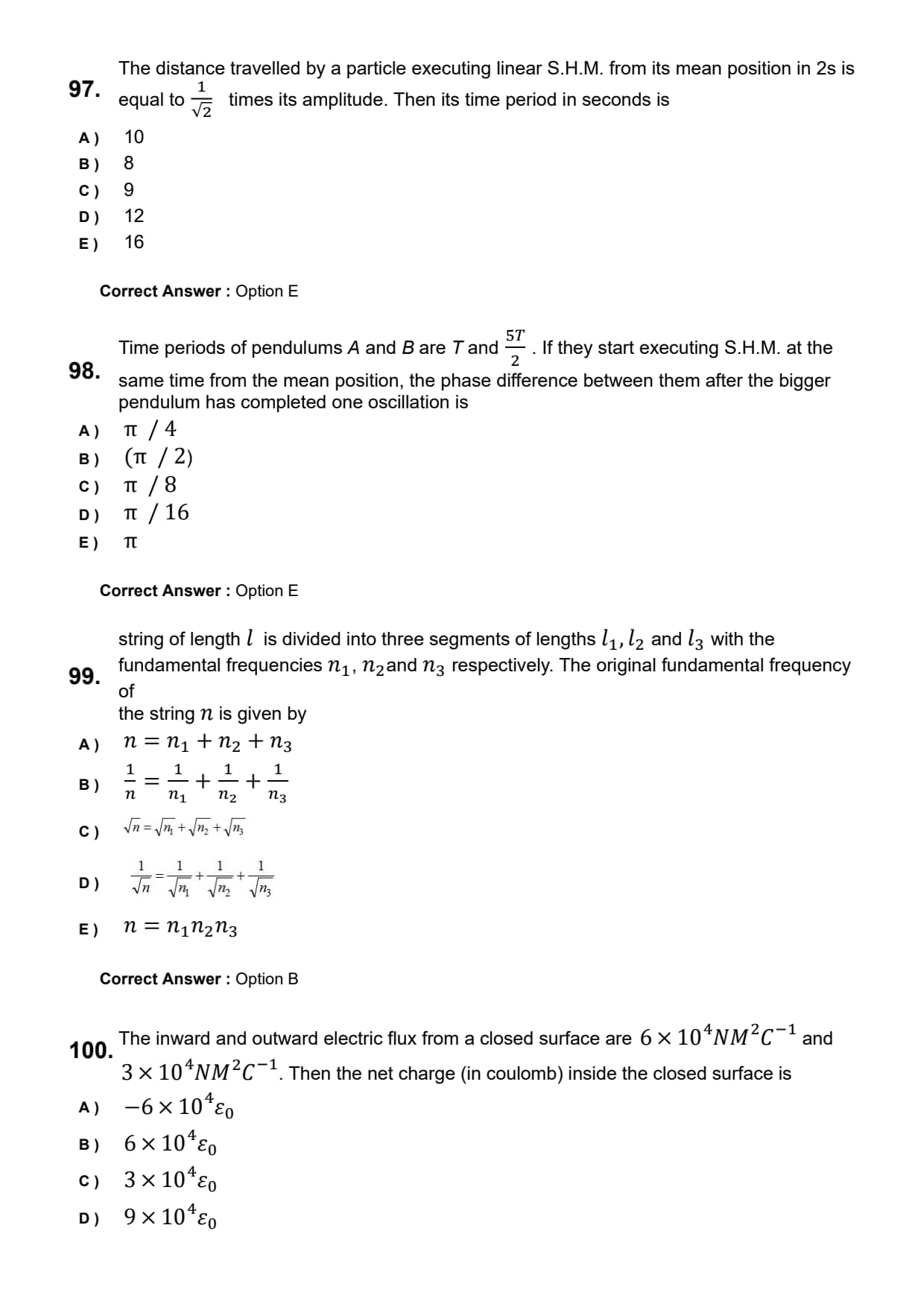
Question 97:
The distance travelled by a particle executing linear S.H.M. from its mean position in 2 s is equal to \( \frac{1}{\sqrt{2}} \) times its amplitude. Then its time period in seconds is
- (A) \(10 \)
- (B) \(8 \)
- (C) \(9 \)
- (D) \(12 \)
- (E) \(16 \)
Question 98:
Time periods of pendulums \( A \) and \( B \) are \( T \) and \( \frac{5T}{2} \). If they start executing S.H.M. at the same time from the mean position, the phase difference between them after the bigger pendulum has completed one oscillation is
- (A) \( \frac{\pi}{4} \)
- (B) \( \frac{\pi}{2} \)
- (C) \( \frac{\pi}{8} \)
- (D) \( \frac{\pi}{16} \)
- (E) \( \pi \)
Question 99:
A string of length \( l \) is divided into three segments of lengths \( l_1, l_2 \) and \( l_3 \) with the fundamental frequencies \( n_1, n_2 \) and \( n_3 \) respectively. The original fundamental frequency of the string is given by
- (A) \( n = n_1 + n_2 + n_3 \)
- (B) \( \frac{1}{n} = \frac{1}{n_1} + \frac{1}{n_2} + \frac{1}{n_3} \)
- (C) \( \sqrt{n} = \sqrt{n_1} + \sqrt{n_2} + \sqrt{n_3} \)
- (D) \( \frac{1}{\sqrt{n}} = \frac{1}{\sqrt{n_1}} + \frac{1}{\sqrt{n_2}} + \frac{1}{\sqrt{n_3}} \)
- (E) \( n = n_1 n_2 n_3 \)
Question 100:
The inward and outward electric flux from a closed surface are \( 6\times10^4 \,Nm^2C^{-1} \) and \( 3\times10^4 \,Nm^2C^{-1} \). Then the net charge (in coulomb) inside the closed surface is
- (A) \( -6\times10^4 \varepsilon_0 \)
- (B) \( 6\times10^4 \varepsilon_0 \)
- (C) \( 3\times10^4 \varepsilon_0 \)
- (D) \( 9\times10^4 \varepsilon_0 \)
- (E) \( -3\times10^4 \varepsilon_0 \)
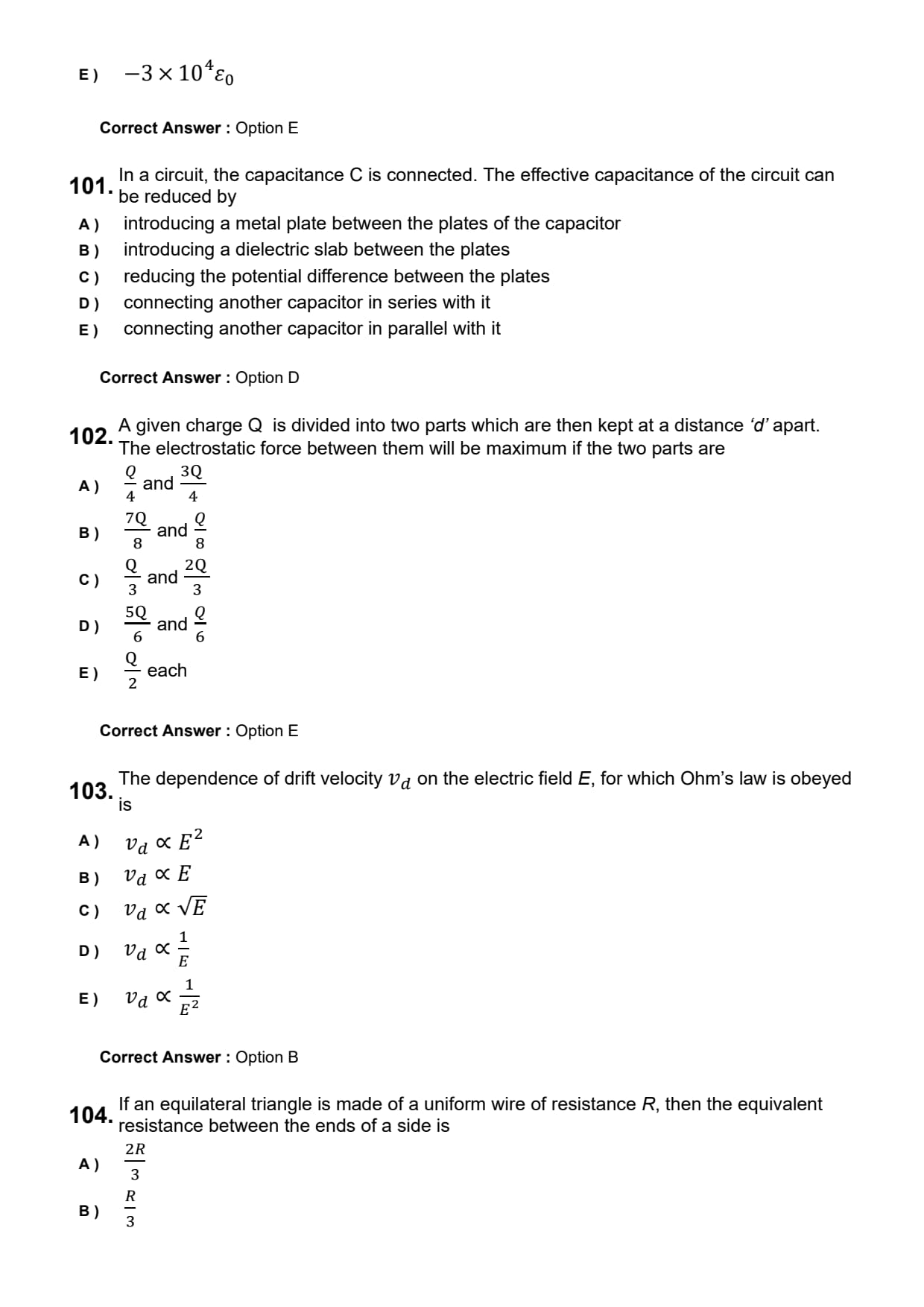
Question 101:
In a circuit, the capacitance \( C \) is connected. The effective capacitance of the circuit can be reduced by
- (A) introducing a metal plate between the plates of the capacitor
- (B) introducing a dielectric slab between the plates
- (C) reducing the potential difference between the plates
- (D) connecting another capacitor in series with it
- (E) connecting another capacitor in parallel with it
Question 102:
A given charge \( Q \) is divided into two parts which are then kept at a distance \( d \) apart. The electrostatic force between them will be maximum if the two parts are
- (A) \( \frac{Q}{4} \) and \( \frac{3Q}{4} \)
- (B) \( \frac{7Q}{8} \) and \( \frac{Q}{8} \)
- (C) \( \frac{Q}{3} \) and \( \frac{2Q}{3} \)
- (D) \( \frac{5Q}{6} \) and \( \frac{Q}{6} \)
- (E) \( \frac{Q}{2} \) each
Question 103:
The dependence of drift velocity \( v_d \) on the electric field \( E \), for which Ohm's law is obeyed is
- (A) \( v_d \propto E^2 \)
- (B) \( v_d \propto E \)
- (C) \( v_d \propto \sqrt{E} \)
- (D) \( v_d \propto \frac{1}{E} \)
- (E) \( v_d \propto \frac{1}{E^2} \)
Question 104:
If an equilateral triangle is made of a uniform wire of resistance \( R \), then the equivalent resistance between the ends of a side is
- (A) \( \frac{2R}{3} \)
- (B) \( \frac{R}{3} \)
- (C) \( \frac{R}{9} \)
- (D) \( \frac{2R}{9} \)
- (E) \( \frac{R}{6} \)
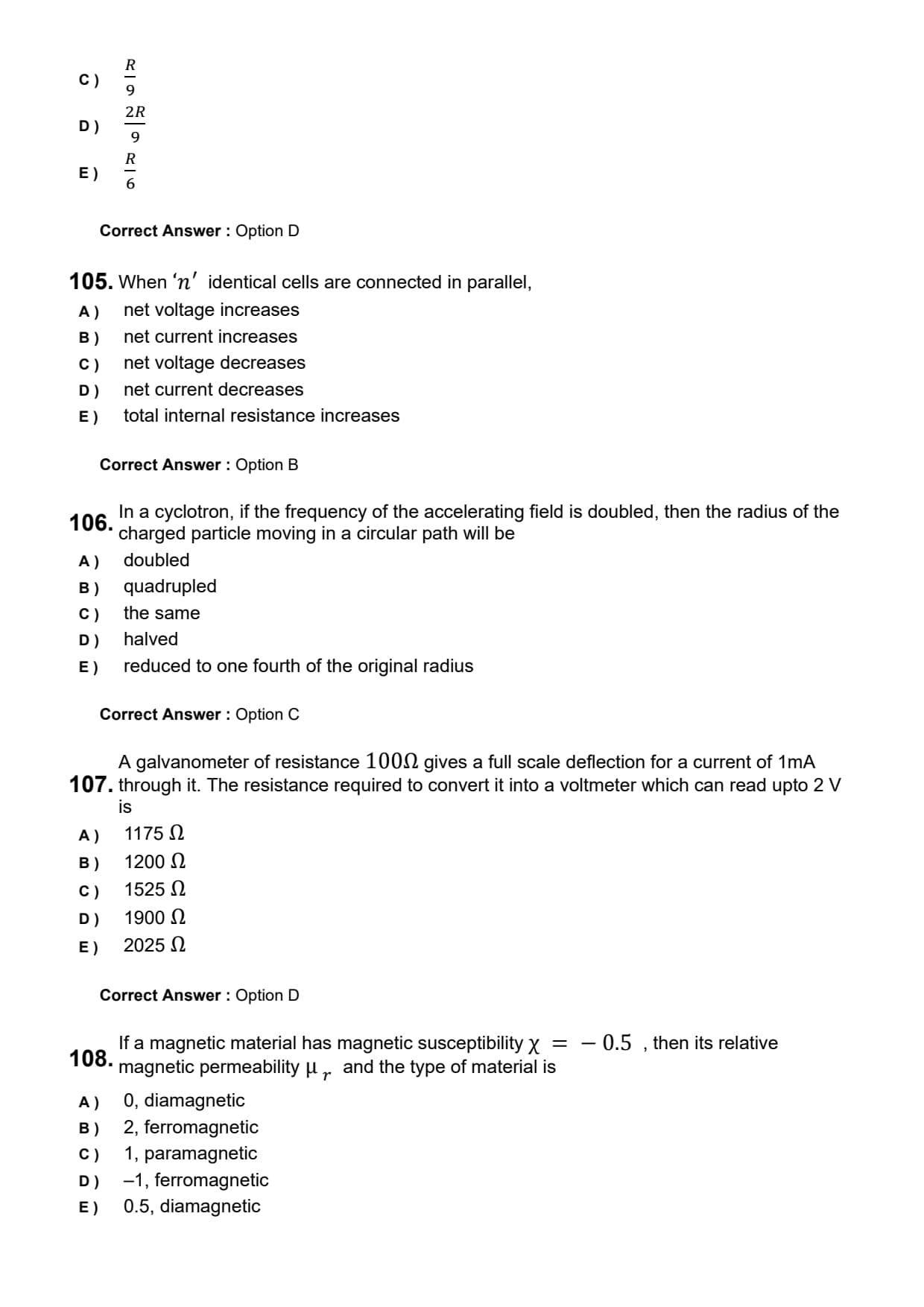
Question 105:
When \( n \) identical cells are connected in parallel,
- (A) net voltage increases
- (B) net current increases
- (C) net voltage decreases
- (D) net current decreases
- (E) total internal resistance increases
Question 106:
In a cyclotron, if the frequency of the accelerating field is doubled, then the radius of the charged particle moving in a circular path will be
- (A) doubled
- (B) quadrupled
- (C) the same
- (D) halved
- (E) reduced to one fourth of the original radius
Question 107:
A galvanometer of resistance \( 100\Omega \) gives a full scale deflection for a current of \( 1\,mA \). The resistance required to convert it into a voltmeter which can read up to \( 2\,V \) is
- (A) \(1175\,\Omega \)
- (B) \(1200\,\Omega \)
- (C) \(1525\,\Omega \)
- (D) \(1900\,\Omega \)
- (E) \(2025\,\Omega \)
Question 108:
If a magnetic material has magnetic susceptibility \( \chi = -0.5 \), then its relative magnetic permeability \( \mu_r \), and the type of material is
- (A) \(0,\ diamagnetic \)
- (B) \(2,\ ferromagnetic \)
- (C) \(1,\ paramagnetic \)
- (D) \(-1,\ ferromagnetic \)
- (E) \(0.5,\ diamagnetic \)
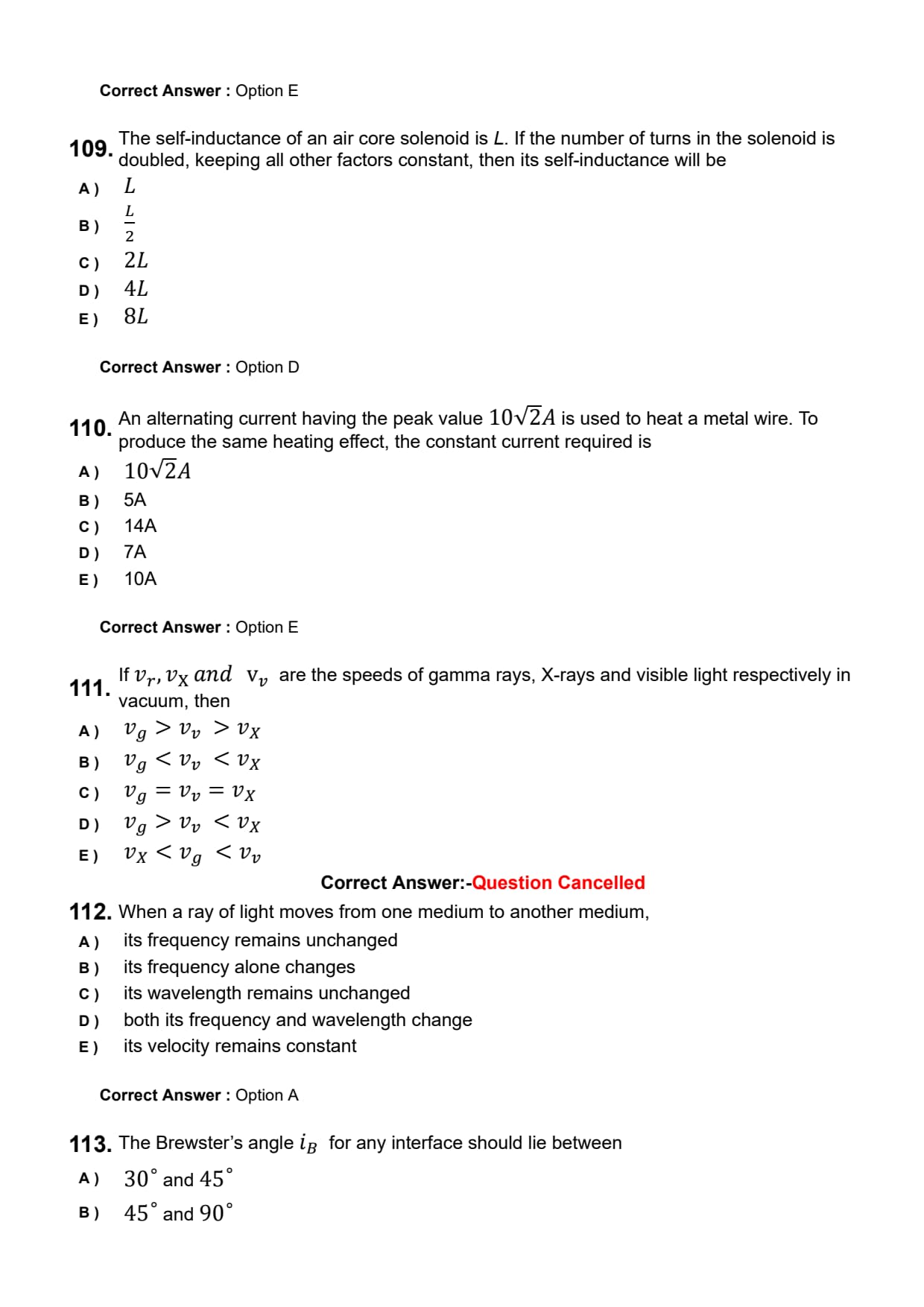
Question 109:
The self-inductance of an air core solenoid is \( L \). If the number of turns in the solenoid is doubled, keeping all other factors constant, then its self-inductance will be
- (A) \(L \)
- (B) \( \frac{L}{2} \)
- (C) \(2L \)
- (D) \(4L \)
- (E) \(8L \)
Question 110:
An alternating current having the peak value \( 10\sqrt{2}\,A \) is used to heat a metal wire. To produce the same heating effect, the constant current required is
- (A) \(10\sqrt{2}\,A \)
- (B) \(5\,A \)
- (C) \(14\,A \)
- (D) \(7\,A \)
- (E) \(10\,A \)
Question 111:
If \( v_g, v_X \) and \( v_v \) are the speeds of gamma rays, X-rays and visible light respectively in vacuum, then
- (A) \( v_g > v_v > v_X \)
- (B) \( v_g < v_v < v_X \)
- (C) \( v_g = v_v = v_X \)
- (D) \( v_g > v_v < v_X \)
- (E) \( v_X < v_g < v_v \)
Question 112:
When a ray of light moves from one medium to another medium,
- (A) its frequency alone changes
- (B) its frequency alone remains unchanged
- (C) its wavelength remains unchanged
- (D) both its frequency and wavelength change
- (E) its velocity remains constant
Question 113:
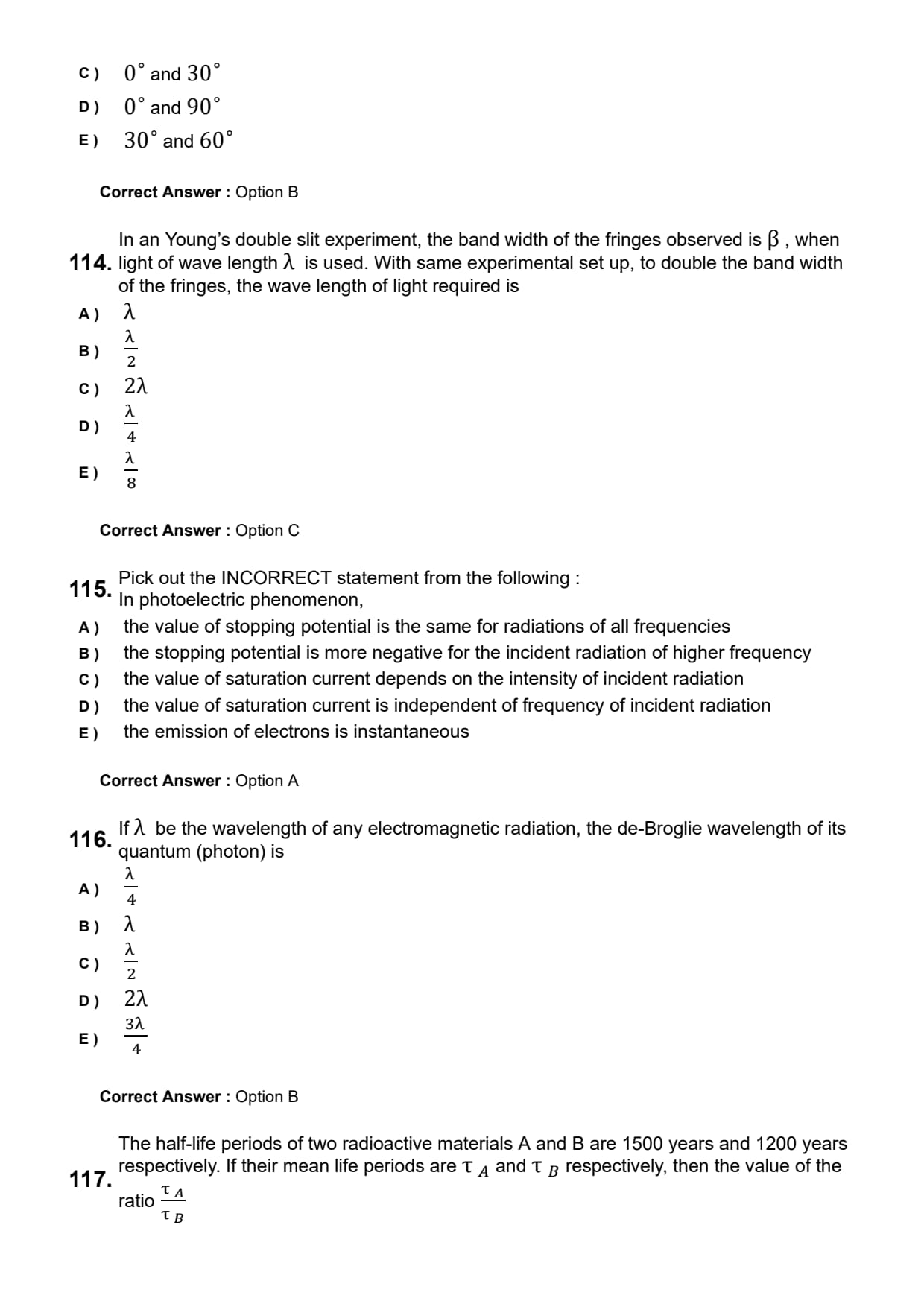
The Brewster's angle \( i_B \) for any interface should lie between
- (A) \(30^\circ and 45^\circ \)
- (B) \(45^\circ and 90^\circ \)
- (C) \(0^\circ and 30^\circ \)
- (D) \(0^\circ and 90^\circ \)
- (E) \(30^\circ and 60^\circ \)
Question 114:
In Young's double slit experiment, the band width of the fringes observed is \( \beta \), when light of wavelength \( \lambda \) is used. With same experimental set up, to double the band width of the fringes, the wavelength of light required is
- (A) \( \lambda \)
- (B) \( \frac{\lambda}{2} \)
- (C) \( 2\lambda \)
- (D) \( \frac{\lambda}{4} \)
- (E) \( \frac{\lambda}{8} \)
Question 115:
Pick out the INCORRECT statement from the following:
- (A) the value of stopping potential is the same for radiations of all frequencies
- (B) the stopping potential is more negative for the incident radiation of higher frequency
- (C) the value of saturation current depends on the intensity of incident radiation
- (D) the value of saturation current is independent of frequency of incident radiation
- (E) the emission of electrons is instantaneous
Question 116:
If \( \lambda \) be the wavelength of any electromagnetic radiation, the de-Broglie wavelength of its quantum (photon) is
- (A) \( \frac{\lambda}{4} \)
- (B) \( \lambda \)
- (C) \( \frac{\lambda}{2} \)
- (D) \( 2\lambda \)
- (E) \( \frac{3\lambda}{4} \)
Question 117:
The half-life periods of two radioactive materials A and B are 1500 years and 1200 years respectively. If their mean life periods are \( \tau_A \) and \( \tau_B \) respectively, then the value of the ratio \( \frac{\tau_A}{\tau_B} \) is
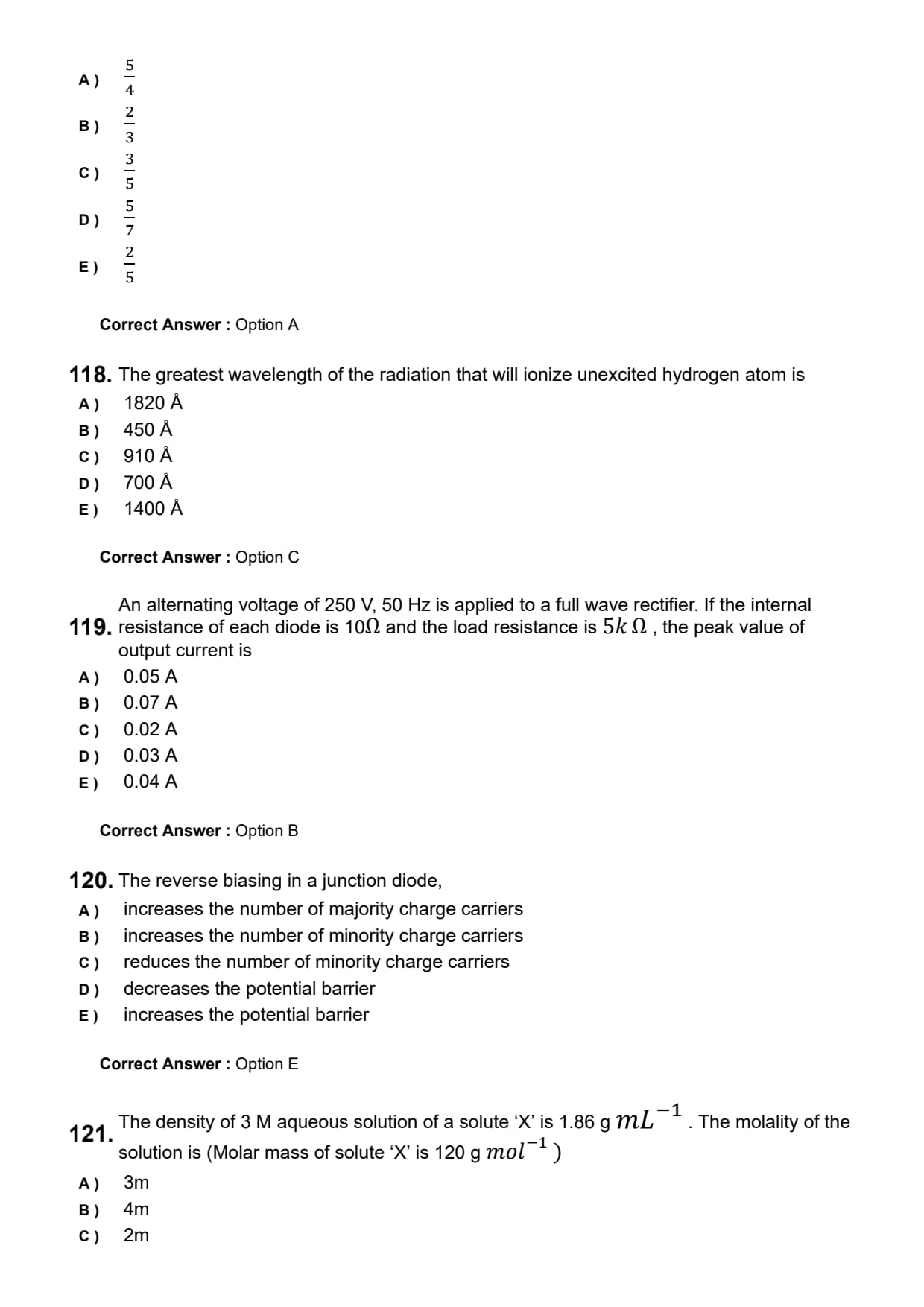
- (A) \( \frac{5}{4} \)
- (B) \( \frac{2}{3} \)
- (C) \( \frac{3}{5} \)
- (D) \( \frac{5}{7} \)
- (E) \( \frac{2}{5} \)
Question 118:
The greatest wavelength of the radiation that will ionize unexcited hydrogen atom is
- (A) \(1820\,\AA \)
- (B) \(450\,\AA \)
- (C) \(910\,\AA \)
- (D) \(700\,\AA \)
- (E) \(1400\,\AA \)
Question 119:
An alternating voltage of \( 250\,V,\,50\,Hz \) is applied to a full wave rectifier. If the internal resistance of each diode is \( 10\,\Omega \) and the load resistance is \( 5\,k\Omega \), the peak value of output current is
- (A) \(0.05\,A \)
- (B) \(0.07\,A \)
- (C) \(0.02\,A \)
- (D) \(0.03\,A \)
- (E) \(0.04\,A \)
Question 120:
The reverse biasing in a junction diode,
- (A) increases the number of majority charge carriers
- (B) increases the number of minority charge carriers
- (C) reduces the number of minority charge carriers
- (D) decreases the potential barrier
- (E) increases the potential barrier
Question 121:
The density of \( 3\,M \) aqueous solution of a solute \( X \) is \( 1.86\,g mL^{-1} \). The molality of the solution is (Molar mass of solute \( X \) is \( 120\,g mol^{-1} \))
- (A) \(3\,m \)
- (B) \(4\,m \)
- (C) \(2\,m \)
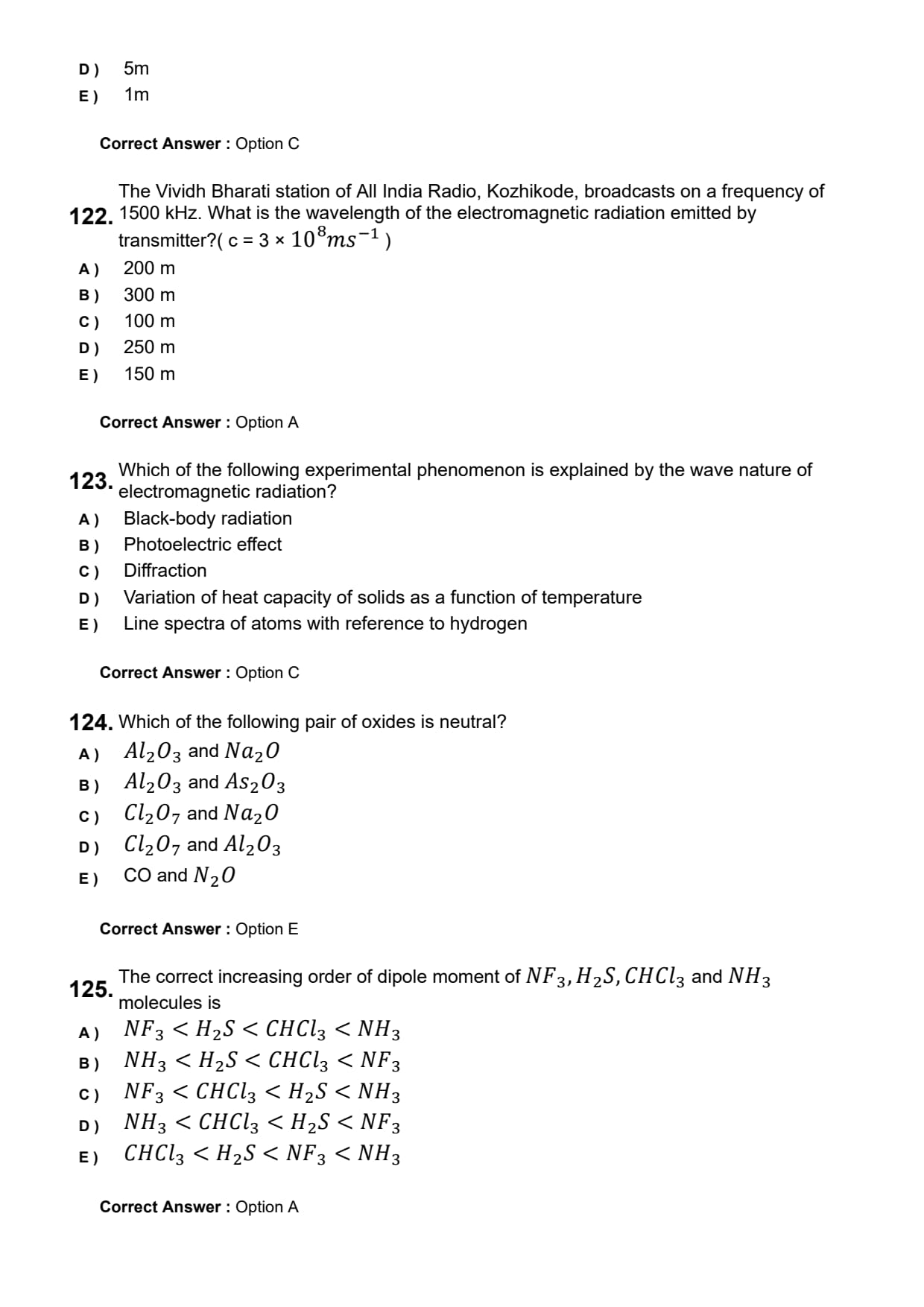
- (D) \(5\,m \)
- (E) \(1\,m \)
Question 122:
The Vividh Bharati station of All India Radio, Kozhikode, broadcasts on a frequency of \( 1500\,kHz \). What is the wavelength of the electromagnetic radiation emitted by the transmitter? \( (c = 3\times10^8\,m s^{-1}) \)
- (A) \(200\,m \)
- (B) \(300\,m \)
- (C) \(100\,m \)
- (D) \(250\,m \)
- (E) \(150\,m \)
Question 123:
Which of the following experimental phenomenon is explained by the wave nature of electromagnetic radiation?
- (A) Black-body radiation
- (B) Photoelectric effect
- (C) Diffraction
- (D) Variation of heat capacity of solids as a function of temperature
- (E) Line spectra of atoms with reference to hydrogen
Question 124:
Which of the following pair of oxides is neutral?
- (A) \( Al_2O_3 and Na_2O \)
- (B) \( Al_2O_3 and As_2O_3 \)
- (C) \( Cl_2O_7 and Na_2O \)
- (D) \( Cl_2O_7 and Al_2O_3 \)
- (E) \( CO and N_2O \)
Question 125:
The correct increasing order of dipole moment of \( NF_3, H_2S, CHCl_3 \) and \( NH_3 \) is
- (A) \( NF_3 < H_2S < CHCl_3 < NH_3 \)
- (B) \( NH_3 < H_2S < CHCl_3 < NF_3 \)
- (C) \( NF_3 < CHCl_3 < H_2S < NH_3 \)
- (D) \( NH_3 < CHCl_3 < H_2S < NF_3 \)
- (E) \( CHCl_3 < H_2S < NF_3 < NH_3 \)
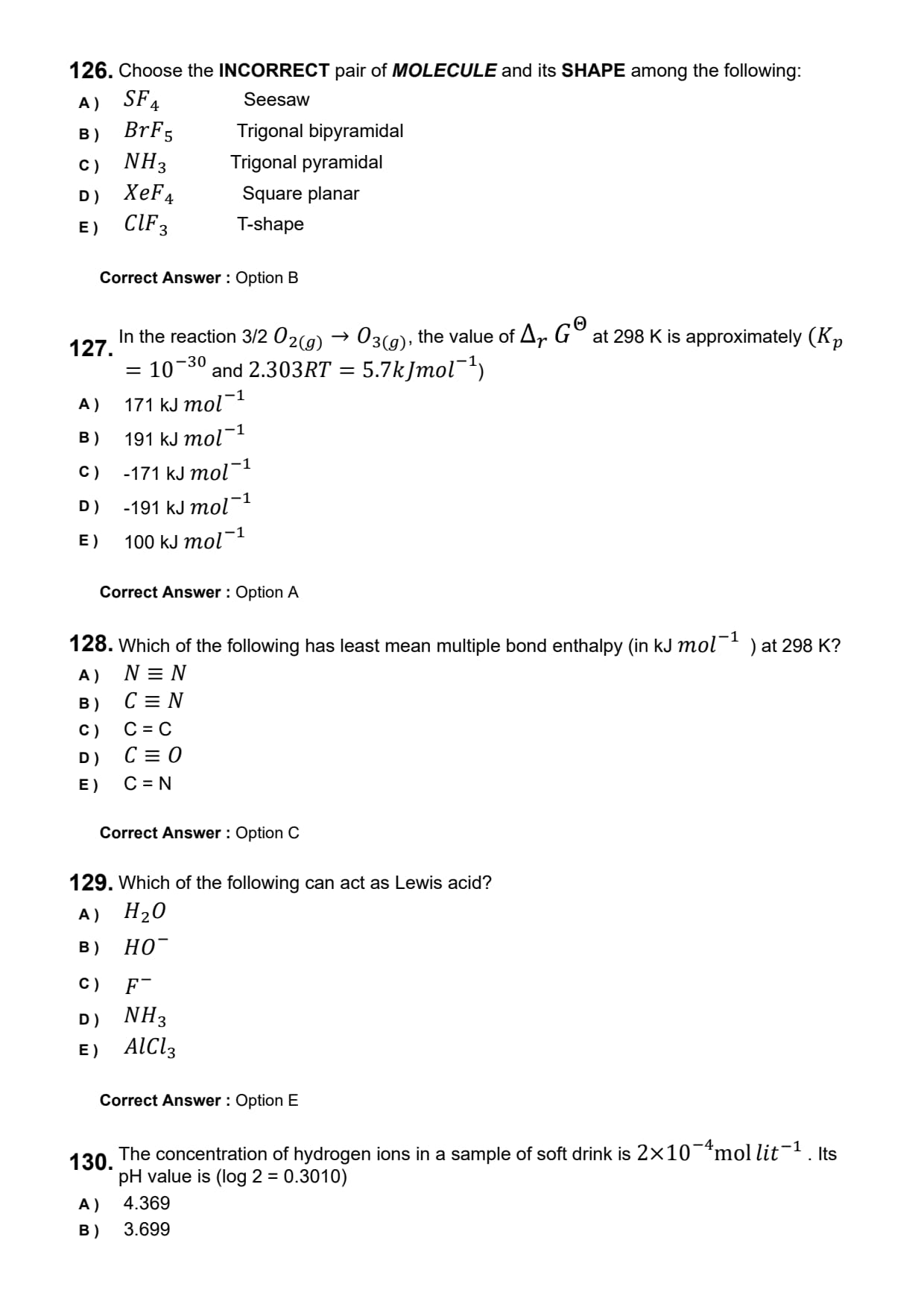
Question 126:
Choose the INCORRECT pair of MOLECULE and its SHAPE among the following:
- (A) \( SF_4 \) — Seesaw
- (B) \( BrF_5 \) — Trigonal bipyramidal
- (C) \( NH_3 \) — Trigonal pyramidal
- (D) \( XeF_4 \) — Square planar
- (E) \( ClF_3 \) — T-shape
Question 127:
In the reaction \( \frac{3}{2}O_2(g) \rightarrow O_3(g) \), the value of \( \Delta_r G^\circ \) at \( 298\,K \) is approximately ( \( K_p = 10^{-30},\ 2.303RT = 5.7\,kJ mol^{-1} \) )
- (A) \(171\,kJ mol^{-1} \)
- (B) \(191\,kJ mol^{-1} \)
- (C) \(-171\,kJ mol^{-1} \)
- (D) \(-191\,kJ mol^{-1} \)
- (E) \(100\,kJ mol^{-1} \)
Question 128:
Which of the following has least mean multiple bond enthalpy (in \( kJ mol^{-1} \)) at 298 K?
- (A) \( N \equiv N \)
- (B) \( C \equiv N \)
- (C) \( C = C \)
- (D) \( C = O \)
- (E) \( C = N \)
Question 129:
Which of the following can act as Lewis acid?
- (A) \( H_2O \)
- (B) \( HO^- \)
- (C) \( F^- \)
- (D) \( NH_3 \)
- (E) \( AlCl_3 \)
Question 130:
The concentration of hydrogen ions in a sample of soft drink is \( 2\times10^{-4}\,mol L^{-1} \). Its pH value is ( \( \log 2 = 0.3010 \) )
- (A) \(4.369 \)
- (B) \(3.699 \)
- (C) \(2.369 \)
- (D) \(5.301 \)
- (E) \(3.301 \)
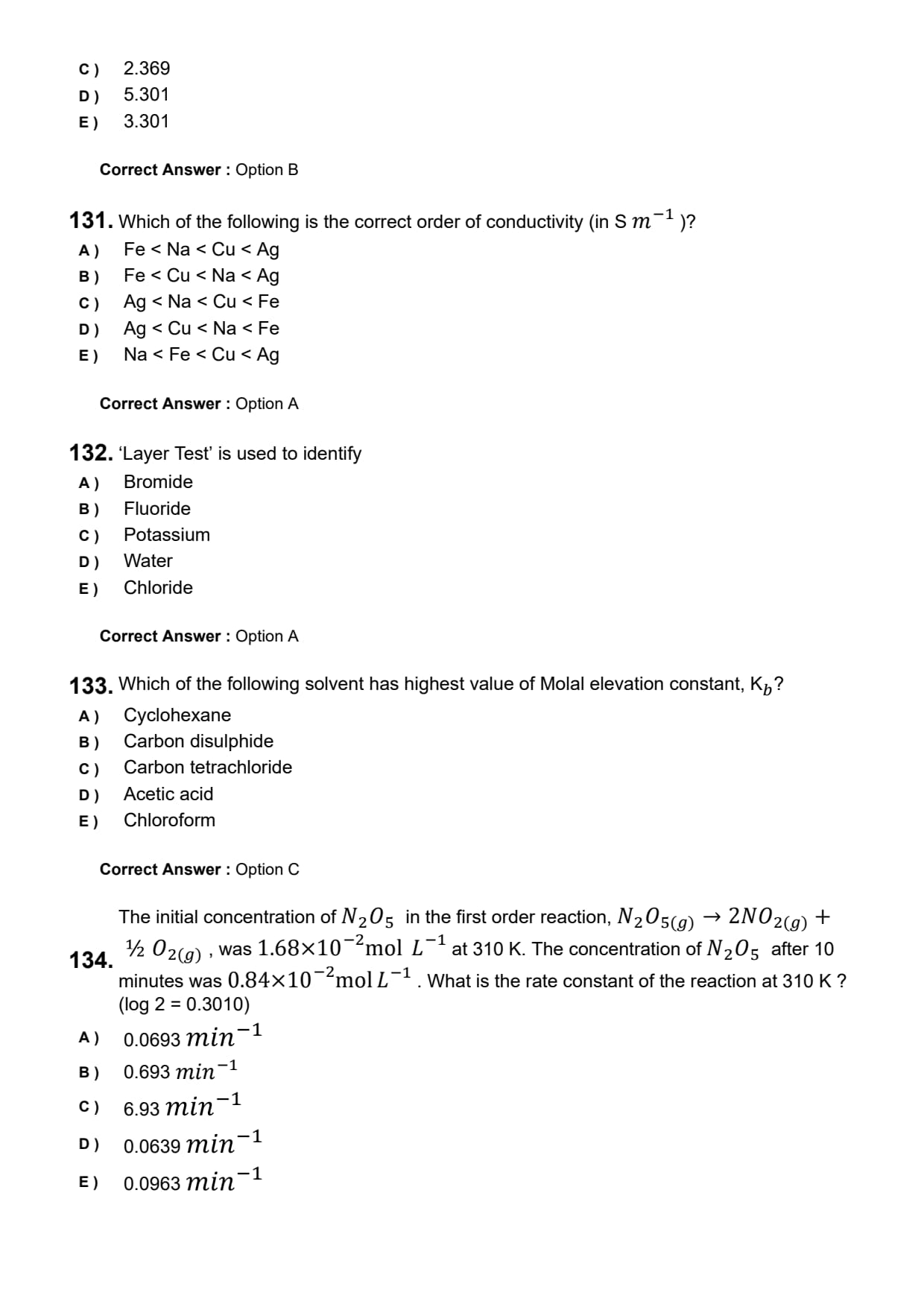
Question 131:
Which of the following is the correct order of conductivity (in \( S m^{-1} \))?
- (A) \( Fe < Na < Cu < Ag \)
- (B) \( Fe < Cu < Na < Ag \)
- (C) \( Ag < Na < Cu < Fe \)
- (D) \( Ag < Cu < Na < Fe \)
- (E) \( Na < Fe < Cu < Ag \)
Question 132:
‘Layer Test’ is used to identify
- (A) Bromide
- (B) Fluoride
- (C) Potassium
- (D) Water
- (E) Chloride
Question 133:
Which of the following solvent has highest value of molal elevation constant \( K_b \)?
- (A) Cyclohexane
- (B) Carbon disulphide
- (C) Carbon tetrachloride
- (D) Acetic acid
- (E) Chloroform
Question 134:
The initial concentration of \( N_2O_5 \) in a first order reaction, \( N_2O_5(g) \rightarrow 2NO_2(g) + \frac{1}{2}O_2(g) \), was \( 1.68\times10^{-2}\,mol L^{-1} \) at \( 310\,K \). The concentration of \( N_2O_5 \) after 10 minutes was \( 0.84\times10^{-2}\,mol L^{-1} \), what is the rate constant at \( 310\,K \)? ( \( \log 2 = 0.3010 \) )
- (A) \(0.0693\,min^{-1} \)
- (B) \(0.693\,min^{-1} \)
- (C) \(6.93\,min^{-1} \)
- (D) \(0.0639\,min^{-1} \)
- (E) \(0.0963\,min^{-1} \)
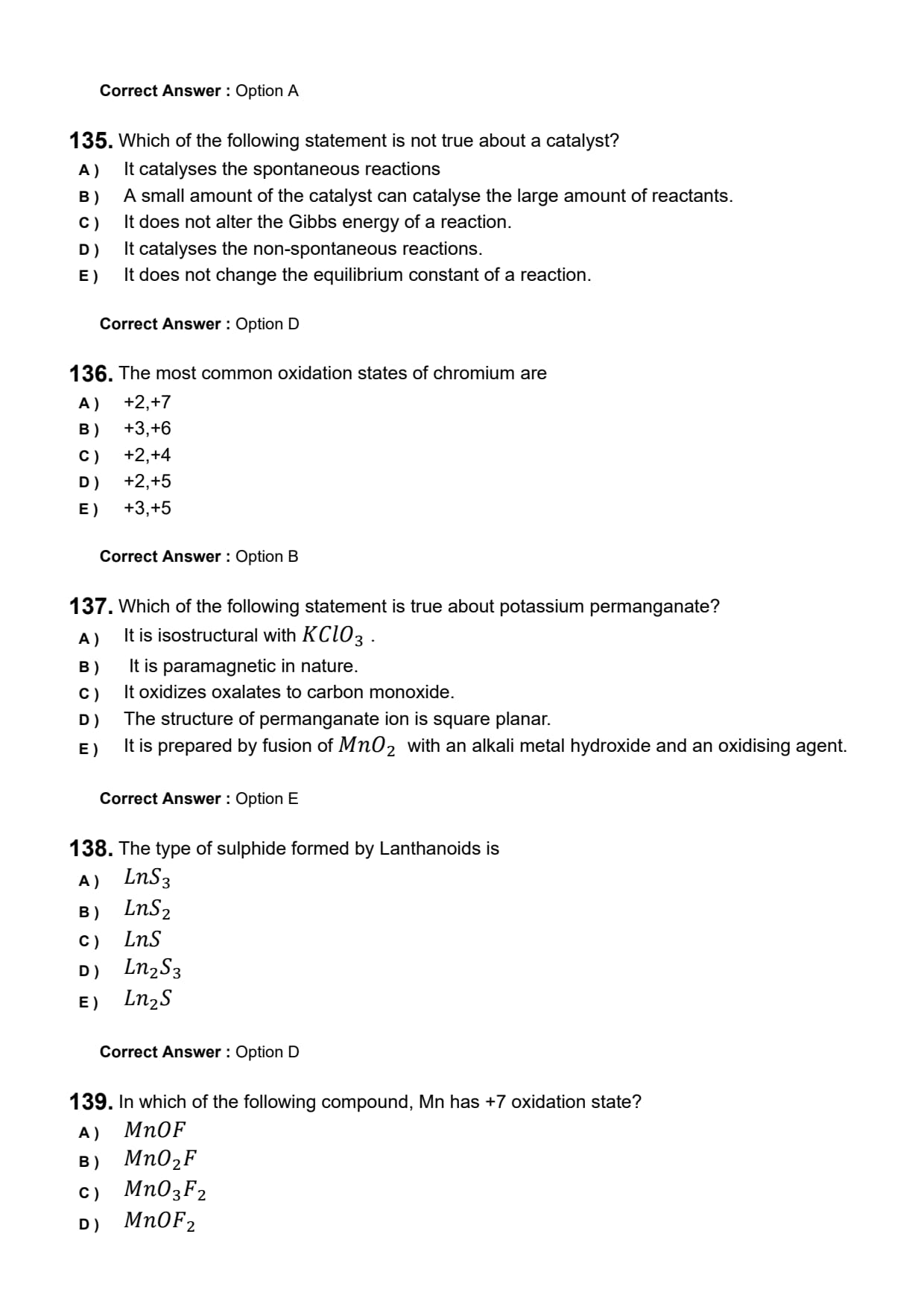
Question 135:
Which of the following statement is not true about a catalyst?
- (A) It catalyses the spontaneous reactions
- (B) A small amount of the catalyst can catalyse large amount of reactants
- (C) It does not alter the Gibbs energy of a reaction
- (D) It catalyses the non-spontaneous reactions
- (E) It does not change the equilibrium constant of a reaction
Question 136:
The most common oxidation states of chromium are
- (A) \(+2,+7 \)
- (B) \(+3,+6 \)
- (C) \(+2,+4 \)
- (D) \(+2,+5 \)
- (E) \(+3,+5 \)
Question 137:
Which of the following statement is true about potassium permanganate?
- (A) It is isostructural with \( KClO_3 \)
- (B) It is paramagnetic in nature
- (C) It oxidizes oxalates to carbon monoxide
- (D) The structure of permanganate ion is square planar
- (E) It is prepared by fusion of \( MnO_2 \) with an alkali metal hydroxide and an oxidising agent
Question 138:
The type of sulphide formed by lanthanoids is
- (A) \( LnS_3 \)
- (B) \( LnS_2 \)
- (C) \( LnS \)
- (D) \( Ln_2S_3 \)
- (E) \( Ln_2S \)
Question 139:
In which of the following compound, Mn has +7 oxidation state?
- (A) \( MnOF \)
- (B) \( MnO_2F \)
- (C) \( MnO_3F_2 \)
- (D) \( MnOF_2 \)
- (E) \( MnO_3F \)
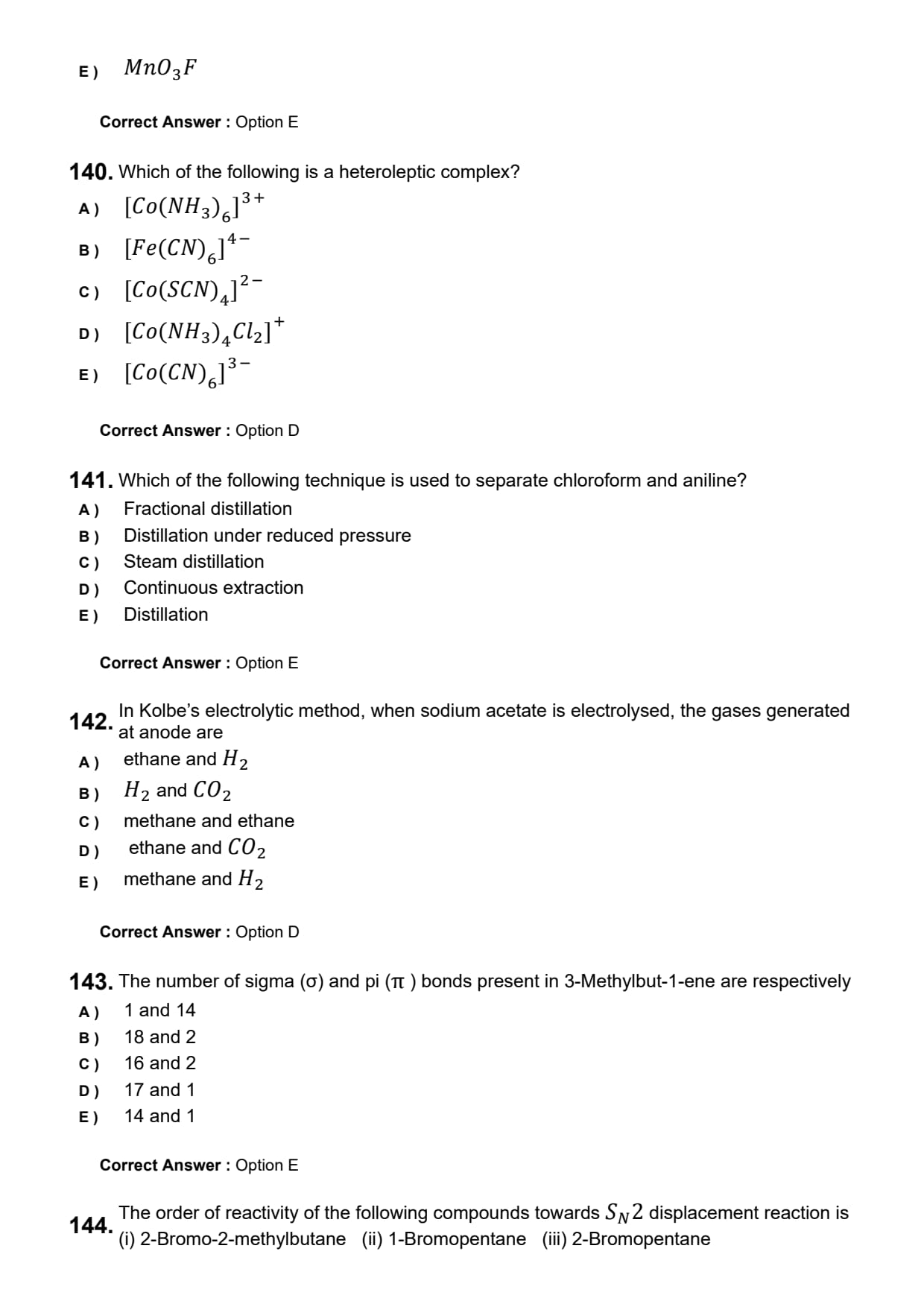
Question 140:
Which of the following is a heteroleptic complex?
- (A) \( [Co(NH_3)_6]^{3+} \)
- (B) \( [Fe(CN)_6]^{4-} \)
- (C) \( [Co(SCN)_4]^{2-} \)
- (D) \( [Co(NH_3)_4Cl_2]^+ \)
- (E) \( [Co(CN)_6]^{3-} \)
Question 141:
Which of the following technique is used to separate chloroform and aniline?
- (A) Fractional distillation
- (B) Distillation under reduced pressure
- (C) Steam distillation
- (D) Continuous extraction
- (E) Distillation
Question 142:
In Kolbe's electrolytic method, when sodium acetate is electrolysed, the gases generated at anode are
- (A) ethane and \( H_2 \)
- (B) \( H_2 \) and \( CO_2 \)
- (C) methane and ethane
- (D) ethane and \( CO_2 \)
- (E) methane and \( H_2 \)
Question 143:
The number of sigma (\( \sigma \)) and pi (\( \pi \)) bonds present in 3-Methylbut-1-ene are respectively
- (A) \(1 and 14 \)
- (B) \(18 and 2 \)
- (C) \(16 and 2 \)
- (D) \(17 and 1 \)
- (E) \(14 and 1 \)
Question 144:
The order of reactivity of the following compounds towards \( S_N2 \) displacement reaction is (i) 2-Bromo-2-methylbutane (ii) 1-Bromopentane (iii) 2-Bromopentane
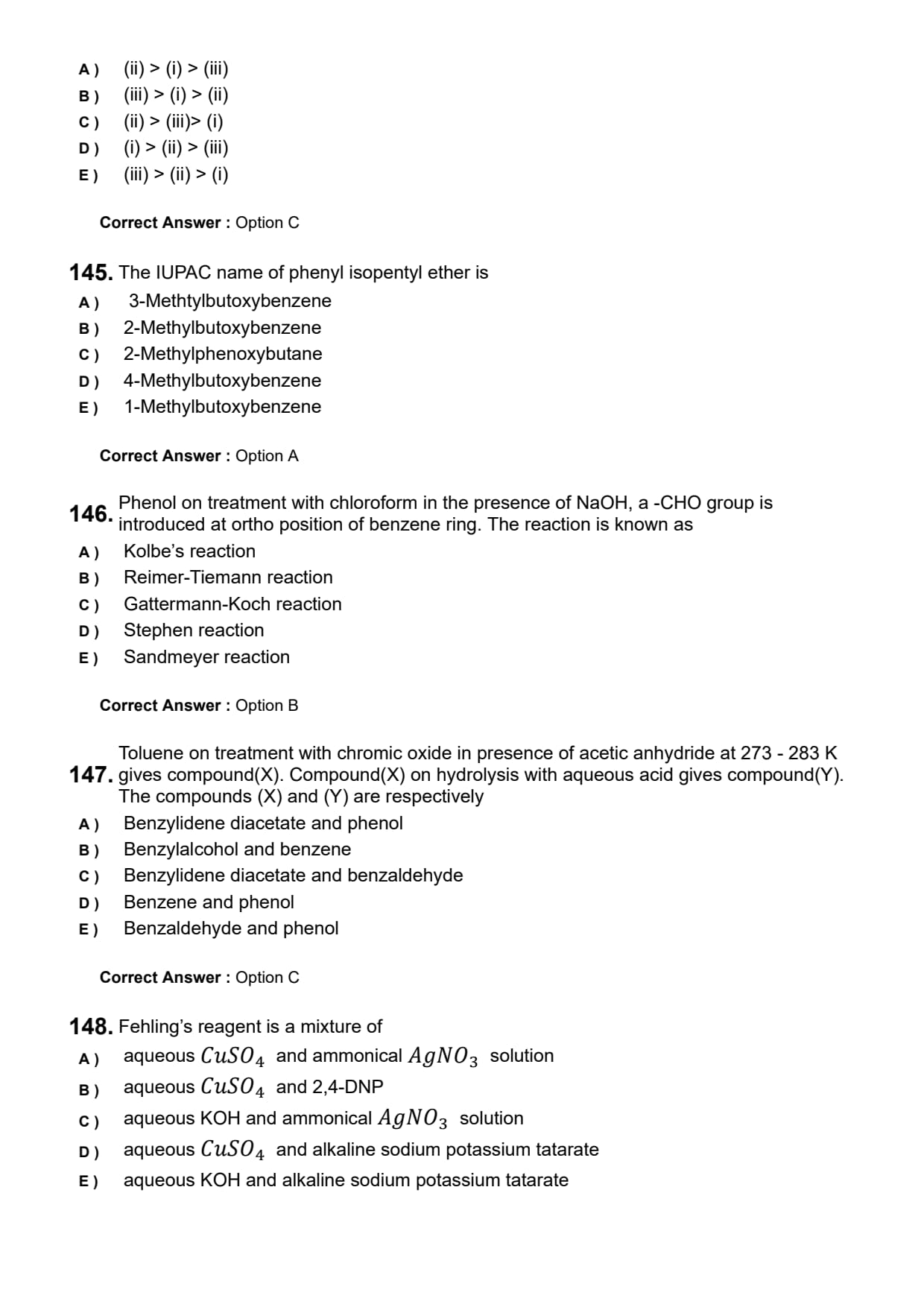
- (A) (ii) > (i) > (iii)
- (B) (iii) > (i) > (ii)
- (C) (ii) > (iii) > (i)
- (D) (i) > (ii) > (iii)
- (E) (iii) > (ii) > (i)
Question 145:
The IUPAC name of phenyl isopentyl ether is
- (A) 3-Methylbutoxybenzene
- (B) 2-Methylbutoxybenzene
- (C) 2-Methylphenoxybutane
- (D) 4-Methylbutoxybenzene
- (E) 1-Methylbutoxybenzene
Question 146:
Phenol on treatment with chloroform in the presence of NaOH, a -CHO group is introduced at ortho position of benzene ring. The reaction is known as
- (A) Kolbe's reaction
- (B) Reimer-Tiemann reaction
- (C) Gattermann-Koch reaction
- (D) Stephen reaction
- (E) Sandmeyer reaction
Question 147:
Toluene on treatment with chromic oxide in presence of acetic anhydride at \( 273{-}283\,K \) gives compound (X). Compound (X) on hydrolysis with aqueous acid gives compound (Y). The compounds (X) and (Y) are respectively
- (A) Benzylidene diacetate and phenol
- (B) Benzyl alcohol and benzene
- (C) Benzylidene diacetate and benzaldehyde
- (D) Benzene and phenol
- (E) Benzaldehyde and phenol
Question 148:
Fehling's reagent is a mixture of
- (A) aqueous \( CuSO_4 \) and ammoniacal \( AgNO_3 \) solution
- (B) aqueous \( CuSO_4 \) and 2,4-DNP
- (C) aqueous \( KOH \) and ammoniacal \( AgNO_3 \) solution
- (D) aqueous \( CuSO_4 \) and alkaline sodium potassium tartrate
- (E) aqueous \( KOH \) and alkaline sodium potassium tartrate
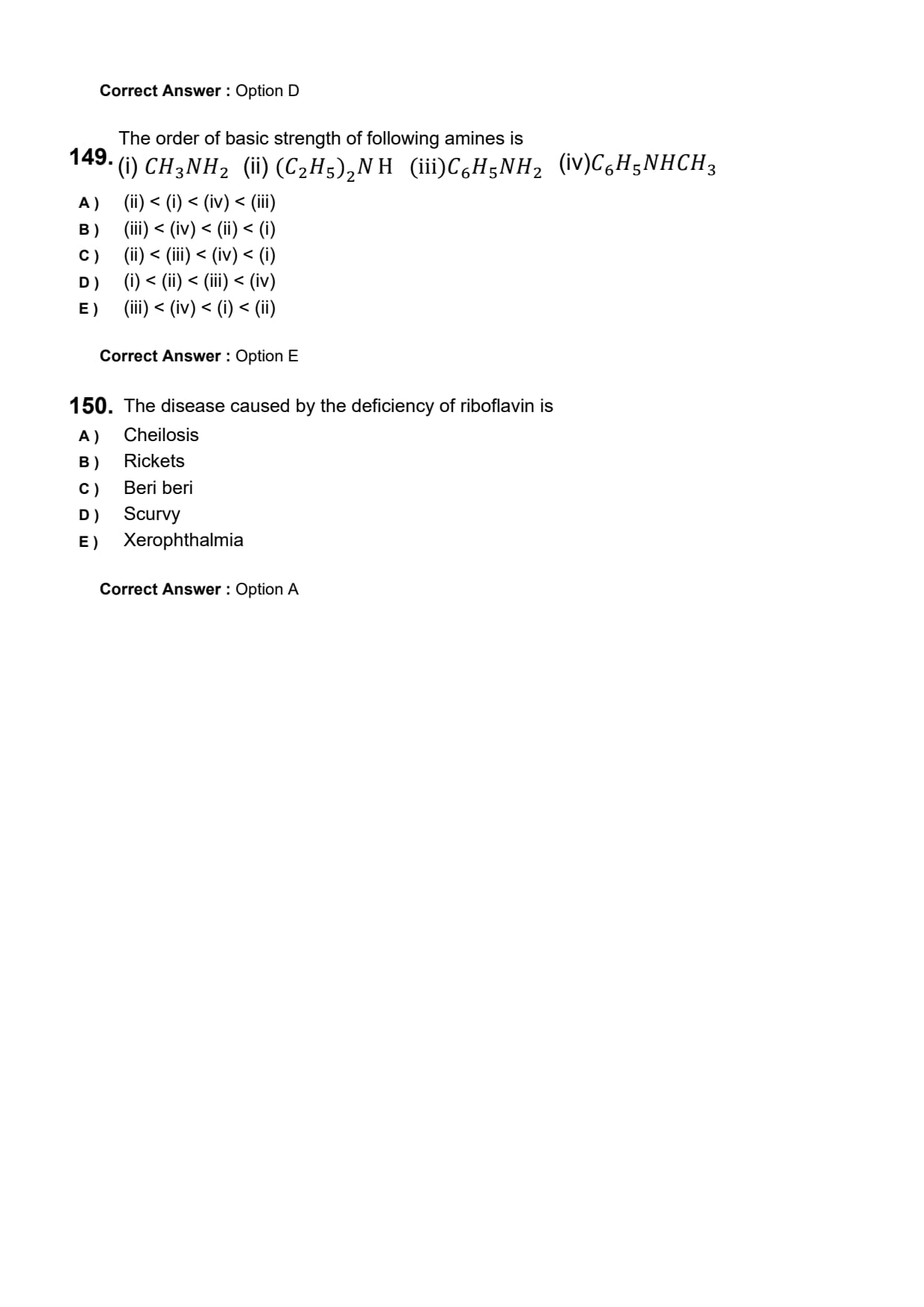
Question 149:
The order of basic strength of following amines is: (i) \( CH_3NH_2 \) (ii) \( (C_2H_5)_2NH \) (iii) \( C_6H_5NH_2 \) (iv) \( C_6H_5NHCH_3 \)
- (A) (ii) < (i) < (iv) < (iii)
- (B) (iii) < (iv) < (ii) < (i)
- (C) (i) < (iii) < (iv) < (ii)
- (D) (i) < (ii) < (iii) < (iv)
- (E) (iii) < (iv) < (i) < (ii)
Question 150:
The disease caused by the deficiency of riboflavin is
- (A) Cheilosis
- (B) Rickets
- (C) Beri beri
- (D) Scurvy
- (E) Xerophthalmia
KEAM 2025 Subject Wise Weightage
Mathematics carries the highest weightage of 50% in the KEAM 2025 exam. A total of 60 questions are asked from Mathematics.
Chemistry carries the least weightage of 16.6%. Easy questions are asked from this section as compared to Physics and Mathematics.
| Subject |
No. of Questions |
Total Marks |
Weightage |
| Physics |
45 |
180 |
33.3% |
| Chemistry |
30 |
180 |
16.6% |
| Mathematics |
60 |
240 |
50% |
| Total |
150 |
600 |
100% |
KEAM 2025 Paper Analysis
KEAM 2025 Difficulty Level (Expected)
Based on the previous year KEAM difficulty level data, the following can be expected for KEAM 2025:
Physics is expected to be tough and lengthy due to the numerical problems. Thorough conceptual knowledge and good time management are required.
Chemistry will be of easy to moderate difficulty level. Candidates can maximize their overall scores in this section.
Mathematics is expected to be of moderate difficulty level. Candidates can score easily if they have a thorough formula based knowledge.
| Subject |
Difficulty Level |
| Physics |
Moderate to Difficult |
| Chemistry |
Easy to Moderate |
| Mathematics |
Moderate |


.jpg?h=56&w=56&mode=stretch)





Comments