The Himachal Pradesh Board of School Education (HPBOSE) successfully conducted the Class 12 Retail (NSQF) Exam on March 30, 2026. HP Board Class 12 2026 Retail (NSQF) Question Paper with Solution PDF is now available for download.
The HP Board Class 12 Retail (NSQF) paper covers important topics from retail management, customer service, sales techniques, merchandising, and store operations. Students should focus on understanding retail concepts, developing practical skills, and improving communication and customer handling abilities. The exam is typically marked out of 100 marks, with 70 marks for the theory paper and 30 marks for practical/internal assessment.
HP Board Class 12 2026 Retail (NSQF) Question Paper with Solution PDF
| HP Board Class 12 Retail (NSQF) Question Paper 2026 | Download PDF | Check Solution |

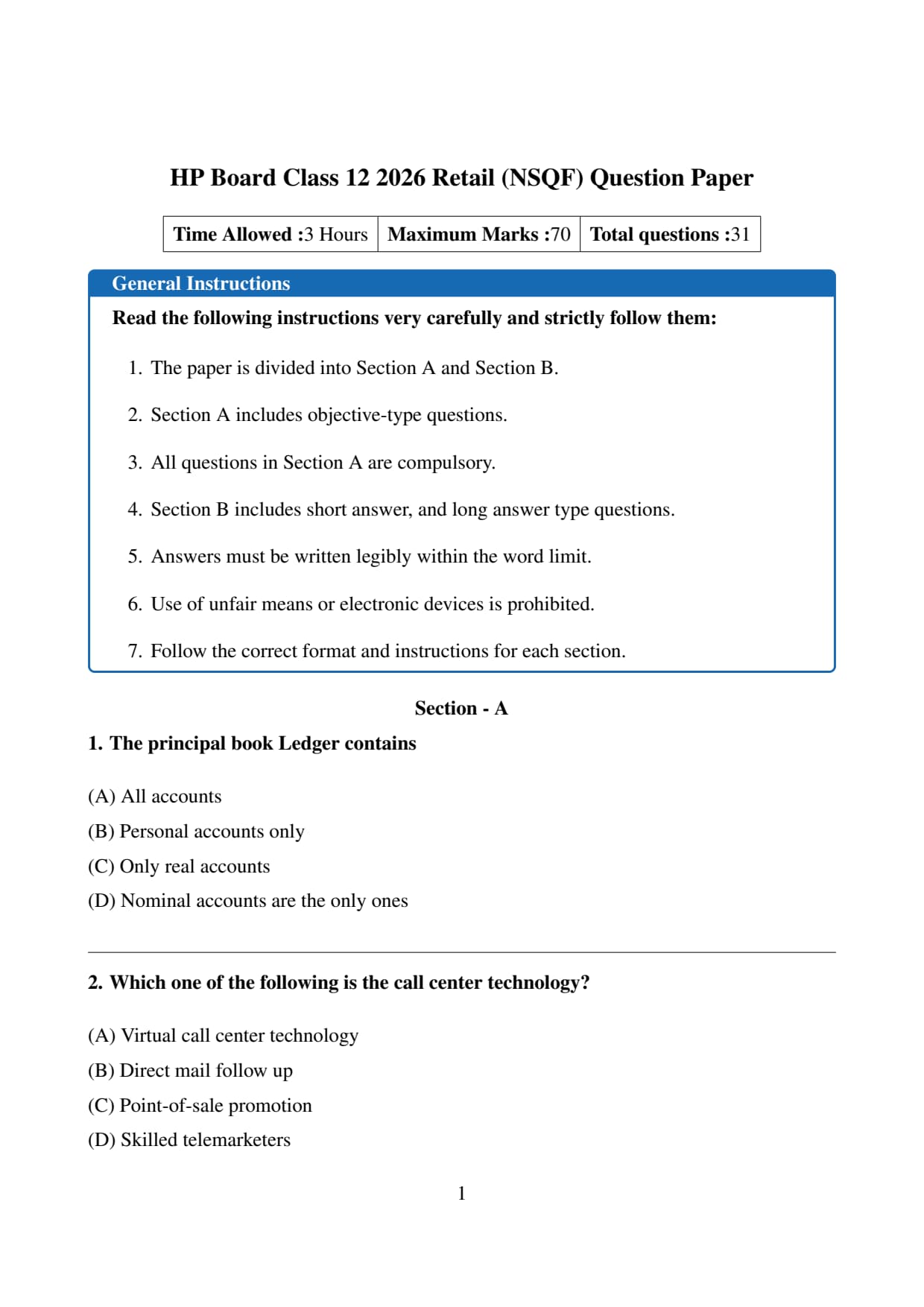
The principal book Ledger contains
View Solution
The principal book Ledger contains all types of accounts, including personal, real, and nominal accounts. It is used to record all financial transactions of the business.
Step 1: Analyzing each option.
(A) All accounts: Correct. The ledger records all accounts: personal, real, and nominal.
(B) Personal accounts only: Incorrect. The ledger does not only contain personal accounts.
(C) Only real accounts: Incorrect. The ledger contains all types of accounts, not just real accounts.
(D) Nominal accounts are the only ones: Incorrect. The ledger records all accounts, not just nominal accounts.
Step 2: Conclusion.
Therefore, the correct answer is (A), as the ledger contains all accounts.
Final Answer: All accounts. Quick Tip: The ledger is a principal book that records all financial transactions in various types of accounts.
Which one of the following is the call center technology?
View Solution
Virtual call center technology allows businesses to manage their customer service operations remotely, using cloud-based systems for call handling, customer support, and CRM systems.
Step 1: Analyzing each option.
(A) Virtual call center technology: Correct. Virtual call center technology is used in modern customer service operations for handling calls remotely.
(B) Direct mail follow up: Incorrect. Direct mail is a marketing technique, not a call center technology.
(C) Point-of-sale promotion: Incorrect. Point-of-sale promotion is related to marketing and sales, not call center technology.
(D) Skilled telemarketers: Incorrect. Skilled telemarketers are important in sales but are not a technology for call centers.
Step 2: Conclusion.
Thus, the correct answer is (A), Virtual call center technology.
Final Answer: Virtual call center technology. Quick Tip: Virtual call center technology allows businesses to manage customer service remotely, improving efficiency and reducing operational costs.
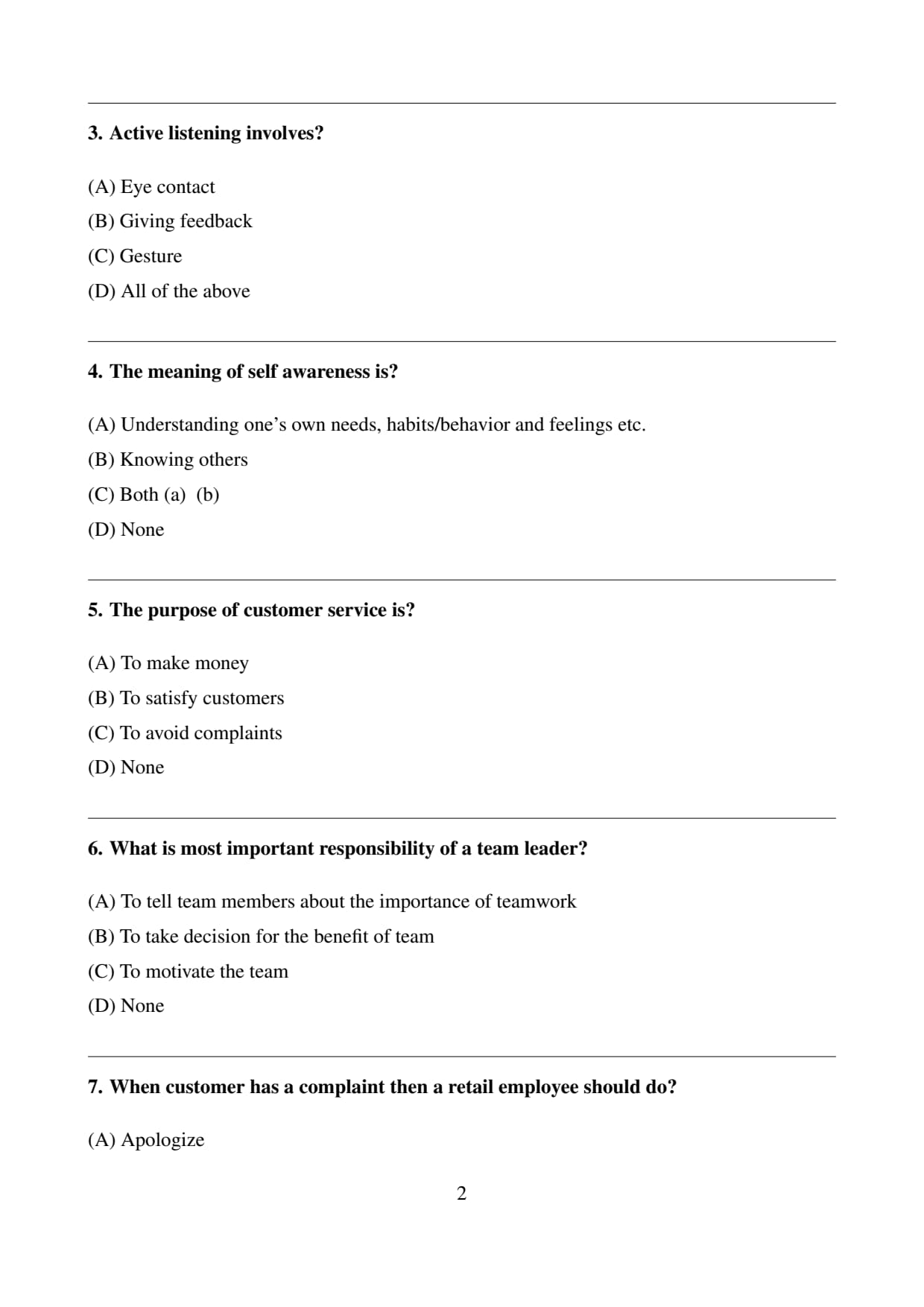
Active listening involves?
View Solution
Active listening involves not just hearing the words but also understanding and engaging with the speaker. It includes maintaining eye contact, observing gestures, and giving appropriate feedback to the speaker. All of these are important for effective communication.
Step 1: Analyzing each option.
(A) Eye contact: Correct. Eye contact is a key part of active listening as it shows attentiveness.
(B) Giving feedback: Correct. Providing feedback helps clarify understanding and show engagement.
(C) Gesture: Correct. Gestures also play a role in active listening by reinforcing verbal communication.
(D) All of the above: Correct. All of the above are essential parts of active listening.
Step 2: Conclusion.
Therefore, the correct answer is (D), as all the mentioned factors contribute to active listening.
Final Answer: All of the above. Quick Tip: Active listening involves being fully present in a conversation, showing attentiveness through eye contact, gestures, and providing feedback.
The meaning of self awareness is?
View Solution
Self-awareness refers to the understanding of one's own feelings, behaviors, and needs. It is the ability to reflect on oneself and recognize personal strengths and weaknesses.
Step 1: Analyzing each option.
(A) Understanding one’s own needs, habits/behavior and feelings etc: Correct. Self-awareness involves recognizing and understanding your own needs, feelings, and behavior patterns.
(B) Knowing others: Incorrect. While knowing others is important, it does not define self-awareness, which is about understanding oneself.
(C) Both (a) & (b): Incorrect. While both are valuable, self-awareness specifically refers to understanding oneself.
(D) None: Incorrect. Option (A) is the correct answer.
Step 2: Conclusion.
Thus, the correct answer is (A), as self-awareness pertains to understanding one's own needs, feelings, and behaviors.
Final Answer: Understanding one’s own needs, habits/behavior and feelings etc. Quick Tip: Self-awareness is a crucial part of emotional intelligence. It helps individuals understand their strengths, weaknesses, and emotional triggers.
The purpose of customer service is?
View Solution
Customer service is primarily aimed at satisfying the needs and expectations of customers. By addressing customer queries and resolving issues, businesses aim to build loyalty and ensure satisfaction.
Step 1: Analyzing each option.
(A) To make money: Incorrect. While customer service indirectly contributes to revenue, its main purpose is to satisfy customers.
(B) To satisfy customers: Correct. The main purpose of customer service is to ensure customer satisfaction.
(C) To avoid complaints: Incorrect. While minimizing complaints is a goal, it is not the primary purpose of customer service.
(D) None: Incorrect. The correct answer is (B).
Step 2: Conclusion.
The purpose of customer service is to satisfy customers and address their needs.
Final Answer: To satisfy customers. Quick Tip: Customer service is about making sure the customer feels valued and their concerns are resolved promptly.
What is most important responsibility of a team leader?
View Solution
The most important responsibility of a team leader is to motivate the team. Motivating the team helps improve performance, collaboration, and morale.
Step 1: Analyzing each option.
(A) To tell team members about the importance of teamwork: Incorrect. While explaining teamwork is important, motivation plays a bigger role in driving success.
(B) To take decision for the benefit of the team: Incorrect. Decision-making is important, but motivation is essential to ensure that the team works towards those decisions.
(C) To motivate the team: Correct. Motivation is key for a team leader to inspire the team to work effectively and achieve goals.
(D) None: Incorrect. Motivating the team is the key responsibility of a team leader.
Step 2: Conclusion.
The correct answer is to motivate the team, as motivation drives engagement and performance.
Final Answer: To motivate the team. Quick Tip: A team leader's most important responsibility is to inspire and motivate the team to work together towards shared goals.
When customer has a complaint then a retail employee should do?
View Solution
When a customer complains, the retail employee should apologize and address the issue calmly. Apologizing shows empathy and helps in maintaining a positive relationship with the customer.
Step 1: Analyzing each option.
(A) Apologize: Correct. Apologizing for the inconvenience shows empathy and helps resolve the issue.
(B) Argue with them: Incorrect. Arguing with the customer worsens the situation and is unprofessional.
(C) Speak loudly: Incorrect. Speaking loudly can escalate the situation and should be avoided.
(D) None: Incorrect. Apologizing is the correct response.
Step 2: Conclusion.
The best approach when a customer complains is to apologize and handle the situation with patience.
Final Answer: Apologize. Quick Tip: When handling customer complaints, always maintain a calm and apologetic tone to show understanding and empathy.
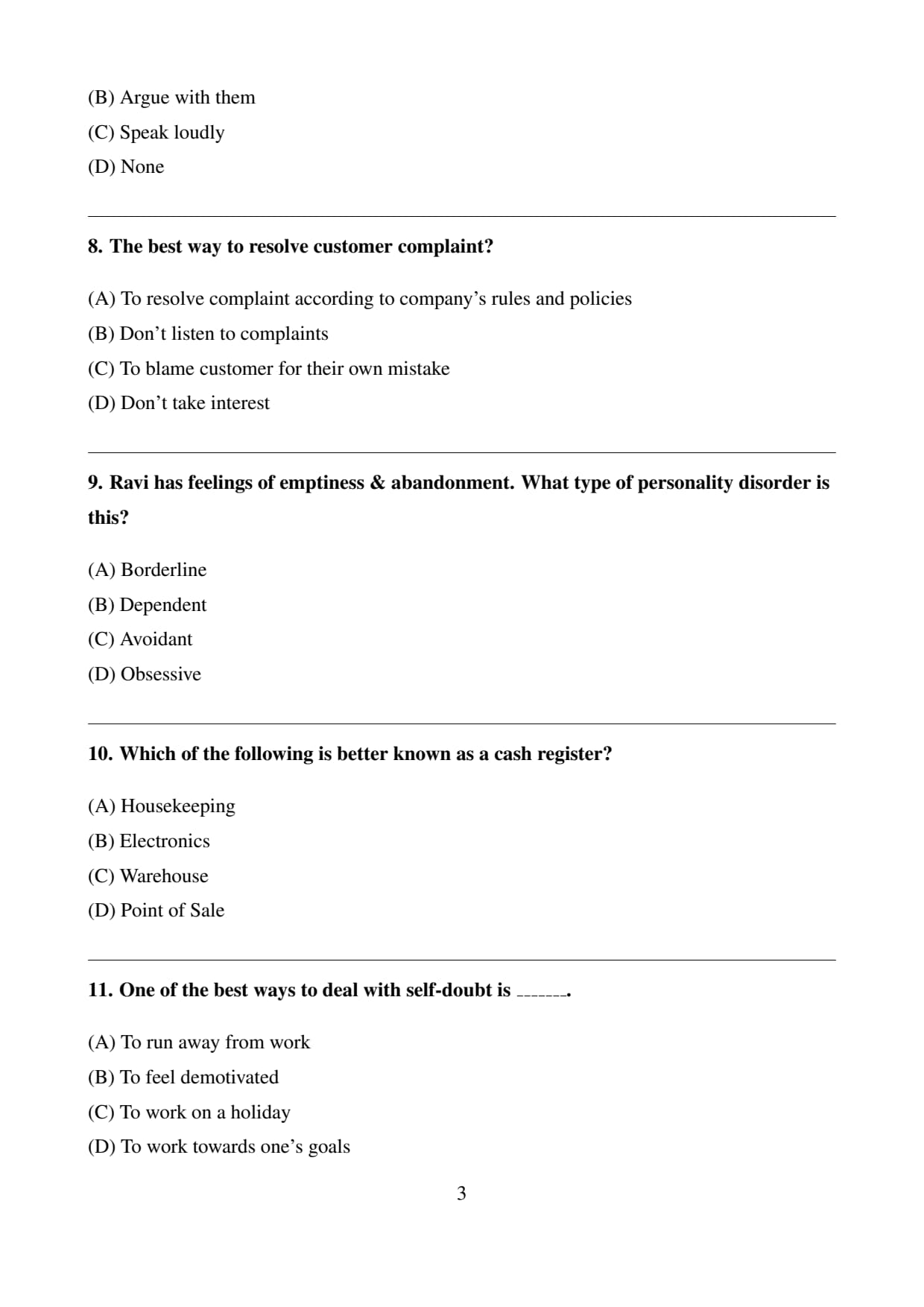
The best way to resolve customer complaint?
View Solution
The best way to resolve customer complaints is by following the company's established rules and policies. This ensures fairness, consistency, and customer satisfaction.
Step 1: Analyzing each option.
(A) To resolve complaint according to company’s rules and policies: Correct. Resolving complaints according to policies ensures consistency and fairness.
(B) Don’t listen to complaints: Incorrect. Ignoring complaints will worsen customer relations.
(C) To blame customer for their own mistake: Incorrect. Blaming customers can create conflict and damage the relationship.
(D) Don’t take interest: Incorrect. Taking no interest in complaints shows a lack of concern for customer satisfaction.
Step 2: Conclusion.
The correct approach is to resolve the complaint according to the company’s rules and policies to ensure fairness and customer satisfaction.
Final Answer: To resolve complaint according to company’s rules and policies. Quick Tip: Always follow company policies and guidelines when resolving complaints to ensure consistency and fairness.
Ravi has feelings of emptiness \& abandonment. What type of personality disorder is this?
View Solution
Borderline Personality Disorder (BPD) is characterized by feelings of emptiness, abandonment, and intense emotional instability. Individuals with BPD often have difficulty maintaining relationships and have impulsive behaviors.
Step 1: Analyzing each option.
(A) Borderline: Correct. BPD is marked by feelings of emptiness and fear of abandonment.
(B) Dependent: Incorrect. Dependent personality disorder is characterized by excessive need to be taken care of, leading to submissive and clinging behaviors.
(C) Avoidant: Incorrect. Avoidant personality disorder is marked by social inhibition and hypersensitivity to criticism.
(D) Obsessive: Incorrect. Obsessive-compulsive personality disorder is focused on perfectionism, control, and rigidity.
Step 2: Conclusion.
Thus, the correct answer is (A), Borderline Personality Disorder.
Final Answer: Borderline. Quick Tip: BPD is characterized by emotional instability, fear of abandonment, and a pattern of unstable relationships.
Which of the following is better known as a cash register?
View Solution
A cash register is also commonly referred to as the Point of Sale (POS) system. It is used for processing transactions in retail settings.
Step 1: Analyzing each option.
(A) Housekeeping: Incorrect. Housekeeping refers to cleaning and maintenance, not to cash handling or sales.
(B) Electronics: Incorrect. Electronics involve devices and gadgets, not cash registers.
(C) Warehouse: Incorrect. A warehouse is a storage facility, not related to cash transactions.
(D) Point of Sale: Correct. The Point of Sale (POS) is the system used for completing transactions, often referred to as a cash register.
Step 2: Conclusion.
The correct answer is (D), Point of Sale, which is commonly known as a cash register.
Final Answer: Point of Sale. Quick Tip: A Point of Sale (POS) system is used for processing payments and handling transactions in retail businesses.
One of the best ways to deal with self-doubt is _____ .
View Solution
The best way to deal with self-doubt is to stay focused and work towards one's goals. This helps build confidence and overcome uncertainty.
Step 1: Analyzing each option.
(A) To run away from work: Incorrect. Running away from work does not solve self-doubt; it can worsen it.
(B) To feel demotivated: Incorrect. Feeling demotivated is a sign of self-doubt but not a way to deal with it.
(C) To work on a holiday: Incorrect. Working on a holiday may give short-term relief, but it doesn't address the root cause of self-doubt.
(D) To work towards one’s goals: Correct. Focusing on personal goals helps overcome self-doubt and boosts confidence.
Step 2: Conclusion.
The most effective way to overcome self-doubt is by working towards one's goals, which provides a sense of direction and purpose.
Final Answer: To work towards one’s goals. Quick Tip: Working towards your goals, even small steps, can help overcome self-doubt and build confidence.
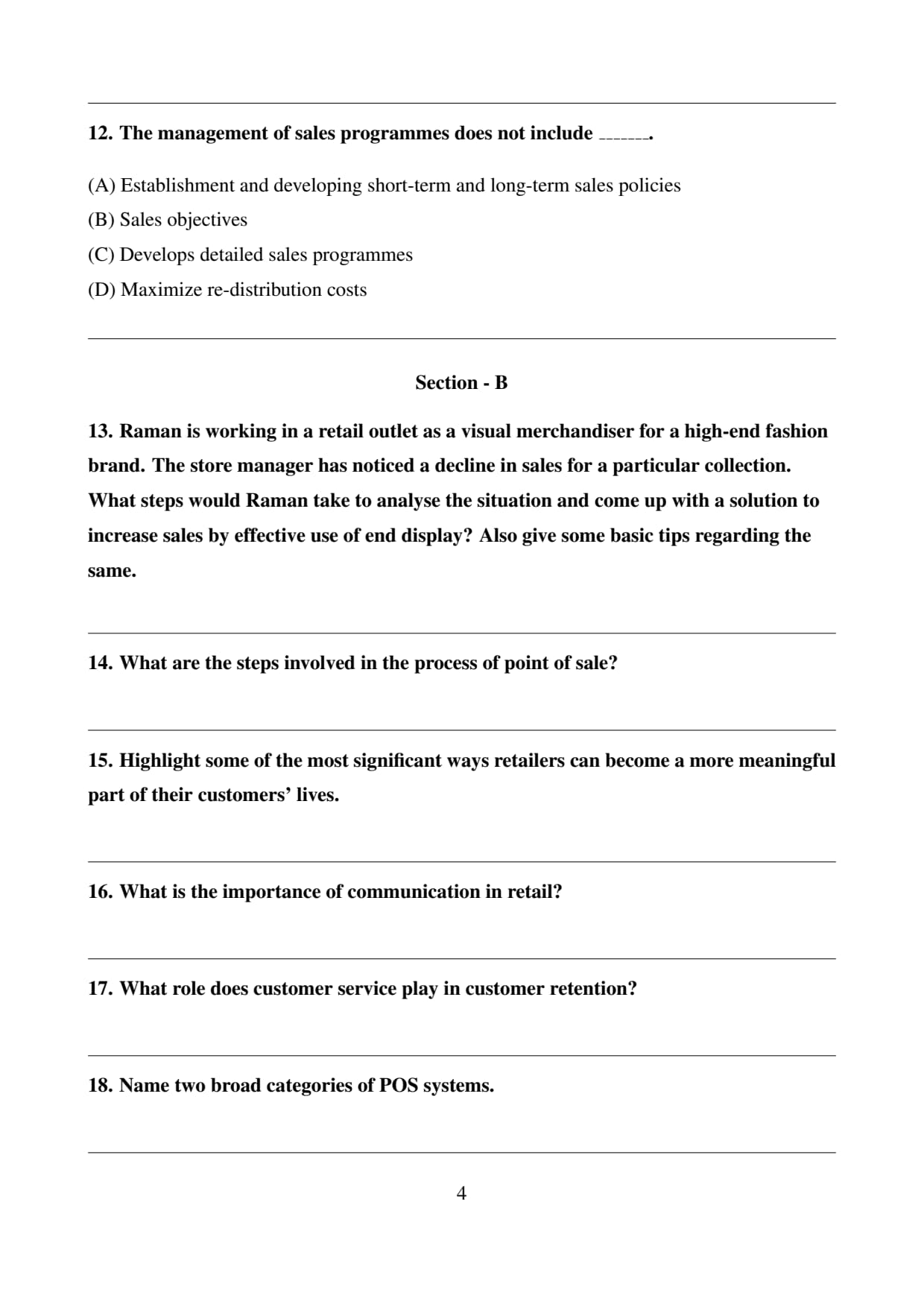
The management of sales programmes does not include _____ .
View Solution
Sales management involves setting sales objectives, creating strategies, and developing detailed sales programs. However, maximizing re-distribution costs is not a typical part of sales management, as it focuses on controlling costs rather than increasing them.
Step 1: Analyzing each option.
(A) Establishment and developing short-term and long-term sales policies: Correct. Developing sales policies is an essential aspect of sales management.
(B) Sales objectives: Correct. Setting sales objectives is a key responsibility in sales management.
(C) Develops detailed sales programmes: Correct. Sales management includes developing detailed plans for achieving sales goals.
(D) Maximize re-distribution costs: Incorrect. Sales management focuses on controlling costs, not maximizing them.
Step 2: Conclusion.
Thus, the correct answer is (D), as maximizing re-distribution costs is not part of sales management.
Final Answer: Maximize re-distribution costs. Quick Tip: Sales management involves planning, goal setting, and developing strategies to achieve sales targets, not increasing unnecessary costs.
Raman is working in a retail outlet as a visual merchandiser for a high-end fashion brand. The store manager has noticed a decline in sales for a particular collection. What steps would Raman take to analyse the situation and come up with a solution to increase sales by effective use of end display? Also give some basic tips regarding the same.
View Solution
Step 1: Analyze the Display Setup.
Raman should first assess the current display setup to ensure that the products are arranged attractively, with appropriate lighting and clear signage. The arrangement should highlight the collection's best-selling or most unique items.
Step 2: Evaluate Product Placement.
The placement of the products is crucial. Items should be placed at eye level or in high-traffic areas where customers are more likely to notice them.
Step 3: Observe Customer Interaction.
Raman should observe how customers are interacting with the display. Are they engaging with the products? Is there a specific reason why sales are low? He may also consider asking the sales team for feedback from customers.
Step 4: Offer Promotions or Discounts.
Raman can propose offering promotions or limited-time discounts on the collection to create urgency and encourage purchases.
Step 5: Update the Display Regularly.
Frequent updates and changes to the display can keep it fresh and engaging for repeat customers.
Step 6: Use Interactive Displays.
Adding elements like touchscreens or interactive digital signage can increase customer engagement and interest in the displayed items. Quick Tip: Effective product displays should be visually appealing, strategically placed, and frequently updated to keep customers engaged and boost sales.
What are the steps involved in the process of point of sale?
View Solution
Step 1: Customer Selection.
The point of sale (POS) process begins when the customer selects items they want to purchase. This includes scanning or entering the items into the system.
Step 2: Pricing and Billing.
The next step involves pricing the items. The system calculates the total amount, including taxes, and generates a bill or receipt. Discounts or promotions, if applicable, are also applied during this stage.
Step 3: Payment Processing.
The customer then makes payment using various methods such as cash, card, or mobile payment. The system processes the payment and confirms the transaction.
Step 4: Receipt Generation.
After successful payment, a receipt is generated for the customer, confirming the purchase. The receipt also includes return or exchange policies.
Step 5: Packaging and Handover.
The final step is packaging the items for the customer and handing them over. This may also include offering additional services like gift wrapping. Quick Tip: The POS process ensures a smooth transaction by automating steps from product selection to payment, ensuring accuracy and efficiency.
Highlight some of the most significant ways retailers can become a more meaningful part of their customers' lives.
View Solution
Step 1: Build Strong Customer Relationships.
Retailers can become more meaningful by fostering strong, personalized relationships with their customers. This can include providing exceptional customer service, engaging through loyalty programs, and offering personalized experiences.
Step 2: Offer Convenience.
By making shopping more convenient, such as through multiple payment options, delivery services, and easy return policies, retailers can become more integral to their customers’ daily lives.
Step 3: Engage with Customers through Digital Platforms.
Retailers can connect with customers via social media, apps, and other digital channels. Providing valuable content, promotions, or customer interaction online can enhance the customer experience and create a sense of community.
Step 4: Consistently Add Value.
Retailers should focus on offering products or services that truly meet customer needs. This might involve curating a high-quality selection, providing expert recommendations, or offering additional services that enhance the value of their offerings. Quick Tip: Creating meaningful connections with customers involves personalization, convenience, and constant engagement. It’s about understanding and meeting their needs.
What is the importance of communication in retail?
View Solution
Step 1: Role of Communication in Retail.
Communication is essential in retail for creating a positive relationship between the store and its customers. It helps ensure that customers' needs are met effectively, making them more likely to return.
Step 2: Importance of Communication.
1. Enhances Customer Experience: Clear and timely communication makes shopping smoother, allowing customers to get the right information about products, prices, and availability.
2. Builds Customer Loyalty: Good communication fosters trust and customer satisfaction, encouraging repeat business and positive reviews.
3. Problem Resolution: Effective communication helps address complaints quickly, improving the likelihood of resolving issues to the customer's satisfaction. Quick Tip: Strong communication is key to building trust and a loyal customer base in retail. It ensures a better experience for customers and can differentiate businesses from competitors.
What role does customer service play in customer retention?
View Solution
Step 1: Define Customer Retention.
Customer retention refers to the strategies and actions a company takes to keep its customers coming back and prevent them from switching to competitors.
Step 2: Role of Customer Service.
Customer service plays a pivotal role in customer retention by providing a positive experience, resolving issues efficiently, and ensuring that customers feel valued. Exceptional customer service can turn a one-time buyer into a loyal customer.
Step 3: How Customer Service Affects Retention.
1. Building Trust: Providing timely and helpful assistance builds trust, making customers feel confident in their purchase decisions.
2. Solving Problems Quickly: Addressing customer complaints or concerns in a timely manner ensures satisfaction and encourages repeat business.
3. Personalized Service: Tailoring services to individual customer needs enhances their experience, making them more likely to return. Quick Tip: Customer service is the foundation of customer retention. By focusing on customer satisfaction, businesses can ensure long-term loyalty.
Name two broad categories of POS systems.
View Solution
Step 1: Define POS Systems.
Point of Sale (POS) systems are used by retailers to complete sales transactions. These systems can be classified into different categories based on their features and usage.
Step 2: Two Broad Categories of POS Systems.
1. Fixed POS Systems: These are traditional POS systems with a stationary setup that includes a cash register, barcode scanner, receipt printer, and other devices. These are often found in brick-and-mortar retail stores.
2. Mobile POS Systems: These are portable systems that allow retailers to process sales anywhere within the store. Mobile POS systems usually work with tablets or smartphones and are often used in smaller retail environments or for on-the-go sales. Quick Tip: Fixed POS systems are best for larger retail environments, while mobile POS systems offer flexibility and convenience, especially in smaller stores or outdoor events.
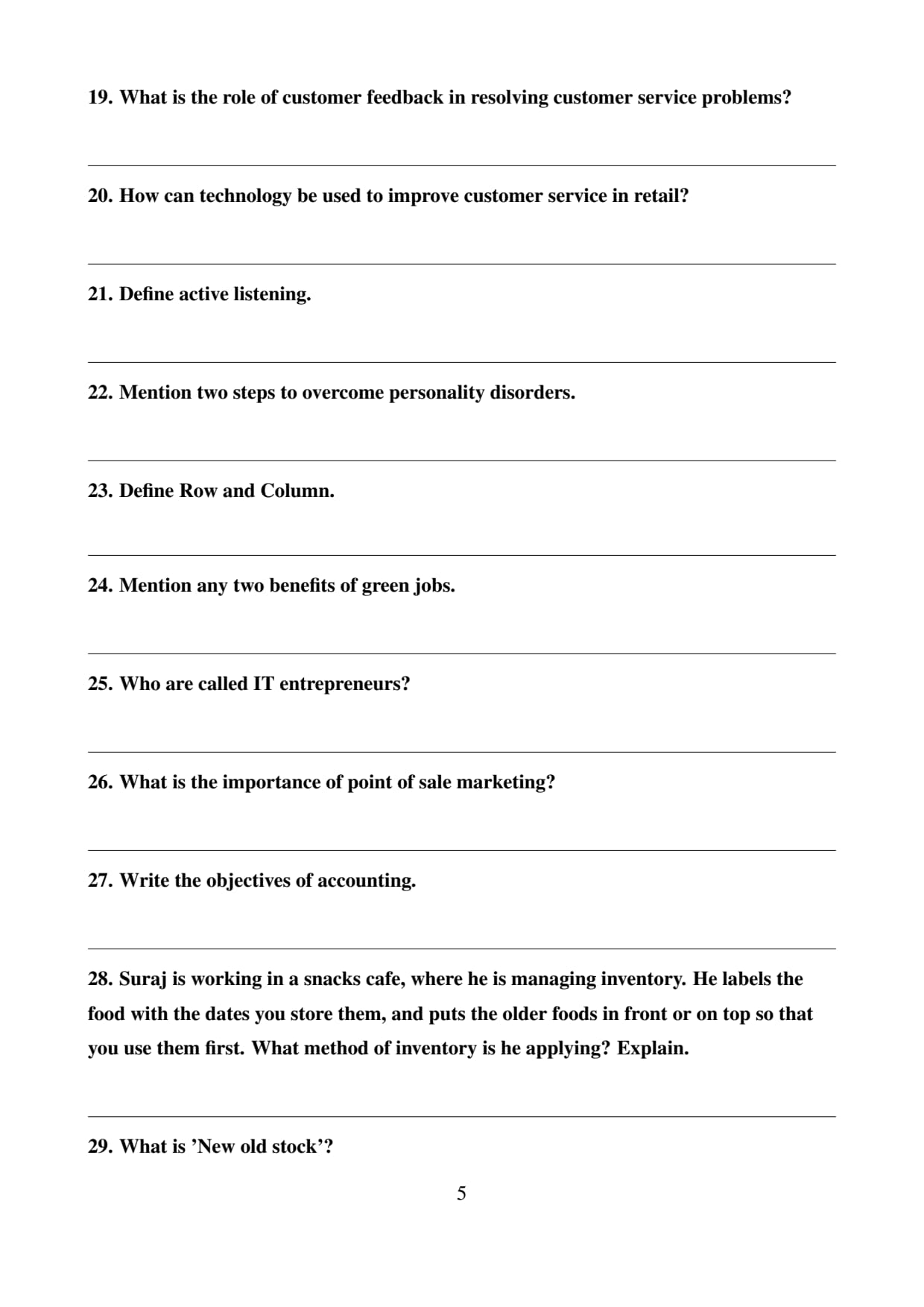
What is the role of customer feedback in resolving customer service problems?
View Solution
Step 1: Importance of Customer Feedback.
Customer feedback is crucial in identifying and understanding issues in customer service. It helps businesses learn about customers' experiences, their expectations, and any gaps in the service provided.
Step 2: Resolving Problems Using Feedback.
By actively listening to customer feedback, businesses can address concerns directly and make necessary improvements. Feedback allows businesses to resolve issues promptly, enhance customer satisfaction, and build trust with customers.
Step 3: Benefits of Using Feedback.
- Identifies areas of improvement.
- Helps in tailoring services to meet customer needs.
- Strengthens customer loyalty and increases the likelihood of repeat business. Quick Tip: Customer feedback is a valuable tool for resolving service issues and improving customer relations by allowing businesses to adapt to their needs.
How can technology be used to improve customer service in retail?
View Solution
Step 1: Role of Technology in Retail.
Technology plays a significant role in enhancing customer service by making the shopping experience more convenient and efficient.
Step 2: Using Technology for Customer Service.
1. Self-service kiosks: Customers can check out items, place orders, and even customize products without waiting in line.
2. Mobile apps: Retailers can develop apps that allow customers to browse products, track purchases, and receive personalized offers.
3. Chatbots and AI: Implementing AI-driven chatbots can provide instant support for common customer queries, improving response time and satisfaction.
4. Data Analytics: Retailers can use customer data to predict buying behavior, personalize marketing strategies, and improve inventory management.
Step 3: Benefits of Technology in Retail.
Technology enables faster service, reduces wait times, and ensures more personalized experiences, making customers feel valued and enhancing overall customer satisfaction. Quick Tip: By adopting new technologies, retailers can not only enhance customer experience but also streamline operations and increase sales.
Define active listening.
View Solution
Step 1: Define Active Listening.
Active listening is the process of fully concentrating, understanding, responding, and remembering what is being said during communication. It goes beyond hearing, as it involves the listener's active participation in the conversation.
Step 2: Key Components of Active Listening.
1. Paying Attention: Giving the speaker undivided attention.
2. Providing Feedback: Paraphrasing or asking questions to ensure understanding.
3. Deferring Judgment: Not interrupting the speaker and avoiding forming opinions before fully understanding the message. Quick Tip: Active listening fosters better communication and helps build stronger relationships by ensuring clarity and understanding between individuals.
Mention two steps to overcome personality disorders.
View Solution
Step 1: Acknowledge the Problem.
The first step is acknowledging the existence of the personality disorder and understanding its symptoms. This awareness helps individuals accept the need for professional help and take proactive steps toward recovery.
Step 2: Seek Professional Help.
The second step is seeking guidance from a psychologist or therapist who specializes in personality disorders. Therapy options like Cognitive Behavioral Therapy (CBT) are effective in helping individuals develop healthier thoughts, emotions, and behaviors. Quick Tip: Overcoming personality disorders requires self-awareness, professional intervention, and the willingness to engage in therapy and personal growth.
Define Row and Column.
View Solution
Step 1: Define Row.
A row is a horizontal arrangement of data elements in a table or matrix. It typically contains multiple cells that are aligned in a straight line from left to right.
Step 2: Define Column.
A column is a vertical arrangement of data elements in a table or matrix. It typically contains multiple cells aligned in a straight line from top to bottom. Quick Tip: Rows are horizontal, and columns are vertical. Together, they form the structure of tables and matrices.
Mention any two benefits of green jobs.
View Solution
Step 1: Define Green Jobs.
Green jobs refer to employment that contributes to the conservation of the environment or to activities that help mitigate climate change.
Step 2: Benefits of Green Jobs.
1. Environmental Sustainability: Green jobs contribute to reducing environmental harm, promoting sustainability through renewable energy, waste reduction, and energy efficiency.
2. Economic Growth: Green jobs create new industries and provide opportunities for innovation, thus fostering economic growth while addressing environmental challenges. Quick Tip: Green jobs play a vital role in promoting a sustainable environment while supporting economic growth in emerging industries.
Who are called IT entrepreneurs?
View Solution
Step 1: Define IT Entrepreneurs.
IT entrepreneurs are individuals who start and manage businesses that primarily deal with information technology products or services. They use technological innovation to solve problems, create new markets, and drive economic growth.
Step 2: Characteristics of IT Entrepreneurs.
1. Innovative Mindset: IT entrepreneurs are driven by the ability to innovate and create new technological solutions.
2. Risk Takers: They take financial and strategic risks to develop and market their technological products or services. Quick Tip: IT entrepreneurs leverage technology and innovation to build businesses that solve problems and create new opportunities in the tech industry.
What is the importance of point of sale marketing?
View Solution
Step 1: Define Point of Sale Marketing.
Point of Sale (POS) marketing refers to promotional activities that occur at the time and place where a customer makes a purchase, often near the checkout counter.
Step 2: Importance of POS Marketing.
POS marketing is crucial because it allows retailers to influence customers' purchasing decisions at the final moment. By strategically placing promotions, discounts, and advertisements at the checkout, retailers can increase impulse buys and boost overall sales.
Step 3: Benefits of POS Marketing.
- \textit{Increased Sales: POS promotions can trigger last-minute purchases, thereby increasing the average transaction value.
- \textit{Customer Engagement: It helps in engaging customers with attractive offers or rewards, building brand loyalty.
- \textit{Targeted Marketing: Retailers can use POS marketing to target specific customer needs or seasonal trends. Quick Tip: POS marketing is an effective way to boost sales and customer engagement by leveraging the purchase moment to offer relevant promotions and discounts.
Write the objectives of accounting.
View Solution
Step 1: Definition of Accounting.
Accounting is the process of recording, classifying, summarizing, and interpreting financial transactions of a business or organization to provide useful financial information. The primary goal of accounting is to ensure that financial information is accurate and that stakeholders can make informed decisions based on it.
Step 2: Objectives of Accounting.
The objectives of accounting can be summarized as follows:
Recording Financial Transactions: The primary objective of accounting is to maintain a systematic record of all financial transactions that take place in a business, ensuring that each transaction is documented accurately and in a timely manner.
Classifying Financial Transactions: After recording, accounting organizes the data into various categories or accounts. This classification helps in tracking business activities and assessing performance.
Summarizing Financial Information: Accounting summarizes the classified financial data into financial statements such as the balance sheet, income statement, and cash flow statement. These summaries provide a snapshot of the business’s financial health.
Providing Information for Decision Making: One of the main objectives of accounting is to provide relevant and reliable financial information to stakeholders (such as managers, investors, and creditors) to support decision-making.
Facilitating Taxation and Legal Compliance: Accounting ensures that businesses comply with tax regulations and other legal requirements by providing accurate records that can be used for tax filing and audits.
Measuring Profit and Loss: Through accounting, businesses can calculate their profitability by comparing revenues and expenses. This allows businesses to understand their financial performance.
Step 3: Conclusion.
In summary, the main objectives of accounting are to ensure accurate financial reporting, support decision-making, ensure legal compliance, and provide a clear picture of the financial position and performance of a business. Quick Tip: Accounting plays a crucial role in providing transparent, accurate, and timely financial information, which helps businesses to operate efficiently and stay compliant with regulations.
Suraj is working in a snacks cafe, where he is managing inventory. He labels the food with the dates you store them, and puts the older foods in front or on top so that you use them first. What method of inventory is he applying? Explain.
View Solution
Step 1: Define the Method.
Suraj is applying the FIFO (First In, First Out) method of inventory management. This method ensures that the oldest items in the stock are used or sold first.
Step 2: Explain FIFO Method.
In the FIFO system, products are rotated so that the items with the earliest expiration dates are used or sold before newer items. This helps to prevent items from becoming obsolete or spoiled.
Step 3: Benefits of FIFO.
- It minimizes waste by ensuring that perishable items are consumed before they expire.
- It helps maintain stock quality by preventing older items from being left unused.
- It ensures a continuous flow of fresh products, which is especially important for food-related businesses. Quick Tip: FIFO is a great method for managing inventory, especially in businesses dealing with perishable goods, ensuring minimal wastage and better stock rotation.
What is 'New old stock'?
View Solution
Step 1: Definition of 'New Old Stock'.
'New Old Stock' (NOS) refers to items that are technically old but have never been sold or used. These items are still in their original packaging and have not been previously owned or used, even though they have been in storage for a long time. In the context of retail or inventory, NOS items are often products that were manufactured long ago but remained unsold, usually because they became obsolete or were discontinued.
Step 2: Examples of 'New Old Stock'.
Some examples of NOS items include:
Electronics or computer parts that were manufactured years ago but never sold.
Vintage items, such as clothing or accessories, that have been stored and remain in brand-new condition.
Car parts that were made but never installed in vehicles and have remained in inventory for years.
Although NOS items may be old, their value can be higher than newer stock due to their rarity, especially if they are collectible or discontinued products. Quick Tip: 'New Old Stock' refers to products that are old in age but have never been used or sold. They can often hold value due to their rarity or collector interest.
Write the use of Swipe Card Reader Interface.
View Solution
Step 1: Definition of Swipe Card Reader Interface.
A Swipe Card Reader Interface is an electronic device used to read data from a magnetic stripe card, typically a credit card, identity card, or access card. It allows the card to be swiped through the reader, which detects the magnetic strip and extracts the encoded data stored on the card. The data is then processed by a connected system, such as a point-of-sale (POS) system or an access control system.
Step 2: Uses of Swipe Card Reader Interface.
Swipe card readers are used in various applications, including:
Access Control Systems: Swipe card readers are commonly used in security systems for buildings, where they allow authorized personnel to access restricted areas. The reader scans the card to verify the individual's identity.
Payment Systems: In retail, swipe card readers are used in POS systems to process credit and debit card transactions. The reader extracts the data from the card and sends it to a payment processor to authorize the transaction.
Identification Systems: Swipe card readers are used to verify identity in systems such as employee identification, student identification for attendance tracking, and membership systems in gyms or clubs.
Time and Attendance Systems: Many companies use swipe card readers to track employee working hours, where employees swipe their cards to register the time they clock in and out.
Step 3: Benefits of Swipe Card Reader Interface.
Swipe card reader interfaces offer a fast and secure way to process transactions and control access. They are simple to use and help eliminate human error, reduce the risk of unauthorized access, and streamline various processes, including payments and identification. Quick Tip: Swipe card readers provide a convenient and secure method for access control, payments, and identification, offering quick data processing and enhanced security.
Explain the rules of double entry. Also mention the steps involved in the application of rules.
View Solution
Step 1: Introduction to Double Entry System.
The double-entry system of accounting is a method in which every financial transaction affects at least two accounts, ensuring that the accounting equation (Assets = Liabilities + Equity) remains balanced. This system is based on the principle that for every debit entry, there must be a corresponding credit entry of equal value.
Step 2: Rules of Double Entry.
The rules of double-entry accounting are as follows:
Rule 1: Personal Accounts:
- Debit the receiver, and
- Credit the giver.
Rule 2: Real Accounts:
- Debit what comes in, and
- Credit what goes out.
Rule 3: Nominal Accounts:
- Debit all expenses and losses, and
- Credit all incomes and gains.
Step 3: Steps Involved in the Application of Rules.
The steps involved in applying the double-entry system are:
Identify the Accounts Involved: First, identify which accounts are affected by the transaction. Every transaction will affect at least two accounts (e.g., cash and sales).
Classify the Accounts: Classify the accounts as either personal, real, or nominal. This helps determine whether the account will be debited or credited according to the rules mentioned.
Apply the Rules: For each account, apply the appropriate rule:
For personal accounts, debit the receiver and credit the giver.
For real accounts, debit what comes in and credit what goes out.
For nominal accounts, debit expenses and losses, and credit incomes and gains.
Record the Entries: Once the appropriate debits and credits are determined, record them in the journal. Each journal entry should show the date, accounts involved, and the amounts debited and credited.
Post to Ledger: After recording journal entries, post the amounts to the respective accounts in the general ledger. The ledger will summarize the account balances.
Step 4: Conclusion.
The double-entry system ensures that the accounting equation is always in balance, providing a more accurate and reliable system of recording financial transactions. By following these rules and steps, businesses can maintain transparent financial records. Quick Tip: The double-entry system is the foundation of accounting and ensures accuracy and balance in financial records. Proper application of the rules is crucial for reliable financial reporting.


Comments