




VITEEE 2018 Question Paper is available for download here. VITEEE 2018 Question Paper includes 40 questions from Mathematics/Biology, 35 questions from Physics, 35 questions from Chemistry, 5 questions from English, 10 questions from Aptitude to be attempted in 150 minutes. Candidates can download the VITEEE 2018 Question Paper with Solution PDF using the link below.
VITEEE 2018 Question Paper with Solution PDF
| VITEEE 2018 Question Paper with Solution PDF | Download PDF | Check Solution |
The resistance of a wire is 'R' ohm. If it is melted and stretched to 'n' times its original length, its new resistance will be:
A coil of 40 henry inductance is connected in series with a resistance of 8 ohm and the combination is joined to the terminals of a 2 volt battery. The time constant of the circuit is:
Which of the following is the correct lens formula?
The magnetic field at a point due to a current carrying conductor is directly proportional to:
A metallic sphere is placed in a uniform electric field. The line of force follow the path (s) shown in the figure as:

Electron in hydrogen atom first jumps from third excited state to second excited state and then from second excited to the first excited state. The ratio of the wavelength \( \lambda_1 : \lambda_2 \) emitted in the two cases is:
In a common emitter transistor amplifier \( \beta = 60 \), \( R_o = 5000 \, \Omega \) and internal resistance of a transistor is 500 \( \Omega \). The voltage amplification of amplifier will be:
A machine gun has a mass 5 kg. It fires 50 gram bullets at the rate of 30 bullets per minute at a speed of 400 m/s. What force is required to keep the gun in position?
The activity of a radioactive sample is measured as 9750 counts per minute at \( t = 0 \) and as 975 counts per minute at \( t = 5 \) minutes. The decay constant is approximately:
The equivalent capacitance between a and b for the combination of capacitors shown in figure where all capacitances are in microfarad is:

Two coils have a mutual inductance 0.005 H. The current changes in the first coil according to equation \( I = I_0 \sin \omega t \), where \( I_0 = 10A \) and \( \omega = 100\pi \, radian/sec \). The maximum value of e.m.f. in the second coil is:
In Young's double slit experiment, intensity at a point is \( \dfrac{1}{4} \) of the maximum intensity. Angular position of this point is (separation between slits is \( d \)):
Two batteries of emf 4 V and 8 V with internal resistance 1 \( \Omega \) and 2 \( \Omega \) are connected in a circuit with a resistance of 9 \( \Omega \) as shown in the figure. The current and potential difference between the points P and Q are:

The horizontal component of the earth’s magnetic field is \( 3.6 \times 10^{-5} \) tesla where the dip angle is 60°. The magnitude of the earth’s magnetic field is:
The velocity of water in a river is 18 km/hr near the surface. If the river is 5 m deep, find the shearing stress between the horizontal layers of water. The coefficient of viscosity of water is \( 10^{-2} \) poise:
The magnetic field in a travelling electromagnetic wave has a peak value of 20 nT. The peak value of electric field strength is:
The I-V characteristic of a diode is shown in the figure. The ratio of forward to reverse bias resistance is:

The principle of conservation of linear momentum can be strictly applied during a collision between two particles provided the time of impact:
The current sensitivity of a moving coil galvanometer depends on:
The length of elastic string, obeying Hooke’s law, is \( \ell_1 \) metres when the tension 4N and \( \ell_2 \) metres when the tension is 5N. The length in metres when the tension is 9N is:
A square loop, carrying a steady current \( I \), is placed in a horizontal plane near a long straight conductor carrying a steady current \( I \), at a distance \( d \) from the conductor as shown in figure. The loop will experience:

The temperature of equal masses of three different liquids A, B, and C are 12°C, 19°C, and 28°C respectively. The temperature when A and B are mixed is 16°C and when B and C are mixed is 23°C. The temperature when A and C are mixed is:
An alternating voltage of 220 V, 50 Hz frequency is applied across a capacitor of capacitance 2 μF. The impedance of the circuit is:
The molar specific heats of an ideal gas at constant pressure and volume are denoted by \( C_p \) and \( C_v \), respectively. If \( \gamma = \dfrac{C_p}{C_v} \) and \( R \) is the universal gas constant, then \( C_v \) is equal to:
The ratio of radii of the first three Bohr orbits is:

A large number of liquid drops each of radius \( r \) coalesce to form a single drop of radius \( R \). The energy released in the process is converted into kinetic energy of the big drop \( M \) is given by (given, surface tension of liquid \( \sigma \)):

The Binding energy per nucleon of \( \dfrac{3}{2} Li \) and \( \dfrac{4}{2} He \) nuclei is 5.60 MeV and 7.06 MeV, respectively.
A ray PQ incident on the refracting face BC is refracted in the prism BA as shown in the figure and emerges from the other refracting face AC as RS such that \( \angle AQ = \angle RS \). If the angle of prism \( A = 60^\circ \) and the refractive index of the material of prism is \( \sqrt{3} \), then the angle of deviation of the ray is:

In a photoelectric effect measurement, the stopping potential for a given metal is found to be \( V_0 \) volt when radiation of wavelength \( \lambda_0 \) is used. If radiation of wavelength \( 2\lambda_0 \) is used with the same metal then the stopping potential (in volt) will be:
In the circuit shown the cells A and B have negligible resistances. For \( V_A = 12 \, V \), \( R_1 = 500 \, \Omega \) and \( R = 1000 \, \Omega \), the galvanometer \( G \) shows no deflection. The value of \( V_B \) is:

A steel wire of length \( \ell \) has a magnetic moment \( M \). It is then bent into a semicircular arc. The new magnetic moment is:
A running man has half the kinetic energy of that of a boy of half his mass. The man speeds up by 1m/s so as to have same K.E. as that of the boy. The original speed of the man will be:
In Young's double slit experiment the two slits are illuminated by light of wavelength 5890Å and the distance between the fringes obtained on the screen is 0.2 cm. If the whole apparatus is immersed in water then the angular fringe width will be \( \dfrac{4}{3} \). The refractive index of water is:
Four point charges \( -Q, -2Q, 2q \) and \( 4q \) are placed, one at each corner of the square. The relation between \( Q \) and \( q \) for which the potential at the centre of the square is zero is:
In the given circuit the reading of voltmeter \( V_1 \) and \( V_2 \) are 300 volt each. The reading of the voltmeter \( V_3 \) and ammeter \( A \) are respectively:

A body cools from 50.0°C to 49.9°C in 5s. How long will it take to cool from 40.0°C to 39.9°C? Assume the temperature of surroundings to be 30.0°C and Newton’s law of cooling to be valid:
Consider the junction diode is ideal. The value of current flowing through AB is:

A metal disc of radius 100 cm is rotated at a constant angular speed of 60 rad/s in a plane at right angles to an external field of magnetic induction 0.5 Wb/m\(^2\). The emf induced between the centre and a point on the rim will be:
Ionisation energy of \( He^+ \) is \( 19.6 \times 10^{-18} \, J \, atom^{-1} \). The energy of the first stationary state (n = 1) of \( Li^{2+} \) is:

Which of the following compounds is formed when a mixture of \( K_2Cr_2O_7 \) and NaCl is heated with conc. \( H_2SO_4 \)?
For the process \( H_2O(g) \, (1 \, bar, 373 \, K) \rightarrow H_2O(g) \, (1 \, bar, 373 \, K) \), the correct set of thermodynamic parameters is:
Compound ‘A’ of molecular formula \( C_6H_10O \) on treatment with Lucas reagent at room temperature gives compound ‘B’. When compound ‘B’ is heated with alcoholic KOH, it gives isobutene. Compound ‘A’ and ‘B’ are respectively:
The reagent(s) which can be used to distinguish acetophenone from benzophenone is (are):
In the extraction of Cu, the metal is formed in the Bessemer converter due to the reaction: \[ Cu_2S + O_2 \rightarrow 2Cu + SO_2 \]
The correct equation is:
For which of the following systems at equilibrium, at constant temperature, will the doubling of the volume cause a shift to the right?
The molecular formula of diphenyl methane, \( C_{13}H_{12} \), is \( C_{13}H_{12} \). How many structural isomers are possible when one of the hydrogens is replaced by a chlorine atom?

Calculate the enthalpy change for the change \( S_8(g) \rightarrow S_g(g) \), given that: \[ H_2S_2(g) \rightarrow 2H(g) + 2S(g), \quad \Delta H = 239.0 \, kcal/mol \] \[ H_2S(g) \rightarrow 2H(g) + S(g), \quad \Delta H = 175.0 \, kcal/mol \]
Which of the following is best method for reducing 3-bromopropanal to 1-bromopropane?
Which one of the following has an optical isomer?
An element occurring in the bcc structure has \( 12.08 \times 10^{23} \) unit cells. The total number of atoms of the element in these cells will be:

Standard cell voltage for the cell \[ Pb | Pb^{2+} | Sn^{2+} | Sn \]
is \( -0.01 \, V \). If the cell is to exhibit \( E_{cell} = 0 \), the value of \( [Sn^{2+}] / [Pb^{2+}] \) should be:
HBr reacts with \( CH_2 = CH - OCH_3 \) under anhydrous conditions at room temperature to give:
Acetic anhydride reacts with diethyl ether in the presence of anhydrous AlCl₃ to give:
The resistance of a 0.01 N solution of an electrolyte was found to be 220 ohm at 298 K using a conductivity cell with a cell constant of 0.88 cm\(^{-1}\). The value of equivalent conductance of solution is:
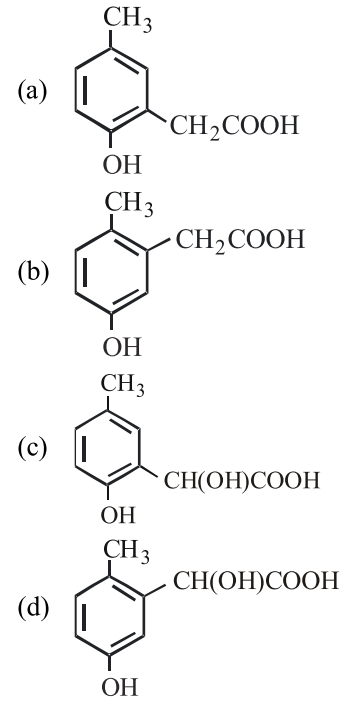
\( p \)-cresol reacts with chloroform in alkaline medium to give the compound A which adds hydrogen cyanide to form the compound B. The latter on acidic hydrolysis gives chiral carboxylic acid. The structure of the carboxylic acid is:

The radius of \( La^{3+} \) (Atomic number of La = 57) is 1.06 Å. Which one of the following given values will be closest to the radius of \( Lu^{3+} \) (Atomic number of Lu = 71)?
In a compound, atoms of element Y form ccp lattice and those of element X occupy \( \frac{2}{3} \)rd of tetrahedral voids. The formula of the compound will be:
An organic compound \( C_6H_9N \) (A), when treated with nitrous acid, gave an alcohol and \( N_2 \) gas was evolved. (A) on warming with \( CHCl_3 \) and caustic potash gave (C), which on reduction gave isopropylmethylamine. Predict the structure of (A):
For the reaction \( 2N_2O_5 \rightarrow 4NO_2 + O_2 \), rate and rate constant are \( 1.02 \times 10^{-4} \, mol \, lit^{-1} \, s^{-1} \) and \( 3.4 \times 10^{-5} \, s^{-1} \), respectively when the concentration of \( N_2O_5 \) at that time will be:
The complex showing a spin-only magnetic moment of 2.82 B.M. is:
What is order with respect to A, B, C, respectively?
In the silver plating of copper, \( K[Ag(CN)_2] \) is used instead of \( AgNO_3 \). The reason is:
Nitrosamines \( (R_2N - N = O) \) are soluble in water. On heating them with concentrated \( H_2SO_4 \), they give secondary amines. This reaction is called:
The energies \( E_1 \) and \( E_2 \) of two radiations are 25 eV and 50 eV, respectively. The relation between their wavelengths i.e., \( \lambda_1 \) and \( \lambda_2 \), will be:

The nucleotide in DNA are linked by:
The correct order of the thermal stability of hydrogen halides (H-X) is:
The values of \( \Delta H \) and \( \Delta S \) for the reaction, \[ C(graphite) + CO_2(g) \rightarrow 2CO(g), \]
are 170 kJ and 170 J/K, respectively. This reaction will be spontaneous at:

Given that the equilibrium constant for the reaction \( 2SO_3(g) + O_2(g) \rightleftharpoons 2SO_2(g) \) has a value of \( 2.78 \times 10^{3} \) at a particular temperature. What is the value of the equilibrium constant for the following reaction at the same temperature? \[ SO_3(g) \rightleftharpoons SO_2(g) + \frac{1}{2}O_2(g) \]
Which one of the following statements is correct?
In case of nitrogen, \( NCl_3 \) is possible but not \( NCl_5 \), while in case of phosphorus, \( PCl_3 \) as well as \( PCl_5 \) is possible. It is due to:
For the reaction: \[ BaO (s) + O_2(g) \rightarrow BaO_2(s) \] \( \Delta H = +ve \), In equilibrium condition, pressure of \( O_2 \) is dependent on:
In the series of reaction \[ C_6H_5NH_2 \xrightarrow{NaNO_2/HCl} X \quad and \quad X \xrightarrow{HNO_3, H_2O} Y + N_2 + HCl, \]
X and Y are respectively:
In \( XeF_2 \), \( XeF_4 \), \( XeF_6 \), the number of lone pairs on Xe are respectively:
In Williamson synthesis if tertiary alkyl halide is used than:
If \( 12 \cot^2 \theta - 31 \csc \theta + 32 = 0 \), then the value of \( \sin \theta \) is:
Amplitude of \( \frac{1 + \sqrt{3}i}{\sqrt{3} + 1} \) is:
The value of \[ \lim_{x \to 0} \frac{x^3 \cot x}{1 - \cos x} \]
is:
The connective in the statement: \[ "2 + 7 > 9 \, or \, 2 + 7 < 9" \]
is:
The number of ways in which 3 prizes can be distributed to 4 children, so that no child gets all the three prizes, are:
If \( A \) and \( B \) are events such that \( P(A) = 0.42 \), \( P(B) = 0.48 \), and \( P(A \cap B) = 0.16 \), then:
I. \( P(not A) = 0.58 \)
II. \( P(not B) = 0.52 \)
III. \( P(A \cup B) = 0.47 \)
The focus of the curve \( y^2 + 4x - 6y + 13 = 0 \) is:
If the parabola \( y^2 = 4ax \) passes through the point \( (1, -2) \), then the tangent at this point is:
The number of points of discontinuity of the function \( f(x) = x - [x] \) in the interval \( (0, 7) \) are:
A football is inflated by pumping air in it. When it acquires spherical shape its radius increases at the rate of \( 0.02 \, cm/s \). The rate of increase of its volume when the radius is \( 10 \, cm \) is:
The interval in which the function \( f(x) = \frac{4x^2 + 1}{x} \) is decreasing is:
The eccentricity of the ellipse whose major axis is three times the minor axis is:
The equation of the hyperbola with vertices \( (3, 0), (-3, 0) \) and semi-latus ***** 4 is given by:
\( f(x) = \left\{ \begin{array}{ll} \sin \frac{1}{x} , & for \, x \neq 0
0, & for \, x = 0 \end{array} \right. \) is:
If \[ \int \frac{3x + 1}{(x-3)(x-5)} \, dx = \int \frac{-5}{(x-3)} \, dx + \int \frac{B}{(x-5)} \, dx, \]
then the value of \( B \) is:
The vector equation of the symmetrical form of equation of straight line \( \mathbf{r} = (3\hat{i} + 7\hat{j} + 2\hat{k}) + \lambda (5\hat{i} + 4\hat{j} - 6\hat{k}) \) is:
Let the line \( \frac{x^2}{2} - \frac{y^2}{1} = 1 \) lie in the plane \( x + 3y - oz + \beta = 0 \). Then \( \beta \) equals:
The principal value of \( \sin^{-1} \left( \sin \frac{5\pi}{3} \right) \) is:
If \( \left[ 1 \quad x \quad 1 \right] \) is equal to \( \left[ 1 \quad 3 \quad 2 \right] \), then \( x \) is:
If \( A = \begin{pmatrix} -7 & -4
7 & 4 \end{pmatrix} \) and \( B = \begin{pmatrix} 4 & 1
2 & 7 \end{pmatrix} \), then which statement is true?
The value of \( c \) in Rolle's Theorem for the function \[ f(x) = e^x \sin x, \, x \in [0, \pi] \]
is:
The area of the region bounded by the curve \( x = 2y + 3 \) and lines \( y = 1 \) and \( y = -1 \) is:
A signal which can be green or red with probability \( \frac{4}{5} \) and \( \frac{1}{5} \) respectively, is received by station A and then transmitted to station B. The probability of each station receiving the signal correctly is \( \frac{3}{4} \). If the signal received at station B is given, then the probability that the original signal is green is:
The value of the determinant \( \Delta = \begin{vmatrix} 1 & 4 & 3
0 & 12 & 9
1 & 2 & 2 \end{vmatrix} \) is:
If the equations \( x + ay = 0 \), \( 2x + y + az = 0 \), \( ax + y + 2z = 0 \) have non-trivial solutions, then \( a = \):
If the I.F. of the differential equation \[ \frac{dy}{dx} + 5y = \cos x \sin x e^{Adx}, then A = \]
What is the length of the projection of \( 3\hat{i} + 4\hat{j} + 5\hat{k} \) on the xy-plane?
The radius of the sphere \[ x^2 + y^2 + z^2 = 49, \quad 2x + 3y - z - 5\sqrt{14} = 0 \]
is:
One of the values of \[ \left( \frac{1 + i}{\sqrt{2}} \right)^{2/3} \]
is:
The value of \( \lambda \) does the line \( y = x + \lambda \) touches the ellipse \( 9x^2 + 16y^2 = 144 \) is:
The combined equation of the asymptotes of the hyperbola \[ 2x^2 + 5xy + 2y^2 + 4x + 5y = 0 \]
is:
The two curves \( x^3 - 3x^2 + 2 = 0 \) and \( 3x y - y^3 - 2 = 0 \) intersect at an angle of:
If at \( x = 1 \), the function \( x^4 - 62x^2 + ax + 9 \) attains its maximum value on the interval \( [0, 2] \), then the value of \( a \) is:
The value of \[ \int_{-1}^{1} (x - \lfloor x \rfloor) dx \quad (where \, \lfloor \cdot \rfloor \, denotes the greatest integer function) \]
is:
The correct evaluation of \[ \int_0^{\frac{\pi}{2}} \sin^4 x \, dx \]
is:
The order and degree of the differential equation
whose solution is \( y = cx + c^2 - 3c^3y^2 + 2 \), where \( c \) is a parameter, is:
The solution of \[ \frac{dv}{dt} + \frac{k}{m} v = -g \]
is:
A unit vector perpendicular to the plane formed by the points \( (1, 0, 1) \), \( (0, 2, 2) \), and \( (3, 3, 0) \) is:
If \( \mathbf{a} = ( \hat{i} + \hat{j} + \hat{k} ) \), \( \mathbf{a} \times \mathbf{b} = \hat{i} - \hat{j} \), then \( \mathbf{b} \) is:
The mean and variance of a random variable \( X \) having binomial distribution are 4 and 2 respectively, then \( P(X = 1) \) is:
Directions (Qs. 121-123): Study the paragraph and answer the questions that follow:
Judiciary has become the centre of controversy, in the recent past, on account of the sudden 'Me' in the level of judicial intervention. The area of judicial intervention has been steadily expanding through the device of public interest litigation. The judiciary has shed its pro-status-quo approach and taken upon itself the duty to enforce the basic rights of the poor and vulnerable sections of society, by progressive interpretation and positive action. The Supreme Court has developed new methods of dispensing justice to the masses through the public interest litigation. Former Chief Justice PN. Bhagwat, under whose leadership public interest litigation attained a new dimension comments that "the Supreme Court has developed several new commitments. It has carried forward participative justice".
Question 121:
The steady expansion of judicial intervention is the result of:
According to the author, judiciary has become the center of controversy because of:
According to Justice PN. Bhagwat, Supreme Court has developed:
Directions (Q.124): In the questions below, a sentence is given, a part of which is printed in bold and underlined. This part may contain a grammatical error. Each sentence is followed by phrases a, b, c and d. Find out which phrase should replace the phrase given in bold/underline to correct the error, if there is any, to make the sentence grammatically meaningful and correct.
Question 124:
Recent incidents of tigers straying have brought to focus the lack of proper regulatory mechanism and powers with the forest department to take action against the resorts mushroom in forest fringes.
Choose the best pronunciation of the word 'Mischievous' from the following options:



Comments