

.png?h=56&w=56&mode=stretch)


Karnataka PGCET 2026 MCA Question Paper is available for download here. Karnataka Examinations Authority (KEA) has conducted Karnataka PGCET 2026 MCA exam on June 14 from 2.30 pm to 4.30 pm. Karnataka PGCET 2026 MCA Question Paper consists of 100 questions for 100 marks to be attempted in 120 minutes.
- Karnataka PGCET MCA Question Paper 2026 is divided into Mathematics, Computer Awareness, Analytical Ability and logical Reasoning, General Awareness and General English questions.
- Each correct answer carries 1 mark and there is no negative marking for incorrect answers.
Karnataka PGCET 2026 MCA Question Paper with Solutions
| Karnataka PGCET MCA Question Paper 2026 | Download PDF | Check Solutions |
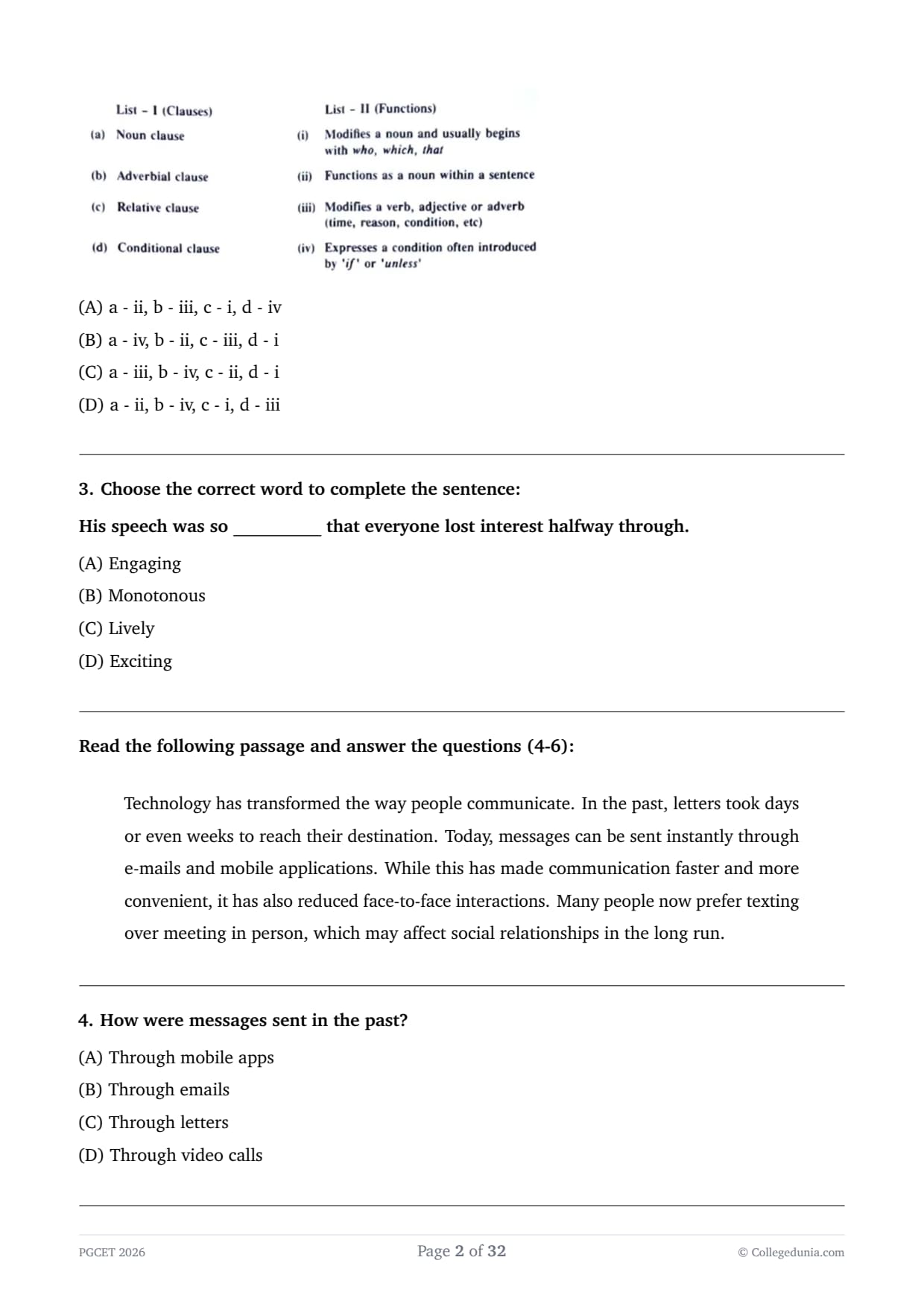

Match the following List-I (verb forms) with List-II (non-finites):

Codes:
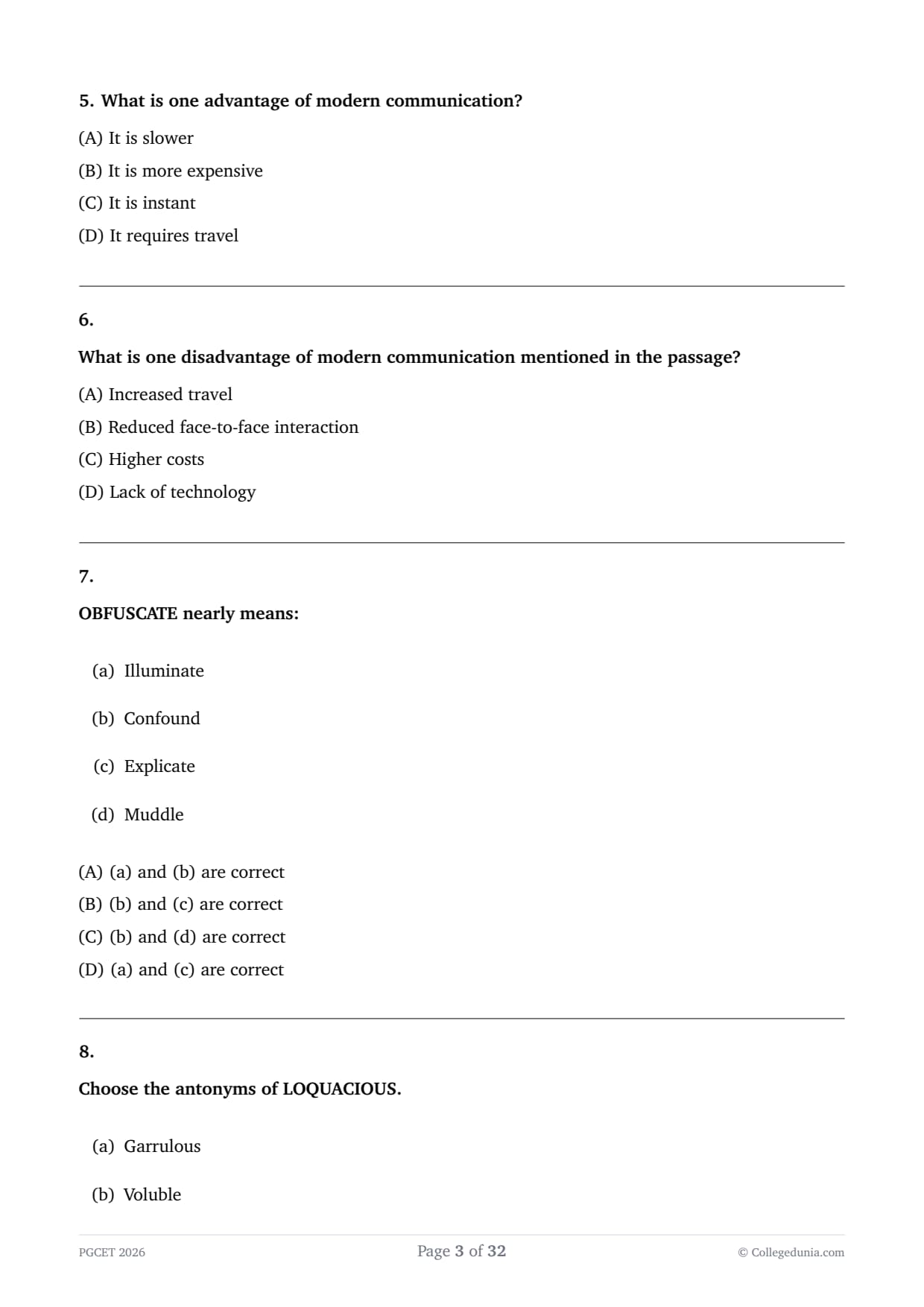
Match the following clauses with their functions:

Choose the correct word to complete the sentence:
His speech was so _____ that everyone lost interest halfway through.
How were messages sent in the past?
What is one advantage of modern communication?
What is one disadvantage of modern communication mentioned in the passage?
OBFUSCATE nearly means:
[(a)] Illuminate
[(b)] Confound
[(c)] Explicate
[(d)] Muddle
Choose the antonyms of LOQUACIOUS.
[(a)] Garrulous
[(b)] Voluble
[(c)] Reticent
[(d)] Taciturn
Choose the correct meaning of the phrase ``a blessing in disguise''.
Arrange the sentences in the correct order.
[(A)] The teacher appreciated her efforts.
[(B)] She worked hard to complete the project on time.
[(C)] Meena was assigned a project in the class.
[(D)] She presented it confidently before everyone.
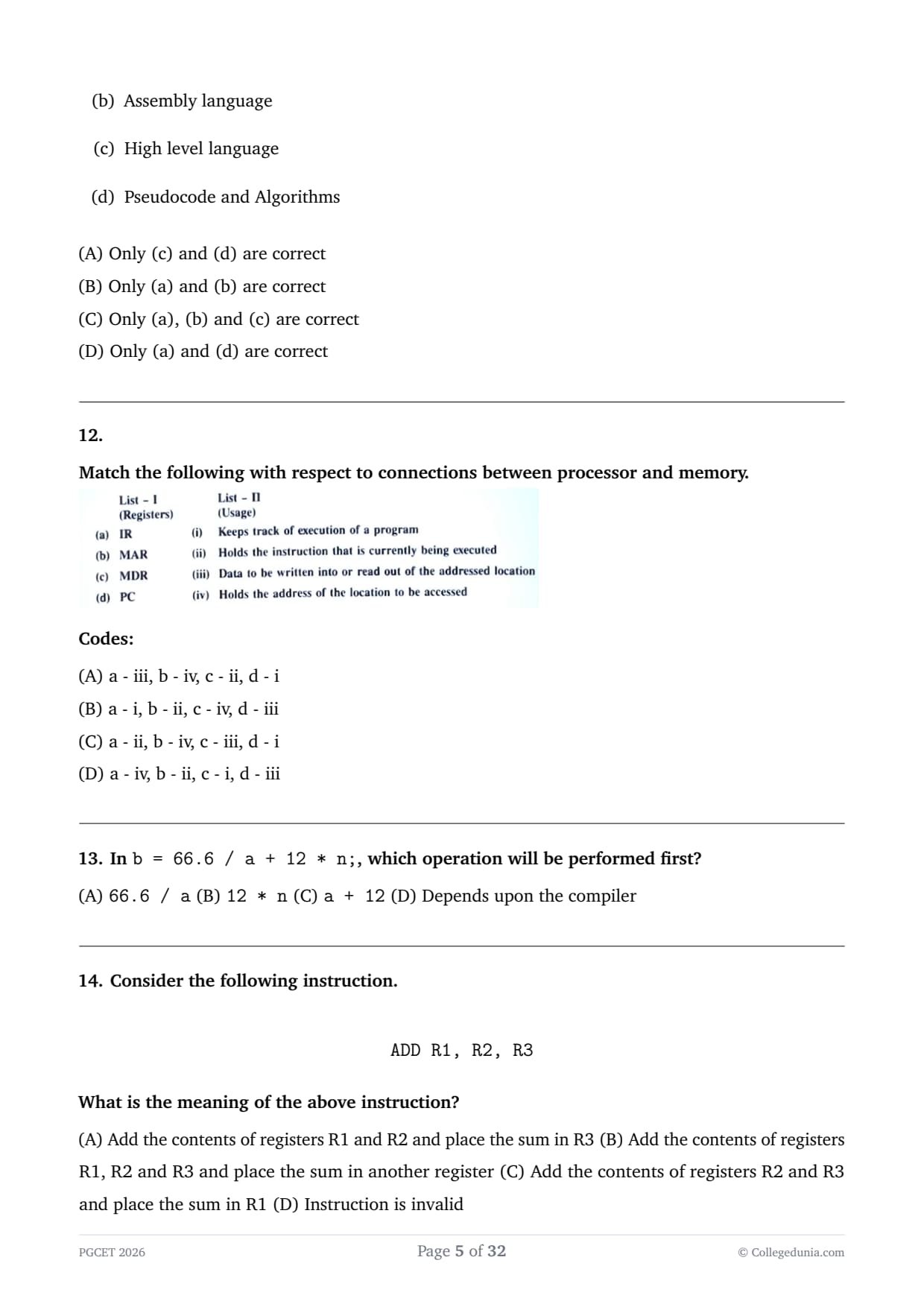
Primary classification of programming languages are
[(a)] Machine language
[(b)] Assembly language
[(c)] High level language
[(d)] Pseudocode and Algorithms
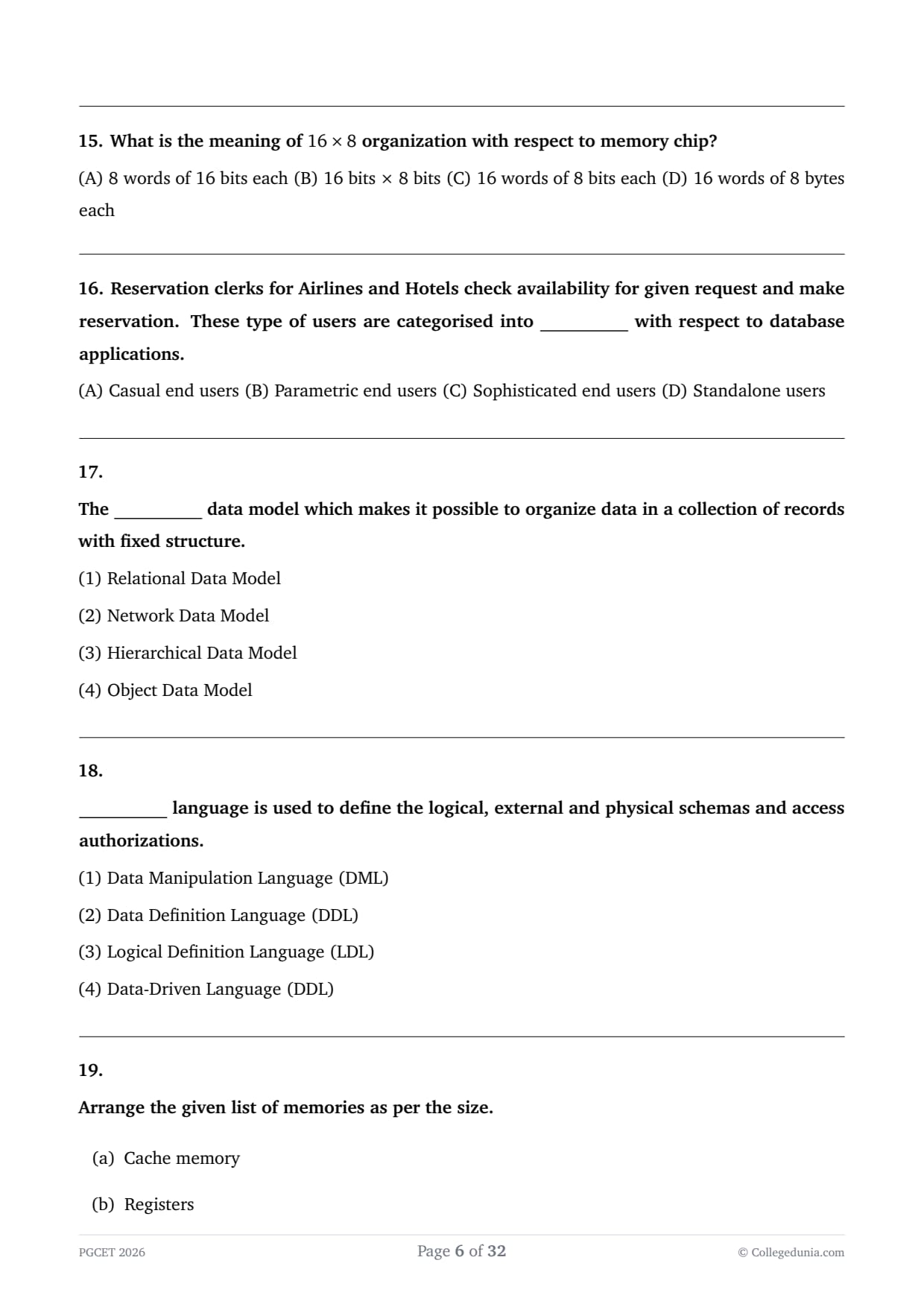
Match the following with respect to connections between processor and memory.

Codes:
In b = 66.6 / a + 12 * n, which operation will be performed first?
Consider the following instruction.
\[ ADD R1, R2, R3} \]
What is the meaning of the above instruction?
What is the meaning of \(16 \times 8\) organization with respect to memory chip?
Reservation clerks for Airlines and Hotels check availability for given request and make reservation. These type of users are categorised into ____ with respect to database applications.
The data model which makes it possible to organize data in a collection of records with fixed structure.
language is used to define the logical, external and physical schemas and access authorizations.
Arrange the given list of memories as per the size.
[(a)] Cache memory
[(b)] Registers
[(c)] Secondary memory
[(d)] Primary memory
The control unit of a computer is designed to go through an instruction cycle that is divided into following phases.
[(a)] Fetch the instruction from memory
[(b)] Decode the instruction
[(c)] Execute the instruction
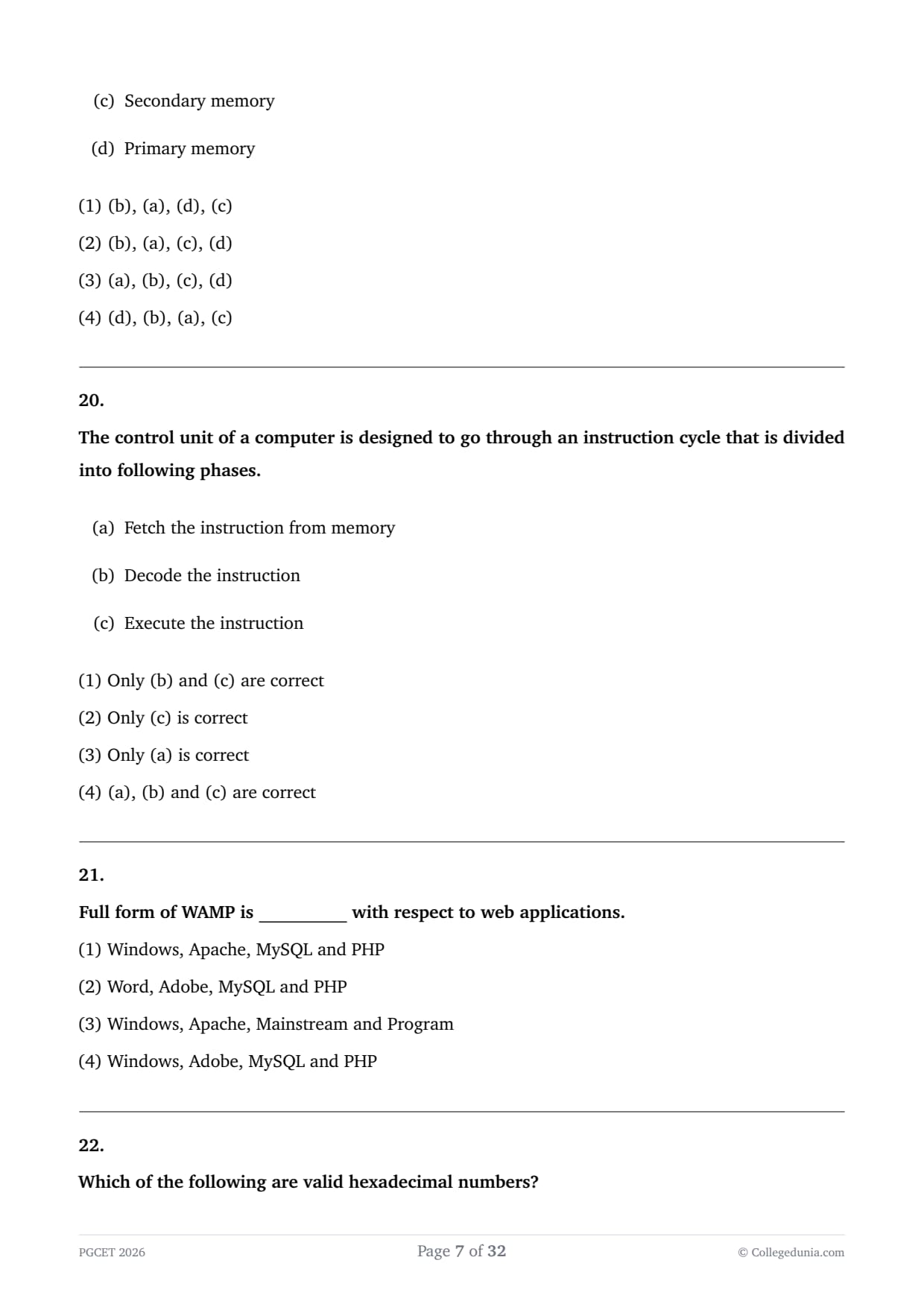
Full form of WAMP is with respect to web applications.
Which of the following are valid hexadecimal numbers?
[(i)] 1A3F
[(ii)] 29GF
[(iii)] FF12
[(iv)] 7BHE
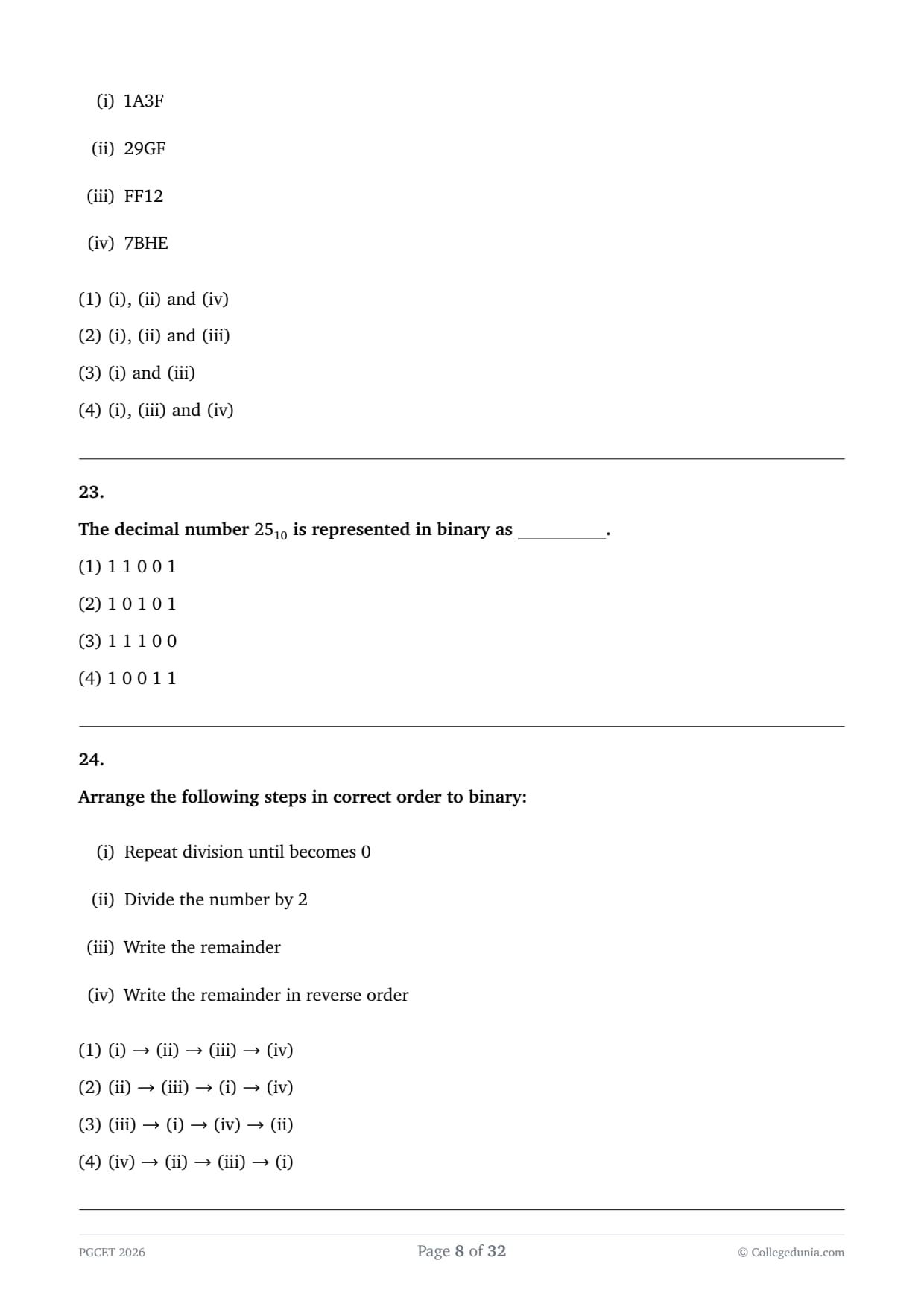
The decimal number \(25_{10}\) is represented in binary as :
Arrange the following steps in correct order to binary:
[(i)] Repeat division until becomes 0
[(ii)] Divide the number by 2
[(iii)] Write the remainder
[(iv)] Write the remainder in reverse order
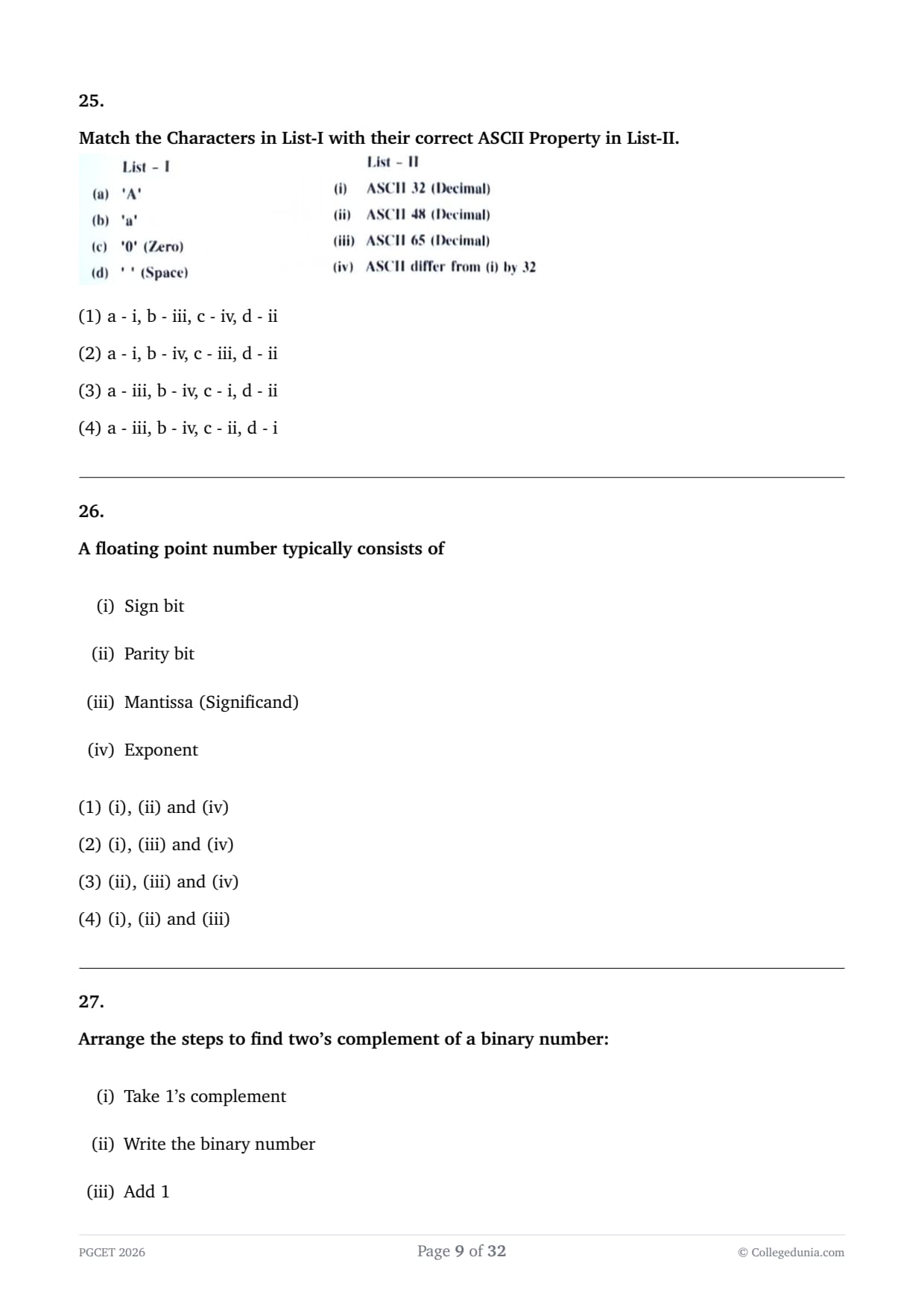
Match the Characters in List-I with their correct ASCII Property in List-II.

A floating point number typically consists of
[(i)] Sign bit
[(ii)] Parity bit
[(iii)] Mantissa (Significand)
[(iv)] Exponent
Arrange the steps to find two's complement of a binary number:
[(i)] Take 1's complement
[(ii)] Write the binary number
[(iii)] Add 1
[(iv)] Obtain final result
The result of \(101_2 \times 10_2\) is .
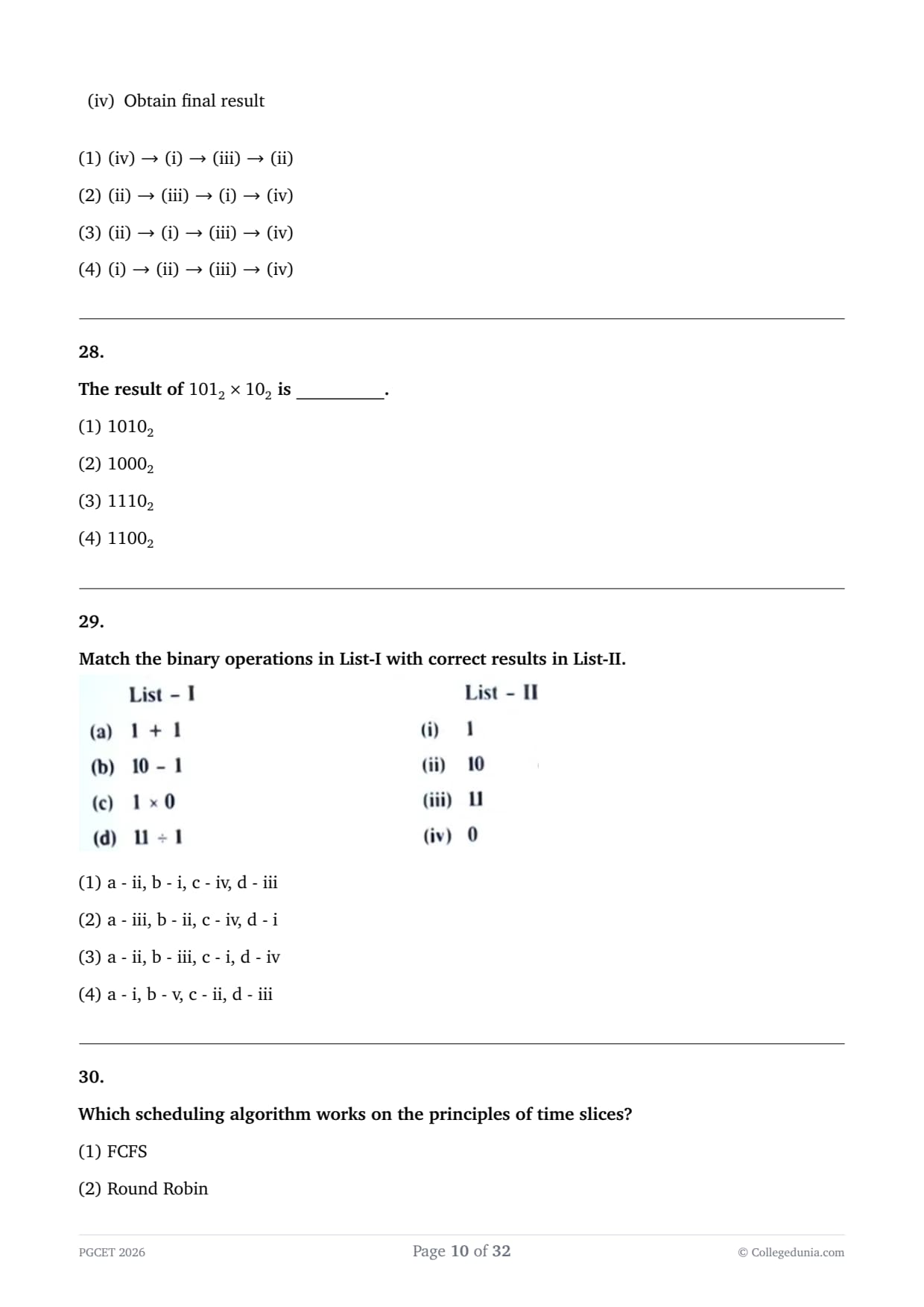
Match the binary operations in List-I with correct results in List-II.

Which scheduling algorithm works on the principles of time slices?
Which of the following are the characteristics of Real Time Operating Systems (RTOS)?
[(i)] Deterministic response
[(ii)] High latency allowed
[(iii)] Strict timing constraints
[(iv)] Used in embedded systems
Arrange the steps in process state transition.
[(i)] Running
[(ii)] Ready
[(iii)] New
[(iv)] Waiting
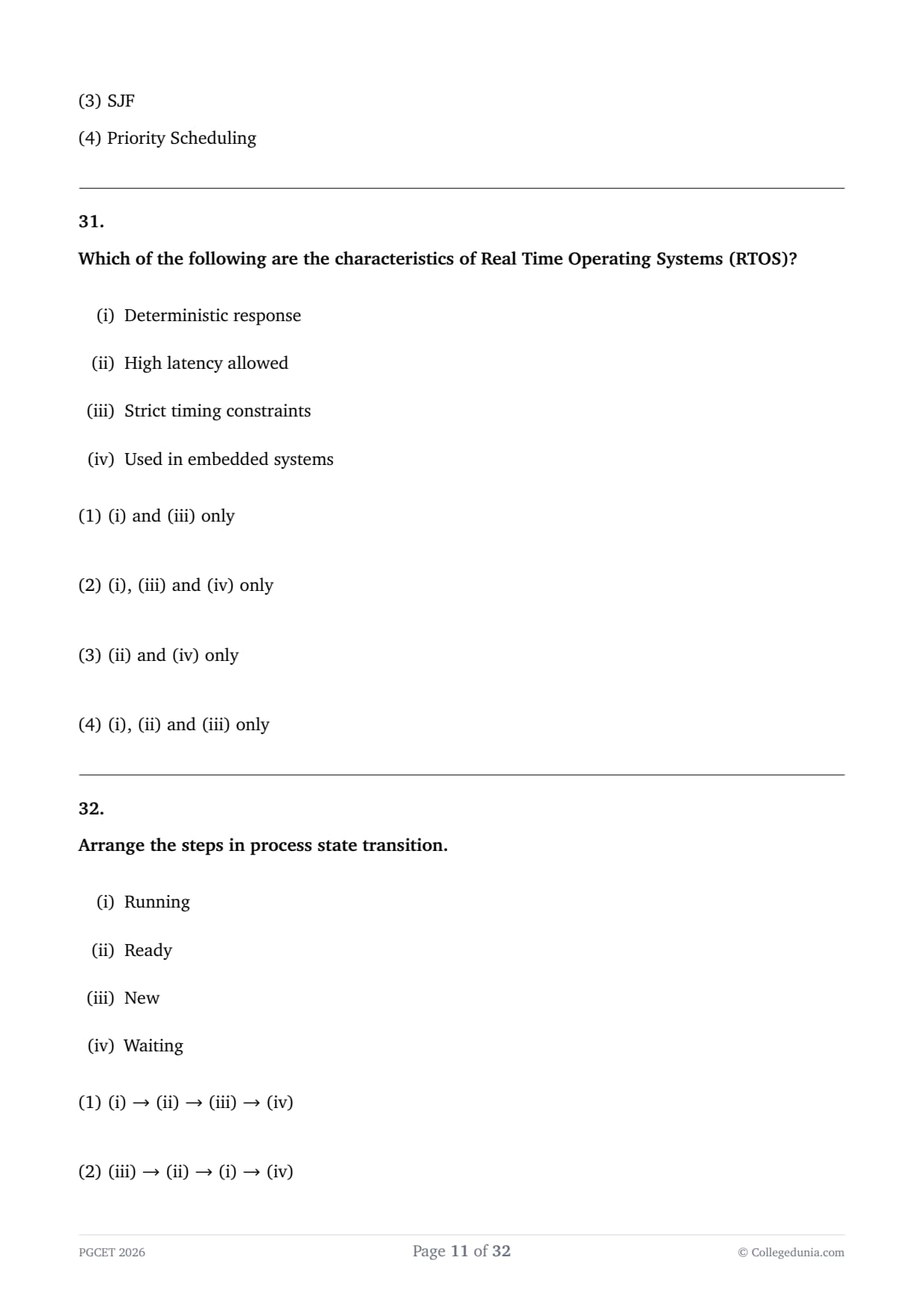
Match the operating systems in List-I with their correct characteristics in List-II.

Codes:
In a class exam, Ramya's average mark was 90 per paper. If she had obtained 4 more marks in Maths paper and 20 more marks in Physics paper, then her average per paper would have been 94. How many papers were there in the exam?
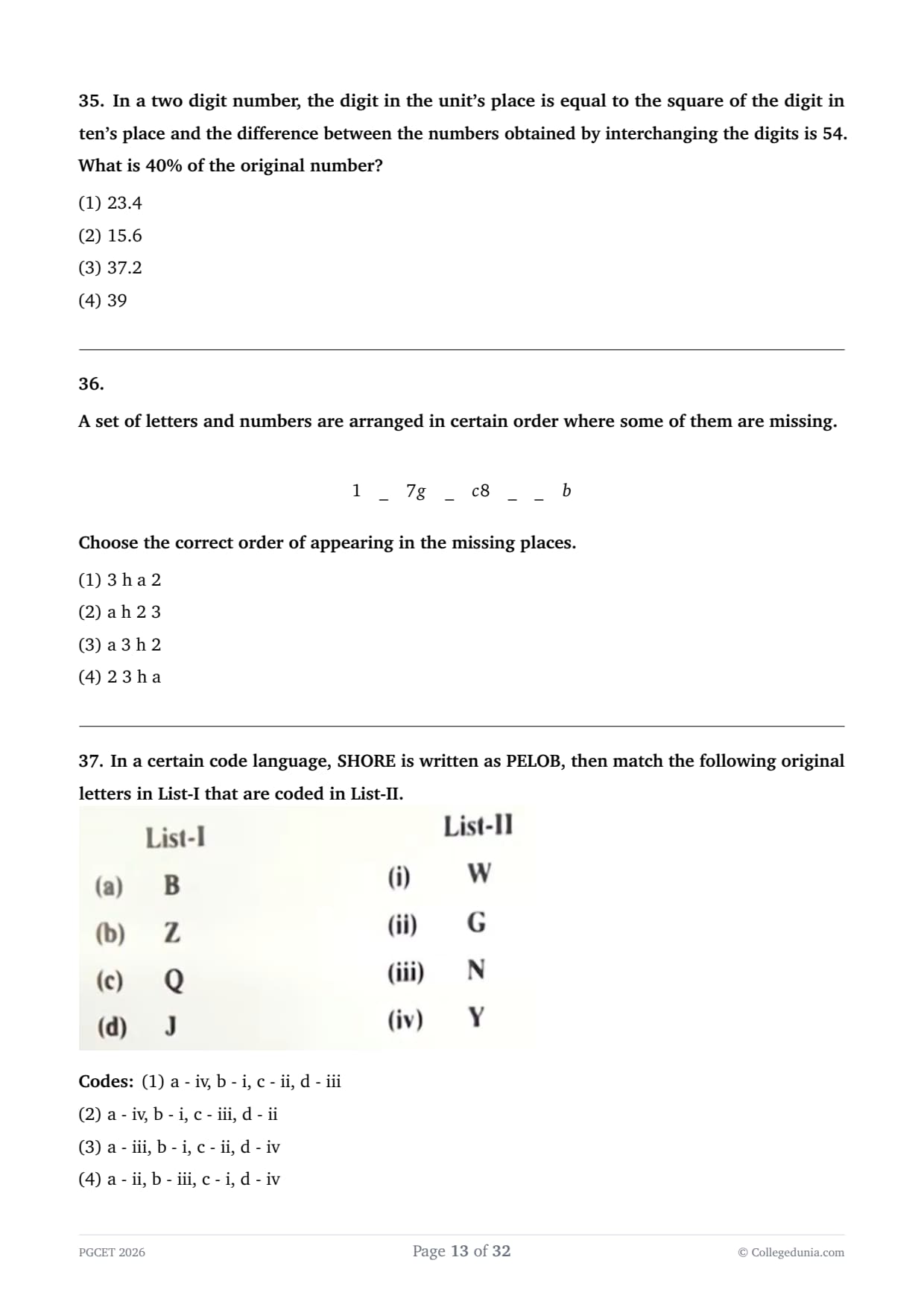
In a two digit number, the digit in the unit's place is equal to the square of the digit in ten's place and the difference between the numbers obtained by interchanging the digits is 54. What is 40% of the original number?
A set of letters and numbers are arranged in certain order where some of them are missing.
\[ 1 \quad \_ \quad 7g \quad \_ \quad c8 \quad \_ \quad \_ \quad b \]
Choose the correct order of appearing in the missing places.
In a certain code language, SHORE is written as PELOB, then match the following original letters in List-I that are coded in List-II.

Codes:
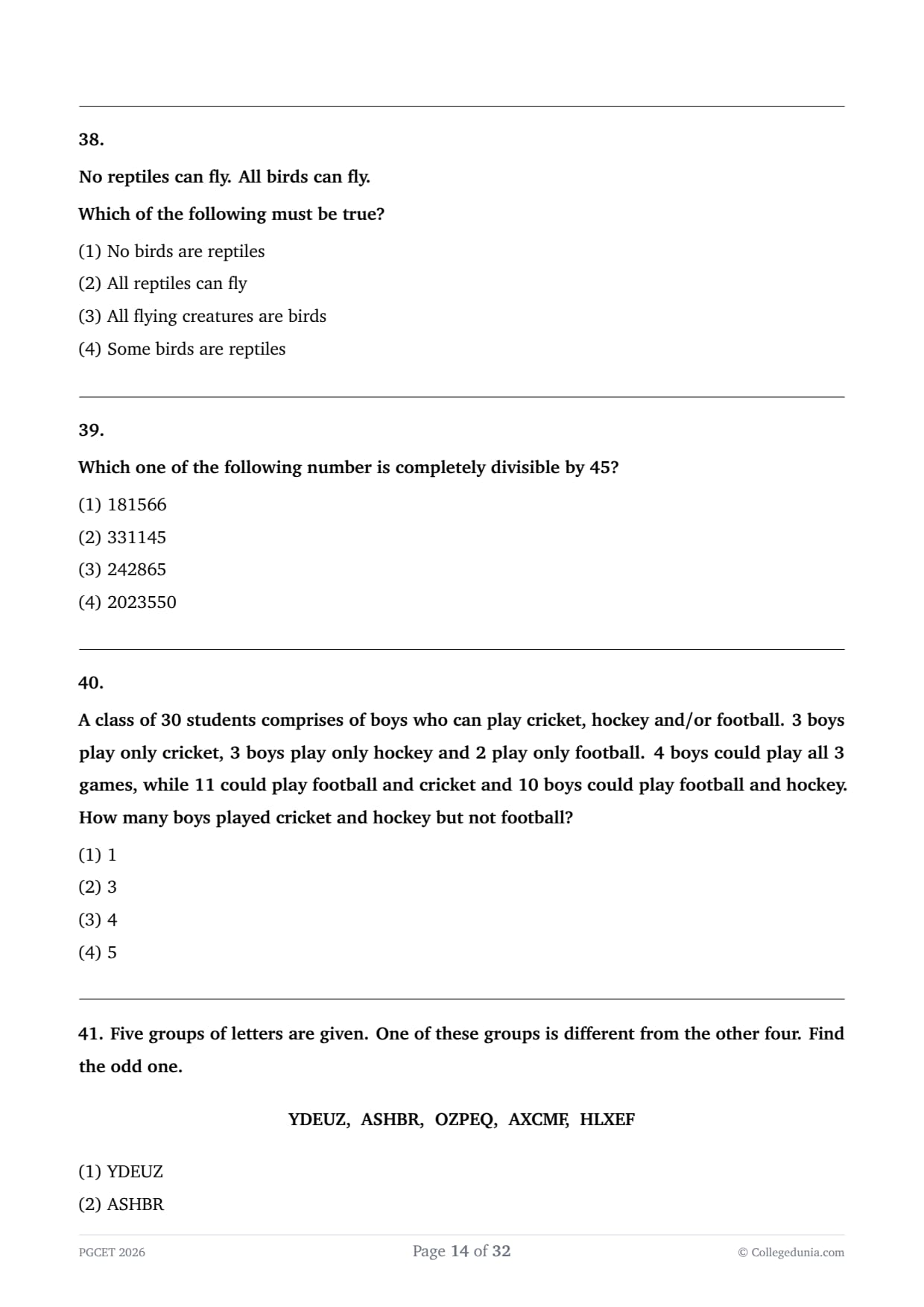
No reptiles can fly. All birds can fly.
Which of the following must be true?
Which one of the following number is completely divisible by 45?
A class of 30 students comprises of boys who can play cricket, hockey and/or football. 3 boys play only cricket, 3 boys play only hockey and 2 play only football. 4 boys could play all 3 games, while 11 could play football and cricket and 10 boys could play football and hockey. How many boys played cricket and hockey but not football?
Five groups of letters are given. One of these groups is different from the other four. Find the odd one.
YDEUZ, ASHBR, OZPEQ, AXCMF, HLXEF
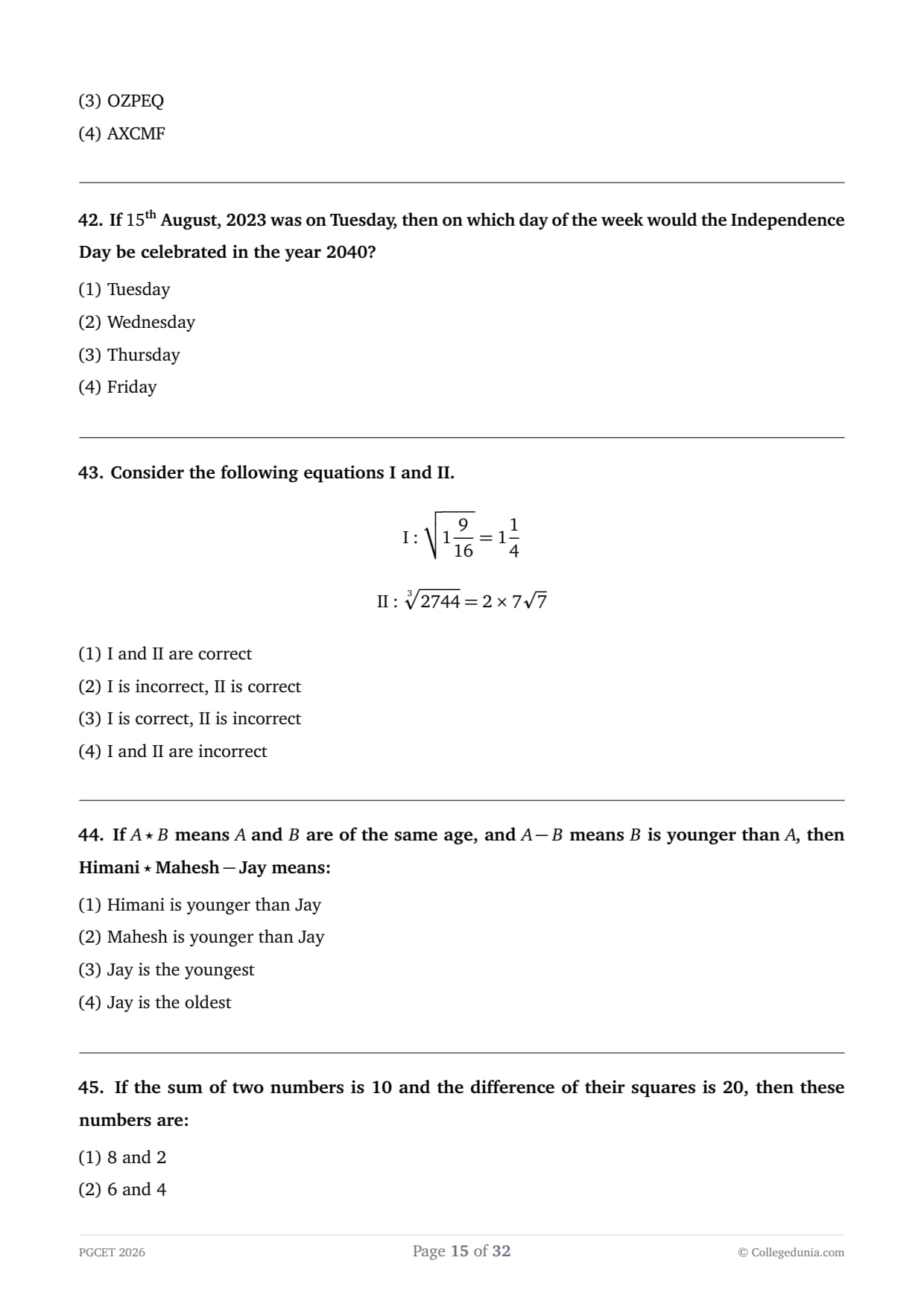
If \( 15^{th} \) August, 2023 was on Tuesday, then on which day of the week would the Independence Day be celebrated in the year 2040?
Consider the following equations I and II. \[ I : \sqrt{1\frac{9}{16}} = 1\frac{1}{4} \] \[ II : \sqrt[3]{2744} = 2 \times 7\sqrt{7} \]
If \(A \star B\) means \(A\) and \(B\) are of the same age, and \(A-B\) means \(B\) is younger than \(A\), then \( Himani \star Mahesh - Jay \) means:
If the sum of two numbers is 10 and the difference of their squares is 20, then these numbers are:
A figure consists of a triangle attached to a square such that the triangle points up. If the figure is rotated \(90^\circ\) clockwise, then where will the triangle point?
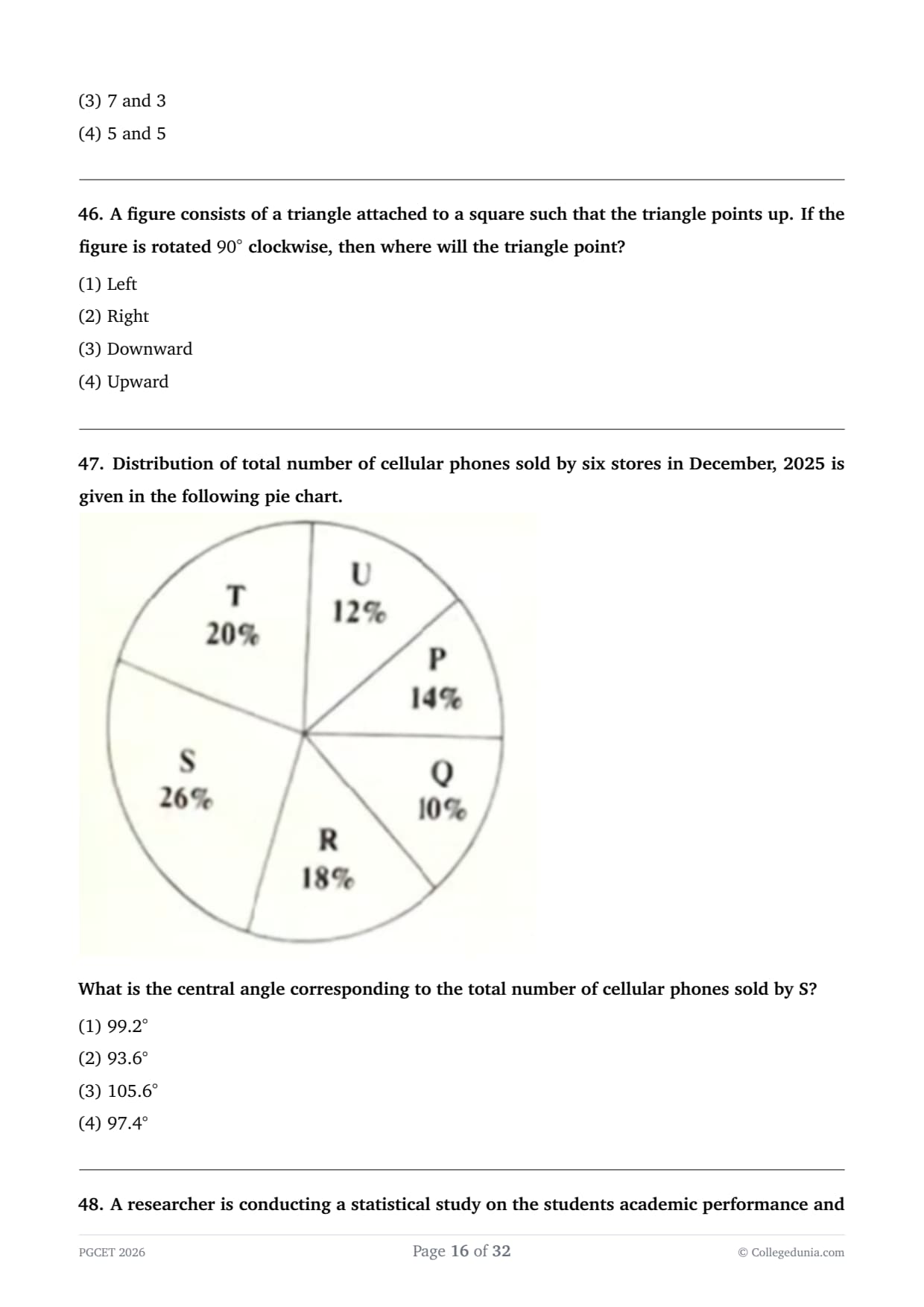
Distribution of total number of cellular phones sold by six stores in December, 2025 is given in the following pie chart.

What is the central angle corresponding to the total number of cellular phones sold by S?
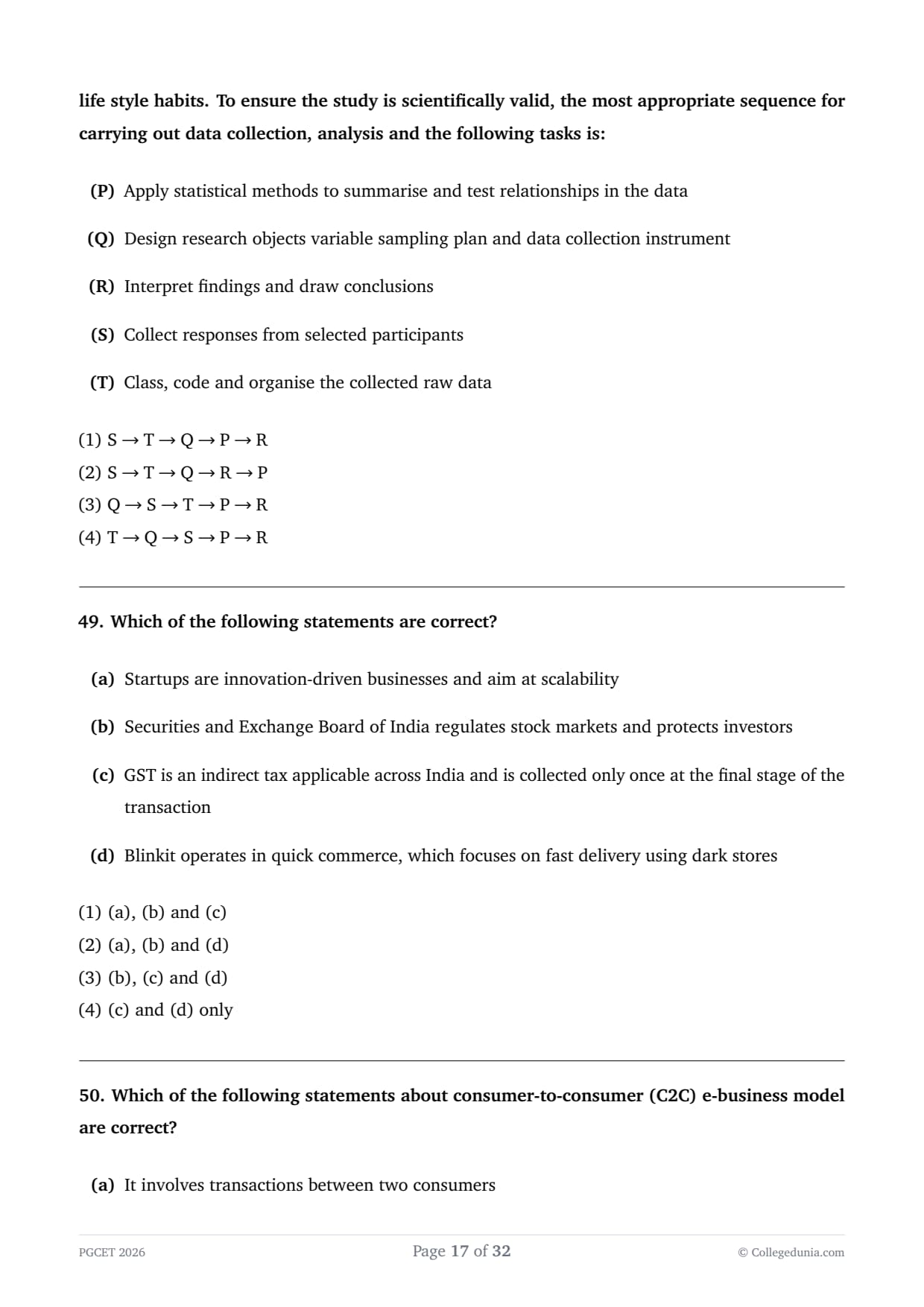
A researcher is conducting a statistical study on the students academic performance and life style habits. To ensure the study is scientifically valid, the most appropriate sequence for carrying out data collection, analysis and the following tasks is:
[(P)] Apply statistical methods to summarise and test relationships in the data
[(Q)] Design research objects variable sampling plan and data collection instrument
[(R)] Interpret findings and draw conclusions
[(S)] Collect responses from selected participants
[(T)] Class, code and organise the collected raw data
Which of the following statements are correct?
[(a)] Startups are innovation-driven businesses and aim at scalability
[(b)] Securities and Exchange Board of India regulates stock markets and protects investors
[(c)] GST is an indirect tax applicable across India and is collected only once at the final stage of the transaction
[(d)] Blinkit operates in quick commerce, which focuses on fast delivery using dark stores
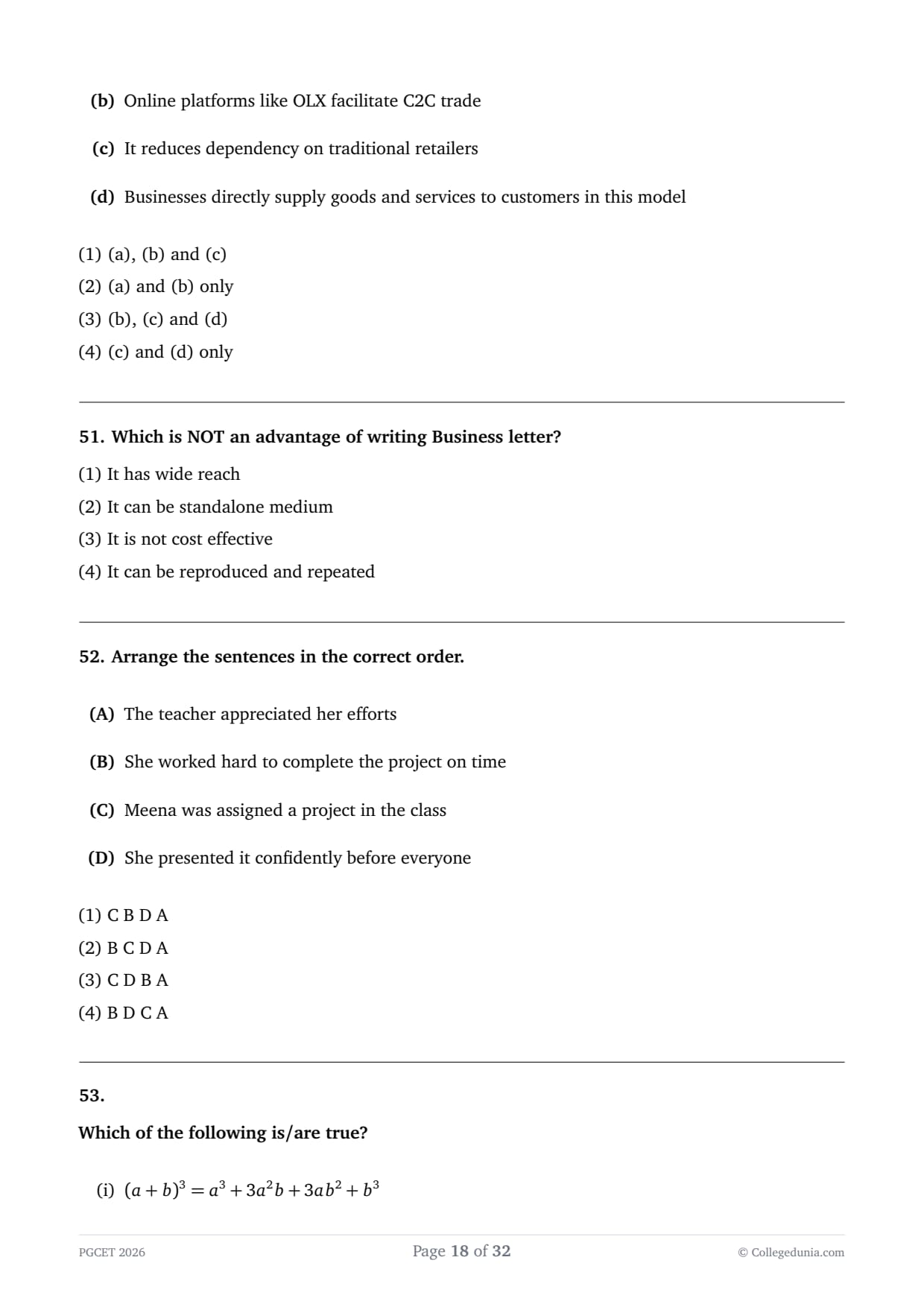
Which of the following statements about consumer-to-consumer (C2C) e-business model are correct?
[(a)] It involves transactions between two consumers
[(b)] Online platforms like OLX facilitate C2C trade
[(c)] It reduces dependency on traditional retailers
[(d)] Businesses directly supply goods and services to customers in this model
Which is NOT an advantage of writing Business letter?
Arrange the sentences in the correct order.
[(A)] The teacher appreciated her efforts
[(B)] She worked hard to complete the project on time
[(C)] Meena was assigned a project in the class
[(D)] She presented it confidently before everyone
Which of the following is/are true?
[(i)] \((a + b)^3 = a^3 + 3a^2b + 3ab^2 + b^3\)
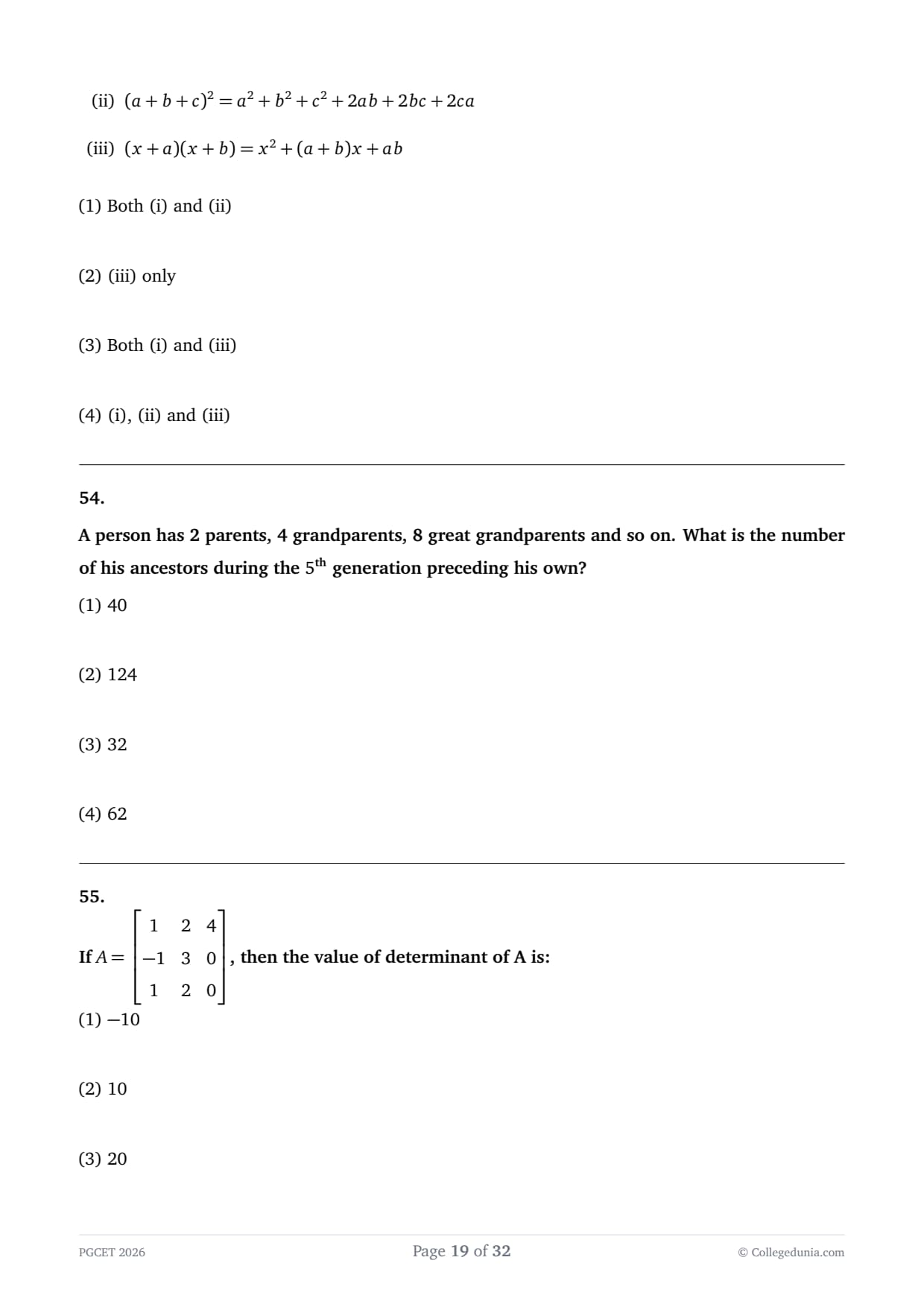
[(ii)] \((a + b + c)^2 = a^2 + b^2 + c^2 + 2ab + 2bc + 2ca\)
[(iii)] \((x + a)(x + b) = x^2 + (a + b)x + ab\)
A person has 2 parents, 4 grandparents, 8 great grandparents and so on. What is the number of his ancestors during the \(5^{th}\) generation preceding his own?
If \(A = \begin{bmatrix} 1 & 2 & 4
-1 & 3 & 0
1 & 2 & 0 \end{bmatrix}\), then the value of determinant of A is:
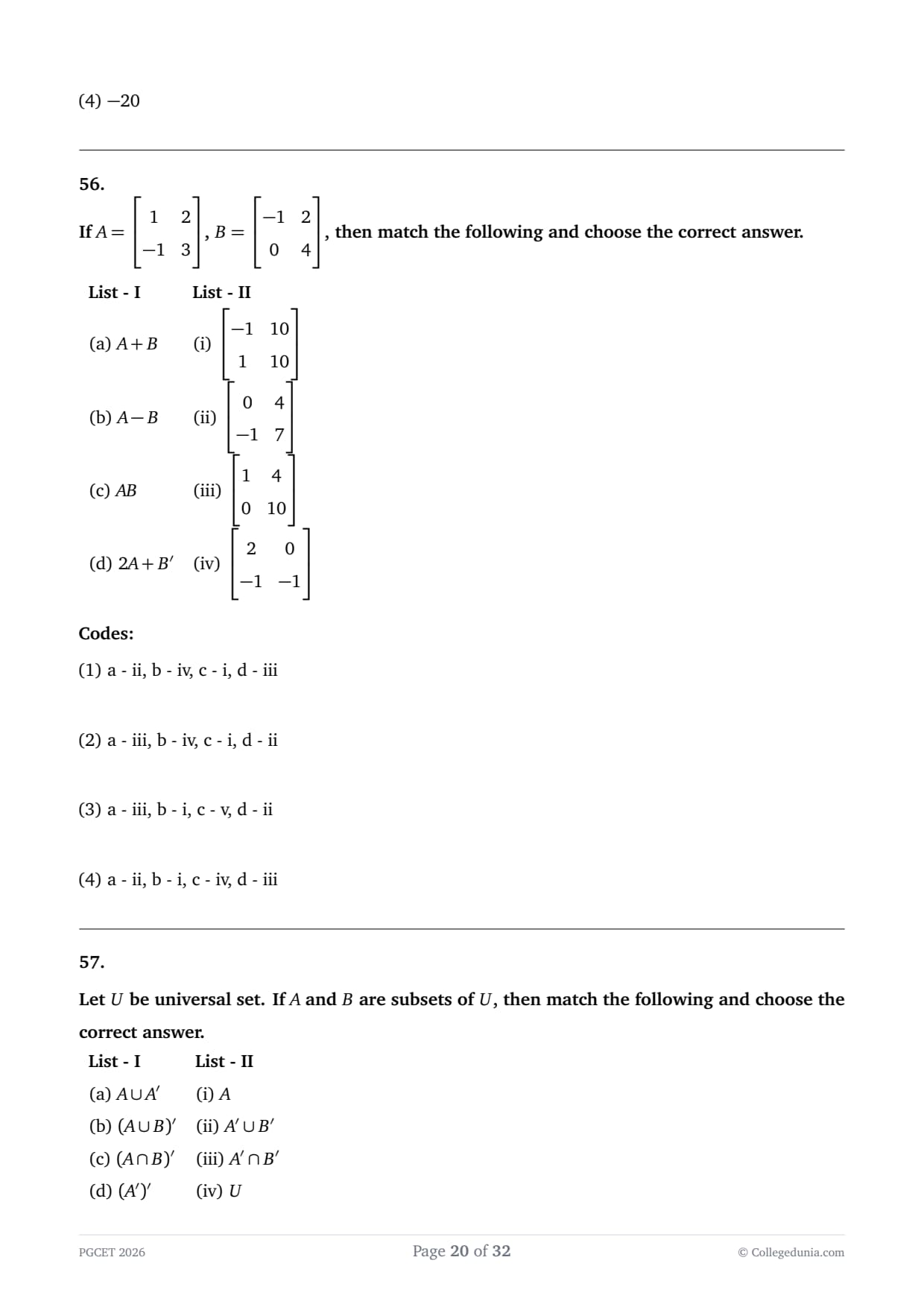
If \(A = \begin{bmatrix} 1 & 2
-1 & 3 \end{bmatrix}\), \(B = \begin{bmatrix} -1 & 2
0 & 4 \end{bmatrix}\), then match the following and choose the correct answer.
List - I & List - II
(a) \(A+B\) &
(i) \(\begin{bmatrix} -1 & 10
1 & 10 \end{bmatrix}\)
(b) \(A-B\) &
(ii) \(\begin{bmatrix} 0 & 4
-1 & 7 \end{bmatrix}\)
(c) \(AB\) &
(iii) \(\begin{bmatrix} 1 & 4
0 & 10 \end{bmatrix}\)
(d) \(2A+B'\) &
(iv) \(\begin{bmatrix} 2 & 0
-1 & -1 \end{bmatrix}\)
Codes:
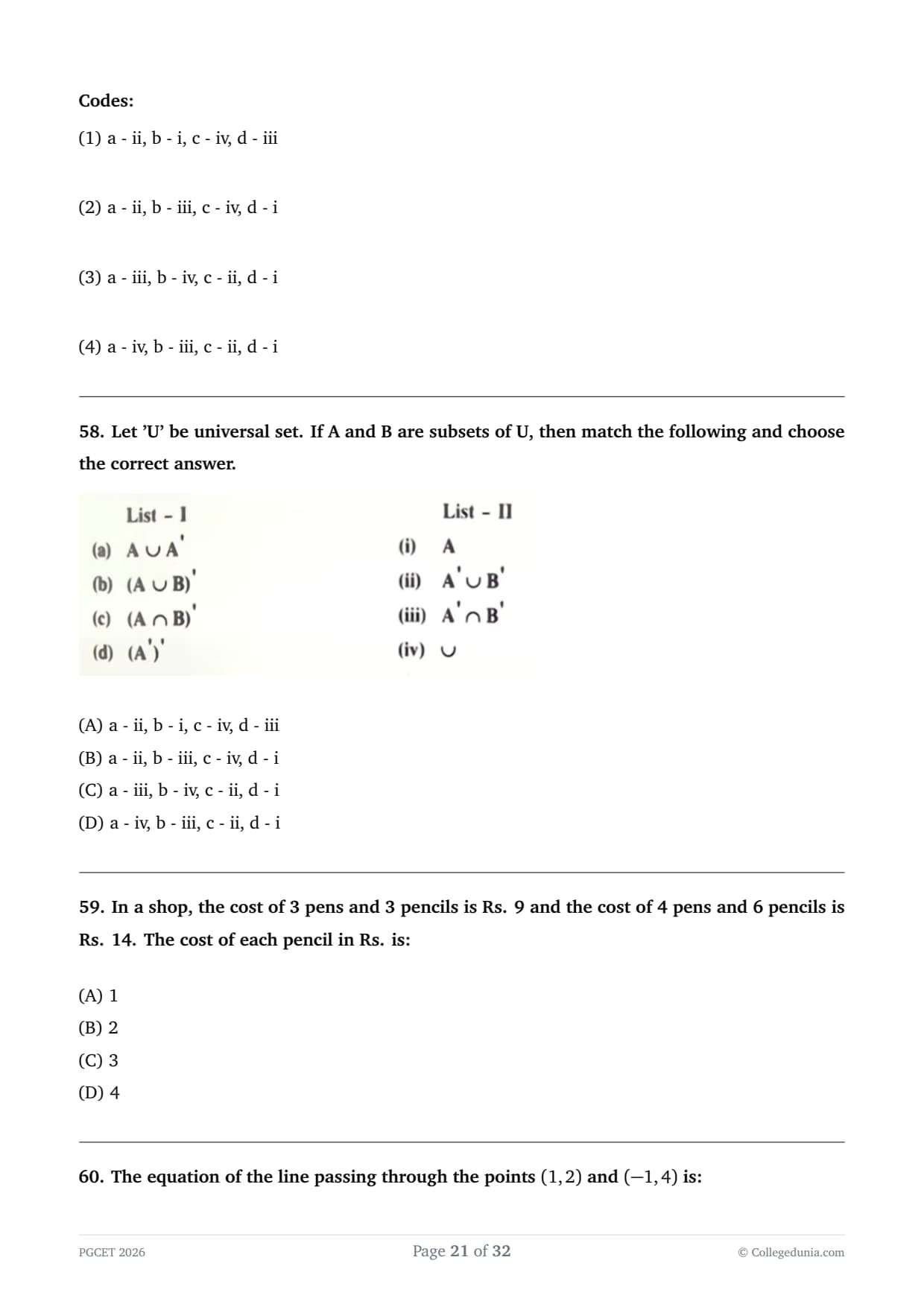
Let \(U\) be universal set. If \(A\) and \(B\) are subsets of \(U\), then match the following and choose the correct answer.
List - I & List - II
(a) \(A \cup A'\) & (i) \(A\)
(b) \((A \cup B)'\) & (ii) \(A' \cup B'\)
(c) \((A \cap B)'\) & (iii) \(A' \cap B'\)
(d) \((A')'\) & (iv) \(U\)
Codes:
Let 'U' be universal set. If A and B are subsets of U, then match the following and choose the correct answer.

In a shop, the cost of 3 pens and 3 pencils is Rs. 9 and the cost of 4 pens and 6 pencils is Rs. 14. The cost of each pencil in Rs. is:
The equation of the line passing through the points \((1, 2)\) and \((-1, 4)\) is:
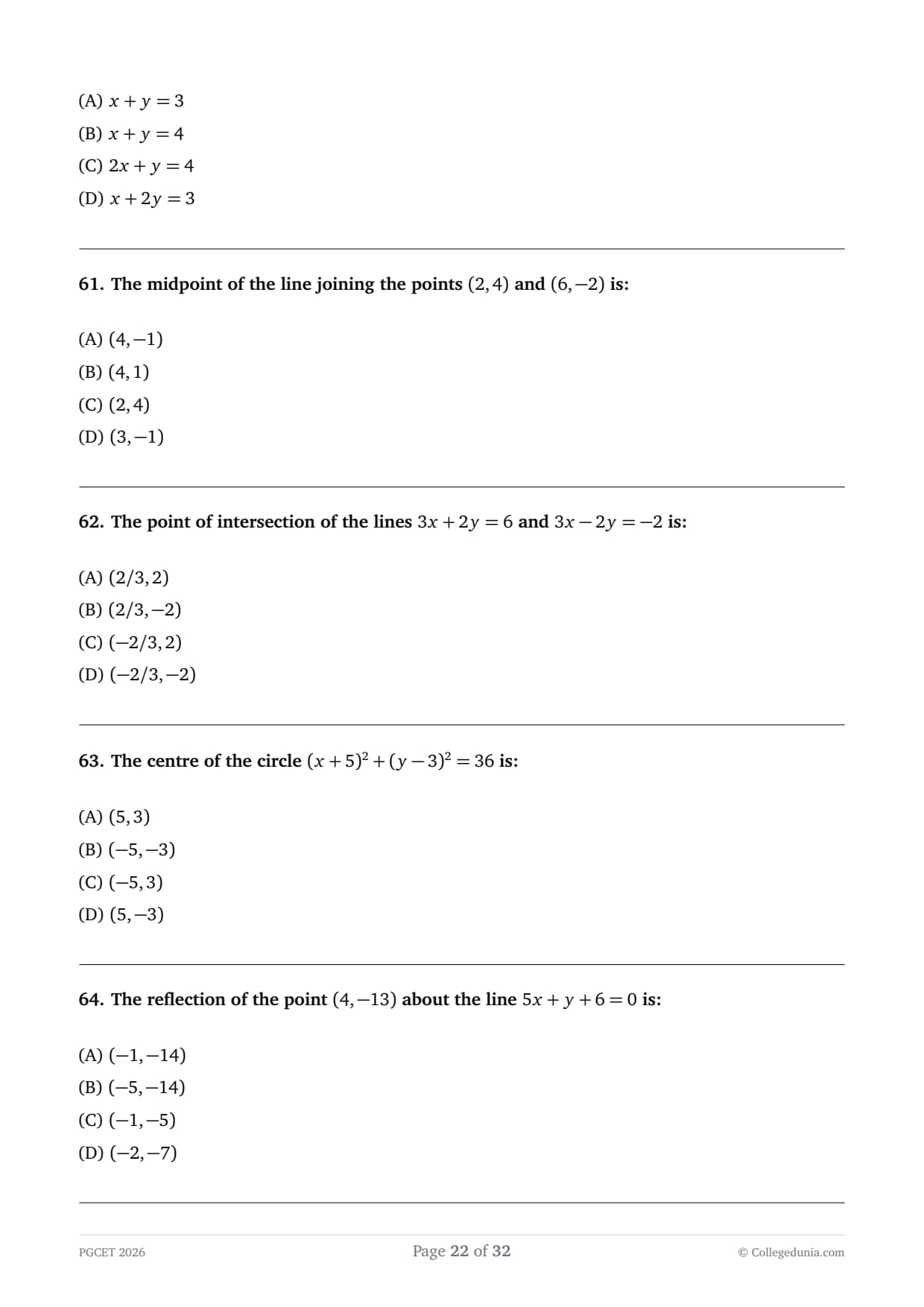
The midpoint of the line joining the points \((2, 4)\) and \((6, -2)\) is:
The point of intersection of the lines \(3x + 2y = 6\) and \(3x - 2y = -2\) is:
The centre of the circle \((x + 5)^2 + (y - 3)^2 = 36\) is:
The reflection of the point \((4, -13)\) about the line \(5x + y + 6 = 0\) is:
The equation of the parabola which is symmetric about the y-axis and passes through the point \((2, -3)\) is:
Consider the triangle with vertices \((0, 0)\), \((5, 0)\) and \((2, 3)\). If scaling of 3 units is applied along both x-axis and y-axis, the new coordinates are:
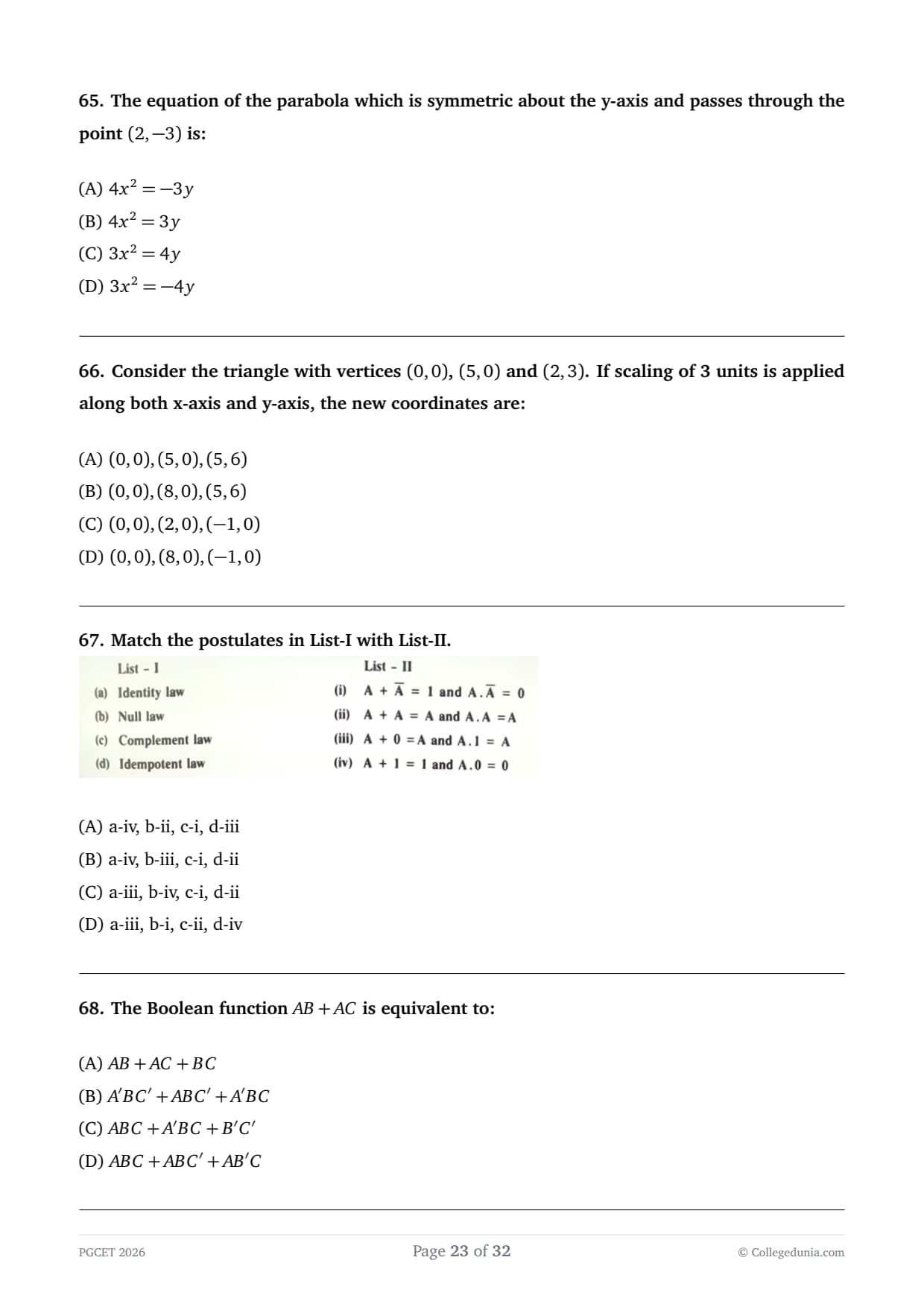
Match the postulates in List-I with List-II.

The Boolean function \(AB + AC\) is equivalent to:
The Boolean expressions \((AB)' = A' + B'\) and \((A + B)' = A'B'\) represent
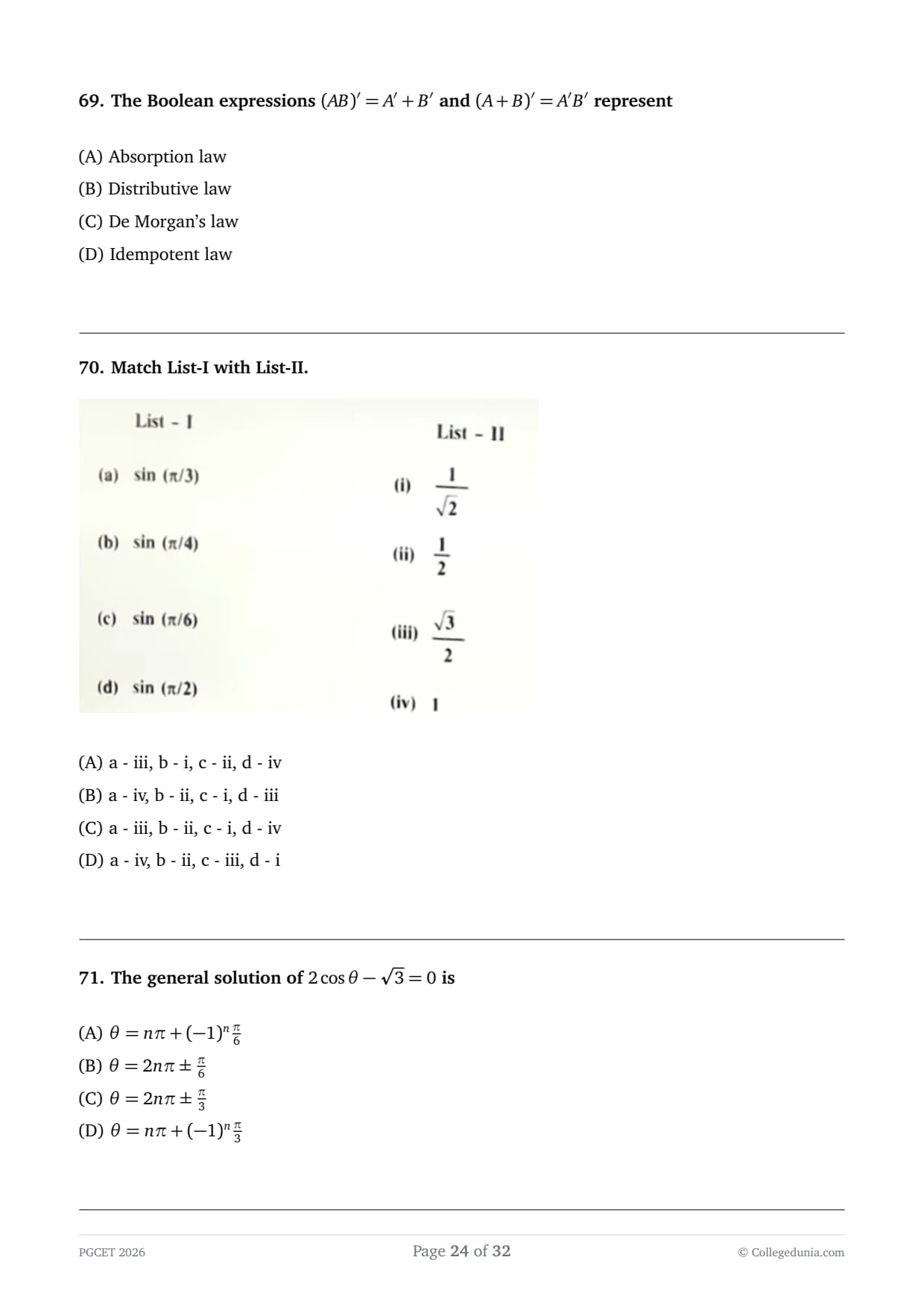
Match List-I with List-II.

The general solution of \(2\cos\theta - \sqrt{3} = 0\) is
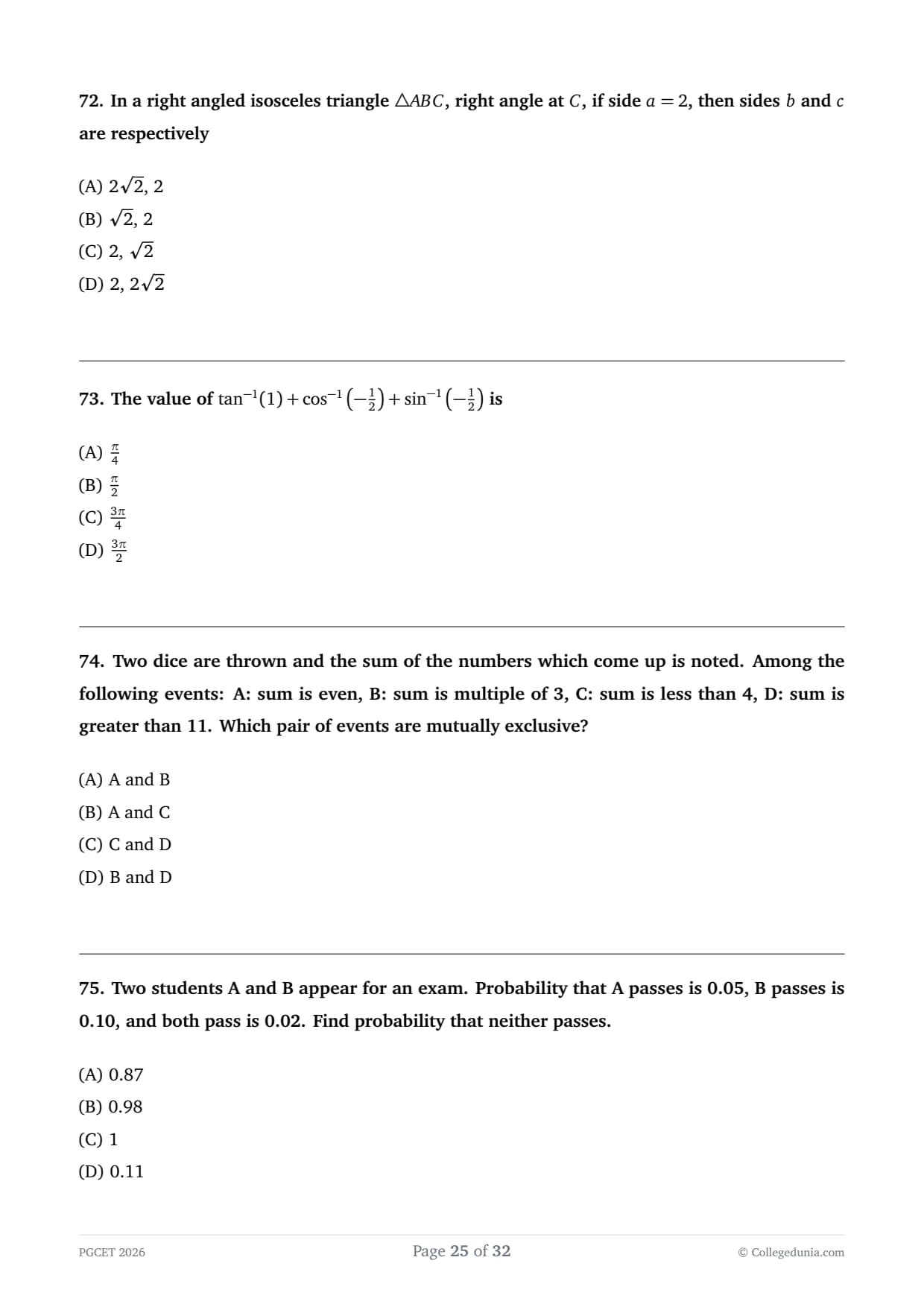
In a right angled isosceles triangle \(\triangle ABC\), right angle at \(C\), if side \(a = 2\), then sides \(b\) and \(c\) are respectively
The value of \(\tan^{-1}(A) + \cos^{-1}\left(-\frac{1}{2}\right) + \sin^{-1}\left(-\frac{1}{2}\right)\) is
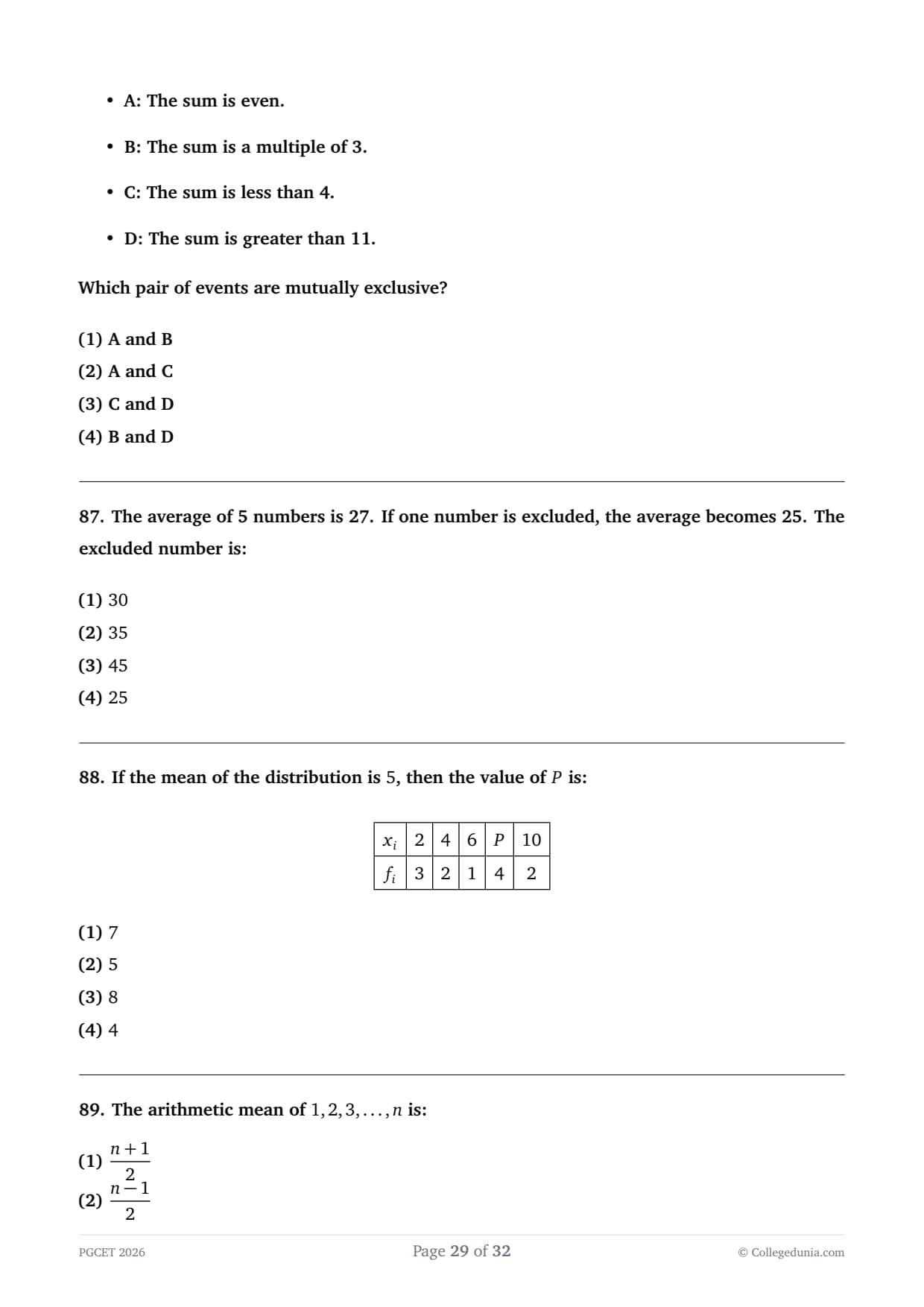
Two dice are thrown and the sum of the numbers which come up is noted. Among the following events: A: sum is even, B: sum is multiple of 3, C: sum is less than 4, D: sum is greater than 11. Which pair of events are mutually exclusive?
Two students A and B appear for an exam. Probability that A passes is 0.05, B passes is 0.10, and both pass is 0.02. Find probability that neither passes.
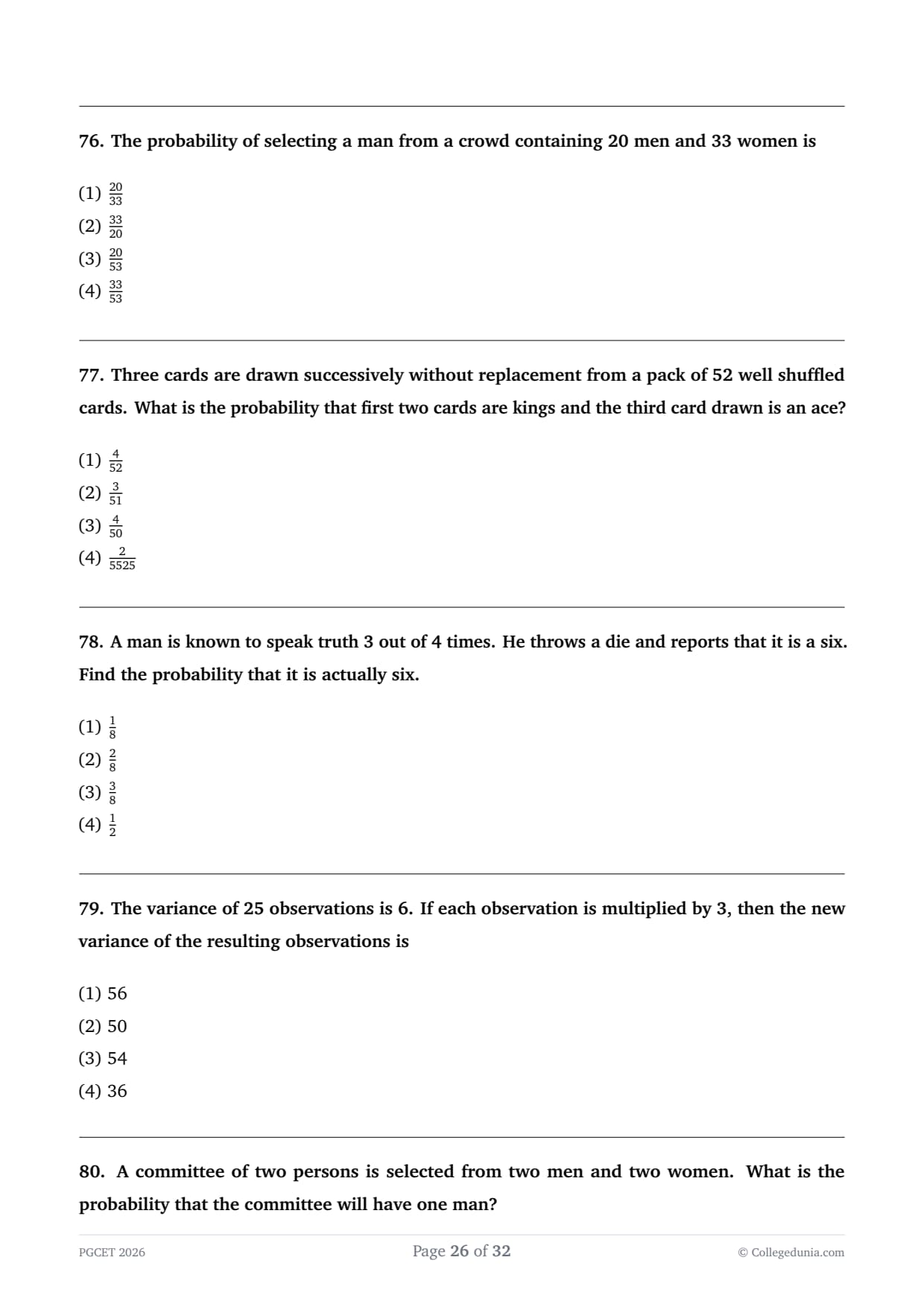
The probability of selecting a man from a crowd containing 20 men and 33 women is
Three cards are drawn successively without replacement from a pack of 52 well shuffled cards. What is the probability that first two cards are kings and the third card drawn is an ace?
A man is known to speak truth 3 out of 4 times. He throws a die and reports that it is a six. Find the probability that it is actually six.
The variance of 25 observations is 6. If each observation is multiplied by 3, then the new variance of the resulting observations is
A committee of two persons is selected from two men and two women. What is the probability that the committee will have one man?
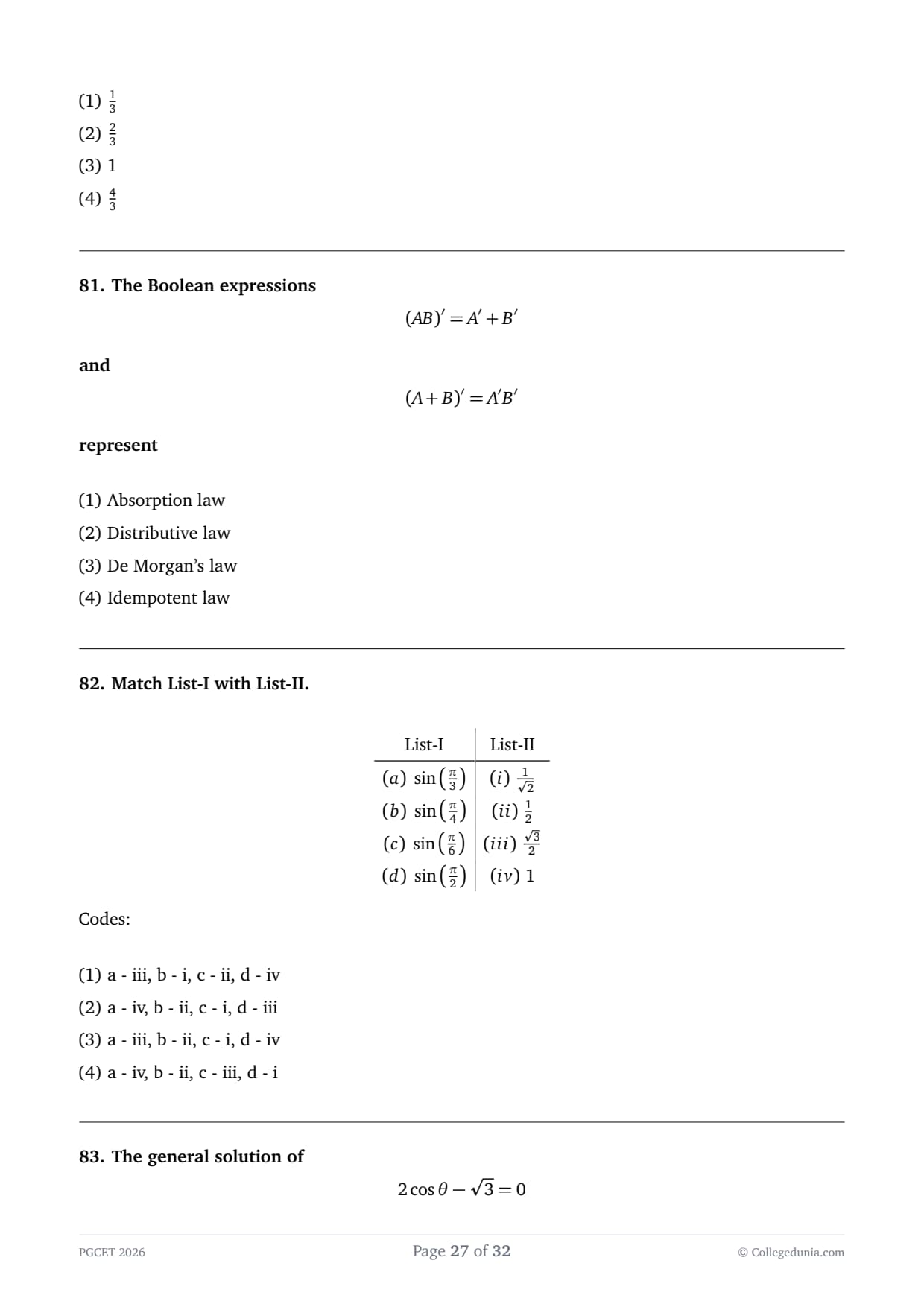
The Boolean expressions \[ (AB)' = A' + B' \]
and \[ (A+B)' = A'B' \]
represent
Match List-I with List-II.

Codes:
The general solution of \[ 2\cos\theta-\sqrt3=0 \]
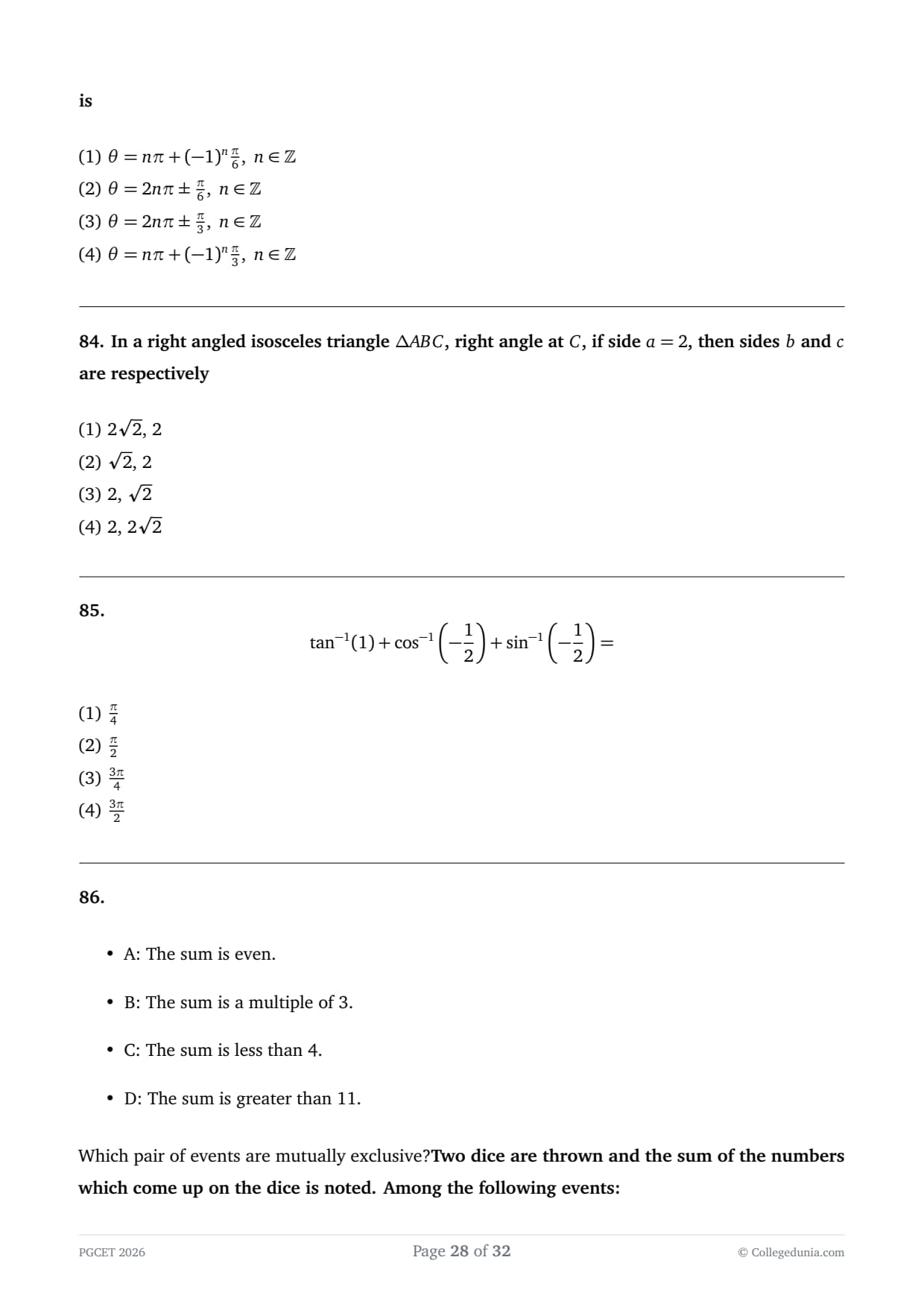
is
In a right angled isosceles triangle \(\Delta ABC\), right angle at \(C\), if side \(a=2\), then sides \(b\) and \(c\) are respectively
\[ \tan^{-1}(1)+\cos^{-1}\left(-\frac12\right)+\sin^{-1}\left(-\frac12\right) = \]
Two dice are thrown and the sum of the numbers which come up on the dice is noted. Among the following events:
A: The sum is even.
B: The sum is a multiple of 3.
C: The sum is less than 4.
D: The sum is greater than 11.
Which pair of events are mutually exclusive?
The average of 5 numbers is 27. If one number is excluded, the average becomes 25. The excluded number is:
If the mean of the distribution is \(5\), then the value of \(P\) is:
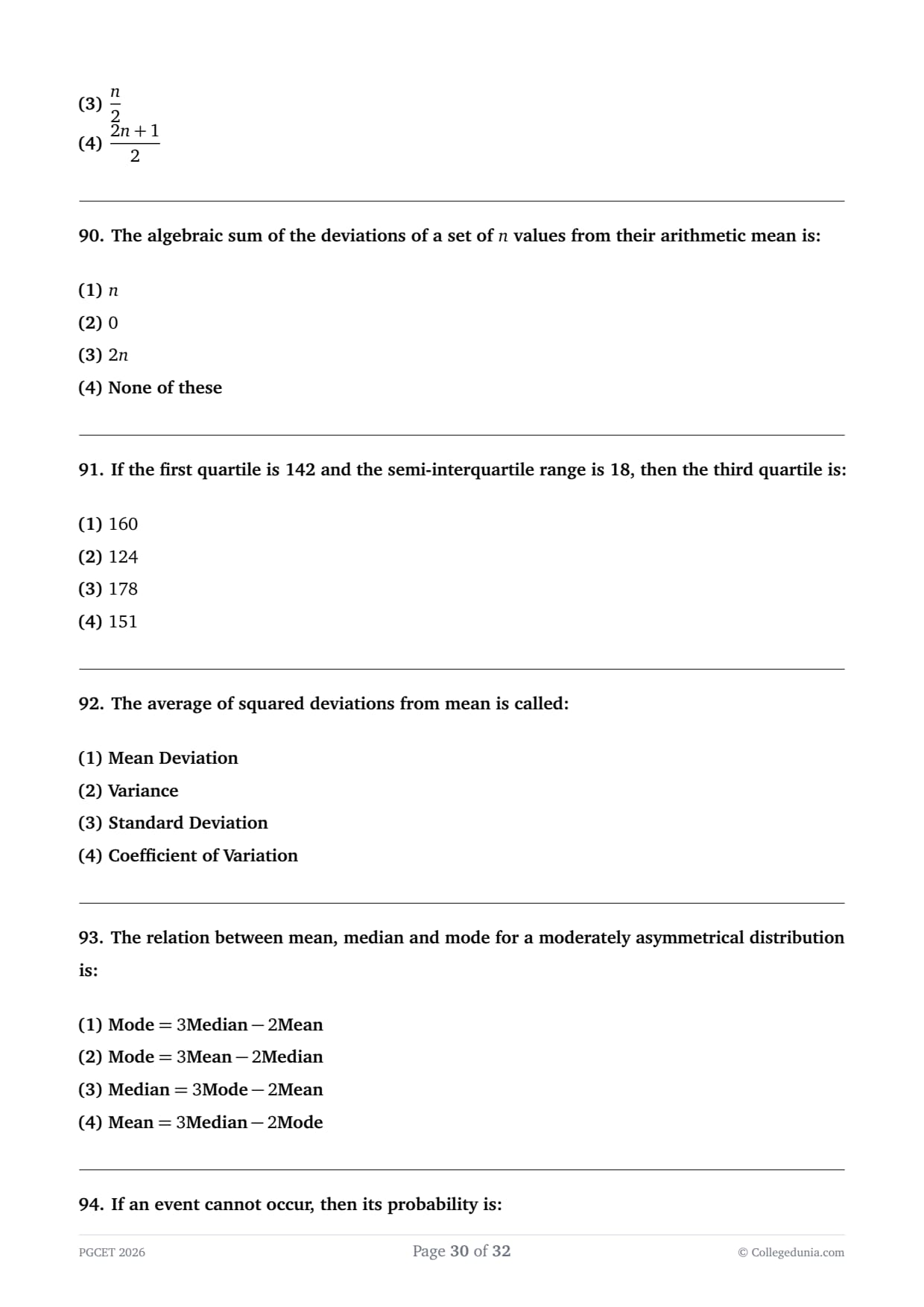
The arithmetic mean of \(1,2,3,\ldots,n\) is:
The algebraic sum of the deviations of a set of \(n\) values from their arithmetic mean is:
If the first quartile is 142 and the semi-interquartile range is 18, then the third quartile is:
The average of squared deviations from mean is called:
The relation between mean, median and mode for a moderately asymmetrical distribution is:
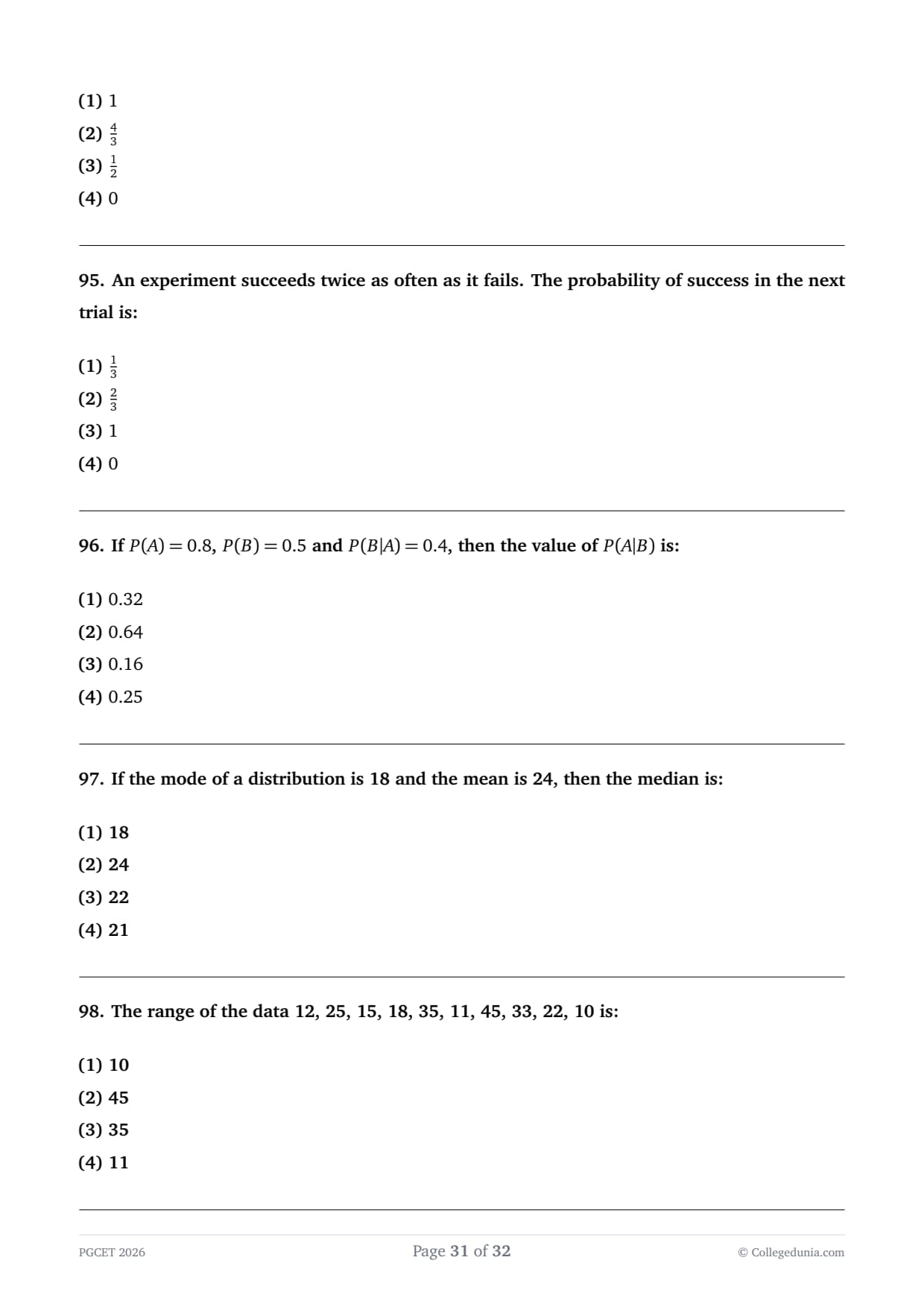
If an event cannot occur, then its probability is:
An experiment succeeds twice as often as it fails. The probability of success in the next trial is:
If \(P(A)=0.8\), \(P(B)=0.5\) and \(P(B|A)=0.4\), then the value of \(P(A|B)\) is:
If the mode of a distribution is 18 and the mean is 24, then the median is:
The range of the data 12, 25, 15, 18, 35, 11, 45, 33, 22, 10 is:
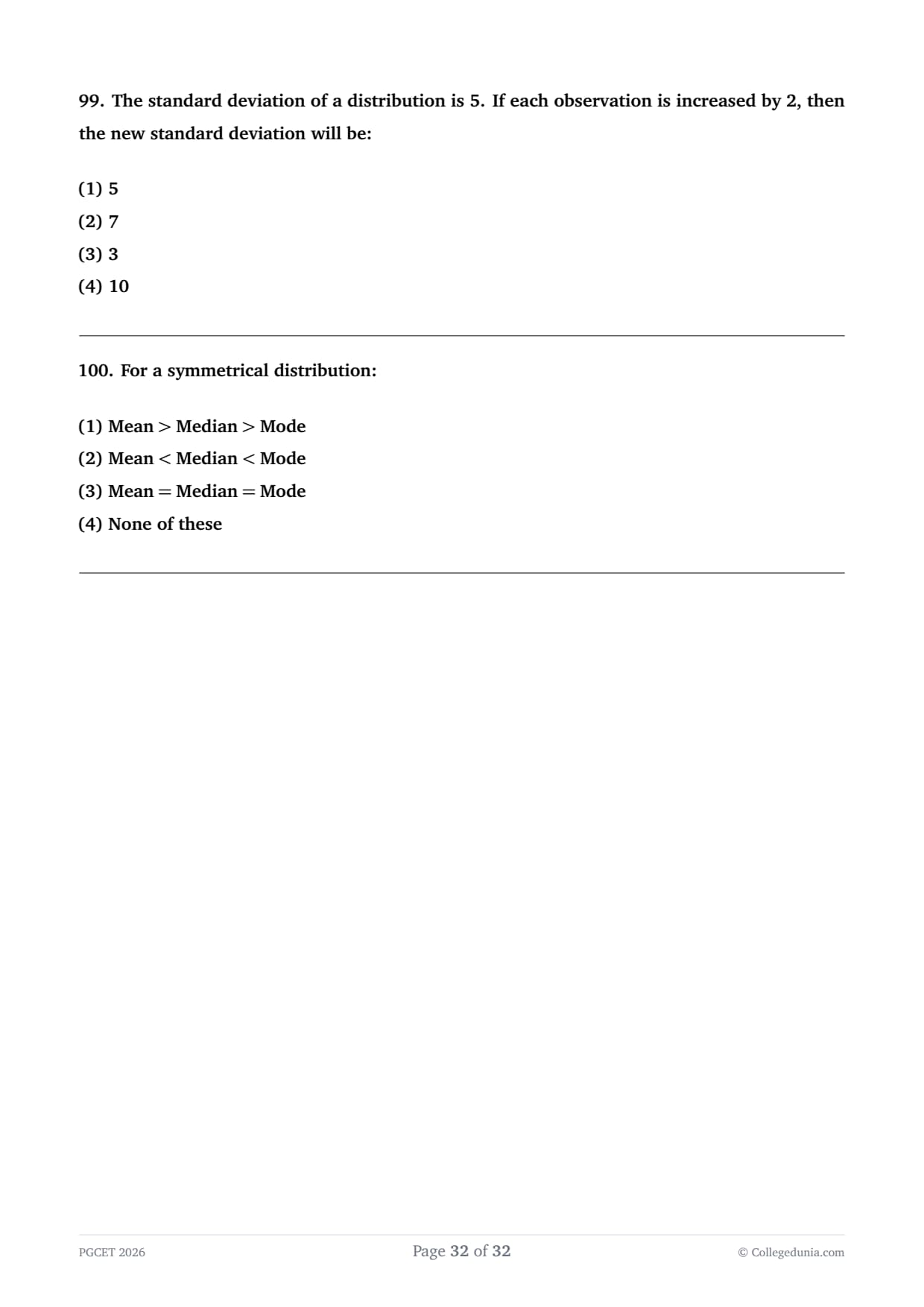
The standard deviation of a distribution is 5. If each observation is increased by 2, then the new standard deviation will be:
For a symmetrical distribution:
Karnataka PGCET 2026 Exam Pattern
| Parameter | Details |
|---|---|
| Exam Mode | OMR based |
| Exam Duration | 120 minutes |
| Question Type | Multiple Choice Questions (MCQs) |
| Total Questions | 100 questions (all compulsory) |
| Maximum Marks | 100 |
| Marking Scheme | +1 for correct, 0 for incorrect |



Comments