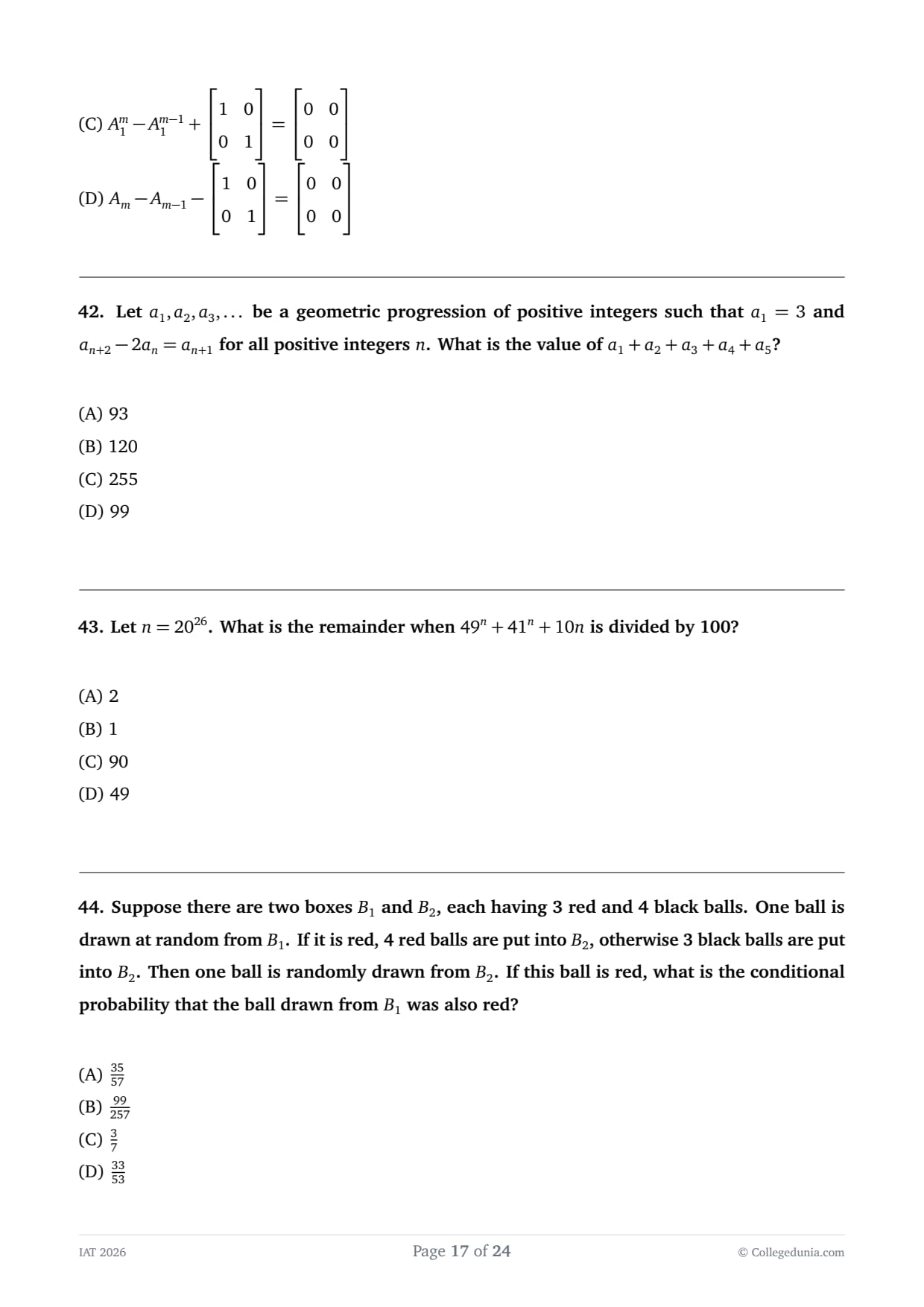
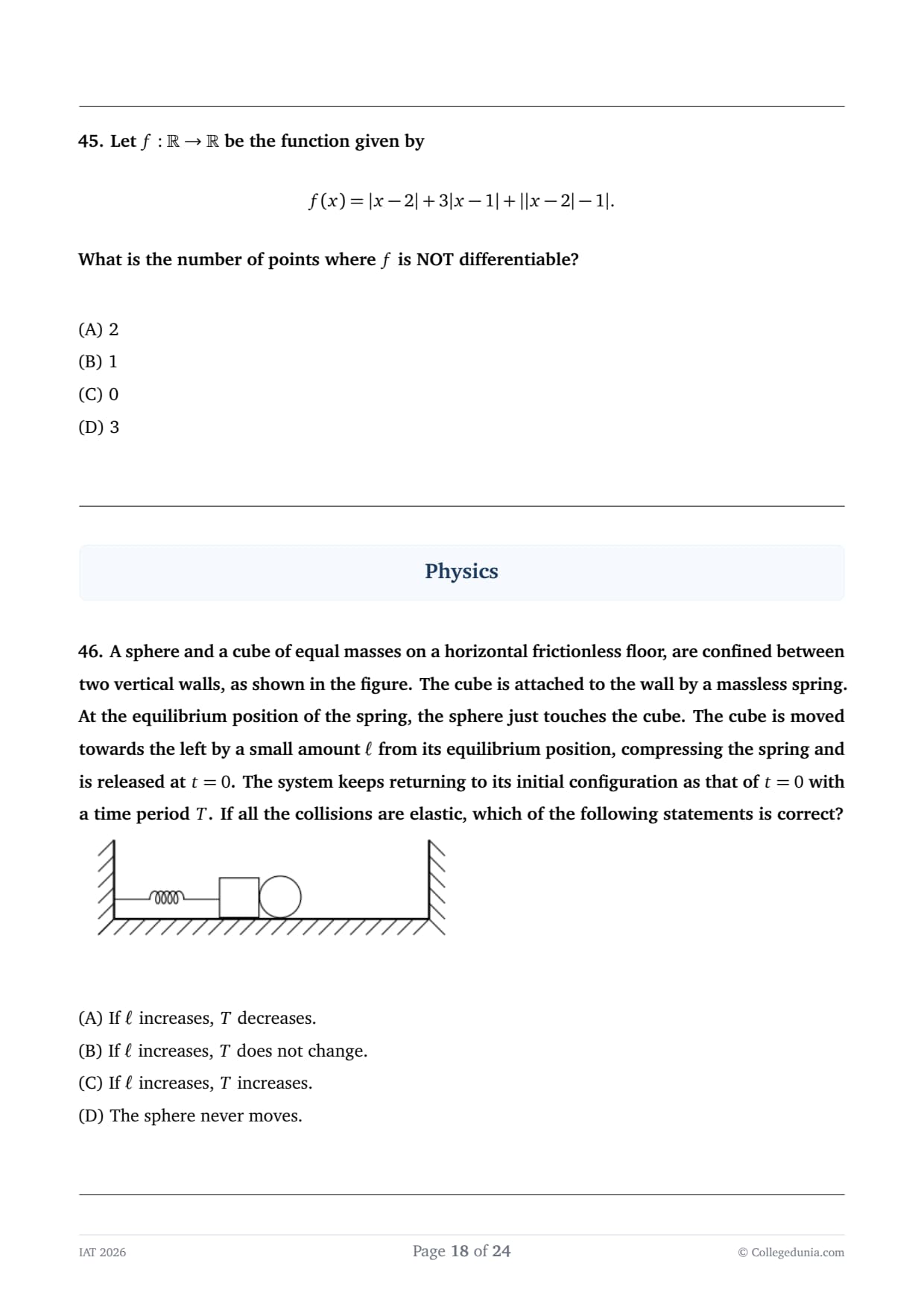
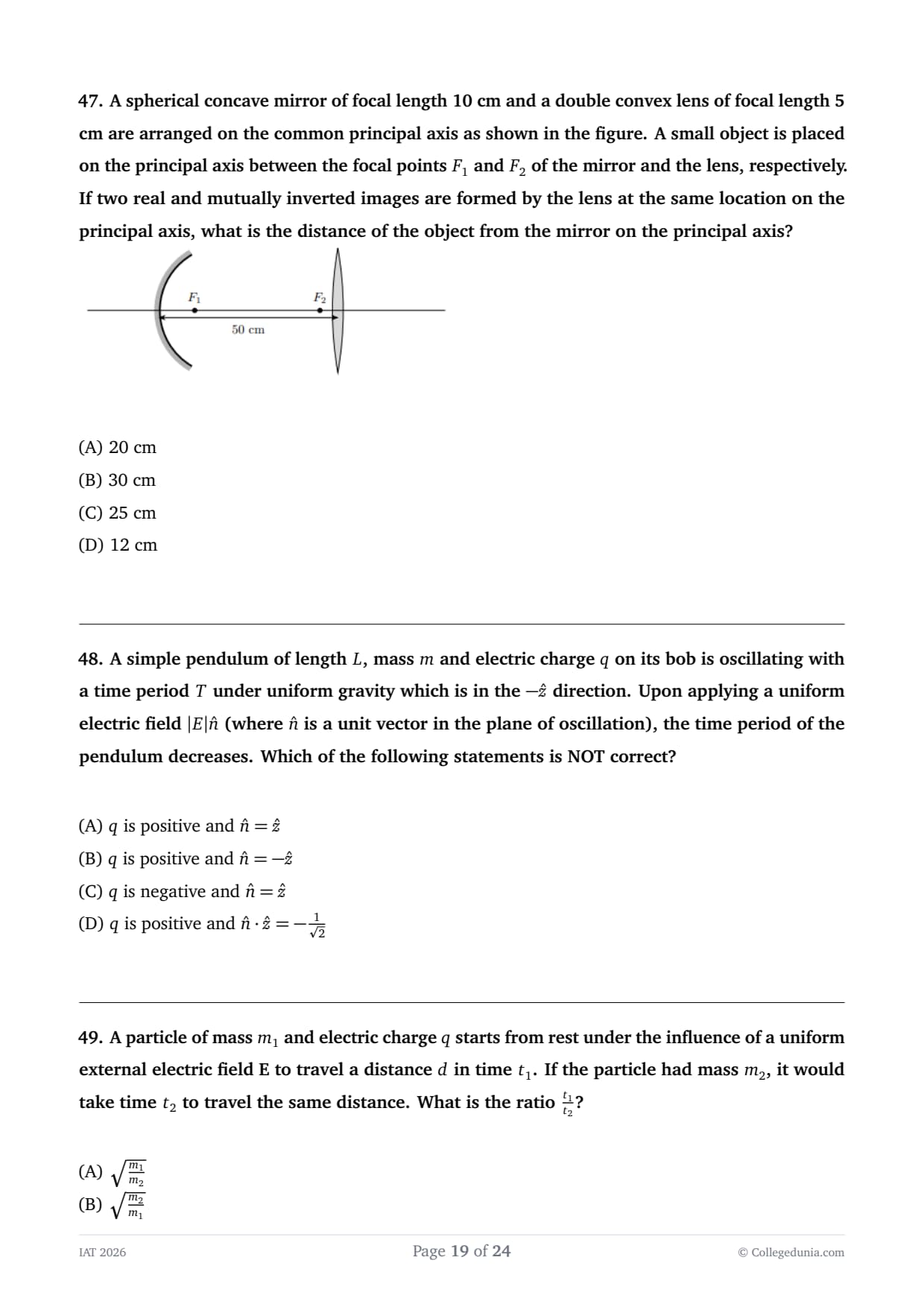
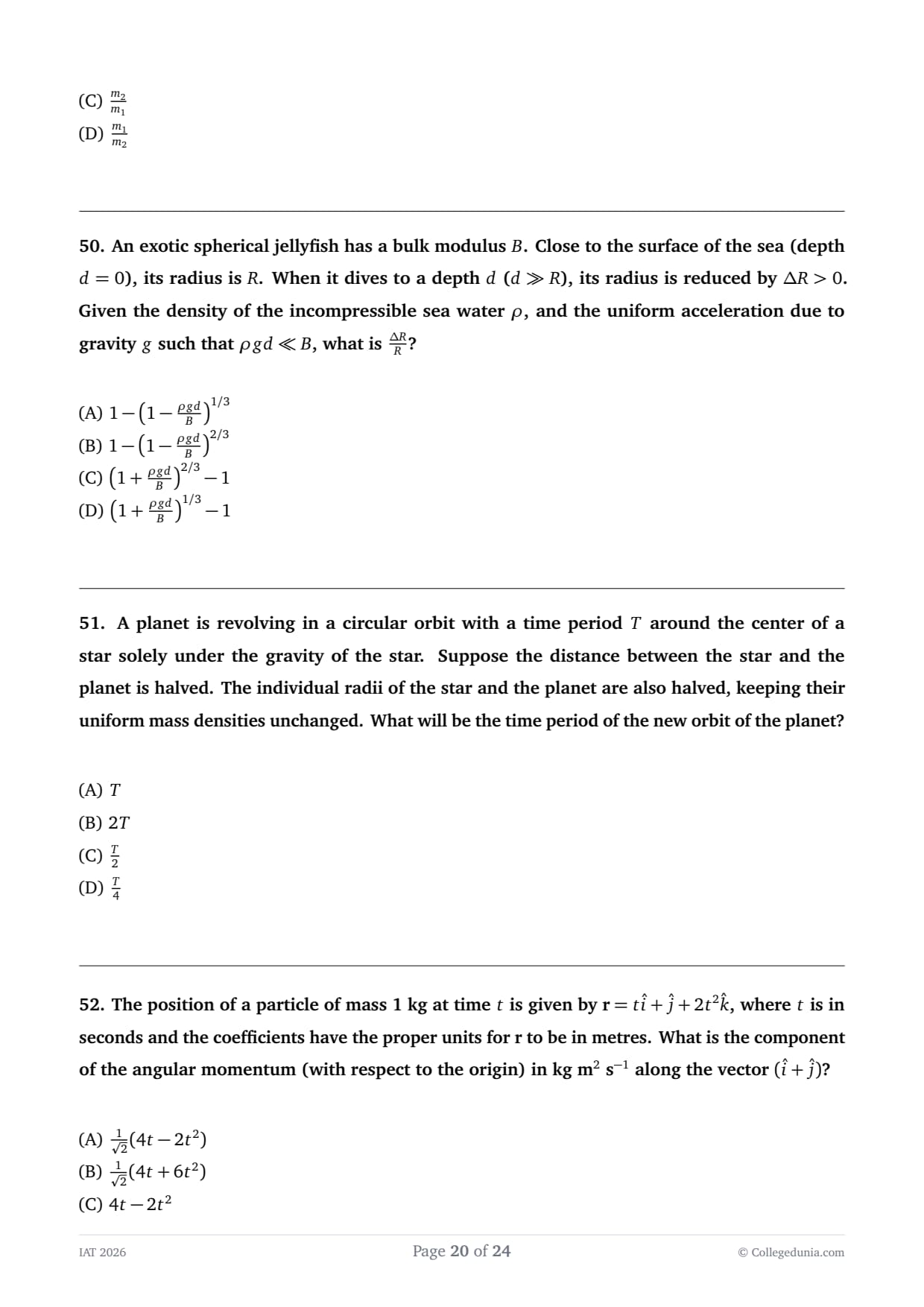
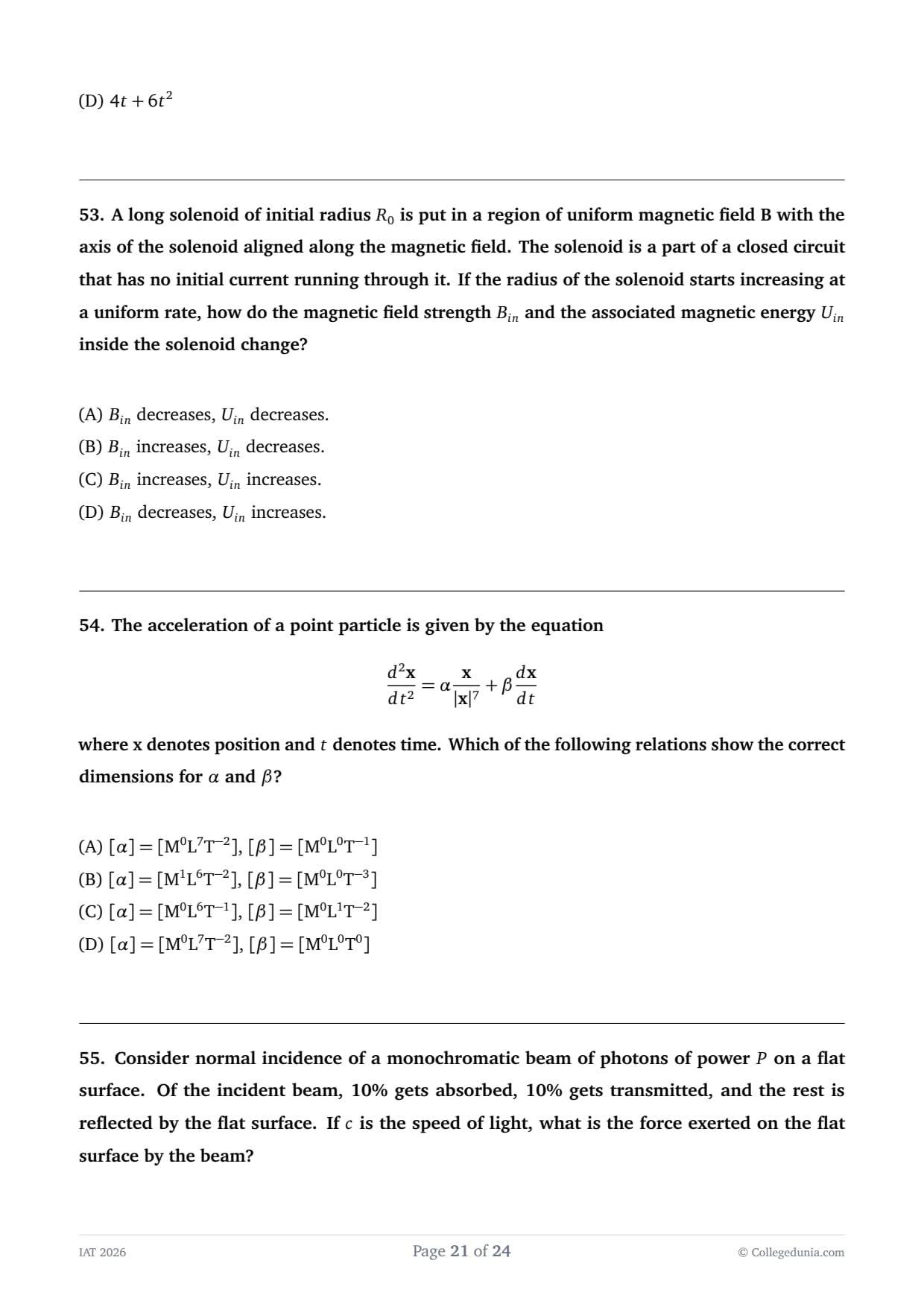
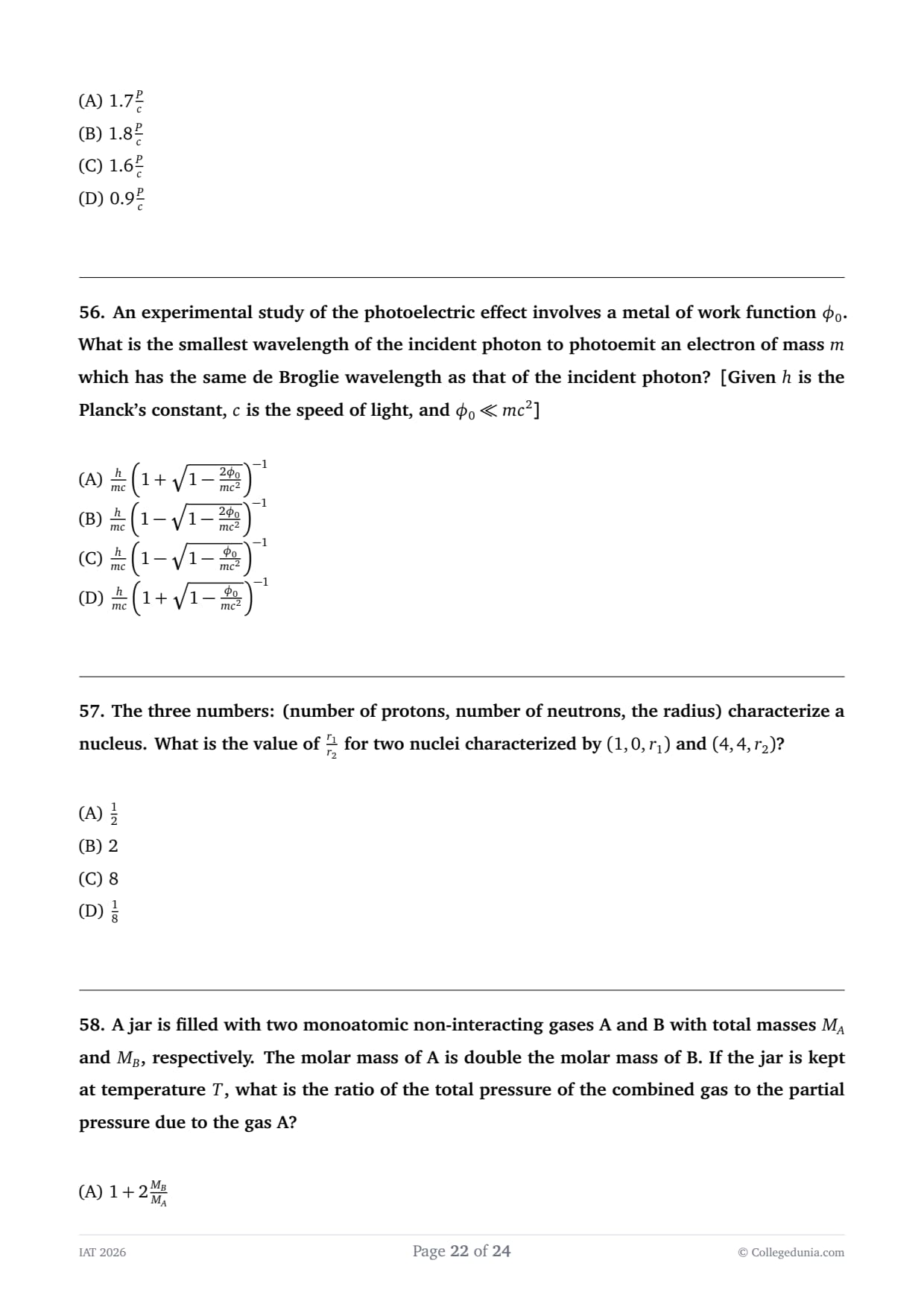
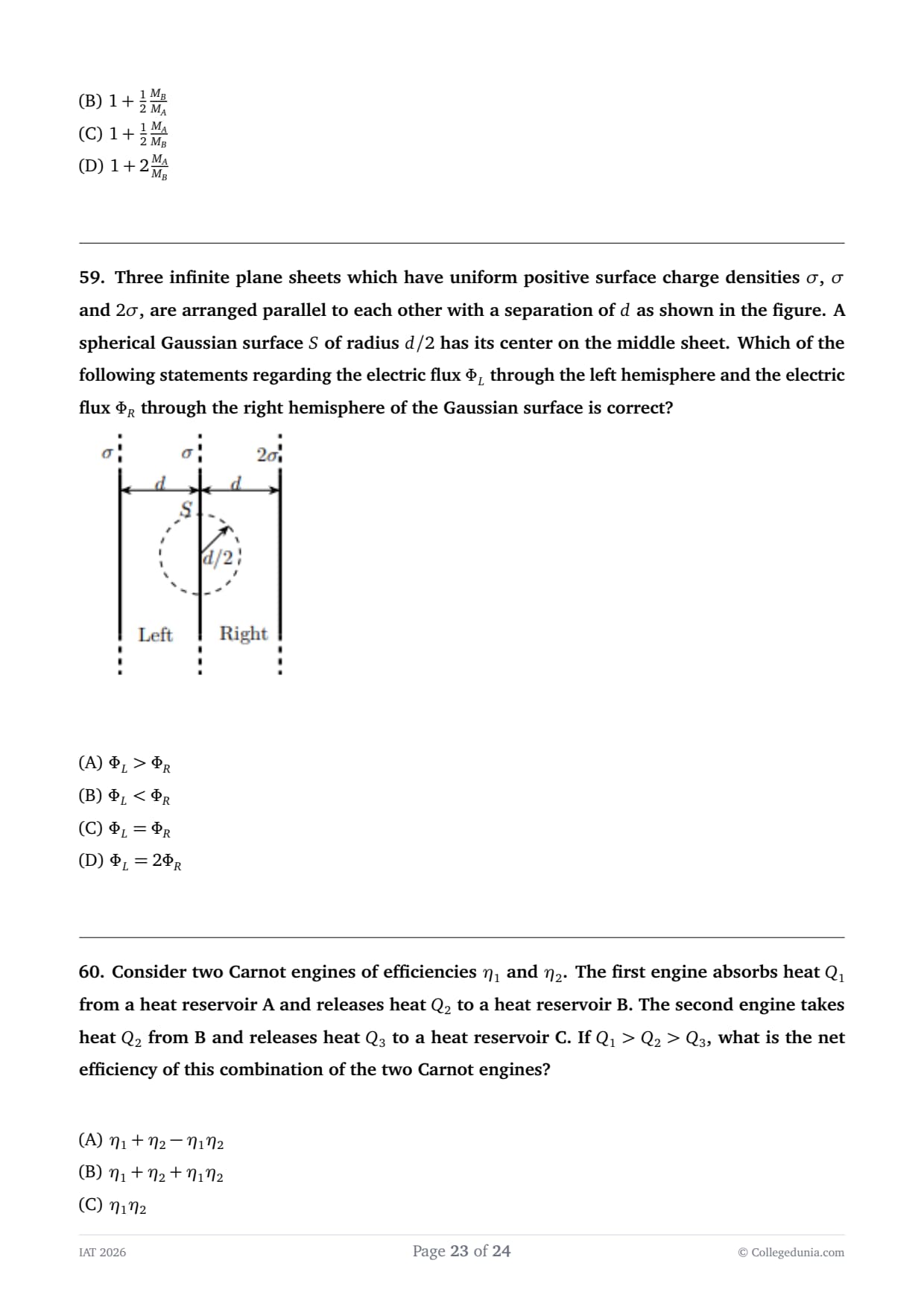
IISER Aptitude Test 2026 Question Paper is available for download. IISER conducted Aptitude Test 2026 on June 7 in single shift from 9 AM to 12 PM.

  • IISER 2026 Question Paper consists of total 60 questions divided into 4 sections –Physics, Chemistry, Mathematics and Biology (15 questions each).
  • As per the IISER 2026 exam pattern 4 marks are awarded for every correct answer and 1 mark is deducted for every wrong answer.
  • The total duration of the exam is 3 hours.

Also Check: IISER Aptitude Test 2026 Answer Key

IISER Aptitude Test 2026 Question Paper with Solutions

IISER Aptitude Test 2026 Question Paper Download PDF Check Solutions

Question 1:

Which of the following processes result in development of a proton gradient across the thylakoid membrane during photosynthesis?

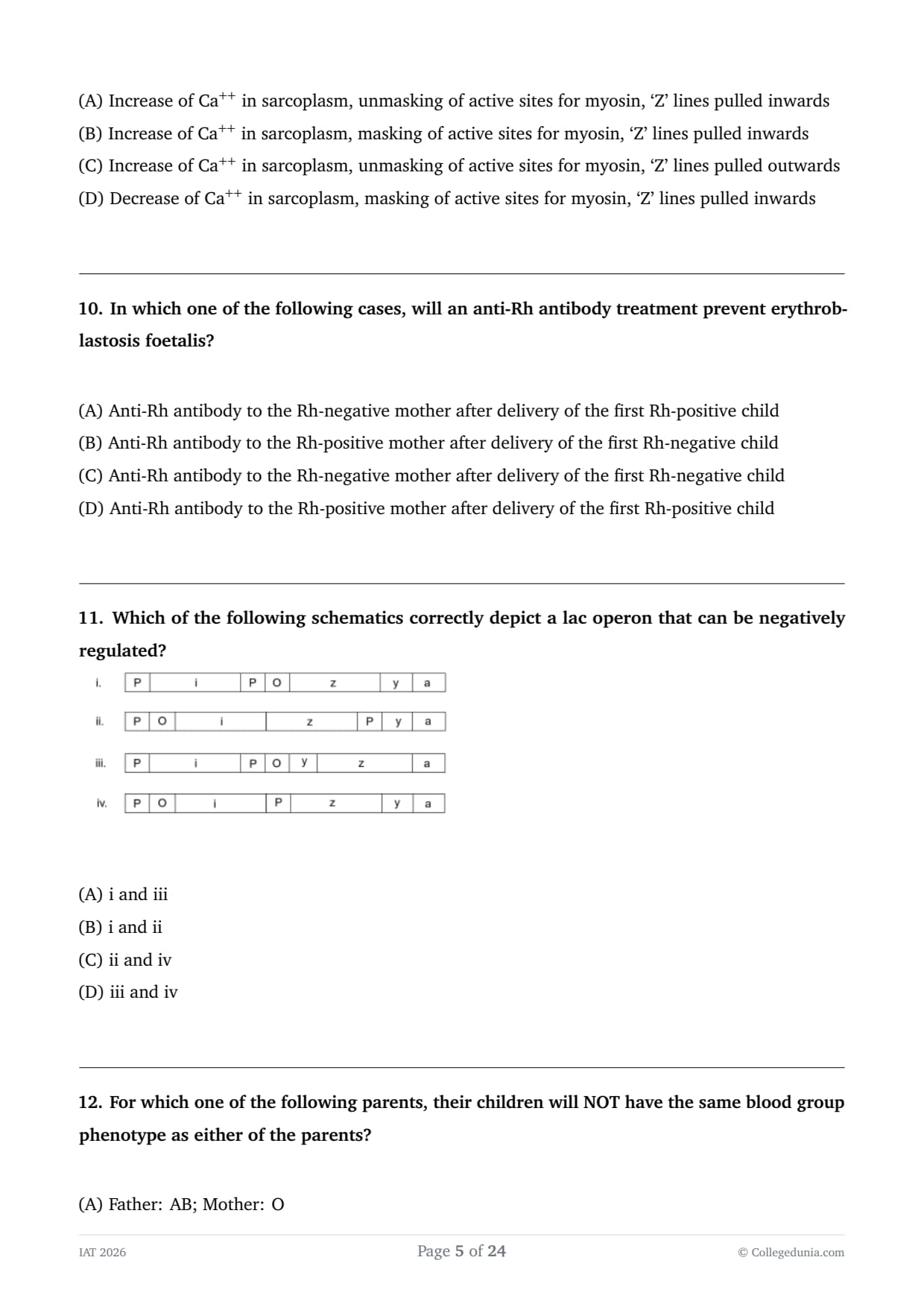
i. Release of protons into the lumen of the thylakoid by plastoquinone

ii. Consumption of protons in the stroma during the reduction of NADP\(^+\)

iii. Release of protons into the lumen of the thylakoid by ATP synthase

iv. Release of protons into the lumen of the thylakoid by water splitting reaction

  • (A) i, ii and iv
  • (B) ii, iii and iv
  • (C) i, iii and iv
  • (D) i, ii and iii
Correct Answer: (A) i, ii and iv
View Solution


Step 1: Understanding the Question:

This question asks us to identify the physiological processes during the light-dependent reactions of photosynthesis that contribute to the generation of a proton gradient (\(\Delta pH\)) across the thylakoid membrane of chloroplasts.

The proton gradient is essential for driving ATP synthesis via chemiosmosis.


Step 2: Key Formula or Approach:

The chemiosmotic hypothesis states that a high concentration of protons (\(H^+\)) must accumulate inside the thylakoid lumen relative to the stroma.

Any process that either increases the proton concentration inside the lumen or decreases the proton concentration in the stroma will help develop or maintain this gradient.


Step 3: Detailed Explanation:


Statement i (Correct): Plastoquinone (PQ) is a mobile electron carrier in the thylakoid membrane.

When PQ receives electrons from Photosystem II, it also picks up protons from the stroma to form plastoquinol (\(PQH_2\)).

As \(PQH_2\) transfers its electrons to the Cytochrome \(b_6f\) complex, it releases these protons directly into the thylakoid lumen, increasing the lumenal proton concentration.

Statement ii (Correct): On the stromal side of the thylakoid membrane, the enzyme NADP\(^+\) reductase catalyzes the reduction of \(NADP^+\) to \(NADPH + H^+\).

This reaction consumes free protons from the stroma, which directly decreases the proton concentration in the stroma and enhances the gradient.

Statement iii (Incorrect): ATP synthase does not release protons into the lumen.

Instead, ATP synthase acts as a channel that allows protons to flow down their electrochemical gradient out of the thylakoid lumen and back into the stroma.

This passive transport of protons dissipates the gradient rather than developing it.

Statement iv (Correct): The water-splitting complex (oxygen-evolving complex) is associated with Photosystem II on the inner (lumenal) side of the thylakoid membrane.

The photolysis of water molecule splits water into oxygen, electrons, and protons:
\[ 2H_2O \rightarrow O_2 + 4H^+ + 4e^- \]
These protons are directly released into the thylakoid lumen, significantly contributing to the high proton concentration there.


Step 4: Final Answer:

Since processes i, ii, and iv contribute to generating the proton gradient, the correct combination is i, ii, and iv.
Quick Tip: Remember that the thylakoid lumen becomes highly acidic (high \(H^+\) concentration) while the stroma remains basic (low \(H^+\) concentration).
Water splitting (internal) and plastoquinone pumping (inward) add protons to the lumen, while NADP\(^+\) reduction (external) removes protons from the stroma.
ATP synthase acts as the "drain" that lets protons escape from the lumen to make ATP.


Question 2:

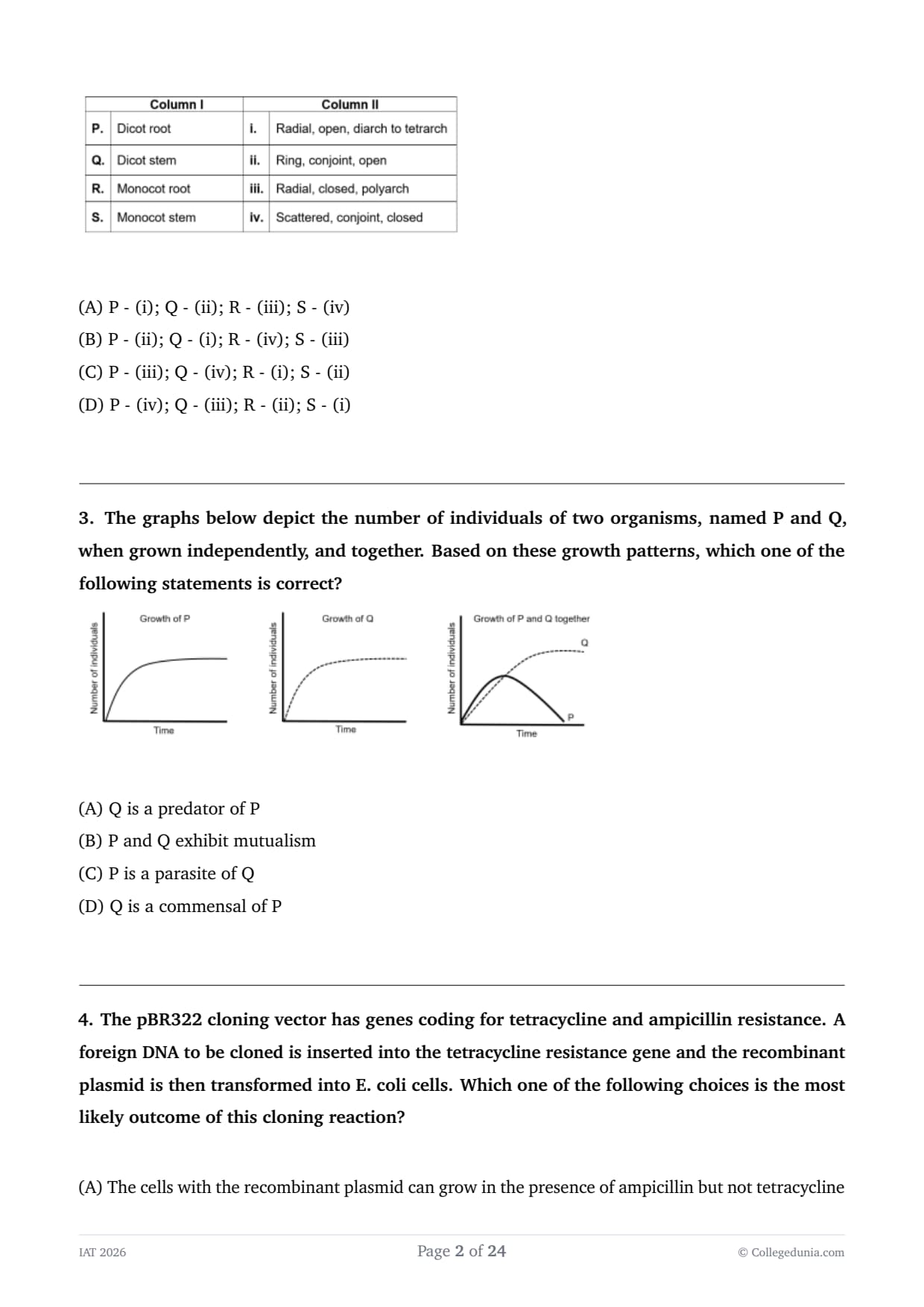
Which one of the following choices matches the organs in column I with their vascular system arrangement described in column II?

  • (A) P - (i); Q - (ii); R - (iii); S - (iv)
  • (B) P - (ii); Q - (i); R - (iv); S - (iii)
  • (C) P - (iii); Q - (iv); R - (i); S - (ii)
  • (D) P - (iv); Q - (iii); R - (ii); S - (i)
Correct Answer: (A) P - (i); Q - (ii); R - (iii); S - (iv)
View Solution


Step 1: Understanding the Question:

The question requires matching different plant organs (roots and stems of monocots and dicots) with their characteristic anatomical arrangements of vascular tissues (xylem and phloem).


Step 2: Key Formula or Approach:

To solve matching questions in plant anatomy, recall key classification criteria:

1. Roots always have a "radial" vascular arrangement where xylem and phloem are on different radii.

2. Stems always have a "conjoint" arrangement where xylem and phloem are on the same radius.

3. "Open" vascular bundles contain cambium (allowing secondary growth, characteristic of dicots).

4. "Closed" vascular bundles lack cambium (characteristic of monocots).


Step 3: Detailed Explanation:

Let's analyze each organ systematically:


P. Dicot root:

- Roots have radial vascular bundles.

- They are typically diarch to tetrarch (containing 2 to 4 xylem/phloem groups).

- While primary root vascular bundles are technically closed initially, they are termed "open" in a developmental sense because a secondary cambium ring forms later to initiate secondary growth.

- Thus, P matches with (i) (Radial, open, diarch to tetrarch).

Q. Dicot stem:

- Dicot stems are characterized by vascular bundles arranged in a distinct ring.

- The bundles are conjoint (xylem and phloem together on the same radius), collateral, and open (possessing intrafascicular cambium).

- Thus, Q matches with (ii) (Ring, conjoint, open).

R. Monocot root:

- Monocot roots have radial vascular bundles.

- They contain many vascular bundles, typically more than six, which is termed polyarch.

- They lack cambium completely, making them closed.

- Thus, R matches with (iii) (Radial, closed, polyarch).

S. Monocot stem:

- Monocot stems have numerous vascular bundles scattered throughout the ground tissue.

- The bundles are conjoint and closed (no cambium present).

- Thus, S matches with (iv) (Scattered, conjoint, closed).


Step 4: Final Answer:

Matching these up: P - (i), Q - (ii), R - (iii), S - (iv). This corresponds perfectly to option (A).
Quick Tip: A quick shortcut for vascular bundles:
Root = Radial (R with R)
Stem = Conjoint
Dicot = Open (capable of secondary growth)
Monocot = Closed
Monocot root has Polyarch xylem (Poly = many).


Question 3:

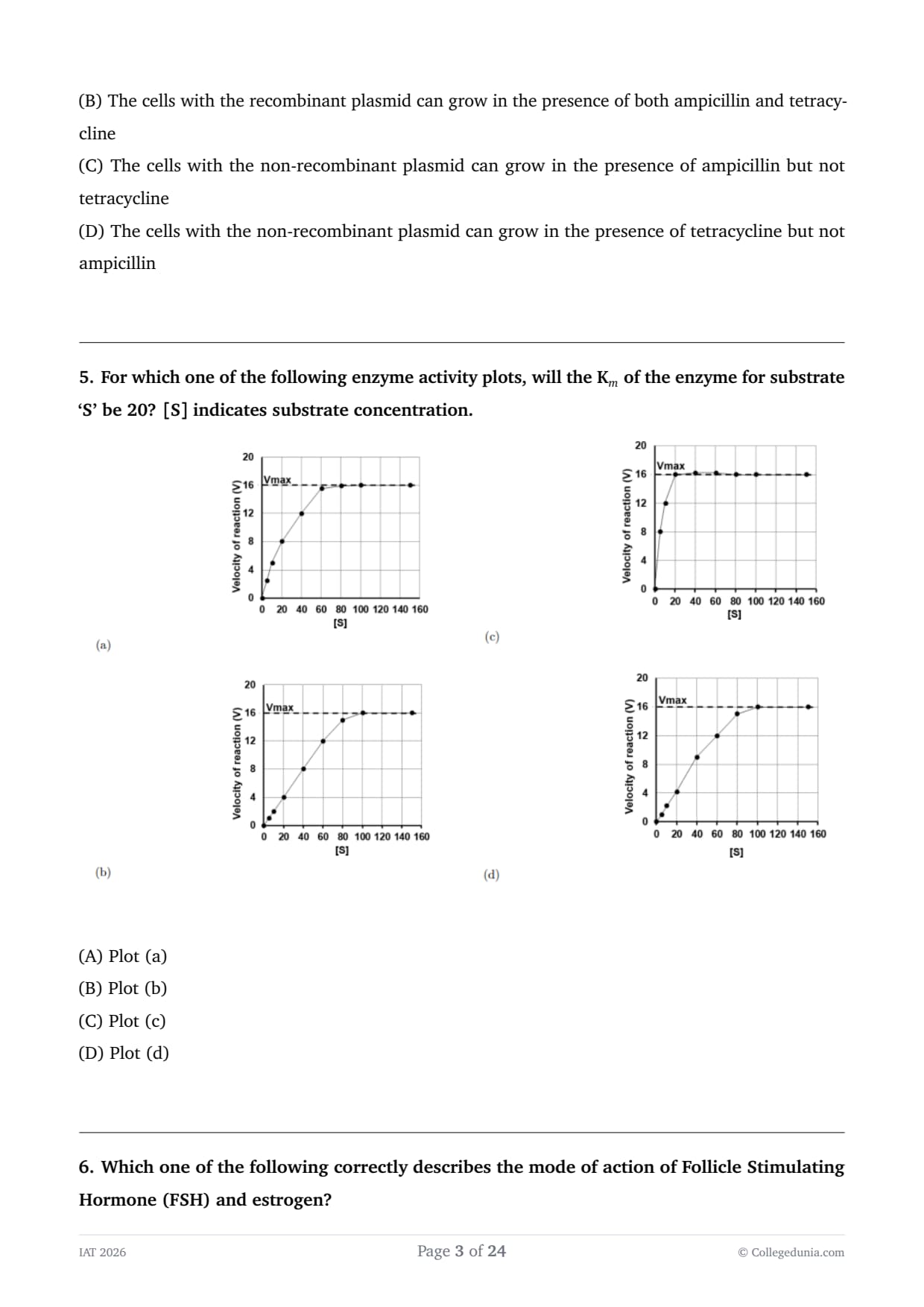
The graphs below depict the number of individuals of two organisms, named P and Q, when grown independently, and together. Based on these growth patterns, which one of the following statements is correct?

  • (A) Q is a predator of P
  • (B) P and Q exhibit mutualism
  • (C) P is a parasite of Q
  • (D) Q is a commensal of P
Correct Answer: (A) Q is a predator of P
View Solution


Step 1: Understanding the Question:

This question tests our ability to interpret population growth curves of two species under separate (independent) and mixed (together) culture conditions to determine the nature of their ecological interaction.


Step 2: Key Formula or Approach:

Evaluate the population dynamics shown in the three graphs:

1. Growth of P independently: P shows a typical sigmoidal (logistic) growth curve, reaching a stable carrying capacity.

2. Growth of Q independently: Q also shows a sigmoidal growth curve, reaching its own carrying capacity.

3. Growth of P and Q together: Q's population grows successfully to a high carrying capacity. In contrast, P's population initially rises slightly and then crashes rapidly to zero (extinction).


Step 3: Detailed Explanation:

Let's analyze the ecological options based on these observations:


Why Mutualism is incorrect: In a mutualistic relationship, both species benefit (\(+/+\)). When grown together, both P and Q should show enhanced growth or at least survive together. Here, P is driven to extinction, which contradicts mutualism.

Why Commensalism is incorrect: In commensalism, one species benefits while the other is unaffected (\(+/0\)). Since P is completely eliminated, it is highly affected, ruling out commensalism.

Why Parasitism is incorrect: If P were a parasite of Q, P would depend on host Q for survival. A parasite does not typically drive its host to extinction while thriving independently. Furthermore, if P is the parasite, it should do better when Q is present, but here P goes extinct when grown with Q.

Why Predation is correct: When a predator (Q) and prey (P) are grown together in a confined space without refuges, the predator Q consumes the prey P. This intense predation leads to the rapid decline and eventual local extinction of the prey population (P).

Since Q can also grow independently (perhaps using an alternative food source provided in the medium), it continues to survive and reach its carrying capacity after consuming all of P.


Step 4: Final Answer:

The sharp decline of P to zero and the robust growth of Q when cultured together indicates that Q acts as a predator that eliminates its prey P.
Quick Tip: In ecological interaction graphs:
If one species dies out completely in the presence of another while both can live fine alone, it indicates either competitive exclusion or intense predation.
Since "competition" is not in the options, "Q is a predator of P" is the most logical answer as the predator eats up the entire prey population in a closed system.


Question 4:

The pBR322 cloning vector has genes coding for tetracycline and ampicillin resistance. A foreign DNA to be cloned is inserted into the tetracycline resistance gene and the recombinant plasmid is then transformed into E. coli cells. Which one of the following choices is the most likely outcome of this cloning reaction?

  • (A) The cells with the recombinant plasmid can grow in the presence of ampicillin but not tetracycline
  • (B) The cells with the recombinant plasmid can grow in the presence of both ampicillin and tetracycline
  • (C) The cells with the non-recombinant plasmid can grow in the presence of ampicillin but not tetracycline
  • (D) The cells with the non-recombinant plasmid can grow in the presence of tetracycline but not ampicillin
Correct Answer: (A) The cells with the recombinant plasmid can grow in the presence of ampicillin but not tetracycline
View Solution


Step 1: Understanding the Question:

This question is based on recombinant DNA selection using the plasmid vector pBR322. We need to determine the growth phenotypes of host bacterial cells containing either recombinant or non-recombinant plasmids.


Step 2: Key Formula or Approach:

Recall the concept of insertional inactivation.

When a foreign DNA sequence is ligated into a restriction site located within the coding sequence of an antibiotic resistance gene, it disrupts the open reading frame of that gene.

As a result, the gene becomes non-functional, and the host cell loses resistance to that specific antibiotic.


Step 3: Detailed Explanation:


The plasmid pBR322 naturally carries two selectable marker genes:

1. \(amp^R\) (conferring resistance to ampicillin)

2. \(tet^R\) (conferring resistance to tetracycline)

During the cloning experiment, the foreign gene of interest is inserted into a restriction site situated inside the \(tet^R\) gene.

This insertion disrupts the \(tet^R\) gene, leading to its inactivation. Consequently, the recombinant plasmid loses the ability to express a functional protein that protects against tetracycline.

However, the \(amp^R\) gene remains completely intact and functional because no insertion occurred within its sequence.

Therefore, host E. coli cells transformed with the recombinant plasmid will:

- Survive and grow on media containing ampicillin.

- Die on media containing tetracycline.

In contrast, non-recombinant plasmids (which did not take up the insert) retain both fully functional \(amp^R\) and \(tet^R\) genes, allowing their transformants to grow on both antibiotics.


Step 4: Final Answer:

Recombinant plasmid-containing cells are ampicillin-resistant but tetracycline-sensitive, matching option (A).
Quick Tip: Insertional Inactivation Rule:
Whichever marker gene you "insert" into is "inactivated" (destroyed).
Inserted in \(tet^R\) \(\rightarrow\) Tetracycline resistance is lost.
Inserted in \(amp^R\) \(\rightarrow\) Ampicillin resistance is lost.
The other marker gene remains perfectly intact and serves for primary selection.


Question 5:

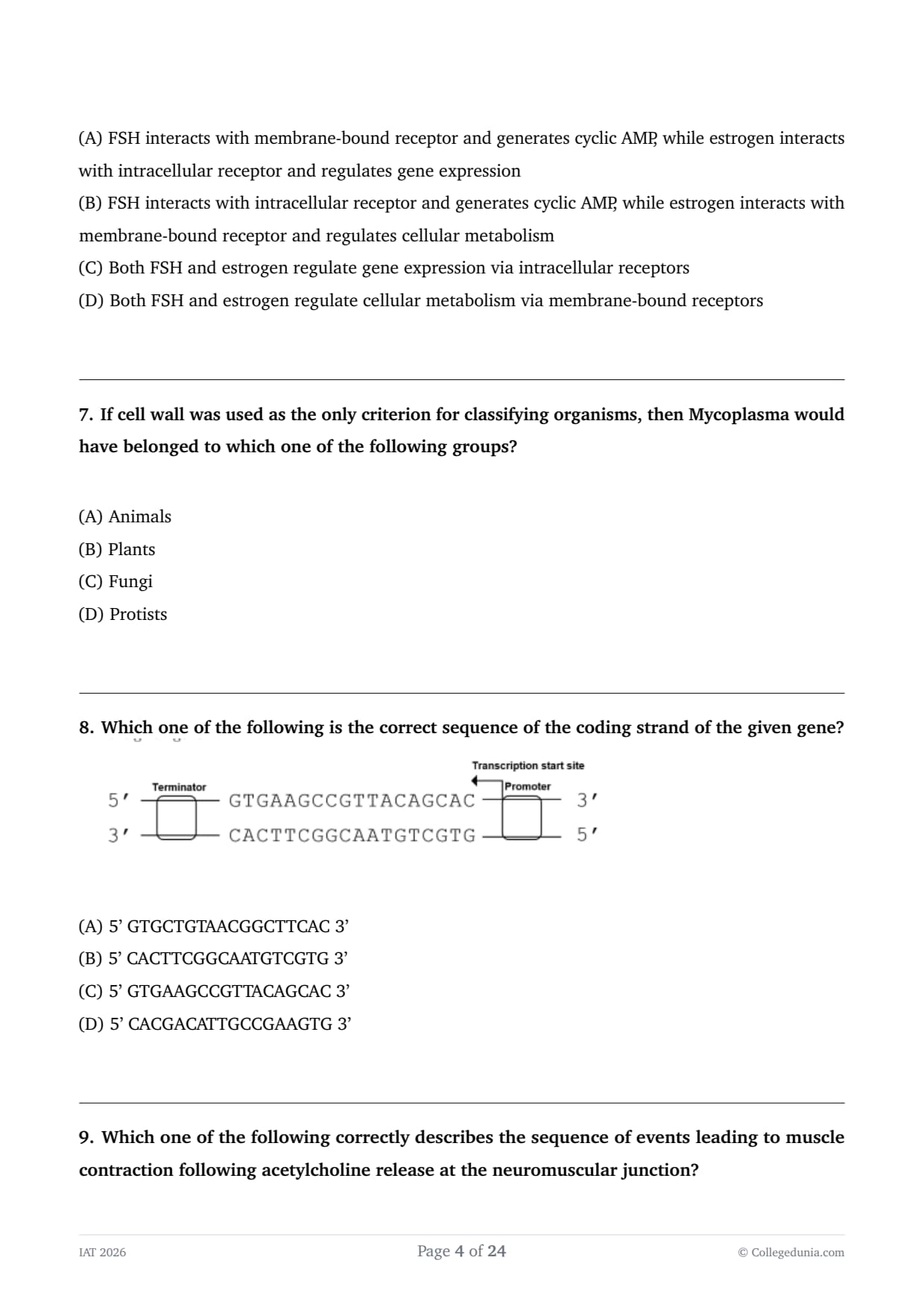
For which one of the following enzyme activity plots, will the K\(_m\) of the enzyme for substrate `S' be 20? [S] indicates substrate concentration.


  • (A) Plot (a)
  • (B) Plot (b)
  • (C) Plot (c)
  • (D) Plot (d)
Correct Answer: (A) Plot (a)
View Solution


Step 1: Understanding the Question:

This question asks us to identify the graph in which the Michaelis constant (\(K_m\)) of the enzyme-catalyzed reaction is exactly equal to 20.


Step 2: Key Formula or Approach:

The Michaelis constant (\(K_m\)) is defined as the substrate concentration \([S]\) at which the initial reaction velocity (\(V\)) is exactly half of the maximum velocity (\(V_{max}\)).
\[ V = \frac{V_{max}}{2} \quad when \quad [S] = K_m \]
We can solve this graphically by:

1. Identifying \(V_{max}\) from the plateau of the curve.

2. Calculating \(V_{max}/2\).

3. Finding the substrate concentration \([S]\) on the x-axis corresponding to this half-maximal velocity on the y-axis.


Step 3: Detailed Explanation:

Let's analyze the graphs provided:


In all four plots, the dashed horizontal line representing \(V_{max}\) is at \(V = 16\).

- Therefore, \(V_{max} = 16\) units.

- Half of the maximum velocity is:
\[ \frac{V_{max}}{2} = \frac{16}{2} = 8 units \]
We are looking for the plot where \(K_m = 20\). This means that at a substrate concentration \([S] = 20\), the velocity \(V\) must be exactly 8.

Let's check each graph at \([S] = 20\):

- Plot (a): At \([S] = 20\) on the x-axis, follow the grid line vertically to the curve. The corresponding value on the y-axis (velocity) is exactly 8. This fits our condition perfectly. Thus, \(K_m = 20\).

- Plot (b): At \([S] = 20\), the velocity is around 4. The velocity reaches 8 at \([S] = 40\). Thus, \(K_m = 40\).

- Plot (c): The velocity increases very steeply. At \([S] = 20\), the velocity is already near \(V_{max}\) (around 16). The velocity is 8 at a much lower concentration, around \([S] = 5\). Thus, \(K_m \approx 5\).

- Plot (d): At \([S] = 20\), the velocity is around 4. The curve is sigmoidal and doesn't hit 8 until a much higher concentration.


Step 4: Final Answer:

Only Plot (a) shows a half-maximal velocity of 8 at \([S] = 20\), so the correct option is (A).
Quick Tip: To quickly find \(K_m\) from a Michaelis-Menten plot:
1. Look at the flat top value (\(V_{max}\)).
2. Cut it in half.
3. Go horizontally from that half-value on the y-axis to the curve, and then look straight down to read the concentration on the x-axis.


Question 6:

Which one of the following correctly describes the mode of action of Follicle Stimulating Hormone (FSH) and estrogen?

  • (A) FSH interacts with membrane-bound receptor and generates cyclic AMP, while estrogen interacts with intracellular receptor and regulates gene expression
  • (B) FSH interacts with intracellular receptor and generates cyclic AMP, while estrogen interacts with membrane-bound receptor and regulates cellular metabolism
  • (C) Both FSH and estrogen regulate gene expression via intracellular receptors
  • (D) Both FSH and estrogen regulate cellular metabolism via membrane-bound receptors
Correct Answer: (A) FSH interacts with membrane-bound receptor and generates cyclic AMP, while estrogen interacts with intracellular receptor and regulates gene expression
View Solution


Step 1: Understanding the Question:

This question asks us to compare the mechanisms of action and signal transduction pathways of two different classes of hormones: Follicle Stimulating Hormone (FSH) and estrogen.


Step 2: Key Formula or Approach:

Hormones are classified biochemically into two main categories which dictate their mode of action:

1. Water-soluble hormones (e.g., proteins/peptides): Cannot cross the lipid bilayer of the cell membrane, so they bind to extracellular, membrane-bound receptors and utilize second messengers.

2. Lipid-soluble hormones (e.g., steroids): Readily diffuse through the cell membrane and bind to intracellular receptors to directly alter gene transcription.


Step 3: Detailed Explanation:


Follicle Stimulating Hormone (FSH):

- FSH is a glycoprotein (peptide) hormone secreted by the anterior pituitary.

- Because it is large and hydrophilic, it cannot cross the hydrophobic plasma membrane of its target cells (granulosa cells in ovaries, Sertoli cells in testes).

- It binds to specific extracellular GPCRs (G-Protein Coupled Receptors) on the cell membrane.

- This binding activates the enzyme adenylyl cyclase, which catalyzes the conversion of ATP into cyclic AMP (cAMP), a second messenger that triggers a downstream kinase cascade.

Estrogen:

- Estrogen is a lipophilic steroid hormone derived from cholesterol.

- It easily diffuses across the phospholipid bilayer of the target cell membrane.

- Inside the cell, it binds to specific intracellular receptors (specifically estrogen receptors located in the cytoplasm or nucleus).

- The hormone-receptor complex then translocates to the nucleus, where it binds directly to hormone response elements on DNA to regulate transcription and gene expression.


Step 4: Final Answer:

FSH acts via membrane-bound receptors and cyclic AMP, while estrogen acts via intracellular receptors regulating gene expression. This corresponds to option (A).
Quick Tip: Protein/Peptide Hormones (FSH, LH, Insulin, Glucagon) = Membrane receptors + Second messenger (cAMP, \(IP_3\), \(Ca^{2+}\)).
Steroid/Thyroid Hormones (Estrogen, Progesterone, Testosterone, Thyroxine) = Intracellular/Nuclear receptors + Direct Gene Regulation.


Question 7:

If cell wall was used as the only criterion for classifying organisms, then Mycoplasma would have belonged to which one of the following groups?

  • (A) Animals
  • (B) Plants
  • (C) Fungi
  • (D) Protists
Correct Answer: (A) Animals
View Solution


Step 1: Understanding the Question:

The question poses a hypothetical taxonomic scenario: if the presence or absence of a cell wall was the sole criterion used to classify all living organisms, to which major eukaryotic group would Mycoplasma be assigned?


Step 2: Key Formula or Approach:

We need to determine:

1. Whether Mycoplasma has a cell wall.

2. Which of the listed groups (Animals, Plants, Fungi, Protists) are universally characterized by the same cell wall status.


Step 3: Detailed Explanation:


Mycoplasma are unique prokaryotes belonging to the Kingdom Monera.

- Their most defining morphological feature is the complete absence of a cell wall surrounding their cell membrane. This makes them naturally resistant to antibiotics like penicillin that target cell wall synthesis.

Now let's look at the cell wall characteristics of the four options:

- Plants: Universally possess a rigid, cellulosic cell wall.

- Fungi: Universally possess a rigid cell wall made of chitin.

- Protists: A highly diverse, heterogeneous group. While some protists (like slime molds and certain algae) possess cell walls, others (like amoebae and paramecia) do not. Thus, they are not a uniform group defined solely by the absence of cell walls.

- Animals: Every single organism in the kingdom Animalia is characterized by the complete lack of a cell wall around their cells.

Therefore, if having no cell wall was the only criterion, any organism lacking a cell wall—including the bacterium Mycoplasma—would be classified alongside animals.


Step 4: Final Answer:

Due to the complete lack of a cell wall in both Mycoplasma and members of the animal kingdom, Mycoplasma would be grouped with Animals, which is option (A).
Quick Tip: Mycoplasmas are the smallest living cells known and lack a cell wall.
Animal cells are the classic eukaryotic cells that lack a cell wall.
No cell wall = Animal-like under this single-criterion system!


Question 8:

Which one of the following is the correct sequence of the coding strand of the given gene?

  • (A) 5' GTGCTGTAACGGCTTCAC 3'
  • (B) 5' CACTTCGGCAATGTCGTG 3'
  • (C) 5' GTGAAGCCGTTACAGCAC 3'
  • (D) 5' CACGACATTGCCGAAGTG 3'
Correct Answer: (A) 5' GTGCTGTAACGGCTTCAC 3'
View Solution


Step 1: Understanding the Question:

This question requires us to identify the correct nucleotide sequence of the coding (non-template) strand of a double-stranded DNA gene in its standard \(5' \rightarrow 3'\) orientation.


Step 2: Key Formula or Approach:

To solve transcription-related strand problems, recall these fundamental rules:

1. Transcription always starts at the promoter and moves towards the terminator.

2. RNA polymerase synthesizes RNA in the \(5' \rightarrow 3'\) direction, meaning it must read the template strand in the \(3' \rightarrow 5'\) direction.

3. The coding strand runs parallel to the RNA transcript (in the \(5' \rightarrow 3'\) direction of transcription) and has the same sequence as the RNA (with T instead of U).


Step 3: Detailed Explanation:

Let's analyze the given diagram:


Direction of Transcription:

- The promoter is on the right, and the terminator is on the left.

- The "Transcription start site" arrow points to the left.

- Therefore, transcription proceeds from right to left.

Identifying the Template Strand:

- Since transcription goes right-to-left, the template strand must run \(3' \rightarrow 5'\) from right to left.

- Looking at the top strand: it has \(3'\) on the right (promoter side) and \(5'\) on the left (terminator side).

- Therefore, the top strand (\(5'\) GTGAAGCCGTTACAGCAC \(3'\)) is the template strand, as reading it right-to-left goes from \(3'\) to \(5'\).

Identifying the Coding Strand:

- The coding strand must run \(5' \rightarrow 3'\) in the direction of transcription (right-to-left).

- The bottom strand has \(5'\) on the right and \(3'\) on the left.

- Looking at the bottom strand: left-to-right it is written as:

\(3'\) CACTTCGGCAATGTCGTG \(5'\)

- Since the coding strand's \(5'\) end is on the right, we must read this strand from right to left to write it in the standard \(5' \rightarrow 3'\) sequence format:

Rightmost nucleotide: G (at the \(5'\) end)

Next: T

Next: G, and so on.

- Reading the bottom strand from right to left gives:

\(5'\) GTGCTGTAACGGCTTCAC \(3'\)


Step 4: Final Answer:

The sequence of the coding strand in the standard \(5' \rightarrow 3'\) direction is \(5'\) GTGCTGTAACGGCTTCAC \(3'\), which matches option (A).
Quick Tip: Always look at the promoter/terminator arrow first!
If the arrow points left, transcription goes right-to-left.
The coding strand must have its \(5'\) end at the promoter side (right) and \(3'\) end at the terminator side (left).
Read that strand from right to left to get the \(5' \rightarrow 3'\) answer!


Question 9:

Which one of the following correctly describes the sequence of events leading to muscle contraction following acetylcholine release at the neuromuscular junction?

  • (A) Increase of Ca\(^{++}\) in sarcoplasm, unmasking of active sites for myosin, `Z' lines pulled inwards
  • (B) Increase of Ca\(^{++}\) in sarcoplasm, masking of active sites for myosin, `Z' lines pulled inwards
  • (C) Increase of Ca\(^{++}\) in sarcoplasm, unmasking of active sites for myosin, `Z' lines pulled outwards
  • (D) Decrease of Ca\(^{++}\) in sarcoplasm, masking of active sites for myosin, `Z' lines pulled inwards
Correct Answer: (A) Increase of Ca\(^{++}\) in sarcoplasm, unmasking of active sites for myosin, `Z' lines pulled inwards
View Solution


Step 1: Understanding the Question:

This question tests our understanding of the sliding filament theory and the excitation-contraction coupling process in skeletal muscle contraction.


Step 2: Key Formula or Approach:

Trace the biochemical and physical events that occur immediately after the neurotransmitter acetylcholine (ACh) is released into the synaptic cleft at the neuromuscular junction.


Step 3: Detailed Explanation:

Let's break down the sequence of events step by step:


1. Action Potential & Calcium Release:

- Acetylcholine binds to receptors on the sarcolemma, generating an action potential.

- This electrical signal propagates down the transverse tubules (T-tubules) and triggers the release of calcium ions (\(Ca^{2+}\)) from the sarcoplasmic reticulum into the sarcoplasm.

- This leads to a rapid increase of \(Ca^{2+}\) in the sarcoplasm.

2. Unmasking of Myosin Binding Sites:

- The released \(Ca^{2+}\) binds to the subunit troponin C on the actin (thin) filaments.

- This binding induces a conformational change in the troponin-tropomyosin complex, shifting tropomyosin away from the active sites on the actin strand.

- This process represents the unmasking of active sites for myosin.

3. Cross-bridge Cycling and Sarcomere Shortening:

- Once the active sites are exposed, energized myosin heads bind to actin to form cross-bridges.

- Myosin performs the "power stroke," pulling the thin actin filaments towards the center of the sarcomere (A-band).

- Because actin filaments are anchored to the Z-lines, this pulling action pulls the Z-lines inwards, shortening the sarcomere and resulting in muscle contraction.


Step 4: Final Answer:

The correct sequence is: Increase of \(Ca^{2+}\) in sarcoplasm \(\rightarrow\) unmasking of active sites for myosin \(\rightarrow\) Z-lines pulled inwards. This matches option (A).
Quick Tip: To contract a muscle, calcium must go UP (to bind troponin), active sites must be UNMASKED (so myosin can grab actin), and the sarcomere must shorten, which means Z-lines are pulled INWARDS.


Question 10:

In which one of the following cases, will an anti-Rh antibody treatment prevent erythroblastosis foetalis?

  • (A) Anti-Rh antibody to the Rh-negative mother after delivery of the first Rh-positive child
  • (B) Anti-Rh antibody to the Rh-positive mother after delivery of the first Rh-negative child
  • (C) Anti-Rh antibody to the Rh-negative mother after delivery of the first Rh-negative child
  • (D) Anti-Rh antibody to the Rh-positive mother after delivery of the first Rh-positive child
Correct Answer: (A) Anti-Rh antibody to the Rh-negative mother after delivery of the first Rh-positive child
View Solution


Step 1: Understanding the Question:

The question asks about the clinical management and prevention of erythroblastosis foetalis (hemolytic disease of the newborn) using passive immunization with anti-Rh antibodies.


Step 2: Key Formula or Approach:

Understand the immunological basis of Rh incompatibility:

1. The disease occurs only when an Rh-negative mother carries an Rh-positive fetus.

2. Sensitization of the mother's immune system typically occurs during the delivery of the first Rh-positive baby, when fetal blood cells enter the maternal circulation.


Step 3: Detailed Explanation:

Let's explore the pathophysiology and preventive treatment:


Pathology:

- An Rh-negative mother does not naturally have the Rh antigen on her red blood cells.

- If she carries an Rh-positive fetus, maternal and fetal blood are separated by the placenta during gestation.

- However, during parturition (delivery), there is a high likelihood of fetal red blood cells crossing into the maternal bloodstream.

- The mother's immune system recognizes these Rh-positive cells as foreign and produces memory B-cells and active anti-Rh antibodies (IgG class).

- During subsequent pregnancies with another Rh-positive fetus, these maternal IgG antibodies cross the placenta and destroy the fetal red blood cells, causing severe anemia, jaundice, or death (erythroblastosis foetalis).

Prevention using Anti-Rh antibodies (RhoGAM):

- To prevent maternal sensitization, exogenous anti-Rh antibodies are administered to the Rh-negative mother immediately (usually within 72 hours) after the delivery of the first Rh-positive child.

- These passively administered antibodies bind to and clear any fetal Rh-positive red blood cells present in the mother's circulation before her own immune system can recognize them and initiate an immune response.


Step 4: Final Answer:

The treatment must be given to an Rh-negative mother after delivering an Rh-positive child, corresponding to option (A).
Quick Tip: Erythroblastosis foetalis only happens when Mother is Rh-negative and Baby is Rh-positive.
The mother is the one who needs protection from becoming sensitized, so the treatment (anti-Rh antibodies) is always given to the Rh-negative mother after she delivers an Rh-positive baby.


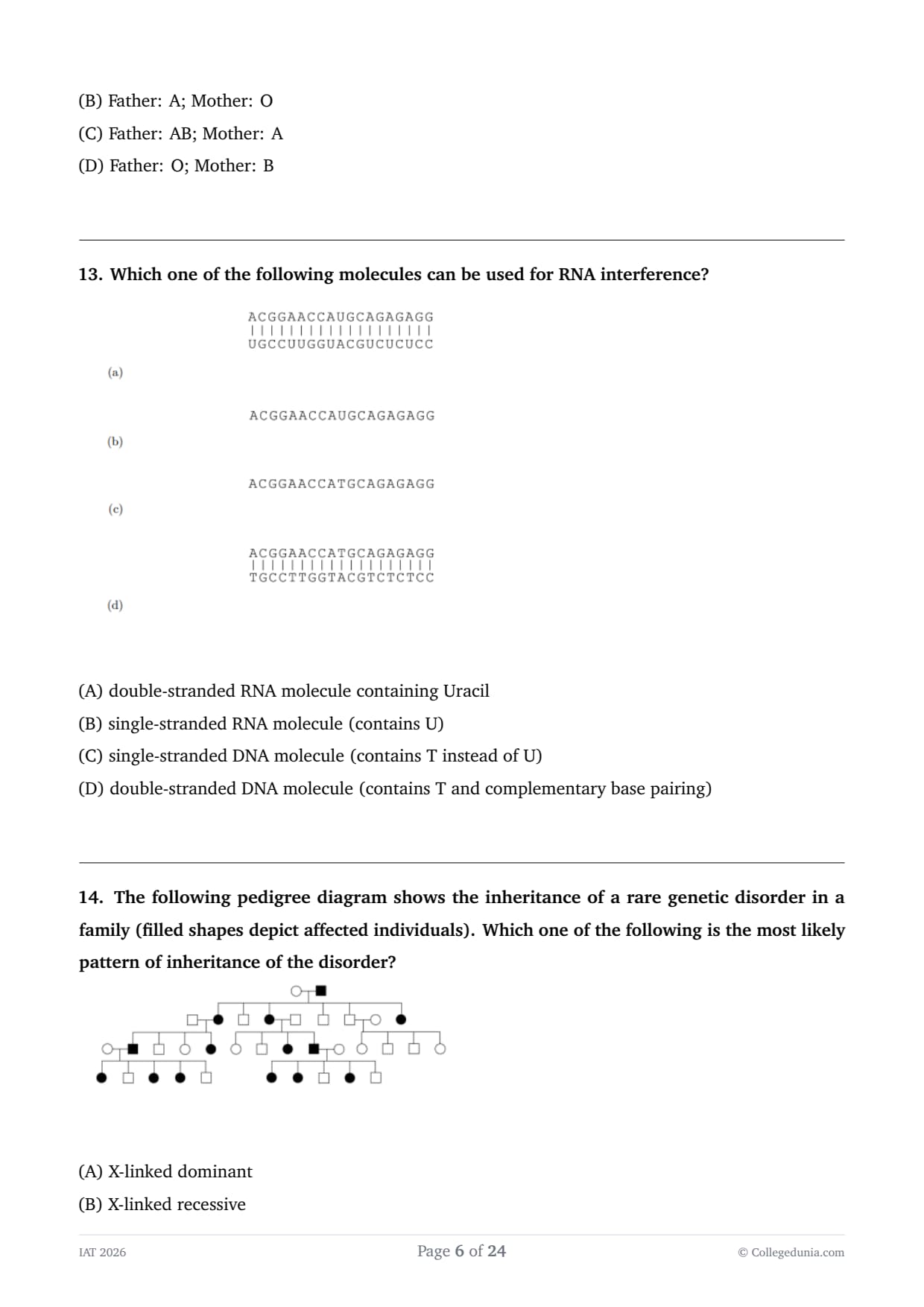
Question 11:

Which of the following schematics correctly depict a lac operon that can be negatively regulated?

  • (A) i and iii
  • (B) i and ii
  • (C) ii and iv
  • (D) iii and iv
Correct Answer: (A) i and iii
View Solution


Step 1: Understanding the Question:

This question asks us to identify which structural arrangements (schematics) of the lac operon genes and regulatory regions allow for successful negative regulation by the Lac repressor.


Step 2: Key Formula or Approach:

Negative regulation of the lac operon relies on:

1. A regulatory gene (\(i\)) with its own promoter to synthesize the repressor protein.

2. An operon promoter (\(P\)) where RNA polymerase binds.

3. An operator (\(O\)) situated downstream of the promoter (\(P\)) and upstream of the structural genes, so that repressor binding physically blocks the movement of RNA polymerase.


Step 3: Detailed Explanation:

Let's analyze each schematic individually:


Schematic i:

- Order: \(P - i - P - O - z - y - a\).

- This is the standard wild-type layout. The \(i\) gene has its promoter. The structural genes (\(z, y, a\)) are driven by their promoter \(P\), which is immediately followed by the operator \(O\).

- When active repressor binds to \(O\), it blocks RNA polymerase from transcribing \(z, y, a\). Thus, it can be negatively regulated.

Schematic ii:

- Order: \(P - O - i - z - P - y - a\).

- Here, the promoter and operator are separated from some of the structural genes, and the gene order is completely scrambled in a way that prevents coordinated transcription from a single operator-controlled promoter. This cannot be normally regulated.

Schematic iii:

- Order: \(P - i - P - O - y - z - a\).

- In this schematic, the positions of the structural genes \(z\) and \(y\) are swapped (\(y - z - a\) instead of \(z - y - a\)).

- However, the crucial regulatory elements (\(P\) and \(O\)) remain correctly positioned upstream of the structural genes.

- RNA polymerase will still bind to \(P\), and repressor binding to \(O\) will still physically block transcription of the structural genes. Thus, this operon can still be negatively regulated.

Schematic iv:

- Order: \(P - O - i - P - z - y - a\).

- Here, the operator \(O\) is placed upstream of the regulatory gene \(i\) and far away from the promoter \(P\) that drives the structural genes (\(z, y, a\)).

- Because there is no operator between the \(P\) promoter and the \(z, y, a\) structural genes, the repressor cannot bind and block RNA polymerase. Thus, negative regulation is impossible.


Step 4: Final Answer:

Schematics i and iii can both be negatively regulated, making option (A) the correct choice.
Quick Tip: For negative regulation to work, the Promoter (\(P\)) and Operator (\(O\)) must be right next to each other, upstream of the structural genes.
Even if the order of the structural genes (\(z, y, a\)) is changed, as long as the \(P-O\) block is upstream of them, the repressor can still block transcription.


Question 12:

For which one of the following parents, their children will NOT have the same blood group phenotype as either of the parents?

  • (A) Father: AB; Mother: O
  • (B) Father: A; Mother: O
  • (C) Father: AB; Mother: A
  • (D) Father: O; Mother: B
Correct Answer: (A) Father: AB; Mother: O
View Solution


Step 1: Understanding the Question:

This genetics problem involves the ABO blood group system. We need to find the parental combination where 100% of the children will have a blood group phenotype that is completely different from both parents.


Step 2: Key Formula or Approach:

Recall the alleles of the ABO blood group system:

- \(I^A\) and \(I^B\) are codominant alleles.

- \(i\) is the recessive allele.

- Phenotype A: \(I^A I^A\) or \(I^A i\).

- Phenotype B: \(I^B I^B\) or \(I^B i\).

- Phenotype AB: \(I^A I^B\).

- Phenotype O: \(ii\).


Step 3: Detailed Explanation:

Let's analyze each parent combination:


Option (A): Father: AB (\(I^A I^B\)) \(\times\) Mother: O (\(ii\))

- The father produces gametes with either the \(I^A\) or \(I^B\) allele.

- The mother produces gametes only with the \(i\) allele.

- Possible offspring genotypes:

- \(I^A i\) (Phenotype: Blood Group A)

- \(I^B i\) (Phenotype: Blood Group B)

- Parents' phenotypes are AB and O. Children's phenotypes can only be A or B.

- Therefore, none of the children will share a phenotype with either parent. This matches the condition.

Option (B): Father: A (\(I^A I^A\) or \(I^A i\)) \(\times\) Mother: O (\(ii\))

- If the father is heterozygous (\(I^A i\)), they can have children with genotype \(ii\) (Phenotype O, same as mother) or \(I^A i\) (Phenotype A, same as father).

Option (C): Father: AB (\(I^A I^B\)) \(\times\) Mother: A (\(I^A I^A\) or \(I^A i\))

- They can easily have children with genotype \(I^A I^A\) or \(I^A i\) (Phenotype A) or \(I^A I^B\) (Phenotype AB), which match the parents.

Option (D): Father: O (\(ii\)) \(\times\) Mother: B (\(I^B I^B\) or \(I^B i\))

- If the mother is heterozygous (\(I^B i\)), they can have children with genotype \(ii\) (O) or \(I^B i\) (B), both of which match the parents' phenotypes.


Step 4: Final Answer:

Only combination (A) guarantees that none of the offspring will have the same blood group phenotype as either parent.
Quick Tip: An AB parent can never pass an "AB" combo in a single gamete, and an O parent can only give "i".
So, AB \(\times\) O always yields 100% A and B offspring (never AB or O). This classic cross is a favorite in genetic exams!


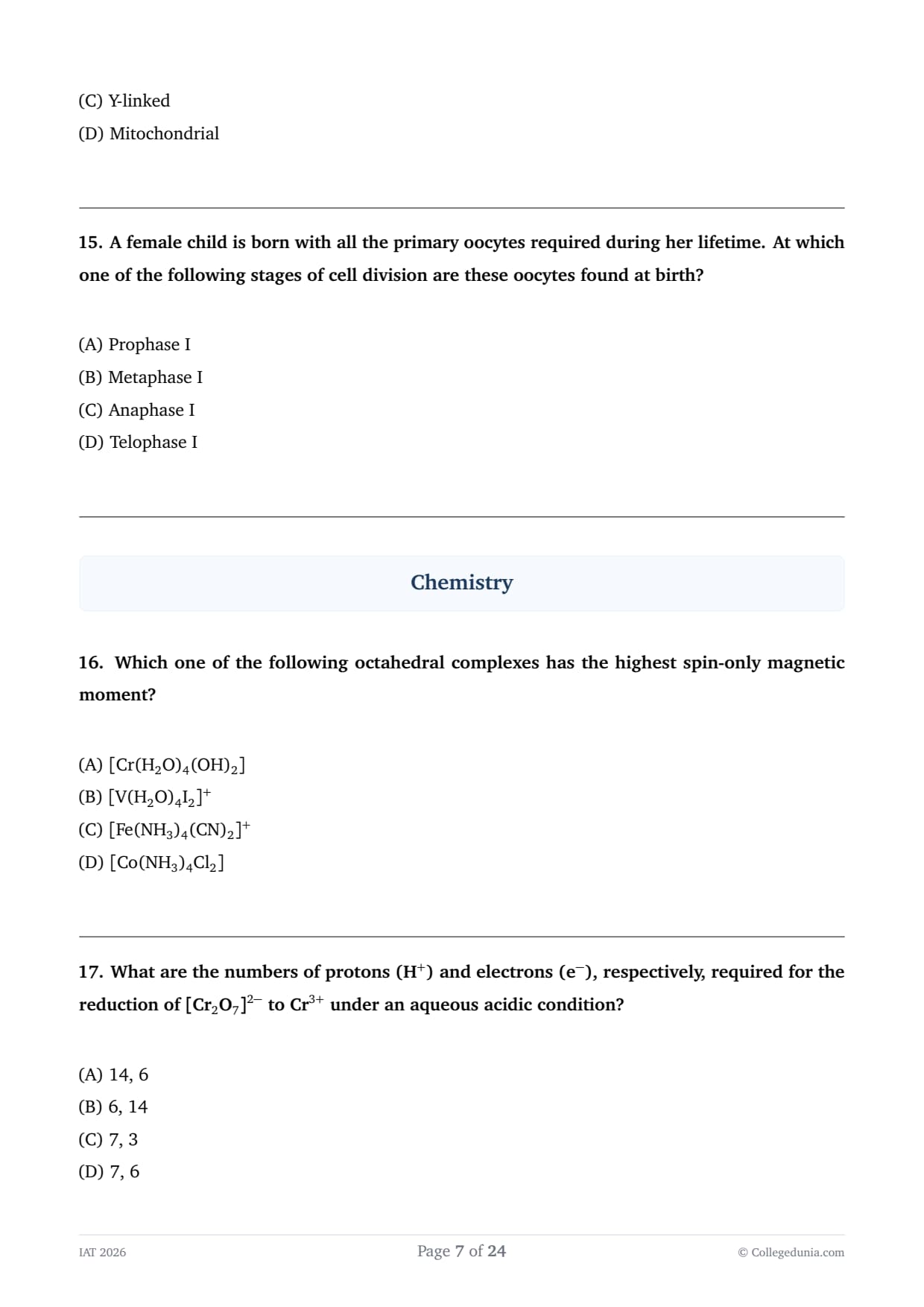
Question 13:

Which one of the following molecules can be used for RNA interference?

  • (A) double-stranded RNA molecule containing Uracil
  • (B) single-stranded RNA molecule (contains U)
  • (C) single-stranded DNA molecule (contains T instead of U)
  • (D) double-stranded DNA molecule (contains T and complementary base pairing)
Correct Answer: (A) double-stranded RNA molecule containing Uracil
View Solution


Step 1: Understanding the Question:

The question asks us to identify which of the molecular structures shown can be used to initiate RNA interference (RNAi) inside a eukaryotic cell.


Step 2: Key Formula or Approach:

RNA interference is a biologically conserved process where double-stranded RNA (dsRNA) molecules are used to silence specific gene expression.

To be effective, the silencing agent must be:

1. Double-stranded to be recognized by the Dicer enzyme.

2. Composed of RNA nucleotides (which contain Uracil 'U' instead of Thymine 'T').


Step 3: Detailed Explanation:

Let's analyze the options:


Option (A):

- This is a double-stranded molecule as shown by the complementary base-pairing lines (\(|\)).

- It contains Uracil (U) and no Thymine (T). This confirms it is a double-stranded RNA (dsRNA) molecule.

- Dicer can recognize and cleave this dsRNA into small interfering RNAs (siRNAs) to initiate target mRNA cleavage. Thus, this can be used for RNAi.

Option (B):

- This is a single-stranded RNA molecule (contains U). Single-stranded RNA does not trigger the RNAi pathway directly without being converted or folded.

Option (C):

- This is a single-stranded DNA molecule (contains T instead of U). DNA cannot be used for direct RNA interference.

Option (D):

- This is a double-stranded DNA molecule (contains T and complementary base pairing). dsDNA is the standard genetic material and does not trigger RNAi.


Step 4: Final Answer:

Option (A) represents a complementary double-stranded RNA molecule, which is the required substrate for initiating RNA interference.
Quick Tip: RNA interference (RNAi) always requires double-stranded RNA} (dsRNA).
Look for two complementary strands and check for the letter "U" (Uracil), which distinguishes RNA from DNA (which has "T").


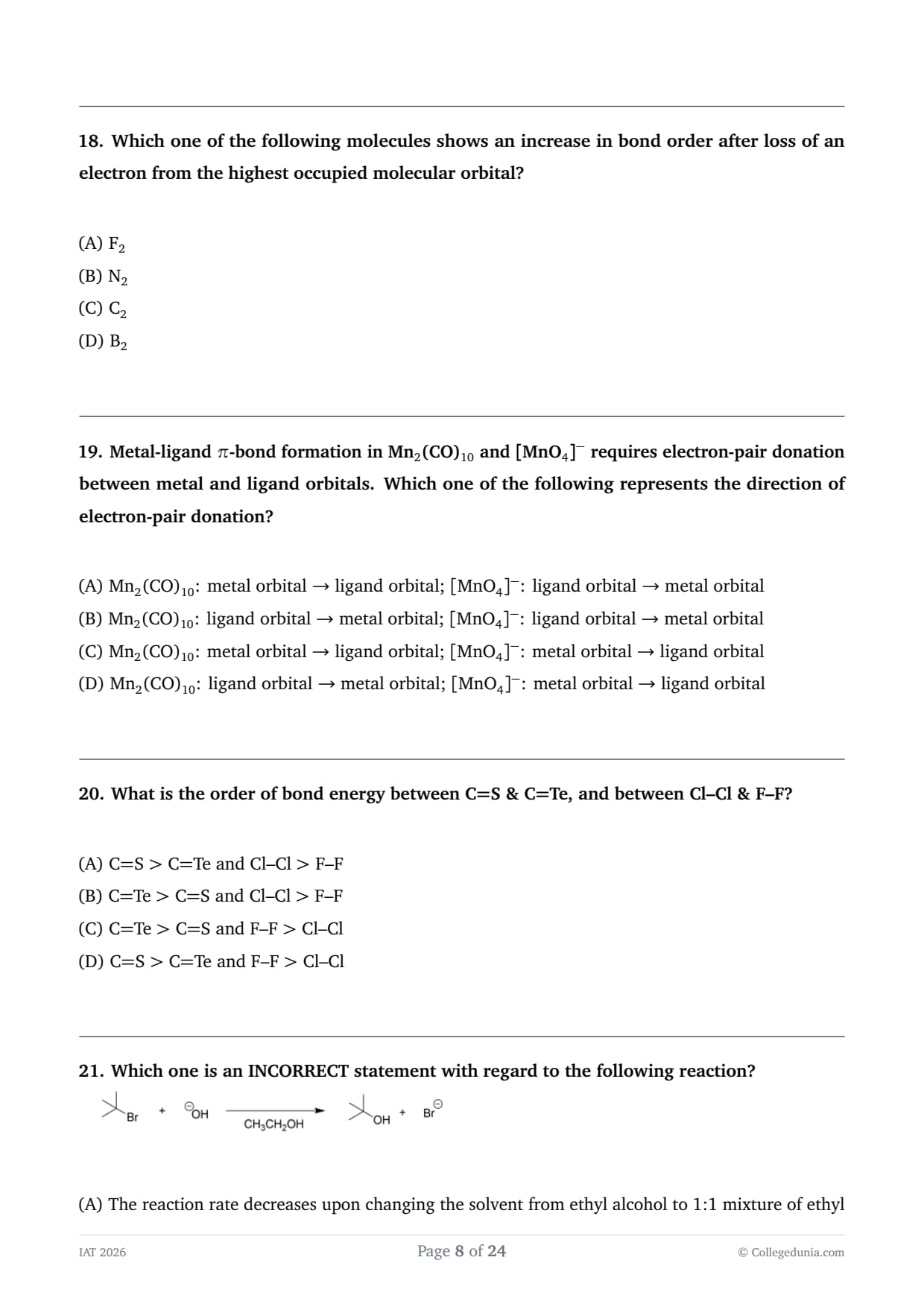
Question 14:

The following pedigree diagram shows the inheritance of a rare genetic disorder in a family (filled shapes depict affected individuals). Which one of the following is the most likely pattern of inheritance of the disorder?

  • (A) X-linked dominant
  • (B) X-linked recessive
  • (C) Y-linked
  • (D) Mitochondrial
Correct Answer: (A) X-linked dominant
View Solution


Step 1: Understanding the Question:

This question asks us to analyze a family pedigree to determine the most probable mode of inheritance for a rare genetic disorder.


Step 2: Key Formula or Approach:

To determine the inheritance pattern from a pedigree chart:

1. Check if the disease skips generations (indicative of recessive) or appears in every generation (indicative of dominant).

2. Look at the ratio of affected males to females.

3. Check the specific transmission patterns from affected parents (especially affected fathers to their sons and daughters).


Step 3: Detailed Explanation:

Let's analyze the pedigree step-by-step:


Dominant vs. Recessive:

- The disease does not skip generations; it is expressed in every single generation, which strongly points to a dominant trait.

Eliminating Y-linked:

- There are multiple affected females (filled circles) in the pedigree. Y-linked traits can only affect males. Thus, Y-linked inheritance is ruled out.

Eliminating Mitochondrial (Maternal) inheritance:

- In mitochondrial inheritance, an affected mother passes the trait to all her children, while an affected father passes it to none of his children.

- In Generation I, we see an affected father (filled square) and an unaffected mother (empty circle) who have affected children in Generation II. This immediately rules out mitochondrial inheritance.

Testing X-linked dominant:

- An affected male has the genotype \(X^D Y\).

- He must pass his Y chromosome to all his sons (making them normal, \(X^d Y\), since they get the normal \(X^d\) from their unaffected mother).

- He must pass his \(X^D\) chromosome to all his daughters, making 100% of his daughters affected (\(X^D X^d\)).

- Let's trace the offspring of affected males in the pedigree:

- The affected father in Gen I has daughters in Gen II, all of whom are affected, and his son in Gen II is unaffected.

- In Gen II, the affected male (filled square) is married to an unaffected female. Their children in Gen III consist of affected daughters (filled circles) and unaffected sons (empty squares). No sons are affected, and all daughters are affected.

- In Gen III, another affected male (filled square) married to an unaffected female also passes the trait to all his daughters and none of his sons in Gen IV.

- This perfect paternal-maternal transmission pattern is a definitive hallmark of X-linked dominant inheritance.


Step 4: Final Answer:

The pedigree perfectly fits the rules of X-linked dominant inheritance, corresponding to option (A).
Quick Tip: X-linked Dominant Gold Standard Rule:
An affected father (\(X^D Y\)) will pass the trait to 100% of his daughters} and 0% of his sons}.
If you see this clean pattern repeated across generations, choose X-linked dominant immediately!


Question 15:

A female child is born with all the primary oocytes required during her lifetime. At which one of the following stages of cell division are these oocytes found at birth?

  • (A) Prophase I
  • (B) Metaphase I
  • (C) Anaphase I
  • (D) Telophase I
Correct Answer: (A) Prophase I
View Solution


Step 1: Understanding the Question:

This question asks about the specific stage of cell division (meiosis) in which the primary oocytes of a human female are arrested at the time of her birth.


Step 2: Detailed Explanation:


Oogenesis is the complex process of female gamete development.

- Unlike males, who produce sperm continuously throughout their post-pubertal lives, females are born with a finite, pre-determined number of potential egg cells.

- During embryonic development, primordial germ cells undergo mitosis to form oogonia, which then differentiate into primary oocytes.

- These primary oocytes initiate the first meiotic division (meiosis I) during the fetal stage.

- However, the division process is suspended or arrested before completion.

- Specifically, the primary oocytes enter the first stage of meiosis I, which is Prophase I.

- Within Prophase I, the chromosomes condense, homologous chromosomes pair up (synapsis), and crossing over occurs.

- The arrest specifically takes place during the diplotene stage of Prophase I.

- The primary oocytes remain dormant in this arrested state (referred to as the dictyate stage) for many years, from birth until the female reaches puberty.

- Starting at puberty, hormonal cycles (specifically surges in luteinizing hormone) prompt a few of these primary oocytes to resume and complete meiosis I each month, just before ovulation.


Step 3: Final Answer:

Therefore, at the time of birth, a female child's primary oocytes are arrested at the Prophase I stage of cell division, corresponding to option (A).
Quick Tip: Remember the arrest stages of oogenesis:
1. First arrest occurs at birth: Prophase I (specifically Diplotene).
2. Second arrest occurs at ovulation: Metaphase II}, which is only completed if fertilization occurs.


Question 16:

Which one of the following octahedral complexes has the highest spin-only magnetic moment?

  • (A) [Cr(H\(_2\)O)\(_4\)(OH)\(_2\)]
  • (B) [V(H\(_2\)O)\(_4\)I\(_2\)]\(^+\)
  • (C) [Fe(NH\(_3\))\(_4\)(CN)\(_2\)]\(^+\)
  • (D) [Co(NH\(_3\))\(_4\)Cl\(_2\)]
Correct Answer: (A) [Cr(H\(_2\)O)\(_4\)(OH)\(_2\)]
View Solution


Step 1: Understanding the Question:

This question asks us to identify the octahedral coordination complex that possesses the highest spin-only magnetic moment (\(\mu_s\)).


Step 2: Key Formula or Approach:

The spin-only magnetic moment (\(\mu_s\)) is directly related to the number of unpaired electrons (\(n\)) in the central metal ion:
\[ \mu_s = \sqrt{n(n + 2)} B.M. \]
Therefore, the complex with the highest number of unpaired d-electrons (\(n\)) will have the highest spin-only magnetic moment.

To find \(n\), we must determine the oxidation state, the d-electron configuration of the metal ion, and whether the ligands are weak-field (high-spin) or strong-field (low-spin).


Step 3: Detailed Explanation:

Let's analyze each complex individually:


(A) [Cr(H\(_2\)O)\(_4\)(OH)\(_2\)]:

- Water (\(H_2O\)) is a neutral ligand (charge = 0), and hydroxide (\(OH^-\)) has a charge of \(-1\).

- Let the oxidation state of Chromium be \(x\). Thus, \(x + 4(0) + 2(-1) = 0 \implies x = +2\).

- \(Cr^{2+}\) has a \(d^4\) valence configuration.

- Since \(H_2O\) and \(OH^-\) are relatively weak-field ligands, they do not cause pairing. This results in a high-spin octahedral state: \(t_{2g}^3 e_g^1\).

- This configuration contains 4 unpaired electrons (\(n = 4\)).

(B) [V(H\(_2\)O)\(_4\)I\(_2\)]\(^+\):

- Let the oxidation state of Vanadium be \(y\). Thus, \(y + 4(0) + 2(-1) = +1 \implies y = +3\).

- \(V^{3+}\) has a \(d^2\) configuration.

- For a \(d^2\) system, the electrons occupy the \(t_{2g}\) orbitals: \(t_{2g}^2 e_g^0\).

- This configuration contains 2 unpaired electrons (\(n = 2\)).

(C) [Fe(NH\(_3\))\(_4\)(CN)\(_2\)]\(^+\):

- Let the oxidation state of Iron be \(z\). Thus, \(z + 4(0) + 2(-1) = +1 \implies z = +3\).

- \(Fe^{3+}\) has a \(d^5\) configuration.

- Here, cyanide (\(CN^-\)) is a very strong-field ligand, and ammonia (\(NH_3\)) is a moderate-to-strong-field ligand, prompting a low-spin configuration: \(t_{2g}^5 e_g^0\).

- This low-spin configuration contains only 1 unpaired electron (\(n = 1\)).

(D) [Co(NH\(_3\))\(_4\)Cl\(_2\)]:

- Let the oxidation state of Cobalt be \(w\). Thus, \(w + 4(0) + 2(-1) = 0 \implies w = +2\).

- \(Co^{2+}\) has a \(d^7\) configuration.

- Because chloride (\(Cl^-\)) is a weak-field ligand, this complex is typically high-spin: \(t_{2g}^5 e_g^2\).

- This high-spin configuration contains 3 unpaired electrons (\(n = 3\)).


Step 4: Final Answer:

Comparing the number of unpaired electrons:

- [Cr(H\(_2\)O)\(_4\)(OH)\(_2\)] has \(n = 4\)

- [V(H\(_2\)O)\(_4\)I\(_2\)]\(^+\) has \(n = 2\)

- [Fe(NH\(_3\))\(_4\)(CN)\(_2\)]\(^+\) has \(n = 1\)

- [Co(NH\(_3\))\(_4\)Cl\(_2\)] has \(n = 3\)

The complex [Cr(H\(_2\)O)\(_4\)(OH)\(_2\)] has the highest number of unpaired electrons (\(n = 4\)), resulting in the highest spin-only magnetic moment. This corresponds to option (A).
Quick Tip: A quick way to estimate the spin-only magnetic moment:
If the number of unpaired electrons is \(n\), the magnetic moment value is always approximately \(n.something\) B.M. (e.g., if \(n=4\), \(\mu \approx 4.9\) B.M.).
Simply find the complex with the highest number of unpaired electrons!


Question 17:

What are the numbers of protons (H\(^+\)) and electrons (e\(^-\)), respectively, required for the reduction of [Cr\(_2\)O\(_7\)]\(^{2-}\) to Cr\(^{3+}\) under an aqueous acidic condition?

  • (A) 14, 6
  • (B) 6, 14
  • (C) 7, 3
  • (D) 7, 6
Correct Answer: (A) 14, 6
View Solution


Step 1: Understanding the Question:

This question asks for the stoichiometric coefficients of protons (\(H^+\)) and electrons (\(e^-\)) required to balance the reduction half-reaction of the dichromate ion (\([Cr_2O_7]^{2-}\)) to chromium(III) ion (\(Cr^{3+}\)) in an acidic aqueous medium.


Step 2: Key Formula or Approach:

Use the ion-electron method to balance the reduction half-reaction:

1. Write the unbalanced key species equation.

2. Balance the chromium atoms.

3. Balance the oxygen atoms by adding water (\(H_2O\)) molecules.

4. Balance the hydrogen atoms by adding protons (\(H^+\)).

5. Balance the net charge by adding electrons (\(e^-\)).


Step 3: Detailed Explanation:

Let's balance the half-reaction step-by-step:


Step 1: Unbalanced species:
\[ Cr_2O_7^{2-} \rightarrow Cr^{3+} \]
Step 2: Balance Chromium atoms:

There are 2 chromium atoms on the reactant side, so we multiply \(Cr^{3+}\) by 2 on the product side:
\[ Cr_2O_7^{2-} \rightarrow 2Cr^{3+} \]
Step 3: Balance Oxygen atoms:

There are 7 oxygen atoms on the reactant side. Add 7 molecules of \(H_2O\) to the product side:
\[ Cr_2O_7^{2-} \rightarrow 2Cr^{3+} + 7H_2O \]
Step 4: Balance Hydrogen atoms:

The addition of 7 water molecules introduces 14 hydrogen atoms on the product side. Add 14 protons (\(H^+\)) to the reactant side:
\[ Cr_2O_7^{2-} + 14H^+ \rightarrow 2Cr^{3+} + 7H_2O \]
Step 5: Balance the electric charge:

- Charge on the reactant side: \((-2) + 14(+1) = +12\)

- Charge on the product side: \(2(+3) + 7(0) = +6\)

- To equalize the charge, add 6 electrons (\(e^-\)) to the reactant side (which reduces the \(+12\) charge to \(+6\)):
\[ Cr_2O_7^{2-} + 14H^+ + 6e^- \rightarrow 2Cr^{3+} + 7H_2O \]


Step 4: Final Answer:

The balanced half-reaction requires 14 protons (\(H^+\)) and 6 electrons (\(e^-\)). This matches option (A).
Quick Tip: Dichromate reduction is a classic redox process:
Each \(Cr\) in \(Cr_2O_7^{2-}\) is in the \(+6\) state. Two \(Cr^{+6}\) ions are reduced to two \(Cr^{3+}\) ions.
The change in oxidation state per chromium is \(3\), so for two chromium atoms, a total of \(2 \times 3 = 6\) electrons are transferred.
This immediately identifies 6 as the number of electrons!


Question 18:

Which one of the following molecules shows an increase in bond order after loss of an electron from the highest occupied molecular orbital?

  • (A) F\(_2\)
  • (B) N\(_2\)
  • (C) C\(_2\)
  • (D) B\(_2\)
Correct Answer: (A) F\(_2\)
View Solution


Step 1: Understanding the Question:

This question asks us to identify which of the given diatomic molecules experienced an increase in its bond order after losing one electron from its Highest Occupied Molecular Orbital (HOMO).


Step 2: Key Formula or Approach:

According to Molecular Orbital (MO) Theory, the bond order (B.O.) of a molecule is given by:
\[ B.O. = \frac{N_b - N_a}{2} \]
Where:

- \(N_b\) is the number of electrons in bonding molecular orbitals.

- \(N_a\) is the number of electrons in antibonding molecular orbitals.

- Removing an electron from a bonding orbital decreases \(N_b\), which decreases the bond order.

- Removing an electron from an antibonding orbital decreases \(N_a\), which increases the bond order.

Thus, the molecule must have its HOMO as an antibonding molecular orbital.


Step 3: Detailed Explanation:

Let's analyze the molecular orbital configurations for each molecule:


(A) F\(_2\) (18 electrons):

- MO configuration:
\[ \sigma_{1s}^2 \sigma_{1s}^{*2} \sigma_{2s}^2 \sigma_{2s}^{*2} \sigma_{2p_z}^2 \pi_{2p_x}^2 \pi_{2p_y}^2 \pi_{2p_x}^{*2} \pi_{2p_y}^{*2} \]
- The HOMO is the \(\pi_{2p}^*\) orbital, which is an antibonding orbital.

- For \(F_2\): \(N_b = 10\), \(N_a = 8 \implies B.O. = \frac{10 - 8}{2} = 1\).

- For \(F_2^+\) (after losing 1 electron from \(\pi_{2p}^*\)): \(N_b = 10\), \(N_a = 7 \implies B.O. = \frac{10 - 7}{2} = 1.5\).

- The bond order increases from 1 to 1.5.

(B) N\(_2\) (14 electrons):

- MO configuration:
\[ \sigma_{1s}^2 \sigma_{1s}^{*2} \sigma_{2s}^2 \sigma_{2s}^{*2} \pi_{2p_x}^2 \pi_{2p_y}^2 \sigma_{2p_z}^2 \]
- The HOMO is the \(\sigma_{2p_z}\) orbital, which is a bonding orbital.

- Removing an electron decreases the bond order from 3 to 2.5 (\(N_2^+\)).

(C) C\(_2\) (12 electrons):

- MO configuration:
\[ \sigma_{1s}^2 \sigma_{1s}^{*2} \sigma_{2s}^2 \sigma_{2s}^{*2} \pi_{2p_x}^2 \pi_{2p_y}^2 \]
- The HOMO is the \(\pi_{2p}\) orbital, which is a bonding orbital.

- Removing an electron decreases the bond order from 2 to 1.5 (\(C_2^+\)).

(D) B\(_2\) (10 electrons):

- MO configuration:
\[ \sigma_{1s}^2 \sigma_{1s}^{*2} \sigma_{2s}^2 \sigma_{2s}^{*2} \pi_{2p_x}^1 \pi_{2p_y}^1 \]
- The HOMO is the \(\pi_{2p}\) orbital, which is a bonding orbital.

- Removing an electron decreases the bond order from 1 to 0.5 (\(B_2^+\)).


Step 4: Final Answer:

Only \(F_2\) experiences an increase in bond order because its HOMO is an antibonding orbital (\(\pi_{2p}^*\)). This corresponds to option (A).
Quick Tip: Lose from Bonding orbital \(\rightarrow\) Bond order decreases (weakens the bond).
Lose from Antibonding orbital \(\rightarrow\) Bond order increases (strengthens the bond).
Among the options, only oxygen (\(O_2\)) and fluorine (\(F_2\)) have antibonding molecular orbitals as their HOMO.


Question 19:

Metal-ligand \(\pi\)-bond formation in Mn\(_2\)(CO)\(_{10}\) and [MnO\(_4\)]\(^-\) requires electron-pair donation between metal and ligand orbitals. Which one of the following represents the direction of electron-pair donation?

  • (A) Mn\(_2\)(CO)\(_{10}\): metal orbital \(\rightarrow\) ligand orbital; [MnO\(_4\)]\(^-\): ligand orbital \(\rightarrow\) metal orbital
  • (B) Mn\(_2\)(CO)\(_{10}\): ligand orbital \(\rightarrow\) metal orbital; [MnO\(_4\)]\(^-\): ligand orbital \(\rightarrow\) metal orbital
  • (C) Mn\(_2\)(CO)\(_{10}\): metal orbital \(\rightarrow\) ligand orbital; [MnO\(_4\)]\(^-\): metal orbital \(\rightarrow\) ligand orbital
  • (D) Mn\(_2\)(CO)\(_{10}\): ligand orbital \(\rightarrow\) metal orbital; [MnO\(_4\)]\(^-\): metal orbital \(\rightarrow\) ligand orbital
Correct Answer: (A) Mn\(_2\)(CO)\(_{10}\): metal orbital \(\rightarrow\) ligand orbital; [MnO\(_4\)]\(^-\): ligand orbital \(\rightarrow\) metal orbital
View Solution


Step 1: Understanding the Question:

This question asks for the direction of electron-pair transfer during the formation of \(\pi\)-bonds in two manganese complexes: the neutral organometallic dimer \(Mn_2(CO)_{10}\) and the permanganate anion \([MnO_4]^-\).


Step 2: Detailed Explanation:

Let's analyze the bonding mechanism in each coordination species:


1. Mn\(_2\)(CO)\(_{10}\) (Metal Carbonyl Complex):

- Bonding in metal carbonyls involves a synergistic interaction.

- First, a \(\sigma\)-bond is formed by the donation of a lone pair from the carbonyl carbon to a vacant \(d\)-orbital on the metal (ligand \(\rightarrow\) metal).

- Second, a \(\pi\)-bond is formed via back-donation (or back-bonding).

- In this step, filled \(d\)-orbitals of the low-valent Manganese metal donate electron density into the vacant, low-lying antibonding \(\pi^*\) orbitals of the carbon monoxide (\(CO\)) ligand.

- Thus, the formation of the \(\pi\)-bond occurs via the direction: metal orbital \(\rightarrow\) ligand orbital.

2. [MnO\(_4\)]\(^-\) (Permanganate Ion):

- In \([MnO_4]^-\), Manganese is in its highest oxidation state of \(+7\) (\(Mn^{7+}\)).

- The electronic configuration of \(Mn^{7+}\) is \(d^0\), meaning it has completely empty \(d\)-orbitals and a very high positive charge density.

- The oxo ligands (\(O^{2-}\)) act as strong \(\pi\)-donors.

- The \(\pi\)-bonds are formed by the overlap of filled \(2p\) orbitals of the oxygen ligands with the vacant \(3d\) orbitals of the metal center. This is also responsible for ligand-to-metal charge transfer (LMCT) transitions.

- Thus, the direction of electron-pair donation for \(\pi\)-bonding is: ligand orbital \(\rightarrow\) metal orbital.


Step 3: Final Answer:

For \(Mn_2(CO)_{10}\), the \(\pi\)-bond is metal \(\rightarrow\) ligand. For \([MnO_4]^-\), the \(\pi\)-bond is ligand \(\rightarrow\) metal. This corresponds to option (A).
Quick Tip: Remember:
- Metal Carbonyls (\(M-CO\)) \(\rightarrow\) Back-bonding (\(M \rightarrow CO\)) is the source of the \(\pi\)-bond!
- Metal Oxo complexes with metals in high oxidation states (like \(CrO_4^{2-}\), \(MnO_4^-\)) \(\rightarrow\) Oxygen acts as a strong \(\pi\)-donor, donating electron density from ligand to metal (\(L \rightarrow M\)).


Question 20:

What is the order of bond energy between C=S \& C=Te, and between Cl–Cl \& F–F?

  • (A) C=S \(>\) C=Te and Cl–Cl \(>\) F–F
  • (B) C=Te \(>\) C=S and Cl–Cl \(>\) F–F
  • (C) C=Te \(>\) C=S and F–F \(>\) Cl–Cl
  • (D) C=S \(>\) C=Te and F–F \(>\) Cl–Cl
Correct Answer: (A) C=S \(>\) C=Te and Cl–Cl \(>\) F–F
View Solution


Step 1: Understanding the Question:

This question asks for the comparative order of bond dissociation energies between a carbon-sulfur double bond (\(C=S\)) and a carbon-tellurium double bond (\(C=Te\)), and between single bonds in chlorine (\(Cl-Cl\)) and fluorine (\(F-F\)).


Step 2: Detailed Explanation:

Let's analyze both pairs of bonds:


1. C=S versus C=Te:

- Bond energy is strongly dependent on the extent of orbital overlap.

- Carbon is a second-period element with \(2p\) valence orbitals.

- Sulfur is a third-period element (\(3p\) valence orbitals), while Tellurium is a fifth-period element (\(5p\) valence orbitals).

- The overlap between the small \(2p\) orbital of Carbon and the relatively smaller \(3p\) orbital of Sulfur is much more effective than the overlap with the large, diffuse \(5p\) orbital of Tellurium.

- Consequently, the \(C=S\) double bond is significantly shorter, more stable, and possesses a higher bond energy than the diffuse \(C=Te\) double bond.

- Hence: \(C=S > C=Te\).

2. Cl–Cl versus F–F:

- Generally, bond energy decreases down a group as atomic size increases. Based on this, one might expect the \(F-F\) bond to be stronger than the \(Cl-Cl\) bond.

- However, Fluorine (\(F_2\)) is an anomalous case.

- The fluorine atom is extremely small, meaning the non-bonding valence electron lone pairs on the two adjacent fluorine atoms are forced into very close proximity.

- This creates intense, destabilizing lone-pair-lone-pair electrostatic repulsion in the \(F-F\) single bond.

- In chlorine (\(Cl_2\)), the larger atomic size and more diffuse \(3p\) orbitals minimize this lone-pair repulsion, making the \(Cl-Cl\) single bond stronger and more stable than the \(F-F\) bond.

- Hence: \(Cl-Cl > F-F\).


Step 3: Final Answer:

The correct orders are \(C=S > C=Te\) and \(Cl-Cl > F-F\), which corresponds to option (A).
Quick Tip: The weak \(F-F\) bond is a classic periodic exception:
Because of high lone-pair-lone-pair repulsion in the tiny \(F_2\) molecule, the halogen bond energy order is: \(Cl_2 > Br_2 > F_2 > I_2\).
Keep this exception in mind, as it is tested frequently!


Question 21:

Which one is an INCORRECT statement with regard to the following reaction?

  • (A) The reaction rate decreases upon changing the solvent from ethyl alcohol to 1:1 mixture of ethyl alcohol and water.
  • (B) The reaction rate does not change upon increasing the concentration of hydroxide ion.
  • (C) The rate determining step is the dissociation of tert-butylbromide.
  • (D) The reaction rate is proportional to the concentration of tert-butylbromide.
Correct Answer: (A) The reaction rate decreases upon changing the solvent from ethyl alcohol to 1:1 mixture of ethyl alcohol and water.
View Solution


Step 1: Understanding the Question:

This question asks us to identify the incorrect statement regarding the nucleophilic substitution reaction of tert-butyl bromide with hydroxide ion in ethanol solvent.


Step 2: Key Formula or Approach:

Analyze the mechanism of the reaction:

- The substrate is a tertiary alkyl halide (tert-butyl bromide).

- The reaction is carried out in a polar protic solvent (ethanol) with a nucleophile (\(OH^-\)).

- This reaction proceeds via the \(S_{N}1\) mechanism (unimolecular nucleophilic substitution) because the tertiary substrate forms a highly stable tertiary carbocation (\(t-Bu^+\)).


Step 3: Detailed Explanation:

Let's evaluate each statement under the rules of the \(S_{N}1\) pathway:


Why Statement (B) is correct:

- For an \(S_{N}1\) reaction, the rate law depends only on the substrate concentration:
\[ Rate = k[t-BuBr] \]
- It is a first-order process that is independent of the concentration and strength of the nucleophile (\(OH^-\)). Thus, increasing \([OH^-]\) will not change the reaction rate.

Why Statement (C) is correct:

- The rate-determining step (RDS) is the slow, initial step where the carbon-bromine bond polarizes and dissociates to form the carbocation intermediate:
\[ t-BuBr \rightarrow t-Bu^+ + Br^- \quad (Slow, RDS) \]
Why Statement (D) is correct:

- Since the rate law is \(Rate = k[t-BuBr]\), the reaction rate is directly proportional to the concentration of the alkyl halide.

Why Statement (A) is incorrect:

- In the rate-determining step of an \(S_{N}1\) reaction, neutral reactant molecules form charged transition states and ionic intermediates (carbocation and leaving group).

- Polar protic solvents stabilize this transition state and the resulting ions via strong solvation (hydrogen bonding and dipole-dipole interactions), reducing the activation energy.

- Water (\(H_2O\)) is much more polar (dielectric constant \(\approx 80\)) than pure ethanol (dielectric constant \(\approx 24.5\)).

- Therefore, adding water to the ethanol solvent (creating a 1:1 mixture) increases the polarity of the medium. This enhances carbocation stabilization and dramatically increases (not decreases) the reaction rate.


Step 4: Final Answer:

Since statement (A) asserts that the rate decreases in a more polar solvent mixture, it is incorrect and is the desired answer.
Quick Tip: For \(S_{N}1\) reactions:
Rate \(\propto\) solvent polarity. More polar solvent = Faster ionization = Higher rate!
For \(S_{N}2\) reactions:
Polar aprotic solvents (like acetone, DMSO) are preferred because they do not solvate and "cage" the nucleophile.


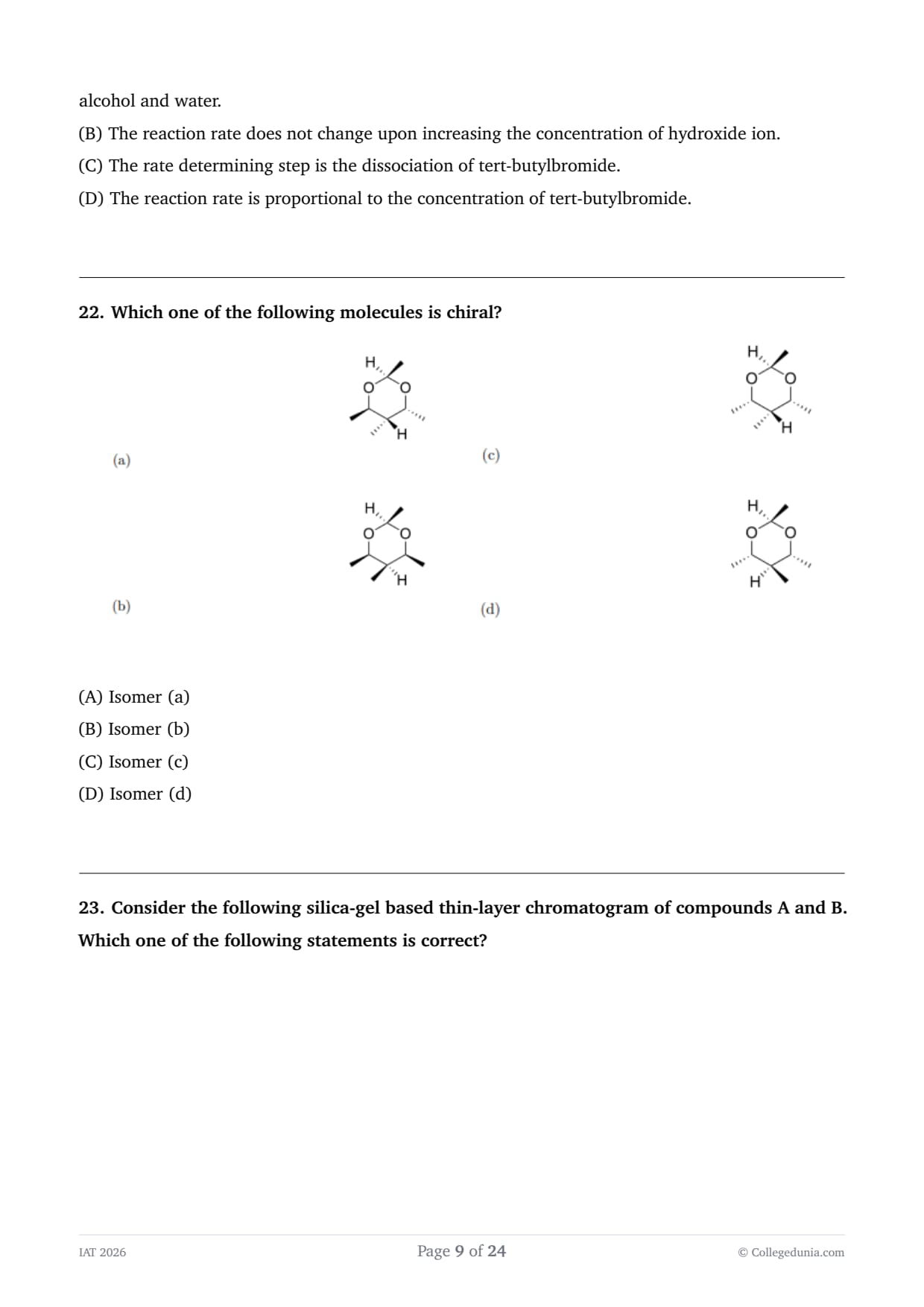
Question 22:

Which one of the following molecules is chiral?


  • (A) Isomer (a)
  • (B) Isomer (b)
  • (C) Isomer (c)
  • (D) Isomer (d)
Correct Answer: (A) Structure (a)
View Solution


Step 1: Understanding the Question:

We are given four stereoisomers of a substituted 1,3-dioxane derivative.

We need to identify which of these molecules is chiral.

A molecule is defined as chiral if it is non-superimposable on its mirror image.

In practical terms, a molecule is achiral if it possesses any element of symmetry, such as a plane of symmetry (\(\sigma\)), a center of inversion (\(i\)), or an alternating axis of symmetry (\(S_n\)).

If all such symmetry elements are absent, the molecule is chiral.


Step 2: Key Formula or Approach:

We will systematically analyze the symmetry elements of the given 1,3-dioxane derivatives.

The potential plane of symmetry in these substituted 1,3-dioxane structures is the vertical plane (\(\sigma_v\)) that bisects the molecule.

This plane passes through the top carbon (C2, with H and Me) and the bottom carbon (C5, with H and Me).

We will examine the stereochemistry (wedges and dashes) of the methyl substituents at the left and right ring positions (C6 and C4) to see if this plane of symmetry is preserved or broken.


Step 3: Detailed Explanation:


Let us analyze each structure individually:

Structure (b):

The methyl group on the left side (C6) is on a wedge (pointing up/towards the viewer).

The methyl group on the right side (C4) is also on a wedge (pointing up/towards the viewer).

The vertical bisecting plane passing through C2 and C5 reflects the left-hand wedged methyl group directly onto the right-hand wedged methyl group.

Thus, this molecule contains a plane of symmetry (\(\sigma\)) and is achiral (a meso compound).

Structure (c):

The methyl group on the left side (C6) is on a dash (pointing down/away from the viewer).

The methyl group on the right side (C4) is also on a dash (pointing down/away from the viewer).

A vertical bisecting plane reflecting the left side to the right side maps the dashed methyl onto the dashed methyl.

Thus, this molecule also contains a plane of symmetry (\(\sigma\)) and is achiral.

Structure (d):

Similar to structure (c), both the left (C6) and right (C4) methyl groups are on dashes.

This structure also possesses a vertical plane of symmetry (\(\sigma\)) and is achiral.

Structure (a):

The methyl group on the left side (C6) is on a wedge (solid wedge).

The methyl group on the right side (C4) is on a dash (hashed wedge).

When we attempt to bisect this molecule with a vertical plane passing through C2 and C5, the left side (wedge) reflects to the right side (where we have a dash instead of a wedge).

Since a wedge does not reflect into a dash, the plane of symmetry (\(\sigma\)) is broken.

Furthermore, because the C2 and C5 positions have different substituents (H and Me), there is no center of inversion (\(i\)) or \(C_2\) rotational axis perpendicular to the ring.

Therefore, this molecule lacks any element of symmetry, making it asymmetric and chiral.


Step 4: Final Answer:

Structure (a) is the only chiral molecule among the given options.
Quick Tip: For cyclic systems with a potential plane of symmetry, if the substituents on opposite symmetric positions have different stereochemical configurations (i.e., one is a wedge and the other is a dash), the plane of symmetry is broken, which typically makes the molecule chiral.


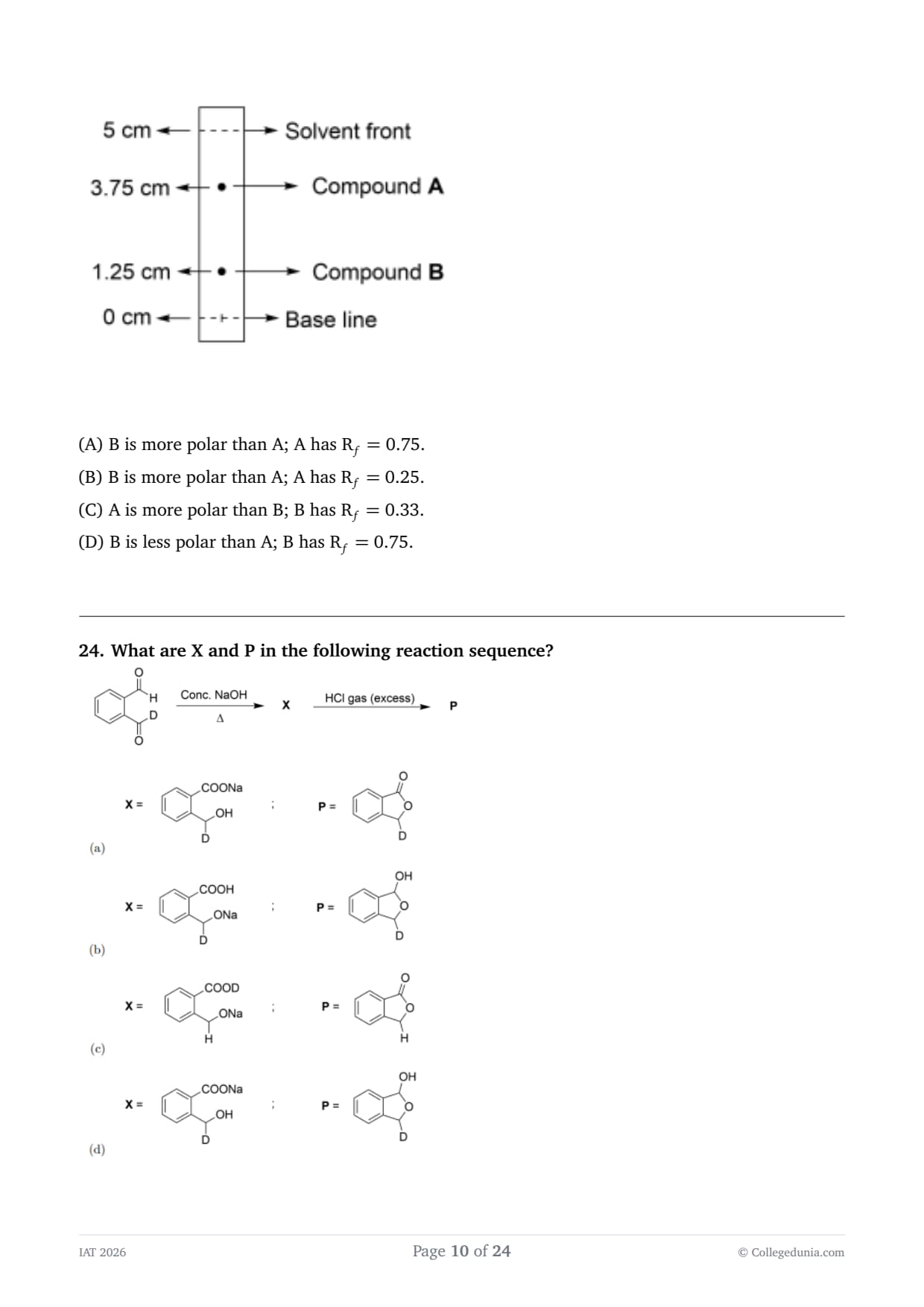
Question 23:

Consider the following silica-gel based thin-layer chromatogram of compounds A and B. Which one of the following statements is correct?

  • (A) B is more polar than A; A has R\(_f\) = 0.75.
  • (B) B is more polar than A; A has R\(_f\) = 0.25.
  • (C) A is more polar than B; B has R\(_f\) = 0.33.
  • (D) B is less polar than A; B has R\(_f\) = 0.75.
Correct Answer: (A) B is more polar than A; A has R\(_f\) = 0.75.
View Solution


Step 1: Understanding the Question:

This question asks us to analyze a thin-layer chromatography (TLC) plate with two compounds, A and B, to calculate their retardation factors (\(R_f\)) and determine their relative polarities based on their elution behavior on silica gel.


Step 2: Key Formula or Approach:

The retardation factor (\(R_f\)) is defined as:
\[ R_f = \frac{Distance traveled by the solute (compound)}{Distance traveled by the solvent front} \]
On a silica-gel based TLC plate (polar stationary phase):

- Silica gel contains highly polar silanol (\(Si-OH\)) groups.

- Polar compounds interact strongly with the silica gel via hydrogen bonding and dipole-dipole forces, causing them to move slowly (resulting in a lower \(R_f\) value).

- Less polar compounds interact weakly with the stationary phase and travel further with the mobile phase, resulting in a higher \(R_f\) value.


Step 3: Detailed Explanation:

Let's perform the calculations based on the given chromatogram:


1. Total distance traveled by the solvent front:

- Distance from baseline (\(0 cm\)) to solvent front \(= 5.0 cm\).

2. Calculate \(R_f\) for Compound A:

- Distance traveled by Compound A \(= 3.75 cm\).
\[ R_f(A) = \frac{3.75 cm}{5.0 cm} = 0.75 \]
3. Calculate \(R_f\) for Compound B:

- Distance traveled by Compound B \(= 1.25 cm\).
\[ R_f(B) = \frac{1.25 cm}{5.0 cm} = 0.25 \]
4. Relative Polarity Analysis:

- Since Compound B has a much lower \(R_f\) value (\(0.25\)) than Compound A (\(0.75\)), Compound B has migrated a much shorter distance.

- This indicates that B is more strongly adsorbed to the polar silica gel, meaning B is more polar than A.


Step 4: Final Answer:

Compound B is more polar than A, and the \(R_f\) of A is \(0.75\). This corresponds exactly to option (A).
Quick Tip: TLC Polarity Rule:
Low spot (low \(R_f\)) = High polarity (clings tightly to the polar silica).
High spot (high \(R_f\)) = Low polarity (travels easily with the solvent).
\(R_f\) is always a fraction between 0 and 1.


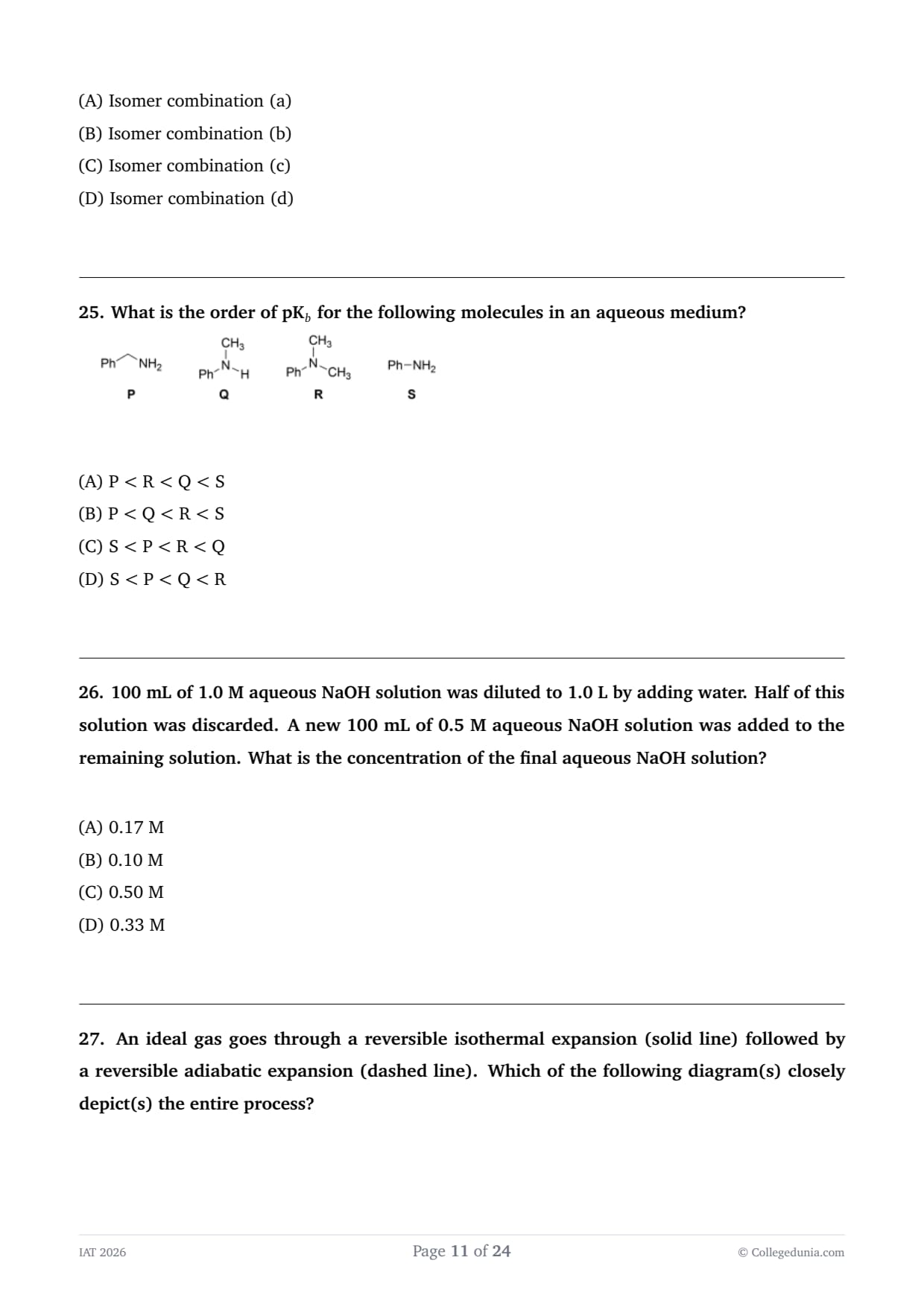
Question 24:

What are X and P in the following reaction sequence?


  • (A) Isomer combination (a)
  • (B) Isomer combination (b)
  • (C) Isomer combination (c)
  • (D) Isomer combination (d)
Correct Answer: (A) Isomer combination (a)
View Solution


Step 1: Understanding the Question:

This question asks us to identify the chemical intermediates and products in a two-step reaction sequence starting from an ortho-phthalaldehyde derivative where one of the aldehyde groups is deuterated (\(-CDO\)) and the other is a standard aldehyde (\(-CHO\)).


Step 2: Detailed Explanation:

Let's analyze each reaction step-by-step:


Step 1: Intramolecular Cannizzaro Reaction:

- The starting material is a phthalaldehyde derivative containing both \(-CHO\) and \(-CDO\) groups.

- Treatment with concentrated sodium hydroxide (\(NaOH\)) under heat (\(\Delta\)) initiates an intramolecular Cannizzaro reaction.

- In this process, one aldehyde group undergoes nucleophilic attack by \(OH^-\), forming a tetrahedral intermediate. This intermediate then transfers a hydride (or deuteride) ion to the adjacent aldehyde carbonyl carbon.

- Because the C-H bond is weaker than the C-D bond, hydride (\(H^-\)) transfer from the \(-CHO\) group is kinetically favored over deuteride (\(D^-\)) transfer.

- Specifically, \(OH^-\) attacks the \(-CHO\) carbonyl carbon to form a tetrahedral intermediate. This intermediate transfers a hydride (\(H^-\)) to the adjacent \(-CDO\) carbonyl carbon.

- This reduces the \(-CDO\) group to a \(-CH(O^-)D\) group, which protonates to form a deuterated alcohol group: \(-CH(OH)D\).

- The original \(-CHO\) group is oxidized to a carboxylate salt: \(-COONa\).

- Thus, intermediate X consists of a benzene ring with a \(-COONa\) group at the top position and a \(-CH(OH)D\) group at the bottom position. This matches the structure of X in option (a).

Step 2: Acid-Catalyzed Lactonization:

- Intermediate X is treated with excess hydrochloric acid gas (\(HCl\)).

- The acid protonates the sodium carboxylate (\(-COONa\)) to form a carboxylic acid (\(-COOH\)).

- Because the carboxylic acid group and the alcohol group are located on adjacent positions of the benzene ring, they undergo a rapid, spontaneous intramolecular esterification (cyclization) to form a stable 5-membered lactone ring (phthalide derivative).

- The oxygen of the \(-CH(OH)D\) group attacks the carbonyl carbon of the \(-COOH\) group, eliminating a water molecule.

- This forms product P, which is a lactone containing a carbonyl (\(C=O\)) group at the top position and a \(-CHD-\) group at the bottom position of the heterocyclic ring.

- This perfectly matches the structure of P in option (a).


Step 3: Final Answer:

The intermediate X and product P are correctly depicted in option (a), so the correct option is (A).
Quick Tip: Remember:
1. Cannizzaro reaction of a dialdehyde yields a hydroxy-acid salt.
2. Treatment of a 1,2-hydroxy-acid with acid (\(HCl\)) always drives intramolecular esterification to yield a cyclic ester, known as a lactone.
3. A lactone contains a carbonyl (\(C=O\)) and a ring oxygen, immediately eliminating hemiacetal structures like those in (b) and (d).


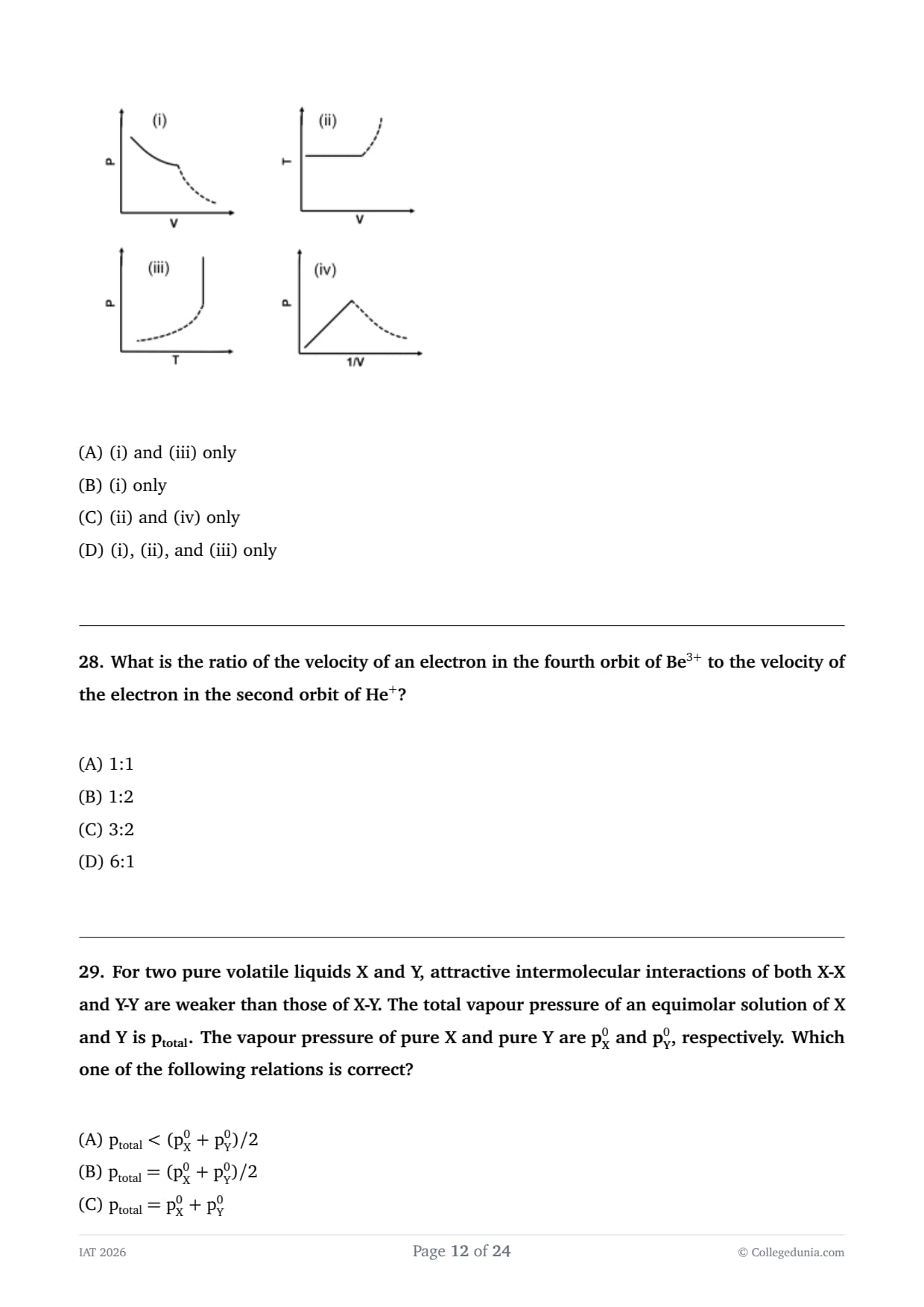
Question 25:

What is the order of pK\(_b\) for the following molecules in an aqueous medium?

  • (A) P \(<\) R \(<\) Q \(<\) S
  • (B) P \(<\) Q \(<\) R \(<\) S
  • (C) S \(<\) P \(<\) R \(<\) Q
  • (D) S \(<\) P \(<\) Q \(<\) R
Correct Answer: (A) P \(<\) R \(<\) Q \(<\) S
View Solution


Step 1: Understanding the Question:

This question asks for the correct ascending order of \(pK_b\) values for four amine molecules (P, Q, R, and S) in an aqueous medium.


Step 2: Key Formula or Approach:

Recall the relationship between base strength (\(K_b\)) and \(pK_b\):
\[ pK_b = -\log_{10} K_b \]
- A stronger base has a higher \(K_b\) and a lower \(pK_b\) value.

- A weaker base has a lower \(K_b\) and a higher \(pK_b\) value.

Thus, the ascending order of \(pK_b\) will run from the strongest base (lowest \(pK_b\)) to the weaker base (highest \(pK_b\)).


Step 3: Detailed Explanation:

Let's analyze the factors affecting the basicity of these amines:


1. Benzylamine (P):

- In benzylamine (\(Ph-CH_2-NH_2\)), the nitrogen atom's lone pair is separated from the benzene ring by an \(sp^3\) hybridized carbon (\(-CH_2-\)).

- Because of this, the lone pair cannot participate in resonance with the aromatic \(\pi\)-system.

- The lone pair is highly localized and readily available for protonation. This makes P an aliphatic-like amine, which is vastly more basic than any of the aromatic amines (Q, R, and S).

- Therefore, P is the strongest base and has the lowest \(pK_b\).

2. Comparing Arlyamines: Aniline (S), N-methylaniline (Q), and N,N-dimethylaniline (R):

- In these three amines, the nitrogen lone pair is directly conjugated with the benzene ring, allowing delocalization and significantly reducing their basicity relative to P.

- To order S, Q, and R, we examine the inductive effect (+I) of the methyl (\(-CH_3\)) groups attached to the nitrogen atom.

- Methyl groups are electron-donating groups. They increase the electron density on the nitrogen atom and stabilize the conjugate acid (anilinium ion) formed upon protonation.

- Aniline (S) has no methyl substituents. It is the weakest base among these three.

- N-methylaniline (Q) has one methyl group, which increases its basicity compared to S.

- N,N-dimethylaniline (R) has two electron-donating methyl groups, which further increase its basicity compared to Q.

- Therefore, the basicity order of the aromatic amines is:
\[ S (weakest) < Q < R (strongest) \]
- Combining this with the highly basic Benzylamine (P), the overall basicity order in aqueous medium is:
\[ S < Q < R < P \]
- Because \(pK_b\) is inversely proportional to basicity, the order of \(pK_b\) is the exact reverse:
\[ pK_b(P) < pK_b(R) < pK_b(Q) < pK_b(S) \]


Step 4: Final Answer:

The ascending order of \(pK_b\) is \(P < R < Q < S\), which corresponds to option (A).
Quick Tip: Basicity: Aliphatic amines \(>\) Aromatic amines.
For aromatic amines, adding electron-donating alkyl groups on the nitrogen increases basicity (\(pK_b\) decreases).
Thus, the more methyl groups on aniline, the stronger the base (lower \(pK_b\)).


Question 26:

100 mL of 1.0 M aqueous NaOH solution was diluted to 1.0 L by adding water. Half of this solution was discarded. A new 100 mL of 0.5 M aqueous NaOH solution was added to the remaining solution. What is the concentration of the final aqueous NaOH solution?

  • (A) 0.17 M
  • (B) 0.10 M
  • (C) 0.50 M
  • (D) 0.33 M
Correct Answer: (A) 0.17 M
View Solution


Step 1: Understanding the Question:

This is a stoichiometry and solution chemistry problem. We need to calculate the molarity of a final sodium hydroxide (\(NaOH\)) solution obtained through a sequence of dilution, volume reduction, and mixing steps.


Step 2: Key Formula or Approach:

Use the fundamental definitions of molarity (\(M\)) and moles (\(n\)):
\[ n = M \times V \]
Where \(V\) is the volume in liters.

To find the final concentration after mixing:
\[ M_{final} = \frac{n_{total}}{V_{total}} = \frac{n_{remaining} + n_{added}}{V_{remaining} + V_{added}} \]

Step 3: Detailed Explanation:

Let's calculate the moles of \(NaOH\) and volumes at each individual stage:


Stage 1: Initial solution:

- Volume \(V_1 = 100 mL = 0.1 L\)

- Molarity \(M_1 = 1.0 M\)

- Moles of \(NaOH\) initially:
\[ n_1 = M_1 \times V_1 = 1.0 mol/L \times 0.1 L = 0.10 mol \]
Stage 2: Dilution to 1.0 L:

- The solution volume is increased to \(V_2 = 1.0 L\) by adding water.

- The total moles of solute remains unchanged: \(n_2 = 0.10 mol\).

Stage 3: Discarding half of the solution:

- Since half of the homogeneous solution is discarded, the volume and moles are both halved:

- Remaining volume:
\[ V_{remaining} = \frac{1.0 L}{2} = 0.5 L \]
- Remaining moles of \(NaOH\):
\[ n_{remaining} = \frac{0.10 mol}{2} = 0.05 mol \]
Stage 4: Addition of a new NaOH solution:

- Added volume \(V_{added} = 100 mL = 0.1 L\)

- Added molarity \(M_{added} = 0.5 M\)

- Moles of \(NaOH\) added:
\[ n_{added} = M_{added} \times V_{added} = 0.5 mol/L \times 0.1 L = 0.05 mol \]
Stage 5: Calculating final concentration:

- Total moles of \(NaOH\) in final mixture:
\[ n_{total} = n_{remaining} + n_{added} = 0.05 mol + 0.05 mol = 0.10 mol \]
- Total volume of the final mixture:
\[ V_{total} = V_{remaining} + V_{added} = 0.5 L + 0.1 L = 0.6 L \]
- Final concentration (\(M_{final}\)):
\[ M_{final} = \frac{n_{total}}{V_{total}} = \frac{0.10 mol}{0.6 L} = 0.167 M \approx 0.17 M \]


Step 4: Final Answer:

The final concentration of the aqueous \(NaOH\) solution is \(0.17 M\), which matches option (A).
Quick Tip: To avoid calculation errors, always keep track of the absolute number of moles of solute at each step.
Dilution changes the volume but keeps moles constant.
Discarding a fraction of a solution reduces both volume and moles by that same fraction.


Question 27:

An ideal gas goes through a reversible isothermal expansion (solid line) followed by a reversible adiabatic expansion (dashed line). Which of the following diagram(s) closely depict(s) the entire process?

  • (A) (i) and (iii) only
  • (B) (i) only
  • (C) (ii) and (iv) only
  • (D) (i), (ii), and (iii) only
Correct Answer: (A) (i) and (iii) only
View Solution


Step 1: Understanding the Question:

This question asks us to identify which of the given thermodynamic graphs (P-V, T-V, P-T, P-1/V) correctly represent a two-step process: first, a reversible isothermal expansion, followed by a reversible adiabatic expansion.


Step 2: Key Formula or Approach:

Let's analyze the mathematical relationships for each process:

1. Reversible Isothermal Expansion (solid line):

- \(T = constant\).

- \(PV = constant\) (Boyle's Law). Since it is an expansion, \(V\) increases and \(P\) decreases.

2. Reversible Adiabatic Expansion (dashed line):

- \(PV^\gamma = constant\) (where \(\gamma > 1\) is the heat capacity ratio).

- The slope of an adiabatic curve on a \(P-V\) diagram is steeper than that of an isothermal curve because:
\[ \left(\frac{\partial P}{\partial V}\right)_{adi} = -\gamma \frac{P}{V} < - \frac{P}{V} = \left(\frac{\partial P}{\partial V}\right)_{iso} \]
- Since work is done at the expense of internal energy during adiabatic expansion, the temperature (\(T\)) decreases as volume (\(V\)) increases.


Step 3: Detailed Explanation:

Let's test each of the four diagrams:


Diagram (i) [P versus V]:

- The solid line (isothermal expansion) slopes downward as volume increases.

- The dashed line (adiabatic expansion) continues downward but with a clearly steeper slope (\(\gamma\) times steeper).

- This is the standard, accurate representation on an indicator diagram. Thus, diagram (i) is correct.

Diagram (ii) [T versus V]:

- For the isothermal step, \(T\) is constant, so it should be represented by a horizontal line. The solid line is indeed horizontal.

- For the adiabatic expansion, temperature must decrease as the gas expands (\(V\) increases). Thus, the dashed line should slope downwards.

- However, diagram (ii) shows the dashed line curving upwards, indicating a temperature increase. Thus, diagram (ii) is incorrect.

Diagram (iii) [P versus T]:

- During the isothermal step, temperature is constant, which means the process must follow a vertical line on a P-T plot. Since it is an expansion, pressure decreases, so the solid line should go straight down. This is correctly depicted.

- During the adiabatic expansion, both pressure (\(P\)) and temperature (\(T\)) decrease. Therefore, the curve should head towards the lower-left quadrant (lower \(P\) and lower \(T\)).

- Diagram (iii) shows the dashed line curving downwards and to the left, which correctly reflects this physical behavior. Thus, diagram (iii) is correct.

Diagram (iv) [P versus 1/V]:

- For an isothermal process, \(P = \frac{constant}{V} \propto \frac{1}{V}\).

- A plot of \(P\) versus \(1/V\) should yield a straight line passing through the origin. Since it is an expansion, \(1/V\) decreases, so we move along this line towards the origin.

- However, diagram (iv) shows a sharp non-linear peak, which is completely incorrect for these processes. Thus, diagram (iv) is incorrect.


Step 4: Final Answer:

Only diagrams (i) and (iii) are correct, which corresponds to option (A).
Quick Tip: Isothermal expansion = Temperature constant, Pressure drops, Volume increases.
Adiabatic expansion = Temperature falls, Pressure drops even faster than in the isothermal step!
Steeper slope on a P-V graph is the signature of an adiabatic curve.


Question 28:

What is the ratio of the velocity of an electron in the fourth orbit of Be\(^{3+}\) to the velocity of the electron in the second orbit of He\(^{+}\)?

  • (A) 1:1
  • (B) 1:2
  • (C) 3:2
  • (D) 6:1
Correct Answer: (A) 1:1
View Solution


Step 1: Understanding the Question:

This question asks for the ratio of the orbital velocities of an electron in two different single-electron systems: the fourth orbit (\(n_1 = 4\)) of a beryllium ion (\(Be^{3+}\)) and the second orbit (\(n_2 = 2\)) of a helium ion (\(He^+\)).


Step 2: Key Formula or Approach:

In Bohr's model of the hydrogen-like atom, the velocity (\(v_n\)) of an electron in the \(n\)-th orbit is given by the formula:
\[ v_n = v_0 \frac{Z}{n} \]
Where:

- \(v_0\) is a constant (velocity of electron in the first Bohr orbit of hydrogen, \(\approx 2.18 \times 10^6 m/s\)).

- \(Z\) is the atomic number of the element.

- \(n\) is the principal quantum number (orbit).

Thus, the velocity is directly proportional to \(Z/n\):
\[ v_n \propto \frac{Z}{n} \]

Step 3: Detailed Explanation:

Let's calculate the value of \(Z/n\) for both systems:


1. For Be\(^{3+}\) (fourth orbit):

- Beryllium (\(Be\)) has an atomic number \(Z_1 = 4\).

- The orbit number is \(n_1 = 4\).

- The ratio factor is:
\[ \frac{Z_1}{n_1} = \frac{4}{4} = 1 \]
2. For He\(^+\) (second orbit):

- Helium (\(He\)) has an atomic number \(Z_2 = 2\).

- The orbit number is \(n_2 = 2\).

- The ratio factor is:
\[ \frac{Z_2}{n_2} = \frac{2}{2} = 1 \]
3. Calculate the velocity ratio:

- Using our proportionality:
\[ \frac{v_{Be^{3+}}}{v_{He^+}} = \frac{Z_1 / n_1}{Z_2 / n_2} = \frac{1}{1} = 1 \]


Step 4: Final Answer:

The ratio of the velocities is \(1:1\), which corresponds to option (A).
Quick Tip: Bohr's orbital variables are extremely useful for quick calculations:
- Velocity \(v \propto Z/n\)
- Radius \(r \propto n^2/Z\)
- Energy \(E \propto Z^2/n^2\)
For these two systems, both have a \(Z/n\) ratio of \(1\), which means the electron travels at the exact same speed in both orbits!


Question 29:

For two pure volatile liquids X and Y, attractive intermolecular interactions of both X-X and Y-Y are weaker than those of X-Y. The total vapour pressure of an equimolar solution of X and Y is p\(_{total}\). The vapour pressure of pure X and pure Y are p\(^0_{X}\) and p\(^0_{Y}\), respectively. Which one of the following relations is correct?

  • (A) p\(_{total} < \) (p\(^0_{X}\) + p\(^0_{Y}\))/2
  • (B) p\(_{total} = \) (p\(^0_{X}\) + p\(^0_{Y}\))/2
  • (C) p\(_{total} = \) p\(^0_{X}\) + p\(^0_{Y}\)
  • (D) p\(_{total} > \) (p\(^0_{X}\) + p\(^0_{Y}\))/2
Correct Answer: (A) p\(_{\text{total}} < \) (p\(^0_{\text{X}}\) + p\(^0_{\text{Y}}\))/2
View Solution


Step 1: Understanding the Question:

This question asks us to identify the correct relationship for the total vapour pressure (\(p_{total}\)) of an equimolar mixture of two volatile liquids, X and Y, where the adhesive intermolecular forces (\(X-Y\)) are stronger than the cohesive forces (\(X-X\) and \(Y-Y\)).


Step 2: Key Formula or Approach:

According to Raoult's Law, for an ideal liquid solution, the total vapour pressure is:
\[ p_{ideal} = x_{X} p_{X}^0 + x_{Y} p_{Y}^0 \]
For an equimolar solution, the mole fractions are:
\[ x_{X} = x_{Y} = 0.5 \]
Thus, the ideal vapour pressure would be:
\[ p_{ideal} = 0.5 p_{X}^0 + 0.5 p_{Y}^0 = \frac{p_{X}^0 + p_{Y}^0}{2} \]

Step 3: Detailed Explanation:

Let's analyze how the relative strength of intermolecular interactions affects the actual vapour pressure:


We are given that the attractive interactions between unlike molecules (\(X-Y\)) are stronger than those between like molecules (\(X-X\) and \(Y-Y\)).

- This means that when X and Y are mixed together, they form stronger attractive bonds with each other than they did in their pure liquid states.

- Because the intermolecular forces are stronger in the solution, the molecules of both X and Y are held more tightly in the liquid phase.

- This significantly reduces the tendency of both components to escape into the gas phase (i.e., less evaporation occurs).

- Consequently, the partial vapour pressures of both X and Y will be lower than predicted by Raoult's Law:
\[ p_{X} < x_{X} p_{X}^0 \quad and \quad p_{Y} < x_{Y} p_{Y}^0 \]
- This behavior represents a negative deviation from Raoult's Law.

- Therefore, the actual total vapour pressure (\(p_{total}\)) will be lower than the ideal total vapour pressure:
\[ p_{total} < p_{ideal} \] \[ p_{total} < \frac{p_{X}^0 + p_{Y}^0}{2} \]


Step 4: Final Answer:

Since the solution shows a negative deviation, the total vapour pressure \(p_{total}\) is less than the average of the two pure vapour pressures, matching option (A).
Quick Tip: Intermolecular forces rules:
- Stronger \(X-Y\) interactions \(\rightarrow\) negative deviation \(\rightarrow\) actual \(P < P_{ideal}\) \(\rightarrow\) \(p_{total} < \frac{p_{X}^0 + p_{Y}^0}{2}\).
- Weaker \(X-Y\) interactions \(\rightarrow\) positive deviation \(\rightarrow\) actual \(P > P_{ideal}\) \(\rightarrow\) \(p_{total} > \frac{p_{X}^0 + p_{Y}^0}{2}\).


Question 30:

The rate constant of a reaction at 600 K with an activation energy of 191.47 kJ mol\(^{-1}\) is 5.0 \(\times\) 10\(^{-5}\) s\(^{-1}\). What is the temperature at which the half-life of the reaction becomes 152 s? [Consider pre-exponential factor and activation energy to be independent of temperature. R = 8.314 J K\(^{-1}\)mol\(^{-1}\)]

  • (A) 680 K
  • (B) 640 K
  • (C) 760 K
  • (D) 720 K
Correct Answer: (A) 680 K
View Solution


Step 1: Understanding the Question:

This chemical kinetics problem asks us to find the temperature (\(T_2\)) at which a reaction will have a half-life of \(152 s\), given its rate constant (\(k_1\)) at \(T_1 = 600 K\) and its activation energy (\(E_a\)).


Step 2: Key Formula or Approach:

1. Identify the reaction order: The unit of the rate constant \(k_1\) is \(s^{-1}\), which indicates a first-order reaction.

2. Calculate the required rate constant (\(k_2\)) at the new temperature (\(T_2\)) using the first-order half-life relationship:
\[ k_2 = \frac{\ln 2}{t_{1/2}} \]
3. Relate rate constants at different temperatures using the integrated Arrhenius equation:
\[ \ln\left(\frac{k_2}{k_1}\right) = \frac{E_a}{R} \left( \frac{1}{T_1} - \frac{1}{T_2} \right) \]

Step 3: Detailed Explanation:

Let's carry out the calculations step-by-step:


1. Calculate the rate constant \(k_2\) at temperature \(T_2\):

- Given \(t_{1/2} = 152 s\) at \(T_2\).
\[ k_2 = \frac{\ln 2}{152 s} \approx \frac{0.69315}{152} \approx 4.56 \times 10^{-3} s^{-1} \]
2. Calculate the ratio of the rate constants:

- Given \(k_1 = 5.0 \times 10^{-5} s^{-1}\) at \(T_1 = 600 K\).
\[ \frac{k_2}{k_1} = \frac{4.56 \times 10^{-3} s^{-1}}{5.0 \times 10^{-5} s^{-1}} = 91.2 \]
- Taking the natural logarithm:
\[ \ln(91.2) \approx 4.513 \]
3. Calculate the \(E_a / R\) ratio:

- Given \(E_a = 191.47 kJ/mol = 191470 J/mol\).

- Given \(R = 8.314 J K^{-1} mol^{-1}\).
\[ \frac{E_a}{R} = \frac{191470}{8.314} \approx 23030 K \]
4. Solve for \(T_2\) using Arrhenius equation:

- Substitute the computed values into the Arrhenius expression:
\[ 4.513 = 23030 \left( \frac{1}{600} - \frac{1}{T_2} \right) \]
- Divide both sides by 23030:
\[ \frac{4.513}{23030} = \frac{1}{600} - \frac{1}{T_2} \] \[ 0.00019596 \approx 0.00166667 - \frac{1}{T_2} \]
- Rearrange to solve for \(1/T_2\):
\[ \frac{1}{T_2} = 0.00166667 - 0.00019596 \approx 0.00147071 \]
- Calculate the final temperature \(T_2\):
\[ T_2 = \frac{1}{0.00147071} \approx 679.94 K \approx 680 K \]


Step 4: Final Answer:

The temperature at which the half-life becomes 152 s is approximately \(680 K\), which corresponds to option (A).
Quick Tip: Always ensure units are consistent before calculating:
Activation energy (\(E_a\)) is often given in \(kJ/mol\) while the gas constant (\(R\)) is in \(J K^{-1} mol^{-1}\).
Always convert \(E_a\) to Joules (\(1 kJ = 1000 J\)) before substituting into the equation!


Question 31:

Let \(p(x)\) be a quadratic polynomial such that \(p(1) = p(-1) = 0\). What is the coefficient of \(x\) in \(p(x)\)?

  • (A) 0
  • (B) 1
  • (C) -1
  • (D) 2
Correct Answer: (A) 0
View Solution


Step 1: Understanding the Question:

We are given a quadratic polynomial \(p(x)\) that satisfies the conditions \(p(1) = 0\) and \(p(-1) = 0\).

This means that \(x = 1\) and \(x = -1\) are the roots (or zeros) of the quadratic polynomial \(p(x)\).

We need to determine the coefficient of the linear term, i.e., the coefficient of \(x\), in the expansion of \(p(x)\).


Step 2: Key Formula or Approach:

Any quadratic polynomial with roots \(\alpha\) and \(\beta\) can be written in the form:
\[ p(x) = a(x - \alpha)(x - \beta) \]

where \(a\) is a non-zero real constant.

Alternatively, we can express the polynomial in its standard form:
\[ p(x) = ax^2 + bx + c \]

and apply the given conditions to find the value of \(b\).


Step 3: Detailed Explanation:


Let us assume the standard form of the quadratic polynomial is:
\[ p(x) = ax^2 + bx + c \quad (where a \neq 0) \]

We substitute the first given condition, \(p(1) = 0\), into the standard form:
\[ p(1) = a(1)^2 + b(1) + c = 0 \]
\[ a + b + c = 0 \quad --- (Equation 1) \]

We substitute the second given condition, \(p(-1) = 0\), into the standard form:
\[ p(-1) = a(-1)^2 + b(-1) + c = 0 \]
\[ a - b + c = 0 \quad --- (Equation 2) \]

To solve for the coefficient of \(x\) (which is \(b\)), we subtract Equation 2 from Equation 1:
\[ (a + b + c) - (a - b + c) = 0 - 0 \]
\[ 2b = 0 \]
\[ b = 0 \]

Alternatively, using the factored form with roots \(\alpha = 1\) and \(\beta = -1\):
\[ p(x) = a(x - 1)(x - (-1)) \]
\[ p(x) = a(x - 1)(x + 1) \]
\[ p(x) = a(x^2 - 1) \]
\[ p(x) = ax^2 + 0x - a \]

Comparing this with the standard form, the coefficient of \(x\) is clearly \(0\).


Step 4: Final Answer:

The coefficient of \(x\) in the quadratic polynomial \(p(x)\) is \(0\).
Quick Tip: If a polynomial \(p(x)\) has roots that are symmetric about the origin (like \(\alpha\) and \(-\alpha\)), then the polynomial is symmetric.
For a quadratic polynomial, this means it is an even function, and thus the coefficient of the odd power of \(x\) (which is \(x^1\)) must be zero.


Question 32:

Consider the following sets of points in the complex plane \[ A = \left\{ \cos \left( \frac{2n\pi}{5} \right) + i \sin \left( \frac{2n\pi}{5} \right) : n \in \mathbb{Z} \right\} and \] \[ B = \left\{ \cos \left( \frac{2n}{5} \right) + i \sin \left( \frac{2n}{5} \right) : n \in \mathbb{Z} \right\} . \]
Which of the following statements is TRUE?

  • (A) \(A\) is finite but \(B\) is infinite.
  • (B) \(A\) is finite and \(B\) is also finite.
  • (C) \(A\) is infinite but \(B\) is finite.
  • (D) \(A\) is infinite and \(B\) is also infinite.
Correct Answer: (A) \(A\) is finite but \(B\) is infinite.
View Solution


Step 1: Understanding the Question:

We are given two sets of complex numbers, \(A\) and \(B\), represented in polar form.

The elements of these sets are generated by varying the parameter \(n\) over all integers \(\mathbb{Z}\).

We need to determine if each set contains a finite or an infinite number of unique elements.


Step 2: Key Formula or Approach:

Euler's formula states that:
\[ e^{i\theta} = \cos \theta + i \sin \theta \]

Using this, we can rewrite the sets as:
\[ A = \left\{ e^{i \theta_n} : \theta_n = \frac{2n\pi}{5}, n \in \mathbb{Z} \right\} \]
\[ B = \left\{ e^{i \phi_n} : \phi_n = \frac{2n}{5}, n \in \mathbb{Z} \right\} \]

Two angles \(\theta_1\) and \(\theta_2\) yield the same complex number on the unit circle if and only if their difference is an integer multiple of \(2\pi\).


Step 3: Detailed Explanation:


Let us analyze set \(A\) first:

The angle is given by \(\theta_n = \frac{2n\pi}{5}\).

For two integers \(n_1\) and \(n_2\) to represent the same complex point:
\[ \theta_{n_1} - \theta_{n_2} = 2k\pi \quad (where k \in \mathbb{Z}) \]
\[ \frac{2n_1\pi}{5} - \frac{2n_2\pi}{5} = 2k\pi \]

Dividing both sides by \(2\pi\):
\[ \frac{n_1 - n_2}{5} = k \implies n_1 - n_2 = 5k \]

This indicates that the values repeat with a period of \(5\).

Thus, the set \(A\) contains exactly \(5\) unique elements corresponding to \(n = 0, 1, 2, 3, 4\):
\[ A = \left\{ 1, e^{i2\pi/5}, e^{i4\pi/5}, e^{i6\pi/5}, e^{i8\pi/5} \right\} \]
Hence, \(A\) is a finite set.

Let us now analyze set \(B\):

The angle is given by \(\phi_n = \frac{2n}{5}\).

For two integers \(n_1\) and \(n_2\) to represent the same complex point:
\[ \phi_{n_1} - \phi_{n_2} = 2k\pi \quad (where k \in \mathbb{Z}) \]
\[ \frac{2n_1}{5} - \frac{2n_2}{5} = 2k\pi \]
\[ \frac{2(n_1 - n_2)}{5} = 2k\pi \implies n_1 - n_2 = 5k\pi \]

Since \(n_1, n_2,\) and \(k\) must be integers, and \(\pi\) is an irrational number, this equality can hold if and only if \(k = 0\).

This implies \(n_1 = n_2\).

Thus, no two distinct integers \(n_1\) and \(n_2\) can produce the same complex number in set \(B\).

Hence, all elements in \(B\) for different \(n \in \mathbb{Z}\) are distinct, making \(B\) an infinite set.


Step 4: Final Answer:

Thus, \(A\) is finite and \(B\) is infinite.
Quick Tip: An exponential expression of the form \(e^{i \alpha n}\) (where \(n \in \mathbb{Z}\)) is periodic and represents a finite set of points if and only if \(\alpha/\pi\) is a rational number.
If \(\alpha/\pi\) is irrational, the points are dense on the unit circle and form an infinite set.


Question 33:

Consider the points \(A(4\hat{i} + \hat{j} + 3\hat{k})\), \(B(2\hat{j})\) and \(C(-4\hat{i} + 3\hat{j} - 3\hat{k})\). Which of the following statements is TRUE?

  • (A) \(A, B\) and \(C\) are collinear.
  • (B) \(\vec{AB} + 3\vec{BC}\) is perpendicular to \(\vec{AC}\).
  • (C) \(\vec{AB} \times \vec{BC} = \hat{i} + \hat{j} + \hat{k}\).
  • (D) \(\vec{AB}, \vec{BC}\) and \(\vec{CA}\) are mutually perpendicular.
Correct Answer: (A) \(A, B\) and \(C\) are collinear.
View Solution


Step 1: Understanding the Question:

We are given three points in three-dimensional space: \(A\), \(B\), and \(C\), with their position vectors specified.

We need to evaluate the properties of the vectors formed by these points (such as collinearity, perpendicularity, and cross product) to find the true statement.


Step 2: Key Formula or Approach:

Let the position vectors of the points be \(\vec{OA}\), \(\vec{OB}\), and \(\vec{OC}\).

We can compute the displacement vectors:
\[ \vec{AB} = \vec{OB} - \vec{OA} \]
\[ \vec{BC} = \vec{OC} - \vec{OB} \]

Two vectors \(\vec{u}\) and \(\vec{v}\) are collinear if \(\vec{u} = \lambda \vec{v}\) for some scalar \(\lambda\).

If they share a common point (like \(B\)), then the three points \(A\), \(B\), and \(C\) are collinear.


Step 3: Detailed Explanation:


Let us write down the given position vectors:
\[ \vec{OA} = 4\hat{i} + \hat{j} + 3\hat{k} \]
\[ \vec{OB} = 2\hat{j} \]
\[ \vec{OC} = -4\hat{i} + 3\hat{j} - 3\hat{k} \]

Next, we calculate the vector \(\vec{AB}\):
\[ \vec{AB} = \vec{OB} - \vec{OA} = (0 - 4)\hat{i} + (2 - 1)\hat{j} + (0 - 3)\hat{k} \]
\[ \vec{AB} = -4\hat{i} + \hat{j} - 3\hat{k} \]

Now, we calculate the vector \(\vec{BC}\):
\[ \vec{BC} = \vec{OC} - \vec{OB} = (-4 - 0)\hat{i} + (3 - 2)\hat{j} + (-3 - 0)\hat{k} \]
\[ \vec{BC} = -4\hat{i} + \hat{j} - 3\hat{k} \]

Comparing the two vectors \(\vec{AB}\) and \(\vec{BC}\):
\[ \vec{AB} = \vec{BC} \]

This means the direction of both vectors is identical (\(\lambda = 1\)), and since they share the point \(B\), the points \(A\), \(B\), and \(C\) must lie on the same straight line.

Thus, the points \(A\), \(B\), and \(C\) are collinear.

Let us verify why the other options are incorrect:

Since \(\vec{AB}\) and \(\vec{BC}\) are parallel:

The cross product \(\vec{AB} \times \vec{BC}\) must be the zero vector \(\vec{0}\), which makes option (C) incorrect.

Collinear vectors cannot be mutually perpendicular, which makes option (D) incorrect.
\(\vec{AB} + 3\vec{BC} = 4\vec{AB}\) and \(\vec{AC} = 2\vec{AB}\). Since both are along the same direction, they are parallel, not perpendicular, which makes option (B) incorrect.


Step 4: Final Answer:

Therefore, the statement "A, B and C are collinear" is true.
Quick Tip: To quickly check for collinearity of three points \(A\), \(B\), and \(C\), compute the components of \(\vec{AB}\) and \(\vec{BC}\).
If their respective components are proportional, i.e., \(\frac{x_1}{x_2} = \frac{y_1}{y_2} = \frac{z_1}{z_2}\), the points are collinear.


Question 34:

Let \(l_1\) be the line joining \((1, 1, 1)\) and \((3, 1, 3)\) and let \(l_2\) be the line joining \((0, 2, -1)\) and \((2, 0, 3)\). What is the angle between \(l_1\) and \(l_2\)?

  • (A) \(30^\circ\)
  • (B) \(60^\circ\)
  • (C) \(45^\circ\)
  • (D) \(90^\circ\)
Correct Answer: (A) \(30^\circ\)
View Solution


Step 1: Understanding the Question:

We are given two lines in 3D space, \(l_1\) and \(l_2\), each defined by a pair of points.

We need to find the angle between these two lines, which is determined by the angle between their respective direction vectors.


Step 2: Key Formula or Approach:
The direction vector \(\vec{v}\) of a line joining two points \((x_1, y_1, z_1)\) and \((x_2, y_2, z_2)\) is given by:
\[ \vec{v} = (x_2 - x_1)\hat{i} + (y_2 - y_1)\hat{j} + (z_2 - z_1)\hat{k} \]

The cosine of the angle \(\theta\) between two direction vectors \(\vec{v_1}\) and \(\vec{v_2}\) is given by:
\[ \cos \theta = \frac{|\vec{v_1} \cdot \vec{v_2}|}{|\vec{v_1}| |\vec{v_2}|} \]


Step 3: Detailed Explanation:


Let us determine the direction vector \(\vec{v_1}\) for the line \(l_1\) joining \((1, 1, 1)\) and \((3, 1, 3)\):
\[ \vec{v_1} = (3 - 1)\hat{i} + (1 - 1)\hat{j} + (3 - 1)\hat{k} \] \[ \vec{v_1} = 2\hat{i} + 0\hat{j} + 2\hat{k} \]
Let us determine the direction vector \(\vec{v_2}\) for the line \(l_2\) joining \((0, 2, -1)\) and \((2, 0, 3)\):
\[ \vec{v_2} = (2 - 0)\hat{i} + (0 - 2)\hat{j} + (3 - (-1))\hat{k} \] \[ \vec{v_2} = 2\hat{i} - 2\hat{j} + 4\hat{k} \]
Now, we calculate the dot product \(\vec{v_1} \cdot \vec{v_2}\):
\[ \vec{v_1} \cdot \vec{v_2} = (2)(2) + (0)(-2) + (2)(4) \] \[ \vec{v_1} \cdot \vec{v_2} = 4 + 0 + 8 = 12 \]
Next, we find the magnitude of each vector:
\[ |\vec{v_1}| = \sqrt{2^2 + 0^2 + 2^2} = \sqrt{4 + 0 + 4} = \sqrt{8} = 2\sqrt{2} \] \[ |\vec{v_2}| = \sqrt{2^2 + (-2)^2 + 4^2} = \sqrt{4 + 4 + 16} = \sqrt{24} = 2\sqrt{6} \]
We substitute these values into the angle formula:
\[ \cos \theta = \frac{12}{(2\sqrt{2})(2\sqrt{6})} = \frac{12}{4\sqrt{12}} = \frac{3}{\sqrt{12}} = \frac{3}{2\sqrt{3}} = \frac{\sqrt{3}}{2} \]
Since \(\cos \theta = \frac{\sqrt{3}}{2}\), the angle \(\theta\) is:
\[ \theta = 30^\circ \]


Step 4: Final Answer:

The angle between \(l_1\) and \(l_2\) is \(30^\circ\).
Quick Tip: To simplify calculations, divide direction vectors by their common factor first.
For example, use \(\vec{v_1'} = \hat{i} + \hat{k}\) and \(\vec{v_2'} = \hat{i} - \hat{j} + 2\hat{k}\).
Then \(\cos \theta = \frac{1 + 0 + 2}{\sqrt{2}\sqrt{6}} = \frac{3}{\sqrt{12}} = \frac{\sqrt{3}}{2}\), which immediately yields \(30^\circ\).


Question 35:

Let \(r, l\) be two integers such that \(r \ge l \ge 3\). What is the total number of functions \[ f : \{1, 2, \dots, r\} \to \{1, 2, \dots, r\} \]
such that \(f(1), f(2), \dots, f(l)\) are all distinct?

  • (A) \(r^{r-l+1}(r - 1)(r - 2)\dots(r - l + 1)\)
  • (B) \(r^{r-l}(r - 1)(r - 2)\dots(r - l + 1)\)
  • (C) \(r(r - 1)(r - 2)\dots(r - l + 1)\)
  • (D) \(r^r\)
Correct Answer: (A) \(r^{r-l+1}(r - 1)(r - 2)\dots(r - l + 1)\)
View Solution


Step 1: Understanding the Question:

We are asked to find the total number of functions from a set containing \(r\) elements to itself.

The condition imposed is that the images of the first \(l\) elements of the domain, i.e., \(\{f(1), f(2), \dots, f(l)\}\), must be distinct.

The remaining \(r - l\) elements in the domain have no restrictions on their mapping.


Step 2: Key Formula or Approach:
We will use the fundamental counting principle.

First, we calculate the number of ways to map the first \(l\) elements such that they have distinct images.

Next, we calculate the number of ways to map the remaining \(r - l\) elements of the domain, which can be mapped to any of the \(r\) elements of the codomain.

The total number of functions is the product of these two values.


Step 3: Detailed Explanation:


Let the domain and codomain be \(S = \{1, 2, \dots, r\}\).

We need to map the subset \(\{1, 2, \dots, l\}\) to distinct values in \(S\).

For the first element, \(1\), there are \(r\) possible choices in the codomain.

For the second element, \(2\), there are \(r - 1\) choices (since \(f(2) \neq f(1)\)).

For the third element, \(3\), there are \(r - 2\) choices (since \(f(3) \neq f(1)\) and \(f(3) \neq f(2)\)).

Continuing this, for the \(l\)-th element, there are \(r - (l - 1) = r - l + 1\) choices.

Thus, the number of ways to assign distinct values to \(f(1), f(2), \dots, f(l)\) is:
\[ P(r, l) = r(r - 1)(r - 2)\dots(r - l + 1) \]

Now, we consider the remaining \(r - l\) elements in the domain, which are \(\{l+1, l+2, \dots, r\}\).

Since there are no restrictions on these remaining elements, each can be mapped to any of the \(r\) elements in the codomain.

The number of ways to map these \(r - l\) elements is:
\[ r \times r \times \dots \times r = r^{r - l} \]

Therefore, the total number of functions is: \[ Total Functions = r(r - 1)(r - 2)\dots(r - l + 1) \times r^{r - l} \]
We can rewrite this expression by combining the factor of \(r\) with \(r^{r-l}\):
\[ Total Functions = r^{r - l + 1}(r - 1)(r - 2)\dots(r - l + 1) \]


Step 4: Final Answer:

The total number of such functions is \(r^{r-l+1}(r-1)(r-2)\dots(r-l+1)\).
Quick Tip: For counting problems with mixed constraints, handle the restricted choices first.
Here, mapping the first \(l\) elements is equivalent to selecting an ordered arrangement of \(l\) elements out of \(r\), which is \(P(r,l) = \frac{r!}{(r-l)!}\).
Then multiply by \(r^{r-l}\) for the remaining unrestricted elements.


Question 36:

Let \(\mathcal{C}\) be the set of all the circles in a plane. If \[ \mathcal{R} = \{(C_1, C_2) \in \mathcal{C} \times \mathcal{C} \mid C_1 and C_2 intersect\} , \]
then which of the following statements is TRUE?

  • (A) \(\mathcal{R}\) is reflexive and symmetric but not transitive.
  • (B) \(\mathcal{R}\) is reflexive and transitive but not symmetric.
  • (C) \(\mathcal{R}\) is symmetric and transitive but not reflexive.
  • (D) \(\mathcal{R}\) is not a relation.
Correct Answer: (A) \(\mathcal{R}\) is reflexive and symmetric but not transitive.
View Solution


Step 1: Understanding the Question:

We are given a relation \(\mathcal{R}\) defined on the set of all circles in a plane, \(\mathcal{C}\).

Two circles \(C_1\) and \(C_2\) are related if they intersect.

We need to test this relation for reflexivity, symmetry, and transitivity.


Step 2: Key Formula or Approach:

Reflexivity: A relation is reflexive if \((C_1, C_1) \in \mathcal{R}\) for every \(C_1 \in \mathcal{C}\).

Symmetry: A relation is symmetric if \((C_1, C_2) \in \mathcal{R} \implies (C_2, C_1) \in \mathcal{R}\).

Transitivity: A relation is transitive if \((C_1, C_2) \in \mathcal{R}\) and \((C_2, C_3) \in \mathcal{R} \implies (C_1, C_3) \in \mathcal{R}\).


Step 3: Detailed Explanation:


Reflexivity:

Let \(C_1\) be any circle in the plane.

Every circle completely overlaps with itself, which means it shares all of its points with itself.

Thus, \(C_1\) intersects \(C_1\).

So, \((C_1, C_1) \in \mathcal{R}\) for all \(C_1 \in \mathcal{C}\).

Therefore, the relation \(\mathcal{R}\) is reflexive.

Symmetry:

Let \(C_1, C_2 \in \mathcal{C}\) such that \((C_1, C_2) \in \mathcal{R}\).

This means \(C_1\) and \(C_2\) intersect, sharing at least one common point.

If \(C_1\) intersects \(C_2\), then \(C_2\) must also intersect \(C_1\).

Thus, \((C_2, C_1) \in \mathcal{R}\).

Therefore, the relation \(\mathcal{R}\) is symmetric.

Transitivity:

Let \(C_1, C_2, C_3 \in \mathcal{C}\) such that \((C_1, C_2) \in \mathcal{R}\) and \((C_2, C_3) \in \mathcal{R}\).

This means \(C_1\) intersects \(C_2\), and \(C_2\) intersects \(C_3\).

However, this does not guarantee that \(C_1\) intersects \(C_3\).

For example, let \(C_1\) be a circle centered at \((0,0)\) with radius \(1\).

Let \(C_2\) be a circle centered at \((1.5,0)\) with radius \(1\).

These two circles intersect because the distance between their centers (\(1.5\)) is less than the sum of their radii (\(2\)).

Now, let \(C_3\) be a circle centered at \((3,0)\) with radius \(1\).
\(C_2\) and \(C_3\) intersect because the distance between their centers (\(1.5\)) is less than \(2\).

But the distance between the centers of \(C_1\) and \(C_3\) is \(3\), which is greater than the sum of their radii (\(2\)).

Therefore, \(C_1\) and \(C_3\) do not intersect.

So, \((C_1, C_2) \in \mathcal{R}\) and \((C_2, C_3) \in \mathcal{R}\), but \((C_1, C_3) \notin \mathcal{R}\).

Thus, the relation \(\mathcal{R}\) is not transitive.


Step 4: Final Answer:

The relation \(\mathcal{R}\) is reflexive and symmetric but not transitive.
Quick Tip: Geometric relations involving concepts like "intersection," "touches," or "is perpendicular to" are typically symmetric but rarely transitive.
Constructing a simple linear arrangement of objects (like three circles in a row) is an easy way to verify transitivity.


Question 37:

What is the value of \(\int_{-1}^{2} \min\{1 - x, 1 - x^3\} \, dx\)?

  • (A) -1
  • (B) 0
  • (C) 1
  • (D) 2
Correct Answer: (A) -1
View Solution


Step 1: Understanding the Question:

We are required to evaluate a definite integral from \(x = -1\) to \(x = 2\).

The integrand is defined as the minimum of two functions: \(f(x) = 1 - x\) and \(g(x) = 1 - x^3\).

To integrate, we must determine which function is smaller on different sub-intervals within \([-1, 2]\).


Step 2: Key Formula or Approach:
We compare the two functions by analyzing the inequality:
\[ 1 - x \le 1 - x^3 \]
This simplifies to:
\[ x^3 - x \le 0 \implies x(x^2 - 1) \le 0 \implies x(x - 1)(x + 1) \le 0 \]
Using the wavy curve method, we find the intervals where \(1 - x\) is smaller than or equal to \(1 - x^3\), and vice versa.


Step 3: Detailed Explanation:


Let us analyze the sign of \(P(x) = x(x - 1)(x + 1)\) on \([-1, 2]\):

The critical points are \(x = -1, 0, 1\).

For \(x \in [-1, 0]\):
\(P(x) \ge 0 \implies x^3 - x \ge 0 \implies 1 - x \ge 1 - x^3\).

Thus, \(\min\{1 - x, 1 - x^3\} = 1 - x^3\).

For \(x \in [0, 1]\):
\(P(x) \le 0 \implies x^3 - x \le 0 \implies 1 - x \le 1 - x^3\).

Thus, \(\min\{1 - x, 1 - x^3\} = 1 - x\).

For \(x \in [1, 2]\):
\(P(x) \ge 0 \implies x^3 - x \ge 0 \implies 1 - x \ge 1 - x^3\).

Thus, \(\min\{1 - x, 1 - x^3\} = 1 - x^3\).

Now, we express the total integral as the sum of three integrals over these sub-intervals:
\[ I = \int_{-1}^{0} (1 - x^3) \, dx + \int_{0}^{1} (1 - x) \, dx + \int_{1}^{2} (1 - x^3) \, dx \]
Let us evaluate each integral separately:
1. For the first sub-interval \([-1, 0]\):
\[ I_1 = \left[ x - \frac{x^4}{4} \right]_{-1}^{0} = 0 - \left( -1 - \frac{1}{4} \right) = \frac{5}{4} \]
2. For the second sub-interval \([0, 1]\):
\[ I_2 = \left[ x - \frac{x^2}{2} \right]_{0}^{1} = \left( 1 - \frac{1}{2} \right) - 0 = \frac{1}{2} \]
3. For the third sub-interval \([1, 2]\):
\[ I_3 = \left[ x - \frac{x^4}{4} \right]_{1}^{2} = \left( 2 - \frac{16}{4} \right) - \left( 1 - \frac{1}{4} \right) = (2 - 4) - \frac{3}{4} = -2 - \frac{3}{4} = -\frac{11}{4} \]
Summing these values gives the final integral:
\[ I = I_1 + I_2 + I_3 = \frac{5}{4} + \frac{1}{2} - \frac{11}{4} = \frac{5 + 2 - 11}{4} = \frac{-4}{4} = -1 \]


Step 4: Final Answer:

The value of the definite integral is -1.
Quick Tip: Whenever you have a \(\min(f(x), g(x))\) or \(\max(f(x), g(x))\) term in an integral, first find their intersection points by solving \(f(x) = g(x)\).
These intersection points will define the limits of the piecewise intervals for integration.


Question 38:

Consider the data of scores obtained by students in an examination. If the score of every student is increased by 2 marks, then which of the following statements is TRUE?

  • (A) The mean deviation about the mean does not change.
  • (B) The mean deviation about the mean is increased by 2.
  • (C) The mean deviation about the median is increased by 2.
  • (D) The variance is increased by 2.
Correct Answer: (A) The mean deviation about the mean does not change.
View Solution


Step 1: Understanding the Question:

We are analyzing how statistical measures of dispersion (specifically mean deviation and variance) behave when a constant value (2 marks) is added to every data point in a set of exam scores.


Step 2: Key Formula or Approach:
Let the original scores be \(x_1, x_2, \dots, x_N\).

The mean of the original data is \(\bar{x}\).

The new scores are \(y_i = x_i + 2\) for all \(i\).

The mean of the new data is \(\bar{y} = \bar{x} + 2\).

We will calculate the mean deviation of the new dataset and compare it to that of the original dataset.


Step 3: Detailed Explanation:


The mean deviation about the mean for the original data is defined as:
\[ MD_x = \frac{1}{N} \sum_{i=1}^{N} |x_i - \bar{x}| \]
For the new dataset, the mean deviation about the mean is:
\[ MD_y = \frac{1}{N} \sum_{i=1}^{N} |y_i - \bar{y}| \]
Substituting \(y_i = x_i + 2\) and \(\bar{y} = \bar{x} + 2\):
\[ |y_i - \bar{y}| = |(x_i + 2) - (\bar{x} + 2)| = |x_i - \bar{x}| \]
Therefore:
\[ MD_y = \frac{1}{N} \sum_{i=1}^{N} |x_i - \bar{x}| = MD_x \]
This proves that the mean deviation about the mean remains completely unchanged.

Similarly, since the median also increases by 2, the deviations from the median remain unchanged, making option (C) false.

Let us check the variance:

The variance of \(x\) is \(\sigma_x^2 = \frac{1}{N} \sum (x_i - \bar{x})^2\).

The variance of \(y\) is \(\sigma_y^2 = \frac{1}{N} \sum (y_i - \bar{y})^2 = \frac{1}{N} \sum (x_i - \bar{x})^2 = \sigma_x^2\).

Thus, the variance does not change, making option (D) false.


Step 4: Final Answer:

The mean deviation about the mean does not change when a constant is added to all data values.
Quick Tip: Measures of dispersion such as Range, Mean Deviation, Standard Deviation, and Variance are independent of the change of origin (i.e., adding or subtracting a constant to/from each observation).
They only change when there is a change of scale (i.e., multiplying or dividing by a constant).


Question 39:

Consider the function \(f : \mathbb{R} \to \mathbb{R}\) defined by \(f(x) = \sin^2(7x) - \sin^2(5x)\). Which of the following statements is NOT TRUE?

  • (A) \(f\) is increasing on \(\left(\frac{3\pi}{2}, 2\pi\right)\).
  • (B) \(f(x) > 0\), for all \(x \in \left(0, \frac{\pi}{48}\right)\).
  • (C) \(f\left(x + \frac{\pi}{2}\right) + f(x) = 0\), for all \(x \in \mathbb{R}\).
  • (D) \(f\left(\frac{\pi}{12}\right) = 0\).
Correct Answer: (A) \(f\) is increasing on \(\left(\frac{3\pi}{2}, 2\pi\right)\).
View Solution


Step 1: Understanding the Question:

We are given a trigonometric function \(f(x) = \sin^2(7x) - \sin^2(5x)\).

We need to test each of the four options to find which statement is false.


Step 2: Key Formula or Approach:
We simplify the function using the standard identity:
\[ \sin^2 A - \sin^2 B = \sin(A + B) \sin(A - B) \]
By setting \(A = 7x\) and \(B = 5x\), we get:
\[ f(x) = \sin(12x) \sin(2x) \]
We can now analyze the behavior of the simplified function.


Step 3: Detailed Explanation:


Let us evaluate Option (D) first:
\[ f\left(\frac{\pi}{12}\right) = \sin\left(12 \cdot \frac{\pi}{12}\right) \sin\left(2 \cdot \frac{\pi}{12}\right) = \sin(\pi) \sin\left(\frac{\pi}{6}\right) = 0 \times \frac{1}{2} = 0 \]
So, Option (D) is TRUE.

Let us evaluate Option (C):
\[ f\left(x + \frac{\pi}{2}\right) = \sin\left(12\left(x + \frac{\pi}{2}\right)\right) \sin\left(2\left(x + \frac{\pi}{2}\right)\right) \] \[ f\left(x + \frac{\pi}{2}\right) = \sin(12x + 6\pi) \sin(2x + \pi) \]
Since \(\sin(\theta + 6\pi) = \sin\theta\) and \(\sin(\theta + \pi) = -\sin\theta\):
\[ f\left(x + \frac{\pi}{2}\right) = \sin(12x) \cdot (-\sin(2x)) = -\sin(12x)\sin(2x) = -f(x) \] \[ f\left(x + \frac{\pi}{2}\right) + f(x) = 0 \]
So, Option (C) is TRUE.

Let us evaluate Option (B):

For \(x \in \left(0, \frac{\pi}{48}\right)\):

The argument of the second sine term is \(2x \in \left(0, \frac{\pi}{24}\right)\), where \(\sin(2x) > 0\).

The argument of the first sine term is \(12x \in \left(0, \frac{\pi}{4}\right)\), where \(\sin(12x) > 0\).

Since both terms are positive in this interval, their product \(f(x) > 0\).

So, Option (B) is TRUE.

Let us evaluate Option (A):

Since options B, C, and D are mathematically correct, Option (A) must be the false statement.

To confirm, let's examine the derivative on \(\left(\frac{3\pi}{2}, 2\pi\right)\).

The derivative \(f'(x)\) is given by:
\[ f'(x) = 12 \cos(12x) \sin(2x) + 2 \sin(12x) \cos(2x) \]
In the interval \(\left(\frac{3\pi}{2}, 2\pi\right)\), \(12x\) spans a wide range of \(6\pi\) radians (from \(18\pi\) to \(24\pi\)), which covers multiple complete periods of both sine and cosine.

Thus, the derivative \(f'(x)\) changes sign multiple times on this interval, meaning \(f(x)\) is not monotonically increasing.

Therefore, Option (A) is NOT TRUE.


Step 4: Final Answer:

The statement "f is increasing on \(\left(\frac{3\pi}{2}, 2\pi\right)\)" is not true.
Quick Tip: The identity \(\sin^2 A - \sin^2 B = \sin(A+B)\sin(A-B)\) is a highly efficient way to simplify differences of squared trigonometric functions.
Always test the easiest options first (like evaluating simple points or checking basic period properties) to eliminate options quickly.


Question 40:

For real numbers \(a\) and \(b\), consider the function \(f : \mathbb{R} \to \mathbb{R}\) given by \[ f(x) = \begin{cases} -ax - b ;& if x < -1, \\
5x + 1 ;& if -1 \le x \le 1, \\
a^2x + 3b ;& if x > 1 . \end{cases} \]
How many pairs \((a, b)\) are there for which \(f\) is continuous at every point of \(\mathbb{R}\)?

  • (A) 0
  • (B) 1
  • (C) 2
  • (D) infinitely many
Correct Answer: (A) 0
View Solution


Step 1: Understanding the Question:

We are given a piecewise defined function \(f(x)\) with two transition boundary points, \(x = -1\) and \(x = 1\).

For \(f(x)\) to be continuous at all points on the real line \(\mathbb{R}\), it must be continuous at these boundary points.

This requires that the left-hand limit, right-hand limit, and the function value be equal at both \(x = -1\) and \(x = 1\).


Step 2: Key Formula or Approach:
We set up limit equations for continuity:

1. Continuity at \(x = -1\):
\[ \lim_{x \to -1^-} f(x) = \lim_{x \to -1^+} f(x) \]
2. Continuity at \(x = 1\):
\[ \lim_{x \to 1^-} f(x) = \lim_{x \to 1^+} f(x) \]
We then solve the resulting system of equations for the parameters \(a\) and \(b\).


Step 3: Detailed Explanation:


Let us establish continuity at \(x = -1\):

The left-hand limit is:
\[ \lim_{x \to -1^-} f(x) = -a(-1) - b = a - b \]
The right-hand limit and function value is:
\[ \lim_{x \to -1^+} f(x) = f(-1) = 5(-1) + 1 = -4 \]
Equating these two values:
\[ a - b = -4 \implies b = a + 4 \quad --- (Equation 1) \]
Let us establish continuity at \(x = 1\):

The left-hand limit and function value is:
\[ \lim_{x \to 1^-} f(x) = f(1) = 5(1) + 1 = 6 \]
The right-hand limit is:
\[ \lim_{x \to 1^+} f(x) = a^2(1) + 3b = a^2 + 3b \]
Equating these two values:
\[ a^2 + 3b = 6 \quad --- (Equation 2) \]
Now, we substitute \(b = a + 4\) from Equation 1 into Equation 2:
\[ a^2 + 3(a + 4) = 6 \] \[ a^2 + 3a + 12 = 6 \] \[ a^2 + 3a + 6 = 0 \]
This is a quadratic equation in terms of \(a\). Let us compute its discriminant \(D\):
\[ D = 3^2 - 4(1)(6) = 9 - 24 = -15 \]
Since the discriminant is negative (\(D < 0\)), there are no real values of \(a\) that satisfy this quadratic equation.

Since \(a\) must be a real number, no such real parameter exists, meaning there are no valid pairs of real numbers \((a, b)\).


Step 4: Final Answer:

There are 0 pairs of real numbers \((a, b)\) for which \(f(x)\) is continuous everywhere.
Quick Tip: For systems of equations containing quadratic terms, always calculate the discriminant \(D = b^2 - 4ac\) first to determine if real solutions exist before attempting to find the roots.


Question 41:

For a \(2 \times 2\) matrix \(A\), whose elements are real numbers, denote by \(A^m\) the product \(AA\dots A\) (\(m\) times), where \(m\) is a positive integer. Define \(x_0 = 0\), \(x_1 = 1\), \(x_n = x_{n-1} + x_{n-2}\), for all \(n \ge 2\) and \[ A_n = \begin{bmatrix} x_{n+1} & x_n
x_n & x_{n-1} \end{bmatrix}, for all n \ge 1. \]
Which of the following statements is TRUE for all \(m \ge 3\)?

  • (A) \(A_1^m = A_1^{m-1} + A_1^{m-2}\)
  • (B) \(\det(A_m) = -1\)
  • (C) \(A_1^m - A_1^{m-1} + \begin{bmatrix} 1 & 0 \\
    0 & 1 \end{bmatrix} = \begin{bmatrix} 0 & 0 \\
    0 & 0 \end{bmatrix}\)
  • (D) \(A_m - A_{m-1} - \begin{bmatrix} 1 & 0   \\
    0 & 1 \end{bmatrix} = \begin{bmatrix} 0 & 0 \\
    0 & 0 \end{bmatrix}\)
Correct Answer: (A) \(A_1^m = A_1^{m-1} + A_1^{m-2}\)
View Solution


Step 1: Understanding the Question:

The sequence \(x_n\) is the standard Fibonacci sequence starting with \(x_0 = 0\) and \(x_1 = 1\).

The matrix \(A_n\) contains terms of this sequence. We need to identify a matrix identity that holds true for all exponents \(m \ge 3\).


Step 2: Key Formula or Approach:
Let us write down the first matrix \(A_1\):
\[ A_1 = \begin{bmatrix} x_2 & x_1 \\
x_1 & x_0 \end{bmatrix} \]
Since \(x_0 = 0, x_1 = 1, x_2 = 1\), we have:
\[ A_1 = \begin{bmatrix} 1 & 1 \\
1 & 0 \end{bmatrix} \]
We will find the characteristic equation of \(A_1\) using the Cayley-Hamilton theorem, which states that every square matrix satisfies its own characteristic equation.


Step 3: Detailed Explanation:


The characteristic equation of \(A_1\) is obtained by setting the determinant of \((A_1 - \lambda I)\) to zero:
\[ \det(A_1 - \lambda I) = \det \begin{bmatrix} 1 - \lambda & 1 \\
1 & -\lambda \end{bmatrix} = 0 \] \[ (1 - \lambda)(-\lambda) - 1 = 0 \] \[ \lambda^2 - \lambda - 1 = 0 \]
Applying the Cayley-Hamilton Theorem, we can replace \(\lambda\) with the matrix \(A_1\):
\[ A_1^2 - A_1 - I = O \]
where \(I = \begin{bmatrix} 1 & 0 \\
0 & 1 \end{bmatrix}\) is the identity matrix and \(O = \begin{bmatrix} 0 & 0 \\
0 & 0 \end{bmatrix}\) is the zero matrix.

This gives:
\[ A_1^2 = A_1 + I \quad --- (Equation 1) \]
To find the relation for any power \(m \ge 3\), we multiply both sides of Equation 1 by \(A_1^{m-2}\):
\[ A_1^2 \cdot A_1^{m-2} = (A_1 + I) \cdot A_1^{m-2} \] \[ A_1^m = A_1^{m-1} + A_1^{m-2} \]
This matches Option (A) directly.

Let us briefly evaluate why the other options are false:

For Option (B), \(\det(A_1) = (1)(0) - (1)(1) = -1\).

Since \(A_m = A_1^m\), we have \(\det(A_m) = (\det A_1)^m = (-1)^m\), which is \(+1\) for even \(m\) and \(-1\) for odd \(m\). Thus, it is not always \(-1\) for all \(m \ge 3\).


Step 4: Final Answer:

The true statement for all \(m \ge 3\) is \(A_1^m = A_1^{m-1} + A_1^{m-2}\).
Quick Tip: The matrix \(A = \begin{bmatrix} 1 & 1
1 & 0 \end{bmatrix}\) is the famous Fibonacci generator matrix.
Its powers generate successive Fibonacci numbers according to \(A^n = \begin{bmatrix} F_{n+1} & F_n
F_n & F_{n-1} \end{bmatrix}\).
Using the Cayley-Hamilton theorem on this matrix immediately yields the recurrence relation in matrix form.


Question 42:

Let \(a_1, a_2, a_3, \dots\) be a geometric progression of positive integers such that \(a_1 = 3\) and \(a_{n+2} - 2a_n = a_{n+1}\) for all positive integers \(n\). What is the value of \(a_1 + a_2 + a_3 + a_4 + a_5\)?

  • (A) 93
  • (B) 120
  • (C) 255
  • (D) 99
Correct Answer: (A) 93
View Solution


Step 1: Understanding the Question:

We are given a geometric progression (GP) of positive integers starting with \(a_1 = 3\).

The terms of the progression satisfy the recurrence relation \(a_{n+2} - 2a_n = a_{n+1}\) for all \(n \ge 1\).

We need to find the common ratio of this progression and calculate the sum of the first 5 terms.


Step 2: Key Formula or Approach:
For a geometric progression, the general term is given by:
\[ a_n = a_1 r^{n-1} \]
where \(r\) is the common ratio. We substitute this into the given recurrence relation to find the value of \(r\).


Step 3: Detailed Explanation:


The given recurrence relation is:
\[ a_{n+2} - a_{n+1} - 2a_n = 0 \]
Let us substitute \(a_n = a_1 r^{n-1}\) into the relation:
\[ a_1 r^{n+1} - a_1 r^n - 2 a_1 r^{n-1} = 0 \]
Since \(a_1 = 3 \neq 0\) and the terms are positive (so \(r \neq 0\)), we can divide the entire equation by \(a_1 r^{n-1}\):
\[ r^2 - r - 2 = 0 \]
We factor the quadratic equation:
\[ (r - 2)(r + 1) = 0 \]
This gives two possible values for the common ratio: \(r = 2\) or \(r = -1\).

Since we are given that the progression consists of positive integers, the common ratio \(r\) must be positive.

Therefore, we choose \(r = 2\).

Now, we can find the first 5 terms of the geometric progression:
\[ a_1 = 3 \] \[ a_2 = 3(2) = 6 \] \[ a_3 = 6(2) = 12 \] \[ a_4 = 12(2) = 24 \] \[ a_5 = 24(2) = 48 \]
The sum of the first 5 terms is:
\[ S_5 = a_1 + a_2 + a_3 + a_4 + a_5 \] \[ S_5 = 3 + 6 + 12 + 24 + 48 = 93 \]


Step 4: Final Answer:

The sum of the first 5 terms of the geometric progression is 93.
Quick Tip: For any GP relation \(a_{n+2} + p a_{n+1} + q a_n = 0\), you can directly write the characteristic equation \(r^2 + p r + q = 0\) to find the common ratio \(r\).
This completely bypasses the need to write out the individual terms.


Question 43:

Let \(n = 20^{26}\). What is the remainder when \(49^n + 41^n + 10n\) is divided by 100?

  • (A) 2
  • (B) 1
  • (C) 90
  • (D) 49
Correct Answer: (A) 2
View Solution


Step 1: Understanding the Question:

We need to find the remainder when the expression \(E = 49^n + 41^n + 10n\) is divided by 100, where \(n = 20^{26}\).

This is equivalent to evaluating \(E \pmod{100}\).


Step 2: Key Formula or Approach:
We will use modular arithmetic and Euler's totient theorem.

Euler's totient function for 100 is:
\[ \phi(100) = 100 \left(1 - \frac{1}{2}\right)\left(1 - \frac{1}{5}\right) = 40 \]
Since \(\gcd(49, 100) = 1\) and \(\gcd(41, 100) = 1\), Euler's theorem states that:
\[ a^{\phi(100)} \equiv 1 \pmod{100} \implies a^{40} \equiv 1 \pmod{100} \]
Thus, we need to analyze \(n \pmod{40}\).


Step 3: Detailed Explanation:


Let us first compute \(n \pmod{40}\) for \(n = 20^{26}\):
\[ n = 20^{26} = 20^2 \cdot 20^{24} = 400 \cdot 20^{24} \]
Since \(400\) is a multiple of \(40\), \(n\) is a multiple of \(40\).

Thus, we can write \(n = 40k\) for some positive integer \(k\).

Using Euler's theorem:
\[ 49^n = 49^{40k} = (49^{40})^k \equiv 1^k \equiv 1 \pmod{100} \] \[ 41^n = 41^{40k} = (41^{40})^k \equiv 1^k \equiv 1 \pmod{100} \]
Now, let us analyze the third term, \(10n\):

Since \(n = 20^{26}\), it is a multiple of \(10\).

In fact, \(n = 20^{26} = 2^{26} \times 10^{26}\), which is highly divisible by 10.

So, \(10n = 10 \times 20^{26}\) is a multiple of 100.

Thus:
\[ 10n \equiv 0 \pmod{100} \]
Combining all three parts:
\[ 49^n + 41^n + 10n \equiv 1 + 1 + 0 \equiv 2 \pmod{100} \]


Step 4: Final Answer:

The remainder when \(49^n + 41^n + 10n\) is divided by 100 is 2.
Quick Tip: To find the remainder modulo 100, always compute \(\phi(100) = 40\) first.
If the exponent is a multiple of 40 and the base is coprime to 100, the term simply becomes 1.


Question 44:

Suppose there are two boxes \(B_1\) and \(B_2\), each having 3 red and 4 black balls. One ball is drawn at random from \(B_1\). If it is red, 4 red balls are put into \(B_2\), otherwise 3 black balls are put into \(B_2\). Then one ball is randomly drawn from \(B_2\). If this ball is red, what is the conditional probability that the ball drawn from \(B_1\) was also red?

  • (A) \(\frac{35}{57}\)
  • (B) \(\frac{99}{257}\)
  • (C) \(\frac{3}{7}\)
  • (D) \(\frac{33}{53}\)
Correct Answer: (A) \(\frac{35}{57}\)
View Solution


Step 1: Understanding the Question:

We are given two boxes, \(B_1\) and \(B_2\), each initially containing 3 red and 4 black balls.

A ball is drawn from \(B_1\), and depending on its color, a specific number of balls are added to \(B_2\).

Finally, a ball is drawn from \(B_2\), and it is found to be red.

We need to calculate the conditional probability that the ball drawn from \(B_1\) was red.


Step 2: Key Formula or Approach:
Let us define the events:

- \(R_1\): The ball drawn from \(B_1\) is red.

- \(B_1\): The ball drawn from \(B_1\) is black.

- \(R_2\): The ball drawn from \(B_2\) is red.

We need to find the conditional probability \(P(R_1 \mid R_2)\). By Bayes' Theorem:
\[ P(R_1 \mid R_2) = \frac{P(R_1) P(R_2 \mid R_1)}{P(R_1) P(R_2 \mid R_1) + P(B_1) P(R_2 \mid B_1)} \]

Step 3: Detailed Explanation:


First, we calculate the prior probabilities for the first draw from \(B_1\):

The box \(B_1\) has 3 red and 4 black balls (total of 7 balls).
\[ P(R_1) = \frac{3}{7} \] \[ P(B_1) = \frac{4}{7} \]
Now, we calculate the conditional probabilities for the second draw:

- Case 1: If a red ball was drawn from \(B_1\) (event \(R_1\)):

We add 4 red balls to \(B_2\).

The new composition of \(B_2\) becomes: \(3 + 4 = 7\) red balls, and 4 black balls (total of 11 balls).
\[ P(R_2 \mid R_1) = \frac{7}{11} \]
- Case 2: If a black ball was drawn from \(B_1\) (event \(B_1\)):

We add 3 black balls to \(B_2\).

The new composition of \(B_2\) becomes: 3 red balls, and \(4 + 3 = 7\) black balls (total of 10 balls).
\[ P(R_2 \mid B_1) = \frac{3}{10} \]
Now, we apply Bayes' Theorem: \[ P(R_1 \mid R_2) = \frac{\frac{3}{7} \times \frac{7}{11}}{\left(\frac{3}{7} \times \frac{7}{11}\right) + \left(\frac{4}{7} \times \frac{3}{10}\right)} \]
Simplifying the terms: \[ Numerator = \frac{3}{11} \] \[ Denominator = \frac{3}{11} + \frac{12}{70} = \frac{3}{11} + \frac{6}{35} \]
Find a common denominator for the terms: \[ Denominator = \frac{3 \times 35 + 6 \times 11}{11 \times 35} = \frac{105 + 66}{385} = \frac{171}{385} \] \[ Numerator = \frac{3}{11} = \frac{3 \times 35}{385} = \frac{105}{385} \]
Thus: \[ P(R_1 \mid R_2) = \frac{105}{171} \]
Dividing both the numerator and the denominator by 3: \[ P(R_1 \mid R_2) = \frac{35}{57} \]


Step 4: Final Answer:

The conditional probability is \(\frac{35}{57}\).
Quick Tip: In Bayes' Theorem problems, keeping fractions with common denominators (like 385 here) makes final division extremely straightforward as the denominators simply cancel out.


Question 45:

Let \(f : \mathbb{R} \to \mathbb{R}\) be the function given by \[ f(x) = |x - 2| + 3|x - 1| + ||x - 2| - 1| . \]
What is the number of points where \(f\) is NOT differentiable?

  • (A) 2
  • (B) 1
  • (C) 0
  • (D) 3
Correct Answer: (A) 2
View Solution


Step 1: Understanding the Question:

We are given a function \(f(x)\) containing absolute value terms.

Absolute value functions are continuous everywhere but typically have "corners" where they are not differentiable.

We need to find the exact number of points where \(f(x)\) is not differentiable.


Step 2: Key Formula or Approach:
The critical points where the arguments of the absolute values change sign are the potential points of non-differentiability.

These points are:

1. \(x - 2 = 0 \implies x = 2\)

2. \(x - 1 = 0 \implies x = 1\)

3. \(|x - 2| - 1 = 0 \implies |x - 2| = 1 \implies x = 3\) or \(x = 1\).

Thus, the critical points are \(x = 1, 2,\) and \(3\). We analyze the left-hand derivative (LHD) and right-hand derivative (RHD) at these three points.


Step 3: Detailed Explanation:


Let us write the function without absolute values by dividing the domain into intervals:
Interval 1: \(x \le 1\)

Here, \(|x - 2| = 2 - x\), \(|x - 1| = 1 - x\), and \(||x - 2| - 1| = |2 - x - 1| = |1 - x| = 1 - x\).
\[ f(x) = (2 - x) + 3(1 - x) + (1 - x) = 6 - 5x \]
Thus, \(f'(x) = -5\).

Interval 2: \(1 < x \le 2\)

Here, \(|x - 2| = 2 - x\), \(|x - 1| = x - 1\), and \(||x - 2| - 1| = |1 - x| = x - 1\) (since \(x > 1\)).
\[ f(x) = (2 - x) + 3(x - 1) + (x - 1) = 3x - 2 \]
What is the derivative? \(f'(x) = 3\).

Interval 3: \(2 < x \le 3\)

Here, \(|x - 2| = x - 2\), \(|x - 1| = x - 1\), and \(||x - 2| - 1| = |x - 3| = 3 - x\) (since \(x \le 3\)).
\[ f(x) = (x - 2) + 3(x - 1) + (3 - x) = 3x - 2 \]
What is the derivative? \(f'(x) = 3\).

Interval 4: \(x > 3\)

Here, \(|x - 2| = x - 2\), \(|x - 1| = x - 1\), and \(||x - 2| - 1| = x - 3\).
\[ f(x) = (x - 2) + 3(x - 1) + (x - 3) = 5x - 8 \]
What is the derivative? \(f'(x) = 5\).

Let us now check differentiability at the critical points:
1. At \(x = 1\):

LHD \(= -5\), RHD \(= 3\). Since LHD \(\neq\) RHD, the function is NOT differentiable at \(x = 1\).

2. At \(x = 2\):

LHD \(= 3\), RHD \(= 3\). Since LHD \(=\) RHD, the function IS differentiable at \(x = 2\).

3. At \(x = 3\):

LHD \(= 3\), RHD \(= 5\). Since LHD \(\neq\) RHD, the function is NOT differentiable at \(x = 3\).


Step 4: Final Answer:

The points of non-differentiability are \(x = 1\) and \(x = 3\). Therefore, there are exactly 2 such points.
Quick Tip: Do not assume every critical point of an absolute value function is a point of non-differentiability.
Sometimes, the linear slopes on either side of a point cancel out perfectly (as happened here at \(x=2\) with a slope of 3 on both sides), making the function smooth and differentiable there.


Question 46:

A sphere and a cube of equal masses on a horizontal frictionless floor, are confined between two vertical walls, as shown in the figure. The cube is attached to the wall by a massless spring. At the equilibrium position of the spring, the sphere just touches the cube. The cube is moved towards the left by a small amount \(\ell\) from its equilibrium position, compressing the spring and is released at \(t = 0\). The system keeps returning to its initial configuration as that of \(t = 0\) with a time period \(T\). If all the collisions are elastic, which of the following statements is correct?

  • (A) If \(\ell\) increases, \(T\) decreases.
  • (B) If \(\ell\) increases, \(T\) does not change.
  • (C) If \(\ell\) increases, \(T\) increases.
  • (D) The sphere never moves.
Correct Answer: (A) If \(\ell\) increases, \(T\) decreases.
View Solution


Step 1: Understanding the Question:

We are given a physical system consisting of a spring-mass cube of mass \(m\) and a sphere of equal mass \(m\) on a frictionless floor between two walls.

The cube is initially compressed by a distance \(\ell\) and released.

Since all collisions (cube-sphere and sphere-wall) are elastic, we need to trace the motion of both objects over one complete cycle and determine how the total time period \(T\) depends on the initial displacement \(\ell\).


Step 2: Key Formula or Approach:

For simple harmonic motion (SHM) of the cube-spring system, the angular frequency is \(\omega = \sqrt{\frac{k}{m}}\), and the displacement is described by \(x(t) = -\ell \cos(\omega t)\).

For an elastic collision between two equal masses where one is initially moving and the other is at rest, the two bodies completely exchange their velocities.

The time period \(T\) of the system is the sum of the time spent by the cube in simple harmonic motion and the time spent by the sphere traveling back and forth.


Step 3: Detailed Explanation:


The cube is released from \(x = -\ell\) at \(t = 0\) and reaches the equilibrium position \(x = 0\) at \(t_1 = \frac{\pi}{2\omega}\).

The velocity of the cube at \(x = 0\) is the maximum velocity of SHM:
\[ v_{max} = \omega \ell \]
At \(x = 0\), the cube collides elastically with the stationary sphere of equal mass \(m\).

Due to the equal mass elastic collision, the cube comes to rest, and the sphere moves to the right with velocity \(v_{sphere} = \omega \ell\).

Let \(D\) be the distance from the equilibrium position to the right wall.

The sphere travels to the wall, collides elastically with it (reversing its velocity), and returns to \(x = 0\).

The time taken by the sphere for this round trip is:
\[ t_2 = \frac{2D}{v_{sphere}} = \frac{2D}{\omega \ell} \]
When the sphere returns to \(x = 0\), it collides elastically with the stationary cube, transferring all its momentum back to the cube.

The sphere comes to rest, and the cube moves to the left with velocity \(\omega \ell\).

The cube goes to the extreme left position \(x = -\ell\) and comes back to \(x=0\), which takes a half-period of SHM:
\[ t_3 = \frac{\pi}{\omega} \]
The total time period \(T\) for one complete cycle is:
\[ T = t_{cube} + t_{sphere} = \frac{\pi}{\omega} + \frac{2D}{\omega \ell} \]
Looking at the expression for \(T\), as \(\ell\) increases, the term \(\frac{2D}{\omega \ell}\) decreases while \(\frac{\pi}{\omega}\) remains constant.

Therefore, as \(\ell\) increases, the total time period \(T\) decreases.


Step 4: Final Answer:

Thus, if \(\ell\) increases, \(T\) decreases.
Quick Tip: An increase in amplitude \(\ell\) increases the maximum velocity of the cube (\(v \propto \ell\)).
Because the sphere travels at this higher speed, it spends less time covering the fixed distance to the wall, thereby reducing the overall period \(T\).


Question 47:

A spherical concave mirror of focal length 10 cm and a double convex lens of focal length 5 cm are arranged on the common principal axis as shown in the figure. A small object is placed on the principal axis between the focal points \(F_1\) and \(F_2\) of the mirror and the lens, respectively. If two real and mutually inverted images are formed by the lens at the same location on the principal axis, what is the distance of the object from the mirror on the principal axis?

  • (A) 20 cm
  • (B) 30 cm
  • (C) 25 cm
  • (D) 12 cm
Correct Answer: (A) 20 cm
View Solution


Step 1: Understanding the Question:

We are given a concave mirror (\(f_m = 10\) cm) and a double convex lens (\(f_l = 5\) cm) separated by \(50\) cm.

An object is placed on their common principal axis.

Two real images are formed at the same final location by the lens: one directly from the lens, and one after reflecting off the mirror first.

Since one image undergoes an additional reflection at the mirror, the two images are mutually inverted.


Step 2: Key Formula or Approach:

For the two images to be formed at the same location, the light reflected from the mirror must retrace its path or act as if it is originating from the same point.

If the object is placed at the center of curvature of the concave mirror, the reflected light forms an inverted intermediate image at the exact position of the object itself.

This intermediate image then acts as an object for the lens, forming the second image at the same location as the direct image.


Step 3: Detailed Explanation:


Let the distance of the object from the concave mirror be \(u_m\).

The focal length of the concave mirror is \(f_m = -10\) cm.

If the object is placed at the center of curvature of the mirror:
\[ u_m = 2 f_m = -20 cm \]
At this position, light rays striking the mirror reflect back along their original paths and form a real, inverted intermediate image at the same position (\(20\) cm from the mirror).

The lens is placed \(50\) cm away from the mirror.

The distance of the object (and the intermediate reflected image) from the lens is:
\[ u_l = 50 - 20 = 30 cm \]
For the direct light path, the object is at a distance of \(30\) cm from the lens.

For the reflected light path, the intermediate image is also at a distance of \(30\) cm from the lens, but inverted.

Both of these act as objects at the same location for the lens, so the lens projects both final images to the same location on the other side.

Since the intermediate image was already inverted by the mirror, the two final images formed by the lens will be mutually inverted.

This matches the physical description given in the question.


Step 4: Final Answer:

The distance of the object from the mirror is 20 cm.
Quick Tip: An object placed at the center of curvature of a concave mirror (\(u = 2f\)) forms an image at the exact same location.
Using this property is the most common way to make two independent optical paths coincide in position.


Question 48:

A simple pendulum of length \(L\), mass \(m\) and electric charge \(q\) on its bob is oscillating with a time period \(T\) under uniform gravity which is in the \(-\hat{z}\) direction. Upon applying a uniform electric field \(|E|\hat{n}\) (where \(\hat{n}\) is a unit vector in the plane of oscillation), the time period of the pendulum decreases. Which of the following statements is NOT correct?

  • (A) \(q\) is positive and \(\hat{n} = \hat{z}\)
  • (B) \(q\) is positive and \(\hat{n} = -\hat{z}\)
  • (C) \(q\) is negative and \(\hat{n} = \hat{z}\)
  • (D) \(q\) is positive and \(\hat{n} \cdot \hat{z} = -\frac{1}{\sqrt{2}}\)
Correct Answer: (A) \(q\) is positive and \(\hat{n} = \hat{z}\)
View Solution


Step 1: Understanding the Question:

A simple pendulum with a charged bob oscillates under gravity pointing downwards in the \(-\hat{z}\) direction.

An electric field \(\mathbf{E} = |E|\hat{n}\) is applied, and the time period of oscillation decreases.

We need to find which of the given options is incorrect.


Step 2: Key Formula or Approach:

The time period of a simple pendulum is given by:
\[ T = 2\pi \sqrt{\frac{L}{g_{eff}}} \]
For the time period \(T\) to decrease, the effective acceleration \(g_{eff}\) must increase, i.e., \(g_{eff} > g\).

The effective acceleration vector is given by:
\[ \mathbf{g}_{eff} = -g \hat{z} + \frac{q \mathbf{E}}{m} = -g \hat{z} + \frac{q|E|}{m} \hat{n} \]

Step 3: Detailed Explanation:


Let us analyze each option to see if \(g_{eff} > g\) is satisfied:

Option (A): \(q\) is positive and \(\hat{n} = \hat{z}\).

The electric force is in the \(+\hat{z}\) direction, which is upwards, opposing gravity.

The effective acceleration is:
\[ \mathbf{g}_{eff} = \left( -g + \frac{q|E|}{m} \right) \hat{z} \implies g_{eff} = g - \frac{q|E|}{m} < g \]
Since \(g_{eff}\) decreases, the time period \(T\) must increase.

This contradicts the statement that the time period decreases, so Option (A) is NOT correct.

Option (B): \(q\) is positive and \(\hat{n} = -\hat{z}\).

The electric force is downwards, in the \(-\hat{z}\) direction.

The effective acceleration is:
\[ g_{eff} = g + \frac{q|E|}{m} > g \]
This increases \(g_{eff}\), so the time period \(T\) decreases. This statement is correct.

Option (C): \(q\) is negative and \(\hat{n} = \hat{z}\).

Since \(q\) is negative, the electric force is \(\mathbf{F}_e = q \mathbf{E} = -|q||E|\hat{z}\), which points downwards.

The effective acceleration increases, so \(T\) decreases. This statement is correct.

Option (D): \(q\) is positive and \(\hat{n} \cdot \hat{z} = -\frac{1}{\sqrt{2}}\).

The unit vector \(\hat{n}\) has a downward component, meaning the electric force has a downward component.

This increases the net downward acceleration, making \(g_{eff} > g\) and decreasing the period \(T\). This statement is correct.


Step 4: Final Answer:

The incorrect statement is that "\(q\) is positive and \(\hat{n} = \hat{z}\)".
Quick Tip: For a pendulum, any external force with a component acting in the same direction as gravity (downwards) will increase the effective acceleration \(g_{eff}\) and thus decrease the time period \(T\).
An upward force decreases \(g_{eff}\) and increases \(T\).


Question 49:

A particle of mass \(m_1\) and electric charge \(q\) starts from rest under the influence of a uniform external electric field \(\mathbf{E}\) to travel a distance \(d\) in time \(t_1\). If the particle had mass \(m_2\), it would take time \(t_2\) to travel the same distance. What is the ratio \(\frac{t_1}{t_2}\)?

  • (A) \(\sqrt{\frac{m_1}{m_2}}\)
  • (B) \(\sqrt{\frac{m_2}{m_1}}\)
  • (C) \(\frac{m_2}{m_1}\)
  • (D) \(\frac{m_1}{m_2}\)
Correct Answer: (A) \(\sqrt{\frac{m_1}{m_2}}\)
View Solution


Step 1: Understanding the Question:

We are studying the motion of a charged particle in a uniform electric field.

The particle starts from rest and travels a fixed distance \(d\) under the influence of the electric field.

We need to find how the travel time depends on the mass of the particle.


Step 2: Key Formula or Approach:

The electrostatic force acting on a charge \(q\) in a field \(\mathbf{E}\) is \(F = qE\).

Using Newton's second law, the acceleration of the particle is \(a = \frac{qE}{m}\).

Using the equation of motion for a particle starting from rest (\(u = 0\)):
\[ d = \frac{1}{2} a t^2 \]

Step 3: Detailed Explanation:


Let us express the distance \(d\) in terms of mass and time:
\[ d = \frac{1}{2} \left( \frac{qE}{m} \right) t^2 \]
Solving for the travel time \(t\):
\[ t^2 = \frac{2md}{qE} \implies t = \sqrt{\frac{2md}{qE}} \]
Since the parameters \(q\), \(E\), and \(d\) are constant for both cases:
\[ t \propto \sqrt{m} \]
Therefore, the ratio of the travel times for the two different masses \(m_1\) and \(m_2\) is:
\[ \frac{t_1}{t_2} = \sqrt{\frac{m_1}{m_2}} \]


Step 4: Final Answer:

The ratio \(\frac{t_1}{t_2}\) is equal to \(\sqrt{\frac{m_1}{m_2}}\).
Quick Tip: For constant force motion starting from rest, acceleration is inversely proportional to mass (\(a \propto 1/m\)).
Since \(d = \frac{1}{2}at^2\), the time taken to travel a fixed distance is proportional to the square root of mass (\(t \propto \sqrt{m}\)).


Question 50:

An exotic spherical jellyfish has a bulk modulus \(B\). Close to the surface of the sea (depth \(d=0\)), its radius is \(R\). When it dives to a depth \(d\) (\(d \gg R\)), its radius is reduced by \(\Delta R > 0\). Given the density of the incompressible sea water \(\rho\), and the uniform acceleration due to gravity \(g\) such that \(\rho g d \ll B\), what is \(\frac{\Delta R}{R}\)?

  • (A) \(1 - \left( 1 - \frac{\rho g d}{B} \right)^{1/3}\)
  • (B) \(1 - \left( 1 - \frac{\rho g d}{B} \right)^{2/3}\)
  • (C) \(\left( 1 + \frac{\rho g d}{B} \right)^{2/3} - 1\)
  • (D) \(\left( 1 + \frac{\rho g d}{B} \right)^{1/3} - 1\)
Correct Answer: (A) \(1 - \left( 1 - \frac{\rho g d}{B} \right)^{1/3}\)
View Solution


Step 1: Understanding the Question:

We are given a spherical jellyfish of radius \(R\) and bulk modulus \(B\).

When it dives to a depth \(d\), the hydrostatic pressure increases, causing its volume to decrease, which in turn reduces its radius to \(R - \Delta R\).

We need to find the fractional change in radius \(\frac{\Delta R}{R}\).


Step 2: Key Formula or Approach:

The bulk modulus \(B\) is defined as:
\[ B = -\frac{\Delta P}{\Delta V / V} \implies \frac{\Delta V}{V} = \frac{\Delta P}{B} \]
where \(\Delta P\) is the change in hydrostatic pressure at depth \(d\), given by \(\Delta P = \rho g d\).

The volume of a sphere is \(V = \frac{4}{3}\pi R^3\).


Step 3: Detailed Explanation:


Let the initial volume at the surface be \(V_i = \frac{4}{3}\pi R^3\).

Let the final volume at depth \(d\) be \(V_f = \frac{4}{3}\pi (R - \Delta R)^3\).

The change in volume is \(\Delta V = V_i - V_f\).

The fractional change in volume is:
\[ \frac{\Delta V}{V_i} = \frac{V_i - V_f}{V_i} = 1 - \frac{V_f}{V_i} \]
Substituting the formulas for volume:
\[ \frac{\Delta V}{V_i} = 1 - \left( \frac{R - \Delta R}{R} \right)^3 = 1 - \left( 1 - \frac{\Delta R}{R} \right)^3 \]
From the definition of bulk modulus:
\[ \frac{\Delta V}{V_i} = \frac{\Delta P}{B} = \frac{\rho g d}{B} \]
Equating the two expressions:
\[ 1 - \left( 1 - \frac{\Delta R}{R} \right)^3 = \frac{\rho g d}{B} \] \[ \left( 1 - \frac{\Delta R}{R} \right)^3 = 1 - \frac{\rho g d}{B} \]
Taking the cube root on both sides:
\[ 1 - \frac{\Delta R}{R} = \left( 1 - \frac{\rho g d}{B} \right)^{1/3} \] \[ \frac{\Delta R}{R} = 1 - \left( 1 - \frac{\rho g d}{B} \right)^{1/3} \]


Step 4: Final Answer:

The fractional change in radius \(\frac{\Delta R}{R}\) is \(1 - \left( 1 - \frac{\rho g d}{B} \right)^{1/3}\).
Quick Tip: For any small fractional changes, the volumetric strain is approximately three times the linear strain (\(\frac{\Delta V}{V} \approx 3 \frac{\Delta R}{R}\)).
Since we are given exact expressions in the options, working with exact volume equations yields the precise formula.


Question 51:

A planet is revolving in a circular orbit with a time period \(T\) around the center of a star solely under the gravity of the star. Suppose the distance between the star and the planet is halved. The individual radii of the star and the planet are also halved, keeping their uniform mass densities unchanged. What will be the time period of the new orbit of the planet?

  • (A) \(T\)
  • (B) \(2T\)
  • (C) \(\frac{T}{2}\)
  • (D) \(\frac{T}{4}\)
Correct Answer: (A) \(T\)
View Solution


Step 1: Understanding the Question:

We are given a system of a planet orbiting a star in a circular path.

The orbital distance, along with the physical sizes (radii) of the star and planet, are halved.

The densities of both bodies remain constant. We need to find how these changes affect the orbital period of the planet.


Step 2: Key Formula or Approach:

Kepler's Third Law states that the orbital period \(T\) of a planet around a star of mass \(M\) in a circular orbit of radius \(r\) is:
\[ T = 2\pi \sqrt{\frac{r^3}{GM}} \]
The mass of a spherical star with radius \(R_{star}\) and density \(\rho\) is:
\[ M = \frac{4}{3}\pi R_{star}^3 \rho \]

Step 3: Detailed Explanation:


Let us express the initial mass of the star as:
\[ M = \frac{4}{3}\pi R_{star}^3 \rho \]
When the radius of the star is halved (\(R'_{star} = \frac{R_{star}}{2}\)) while keeping density \(\rho\) constant, the new mass \(M'\) is:
\[ M' = \frac{4}{3}\pi \left( \frac{R_{star}}{2} \right)^3 \rho = \frac{M}{8} \]
The new orbital distance is also halved:
\[ r' = \frac{r}{2} \]
Let us calculate the new orbital period \(T'\):
\[ T' = 2\pi \sqrt{\frac{(r')^3}{G M'}} \]
Substituting the values of \(r'\) and \(M'\):
\[ T' = 2\pi \sqrt{\frac{\left( \frac{r}{2} \right)^3}{G \left( \frac{M}{8} \right)}} = 2\pi \sqrt{\frac{\frac{r^3}{8}}{G \frac{M}{8}}} = 2\pi \sqrt{\frac{r^3}{GM}} = T \]
Thus, the orbital period of the planet remains completely unchanged.


Step 4: Final Answer:

The new time period of the orbit is \(T\).
Quick Tip: For any gravitational system, if all linear dimensions (orbital radius and object sizes) are scaled by a factor \(k\) while densities remain constant, the orbital time scale remains invariant (\(T \propto \sqrt{\frac{r^3}{M}} \propto \sqrt{\frac{r^3}{r^3}} = const\)).


Question 52:

The position of a particle of mass 1 kg at time \(t\) is given by \(\mathbf{r} = t\hat{i} + \hat{j} + 2t^2\hat{k}\), where \(t\) is in seconds and the coefficients have the proper units for \(\mathbf{r}\) to be in metres. What is the component of the angular momentum (with respect to the origin) in kg m\(^2\) s\(^{-1}\) along the vector \((\hat{i} + \hat{j})\)?

  • (A) \(\frac{1}{\sqrt{2}}(4t - 2t^2)\)
  • (B) \(\frac{1}{\sqrt{2}}(4t + 6t^2)\)
  • (C) \(4t - 2t^2\)
  • (D) \(4t + 6t^2\)
Correct Answer: (A) \(\frac{1}{\sqrt{2}}(4t - 2t^2)\)
View Solution


Step 1: Understanding the Question:

We are given the position vector \(\mathbf{r}(t)\) of a \(1\) kg particle as a function of time.

We need to calculate the angular momentum vector \(\mathbf{L}\) of the particle with respect to the origin and then find its scalar component along the direction of the vector \((\hat{i} + \hat{j})\).


Step 2: Key Formula or Approach:

The velocity vector of the particle is:
\[ \mathbf{v} = \frac{d\mathbf{r}}{dt} \]
The angular momentum \(\mathbf{L}\) with respect to the origin is:
\[ \mathbf{L} = \mathbf{r} \times \mathbf{p} = m(\mathbf{r} \times \mathbf{v}) \]
The component of \(\mathbf{L}\) along any vector \(\mathbf{A}\) is given by the dot product with the unit vector of \(\mathbf{A}\):
\[ L_A = \mathbf{L} \cdot \frac{\mathbf{A}}{|\mathbf{A}|} \]

Step 3: Detailed Explanation:


First, we find the velocity vector \(\mathbf{v}\) by differentiating \(\mathbf{r}(t)\):
\[ \mathbf{v} = \frac{d}{dt}(t\hat{i} + \hat{j} + 2t^2\hat{k}) = \hat{i} + 0\hat{j} + 4t\hat{k} \]
Next, since mass \(m = 1\) kg, we compute the angular momentum \(\mathbf{L} = \mathbf{r} \times \mathbf{v}\) using a determinant:
\[ \mathbf{L} = \begin{vmatrix} \hat{i} & \hat{j} & \hat{k}
t & 1 & 2t^2
1 & 0 & 4t \end{vmatrix} \] \[ \mathbf{L} = \hat{i}(1 \cdot 4t - 0) - \hat{j}(t \cdot 4t - 2t^2 \cdot 1) + \hat{k}(t \cdot 0 - 1 \cdot 1) \] \[ \mathbf{L} = 4t\hat{i} - 2t^2\hat{j} - \hat{k} \]
The vector along which we want the component is \(\mathbf{A} = \hat{i} + \hat{j}\).

The unit vector is:
\[ \hat{u} = \frac{\hat{i} + \hat{j}}{\sqrt{1^2 + 1^2}} = \frac{\hat{i} + \hat{j}}{\sqrt{2}} \]
Finally, we find the scalar component of \(\mathbf{L}\) along \(\hat{u}\):
\[ L_A = \mathbf{L} \cdot \hat{u} = (4t\hat{i} - 2t^2\hat{j} - \hat{k}) \cdot \left( \frac{\hat{i} + \hat{j}}{\sqrt{2}} \right) \] \[ L_A = \frac{4t(1) + (-2t^2)(1) + 0}{\sqrt{2}} = \frac{1}{\sqrt{2}}(4t - 2t^2) \]


Step 4: Final Answer:

The component of the angular momentum along \((\hat{i} + \hat{j})\) is \(\frac{1}{\sqrt{2}}(4t - 2t^2)\).
Quick Tip: To find the scalar component of any vector along a target vector, always normalize the target vector to a unit vector first, and then take the dot product.


Question 53:

A long solenoid of initial radius \(R_0\) is put in a region of uniform magnetic field \(\mathbf{B}\) with the axis of the solenoid aligned along the magnetic field. The solenoid is a part of a closed circuit that has no initial current running through it. If the radius of the solenoid starts increasing at a uniform rate, how do the magnetic field strength \(B_{in}\) and the associated magnetic energy \(U_{in}\) inside the solenoid change?

  • (A) \(B_{in}\) decreases, \(U_{in}\) decreases.
  • (B) \(B_{in}\) increases, \(U_{in}\) decreases.
  • (C) \(B_{in}\) increases, \(U_{in}\) increases.
  • (D) \(B_{in}\) decreases, \(U_{in}\) increases.
Correct Answer: (A) \(B_{in}\) decreases, \(U_{in}\) decreases.
View Solution


Step 1: Understanding the Question:

We have a closed-loop conducting solenoid placed in an external magnetic field \(\mathbf{B}\) parallel to its axis.

The radius of the solenoid is increasing.

As the cross-sectional area of the solenoid increases, the magnetic flux through it changes, inducing an electromotive force (EMF) and a current to oppose this change.


Step 2: Key Formula or Approach:

According to Lenz's law and flux conservation in a low-resistance closed circuit, the total magnetic flux \(\Phi\) through the solenoid is conserved:
\[ \Phi = B_{in} A = constant \]
The magnetic energy \(U_{in}\) inside the solenoid is given by:
\[ U_{in} = \frac{B_{in}^2}{2\mu_0} \times Volume \]

Step 3: Detailed Explanation:


Let the cross-sectional area of the solenoid be \(A = \pi R^2\).

As the radius \(R\) increases, the area \(A\) increases.

To maintain flux conservation, we have:
\[ B_{in} \cdot A = constant \implies B_{in} \propto \frac{1}{A} \]
Since \(A\) is increasing, \(B_{in}\) must decrease.

The magnetic energy density is:
\[ u = \frac{B_{in}^2}{2\mu_0} \]
The total magnetic energy \(U_{in}\) inside a solenoid of length \(l\) is:
\[ U_{in} = u \cdot Volume = \frac{B_{in}^2}{2\mu_0} (A \cdot l) \]
Since \(B_{in} \propto \frac{1}{A}\):
\[ U_{in} \propto \left( \frac{1}{A} \right)^2 \cdot A = \frac{1}{A} \]
Since the area \(A\) increases, the magnetic energy \(U_{in}\) must decrease.


Step 4: Final Answer:

Both \(B_{in}\) and \(U_{in}\) decrease as the radius increases.
Quick Tip: For superconducting or low-resistance loops, the total magnetic flux \(\Phi\) is conserved.
Using the relation \(U \propto \frac{\Phi^2}{A}\) immediately shows that as the area \(A\) increases, the stored magnetic energy \(U\) must decrease.


Question 54:

The acceleration of a point particle is given by the equation \[ \frac{d^2\mathbf{x}}{dt^2} = \alpha \frac{\mathbf{x}}{|\mathbf{x}|^7} + \beta \frac{d\mathbf{x}}{dt} \]
where \(\mathbf{x}\) denotes position and \(t\) denotes time. Which of the following relations show the correct dimensions for \(\alpha\) and \(\beta\)?

  • (A) \([\alpha] = [M^0L^7T^{-2}]\), \([\beta] = [M^0L^0T^{-1}]\)
  • (B) \([\alpha] = [M^1L^6T^{-2}]\), \([\beta] = [M^0L^0T^{-3}]\)
  • (C) \([\alpha] = [M^0L^6T^{-1}]\), \([\beta] = [M^0L^1T^{-2}]\)
  • (D) \([\alpha] = [M^0L^7T^{-2}]\), \([\beta] = [M^0L^0T^0]\)
Correct Answer: (A) \([\alpha] = [\text{M}^0\text{L}^7\text{T}^{-2}]\), \([\beta] = [\text{M}^0\text{L}^0\text{T}^{-1}]\)
View Solution


Step 1: Understanding the Question:

We are given a differential equation describing the acceleration of a point particle.

Using the principle of dimensional homogeneity, all terms in a physical equation must have the exact same dimensions.

We will find the dimensions of \(\alpha\) and \(\beta\) by equating the dimensions of the terms on the right-hand side to those of acceleration on the left-hand side.


Step 2: Key Formula or Approach:

The dimensions of the basic quantities are:

- Position: \([\mathbf{x}] = [L]\)

- Time: \([t] = [T]\)

- Acceleration (LHS): \(\left[ \frac{d^2\mathbf{x}}{dt^2} \right] = [LT^{-2}]\)


Step 3: Detailed Explanation:


Let us analyze the first term on the right-hand side:
\[ \left[ \alpha \frac{\mathbf{x}}{|\mathbf{x}|^7} \right] = [LT^{-2}] \] \[ [\alpha] \frac{[L]}{[L]^7} = [LT^{-2}] \] \[ [\alpha] [L]^{-6} = [LT^{-2}] \] \[ [\alpha] = [L]^7 [T]^{-2} = [M^0L^7T^{-2}] \]
Now, let us analyze the second term on the right-hand side:
\[ \left[ \beta \frac{d\mathbf{x}}{dt} \right] = [LT^{-2}] \] \[ [\beta] [LT^{-1}] = [LT^{-2}] \] \[ [\beta] = [T]^{-1} = [M^0L^0T^{-1}] \]


Step 4: Final Answer:

The dimensions are \([\alpha] = [M^0L^7T^{-2}]\) and \([\beta] = [M^0L^0T^{-1}]\).
Quick Tip: The principle of dimensional homogeneity requires that every term separated by a plus or minus sign in an equation must have the exact same dimensions as the term on the other side of the equal sign.


Question 55:

Consider normal incidence of a monochromatic beam of photons of power \(P\) on a flat surface. Of the incident beam, 10% gets absorbed, 10% gets transmitted, and the rest is reflected by the flat surface. If \(c\) is the speed of light, what is the force exerted on the flat surface by the beam?

  • (A) \(1.7 \frac{P}{c}\)
  • (B) \(1.8 \frac{P}{c}\)
  • (C) \(1.6 \frac{P}{c}\)
  • (D) \(0.9 \frac{P}{c}\)
Correct Answer: (A) \(1.7 \frac{P}{c}\)
View Solution


Step 1: Understanding the Question:

A light beam of power \(P\) carrying momentum is incident normally on a flat surface.

The beam undergoes three distinct interactions: absorption (10%), transmission (10%), and reflection (80%).

We need to calculate the total force exerted on the surface, which is equal to the rate of transfer of momentum to the surface.


Step 2: Key Formula or Approach:

The momentum carried per second by a light beam of power \(P\) is:
\[ p_{sec} = \frac{P}{c} \]
For each component:

- Absorbed light: transfers all its momentum to the surface: \(\Delta p = p_i\).

- Transmitted light: passes through without transferring any momentum: \(\Delta p = 0\).

- Reflected light: bounces back, reversing direction, transferring twice its initial momentum: \(\Delta p = 2p_i\).


Step 3: Detailed Explanation:


Let us calculate the force contribution from each part of the beam:
1. Absorbed portion (10%):

The force exerted by absorption is:
\[ F_{abs} = 0.10 \times \frac{P}{c} \]
2. Transmitted portion (10%):

Since this portion passes through the surface without any momentum change relative to the surface:
\[ F_{trans} = 0 \]
3. Reflected portion (80%):

The force exerted by reflection is:
\[ F_{ref} = 2 \times 0.80 \times \frac{P}{c} = 1.60 \frac{P}{c} \]
The total force \(F\) on the surface is the sum of these contributions:
\[ F = F_{abs} + F_{trans} + F_{ref} \] \[ F = 0.10 \frac{P}{c} + 0 + 1.60 \frac{P}{c} = 1.7 \frac{P}{c} \]


Step 4: Final Answer:

The total force exerted on the surface by the beam is \(1.7 \frac{P}{c}\).
Quick Tip: For radiation pressure / force calculations, use the formula \(F = (1 + R - T)\frac{P}{c}\), where \(R\) is the reflection coefficient, and \(T\) is the transmission coefficient.
Here, \(R=0.8\) and \(T=0.1\), so \(F = (1 + 0.8 - 0.1)\frac{P}{c} = 1.7\frac{P}{c}\).


Question 56:

An experimental study of the photoelectric effect involves a metal of work function \(\phi_0\). What is the smallest wavelength of the incident photon to photoemit an electron of mass \(m\) which has the same de Broglie wavelength as that of the incident photon? [Given \(h\) is the Planck's constant, \(c\) is the speed of light, and \(\phi_0 \ll mc^2\)]

  • (A) \(\frac{h}{mc} \left( 1 + \sqrt{1 - \frac{2\phi_0}{mc^2}} \right)^{-1}\)
  • (B) \(\frac{h}{mc} \left( 1 - \sqrt{1 - \frac{2\phi_0}{mc^2}} \right)^{-1}\)
  • (C) \(\frac{h}{mc} \left( 1 - \sqrt{1 - \frac{\phi_0}{mc^2}} \right)^{-1}\)
  • (D) \(\frac{h}{mc} \left( 1 + \sqrt{1 - \frac{\phi_0}{mc^2}} \right)^{-1}\)
Correct Answer: (A) \(\frac{h}{mc} \left( 1 + \sqrt{1 - \frac{2\phi_0}{mc^2}} \right)^{-1}\)
View Solution


Step 1: Understanding the Question:

We are studying the photoelectric effect where a photon of wavelength \(\lambda\) falls on a metal surface of work function \(\phi_0\).

An electron of mass \(m\) is emitted. The de Broglie wavelength of this emitted electron (\(\lambda_e\)) is equal to the wavelength of the incident photon (\(\lambda\)).

We need to find the smallest wavelength \(\lambda\) of the incident photon that satisfies this condition.


Step 2: Key Formula or Approach:

The energy of the incident photon is:
\[ E_{ph} = \frac{hc}{\lambda} \]
The de Broglie wavelength of the electron is \(\lambda_e = \frac{h}{p}\), which means its momentum is:
\[ p = \frac{h}{\lambda_e} = \frac{h}{\lambda} \]
Since \(\phi_0 \ll mc^2\), the kinetic energy of the electron can be written using non-relativistic mechanics:
\[ K = \frac{p^2}{2m} = \frac{h^2}{2m\lambda^2} \]
According to Einstein's photoelectric equation:
\[ E_{ph} = K + \phi_0 \implies \frac{hc}{\lambda} = \frac{h^2}{2m\lambda^2} + \phi_0 \]

Step 3: Detailed Explanation:


Let us rewrite the equation in terms of \(\frac{1}{\lambda}\) to form a quadratic equation:
\[ \frac{h^2}{2m} \left(\frac{1}{\lambda}\right)^2 - hc \left(\frac{1}{\lambda}\right) + \phi_0 = 0 \]
Let \(x = \frac{1}{\lambda}\):
\[ \frac{h^2}{2m} x^2 - hc x + \phi_0 = 0 \]
Solving this quadratic equation for \(x\) using the quadratic formula:
\[ x = \frac{hc \pm \sqrt{(hc)^2 - 4 \left( \frac{h^2}{2m} \right) \phi_0}}{2 \left( \frac{h^2}{2m} \right)} \] \[ x = \frac{hc \pm \sqrt{h^2c^2 - \frac{2h^2\phi_0}{m}}}{\frac{h^2}{m}} \]
Factoring out \(h^2c^2\) from the square root:
\[ x = \frac{hc \pm hc \sqrt{1 - \frac{2\phi_0}{mc^2}}}{\frac{h^2}{m}} \] \[ x = \frac{mc}{h} \left( 1 \pm \sqrt{1 - \frac{2\phi_0}{mc^2}} \right) \]
For the smallest wavelength \(\lambda\), we must choose the maximum possible value of \(x = \frac{1}{\lambda}\). Therefore, we take the positive sign:
\[ \frac{1}{\lambda} = \frac{mc}{h} \left( 1 + \sqrt{1 - \frac{2\phi_0}{mc^2}} \right) \]
Taking the reciprocal to find \(\lambda\):
\[ \lambda = \frac{h}{mc} \left( 1 + \sqrt{1 - \frac{2\phi_0}{mc^2}} \right)^{-1} \]


Step 4: Final Answer:

The smallest wavelength of the incident photon is \(\frac{h}{mc} \left( 1 + \sqrt{1 - \frac{2\phi_0}{mc^2}} \right)^{-1}\).
Quick Tip: In algebraic physics problems with quadratic equations, always correlate "smallest value of variable" with the "largest value of its reciprocal" to determine whether to use the positive or negative root.


Question 57:

The three numbers: (number of protons, number of neutrons, the radius) characterize a nucleus. What is the value of \(\frac{r_1}{r_2}\) for two nuclei characterized by \((1, 0, r_1)\) and \((4, 4, r_2)\)?

  • (A) \(\frac{1}{2}\)
  • (B) 2
  • (C) 8
  • (D) \(\frac{1}{8}\)
Correct Answer: (A) \(\frac{1}{2}\)
View Solution


Step 1: Understanding the Question:

We are given two nuclei characterized by the coordinates \((Z, N, r)\), representing the number of protons, number of neutrons, and the radius, respectively.

We need to find the ratio of their radii, \(\frac{r_1}{r_2}\).


Step 2: Key Formula or Approach:

The mass number \(A\) of a nucleus is the sum of the number of protons \(Z\) and the number of neutrons \(N\):
\[ A = Z + N \]
The empirical formula for the radius \(r\) of a nucleus as a function of its mass number \(A\) is:
\[ r = R_0 A^{1/3} \]
where \(R_0\) is a constant.


Step 3: Detailed Explanation:


For the first nucleus, characterized by \((1, 0, r_1)\):

Number of protons \(Z_1 = 1\), and number of neutrons \(N_1 = 0\).

The mass number is:
\[ A_1 = Z_1 + N_1 = 1 + 0 = 1 \]
The radius is:
\[ r_1 = R_0 (1)^{1/3} \]
For the second nucleus, characterized by \((4, 4, r_2)\):

Number of protons \(Z_2 = 4\), and number of neutrons \(N_2 = 4\).

The mass number is:
\[ A_2 = Z_2 + N_2 = 4 + 4 = 8 \]
The radius is:
\[ r_2 = R_0 (8)^{1/3} = 2 R_0 \]
Now, we find the ratio of the two radii:
\[ \frac{r_1}{r_2} = \frac{R_0 (1)^{1/3}}{R_0 (8)^{1/3}} = \left( \frac{1}{8} \right)^{1/3} = \frac{1}{2} \]


Step 4: Final Answer:

The ratio \(\frac{r_1}{r_2}\) is equal to \(\frac{1}{2}\).
Quick Tip: The nuclear radius is directly proportional to the cube root of the mass number (\(r \propto A^{1/3}\)).
Always find the mass number \(A = Z + N\) first, and then apply the proportionality.


Question 58:

A jar is filled with two monoatomic non-interacting gases A and B with total masses \(M_A\) and \(M_B\), respectively. The molar mass of A is double the molar mass of B. If the jar is kept at temperature \(T\), what is the ratio of the total pressure of the combined gas to the partial pressure due to the gas A?

  • (A) \(1 + 2 \frac{M_B}{M_A}\)
  • (B) \(1 + \frac{1}{2} \frac{M_B}{M_A}\)
  • (C) \(1 + \frac{1}{2} \frac{M_A}{M_B}\)
  • (D) \(1 + 2 \frac{M_A}{M_B}\)
Correct Answer: (A) \(1 + 2 \frac{M_B}{M_A}\)
View Solution


Step 1: Understanding the Question:

We are given a mixture of two monoatomic gases, A and B, in a container.

The total masses are \(M_A\) and \(M_B\), and the molar mass of gas A is twice that of gas B.

We need to find the ratio of the total pressure to the partial pressure of gas A.


Step 2: Key Formula or Approach:

According to Dalton's law of partial pressures, the total pressure is the sum of the partial pressures:
\[ P_{total} = P_A + P_B \]
The ratio of total pressure to the partial pressure of A is:
\[ \frac{P_{total}}{P_A} = \frac{P_A + P_B}{P_A} = 1 + \frac{P_B}{P_A} \]
The partial pressure of an ideal gas is proportional to its number of moles (\(n\)), so:
\[ \frac{P_B}{P_A} = \frac{n_B}{n_A} \]

Step 3: Detailed Explanation:


Let the molar mass of gas B be \(M_{0B}\).

The molar mass of gas A is \(M_{0A} = 2 M_{0B}\).

The number of moles of gas A is:
\[ n_A = \frac{M_A}{M_{0A}} = \frac{M_A}{2 M_{0B}} \]
The number of moles of gas B is:
\[ n_B = \frac{M_B}{M_{0B}} \]
Let us compute the ratio of the number of moles of B to A:
\[ \frac{n_B}{n_A} = \frac{\frac{M_B}{M_{0B}}}{\frac{M_A}{2 M_{0B}}} = 2 \frac{M_B}{M_A} \]
Substituting this back into the pressure ratio formula:
\[ \frac{P_{total}}{P_A} = 1 + \frac{P_B}{P_A} = 1 + \frac{n_B}{n_A} = 1 + 2 \frac{M_B}{M_A} \]


Step 4: Final Answer:

The ratio of the total pressure to the partial pressure of gas A is \(1 + 2 \frac{M_B}{M_A}\).
Quick Tip: For ideal gas mixtures, the ratio of partial pressures is simply the ratio of their mole counts (\(P_i \propto n_i\)).
Convert masses to moles first to simplify any mixture pressure calculations.


Question 59:

Three infinite plane sheets which have uniform positive surface charge densities \(\sigma\), \(\sigma\) and \(2\sigma\), are arranged parallel to each other with a separation of \(d\) as shown in the figure. A spherical Gaussian surface \(S\) of radius \(d/2\) has its center on the middle sheet. Which of the following statements regarding the electric flux \(\Phi_L\) through the left hemisphere and the electric flux \(\Phi_R\) through the right hemisphere of the Gaussian surface is correct?

  • (A) \(\Phi_L > \Phi_R\)
  • (B) \(\Phi_L < \Phi_R\)
  • (C) \(\Phi_L = \Phi_R\)
  • (D) \(\Phi_L = 2\Phi_R\)
Correct Answer: (A) \(\Phi_L > \Phi_R\)
View Solution


Step 1: Understanding the Question:

We have three parallel infinite charged sheets of surface charge densities \(\sigma\) (left), \(\sigma\) (middle), and \(2\sigma\) (right).

A spherical Gaussian surface of radius \(d/2\) is centered on the middle sheet.

We need to compare the flux through the left and right hemispheres of this sphere.


Step 2: Key Formula or Approach:

The electric field due to an infinite plane sheet of charge density \(\sigma\) is:
\[ E = \frac{\sigma}{2\varepsilon_0} \]
directed away from the positive sheet.

Using the superposition principle, we find the net electric field in the regions inside the sphere on both sides of the middle sheet.


Step 3: Detailed Explanation:


Let us define the positions of the sheets on the \(x\)-axis:
- Left sheet: \(x = -d\), with \(\sigma_1 = \sigma\)

- Middle sheet: \(x = 0\), with \(\sigma_2 = \sigma\)

- Right sheet: \(x = d\), with \(\sigma_3 = 2\sigma\)

The Gaussian sphere of radius \(d/2\) is centered at \(x = 0\).

- The left hemisphere lies in the region \(-d/2 < x < 0\).

- The right hemisphere lies in the region \(0 < x < d/2\).

Let us calculate the electric field in the left region (\(-d/2 < x < 0\)):

- Field due to left sheet: \(\mathbf{E}_1 = +\frac{\sigma}{2\varepsilon_0} \hat{i}\) (pointing right)

- Field due to middle sheet: \(\mathbf{E}_2 = -\frac{\sigma}{2\varepsilon_0} \hat{i}\) (pointing left)

- Field due to right sheet: \(\mathbf{E}_3 = -\frac{2\sigma}{2\varepsilon_0} \hat{i}\) (pointing left)

- Net field:
\[ \mathbf{E}_L = \left( \frac{\sigma}{2\varepsilon_0} - \frac{\sigma}{2\varepsilon_0} - \frac{2\sigma}{2\varepsilon_0} \right) \hat{i} = -\frac{\sigma}{\varepsilon_0} \hat{i} \]
Thus, there is a non-zero electric field pointing to the left in the left hemisphere.

Let us calculate the electric field in the right region (\(0 < x < d/2\)):

- Field due to left sheet: \(\mathbf{E}_1 = +\frac{\sigma}{2\varepsilon_0} \hat{i}\) (pointing right)

- Field due to middle sheet: \(\mathbf{E}_2 = +\frac{\sigma}{2\varepsilon_0} \hat{i}\) (pointing right)

- Field due to right sheet: \(\mathbf{E}_3 = -\frac{2\sigma}{2\varepsilon_0} \hat{i}\) (pointing left)

- Net field:
\[ \mathbf{E}_R = \left( \frac{\sigma}{2\varepsilon_0} + \frac{\sigma}{2\varepsilon_0} - \frac{2\sigma}{2\varepsilon_0} \right) \hat{i} = \mathbf{0} \]
Thus, the electric field is exactly zero in the region of the right hemisphere.

Since \(\mathbf{E}_R = \mathbf{0}\), the flux through the right hemisphere is \(\Phi_R = 0\).

Since \(\mathbf{E}_L \neq \mathbf{0}\) and points outward through the curved surface, the flux through the left hemisphere is positive (\(\Phi_L > 0\)).

Therefore, \(\Phi_L > \Phi_R\).


Step 4: Final Answer:

The electric flux through the left hemisphere is greater than that through the right hemisphere (\(\Phi_L > \Phi_R\)).
Quick Tip: Using superposition to find the net electric field in each region is a quick way to solve flux problems.
If the field is zero in a region, the flux through the corresponding bounding surface in that region is also zero.


Question 60:

Consider two Carnot engines of efficiencies \(\eta_1\) and \(\eta_2\). The first engine absorbs heat \(Q_1\) from a heat reservoir A and releases heat \(Q_2\) to a heat reservoir B. The second engine takes heat \(Q_2\) from B and releases heat \(Q_3\) to a heat reservoir C. If \(Q_1 > Q_2 > Q_3\), what is the net efficiency of this combination of the two Carnot engines?

  • (A) \(\eta_1 + \eta_2 - \eta_1\eta_2\)
  • (B) \(\eta_1 + \eta_2 + \eta_1\eta_2\)
  • (C) \(\eta_1\eta_2\)
  • (D) \(\eta_1 + \eta_2\)
Correct Answer: (A) \(\eta_1 + \eta_2 - \eta_1\eta_2\)
View Solution


Step 1: Understanding the Question:

We are given two Carnot engines operating in series.

The first engine takes heat \(Q_1\) from reservoir A and rejects \(Q_2\) to reservoir B.

The second engine takes this rejected heat \(Q_2\) from reservoir B and rejects \(Q_3\) to reservoir C.

We need to find the overall efficiency of this combined multi-stage system.


Step 2: Key Formula or Approach:

The efficiency of a heat engine is defined as:
\[ \eta = 1 - \frac{Q_{rejected}}{Q_{absorbed}} \]
The individual efficiencies of the two engines are:
\[ \eta_1 = 1 - \frac{Q_2}{Q_1} \implies \frac{Q_2}{Q_1} = 1 - \eta_1 \] \[ \eta_2 = 1 - \frac{Q_3}{Q_2} \implies \frac{Q_3}{Q_2} = 1 - \eta_2 \]

Step 3: Detailed Explanation:


The net efficiency of the combined system is the ratio of total work done to the heat absorbed from the primary source (reservoir A).

The net heat absorbed from reservoir A is \(Q_1\), and the final heat rejected to reservoir C is \(Q_3\).

Thus, the net efficiency of the combined system is:
\[ \eta_{net} = 1 - \frac{Q_3}{Q_1} \]
We can express the ratio \(\frac{Q_3}{Q_1}\) as the product of the individual ratios:
\[ \frac{Q_3}{Q_1} = \frac{Q_3}{Q_2} \cdot \frac{Q_2}{Q_1} \]
Substituting the expressions in terms of efficiency:
\[ \frac{Q_3}{Q_1} = (1 - \eta_2)(1 - \eta_1) \] \[ \frac{Q_3}{Q_1} = 1 - \eta_1 - \eta_2 + \eta_1\eta_2 \]
Now, we substitute this back into the formula for net efficiency:
\[ \eta_{net} = 1 - (1 - \eta_1 - \eta_2 + \eta_1\eta_2) \] \[ \eta_{net} = \eta_1 + \eta_2 - \eta_1\eta_2 \]


Step 4: Final Answer:

The net efficiency of the combination is \(\eta_1 + \eta_2 - \eta_1\eta_2\).
Quick Tip: For any number of engines operating in series, the overall fraction of heat remaining is the product of the individual remaining fractions:
\[ (1 - \eta_{net}) = (1 - \eta_1)(1 - \eta_2)\dots(1 - \eta_n) \] Expanding this product for two stages immediately yields the correct net efficiency.

IISER IAT 2026 Exam Pattern

Parameter Details
Exam Mode Computer-Based Test (CBT)
Exam Duration 3 hours; 4 hours for PwD (40%+ disability)
Language Bilingual- English and Hindi
Total Questions 60 MCQs
Total Marks 240
Question Type Single-correct MCQs only
Marks per Correct Answer +4
Negative Marking −1 per wrong answer
Unattempted Questions 0 marks

IISER Aptitude Test 2026 Paper Analysis