




IISER Aptitude Test 2025 Question Paper is available for download. As per the schedule, the IISER Aptitude Test 2025 was held on May 25, 2025, for admission to 5-year BS-MS programmes at IISERs.
The IISER 2025 Question Paper consisted of total 60 questions divided into 4 sections – Physics, Chemistry, Mathematics and Biology (15 questions each). As per the IISER 2025 exam pattern 4 marks are awarded for every correct answer and 1 mark is deducted for every wrong answer. The total duration of the exam is 3 hours.
IISER Aptitude Test 2025 Question Paper with Solutions
| IISER Aptitude Test 2025 Question Paper Pdf | Download PDF | Check Solutions |
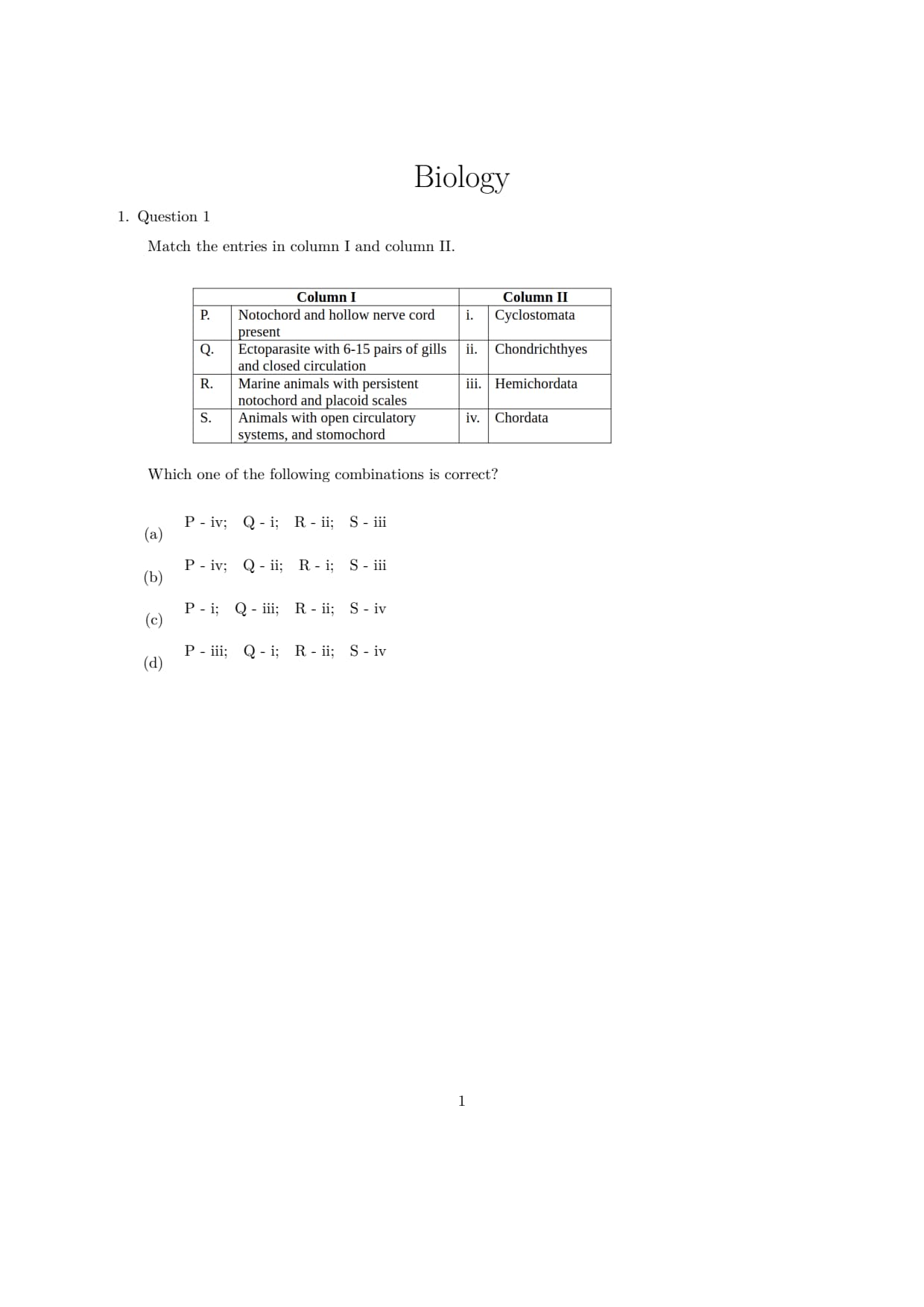
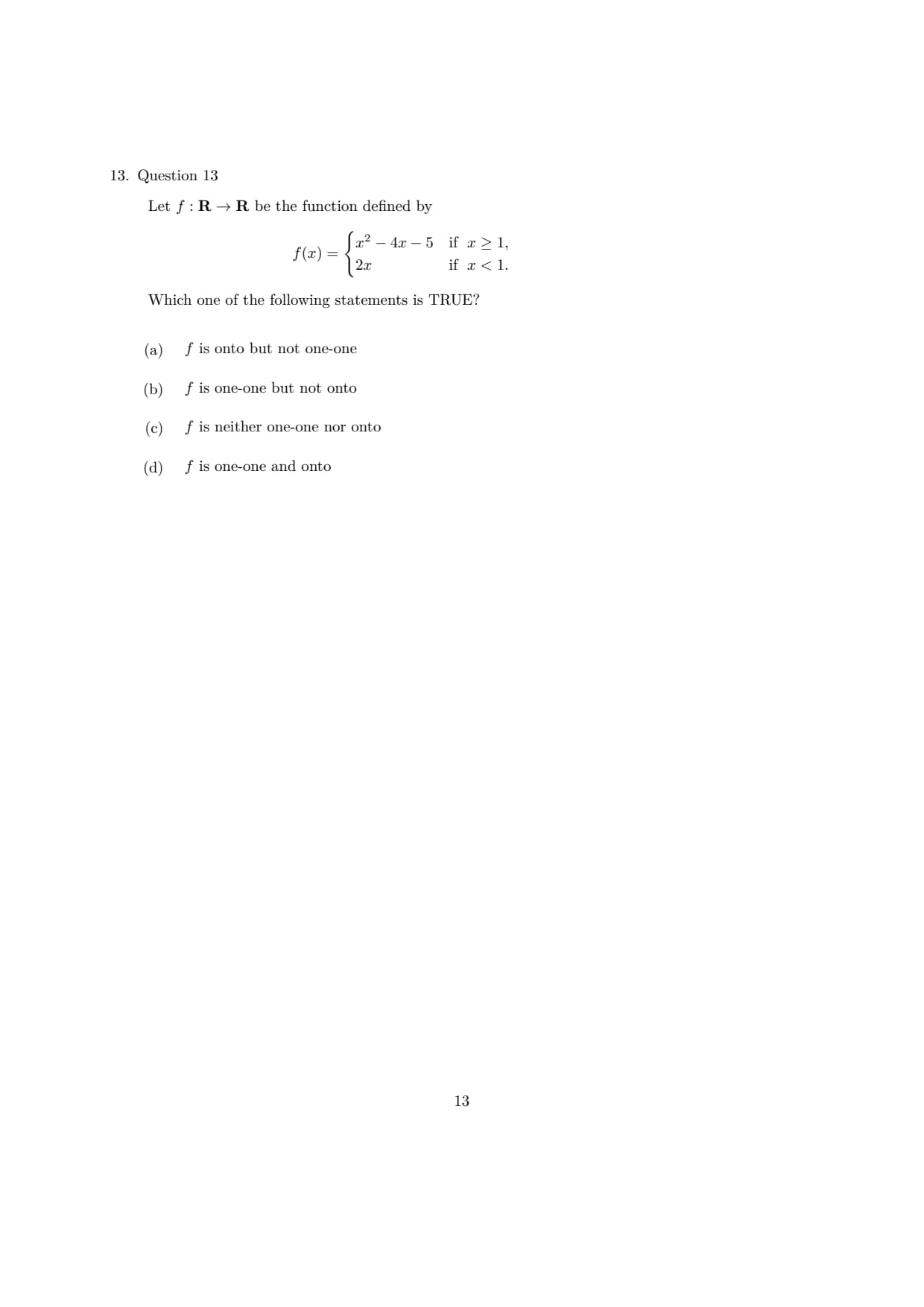
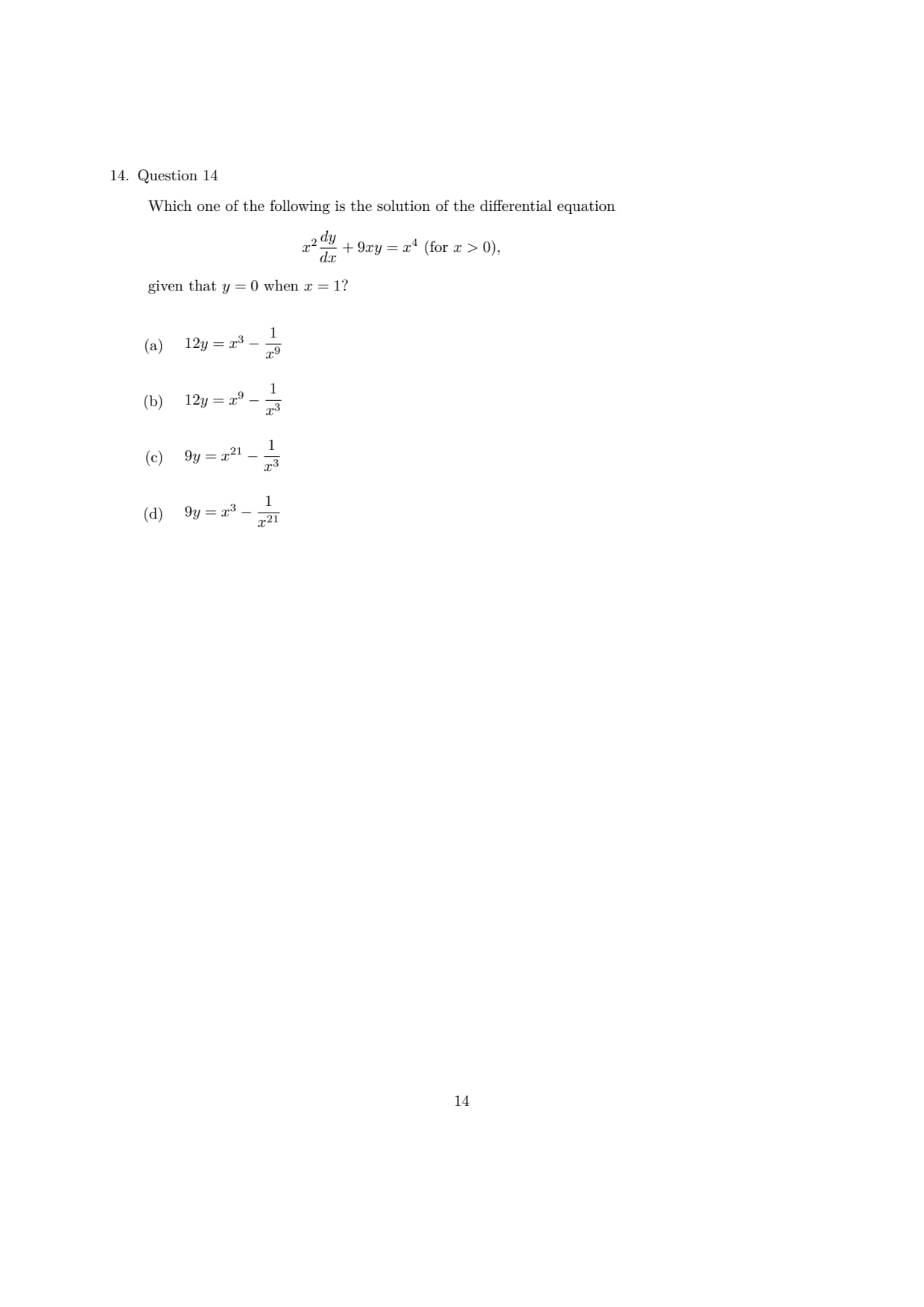
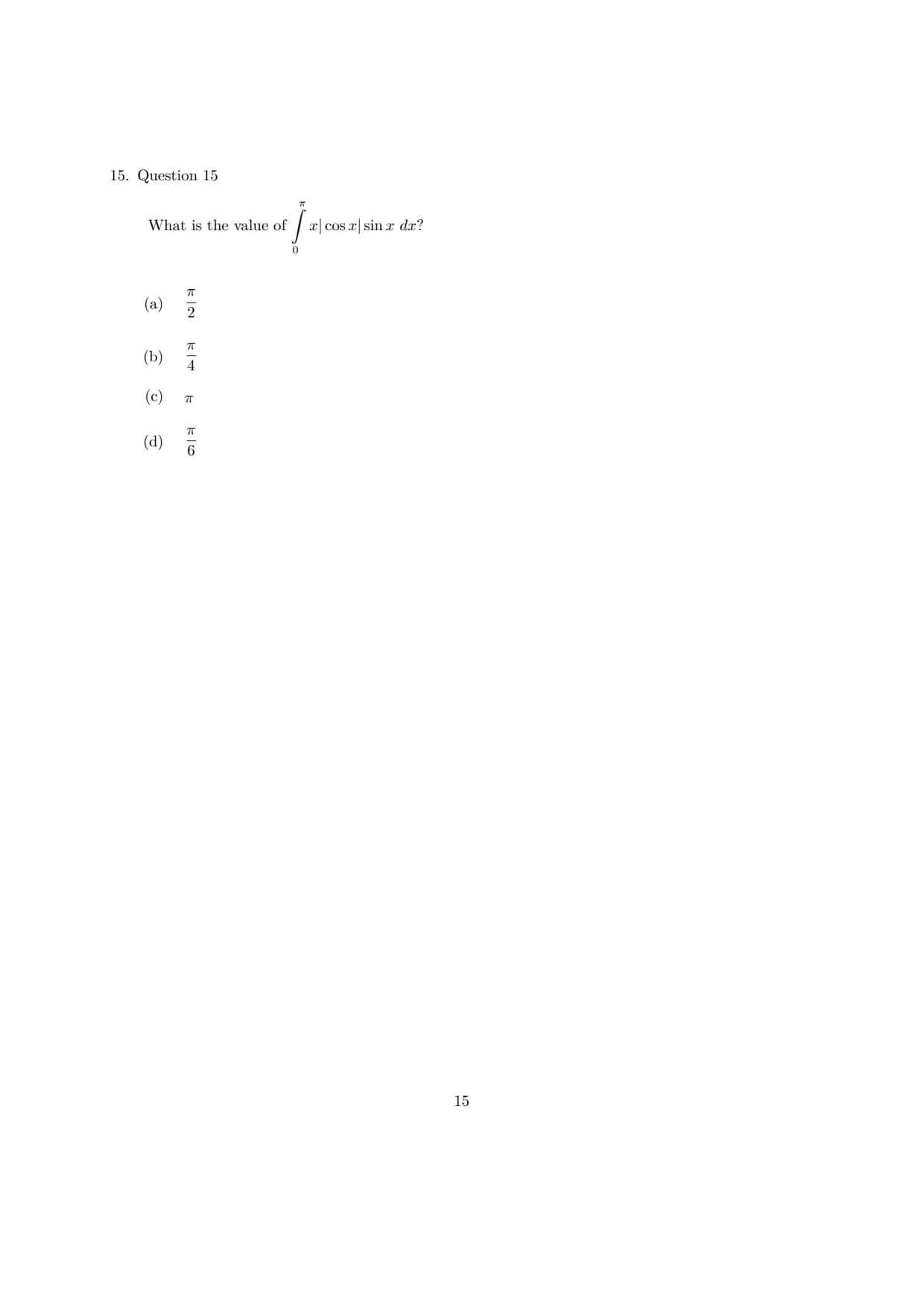
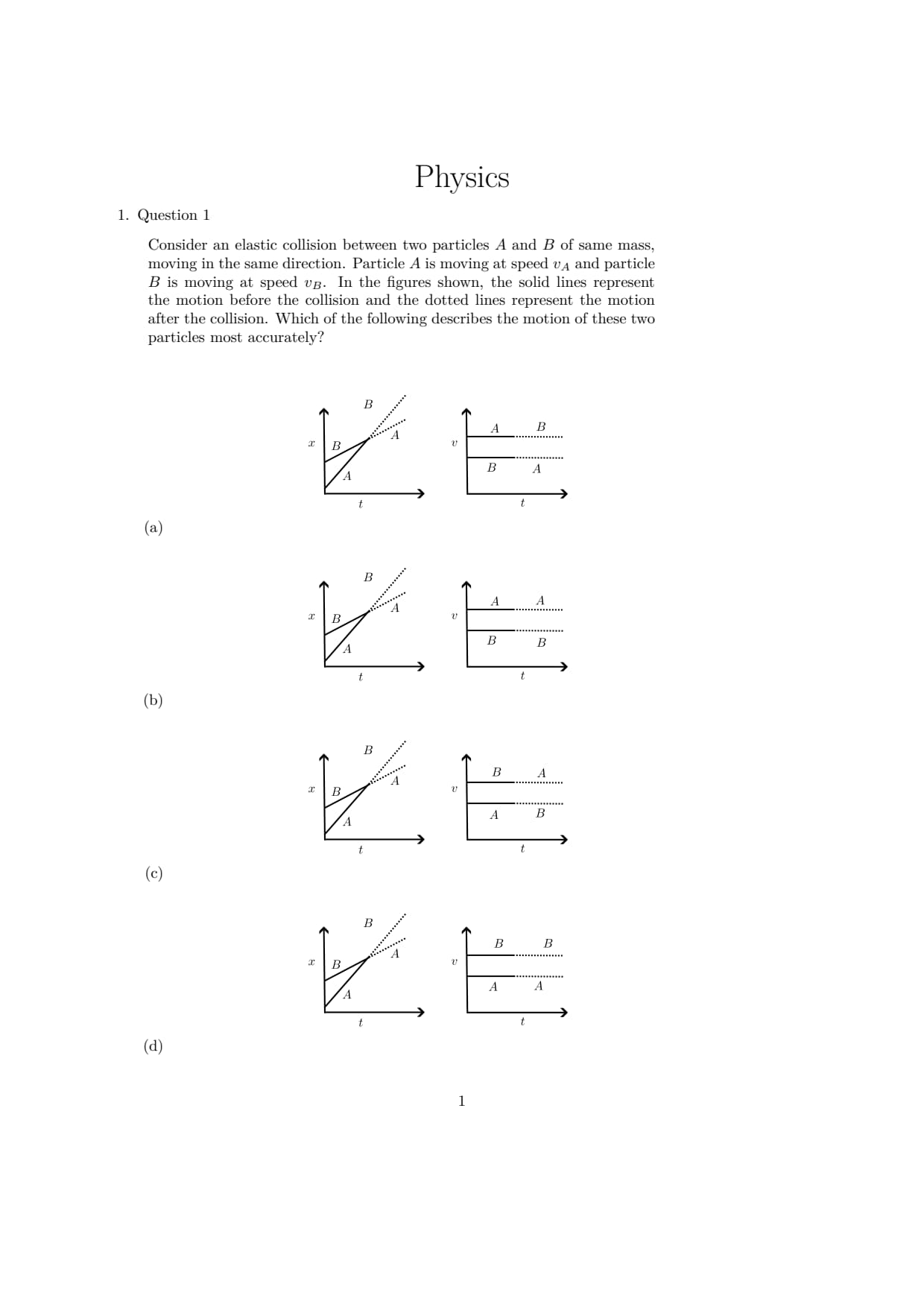
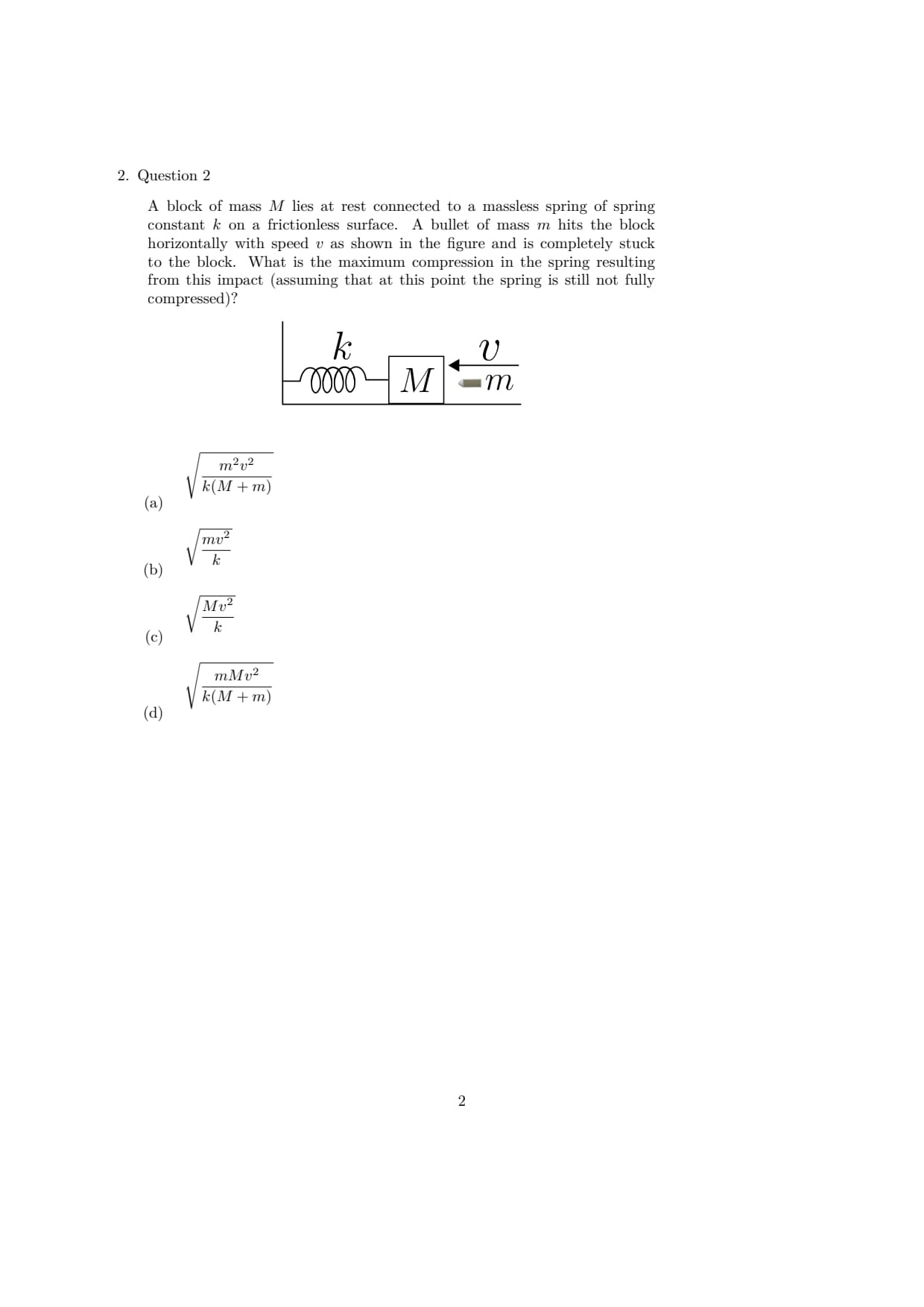
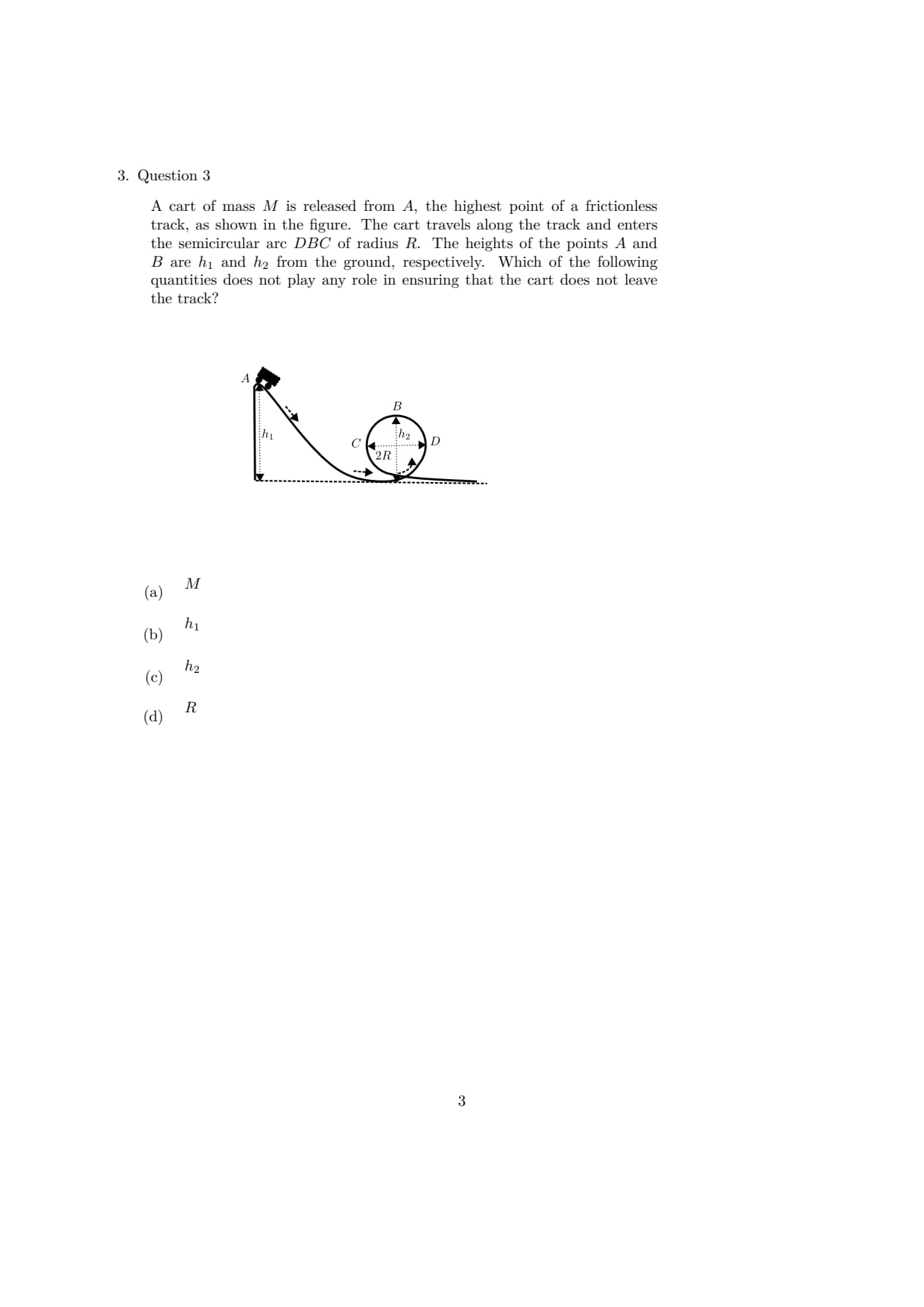
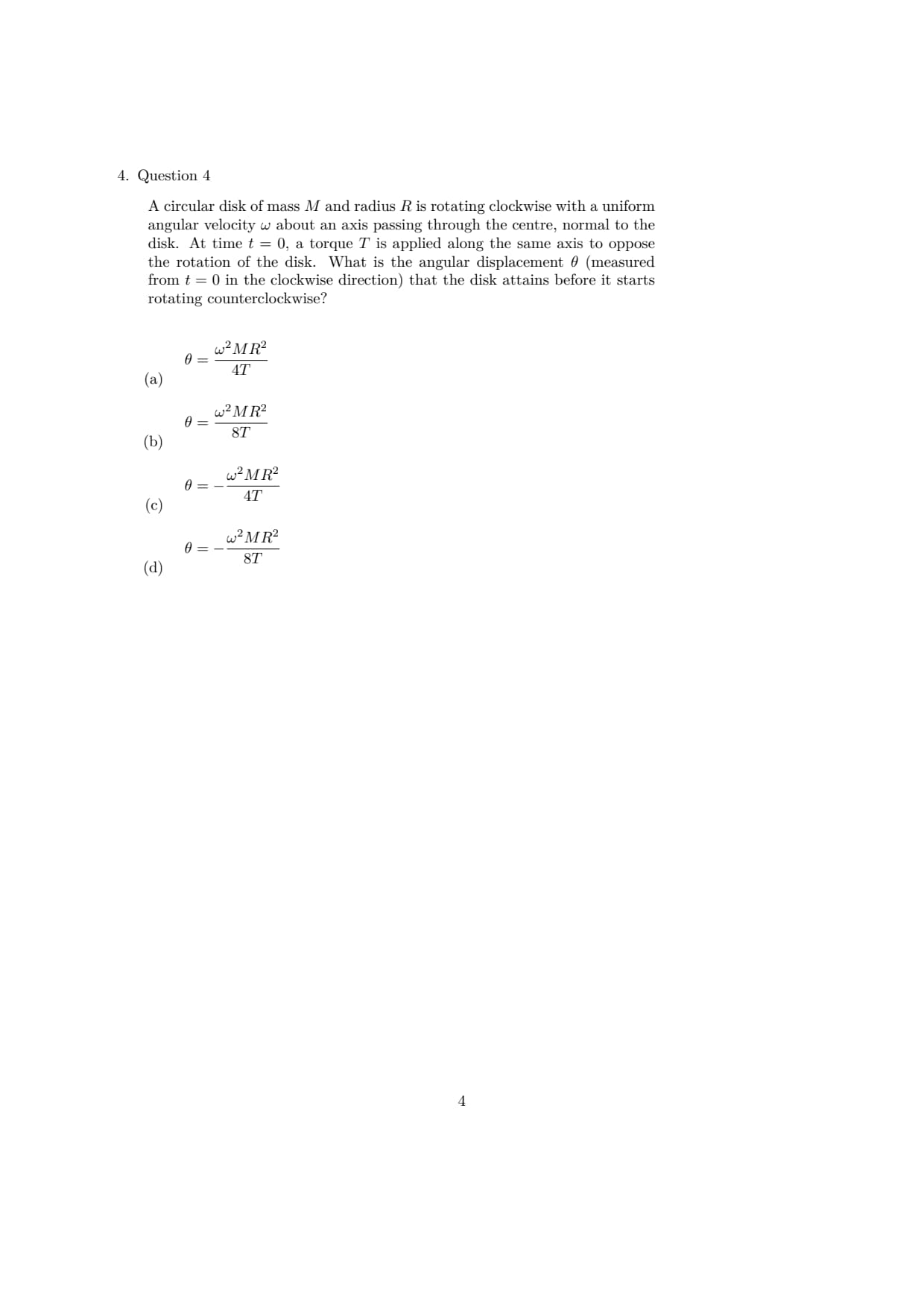
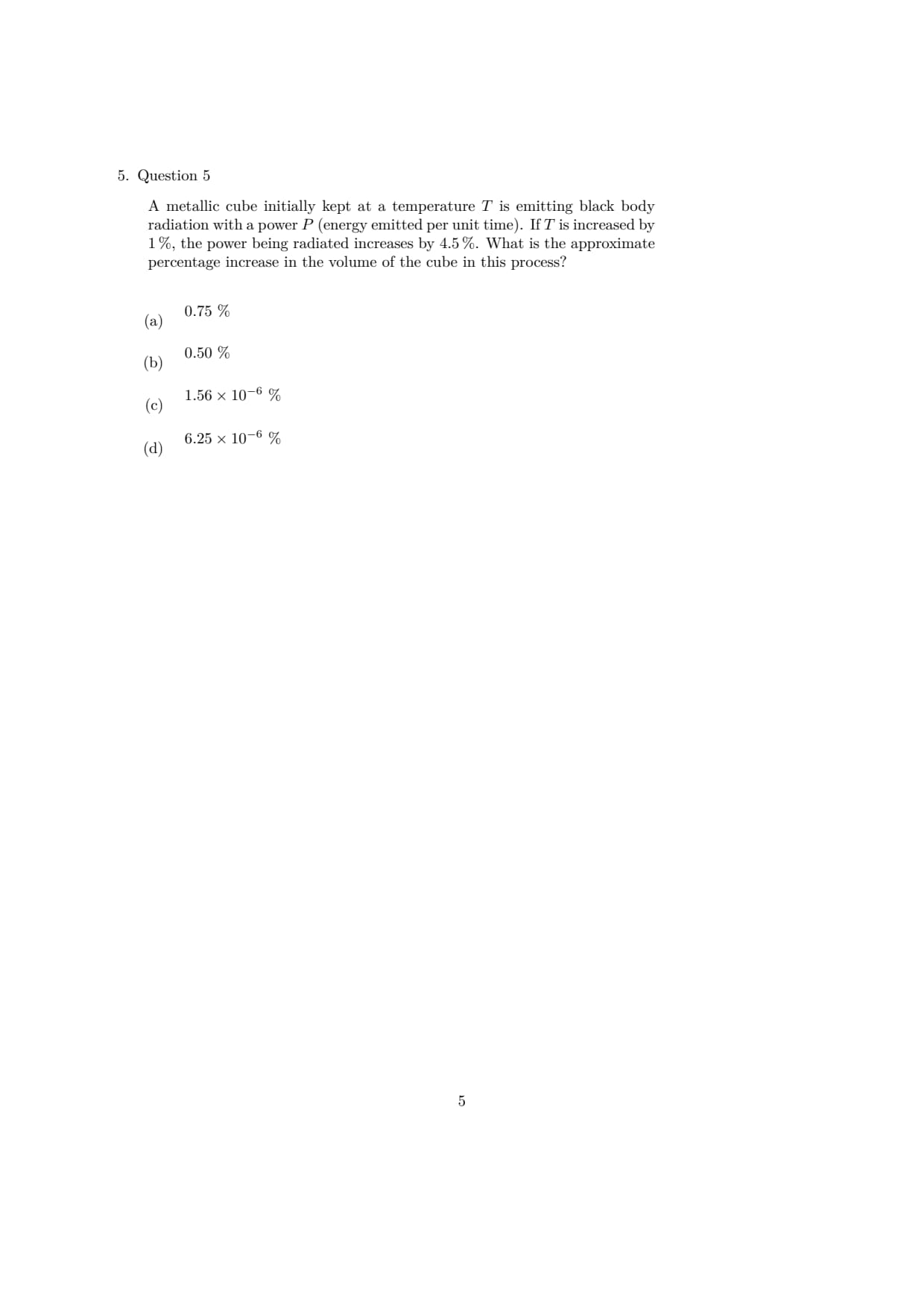
Match the entries in column I and column II.

Which one of the following combinations is correct?
View Solution
Step 1 : Understanding the Question:
This question requires matching various taxonomic categories of animals in Column II with their unique morphological and anatomical features listed in Column I.
We are examining characteristics from Phylum Chordata, Class Cyclostomata, Class Chondrichthyes, and Phylum Hemichordata.
Step 2. Key Formulas and Approach:
The approach involves identifying the key diagnostic features for each animal group based on standard systematic classification.
By establishing definite matches for the most distinct diagnostic features (such as the presence of a stomochord in Hemichordata), we can systematically eliminate incorrect combinations.
Step 3 : Detailed Explanation:
Notochord and hollow nerve cord present (P): These are the defining primary features of the phylum Chordata.
Therefore, P matches with iv (Chordata).
Ectoparasite with 6-15 pairs of gills and closed circulation (Q): Members of the class Cyclostomata (jawless vertebrates like lampreys) are known to be ectoparasites on certain fishes, have 6 to 15 pairs of gill slits, and possess a closed circulatory system.
Therefore, Q matches with i (Cyclostomata).
Marine animals with persistent notochord and placoid scales (R): Class Chondrichthyes (cartilaginous fishes, such as sharks) are marine organisms with a lifelong persistent notochord and skin covered by placoid scales.
Therefore, R matches with ii (Chondrichthyes).
Animals with open circulatory systems and stomochord (S): Phylum Hemichordata comprises worm-like marine animals with an open circulatory system and a rudimentary structure in the collar region called a stomochord.
Therefore, S matches with iii (Hemichordata).
Step 4 : Final Answer:
Combining these individual matches, we obtain: P - iv, Q - i, R - ii, S - iii.
This corresponds to Option (A).
Quick Tip: In matching questions, identify the most unique structure first.
The "stomochord" is a highly specific key term associated exclusively with Hemichordata, which immediately establishes S - iii and narrows down the correct choice.
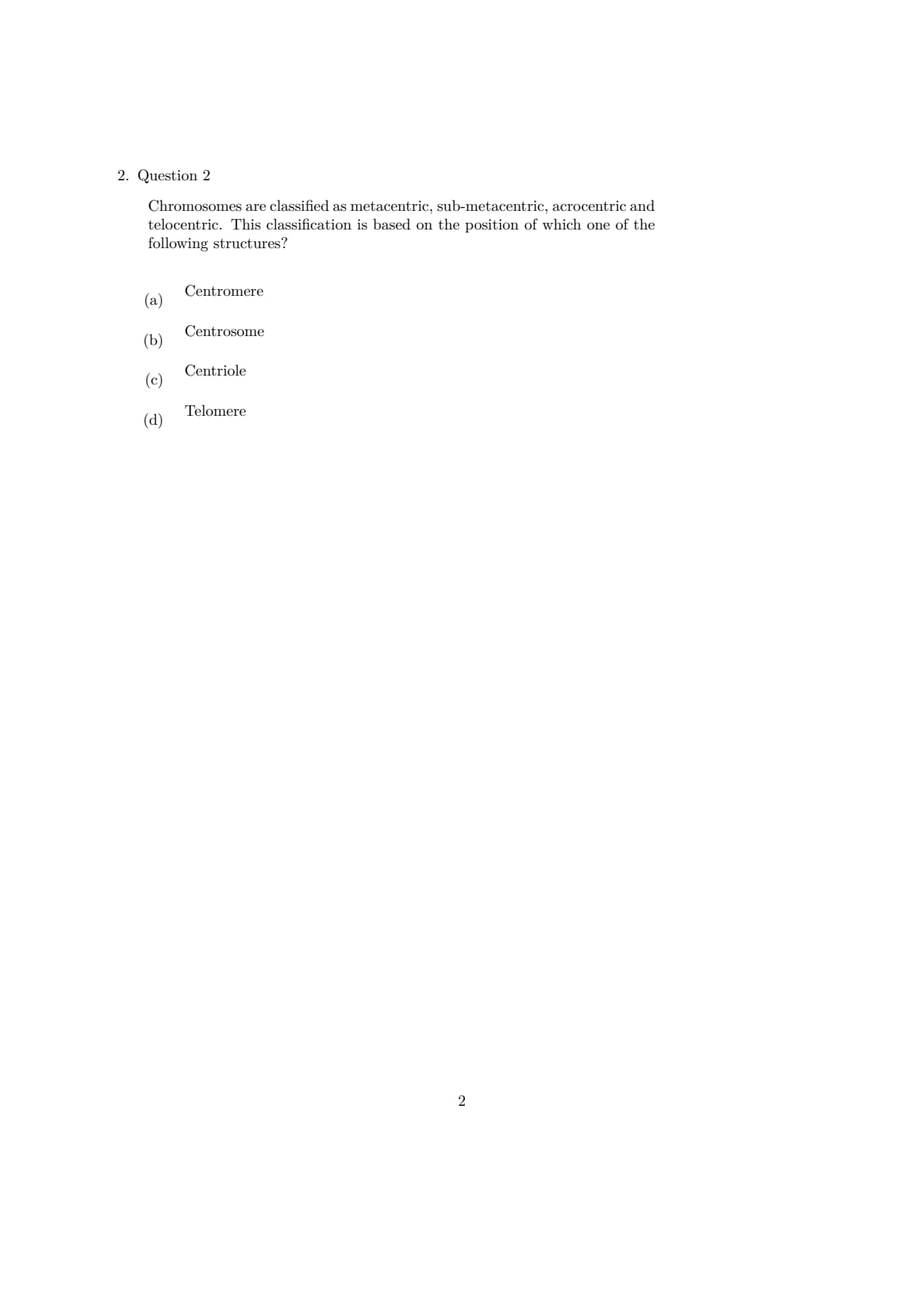
Chromosomes are classified as metacentric, sub-metacentric, acrocentric and telocentric. This classification is based on the position of which one of the following structures?
View Solution
Step 1 : Understanding the Question:
The question asks to identify the organelle or chromosomal structure whose physical position determines the classification of chromosomes into metacentric, sub-metacentric, acrocentric, and telocentric types.
Step 2 : Key Formulas and Approach:
The approach involves recalling the structural anatomy of a eukaryotic chromosome and understanding how the position of the primary constriction (centromere) divides the chromosome arms.
Step 3 : Detailed Explanation:
Centromere: The centromere, or primary constriction, is the region of the chromosome where sister chromatids are held together and spindle fibers attach during cell division.
Metacentric: The centromere is located in the middle, dividing the chromosome into two equal arms.
Sub-metacentric: The centromere is situated slightly away from the middle, resulting in one slightly shorter arm and one longer arm.
Acrocentric: The centromere is positioned close to one end, producing one extremely short arm and one very long arm.
Telocentric: The centromere is located at the terminal end, so the chromosome has only one visible arm.
Other structures like the centrosome and centriole are involved in spindle formation but are not part of the chromosome itself, while the telomere represents the protective end caps of the chromosome.
Step 4 : Final Answer:
Therefore, the classification is based on the position of the centromere.
This matches Option (A).
Quick Tip: Remember that "centro-..." terms can be confusing.
Associate "centromere" directly with the chromosome structure ("mere" means part/segment), while "centrosome" and "centriole" are microtubule-organizing centers in the cytoplasm.
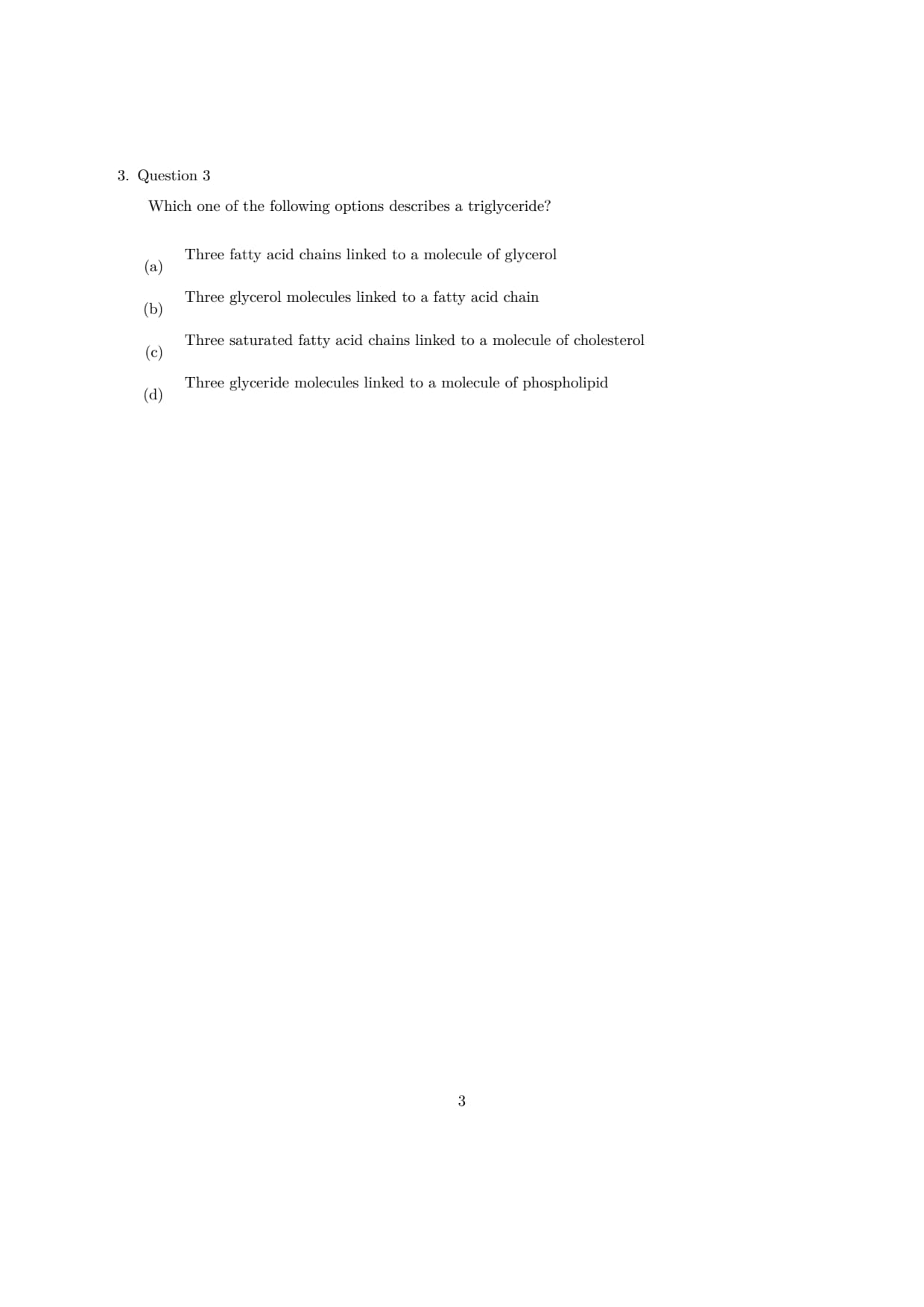
Which one of the following options describes a triglyceride?
View Solution
Step 1 : Understanding the Question:
This question tests the biochemical definition and structural composition of a triglyceride molecule, which is a major type of lipid found in organisms.
Step 2 : Key Formulas and Approach:
The approach involves understanding the esterification reaction that occurs between alcohol groups and carboxylic acid groups during lipid synthesis.
A triglyceride is chemically known as a triacylglycerol.
Step 3 : Detailed Explanation:
Glycerol Backbone: Glycerol is a simple three-carbon compound containing three hydroxyl (\(-OH\)) groups, represented chemically as \(CH_2OH-CHOH-CH_2OH\).
Fatty Acids: Fatty acids consist of long hydrocarbon chains terminating in a carboxyl group (\(-COOH\)).
Esterification: During the synthesis of a triglyceride, each of the three hydroxyl groups of the single glycerol molecule undergoes a condensation reaction with the carboxyl group of a fatty acid chain.
This process results in the formation of three ester bonds and the release of three water molecules, linking three fatty acid chains to one glycerol molecule.
The other options describe chemically incorrect combinations, such as multiple glycerol molecules attached to a single fatty acid, or connections involving cholesterol or phospholipids.
Step 4 : Final Answer:
Thus, a triglyceride is composed of three fatty acid chains linked to one molecule of glycerol.
This corresponds to Option (A).
Quick Tip: Pay close attention to the prefixes.
"Tri-" refers to the three fatty acid chains (acyl groups), while "glyceride" refers to the single glycerol backbone.
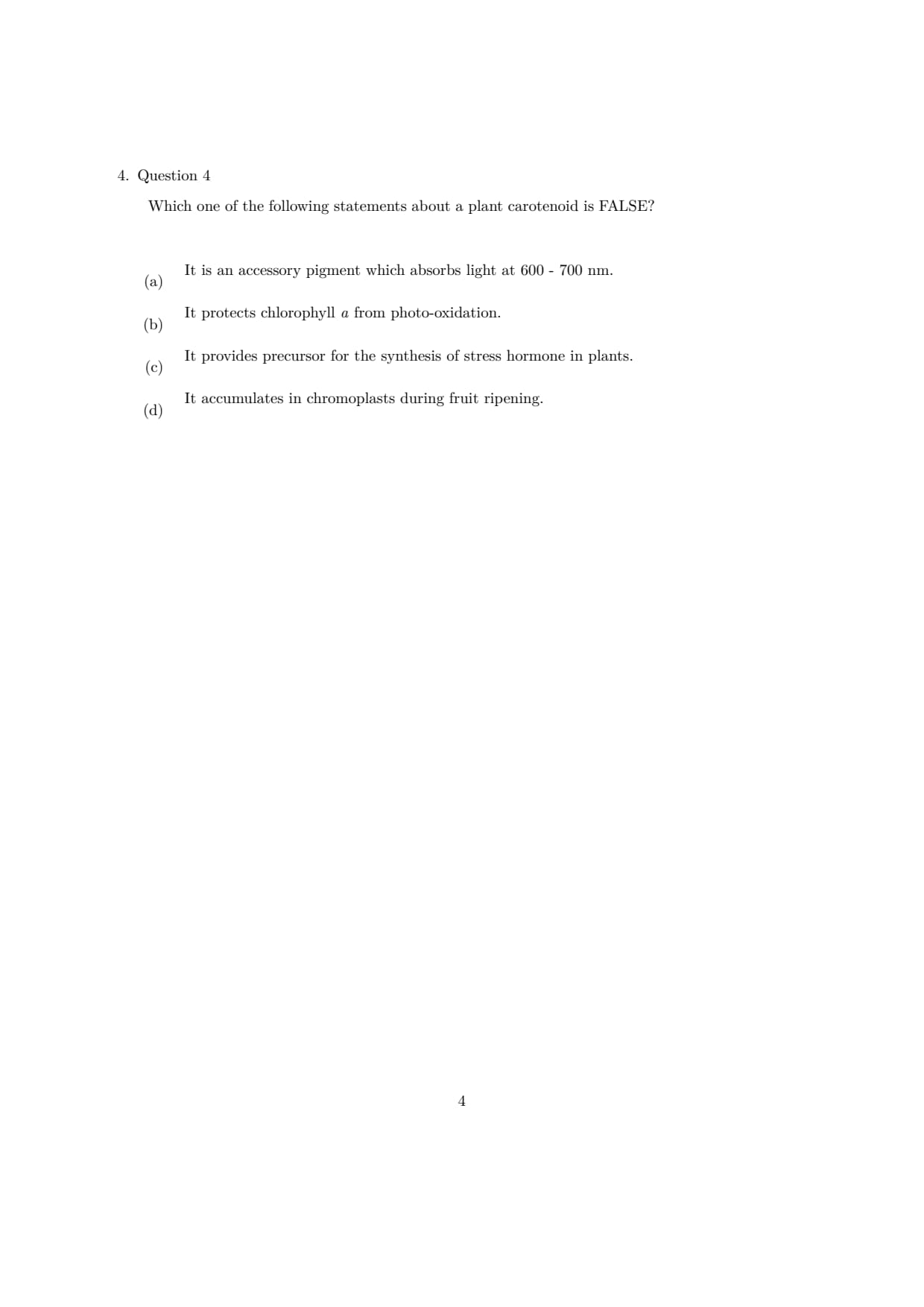
Which one of the following statements about a plant carotenoid is FALSE?
View Solution
Step 1 : Understanding the Question:
The question requires identifying the incorrect (false) statement regarding carotenoids, which are a class of accessory pigments found in plants.
Step 2 : Key Formulas and Approach:
The approach involves evaluating the physiological functions, biosynthetic pathways, and light absorption characteristics of plant carotenoids.
Step 3 : Detailed Explanation:
Absorption Spectrum: Carotenoids (such as carotenes and xanthophylls) are accessory pigments that absorb light primarily in the blue-violet and blue-green regions of the spectrum (approximately \(400--500\) nm).
The red-light region (\(600--700\) nm) is absorbed primarily by chlorophyll pigments (chlorophyll a and b). Thus, stating that carotenoids absorb light at \(600--700\) nm is incorrect.
Photo-protection: Carotenoids act as antioxidants and quench singlet oxygen and excess excitation energy, protecting chlorophyll a molecules from damage caused by photo-oxidation. This statement is correct.
Hormone Precursor: Carotenoids (specifically violaxanthin) serve as biosynthetic precursors for abscisic acid (ABA), which is the primary plant stress hormone. This statement is correct.
Accumulation in Chromoplasts: During the ripening of fruits and senescence of leaves, chloroplasts transition into chromoplasts, which synthesize and accumulate high levels of carotenoids, giving them yellow, orange, or red colors. This statement is correct.
Step 4 : Final Answer:
The false statement is Option (A), as carotenoids do not absorb light in the \(600--700\) nm range.
Quick Tip: Remember that pigments appear as the color they reflect.
Since carotenoids are yellow, orange, and red, they reflect wavelengths in the \(600--700\) nm range.
Consequently, they must absorb in the opposite complementary region, which is the blue-green light range (\(400--500\) nm).
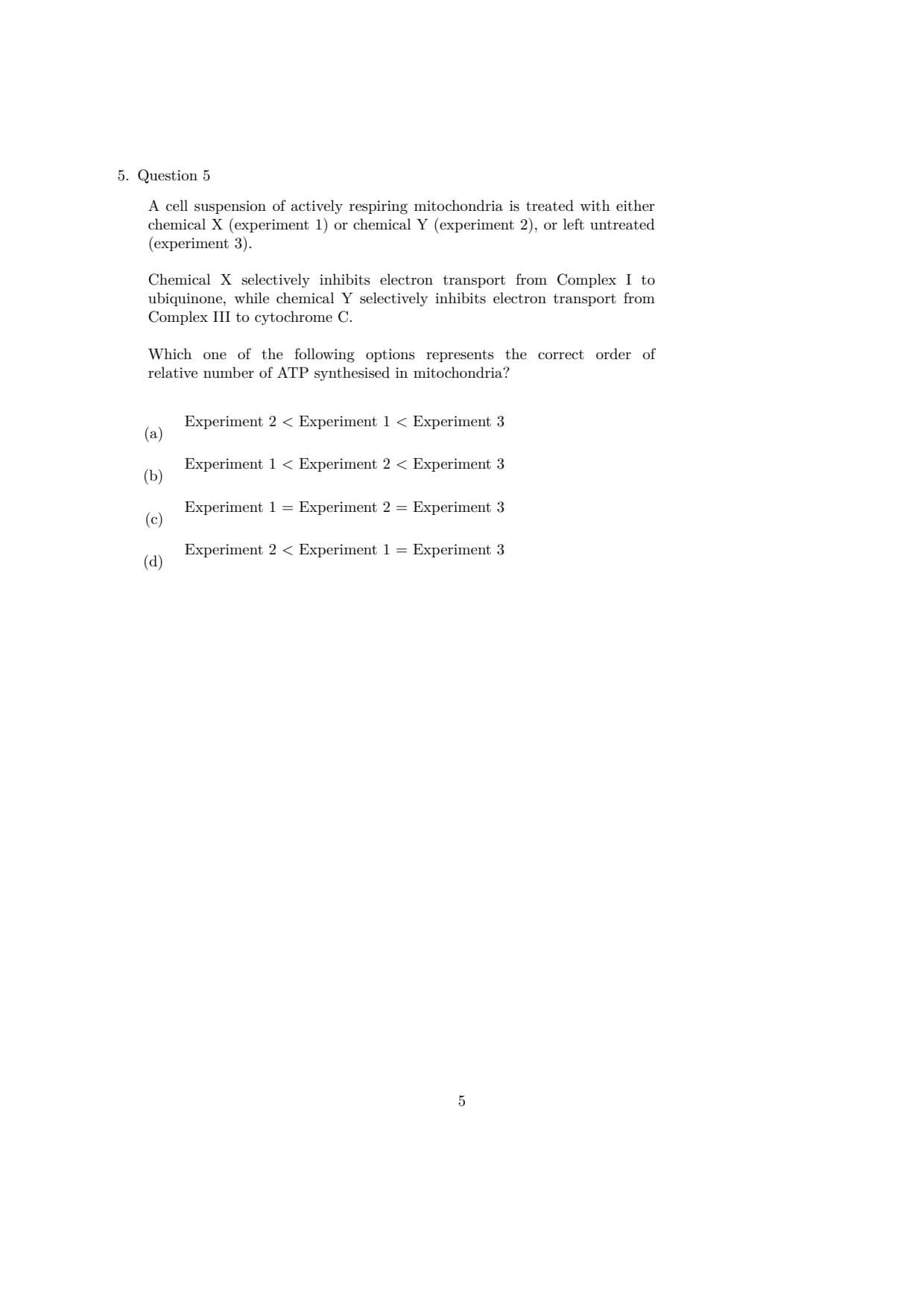
A cell suspension of actively respiring mitochondria is treated with either chemical X (experiment 1) or chemical Y (experiment 2), or left untreated (experiment 3).
Chemical X selectively inhibits electron transport from Complex I to ubiquinone, while chemical Y selectively inhibits electron transport from Complex III to cytochrome C.
Which one of the following options represents the correct order of relative number of ATP synthesised in mitochondria?
View Solution
Step 1 : Understanding the Question:
This question asks us to compare the relative amounts of ATP produced in three different experiments based on the effects of two metabolic inhibitors on the electron transport chain (ETC) in mitochondria.
Step 2 : Key Formulas and Approach:
The approach involves tracing the pathway of electron flow from electron donors (NADH and \(FADH_2\)) through the different complexes of the ETC to oxygen, and determining how blocking specific steps impacts the proton gradient (\(\Delta p\)) that drives ATP synthesis via ATP synthase.
Step 3 : Detailed Explanation:
Experiment 3 (Untreated): In the untreated control, the ETC functions at normal capacity. Electrons from both NADH (entering at Complex I) and \(FADH_2\) (entering at Complex II) flow smoothly through ubiquinone, Complex III, cytochrome C, and Complex IV to reduce oxygen.
This generates the maximum proton gradient and yields the highest amount of ATP.
Experiment 1 (Chemical X): Chemical X blocks electron transfer from Complex I to ubiquinone. This stops NADH oxidation from contributing to the proton gradient.
However, \(FADH_2\) can still feed electrons into the ETC at Complex II. These electrons pass through ubiquinone to Complexes III and IV, allowing some proton pumping and resulting in a reduced but significant amount of ATP synthesis.
Experiment 2 (Chemical Y): Chemical Y blocks the flow of electrons from Complex III to cytochrome C. Because all electrons, whether originating from Complex I (NADH) or Complex II (\(FADH_2\)), must pass through Complex III to proceed further, this block halts the entire downstream respiratory chain.
As a result, electron flow is completely stopped, proton pumping is minimized, and ATP synthesis drops to near zero.
Step 4 : Final Answer:
Comparing the three experiments, we have: Experiment 2 (least ATP) \(<\) Experiment 1 (intermediate ATP) \(<\) Experiment 3 (maximum ATP).
This matches Option (A).
Quick Tip: An inhibitor that blocks a downstream bottleneck (like Complex III or IV) is always more disruptive than one that blocks only one of the upstream entry ports (like Complex I), because the other entry port (Complex II) can partially compensate.
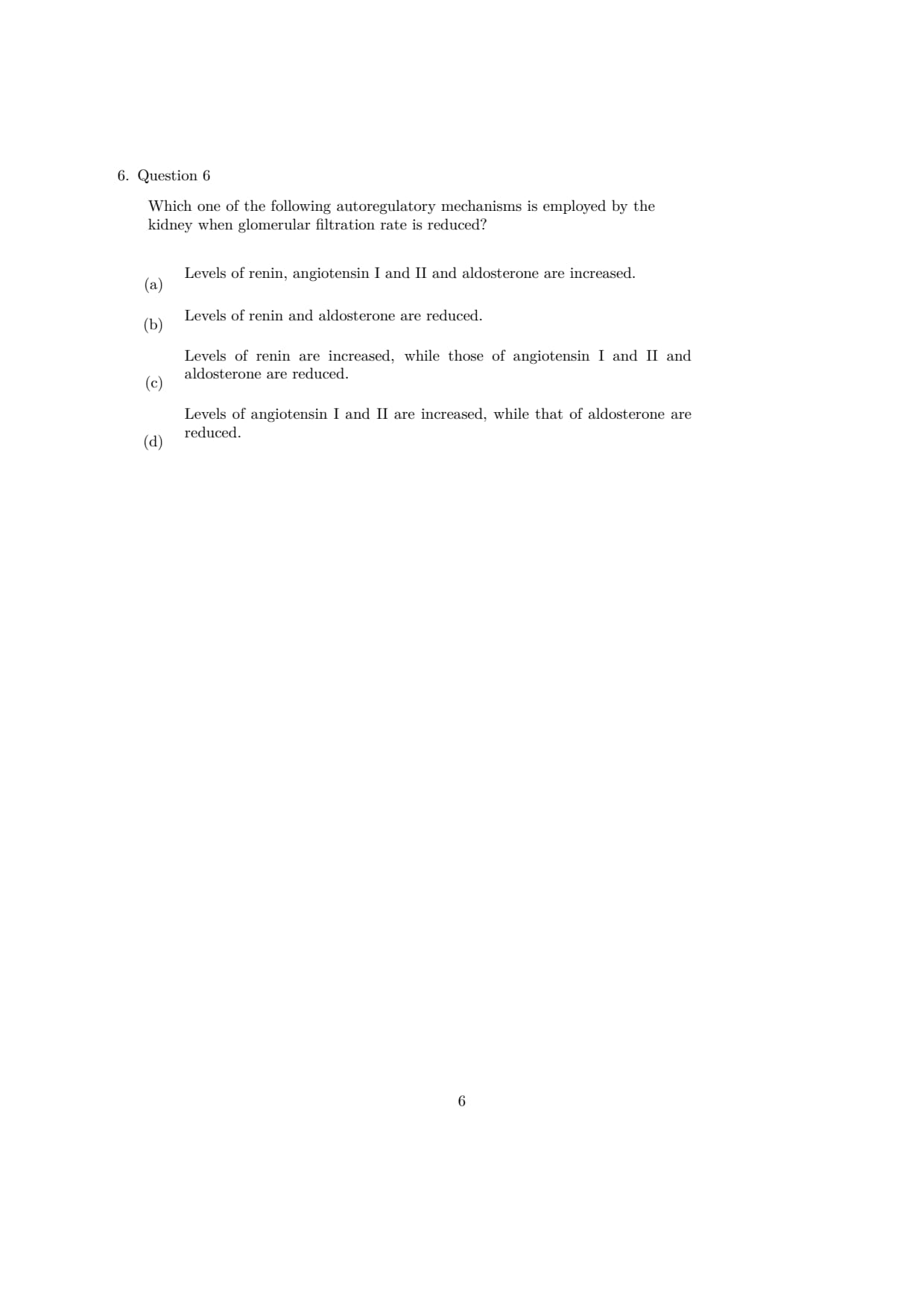
Which one of the following autoregulatory mechanisms is employed by the kidney when glomerular filtration rate is reduced?
View Solution
Step 1 : Understanding the Question:
The question asks about the physiological hormonal response mechanism triggered by mammalian kidneys when there is a reduction in the Glomerular Filtration Rate (GFR).
Step 2 : Key Formulas and Approach:
The approach involves examining the homeostatic feedback loop governed by the Renin-Angiotensin-Aldosterone System (RAAS), which regulates blood volume, systemic blood pressure, and GFR.
Step 3 : Detailed Explanation:
Triggering the RAAS: A fall in GFR or blood pressure is detected by the juxtaglomerular (JG) cells of the kidney.
Release of Renin: In response, the JG cells release the enzyme renin directly into the bloodstream.
Activation Cascade: Renin converts the circulating plasma protein angiotensinogen into angiotensin I.
Angiotensin I is then converted into angiotensin II by the Angiotensin-Converting Enzyme (ACE) present in lung capillaries.
Action of Angiotensin II and Aldosterone: Angiotensin II acts as a powerful vasoconstrictor to increase glomerular blood pressure.
Simultaneously, angiotensin II stimulates the adrenal cortex to release the hormone aldosterone.
Aldosterone promotes the reabsorption of sodium ions (\(Na^+\)) and water from the distal tubules, increasing blood volume and blood pressure, which helps restore GFR back to normal levels.
Consequently, during this autoregulatory response, the levels of renin, angiotensin I, angiotensin II, and aldosterone are all increased.
Step 4 : Final Answer:
Therefore, the autoregulatory response involves an increase in the levels of all these components, as described in Option (A).
Quick Tip: Remember that the RAAS pathway is a positive cascade.
An increase in the starting enzyme (renin) leads directly to sequential increases in all subsequent downstream products (angiotensins and aldosterone) to restore blood pressure.
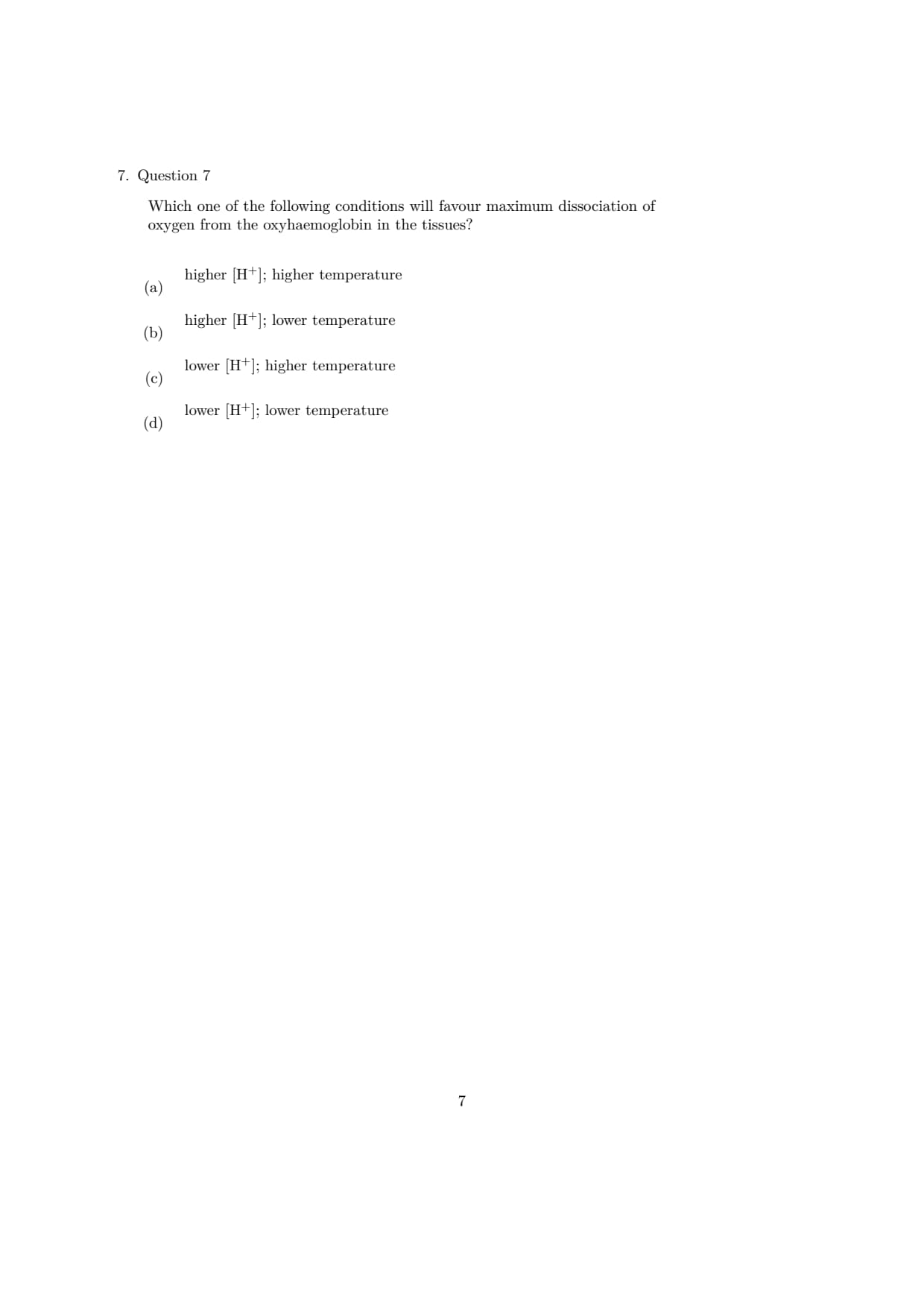
Which one of the following conditions will favour maximum dissociation of oxygen from the oxyhaemoglobin in the tissues?
View Solution
Step 1 : Understanding the Question:
This question tests the understanding of the factors that control the binding affinity between oxygen and hemoglobin, specifically focusing on the conditions that promote the release (dissociation) of oxygen in active tissues.
Step 2 : Key Formulas and Approach:
The approach involves applying the principles of the oxygen-hemoglobin dissociation curve and the Bohr effect.
Factors that decrease hemoglobin's affinity for oxygen shift the dissociation curve to the right, facilitating oxygen unloading in tissues.
Step 3 : Detailed Explanation:
In metabolically active tissues, high rates of cellular respiration consume oxygen and produce carbon dioxide (\(CO_2\)) and heat.
Effect of [\(H^+\)] (Bohr Effect): Increased \(CO_2\) reacts with water to form carbonic acid, which dissociates into bicarbonate and hydrogen ions (\(H^+\)).
This increases the concentration of hydrogen ions (higher [\(H^+\)] / lower pH). These protons bind to hemoglobin, altering its conformation and reducing its affinity for oxygen, promoting oxygen release.
Effect of Temperature: An increase in temperature (higher temperature) due to metabolic heat also destabilizes the bond between oxygen and hemoglobin, facilitating dissociation.
Conversely, lower temperature and lower [\(H^+\)] (higher pH) stabilize the oxyhemoglobin state, which is characteristic of the lungs where oxygen loading occurs.
Step 4 : Final Answer:
Thus, the combination of higher [\(H^+\)] and higher temperature promotes maximum oxygen dissociation.
This matches Option (A).
Quick Tip: Think of "active muscle conditions" to remember oxygen unloading.
An active muscle is warm (higher temperature) and acidic (higher [\(H^+\)] from lactic acid and \(CO_2\)).
These identical conditions are what trigger hemoglobin to release its oxygen.
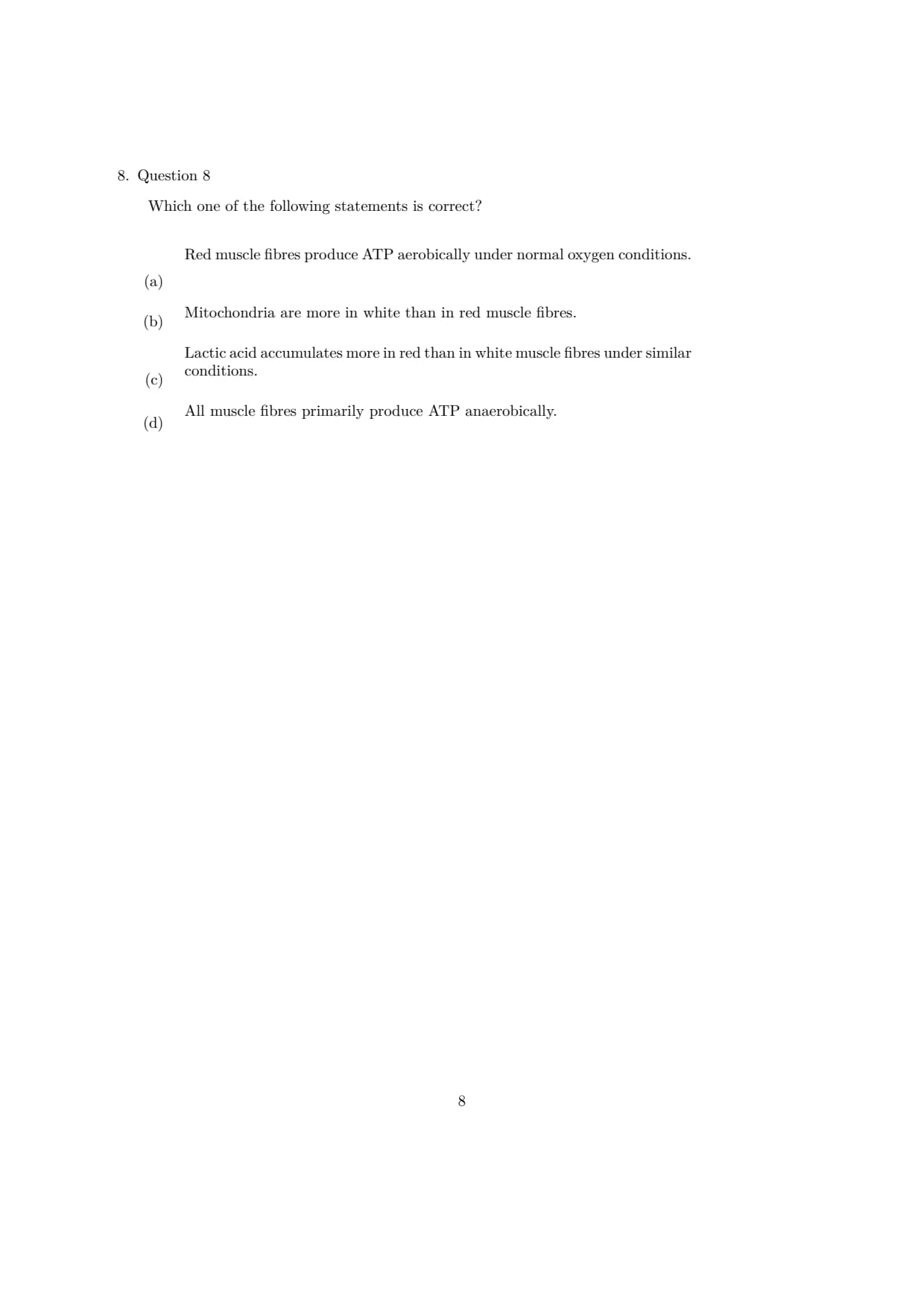
Which one of the following statements is correct?
View Solution
Step 1 : Understanding the Question:
The question asks us to identify the correct physiological statement regarding the differences between red and white skeletal muscle fibers in terms of their metabolism and organelle composition.
Step 2 : Key Formulas and Approach:
The approach involves comparing the structural and metabolic characteristics of slow-twitch (red) and fast-twitch (white) muscle fibers.
We will evaluate each option based on established muscular physiology.
Step 3 : Detailed Explanation:
Red Muscle Fibers (Type I): These fibers contain high amounts of myoglobin (an oxygen-storing pigment, which gives them their red color) and a dense network of blood capillaries.
They also contain a very high number of mitochondria, enabling them to utilize oxygen efficiently to produce ATP through aerobic respiration under normal conditions. This statement is correct.
White Muscle Fibers (Type II): These fibers contain far less myoglobin and fewer mitochondria than red fibers. Thus, statement (B) is incorrect.
Lactic Acid Accumulation: Since white muscle fibers rely heavily on anaerobic glycolysis for rapid energy, they generate and accumulate lactic acid much faster than red fibers, which primarily perform aerobic respiration. Thus, statement (C) is incorrect.
Generalization: Not all muscle fibers produce ATP anaerobically; red muscle fibers are highly specialized for aerobic ATP production. Thus, statement (D) is incorrect.
Step 4 : Final Answer:
Therefore, the only correct statement is Option (A).
Quick Tip: Associate "Red" with "Myoglobin" (which binds oxygen) and "Mitochondria" (which use oxygen).
This setup is designed for aerobic respiration, making red muscles highly resistant to fatigue compared to white muscles.
Which one of the following organisms produces the female gamete by mitosis of haploid cells?
View Solution
Step 1 : Understanding the Question:
The question asks to identify which of the given organisms produces its female gamete (egg cell) through the process of mitosis within haploid cells, rather than through meiosis of diploid germ cells.
Step 2 : Key Formulas and Approach:
The approach involves distinguishing between the life cycles of land plants (which exhibit alternation of generations) and animals (which have a diplontic life cycle).
Step 3 : Detailed Explanation:
Alternation of Generations (Plants): In land plants like the garden pea (\textit{Pisum sativum), the diploid sporophyte produces haploid spores via meiosis.
Gametophyte Development: The haploid megaspore undergoes several rounds of mitosis to form the multicellular haploid female gametophyte (known as the embryo sac).
Gamete Production: Within this haploid embryo sac, the egg cell (female gamete) is produced directly by mitotic division of a haploid precursor cell. This matches the condition in the question.
Animal Life Cycles: In animals like the honey bee, fruit fly, and chicken, there is no multicellular haploid stage.
These animals are diploid, and their female gametes (eggs) are produced directly via meiosis of diploid germline cells in the ovaries.
Step 4 : Final Answer:
Thus, only the garden pea produces its female gametes by the mitosis of haploid cells.
This corresponds to Option (A).
Quick Tip: In all plants (mosses, ferns, angiosperms), gametes are always produced by mitosis because they arise from a haploid gametophyte.
In contrast, animals always produce gametes by meiosis from diploid cells.
Which amino acid will be charged on the tRNA with anticodon 5Õ-GUU-3Õ?
View Solution
Step 1 : Understanding the Question:
The question asks us to identify which amino acid is attached to a tRNA molecule that possesses the anticodon sequence \(5'-GUU-3'\).
Step 2 : Key Formulas and Approach:
The approach is based on the rules of complementary, antiparallel base pairing between the mRNA codon and the tRNA anticodon during translation.
Nucleic acid strands always align antiparallel to each other (\(5'\rightarrow 3'\) pairs with \(3'\rightarrow 5'\)).
Step 3 : Detailed Explanation:
tRNA Anticodon: The given sequence is \(5'-G-U-U-3'\).
Complementary base-pairing rules:
G pairs with C
U pairs with A
U pairs with A
Determining mRNA Codon: Writing the complementary partners in the antiparallel direction gives:
\(3'-C-A-A-5'\)
Standard Direction: We write the mRNA codon in the standard \(5'\rightarrow 3'\) direction:
\(5'-A-A-C-3'\) (or simply AAC)
Amino Acid Assignment: The genetic code table is based on mRNA codons.
The codon \(5'-AAC-3'\) specifically codes for the amino acid Asparagine.
Step 4 : Final Answer:
Therefore, the tRNA with the anticodon \(5'-GUU-3'\) will carry the amino acid Asparagine, corresponding to Option (A).
Quick Tip: Always write out the \(5'\) and \(3'\) ends explicitly when pairing codon and anticodon.
\(5'-GUU-3'\) (anticodon) pairs with \(3'-CAA-5'\) (codon), which is read as \(5'-AAC-3'\) (Asparagine) from left to right.
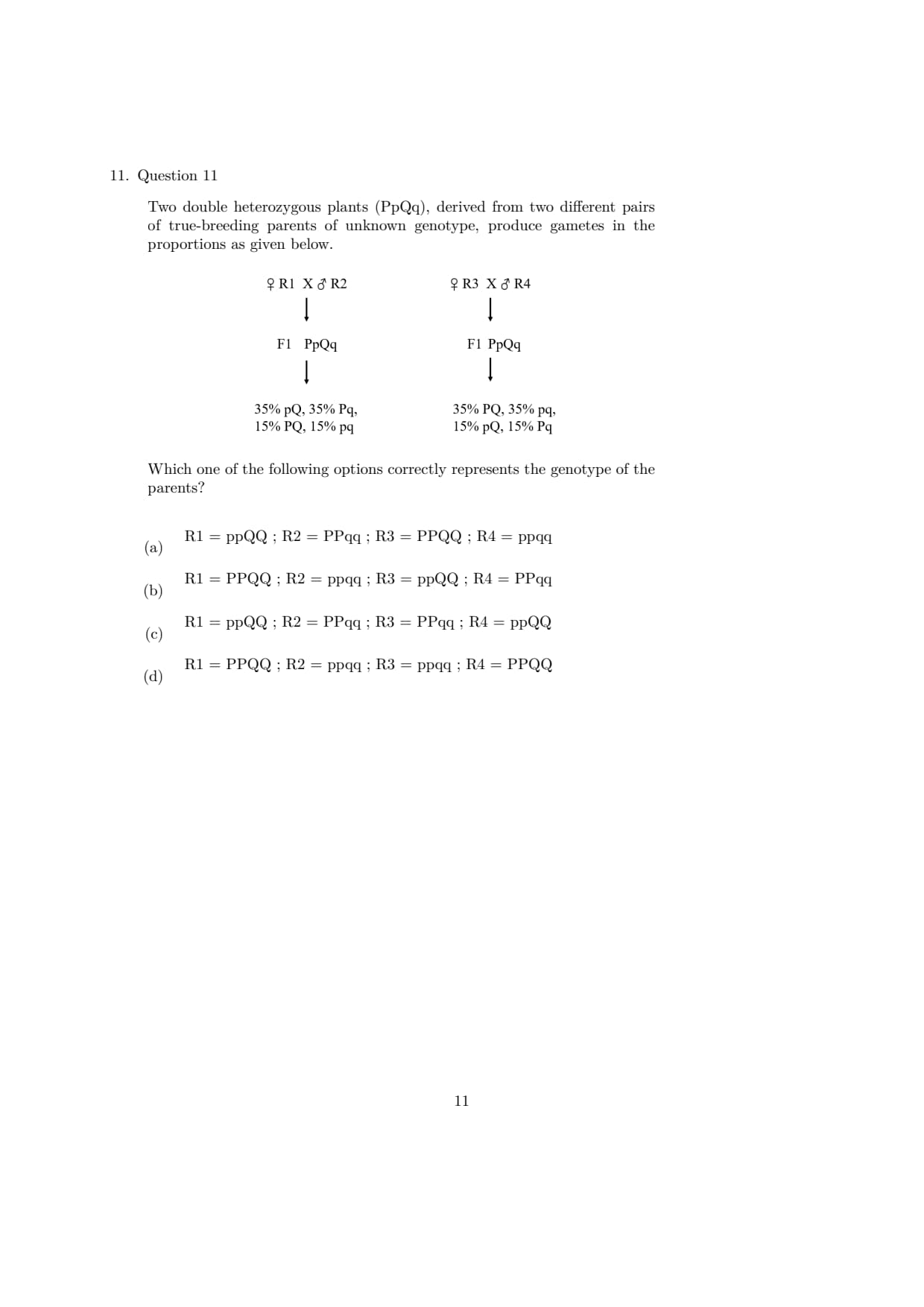
Two double heterozygous plants (PpQq), derived from two different pairs of true-breeding parents of unknown genotype, produce gametes in the proportions as given below.

Which one of the following options correctly represents the genotype of the parents?
View Solution
Step 1 : Understanding the Question:
The question asks to determine the genotypes of the homozygous, true-breeding parental lines (R1, R2, R3, R4) that produced the \(F_1\) dihybrids based on the ratios of gametes produced by those \(F_1\) plants.
Step 2 : Key Formulas and Approach:
The approach relies on the principles of genetic linkage and recombination.
In a linked dihybrid system, parental gametes are always produced in higher frequencies (\(> 25%\) each) due to linkage, while recombinant gametes are produced in lower frequencies (\(< 25%\) each) due to crossing over.
Step 3 : Detailed Explanation:
Analyzing Cross 1 (R1 \(\times\) R2):
The \(F_1\) dihybrid produces gametes in the proportions: \(35%\ pQ\), \(35%\ Pq\), \(15%\ PQ\), and \(15%\ pq\).
The gametes with the highest frequencies (\(35%\) each) represent the non-recombinant (parental) configurations: \(pQ\) and \(Pq\).
This indicates the \(F_1\) alleles are in the repulsion (trans) phase, represented as \(pQ/Pq\).
Since the parents R1 and R2 are true-breeding (homozygous), one must have contributed the \(pQ\) chromosome and the other the \(Pq\) chromosome.
Thus, the parental genotypes must be \(ppQQ\) and \(PPqq\).
Analyzing Cross 2 (R3 \(\times\) R4):
The \(F_1\) dihybrid produces gametes in the proportions: \(35%\ PQ\), \(35%\ pq\), \(15%\ pQ\), and \(15%\ Pq\).
Here, the high-frequency parental gametes are \(PQ\) and \(pq\) (\(35%\) each).
This indicates the \(F_1\) alleles are in the coupling (cis) phase, represented as \(PQ/pq\).
The homozygous parents R3 and R4 must have contributed the \(PQ\) and \(pq\) chromosomes.
Thus, their genotypes are \(PPQQ\) and \(ppqq\).
Step 4 : Final Answer:
Matching these findings, we get: R1 = ppQQ, R2 = PPqq, R3 = PPQQ, R4 = ppqq.
This is represented by Option (A).
Quick Tip: The gametes with the highest percentages are always the parental types.
For Cross 1, they are \(pQ\) and \(Pq\), meaning parents must have those exact alleles homozygous (ppQQ and PPqq).
This tip lets you solve linkage problems in seconds.
What are retroviruses?
View Solution
Step 1 : Understanding the Question:
The question asks for the fundamental biological definition and characteristics of retroviruses.
Step 2 : Key Formulas and Approach:
The approach involves identifying the nature of the genetic material (genome) of retroviruses and their unique mechanism of replication inside host cells.
Step 3 : Detailed Explanation:
Viral Genome: Retroviruses belong to a family of enveloped viruses whose genetic material consists of single-stranded RNA molecules.
Reverse Transcription: Unlike standard central dogma processes where DNA is transcribed into RNA, retroviruses carry a unique enzyme called reverse transcriptase.
Once inside a host cell, this enzyme uses the viral RNA template to synthesize a complementary DNA (cDNA) molecule.
This viral DNA is subsequently integrated into the host cell's genome, allowing the virus to replicate and produce more viral particles.
Thus, retroviruses are characterized by having an RNA genome and showing reverse transcriptase activity.
Step 4 : Final Answer:
Therefore, retroviruses are defined as a group of viruses with an RNA genome and reverse transcriptase activity, as described in Option (A).
Quick Tip: The prefix "retro-" means backward.
This refers to the "backward" flow of genetic information from RNA to DNA, which is executed by the enzyme reverse transcriptase.
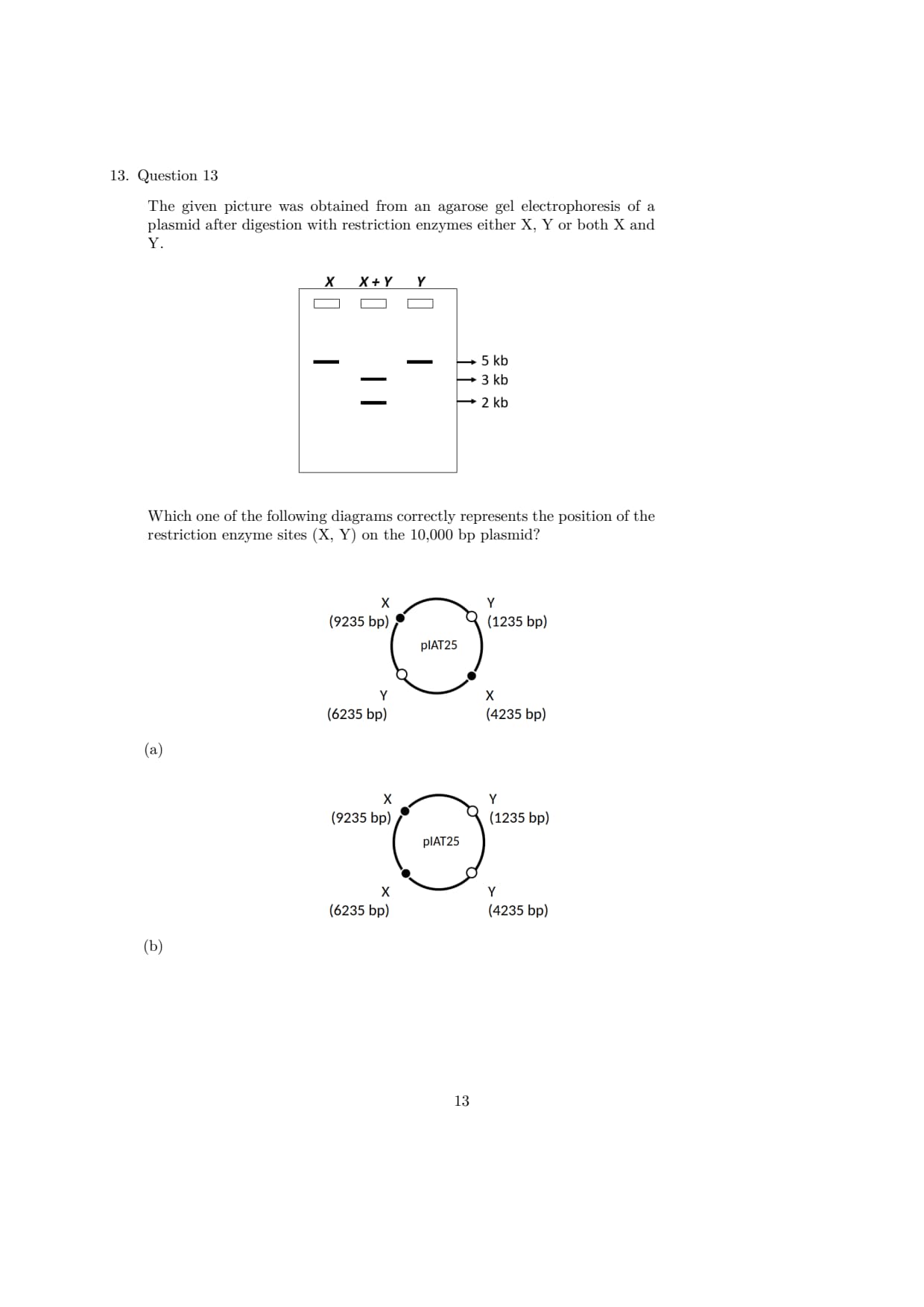
The given picture was obtained from an agarose gel electrophoresis of a plasmid after digestion with restriction enzymes either X, Y or both X and Y.

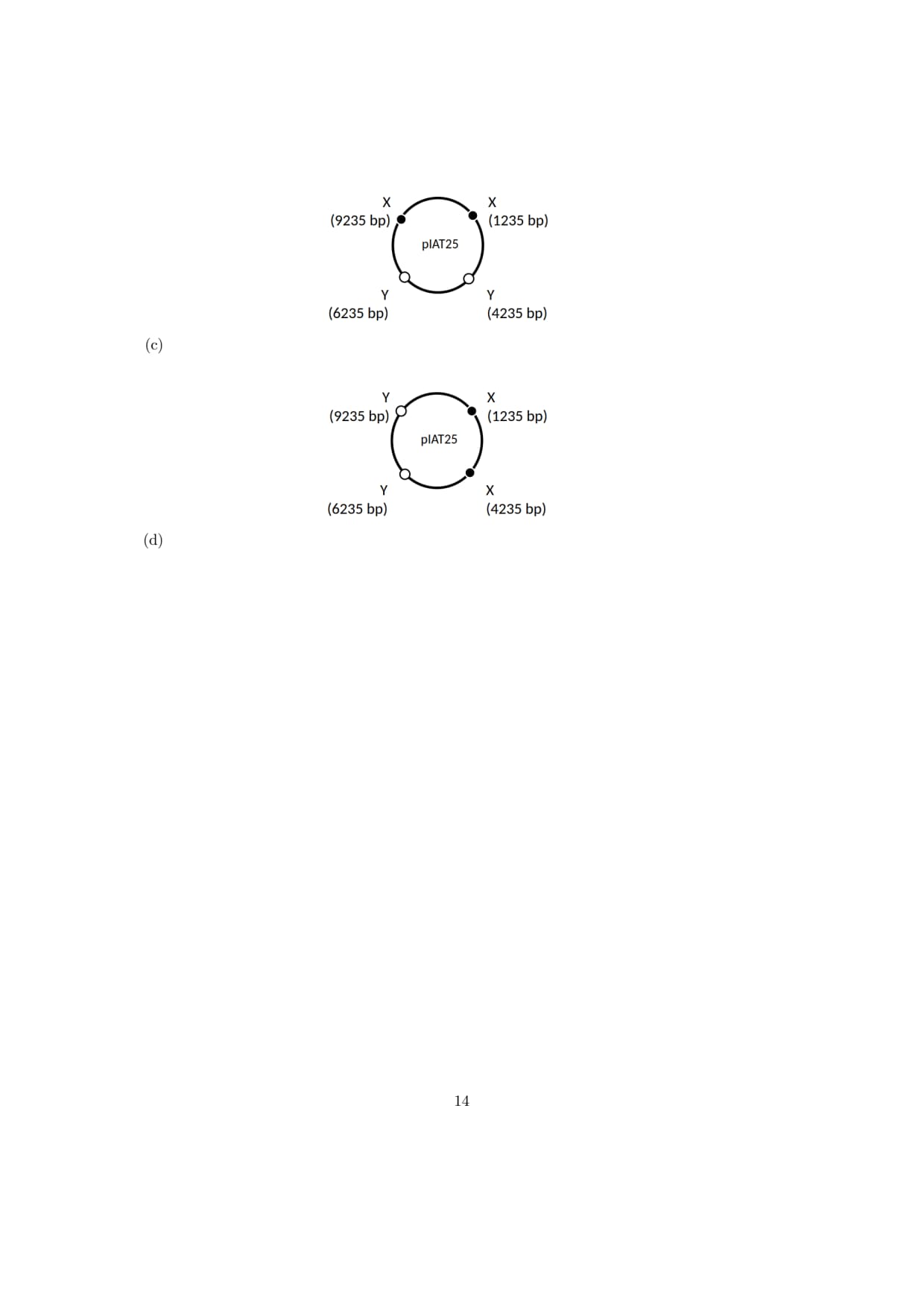
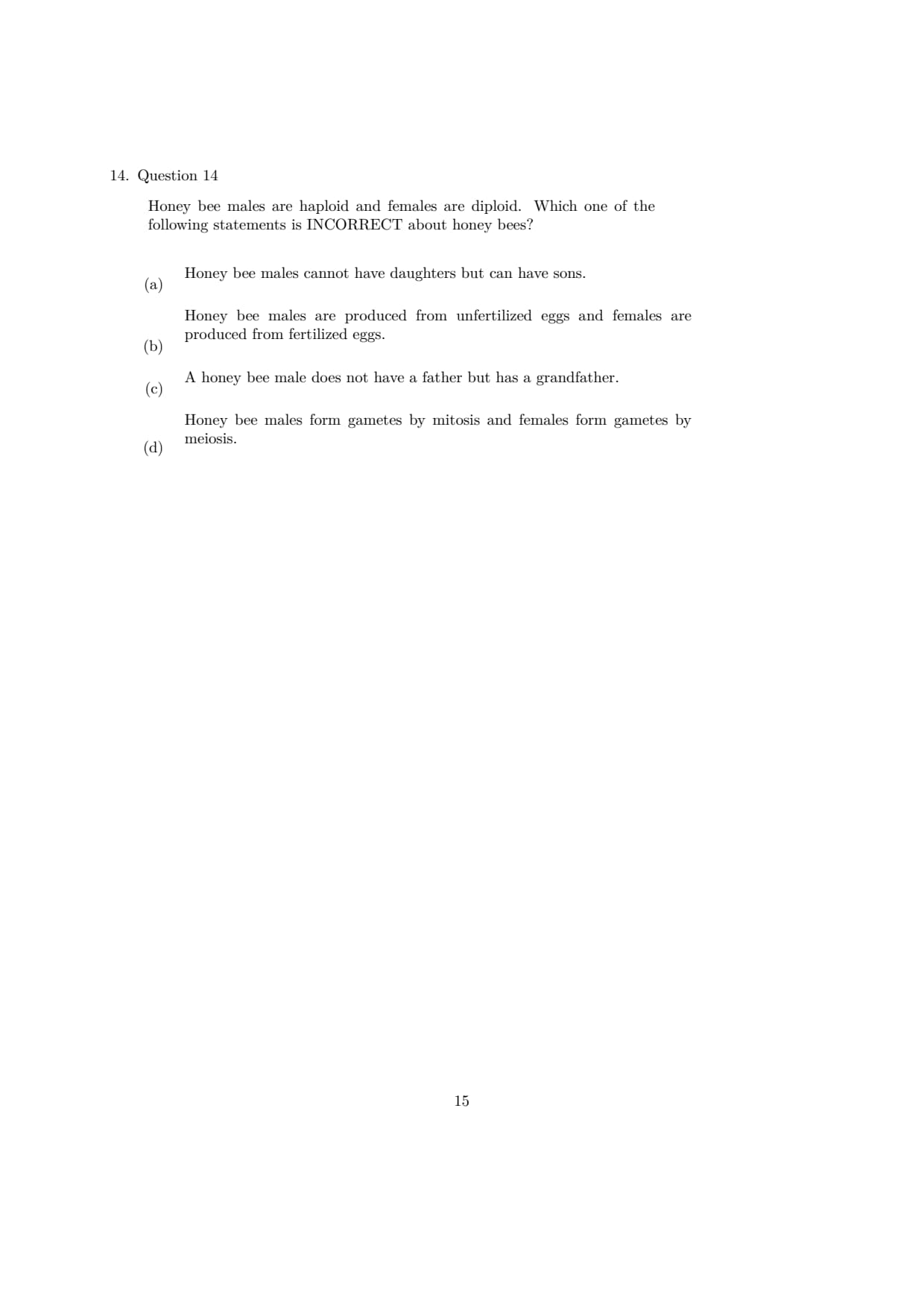
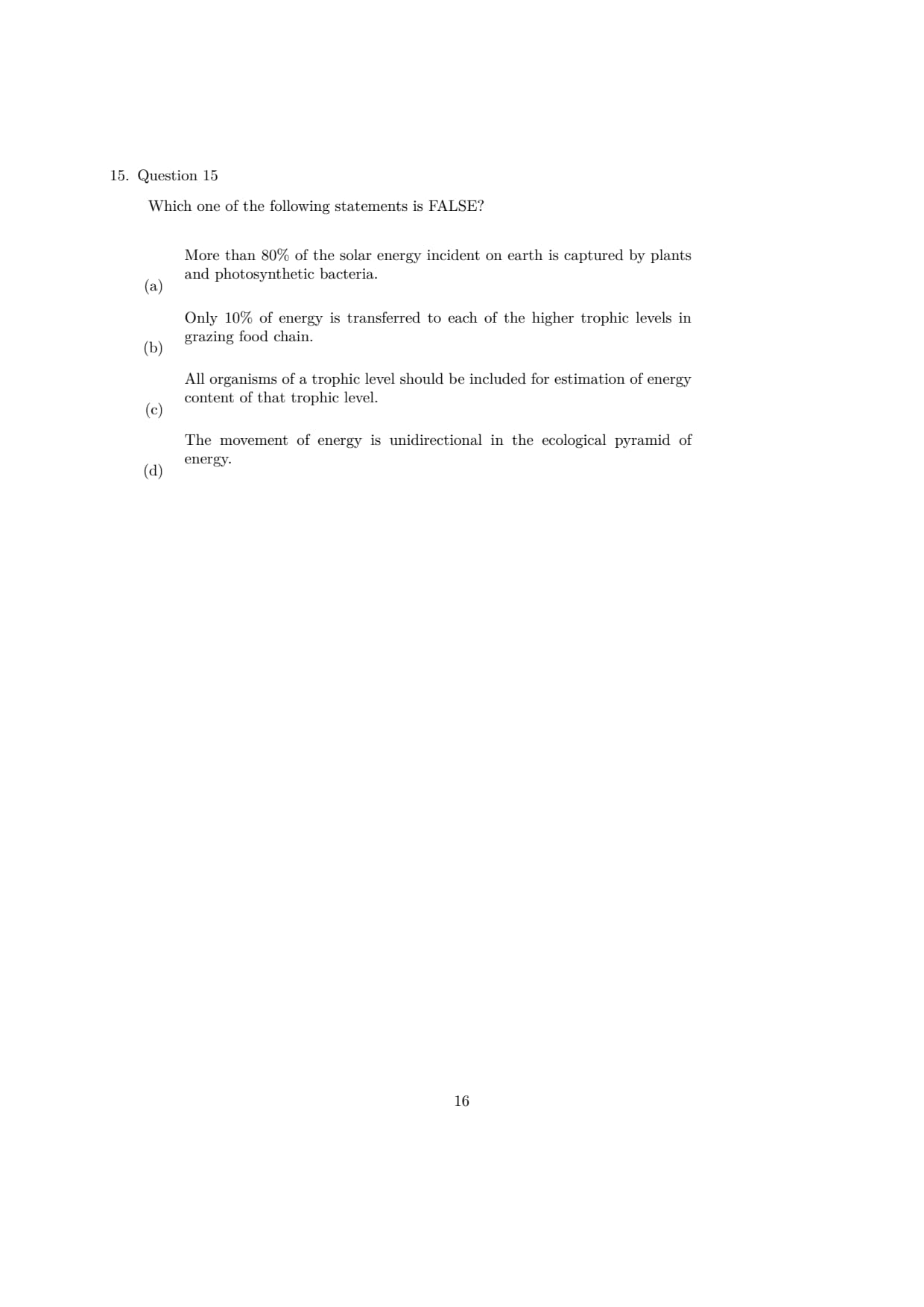
Which one of the following diagrams correctly represents the position of the restriction enzyme sites (X, Y) on the 10,000 bp plasmid?
- (A)
![]()
- (B)
![]()
- (C)
![]()
- (D)
![]()


View Solution
Step 1 : Understanding the Question:
This question requires constructing a restriction map of a \(10,000\) base-pair (bp) circular plasmid based on the fragment sizes obtained after single and double enzymatic digestions shown on an agarose gel.
Step 2 : Key Formulas and Approach:
The approach involves calculating the distances between restriction sites on a circular map of total size \(10,000\) bp.
For a circular plasmid, the number of fragments produced by digestion equals the number of restriction sites present.
We will check each option to see which mapping matches the fragment lengths observed on the gel.
Step 3 : Detailed Explanation:
Analyzing Gel Bands:
Lane 1 (X alone): Yields a single band at \(5\) kb (\(5000\) bp). This means there are two X sites located exactly \(5000\) bp apart, which yields two fragments of \(5000\) bp running as a single band.
Lane 3 (Y alone): Also yields a single band at \(5\) kb (\(5000\) bp), indicating two Y sites located exactly \(5000\) bp apart.
Lane 2 (X + Y double digest): Yields two bands at \(3\) kb (\(3000\) bp) and \(2\) kb (\(2000\) bp). This indicates that the four restriction sites (two X and two Y) partition the \(10,000\) bp plasmid into alternating fragments of \(3000\) bp and \(2000\) bp (summing to \(10,000\) bp).
Testing Option (A):
X sites are placed at \(9235\) bp and \(4235\) bp. The distance is \(9235 - 4235 = 5000\) bp. This matches the single digest result.
Y sites are placed at \(1235\) bp and \(6235\) bp. The distance is \(6235 - 1235 = 5000\) bp. This also matches the single digest result.
Arranging all four sites in sequential order along the circular plasmid: Y (\(1235\) bp) \(\rightarrow\) X (\(4235\) bp) \(\rightarrow\) Y (\(6235\) bp) \(\rightarrow\) X (\(9235\) bp) \(\rightarrow\) Y (\(1235\) bp).
The distances between these adjacent sites are:
From Y(\(1235\)) to X(\(4235\)): \(4235 - 1235 = 3000\) bp (\(3\) kb)
From X(\(4235\)) to Y(\(6235\)): \(6235 - 4235 = 2000\) bp (\(2\) kb)
From Y(\(6235\)) to X(\(9235\)): \(9235 - 6235 = 3000\) bp (\(3\) kb)
From X(\(9235\)) to Y(\(1235\)) (across the origin): \((10000 - 9235) + 1235 = 2000\) bp (\(2\) kb)
These calculations yield exactly two \(3\) kb fragments and two \(2\) kb fragments, which perfectly match the gel lanes.
Step 4 : Final Answer:
Thus, Option (A) is the only correct restriction map that explains the experimental gel data.
Quick Tip: For double digestions of circular DNA, check if the sum of all fragment lengths equals the total plasmid length.
Here, the bands are \(3\) kb and \(2\) kb, which sum to \(5\) kb.
Since the plasmid is \(10\) kb, there must be duplicate fragments (\(2 \times 3\) kb + \(2 \times 2\) kb = \(10\) kb), meaning the restriction sites must alternate around the circle.
Honey bee males are haploid and females are diploid. Which one of the following statements is INCORRECT about honey bees?
View Solution
Step 1 : Understanding the Question:
The question asks to identify the incorrect statement regarding the sex determination system and reproduction of honey bees.
Step 2 : Key Formulas and Approach:
The approach involves understanding the haplodiploid sex-determination system characteristic of Hymenoptera (including honey bees).
Under this system, males are haploid (\(n\)) and females are diploid (\(2n\)).
Step 3 : Detailed Explanation:
Sex Determination: Diploid females (queens or workers) develop from fertilized eggs, whereas haploid males (drones) develop parthenogenetically from unfertilized eggs. Thus, statement (B) is correct.
Meiosis vs. Mitosis: Since males are already haploid (\(n\)), they cannot undergo meiosis to produce sperm. Instead, they form sperm gametes via mitosis.
Diploid females produce haploid egg gametes via meiosis. Thus, statement (D) is correct.
Ancestry: Since a male develops from an unfertilized egg, he has no biological father.
However, his mother (the queen) arose from a fertilized egg, meaning she had both a mother and a father.
Therefore, a male bee has a maternal grandfather. Thus, statement (C) is correct.
Offspring: Since males only produce sperm that, upon fertilization, form diploid females, any offspring of a male must be female (daughters).
Unfertilized eggs laid by his mate develop into males without his genetic contribution, meaning a male cannot have biological sons.
Therefore, statement (A), which claims "males cannot have daughters but can have sons," is incorrect.
Step 4 : Final Answer:
The incorrect statement is Option (A).
Quick Tip: Remember this simple lineage rule for honey bee drones:
"A male drone has no father and can have no sons, but he has a grandfather and can have daughters."
This immediately points out the error in statement (A).
Which one of the following statements is FALSE?
View Solution
Step 1 : Understanding the Question:
The question asks to identify which of the given ecological statements is false.
Step 2 : Key Formulas and Approach:
The approach involves reviewing thermodynamic and ecological principles governing energy capture and flow through trophic levels in an ecosystem.
Step 3 : Detailed Explanation:
Solar Energy Capture: Out of the total solar radiation incident on Earth, less than \(50%\) represents Photosynthetically Active Radiation (PAR).
Plants and photosynthetic bacteria capture only \(2--10%\) of this PAR.
This means they capture only about \(1--5%\) of the total incident solar energy, not "more than \(80%\)". Thus, statement (A) is completely false.
Ten Percent Law: According to Lindeman's \(10%\) law of trophic efficiency, only about \(10%\) of the energy in one trophic level is transferred to the next higher level, while the rest is lost as heat or used in respiration. Thus, statement (B) is correct.
Trophic Level Estimation: To accurately calculate the total biomass, energy, or numbers of a trophic level, all organisms belonging to that level must be accounted for. Thus, statement (C) is correct.
Unidirectional Flow: Energy flow in an ecosystem is strictly unidirectional, moving from primary producers to herbivores and then to carnivores. It can never flow backwards. Thus, statement (D) is correct.
Step 4 : Final Answer:
Therefore, the false statement is Option (A).
Quick Tip: Plants are actually very inefficient at harvesting overall solar energy.
They capture only \(2--10%\) of the Photosynthetically Active Radiation (PAR), which is a tiny fraction of the total sunlight hitting the Earth.
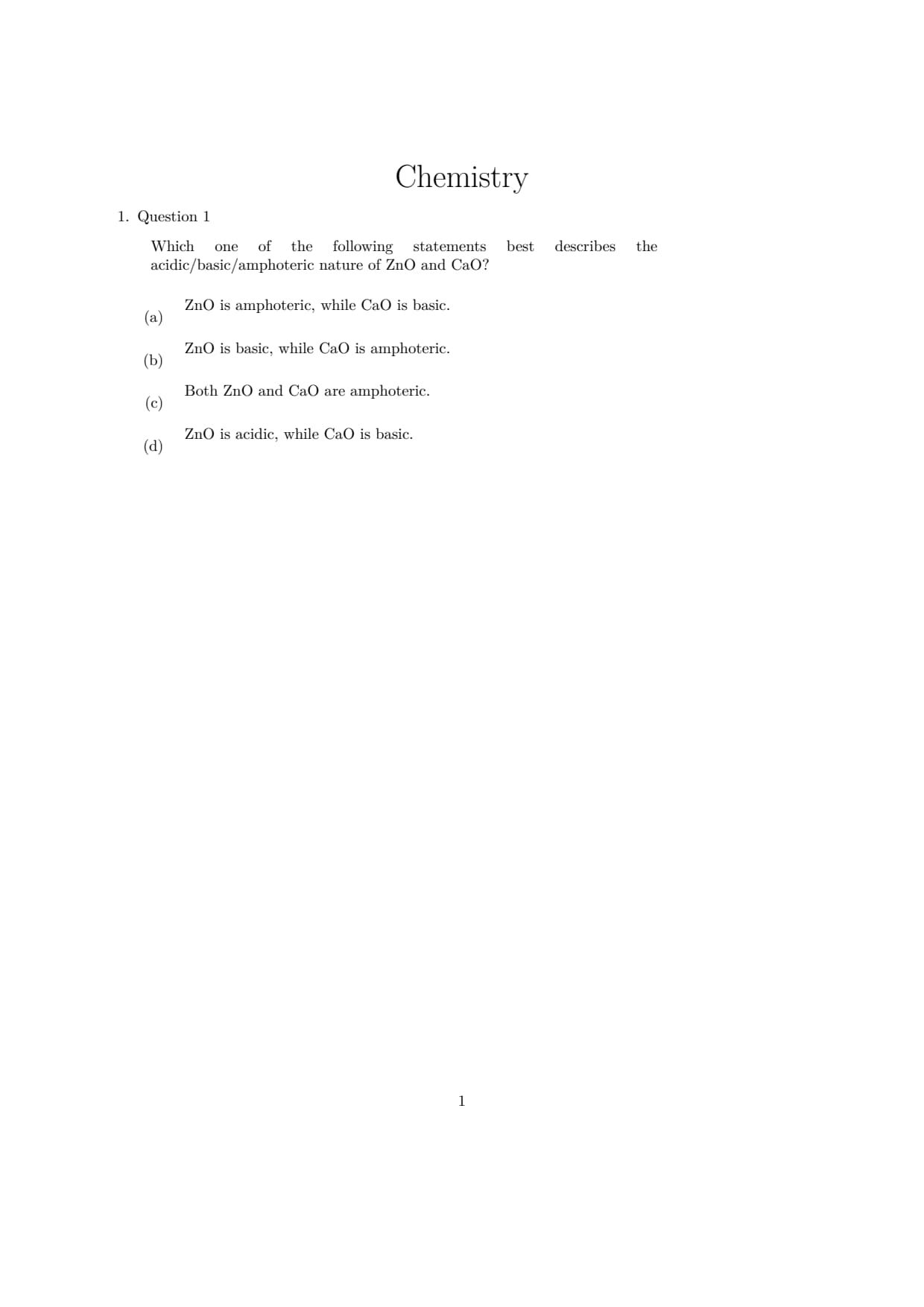
Which one of the following statements best describes the acidic/basic/amphoteric nature of ZnO and CaO?
View Solution
Step 1 : Understanding the Question:
This question asks us to identify the acid-base nature of two metal oxides, zinc oxide (\(ZnO\)) and calcium oxide (\(CaO\)).
Step 2 : Key Formulas and Approach:
The approach involves classifying metal oxides based on their reactions with acids and bases.
Typically, highly electropositive s-block metals form basic oxides, while some d-block and p-block metals form amphoteric or acidic oxides.
Step 3 : Detailed Explanation:
Zinc Oxide (\(ZnO\)): Zinc is a d-block transition metal.
Its oxide, \(ZnO\), exhibits both acidic and basic properties, which makes it amphoteric.
It reacts with acids to form zinc salts:
\[ ZnO + 2H^+ \rightarrow Zn^{2+} + H_2O \]
It also reacts with strong bases to form zincate complex ions:
\[ ZnO + 2OH^- + H_2O \rightarrow [Zn(OH)_4]^{2-} \]
Calcium Oxide (\(CaO\)): Calcium is an alkaline earth metal (s-block) with high electropositivity.
Its oxide, \(CaO\), reacts vigorously with water to form calcium hydroxide (an alkaline solution) and reacts readily with acids, but does not react with bases:
\[ CaO + H_2O \rightarrow Ca(OH)_2 \]
Thus, \(CaO\) is strongly basic.
Step 4 : Final Answer:
Therefore, \(ZnO\) is amphoteric, while \(CaO\) is basic.
This matches Option (A).
Quick Tip: Remember the common amphoteric oxides in inorganic chemistry using the mnemonic:
"Al, Zn, Pb, Sn, Be, Sb, As" form amphoteric oxides (\(Al_2O_3\), \(ZnO\), \(PbO\), \(SnO\), \(BeO\), etc.).
Most s-block metal oxides (like \(CaO\), \(Na_2O\)) are purely basic.
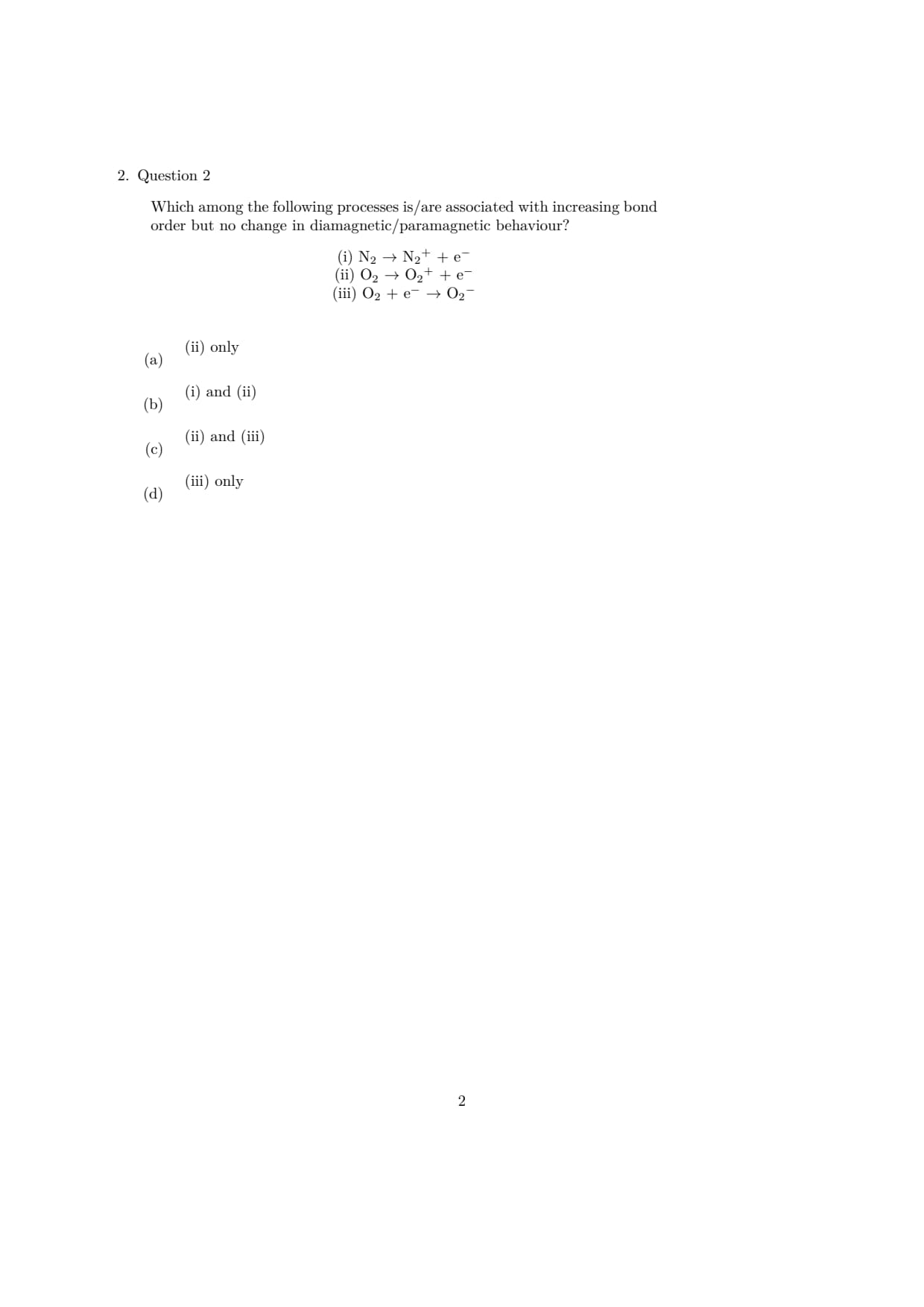
Which among the following processes is/are associated with increasing bond order but no change in diamagnetic/paramagnetic behaviour?
(i) \(N_2 \rightarrow N_2^+ + e^-\)
(ii) \(O_2 \rightarrow O_2^+ + e^-\)
(iii) \(O_2 + e^- \rightarrow O_2^-\)
View Solution
Step 1 : Understanding the Question:
The question asks to find which of the given molecular transformations result in both an increase in bond order and no change in magnetic behavior (remaining either diamagnetic or paramagnetic).
Step 2 : Key Formulas and Approach:
We will use Molecular Orbital (MO) Theory to determine the bond order and magnetic properties of each species.
The formula for Bond Order (BO) is:
\[ BO = \frac{N_b - N_a}{2} \]
where \(N_b\) is the number of bonding electrons and \(N_a\) is the number of antibonding electrons.
If a species contains unpaired electrons, it is paramagnetic; otherwise, it is diamagnetic.
Step 3 : Detailed Explanation:
Process (i): \(N_2 \rightarrow N_2^+ + e^-\)
\(N_2\) has 14 electrons. Its MO configuration is: \(\sigma_{1s}^2 \sigma_{1s}^{*2} \sigma_{2s}^2 \sigma_{2s}^{*2} \pi_{2p_x}^2 \pi_{2p_y}^2 \sigma_{2p_z}^2\).
Bond Order of \(N_2 = \frac{10 - 4}{2} = 3\). All electrons are paired, so it is diamagnetic.
\(N_2^+\) has 13 electrons. One electron is removed from the bonding orbital (\(\sigma_{2p_z}\)).
Bond Order of \(N_2^+ = \frac{9 - 4}{2} = 2.5\). It has one unpaired electron, so it is paramagnetic.
Here, the bond order decreases, and the magnetic behavior changes from diamagnetic to paramagnetic.
Process (ii): \(O_2 \rightarrow O_2^+ + e^-\)
\(O_2\) has 16 electrons. Its MO configuration is: \(\sigma_{1s}^2 \sigma_{1s}^{*2} \sigma_{2s}^2 \sigma_{2s}^{*2} \sigma_{2p_z}^2 \pi_{2p_x}^2 \pi_{2p_y}^2 \pi_{2p_x}^{*1} \pi_{2p_y}^{*1}\).
Bond Order of \(O_2 = \frac{10 - 6}{2} = 2\). It has two unpaired electrons, so it is paramagnetic.
\(O_2^+\) has 15 electrons. One electron is removed from an antibonding orbital (\(\pi_{2p}^*\)).
Bond Order of \(O_2^+ = \frac{10 - 5}{2} = 2.5\). It has one unpaired electron, so it is still paramagnetic.
Here, the bond order increases (\(2 \rightarrow 2.5\)), and there is no change in magnetic behavior (both are paramagnetic).
Process (iii): \(O_2 + e^- \rightarrow O_2^-\)
\(O_2^-\) has 17 electrons. The extra electron is added to an antibonding orbital (\(\pi_{2p}^*\)).
Bond Order of \(O_2^- = \frac{10 - 7}{2} = 1.5\).
Here, the bond order decreases from \(2\) to \(1.5\).
Step 4 : Final Answer:
Only process (ii) is associated with an increase in bond order and no change in magnetic behavior.
This corresponds to Option (A).
Quick Tip: Removing an electron from an antibonding orbital (\(\pi^*\) or \(\sigma^*\)) always increases the bond order.
Since \(O_2\) has unpaired electrons in its antibonding \(\pi^*\) orbitals, removing one electron to form \(O_2^+\) increases the bond order from 2 to 2.5 while keeping it paramagnetic.
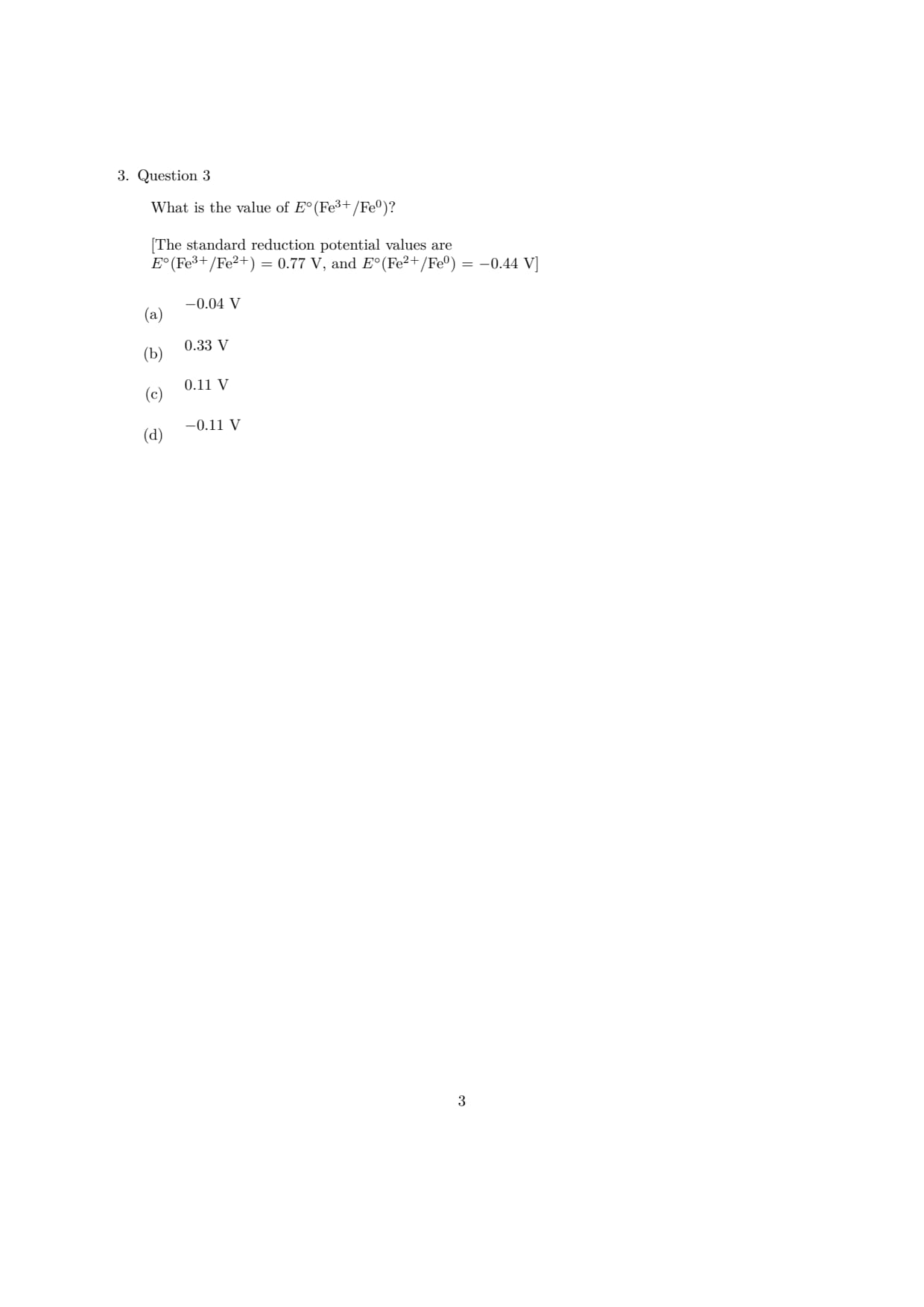
What is the value of \(E^\circ(Fe^{3+}/Fe^0)\)?
(The standard reduction potential values are \(E^\circ(Fe^{3+}/Fe^{2+}) = 0.77 V\), and \(E^\circ(Fe^{2+}/Fe^0) = -0.44 V\))
View Solution
Step 1 : Understanding the Question:
The question asks us to calculate the standard reduction potential for the reduction of \(Fe^{3+}\) to metallic iron (\(Fe^0\)) using the given standard reduction potentials of the individual steps (\(Fe^{3+}/Fe^{2+}\) and \(Fe^{2+}/Fe^0\)).
Step 2 : Key Formulas and Approach:
Standard reduction potentials (\(E^\circ\)) are intensive properties and cannot be added directly.
We must convert them to standard Gibbs free energy changes (\(\Delta G^\circ\)), which is an extensive property, using the formula:
\[ \Delta G^\circ = -nFE^\circ \]
We will set up the thermodynamic cycle:
\[ \Delta G^\circ_3 = \Delta G^\circ_1 + \Delta G^\circ_2 \]
Step 3 : Detailed Explanation:
Let us write down the half-cell reactions and their corresponding parameters:
First step: Reduction of \(Fe^{3+}\) to \(Fe^{2+}\)
\[ Fe^{3+} + e^- \rightarrow Fe^{2+} \quad (n_1 = 1, \, E_1^\circ = 0.77 V) \]
\[ \Delta G^\circ_1 = -1 \cdot F \cdot (0.77) = -0.77F \]
Second step: Reduction of \(Fe^{2+}\) to \(Fe^0\)
\[ Fe^{2+} + 2e^- \rightarrow Fe^0 \quad (n_2 = 2, \, E_2^\circ = -0.44 V) \]
\[ \Delta G^\circ_2 = -2 \cdot F \cdot (-0.44) = +0.88F \]
Target step: Reduction of \(Fe^{3+}\) to \(Fe^0\)
\[ Fe^{3+} + 3e^- \rightarrow Fe^0 \quad (n_3 = 3, \, E_3^\circ = ?) \]
\[ \Delta G^\circ_3 = -3 \cdot F \cdot E_3^\circ \]
Now, adding the first two reactions gives the target reaction:
\[ \Delta G^\circ_3 = \Delta G^\circ_1 + \Delta G^\circ_2 \]
\[ -3FE_3^\circ = -0.77F + 0.88F \]
\[ -3E_3^\circ = 0.11 \]
\[ E_3^\circ = -\frac{0.11}{3} \approx -0.0367 V \]
Rounding this value to two decimal places gives \(-0.04 V\).
Step 4 : Final Answer:
The standard reduction potential \(E^\circ(Fe^{3+}/Fe^0)\) is \(-0.04 V\).
This corresponds to Option (A).
Quick Tip: Never add \(E^\circ\) values directly!
Always use the formula:
\[ E^\circ_{net} = \frac{n_1 E^\circ_1 + n_2 E^\circ_2}{n_1 + n_2} \]
Plugging in:
\[ E^\circ_{net} = \frac{1(0.77) + 2(-0.44)}{3} = \frac{0.77 - 0.88}{3} = -0.037 V \]
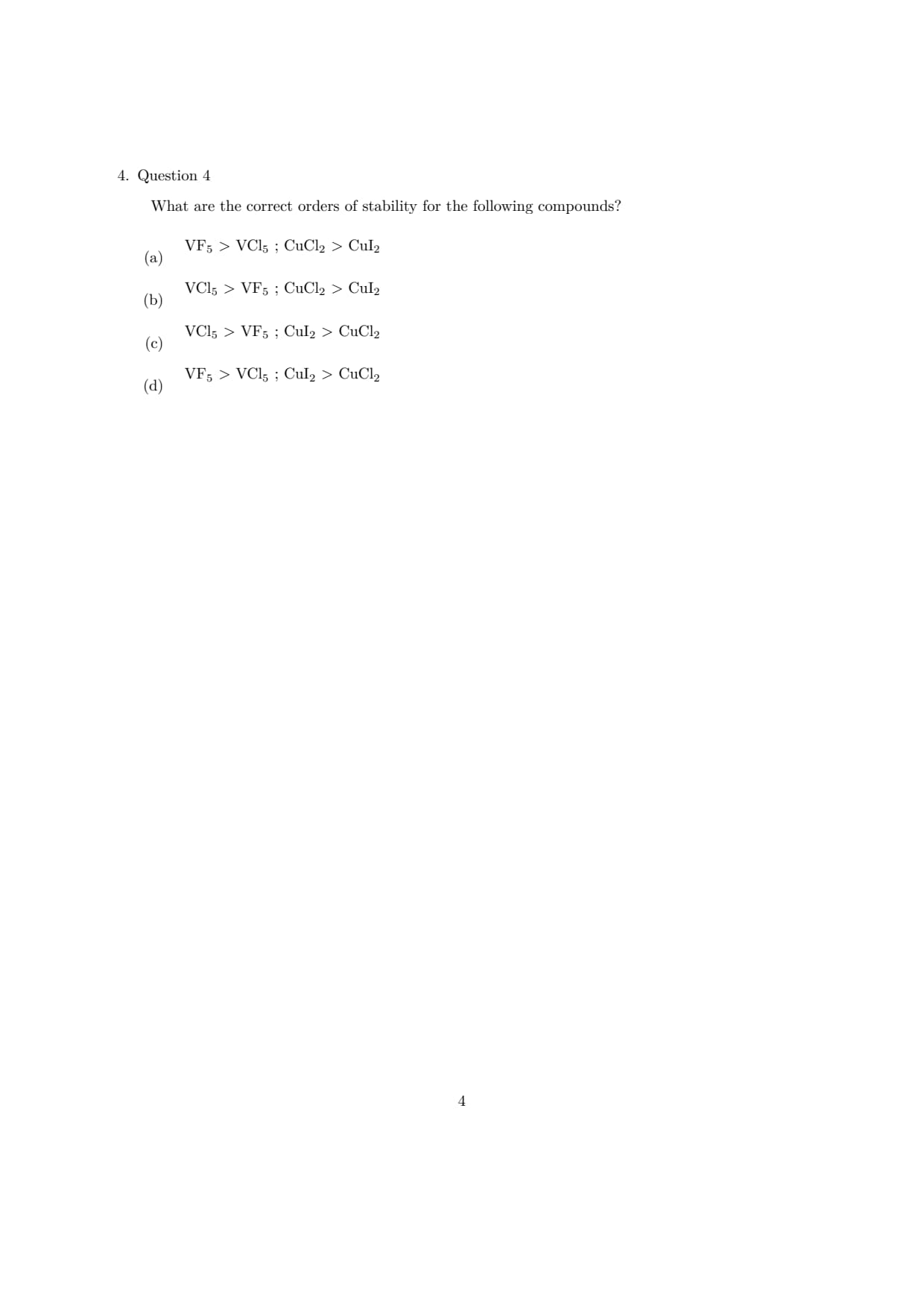
What are the correct orders of stability for the following compounds?
View Solution
Step 1 : Understanding the Question:
The question asks us to determine the relative stability orders for two pairs of transition metal halides: vanadium pentahalides (\(VF_5\) vs \(VCl_5\)) and copper dihalides (\(CuCl_2\) vs \(CuI_2\)).
Step 2 : Key Formulas and Approach:
The stability of transition metal halides in high oxidation states depends on the size and electronegativity of the halogen.
Higher oxidation states are stabilized by smaller, highly electronegative ligands (like fluorine).
The stability of halides in lower oxidation states is affected by the reducing ability of the halide ion.
Step 3 : Detailed Explanation:
Vanadium halides (\(VF_5\) vs \(VCl_5\)): Vanadium is in its maximum \(+5\) oxidation state.
Fluorine, being extremely small and the most electronegative element, can stabilize this high \(+5\) oxidation state due to high lattice energy and steric feasibility.
In contrast, chlorine is larger and less electronegative, making \(VCl_5\) highly unstable; it decomposes readily into \(VCl_4\) and \(Cl_2\).
Thus, \(VF_5 > VCl_5\).
Copper halides (\(CuCl_2\) vs \(CuI_2\)): Copper is in the \(+2\) oxidation state.
Iodide ion (\(I^-\)) is a strong reducing agent. It readily reduces \(Cu^{2+}\) to \(Cu^+\), oxidizing itself to iodine (\(I_2\)):
\[ 2Cu^{2+} + 4I^- \rightarrow 2CuI \, (s) + I_2 \]
Because of this spontaneous redox reaction, \(CuI_2\) does not exist in stable form.
Chloride ion (\(Cl^-\)) is not a strong enough reducing agent to reduce \(Cu^{2+}\), so \(CuCl_2\) is stable.
Thus, \(CuCl_2 > CuI_2\).
Step 4 : Final Answer:
The correct stability orders are \(VF_5 > VCl_5\) and \(CuCl_2 > CuI_2\).
This matches Option (A).
Quick Tip: Fluoride stabilizes the highest oxidation state of transition metals due to strong metal-ligand bonding.
Iodide fails to stabilize high oxidation states because of its strong reducing nature, making \(CuI_2\) decompose instantly into stable white insoluble \(CuI\).
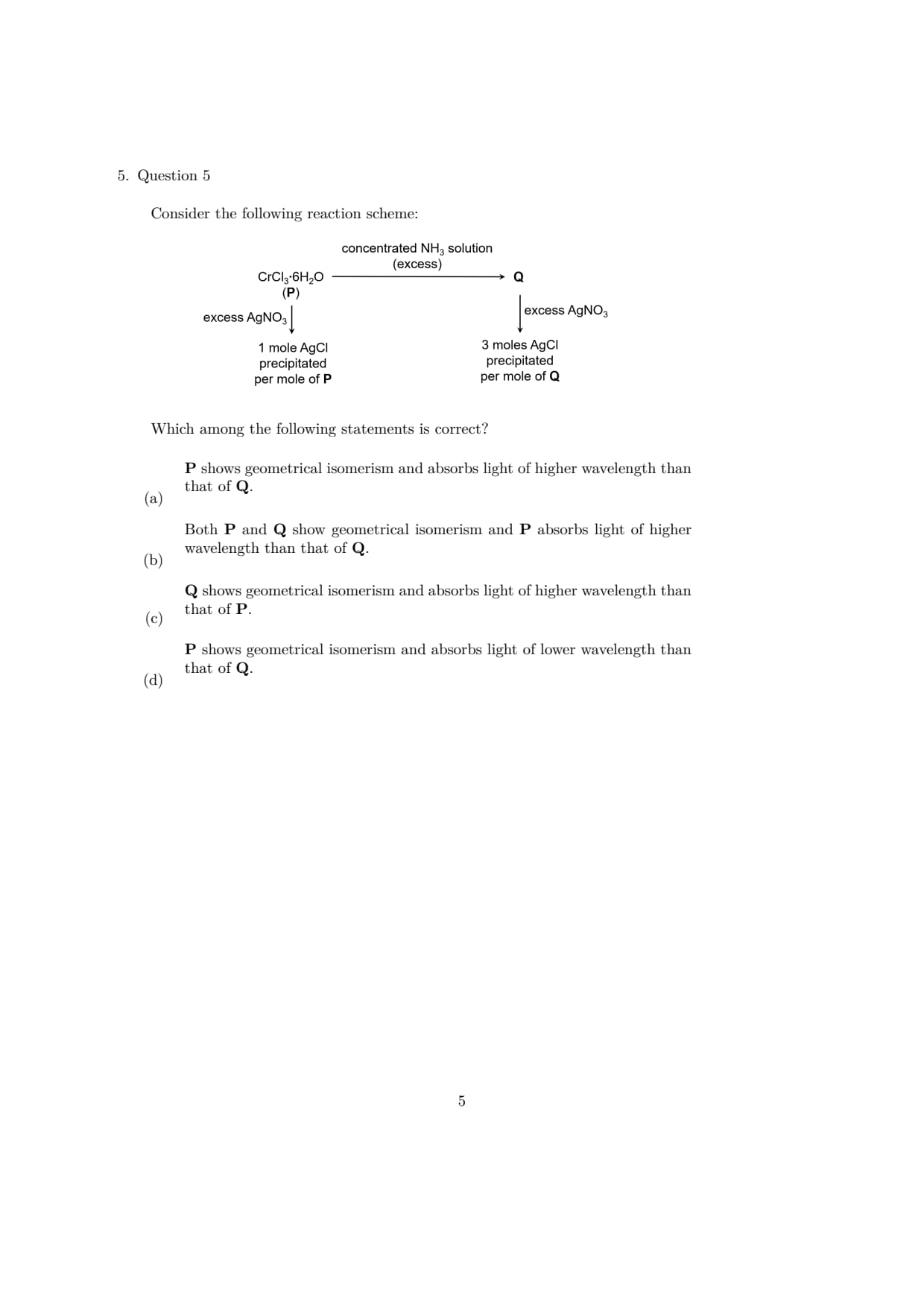
Consider the following reaction scheme:

Which among the following statements is correct?
View Solution
Step 1 : Understanding the Question:
The question asks us to identify the coordination formulas of compounds P and Q based on a reaction scheme and then compare their geometrical isomerism and light absorption properties.
Step 2 : Key Formulas and Approach:
We will use Werner's coordination theory to write the formulas of the complex isomers.
We will use Crystal Field Theory (CFT) to evaluate their crystal field splitting energy (\(\Delta_o\)).
The relationship between energy (\(\Delta_o\)) and wavelength of light absorbed (\(\lambda\)) is given by:
\[ \Delta_o = \frac{hc}{\lambda} \implies \lambda \propto \frac{1}{\Delta_o} \]
Step 3 : Detailed Explanation:
Determining Formula of P:
The hydrate isomer of \(CrCl_3 \cdot 6H_2O\) (P) reacts with excess \(AgNO_3\) to precipitate 1 mole of \(AgCl\) per mole of P.
This means there is exactly one counter chloride ion outside the coordination sphere.
Thus, the formula of P is \([Cr(H_2O)_4Cl_2]Cl \cdot 2H_2O\).
Since P is of the type \([MA_4B_2]Y\), it can exist as both cis and \textit{trans isomers, thus exhibiting geometrical isomerism.
Determining Formula of Q:
Treating P with excess concentrated \(NH_3\) solution replaces both coordinated water and chloride ligands with ammine (\(NH_3\)) ligands.
The resulting product Q precipitates 3 moles of \(AgCl\) per mole of Q, meaning all three chloride ions are now outside the coordination sphere.
Thus, the formula of Q is \([Cr(NH_3)_6]Cl_3\).
Since Q is of the type \([MA_6]Y_3\), it does not show geometrical isomerism.
Comparing Absorption Wavelength:
According to the spectrochemical series, \(NH_3\) is a stronger field ligand than both \(H_2O\) and \(Cl^-\).
Therefore, the crystal field splitting energy (\(\Delta_o\)) of the hexammine complex Q is larger than that of P:
\[ \Delta_o(Q) > \Delta_o(P) \]
Since \(\lambda\) is inversely proportional to \(\Delta_o\), the wavelength of light absorbed by P is higher than that absorbed by Q:
\[ \lambda_{absorb(P) > \lambda_{absorb}(Q) \]
Step 4 : Final Answer:
Therefore, P shows geometrical isomerism and absorbs light of higher wavelength than Q.
This corresponds to Option (A).
Quick Tip: Stronger field ligands (like \(NH_3\)) cause larger d-orbital splitting (\(\Delta_o\)).
Larger splitting requires higher energy (blue/violet light, shorter wavelength) for electronic excitation, meaning the weaker-field complex P absorbs at a higher wavelength.
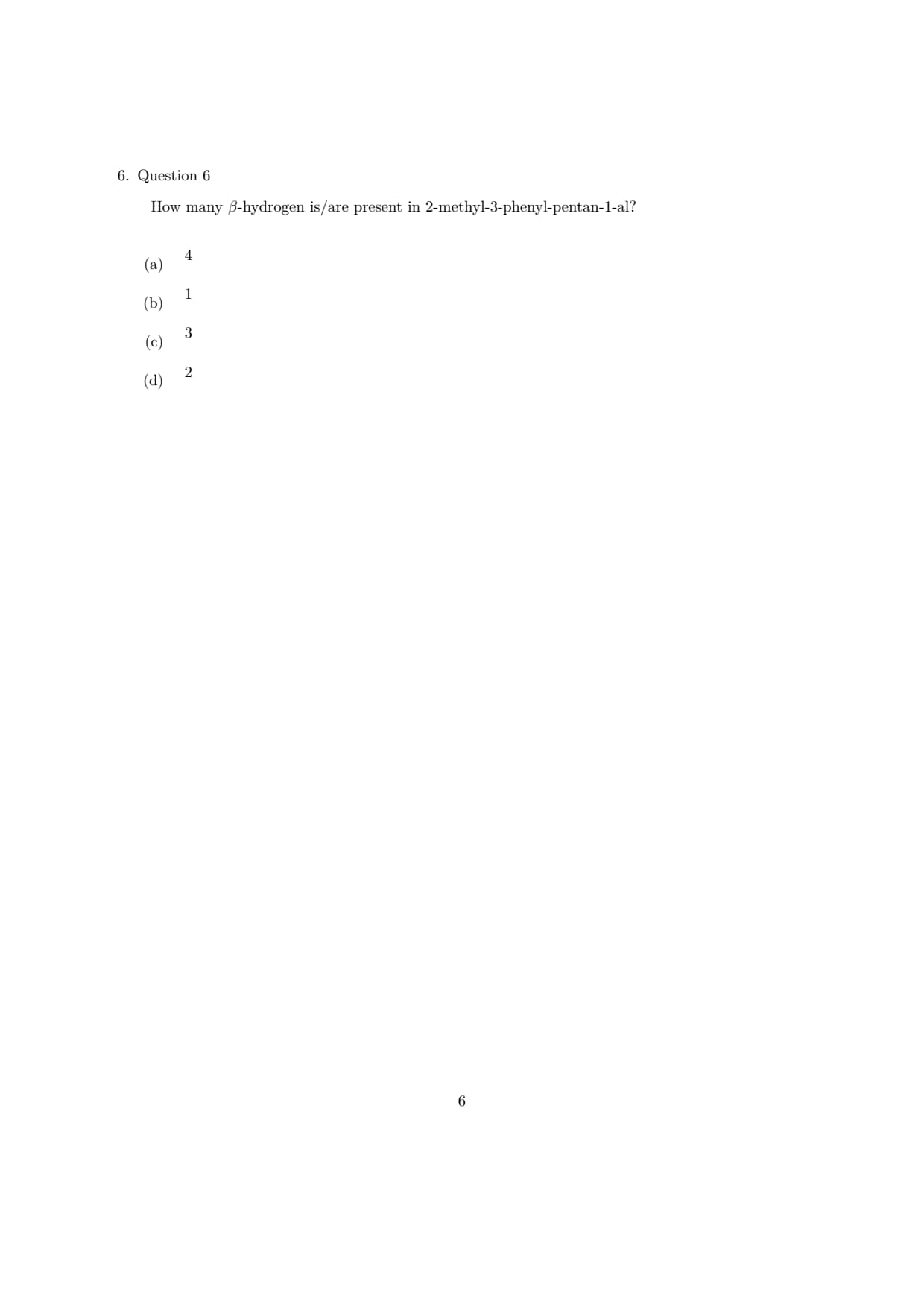
How many \(\beta\)-hydrogen is/are present in 2-methyl-3-phenyl-pentan-1-al?
View Solution
Step 1 : Understanding the Question:
The question asks us to find the total number of \(\beta\)-hydrogens present in the organic molecule 2-methyl-3-phenyl-pentan-1-al.
Step 2 : Key Formulas and Approach:
The approach involves drawing the IUPAC chemical structure of the molecule and identifying the carbons in the chain based on their position relative to the carbonyl group (\(-CHO\)).
The carbon directly attached to the carbonyl carbon is the \(\alpha\)-carbon.
Any carbon directly attached to the \(\alpha\)-carbon is a \(\beta\)-carbon, and the hydrogens attached to these \(\beta\)-carbons are \(\beta\)-hydrogens.
Step 3 : Detailed Explanation:
Let us write down the skeletal structure of 2-methyl-3-phenylpentanal:
The main chain has 5 carbon atoms (pentanal) with the functional group at position 1:
\[ \overset{5}{CH_3} - \overset{4}{CH_2} - \overset{3}{CH}(C_6H_5) - \overset{2}{CH}(CH_3) - \overset{1}{CHO} \]
Let us identify the positions of the carbons relative to the \(-CHO\) group:
Carbonyl carbon (C1): \(-CHO\)
Alpha (\(\alpha\)) carbon (C2): \(-CH(CH_3)-\)
Beta (\(\beta\)) carbons: Any carbon directly attached to the \(\alpha\)-carbon (C2).
Looking at C2, it is connected to two carbon atoms:
Carbon C3 of the main chain: \(-CH(C_6H_5)-\)
The carbon of the methyl group attached at C2: \(-CH_3\)
Therefore, both C3 and the methyl carbon are classified as \(\beta\)-carbons.
Counting \(\beta\)-hydrogens:
The \(\beta\)-carbon C3 is bonded to one phenyl group and one hydrogen atom. Thus, it contains 1 \(\beta\)-hydrogen.
The \(\beta\)-carbon of the C2 methyl group is bonded to three hydrogen atoms (\(-CH_3\)). Thus, it contains 3 \(\beta\)-hydrogens.
The phenyl ring is attached to C3 (which is a \(\beta\)-position), so the ring carbons themselves are at \(\gamma\) or higher positions and do not contain \(\beta\)-hydrogens.
Total number of \(\beta\)-hydrogens = \(1 (from C3) + 3 (from methyl) = 4\).
Step 4 : Final Answer:
There are 4 \(\beta\)-hydrogens in the given compound.
This matches Option (A).
Quick Tip: Always draw out the structural formula fully when counting \(\alpha\) or \(\beta\) hydrogens.
Do not forget that branches on the \(\alpha\)-carbon (like a methyl group) are physically positioned at the \(\beta\)-distance from the functional group and must be counted.
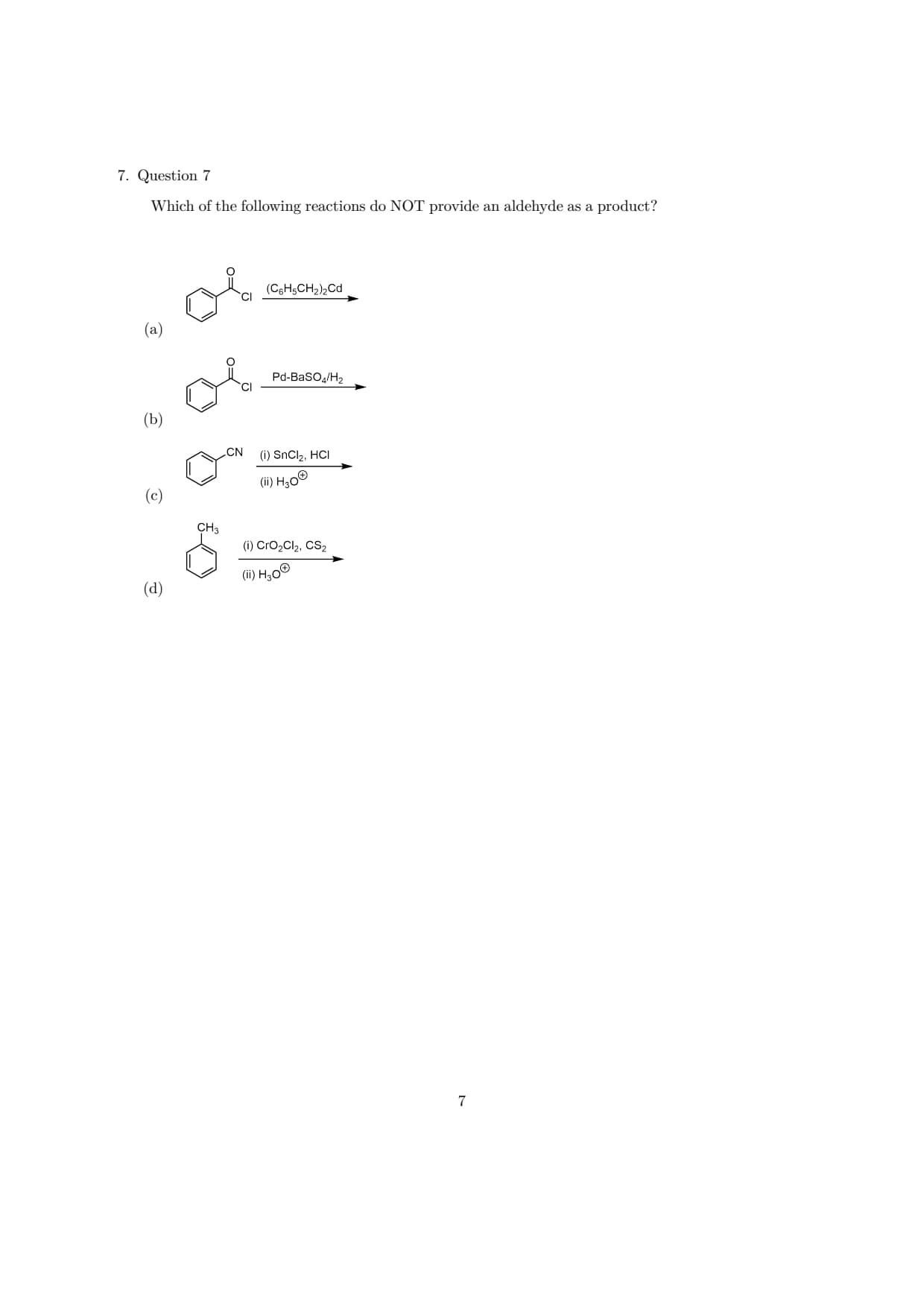
Which of the following reactions do NOT provide an aldehyde as a product?
- (A)
![]()
- (B)
![]()
- (C)
![]()
- (D)
![]()


View Solution
Step 1 : Understanding the Question:
The question asks us to identify which of the given organic chemical reactions does not produce an aldehyde as its major product.
Step 2 : Key Formulas and Approach:
The approach involves identifying the name and mechanism of each reaction:
Reaction (a): Treatment of an acid chloride with a dialkylcadmium reagent.
Reaction (b): Rosenmund reduction.
Reaction (c): Stephen reduction.
Reaction (d): Étard reaction.
Step 3 : Detailed Explanation:
Let us evaluate each reaction individually:
Reaction (a): Benzoyl chloride is treated with dibenzylcadmium, \((C_6H_5CH_2)_2Cd\).
Organocadmium reagents are less nucleophilic than Grignard reagents. They react smoothly with acid chlorides to yield ketones, but do not react further to form tertiary alcohols.
The reaction is:
\[ 2C_6H_5COCl + (C_6H_5CH_2)_2Cd \rightarrow 2C_6H_5COCH_2C_6H_5 + CdCl_2 \]
The product is benzyl phenyl ketone, which is a ketone, not an aldehyde.
Reaction (b): Benzoyl chloride is reduced with hydrogen gas in the presence of palladium on barium sulfate catalyst (\(Pd-BaSO_4\)).
This is the Rosenmund reduction, which selectively reduces acid chlorides to benzaldehyde (an aldehyde).
Reaction (c): Benzonitrile is reduced using tin(II) chloride (\(SnCl_2\)) and \(HCl\), followed by acidic hydrolysis.
This is the Stephen reduction, which converts nitriles to imines, which are then hydrolyzed to benzaldehyde (an aldehyde).
Reaction (d): Toluene is oxidized using chromyl chloride (\(CrO_2Cl_2\)) in carbon disulfide (\(CS_2\)), followed by hydrolysis.
This is the Étard reaction, which selectively oxidizes the methyl group of toluene to form benzaldehyde (an aldehyde).
Step 4 : Final Answer:
Reaction (a) yields a ketone instead of an aldehyde, making it the correct choice.
This corresponds to Option (A).
Quick Tip: Organometallic reagents have varying reactivities:
\(R_2Cd\) and \(R_2Zn\) are mild nucleophiles that halt at the ketone stage when reacted with acid chlorides, whereas \(RMgX\) and \(RLi\) are strong nucleophiles that carry the reaction to tertiary alcohols.
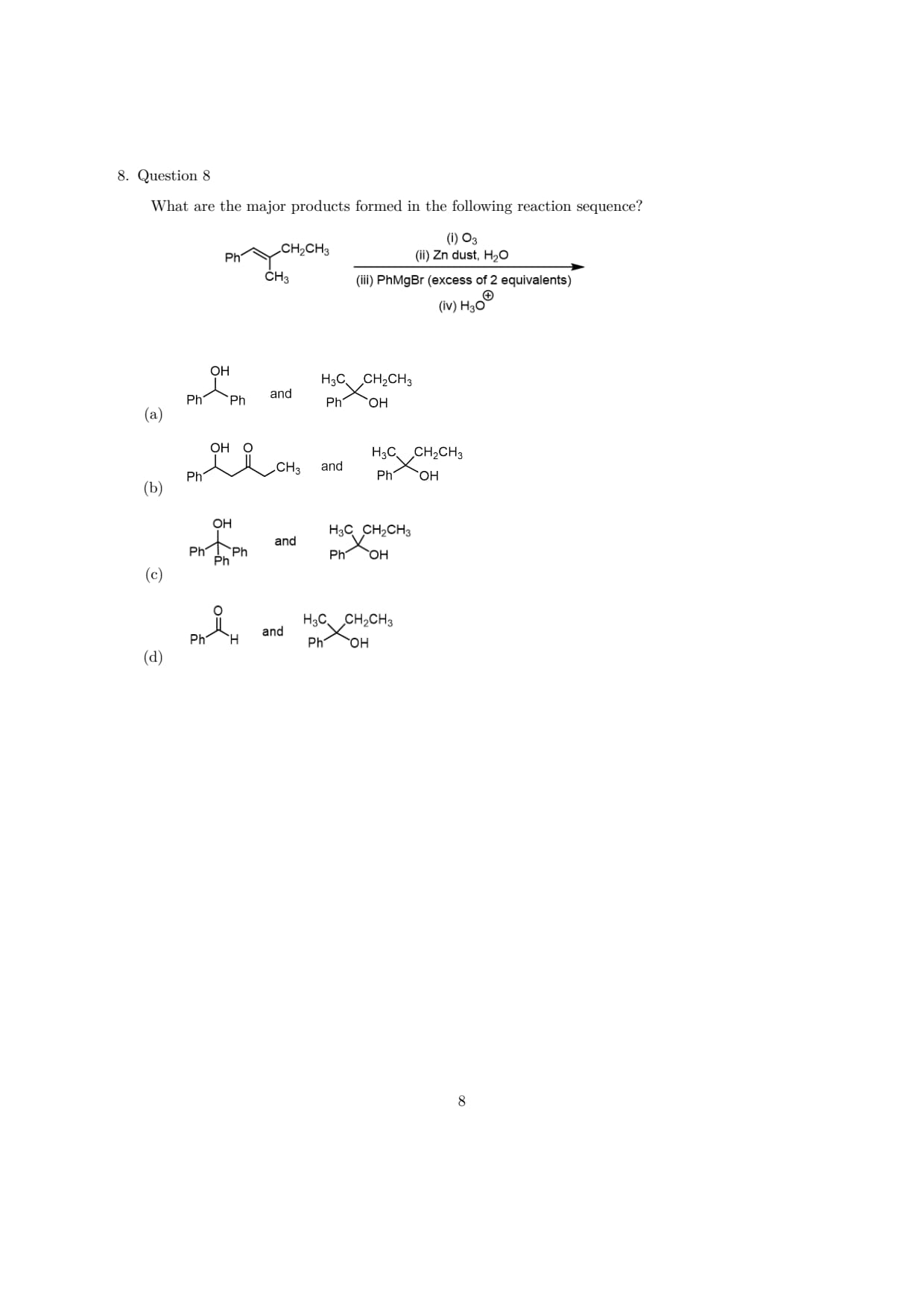
What are the major products formed in the following reaction sequence?


View Solution
Step 1 : Understanding the Question:
The question asks for the major products formed when the given alkene, (2-methylbut-1-en-1-yl)benzene (\(Ph-CH=C(CH_3)-CH_2CH_3\)), undergoes reductive ozonolysis followed by reaction with excess phenylmagnesium bromide (\(PhMgBr\)) and subsequent hydrolysis.
Step 2 : Key Formulas and Approach:
The approach involves a two-stage organic synthesis:
Reductive ozonolysis (\(O_3\), followed by \(Zn/H_2O\)) of the alkene to cleave the double bond and yield two carbonyl compounds.
Nucleophilic addition of the Grignard reagent (\(PhMgBr\)) to both carbonyl compounds, followed by protonation (\(H_3O^+\)) to yield the corresponding alcohols.
Step 3 : Detailed Explanation:
Let us carry out the chemical steps:
Stage 1: Ozonolysis
The starting alkene is:
\[ Ph-CH=C(CH_3)-CH_2CH_3 \]
Ozonolysis cleaves the double bond to produce two carbonyl products:
\[ Ph-CH=O \quad (Benzaldehyde, an aldehyde) \]
\[ O=C(CH_3)-CH_2CH_3 \quad (Butanone, a ketone) \]
Stage 2: Grignard Reaction
We treat the mixture with an excess of phenylmagnesium bromide (at least 2 equivalents):
Reaction with Benzaldehyde:
The nucleophilic phenyl group attacks the aldehyde carbon:
\[ Ph-CHO + PhMgBr \rightarrow Ph_2CH-OMgBr \xrightarrow{H_3O^+} Ph_2CH-OH \]
The product is diphenylmethanol (also known as benzhydrol).
Reaction with Butanone:
The nucleophilic phenyl group attacks the ketone carbonyl carbon:
\[ CH_3-CO-CH_2CH_3 + PhMgBr \rightarrow CH_3-C(OMgBr)(Ph)-CH_2CH_3 \]
\[ \xrightarrow{H_3O^+} CH_3-C(OH)(Ph)-CH_2CH_3 \]
The product is 2-phenylbutan-2-ol.
Step 4 : Final Answer:
The major products formed are diphenylmethanol (shown as \(Ph-CH(OH)-Ph\)) and 2-phenylbutan-2-ol (shown as \(H_3C-C(OH)(Ph)-CH_2CH_3\)).
This corresponds to Option (A).
Quick Tip: Ozonolysis converts alkenes into carbonyls.
Grignard addition to an aldehyde (\(RCHO\)) yields a secondary alcohol (\(R_2CHOH\)), while addition to a ketone (\(R_2CO\)) yields a tertiary alcohol (\(R_3COH\)).
This functional group behavior allows you to quickly narrow down the alcohol types.
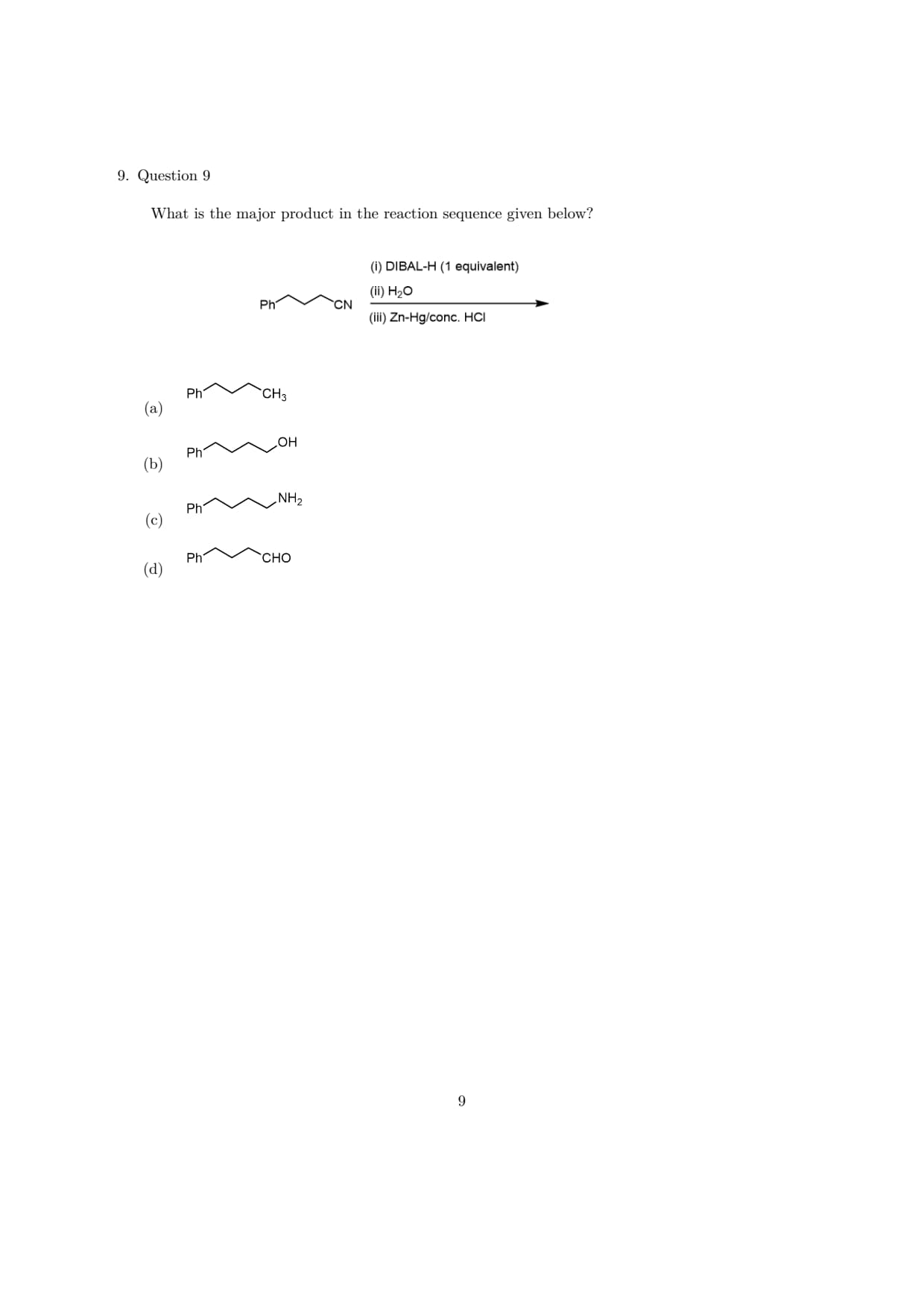
What is the major product in the reaction sequence given below?


View Solution
Step 1 : Understanding the Question:
The question asks us to determine the final major product of a multi-step reaction starting with 4-phenylbutanenitrile (\(Ph-CH_2-CH_2-CH_2-CN\)).
Step 2 : Key Formulas and Approach:
We will analyze the reaction sequence step-by-step:
Diisobutylaluminum hydride (\(DIBAL-H\), 1 equivalent) is a selective reducing agent that reduces nitriles to imines.
Acidic hydrolysis (\(H_2O\)) converts the imine intermediate into an aldehyde.
Clemmensen reduction (\(Zn-Hg/conc. HCl\)) reduces the carbonyl group (\(-CHO\)) of the aldehyde to a methylene group (\(-CH_3\)).
Step 3 : Detailed Explanation:
Let us trace each step of the reaction:
Steps (i) and (ii): DIBAL-H reduction followed by Hydrolysis
The starting material is 4-phenylbutanenitrile:
\[ Ph-CH_2-CH_2-CH_2-CN \]
Treatment with one equivalent of \(DIBAL-H\) reduces the nitrile group selectively to an imine intermediate:
\[ Ph-CH_2-CH_2-CH_2-CH=NH \]
Subsequent addition of water hydrolyzes this imine to yield the corresponding aldehyde, 4-phenylbutanal:
\[ Ph-CH_2-CH_2-CH_2-CHO \]
Step (iii): Clemmensen Reduction
The aldehyde is treated with zinc amalgam (\(Zn-Hg\)) and concentrated hydrochloric acid (\(HCl\)).
This is the classic Clemmensen reduction, which converts the carbonyl group (\(C=O\)) of aldehydes and ketones into a hydrocarbon group (\(CH_2\)):
\[ Ph-CH_2-CH_2-CH_2-CHO \xrightarrow{Zn-Hg/conc. HCl} Ph-CH_2-CH_2-CH_2-CH_3 \]
The resulting product is butylbenzene.
Step 4 : Final Answer:
The final major product of the reaction sequence is butylbenzene (an alkane), as shown in Option (A).
Quick Tip: Remember:
\[ R-CN \xrightarrow{(1) DIBAL-H, (2) H_2O} R-CHO \]
\[ R-CHO \xrightarrow{Zn-Hg/HCl} R-CH_3 \]
Combined, this sequence converts a nitrile group (\(-CN\)) into a methyl group (\(-CH_3\)).
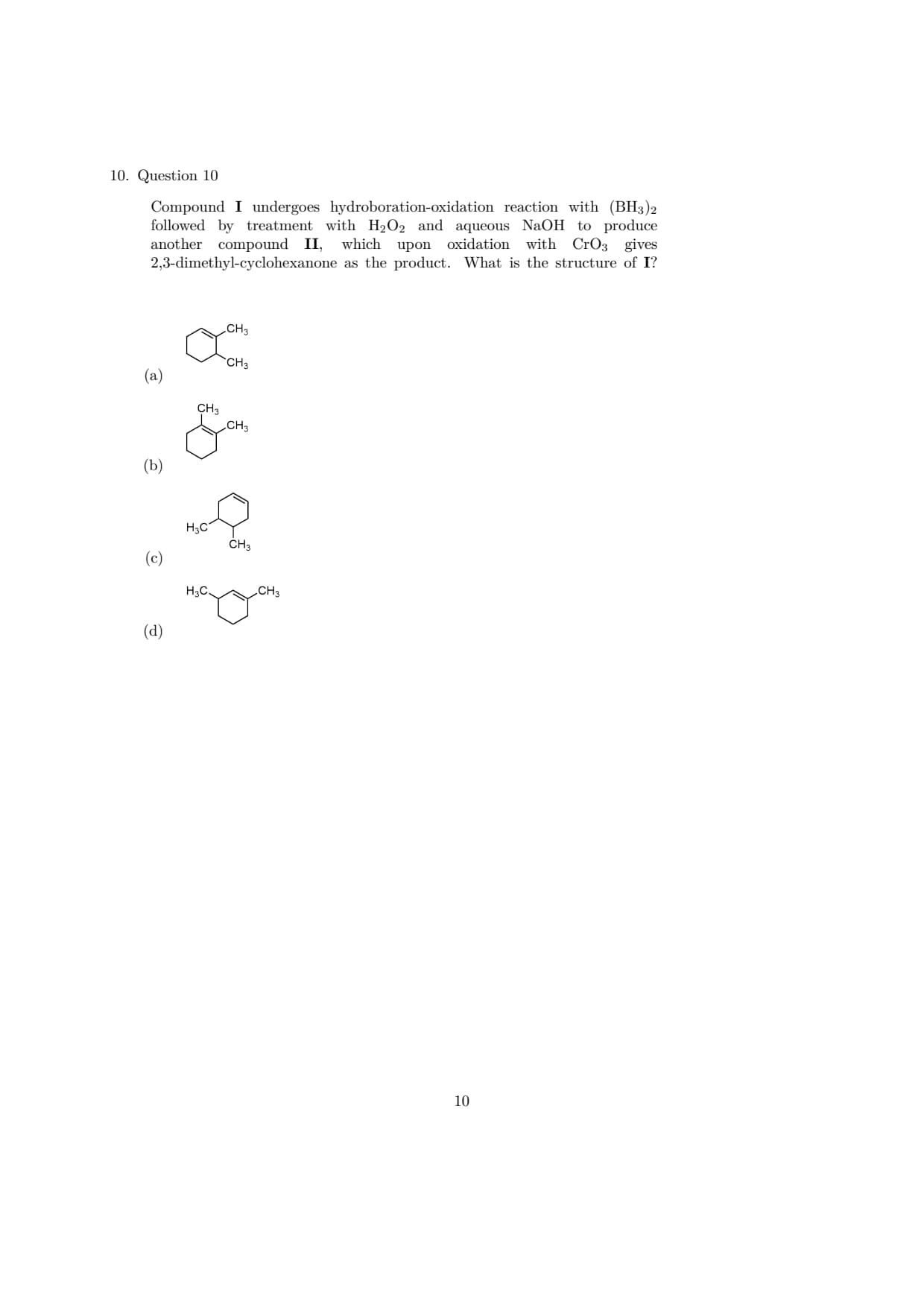
Compound I undergoes hydroboration-oxidation reaction with \((BH_3)_2\) followed by treatment with \(H_2O_2\) and aqueous \(NaOH\) to produce another compound II, which upon oxidation with \(CrO_3\) gives 2,3-dimethyl-cyclohexanone as the product. What is the structure of I?

View Solution
Step 1 : Understanding the Question:
This question asks us to find the structure of alkene I which, upon hydroboration-oxidation to form alcohol II and subsequent oxidation with chromium trioxide (\(CrO_3\)), yields 2,3-dimethylcyclohexanone as the final product.
Step 2 : Key Formulas and Approach:
We will work backward from the final product to determine the intermediate and reactant:
Oxidation: Oxidation of secondary alcohol II with \(CrO_3\) yields the ketone 2,3-dimethylcyclohexanone. This means II must be 2,3-dimethylcyclohexan-1-ol.
Hydroboration-Oxidation: Hydroboration-oxidation adds \(-H\) and \(-OH\) across a double bond in a \textit{syn, anti-Markovnikov (less-substituted carbon) fashion.
Step 3 : Detailed Explanation:
Let us analyze the structures:
The Final Product: 2,3-dimethylcyclohexanone
The structure has a carbonyl group at position 1, and methyl groups at positions 2 and 3.
To obtain this ketone upon oxidation, alcohol II must have its hydroxyl group (\(-OH\)) at position 1:
\[ Compound II = 2,3-dimethylcyclohexan-1-ol \]
Evaluating Alkene I Options:
Option (a): 1,2-dimethylcyclohexene
The double bond is between C1 and C2, both of which are tertiary carbons (each is bonded to a methyl group).
Hydroboration-oxidation of this symmetric alkene would place the \(-OH\) group on either C1 or C2, yielding 1,2-dimethylcyclohexan-1-ol (a tertiary alcohol, which cannot be oxidized to a ketone). So Option (a) is incorrect.
Option (b): 2,3-dimethylcyclohexene
The double bond is between C1 and C2. C2 has a methyl group, while C1 is unsubstituted. C3 has the second methyl group.
During hydroboration-oxidation, the boron atom adds to the less-substituted carbon of the double bond (C1), which upon oxidation yields the alcohol:
\[ 2,3-dimethylcyclohexan-1-ol \]
Oxidation of this secondary alcohol with \(CrO_3\) converts the secondary alcohol at C1 into a carbonyl group, yielding:
\[ 2,3-dimethylcyclohexanone \]
This matches the target product.
Step 4 : Final Answer:
The starting alkene I must be 2,3-dimethylcyclohexene, represented by Structure (b).
This corresponds to Option (B).
Quick Tip: Hydroboration-oxidation is an anti-Markovnikov hydration.
To get a ketone at C1 with a methyl at C2, the double bond must have been between C1 and C2, with C2 being the more substituted carbon (bearing the methyl) so that \(-OH\) adds selectively to C1.
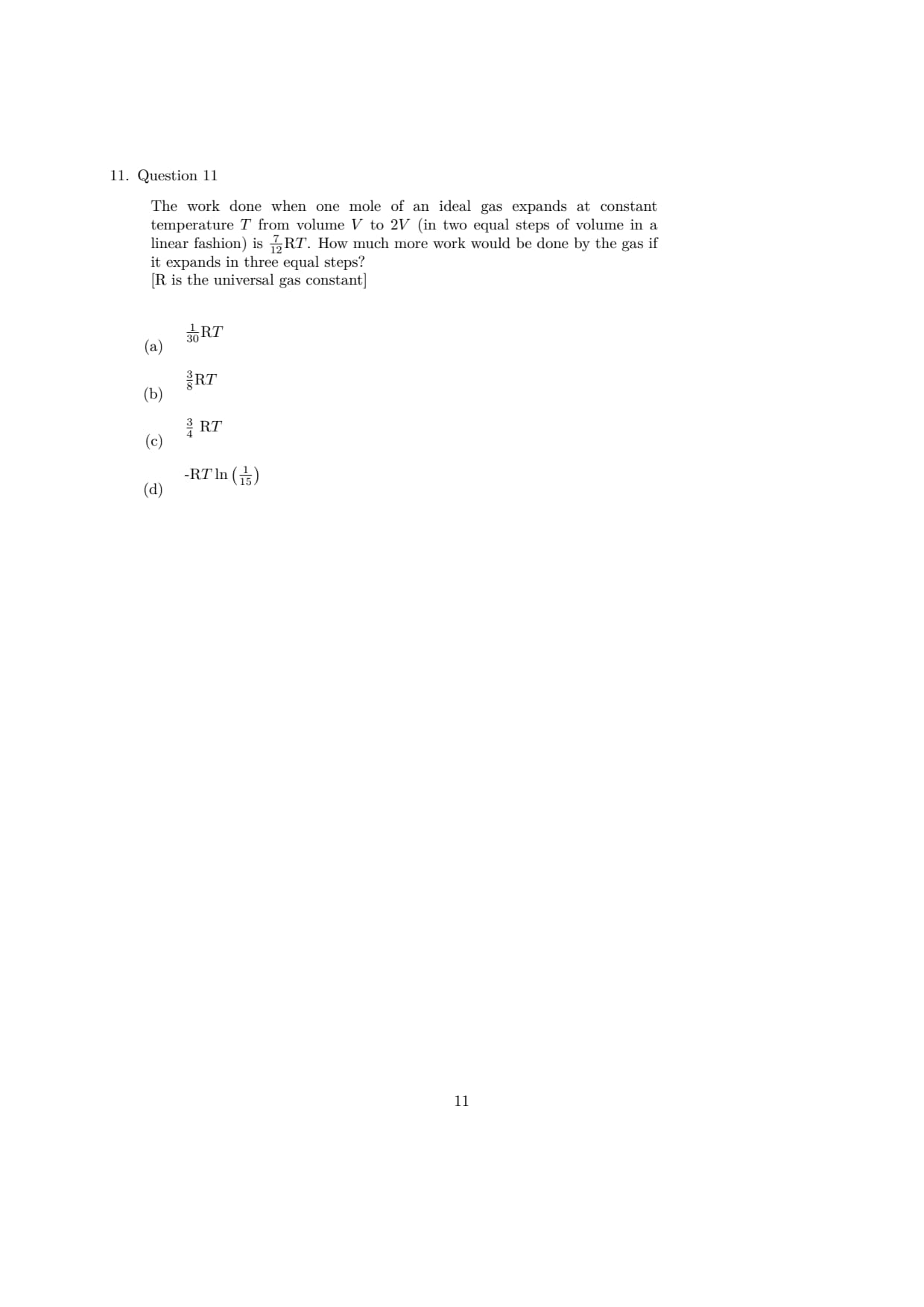
The work done when one mole of an ideal gas expands at constant temperature \(T\) from volume \(V\) to \(2V\) (in two equal steps of volume in a linear fashion) is \(\frac{7}{12}RT\). How much more work would be done by the gas if it expands in three equal steps?
(R is the universal gas constant)
View Solution
Step 1 : Understanding the Question:
The question asks us to calculate the difference in work done by one mole of an ideal gas when it undergoes isothermal expansion from volume \(V\) to \(2V\) in three equal volume steps versus two equal volume steps.
Step 2 : Key Formulas and Approach:
For a step-wise, irreversible gas expansion, the work done in each step is:
\[ W = P_{ext} \Delta V \]
The external pressure (\(P_{ext}\)) for each step is equal to the final pressure of the gas at the end of that step.
For an ideal gas, \(P = \frac{RT}{V_f}\).
Step 3 : Detailed Explanation:
Let us first verify the two-step expansion work \(W_{(2)}\):
The total volume change is \(2V - V = V\). For 2 equal steps, \(\Delta V = \frac{V}{2} = 0.5V\).
Step 1: Expansion from \(V\) to \(1.5V\).
\[ P_{ext, 1} = P(1.5V) = \frac{RT}{1.5V} = \frac{2RT}{3V} \]
\[ W_1 = \left(\frac{2RT}{3V}\right)(0.5V) = \frac{1}{3}RT \]
Step 2: Expansion from \(1.5V\) to \(2V\).
\[ P_{ext, 2} = P(2V) = \frac{RT}{2V} \]
\[ W_2 = \left(\frac{RT}{2V}\right)(0.5V) = \frac{1}{4}RT \]
Total work:
\[ W_{(2)} = \left(\frac{1}{3} + \frac{1}{4}\right)RT = \frac{7}{12}RT \quad (This matches the given value) \]
Now, let us calculate the work done in three equal steps \(W_{(3)}\):
Here, the volume change per step is \(\Delta V = \frac{V}{3}\).
The volumes at the end of each step are \(V_1 = \frac{4}{3}V\), \(V_2 = \frac{5}{3}V\), and \(V_3 = 2V\).
Step 1: Expansion from \(V\) to \(\frac{4}{3}V\).
\[ P_{ext, 1} = \frac{RT}{\frac{4}{3}V} = \frac{3RT}{4V} \implies W_1 = \left(\frac{3RT}{4V}\right)\left(\frac{V}{3}\right) = \frac{1}{4}RT \]
Step 2: Expansion from \(\frac{4}{3}V\) to \(\frac{5}{3}V\).
\[ P_{ext, 2} = \frac{RT}{\frac{5}{3}V} = \frac{3RT}{5V} \implies W_2 = \left(\frac{3RT}{5V}\right)\left(\frac{V}{3}\right) = \frac{1}{5}RT \]
Step 3: Expansion from \(\frac{5}{3}V\) to \(2V\).
\[ P_{ext, 3} = \frac{RT}{2V} \implies W_3 = \left(\frac{RT}{2V}\right)\left(\frac{V}{3}\right) = \frac{1}{6}RT \]
Total work:
\[ W_{(3)} = \left(\frac{1}{4} + \frac{1}{5} + \frac{1}{6}\right)RT = \left(\frac{15 + 12 + 10}{60}\right)RT = \frac{37}{60}RT \]
Let us calculate how much more work is done:
\[ \Delta W = W_{(3)} - W_{(2)} = \frac{37}{60}RT - \frac{7}{12}RT = \frac{37 - 35}{60}RT = \frac{2}{60}RT = \frac{1}{30}RT \]
Step 4 : Final Answer:
The additional work done in three steps is \(\frac{1}{30}RT\).
This corresponds to Option (A).
Quick Tip: As the number of steps in an irreversible expansion increases, the process approaches reversible expansion, and the magnitude of work done by the gas increases.
The work for \(n\) steps is given by the sum of series \(\sum \frac{1}{n_i} RT\).
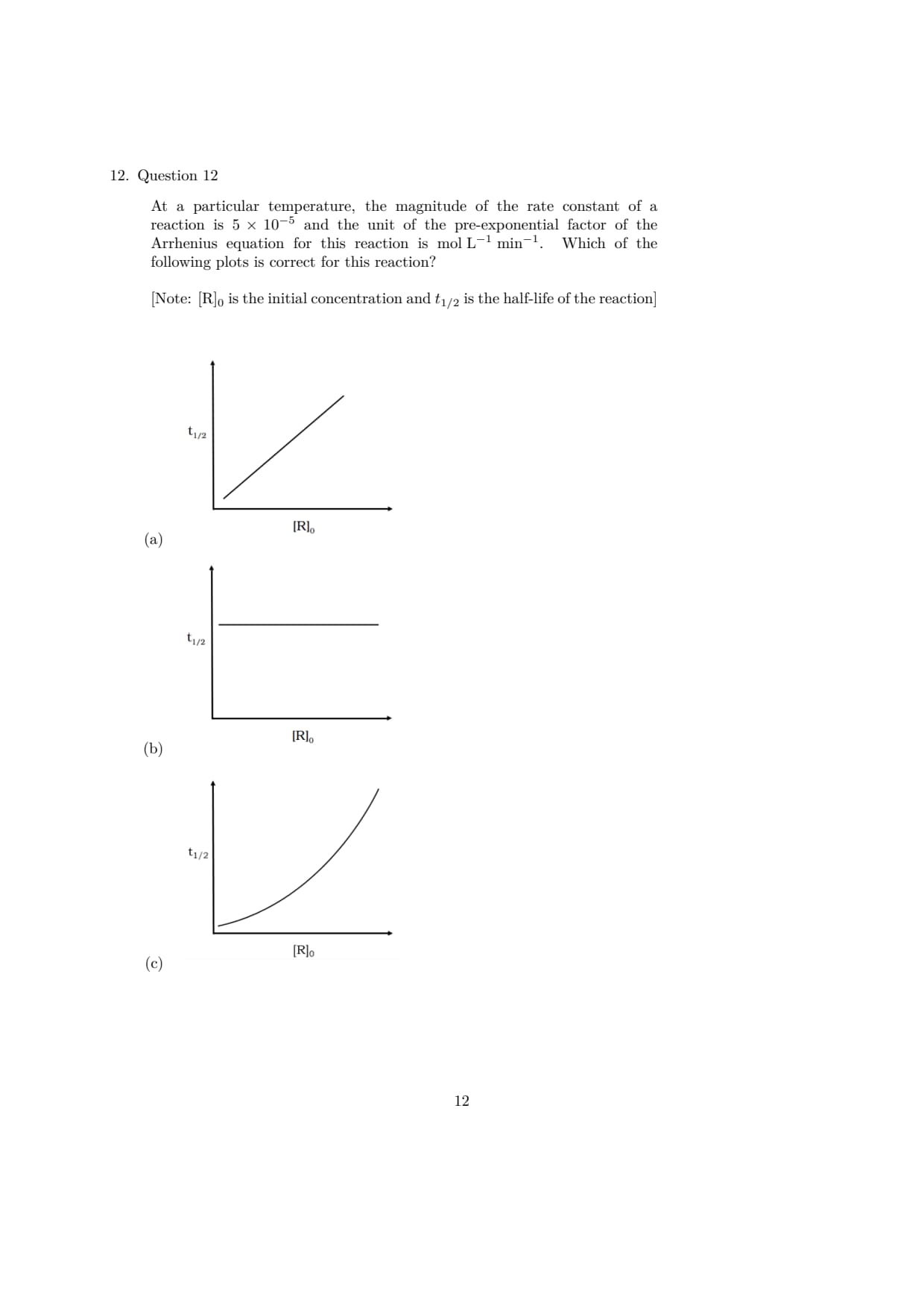
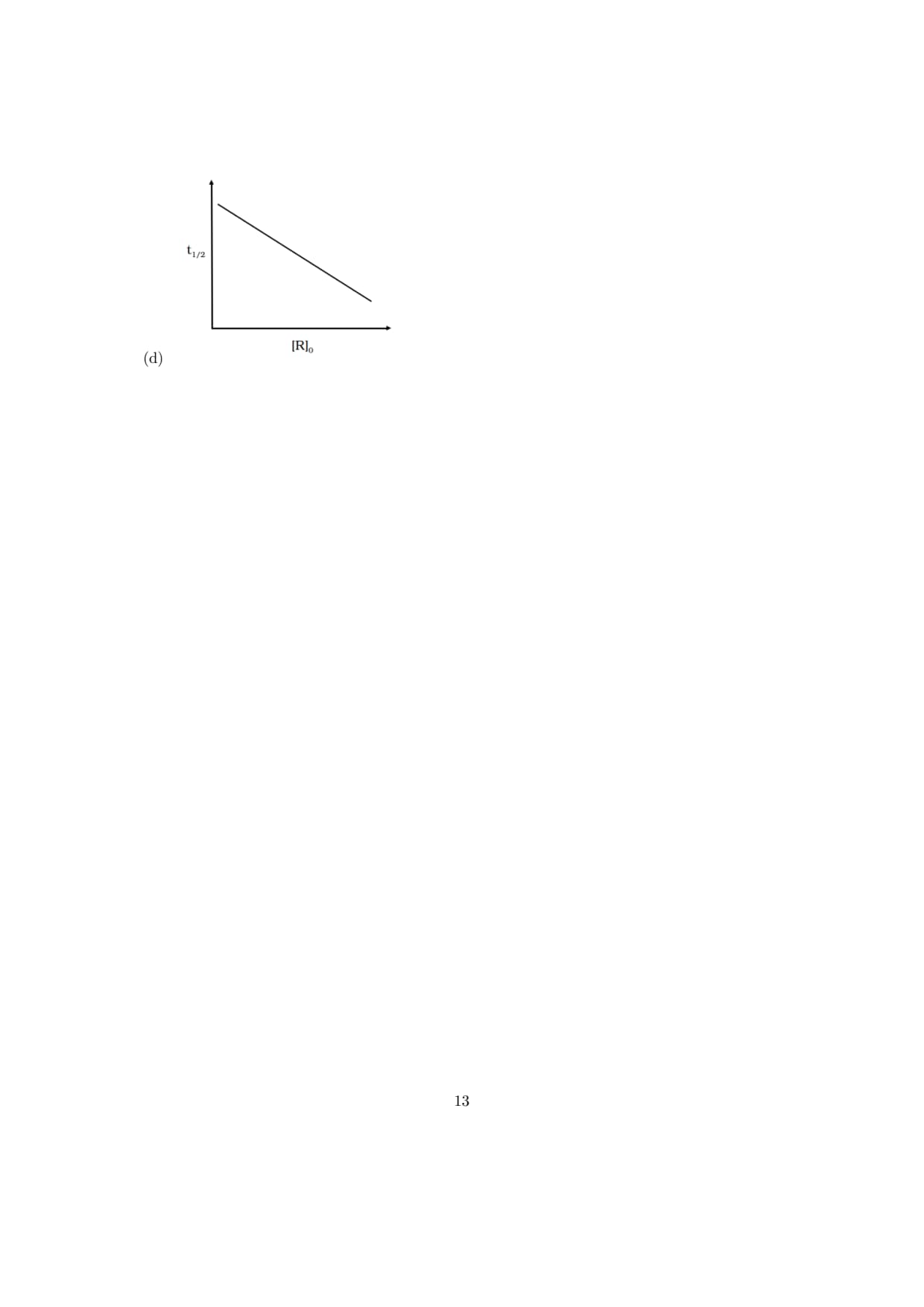
At a particular temperature, the magnitude of the rate constant of a reaction is \(5 \times 10^{-5}\) and the unit of the pre-exponential factor of the Arrhenius equation for this reaction is \(mol L^{-1} min^{-1}\). Which of the following plots is correct for this reaction?
[Note: \([R]_0\) is the initial concentration and \(t_{1/2}\) is the half-life of the reaction]
- (A)
![]()
- (B)
![]()
- (C)
![]()
- (D)
![]()


View Solution
Step 1 : Understanding the Question:
The question asks us to identify the correct plot of half-life (\(t_{1/2}\)) versus initial concentration (\([R]_0\)) based on the unit of the pre-exponential factor (\(A\)) in the Arrhenius equation.
Step 2 : Key Formulas and Approach:
The Arrhenius equation is:
\[ k = A e^{-E_a/RT} \]
Since the exponential term \(e^{-E_a/RT}\) is dimensionless, the unit of the pre-exponential factor \(A\) is identical to the unit of the rate constant \(k\).
We will determine the order of the reaction from the units of \(k\) and then apply the half-life equation for that order.
Step 3 : Detailed Explanation:
Determining Reaction Order:
The unit of \(A\) is given as \(mol L^{-1} min^{-1}\).
Thus, the unit of the rate constant \(k\) is also \(mol L^{-1} min^{-1}\).
The general unit for a rate constant of an \(n\)-th order reaction is:
\[ (mol L^{-1})^{1-n} time^{-1} \]
Comparing the units:
\[ 1 - n = 1 \implies n = 0 \]
This confirms the reaction is of zero order.
Half-Life of a Zero-Order Reaction:
For a zero-order reaction, the half-life (\(t_{1/2}\)) is given by the formula:
\[ t_{1/2} = \frac{[R]_0}{2k} \]
This represents a straight-line equation of the form \(y = mx\), where:
\[ y = t_{1/2}, \quad x = [R]_0, \quad and slope m = \frac{1}{2k} \]
Since \(k\) is positive, the slope is positive, meaning \(t_{1/2}\) increases linearly with \([R]_0\) starting from the origin.
Step 4 : Final Answer:
This linear relationship starting from the origin is correctly depicted in Plot (a).
This matches Option (A).
Quick Tip: Always check units first in chemical kinetics!
\(mol L^{-1} s^{-1}\) (or \(min^{-1}\)) belongs exclusively to a zero-order reaction.
For zero order, \(t_{1/2} \propto [R]_0\), which must be a straight line passing through the origin.
What is the time period of revolution of an electron in the fourth Bohr orbit of \(He^+\)?
(Bohr radius = 52.9 picometers, mass of an electron = \(9.11 \times 10^{-31} kg\), Planck’s constant = \(6.626 \times 10^{-34} Js\))
View Solution
Step 1 : Understanding the Question:
The question asks us to calculate the time period of revolution of an electron revolving in the fourth orbit (\(n=4\)) of a helium ion (\(He^+\), \(Z=2\)).
Step 2 : Key Formulas and Approach:
The time period of revolution (\(T\)) is the distance of one orbit divided by the velocity of the electron:
\[ T = \frac{2\pi r}{v} \]
According to Bohr's model:
\[ r_n = a_0 \frac{n^2}{Z} \quad and \quad v_n = v_0 \frac{Z}{n} \]
Thus, the time period \(T_n\) scales as:
\[ T_n \propto \frac{n^3}{Z^2} \]
The standard time period for the ground state of hydrogen (\(n=1\), \(Z=1\)) is:
\[ T_{H, 1} = \frac{2\pi a_0}{v_0} \approx 1.52 \times 10^{-16} s \]
Step 3 : Detailed Explanation:
Let us calculate \(T\) for \(n = 4\) and \(Z = 2\) (\(He^+\)):
\[ T = T_{H, 1} \times \frac{n^3}{Z^2} \]
Plugging in the values:
\[ T = (1.52 \times 10^{-16} s) \times \frac{4^3}{2^2} \]
\[ T = (1.52 \times 10^{-16} s) \times \frac{64}{4} \]
\[ T = (1.52 \times 10^{-16} s) \times 16 \]
\[ T = 2.432 \times 10^{-15} s \]
Since \(1 femtosecond (fs) = 10^{-15} s\), we have:
\[ T \approx 2.4 femtoseconds \]
Step 4 : Final Answer:
The time period of revolution of the electron is approximately 2.4 femtoseconds.
This corresponds to Option (A).
Quick Tip: Remember the scaling relation:
\[ T \propto \frac{n^3}{Z^2} \]
For \(n=4\) and \(Z=2\), the factor is \(\frac{64}{4} = 16\).
Multiplying the base ground-state hydrogen time period (\(1.5 \times 10^{-16} s\)) by 16 gives \(2.4 \times 10^{-15} s\) directly.
The dipole moments of three \(AB_3\)-type molecules I, II, and III are measured to be 0.0 D, 0.2 D, and 1.5 D, respectively. Which one of the following options is correct regarding the identity of I, II, and III?
View Solution
Step 1 : Understanding the Question:
The question asks us to identify three \(AB_3\)-type molecules based on their measured dipole moments: \(0.0 D\) (I), \(0.2 D\) (II), and \(1.5 D\) (III).
Step 2 : Key Formulas and Approach:
The dipole moment (\(\mu\)) depends on molecular geometry (VSEPR theory) and the electronegativity differences between the constituent atoms.
Symmetric molecules with no lone pairs have a net dipole moment of zero.
For pyramidal molecules, we compare the direction of the bond dipoles with the lone-pair orbital dipole.
Step 3 : Detailed Explanation:
Molecule I (\(\mu = 0.0 D\)):
\(BF_3\) has a symmetric, trigonal planar geometry (\(sp^2\) hybridized boron with no lone pairs).
The three polar \(B-F\) bond dipoles point toward the corners of an equilateral triangle and perfectly cancel each other out, resulting in a net dipole moment of zero.
Thus, Molecule I is \(BF_3\).
Comparing \(NH_3\) and \(NF_3\) (Molecules II and III):
Both molecules have a trigonal pyramidal geometry (\(sp^3\) hybridized central nitrogen with one lone pair).
In \(NH_3\), nitrogen is more electronegative than hydrogen.
The three \(N-H\) bond dipoles point toward the nitrogen atom (upward), acting in the same direction as the lone-pair orbital dipole. They reinforce each other, resulting in a high net dipole moment (\(\mu \approx 1.47 D \approx 1.5 D\)).
Thus, Molecule III is \(NH_3\).
In \(NF_3\), fluorine is more electronegative than nitrogen.
The three \(N-F\) bond dipoles point away from the nitrogen atom (downward), opposing the lone-pair orbital dipole. They partially cancel each other out, resulting in a very low net dipole moment (\(\mu \approx 0.23 D \approx 0.2 D\)).
Thus, Molecule II is \(NF_3\).
Step 4 : Final Answer:
The correct identities are: I: \(BF_3\), II: \(NF_3\), III: \(NH_3\).
This matches Option (A).
Quick Tip: The comparison between \(NH_3\) and \(NF_3\) is a classic concept.
In \(NH_3\), bond dipoles and lone-pair dipoles assist each other, whereas in \(NF_3\), they oppose each other, which reduces its dipole moment significantly down to \(0.2 D\).
During the charging and discharging of a lead-acid battery (a \(Pb\) anode, a grid of \(Pb\) packed with \(PbO_2\) as cathode, and an aqueous solution of \(H_2SO_4\) as an electrolyte), which of the following redox reactions does NOT occur?
View Solution
Step 1 : Understanding the Question:
The question asks us to identify which of the given redox half-reactions or overall reactions does not take place during the operation (either charging or discharging) of a lead-acid storage battery.
Step 2 : Key Formulas and Approach:
We will write down the chemical reactions that occur at both electrodes of the lead-acid battery during discharging and charging.
By tracking the oxidation states of lead (\(Pb\) in \(0\), \(+2\), and \(+4\) states), we can determine which electron transfer steps actually occur.
Step 3 : Detailed Explanation:
Let us analyze the chemistry of the lead-acid battery:
During Discharging (Galvanic Cell Mode):
At Anode (Oxidation): Metallic lead (\(Pb\)) is oxidized to lead(II) ions:
\[ Pb \, (s) + SO_4^{2-} \, (aq) \rightarrow PbSO_4 \, (s) + 2e^- \]
This corresponds to: \(Pb \rightarrow Pb^{2+} + 2e^-\) (Reaction C occurs).
At Cathode (Reduction): Lead dioxide (\(PbO_2\), where lead is in \(+4\) state) is reduced to lead(II) ions:
\[ PbO_2 \, (s) + SO_4^{2-} \, (aq) + 4H^+ \, (aq) + 2e^- \rightarrow PbSO_4 \, (s) + 2H_2O \]
This corresponds to the reduction: \(Pb^{4+} + 2e^- \rightarrow Pb^{2+}\).
During Charging (Electrolytic Cell Mode):
The reverse reactions occur under an applied external potential:
At anode: \(Pb^{2+} \rightarrow Pb^{4+} + 2e^-\) (Reaction B occurs).
At cathode: \(Pb^{2+} + 2e^- \rightarrow Pb^0\).
Net Cell Reaction of Charging:
If we combine both charging half-reactions, we obtain:
\[ 2Pb^{2+} \rightarrow Pb^{4+} + Pb \]
This is a disproportionation-like redox change, showing that Reaction D also occurs.
There is no step in either the charging or discharging process where \(Pb^{4+}\) (from \(PbO_2\)) is directly reduced to metallic \(Pb^0\) in a single 4-electron transfer step. Thus, Reaction (A) does not occur.
Step 4 : Final Answer:
The reaction \(Pb^{4+} + 4e^- \rightarrow Pb\) does not occur in a lead-acid battery.
This corresponds to Option (A).
Quick Tip: In both charging and discharging of a lead-acid battery, the stable end-product of both electrode reactions is always solid insoluble \(PbSO_4\) (where lead is in the \(+2\) state).
Therefore, only 2-electron transfer steps involving \(Pb^{0} \leftrightarrow Pb^{2+}\) and \(Pb^{2+} \leftrightarrow Pb^{4+}\) occur.
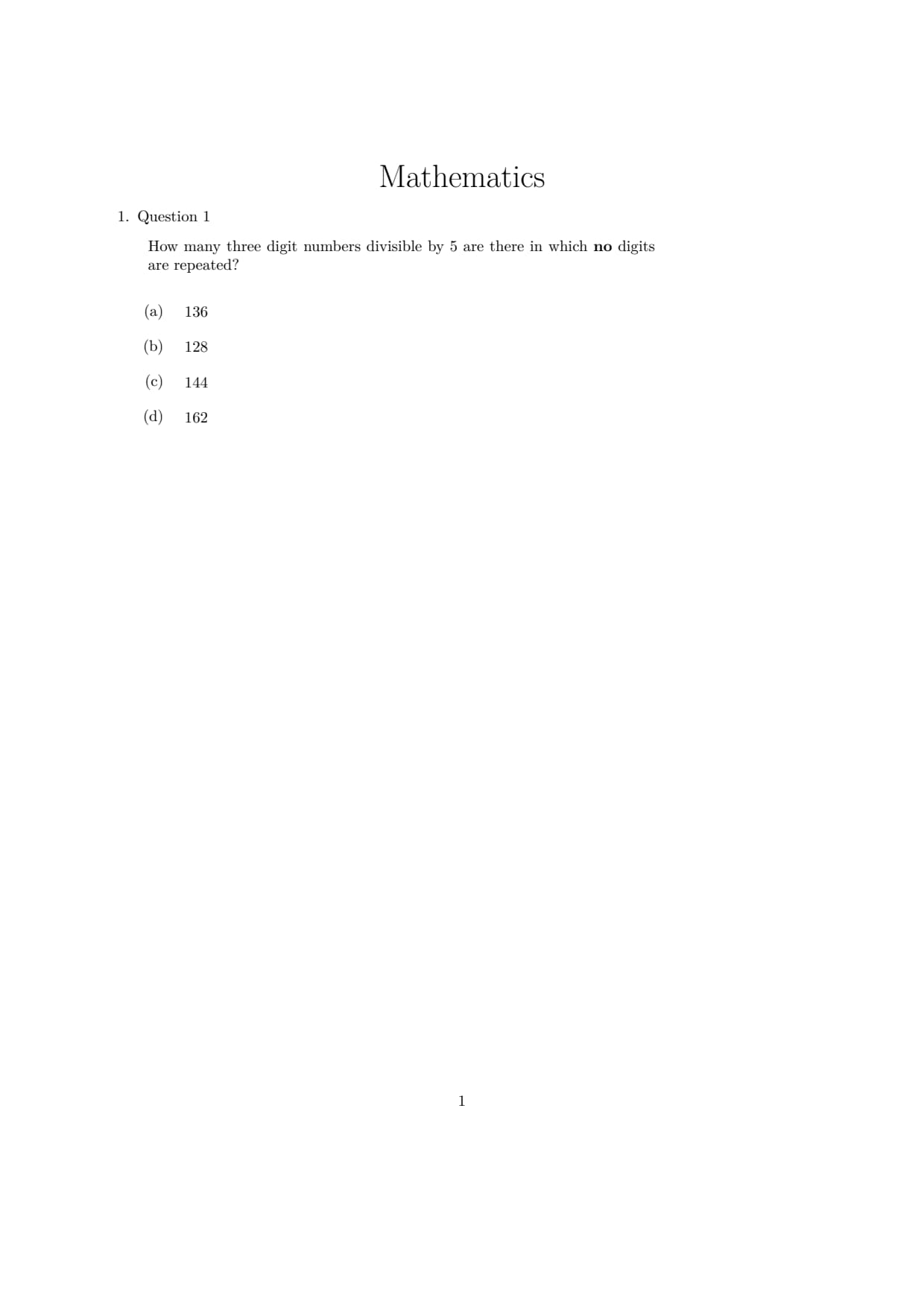
How many three digit numbers divisible by 5 are there in which no digits are repeated?
View Solution
Step 1 : Understanding the Question:
This question asks us to find the number of three-digit numbers divisible by 5 such that no digits are repeated.
Step 2 : Key Formulas and Approach:
A three-digit number can be represented as \(d_1d_2d_3\), where \(d_1 \in \{1, 2, \dots, 9\}\) and \(d_2, d_3 \in \{0, 1, \dots, 9\}\).
For a number to be divisible by 5, its units digit (\(d_3\)) must be either 0 or 5.
Since the digit 0 cannot occupy the hundreds place (\(d_1\)), we must analyze the two possible cases for \(d_3\) separately to avoid double-counting or invalid placements.
Step 3 : Detailed Explanation:
Let us divide the problem into two mutually exclusive cases:
Case 1: The units digit \(d_3\) is 0.
The units place is fixed as 0, which can be done in \(1\) way.
Since repetition is not allowed and 0 is already used, the hundreds place \(d_1\) can be filled with any of the remaining non-zero digits from \(\{1, 2, \dots, 9\}\). This gives \(9\) possible choices.
The tens place \(d_2\) can then be filled with any of the remaining \(8\) digits.
Number of ways for Case 1 = \(9 \times 8 \times 1 = 72\) ways.
Case 2: The units digit \(d_3\) is 5.
The units place is fixed as 5, which can be done in \(1\) way.
Since 5 is used, the hundreds place \(d_1\) can be filled with any non-zero digit except 5.
The available digits for \(d_1\) are \(\{1, 2, 3, 4, 6, 7, 8, 9\}\), which gives \(8\) choices.
The tens place \(d_2\) can be filled with any of the remaining digits, which now includes 0.
The total available digits are \(\{0, 1, 2, \dots, 9\}\) excluding 5 and whichever digit was placed in \(d_1\). This leaves \(10 - 2 = 8\) choices.
Number of ways for Case 2 = \(8 \times 8 \times 1 = 64\) ways.
Adding the possibilities from both cases gives:
\[ Total numbers = 72 + 64 = 136 \]
Step 4 : Final Answer:
The total number of such three-digit numbers is 136.
This corresponds to Option (A).
Quick Tip: Whenever the digit 0 is restricted from the first position and is also part of a divisibility condition, always split the counting into two scenarios: "ending in 0" and "ending in the non-zero option".
This prevents errors regarding the placement of 0 in the hundreds place.
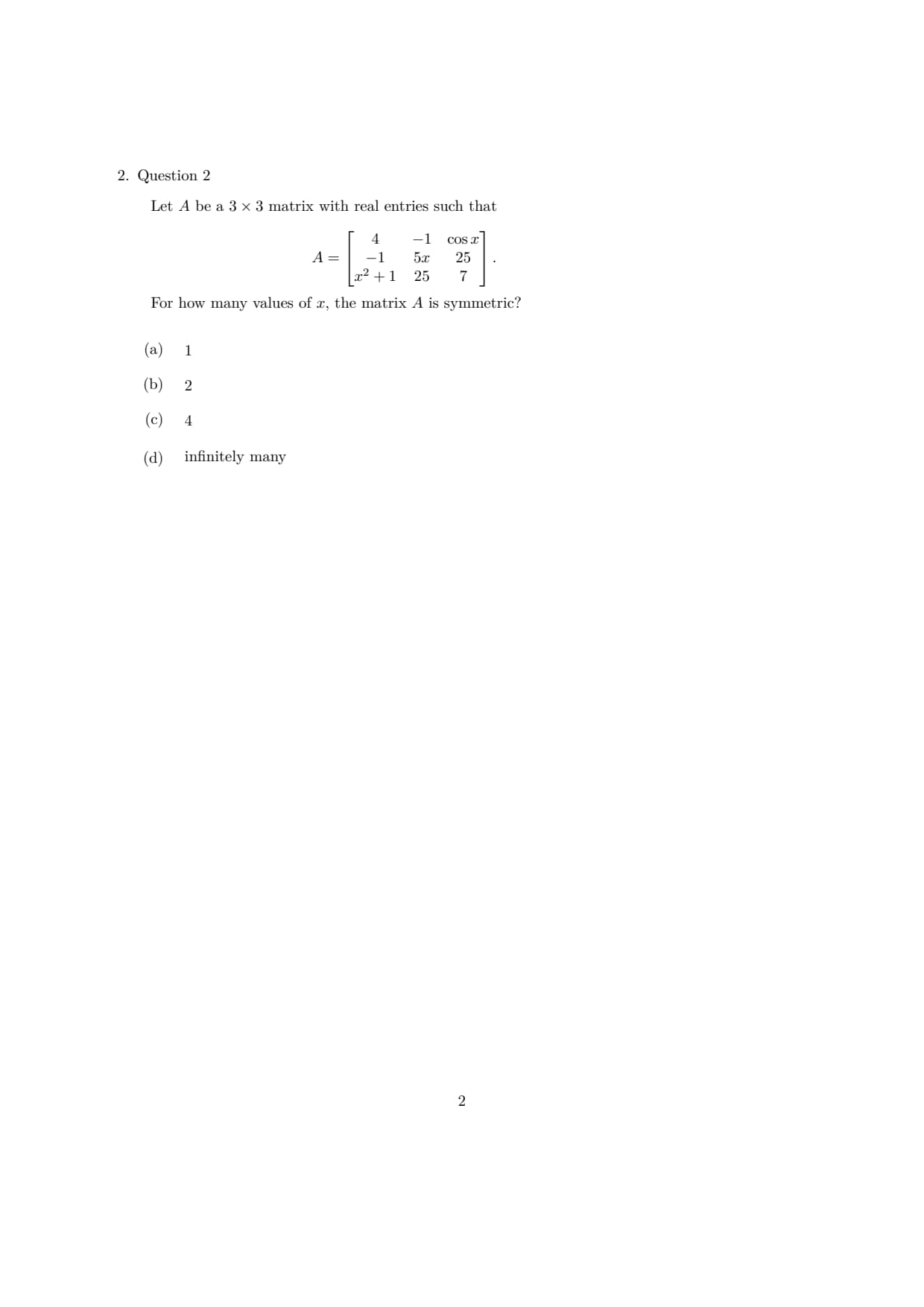
Let \(A\) be a \(3 \times 3\) matrix with real entries such that
\[ A = \begin{bmatrix} 4 & -1 & \cos x \\
-1 & 5x & 25 \\
x^2+1 & 25 & 7 \end{bmatrix} \]
For how many values of \(x\), the matrix \(A\) is symmetric?
View Solution
Step 1 : Understanding the Question:
The question asks to find the number of real values of \(x\) for which the given \(3 \times 3\) matrix \(A\) is symmetric.
Step 2 : Key Formulas and Approach:
A matrix \(A\) is symmetric if and only if it is equal to its transpose (\(A = A^T\)), which implies \(a_{ij} = a_{ji}\) for all indices \(i\) and \(j\).
We will set up the equality condition for the off-diagonal entries and solve the resulting transcendental equation.
Step 3 : Detailed Explanation:
Let us compare the symmetric entries \(a_{ij}\) and \(a_{ji}\) of the matrix \(A\):
\(a_{12} = -1\) and \(a_{21} = -1\) (already equal)
\(a_{23} = 25\) and \(a_{32} = 25\) (already equal)
\(a_{13} = \cos x\) and \(a_{31} = x^2 + 1\)
For \(A\) to be symmetric, we must have:
\[ \cos x = x^2 + 1 \]
Let us analyze the range of the functions on both sides of this equation:
For any real number \(x\), the range of the cosine function is:
\[ -1 \le \cos x \le 1 \]
For any real number \(x\), we know that \(x^2 \ge 0\). Adding 1 to both sides gives:
\[ x^2 + 1 \ge 1 \]
The only way for these two expressions to be equal is if both sides are simultaneously equal to \(1\):
\[ \cos x = 1 \quad and \quad x^2 + 1 = 1 \]
Solving the quadratic equation:
\[ x^2 = 0 \implies x = 0 \]
Let us verify if \(x = 0\) satisfies the first condition:
\[ \cos(0) = 1 \]
This is true. Thus, \(x = 0\) is the unique real solution to the equation.
Step 4 : Final Answer:
There is exactly 1 real value of \(x\) (\(x = 0\)) for which the matrix \(A\) is symmetric.
This corresponds to Option (A).
Quick Tip: Inequalities are powerful tools for solving transcendental equations.
Since \(\cos x \le 1\) and \(x^2 + 1 \ge 1\), the graphs of \(y = \cos x\) and \(y = x^2 + 1\) can only touch at their boundary value of \(1\), which immediately restricts the solution to \(x=0\).
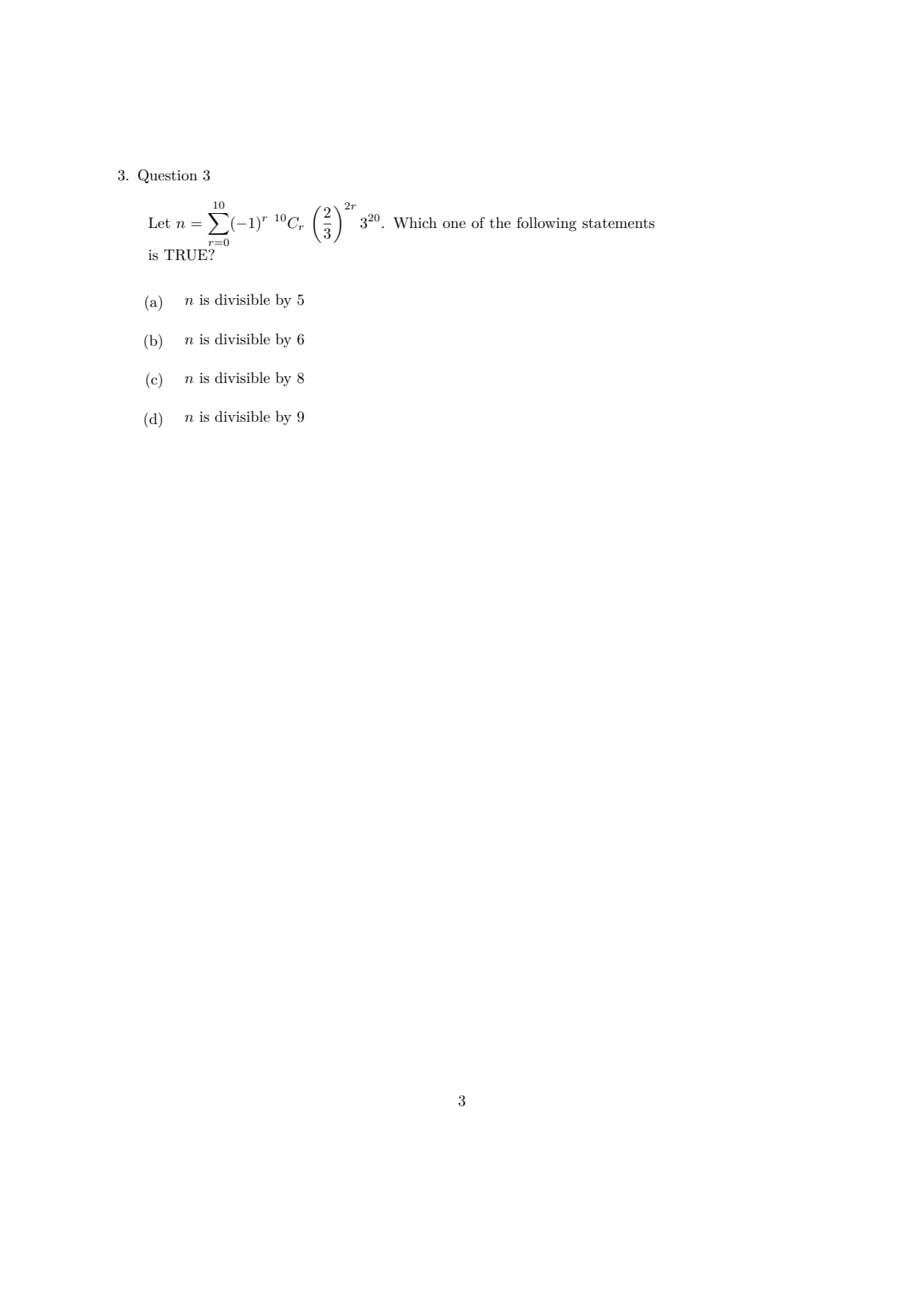
Let \(n = \sum_{r=0}^{10} (-1)^r \binom{10}{r} \left(\frac{2}{3}\right)^{2r} 3^{20}\). Which one of the following statements is TRUE?
View Solution
Step 1 : Understanding the Question:
The question asks to simplify a summation expression containing binomial coefficients and determine which of the given options correctly describes its divisibility.
Step 2 : Key Formulas and Approach:
The Binomial Theorem states that:
\[ (1 + x)^N = \sum_{r=0}^{N} \binom{N}{r} x^r \]
We will rewrite the terms inside the summation to match the binomial expansion formula, simplify the expression for \(n\), and test its divisibility.
Step 3 : Detailed Explanation:
Let us write down the given expression for \(n\):
\[ n = \sum_{r=0}^{10} (-1)^r \binom{10}{r} \left(\frac{2}{3}\right)^{2r} 3^{20} \]
We can simplify the term \(\left(\frac{2}{3}\right)^{2r}\):
\[ \left(\frac{2}{3}\right)^{2r} = \left[\left(\frac{2}{3}\right)^2\right]^r = \left(\frac{4}{9}\right)^r \]
Now, substitute this back into the expression:
\[ n = \sum_{r=0}^{10} \binom{10}{r} (-1)^r \left(\frac{4}{9}\right)^r 3^{20} \]
Since \(3^{20}\) is independent of the summation index \(r\), we can factor it outside the summation:
\[ n = 3^{20} \sum_{r=0}^{10} \binom{10}{r} \left(-\frac{4}{9}\right)^r \]
The summation term is exactly the binomial expansion of \((1 + x)^{10}\) with \(x = -\frac{4}{9}\):
\[ \sum_{r=0}^{10} \binom{10}{r} \left(-\frac{4}{9}\right)^r = \left(1 - \frac{4}{9}\right)^{10} = \left(\frac{5}{9}\right)^{10} \]
Substitute this back into the equation for \(n\):
\[ n = 3^{20} \cdot \left(\frac{5}{9}\right)^{10} \]
Expressing the denominator as a power of 3 (\(9^{10} = (3^2)^{10} = 3^{20}\)):
\[ n = 3^{20} \cdot \frac{5^{10}}{3^{20}} \]
The terms \(3^{20}\) cancel out, leaving:
\[ n = 5^{10} \]
Since \(n = 5^{10}\), it is clearly a power of 5, which means it is divisible by 5, but not by 6, 8, or 9.
Step 4 : Final Answer:
The simplified value of \(n\) is \(5^{10}\), which is divisible by 5.
This corresponds to Option (A).
Quick Tip: When dealing with summations involving \(\binom{N}{r}\), look to factor out terms independent of \(r\) first.
Matching the remaining terms to the binomial identity \((1+x)^N\) makes simplifying such expressions very straightforward.
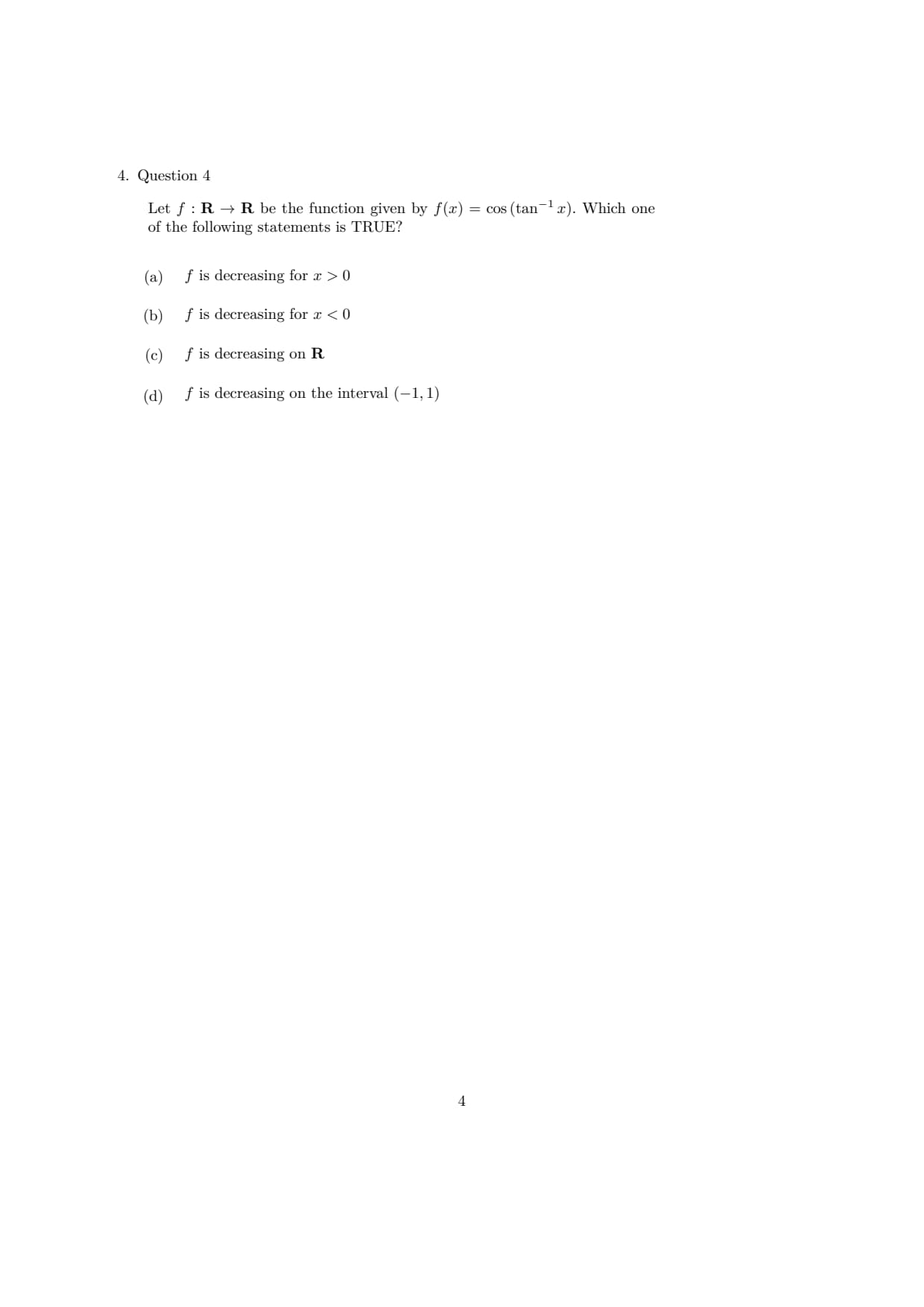
Let \(f : \mathbb{R} \rightarrow \mathbb{R}\) be the function given by \(f(x) = \cos(\tan^{-1} x)\). Which one of the following statements is TRUE?
View Solution
Step 1 : Understanding the Question:
The question asks us to identify the interval on which the composite trigonometric function \(f(x) = \cos(\tan^{-1} x)\) is decreasing.
Step 2 : Key Formulas and Approach:
We will first simplify the composite function \(f(x)\) into an algebraic form using trigonometric identities.
Then, we will compute the first derivative \(f'(x)\) and determine its sign on different intervals:
If \(f'(x) < 0\), the function is decreasing.
If \(f'(x) > 0\), the function is increasing.
Step 3 : Detailed Explanation:
Let us simplify \(f(x) = \cos(\tan^{-1} x)\):
Let \(\theta = \tan^{-1} x \implies \tan \theta = x\).
Since the range of \(\tan^{-1} x\) is \((-\frac{\pi}{2}, \frac{\pi}{2})\), \(\cos \theta\) is always positive.
Using the right-angled triangle relationship:
\[ \cos \theta = \frac{1}{\sec \theta} = \frac{1}{\sqrt{1 + \tan^2 \theta}} = \frac{1}{\sqrt{1 + x^2}} \]
Thus, we can write \(f(x)\) as:
\[ f(x) = (1 + x^2)^{-1/2} \]
Now, let us differentiate \(f(x)\) with respect to \(x\) using the chain rule:
\[ f'(x) = -\frac{1}{2}(1 + x^2)^{-3/2} \cdot \frac{d}{dx}(1 + x^2) \]
\[ f'(x) = -\frac{1}{2}(1 + x^2)^{-3/2} \cdot (2x) \]
\[ f'(x) = -\frac{x}{(1 + x^2)^{3/2}} \]
Let us analyze the sign of \(f'(x)\):
Since the denominator \((1 + x^2)^{3/2}\) is always positive for all real \(x\), the sign of \(f'(x)\) depends solely on the numerator \(-x\).
Case 1: \(x > 0\)
Here, \(-x < 0 \implies f'(x) < 0\).
Thus, \(f(x)\) is strictly decreasing for \(x > 0\).
Case 2: \(x < 0\)
Here, \(-x > 0 \implies f'(x) > 0\).
Thus, \(f(x)\) is strictly increasing for \(x < 0\).
Step 4 : Final Answer:
The function \(f(x)\) is decreasing for \(x > 0\).
This matches Option (A).
Quick Tip: An alternate graphical way is to recognize that \(f(x) = \frac{1}{\sqrt{1+x^2}}\) is an even function symmetric about the y-axis, with its maximum at \(x=0\).
As \(x\) moves away from 0 in the positive direction, the denominator increases, which means \(f(x)\) must decrease for \(x > 0\).
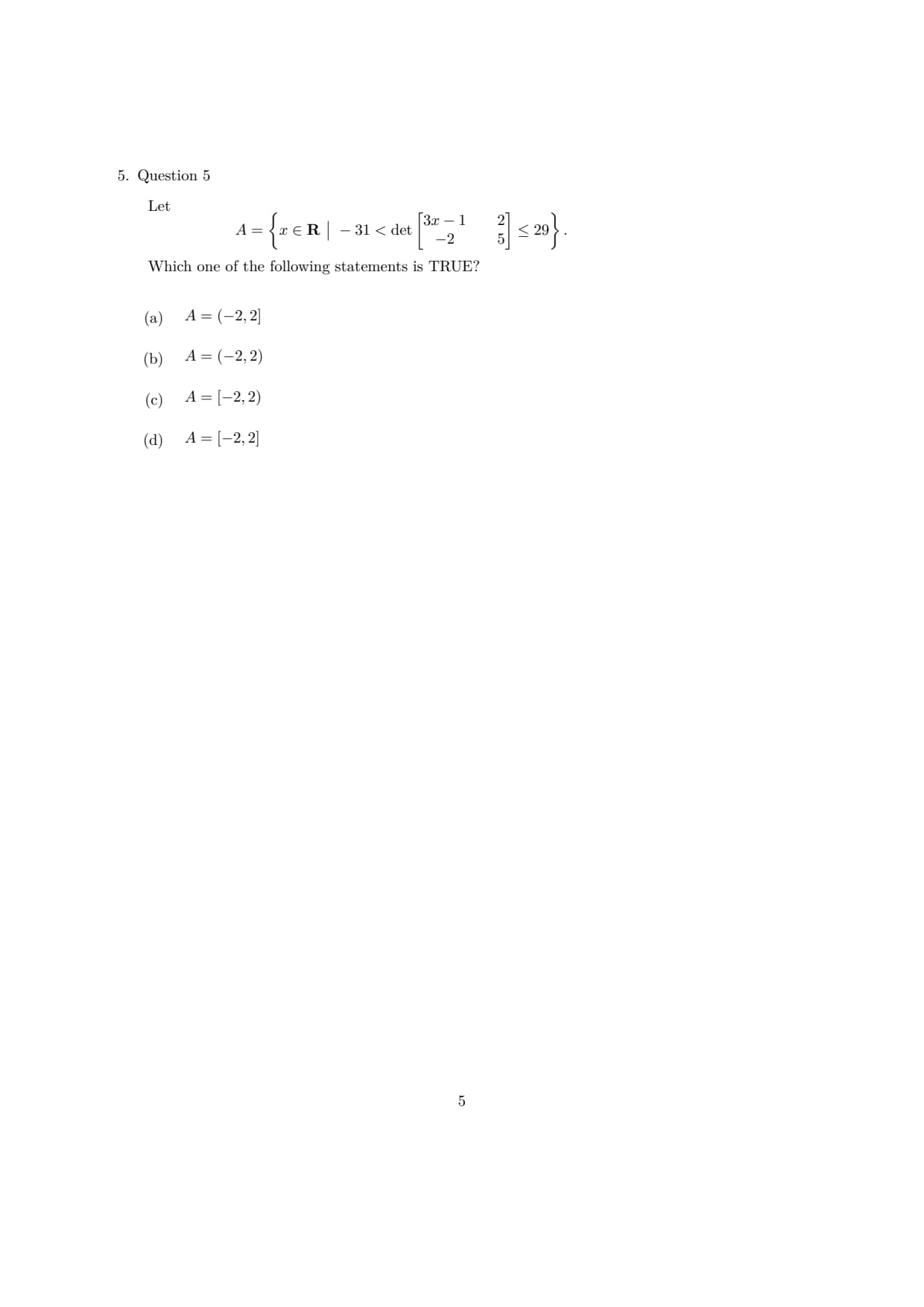
Let \(A = \left\{ x \in \mathbb{R} \;\middle|\; -31 < \det \begin{bmatrix} 3x - 1 & 2 \\
-2 & 5 \end{bmatrix} \le 29 \right\}\). Which one of the following statements is TRUE?
View Solution
Step 1 : Understanding the Question:
The question asks us to find the set of real numbers \(A\) defined by a double inequality involving the determinant of a \(2 \times 2\) matrix.
Step 2 : Key Formulas and Approach:
For a \(2 \times 2\) matrix, the determinant is calculated using the formula:
\[ \det \begin{bmatrix} a & b \\
c & d \end{bmatrix} = ad - bc \]
We will calculate the determinant in terms of \(x\), substitute it into the inequality \(-31 < \det(matrix) \le 29\), and solve for \(x\).
Step 3 : Detailed Explanation:
Let us calculate the determinant of the given matrix:
\[ D = \det \begin{bmatrix} 3x - 1 & 2 \\
-2 & 5 \end{bmatrix} \]
Applying the formula:
\[ D = (3x - 1)(5) - (2)(-2) \]
\[ D = 15x - 5 + 4 \]
\[ D = 15x - 1 \]
Now, substitute this expression into the inequality:
\[ -31 < 15x - 1 \le 29 \]
Let us add 1 to all parts of the inequality to isolate the term containing \(x\):
\[ -31 + 1 < 15x \le 29 + 1 \]
\[ -30 < 15x \le 30 \]
Now, divide all parts of the inequality by 15:
\[ -\frac{30}{15} < x \le \frac{30}{15} \]
\[ -2 < x \le 2 \]
Thus, the set \(A\) is the interval \((-2, 2]\).
Step 4 : Final Answer:
The set is \(A = (-2, 2]\).
This corresponds to Option (A).
Quick Tip: Pay close attention to the inequality symbols.
The strictly less than symbol (\(<\)) on the left corresponds to an open boundary (parenthesis '\((\)'), while the less than or equal to symbol (\(\le\)) on the right corresponds to a closed boundary (bracket '\(]\)').
Let \(z_1, z_2\), and \(z_3\) be complex numbers satisfying the following conditions:
\[ 2 = |2z_1| = |z_2 - 1| = |z_3 + 1| = \left| \frac{1}{z_1} + \frac{1}{z_2 - 1} + \frac{1}{z_3 + 1} \right| \]
What is the value of \(|4z_1 + z_2 + z_3|\)?
View Solution
Step 1 : Understanding the Question:
The question asks us to find the modulus of the complex expression \(|4z_1 + z_2 + z_3|\) given the moduli of individual terms and the modulus of the sum of their reciprocals.
Step 2 : Key Formulas and Approach:
For any complex number \(w\), we have the property:
\[ |w|^2 = w \bar{w} \implies \frac{1}{w} = \frac{\bar{w}}{|w|^2} \]
We will use this identity to rewrite the reciprocals of the complex terms in the given equation and then simplify the resulting expression.
Step 3 : Detailed Explanation:
Let us analyze the individual given moduli first:
\(|2z_1| = 2 \implies |z_1| = 1 \implies |z_1|^2 = 1\)
\(|z_2 - 1| = 2 \implies |z_2 - 1|^2 = 4\)
\(|z_3 + 1| = 2 \implies |z_3 + 1|^2 = 4\)
Using the reciprocal property \(\frac{1}{w} = \frac{\bar{w}}{|w|^2}\) for each term:
For \(z_1\):
\[ \frac{1}{z_1} = \frac{\bar{z}_1}{|z_1|^2} = \bar{z}_1 \]
For \(z_2 - 1\):
\[ \frac{1}{z_2 - 1} = \frac{\bar{z}_2 - 1}{|z_2 - 1|^2} = \frac{\bar{z}_2 - 1}{4} \]
For \(z_3 + 1\):
\[ \frac{1}{z_3 + 1} = \frac{\bar{z}_3 + 1}{|z_3 + 1|^2} = \frac{\bar{z}_3 + 1}{4} \]
Substitute these expressions into the given sum modulus equation:
\[ \left| \frac{1}{z_1} + \frac{1}{z_2 - 1} + \frac{1}{z_3 + 1} \right| = 2 \]
\[ \left| \bar{z}_1 + \frac{\bar{z}_2 - 1}{4} + \frac{\bar{z}_3 + 1}{4} \right| = 2 \]
Let us factor out \(\frac{1}{4}\) from the expression inside the modulus:
\[ \left| \frac{4\bar{z}_1 + (\bar{z}_2 - 1) + (\bar{z}_3 + 1)}{4} \right| = 2 \]
Using the property \(|k w| = |k||w|\):
\[ \frac{1}{4} \left| 4\bar{z}_1 + \bar{z}_2 + \bar{z}_3 \right| = 2 \]
\[ \left| \overline{4z_1 + z_2 + z_3} \right| = 8 \]
Since the modulus of a complex conjugate is equal to the modulus of the complex number itself (\(|\bar{u}| = |u|\)):
\[ |4z_1 + z_2 + z_3| = 8 \]
Step 4 : Final Answer:
The value of \(|4z_1 + z_2 + z_3|\) is 8.
This matches Option (A).
Quick Tip: For any complex equation involving sums of reciprocals \(\frac{1}{w}\), always think of substituting \(\frac{1}{w} = \frac{\bar{w}}{|w|^2}\).
This is a standard technique that converts reciprocals into direct linear terms of conjugates, which are much easier to simplify.
Let \(f : \mathbb{R} \rightarrow \mathbb{R}\) be defined as \(f(x) = |x^3 - 3x|[x]\), where \([x]\) denotes the greatest integer less than or equal to \(x\). Which one of the following statements is TRUE?
View Solution
Step 1 : Understanding the Question:
The question asks us to identify the points of discontinuity of the function \(f(x) = |x^3 - 3x|[x]\).
Step 2 : Key Formulas and Approach:
The function is a product of \(g(x) = |x^3 - 3x|\) (which is continuous everywhere on \(\mathbb{R}\)) and the step function \([x]\) (which is continuous everywhere except at integer values \(x = k \in \mathbb{Z}\)).
We will evaluate the left-hand limit (LHL) and right-hand limit (RHL) at any integer point \(x = k\) to determine whether the function is continuous at that point.
Step 3 : Detailed Explanation:
Let us test the continuity of \(f(x)\) at an arbitrary integer \(x = k \in \mathbb{Z}\):
Left-Hand Limit (LHL):
As \(x \to k^-\), the value of \([x] \to k - 1\). Since \(g(x)\) is continuous:
\[ \lim_{x \to k^-} f(x) = |k^3 - 3k|(k - 1) \]
Right-Hand Limit (RHL):
As \(x \to k^+\), the value of \([x] \to k\). Thus:
\[ \lim_{x \to k^+} f(x) = |k^3 - 3k|k \]
Function Value:
The value of the function at \(x = k\) is:
\[ f(k) = |k^3 - 3k|k \]
For \(f(x)\) to be continuous at \(x = k\), we must have \(LHL = RHL\):
\[ |k^3 - 3k|(k - 1) = |k^3 - 3k|k \]
\[ |k^3 - 3k| \left[ k - (k - 1) \right] = 0 \]
\[ |k^3 - 3k| = 0 \]
This equation is satisfied only when:
\[ k(k^2 - 3) = 0 \implies k = 0 \quad or \quad k = \pm\sqrt{3} \]
Since \(k\) must be an integer, the only valid integer solution is \(k = 0\) (as \(\pm\sqrt{3}\) are irrational).
Let us verify continuity at \(x = 0\):
\[ LHL = |0|(0 - 1) = 0 \]
\[ RHL = |0|(0) = 0 \]
Since \(LHL = RHL = f(0) = 0\), the function is continuous at \(x = 0\).
For any other integer \(k \neq 0\), \(|k^3 - 3k| \neq 0\), meaning \(LHL \neq RHL\).
Thus, \(f(x)\) is discontinuous at all non-zero integers.
Step 4 : Final Answer:
Every non-zero integer is a point of discontinuity of \(f\).
This corresponds to Option (A).
Quick Tip: A product of a continuous function \(g(x)\) and a step function \(h(x)\) (discontinuous at \(x=k\)) is continuous at \(x=k\) if and only if \(g(k) = 0\).
Here, \(x^3 - 3x = 0\) at integer \(x = 0\), making it the only integer where the discontinuity of \([x]\) is resolved.
Let \(\ell\) be the tangent line to the ellipse \(x^2 + 16y^2 = 4\) at \(\left(1, \frac{\sqrt{3}}{4}\right)\). What is the equation of the line perpendicular to \(\ell\) passing through \((2, 0)\)?
View Solution
Step 1 : Understanding the Question:
The question asks us to find the equation of a line perpendicular to the tangent line of the given ellipse at a specific point, passing through \((2, 0)\).
Step 2 : Key Formulas and Approach:
We will find the slope of the tangent line (\(m_{tangent}\)) by differentiating the equation of the ellipse \(x^2 + 16y^2 = 4\).
The slope of the perpendicular line (\(m_{perp}\)) is given by the relation:
\[ m_{perp} = -\frac{1}{m_{tangent}} \]
We will write the equation of the line using the point-slope form:
\[ y - y_1 = m_{perp}(x - x_1) \]
Step 3 : Detailed Explanation:
Let us differentiate the equation of the ellipse \(x^2 + 16y^2 = 4\) implicitly with respect to \(x\):
\[ \frac{d}{dx}(x^2) + \frac{d}{dx}(16y^2) = \frac{d}{dx}(4) \]
\[ 2x + 32y \frac{dy}{dx} = 0 \]
\[ \frac{dy}{dx} = -\frac{2x}{32y} = -\frac{x}{16y} \]
Now, let us find the slope of the tangent line at the point \(\left(1, \frac{\sqrt{3}}{4}\right)\):
\[ m_{tangent} = \left. \frac{dy}{dx} \right|_{\left(1, \frac{\sqrt{3}}{4}\right)} = -\frac{1}{16 \left(\frac{\sqrt{3}}{4}\right)} = -\frac{1}{4\sqrt{3}} \]
The slope of the line perpendicular to this tangent is:
\[ m_{perp} = -\frac{1}{m_{tangent}} = -\frac{1}{-\frac{1}{4\sqrt{3}}} = 4\sqrt{3} \]
Using the point-slope form for a line passing through \((2, 0)\) with slope \(4\sqrt{3}\):
\[ y - 0 = 4\sqrt{3}(x - 2) \]
\[ y = 4\sqrt{3}(x - 2) \]
Step 4 : Final Answer:
The equation of the perpendicular line is \(y = 4\sqrt{3}(x - 2)\).
This corresponds to Option (A).
Quick Tip: For any curve \(f(x, y) = c\), the slope of the normal (which is perpendicular to the tangent) at \((x_1, y_1)\) is simply:
\[ m_{normal} = \frac{\partial f / \partial y}{\partial f / \partial x} \]
Evaluating at \(\left(1, \frac{\sqrt{3}}{4}\right)\) gives \(\frac{32y}{2x} = 16 \left(\frac{\sqrt{3}}{4}\right) = 4\sqrt{3}\) directly.
Let \(\vec{a}\) and \(\vec{b}\) be two vectors such that \(|\vec{a} + \vec{b}| = 15\) and
\( \vec{a} \times (3\hat{i} - 4\hat{j} + 5\hat{k}) = (3\hat{i} - 4\hat{j} + 5\hat{k}) \times \vec{b} \)
What is the value of \(|(\vec{a} + \vec{b}) \cdot (2\hat{i} + 3\hat{j} + \hat{k})|\)?
View Solution
Step 1 : Understanding the Question:
The question asks us to compute the absolute value of the dot product of the vector sum \((\vec{a} + \vec{b})\) with the vector \((2\hat{i} + 3\hat{j} + \hat{k})\), based on a given cross-product relation.
Step 2 : Key Formulas and Approach:
Let \(\vec{c} = 3\hat{i} - 4\hat{j} + 5\hat{k}\).
The given equation is \(\vec{a} \times \vec{c} = \vec{c} \times \vec{b}\).
Using the anticommutative property of the cross product (\(\vec{c} \times \vec{b} = -\vec{b} \times \vec{c}\)), we will rewrite this as a single cross-product equation.
This will show that \((\vec{a} + \vec{b})\) is collinear (parallel) to \(\vec{c}\), allowing us to express it as \(\lambda \vec{c}\).
Step 3 : Detailed Explanation:
Let us simplify the cross-product relation:
\[ \vec{a} \times \vec{c} = -\vec{b} \times \vec{c} \]
\[ \vec{a} \times \vec{c} + \vec{b} \times \vec{c} = \vec{0} \]
\[ (\vec{a} + \vec{b}) \times \vec{c} = \vec{0} \]
Since the cross product of \((\vec{a} + \vec{b})\) and \(\vec{c}\) is the zero vector, they must be parallel:
\[ \vec{a} + \vec{b} = \lambda \vec{c} \]
where \(\lambda\) is a real scalar.
Let us find \(|\lambda|\) using the given modulus \(|\vec{a} + \vec{b}| = 15\):
\[ |\vec{a} + \vec{b}| = |\lambda \vec{c}| = |\lambda| |\vec{c}| \]
First, calculate \(|\vec{c}|\):
\[ |\vec{c}| = \sqrt{3^2 + (-4)^2 + 5^2} = \sqrt{9 + 16 + 25} = \sqrt{50} = 5\sqrt{2} \]
Now, substitute this into the modulus equation:
\[ 15 = |\lambda| \cdot 5\sqrt{2} \implies |\lambda| = \frac{15}{5\sqrt{2}} = \frac{3}{\sqrt{2}} \]
Let \(\vec{d} = 2\hat{i} + 3\hat{j} + \hat{k}\). We want to evaluate:
\[ |(\vec{a} + \vec{b}) \cdot \vec{d}| = |\lambda \vec{c} \cdot \vec{d}| = |\lambda| |\vec{c} \cdot \vec{d}| \]
Let us calculate the dot product \(\vec{c} \cdot \vec{d}\):
\[ \vec{c} \cdot \vec{d} = (3\hat{i} - 4\hat{j} + 5\hat{k}) \cdot (2\hat{i} + 3\hat{j} + \hat{k}) \]
\[ \vec{c} \cdot \vec{d} = 3(2) + (-4)(3) + 5(1) \]
\[ \vec{c} \cdot \vec{d} = 6 - 12 + 5 = -1 \]
Now substitute the values back:
\[ |(\vec{a} + \vec{b}) \cdot \vec{d}| = \frac{3}{\sqrt{2}} \times |-1| = \frac{3}{\sqrt{2}} \]
Step 4 : Final Answer:
The value of the expression is \(\frac{3}{\sqrt{2}}\).
This corresponds to Option (A).
Quick Tip: Whenever you see \(\vec{u} \times \vec{w} = \vec{w} \times \vec{v}\), immediately rewrite it as \((\vec{u} + \vec{v}) \times \vec{w} = \vec{0}\).
This geometric identity instantly shows that the sum vector \((\vec{u} + \vec{v})\) is parallel to \(\vec{w}\).
What is the derivative of \(\log(\sin^2 x)\) with respect to \(\sin x\)?
View Solution
Step 1 : Understanding the Question:
The question asks us to compute the derivative of the function \(f(x) = \log(\sin^2 x)\) with respect to another function \(g(x) = \sin x\).
Step 2 : Key Formulas and Approach:
For finding the derivative of a function \(u\) with respect to another variable \(v\), we use the change of variable method.
Let \(u = \sin x\). We can express \(\log(\sin^2 x)\) in terms of \(u\) and then differentiate directly with respect to \(u\):
\[ \frac{d}{du}[\log(u^2)] \]
Step 3 : Detailed Explanation:
Let us define the variable:
\[ u = \sin x \]
We want to find:
\[ \frac{d}{du} \left[ \log(\sin^2 x) \right] \]
Substitute \(\sin x = u\) into the expression:
\[ \log(\sin^2 x) = \log(u^2) \]
Using the logarithmic power property \(\log(a^b) = b \log a\):
\[ \log(u^2) = 2 \log u \]
Now, differentiate \(2 \log u\) with respect to \(u\):
\[ \frac{d}{du}(2 \log u) = \frac{2}{u} \]
Now substitute \(u = \sin x\) back into the result:
\[ \frac{2}{\sin x} = 2 \csc x \]
Step 4 : Final Answer:
The derivative with respect to \(\sin x\) is \(2\csc x\).
This corresponds to Option (A).
Quick Tip: For any derivative of \(f(g(x))\) with respect to \(g(x)\), you can treat \(g(x)\) as a single variable \(u\).
This simplifies the problem into a simple single-variable derivative \(\frac{d}{du}[f(u)]\), completely avoiding the need for complex chain-rule steps.
Let \(S_n\) denote the sum of the first \(n\) terms of a sequence \(a_1, a_2, a_3, \dots\). If \(S_{n+3} - S_n = 13n + 7\) for all \(n\), what is the value of \(a_{13} - a_{10}\)?
View Solution
Step 1 : Understanding the Question:
The question asks us to find the difference between two specific terms of a sequence, \(a_{13} - a_{10}\), using a given relation for the difference of partial sums \(S_{n+3} - S_n\).
Step 2 : Key Formulas and Approach:
The sum of the first \(n\) terms is \(S_n = a_1 + a_2 + \dots + a_n\).
The difference \(S_{n+3} - S_n\) represents the sum of the three consecutive terms following \(a_n\):
\[ S_{n+3} - S_n = a_{n+1} + a_{n+2} + a_{n+3} \]
We will evaluate this equation for two consecutive values of \(n\) to isolate the difference \(a_{13} - a_{10}\).
Step 3 : Detailed Explanation:
Let us write down the relation:
\[ a_{n+1} + a_{n+2} + a_{n+3} = 13n + 7 \]
We want to find \(a_{13} - a_{10}\). Let us choose two values of \(n\) that contain these terms:
For \(n = 10\):
The terms are \(a_{11}\), \(a_{12}\), and \(a_{13}\). The equation becomes:
\[ a_{11} + a_{12} + a_{13} = 13(10) + 7 \]
\[ a_{11} + a_{12} + a_{13} = 137 \quad --- (Equation 1) \]
For \(n = 9\):
The terms are \(a_{10}\), \(a_{11}\), and \(a_{12}\). The equation becomes:
\[ a_{10} + a_{11} + a_{12} = 13(9) + 7 \]
\[ a_{10} + a_{11} + a_{12} = 124 \quad --- (Equation 2) \]
Now, let us subtract Equation 2 from Equation 1:
\[ (a_{11} + a_{12} + a_{13}) - (a_{10} + a_{11} + a_{12}) = 137 - 124 \]
Notice that the common terms \(a_{11}\) and \(a_{12}\) cancel out:
\[ a_{13} - a_{10} = 13 \]
Step 4 : Final Answer:
The value of \(a_{13} - a_{10}\) is 13.
This corresponds to Option (A).
Quick Tip: To find the difference between terms separated by a gap of \(d\), evaluate the sum-term relation at \(n\) and \(n-1\).
The intermediate terms will cancel out, leaving the direct difference of interest:
\[ (S_{n+3} - S_n) - (S_{n+2} - S_{n-1}) = a_{n+3} - a_n \]
Five fair coins are tossed independently. What is the probability that at least two heads appear?
View Solution
Step 1 : Understanding the Question:
The question asks us to calculate the probability of getting at least two heads when five fair coins are tossed independently.
Step 2 : Key Formulas and Approach:
The number of heads (\(X\)) obtained in \(N\) independent coin tosses follows a Binomial Distribution:
\[ P(X = r) = \binom{N}{r} p^r (1-p)^{N-r} \]
Here, \(N = 5\) and \(p = \frac{1}{2}\) (for a fair coin).
Using the complement rule is much faster:
\[ P(X \ge 2) = 1 - P(X < 2) = 1 - [P(X = 0) + P(X = 1)] \]
Step 3 : Detailed Explanation:
Let us calculate the individual probabilities for the complementary events:
Probability of 0 heads (\(P(X = 0)\)):
\[ P(X = 0) = \binom{5}{0} \left(\frac{1}{2}\right)^5 = 1 \times \frac{1}{32} = \frac{1}{32} \]
Probability of 1 head (\(P(X = 1)\)):
\[ P(X = 1) = \binom{5}{1} \left(\frac{1}{2}\right)^1 \left(\frac{1}{2}\right)^4 = 5 \times \frac{1}{32} = \frac{5}{32} \]
Now, sum the probabilities of the complementary events:
\[ P(X < 2) = P(X = 0) + P(X = 1) = \frac{1}{32} + \frac{5}{32} = \frac{6}{32} = \frac{3}{16} \]
Apply the complement formula to find the probability of getting at least 2 heads:
\[ P(X \ge 2) = 1 - P(X < 2) = 1 - \frac{3}{16} = \frac{13}{16} \]
Step 4 : Final Answer:
The probability that at least two heads appear is \(\frac{13}{16}\).
This corresponds to Option (A).
Quick Tip: For "at least" probability questions, always consider the complement.
Calculating \(1 - [P(0) + P(1)]\) requires only two quick binomial computations, whereas direct calculation of \(P(2) + P(3) + P(4) + P(5)\) requires four, saving valuable time.
Let \(f : \mathbb{R} \rightarrow \mathbb{R}\) be the function defined by
\[ f(x) = \begin{cases} x^2 - 4x - 5 & if x \ge 1
2x & if x < 1 \end{cases} \]
Which one of the following statements is TRUE?
View Solution
Step 1 : Understanding the Question:
The question asks us to analyze the given piecewise function \(f(x)\) and determine whether it is one-one (injective) and/or onto (surjective).
Step 2 : Key Formulas and Approach:
One-One (Injective): A function is one-one if \(f(a) = f(b) \implies a = b\). Geometrically, any horizontal line must cross the graph at most once.
Onto (Surjective): A function is onto if its Range is equal to the Codomain (\(\mathbb{R}\)).
We will analyze the range and behavior of \(f(x)\) on both intervals.
Step 3 : Detailed Explanation:
Let us examine the two parts of the piecewise function:
Part 1: \(x < 1\)
Here, \(f(x) = 2x\).
Since \(x < 1\), the values of \(f(x)\) lie in the range:
\[ Range_1 = (-\infty, 2) \]
This function is strictly increasing since the derivative is \(2 > 0\).
Part 2: \(x \ge 1\)
Here, \(f(x) = x^2 - 4x - 5\).
We can rewrite this by completing the square:
\[ f(x) = (x - 2)^2 - 9 \]
This is a parabola opening upwards with its vertex at \((2, -9)\).
Since the domain for this part is \(x \ge 1\):
At \(x = 1\), \(f(1) = 1 - 4 - 5 = -8\).
At the vertex \(x = 2\), it reaches its minimum value: \(f(2) = -9\).
As \(x \to \infty\), \(f(x) \to \infty\).
Thus, the range of this quadratic part is:
\[ Range_2 = [-9, \infty) \]
Let us evaluate onto-ness and one-one-ness:
Onto-ness:
The total range of \(f(x)\) is the union of the ranges of the two parts:
\[ Range = Range_1 \cup Range_2 = (-\infty, 2) \cup [-9, \infty) = (-\infty, \infty) = \mathbb{R} \]
Since the Range is equal to the Codomain (\(\mathbb{R}\)), the function is onto.
One-one-ness:
Let us check if multiple values of \(x\) map to the same value \(y = 0\):
From Part 1 (\(x < 1\)): \(2x = 0 \implies x = 0\) (which is \(< 1\), so it is a valid input).
From Part 2 (\(x \ge 1\)): \(x^2 - 4x - 5 = 0 \implies (x-5)(x+1) = 0 \implies x = 5\) (which is \(\ge 1\), so it is a valid input).
Since \(f(0) = 0\) and \(f(5) = 0\) but \(0 \neq 5\), the function is not one-one.
Step 4 : Final Answer:
The function \(f(x)\) is onto but not one-one.
This corresponds to Option (A).
Quick Tip: If the ranges of two continuous parts of a piecewise function overlap heavily (here, \((-\infty, 2)\) and \([-9, \infty)\) overlap on \([-9, 2)\)), the function will fail the horizontal line test and will not be one-one.
Which one of the following is the solution of the differential equation
\[ x^2 \frac{dy}{dx} + 9xy = x^4 \quad (for x > 0) \]
given that \(y = 0\) when \(x = 1\)?
View Solution
Step 1 : Understanding the Question:
The question asks us to find the particular solution to the given first-order linear differential equation under the initial condition \(y(1) = 0\).
Step 2 : Key Formulas and Approach:
A first-order linear differential equation in standard form is:
\[ \frac{dy}{dx} + P(x)y = Q(x) \]
We solve this using the Integrating Factor (I.F.) method:
\[ I.F. = e^{\int P(x) \, dx} \]
The general solution is then given by:
\[ y \cdot (I.F.) = \int Q(x) \cdot (I.F.) \, dx + C \]
Step 3 : Detailed Explanation:
Let us divide the given equation by \(x^2\) (since \(x > 0\)) to bring it into the standard form:
\[ \frac{dy}{dx} + \frac{9}{x}y = x^2 \]
Here, \(P(x) = \frac{9}{x}\) and \(Q(x) = x^2\).
Let us calculate the Integrating Factor (I.F.):
\[ I.F. = e^{\int \frac{9}{x} \, dx} = e^{9 \ln x} = e^{\ln x^9} = x^9 \]
Now, write the general solution:
\[ y \cdot x^9 = \int x^2 \cdot x^9 \, dx + C \]
\[ y \cdot x^9 = \int x^{11} \, dx + C \]
\[ y \cdot x^9 = \frac{x^{12}}{12} + C \]
Now, let us apply the initial condition \(y = 0\) when \(x = 1\):
\[ 0 \cdot (1)^9 = \frac{1^{12}}{12} + C \implies C = -\frac{1}{12} \]
Substitute \(C = -\frac{1}{12}\) back into the general solution:
\[ y \cdot x^9 = \frac{x^{12}}{12} - \frac{1}{12} \]
Multiply both sides of the equation by 12:
\[ 12y \cdot x^9 = x^{12} - 1 \]
Now, divide by \(x^9\) to solve for \(12y\):
\[ 12y = \frac{x^{12} - 1}{x^9} = x^3 - \frac{1}{x^9} \]
Step 4 : Final Answer:
The solution of the differential equation is \(12y = x^3 - \frac{1}{x^9}\).
This corresponds to Option (A).
Quick Tip: Before doing the integration, always divide out the coefficient of \(\frac{dy}{dx}\) to ensure the equation is in standard form.
Failing to do so will result in an incorrect Integrating Factor.
What is the value of \(\int_{0}^{\pi} x |\cos x| \sin x \, dx\)?
View Solution
Step 1 : Understanding the Question:
The question asks us to evaluate the definite integral \(I = \int_{0}^{\pi} x |\cos x| \sin x \, dx\).
Step 2 : Key Formulas and Approach:
We will use the properties of definite integrals, specifically King's Property:
\[ \int_{a}^{b} f(x) \, dx = \int_{a}^{b} f(a + b - x) \, dx \]
Applying this property allows us to eliminate the linear factor \(x\) from the integrand.
Step 3 : Detailed Explanation:
Let the given integral be:
\[ I = \int_{0}^{\pi} x |\cos x| \sin x \, dx \quad --- (Equation 1) \]
Using King's Property, replace \(x\) with \(\pi - x\):
\[ I = \int_{0}^{\pi} (\pi - x) |\cos(\pi - x)| \sin(\pi - x) \, dx \]
We know that:
\(\sin(\pi - x) = \sin x\)
\(\cos(\pi - x) = -\cos x \implies |\cos(\pi - x)| = |-\cos x| = |\cos x|\)
Substitute these back into the integral:
\[ I = \int_{0}^{\pi} (\pi - x) |\cos x| \sin x \, dx \]
\[ I = \pi \int_{0}^{\pi} |\cos x| \sin x \, dx - \int_{0}^{\pi} x |\cos x| \sin x \, dx \]
Notice that the second integral is the original integral \(I\):
\[ I = \pi \int_{0}^{\pi} |\cos x| \sin x \, dx - I \]
\[ 2I = \pi \int_{0}^{\pi} |\cos x| \sin x \, dx \]
\[ I = \frac{\pi}{2} \int_{0}^{\pi} |\cos x| \sin x \, dx \]
Let us evaluate the remaining integral \(J = \int_{0}^{\pi} |\cos x| \sin x \, dx\).
Since the integrand \(|\cos x| \sin x\) is symmetric about \(\frac{\pi}{2}\) (the function value at \(\pi - x\) is equal to the function value at \(x\)), we can write:
\[ J = 2 \int_{0}^{\pi/2} \cos x \sin x \, dx \]
Using the double-angle identity \(2 \sin x \cos x = \sin 2x\):
\[ J = \int_{0}^{\pi/2} \sin 2x \, dx \]
\[ J = \left[ -\frac{\cos 2x}{2} \right]_{0}^{\pi/2} \]
\[ J = -\frac{1}{2} \left( \cos \pi - \cos 0 \right) \]
\[ J = -\frac{1}{2} (-1 - 1) = 1 \]
Now substitute \(J = 1\) back into the expression for \(I\):
\[ I = \frac{\pi}{2} \cdot (1) = \frac{\pi}{2} \]
Step 4 : Final Answer:
The value of the definite integral is \(\frac{\pi}{2}\).
This corresponds to Option (A).
Quick Tip: Whenever the term \(x\) is multiplied by a symmetric trigonometric expression over the interval \([0, \pi]\), King's property always simplifies the integral by converting \(\int_0^\pi x f(x) \, dx\) to \(\frac{\pi}{2} \int_0^\pi f(x) \, dx\).
This is a standard shortcut for competitive exams.
Consider an elastic collision between two particles \(A\) and \(B\) of same mass, moving in the same direction. Particle \(A\) is moving at speed \(v_A\) and particle \(B\) is moving at speed \(v_B\). In the figures shown, the solid lines represent the motion before the collision and the dotted lines represent the motion after the collision. Which of the following describes the motion of these two particles most accurately?
- (A)
![]()
- (B)
![]()
- (C)
![]()
- (D)
![]()


View Solution
Step 1: Understanding the Question:
This question tests the conceptual understanding of a one-dimensional elastic collision between two identical masses, and how to represent this motion using position-time (\(x-t\)) and velocity-time (\(v-t\)) graphs.
Step 2: Key Formulas and Approach:
1. When two particles of equal mass (\(m_A = m_B\)) undergo a perfectly elastic head-on collision, they completely exchange their velocities.
2. Let \(v_A\) and \(v_B\) be the initial velocities of particles \(A\) and \(B\), respectively, and \(v'_A\) and \(v'_B\) be their final velocities post-collision.
3. The exchange of velocities implies:
\[ v'_A = v_B \quad and \quad v'_B = v_A \]
4. In the \(x-t\) graph, the slope of the line represents velocity:
\[ Slope = \frac{dx}{dt} = v \]
Step 3: Detailed Explanation:
Since particle \(A\) collides with particle \(B\) while both are moving in the same direction, particle \(A\) (which is behind) must have a greater initial velocity than \(B\) (\(v_A > v_B > 0\)).
Before the collision, the position-time (\(x-t\)) graph shows a steeper solid line for \(A\) (higher slope \(v_A\)) and a flatter solid line for \(B\) (lower slope \(v_B\)).
Since \(A\) starts from \(x=0\) at \(t=0\) and \(B\) starts from \(x > 0\), the two lines intersect at the point of collision.
After the elastic collision, the two particles exchange their velocities. Therefore, particle \(B\) now moves with the higher velocity \(v'_B = v_A\), and particle \(A\) moves with the lower velocity \(v'_A = v_B\).
This means that after the collision (dotted lines), the slope of \(B\)'s graph becomes steep, while the slope of \(A\)'s graph becomes flat.
Now, looking at the velocity-time (\(v-t\)) graphs, before the collision, the velocity of \(A\) is a constant line at a higher value, and the velocity of \(B\) is a constant line at a lower value.
After the collision, the velocity of \(B\) jumps up to the higher value, and the velocity of \(A\) drops down to the lower value. This is represented by dotted lines in the graph.
Analyzing the given options, only option (a) correctly depicts this exchange in both the \(x-t\) and \(v-t\) graphs.
Step 4: Final Answer:
The correct representation of the elastic collision between the two identical masses is given in Option (A).
Quick Tip: For a 1D elastic collision of equal masses, always remember that velocities are swapped.
This means the slopes on an \(x-t\) plot and values on a \(v-t\) plot are exchanged after collision.
This shortcut helps you identify the correct graph instantly without calculating.
A block of mass \(M\) lies at rest connected to a massless spring of spring constant \(k\) on a frictionless surface. A bullet of mass \(m\) hits the block horizontally with speed \(v\) as shown in the figure and is completely stuck to the block. What is the maximum compression in the spring resulting from this impact (assuming that at this point the spring is still not fully compressed)?

View Solution
Step 1: Understanding the Question:
This problem involves a two-stage physical process: first, a completely inelastic collision between a bullet and a stationary block, followed by the compression of a spring attached to the combined mass.
Step 2: Key Formulas and Approach:
1. Conservation of Linear Momentum during the collision (since the impact is instantaneous and external spring force is negligible during this very short time interval):
\[ p_{initial} = p_{final} \implies m v = (M + m) V \]
2. Conservation of Mechanical Energy during the subsequent spring compression:
\[ \frac{1}{2} (M + m) V^2 = \frac{1}{2} k x_{\max}^2 \]
Step 3: Detailed Explanation:
Let us first find the velocity \(V\) of the combined mass \((M + m)\) immediately after the completely inelastic collision. Using conservation of linear momentum:
\[ m v = (M + m) V \implies V = \frac{m v}{M + m} \]
Once the bullet is embedded in the block, the combined system acts as a single mass \((M + m)\) with initial kinetic energy:
\[ K = \frac{1}{2} (M + m) V^2 \]
As the combined mass moves to the left, it compresses the spring of spring constant \(k\). Since the surface is frictionless, mechanical energy is conserved during the compression process.
The kinetic energy of the combined mass is entirely converted into elastic potential energy of the spring at the point of maximum compression \(x_{\max}\):
\[ \frac{1}{2} (M + m) V^2 = \frac{1}{2} k x_{\max}^2 \]
Substitute the expression for \(V\) into the energy conservation equation:
\[ (M + m) \left( \frac{m v}{M + m} \right)^2 = k x_{\max}^2 \]
\[ \frac{m^2 v^2}{M + m} = k x_{\max}^2 \]
Solve for \(x_{\max}\):
\[ x_{\max}^2 = \frac{m^2 v^2}{k(M + m)} \implies x_{\max} = \sqrt{\frac{m^2 v^2}{k(M + m)}} \]
Step 4: Final Answer:
The maximum compression in the spring is \(\sqrt{\frac{m^2v^2}{k(M + m)}}\), which corresponds to Option (A).
Quick Tip: For a completely inelastic collision followed by spring compression, you can write the conservation equations directly.
The final mechanical energy stored in the spring is equal to the kinetic energy just after the collision, which is \(K = \frac{p^2}{2(M+m)}\) where \(p = mv\).
Equating \(\frac{(mv)^2}{2(M+m)} = \frac{1}{2}kx_{\max}^2\) immediately yields the answer.
A cart of mass \(M\) is released from \(A\), the highest point of a frictionless track, as shown in the figure. The cart travels along the track and enters the semicircular arc \(DBC\) of radius \(R\). The heights of the points \(A\) and \(B\) are \(h_1\) and \(h_2\) from the ground, respectively. Which of the following quantities does not play any role in ensuring that the cart does not leave the track?

View Solution
Step 1: Understanding the Question:
This question examines the conditions required for a cart to complete a loop-the-loop without losing contact with the track, focusing on which parameters determine this threshold.
Step 2: Key Formulas and Approach:
1. At any point along the circular track, the normal force \(N\) and gravity provide the centripetal acceleration.
2. At the highest point of the loop (point \(B\)), the minimum condition to stay on the track is that the normal force \(N \ge 0\).
3. Conservation of mechanical energy is used to relate the speeds and heights:
\[ M g h_1 = M g h_2 + \frac{1}{2} M v_B^2 \]
Step 3: Detailed Explanation:
Let \(v_B\) be the velocity of the cart of mass \(M\) at the highest point of the loop \(B\).
The forces acting on the cart at \(B\) are the gravitational force \(Mg\) (downwards) and the normal force \(N\) from the track (downwards).
Writing the equation of motion for circular motion at \(B\):
\[ N + Mg = \frac{M v_B^2}{R} \implies N = \frac{M v_B^2}{R} - Mg \]
To ensure that the cart does not leave the track, the normal force must be non-negative (\(N \ge 0\)):
\[ \frac{M v_B^2}{R} - Mg \ge 0 \implies v_B^2 \ge gR \]
Now, we use the conservation of mechanical energy between the starting point \(A\) and the highest point \(B\):
\[ M g h_1 = M g h_2 + \frac{1}{2} M v_B^2 \]
Dividing the entire equation by the mass \(M\):
\[ g h_1 = g h_2 + \frac{1}{2} v_B^2 \implies v_B^2 = 2g(h_1 - h_2) \]
Notice that the mass \(M\) completely cancels out of the energy equation.
Substituting this expression for \(v_B^2\) into the circular motion condition:
\[ 2g(h_1 - h_2) \ge gR \implies 2(h_1 - h_2) \ge R \]
Since \(h_2 = 2R\), we can also write this condition as:
\[ h_1 \ge \frac{5}{2} R \]
The final condition involves \(h_1\), \(h_2\), and \(R\), meaning that these three parameters are vital to determining whether the cart stays on the track.
The mass \(M\) does not appear in this final relation and thus plays no role.
Step 4: Final Answer:
The mass \(M\) of the cart plays no role in ensuring that the cart does not leave the track, corresponding to Option (A).
Quick Tip: In gravitational loop-the-loop problems on frictionless tracks, the motion is purely determined by kinematics and energy conservation.
Since both kinetic and potential energy are directly proportional to mass, \(M\) cancels out from the equations.
Therefore, the mass of the object never plays a role in loop-the-loop conditions.
A circular disk of mass \(M\) and radius \(R\) is rotating clockwise with a uniform angular velocity \(\omega\) about an axis passing through the centre, normal to the disk. At time \(t = 0\), a torque \(T\) is applied along the same axis to oppose the rotation of the disk. What is the angular displacement \(\theta\) (measured from \(t = 0\) in the clockwise direction) that the disk attains before it starts rotating counterclockwise?
View Solution
Step 1: Understanding the Question:
This question requires calculating the angular displacement of a rotating disk brought to rest by a constant retarding torque.
Step 2: Key Formulas and Approach:
1. Moment of inertia of a uniform circular disk of mass \(M\) and radius \(R\) about its central perpendicular axis:
\[ I = \frac{1}{2} M R^2 \]
2. Torque-angular acceleration relation:
\[ \tau = I \alpha \implies \alpha = \frac{\tau}{I} \]
3. Rotational kinematic equation relating angular velocities, angular acceleration, and displacement:
\[ \omega_f^2 = \omega_i^2 + 2\alpha \theta \]
Step 3: Detailed Explanation:
Let the clockwise direction be positive. The initial angular velocity is \(\omega_i = \omega\).
The retarding torque \(T\) opposes the clockwise rotation, so the applied torque is negative: \(\tau = -T\).
The moment of inertia of the disk is:
\[ I = \frac{1}{2} M R^2 \]
This torque produces a constant angular acceleration (deceleration) \(\alpha\):
\[ \alpha = \frac{-T}{I} = \frac{-T}{\frac{1}{2} M R^2} = -\frac{2T}{MR^2} \]
The disk will temporarily come to a halt before reversing its direction of rotation. Thus, at the maximum clockwise angular displacement, the final angular velocity is \(\omega_f = 0\).
Using the rotational equation of motion:
\[ \omega_f^2 = \omega_i^2 + 2\alpha \theta \]
Substituting the known values:
\[ 0^2 = \omega^2 + 2 \left( -\frac{2T}{MR^2} \right) \theta \]
\[ 0 = \omega^2 - \frac{4T}{MR^2} \theta \]
\[ \theta = \frac{\omega^2 MR^2}{4T} \]
Step 4: Final Answer:
The angular displacement attained by the disk is \(\theta = \frac{\omega^2 M R^2}{4T}\), which matches Option (A).
Quick Tip: Using the work-energy theorem for rotation: the work done by the retarding torque equals the change in rotational kinetic energy.
\[ W = \tau \theta = -T \theta \]
\[ \Delta K_{rot} = 0 - \frac{1}{2} I \omega^2 \implies -T \theta = -\frac{1}{4} M R^2 \omega^2 \]
This gives \(\theta = \frac{\omega^2 M R^2}{4T}\) in one simple step!
A metallic cube initially kept at a temperature \(T\) is emitting black body radiation with a power \(P\) (energy emitted per unit time). If \(T\) is increased by \(1%\), the power being radiated increases by \(4.5%\). What is the approximate percentage increase in the volume of the cube in this process?
View Solution
Step 1: Understanding the Question:
This problem relates the thermal expansion of a metallic cube (volume change) to the change in its black body radiation power due to both a temperature rise and an area increase.
Step 2: Key Formulas and Approach:
1. Stefan-Boltzmann Law for black body radiation:
\[ P = \sigma A T^4 \]
where \(A\) is the surface area and \(T\) is the absolute temperature.
2. Geometry of a cube:
For a cube of side \(L\), the volume is \(V = L^3\) and the surface area is \(A = 6L^2 = 6V^{2/3}\). Therefore, \(A \propto V^{2/3}\).
3. Fractional change approximation using logarithms and differentials:
\[ \ln P = \ln(constant) + \frac{2}{3}\ln V + 4\ln T \]
Step 3: Detailed Explanation:
Let the initial power radiated be \(P = \sigma A T^4\).
Substituting \(A \propto V^{2/3}\) into the Stefan-Boltzmann equation:
\[ P = C \cdot V^{2/3} T^4 \]
where \(C\) is a constant.
Taking the natural logarithm on both sides:
\[ \ln P = \ln C + \frac{2}{3} \ln V + 4 \ln T \]
Differentiating both sides to find small fractional changes:
\[ \frac{dP}{P} = \frac{2}{3} \frac{dV}{V} + 4 \frac{dT}{T} \]
Expressing this in terms of percentage changes by multiplying by 100:
\[ \left( \frac{dP}{P} \times 100 \right) = \frac{2}{3} \left( \frac{dV}{V} \times 100 \right) + 4 \left( \frac{dT}{T} \times 100 \right) \]
We are given that the temperature increases by \(1%\) (\(\frac{dT}{T} \times 100 = 1%\)) and the power increases by \(4.5%\) (\(\frac{dP}{P} \times 100 = 4.5%\)).
Substitute these values into the equation:
\[ 4.5 = \frac{2}{3} \left( \frac{dV}{V} \times 100 \right) + 4(1) \]
\[ 4.5 = \frac{2}{3} \left( \frac{dV}{V} \times 100 \right) + 4 \]
\[ 0.5 = \frac{2}{3} \left( \frac{dV}{V} \times 100 \right) \]
\[ \frac{dV}{V} \times 100 = 0.5 \times \frac{3}{2} = 0.75% \]
Thus, the approximate percentage increase in the volume of the cube is \(0.75%\).
Step 4: Final Answer:
The approximate percentage increase in the volume of the cube is \(0.75%\), which corresponds to Option (A).
Quick Tip: Using differentials for power-law relations \(P \propto V^{2/3} T^4\) is extremely fast.
Simply write: \(% \Delta P = \frac{2}{3} % \Delta V + 4 % \Delta T\).
Substitute the given percentages to immediately solve for \(% \Delta V\).
Consider two pipes \(A\) and \(B\) of identical length. \(A\) has one end closed and one end open. \(B\) has both ends open. Each tube is immersed in a closed chamber of ideal gas having volume \(V\). The chamber containing tube \(A\) is at temperature \(T_A\) and the chamber containing tube \(B\) is at temperature \(T_B\). The sound frequencies corresponding to the \(n_A\)-th harmonic in tube \(A\) and the \(n_B\)-th harmonic in tube \(B\) are the same. What is the relation between the temperatures \(T_A\) and \(T_B\)?
View Solution
Step 1: Understanding the Question:
This problem links the harmonics of open and closed organ pipes with the speed of sound in ideal gases at different temperatures.
Step 2: Key Formulas and Approach:
1. Frequency of the \(n_A\)-th harmonic for a pipe closed at one end (length \(L\), sound speed \(v_A\)):
\[ f_A = n_A \frac{v_A}{4L} \]
2. Frequency of the \(n_B\)-th harmonic for a pipe open at both ends (length \(L\), sound speed \(v_B\)):
\[ f_B = n_B \frac{v_B}{2L} \]
3. Speed of sound in an ideal gas:
\[ v = \sqrt{\frac{\gamma R T}{M}} \implies v \propto \sqrt{T} \]
Step 3: Detailed Explanation:
Let \(L\) be the identical length of both pipes \(A\) and \(B\).
For pipe \(A\) (one end closed, one end open), the allowed frequencies are given by the odd harmonics:
\[ f_A = n_A \frac{v_A}{4L} \]
For pipe \(B\) (both ends open), the allowed frequencies are given by:
\[ f_B = n_B \frac{v_B}{2L} \]
Since we are given that the frequencies are equal (\(f_A = f_B\)):
\[ n_A \frac{v_A}{4L} = n_B \frac{v_B}{2L} \]
Simplify this relation by canceling out \(L\) and reducing the constants:
\[ \frac{n_A v_A}{2} = n_B v_B \implies \frac{v_A}{v_B} = \frac{2 n_B}{n_A} \]
The speed of sound in an ideal gas is related to the absolute temperature \(T\) of the gas by:
\[ v = \sqrt{\frac{\gamma R T}{M}} \]
Assuming both chambers contain the same ideal gas (same \(\gamma\) and molecular mass \(M\)), we have:
\[ \frac{v_A}{v_B} = \sqrt{\frac{T_A}{T_B}} \]
Substituting this back into our frequency relation:
\[ \sqrt{\frac{T_A}{T_B}} = \frac{2 n_B}{n_A} \]
Squaring both sides to solve for the temperature ratio:
\[ \frac{T_A}{T_B} = \frac{4 n_B^2}{n_A^2} \implies T_A = \left( \frac{4 n_B^2}{n_A^2} \right) T_B \]
Step 4: Final Answer:
The relation between the temperatures is \(T_A = \left( \frac{4 n_B^2}{n_A^2} \right) T_B\), which corresponds to Option (A).
Quick Tip: Remember that for identical lengths, the fundamental frequency of an open pipe is twice that of a closed pipe: \(f_{open} = 2 f_{closed}\) at the same temperature.
Including temperature dependence (\(v \propto \sqrt{T}\)), this leads to the relation \(\sqrt{T_A} / \sqrt{T_B} \propto 2 n_B / n_A\).
Squaring this immediately gives the factor of \(4\).
Consider two waves, which are given by \(y_1(x, t) = A \sin(kx - \omega t)\) and \(y_2(x, t) = \sqrt{3}A \cos(kx - \omega t)\), where \(k\) is the wave number and \(\omega\) is the angular frequency. The amplitude of the resultant waveform obtained by the superposition of the two waves is \(A_s\) and its phase difference with \(y_1\) is \(\phi_s\). What are \(A_s\) and \(\phi_s\)?
View Solution
Step 1: Understanding the Question:
This question asks for the resultant amplitude and relative phase of two superimposed harmonic waves.
Step 2: Key Formulas and Approach:
1. Represent the cosine wave in terms of a sine wave to easily find the phase difference:
\[ \cos(\theta) = \sin\left(\theta + \frac{\pi}{2}\right) \]
2. Alternatively, use trigonometric expansion of the linear combination:
\[ X \sin \theta + Y \cos \theta = \sqrt{X^2 + Y^2} \sin(\theta + \phi_s) \]
where \(\tan \phi_s = \frac{Y}{X}\).
Step 3: Detailed Explanation:
Let us write the total displacement \(y = y_1 + y_2\):
\[ y = A \sin(kx - \omega t) + \sqrt{3}A \cos(kx - \omega t) \]
We can rewrite the sum by multiplying and dividing the right-hand side by \(\sqrt{A^2 + (\sqrt{3}A)^2} = \sqrt{A^2 + 3A^2} = 2A\):
\[ y = 2A \left[ \frac{1}{2} \sin(kx - \omega t) + \frac{\sqrt{3}}{2} \cos(kx - \omega t) \right] \]
We know that:
\[ \cos\left(\frac{\pi}{3}\right) = \frac{1}{2} \quad and \quad \sin\left(\frac{\pi}{3}\right) = \frac{\sqrt{3}}{2} \]
Substituting these values into the bracketed term:
\[ y = 2A \left[ \sin(kx - \omega t) \cos\left(\frac{\pi}{3}\right) + \cos(kx - \omega t) \sin\left(\frac{\pi}{3}\right) \right] \]
Using the trigonometric identity \(\sin(\alpha + \beta) = \sin\alpha \cos\beta + \cos\alpha \sin\beta\), we can simplify the expression:
\[ y = 2A \sin\left(kx - \omega t + \frac{\pi}{3}\right) \]
Comparing this resultant wave with the standard form \(y = A_s \sin(kx - \omega t + \phi_s)\):
The resultant amplitude is \(A_s = 2A\).
The phase difference with respect to \(y_1(x, t) = A \sin(kx - \omega t)\) is \(\phi_s = \frac{\pi}{3}\).
Step 4: Final Answer:
The amplitude \(A_s\) is \(2A\) and the phase difference \(\phi_s\) is \(\frac{\pi}{3}\), which corresponds to Option (A).
Quick Tip: Using phasors, the two waves can be represented as vectors: \(\vec{A}_1\) along the x-axis with magnitude \(A\), and \(\vec{A}_2\) along the y-axis (since cosine leads sine by \(\pi/2\)) with magnitude \(\sqrt{3}A\).
The magnitude of the resultant vector is \(A_s = \sqrt{A^2 + (\sqrt{3}A)^2} = 2A\).
The phase angle \(\phi_s\) with respect to the x-axis is \(\tan^{-1}\left(\frac{\sqrt{3}A}{A}\right) = \tan^{-1}(\sqrt{3}) = \frac{\pi}{3}\).
A particle of charge \(q = 1e\) and mass \(m\) with kinetic energy \(K\) enters an electric field set up by two parallel plates of length \(l\) as illustrated in the figure. The potential difference between the two plates is \(1 V\) and their separation is \(d\). What is the minimum value of \(K\) (in \(eV\)) for which the particle will not hit either of the plates? [\(e\) is the charge of the electron.]

View Solution
Step 1: Understanding the Question:
This problem analyzes the projectile-like motion of a charged particle entering a uniform electric field between two parallel plates. We need to find the minimum kinetic energy required to prevent the particle from hitting the plates.
Step 2: Key Formulas and Approach:
1. Electric field between plates:
\[ E = \frac{V}{d} \]
2. Force and acceleration:
\[ F = qE \implies a_y = \frac{qV}{md} \]
3. Kinematic equations of motion:
\[ x = vt \implies t = \frac{l}{v} \]
\[ y = \frac{1}{2} a_y t^2 \]
4. Relationship with kinetic energy:
\[ K = \frac{1}{2} mv^2 \implies mv^2 = 2K \]
Step 3: Detailed Explanation:
The particle of mass \(m\) and charge \(q\) enters the plates exactly halfway between them. Therefore, the maximum allowable vertical deflection before hitting a plate is:
\[ y_{\max} = \frac{d}{2} \]
The horizontal velocity of the particle is \(v\). The time \(t\) taken to traverse the horizontal plate length \(l\) is:
\[ t = \frac{l}{v} \]
The electric field \(E\) exerts a constant vertical force \(F = qE = \frac{qV}{d}\) on the particle, producing a vertical acceleration:
\[ a_y = \frac{qV}{md} \]
The vertical displacement \(y\) of the particle as it leaves the plates is:
\[ y = \frac{1}{2} a_y t^2 = \frac{1}{2} \left( \frac{qV}{md} \right) \left( \frac{l}{v} \right)^2 = \frac{qVl^2}{2mv^2d} \]
Expressing the denominator in terms of kinetic energy \(K = \frac{1}{2}mv^2 \implies mv^2 = 2K\):
\[ y = \frac{qVl^2}{4Kd} \]
To ensure the particle does not strike either plate, we must have \(y < \frac{d}{2}\):
\[ \frac{qVl^2}{4Kd} < \frac{d}{2} \]
\[ \frac{qVl^2}{2Kd} < d \implies K > \frac{qVl^2}{2d^2} \]
Given that \(q = 1e\) and \(V = 1 V\), we substitute these values:
\[ K > \frac{(1e)(1 V)l^2}{2d^2} = \left( \frac{l^2}{2d^2} \right) eV \]
Thus, the minimum kinetic energy in \(eV\) is:
\[ K_{\min} = \frac{l^2}{2d^2} \]
Step 4: Final Answer:
The minimum kinetic energy is \(\frac{l^2}{2d^2} eV\), which corresponds to Option (A).
Quick Tip: For a particle entering midway between parallel plates, the threshold for not hitting is when the exit deflection \(y = d/2\).
Since \(y \propto 1/K\), a higher kinetic energy leads to smaller deflection.
So setting \(y = d/2\) gives the minimum value of \(K\) directly.
What is the potential difference between the points \(P\) and \(Q\) in the circuit shown below, once the capacitors are fully charged?

View Solution
Step 1: Understanding the Question:
This question requires calculating the potential difference between two intermediate nodes in a fully-charged capacitive bridge network connected across a DC voltage source.
Step 2: Key Formulas and Approach:
1. When fully charged, no current flows through the circuit, and the capacitors in each series branch act as a voltage divider.
2. Equivalent capacitance of two capacitors \(C_1\) and \(C_2\) in series:
\[ C_{eq} = \frac{C_1 C_2}{C_1 + C_2} \]
3. Potential at the junction of two series capacitors connected to a voltage source \(V\):
\[ V_{junction} = V_{source} \left( 1 - \frac{C_1}{C_1 + C_2} \right) \]
Step 3: Detailed Explanation:
Let us assume the potential of the left junction is \(V_L = 12 V\) and the right junction is \(V_R = 0 V\).
The top path consists of a \(4 \mu F\) capacitor in series with a \(2 \mu F\) capacitor. The point \(P\) is located between them.
The charge \(Q_{top}\) on the top series combination is:
\[ Q_{top} = C_{eq, top} \times V = \left( \frac{4 \times 2}{4 + 2} \right) \mu F \times 12 V = \frac{8}{6} \times 12 = 16\ \mu C \]
The potential drop across the first capacitor (\(4 \mu F \)) in the top branch is:
\[ V_L - V_P = \frac{Q_{top}}{C_1} = \frac{16 \mu C }{4 \mu F } = 4 V \]
Since \(V_L = 12 V\), the potential at point \(P\) is:
\[ 12 - V_P = 4 \implies V_P = 8 V \]
The bottom path consists of a \(2 \mu F\) capacitor in series with a \(4 \mu F\) capacitor. The point \(Q\) is located between them.
The charge \(Q_{bottom}\) on the bottom series combination is:
\[ Q_{bottom} = C_{eq, bottom} \times V = \left( \frac{2 \times 4}{2 + 4} \right) \mu F \times 12 V = 16\ \mu C \]
The potential drop across the first capacitor (\(2 \mu F\)) in the bottom branch is:
\[ V_L - V_Q = \frac{Q_{bottom}}{C_3} = \frac{16 \mu C }{2 \mu F} = 8 V \]
Since \(V_L = 12 V\), the potential at point \(Q\) is:
\[ 12 - V_Q = 8 \implies V_Q = 4 V \]
Therefore, the potential difference between \(P\) and \(Q\) is:
\[ V_{PQ} = |V_P - V_Q| = |8 V - 4 V| = 4 V \]
Step 4: Final Answer:
The potential difference between \(P\) and \(Q\) is \(4 V\), which corresponds to Option (A).
Quick Tip: Using the voltage divider formula directly for capacitors:
The potential drop is inversely proportional to capacitance.
For point P: \(V_P = 12 \times \frac{2}{4+2} = 4 V\) (from the 0V side), so \(V_P = 4 V\) if measured relative to 0V. Wait, \(V_P = 12 \times \frac{2}{6} = 4 V\) (since \(Q = C_1(12-V_P) = C_2(V_P)\)). Yes, relative to 0V: \(V_P = 4 V\) (if 2uF is on the right) and \(V_Q = 12 \times \frac{4}{6} = 8 V\).
In either case, the difference is \(|8 V - 4 V| = 4 V\). This saves significant calculation time.
A particle of mass \(m\) and charge \(q\) moving with a velocity \(\vec{v} = v_0(\hat{i} + \hat{j} - \hat{k})\) is placed in a uniform magnetic field \(\vec{B} = B_0(\hat{i} + \hat{j} + \hat{k})\). It executes a helical trajectory of radius \(r\) and pitch \(p\). Which of the following options is correct?
View Solution
Step 1: Understanding the Question:
This problem asks for the parameters (radius and pitch) of the helical trajectory of a charged particle moving obliquely relative to a uniform magnetic field.
Step 2: Key Formulas and Approach:
1. Resolve velocity \(\vec{v}\) into parallel (\(v_{\parallel}\)) and perpendicular (\(v_{\perp}\)) components relative to the magnetic field direction.
2. Magnitude of magnetic field:
\[ B = |\vec{B}| = \sqrt{3} B_0 \]
3. Helical radius \(r\):
\[ r = \frac{m v_{\perp}}{q B} \]
4. Pitch of the helix \(p\):
\[ p = v_{\parallel} T = v_{\parallel} \left( \frac{2\pi m}{q B} \right) \]
Step 3: Detailed Explanation:
Let us first find the magnitude of the magnetic field:
\[ B = |\vec{B}| = B_0 \sqrt{1^2 + 1^2 + 1^2} = \sqrt{3} B_0 \]
Let \(\hat{b}\) be the unit vector in the direction of the magnetic field:
\[ \hat{b} = \frac{\vec{B}}{B} = \frac{\hat{i} + \hat{j} + \hat{k}}{\sqrt{3}} \]
The parallel component of the velocity, \(v_{\parallel}\), is:
\[ v_{\parallel} = \vec{v} \cdot \hat{b} = v_0 (\hat{i} + \hat{j} - \hat{k}) \cdot \frac{\hat{i} + \hat{j} + \hat{k}}{\sqrt{3}} \]
\[ v_{\parallel} = \frac{v_0}{\sqrt{3}} \left( 1 + 1 - 1 \right) = \frac{v_0}{\sqrt{3}} \]
The square of the magnitude of the total velocity is:
\[ v^2 = v_0^2 \left( 1^2 + 1^2 + (-1)^2 \right) = 3 v_0^2 \]
The perpendicular velocity component \(v_{\perp}\) satisfies:
\[ v_{\perp}^2 = v^2 - v_{\parallel}^2 = 3 v_0^2 - \frac{v_0^2}{3} = \frac{8}{3} v_0^2 \]
\[ v_{\perp} = \sqrt{\frac{8}{3}} v_0 = \frac{2\sqrt{2}}{\sqrt{3}} v_0 \]
Using the formula for the radius \(r\) of helical motion:
\[ r = \frac{m v_{\perp}}{q B} = \frac{m \left( \frac{2\sqrt{2}}{\sqrt{3}} v_0 \right)}{q \left( \sqrt{3} B_0 \right)} = \frac{2\sqrt{2} m v_0}{3 q B_0} \]
The time period \(T\) for one complete revolution is:
\[ T = \frac{2\pi m}{q B} = \frac{2\pi m}{q \sqrt{3} B_0} \]
The pitch \(p\) of the helix is the distance traveled along the magnetic field during one time period:
\[ p = v_{\parallel} T = \left( \frac{v_0}{\sqrt{3}} \right) \left( \frac{2\pi m}{q \sqrt{3} B_0} \right) = \frac{2\pi m v_0}{3 q B_0} \]
Step 4: Final Answer:
The radius is \(r = \frac{2\sqrt{2}mv_0}{3qB_0}\) and the pitch is \(p = \frac{2\pi mv_0}{3qB_0}\), corresponding to Option (A).
Quick Tip: Notice that the denominator for both \(r\) and \(p\) contains \(3qB_0\).
Evaluating \(v_{\parallel} = v_0/\sqrt{3}\) quickly shows that the pitch \(p \propto v_{\parallel}/B \propto v_0/3B_0\), which immediately narrows down the choices.
This vector projection trick is highly effective for competitive exams.
A charged particle is moving in a circular orbit with radius \(r\) and orbital angular frequency \(\omega\) in the presence of a magnetic field. The orbit is enclosed within a larger circular metallic frame. The frame is concentric and coplanar with the orbit. The radius of the frame is now gradually decreased. Assuming that the particle remains within the frame at all times, what changes to the trajectory of the particle will occur as the frame is being shrunk?
View Solution
Step 1: Understanding the Question:
This question explores electromagnetic induction in a shrinking conducting loop (frame) placed in a magnetic field, and the subsequent effect of the altered local magnetic field on a charged particle's cyclotron orbit.
Step 2: Key Formulas and Approach:
1. Lenz's Law and Faraday's Law:
As the conducting frame's area decreases, the magnetic flux through it decreases. This induces a current in the frame that opposes the change, increasing the magnetic field inside the frame.
2. Cyclotron frequency:
\[ \omega = \frac{q B}{m} \]
3. Adiabatic invariance of magnetic flux through the orbit:
For slowly changing magnetic fields, the magnetic flux through the particle's orbit is conserved:
\[ \Phi_{orbit} = B \cdot \pi r^2 = constant \]
Step 3: Detailed Explanation:
When the metallic frame is shrunk, the cross-sectional area enclosed by the frame decreases.
Since there is a magnetic field passing through the frame, this reduction in area leads to a decrease in the magnetic flux through the frame.
According to Faraday's Law and Lenz's Law, this changing flux induces an electromotive force (EMF) and a current in the conducting metallic frame.
The direction of the induced current is such that it generates its own magnetic field to oppose the reduction of the original flux. Thus, the induced magnetic field is in the same direction as the external magnetic field.
Consequently, the net magnetic field \(B\) in the region enclosed by the frame increases.
The orbital angular frequency \(\omega\) of the charged particle is given by:
\[ \omega = \frac{q B}{m} \]
Since \(B\) increases, the frequency \(\omega\) must gradually increase.
For a slowly changing magnetic field (adiabatic variation), the flux linked with the circular orbit of the particle remains invariant:
\[ B \cdot (\pi r^2) = constant \]
Because the magnetic field \(B\) is increasing, the orbital radius \(r\) must decrease to keep the product \(B r^2\) constant.
Step 4: Final Answer:
The radius of the orbit will gradually decrease and the frequency will gradually increase, which matches Option (A).
Quick Tip: Shrinking a conductor in a magnetic field always concentrates the flux lines inside it due to Lenz's law.
An increased \(B\)-field naturally means a smaller orbit radius (\(r \propto B^{-1/2}\)) and a higher orbital frequency (\(\omega \propto B\)).
This physical intuition lets you quickly choose Option (A) without deep calculations.
Consider an equilateral prism of refractive index 1.5 and a parallelepiped block of refractive index 2.0 arranged as shown in the figure such that their adjacent faces are parallel. A light ray enters the prism from air at an angle of incidence such that the ray travels through the prism parallel to its base. What is the angle of emergence \(\theta\)?

View Solution
Step 1: Understanding the Question:
This problem involves a multi-interface ray-tracing scenario where light passes through a symmetric equilateral prism, a gap of air, and a parallel-sided block. We are asked to determine the final angle of emergence.
Step 2: Key Formulas and Approach:
1. Snell's Law at any refracting interface:
\[ n_i \sin \theta_i = n_r \sin \theta_r \]
2. Geometry of an equilateral prism (\(A = 60^\circ\)):
When a ray travels parallel to the base, the refraction is symmetric:
\[ r_1 = r_2 = \frac{A}{2} = 30^\circ \]
3. For any series of parallel interfaces, the relation \(n \sin \theta = constant\) holds true across all parallel media.
Step 3: Detailed Explanation:
The equilateral prism has an angle of \(A = 60^\circ\) and a refractive index \(n_{prism} = 1.5\).
Since the ray inside the prism travels parallel to the base, the path is symmetric. The angle of refraction at the first face (\(r_1\)) and the angle of incidence on the second face (\(r_2\)) are equal:
\[ r_1 = r_2 = \frac{A}{2} = 30^\circ \]
The ray exits the second face of the prism into a thin parallel air gap (\(n_{air} = 1.0\)) at an angle of refraction \(\theta_{air}\). By Snell's Law:
\[ n_{prism} \sin(r_2) = n_{air} \sin(\theta_{air}) \]
\[ 1.5 \sin(30^\circ) = 1.0 \sin(\theta_{air}) \]
\[ \sin(\theta_{air}) = 1.5 \times \frac{1}{2} = 0.75 = \frac{3}{4} \]
Since the adjacent faces of the prism and the block are parallel, the angle of incidence on the first face of the parallelepiped block is also \(\theta_{air}\).
For a parallel-sided block of refractive index \(n_{block} = 2.0\), the angle of emergence \(\theta\) into air on the opposite side is related to the initial angle of incidence by:
\[ n_{air} \sin(\theta_{air}) = n_{block} \sin(\theta_{block}) = n_{air} \sin(\theta) \]
This simplifies to:
\[ \sin(\theta) = \sin(\theta_{air}) = \frac{3}{4} \]
Solving for the angle of emergence \(\theta\):
\[ \theta = \sin^{-1}\left(\frac{3}{4}\right) \]
Step 4: Final Answer:
The angle of emergence is \(\sin^{-1}(3/4)\), which corresponds to Option (A).
Quick Tip: For parallel slabs/interfaces, the intermediate refractive index values do not affect the final angle of emergence.
You can directly link the initial medium (prism) to the final medium (air) using \(n_{prism} \sin(r_2) = n_{final} \sin(\theta)\).
This shortcut avoids any calculations regarding the parallelepiped block entirely!
A source produces a light beam of intensity \(I_0\) polarized along the \(x\)-direction. The beam is sent along the \(z\)-direction. It enters a polaroid \(P_1\) with its polaroid axis aligned along the \(y\)-direction so that no light exits the polaroid. When another polaroid \(P_2\) is placed in between the source and \(P_1\), the intensity measured after \(P_1\) is \(3I_0/16\). Which among the following is a possible value of \(\theta\), the angle of the polaroid axis measured from the \(x\)-axis?

View Solution
Step 1: Understanding the Question:
This question requires calculating the orientation angle of an intermediate polaroid inserted between two crossed polaroids to achieve a given final light intensity.
Step 2: Key Formulas and Approach:
1. Malus's Law:
\[ I = I_{in} \cos^2 \phi \]
where \(\phi\) is the angle between the polarization of the incident light and the transmission axis of the polaroid.
2. Trigonometric identity:
\[ \sin(2\theta) = 2 \sin \theta \cos \theta \]
Step 3: Detailed Explanation:
The incident light has intensity \(I_0\) and is polarized along the \(x\)-axis (angle \(0^\circ\)).
Polaroid \(P_2\) is placed at an angle \(\theta\) relative to the \(x\)-axis. By Malus's Law, the intensity of light transmitted through \(P_2\) is:
\[ I_2 = I_0 \cos^2 \theta \]
The light emerging from \(P_2\) is now linearly polarized along the axis of \(P_2\) (angle \(\theta\)).
Polaroid \(P_1\) is oriented along the \(y\)-axis (angle \(90^\circ\)). The angle between the polarization of light leaving \(P_2\) and the axis of \(P_1\) is:
\[ \phi = 90^\circ - \theta \]
By Malus's Law, the intensity of light transmitted through \(P_1\) is:
\[ I_1 = I_2 \cos^2(90^\circ - \theta) = I_0 \cos^2\theta \sin^2\theta \]
Using the identity \(\cos\theta \sin\theta = \frac{1}{2} \sin(2\theta)\):
\[ I_1 = I_0 \left( \frac{\sin(2\theta)}{2} \right)^2 = I_0 \frac{\sin^2(2\theta)}{4} \]
We are given that the final intensity is \(I_1 = \frac{3I_0}{16}\):
\[ I_0 \frac{\sin^2(2\theta)}{4} = \frac{3I_0}{16} \]
\[ \sin^2(2\theta) = \frac{3}{4} \implies \sin(2\theta) = \frac{\sqrt{3}}{2} \quad (for 0^\circ < \theta < 90^\circ) \]
Solving for \(2\theta\):
\[ 2\theta = 60^\circ \implies \theta = 30^\circ \]
\[ or 2\theta = 120^\circ \implies \theta = 60^\circ \]
Comparing these values with the options, \(\theta = 60^\circ\) is listed.
Step 4: Final Answer:
One possible value for the angle of the polaroid axis is \(60^\circ\), which corresponds to Option (A).
Quick Tip: The output intensity formula for three polaroids where the outer two are crossed is always \(I = \frac{I_0}{4} \sin^2(2\theta)\).
Setting this equal to \(\frac{3I_0}{16}\) gives \(\sin(2\theta) = \frac{\sqrt{3}}{2}\) immediately.
Remembering this general formula saves time in multiple-choice exams.
An electron in the ground state (with energy \(E_1\)) of a hydrogen atom, absorbs a photon of energy \(E_a\), and gets excited to a higher energy level of principal quantum number \(n\). What is the value of \(n\)?
View Solution
Step 1: Understanding the Question:
This question relates the absorption of a photon by a ground-state hydrogen electron to its subsequent transition to a higher principal quantum number \(n\).
Step 2: Key Formulas and Approach:
1. Energy of an electron in the \(n\)-th state of a hydrogen-like atom:
\[ E_n = \frac{E_1}{n^2} \]
where \(E_1\) is the ground state energy.
2. Energy conservation for photon absorption:
\[ E_n = E_1 + E_a \]
Step 3: Detailed Explanation:
The energy level of a hydrogen atom is quantized and given by:
\[ E_n = \frac{E_1}{n^2} \]
where \(E_1 \approx -13.6 eV\) represents the negative ground-state energy, and \(n\) is the principal quantum number.
The electron initially in the ground state has energy \(E_1\).
Upon absorbing a photon of energy \(E_a\), the final energy of the electron becomes:
\[ E_n = E_1 + E_a \]
Equating this to the formula for \(E_n\):
\[ \frac{E_1}{n^2} = E_1 + E_a \]
Solve for \(n^2\) by taking the reciprocal:
\[ n^2 = \frac{E_1}{E_1 + E_a} \]
Taking the square root on both sides:
\[ n = \sqrt{\frac{E_1}{E_1 + E_a}} \]
Since both \(E_1\) and \(E_1 + E_a\) are negative quantities for a bound state, their ratio is positive, giving a real and valid principal quantum number \(n\).
Step 4: Final Answer:
The value of \(n\) is \(\sqrt{\frac{E_1}{E_1 + E_a}}\), which corresponds to Option (A).
Quick Tip: Always check the dimensions and sign of the terms.
Since \(n\) must be a positive integer greater than 1, and \(E_1\) is negative, \(E_1 + E_a\) is less negative (closer to zero).
Thus, \(\frac{E_1}{E_1 + E_a} > 1\), which is required for \(n > 1\).
This sign analysis helps you eliminate incorrect options instantly.



Comments