The NCERT Solutions for Class 7 Social Science Chapter 12 Understanding Markets cover all questions and activities from the 2026-27 NCERT textbook. The PDF explains markets, prices, demand, supply, wholesalers, retailers, government rules and quality checks in simple language.
Question count: 10 NCERT questions and activities are solved.
Best for: homework, classroom discussion and quick revision.
In a Collegedunia review of 6,900 Class 7 Social Science students before the 2026 exams, students said the guava price example and quality labels were the easiest way to remember this chapter.
Understanding Markets Exercise Coverage for Class 7 Social Science
Chapter 12 explains how goods and services reach people through markets. The safest revision line is that every market needs buyers, sellers, goods or services and an agreed price.
NCERT Topic
What Students Learn
Question Link
Market Features
Buyer, seller, goods, services and price
Questions 1 and 2
Demand and Supply
How prices respond to market interaction
Questions 3, 5 and 7
Market Types
Physical, online, domestic, international, wholesale and retail
Question 4
Quality Checks
Labels, certification marks and consumer information
Questions 9 and 10
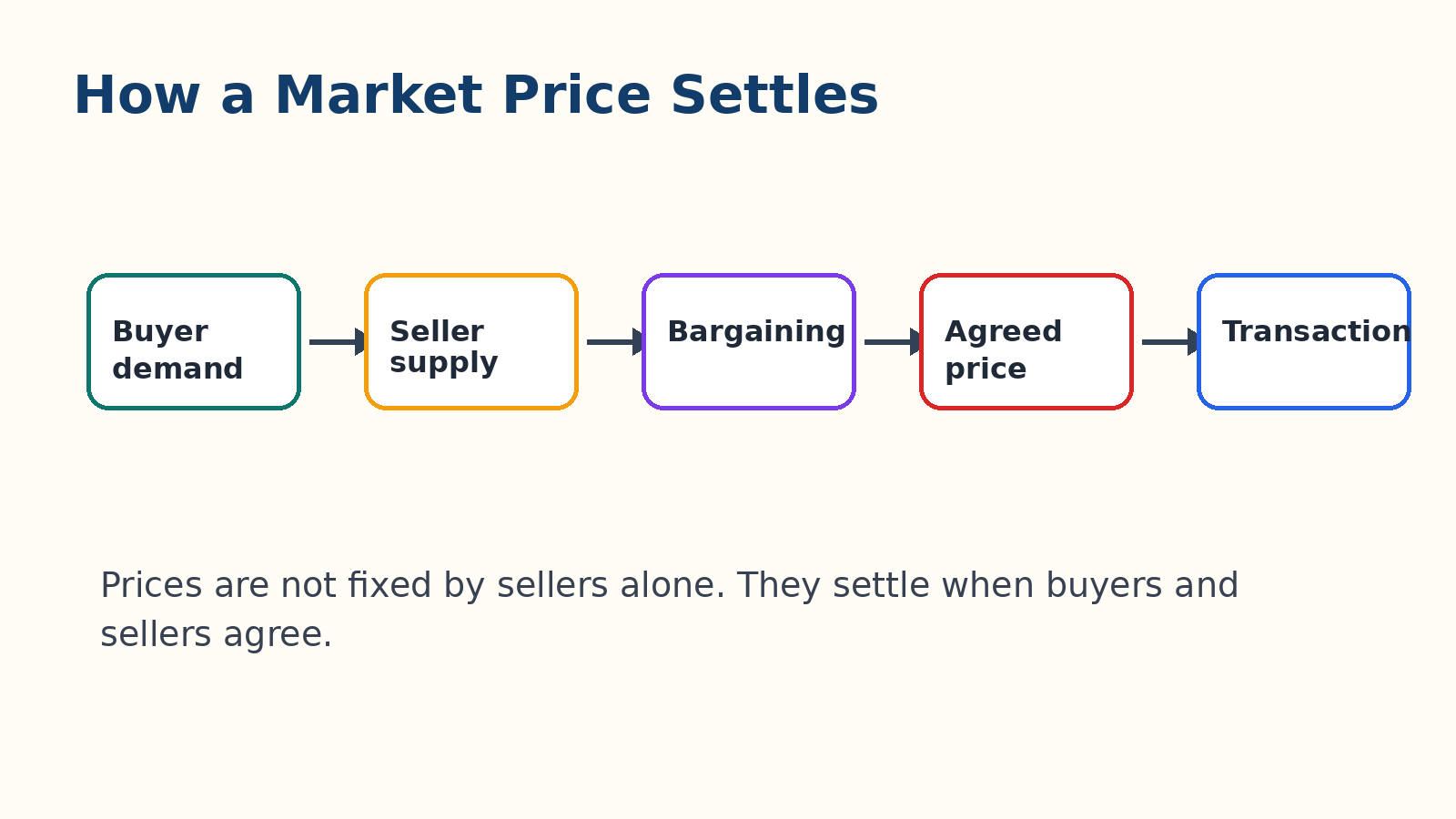
How a Market Price Settles in Understanding Markets
NCERT uses the guava example to show how price is shaped. The seller may ask for ₹80 per kg, but buyers may not accept it. A very low price may hurt the seller. A fair price appears when both sides agree.
Demand: the quantity buyers are willing and able to buy.
Supply: the quantity sellers are willing and able to sell.
Bargaining: the discussion that helps both sides reach a price.
Understanding Markets Explained in Simple Language
Source: YouTube chapter overview
Types of Markets in Class 7 Social Science Understanding Markets
The chapter explains that markets can look very different. A weekly haat, a mall, a shopping app, a wholesale mandi and an international trade network are all markets because exchange takes place.
Physical market: buyers and sellers meet in person.
Online market: buyers and sellers transact through apps or websites.
Domestic market: goods and services are traded inside one country.
International market: goods and services move across countries.
Wholesale market: goods are bought and sold in bulk.
Retail market: final consumers buy goods or services.
Consumer Quality Checks in Understanding Markets
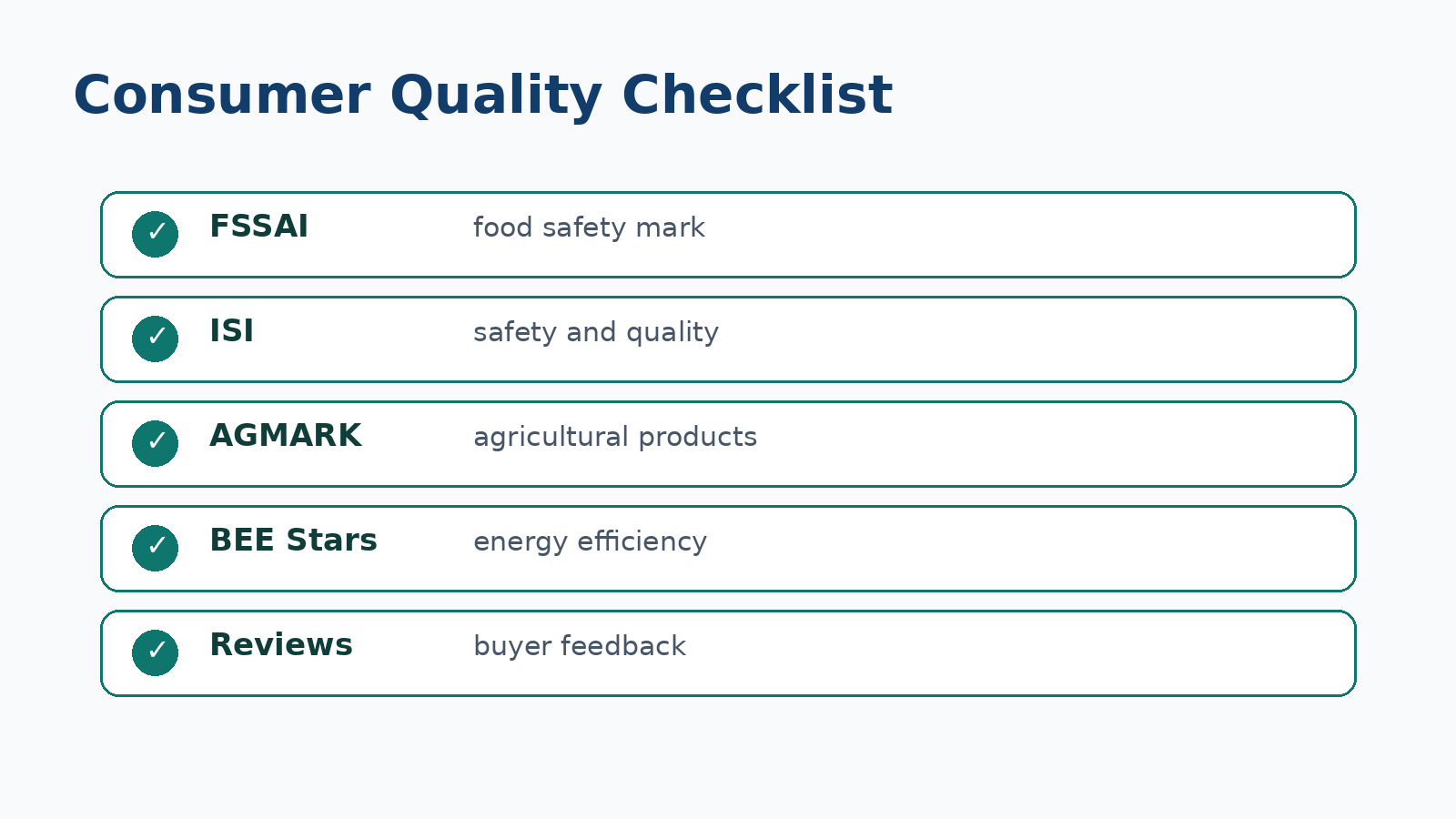
Consumers need ways to check quality before buying. Labels and certification marks help buyers make safer choices in markets. NCERT discusses FSSAI, ISI, AGMARK and BEE Star labels as examples.
Mark or Label
Where It Helps
FSSAI
Food safety and food packets
ISI
Electrical goods and other standardised products
AGMARK
Agricultural products
BEE Star
Energy efficiency of appliances
Understanding Markets Class 7 Cross Resource Links
All NCERT Solutions for Class 7 Social Science Chapter 12 Understanding Markets with Step-by-Step Solutions
Q 12.1
What are the main features of a market? Recall a recent visit to a market to purchase a product. What are the different features of a market that you observed during this visit?
Concept used. A market is a place or system where buyers and sellers exchange goods or services at an agreed price.
A market needs buyers who want goods or services.
It needs sellers who offer goods or services for sale.
There must be goods or services that can be exchanged.
Buyer and seller must agree on a price before the transaction happens.
Markets may be physical, such as a weekly market, or online, such as a shopping app.
In a recent vegetable market visit, I observed buyers, sellers, vegetables, bargaining, weighing, payment, and delivery.
Final Answer: The main features are buyers, sellers, goods or services, price, negotiation, and exchange. I observed all these in a local vegetable market.
AS
Aditi Sharma
M.A. Economics, Delhi University
Verified Expert
Quick reading. This question tests whether you can connect the chapter idea with daily life.
This question tests whether you can connect the chapter idea with daily life.
A local market shows the full chain clearly. A seller displays goods, a buyer checks them, both discuss price, and then money is paid.
You can also mention small details such as weighing vegetables, checking quality, carrying bags, or comparing prices at different shops.
These details prove that a market is not only a place. It is an exchange system.
Final Answer: A complete answer names buyers, sellers, goods or services, price, bargaining, and a real market observation.
Q 12.2
Remember the epigraph from a famous economist at the beginning of the chapter? Discuss its relevance in the context of the chapter you have read.
Concept used. The epigraph says prosperity grows when markets develop because people need goods and services they cannot make themselves.
No person or family can produce every good and service they need.
Markets connect people who produce goods with people who need them.
The Hampi Bazaar example shows how a market can become a centre of trade and prosperity.
Wholesale and retail chains help goods move from producers to final consumers.
Markets also support employment, income, and exchange of ideas and traditions.
Final Answer: The epigraph is relevant because the chapter shows that markets connect people, support trade, spread goods, and help prosperity grow.
RM
Rohan Mehta
M.A. Social Science, JNU
Verified Expert
Structural observation. Adam Smith's line fits the chapter because markets solve a practical problem.
Adam Smith's line fits the chapter because markets solve a practical problem.
People need food, clothes, tools, services, and many other things. They cannot make all of these by themselves.
A market lets producers, wholesalers, retailers, and consumers meet directly or indirectly.
So the chapter uses Hampi, Surat, online markets, and local markets to show how exchange creates economic life.
Final Answer: The quotation matches the chapter because markets turn individual needs and production into wider trade and prosperity.
Q 12.3
In the example of buying and selling of guavas, imagine that the seller is getting a good price, and is able to make a profit. He will try to get more guavas from farmers to be able to sell them at the same price and increase his earnings. What is the farmer likely to do in this kind of a situation? Do you think he will start thinking about the demand for guavas in the next season? What is likely to be his response?
Concept used. Demand means the quantity buyers want at a price. Supply means the quantity sellers offer at a price.
If the seller earns a good profit, he will demand more guavas from farmers.
Farmers will notice that guavas are selling well in the market.
They may try to grow or supply more guavas in the next season.
They may also plan better storage, transport, or sale timing.
If many farmers supply more guavas, the price may later adjust because supply increases.
Final Answer: The farmer is likely to increase guava production or supply in the next season after seeing strong demand and good prices.
KN
Kavya Nair
M.A. Education, University of Hyderabad
Verified Expert
Strategic angle. The question asks how market signals travel from the seller to the farmer.
The question asks how market signals travel from the seller to the farmer.
A good selling price tells the seller that buyers want guavas. The seller passes this signal to farmers by asking for more guavas.
The farmer may respond by planting more guava trees, bringing more produce to market, or improving quality.
This is how markets guide future production, even before the next season begins.
Final Answer: High demand and profit can encourage farmers to supply more guavas in the next season.
Q 12.4
Match the following types of markets with their characteristics. Column A: Physical market, Online market, Domestic market, International market, Wholesale market, Retail market. Column B: requires physical presence of buyer and seller, transaction happens virtually, trade within a nation, trade across national boundaries, deals in bulk quantities, sells to final consumers.
Concept used. Different markets are classified by place, scale, boundary, and buyer type.
Physical market matches: Requires physical presence of buyers and seller.
Online market matches: Buyers and sellers meet virtually and can transact at any time.
Domestic market matches: Lies within the boundaries of a nation.
International market matches: Goods and services flow outside the nation's boundaries.
Wholesale market matches: Deals in bulk quantities.
Retail market matches: Serves final consumers with goods and services.
Final Answer: 1 Physical market: physical presence. 2 Online market: virtual transaction. 3 Domestic market: within nation. 4 International market: across boundaries. 5 Wholesale market: bulk quantities. 6 Retail market: final consumers.
DJ
Dev Joshi
M.Ed., Mumbai University
Verified Expert
Quick reading. Each market type has one clear clue in its name.
Each market type has one clear clue in its name.
Physical and online describe how buyers and sellers meet. Domestic and international describe the boundary of trade.
Wholesale and retail describe the stage in the supply chain.
Using these three pairs makes the matching question easy and avoids guesswork.
Final Answer: The correct matches are physical-presence, online-virtual, domestic-within nation, international-across nations, wholesale-bulk, and retail-final consumer.
Q 12.5
Prices are generally determined by the interaction between demand from buyers and supply by sellers. Can you think of products where prices are high despite lesser number of buyers demanding the product? What could be the reasons for that?
Concept used. A price may remain high when supply is limited, production is costly, or the product has special quality or status.
Some products have few buyers but still sell at high prices.
Examples include diamonds, rare paintings, luxury cars, special medicines, and designer clothes.
Their prices can be high because supply is limited.
The cost of skill, raw material, technology, research, or brand value may also be high.
Some buyers are willing to pay more for rarity, quality, status, or special need.
Final Answer: Prices may be high despite fewer buyers because of scarcity, high production cost, special skill, brand value, quality, or urgent need.
MR
Meera Rao
M.A. Economics, Banaras Hindu University
Verified Expert
Structural observation. The chapter gives demand and supply as the basic price rule. This question asks for an exception-like situation.
The chapter gives demand and supply as the basic price rule. This question asks for an exception-like situation.
A diamond may have fewer buyers than rice, but its supply is limited and people attach high value to it.
A special medicine may have few buyers, but research, testing, and production can make it costly.
So price depends on demand, supply, cost, scarcity, and how much buyers value the product.
Final Answer: High prices can happen with fewer buyers when supply is scarce or the product is costly, rare, branded, or urgently needed.
Q 12.6
Look at the real life situation that a retail seller of vegetables encountered: A family came to shop for vegetables. The price of beans that the seller on the cart was offering was ₹30 / kg. The lady started to bargain with the seller to bring the price down to ₹25 / kg. The seller protested and refused to sell at that price saying he would make a loss at that price. The lady walks away. The family then goes to a super bazaar nearby. They buy vegetables in the super bazaar where they pay ₹40 / kg for the beans that is neatly packed in a plastic bag. What are the reasons that the family does this? Are there factors that affect buying and selling which are not directly connected to price?
Concept used. Buying decisions are shaped by price, but also by quality, convenience, trust, packaging, hygiene, and shopping experience.
The family may feel the super bazaar beans look cleaner and better packed.
They may trust the shop more because prices, weight, and billing appear fixed.
The family may prefer convenience, air conditioning, parking, or one-stop shopping.
They may think packaging protects the vegetables and saves time.
This shows that factors other than price can affect buying and selling.
Final Answer: The family may pay more because of packaging, cleanliness, trust, convenience, fixed weight, billing, and shopping experience. Yes, non-price factors affect markets.
AS
Ankit Singh
M.A. History, Aligarh Muslim University
Verified Expert
Strategic angle. The example shows that consumers do not always choose the lowest price.
The example shows that consumers do not always choose the lowest price.
A packed product may seem more hygienic, standard, or reliable. A super bazaar may also offer bills, fixed weights, and many goods in one place.
The cart seller may offer a lower price, but the family may value other things more at that moment.
This proves that market decisions include price and non-price factors.
Final Answer: The family pays extra for perceived quality, trust, convenience, packaging, and a better shopping environment.
Q 12.7
Some districts in India are famous for growing tomatoes. During some seasons farmers throw away their produce. Why do you think farmers do this? What role can wholesalers play? What are possible ways to ensure tomatoes are not wasted and farmers are not at a loss?
Concept used. Perishable goods can lose value quickly when supply is high and demand, storage, or transport is weak.
Tomatoes spoil quickly, so farmers cannot store them for long without proper facilities.
If many farmers harvest at the same time, supply becomes very high.
When supply is much higher than demand, prices can fall sharply.
Farmers may throw tomatoes away if transport and sale cost more than the market price.
Wholesalers can buy in bulk, arrange transport, connect distant markets, and use cold storage.
Wastage can be reduced through cold storage, processing into puree or ketchup, better transport, cooperative sale, and timely market information.
Final Answer: Farmers may throw tomatoes away because prices crash and tomatoes spoil quickly. Wholesalers, cold storage, processing, transport, and cooperatives can reduce waste and loss.
PI
Priya Iyer
M.A. Education, Calcutta University
Verified Expert
Quick reading. The problem is not that tomatoes have no value. The problem is timing and movement.
The problem is not that tomatoes have no value. The problem is timing and movement.
A large harvest can flood nearby markets. If there is no cold storage or quick transport, the tomatoes rot before they reach better markets.
Wholesalers can help by collecting large quantities, storing them, and sending them to areas where demand is higher.
Processing units and farmer cooperatives can also give farmers more options than distress sale.
Final Answer: Better storage, bulk purchase, transport, processing, and cooperative marketing can protect farmers from tomato wastage and price crashes.
Q 12.8
Have you heard about or visited a school carnival or fair? Discuss the activities organized by students there. How do they conduct selling and negotiation with buyers?
Concept used. A school fair is a small market because students sell goods or services to visitors at agreed prices.
Students may organize food stalls, game stalls, craft stalls, book stalls, or handmade product stalls.
They decide the price of each item before the fair or during sale.
They attract buyers by explaining the product, displaying it well, or offering samples.
Negotiation may happen when buyers ask for a discount or buy more than one item.
Students calculate cost, collect money, return change, and record sales.
Final Answer: A school fair works like a market: students set up stalls, display goods, quote prices, bargain politely, sell items, and handle payment.
NK
Neha Kapoor
M.Com., Panjab University
Verified Expert
Structural observation. This activity connects classroom learning with a real small market.
This activity connects classroom learning with a real small market.
Students become sellers. Visitors become buyers. Goods and services are displayed, priced, and exchanged for money.
Negotiation may be simple, such as giving a small discount for two plates of snacks or a combo game ticket.
The fair also teaches planning, pricing, teamwork, and customer interaction.
Final Answer: A school fair shows buying, selling, display, pricing, negotiation, payment, and teamwork in a simple market setting.
Q 12.9
Choose any 5 products and check out the label with the certification signs discussed in the chapter. Did you find products that did not have a logo? Why do you think this is so?
Concept used. Certification signs help consumers check whether a product meets minimum quality or safety standards.
Gram flour packet: FSSAI mark and licence number were present.
Honey bottle: FSSAI mark was present and AGMARK may be checked where applicable.
Pressure cooker: ISI mark was present.
LED bulb: BEE Star rating was present.
Loose vegetables from a local cart: no certification logo was present.
Some products may not have a logo because they are loose, unpackaged, local, unbranded, or not covered by that certification category.
Final Answer: Sample check: gram flour and honey showed FSSAI, pressure cooker showed ISI, LED bulb showed BEE Star rating, and loose vegetables had no logo because they were unpackaged.
RM
Rahul Menon
M.A. Economics, Madras University
Verified Expert
Quick reading. This question wants observation, not memorisation alone.
This question wants observation, not memorisation alone.
You can choose products at home and check their packets. Food packets often show FSSAI. Electrical goods may show ISI or BEE stars.
If a product has no logo, do not immediately call it fake. It may be sold loose, made locally, or outside the certification type discussed.
A clear table makes this activity answer easy to read.
Final Answer: A strong sample answer records five products, their marks, and explains missing logos through loose sale, local packing, or certification rules.
Q 12.10
You and your classmates have manufactured a soap bar. Design a label for its packaging. What in your opinion should be mentioned on the label for the consumer to know the product better?
Concept used. A product label gives information that helps consumers check quality, safety, price, quantity, and use.
Write the brand name and product name clearly.
Mention net quantity or weight of the soap bar.
Add ingredients, fragrance, and skin-use information.
Mention date of manufacture, best before date, batch number, and MRP.
Add name and address of the manufacturer or school group.
Mention usage instructions, storage advice, allergy warning, and customer contact.
If tested or certified, show the relevant certification details.
Final Answer: The soap label should mention brand name, ingredients, net weight, MRP, batch number, manufacturing date, best before date, manufacturer details, directions, warnings, and certification if any.
ST
Sara Thomas
M.A. Public Policy, TISS
Verified Expert
Strategic angle. The label is the consumer's first source of information.
The label is the consumer's first source of information.
For a soap bar, buyers need to know what it contains, how much it weighs, how much it costs, and whether it may cause allergy.
Dates, batch number, and manufacturer details help trace the product if there is a complaint.
This is why labels are part of consumer protection in markets.
Final Answer: A good soap label gives identity, ingredients, quantity, price, dates, batch number, maker details, use instructions, warnings, and certification.
Understanding Markets Class 7 Social Science NCERT Solutions FAQs
Ques. What does Class 7 Social Science Chapter 12 Understanding Markets explain?
Ans. It explains buyers, sellers, prices, demand, supply, physical and online markets, wholesale and retail markets, government regulation and quality checks.
Ques. Are these Understanding Markets NCERT Solutions useful for the 2026-27 session?
Ans. Yes. The PDF follows the 2026-27 NCERT Class 7 Social Science textbook and solves all chapter questions and activities.
Ques. What are the main features of a market?
Ans. A market needs buyers, sellers, goods or services, a price, negotiation or agreement, and an exchange between the two sides.
Ques. How can consumers assess quality in markets?
Ans. Consumers can check labels, FSSAI, ISI, AGMARK, BEE Star rating, manufacturer details, net quantity, dates and online reviews.





Chapter12UnderstandingMarketsSolutions.pdf?page=1&dpi=150)
Chapter12UnderstandingMarketsSolutions.pdf?page=2&dpi=150)
Chapter12UnderstandingMarketsSolutions.pdf?page=3&dpi=150)
Chapter12UnderstandingMarketsSolutions.pdf?page=4&dpi=150)
Chapter12UnderstandingMarketsSolutions.pdf?page=5&dpi=150)
Chapter12UnderstandingMarketsSolutions.pdf?page=6&dpi=150)
Chapter12UnderstandingMarketsSolutions.pdf?page=7&dpi=150)
Chapter12UnderstandingMarketsSolutions.pdf?page=8&dpi=150)
Chapter12UnderstandingMarketsSolutions.pdf?page=9&dpi=150)
Chapter12UnderstandingMarketsSolutions.pdf?page=10&dpi=150)
Chapter12UnderstandingMarketsSolutions.pdf?page=11&dpi=150)
Chapter12UnderstandingMarketsSolutions.pdf?page=12&dpi=150)
Chapter12UnderstandingMarketsSolutions.pdf?page=13&dpi=150)
Chapter12UnderstandingMarketsSolutions.pdf?page=14&dpi=150)
Chapter12UnderstandingMarketsSolutions_flat_MobileCard.pdf?page=1&dpi=150)
Chapter12UnderstandingMarketsSolutions_flat_MobileCard.pdf?page=2&dpi=150)
Chapter12UnderstandingMarketsSolutions_flat_MobileCard.pdf?page=3&dpi=150)
Chapter12UnderstandingMarketsSolutions_flat_MobileCard.pdf?page=4&dpi=150)
Chapter12UnderstandingMarketsSolutions_flat_MobileCard.pdf?page=5&dpi=150)
Chapter12UnderstandingMarketsSolutions_flat_MobileCard.pdf?page=6&dpi=150)
Chapter12UnderstandingMarketsSolutions_flat_MobileCard.pdf?page=7&dpi=150)
Chapter12UnderstandingMarketsSolutions_flat_MobileCard.pdf?page=8&dpi=150)
Chapter12UnderstandingMarketsSolutions_flat_MobileCard.pdf?page=9&dpi=150)
Chapter12UnderstandingMarketsSolutions_flat_MobileCard.pdf?page=10&dpi=150)
Chapter12UnderstandingMarketsSolutions_flat_MobileCard.pdf?page=11&dpi=150)
Chapter12UnderstandingMarketsSolutions_flat_MobileCard.pdf?page=12&dpi=150)
Chapter12UnderstandingMarketsSolutions_flat_MobileCard.pdf?page=13&dpi=150)
Chapter12UnderstandingMarketsSolutions_flat_MobileCard.pdf?page=14&dpi=150)
Chapter12UnderstandingMarketsSolutions_flat_MobileCard.pdf?page=15&dpi=150)
Chapter12UnderstandingMarketsSolutions_flat_MobileCard.pdf?page=16&dpi=150)
Chapter12UnderstandingMarketsSolutions_flat_MobileCard.pdf?page=17&dpi=150)
Chapter12UnderstandingMarketsSolutions_flat_MobileCard.pdf?page=18&dpi=150)
Chapter12UnderstandingMarketsSolutions_flat_MobileCard.pdf?page=19&dpi=150)
Chapter12UnderstandingMarketsSolutions_flat_MobileCard.pdf?page=20&dpi=150)
Chapter12UnderstandingMarketsSolutions_flat_MobileCard.pdf?page=21&dpi=150)
Chapter12UnderstandingMarketsSolutions_flat_MobileCard.pdf?page=22&dpi=150)
Chapter12UnderstandingMarketsSolutions_flat_MobileCard.pdf?page=23&dpi=150)
Chapter12UnderstandingMarketsSolutions_flat_MobileCard.pdf?page=24&dpi=150)
Chapter12UnderstandingMarketsSolutions_flat_MobileCard.pdf?page=25&dpi=150)
Chapter12UnderstandingMarketsSolutions_flat_MobileCard.pdf?page=26&dpi=150)
Chapter12UnderstandingMarketsSolutions_flat_MobileCard.pdf?page=27&dpi=150)
Chapter12UnderstandingMarketsSolutions_flat_MobileCard.pdf?page=28&dpi=150)



Comments