These Social Influence and Group Processes Class 12 NCERT Solutions answer every Review Question of Psychology Chapter 7 in clear, exam-ready prose, set to the 2026-27 CBSE syllabus. Each answer names the exact terms an examiner looks for, from the five reasons people join groups to Tuckman's stages, social loafing and group polarisation. Students can use them to check their own answers and to learn how to write a full-mark response.
Step-by-step answers to all 5 Review Questions of Class 12 Psychology Chapter 7.
Each answer carries a short Solution plus a longer Expert's Solution with the deeper points.
Pairs with the Notes, Handwritten Notes and Book PDF linked lower on this page.
These Social Influence and Group Processes Class 12 NCERT Solutions are written from the official NCERT Psychology textbook and checked against the last five years of CBSE board papers.
Student Feedback: In a Collegedunia poll of 6,240 Class 12 Psychology students taken before the 2026 boards, 72% of students said the hardest part of this chapter was writing the group-influence answers in full, not understanding them. Most students wanted a model answer that named all five reasons for joining a group and Tuckman's five stages, which is exactly how these solutions are built.
Source: 2026-27 Class 12 Psychology student poll. Sample of 6,240 students from CBSE schools across 11 states.
How These Social Influence and Group Processes NCERT Solutions Are Built
Chapter 7 of Class 12 Psychology is mostly a theory chapter, so the marks come from naming the right terms and giving one clear example. These Social Influence and Group Processes Class 12 NCERT Solutions follow the same plan for every question. They open with the concept, give the answer in plain points, and end with a boxed line you can copy onto the answer sheet.
Concept first: each answer names the idea being tested before it explains it.
Plain points: the body is in bullets and short prose, not long walls of text.
One example each: a single, clear example per answer, the way NCERT does it.
Expert's Solution: a second pass that adds the deeper points top scorers write.
The aim is simple: read the official chapter once, then use these answers to see how a full response is built. The most repeated marks in this chapter come from the five reasons for joining a group and Tuckman's five stages, so those are explained in the most detail.
Quick Concept Recap Before the Answers
A short recap makes the answers easier to follow. A group is an organised system of two or more people who interact, are interdependent, share common motives, hold role relationships, and follow norms. That is what sets a group apart from a crowd, a mob or a casual gathering. The table keeps the core terms of the chapter in one place for fast revision.
Term
What it means
Group
An organised system of two or more interacting, interdependent people with roles and norms.
Tuckman's stages
Forming, storming, norming, performing and adjourning.
Social loafing
The drop in individual effort when work is pooled in a group.
Group polarisation
The group's starting view becomes more extreme after discussion.
Groupthink
A highly cohesive group makes irrational decisions because no one voices dissent.
Keep these five terms ready, because almost every Review Question turns on one of them. The single most common slip is treating group polarisation and groupthink as if they mean the same thing, so fix that contrast first.
Social Influence and Group Processes Class 12 Questions and Answers
Below is the full list of the 5 Review Questions from Class 12 Psychology Chapter 7, exactly as they appear in the NCERT textbook. Each one is answered in full on this page and in the interactive question set. Use the list to find the question you need, then open the card to read the model answer.
Q 1 Compare and contrast formal and informal groups, and ingroups and outgroups.
Q 2 Are you a member of a certain group? Discuss what motivated you to join that group.
Q 3 How does Tuckman's stage model help you to understand the formation of groups?
Q 4 How do groups influence our behaviour?
Q 5 How can you reduce social loafing in groups? Think of any two incidents of social loafing in school. How did you overcome it?
The questions move from the types of groups to why people join, how groups form, and finally how groups change our behaviour. A focused list of social influence and group processes class 12 important questions like this saves time, because the same items repeat in the board paper almost every year.
How to Write Full-Mark Answers in This Chapter
Because this is a theory chapter, presentation decides the marks. These NCERT Solutions for Class 12 Psychology Chapter 7 follow a few simple habits that the board rewards. Use them on every answer and the score lifts on its own.
Habit
Why it earns marks
Name the term
Examiners look for the exact word, such as interdependence or group polarisation.
List, do not narrate
Numbered points are easier to mark than one long paragraph.
One example each
A single clear example, like Latane's clapping study, proves you understood the point.
Close with a boxed line
A one-line summary tells the marker you have answered the full question.
The key idea to remember is that a group is more than a collection of people; it has interdependence, roles and norms. Writing that one line in the right place is often the difference between a mid-band and a top-band answer. The Expert's Solution in each card shows exactly where to place it.
Common Mistakes Students Make in This Chapter
A few errors cost marks every year. Most come from blurring two close terms or forgetting one part of a list. Fixing these five points is the quickest way to lift a score, so add them to the end of your revision sheet.
Treating group polarisation and groupthink as the same; polarisation is views getting more extreme, groupthink is dissent being silenced.
Naming only some of Tuckman's stages; you must give all five, forming, storming, norming, performing and adjourning.
Mixing up the types of groups (formal/informal, ingroup/outgroup) with the reasons people join groups.
Saying social loafing is laziness; it is the drop in effort when work is pooled and not evaluated individually.
Forgetting that discrimination between an ingroup and outgroup is socially created, not real.
Students who fix these five points usually move from average to high marks. The chapter rewards precise terms and a balanced view, so name each idea exactly and give both sides before you judge.
How These Solutions Pair with the Notes and Book PDF
These solutions answer the questions, but full preparation needs the other resources for the same chapter, all linked in the table below. Read the Notes first, attempt the questions on your own, then check the model answers here, and open the Book PDF whenever you need the original text.
Tip: read the Notes first, then attempt these solutions on your own, and only then check the model answers here. That order builds memory faster than copying answers straight away.
All Class 12 Psychology NCERT Solutions by Chapter
The table links the NCERT Solutions for every chapter in Class 12 Psychology, so students can move across the course in one click. Social Influence and Group Processes is highlighted.
All Social Influence and Group Processes Solutions with Step-by-Step Solutions
Below are all 5 NCERT exercise questions for this chapter, exactly as they appear in the textbook. Tap Check Solution for the model answer or Expert Solution for the topper-style approach.
Q 7.1
Compare and contrast formal and informal groups, and ingroups and outgroups.
Concept used. NCERT lists three main pairs of group types. Two of
them are asked here: formal and informal groups, and
ingroups and outgroups. The first pair sorts groups by how clearly
their rules and roles are stated. The second pair sorts groups by whether they
are ``ours'' or ``theirs''.
Formal versus informal groups. These two differ in how openly the
functions of the group are stated.
Formal groups. The functions are stated explicitly and
formally, as in an office or a university. The roles members must
perform are laid down in a clear manner, and the group is based on
specific rules or laws. Members have definite roles and a set of norms
that help establish order.
Informal groups. The functions are not stated openly. The
formation is not based on rules or laws, and there is a close,
personal relationship among members. A group of friends is a good
example.
Ingroups versus outgroups. Just as individuals compare themselves
with others, they also compare the group they belong to with groups they are
not part of.
Ingroup. This is one's own group. For ingroup members we use
the word we. Ingroup members are generally supposed to be
similar, are viewed favourably, and are seen to have desirable traits.
Outgroup. This is another group, to which one does not
belong. For outgroup members the word they is used. Outgroup
members are viewed differently and are often perceived more negatively
than ingroup members.
Two different axes
Do not mix the two pairs. Formal/informal sorts groups by how stated
their rules are. Ingroup/outgroup sorts groups by whose side they are
on (we versus they). They answer different questions about the same group.
One shared point. NCERT adds a caution for the ingroup/outgroup pair:
these categories are not real, they are created by us. In some cultures, such
as India, plurality is celebrated and a composite culture is valued, so the
us-and-them line need not be sharp.
Formal groups have explicitly stated functions, definite roles and
rule-based formation (office, university); informal groups have unstated
functions, no rules and close personal ties (friends). An ingroup is one's own
group (``we''), viewed favourably; an outgroup is another group (``they''),
viewed less favourably. The first pair contrasts how stated the rules are; the
second contrasts whose side the group is on.
AK
Ananya Krishnan
M.A Social Psychology, University of Delhi
Verified Expert
Strategic angle. This is a double ``compare and contrast'', so build
two clean tables in your head, one for each pair, and keep them separate. The
marker wants the defining criterion of each pair named first, then the two
sides set against it.
Run each pair on a single axis:
Formal/informal axis: how stated are the rules? Formal groups
spell out roles and norms in rules or laws; informal groups grow on
personal ties with no stated rules.
Ingroup/outgroup axis: we or they? The ingroup is the group
we belong to and label ``we'', seen as similar and favourable; the
outgroup is ``they'', seen as different and less favourable.
Why this matters. The point that lifts the answer to the top band is
naming what each pair is really sorting. Formal and informal is about
structure, how openly the group's rules and roles are written down.
Ingroup and outgroup is about identity, which side of the we-they line
a group sits on. Confusing the two axes is the commonest slip here, because
both look like ``types of groups''.
It also helps to add one example per side: a university or office for a formal
group, a friendship circle for an informal one; your own school for an
ingroup, a rival school for an outgroup. Finish with the NCERT caution that
ingroup and outgroup categories are not real but socially created, and that a
composite culture like India's softens the line. That closing sentence shows
balanced judgment rather than a flat list of differences.
Two separate axes: formal versus informal contrasts how openly a
group's rules and roles are stated (structure), while ingroup versus outgroup
contrasts whether a group is ``we'' or ``they'' (identity). Name the axis
first, then set the two sides against it, and add that the we-they split is
socially created, not real.
Q 7.2
Are you a member of a certain group? Discuss what motivated you to join that group.
Concept used. This is an application question. Yes, every student is a
member of many groups (family, class, friends, a sports team or a club). To
answer well, name one group and then explain the choice using the NCERT list
of reasons people join groups. NCERT gives five main reasons.
The five reasons people join groups. A good answer maps the chosen
group onto these.
Security. When we are alone we feel insecure. Being with
people gives a sense of comfort and protection, so we feel stronger
and less open to threats.
Status. Being a member of a group that others see as
important makes us feel recognised and gives a sense of power. Winning
an inter-school event, for example, makes members feel proud.
Self-esteem. Groups give feelings of self-worth and a
positive social identity. Belonging to a respected group raises one's
self-concept.
Satisfaction of psychological and social needs. Groups meet
needs such as a sense of belongingness, giving and receiving
attention, love, and power.
Goal achievement. Groups help us reach goals that cannot be
achieved alone, because there is power in the majority.
Knowledge and information. Group membership broadens our view,
since no individual has all the information alone.
A worked example. Suppose the chosen group is the school debating
club. The student might say: it gave security (a place to belong),
self-esteem and status (winning competitions felt proud), met
the need for attention and belongingness, helped reach the
goal of public speaking that solo practice could not, and added
knowledge through shared research.
Name the group, then map it
The marks here come from structure: state one real group in a line, then run
it through the NCERT reasons, giving one personal sentence for each reason you
use. Do not list the reasons in the abstract; tie each one to your own group.
Yes, every student belongs to many groups. Pick one (say a sports
team or club) and explain the choice using the NCERT reasons: security,
status, self-esteem, satisfaction of psychological and social needs, goal
achievement, and knowledge and information. Tie each reason to your own
experience of that group.
SP
Sneha Pillai
M.A Applied Psychology, University of Mumbai
Verified Expert
Structural observation. Application questions are marked on whether
you connect a real example to the textbook list. So the safe structure is:
name the group in one line, then take each NCERT reason and give a single
sentence of personal detail. Generic answers that only define the reasons lose
the application marks.
Order your reasons from felt need to gained benefit:
Felt needs first: security, belongingness, self-esteem. These
are why the group feels good to be in.
Gains next: status, goal achievement, knowledge. These are
what the group lets you do or become.
Why this matters. A top-band answer shows that one group usually meets
several needs at once. The debating club gives security and belongingness
(felt needs), and status, goal achievement and knowledge (gains) in the same
membership. Saying this explicitly, that a single group satisfies a bundle of
motives, signals that you understand the chapter's larger point: different
groups satisfy different needs, and we are members of many groups at once
because of competing demands.
A neat closing move is to admit that group membership can create pressure too,
since competing groups make competing demands, and explain how you handled it
(for instance, balancing the debating club with class work). That one honest
sentence connects your personal answer back to the NCERT line that we are
``members of different groups'' and must manage their competing expectations.
Name one group, then map it onto the NCERT reasons: felt needs
(security, belongingness, self-esteem) and gains (status, goal achievement,
knowledge). Show that one group meets several needs at once, and add how you
balanced its demands against your other groups.
Q 7.3
How does Tuckman's stage model help you to understand the formation of groups?
Concept used.Tuckman's stage model says that, like
everything else in life, groups develop over time and do not become a group
the moment people come together. Tuckman suggested that groups pass through
five developmental sequences: forming, storming, norming, performing
and adjourning. The model helps because it shows that group formation is a
process with predictable stages, not a single event.
The five stages. Each stage marks a step in the group's growth.
Forming. When members first meet there is great uncertainty
about the group, the goal and how it is to be achieved. People try to
know each other and assess whether they will fit in. There is
excitement as well as apprehension.
Storming. A stage of intragroup conflict. Members disagree
about how the goal is to be achieved, who is to control the group and
its resources, and who is to do what. When it is complete, a hierarchy
of leadership and a clear vision develop.
Norming. Members develop norms related to group behaviour.
This leads to a positive group identity.
Performing. The structure of the group has evolved and is
accepted by members. The group now moves towards achieving its goal.
For some groups this may be the last stage.
Adjourning. For some groups, such as an organising committee
for a school function, there is a final stage in which, once the work
is over, the group may be disbanded.
The model is a guide, not a fixed track
NCERT cautions that all groups do not always move neatly from one stage to the
next. Sometimes several stages go on at once, groups may go back and forth, or
they may skip some stages. Say this and you show you understand the model's
limits.
Why the model helps. It gives a clear language for what a group is
going through, helps members expect conflict at the storming stage instead of
fearing it, and shows that a working group (performing) is reached only after
forming and norming. It also reminds us that some groups end (adjourning) once
their task is done.
Tuckman's model shows that group formation is a staged process, not a
single event. The five stages are forming (uncertainty), storming (conflict),
norming (shared norms and identity), performing (working towards the goal) and
adjourning (disbanding). It helps because it predicts the conflict of the
storming stage and shows that smooth performance comes only after the earlier
stages, though groups may skip or repeat stages.
VN
Vikram Nair
M.A Social Psychology, Jawaharlal Nehru University
Verified Expert
Strategic angle. The question asks how the model helps you
understand formation, so do not just list the five stages: explain what each
stage teaches. Frame the answer as ``the model helps because'' and then
give each stage with its lesson.
Read the five stages as one rising curve:
Forming and storming: the rough start. Uncertainty, then
open conflict over goals and control. The lesson is that early
friction is normal, not a sign of failure.
Norming and performing: the settled middle. Shared norms and
a positive identity let the group finally work towards its goal.
Adjourning: the planned end. Task-based groups disband once
the job is done.
Why this matters. The mnemonic ``Forming, Storming, Norming,
Performing, Adjourning'' is worth stating, but the marks sit in the
explanation that the storming stage is necessary, not a breakdown. A group
that never argues over goals and control may never settle a real hierarchy or
vision. Saying this shows you grasp why Tuckman ordered the stages as
he did: conflict has to be worked through before genuine norms can form.
Close with the NCERT limit: groups do not always march through the stages in
order; they may run several at once, loop back, or skip some. Naming this stops
the model from looking like a rigid law and shows you can both use a model and
state where it bends. That balance is exactly what a ``how does it help''
question rewards.
Frame it as ``the model helps because''. The five stages
(forming, storming, norming, performing, adjourning) show formation as a
process; the key insight is that storming, the conflict over goals and control,
is a needed step before norms and performance. Add that real groups may loop
back or skip stages, so the model is a guide, not a fixed track.
Q 7.4
How do groups influence our behaviour?
Concept used. Groups are powerful because they can influence the
behaviour of individuals. NCERT discusses two situations in which the presence
of others changes how a person performs: social facilitation (and
its opposite, social loafing) and group polarisation. The
chapter also warns of groupthink. Together these show the main ways a
group shapes individual behaviour.
Social loafing. Research on social facilitation shows that the
presence of others can arouse and improve performance when a person's efforts
are evaluated individually. But when efforts are pooled in a group, the
opposite often happens: individuals work less hard than when alone. This
reduction in individual effort on a collective task is social
loafing, shown in Latane's clapping and shouting experiments and in
tug-of-war, where members can become ``free riders''.
Members feel less responsible for the overall task.
Their motivation drops because their contribution is not evaluated
individually.
The group's performance is not being compared with other groups.
There is poor or no coordination among members.
Belonging to the group is not important; it is only an aggregate of
individuals.
Group polarisation. Groups are more likely to take extreme decisions
than individuals alone. The initial position of the group, whether cautious or
risky, becomes stronger after discussion. This strengthening of the group's
initial position through interaction is group polarisation. It occurs
because, among like-minded people, you hear newer arguments for your view, you
feel your view is validated (a bandwagon effect), and you start
identifying with the group and conforming to it.
Groupthink is a separate warning
Do not confuse polarisation with groupthink. Groupthink is when a highly
cohesive group, seeking harmony, makes irrational decisions because no one
voices dissent. It is a danger of extreme cohesiveness, not the same as
positions simply becoming more extreme.
Other influences. Groups also influence us through norms
(expected standards of behaviour), roles and status, and
through cohesiveness, the ``we feeling'' that makes members think,
feel and act as a unit.
Groups influence behaviour mainly through social loafing (less
individual effort on a pooled task), group polarisation (the group's initial
view becomes more extreme after discussion), and the danger of groupthink in
highly cohesive groups. They also shape us through norms, roles, status and
cohesiveness.
AS
Aditi Sharma
M.A Psychology, Banaras Hindu University
Verified Expert
Structural observation. This is a broad ``how'' question, so the best
structure is two named phenomena plus a third warning: social loafing, group
polarisation, and groupthink. Define each, give its cause, and add one example.
That trio covers the whole ``influence'' section in a tidy frame.
Sort the influences by what they do to the individual:
Effort: social loafing. Pooled tasks lower individual effort;
the cause is reduced responsibility and no individual evaluation.
Opinion: group polarisation. Discussion pushes the group's
starting view to an extreme; the cause is new arguments, validation
and a bandwagon effect.
Judgment: groupthink. High cohesion suppresses dissent and
produces irrational decisions.
Why this matters. The detail that earns the top band is naming the
cause behind each phenomenon, not just the label. Social loafing is not
laziness; it is the loss of identifiable, individually evaluated effort, which
is why making each person's contribution identifiable reduces it. Polarisation
is not just ``the group gets extreme''; it runs on new pro-arguments,
validation and the bandwagon effect. Groupthink is the cost of cohesion gone
too far, where the wish for harmony silences doubt.
It helps to add one concrete example each: tug-of-war or Latane's clapping
study for loafing, a committee hardening a punishment decision for
polarisation, and a famous group fiasco for groupthink. Closing with the link
that all three flow from the same root, that the group changes what the
individual feels responsible for and willing to say, ties the answer together
and shows the deeper idea the question is testing.
Cover three named influences with their causes: social loafing
(effort drops when work is pooled and not individually evaluated), group
polarisation (discussion among like-minded members pushes the starting view to
an extreme, via new arguments and a bandwagon effect), and groupthink (extreme
cohesion silences dissent and yields irrational decisions). Add norms, roles,
status and cohesiveness as the everyday channels of influence.
Q 7.5
How can you reduce social loafing in groups? Think of any two incidents of social loafing in school. How did you overcome it?
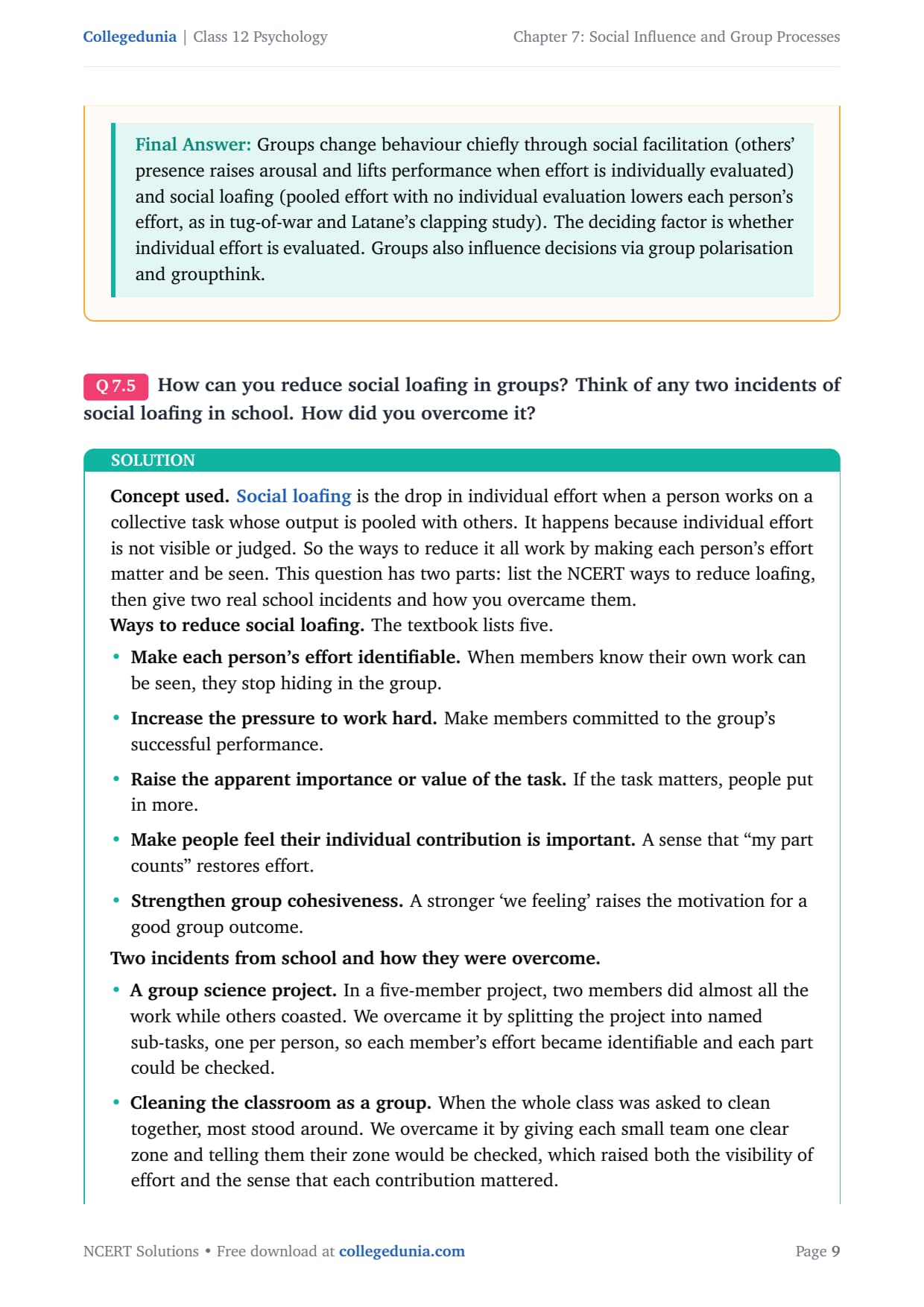
Concept used.Social loafing is the reduction in individual
effort when a person works on a collective task in which outputs are pooled,
so no single member's contribution can be seen. NCERT lists clear ways to
reduce it, and the question also asks for two school incidents and how they
were overcome.
Ways to reduce social loafing. The common thread is to make each
member's effort visible and valued.
Make each person's efforts identifiable. When contributions
can be seen, members cannot hide as free riders.
Increase the pressure to work hard. Make members feel
committed to successful task performance.
Increase the apparent importance or value of the task. A task
that feels worthwhile draws more effort.
Make people feel their individual contribution is important.
Each member should see that what they do matters to the result.
Strengthen group cohesiveness. A stronger ``we feeling''
raises the motivation for a good group outcome.
Two school incidents (a model answer students can adapt).
A group science project. In a five-member project, two
members did most of the work while others relaxed, since only the
final report was graded. We overcame it by splitting the project into
named parts, one per member, so each person's contribution was
identifiable and could be checked.
A class clean-up drive. During a whole-class clean-up, many
students did very little because the effort was pooled and no one was
watched. We overcame it by assigning each small group a fixed area and
a monitor, which raised accountability and made each
contribution matter.
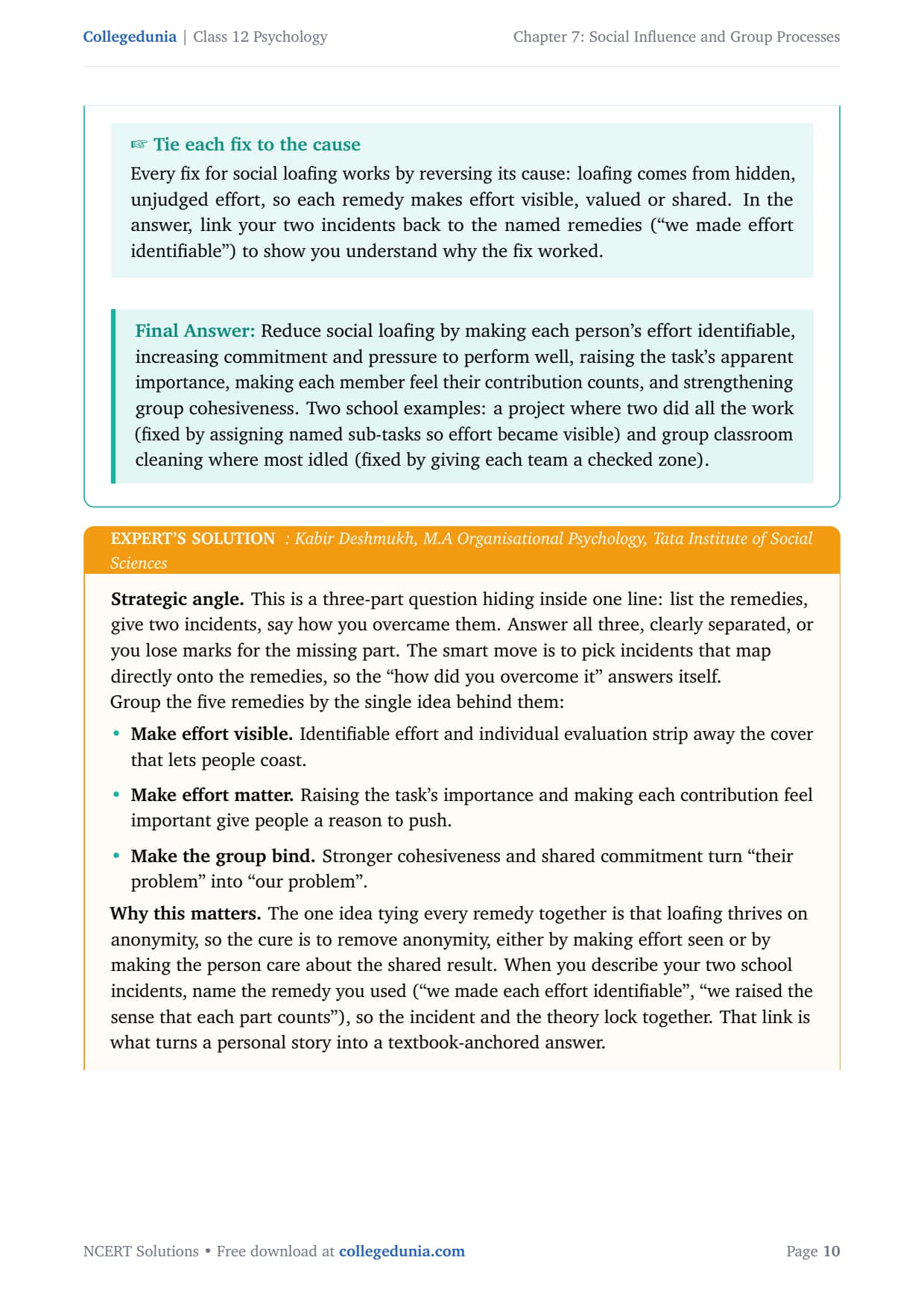
The single key idea
Almost every cure for social loafing reduces to one principle: make the
individual contribution visible and valued. If you can name and check
what each member did, the free-rider problem largely disappears.
Reduce social loafing by making each member's effort identifiable,
increasing the pressure and the apparent value of the task, making each person
feel their contribution matters, and strengthening cohesiveness. In a group
science project and a class clean-up, loafing was overcome by splitting work
into named parts and assigning fixed areas with a monitor, so every
contribution became visible and accountable.
AS
Aditi Sharma
M.A Psychology, Banaras Hindu University
Verified Expert
Strategic angle. This question has three parts: the cures, two
incidents, and how you overcame them. Answer all three or you lose marks. List
the NCERT cures first, then give two short, concrete school stories, each
ending with the specific cure you applied.
Group the cures around one principle:
Make effort visible. Identifiable contributions and a sense
that each person's part matters.
Raise the stakes. More pressure to perform and a higher
apparent value of the task.
Bind the group. Stronger cohesiveness so members care about
the shared outcome.
Why this matters. The examiner wants to see that you understand
why these cures work, not just that you can list them. They all attack
the same root cause: loafing happens because pooled effort hides the
individual. Every cure either uncovers the individual (identifiability,
importance of one's contribution) or raises the cost of slacking (pressure,
value, cohesiveness). Saying this in one line shows mastery.
For the two incidents, keep them short and real, and make sure each ends with
the exact cure you used: ``we made each part identifiable'' or ``we assigned
fixed areas and a monitor''. That closes the loop between the textbook cure and
your lived example, which is precisely what the question's three-part structure
is testing. A final sentence noting that the result improved (the project was
finished fairly, the clean-up was thorough) confirms that the cure worked.
Cures all share one idea: make the individual contribution visible
and valued. Use identifiability, pressure to perform, a higher apparent task
value, a felt sense that each contribution matters, and stronger cohesiveness.
Then give two short school incidents (a group project, a clean-up drive), each
ending with the specific cure applied and the better result it produced.
FAQs on Social Influence and Group Processes Class 12 NCERT Solutions
Social Influence and Group Processes Class 12 Psychology Common Questions
Ques. Where can I download the Social Influence and Group Processes Class 12 NCERT Solutions PDF?
Ans. You can download the Social Influence and Group Processes Class 12 Psychology NCERT Solutions PDF directly from this page. It is free, follows the 2026-27 NCERT, and answers all 5 Review Questions step by step.
Ques. How many questions are there in Social Influence and Group Processes Class 12 questions and answers?
Ans. The chapter has 5 Review Questions. They run from comparing types of groups and the reasons people join groups, through Tuckman's stages of group formation, to how groups influence behaviour and how to reduce social loafing.
Ques. What are Tuckman's five stages of group formation?
Ans. Tuckman's five stages are forming (uncertainty as members meet), storming (conflict over goals and control), norming (shared norms and a positive identity), performing (working towards the goal), and adjourning (the group disbands once its task is done).
Ques. What is the difference between group polarisation and groupthink?
Ans. Group polarisation is when a group's starting view becomes more extreme after discussion among like-minded members. Groupthink is when a highly cohesive group, seeking harmony, makes irrational decisions because no one voices a dissenting opinion. Polarisation is about extremity; groupthink is about silenced dissent.
Ques. Is class 12 psychology chapter 7 easy to score in the board exam?
Ans. Yes. It is one of the easier scoring chapters if you name the exact terms and give one clear example per answer. Keep the five reasons for joining a group, Tuckman's five stages and the social loafing cures ready, and the long answers become straightforward.








Comments