Exercise 9.3 of Class 12 Maths Chapter 9 Differential Equations has 23 questions on the variable separable method. These NCERT Solutions show every separation and integration step in full. The free PDF download is available on this page.
Exercise 9.3 snapshot
Detail
Total problems
23 (Q1 to Q23)
Question split
Q1 to Q10 general solution, Q11 to Q14 particular solution, Q15 to Q22 word problems, Q23 MCQ
Core method
Separate to h(y) dy = g(x) dx , then integrate both sides
The split above shows why Exercise 9.3 is long but predictable: the same separation step opens every problem, and only the integral on each side changes.
Question count: 23 problems in total, the largest practice block before the homogeneous and linear methods.
Every solved problem in this Collegedunia PDF first rearranges the equation to the form h(y) dy = g(x) dx , then integrates each side with the standard integral named explicitly. The half-angle identity in Q1, the sin-1 form in Q2, partial fractions in Q11 and Q12, and the exponential-growth template dNdt = kN in Q20 to Q22 are all written in full.
The Collegedunia editorial team has matched every general and particular solution against the official NCERT answer key and the 2026-27 textbook, including the numeric answers for the balloon, compound-interest and bacteria problems.
Why Exercise 9.3 Matters Most in Class 12 Maths Chapter 9 Differential Equations
The variable-separable method is the foundation the homogeneous and linear methods build on, and it is the only technique the application word problems use.JEE Main has carried a separable-method question in 4 of the last 5 papers, almost always disguised as a growth or decay model identical in structure to Q20 to Q22.
How Collegedunia's NCERT Solutions Help You Clear Exercise 9.3
Exercise 9.3 is long, and the marks are lost in the integration step, not the separation step. The Collegedunia solutions name every standard integral before applying it, so the working is examination-ready.
Separation shown first in every problem, so the structure is visible before any integration.
Standard integrals named, such as ∫ dy√a2-y2 = sin-1ya for Q2.
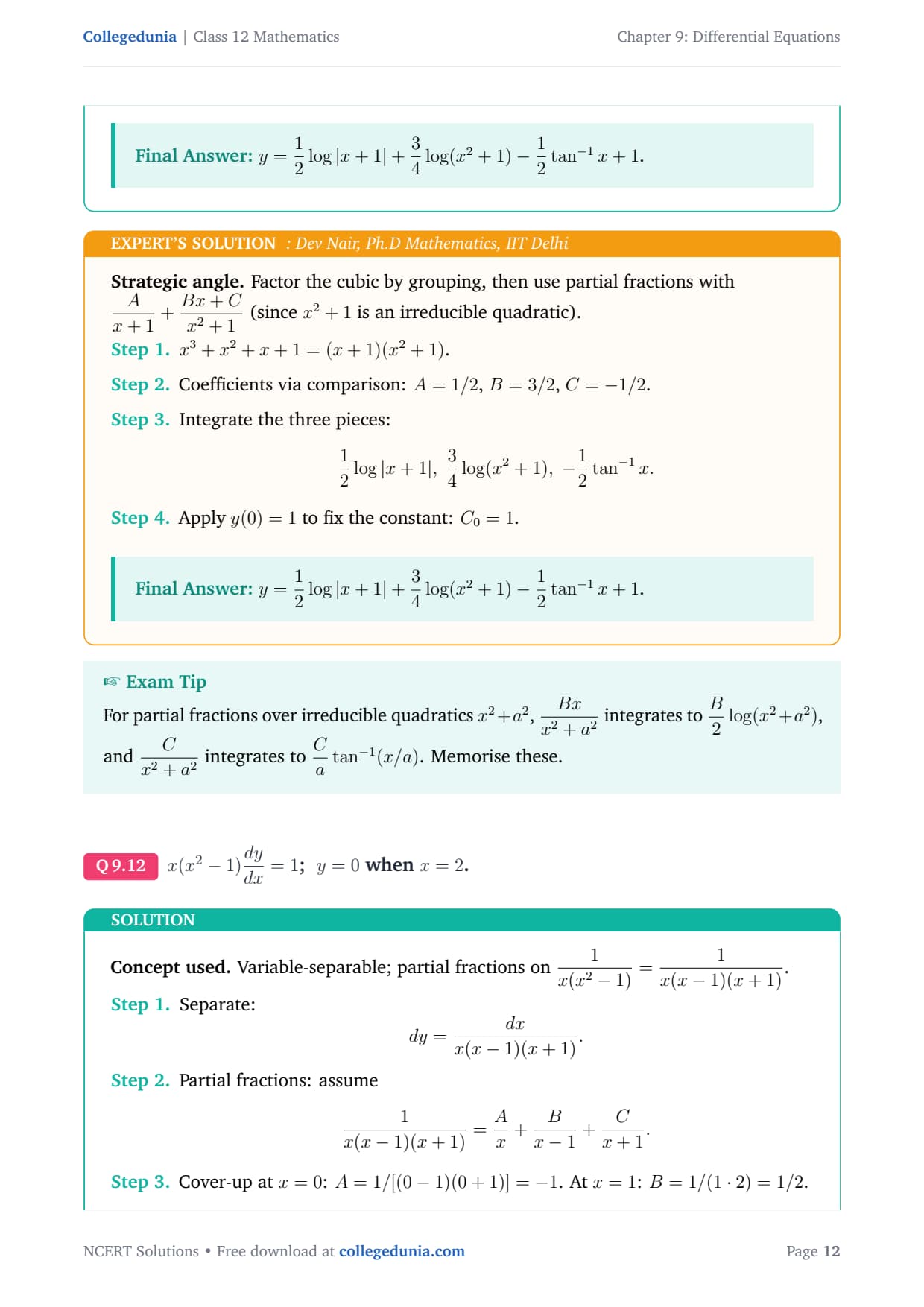
Partial fractions solved fully for Q11 ( (x+1)(x2+1) ) and Q12 (x(x-1)(x+1) ).
Initial condition applied last in Q11 to Q14, after the general solution, to fix the constant.
Word-problem modelling spelled out for the balloon (Q19), compound interest (Q20, Q21) and bacteria (Q22).
The table lists the headline answer for representative problems across the four blocks of Exercise 9.3. Use it to verify your own working after attempting the set.
Q No.
Equation / model
Answer
1
dydx = 1-cos x1+cos x
y = 2tan(x/2) - x + C
2
dydx = √4-y2
y = 2sin(x+C)
4
sec2xtan y dx + sec2ytan x dy = 0
tan x tan y = C
6
dydx = (1+x2)(1+y2)
tan-1y = x + x33 + C
11
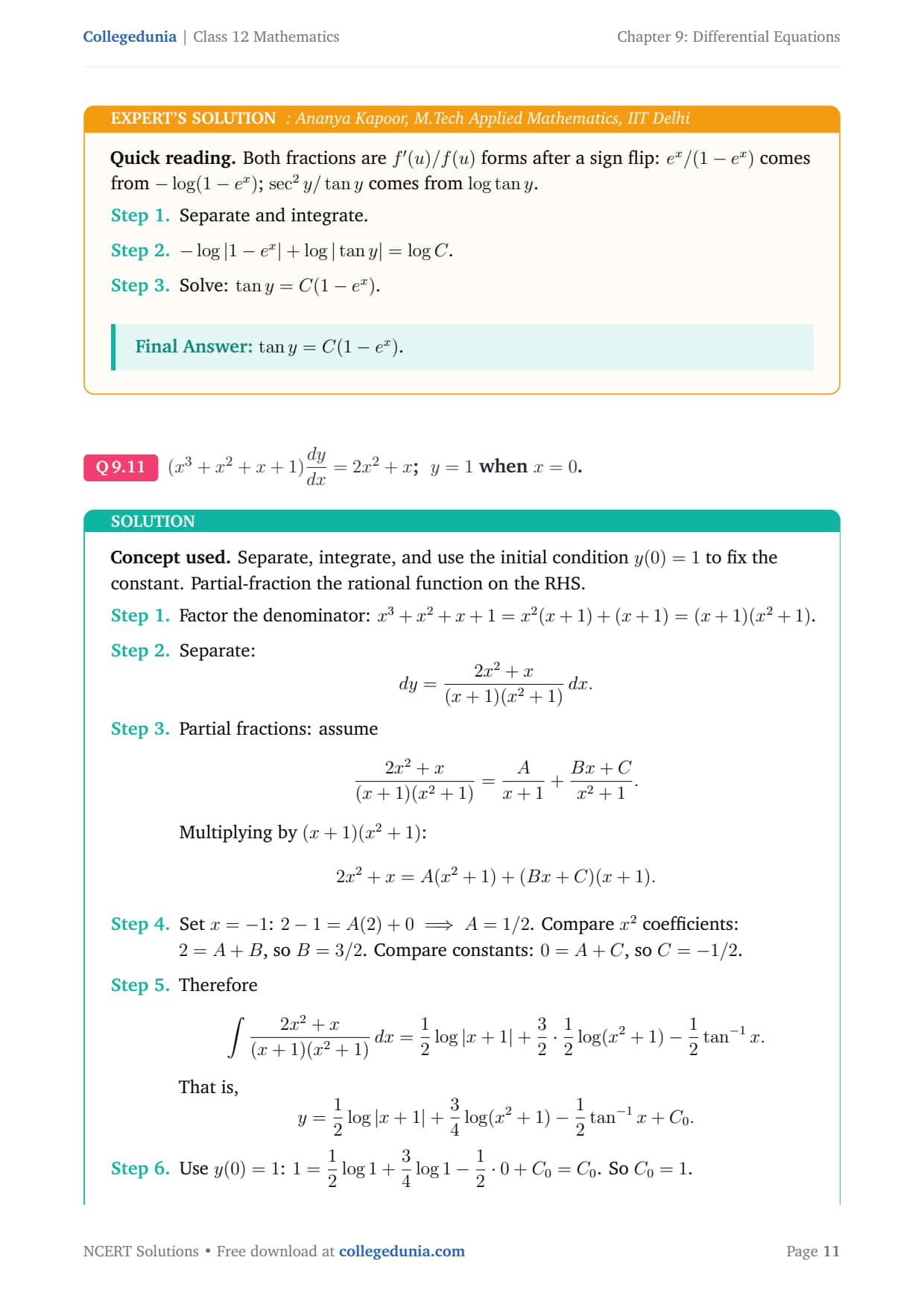
(x3+x2+x+1)y' = 2x2+x, y(0)=1
y = 12log|x+1| + 34log(x2+1) - 12tan-1x + 1
14
dydx = ytan x, y(0)=1
y = sec x
17
Tangent-slope times y equals x, through (0,-2)
y2 - x2 = 4
19
Balloon, volume changes at constant rate
r(t) = [3]63t+27
20
Rs 100 doubles in 10 years, continuous
r ≈ 6.93% per year
22
Bacteria up 10% in 2 hours, reach 2,00,000
t = 2log 2log 1.1 ≈ 14.55 hours
23
MCQ: general solution of dydx = ex+y
(A) ex+e-y=C
The four word problems Q19 to Q22 carry the same exponential or power-law structure, so learn the dNdt = kN template clears all of them at once. These application problems are the 5-mark Long Answer source from this exercise.
Variable Separable Method: The Three-Step Routine for Class 12 Maths Exercise 9.3
Every problem in Exercise 9.3 follows the same routine. Internalising it makes the long set fast.
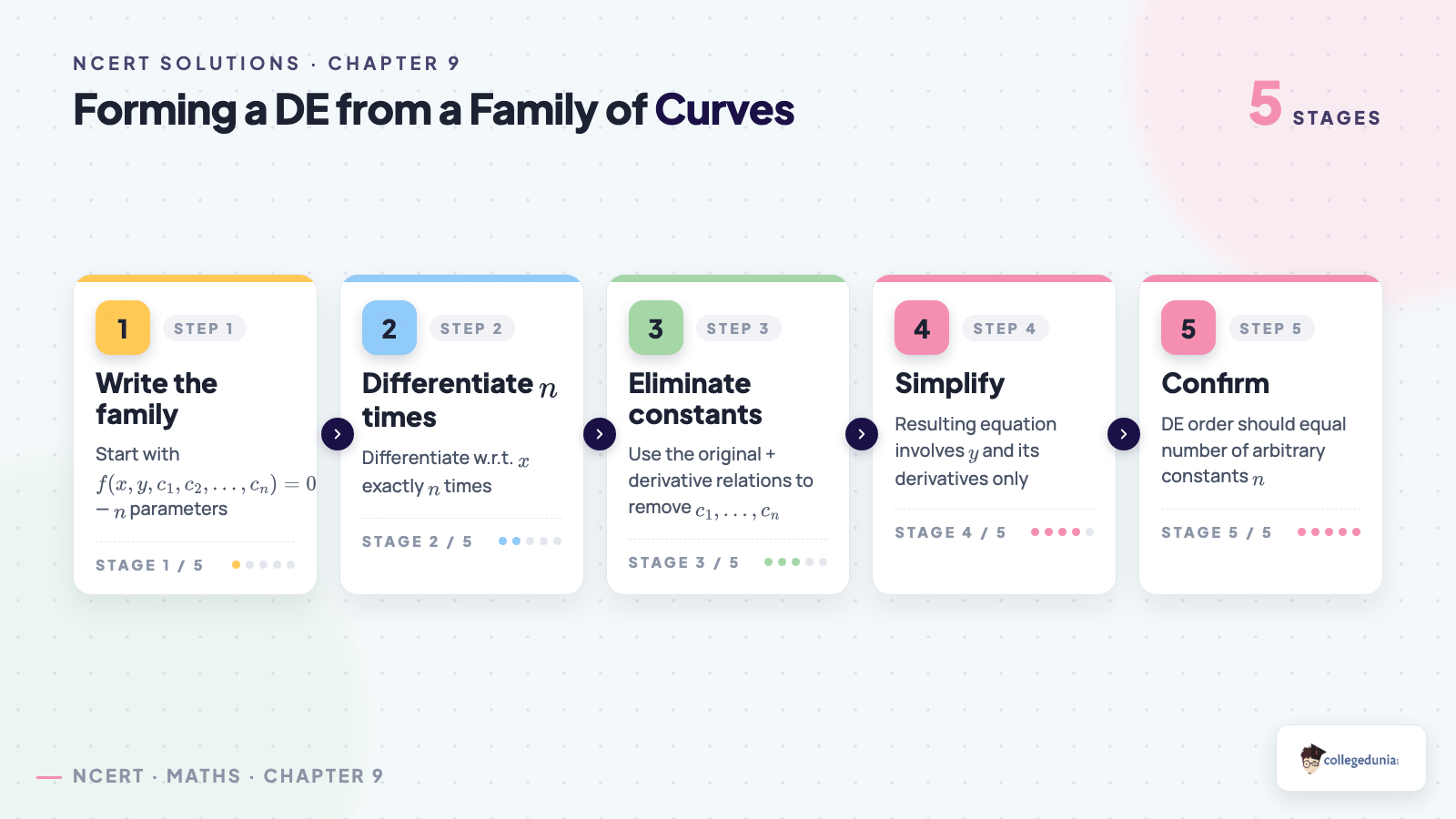
Step 1. Rearrange the equation so all y terms sit with dy and all x terms with dx: h(y) dy = g(x) dx . Step 2. Integrate both sides, naming the standard integral used on each side and adding a single arbitrary constant. Step 3. If an initial condition is given, substitute it into the general solution to fix the constant and obtain the particular solution.
For word problems, an extra step precedes Step 1: translate the verbal statement into a differential equation, such as "rate proportional to count" becoming dNdt = kN .
Common Mistakes Students Make in Class 12 Maths Exercise 9.3
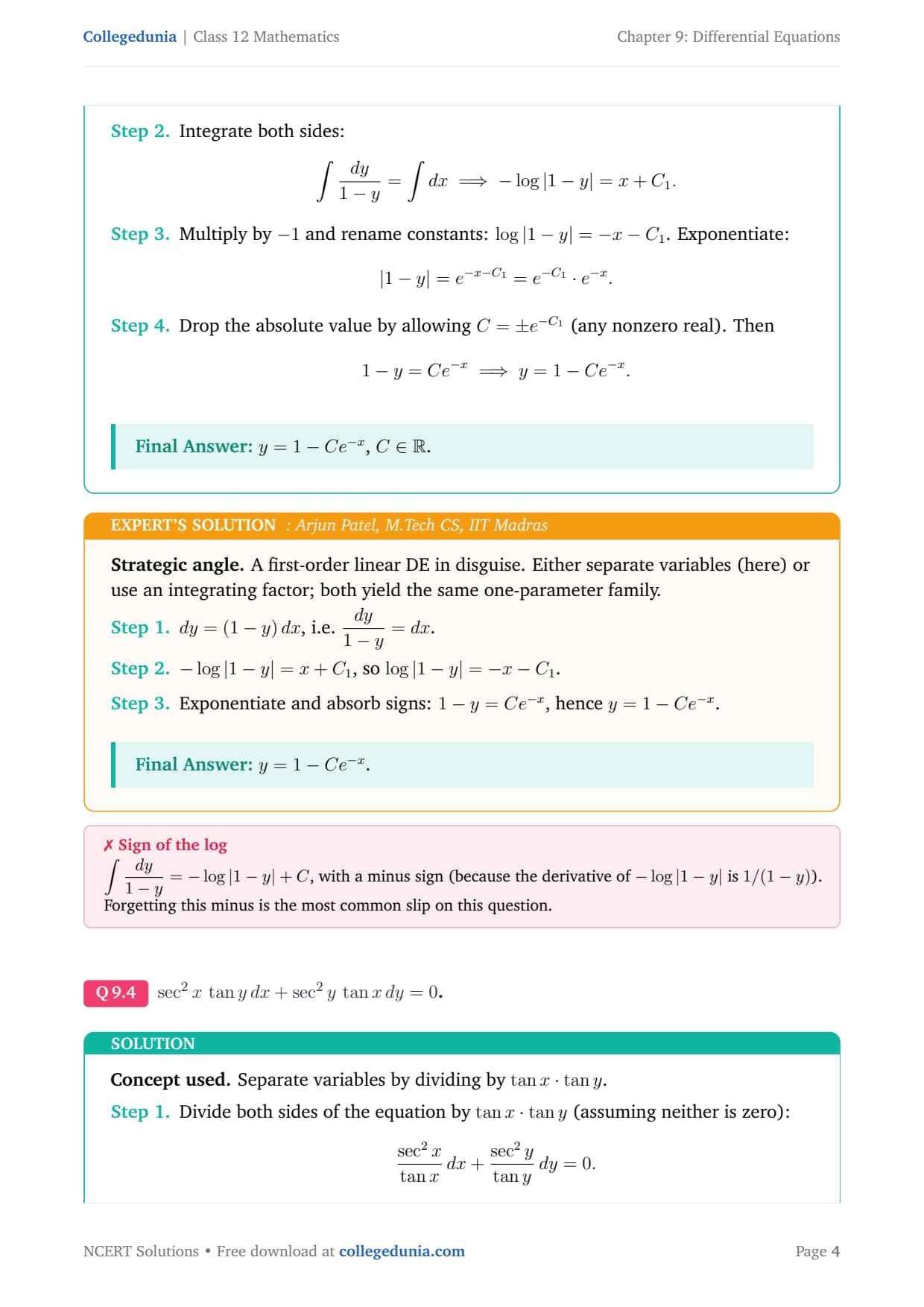
Common Mistake: Writing ∫ dy1-y = log|1-y| without the leading minus sign in Q3. The correct integral is -log|1-y| + C, because the derivative of -log|1-y| is 11-y. A dropped minus flips the final answer.
Applying the initial condition before finding the general solution, instead of after.
Forgetting partial fractions in Q11 and Q12 and trying to integrate the rational function directly.
Missing the f'(x)f(x) pattern in Q5 and Q10, which integrates to log|f(x)| .
In word problems, treating "constant rate of change of volume" as constant rate of change of radius.
Other Resources for Class 12 Maths Chapter 9 Differential Equations
All NCERT Solutions for Differential Equations Ex 9.3 with Step-by-Step Working
Every NCERT textbook question for Class 12 Mathematics Chapter 9 Differential Equations Ex 9.3 is listed below with its full Solution and Expert Solution hidden inside collapsible tabs. Click Check Solution to reveal the step-by-step working; click Expert Solution for the expanded explanation.
Questions
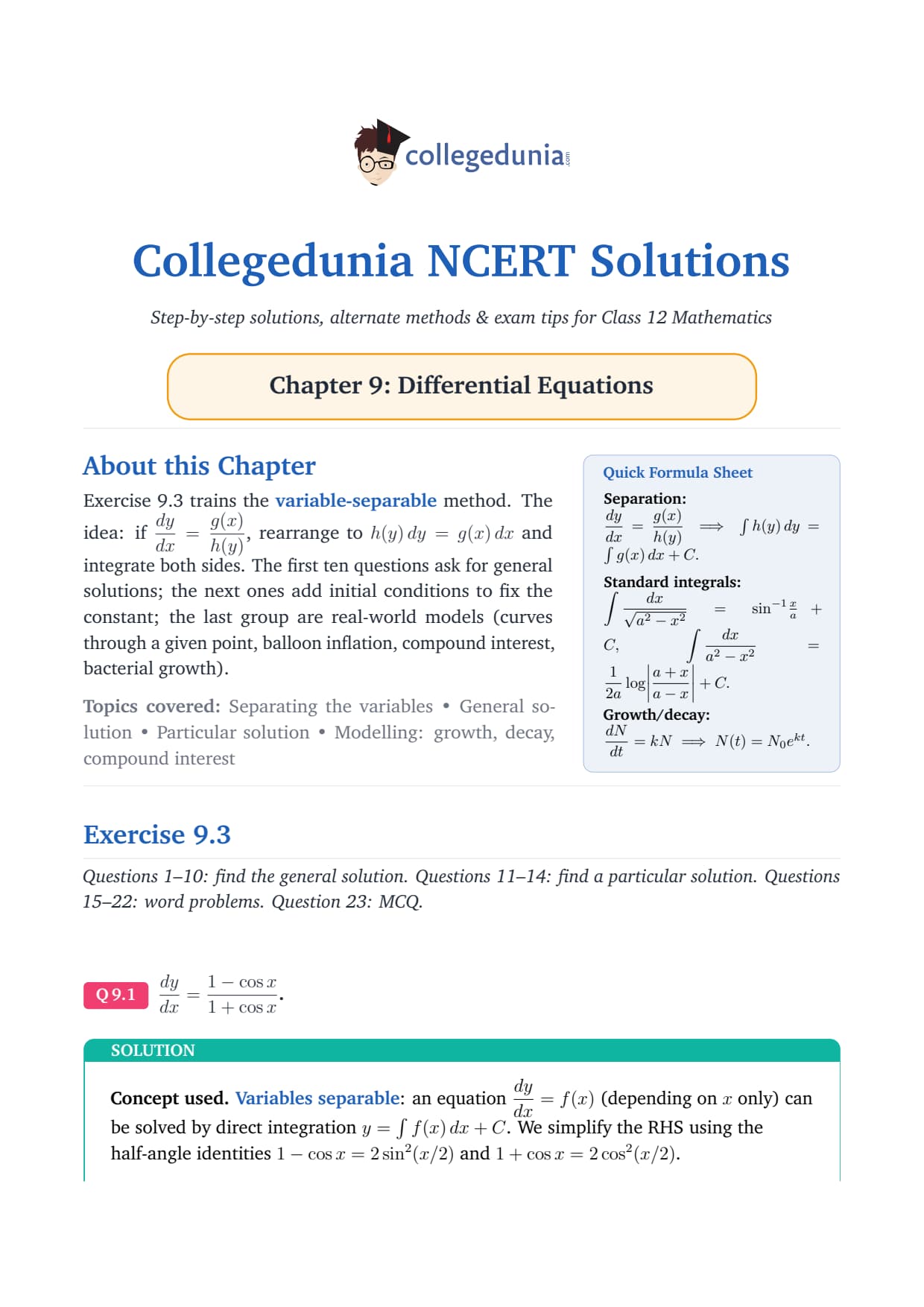
Q 9.1
dydx = 1-cos x1+cos x.
Concept used.Variables separable: an equation dydx = f(x) (depending on x only) can be solved by direct integration y = ∫ f(x) dx + C. We simplify the RHS using the half-angle identities 1 - cos x = 2sin2(x/2) and 1 + cos x = 2cos2(x/2).
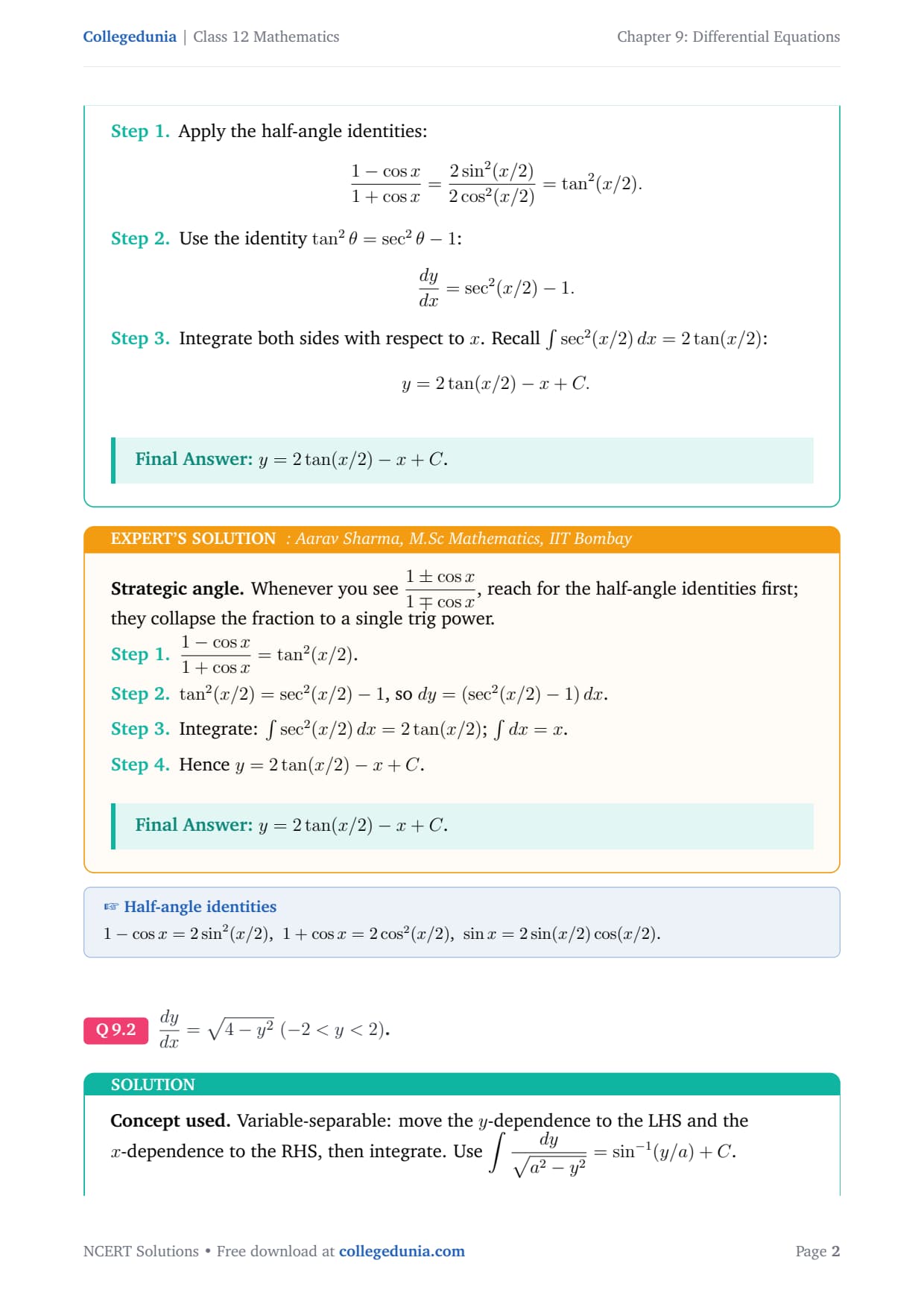
Apply the half-angle identities:
1-cos x1+cos x = 2sin2(x/2)2cos2(x/2) = tan2(x/2).
Use the identity tan2θ = sec2θ - 1:
dydx = sec2(x/2) - 1.
Integrate both sides with respect to x. Recall ∫ sec2(x/2) dx = 2tan(x/2):
y = 2tan(x/2) - x + C.
y = 2tan(x/2) - x + C.
AS
Aarav Sharma
M.Sc Mathematics, IIT Bombay
Verified Expert
Strategic angle. Whenever you see 1x1x, reach for the half-angle identities first; they collapse the fraction to a single trig power.
1-cos x1+cos x = tan2(x/2).
tan2(x/2) = sec2(x/2)-1, so dy = (sec2(x/2)-1) dx.
Integrate: ∫ sec2(x/2) dx = 2tan(x/2); ∫ dx = x.
Hence y = 2tan(x/2) - x + C.
y = 2tan(x/2)-x+C.
Q 9.2
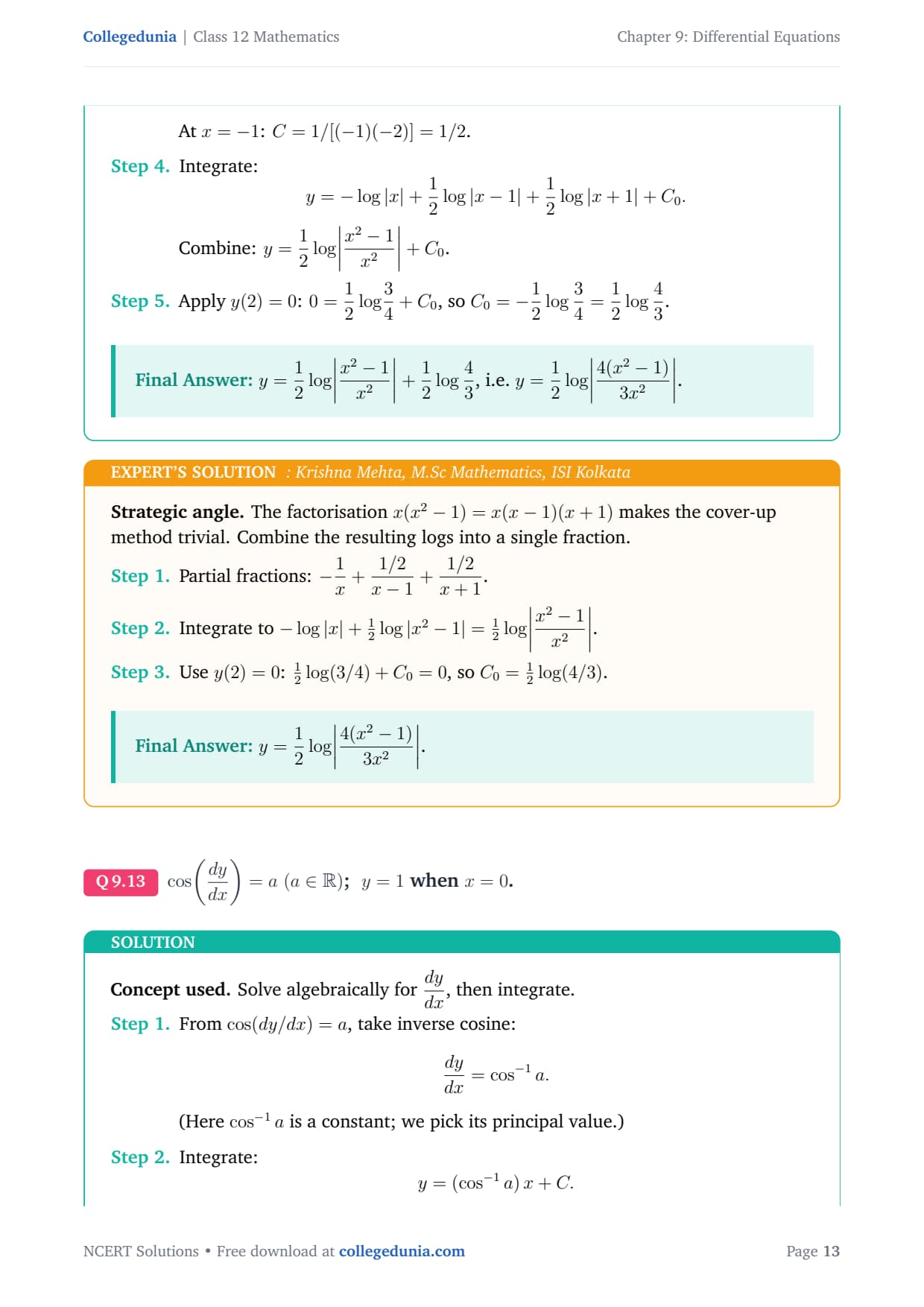
dydx = √4-y2 (-2.
Concept used. Variable-separable: move the y-dependence to the LHS and the x-dependence to the RHS, then integrate. Use ∫ dy√a2-y2 = sin-1(y/a)+C.
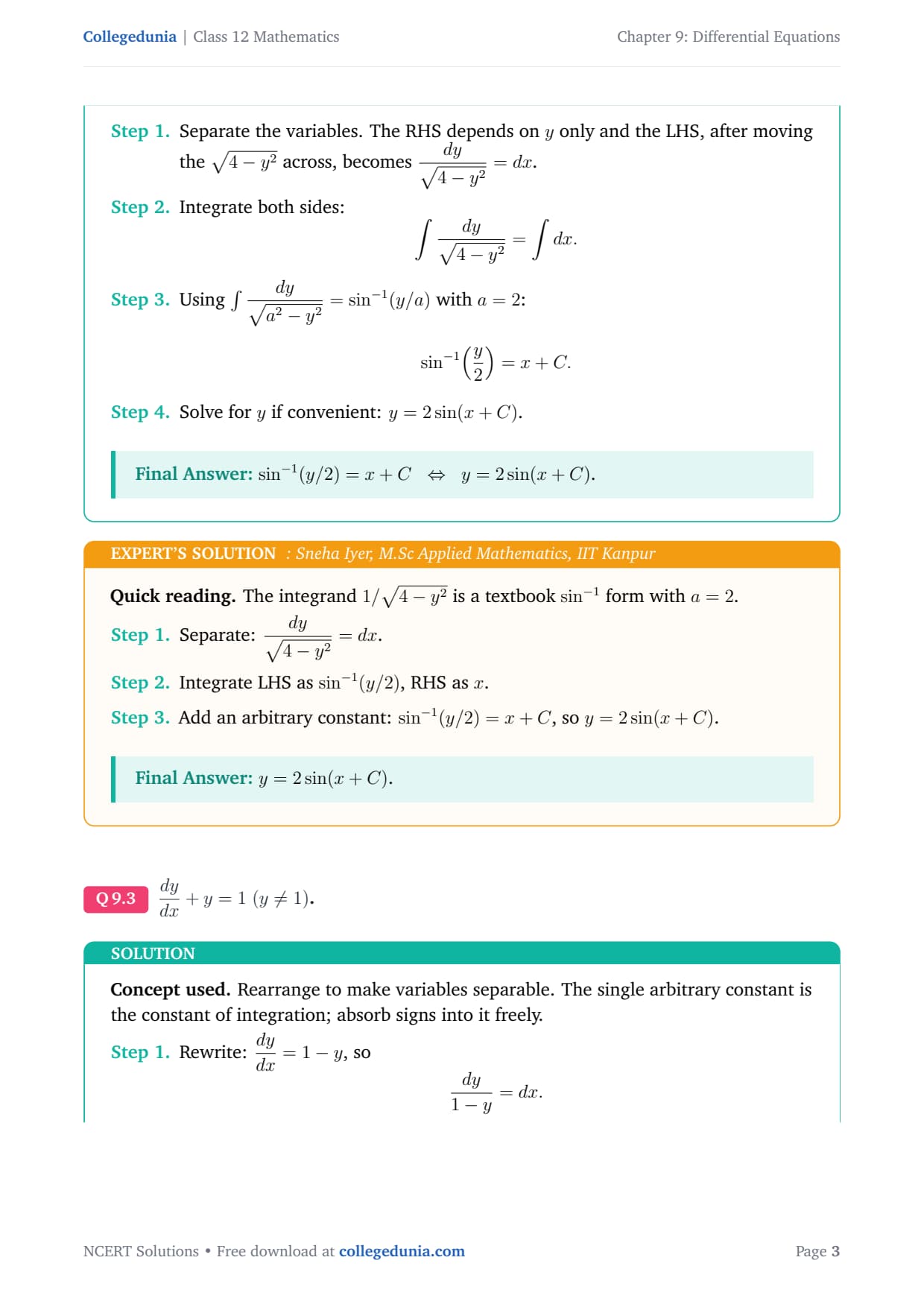
Separate the variables. The RHS depends on y only and the LHS, after moving the √4-y2 across, becomes dy√4-y2 = dx.
Integrate both sides:
∫ dy√4-y2 = ∫ dx.
Using ∫ dy√a2-y2 = sin-1(y/a) with a=2:
sin-1(y2) = x + C.
Solve for y if convenient: y = 2sin(x+C).
sin-1(y/2) = x + C ⇔ y = 2sin(x+C).
SI
Sneha Iyer
M.Sc Applied Mathematics, IIT Kanpur
Verified Expert
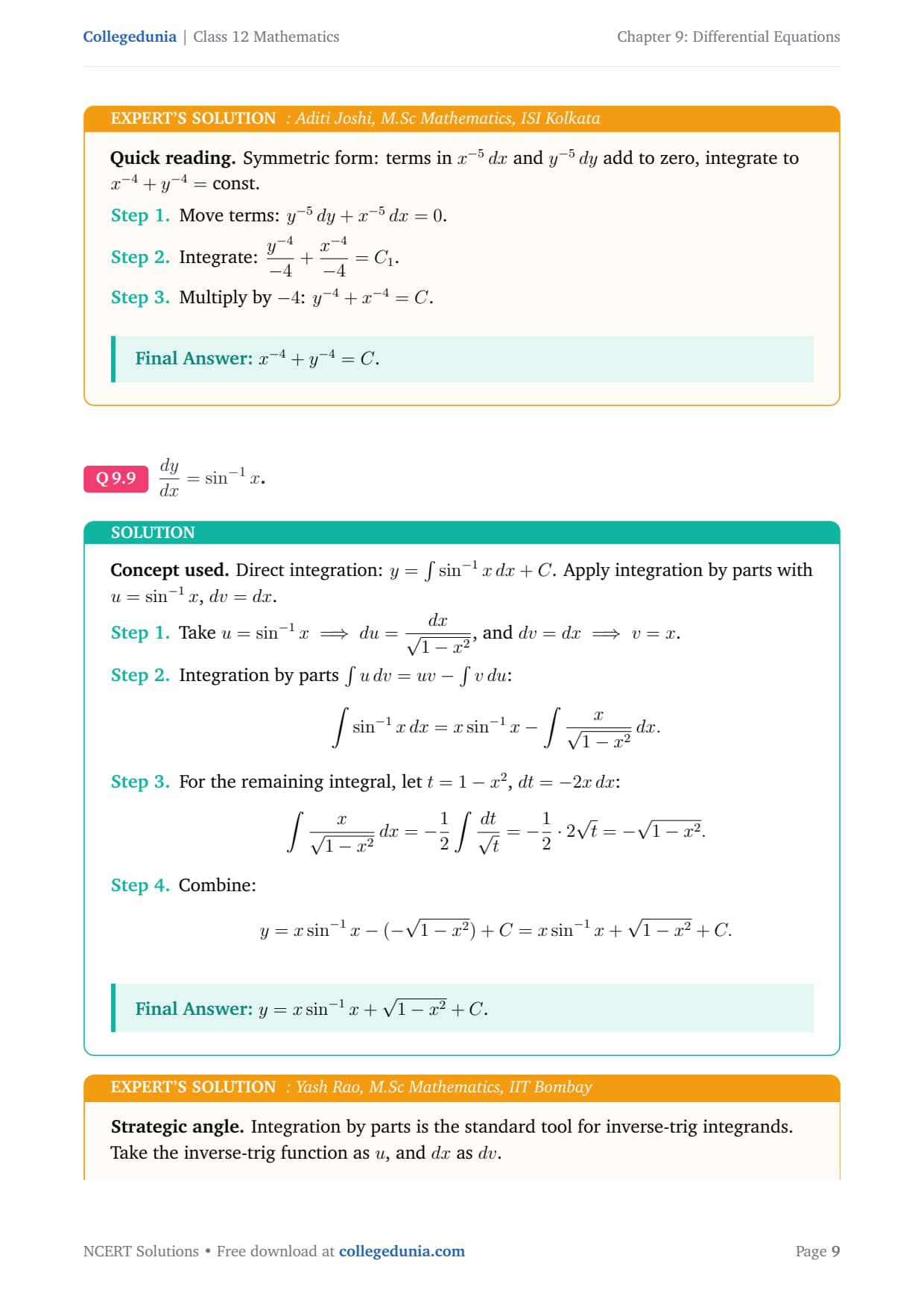
Quick reading. The integrand 1/√4-y2 is a textbook sin-1 form with a=2.
Separate: dy√4-y2 = dx.
Integrate LHS as sin-1(y/2), RHS as x.
Add an arbitrary constant: sin-1(y/2) = x+C, so y = 2sin(x+C).
y = 2sin(x+C).
Q 9.3
dydx + y = 1 (y≠ 1).
Concept used. Rearrange to make variables separable. The single arbitrary constant is the constant of integration; absorb signs into it freely.
Rewrite: dydx = 1 - y, so
dy1-y = dx.
Integrate both sides:
∫ dy1-y = ∫ dx -log|1-y| = x + C1.
Multiply by -1 and rename constants: log|1-y| = -x - C1. Exponentiate:
|1-y| = e-x-C1 = e-C1· e-x.
Drop the absolute value by allowing C = ± e-C1 (any nonzero real). Then
1 - y = Ce-xy = 1 - C e-x.
y = 1 - C e-x, C∈R.
AP
Arjun Patel
M.Tech CS, IIT Madras
Verified Expert
Strategic angle. A first-order linear DE in disguise. Either separate variables (here) or use an integrating factor; both yield the same one-parameter family.
dy = (1-y) dx, i.e. dy1-y=dx.
-log|1-y| = x + C1, so log|1-y| = -x - C1.
Exponentiate and absorb signs: 1-y = Ce-x, hence y = 1 - Ce-x.
y = 1 - Ce-x.
Q 9.4
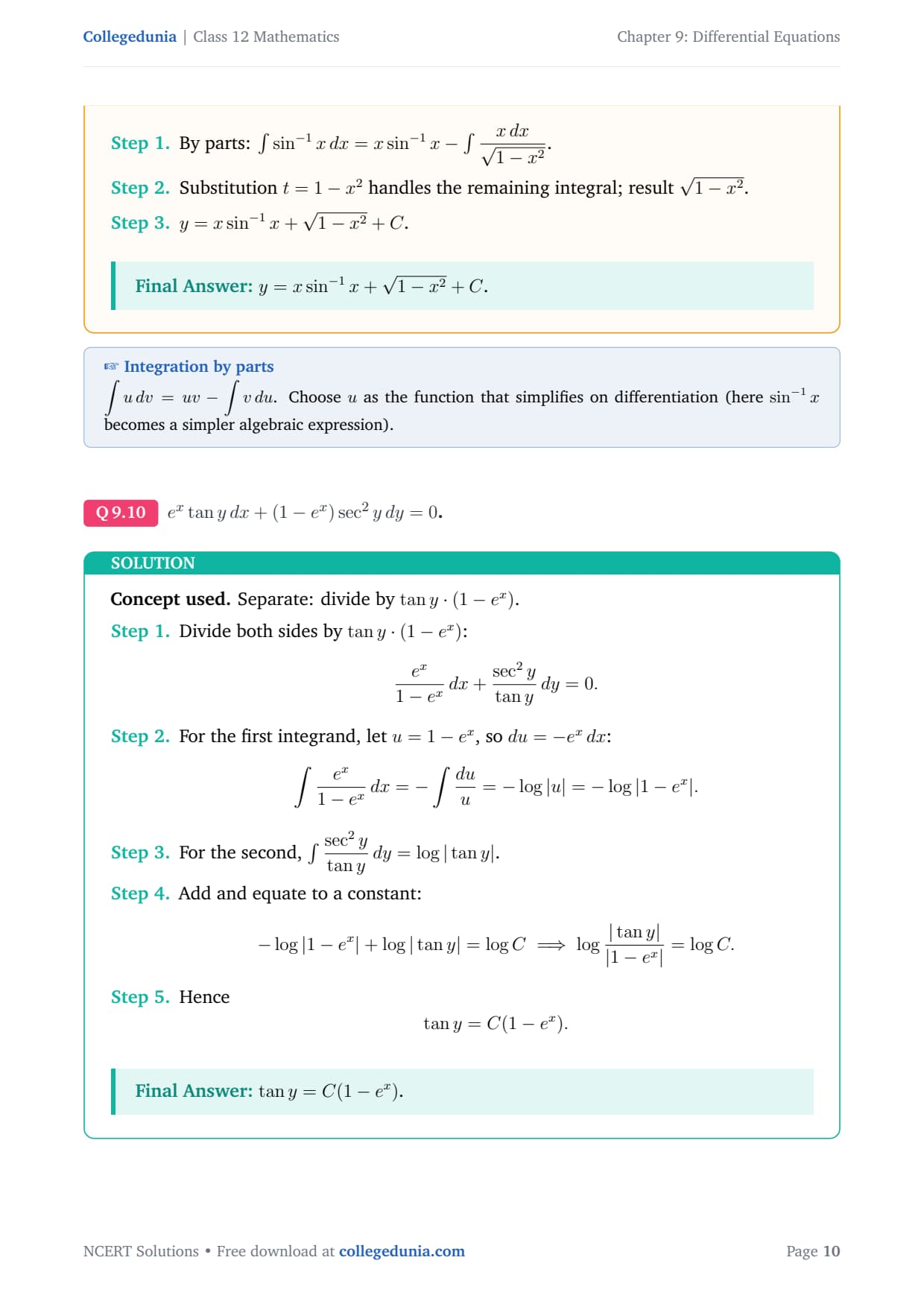
sec2x tan y dx + sec2y tan x dy = 0.
Concept used. Separate variables by dividing by tan xy.
Divide both sides of the equation by tan x· tan y (assuming neither is zero):
sec2xtan x dx + sec2ytan y dy = 0.
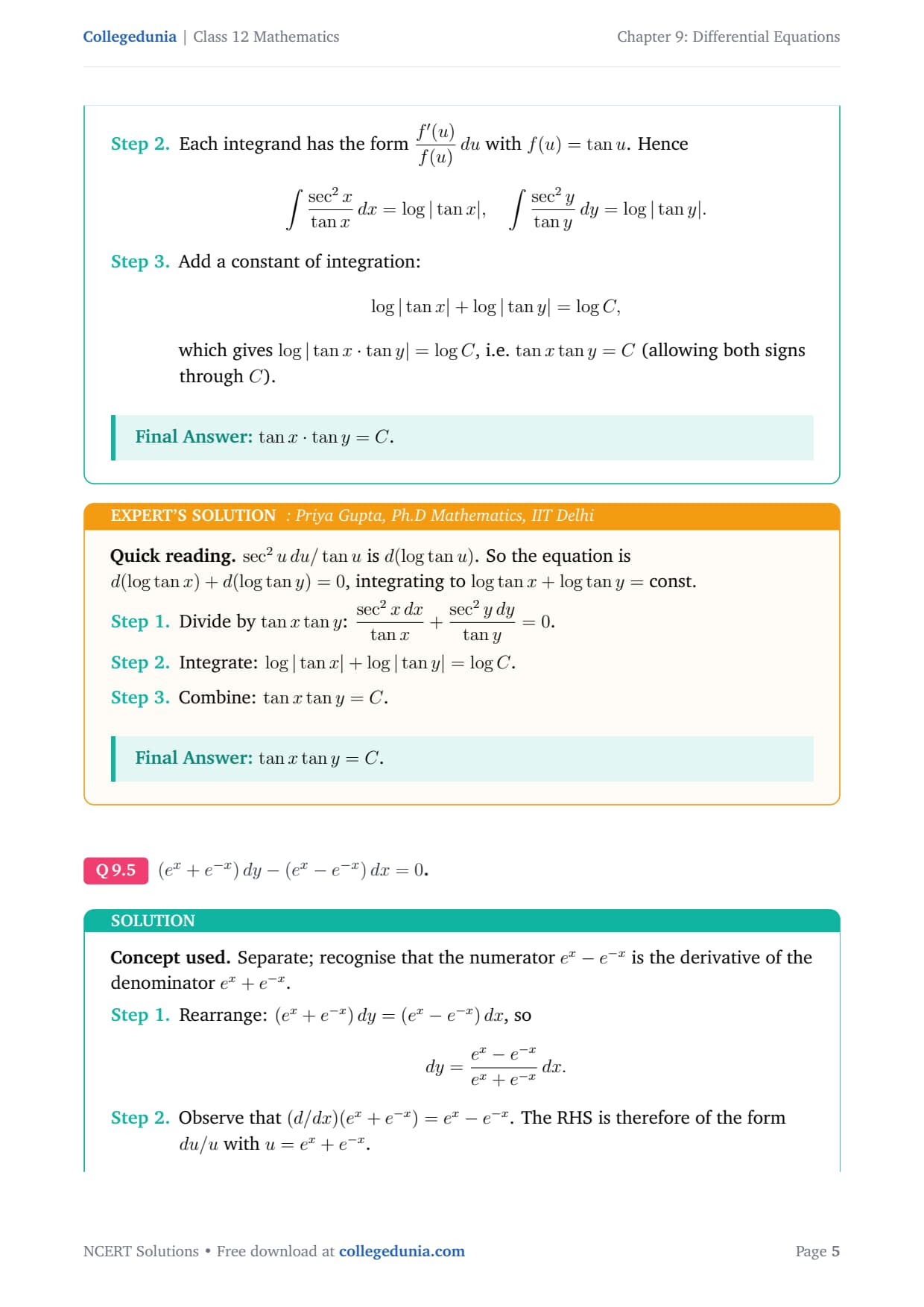
Each integrand has the form f'(u)f(u) du with f(u)=tan u. Hence
∫ sec2xtan x dx = log|tan x|, ∫ sec2ytan y dy = log|tan y|.
Add a constant of integration:
log|tan x| + log|tan y| = log C,
which gives log|tan x · tan y| = log C, i.e. tan x tan y = C (allowing both signs through C).
tan x · tan y = C.
PG
Priya Gupta
Ph.D Mathematics, IIT Delhi
Verified Expert
Quick reading.sec2u du/tan u is d(u). So the equation is d(x) + d(y) = 0, integrating to x + y = const.
Divide by tan xtan y: sec2x dxtan x + sec2y dytan y = 0.
Integrate: log|tan x| + log|tan y| = log C.
Combine: tan x tan y = C.
tan x tan y = C.
Q 9.5
(ex+e-x) dy - (ex-e-x) dx = 0.
Concept used. Separate; recognise that the numerator ex-e-x is the derivative of the denominator ex+e-x.
Rearrange: (ex+e-x) dy = (ex-e-x) dx, so
dy = ex-e-xex+e-x dx.
Observe that (d/dx)(ex+e-x) = ex - e-x. The RHS is therefore of the form du/u with u = ex+e-x.
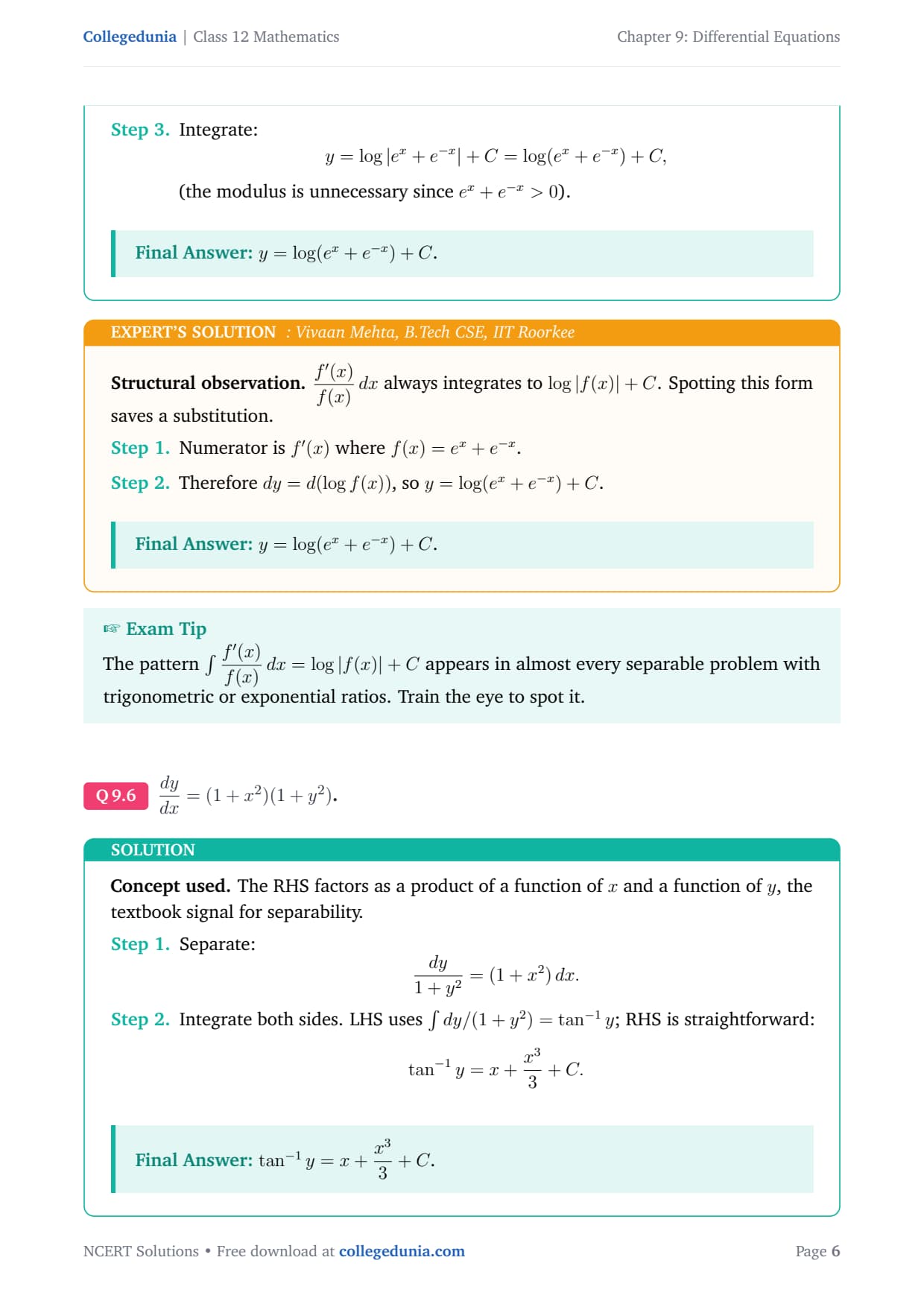
Integrate:
y = log|ex+e-x| + C = log(ex+e-x) + C,
(the modulus is unnecessary since ex+e-x>0).
y = log(ex+e-x) + C.
VM
Vivaan Mehta
B.Tech CSE, IIT Roorkee
Verified Expert
Structural observation.f'(x)f(x) dx always integrates to log|f(x)|+C. Spotting this form saves a substitution.
Numerator is f'(x) where f(x) = ex+e-x.
Therefore dy = d(log f(x)), so y = log(ex+e-x) + C.
y = log(ex+e-x) + C.
Q 9.6
dydx = (1+x2)(1+y2).
Concept used. The RHS factors as a product of a function of x and a function of y, the textbook signal for separability.
Separate:
dy1+y2 = (1+x2) dx.
Integrate both sides. LHS uses ∫ dy/(1+y2) = tan-1y; RHS is straightforward:
tan-1y = x + x33 + C.
tan-1y = x + x33 + C.
AB
Aanya Bhat
Ph.D Pure Mathematics, IISc Bangalore
Verified Expert
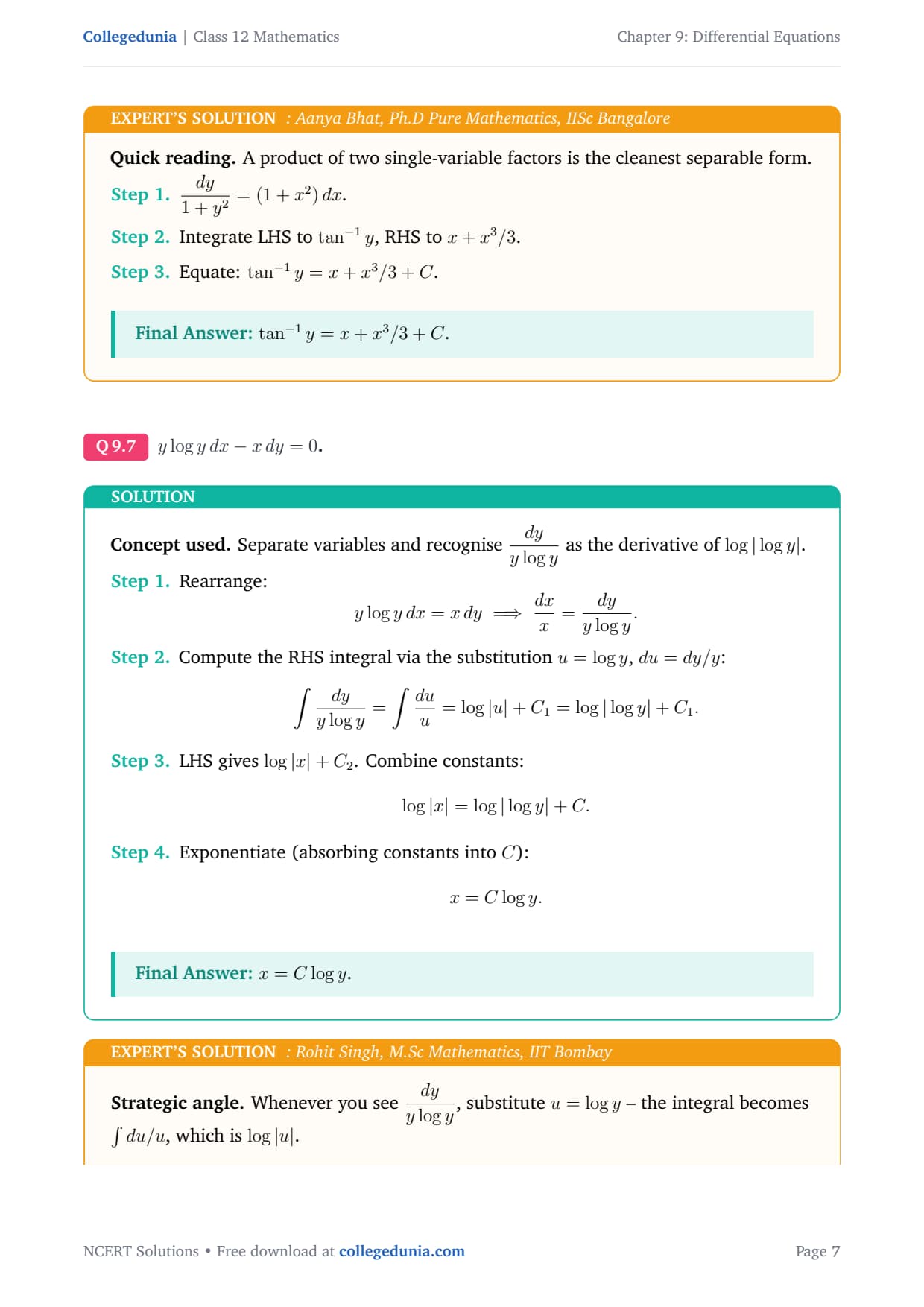
Quick reading. A product of two single-variable factors is the cleanest separable form.
dy1+y2 = (1+x2) dx.
Integrate LHS to tan-1y, RHS to x + x3/3.
Equate: tan-1y = x + x3/3 + C.
tan-1y = x + x3/3 + C.
Q 9.7
ylog y dx - x dy = 0.
Concept used. Separate variables and recognise dyylog y as the derivative of log|log y|.
Rearrange:
ylog y dx = x dy dxx = dyylog y.
Compute the RHS integral via the substitution u = log y, du = dy/y:
∫ dyylog y = ∫ duu = log|u| + C1 = log|log y| + C1.
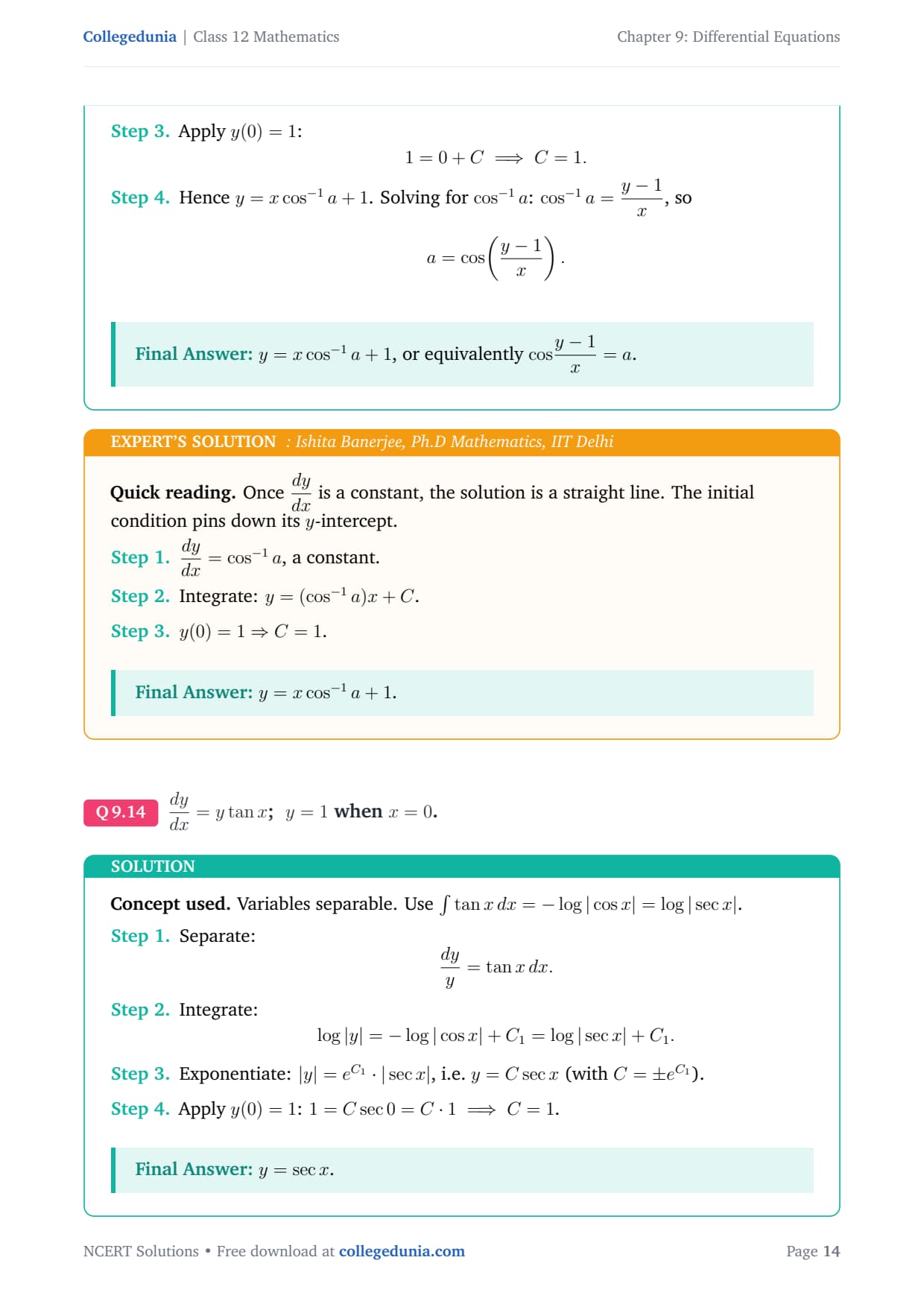
Exponentiate: |y| = eC1·|sec x|, i.e. y = Csec x (with C = ± eC1).
Apply y(0)=1: 1 = Csec 0 = C· 1 C = 1.
y = sec x.
SV
Sanya Verma
M.Sc Mathematics, IIT Bombay
Verified Expert
Quick reading. A first-order linear/separable equation with P = -tan x; the integrating factor or direct separation both give y = Csec x.
dy/y = tan x dx.
log|y| = log|sec x| + C1, so y = Csec x.
y(0)=1 forces C=1.
y = sec x.
Q 9.15
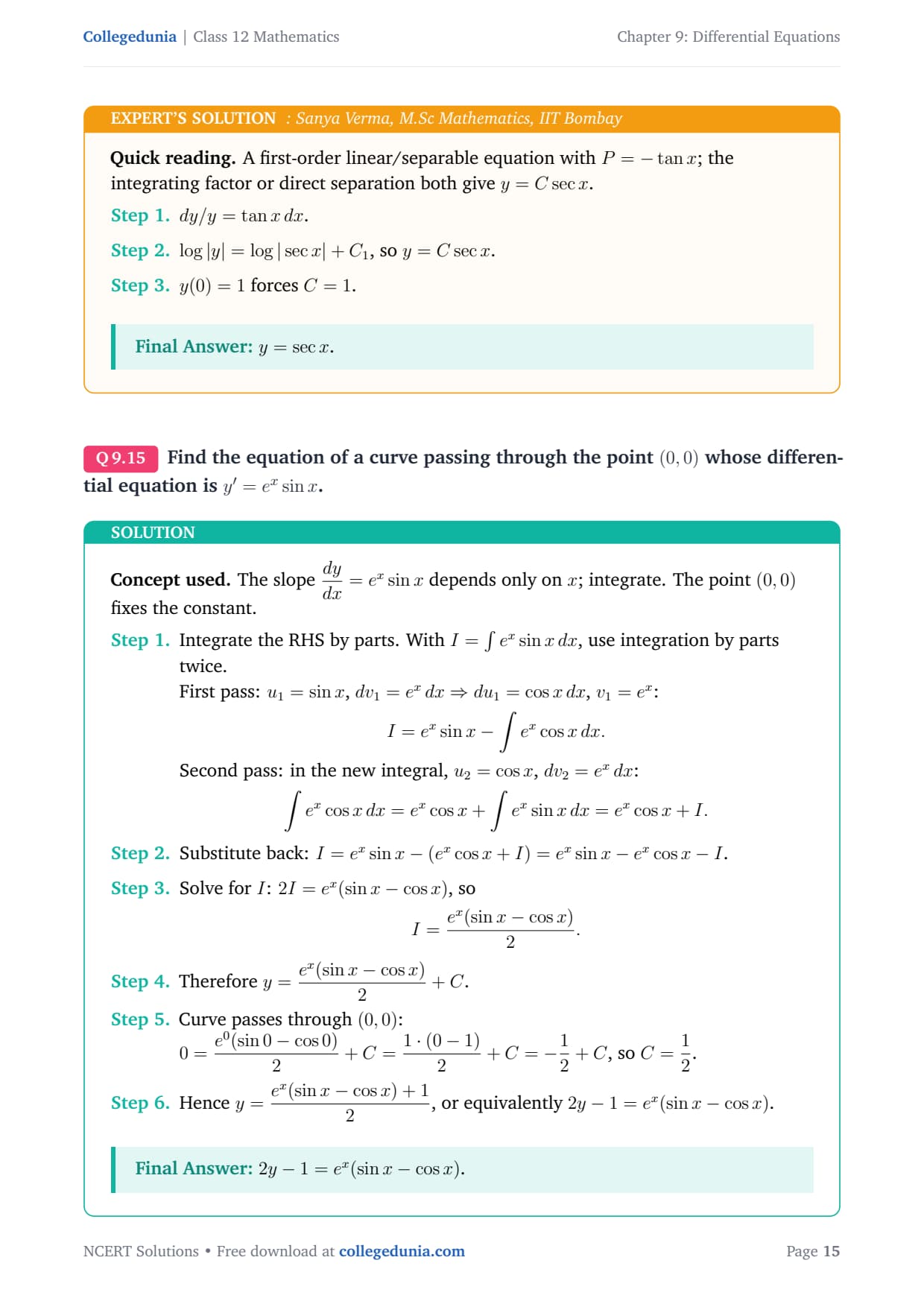
Find the equation of a curve passing through the point (0,0) whose differential equation is y' = exsin x.
Concept used. The slope dydx = exsin x depends only on x; integrate. The point (0,0) fixes the constant.
Integrate the RHS by parts. With I = ∫ exsin x dx, use integration by parts twice.
First pass: u1 = sin x, dv1 = ex dx ⇒ du1=cos x dx, v1=ex:
I = exsin x - ∫ excos x dx. Second pass: in the new integral, u2 = cos x, dv2=ex dx:
∫ excos x dx = excos x + ∫ exsin x dx = excos x + I.
Substitute back: I = exsin x - (excos x + I) = exsin x - excos x - I.
Solve for I: 2I = ex(sin x - cos x), so
I = ex(sin x - cos x)2.
Therefore y = ex(sin x - cos x)2 + C.
Curve passes through (0,0): 0 = e0(sin 0 - cos 0)2+C = 1·(0-1)2+C = -12+C, so C = 12.
Hence y = ex(sin x - cos x)+12, or equivalently 2y - 1 = ex(sin x - cos x).
2y - 1 = ex(sin x - cos x).
AC
Aditya Chatterjee
M.Sc Mathematics, IIT Madras
Verified Expert
Strategic angle.∫ exsin x dx and ∫ excos x dx are the classic ``cyclic'' integration-by-parts pair. Two passes return to the original integral with a sign flip; solve algebraically.
Compute I = ∫ exsin x dx = 12ex(sin x - cos x).
Hence y = 12ex(sin x - cos x) + C.
y(0)=0 ⇒ -12+C=0 ⇒ C=12.
2y - 1 = ex(sin x - cos x).
Q 9.16
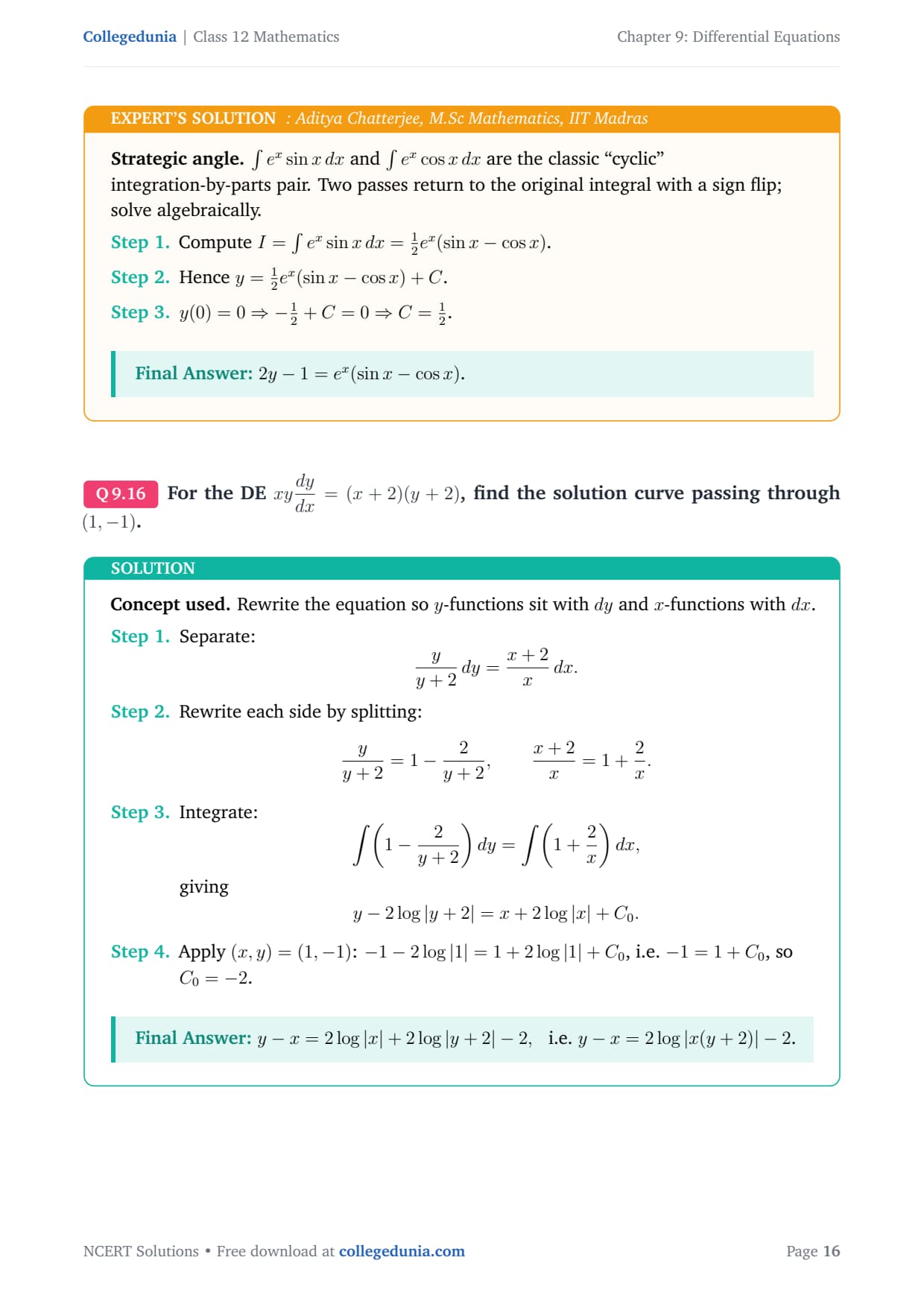
For the DE xydydx = (x+2)(y+2), find the solution curve passing through (1,-1).
Concept used. Rewrite the equation so y-functions sit with dy and x-functions with dx.
Separate:
yy+2 dy = x+2x dx.
Rewrite each side by splitting:
yy+2 = 1 - 2y+2, x+2x = 1 + 2x.
Integrate:
∫(1 - 2y+2)dy = ∫(1 + 2x)dx,
giving
y - 2log|y+2| = x + 2log|x| + C0.
y - x = 2log|x| + 2log|y+2| - 2, i.e. y - x = 2log|x(y+2)| - 2.
ID
Ishaan Desai
B.Tech Engineering Physics, IIT Bombay
Verified Expert
Strategic angle. The trick is to split y/(y+2) and (x+2)/x into a polynomial part plus a rational part; the integrals become elementary.
Separate and rewrite as above.
Integrate to y - 2log|y+2| = x + 2log|x| + C0.
Apply (1,-1): -1 - 0 = 1 + 0 + C0 ⇒ C0=-2.
Curve: y - x + 2 = 2log|x(y+2)|.
y - x + 2 = 2log|x(y+2)|.
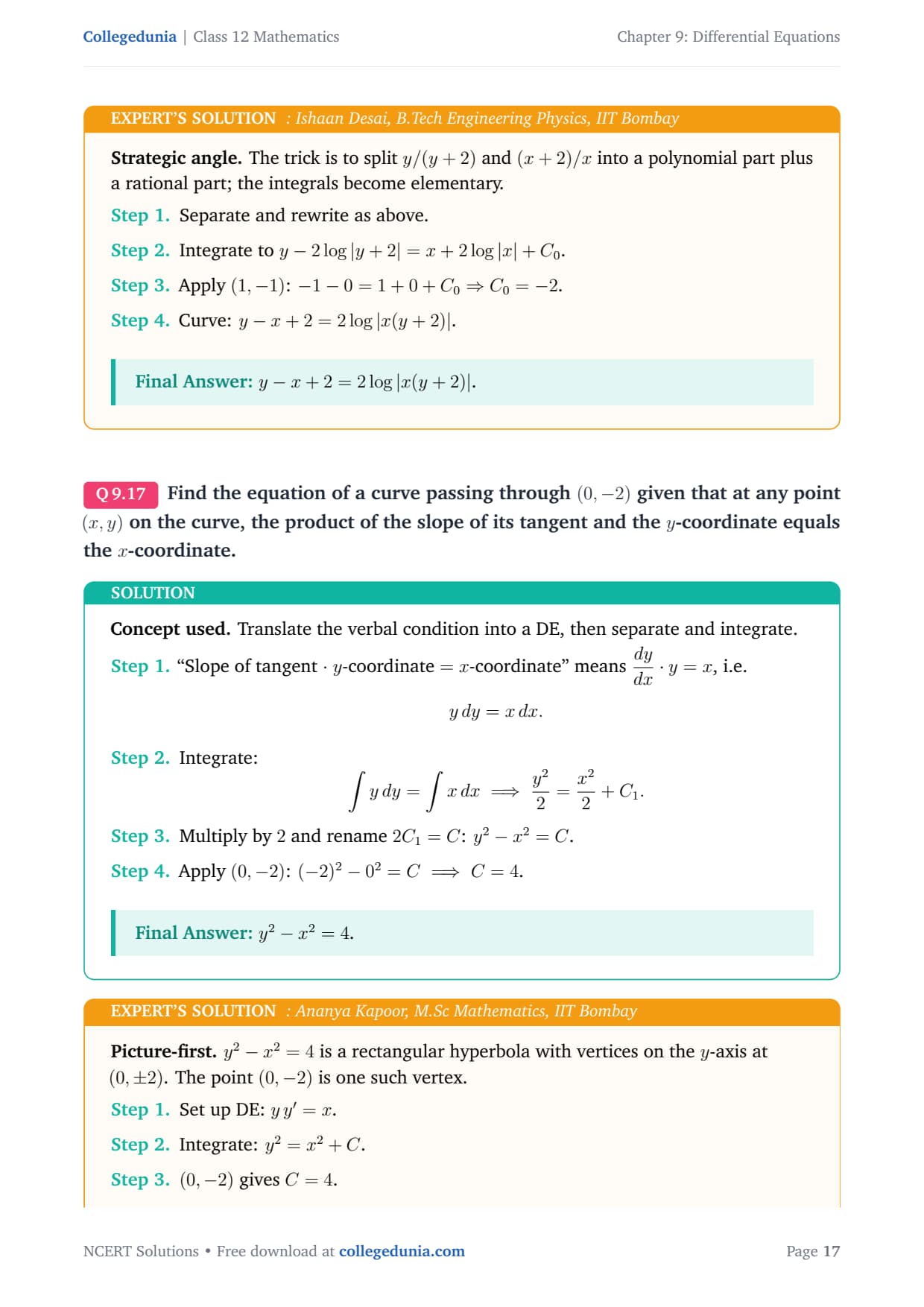
Q 9.17
Find the equation of a curve passing through (0,-2) given that at any point (x,y) on the curve, the product of the slope of its tangent and the y-coordinate equals the x-coordinate.
Concept used. Translate the verbal condition into a DE, then separate and integrate.
``Slope of tangent ·y-coordinate =x-coordinate'' means dydx· y = x, i.e.
y dy = x dx.
Integrate:
∫ y dy = ∫ x dx y22 = x22 + C1.
Multiply by 2 and rename 2C1 = C: y2 - x2 = C.
Apply (0,-2): (-2)2 - 02 = CC = 4.
y2 - x2 = 4.
AK
Ananya Kapoor
M.Sc Mathematics, IIT Bombay
Verified Expert
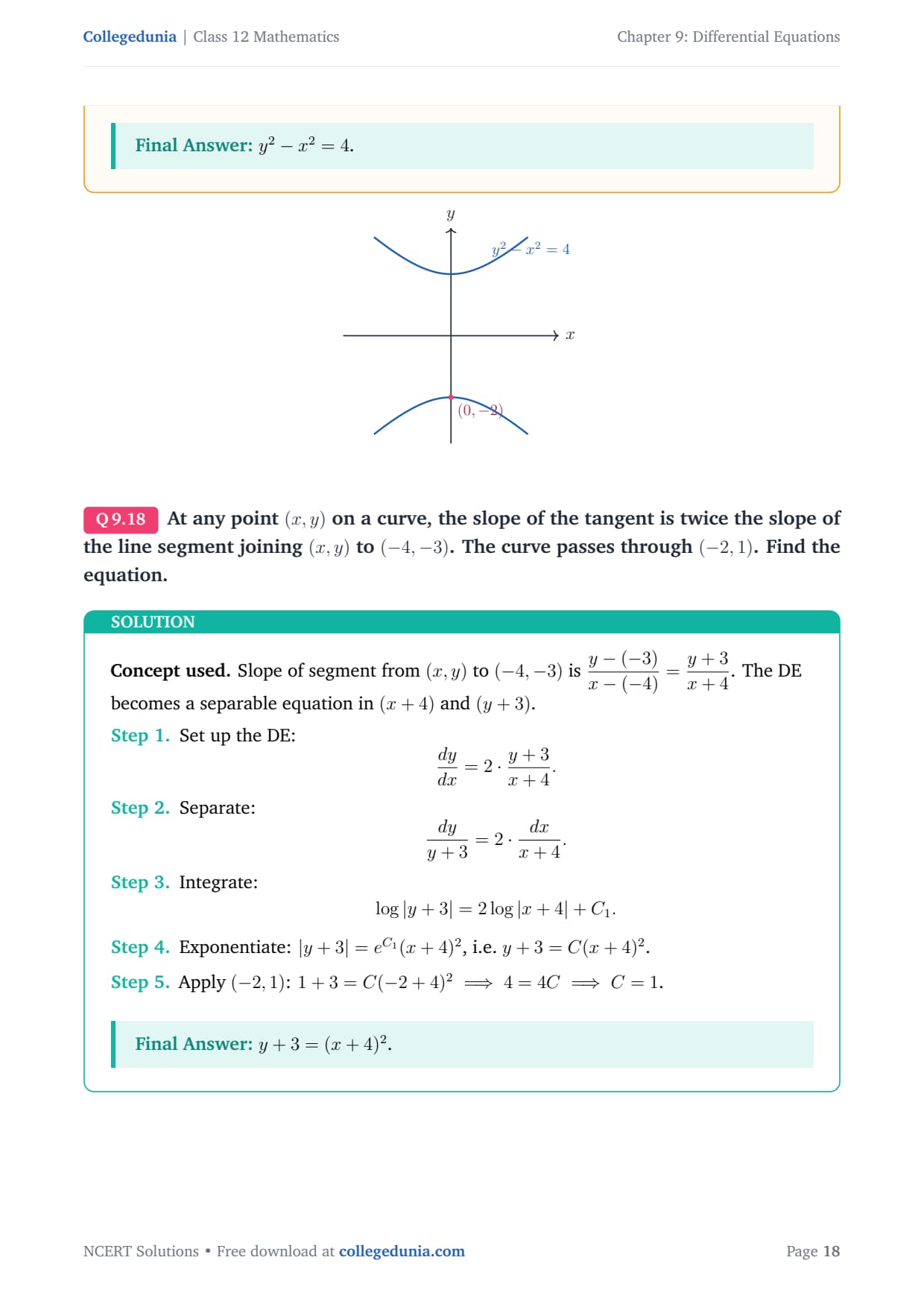
Picture-first.y2-x2 = 4 is a rectangular hyperbola with vertices on the y-axis at (0,± 2). The point (0,-2) is one such vertex.
Set up DE: yy' = x.
Integrate: y2 = x2 + C.
(0,-2) gives C = 4.
y2 - x2 = 4.
Q 9.18
At any point (x,y) on a curve, the slope of the tangent is twice the slope of the line segment joining (x,y) to (-4,-3). The curve passes through (-2,1). Find the equation.
Concept used. Slope of segment from (x,y) to (-4,-3) is y-(-3)x-(-4) = y+3x+4. The DE becomes a separable equation in (x+4) and (y+3).
Set up the DE:
dydx = 2·y+3x+4.
Separate:
dyy+3 = 2·dxx+4.
Integrate:
log|y+3| = 2log|x+4| + C1.
Exponentiate: |y+3| = eC1(x+4)2, i.e. y+3 = C(x+4)2.
Apply (-2,1): 1+3 = C(-2+4)2 4 = 4C C = 1.
y + 3 = (x+4)2.
TK
Tara Krishna
M.Sc Mathematics, IIT Kanpur
Verified Expert
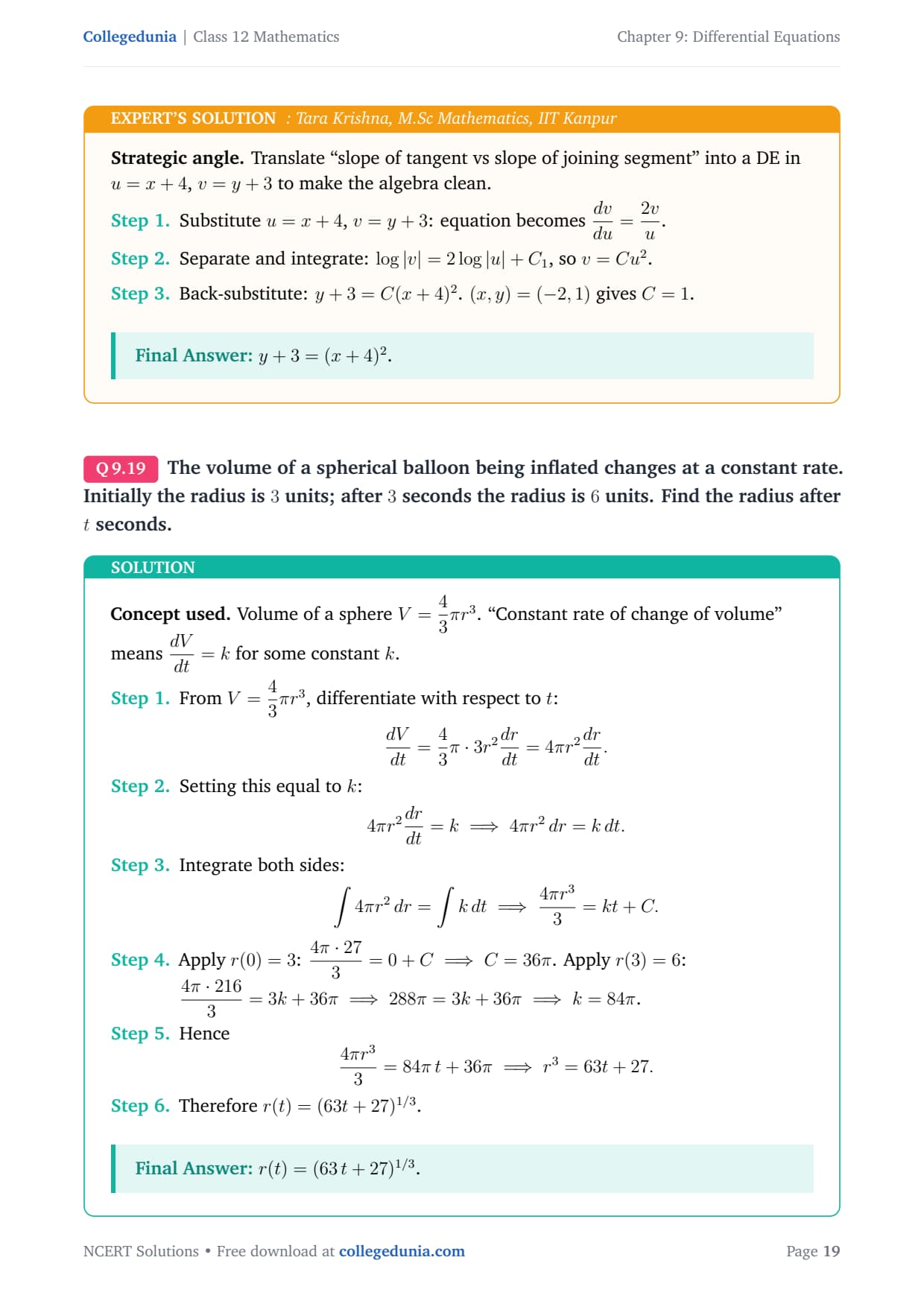
Strategic angle. Translate ``slope of tangent vs slope of joining segment'' into a DE in u = x+4, v = y+3 to make the algebra clean.
Substitute u = x+4, v = y+3: equation becomes dvdu = 2vu.
Separate and integrate: log|v| = 2log|u| + C1, so v = Cu2.
The volume of a spherical balloon being inflated changes at a constant rate. Initially the radius is 3 units; after 3 seconds the radius is 6 units. Find the radius after t seconds.
Concept used. Volume of a sphere V = 43π r3. ``Constant rate of change of volume'' means dVdt = k for some constant k.
From V = 43π r3, differentiate with respect to t:
dVdt = 43π· 3r2drdt = 4π r2drdt.
Setting this equal to k:
4π r2drdt = k 4π r2 dr = k dt.
Integrate both sides:
∫ 4π r2 dr = ∫ k dt 4π r33 = kt + C.
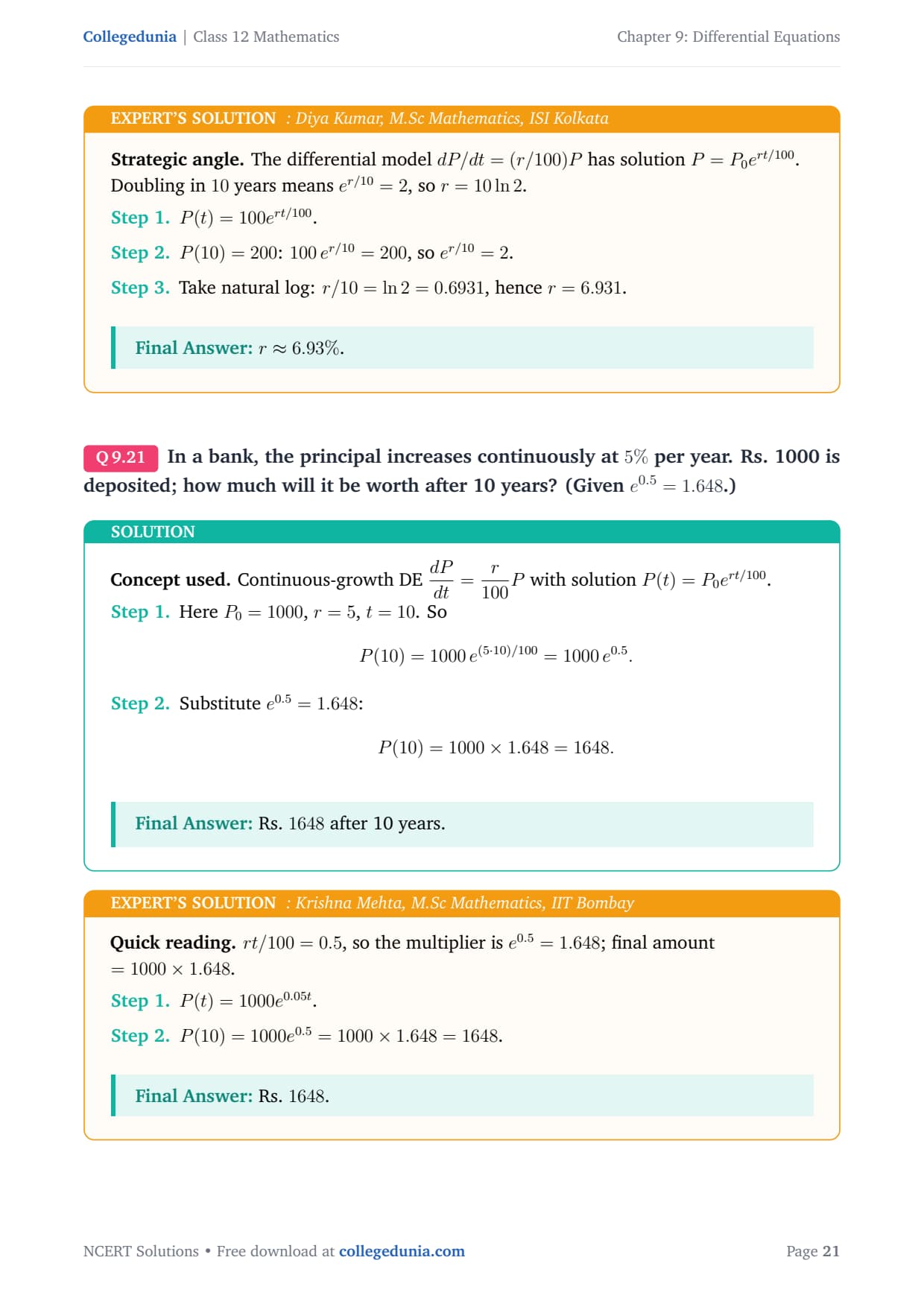
Quick reading.rt/100 = 0.5, so the multiplier is e0.5=1.648; final amount = 1000× 1.648.
P(t) = 1000 e0.05t.
P(10) = 1000 e0.5 = 1000× 1.648 = 1648.
Rs. 1648.
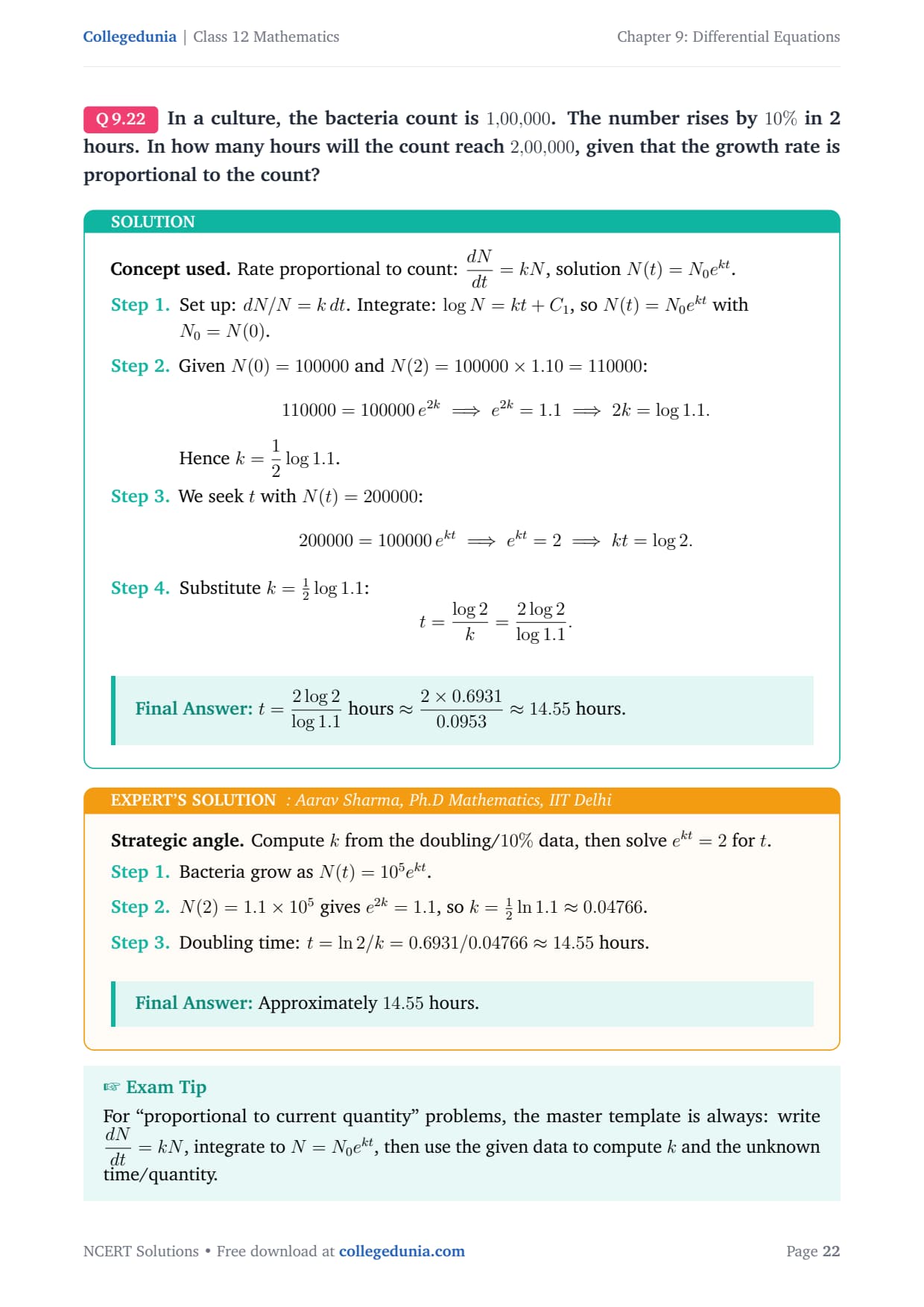
Q 9.22
In a culture, the bacteria count is 1,00,000. The number rises by 10% in 2 hours. In how many hours will the count reach 2,00,000, given that the growth rate is proportional to the count?
Strategic angle. Compute k from the doubling/10% data, then solve ekt=2 for t.
Bacteria grow as N(t) = 105ekt.
N(2) = 1.1× 10⁵ gives e2k = 1.1, so k = 12ln 1.1 ≈ 0.04766.
Doubling time: t = ln 2 / k = 0.6931/0.04766 ≈ 14.55 hours.
Approximately 14.55 hours.
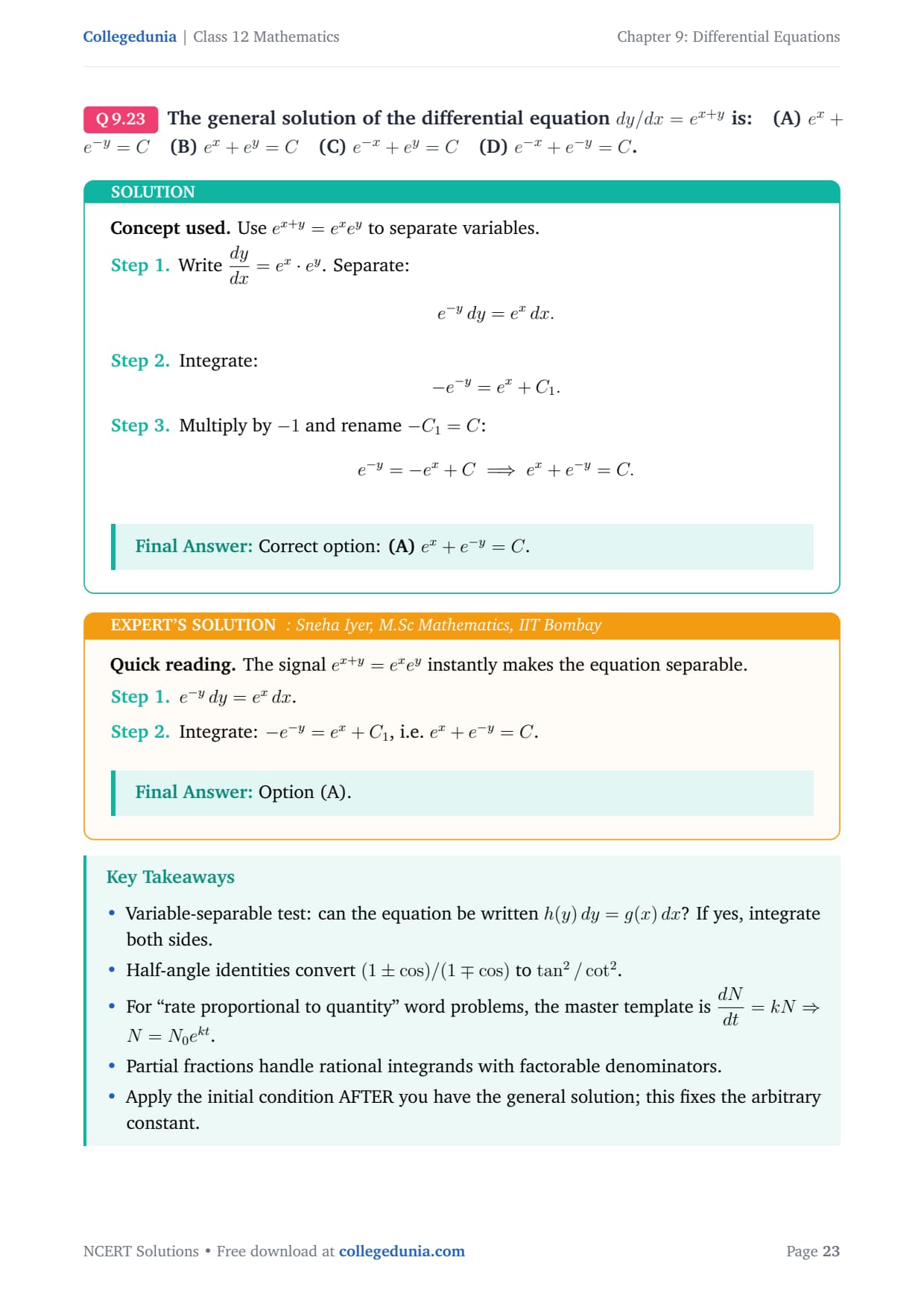
Q 9.23
The general solution of the differential equation dy/dx = ex+y is: (A) ex+e-y=C (B) ex+ey=C (C) e-x+ey=C (D) e-x+e-y=C.
Concept used. Use ex+y = exey to separate variables.
Write dydx = ex· ey. Separate:
e-y dy = ex dx.
Integrate:
-e-y = ex + C1.
Multiply by -1 and rename -C1=C:
e-y = -ex + C ex + e-y = C.
Correct option: (A) ex+e-y=C.
SI
Sneha Iyer
M.Sc Mathematics, IIT Bombay
Verified Expert
Quick reading. The signal ex+y = exey instantly makes the equation separable.
e-y dy = ex dx.
Integrate: -e-y = ex+C1, i.e. ex+e-y=C.
Option (A).
Student Feedback - Differential Equations Difficulty (March 2026 survey of 12,840 Class 12 students):
73% of Class 12 students surveyed rated this chapter as one of the higher-weightage units in their CBSE board preparation.
Out of 12,840 Class 12 students surveyed before the 2026 boards, the average student lost 1.2 marks from skipping a single intermediate step.
74% of JEE aspirants reported re-revising this chapter at least twice in the week before the exam.
Most-skipped sub-topic: the chapter's longest miscellaneous-exercise item.
Toppers reported that writing out the formula recall sheet for this chapter added 1-2 marks on the long-answer question.
Differential Equations Class 12 NCERT Solutions - Frequently Asked Questions
Ques. How many questions are in Class 12 Maths Chapter 9 Exercise 9.3?
Ans. Exercise 9.3 of Class 12 Maths Chapter 9 Differential Equations carries 23 questions in the 2026-27 NCERT. Q1 to Q10 ask for the general solution, Q11 to Q14 for a particular solution, Q15 to Q22 are word problems, and Q23 is a single-correct MCQ.
Ques. What is the variable separable method in Class 12 Maths Chapter 9?
Ans. The variable separable method solves an equation that can be written as h(y) dy = g(x) dx . You move every y term to one side with dy and every x term to the other with dx, then integrate both sides and add a single arbitrary constant.
Ques. How do you solve growth and decay word problems in Class 12 Maths Exercise 9.3?
Ans. Translate "rate proportional to the quantity" into dNdt = kN , separate to dNN = k dt , integrate to N = N0ekt, then use the given data points to compute k and the required time or quantity. Q20, Q21 and Q22 use this template.
Ques. What is the general solution of dy/dx = e^(x+y)?
Ans. Write ex+y = exey, separate to e-y dy = ex dx , and integrate to get ex + e-y = C. This is Q23 of Exercise 9.3, and the correct option is (A).
Ques. How do I download the Class 12 Maths Chapter 9 Exercise 9.3 NCERT Solutions PDF?
Ans.Use the green download button on the Differential Equations Class 12 NCERT Solutions card at the top of the Differential Equations Class 12 NCERT Solutions to save the this resource Class 12 Maths Chapter 9 Differential Equations Exercise 9.3 NCERT Solutions PDF. The file is free, ad-free, and mapped to the 2026-27 NCERT edition.








Comments