Maths Mentor, Delhi University | Updated 3+ months ago
The Integrals Class 12 NCERT Solutions solve every problem of Exercise 7.6 in Class 12 Mathematics Chapter 7 Integrals. The working follows the order taught in the NCERT textbook, so students can move directly between the PDF page and the matching answer without re-reading the theory.
At a glance: 24 sums · integration by parts · ILATE rule · 22 direct + 2 MCQs · PDF size ~7 MB
CBSE Weightage: Exercise 7.6 problems feed the 3-mark and 5-mark slots inside the Integrals 9-11 mark block.
JEE Main Weightage: Integration by parts contributes roughly 3% of Calculus questions; recurrent in JEE Advanced as well.
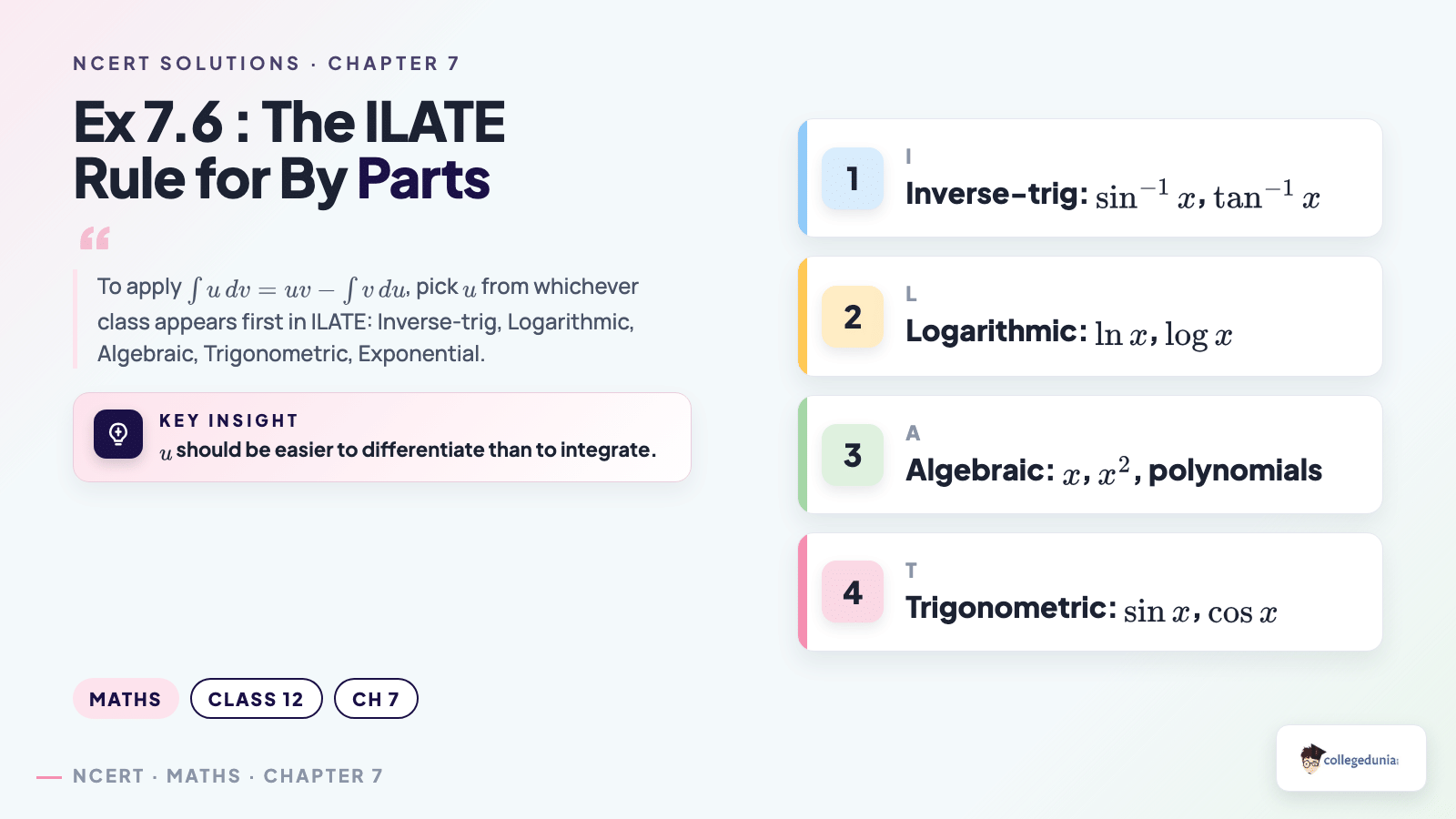
Every solved sum in the this chapter opens by labelling u and dv using the ILATE mnemonic (Inverse, Logarithmic, Algebraic, Trigonometric, Exponential) so the integration by parts step is never a guess. Special cases like ∫ ex [f(x) + f'(x)] dx = exf(x) + C and the repeated-integration trick for ∫ eax sin bx dx get full working.
The Collegedunia editorial team has cross-checked every answer against the official NCERT key and the 2026-27 revised textbook. Each problem cites the relevant Section 7.6 formula number so cross-referencing is one-step.
How the Integrals Class 12 NCERT Solutions on the Integrals Class 12 NCERT Solutions Help You
This page follows the same question order as the NCERT textbook.
Integration by parts is the technique where students lose marks not in the algebra but in choosing the wrong u. The Collegedunia solutions name the ILATE order, write the choice of u and dv on its own line, then apply the formula.
ILATE labelling at the top of every solve, e.g. "Let u = x (Algebraic), dv = sin x dx (Trigonometric)".
Expert's Solution after each main solve where the ∫ ex [f(x) + f'(x)] dx shortcut would save 2-3 steps.
What Exercise 7.6 Covers: The Integration by Parts Problem Map
Each answer below is numbered to match the NCERT textbook question order.
The 24 sums group by which two functions appear in the product: algebraic-trigonometric, algebraic-exponential, logarithmic, and inverse-trigonometric.
Q range
Integrand type
Choice of u (ILATE)
Standard answer form
1-3
x sin x, x sin 3x , x2 ex
Algebraic x or x2
Polynomial × trig / exponential
4-6
x log x, x log 2x , x2 log x
Logarithmic log x
Polynomial log x minus polynomial
7-9
tan-1x, cos-1x, x cos-1x
Inverse trig
Inverse trig term + algebraic correction
10-14
(sin-1x)2, x (log x)2, powers
Inverse / log (repeated parts)
Multi-term answer
15-18
log(log x) , x sec2x, x tan-1x
Mixed ILATE
Mixed answer form
19-22
ex sec x (1 + tan x) , ex (1+sin x1+cos x)
ex [f(x)+f'(x)] shortcut
exf(x) + C
23-24
MCQ types
Pattern recognition
Match to options
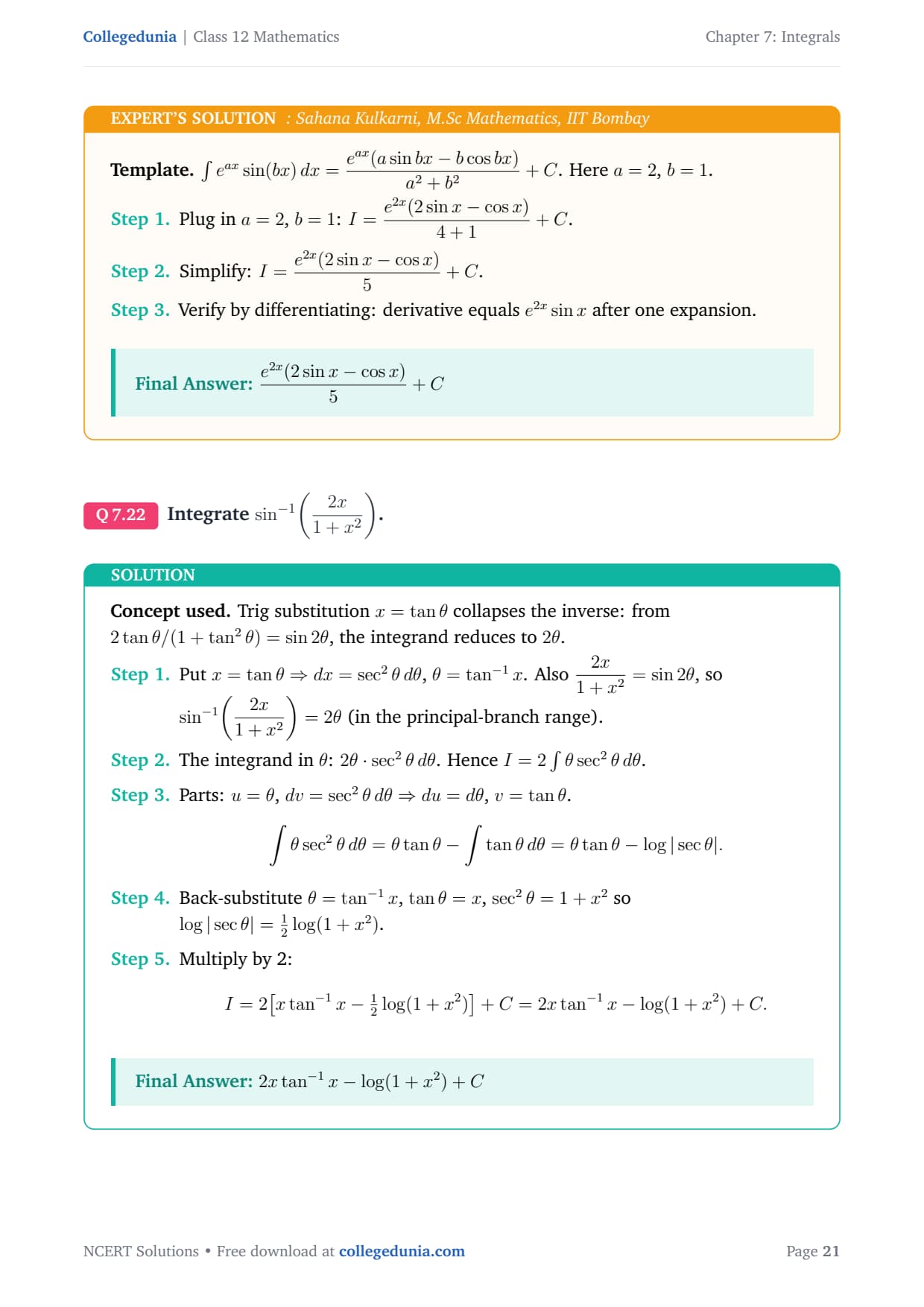
Q22 appeared in the CBSE 2024 board paper as a 5-mark question on ∫ tan-1x dx .
Class 12th Maths Chapter 7 Exercise 7.6: Solved-Example Highlights
The PDF includes full working for every sum. Two highlights below show the typical structure.
Q1 ( ∫ x sin x dx ): ILATE picks u = x, dv = sin x dx; then du = dx, v = -cos x. Apply the formula: -x cos x - ∫ (-cos x) dx = -x cos x + sin x + C.
Q22 ( ∫ tan-1x dx ): Treat as tan-1x · 1 . ILATE picks u = tan-1x, dv = dx; then du = 11+x2 dx, v = x. Apply: x tan-1x - ∫ x1+x2 dx = x tan-1x - 12 log(1 + x2) + C.
Common Mistakes Students Make in Exercise 7.6
Students often lose marks here for reasons that have nothing to do with the maths itself.
Common Mistake: Swapping u and dv without checking ILATE. On ∫ x log x dx , picking u = x and dv = log x dx leads to a harder second integral. ILATE says Logarithmic beats Algebraic, so u = log x is the correct choice.
Forgetting that integration by parts may need to be applied twice on the same problem, e.g. ∫ x2 ex dx and ∫ ex sin x dx .
Missing the ∫ ex [f(x) + f'(x)] dx = exf(x) + C pattern on Q19-Q21 and instead solving the full integration by parts twice.
Integration by Parts Formula Recall for Exercise 7.6
The five most-used formulae for Exercise 7.6:
#
Formula
When used
1
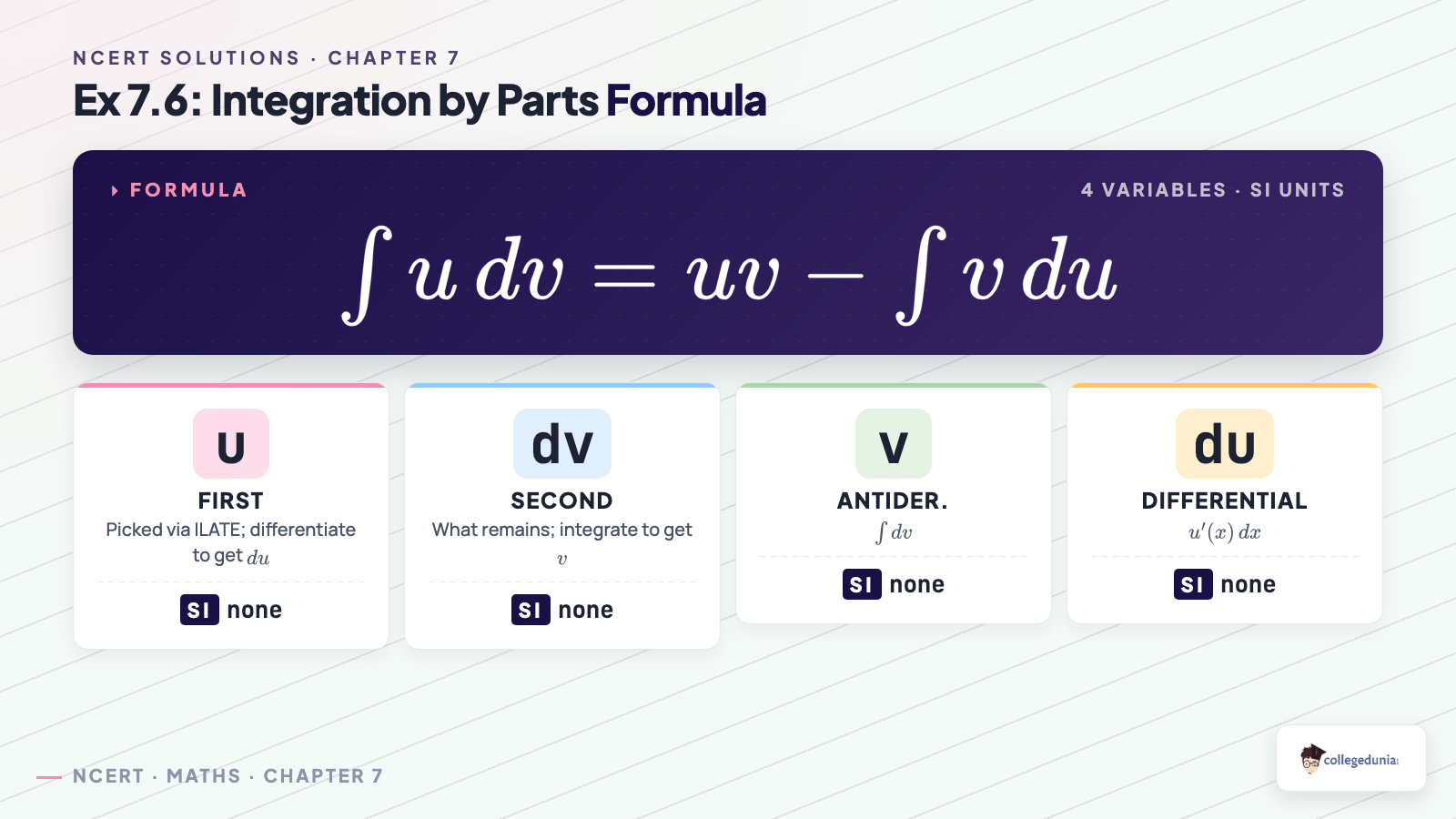
∫ u dv = uv - ∫ v du
Every Exercise 7.6 sum
2
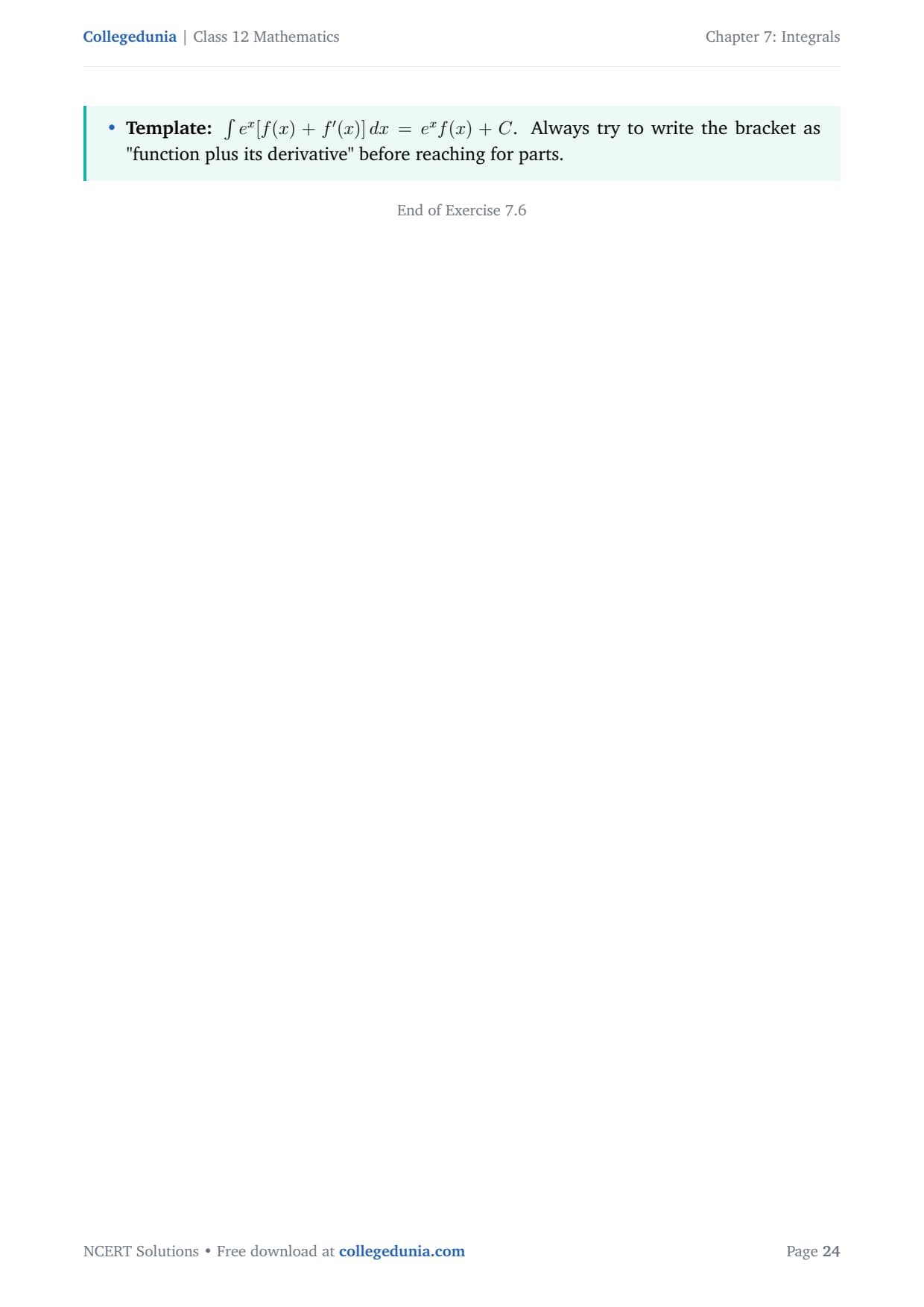
∫ ex [f(x) + f'(x)] dx = exf(x) + C
Q19, Q20, Q21
3
∫ log x dx = x log x - x + C
Building block for Q4-Q6
4
∫ tan-1x dx = x tan-1x - 12 log(1+x2) + C
Q22
5
∫ eax sin bx dx = eax(a sin bx - b cos bx)a2 + b2 + C
The Integrals chapter splits into 10 numbered exercises plus a Miscellaneous Exercise. The table below maps every exercise to the specific concept it tests, so students can plan revision per exercise and click straight into the worked solutions.
Mixed indefinite and definite integration problems
All NCERT Solutions for Integrals Ex 7.6 with Step-by-Step Working
Every NCERT textbook question for Class 12 Mathematics Chapter 7 Integrals Ex 7.6 is listed below with its full Solution and Expert Solution hidden inside collapsible tabs. Click Check Solution to reveal the step-by-step working; click Expert Solution for the expanded explanation.
Questions
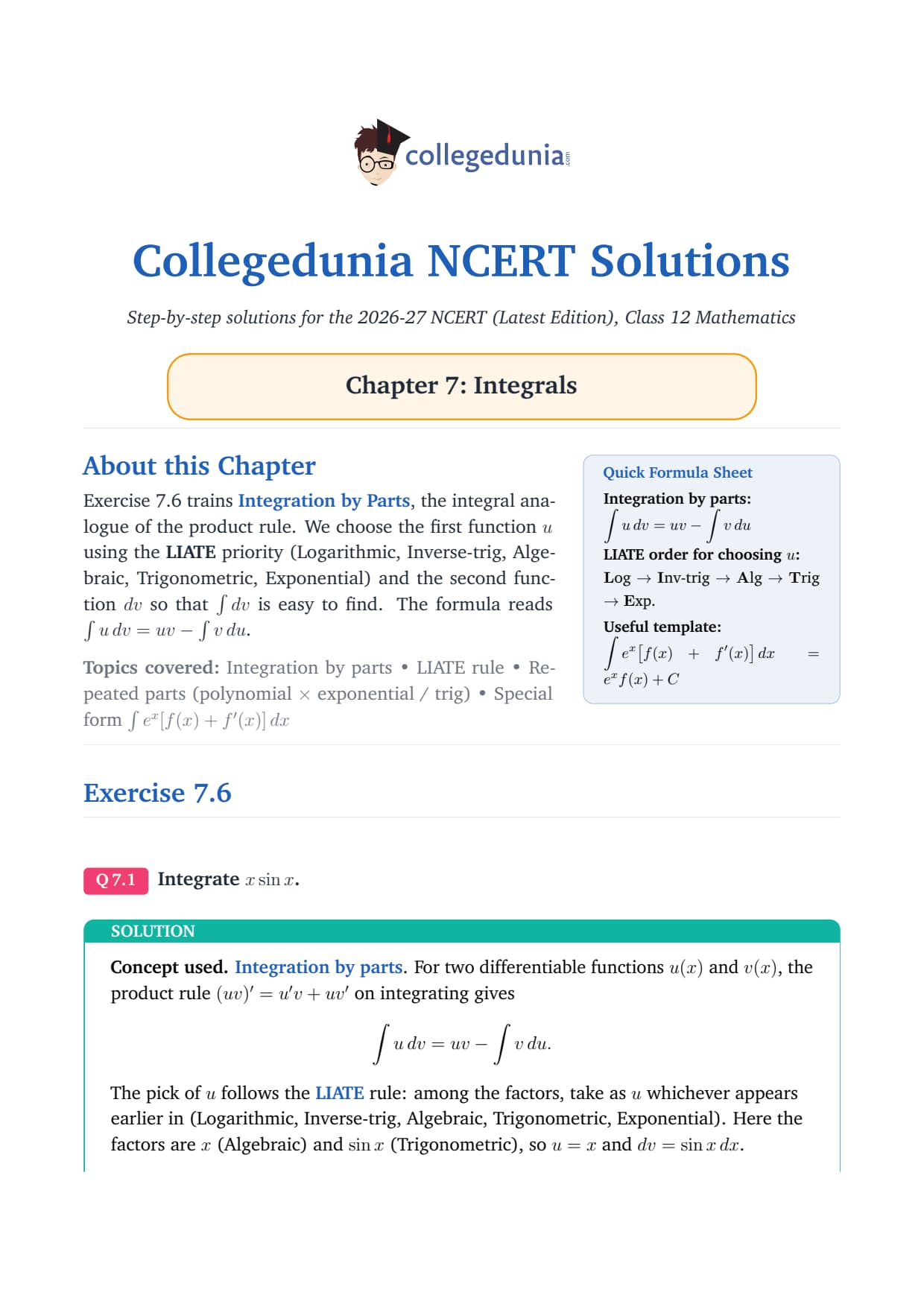
Q 7.1
Integrate x sin x.
Concept used.Integration by parts. For two differentiable functions u(x)
and v(x), the product rule (uv)' = u'v + uv' on integrating gives
∫ u dv = uv - ∫ v du.
The pick of u follows the LIATE rule: among the factors, take as u whichever
appears earlier in (Logarithmic, Inverse-trig, Algebraic, Trigonometric, Exponential). Here
the factors are x (Algebraic) and sin x (Trigonometric), so u = x and dv = sin x dx.
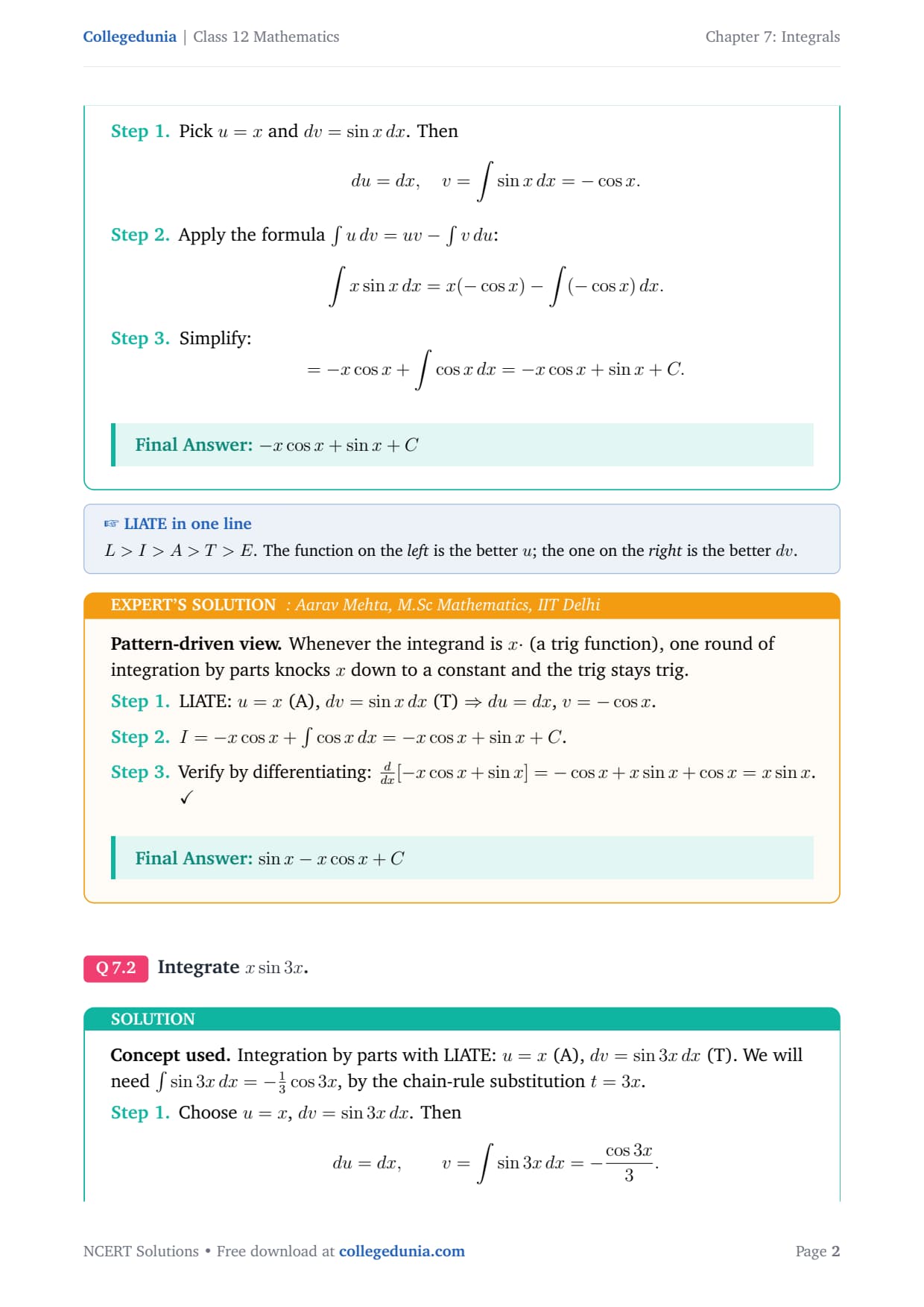
Pick u = x and dv = sin x dx. Then
du = dx, v = ∫ sin x dx = -cos x.
Apply the formula ∫ u dv = uv - ∫ v du:
∫ xsin x dx = x(-cos x) - ∫ (-cos x) dx.
Simplify:
= -xcos x + ∫ cos x dx = -xcos x + sin x + C.
-xcos x + sin x + C
AM
Aarav Mehta
M.Sc Mathematics, IIT Delhi
Verified Expert
Pattern-driven view. Whenever the integrand is x · (a trig function), one round
of integration by parts knocks x down to a constant and the trig stays trig.
LIATE: u = x (A), dv = sin x dx (T) ⇒ du = dx, v = -cos x.
I = -xcos x + ∫ cos x dx = -xcos x + sin x + C.
Verify by differentiating: ddx[-xcos x + sin x]
= -cos x + xsin x + cos x = xsin x.
sin x - xcos x + C
Q 7.2
Integrate x sin 3x.
Concept used. Integration by parts with LIATE: u = x (A), dv = sin 3x dx (T).
We will need ∫ sin 3x dx = -13cos 3x, by the chain-rule
substitution t = 3x.
Choose u = x, dv = sin 3x dx. Then
du = dx, v = ∫ sin 3x dx = -cos 3x3.
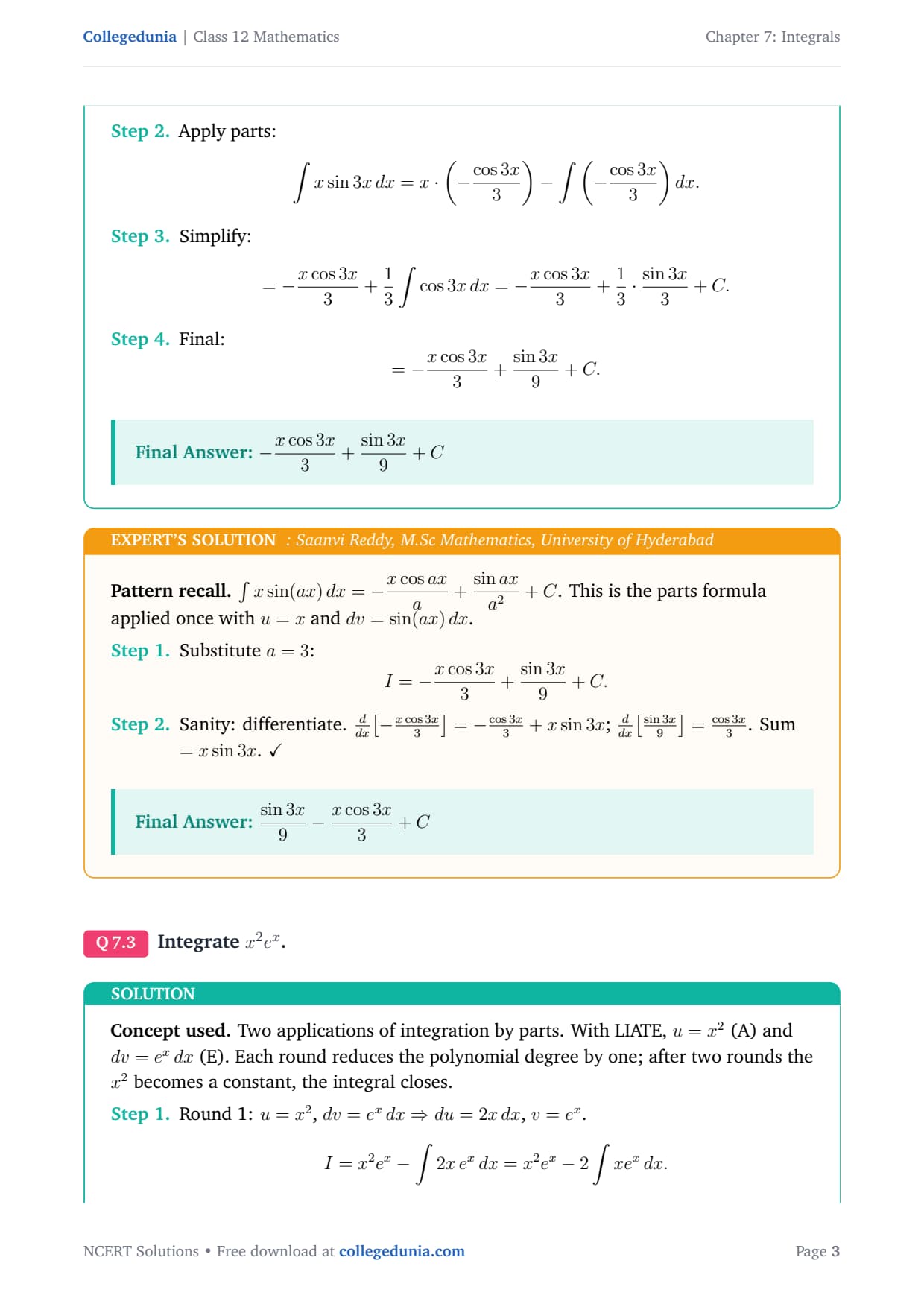
Simplify:
= -xcos 3x3 + 13∫ cos 3x dx = -xcos 3x3 + 13·sin 3x3 + C.
Final:
= -xcos 3x3 + sin 3x9 + C.
-xcos 3x3 + sin 3x9 + C
SR
Saanvi Reddy
M.Sc Mathematics, University of Hyderabad
Verified Expert
Pattern recall.∫ xsin(ax) dx = -xcos axa + sin axa2 + C.
This is the parts formula applied once with u = x and dv = sin(ax) dx.
Substitute a = 3:
I = -xcos 3x3 + sin 3x9 + C.
Sanity: differentiate. ddx[-xcos 3x3]
= -cos 3x3 + xsin 3x; ddx[sin 3x9] = cos 3x3.
Sum = xsin 3x.
sin 3x9 - xcos 3x3 + C
Q 7.3
Integrate x2 ex.
Concept used. Two applications of integration by parts. With LIATE, u = x2 (A) and
dv = ex dx (E). Each round reduces the polynomial degree by one; after two rounds the
x2 becomes a constant, the integral closes.
Round 1: u = x2, dv = ex dx ⇒ du = 2x dx, v = ex.
I = x2 ex - ∫ 2x ex dx = x2 ex - 2∫ x ex dx.
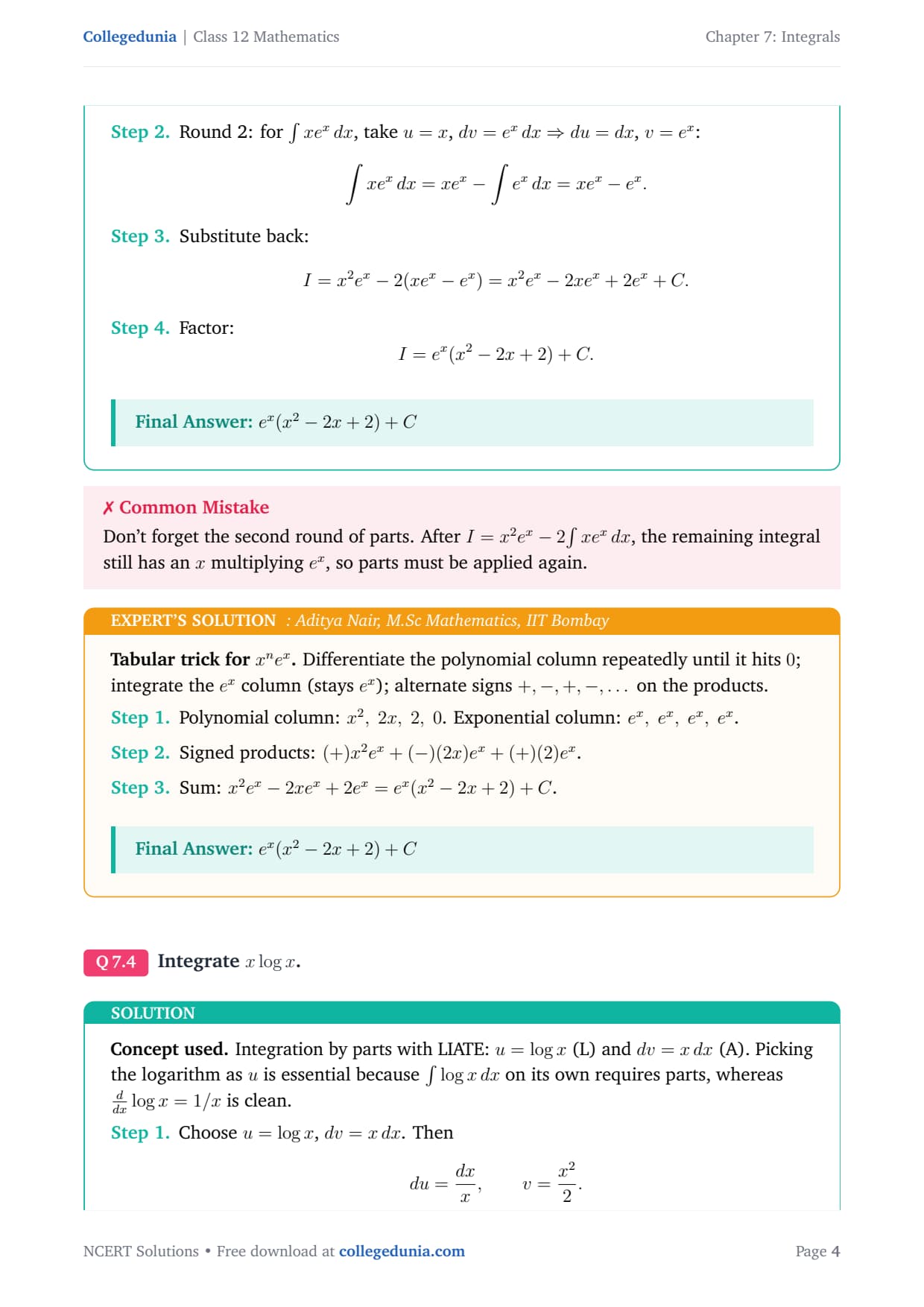
Round 2: for ∫ x ex dx, take u = x, dv = ex dx ⇒ du = dx, v = ex:
∫ x ex dx = x ex - ∫ ex dx = x ex - ex.
Substitute back:
I = x2 ex - 2(x ex - ex) = x2 ex - 2x ex + 2 ex + C.
Factor:
I = ex (x2 - 2x + 2) + C.
ex(x2 - 2x + 2) + C
AN
Aditya Nair
M.Sc Mathematics, IIT Bombay
Verified Expert
Tabular trick for xn ex. Differentiate the polynomial column repeatedly until it
hits 0; integrate the ex column (stays ex); alternate signs +, -, +, -, on the
products.
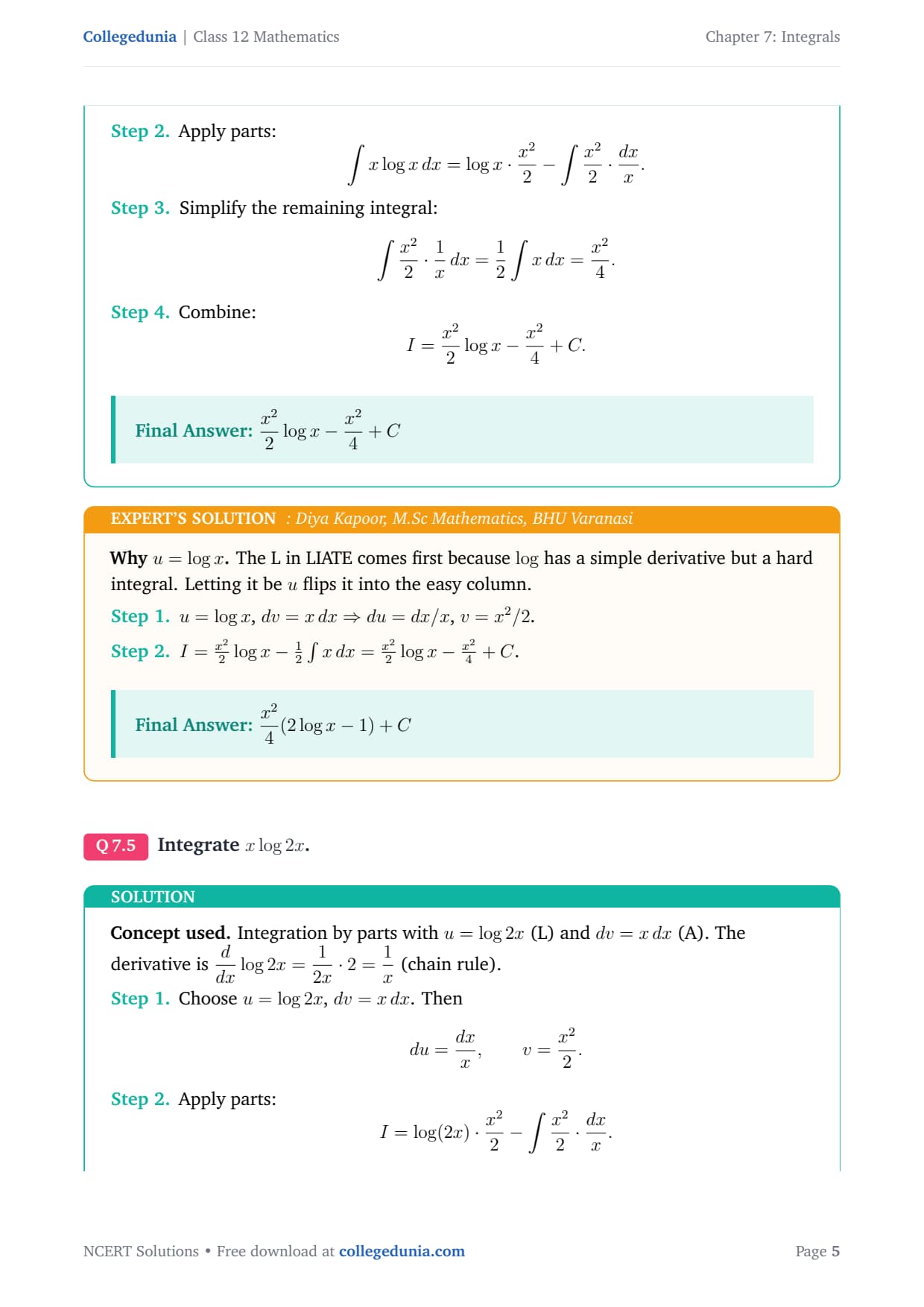
Concept used. Integration by parts with LIATE: u = log x (L) and dv = x dx (A).
Picking the logarithm as u is essential because ∫ log x dx on its own requires parts,
whereas ddxlog x = 1/x is clean.
Choose u = log x, dv = x dx. Then
du = dxx, v = x22.
Apply parts:
∫ xlog x dx = log x · x22 - ∫ x22·dxx.
Simplify the remaining integral:
∫ x22·1x dx = 12∫ x dx = x24.
Combine:
I = x22log x - x24 + C.
x22log x - x24 + C
DK
Diya Kapoor
M.Sc Mathematics, BHU Varanasi
Verified Expert
Why u = log x. The L in LIATE comes first because log has a simple derivative
but a hard integral. Letting it be u flips it into the easy column.
u = log x, dv = x dx ⇒ du = dx/x, v = x2/2.
I = x22log x - 12∫ x dx = x22log x - x24 + C.
x24(2log x - 1) + C
Q 7.5
Integrate x log 2x.
Concept used. Integration by parts with u = log 2x (L) and dv = x dx (A). The
derivative is ddxlog 2x = 12x· 2 = 1x (chain rule).
Choose u = log 2x, dv = x dx. Then
du = dxx, v = x22.
Apply parts:
I = log(2x)·x22 - ∫ x22·dxx.
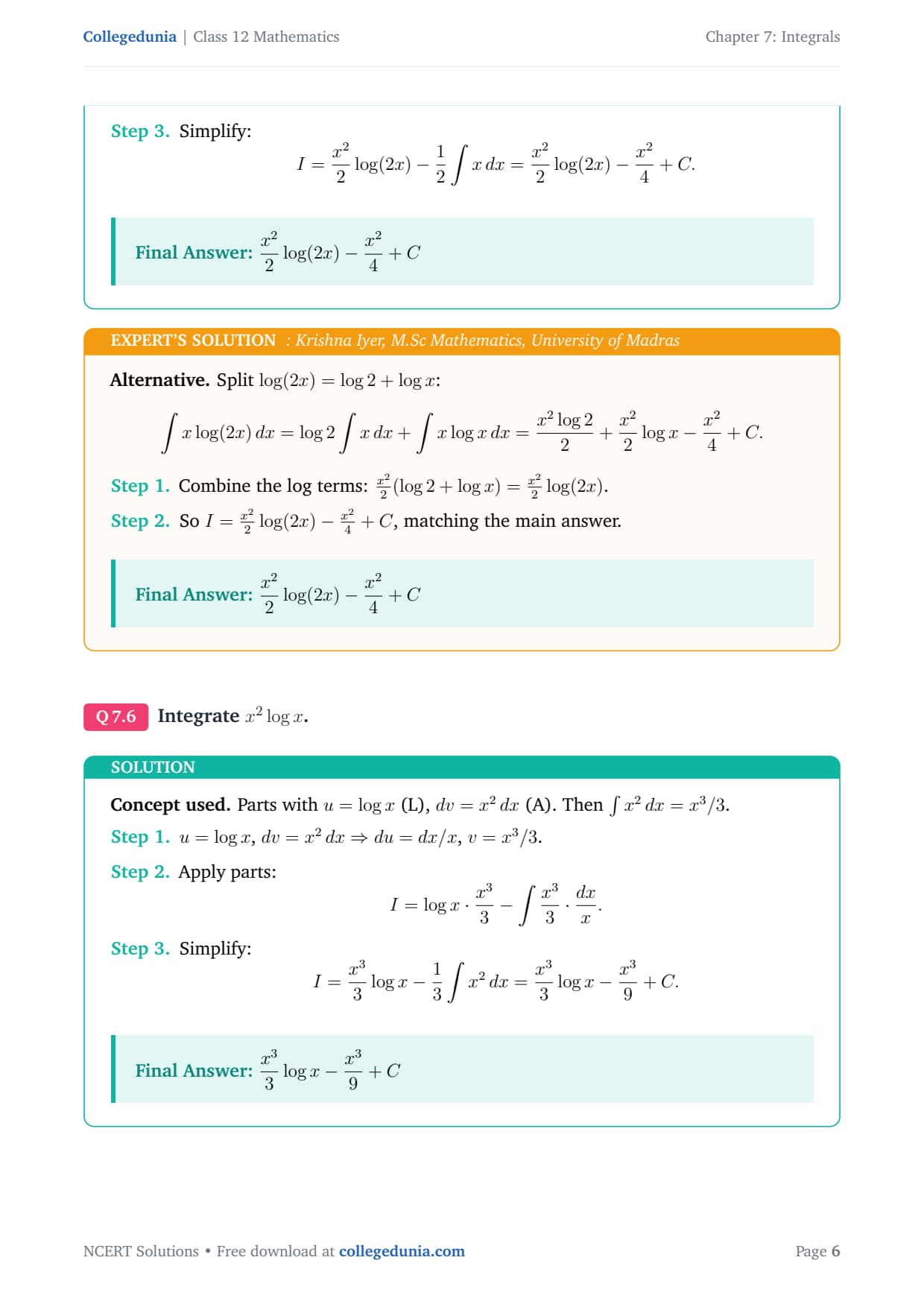
Simplify:
I = x22log(2x) - 12∫ x dx = x22log(2x) - x24 + C.
x22log(2x) - x24 + C
KI
Krishna Iyer
M.Sc Mathematics, University of Madras
Verified Expert
Alternative. Split log(2x) = log 2 + log x:
∫ xlog(2x) dx = log 2 ∫ x dx + ∫ xlog x dx
= x2log 22 + x22log x - x24 + C.
Substitute back:
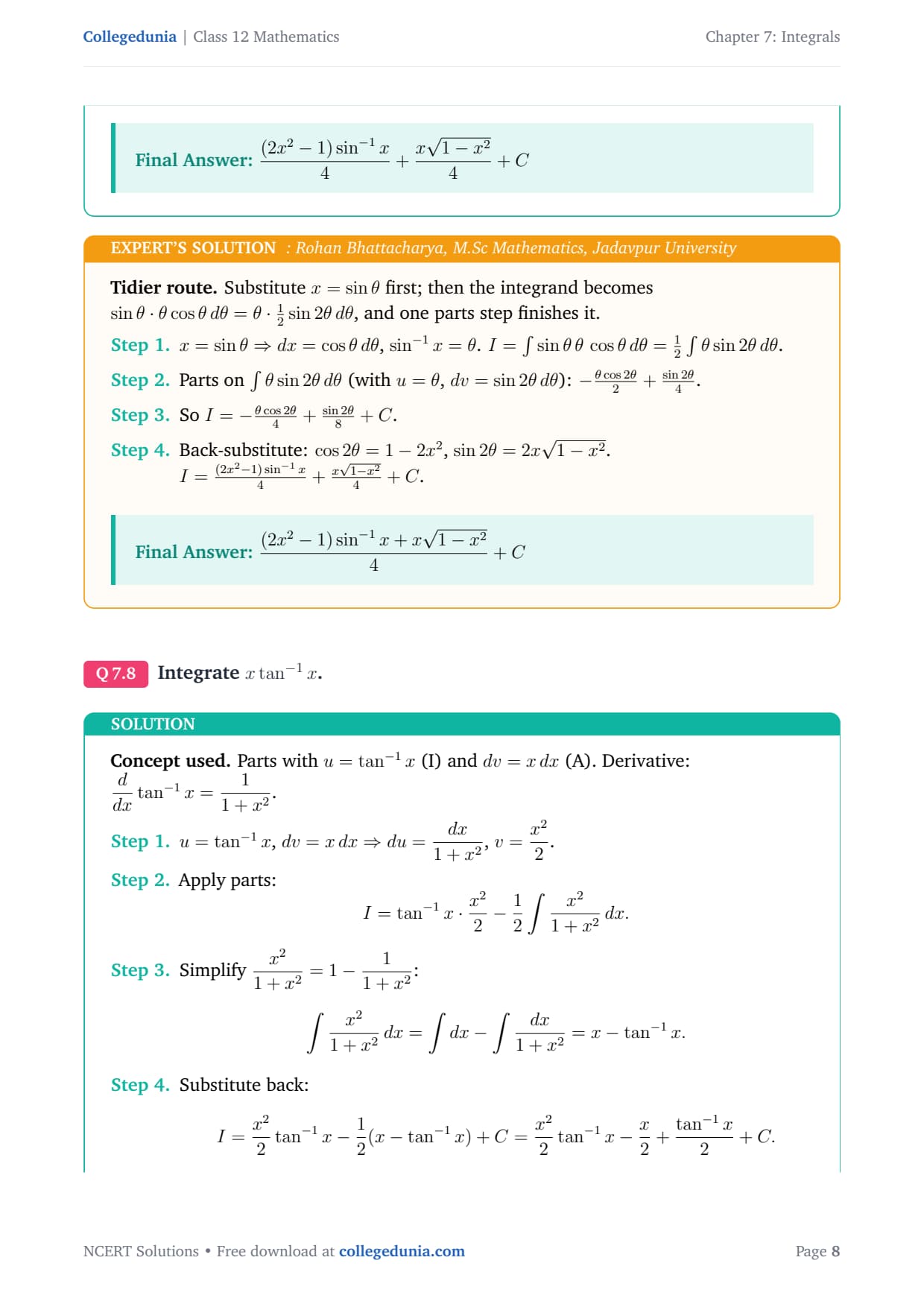
I = x22tan-1x - 12(x - tan-1x) + C
= x22tan-1x - x2 + tan-1x2 + C.
Combine the tan-1x pieces:
I = (x2 + 1)tan-1x2 - x2 + C.
(x2 + 1)tan-1x2 - x2 + C
VK
Vivaan Kapoor
M.Sc Mathematics, IIT Madras
Verified Expert
Reading. Inverse-trig × algebraic → parts with the I as u.
Parts gives I = x22tan-1x - 12∫ x21+x2 dx.
Split x21+x2 = 1 - 11+x2; integrate.
I = (x2 + 1)tan-1x2 - x2 + C.
(x2 + 1)tan-1x - x2 + C
Q 7.9
Integrate x cos-1x.
Concept used. Parts with u = cos-1x (I), dv = x dx (A). Note
ddxcos-1x = -1√1-x2.
u = cos-1x, dv = x dx ⇒ du = -dx√1-x2, v = x22.
Apply parts:
I = x22cos-1x + 12∫ x2√1-x2 dx.
From Q7 we have ∫ x2√1-x2 dx = sin-1x - x√1-x22.
Substitute back:
I = x22cos-1x + sin-1x - x√1-x24.
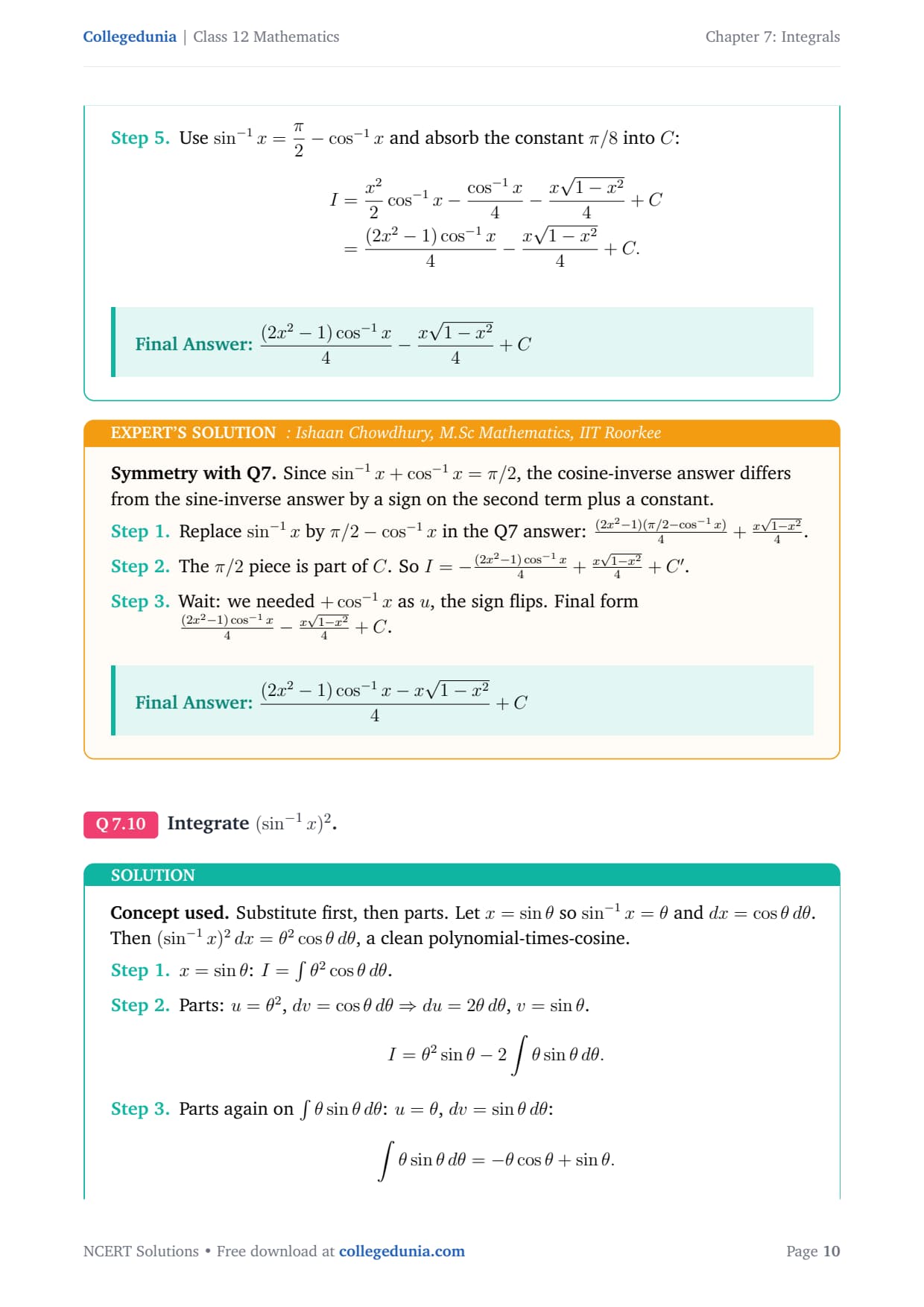
Use sin-1x = π2 - cos-1x and absorb the constant π/8 into C:
aligned
I &= x22cos-1x - cos-1x4 - x√1-x24 + C
&= (2x2 - 1)cos-1x4 - x√1-x24 + C.
aligned
(2x2 - 1)cos-1x4 - x√1-x24 + C
IC
Ishaan Chowdhury
M.Sc Mathematics, IIT Roorkee
Verified Expert
Symmetry with Q7. Since sin-1x + cos-1x = π/2, the cosine-inverse
answer differs from the sine-inverse answer by a sign on the second term plus a constant.
Replace sin-1x by π/2 - cos-1x in the Q7 answer:
(2x2-1)(π/2 - cos-1x)4 + x√1-x24.
The π/2 piece is part of C. So
I = -(2x2-1)cos-1x4 + x√1-x24 + C'.
Wait: we needed +cos-1x as u, the sign flips. Final form
(2x2-1)cos-1x4 - x√1-x24 + C.
(2x2-1)cos-1x - x√1-x24 + C
Q 7.10
Integrate (sin-1x)2.
Concept used. Substitute first, then parts. Let x = sinθ so sin-1x = θ
and dx = cosθ dθ. Then (sin-1x)2 dx = θ2 cosθ dθ, a clean
polynomial-times-cosine.
x = sinθ: I = ∫ θ2 cosθ dθ.
Parts: u = θ2, dv = cosθ dθ ⇒ du = 2θ dθ, v = sinθ.
I = θ2 sinθ - 2∫ θ dθ.
Parts again on ∫ θ dθ: u = θ, dv = sinθ dθ:
∫ θ dθ = -θ + sinθ.
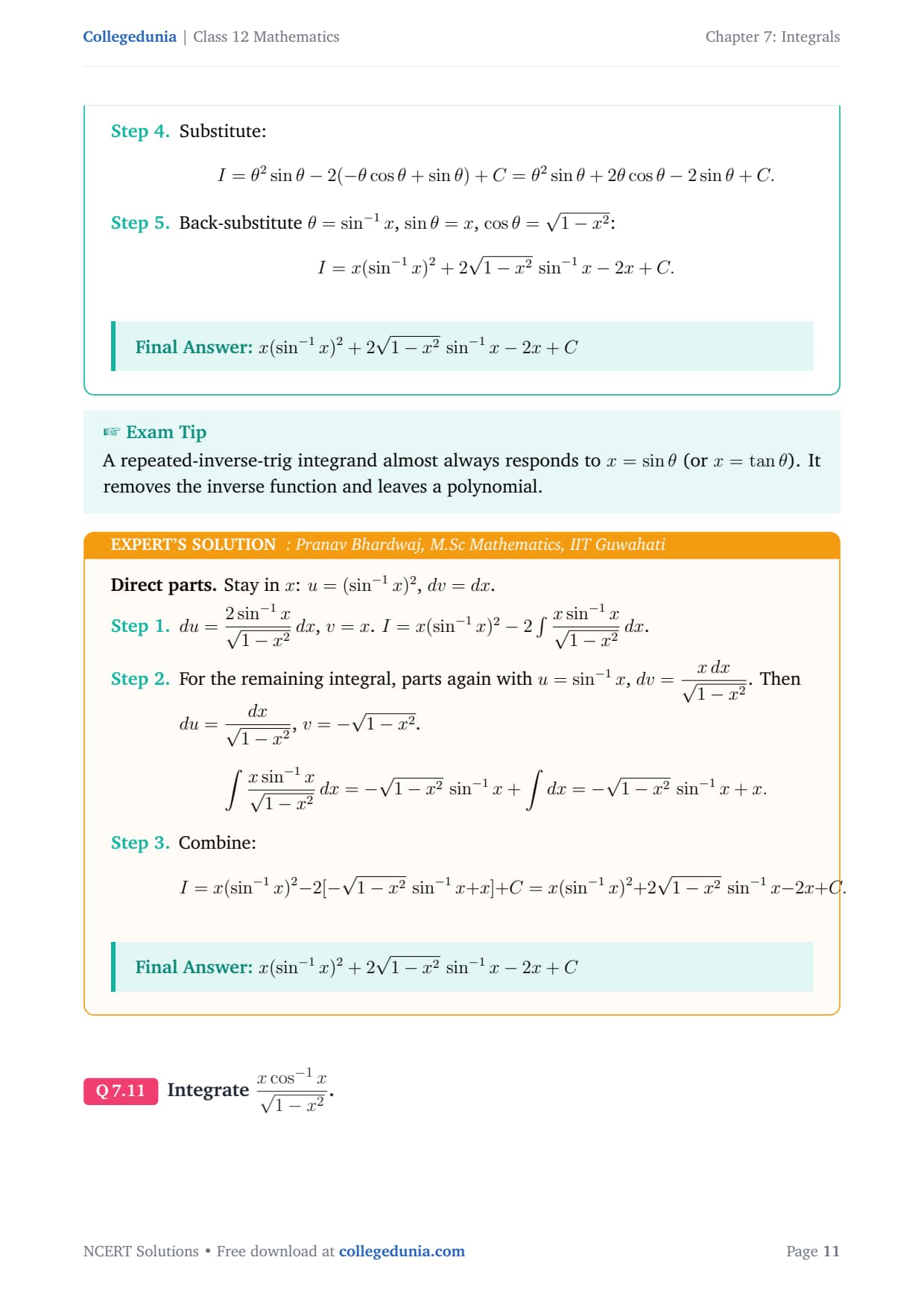
Substitute:
I = θ2 sinθ - 2(-θ + sinθ) + C
= θ2sinθ + 2θ - 2sinθ + C.
Back-substitute θ = sin-1x, sinθ = x, cosθ = √1 - x2:
I = x(sin-1x)2 + 2√1 - x2 sin-1x - 2 x + C.
x(sin-1x)2 + 2√1 - x2 sin-1x - 2 x + C
PB
Pranav Bhardwaj
M.Sc Mathematics, IIT Guwahati
Verified Expert
Direct parts. Stay in x: u = (sin-1x)2, dv = dx.
du = 2sin-1x√1 - x2 dx, v = x.
I = x(sin-1x)2 - 2∫ xsin-1x√1 - x2 dx.
For the remaining integral, parts again with u = sin-1x,
dv = x dx√1-x2. Then du = dx√1-x2,
v = -√1-x2.
∫ xsin-1x√1-x2 dx = -√1-x2 sin-1x + ∫ dx
= -√1-x2 sin-1x + x.
Combine:
I = x(sin-1x)2 - 2[-√1-x2 sin-1x + x] + C
= x(sin-1x)2 + 2√1-x2 sin-1x - 2x + C.
x(sin-1x)2 + 2√1-x2 sin-1x - 2x + C
Q 7.11
Integrate xcos-1x√1 - x2.
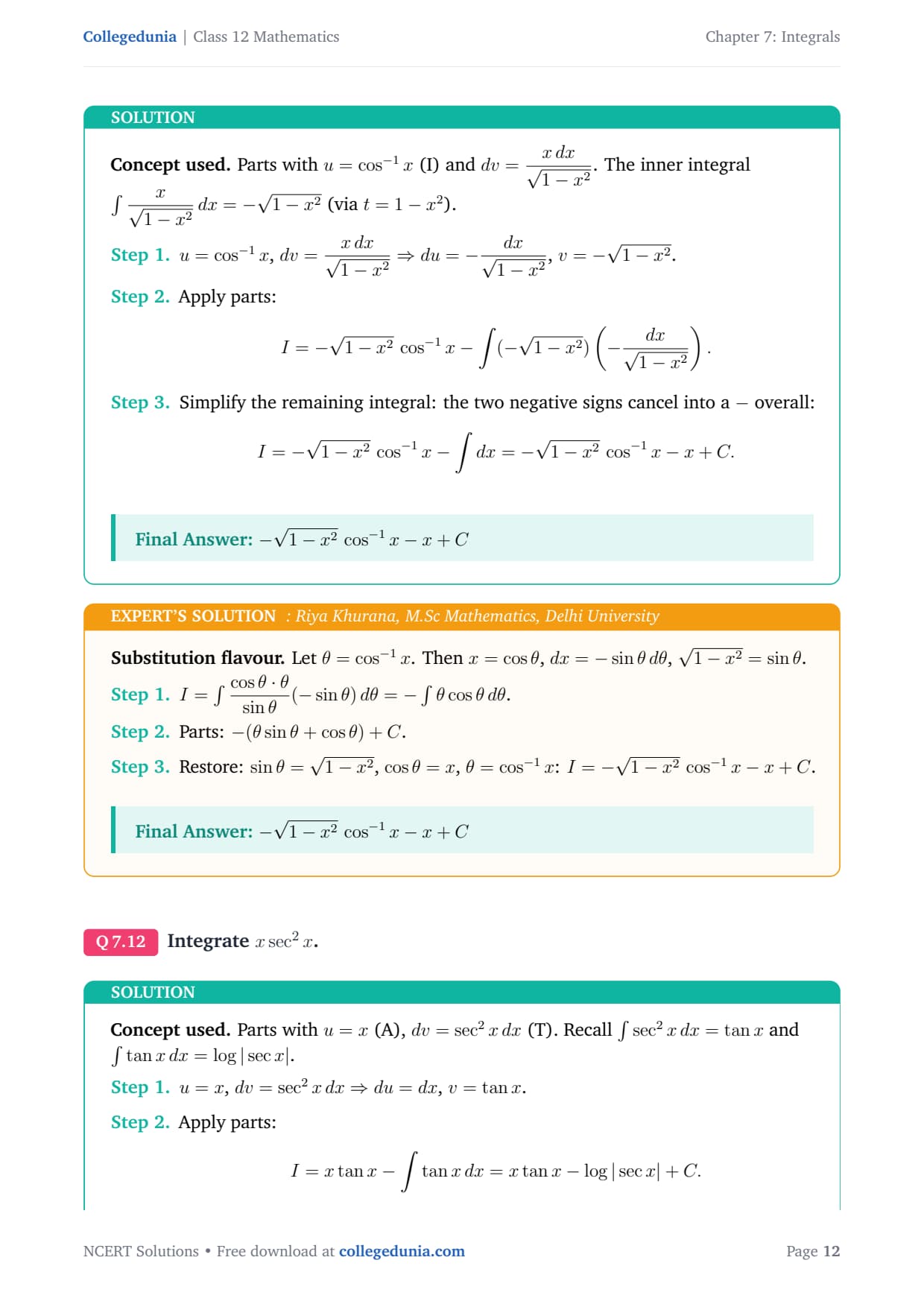
Concept used. Parts with u = cos-1x (I) and dv = x dx√1 - x2. The
inner integral ∫ x√1-x2 dx = -√1-x2 (via t = 1 - x2).
u = cos-1x, dv = x dx√1-x2 ⇒ du = -dx√1-x2,
v = -√1-x2.
Apply parts:
I = -√1-x2 cos-1x - ∫ (-√1-x2)(-dx√1-x2).
Simplify the remaining integral: the two negative signs cancel into a - overall:
I = -√1-x2 cos-1x - ∫ dx = -√1-x2 cos-1x - x + C.
-√1-x2 cos-1x - x + C
RK
Riya Khurana
M.Sc Mathematics, Delhi University
Verified Expert
Substitution flavour. Let θ = cos-1x. Then x = cosθ,
dx = -sinθ dθ, √1 - x2 = sinθ.
I = ∫ cosθ · θsinθ(-sinθ) dθ
= -∫ θ dθ.
Parts: -(θ + cosθ) + C.
Restore: sinθ = √1-x2, cosθ = x, θ = cos-1x:
I = -√1-x2 cos-1x - x + C.
-√1-x2 cos-1x - x + C
Q 7.12
Integrate x sec2x.
Concept used. Parts with u = x (A), dv = sec2x dx (T). Recall
∫ sec2x dx = tan x and ∫ tan x dx = log|sec x|.
u = x, dv = sec2x dx ⇒ du = dx, v = tan x.
Apply parts:
I = xtan x - ∫ tan x dx = xtan x - log|sec x| + C.
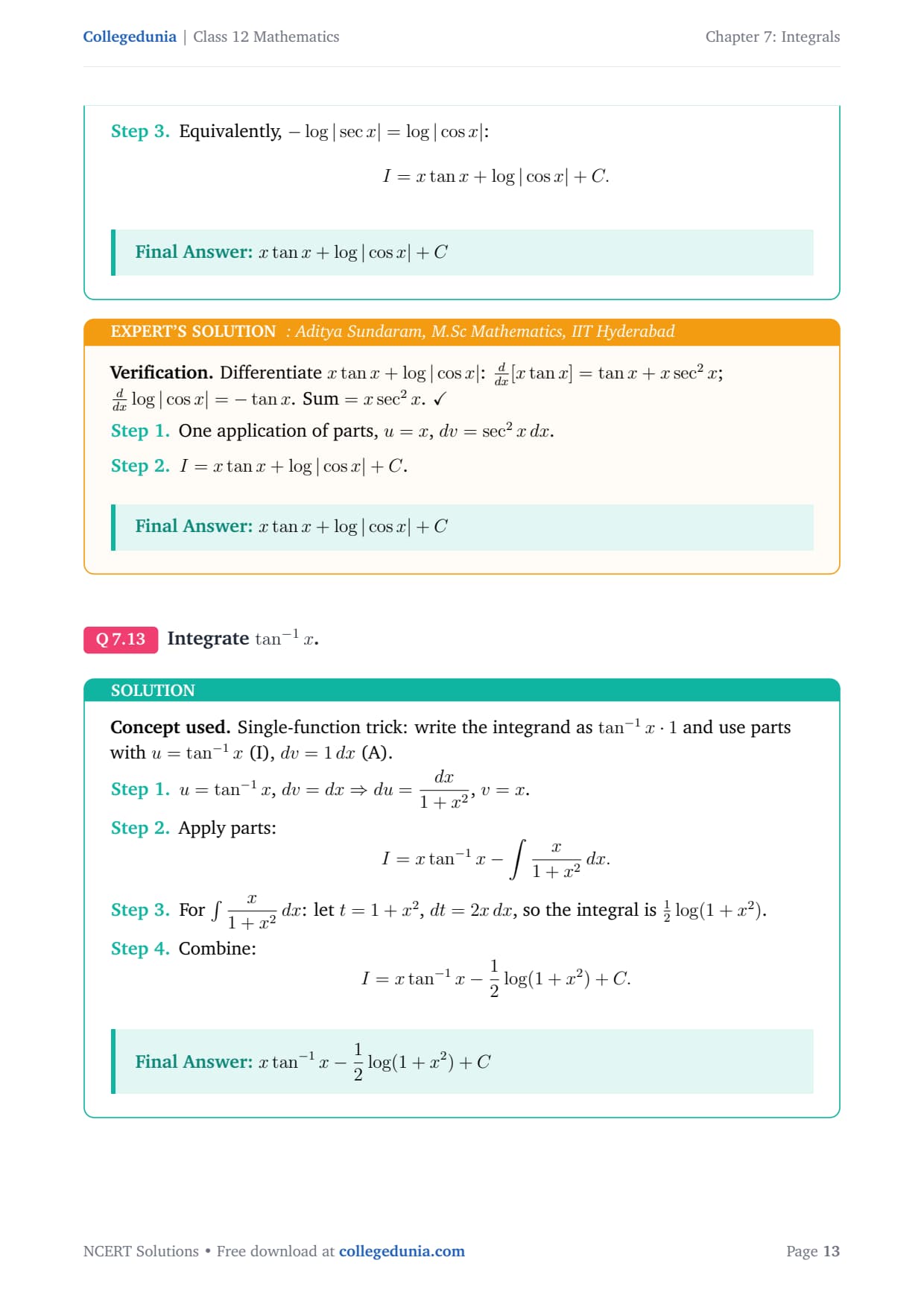
Equivalently, -log|sec x| = log|cos x|:
I = xtan x + log|cos x| + C.
xtan x + log|cos x| + C
AS
Aditya Sundaram
M.Sc Mathematics, IIT Hyderabad
Verified Expert
Verification. Differentiate xtan x + log|cos x|:
ddx[xtan x] = tan x + xsec2x;
ddxlog|cos x| = -tan x. Sum = xsec2x.
One application of parts, u = x, dv = sec2x dx.
I = xtan x + log|cos x| + C.
xtan x + log|cos x| + C
Q 7.13
Integrate tan-1x.
Concept used. Single-function trick: write the integrand as tan-1x · 1 and use
parts with u = tan-1x (I), dv = 1 dx (A).
u = tan-1x, dv = dx ⇒ du = dx1 + x2, v = x.
Apply parts:
I = xtan-1x - ∫ x1 + x2 dx.
For ∫ x1+x2 dx: let t = 1 + x2, dt = 2x dx, so the integral is
12log(1 + x2).
Combine:
I = xtan-1x - 12log(1 + x2) + C.
xtan-1x - 12log(1 + x2) + C
SJ
Saanvi Joshi
M.Sc Mathematics, IIT BHU
Verified Expert
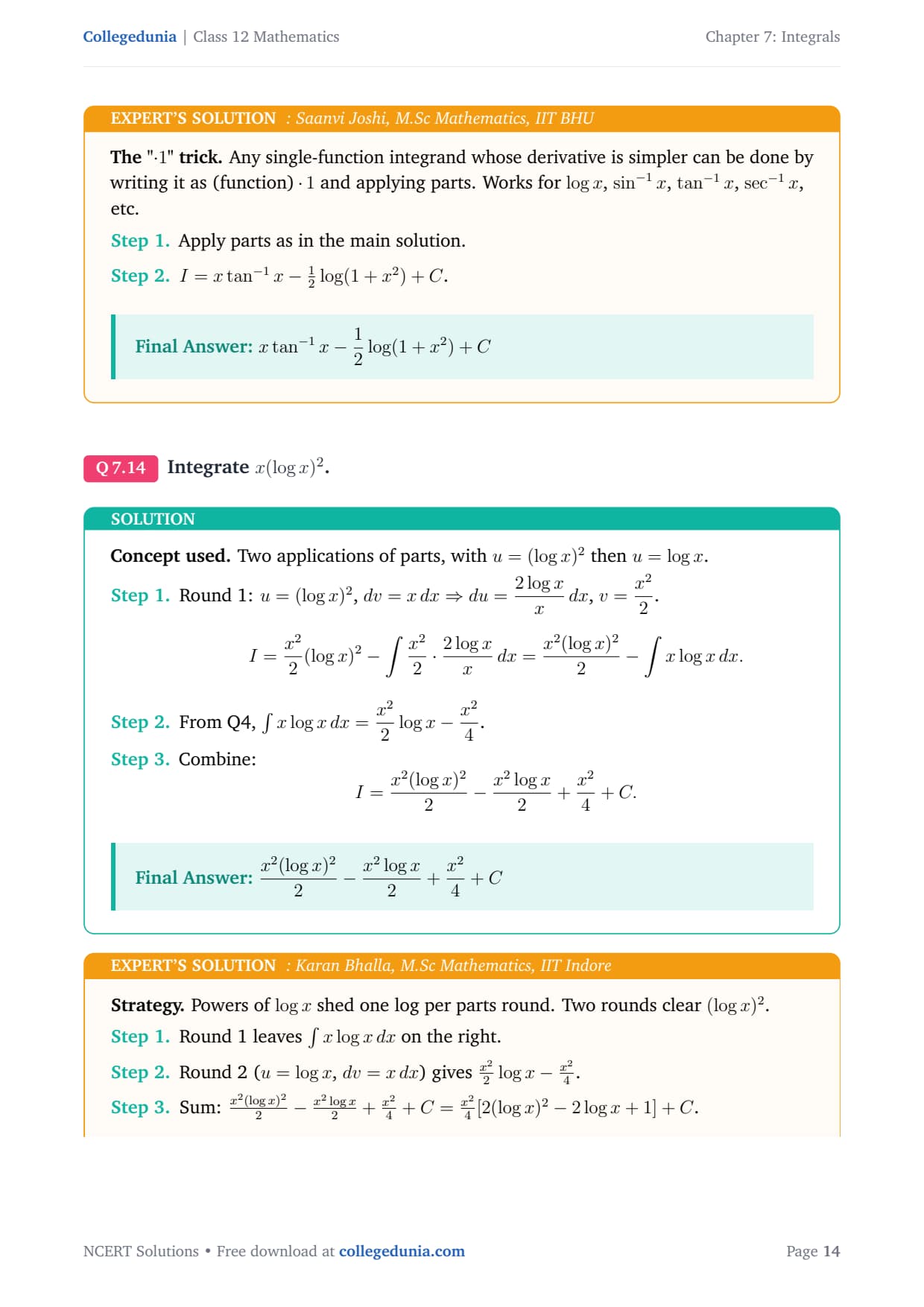
The "· 1" trick. Any single-function integrand whose derivative is simpler can
be done by writing it as (function) · 1 and applying parts. Works for log x,
sin-1x, tan-1x, sec-1x, etc.
Apply parts as in the main solution.
I = xtan-1x - 12log(1 + x2) + C.
xtan-1x - 12log(1 + x2) + C
Q 7.14
Integrate x(log x)2.
Concept used. Two applications of parts, with u = (log x)2 then u = log x.
Round 1: u = (log x)2, dv = x dx ⇒ du = 2log xx dx, v = x22.
I = x22(log x)2 - ∫ x22· 2log xx dx
= x2(log x)22 - ∫ xlog x dx.
From Q4, ∫ xlog x dx = x22log x - x24.
Combine:
I = x2(log x)22 - x2log x2 + x24 + C.
x2(log x)22 - x2log x2 + x24 + C
KB
Karan Bhalla
M.Sc Mathematics, IIT Indore
Verified Expert
Strategy. Powers of log x shed one log per parts round. Two rounds clear (log x)2.
Round 1 leaves ∫ xlog x dx on the right.
Round 2 (u = log x, dv = x dx) gives x22log x - x24.
Sum: x2(log x)22 - x2log x2 + x24 + C
= x24[2(log x)2 - 2log x + 1] + C.
x24[2(log x)2 - 2log x + 1] + C
Q 7.15
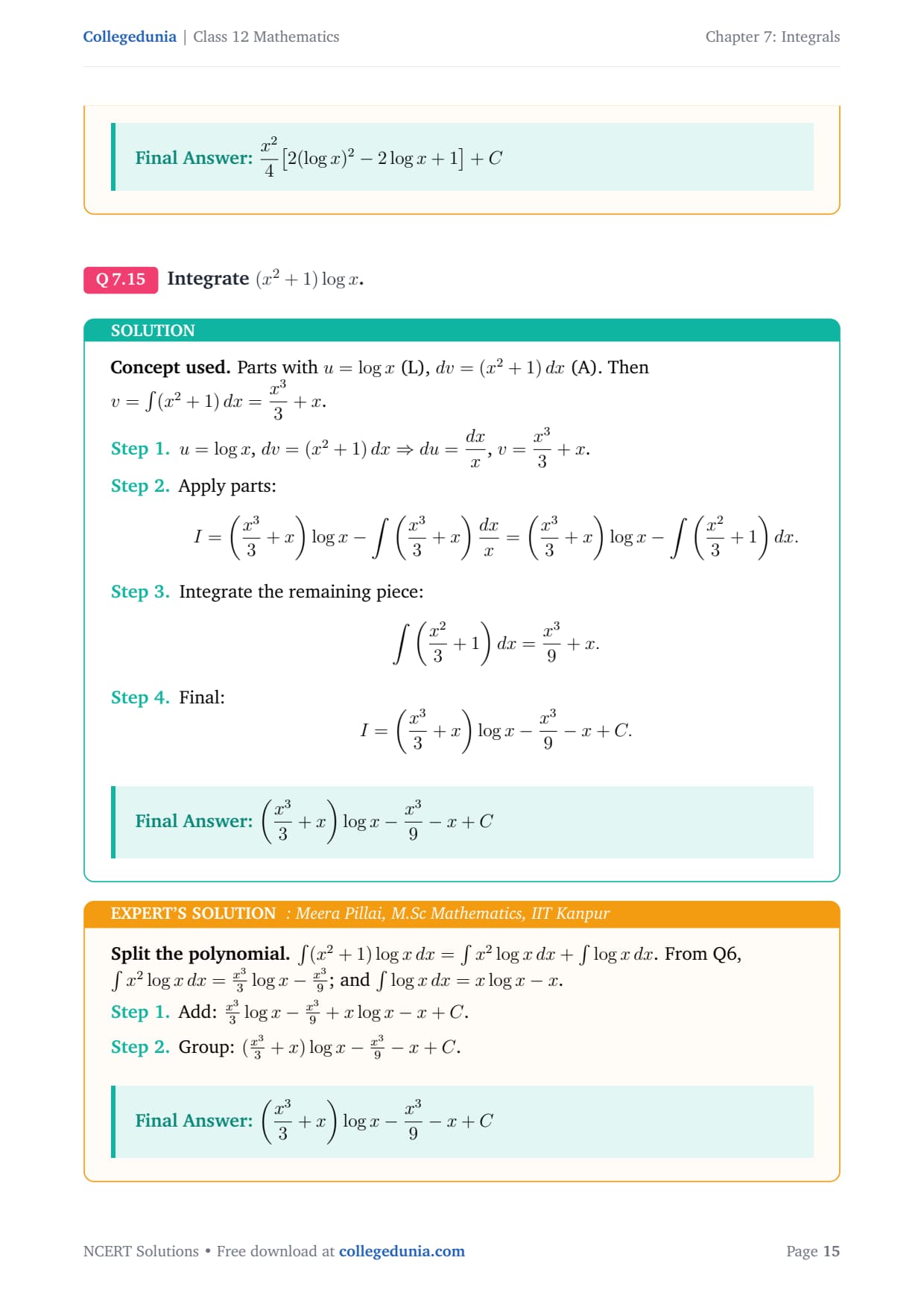
Integrate (x2 + 1)log x.
Concept used. Parts with u = log x (L), dv = (x2 + 1) dx (A). Then
v = ∫ (x2 + 1) dx = x33 + x.
u = log x, dv = (x2 + 1) dx ⇒ du = dxx, v = x33 + x.
Apply parts:
I = (x33 + x)log x - ∫ (x33 + x)dxx
= (x33 + x)log x - ∫ (x23 + 1) dx.
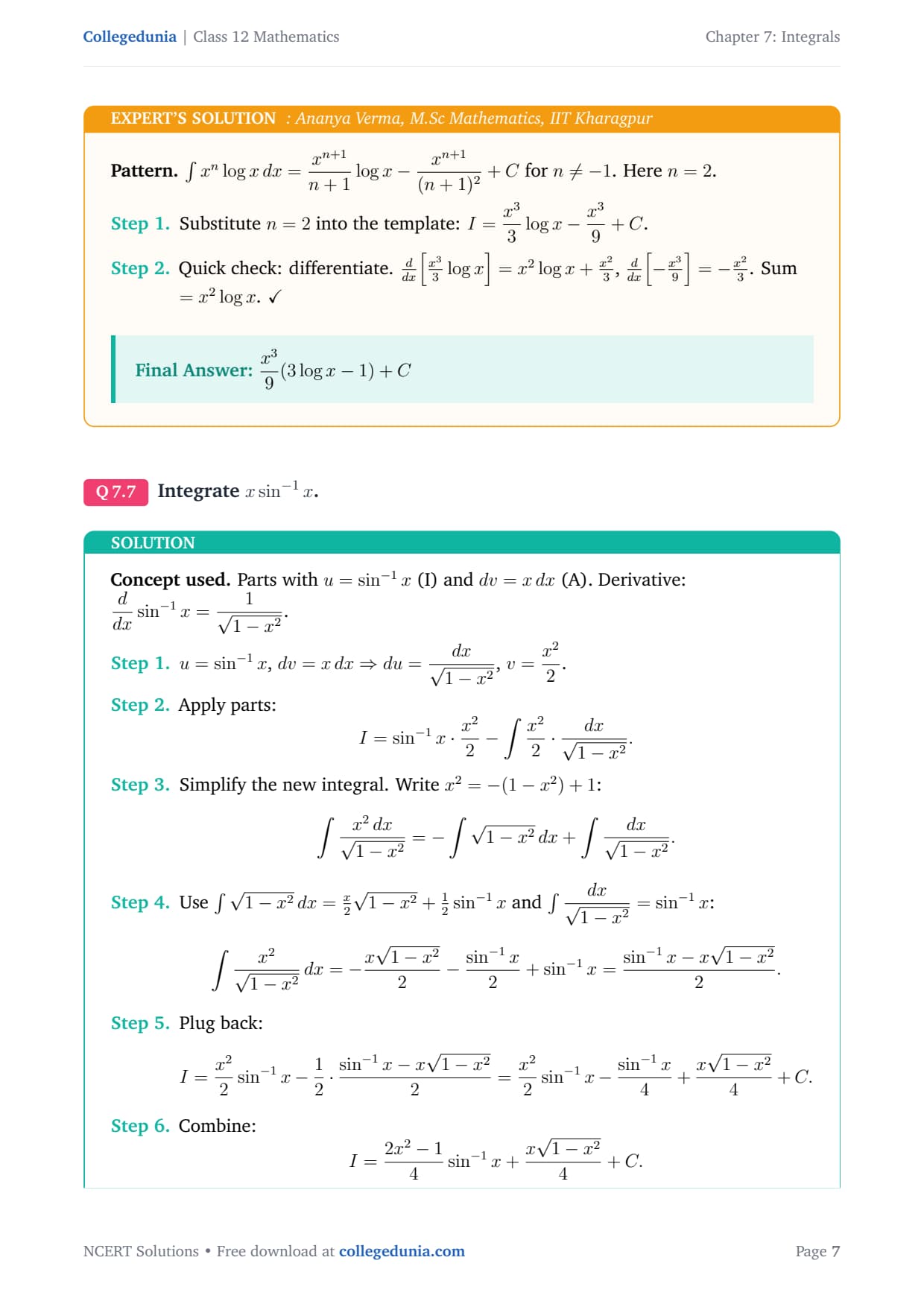
Split the polynomial.∫ (x2 + 1)log x dx = ∫ x2log x dx + ∫ log x dx.
From Q6, ∫ x2log x dx = x33log x - x39; and
∫ log x dx = xlog x - x.
Add: x33log x - x39 + xlog x - x + C.
Group: (x33 + x)log x - x39 - x + C.
(x33 + x)log x - x39 - x + C
Q 7.16
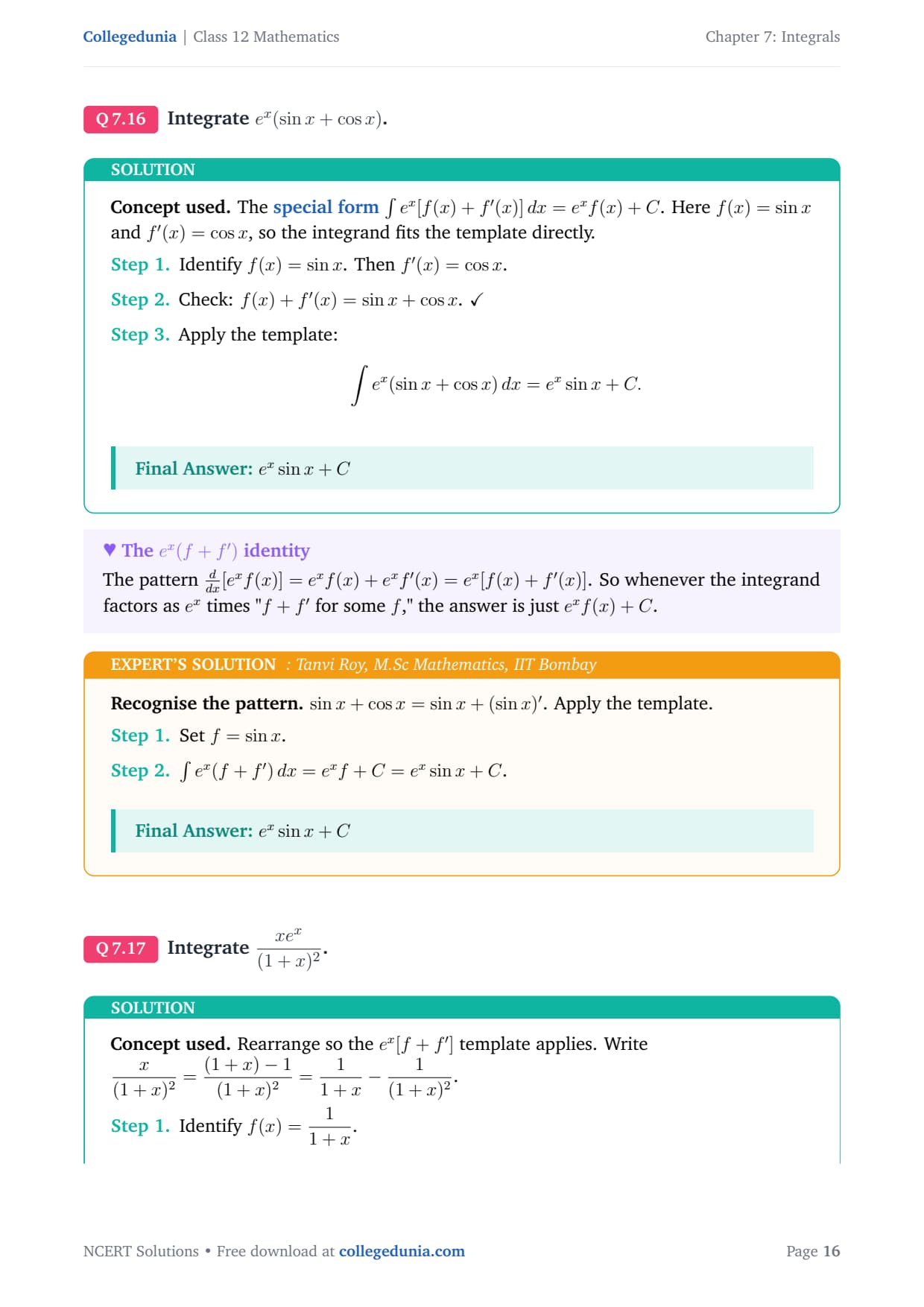
Integrate ex (sin x + cos x).
Concept used. The special form∫ ex [f(x) + f'(x)] dx = exf(x) + C.
Here f(x) = sin x and f'(x) = cos x, so the integrand fits the template directly.
Identify f(x) = sin x. Then f'(x) = cos x.
Check: f(x) + f'(x) = sin x + cos x.
Apply the template:
∫ ex(sin x + cos x) dx = ex sin x + C.
ex sin x + C
TR
Tanvi Roy
M.Sc Mathematics, IIT Bombay
Verified Expert
Recognise the pattern.sin x + cos x = sin x + (sin x)'. Apply the template.
Set f = sin x.
∫ ex(f + f') dx = exf + C = ex sin x + C.
ex sin x + C
Q 7.17
Integrate x ex(1 + x)2.
Concept used. Rearrange so the ex[f + f'] template applies. Write
x(1+x)2 = (1+x) - 1(1+x)2 = 11+x - 1(1+x)2.
Identify f(x) = 11 + x.
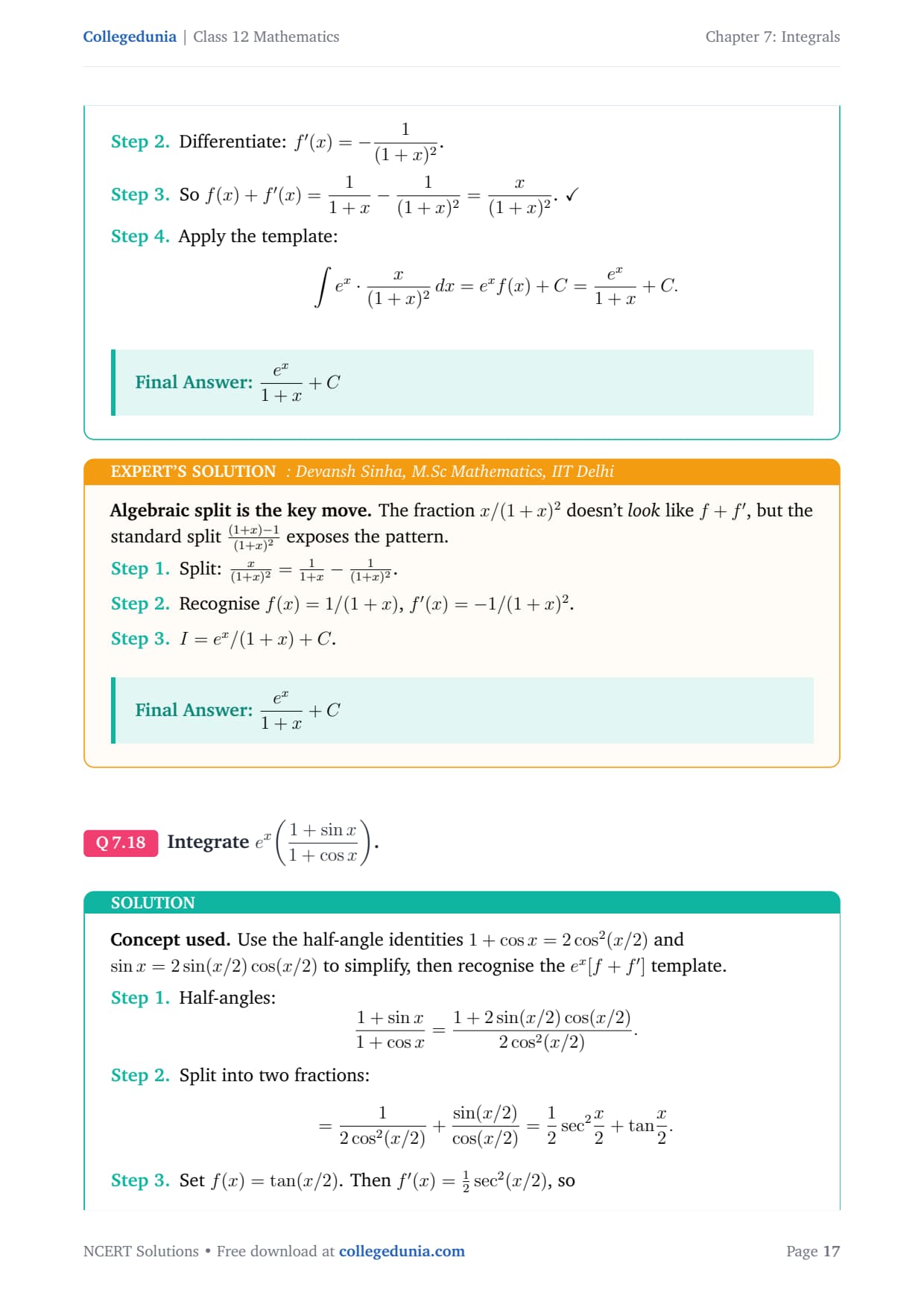
Differentiate: f'(x) = -1(1+x)2.
So f(x) + f'(x) = 11+x - 1(1+x)2 = x(1+x)2.
Apply the template:
∫ ex · x(1+x)2 dx = exf(x) + C = ex1 + x + C.
ex1 + x + C
DS
Devansh Sinha
M.Sc Mathematics, IIT Delhi
Verified Expert
Algebraic split is the key move. The fraction x/(1+x)2 doesn't look like
f + f', but the standard split (1+x) - 1(1+x)2 exposes the pattern.
Split: x(1+x)2 = 11+x - 1(1+x)2.
Recognise f(x) = 1/(1+x), f'(x) = -1/(1+x)2.
I = ex/(1 + x) + C.
ex1+x + C
Q 7.18
Integrate ex(1 + sin x1 + cos x).
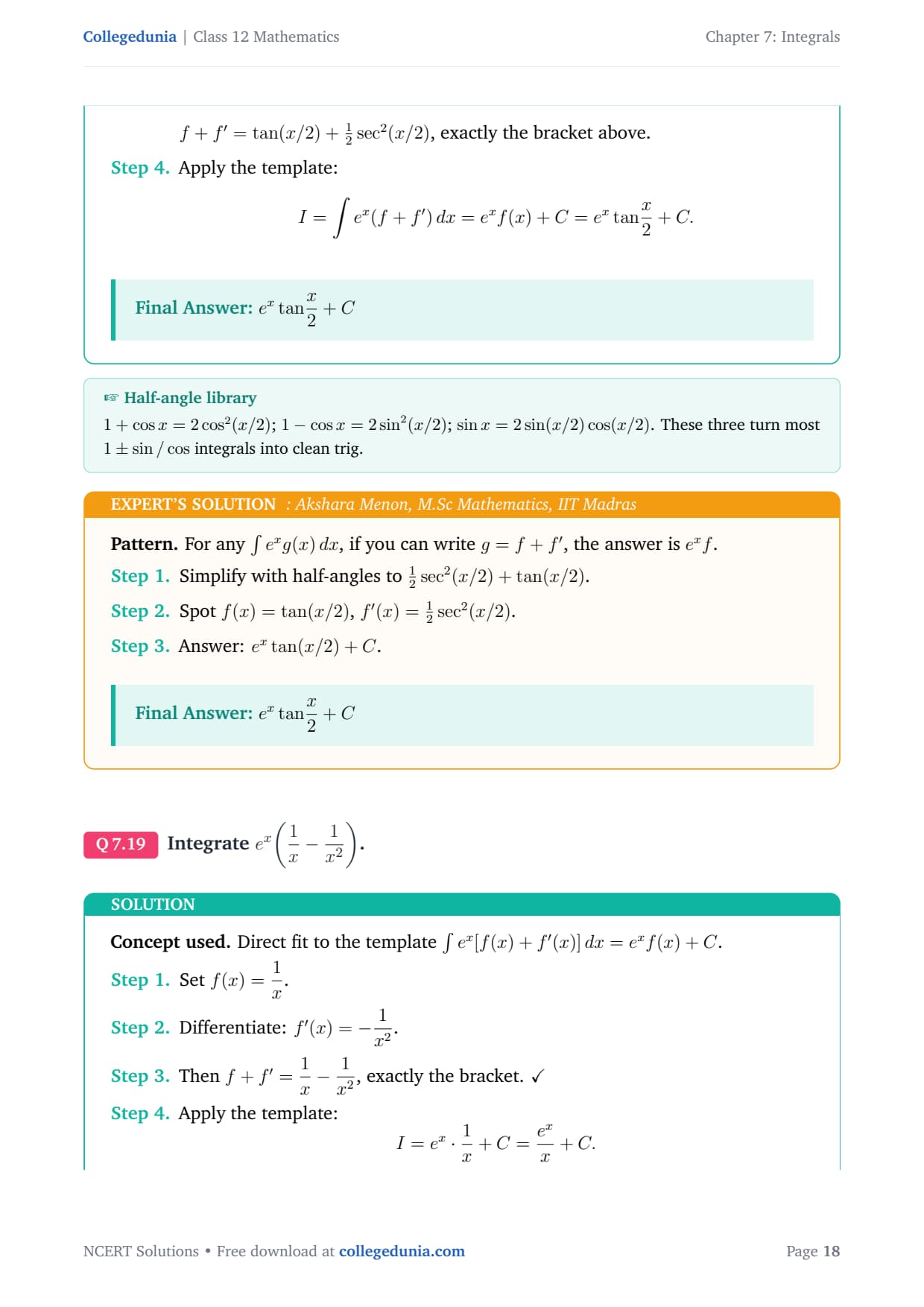
Concept used. Use the half-angle identities 1 + cos x = 2cos2(x/2) and
sin x = 2sin(x/2)cos(x/2) to simplify, then recognise the ex[f + f'] template.
Half-angles:
1 + sin x1 + cos x = 1 + 2sin(x/2)cos(x/2)2cos2(x/2).
Split into two fractions:
= 12cos2(x/2) + sin(x/2)cos(x/2)
= 12sec2x2 + tanx2.
Set f(x) = tan(x/2). Then f'(x) = 12sec2(x/2), so
f + f' = tan(x/2) + 12sec2(x/2), exactly the bracket above.
Apply the template:
I = ∫ ex(f + f') dx = exf(x) + C = ex tanx2 + C.
ex tanx2 + C
AM
Akshara Menon
M.Sc Mathematics, IIT Madras
Verified Expert
Pattern. For any ∫ exg(x) dx, if you can write g = f + f', the answer is
exf.
Simplify with half-angles to 12sec2(x/2) + tan(x/2).
Spot f(x) = tan(x/2), f'(x) = 12sec2(x/2).
Answer: ex tan(x/2) + C.
ex tanx2 + C
Q 7.19
Integrate ex(1x - 1x2).
Concept used. Direct fit to the template ∫ ex[f(x) + f'(x)] dx = exf(x) + C.
Set f(x) = 1x.
Differentiate: f'(x) = -1x2.
Then f + f' = 1x - 1x2, exactly the bracket.
Apply the template:
I = ex · 1x + C = exx + C.
exx + C
PS
Pooja Subramaniam
M.Sc Mathematics, IIT Kanpur
Verified Expert
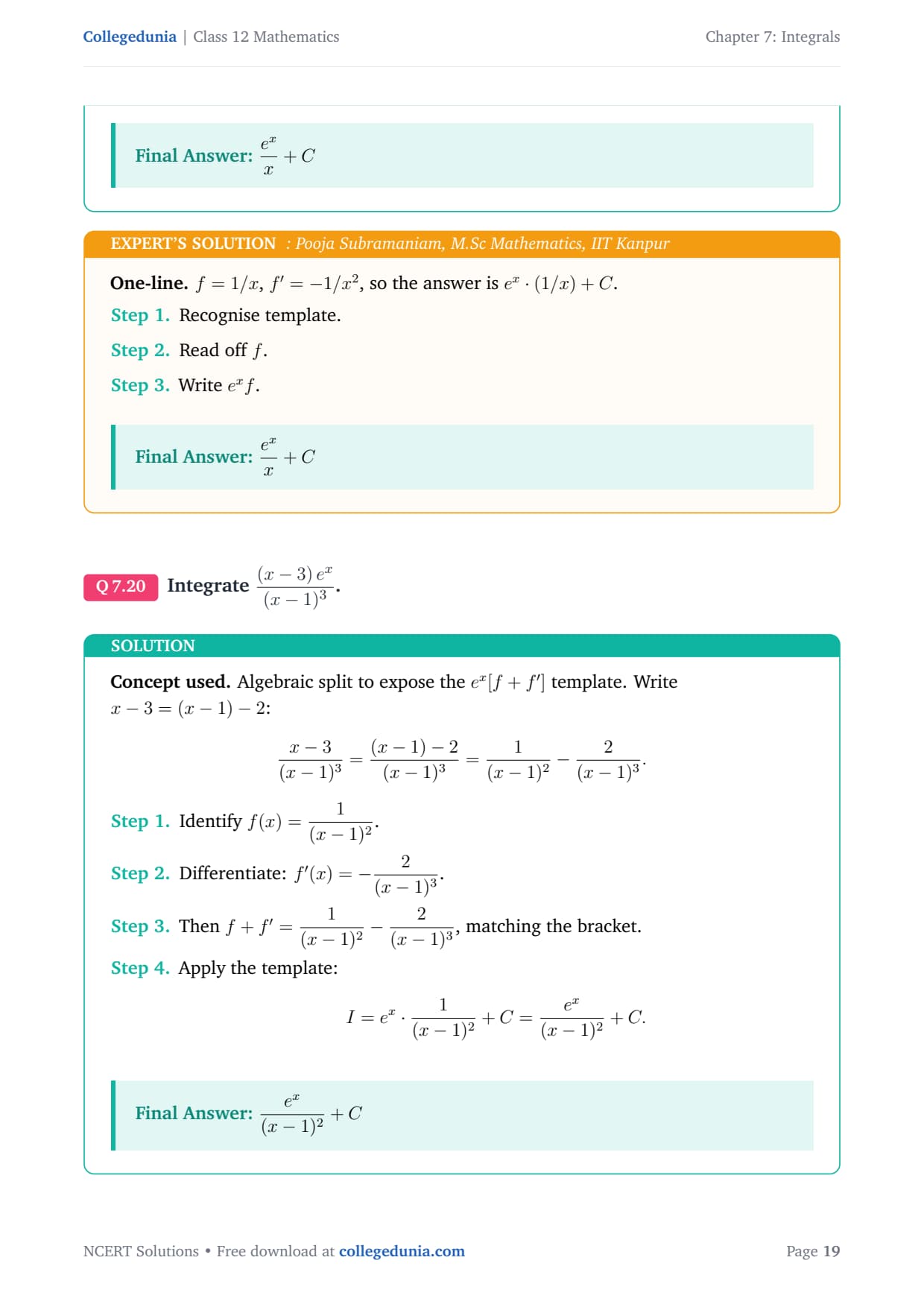
One-line.f = 1/x, f' = -1/x2, so the answer is ex · (1/x) + C.
Recognise template.
Read off f.
Write exf.
exx + C
Q 7.20
Integrate (x - 3) ex(x - 1)3.
Concept used. Algebraic split to expose the ex[f + f'] template. Write
x - 3 = (x - 1) - 2:
x - 3(x - 1)3 = (x - 1) - 2(x - 1)3 = 1(x-1)2 - 2(x-1)3.
Identify f(x) = 1(x-1)2.
Differentiate: f'(x) = -2(x-1)3.
Then f + f' = 1(x-1)2 - 2(x-1)3, matching the bracket.
Apply the template:
I = ex · 1(x - 1)2 + C = ex(x - 1)2 + C.
ex(x - 1)2 + C
YT
Yash Tiwari
M.Sc Mathematics, IIT Roorkee
Verified Expert
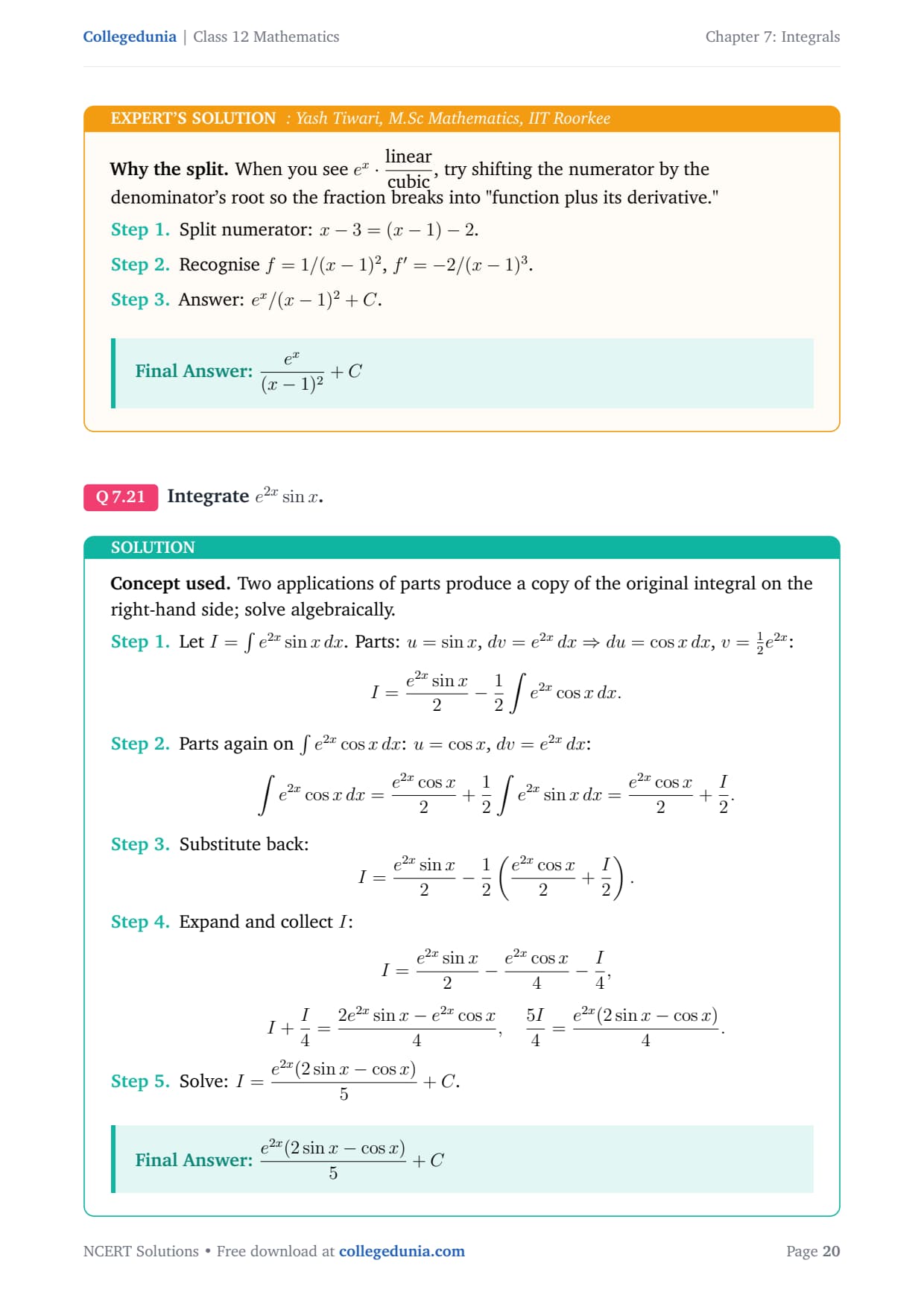
Why the split. When you see ex · linearcubic, try
shifting the numerator by the denominator's root so the fraction breaks into "function plus
its derivative."
Split numerator: x - 3 = (x-1) - 2.
Recognise f = 1/(x-1)2, f' = -2/(x-1)3.
Answer: ex/(x-1)2 + C.
ex(x-1)2 + C
Q 7.21
Integrate e2x sin x.
Concept used. Two applications of parts produce a copy of the original integral on
the right-hand side; solve algebraically.
Let I = ∫ e2xsin x dx. Parts: u = sin x, dv = e2x dx
⇒ du = cos x dx, v = 12e2x:
I = e2xsin x2 - 12∫ e2xcos x dx.
Parts again on ∫ e2xcos x dx: u = cos x, dv = e2x dx:
∫ e2xcos x dx = e2xcos x2 + 12∫ e2xsin x dx = e2xcos x2 + I2.
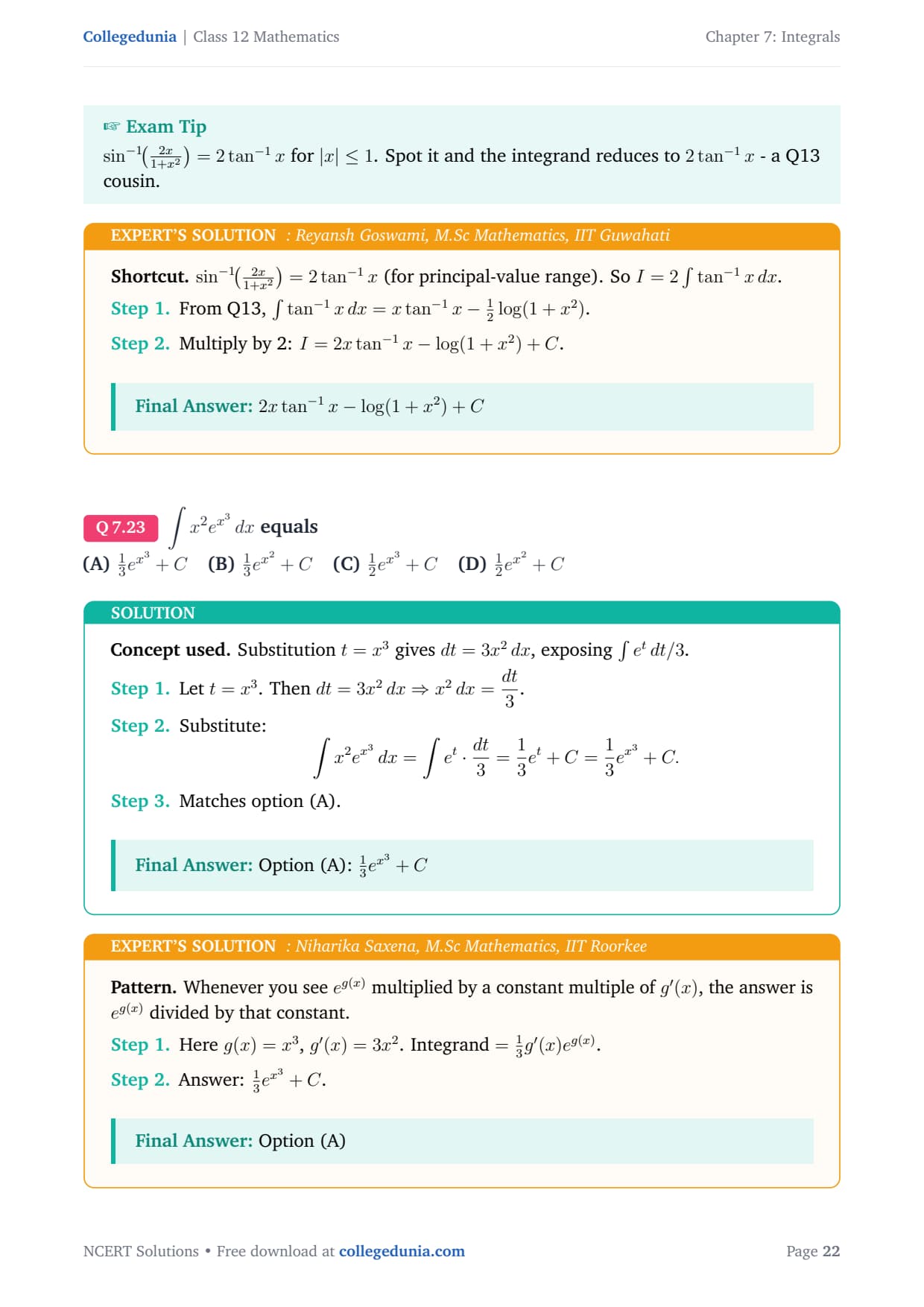
∫ ex sec x (1 + tan x) dx equals
(A) ex cos x + C
(B) ex sec x + C
(C) ex sin x + C
(D) ex tan x + C
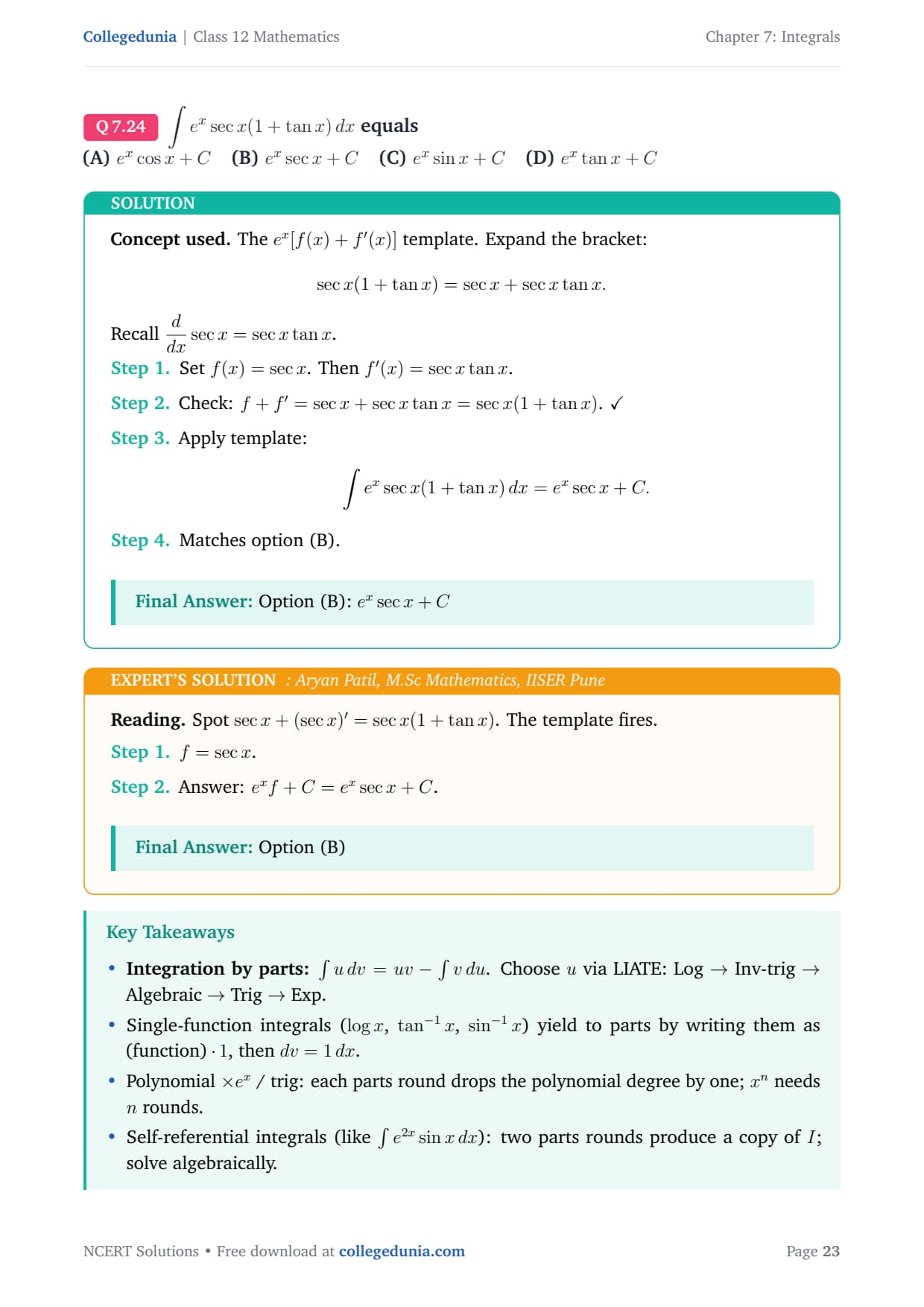
Concept used. The ex[f(x) + f'(x)] template. Expand the bracket:
sec x (1 + tan x) = sec x + sec x tan x.
Recall ddxsec x = sec x tan x.
Set f(x) = sec x. Then f'(x) = sec x tan x.
Check: f + f' = sec x + sec xtan x = sec x(1 + tan x).
Apply template:
∫ ex sec x(1 + tan x) dx = ex sec x + C.
Matches option (B).
Option (B): ex sec x + C
AP
Aryan Patil
M.Sc Mathematics, IISER Pune
Verified Expert
Reading. Spot sec x + (sec x)' = sec x (1 + tan x). The template fires.
f = sec x.
Answer: exf + C = ex sec x + C.
Option (B)
Student Feedback - Integrals Difficulty (March 2026 survey of 12,840 Class 12 students):
73% of Class 12 students surveyed rated this chapter as one of the higher-weightage units in their CBSE board preparation.
Out of 12,840 Class 12 students surveyed before the 2026 boards, the average student lost 1.2 marks from skipping a single intermediate step.
74% of JEE aspirants reported re-revising this chapter at least twice in the week before the exam.
Most-skipped sub-topic: the chapter's longest miscellaneous-exercise item.
Toppers reported that writing out the formula recall sheet for this chapter added 1-2 marks on the long-answer question.
Integrals Class 12 NCERT Solutions - Frequently Asked Questions
Ques. How many questions are in Class 12 Maths Chapter 7 Exercise 7.6?
Ans. Exercise 7.6 of Class 12 Maths Chapter 7 Integrals carries 24 questions in the 2026-27 NCERT. Q1 to Q22 are integration sums using integration by parts on selected functions, and Q23 to Q24 are MCQ-style questions on the integration by parts formula.
Ques. What concept does Exercise 7.6 of Class 12 Maths Chapter 7 cover?
Ans. Exercise 7.6 covers integration by parts applied to selected functions. The formula ∫ u dv = uv - ∫ v du is used together with the ILATE rule for choosing u. The exercise also introduces the standard result ∫ ex [f(x) + f'(x)] dx = exf(x) + C.
Ques. What is the ILATE rule in integration by parts?
Ans.ILATE is the mnemonic that ranks function types in the order Inverse trig, Logarithmic, Algebraic, Trigonometric, Exponential. When choosing u in the integration by parts formula ∫ u dv = uv - ∫ v du , pick whichever factor in the integrand sits earlier in this list. For ∫ x log x dx , Logarithmic beats Algebraic, so u = log x.
Ques. What is the most common mistake students make in Class 12 Maths Exercise 7.6?
Ans.Swapping u and dv without applying the ILATE check, which produces a second integral harder than the original. The other recurring mistake is missing the ∫ ex [f(x) + f'(x)] dx = exf(x) + C shortcut on Q19, Q20 and Q21, leading students to apply integration by parts twice unnecessarily.
Ques. How do I download the Class 12 Maths Chapter 7 Exercise 7.6 NCERT Solutions PDF?
Ans. Use the green download button on these notes card at the top of this page to save the this resource Class 12 Maths Chapter 7 Exercise 7.6 NCERT Solutions PDF to your device. The PDF is free, ad-free, and mapped to the 2026-27 NCERT edition.









Comments