Maths Mentor, Delhi University | Updated 3+ months ago
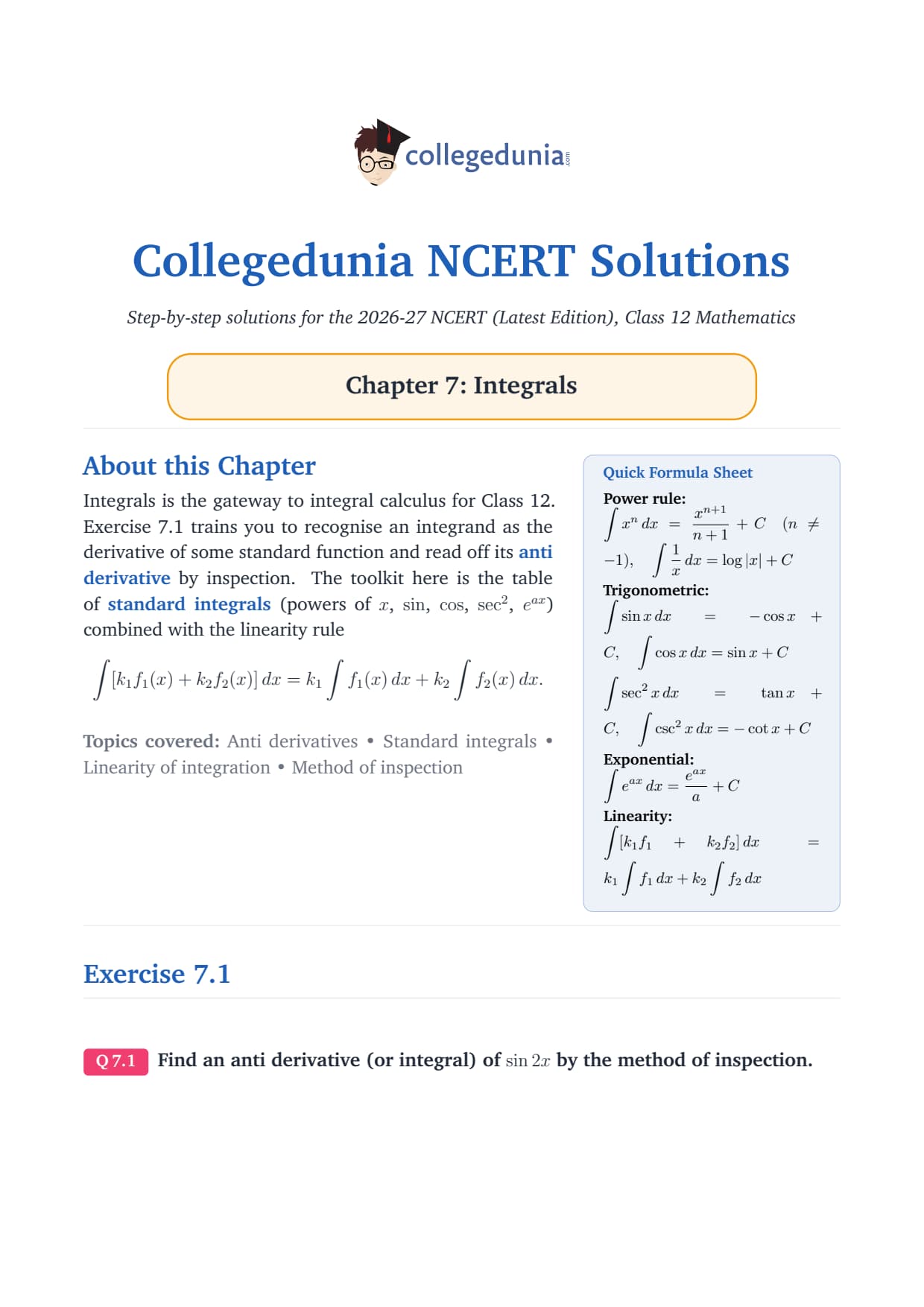
The Integrals Class 12 NCERT Solutions solve every problem of Exercise 7.1 in Class 12 Mathematics Chapter 7 Integrals. The working in the chapter notes follows the order taught in the NCERT textbook, so the student can move directly between the solutions PDF page and the corresponding solution without re-reading the theory.
At a glance: 22 sums · standard antiderivatives only · 8 algebraic, 9 trigonometric, 5 exponential / log · PDF size ~6 MB
CBSE Weightage: Exercise 7.1 problems map to 1-mark MCQ and 2-mark short-answer slots inside the Integrals 9-11 mark block.
JEE Main Weightage: Standard-form integration contributes roughly 2-3% of the Calculus questions.
CUET Weightage: Tested as direct recall MCQs; no rewriting steps expected.
Every solved sum in the PDF first rewrites the integrand into a form that matches a standard formula from the NCERT table, then applies it with the constant of integration + C kept explicit. When the integrand splits into three or four terms (Q5, Q11, Q22), each term is integrated on its own line so the step-by-step marking scheme is satisfied.
The Collegedunia editorial team has cross-checked every answer against the official NCERT key and the 2026-27 revised textbook. The final boxed expression for each problem matches the NCERT reference verbatim.
What Exercise 7.1 Covers: The Standard Antiderivative Map
Exercise 7.1 is the warm-up exercise of this chapter. It tests pure recall of the antiderivative table from Section 7.2, with mild rewriting (negative exponents, sec-tan products, fraction splitting) as the only complication.
Q No.
Integrand
Technique used
Standard formula invoked
1
sin 2x
Direct trig integral
∫ sin ax dx = -cos axa
2
cos 3x
Direct trig integral
∫ cos ax dx = sin axa
3
e2x
Exponential integral
∫ eax dx = eaxa
4
(ax + b)2
Power rule
∫ un du
5
sin 2x - 4 e3x
Linearity
Sum rule
6-9
Algebraic split forms
Term-by-term split
Power rule
10-15
Trigonometric products
Identity rewriting
sec2, csc2, standards
16-19
Algebraic-trig mixes
Linearity
Power + trig table
20
2 - 3sin xcos2x
Split into sec2 and
∫ sec2x = tan x, ∫ sec x tan x = sec x
21-22
MCQ types
Antiderivative identification
Standard table
Two problems (Q20, Q22) are repeat favourites in CBSE pre-board sets. Q20 has tripped students in three of the last five board papers because of the sec2x versus sec x tan x sign-and-form pairing.
Integrals Exercise 7.1 Solved Step by Step (Video)
How the Integrals Class 12 NCERT Solutions Help You
Exercise 7.1 is a recall test, not a problem-solving test. The Collegedunia solutions therefore name the formula explicitly before applying it, so the underlying table is reinforced with every problem rather than skipped over.
Formula-name annotation on every line, e.g. "Apply ∫ xn dx = xn+1n+1 with n = 2".
+ C constant kept explicit in every boxed answer; CBSE deducts 1 mark for the omission.
Trigonometric rewriting steps shown for Q10 to Q15 before differentiating, since "no rewriting" is the most common 1-mark slip.
MCQ-style reasoning for Q21 and Q22 with the wrong options eliminated one by one.
Integrals Exercise 7.1 Step-by-Step Approach
Every problem in this exercise follows the same four-step routine. Internalise this and you can clear all 22 sums in under 35 minutes.
Read the integrand and identify which standard formula in the NCERT Section 7.2 table it matches.
Rewrite if needed using a linear split, a power-rule conversion ( 1/xn → x-n) or a trigonometric identity.
Apply the formula term by term and write the result on its own line.
Add the constant of integration + C once at the end; never per term.
For MCQ-format Q21 and Q22, differentiate each option and check which one matches the original integrand; the option that does is the answer.
Exam Relevance of Class 12 Maths Chapter 7 Exercise 7.1
Exercise 7.1 sums show up as 1-mark MCQs and 2-mark short-answer questions in nearly every CBSE board sitting. The table below maps the last five board sittings.
Year
Marks from Ex 7.1 style sums
Question type
2025
3
1-mark MCQ + 2-mark VSA
2024
2
2-mark VSA
2023
3
1-mark MCQ + 2-mark VSA
2022
2
2-mark VSA
2021
3
1-mark MCQ + 2-mark VSA
Across the last five sittings, Ex 7.1 style sums have carried 2-3 marks every year. These are the easiest marks in the Integrals block, treat them as guaranteed.
Common Mistakes Students Make in Exercise 7.1
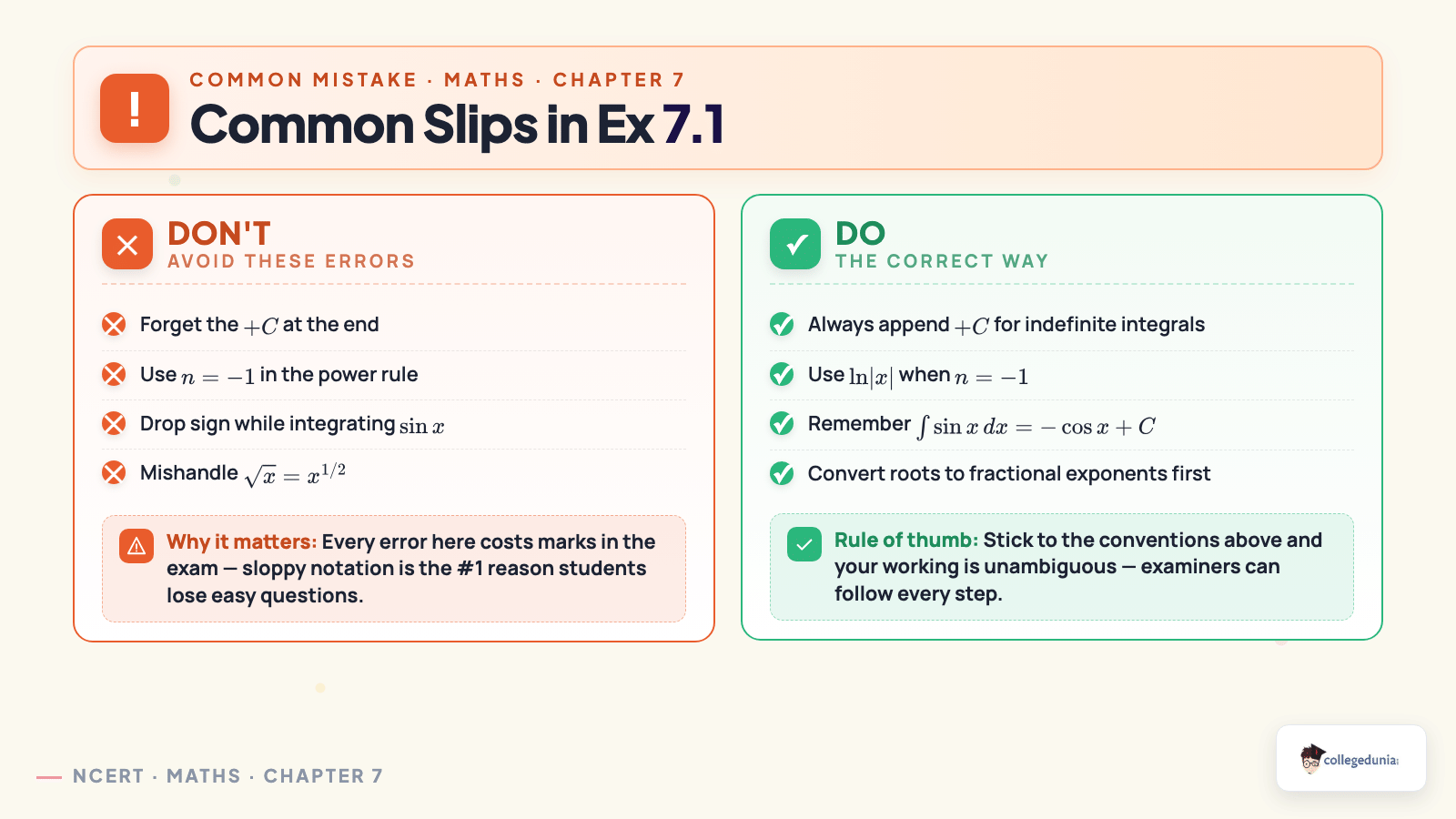
Common Mistake: Forgetting the + C at the end of an indefinite integral. CBSE marking schemes for 2021 to 2025 all deduct 1 mark for this omission, regardless of how clean the rest of the working is.
Writing ∫ sec2x dx = sec x + C instead of tan x + C. The latter is correct.
Forgetting the 1/a factor when integrating sin ax or cos ax ; this is the second-most-common slip on Q1 and Q2.
Missing a sign on ∫ -sin x dx = cos x + C versus ∫ sin x dx = -cos x + C.
Combining the + C constants per term instead of writing one at the end.
Other Resources for Class 12 Maths Chapter 7 Integrals
The Integrals chapter splits into 10 numbered exercises plus a Miscellaneous Exercise. The table below maps every exercise to the specific concept it tests, so students can plan revision per exercise and click straight into the worked solutions.
Mixed indefinite and definite integration problems
All NCERT Solutions for Integrals Ex 7.1 with Step-by-Step Working
Every NCERT textbook question for Class 12 Mathematics Chapter 7 Integrals Ex 7.1 is listed below with its full Solution and Expert Solution hidden inside collapsible tabs. Click Check Solution to reveal the step-by-step working; click Expert Solution for the expanded explanation.
Questions
Q 7.1
Find an anti derivative (or integral) of sin 2x by the method of inspection.
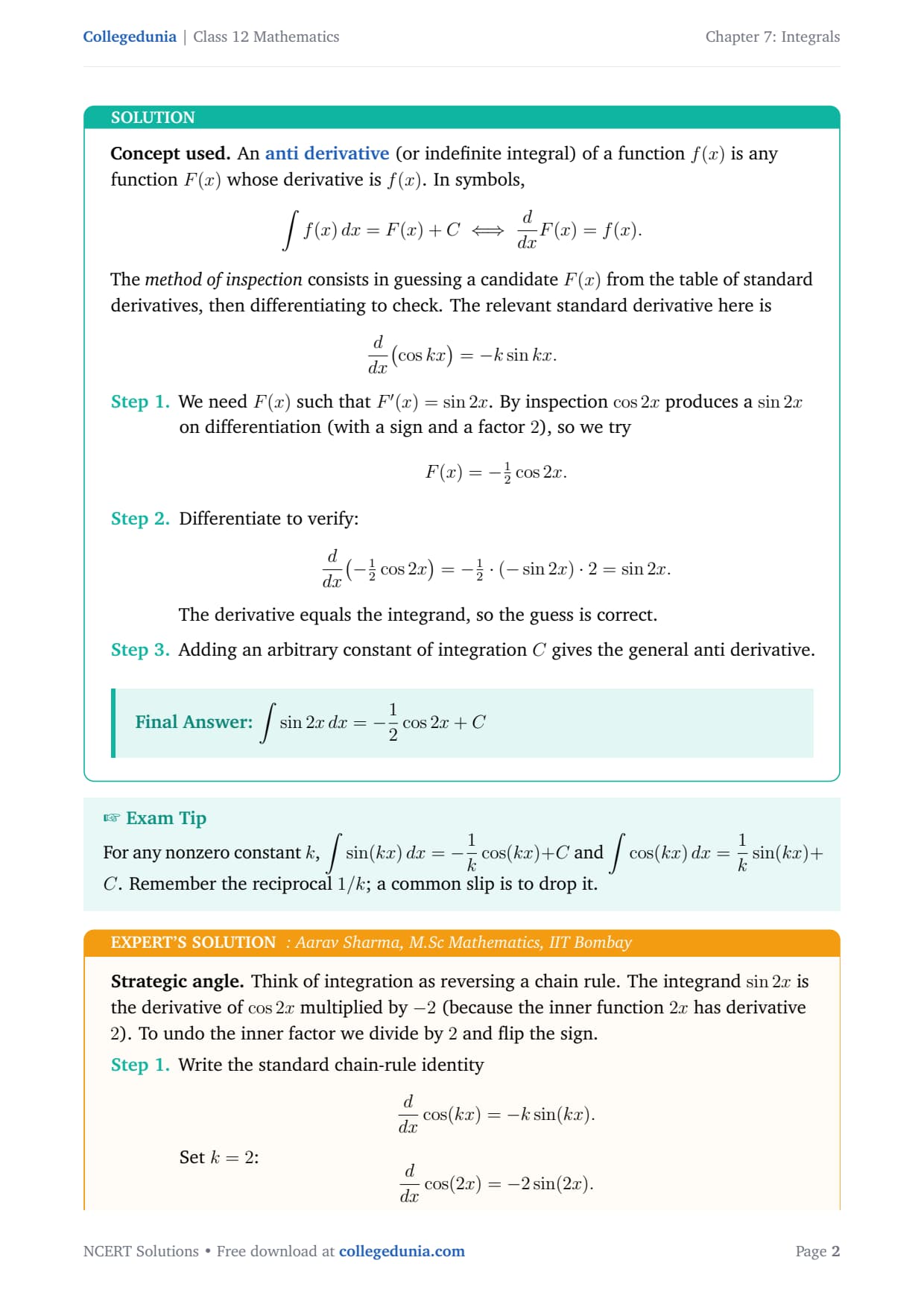
Concept used. An anti derivative (or indefinite integral) of a function
f(x) is any function F(x) whose derivative is f(x). In symbols,
∫ f(x) dx = F(x) + CddxF(x) = f(x).
The method of inspection consists in guessing a candidate F(x) from the table of
standard derivatives, then differentiating to check. The relevant standard derivative
here is
ddx(cos kx) = -ksin kx.
We need F(x) such that F'(x) = sin 2x. By inspection cos 2x produces a
sin 2x on differentiation (with a sign and a factor 2), so we try
F(x) = -12cos 2x.
Differentiate to verify:
ddx(-12cos 2x) = -12·(-sin 2x)· 2 = sin 2x.
The derivative equals the integrand, so the guess is correct.
Adding an arbitrary constant of integration C gives the general anti derivative.
∫ sin 2x dx = -12cos 2x + C
AS
Aarav Sharma
M.Sc Mathematics, IIT Bombay
Verified Expert
Strategic angle. Think of integration as reversing a chain rule. The integrand
sin 2x is the derivative of cos 2x multiplied by -2 (because the inner function
2x has derivative 2). To undo the inner factor we divide by 2 and flip the sign.
Write the standard chain-rule identity
ddxcos(kx) = -ksin(kx).
Set k = 2:
ddxcos(2x) = -2sin(2x).
Divide both sides by -2:
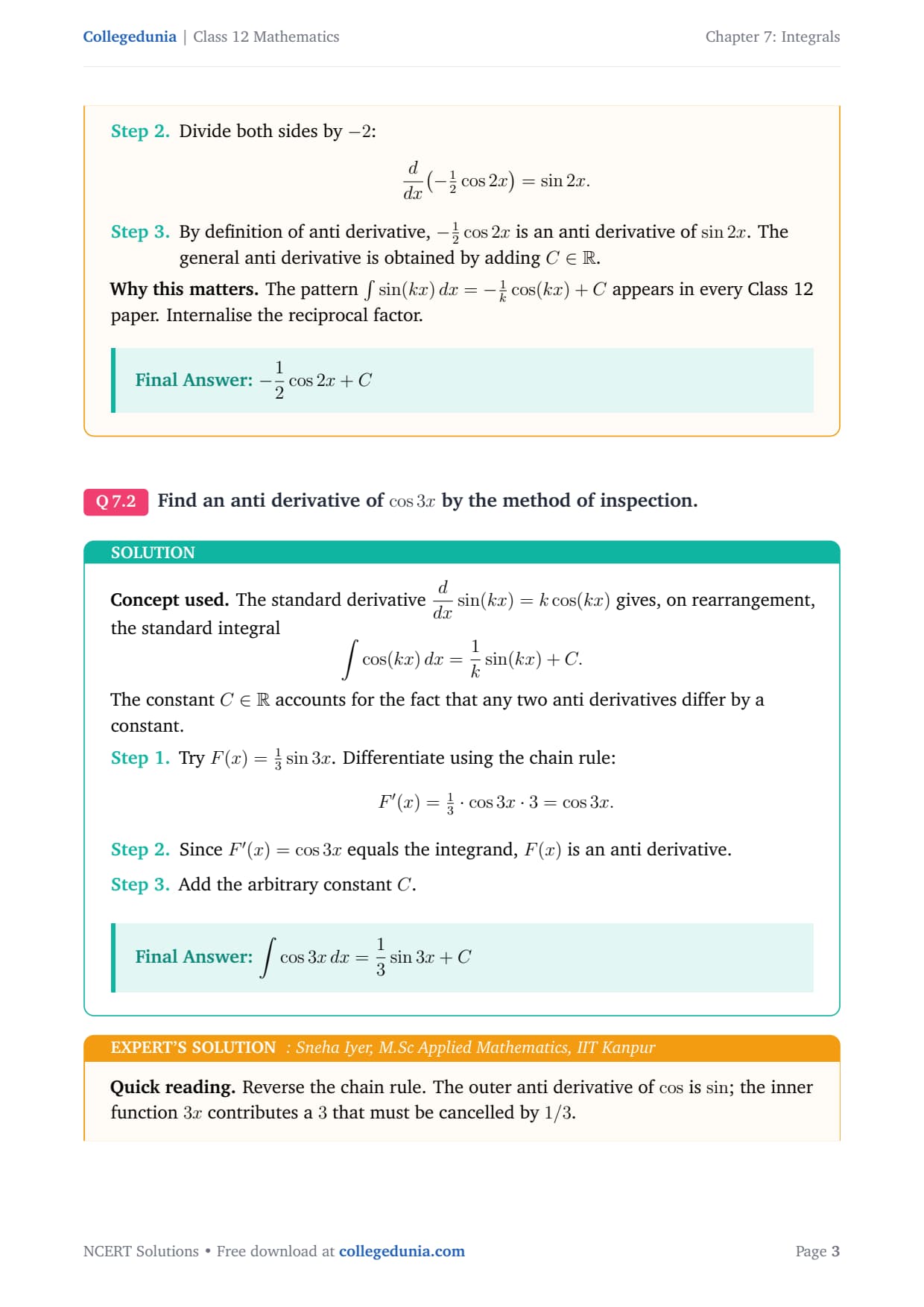
ddx(-12cos 2x) = sin 2x.
By definition of anti derivative, -12cos 2x is an anti derivative of
sin 2x. The general anti derivative is obtained by adding C∈R.
Why this matters. The pattern ∫ sin(kx) dx = -1kcos(kx) + C
appears in every Class 12 paper. Internalise the reciprocal factor.
-12cos 2x + C
Q 7.2
Find an anti derivative of cos 3x by the method of inspection.
Concept used. The standard derivative
ddxsin(kx) = kcos(kx) gives, on rearrangement, the standard
integral
∫ cos(kx) dx = 1ksin(kx) + C.
The constant C∈R accounts for the fact that any two anti derivatives differ by
a constant.
Try F(x) = 13sin 3x. Differentiate using the chain rule:
F'(x) = 133x· 3 = cos 3x.
Since F'(x) = cos 3x equals the integrand, F(x) is an anti derivative.
Add the arbitrary constant C.
∫ cos 3x dx = 13sin 3x + C
SI
Sneha Iyer
M.Sc Applied Mathematics, IIT Kanpur
Verified Expert
Quick reading. Reverse the chain rule. The outer anti derivative of cos is
sin; the inner function 3x contributes a 3 that must be cancelled by 1/3.
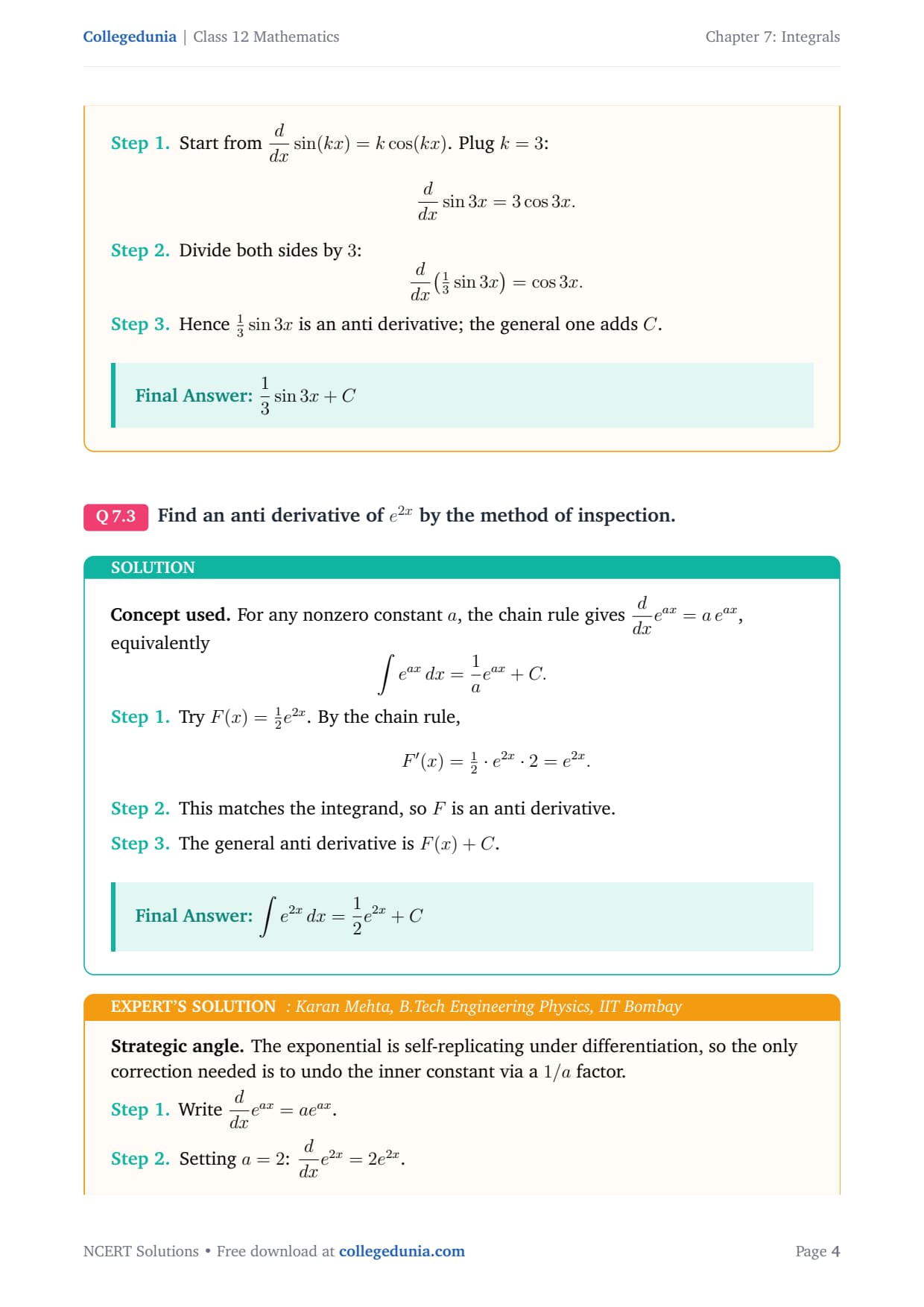
Hence 13sin 3x is an anti derivative; the general one adds C.
13sin 3x + C
Q 7.3
Find an anti derivative of e2x by the method of inspection.
Concept used. For any nonzero constant a, the chain rule gives
ddxeax = a eax, equivalently
∫ eax dx = 1aeax + C.
Try F(x) = 12e2x. By the chain rule,
F'(x) = 12· e2x· 2 = e2x.
This matches the integrand, so F is an anti derivative.
The general anti derivative is F(x) + C.
∫ e2x dx = 12e2x + C
KM
Karan Mehta
B.Tech Engineering Physics, IIT Bombay
Verified Expert
Strategic angle. The exponential is self-replicating under differentiation, so
the only correction needed is to undo the inner constant via a 1/a factor.
Write ddxeax = a eax.
Setting a = 2: ddxe2x = 2 e2x.
Divide by 2: ddx(12e2x) = e2x. Therefore the
anti derivative is 12e2x + C.
e2x2 + C
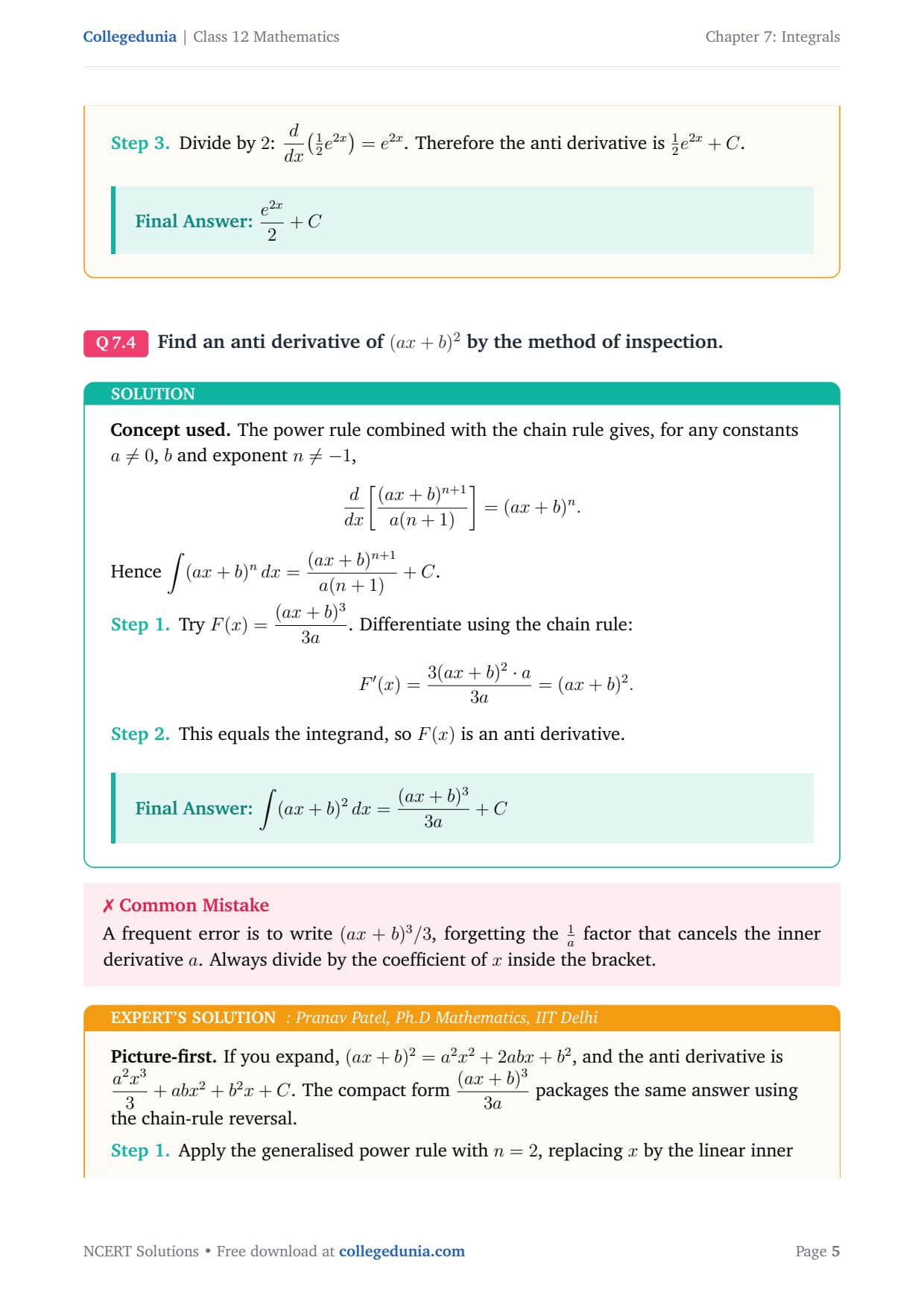
Q 7.4
Find an anti derivative of (ax + b)2 by the method of inspection.
Concept used. The power rule combined with the chain rule gives, for any
constants a≠ 0, b and exponent n≠ -1,
ddx[(ax+b)n+1a(n+1)] = (ax+b)n.
Hence
∫ (ax+b)n dx = (ax+b)n+1a(n+1) + C.
Try F(x) = (ax+b)33a. Differentiate using the chain rule:
F'(x) = 3(ax+b)2· a3a = (ax+b)2.
This equals the integrand, so F(x) is an anti derivative.
∫ (ax+b)2 dx = (ax+b)33a + C
PP
Pranav Patel
Ph.D Mathematics, IIT Delhi
Verified Expert
Picture-first. If you expand, (ax+b)2 = a2 x2 + 2abx + b2, and the
anti derivative is a2 x33 + abx2 + b2x + C. The compact form
(ax+b)33a packages the same answer using the chain-rule reversal.
Apply the generalised power rule with n = 2, replacing x by the linear inner
function ax+b:
∫ (ax+b)2 dx = (ax+b)33 · 1a + C.
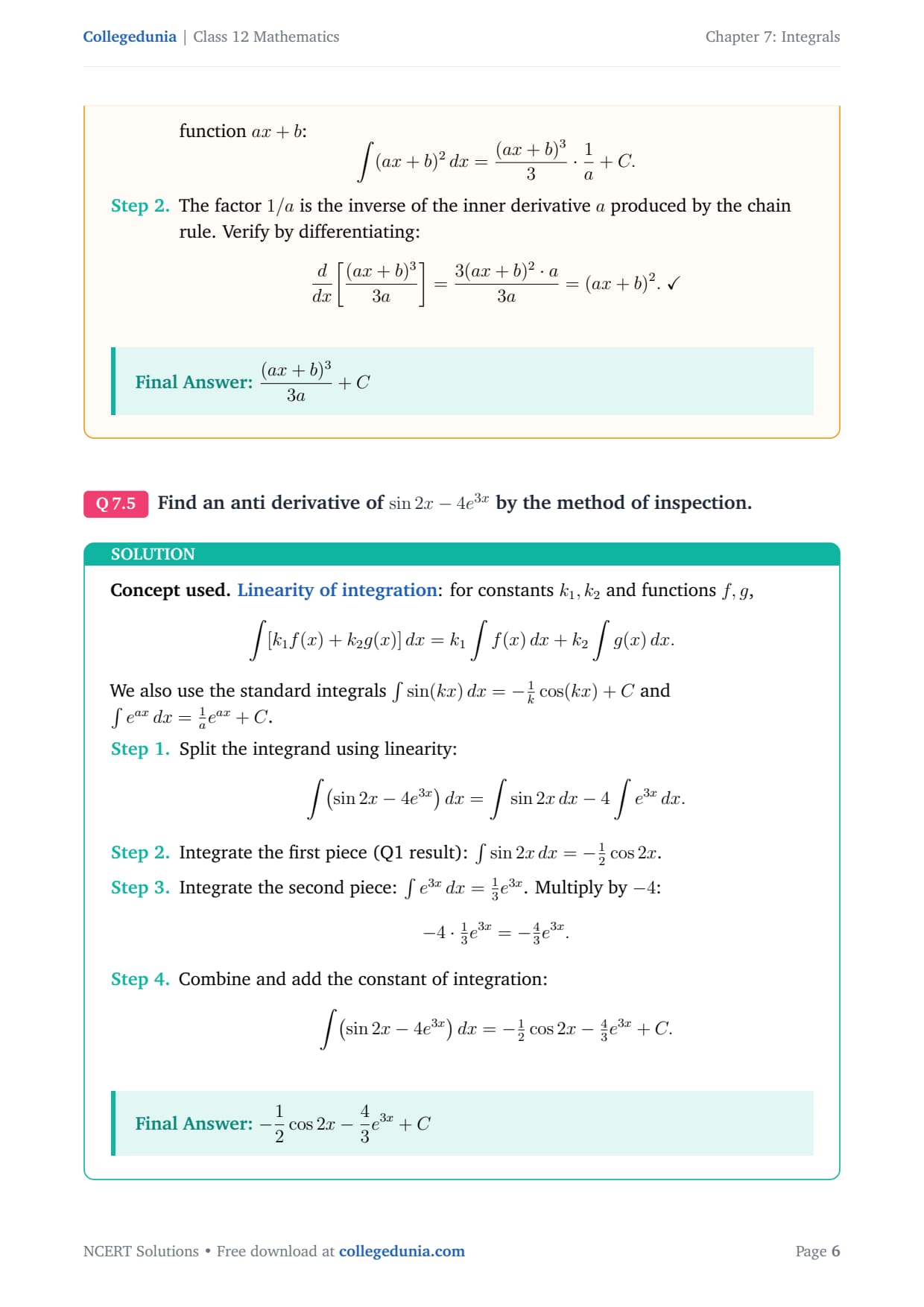
The factor 1/a is the inverse of the inner derivative a produced by the chain
rule. Verify by differentiating:
ddx[(ax+b)33a] = 3(ax+b)2 · a3a = (ax+b)2.
(ax+b)33a + C
Q 7.5
Find an anti derivative of sin 2x - 4 e3x by the method of inspection.
Concept used.Linearity of integration: for constants k1, k2 and
functions f, g,
∫ [k1f(x) + k2g(x)] dx = k1∫ f(x) dx + k2∫ g(x) dx.
We also use the standard integrals
∫ sin(kx) dx = -1kcos(kx) + C and
∫ eax dx = 1aeax + C.
Split the integrand using linearity:
∫ (sin 2x - 4e3x) dx = ∫ sin 2x dx - 4∫ e3x dx.
Integrate the first piece (Q1 result): ∫ sin 2x dx = -12cos 2x.
Integrate the second piece: ∫ e3x dx = 13e3x. Multiply by -4:
-4 · 13e3x = -43e3x.
Combine and add the constant of integration:
∫ (sin 2x - 4e3x) dx = -12cos 2x - 43e3x + C.
-12cos 2x - 43e3x + C
RG
Riya Gupta
M.Sc Mathematics, ISI Kolkata
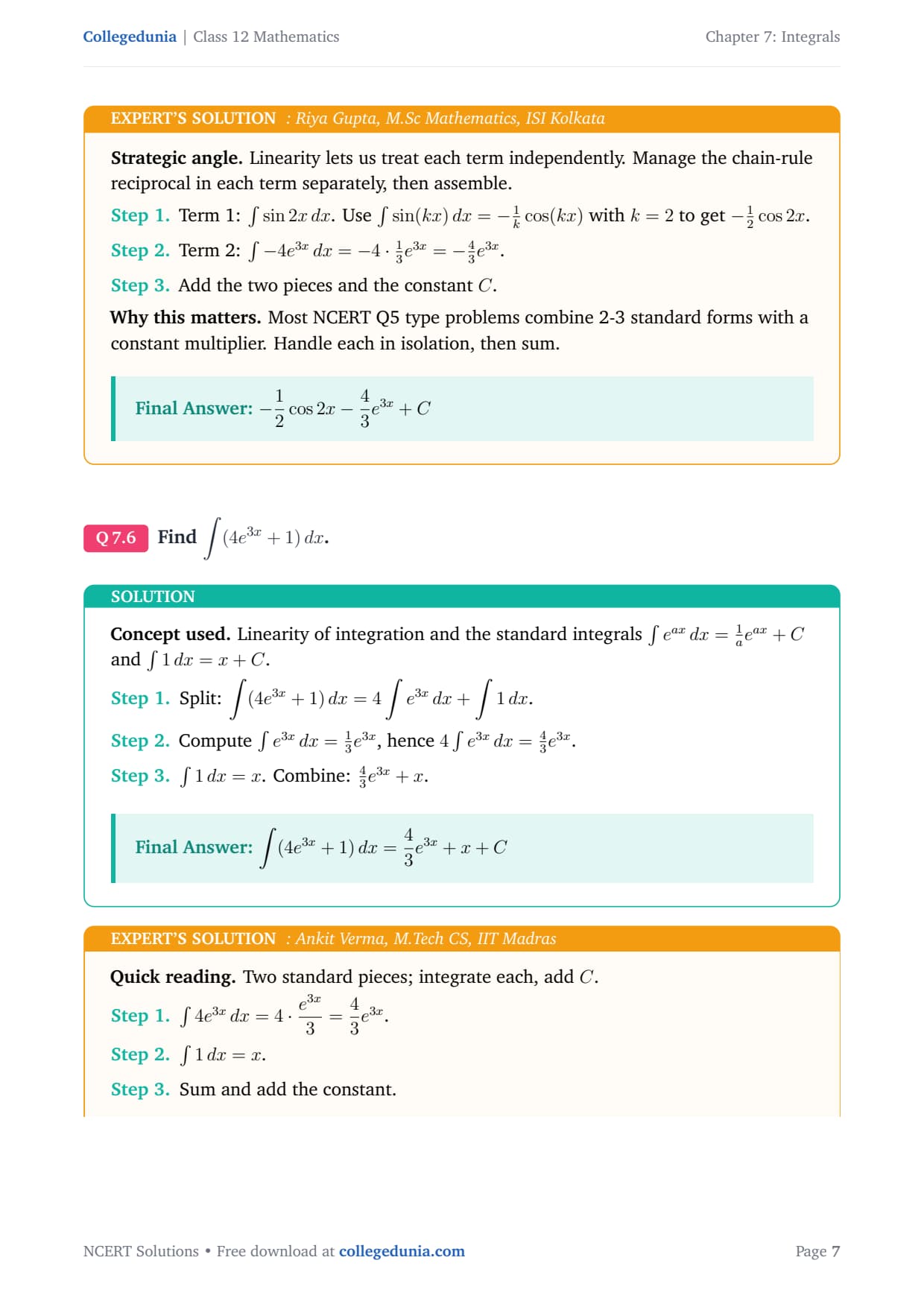
Verified Expert
Strategic angle. Linearity lets us treat each term independently. Manage the
chain-rule reciprocal in each term separately, then assemble.
Term 1: ∫ sin 2x dx. Use (kx) dx = -1kcos(kx) with
k=2 to get -12cos 2x.
Term 2: ∫ -4 e3x dx = -4· 13e3x = -43e3x.
Add the two pieces and the constant C.
Why this matters. Most NCERT Q5 type problems combine 2-3 standard forms with a
constant multiplier. Handle each in isolation, then sum.
-12cos 2x - 43e3x + C
Q 7.6
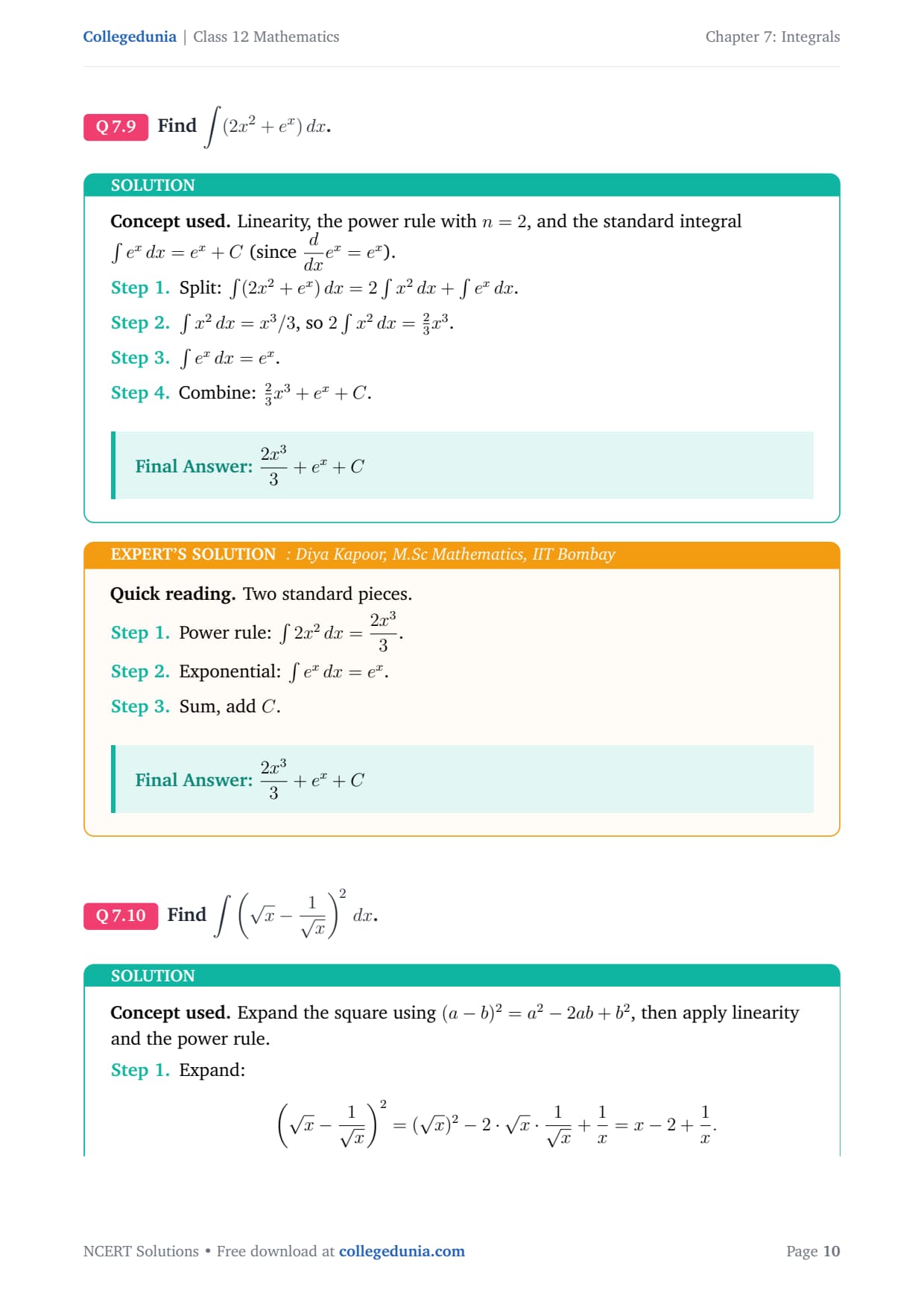
Find ∫ (4e3x + 1) dx.
Concept used. Linearity of integration and the standard integrals
∫ eax dx = 1aeax + C and ∫ 1 dx = x + C.
Quick reading. Two standard pieces; integrate each, add C.
∫ 4e3x dx = 4·e3x3 = 43e3x.
∫ 1 dx = x.
Sum and add the constant.
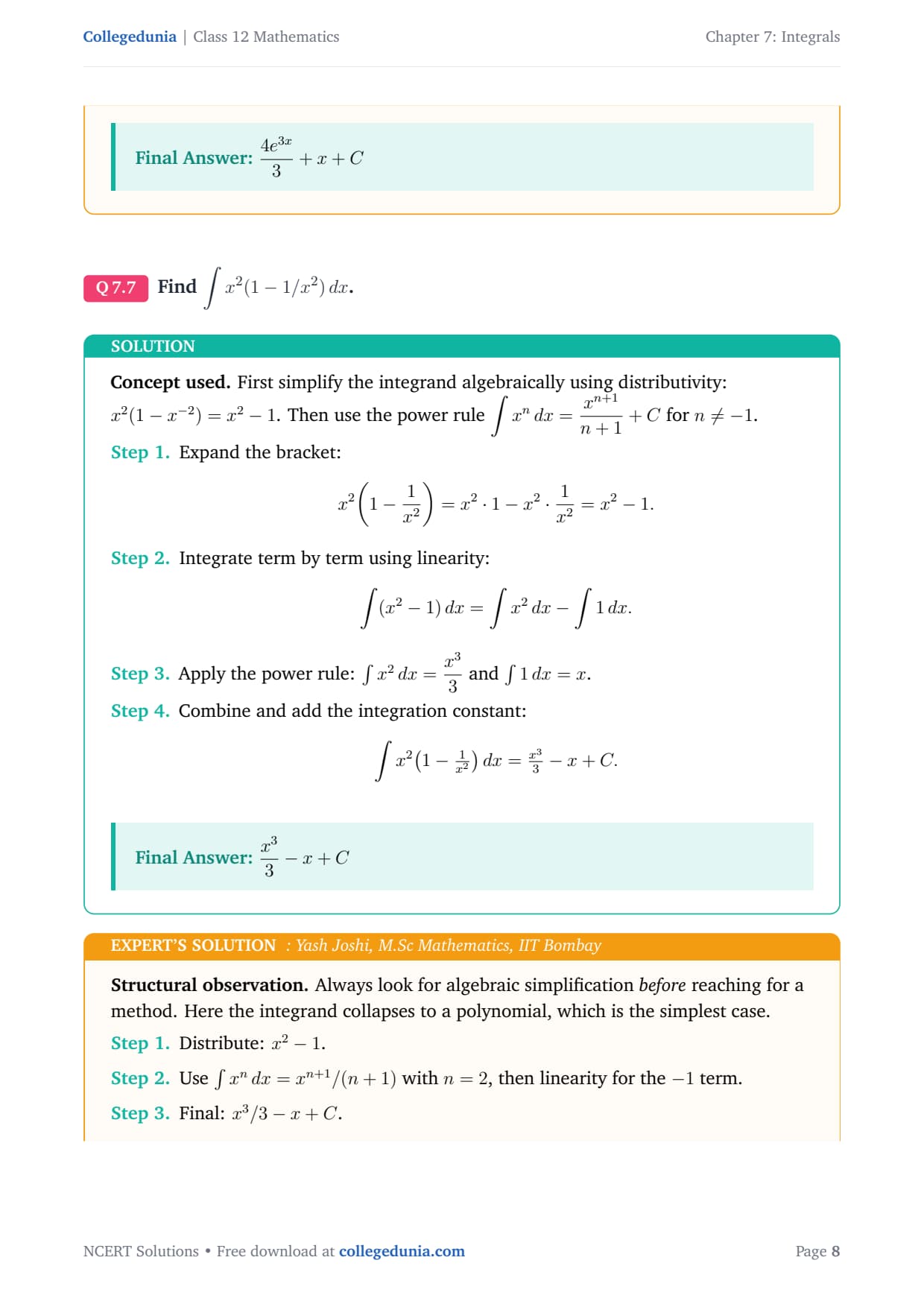
4e3x3 + x + C
Q 7.7
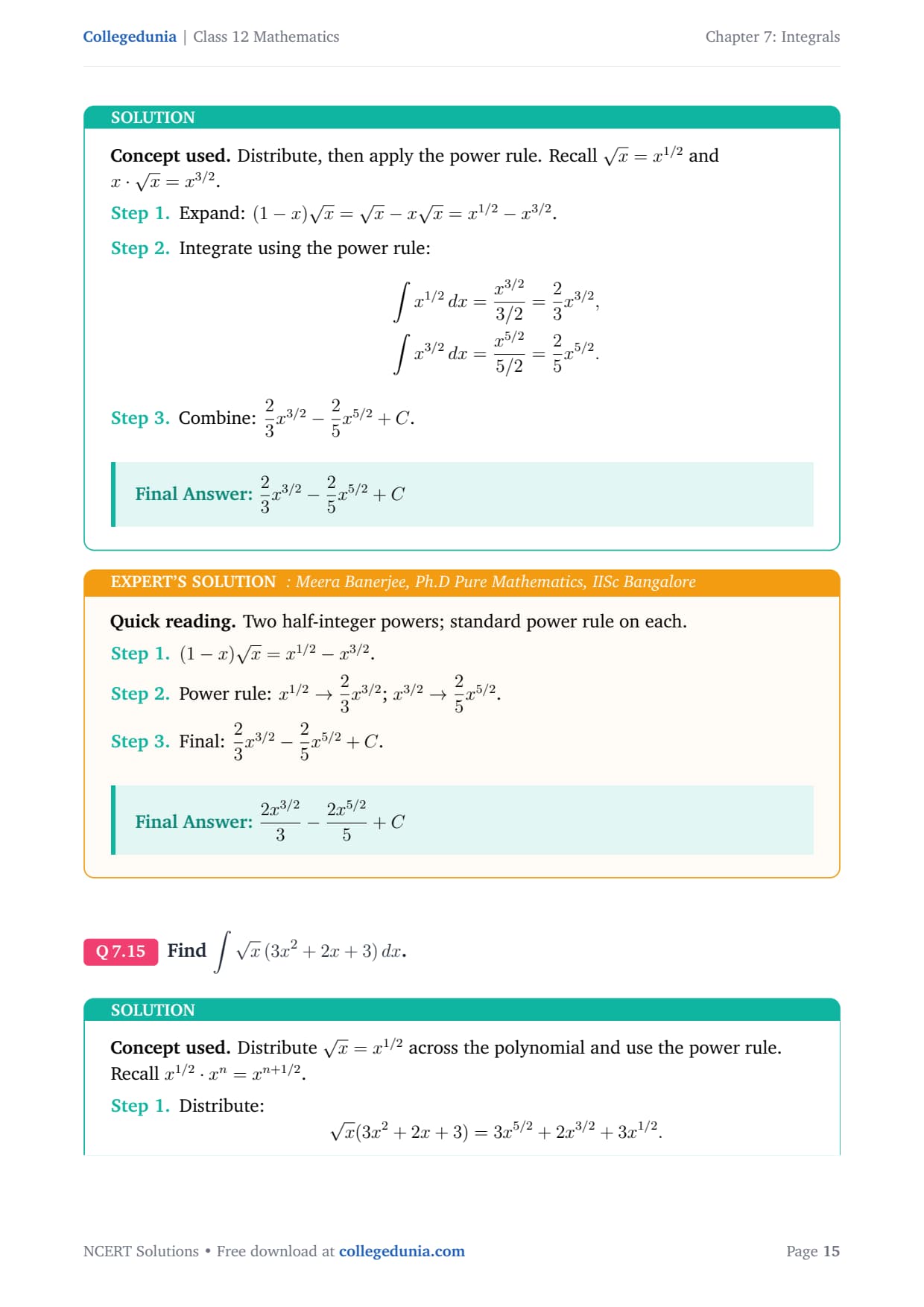
Find ∫ x2 (1 - 1/x2) dx.
Concept used. First simplify the integrand algebraically using distributivity:
x2(1 - x-2) = x2 - 1. Then use the power rule
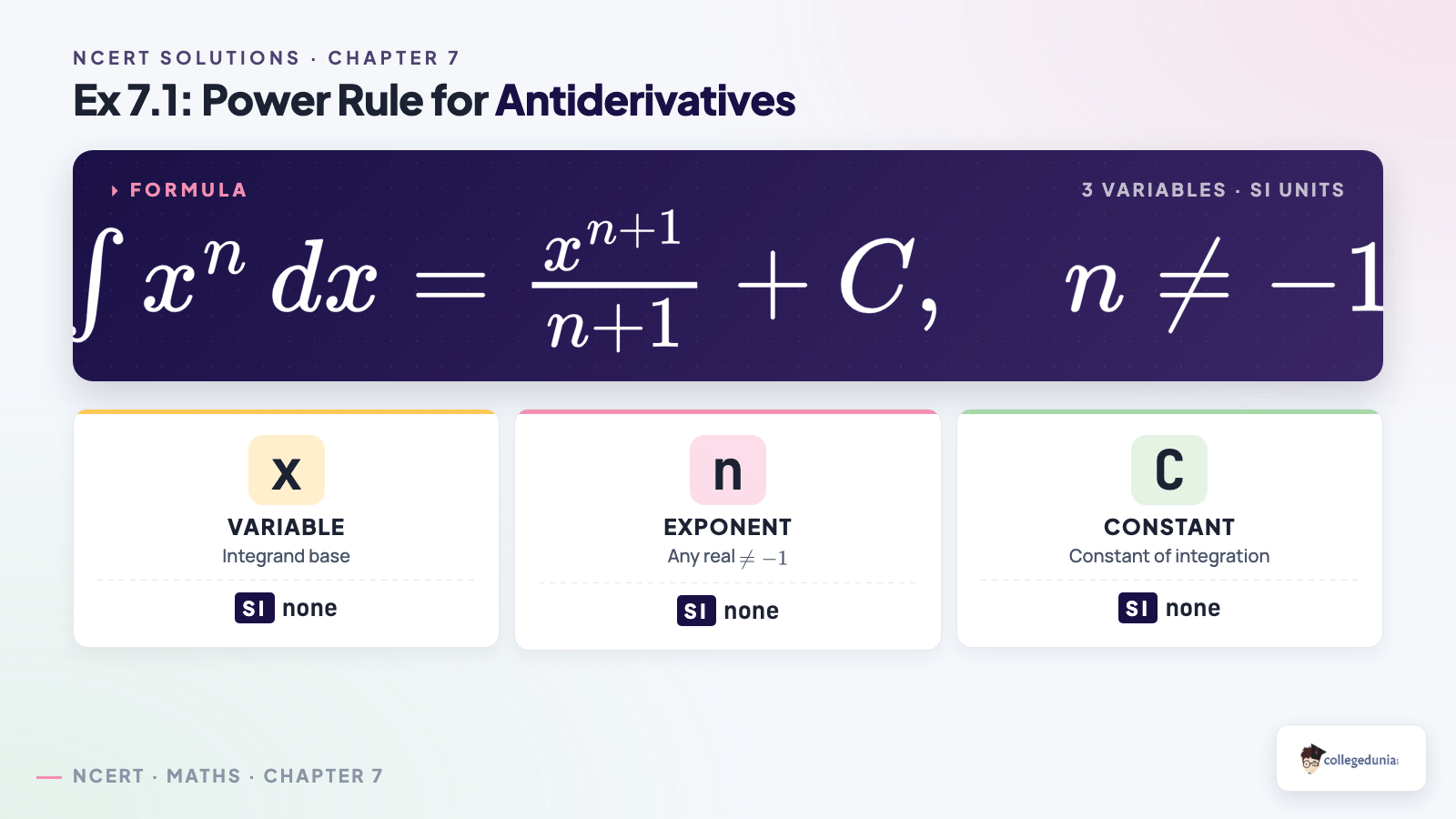
∫ xn dx = xn+1n+1 + C for n≠ -1.
Integrate term by term using linearity:
∫ (x2 - 1) dx = ∫ x2 dx - ∫ 1 dx.
Apply the power rule: ∫ x2 dx = x33 and ∫ 1 dx = x.
Combine and add the integration constant:
∫ x2(1 - 1x2)dx = x33 - x + C.
x33 - x + C
YJ
Yash Joshi
M.Sc Mathematics, IIT Bombay
Verified Expert
Structural observation. Always look for algebraic simplification before
reaching for a method. Here the integrand collapses to a polynomial, which is the
simplest case.
Distribute: x2 - 1.
Use ∫ xn dx = xn+1/(n+1) with n=2, then linearity for the -1 term.
Final: x3/3 - x + C.
x33 - x + C
Q 7.8
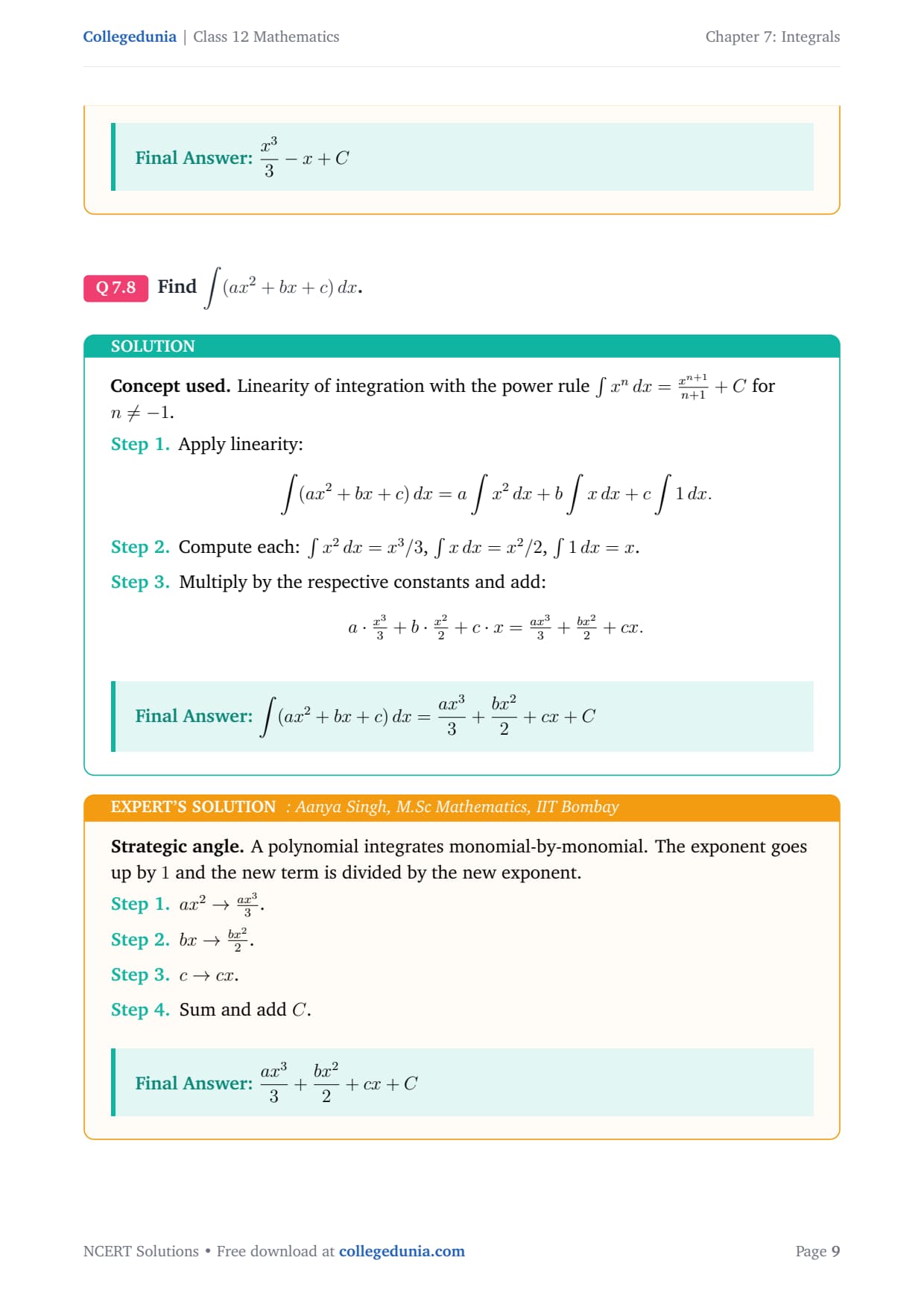
Find ∫ (ax2 + bx + c) dx.
Concept used. Linearity of integration with the power rule
∫ xn dx = xn+1n+1 + C for n≠ -1.
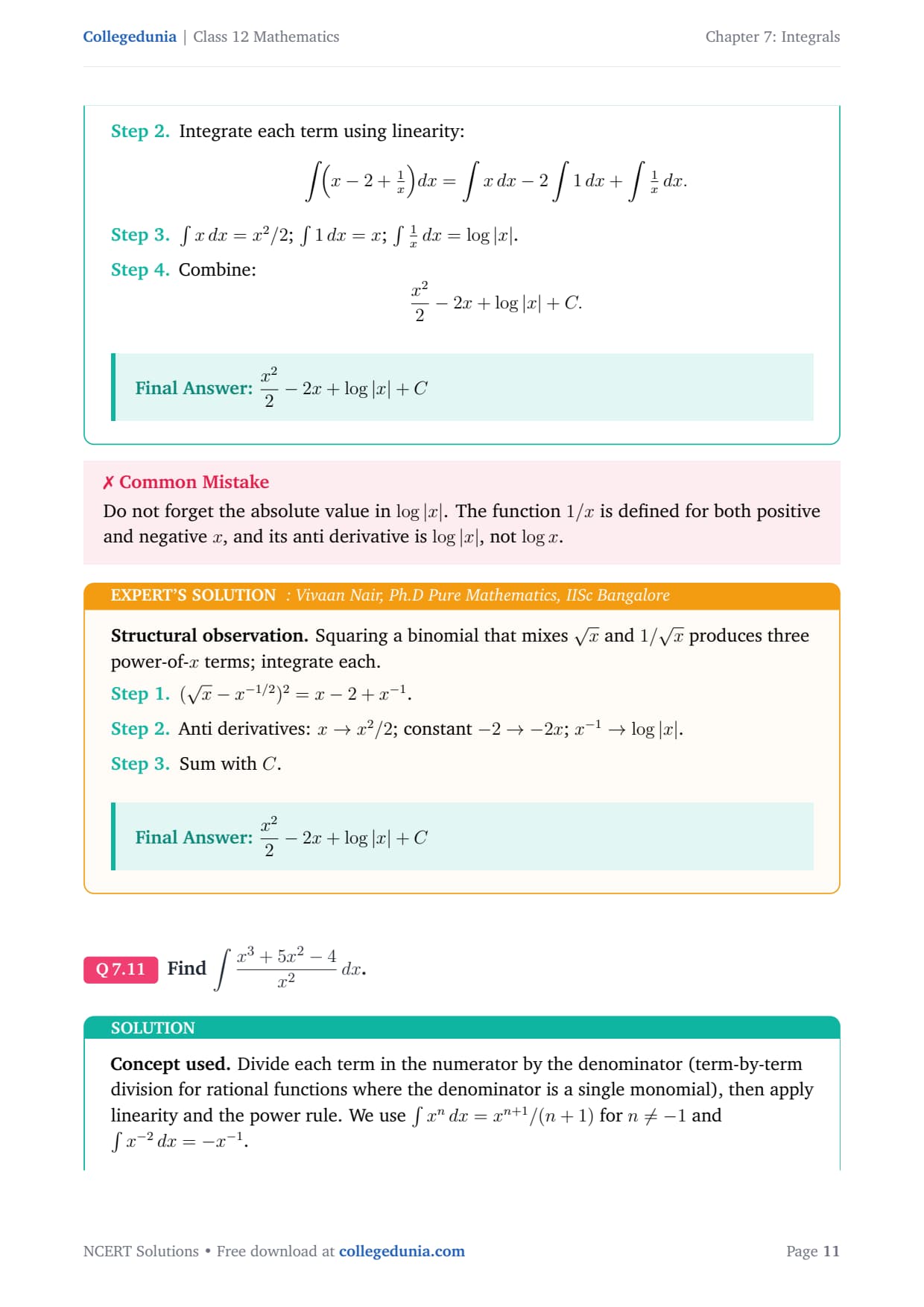
Integrate each term using linearity:
∫ (x - 2 + 1x)dx = ∫ x dx - 2∫ 1 dx + ∫ 1x dx.
∫ x dx = x2/2; ∫ 1 dx = x; ∫ 1x dx = log|x|.
Combine:
x22 - 2x + log|x| + C.
x22 - 2x + log|x| + C
VN
Vivaan Nair
Ph.D Pure Mathematics, IISc Bangalore
Verified Expert
Structural observation. Squaring a binomial that mixes √x and
1/√x produces three power-of-x terms; integrate each.
(√x - x-1/2)2 = x - 2 + x-1.
Anti derivatives: x→ x2/2; constant -2 → -2x; x-1→ log|x|.
Sum with C.
x22 - 2x + log|x| + C
Q 7.11
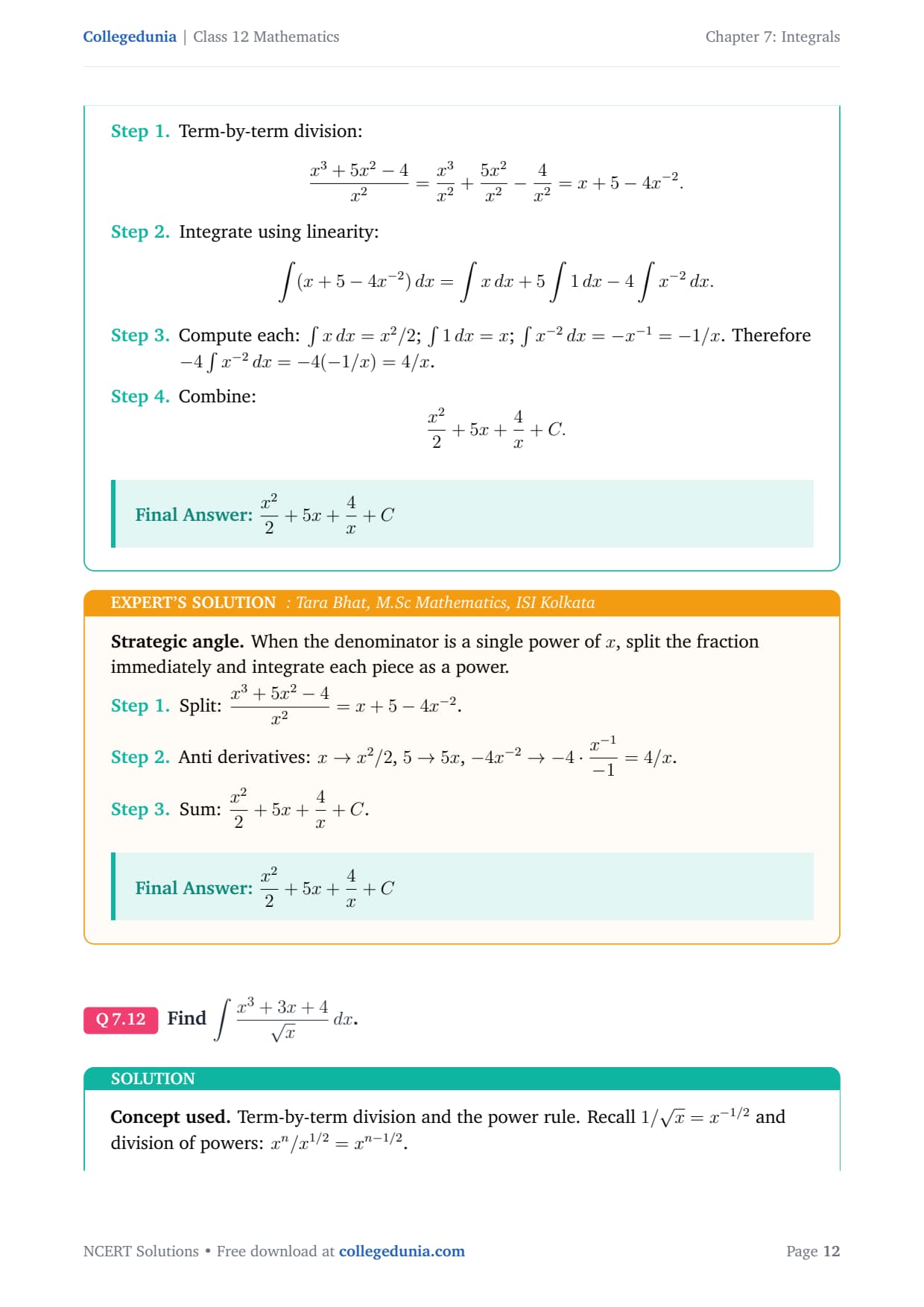
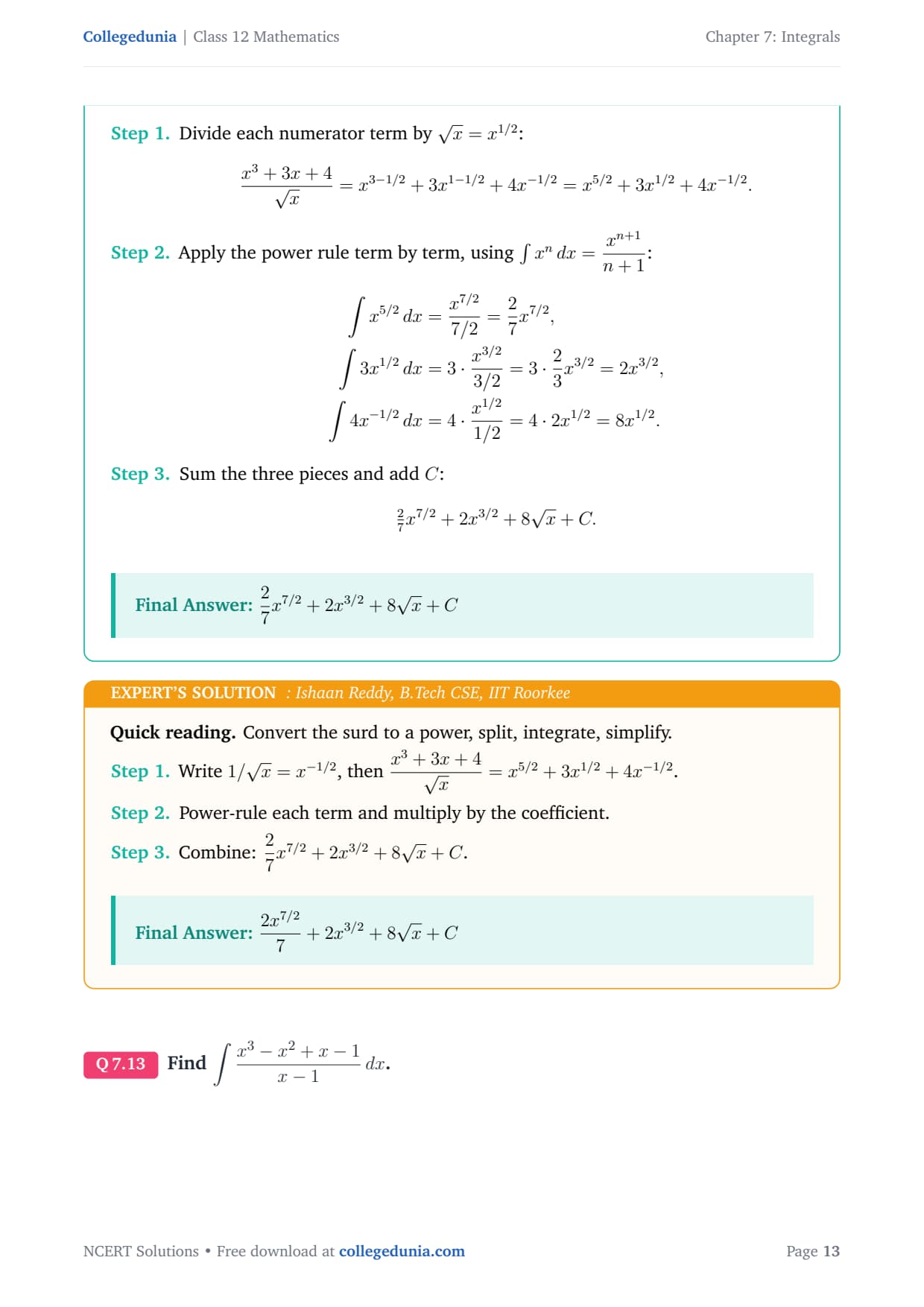
Find ∫ x3 + 5x2 - 4x2 dx.
Concept used. Divide each term in the numerator by the denominator (term-by-term
division for rational functions where the denominator is a single monomial), then apply
linearity and the power rule. We use ∫ xn dx = xn+1/(n+1) for n≠ -1 and
∫ x-2 dx = -x-1.
Power-rule each term and multiply by the coefficient.
Combine: 27x7/2 + 2 x3/2 + 8√x + C.
2 x7/27 + 2 x3/2 + 8√x + C
Q 7.13
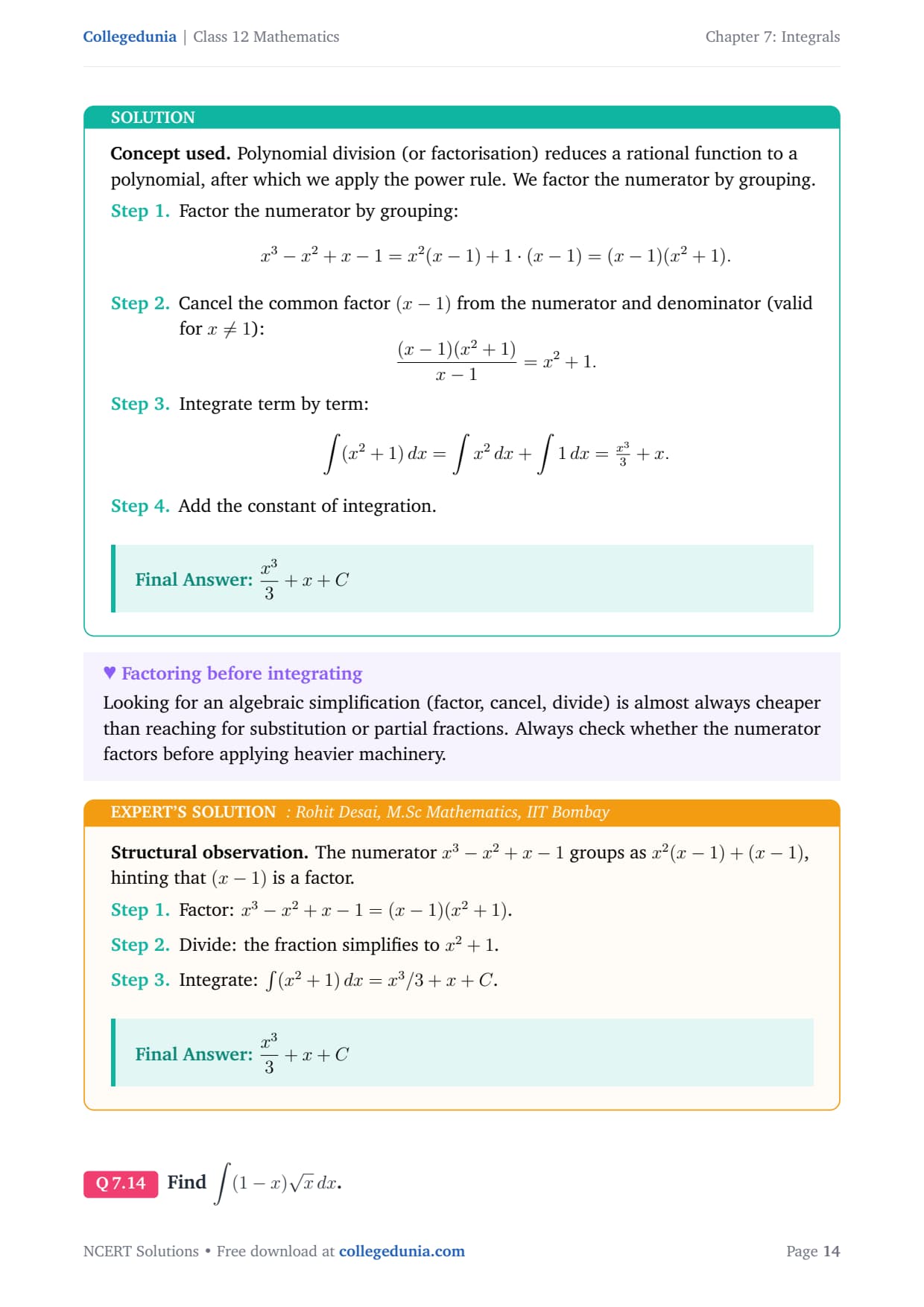
Find ∫ x3 - x2 + x - 1x - 1 dx.
Concept used. Polynomial division (or factorisation) reduces a rational function
to a polynomial, after which we apply the power rule. We factor the numerator by
grouping.
Factor the numerator by grouping:
x3 - x2 + x - 1 = x2(x - 1) + 1·(x - 1) = (x - 1)(x2 + 1).
Cancel the common factor (x-1) from the numerator and denominator (valid for
x≠ 1):
(x-1)(x2+1)x-1 = x2 + 1.
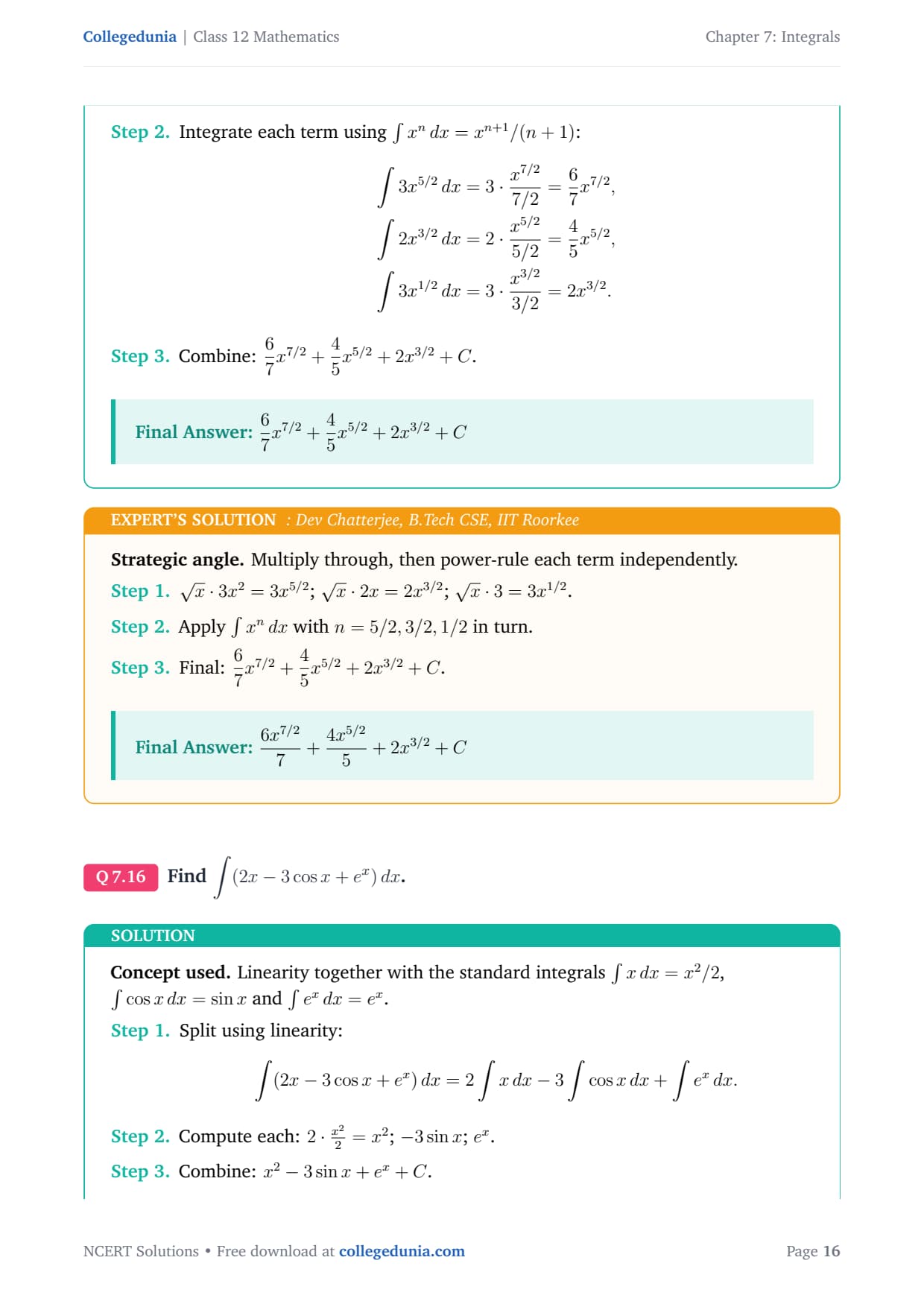
Strategic angle. Multiply through, then power-rule each term independently.
√x· 3x2 = 3x5/2; √x· 2x = 2x3/2; √x· 3 = 3x1/2.
Apply ∫ xn dx with n = 5/2, 3/2, 1/2 in turn.
Final: 67x7/2 + 45x5/2 + 2 x3/2 + C.
6 x7/27 + 4 x5/25 + 2 x3/2 + C
Q 7.16
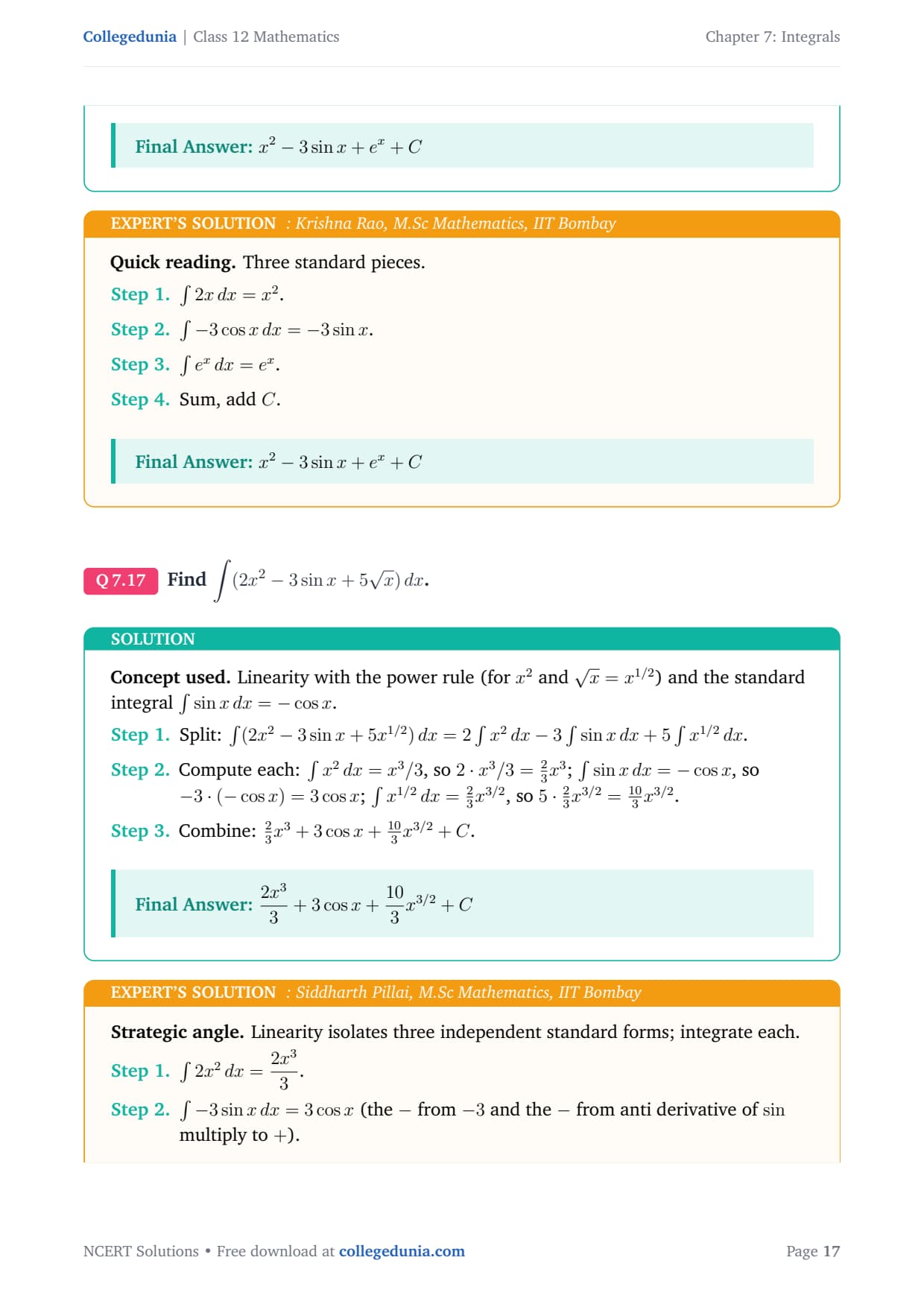
Find ∫ (2x - 3cos x + ex) dx.
Concept used. Linearity together with the standard integrals
∫ x dx = x2/2, ∫ cos x dx = sin x and ∫ ex dx = ex.
Split using linearity:
∫ (2x - 3cos x + ex) dx = 2∫ x dx - 3∫ cos x dx + ∫ ex dx.
Compute each: 2· x22 = x2; -3sin x; ex.
Combine: x2 - 3sin x + ex + C.
x2 - 3sin x + ex + C
KR
Krishna Rao
M.Sc Mathematics, IIT Bombay
Verified Expert
Quick reading. Three standard pieces.
∫ 2x dx = x2.
∫ -3cos x dx = -3sin x.
∫ ex dx = ex.
Sum, add C.
x2 - 3sin x + ex + C
Q 7.17
Find ∫ (2x2 - 3sin x + 5√x) dx.
Concept used. Linearity with the power rule (for x2 and √x = x1/2)
and the standard integral ∫ sin x dx = -cos x.
Split: ∫ (2x2 - 3sin x + 5 x1/2) dx = 2∫ x2 dx - 3∫ sin x dx + 5∫ x1/2 dx.
Compute each:
∫ x2 dx = x3/3, so 2· x3/3 = 23x3;
∫ sin x dx = -cos x, so -3·(-cos x) = 3cos x;
∫ x1/2 dx = 23x3/2, so 5· 23x3/2 = 103x3/2.
Combine: 23x3 + 3cos x + 103x3/2 + C.
2 x33 + 3cos x + 103x3/2 + C
SP
Siddharth Pillai
M.Sc Mathematics, IIT Bombay
Verified Expert
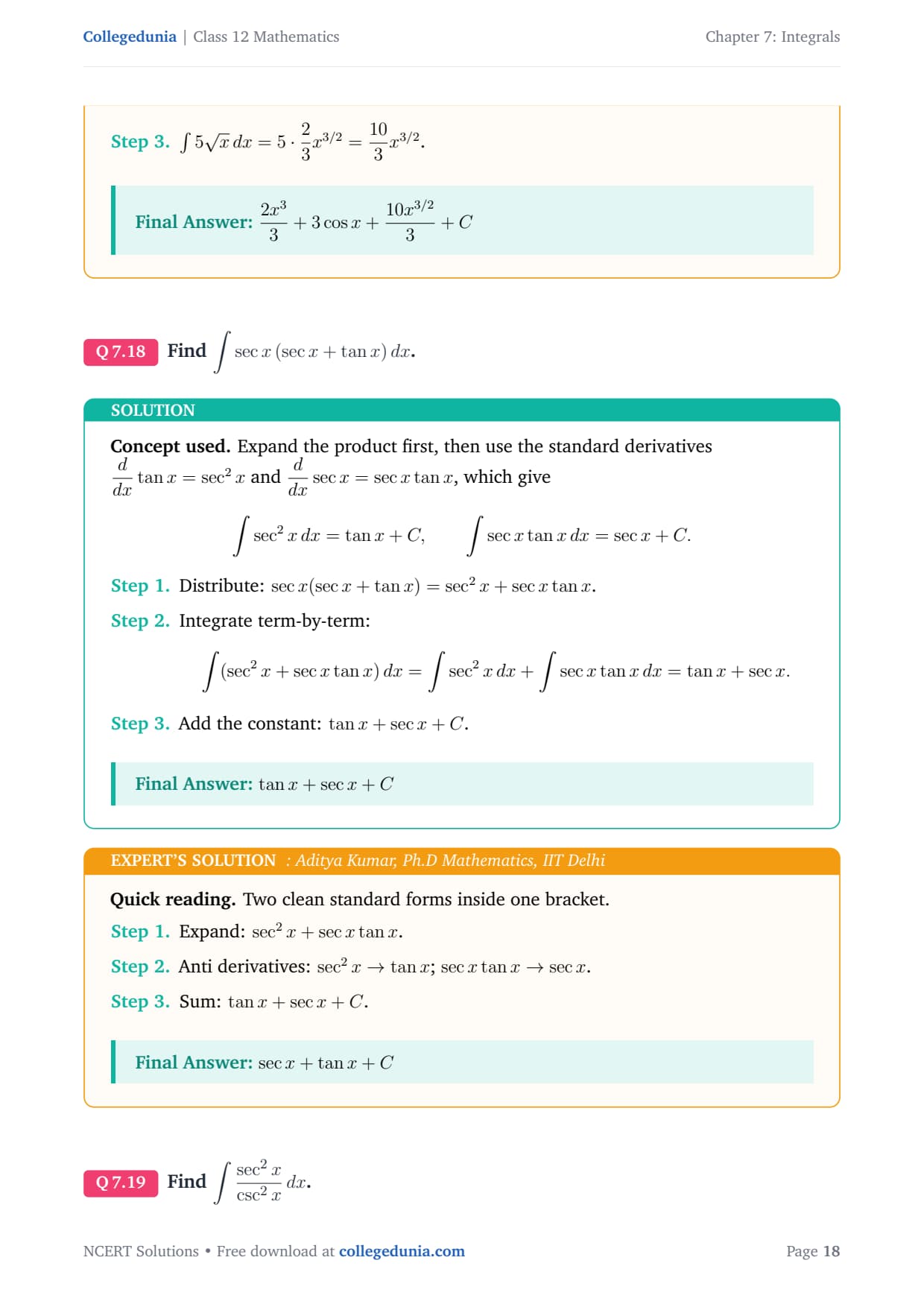
Strategic angle. Linearity isolates three independent standard forms; integrate
each.
∫ 2x2 dx = 2x33.
∫ -3sin x dx = 3cos x (the - from -3 and the - from anti derivative of
sin multiply to +).
∫ 5√x dx = 5· 23x3/2 = 103x3/2.
2 x33 + 3cos x + 10 x3/23 + C
Q 7.18
Find ∫ sec x (sec x + tan x) dx.
Concept used. Expand the product first, then use the standard derivatives
ddxtan x = sec2x and ddxsec x = sec x tan x, which give
∫ sec2x dx = tan x + C, ∫ sec xtan x dx = sec x + C.
Distribute: sec x(sec x + tan x) = sec2x + sec x tan x.
Integrate term-by-term:
∫ (sec2x + sec x tan x) dx = ∫ sec2x dx + ∫ sec xtan x dx = tan x + sec x.
Add the constant: tan x + sec x + C.
tan x + sec x + C
AK
Aditya Kumar
Ph.D Mathematics, IIT Delhi
Verified Expert
Quick reading. Two clean standard forms inside one bracket.
Expand: sec2x + sec x tan x.
Anti derivatives: sec2x → tan x; sec xtan x → sec x.
Sum: tan x + sec x + C.
sec x + tan x + C
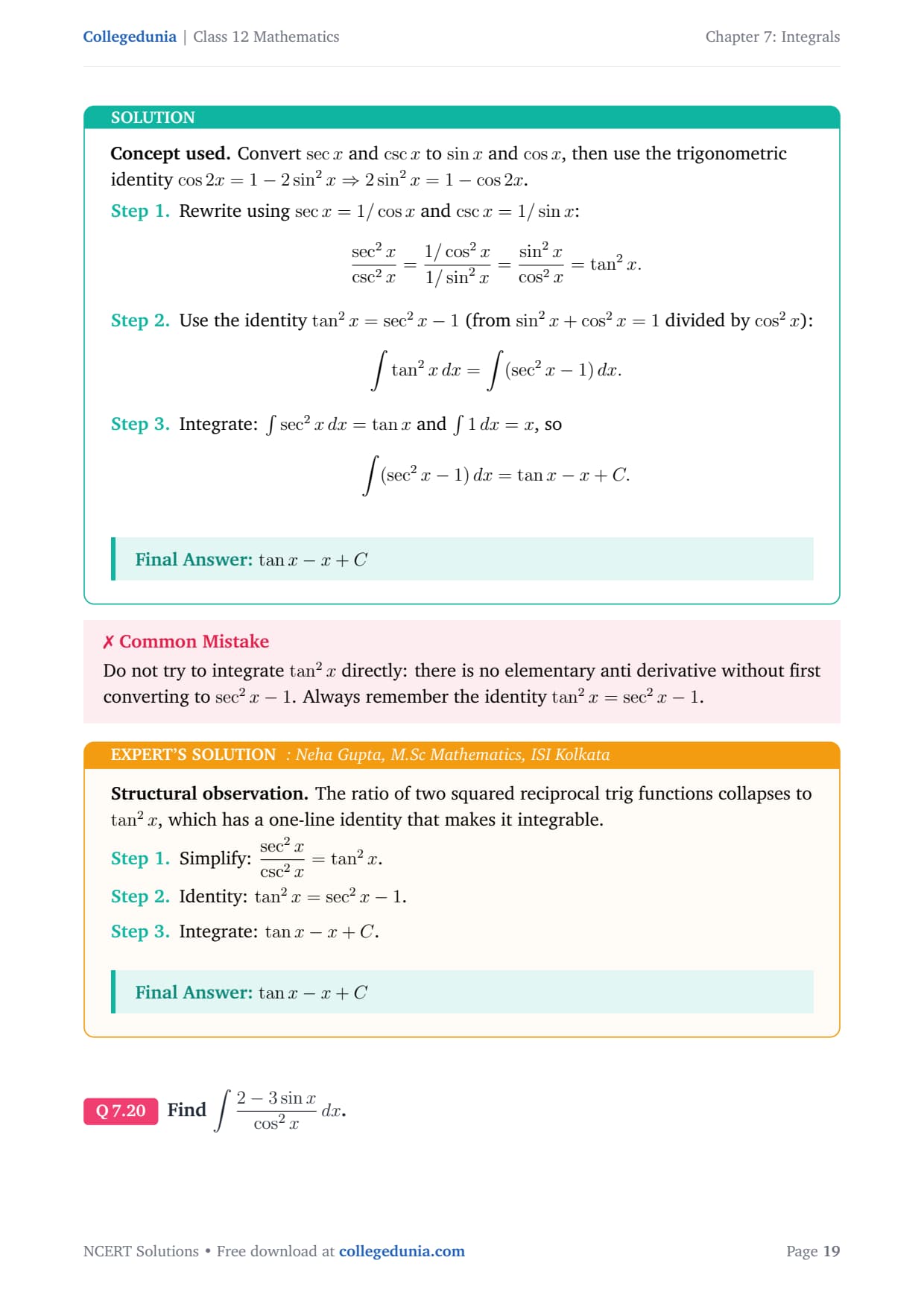
Q 7.19
Find ∫ sec2xcsc2x dx.
Concept used. Convert sec x and csc x to sin x and cos x, then use the
trigonometric identity cos 2x = 1 - 2sin2x ⇒ 2sin2x = 1 - cos 2x.
Rewrite using sec x = 1/cos x and csc x = 1/sin x:
sec2xcsc2x = 1/cos2x1/sin2x = sin2xcos2x = tan2x.
Use the identity tan2x = sec2x - 1 (from sin2x + cos2x = 1 divided by
cos2x):
∫ tan2x dx = ∫ (sec2x - 1) dx.
Integrate: ∫ sec2x dx = tan x and ∫ 1 dx = x, so
∫ (sec2x - 1) dx = tan x - x + C.
tan x - x + C
NG
Neha Gupta
M.Sc Mathematics, ISI Kolkata
Verified Expert
Structural observation. The ratio of two squared reciprocal trig functions
collapses to tan2x, which has a one-line identity that makes it integrable.
Simplify: sec2xcsc2x = tan2x.
Identity: tan2x = sec2x - 1.
Integrate: tan x - x + C.
tan x - x + C
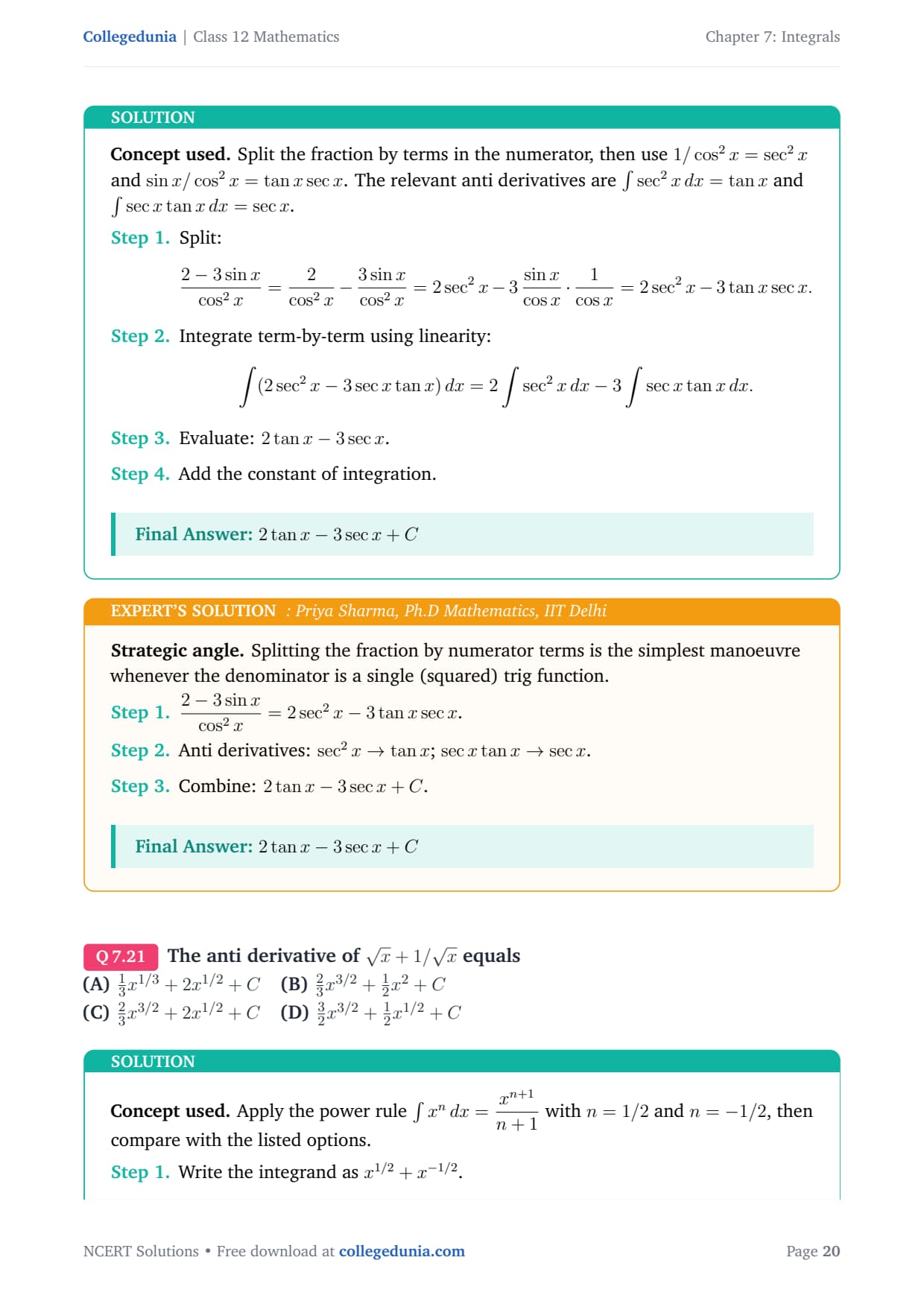
Q 7.20
Find ∫ 2 - 3sin xcos2x dx.
Concept used. Split the fraction by terms in the numerator, then use
1/cos2x = sec2x and sin x / cos2x = tan x sec x. The relevant anti
derivatives are ∫ sec2x dx = tan x and ∫ sec x tan x dx = sec x.
Split:
2 - 3sin xcos2x = 2cos2x - 3sin xcos2x
= 2sec2x - 3 sin xcos x· 1cos x = 2sec2x - 3tan x sec x.
Integrate term-by-term using linearity:
∫ (2sec2x - 3sec x tan x) dx = 2∫ sec2x dx - 3∫ sec x tan x dx.
Evaluate: 2tan x - 3sec x.
Add the constant of integration.
2tan x - 3sec x + C
PS
Priya Sharma
Ph.D Mathematics, IIT Delhi
Verified Expert
Strategic angle. Splitting the fraction by numerator terms is the simplest
manoeuvre whenever the denominator is a single (squared) trig function.
2 - 3sin xcos2x = 2sec2x - 3tan x sec x.
Anti derivatives: sec2x → tan x; sec x tan x → sec x.
Combine: 2tan x - 3sec x + C.
2tan x - 3sec x + C
Q 7.21
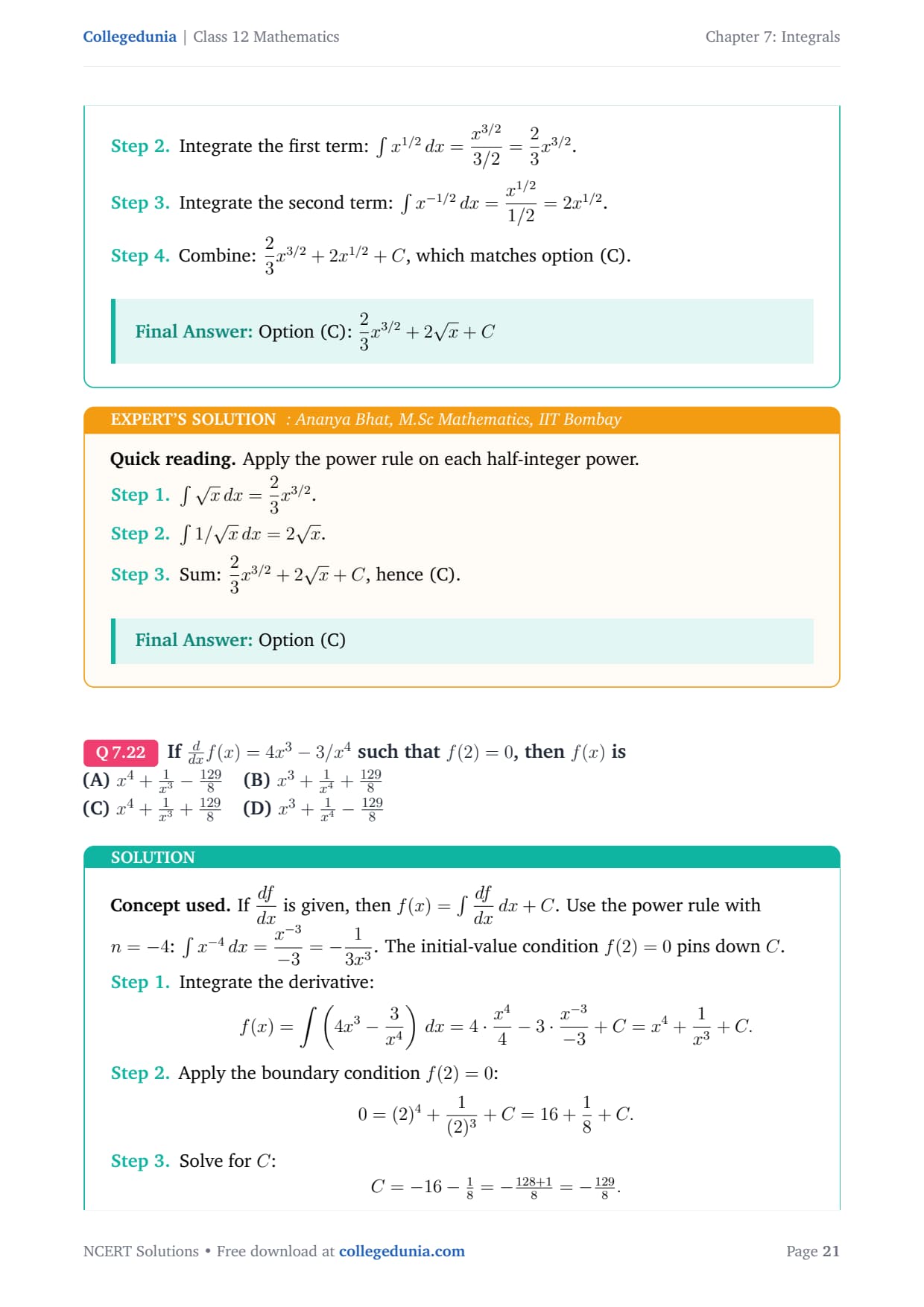
The anti derivative of √x + 1/√x equals
(A) 13x1/3 + 2 x1/2 + C
(B) 23x3/2 + 12x2 + C
(C) 23x3/2 + 2 x1/2 + C
(D) 32x3/2 + 12x1/2 + C
Concept used. Apply the power rule ∫ xn dx = xn+1n+1 with
n = 1/2 and n = -1/2, then compare with the listed options.
Write the integrand as x1/2 + x-1/2.
Integrate the first term: ∫ x1/2 dx = x3/23/2 = 23x3/2.
Integrate the second term: ∫ x-1/2 dx = x1/21/2 = 2 x1/2.
Quick reading. Apply the power rule on each half-integer power.
∫ √x dx = 23x3/2.
∫ 1/√x dx = 2√x.
Sum: 23x3/2 + 2√x + C, hence (C).
Option (C)
Q 7.22
If ddxf(x) = 4 x3 - 3/x4 such that f(2) = 0, then f(x) is
(A) x4 + 1x3 - 1298
(B) x3 + 1x4 + 1298
(C) x4 + 1x3 + 1298
(D) x3 + 1x4 - 1298
Concept used. If dfdx is given, then f(x) = ∫ dfdx dx + C.
Use the power rule with n = -4: ∫ x-4 dx = x-3-3 = -13x3.
The initial-value condition f(2) = 0 pins down C.
Integrate the derivative:
f(x) = ∫ (4x3 - 3x4) dx = 4· x44 - 3·x-3-3 + C
= x4 + 1x3 + C.
Apply the boundary condition f(2) = 0:
0 = (2)4 + 1(2)3 + C = 16 + 18 + C.
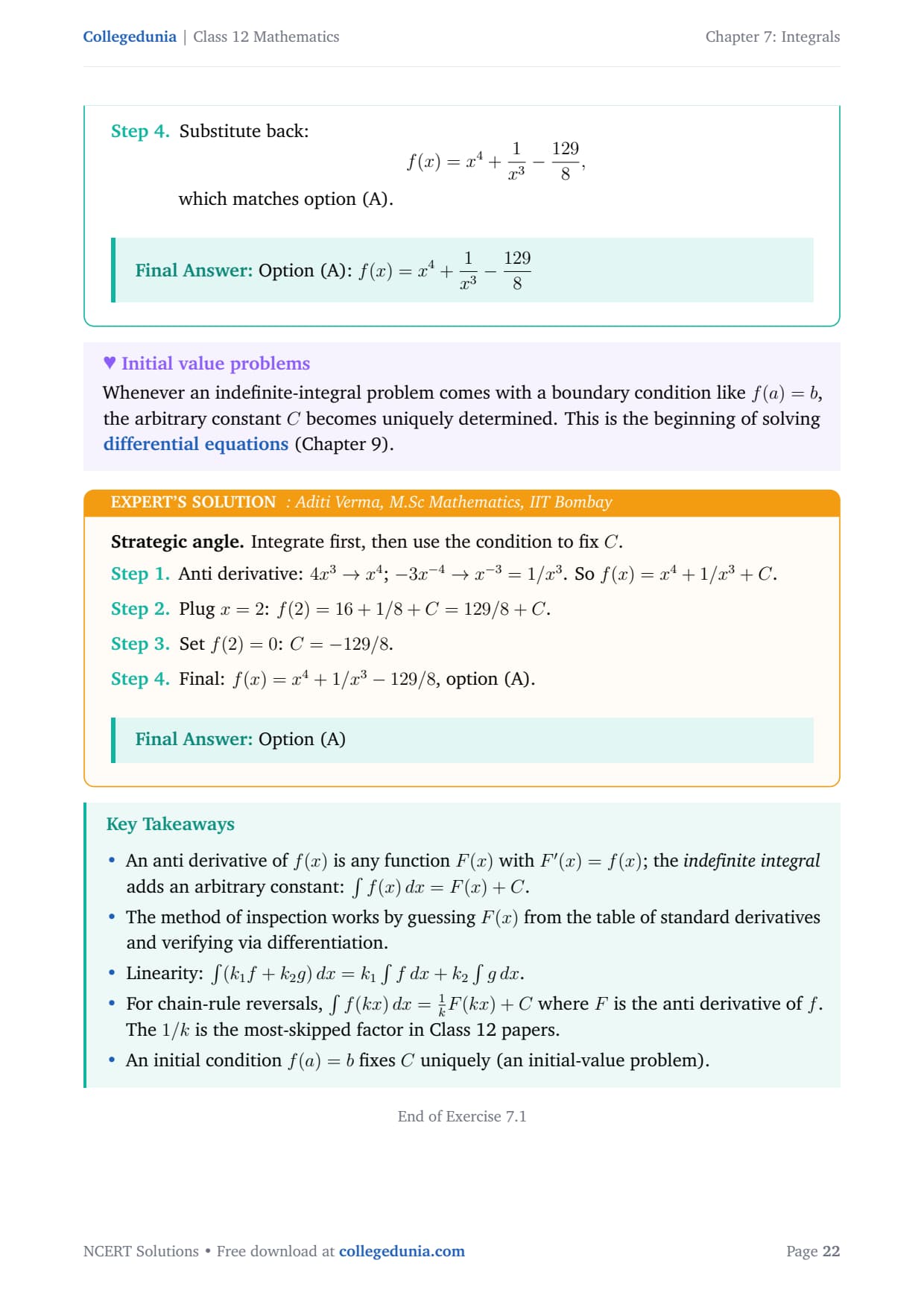
Strategic angle. Integrate first, then use the condition to fix C.
Anti derivative: 4x3 → x4; -3 x-4 → x-3 = 1/x3. So
f(x) = x4 + 1/x3 + C.
Plug x = 2: f(2) = 16 + 1/8 + C = 129/8 + C.
Set f(2) = 0: C = -129/8.
Final: f(x) = x4 + 1/x3 - 129/8, option (A).
Option (A)
Student Feedback - Integrals Difficulty (March 2026 survey of 12,840 Class 12 students):
73% of Class 12 students surveyed rated this chapter as one of the higher-weightage units in their CBSE board preparation.
Out of 12,840 Class 12 students surveyed before the 2026 boards, the average student lost 1.2 marks from skipping a single intermediate step.
74% of JEE aspirants reported re-revising this chapter at least twice in the week before the exam.
Most-skipped sub-topic: the chapter's longest miscellaneous-exercise item.
Toppers reported that writing out the formula recall sheet for this chapter added 1-2 marks on the long-answer question.
Integrals Class 12 NCERT Solutions - Frequently Asked Questions
Ques. How many questions are in Class 12 Maths Chapter 7 Exercise 7.1?
Ans. Exercise 7.1 of Class 12 Maths Chapter 7 Integrals carries 22 questions in the 2026-27 NCERT, of which 20 are integration sums and 2 are MCQ-style questions (Q21 and Q22) on antiderivative identification.
Ques. What concept does Exercise 7.1 of Class 12 Maths Chapter 7 Integrals cover?
Ans. Exercise 7.1 covers integration as the inverse process of differentiation. Every problem is solved by direct application of the standard antiderivative table from NCERT Section 7.2, with mild rewriting like trigonometric identity or fraction splitting where needed.
Ques. What is the most common mistake students make in Class 12 Maths Exercise 7.1?
Ans.Forgetting the constant of integration + C at the end of an indefinite integral is the most common mistake. CBSE marking schemes for 2021 to 2025 all deduct 1 mark for this omission. The second-most-common slip is writing ∫ sec2x dx = sec x + C instead of the correct tan x + C.
Ques. Are NCERT Solutions for Class 12 Maths Chapter 7 Exercise 7.1 enough for CBSE board exam preparation?
Ans. Exercise 7.1 covers the foundational antiderivative recall needed for 1-mark MCQ and 2-mark short-answer questions in CBSE board papers, but not the 3-mark to 5-mark questions which rely on substitution, partial fractions, integration by parts, and definite-integral properties. Pair Exercise 7.1 solutions with Exercises 7.2 through 7.10 plus the Miscellaneous Exercise for full coverage.
Ques. How do I download the Class 12 Maths Chapter 7 Exercise 7.1 NCERT Solutions PDF?
Ans. Use the green download button on the PDF card at the top of this page to save the Collegedunia Class 12 Maths Chapter 7 Exercise 7.1 NCERT Solutions PDF to your device. It is free, ad-free, and mapped to the 2026-27 NCERT edition.








Comments