This page hosts the Application of Derivatives Class 12 NCERT Solutions, presenting it for Miscellaneous Exercise of Class 12 Mathematics Chapter 6 Application of Derivatives. Each solution in the Application of Derivatives Class 12 NCERT Solutions explicitly names the theorem or formula applied, then proceeds line-by-line to the final answer. Aligned to the 2026-27 NCERT syllabus.
CBSE Weightage: 5-7 marks from Application of Derivatives
JEE Main Coverage: 3-5% of the calculus segment
Miscellaneous Exercise Problems: 17 questions
Each solution follows the 2026-27 NCERT syllabus. The Miscellaneous Exercise rewards students who can recognise which tool from earlier exercises to deploy on each new problem. Collegedunia's solutions explicitly call out the technique used in the first line of every answer, so you build a mental decision tree as you read.
NCERT Solutions for Class 12 Maths Chapter 6 Miscellaneous - Topics Covered
These notes address this in the same order as the NCERT textbook.
The Miscellaneous Exercise spans the full chapter. The table below shows which earlier exercise each question is most closely related to, so you can target your revision.
How the NCERT Solutions Class 12 Maths on the Application of Derivatives Class 12 NCERT Solutions Help You
The this Class 12 page address this in the same order as the NCERT textbook.
Miscellaneous Exercise problems are designed to mimic Board exam questions. The solutions you study here have to teach you not just the algebra but the recognition pattern: which derivative tool applies to which problem class. Our solutions provide:
An opening tag line on every problem identifying the technique used
Labelled diagrams for every word problem on geometric optimisation
Both first and second derivative tests demonstrated
Step-by-step elimination of the constraint variable in word problems
Verification step after every extremum is found
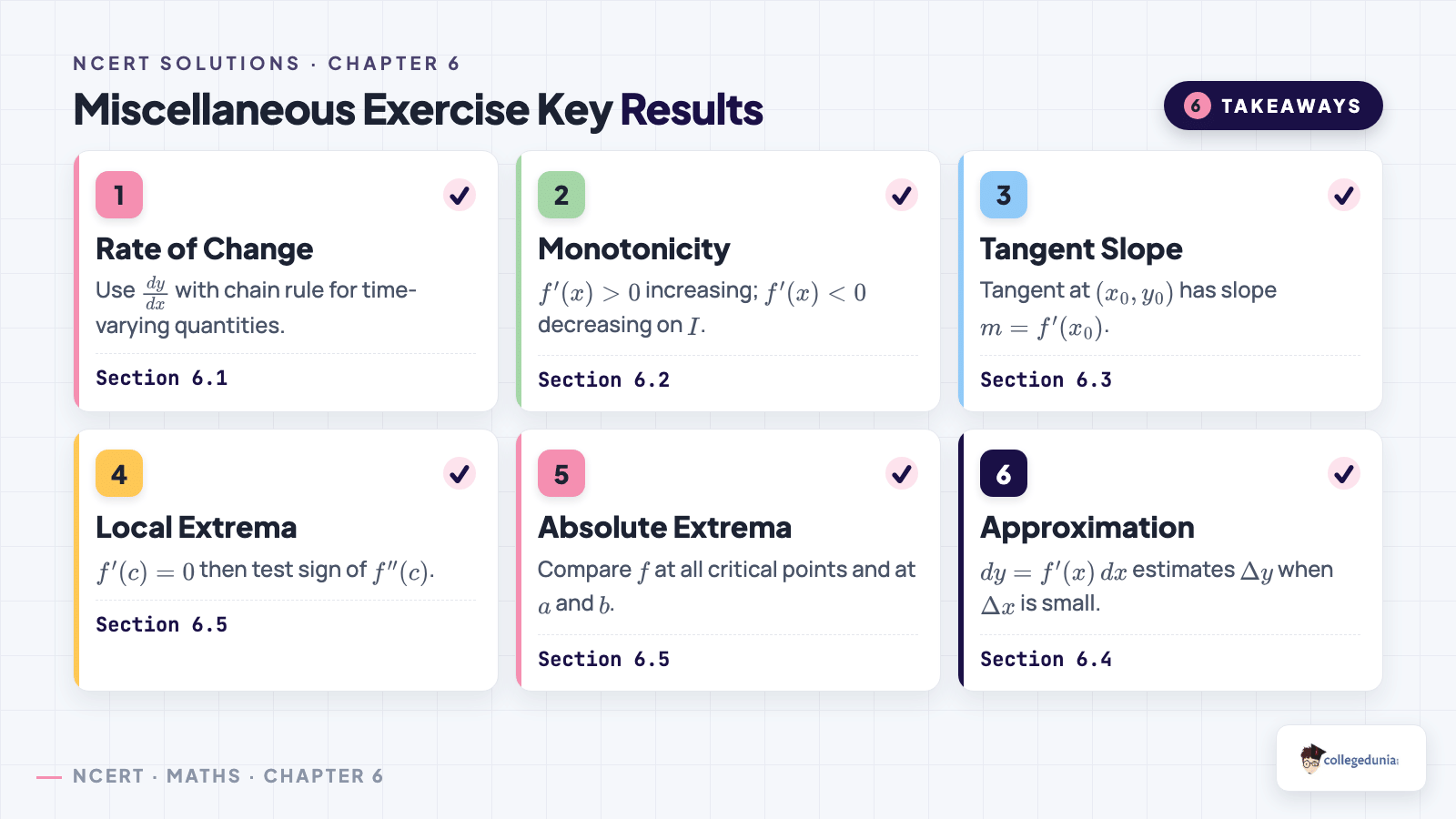
Key Tests and Formulae for the Miscellaneous Exercise
The the resource address this in the same order as the NCERT textbook.
Below is the consolidated toolkit you need for every Miscellaneous Exercise problem. Each problem reduces to one or two of these tests.
Solved Example from Miscellaneous - Rate of Change
If the radius of a sphere is increasing at the rate of 0.2 cm/s, find the rate at which the volume is increasing when the radius is 5 cm.
Step 1. Volume of sphere V = 43 π r3.
Step 2. Differentiate with respect to t: dVdt = 4 π r2drdt.
Step 3. Substitute r = 5 and drdt = 0.2 : dVdt = 4 π (25)(0.2) = 20 π cm³/s. The volume increases at 20π cm³/s.
Common Mistakes in the Miscellaneous Exercise
The chapter notes are written in formal mathematical notation, line by line, in the same convention as the official NCERT print.
Because the Miscellaneous Exercise mixes problem types without warning, students often default to whichever technique they used most recently. Watch for these errors.
Applying the second derivative test without first solving f'(x) = 0
Forgetting to differentiate the constraint equation in related-rates problems
Mixing up units (cm vs cm² vs cm³) in optimisation word problems
Treating a local extremum as an absolute extremum without endpoint verification
NCERT Solutions Class 12 Maths: available above as a free PDF download, aligned to the 2026-27 NCERT Class 12 Mathematics syllabus.
the PDF: available above as a free PDF download, aligned to the 2026-27 NCERT Class 12 Mathematics syllabus.
Exercise-wise Breakdown of the Application of Derivatives Chapter
The Application of Derivatives chapter splits into 3 numbered exercises plus a Miscellaneous Exercise. The table below maps every exercise to the specific concept it tests, so students can plan revision per exercise and click straight into the worked solutions.
All NCERT Solutions for Application of Derivatives Misc with Step-by-Step Working
Every NCERT textbook question for Class 12 Mathematics Chapter 6 Application of Derivatives Misc is listed below with its full Solution and Expert Solution hidden inside collapsible tabs. Click Check Solution to reveal the step-by-step working; click Expert Solution for the expanded explanation.
Questions
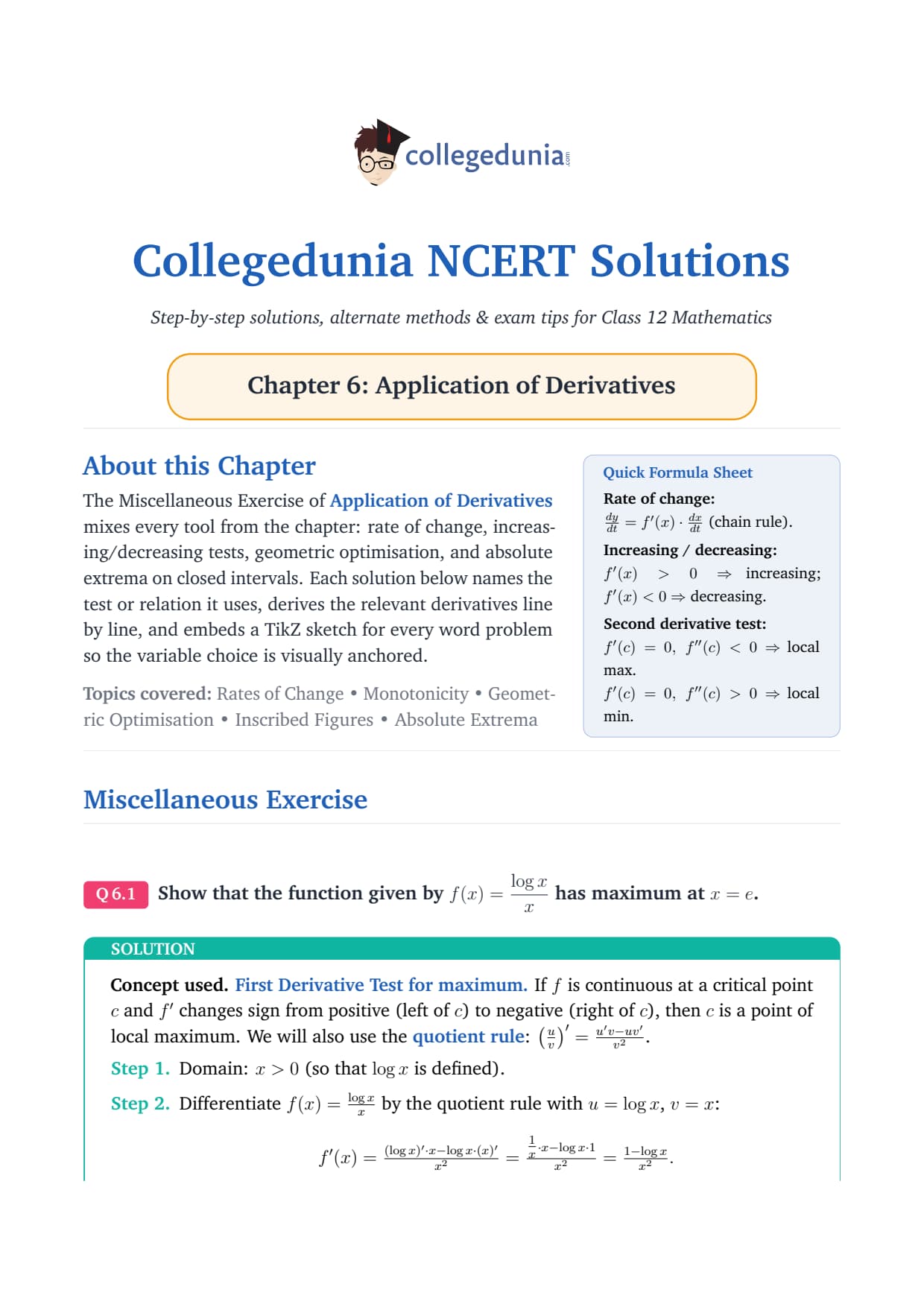
Q 6.1
Show that the function given by f(x) = log xx has maximum at x = e.
Concept used.First Derivative Test for maximum. If f is continuous at a
critical point c and f' changes sign from positive (left of c) to negative (right of
c), then c is a point of local maximum. We will also use the quotient rule:
(uv)' = u'v - uv'v2.
Domain: x > 0 (so that log x is defined).
Differentiate f(x) = log xx by the quotient rule with u = log x,
v = x:
f'(x) = (log x)' · x - log x · (x)'x2
= 1x· x - log x · 1x2
= 1 - log xx2.
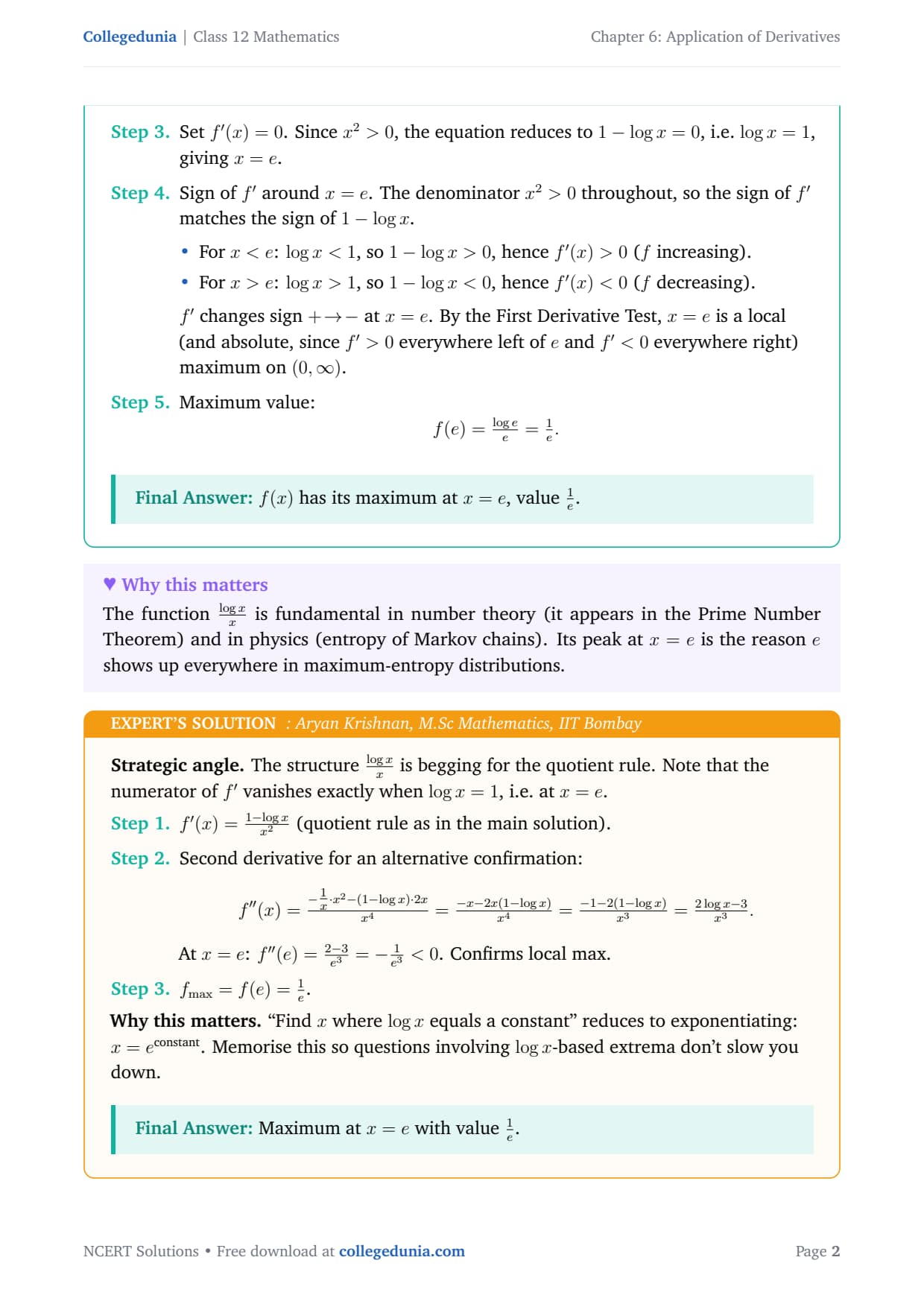
Set f'(x) = 0. Since x2 > 0, the equation reduces to 1 - log x = 0, i.e. log x = 1,
giving x = e.
Sign of f' around x = e. The denominator x2 > 0 throughout, so the sign of
f' matches the sign of 1 - log x.
For x < e: log x < 1, so 1 - log x > 0, hence f'(x) > 0 (f increasing).
For x > e: log x > 1, so 1 - log x < 0, hence f'(x) < 0 (f decreasing).
f' changes sign +→- at x = e. By the First Derivative Test, x = e is a
local (and absolute, since f' > 0 everywhere left of e and f' < 0 everywhere
right) maximum on (0,∞).
Maximum value:
f(e) = log ee = 1e.
f(x) has its maximum at x = e, value 1e.
AK
Aryan Krishnan
M.Sc Mathematics, IIT Bombay
Verified Expert
Strategic angle. The structure log xx is begging for the quotient
rule. Note that the numerator of f' vanishes exactly when log x = 1, i.e. at x = e.
f'(x) = 1 - log xx2 (quotient rule as in the main solution).
Second derivative for an alternative confirmation:
f''(x) = -1x· x2 - (1 - log x)· 2xx4
= -x - 2x(1 - log x)x4 = -1 - 2(1 - log x)x3 = 2log x - 3x3.
At x = e: f''(e) = 2 - 3e3 = -1e3 < 0. Confirms local max.
fmax = f(e) = 1e.
Why this matters. ``Find x where log x equals a constant'' reduces to
exponentiating: x = econstant. Memorise this so questions involving
log x-based extrema don't slow you down.
Maximum at x = e with value 1e.
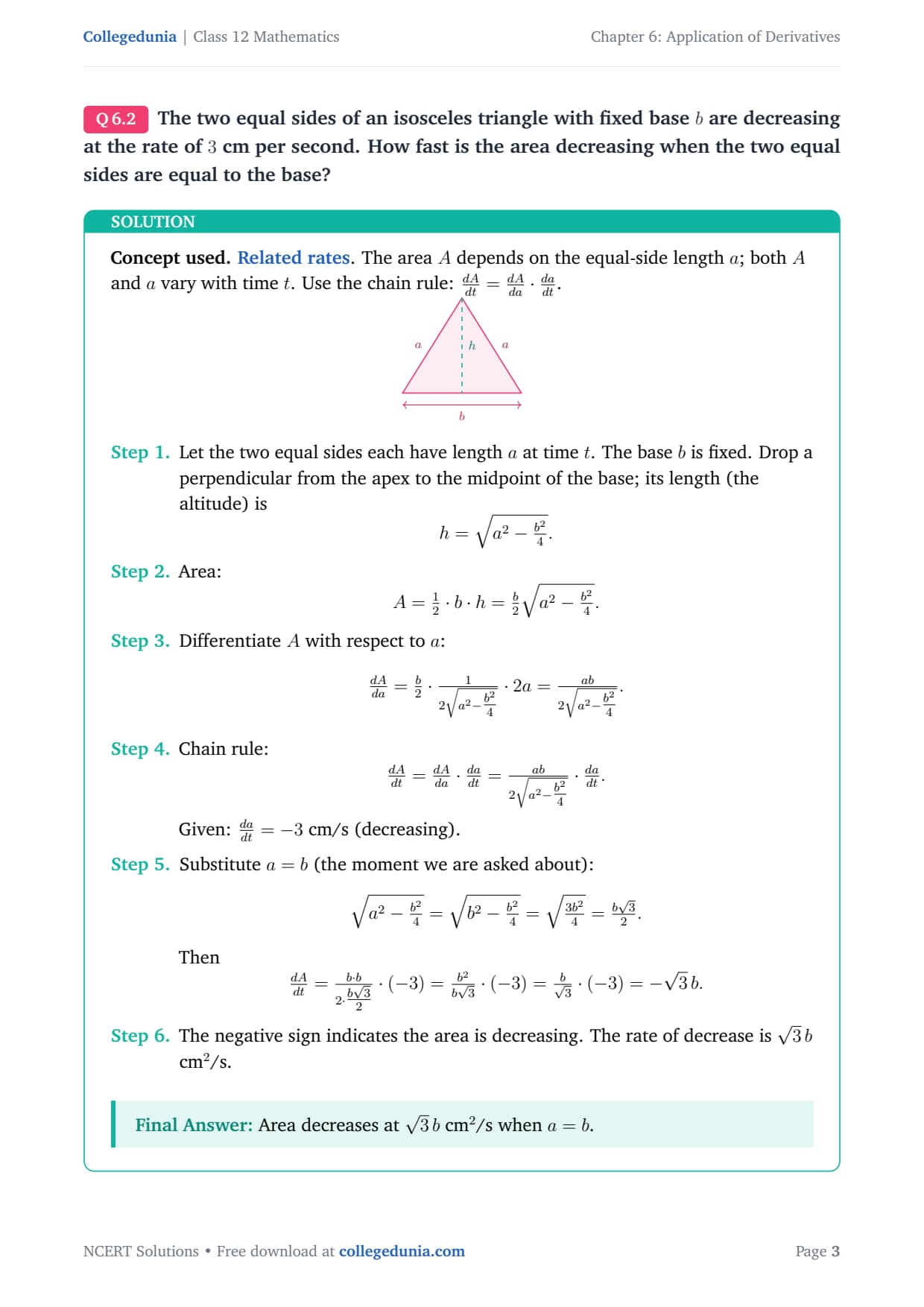
Q 6.2
The two equal sides of an isosceles triangle with fixed base b are decreasing at the rate of 3 cm per second. How fast is the area decreasing when the two equal sides are equal to the base?
Concept used.Related rates. The area A depends on the equal-side
length a; both A and a vary with time t. Use the chain rule:
dAdt = dAda· dadt.
[See diagram in the PDF version]
Let the two equal sides each have length a at time t. The base b is fixed.
Drop a perpendicular from the apex to the midpoint of the base; its length (the
altitude) is
h = √a2 - b24.
Area:
A = 12· b· h = b2√a2 - b24.
Differentiate A with respect to a:
dAda = b2· 12√a2 - b24· 2a = ab2√a2 - b24.
Substitute a = b (the moment we are asked about):
√a2 - b24 = √b2 - b24 = √3b24 = b32.
Then
dAdt = b· b2· b32· (-3) = b2b3· (-3) = b3· (-3) = -3 b.
The negative sign indicates the area is decreasing. The rate of decrease is
3 b cm2/s.
Area decreases at 3 b cm2/s when a = b.
SK
Saanvi Khanna
Ph.D Mathematics, IIT Delhi
Verified Expert
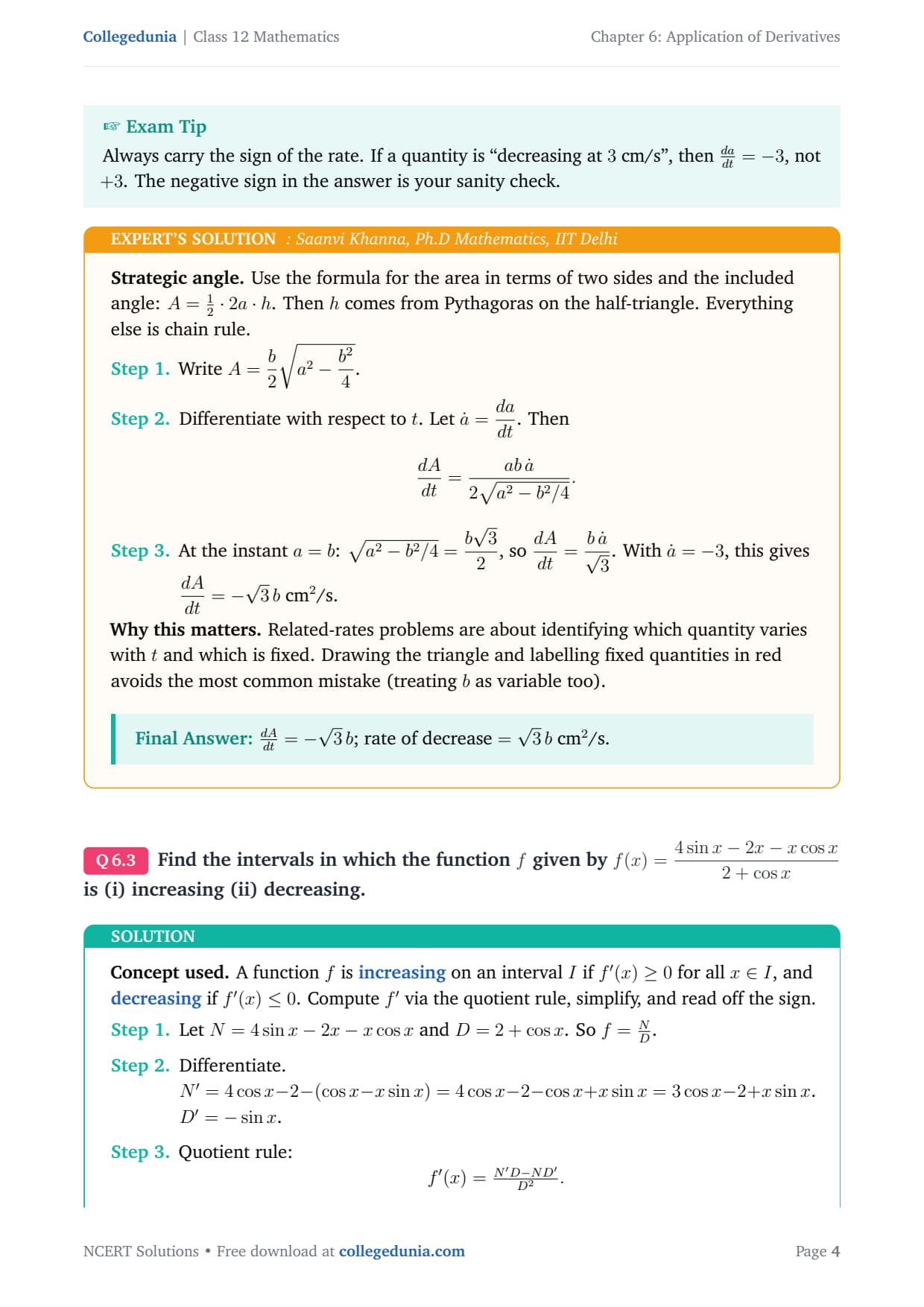
Strategic angle. Use the formula for the area in terms of two sides and the
included angle: A = 12· 2a· h. Then h comes from Pythagoras on the
half-triangle. Everything else is chain rule.
Write A = b2√a2 - b24.
Differentiate with respect to t. Let a = dadt. Then
dAdt = ab a2√a2 - b2/4.
At the instant a = b:
√a2 - b2/4 = b32,
so dAdt = ba3.
With a = -3, this gives dAdt = -3 b cm2/s.
Why this matters. Related-rates problems are about identifying which quantity
varies with t and which is fixed. Drawing the triangle and labelling fixed quantities in
red avoids the most common mistake (treating b as variable too).
dAdt = -3 b; rate of decrease = 3 b cm2/s.
Q 6.3
Find the intervals in which the function f given by f(x) = 4sin x - 2x - xcos x2 + cos x is (i) increasing (ii) decreasing.
Concept used. A function f is increasing on an interval I if
f'(x) ≥ 0 for all x ∈ I, and decreasing if f'(x) ≤ 0. Compute f'
via the quotient rule, simplify, and read off the sign.
Let N = 4sin x - 2x - xcos x and D = 2 + cos x. So f = ND.
Differentiate.
N' = 4cos x - 2 - (cos x - xsin x) = 4cos x - 2 - cos x + xsin x = 3cos x - 2 + xsin x.
D' = -sin x.
Quotient rule:
f'(x) = N' D - ND'D2.
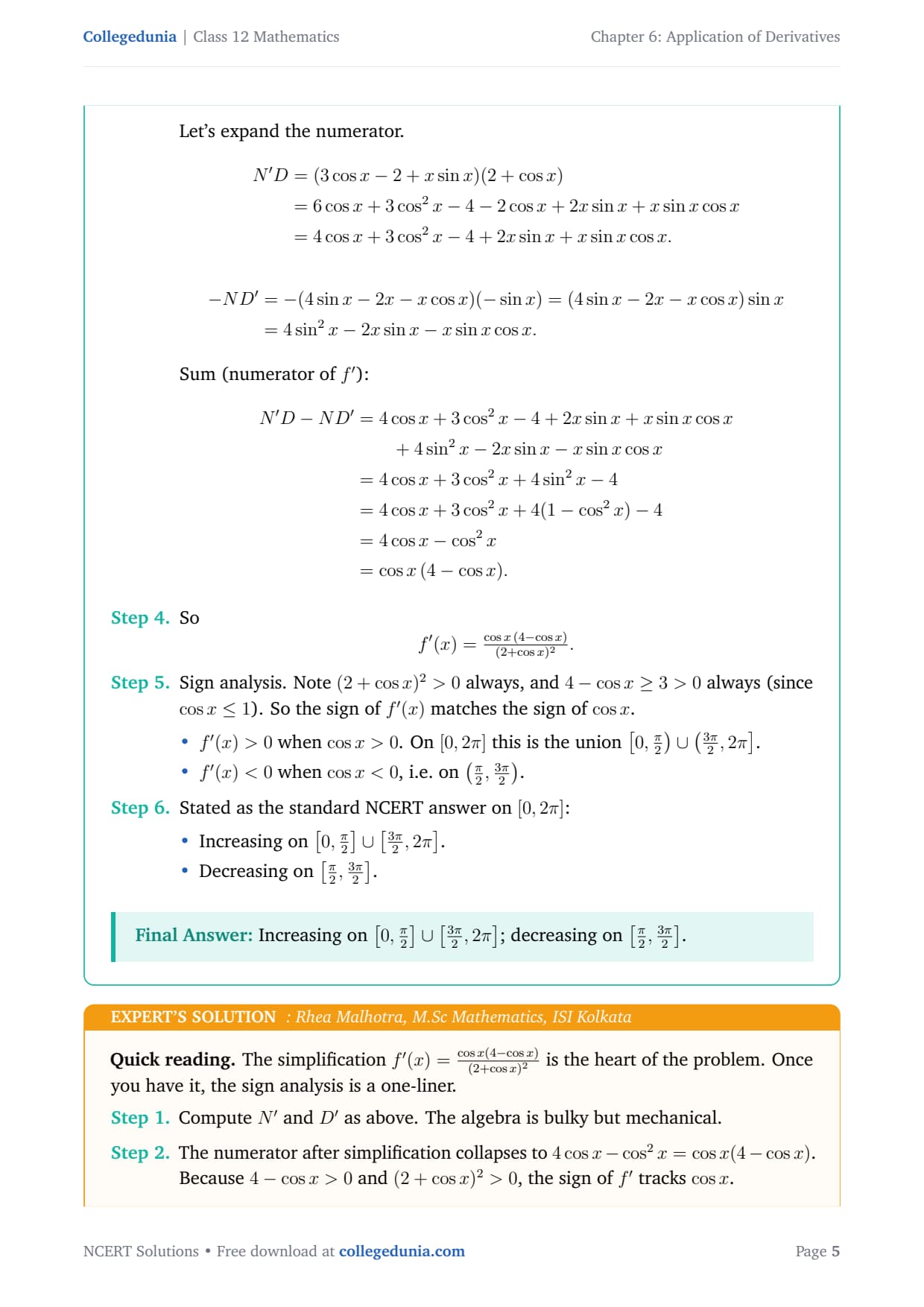
Let's expand the numerator.
aligned
N'D &= (3cos x - 2 + xsin x)(2 + cos x)
&= 6cos x + 3cos2x - 4 - 2cos x + 2xsin x + xsin xcos x
&= 4cos x + 3cos2x - 4 + 2xsin x + xsin xcos x.
alignedaligned
-ND' &= -(4sin x - 2x - xcos x)(-sin x) = (4sin x - 2x - xcos x)sin x
&= 4sin2x - 2xsin x - xsin xcos x.
aligned
Sum (numerator of f'):
aligned
N'D - ND' &= 4cos x + 3cos2x - 4 + 2xsin x + xsin xcos x
& + 4sin2x - 2xsin x - xsin xcos x
&= 4cos x + 3cos2x + 4sin2x - 4
&= 4cos x + 3cos2x + 4(1 - cos2x) - 4
&= 4cos x - cos2 x
&= cos x (4 - cos x).
aligned
So
f'(x) = cos x (4 - cos x)(2 + cos x)2.
Sign analysis. Note (2 + cos x)2 > 0 always, and 4 - cos x ≥ 3 > 0
always (since cos x ≤ 1). So the sign of f'(x) matches the sign of cos x.
f'(x) > 0 when cos x > 0. On [0, 2π] this is the union [0,π2)∪(3π2, 2π].
f'(x) < 0 when cos x < 0, i.e. on (π2, 3π2).
Stated as the standard NCERT answer on [0, 2π]:
Increasing on [0,π2]∪[3π2, 2π].
Decreasing on [π2, 3π2].
Increasing on [0,π2]∪[3π2, 2π];
decreasing on [π2, 3π2].
RM
Rhea Malhotra
M.Sc Mathematics, ISI Kolkata
Verified Expert
Quick reading. The simplification f'(x) = cos x(4 - cos x)(2 + cos x)2
is the heart of the problem. Once you have it, the sign analysis is a one-liner.
Compute N' and D' as above. The algebra is bulky but mechanical.
The numerator after simplification collapses to 4cos x - cos2x = cos x(4 - cos x).
Because 4 - cos x > 0 and (2 + cos x)2 > 0, the sign of f' tracks cos x.
So f inherits the sign-of-cos x structure: rises whenever cos x > 0,
falls whenever cos x < 0.
Why this matters. Big rational derivatives often simplify dramatically. Push
through the algebra; you'll find one nice factor at the end.
Increasing on cos x > 0; decreasing on cos x < 0.
Q 6.4
Find the intervals in which the function f given by f(x) = x3 + 1x3, x ≠ 0, is (i) increasing (ii) decreasing.
Concept used. Compute f'(x) and determine where it is positive (increasing)
or negative (decreasing).
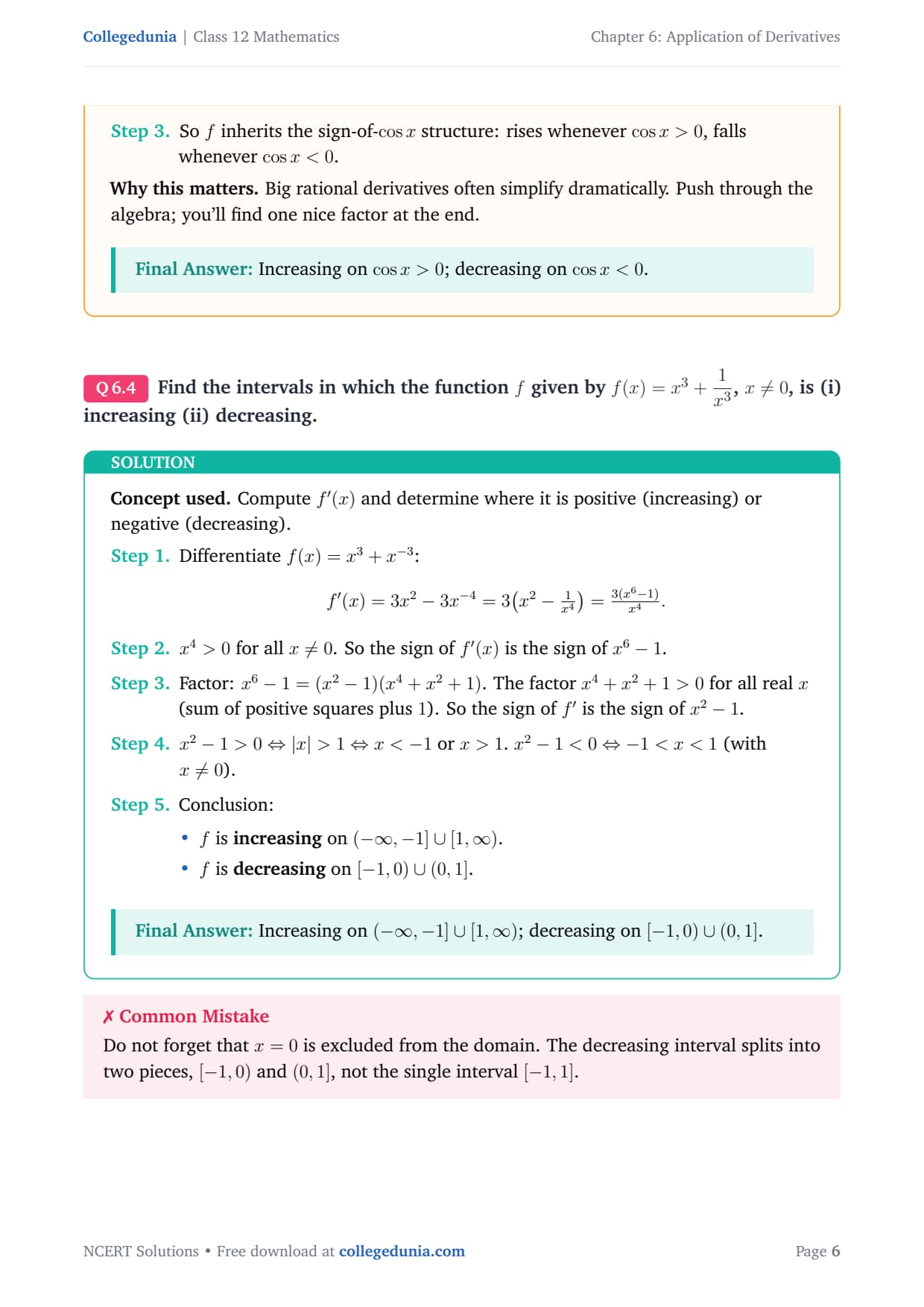
x4 > 0 for all x≠ 0. So the sign of f'(x) is the sign of x6 - 1.
Factor: x6 - 1 = (x2 - 1)(x4 + x2 + 1). The factor x4 + x2 + 1 > 0
for all real x (sum of positive squares plus 1). So the sign of f' is the
sign of x2 - 1.
x2 - 1 > 0 ⇔ |x| > 1 ⇔ x < -1 or x > 1.
x2 - 1 < 0 ⇔ -1 < x < 1 (with x ≠ 0).
Conclusion:
f is increasing on (-∞, -1]∪[1, ∞).
f is decreasing on [-1, 0)∪(0, 1].
Increasing on (-∞, -1]∪[1,∞); decreasing on [-1, 0)∪(0, 1].
RP
Rohan Pandey
M.Tech CS, IIT Madras
Verified Expert
Structural observation. The function f(x) = x3 + 1x3 is odd
(f(-x) = -f(x)), so its behaviour for x < 0 mirrors x > 0. We can study only x > 0.
For x > 0, f'(x) = 3x2 - 3x4 = 3(x6 - 1)x4.
Sign= sign(x6 - 1) = sign(x - 1) on x > 0.
So on (0, 1), f' < 0 (decreasing); on (1, ∞), f' > 0 (increasing).
By odd symmetry, on (-1, 0), f is decreasing; on (-∞, -1), f is increasing.
Why this matters. For odd functions, study only one half; the rest follows by
symmetry. Cuts your work in half on every odd-function problem.
Find the maximum area of an isosceles triangle inscribed in the ellipse x2a2 + y2b2 = 1 with its vertex at one end of the major axis.
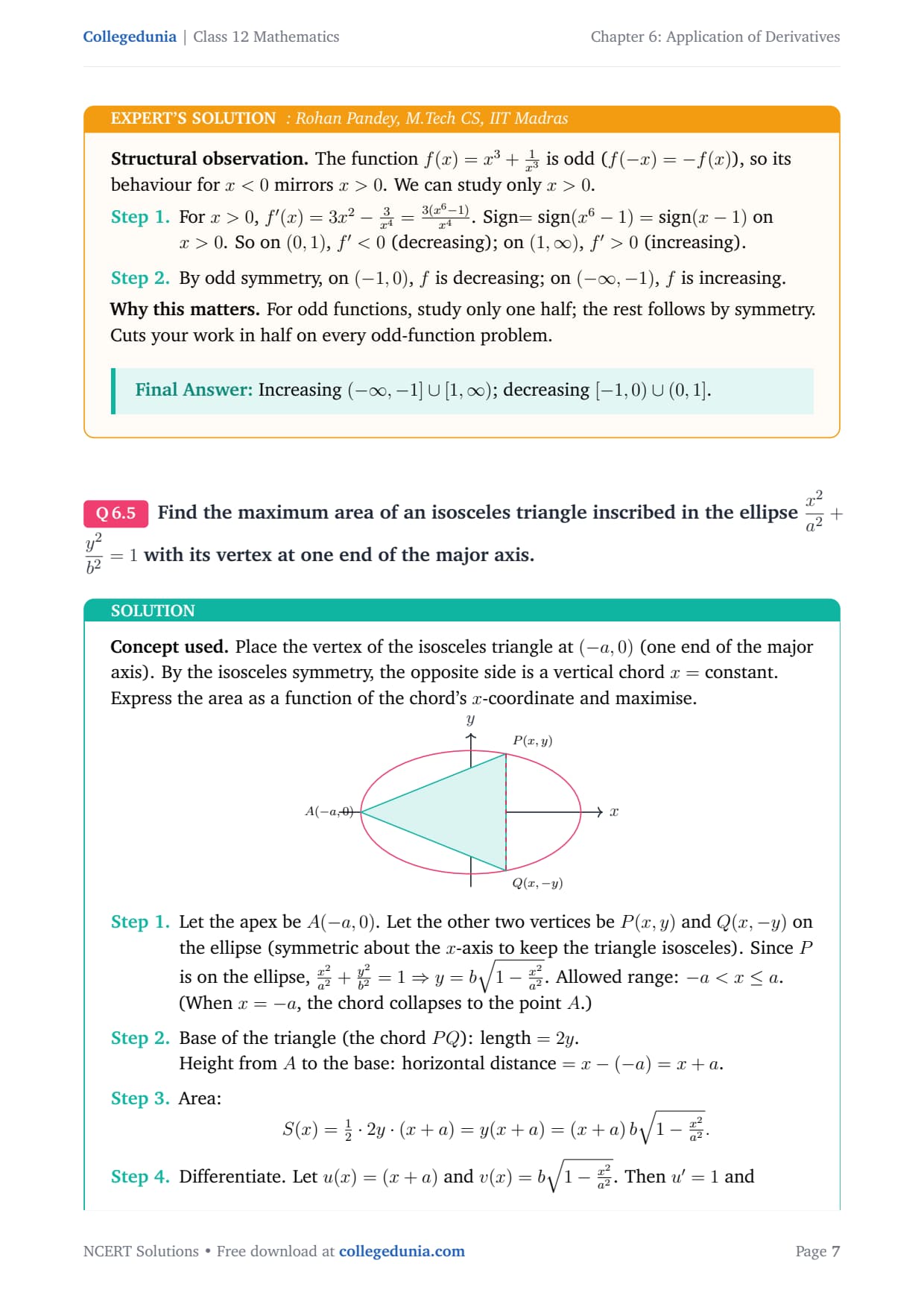
Concept used. Place the vertex of the isosceles triangle at (-a, 0) (one end of
the major axis). By the isosceles symmetry, the opposite side is a vertical chord
x = constant. Express the area as a function of the chord's x-coordinate and maximise.
[See diagram in the PDF version]
Let the apex be A(-a, 0). Let the other two vertices be P(x, y) and Q(x, -y)
on the ellipse (symmetric about the x-axis to keep the triangle isosceles).
Since P is on the ellipse, x2a2 + y2b2 = 1 ⇒ y = b√1 - x2a2.
Allowed range: -a < x ≤ a. (When x = -a, the chord collapses to the point A.)
Base of the triangle (the chord PQ): length = 2y.
Height from A to the base: horizontal distance = x - (-a) = x + a.
Area:
S(x) = 12· 2y· (x + a) = y(x + a) = (x + a) b√1 - x2a2.
Differentiate. Let u(x) = (x + a) and v(x) = b√1 - x2a2.
Then u' = 1 and v' = b· -x/a2√1 - x2/a2 = -bxa2√1 - x2/a2.
Product rule:
S'(x) = b√1 - x2a2 + (x + a)· -bxa2√1 - x2/a2.
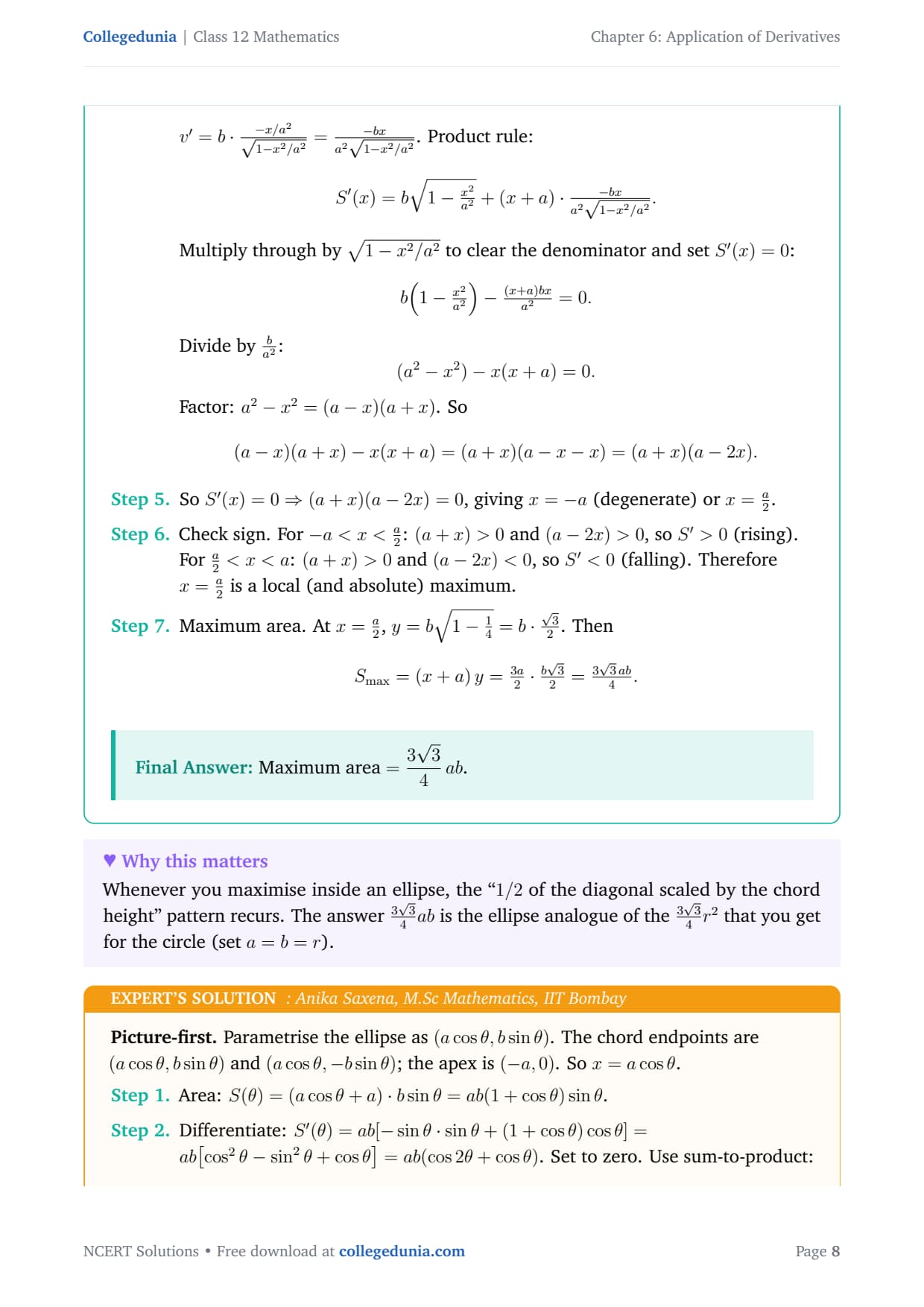
Multiply through by √1 - x2/a2 to clear the denominator and set S'(x) = 0:
b(1 - x2a2) - (x + a)bxa2 = 0.
Divide by ba2:
(a2 - x2) - x(x + a) = 0.
Factor: a2 - x2 = (a - x)(a + x). So
(a - x)(a + x) - x(x + a) = (a + x)(a - x - x) = (a + x)(a - 2x).
So S'(x) = 0 ⇒ (a + x)(a - 2x) = 0, giving x = -a (degenerate) or x = a2.
Check sign. For -a < x < a2: (a + x) > 0 and (a - 2x) > 0, so S' > 0 (rising).
For a2 < x < a: (a + x) > 0 and (a - 2x) < 0, so S' < 0 (falling).
Therefore x = a2 is a local (and absolute) maximum.
Maximum area. At x = a2,
y = b√1 - 14 = b· 32.
Then
Smax = (x + a) y = 3a2· b32 = 33 ab4.
Maximum area =334 ab.
AS
Anika Saxena
M.Sc Mathematics, IIT Bombay
Verified Expert
Picture-first. Parametrise the ellipse as (acosθ, bsinθ). The chord
endpoints are (acosθ, bsinθ) and (acosθ, -bsinθ); the apex is
(-a, 0). So x = acosθ.
Why this matters. Trig parametrisation of the ellipse is the cleanest path for
``maximise on an ellipse'' problems. The constraint is built into the parametrisation, so
no Lagrange multipliers needed.
Smax = 334 ab.
Q 6.6
A tank with rectangular base and rectangular sides, open at the top is to be constructed so that its depth is 2 m and volume is 8 m3. If building of tank costs Rs 70 per sq metres for the base and Rs 45 per square metre for sides. What is the cost of least expensive tank?
Concept used. Express the cost as a function of one variable using the volume
constraint, then minimise. Volume = (base area)×(depth); cost = 70·(base area)
+ 45·(total side area).
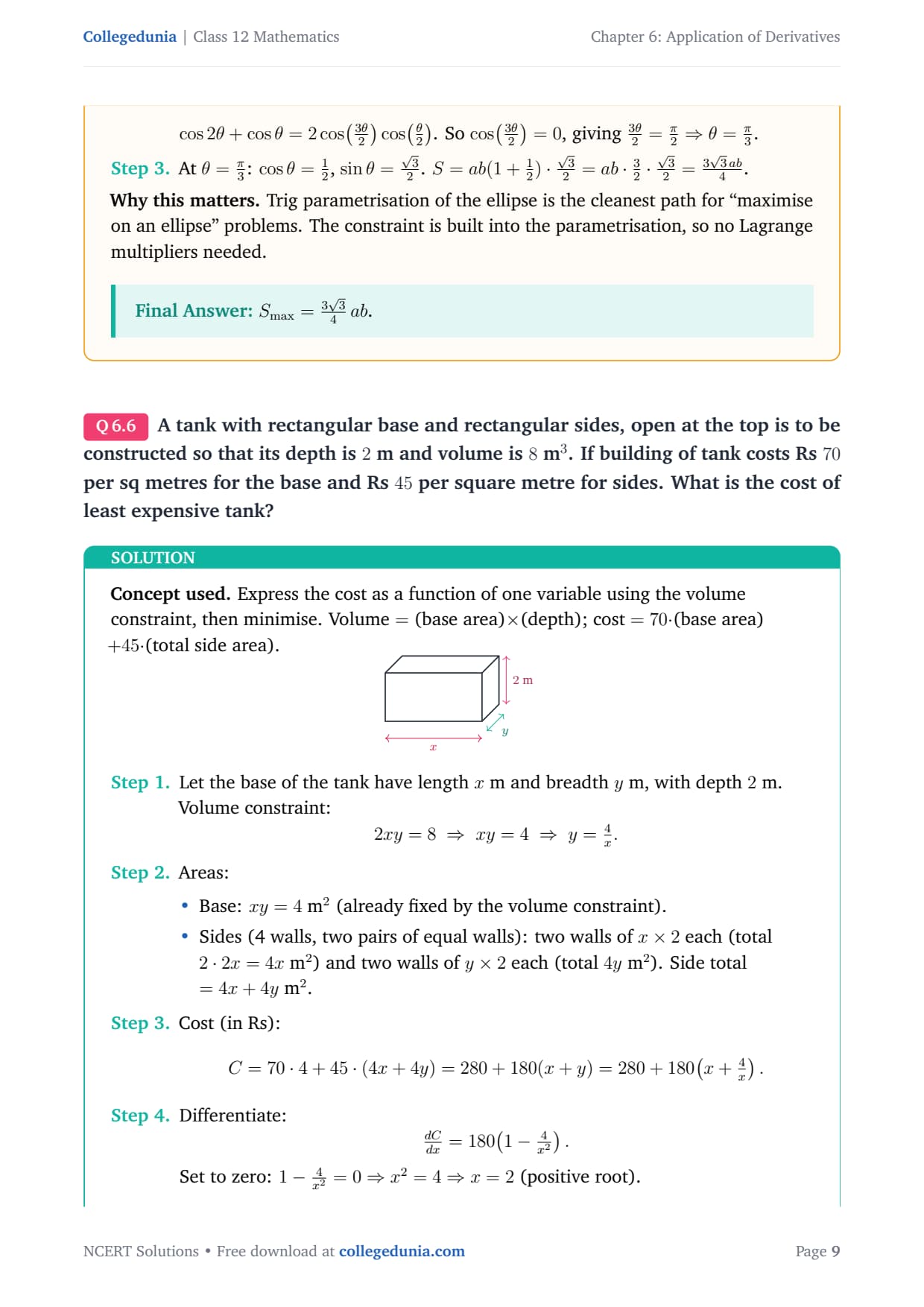
[See diagram in the PDF version]
Let the base of the tank have length x m and breadth y m, with depth 2 m.
Volume constraint:
2xy = 8 ⇒ xy = 4 ⇒ y = 4x.
Areas:
Base: xy = 4 m2 (already fixed by the volume constraint).
Sides (4 walls, two pairs of equal walls): two walls of x× 2 each
(total 2· 2x = 4x m2) and two walls of y× 2 each
(total 4y m2). Side total = 4x + 4y m2.
Least cost = Rs 1000 (with x = y = 2 m, depth = 2 m).
IR
Ishaan Roy
B.Tech CSE, IIT Roorkee
Verified Expert
Quick reading. The base cost is fixed (Rs 280, since base area must be 4 m2).
Only the side cost varies; minimise x + y subject to xy = 4.
By AM–GM, x + y ≥ 2√xy = 24 = 4, with equality iff x = y = 2.
Side cost is minimised at 180· 4 = 720 Rs.
Total: 280 + 720 = 1000 Rs.
Why this matters. AM–GM is the workhorse for ``minimise sum subject to fixed
product''.
Rs 1000.
Q 6.7
The sum of the perimeter of a circle and square is k, where k is some constant. Prove that the sum of their areas is least when the side of square is double the radius of the circle.
Concept used. Same approach as the ``wire cut into circle + square'' problem from
Ex 6.3: write the total area as a single-variable function and minimise.
Let the circle have radius r and the square have side s. Perimeters add to k:
2π r + 4s = k ⇒ s = k - 2π r4.
Total area:
A = π r2 + s2 = π r2 + (k - 2π r)216.
Differentiate with respect to r:
dAdr = 2π r + 2(k - 2π r)(-2π)16 = 2π r - π(k - 2π r)4.
Set dAdr = 0:
2π r = π(k - 2π r)4 ⇒ 8π r = π(k - 2π r) ⇒ 8r = k - 2π r.
Solve for r: 8r + 2π r = k ⇒ r(8 + 2π) = k ⇒ r = k2(π + 4).
Compute s:
s = k - 2π r4 = k - 2π· k2(π + 4)4 = k - π kπ + 44 = k(π + 4) - π kπ + 44 = 4k4(π + 4) = kπ + 4.
Ratio: sr = k/(π+4)k/[2(π+4)] = 2.
So s = 2r: the side of the square equals the diameter of the circle.
Strategic angle. Eliminate s (linear in r) and minimise a quadratic in r.
A(r) = π r2 + (k - 2π r)216. Differentiate: A'(r) = 2π r - π(k - 2π r)4. Set zero, simplify: 8r = k - 2π r ⇒ r = k2(π+4).
Then s = kπ + 4 = 2r.
Why this matters. The same ratio ``side = diameter'' appears whenever you
allocate a fixed perimeter between a circle and a square to minimise total area.
Memorise it for objective questions.
s = 2r.
Q 6.8
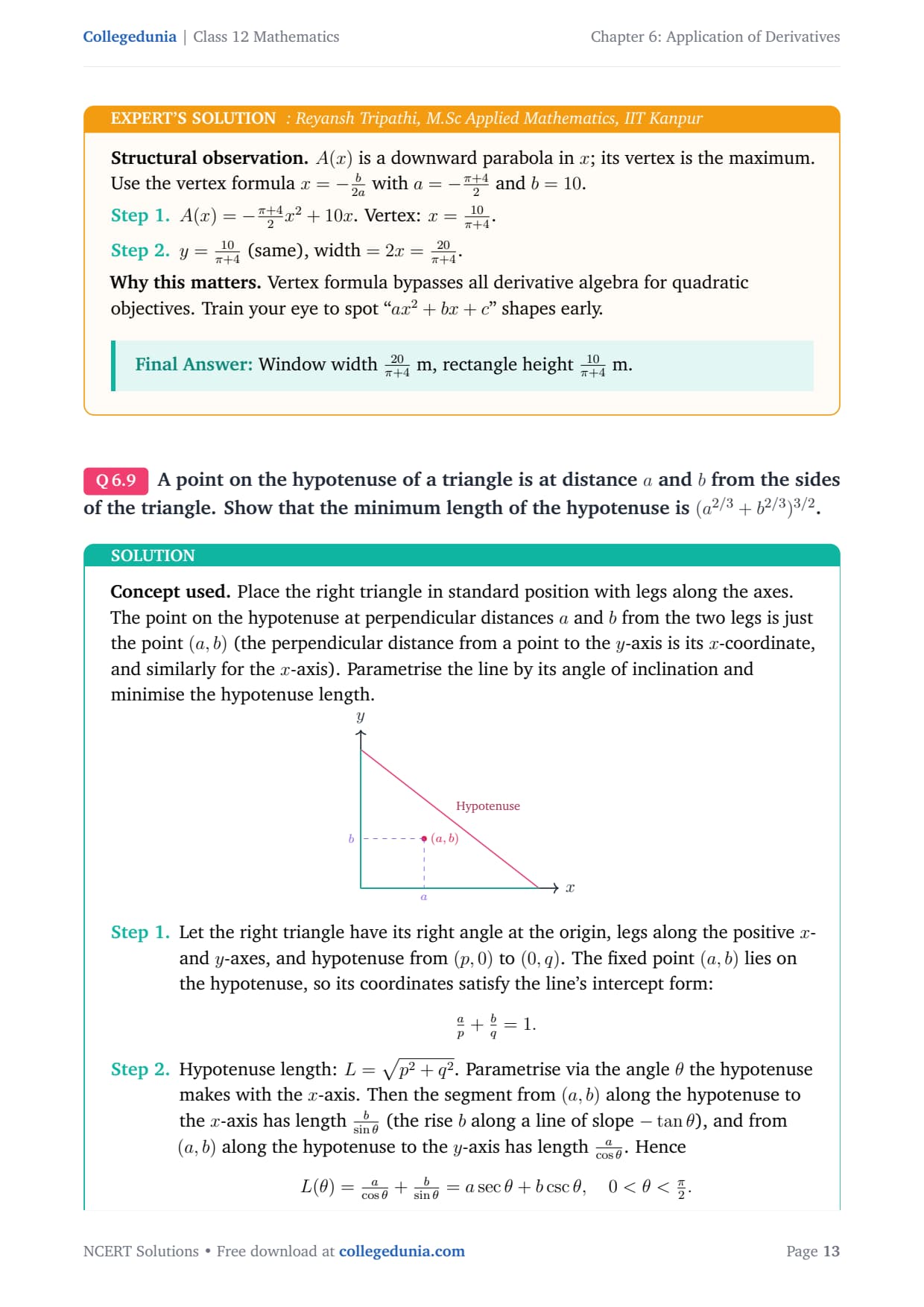
A window is in the form of a rectangle surmounted by a semicircular opening. The total perimeter of the window is 10 m. Find the dimensions of the window to admit maximum light through the whole opening.
Concept used. ``Maximum light'' = maximum area of the window. Express the area
in terms of one variable using the perimeter constraint, then maximise.
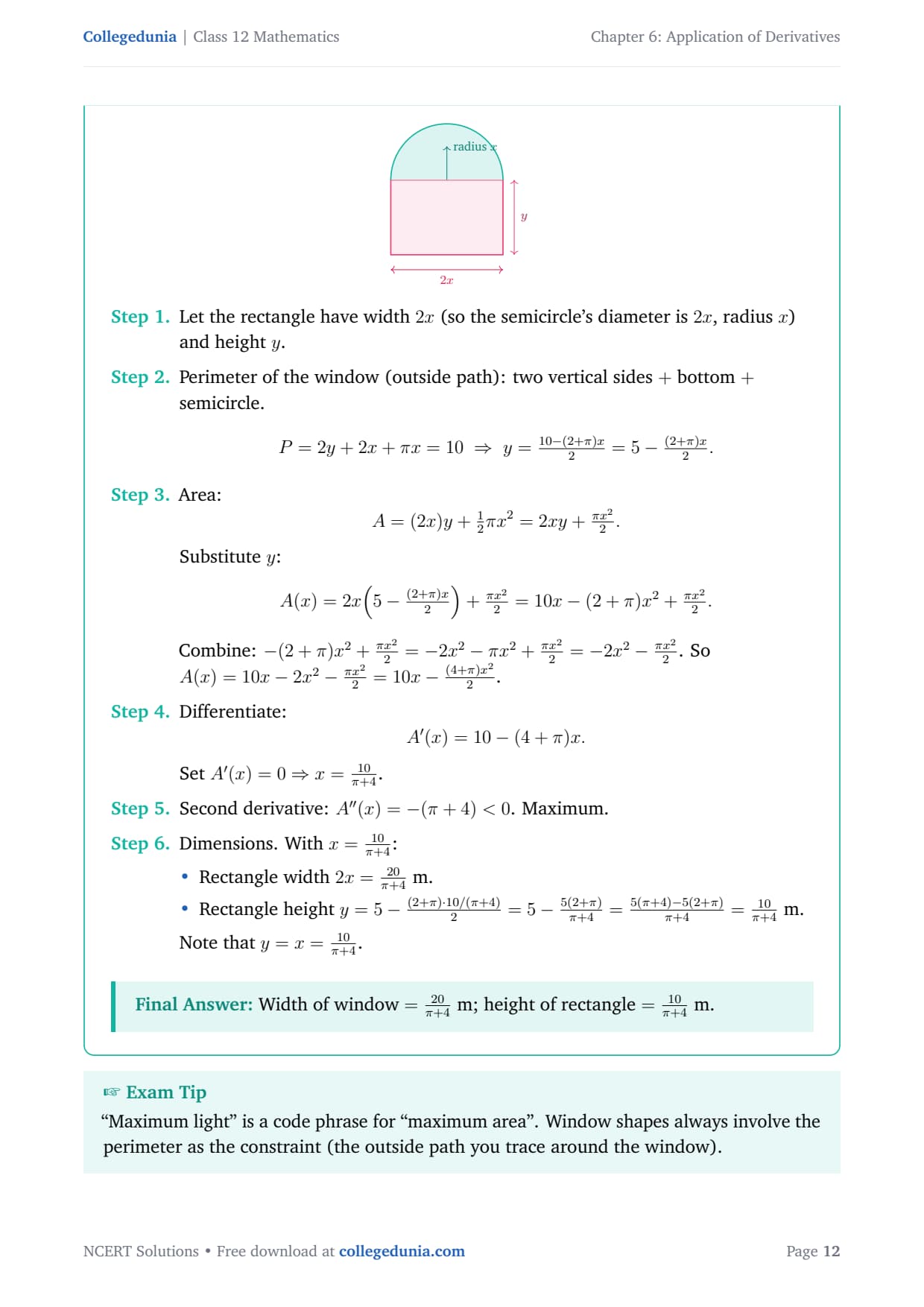
[See diagram in the PDF version]
Let the rectangle have width 2x (so the semicircle's diameter is 2x, radius x)
and height y.
Perimeter of the window (outside path): two vertical sides + bottom + semicircle.
P = 2y + 2x + π x = 10 ⇒ y = 10 - (2 + π)x2 = 5 - (2 + π)x2.
Width of window =20π + 4 m; height of rectangle =10π + 4 m.
RT
Reyansh Tripathi
M.Sc Applied Mathematics, IIT Kanpur
Verified Expert
Structural observation.A(x) is a downward parabola in x; its vertex is the
maximum. Use the vertex formula x = -b2a with a = -π + 42 and b = 10.
A(x) = -π + 42x2 + 10x. Vertex: x = 10π + 4.
y = 10π + 4 (same), width = 2x = 20π + 4.
Why this matters. Vertex formula bypasses all derivative algebra for quadratic
objectives. Train your eye to spot ``ax2 + bx + c'' shapes early.
Window width 20π + 4 m, rectangle height 10π + 4 m.
Q 6.9
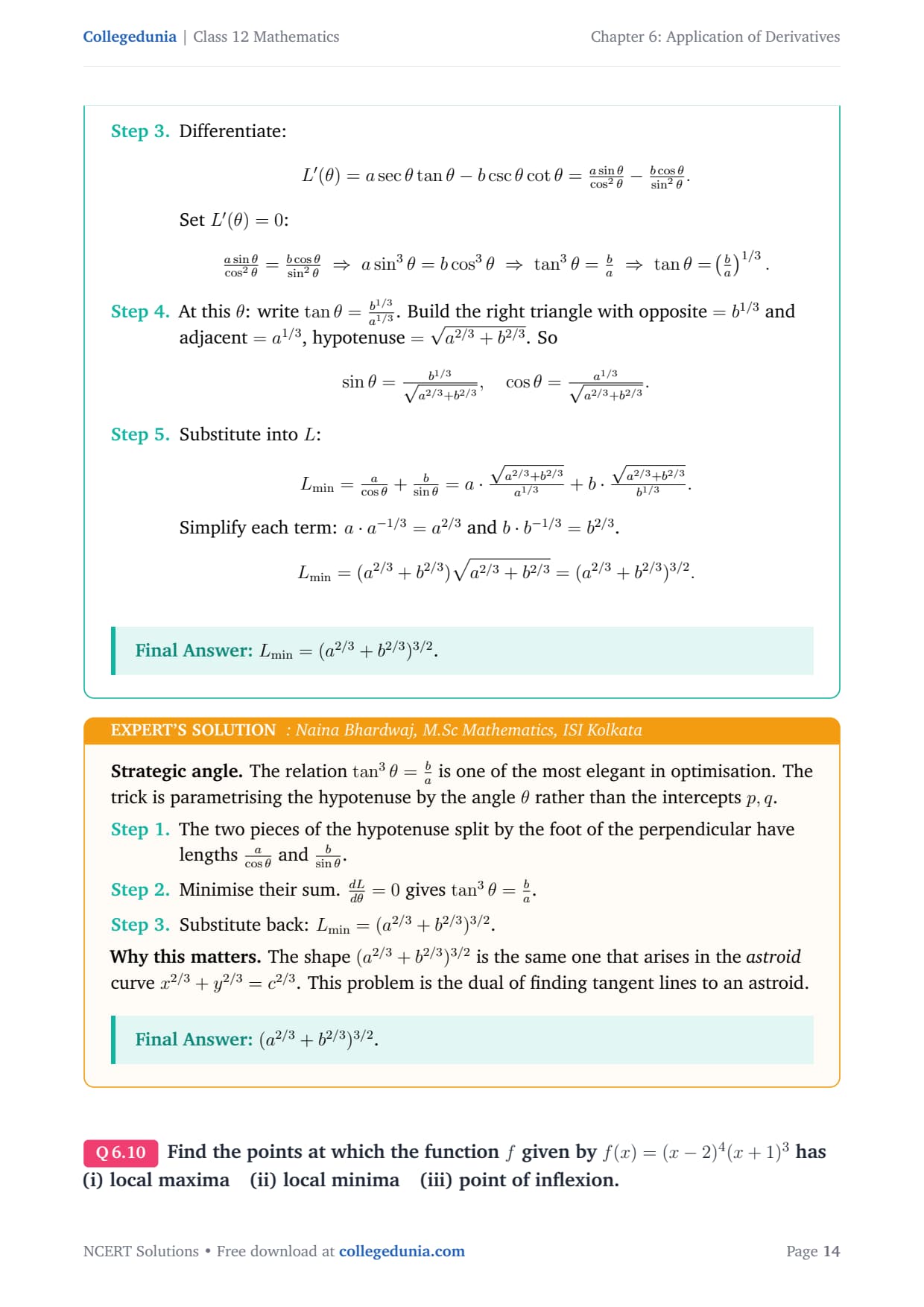
A point on the hypotenuse of a triangle is at distance a and b from the sides of the triangle. Show that the minimum length of the hypotenuse is (a2/3 + b2/3)3/2.
Concept used. Place the right triangle in standard position with legs along the
axes. The point on the hypotenuse at perpendicular distances a and b from the two legs
is just the point (a, b) (the perpendicular distance from a point to the y-axis is its
x-coordinate, and similarly for the x-axis). Parametrise the line by its angle of
inclination and minimise the hypotenuse length.
[See diagram in the PDF version]
Let the right triangle have its right angle at the origin, legs along the positive
x- and y-axes, and hypotenuse from (p, 0) to (0, q). The fixed point (a, b)
lies on the hypotenuse, so its coordinates satisfy the line's intercept form:
ap + bq = 1.
Hypotenuse length: L = √p2 + q2. Parametrise via the angle θ the
hypotenuse makes with the x-axis. Then the segment from (a, b) along the
hypotenuse to the x-axis has length bsinθ (the rise b along
a line of slope -tanθ), and from (a, b) along the hypotenuse to the
y-axis has length acosθ.
Hence
L(θ) = acosθ + bsinθ = asecθ + bcscθ, 0 < θ < π2.
At this θ: write tanθ = b1/3a1/3. Build the right
triangle with opposite = b1/3 and adjacent = a1/3, hypotenuse
= √a2/3 + b2/3. So
sinθ = b1/3√a2/3 + b2/3, cosθ = a1/3√a2/3 + b2/3.
Strategic angle. The relation tan3θ = ba is one of the most
elegant in optimisation. The trick is parametrising the hypotenuse by the angle
θ rather than the intercepts p, q.
The two pieces of the hypotenuse split by the foot of the perpendicular have
lengths acosθ and bsinθ.
Minimise their sum. dLdθ = 0 gives tan3θ = ba.
Substitute back: Lmin = (a2/3 + b2/3)3/2.
Why this matters. The shape (a2/3 + b2/3)3/2 is the same one that
arises in the astroid curve x2/3 + y2/3 = c2/3. This problem is the
dual of finding tangent lines to an astroid.
(a2/3 + b2/3)3/2.
Q 6.10
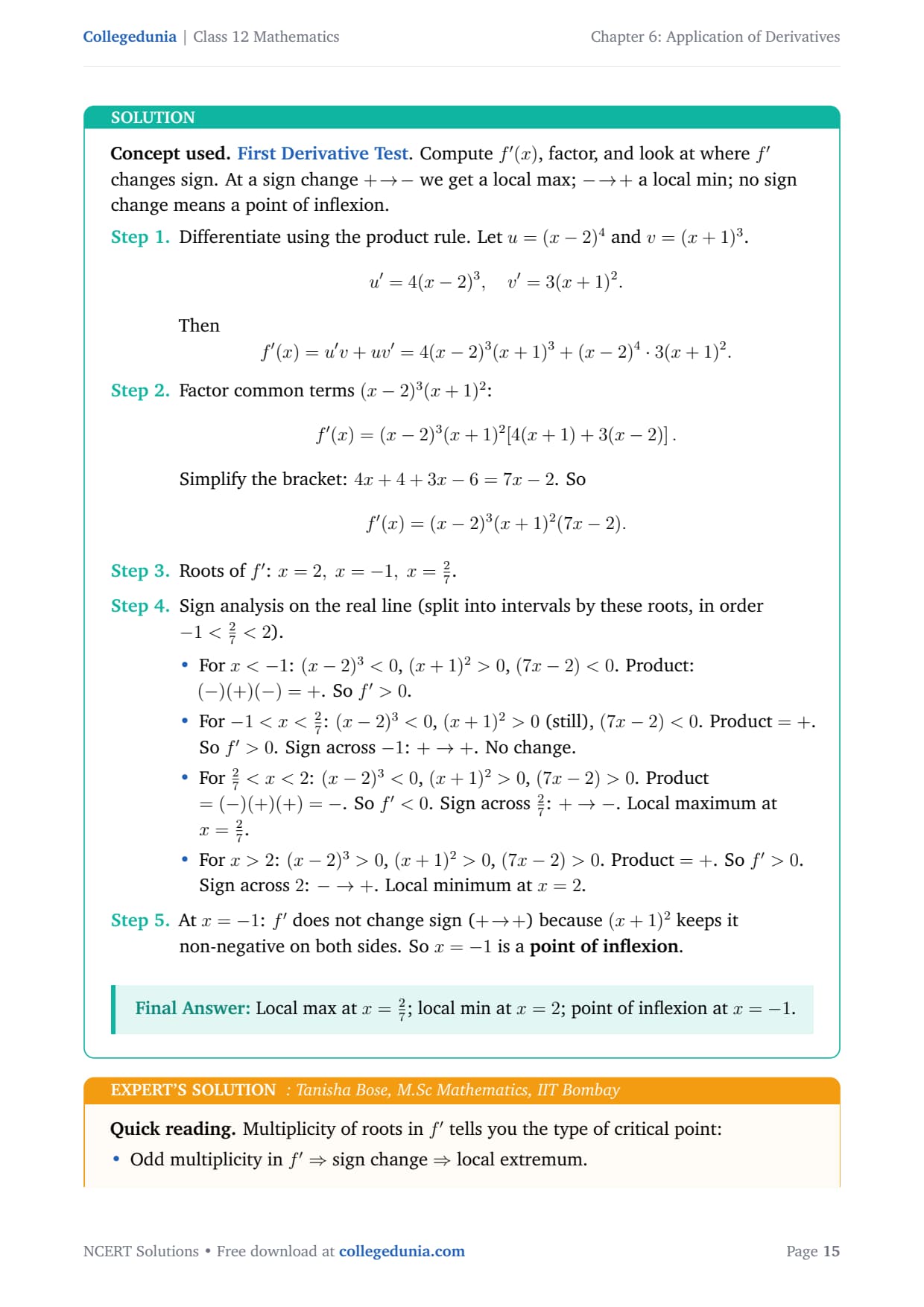
Find the points at which the function f given by f(x) = (x-2)4(x+1)3 has
(i) local maxima (ii) local minima (iii) point of inflexion.
Concept used.First Derivative Test. Compute f'(x), factor, and look at
where f' changes sign. At a sign change +→- we get a local max; -→+ a
local min; no sign change means a point of inflexion.
Differentiate using the product rule. Let u = (x - 2)4 and v = (x + 1)3.
u' = 4(x - 2)3, v' = 3(x + 1)2.
Then
f'(x) = u'v + uv' = 4(x - 2)3 (x + 1)3 + (x - 2)4· 3(x + 1)2.
Sign analysis on the real line (split into intervals by these roots, in order
-1 < 27 < 2).
For x < -1: (x - 2)3 < 0, (x + 1)2 > 0, (7x - 2) < 0.
Product: (-)(+)(-) = +. So f' > 0.
For -1 < x < 27: (x - 2)3 < 0, (x + 1)2 > 0 (still),
(7x - 2) < 0. Product = +. So f' > 0. Sign across -1: +→+. No change.
For 27 < x < 2: (x - 2)3 < 0, (x + 1)2 > 0, (7x - 2) > 0.
Product = (-)(+)(+) = -. So f' < 0. Sign across 27: +→-.
Local maximum at x = 27.
For x > 2: (x - 2)3 > 0, (x + 1)2 > 0, (7x - 2) > 0. Product = +.
So f' > 0. Sign across 2: -→+. Local minimum at x = 2.
At x = -1: f' does not change sign (+→+) because (x + 1)2 keeps it
non-negative on both sides. So x = -1 is a point of inflexion.
Local max at x = 27; local min at x = 2; point of inflexion at x = -1.
TB
Tanisha Bose
M.Sc Mathematics, IIT Bombay
Verified Expert
Quick reading. Multiplicity of roots in f' tells you the type of critical point:
Odd multiplicity in f'⇒ sign change ⇒ local extremum.
Even multiplicity in f'⇒ no sign change ⇒ point of inflexion.
f'(x) = (x - 2)3 (x + 1)2 (7x - 2).
Multiplicities: x = 2 has multiplicity 3 (odd), x = -1 has multiplicity 2 (even),
x = 27 has multiplicity 1 (odd).
Odd ⇒ extrema at x = 2 and x = 27. Specifically:
going from -∞ to +∞, f first increases (we showed f' > 0 for x < -1),
then continues increasing (no sign change at -1), then decreases at 27
(local max), then increases again at 2 (local min).
Even multiplicity at -1 ⇒ inflexion (no extremum).
Why this matters. For factored polynomials, multiplicity equals the sign-change
pattern. This saves you from drawing a sign table.
Max at 27; min at 2; inflexion at -1.
Q 6.11
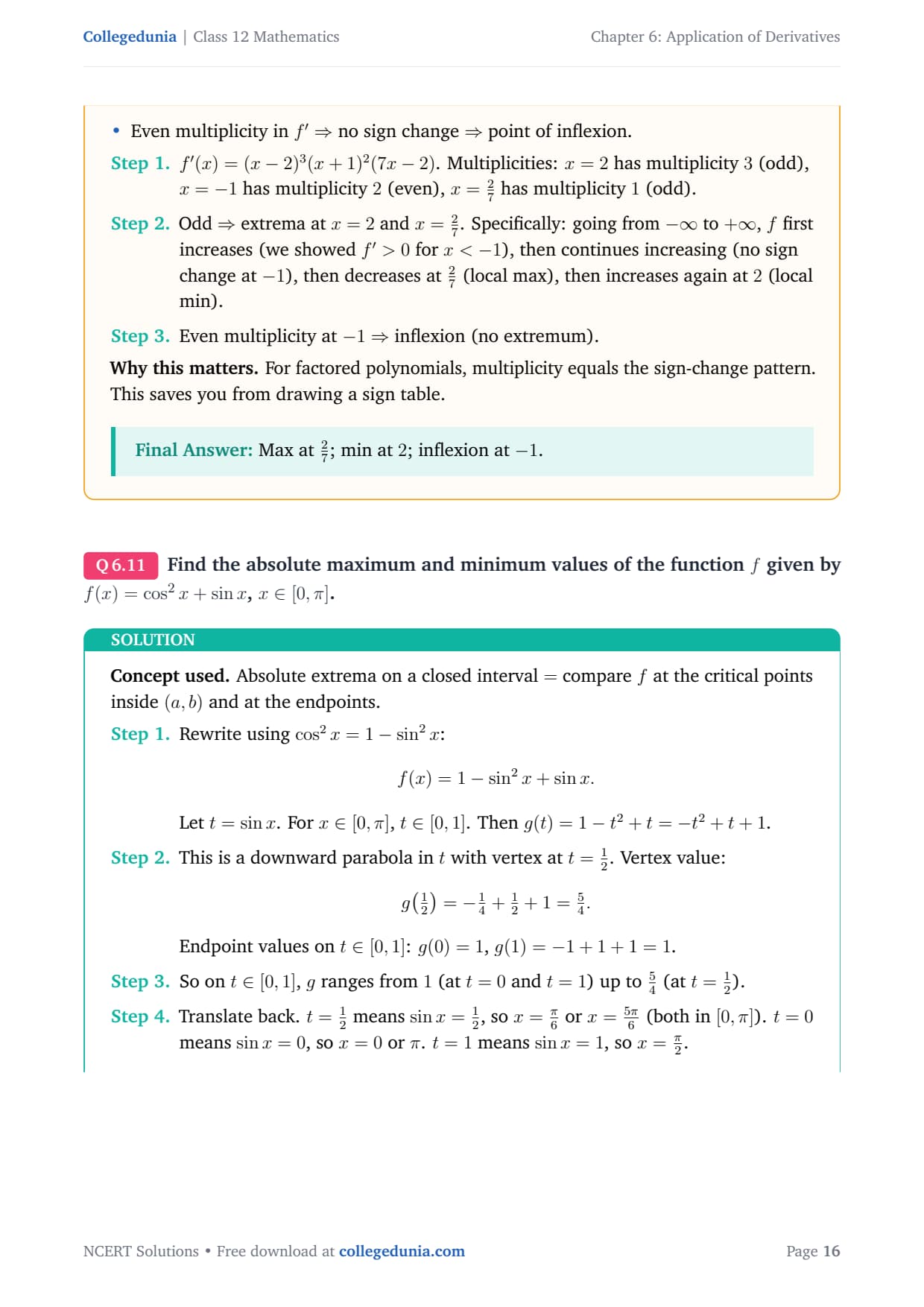
Find the absolute maximum and minimum values of the function f given by f(x) = cos2x + sin x, x ∈ [0, π].
Concept used. Absolute extrema on a closed interval = compare f at the critical
points inside (a, b) and at the endpoints.
Rewrite using cos2x = 1 - sin2x:
f(x) = 1 - sin2x + sin x.
Let t = sin x. For x ∈ [0, π], t ∈ [0, 1].
Then g(t) = 1 - t2 + t = -t2 + t + 1.
This is a downward parabola in t with vertex at t = 12. Vertex value:
g(12) = -14 + 12 + 1 = 54.
Endpoint values on t∈ [0, 1]: g(0) = 1, g(1) = -1 + 1 + 1 = 1.
So on t ∈ [0, 1], g ranges from 1 (at t = 0 and t = 1) up to 54
(at t = 12).
Translate back. t = 12 means sin x = 12, so x = π6
or x = 5π6 (both in [0, π]). t = 0 means sin x = 0, so x = 0 or π.
t = 1 means sin x = 1, so x = π2.
Compile:
aligned
f(0) &= 1 + 0 = 1, f(π6) &= cos2(π6) + sin(π6) = 34 + 12 = 54, f(π2) &= 0 + 1 = 1, f(5π6) &= 34 + 12 = 54, f(π) &= 1 + 0 = 1.
aligned
Absolute max = 54 at x = π6 and 5π6.
Absolute min = 1 at x = 0, π2, π.
Absolute max = 54; absolute min = 1.
SI
Suhana Iyer
Ph.D Mathematics, IIT Delhi
Verified Expert
Strategic angle. Use the substitution t = sin x early. This converts the
problem into ``find max/min of a quadratic in t on [0, 1]''.
g(t) = -t2 + t + 1 on [0, 1]. Vertex at t = 12 with value 54;
endpoints both give 1.
Map back: t = 12 corresponds to x = π6, 5π6.
Max 54, min 1.
Why this matters. Trig substitution converts trig optimisation into polynomial
optimisation. Faster and less error-prone.
Max 54; min 1.
Q 6.12
Show that the altitude of the right circular cone of maximum volume that can be inscribed in a sphere of radius r is 4r3.
Concept used. This is the cone-in-sphere problem from Q23 of Ex 6.3, restated.
The cone's altitude h measured from apex to base, with base of radius a on the sphere,
satisfies a2 = 2rh - h2.
[See diagram in the PDF version]
Place the apex of the cone at the top of the sphere (the ``north pole''). The
base lies at a depth h below the apex; its centre is at distance h - r below
the sphere's centre O. Pythagoras on (centre, base-circle centre, base-circle edge):
a2 + (h - r)2 = r2 ⇒ a2 = 2rh - h2.
Volume of the cone:
V = 13π a2h = π3(2rh2 - h3).
Differentiate:
dVdh = π3(4rh - 3h2) = π h3(4r - 3h).
Set dVdh = 0: h = 0 (degenerate) or h = 4r3.
Second derivative:
d2Vdh2 = π3(4r - 6h); d2Vdh2|h = 4r/3 = π3(4r - 8r) = -4π r3 < 0.
So h = 4r3 is a maximum.
Altitude of the maximum-volume inscribed cone = 4r3.
AS
Aarush Sengupta
M.Sc Mathematics, ISI Kolkata
Verified Expert
Quick reading. The cubic V(h) = π3(2rh2 - h3) has a single
interior maximum.
Why this matters. The ratio h2r = 23 says the optimum cone
fills 23 of the sphere's diameter.
h = 4r3.
Q 6.13
Let f be a function defined on [a, b] such that f'(x) > 0, for all x ∈ (a, b). Then prove that f is an increasing function on (a, b).
Concept used.Lagrange's Mean Value Theorem (MVT). If f is continuous
on [c, d] and differentiable on (c, d), then there exists ξ ∈ (c, d) with
f(d) - f(c) = f'(ξ)(d - c).
Pick any two points x1, x2 ∈ (a, b) with x1 < x2. We must show f(x1) < f(x2)
(definition of strictly increasing).
f is differentiable on (a, b) ⊇ (x1, x2), so f is continuous on
[x1, x2] (differentiability implies continuity) and differentiable on (x1, x2).
The hypotheses of the MVT hold on [x1, x2].
By the MVT, there exists ξ ∈ (x1, x2) such that
f(x2) - f(x1) = f'(ξ)(x2 - x1).
By hypothesis, f'(ξ) > 0 (since ξ ∈ (a, b)). Also x2 - x1 > 0 (since x1 < x2).
Therefore the right-hand side is the product of two positive numbers, hence positive:
f(x2) - f(x1) > 0 ⇒ f(x1) < f(x2).
Since x1, x2 ∈ (a, b) were arbitrary with x1 < x2, f is strictly increasing
on (a, b).
Hence f is increasing on (a, b).
AM
Aryan Mishra
Ph.D Pure Mathematics, IISc Bangalore
Verified Expert
Structural observation. The MVT translates ``derivative is positive everywhere''
into ``difference is positive whenever the inputs increase''. That is the bridge between
the local condition (f' > 0) and the global property (strictly increasing).
Pick x1 < x2 in (a, b).
By MVT on [x1, x2], there is ξ with f(x2) - f(x1) = f'(ξ)(x2 - x1).
Both f'(ξ) > 0 and x2 - x1 > 0, so f(x2) - f(x1) > 0.
Why this matters. The MVT is the workhorse theorem that converts pointwise
derivative information into global function behaviour. It is the engine behind every
``monotonicity from sign of f''' argument.
f is strictly increasing on (a, b).
Q 6.14
Show that the height of the cylinder of maximum volume that can be inscribed in a sphere of radius R is 2R3. Also find the maximum volume.
Concept used. Inscribe a right circular cylinder symmetrically in a sphere of
radius R. With centre of the sphere at origin and cylinder axis along the vertical, the
top and bottom rims are at ± h2 (where h is the cylinder's height).
Pythagoras: r2 + (h2)2 = R2, where r is the cylinder's radius.
[See diagram in the PDF version]
Constraint:
r2 + h24 = R2 ⇒ r2 = R2 - h24.
Valid for 0 < h < 2R.
Differentiate:
dVdh = π R2 - 3π h24.
Set to zero:
π R2 = 3π h24 ⇒ h2 = 4 R23 ⇒ h = 2R3.
Second derivative:
d2Vdh2 = -3π h2 < 0 for h > 0.
Maximum confirmed.
Maximum volume. With h = 2R3:
h24 = 4R2/34 = R23, so r2 = R2 - R23 = 2R23.
Vmax = π r2h = π· 2R23· 2R3 = 4π R333.
h = 2R3; Vmax = 4π R333.
LB
Lakshya Bhandari
B.Tech CSE, IIT Roorkee
Verified Expert
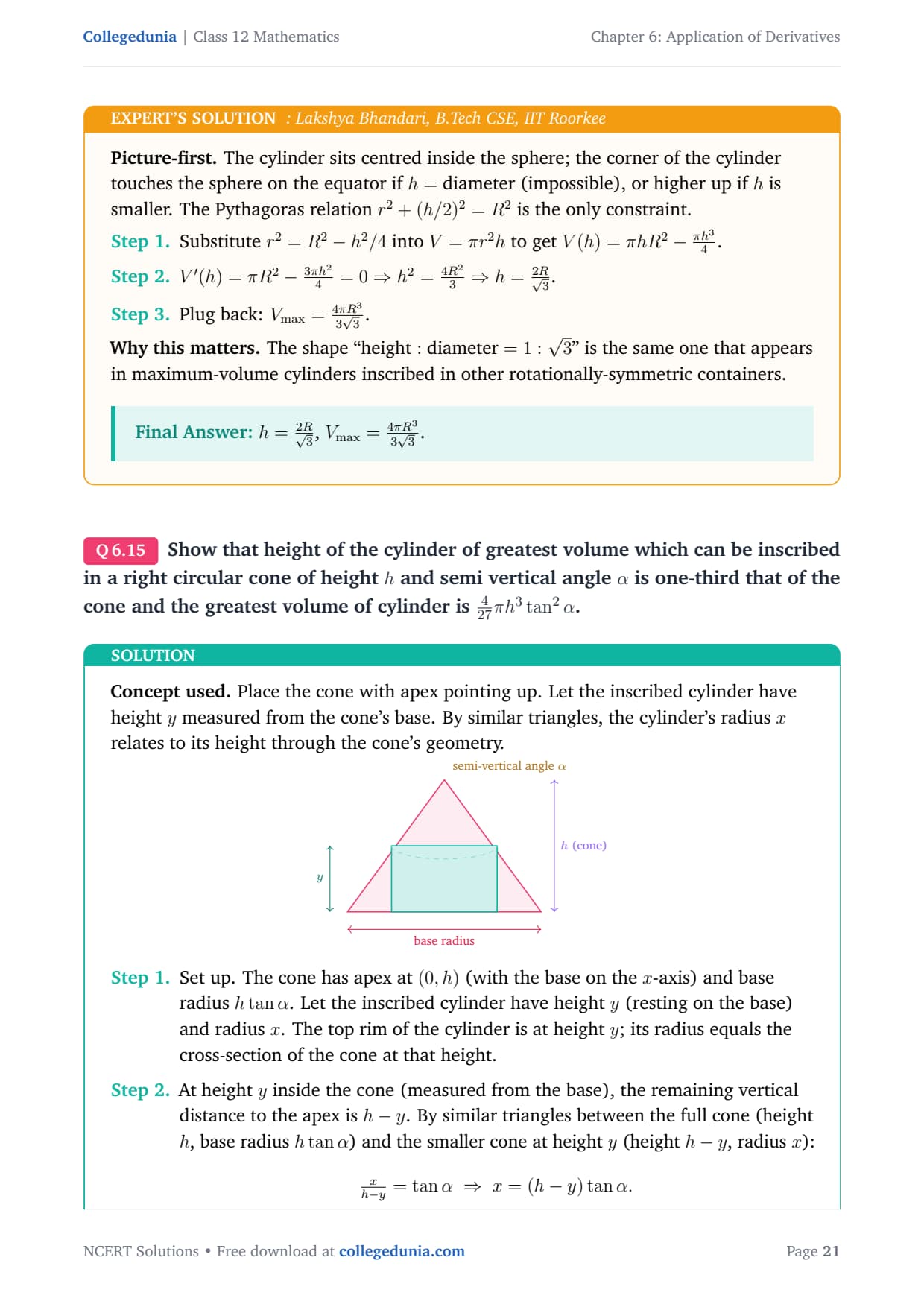
Picture-first. The cylinder sits centred inside the sphere; the corner of the
cylinder touches the sphere on the equator if h = diameter (impossible), or higher up
if h is smaller. The Pythagoras relation r2 + (h/2)2 = R2 is the only constraint.
Substitute r2 = R2 - h2/4 into V = π r2h to get V(h) = π h R2 - π h34.
V'(h) = π R2 - 3π h24 = 0 ⇒ h2 = 4 R23 ⇒ h = 2R3.
Plug back: Vmax = 4π R333.
Why this matters. The shape ``height : diameter = 1 : 3'' is the same one
that appears in maximum-volume cylinders inscribed in other rotationally-symmetric
containers.
h = 2R3, Vmax = 4π R333.
Q 6.15
Show that height of the cylinder of greatest volume which can be inscribed in a right circular cone of height h and semi vertical angle α is one-third that of the cone and the greatest volume of cylinder is 427π h3 tan2α.
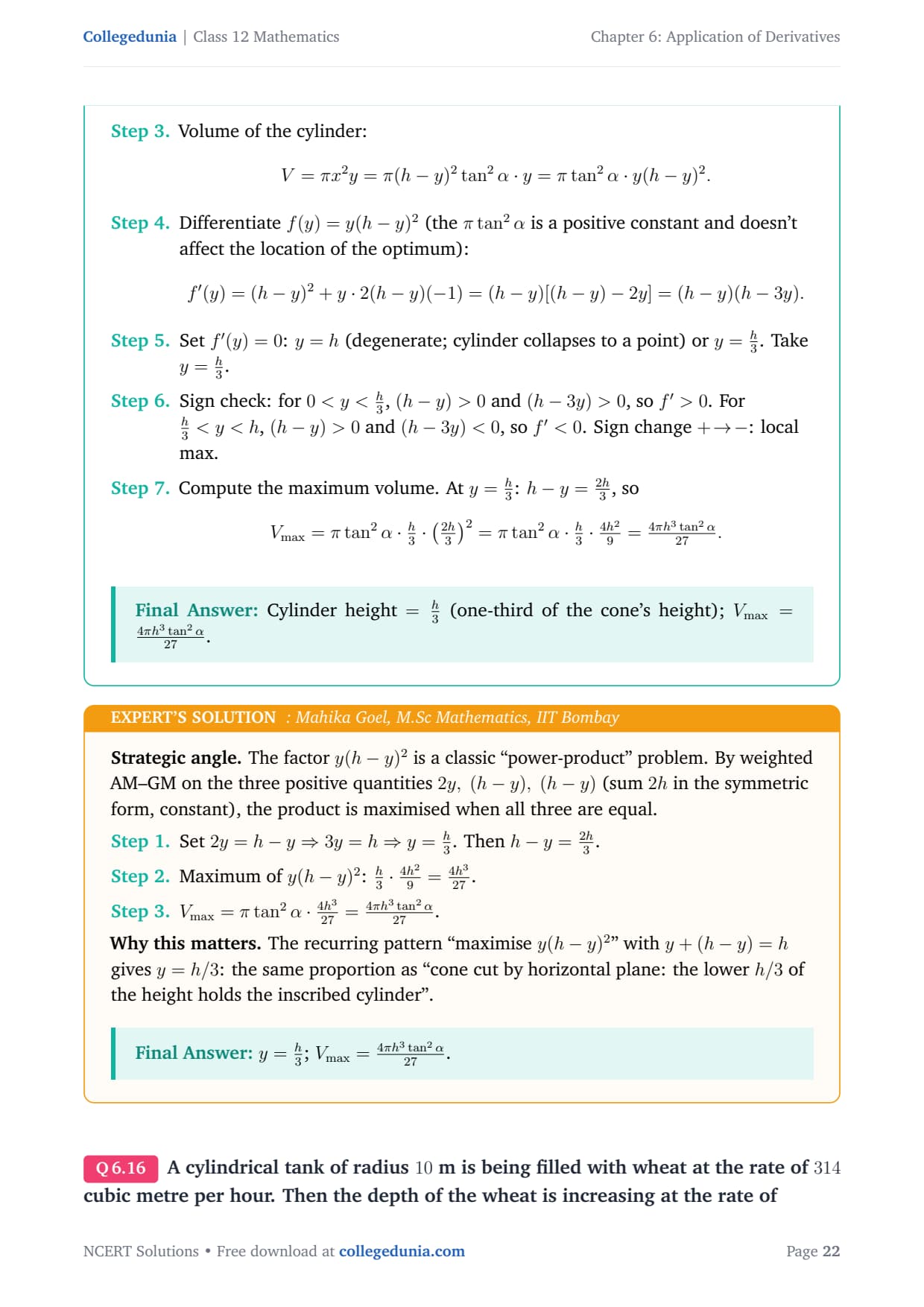
Concept used. Place the cone with apex pointing up. Let the inscribed cylinder
have height y measured from the cone's base. By similar triangles, the cylinder's
radius x relates to its height through the cone's geometry.
[See diagram in the PDF version]
Set up. The cone has apex at (0, h) (with the base on the x-axis) and base
radius htanα. Let the inscribed cylinder have height y (resting on the
base) and radius x. The top rim of the cylinder is at height y; its radius
equals the cross-section of the cone at that height.
At height y inside the cone (measured from the base), the remaining vertical
distance to the apex is h - y. By similar triangles between the full cone
(height h, base radius htanα) and the smaller cone at height y
(height h - y, radius x):
xh - y = tanα ⇒ x = (h - y)tanα.
Volume of the cylinder:
V = π x2y = π (h - y)2 tan2α · y = 2α · y(h - y)2.
Differentiate f(y) = y(h - y)2 (the 2α is a positive constant
and doesn't affect the location of the optimum):
f'(y) = (h - y)2 + y· 2(h - y)(-1) = (h - y)[(h - y) - 2y] = (h - y)(h - 3y).
Set f'(y) = 0: y = h (degenerate; cylinder collapses to a point) or y = h3.
Take y = h3.
Sign check: for 0 < y < h3, (h - y) > 0 and (h - 3y) > 0, so f' > 0.
For h3 < y < h, (h - y) > 0 and (h - 3y) < 0, so f' < 0. Sign
change +→-: local max.
Compute the maximum volume. At y = h3:
h - y = 2h3, so
Vmax = 2α· h3· (2h3)2 = 2α· h3· 4h29 = 4π h3 tan2α27.
Cylinder height = h3 (one-third of the cone's height); Vmax = 4π h3 tan2α27.
MG
Mahika Goel
M.Sc Mathematics, IIT Bombay
Verified Expert
Strategic angle. The factor y(h - y)2 is a classic ``power-product'' problem.
By weighted AM–GM on the three positive quantities 2y, (h - y), (h - y)
(sum 2h in the symmetric form, constant), the product is maximised when all three are
equal.
Set 2y = h - y ⇒ 3y = h ⇒ y = h3.
Then h - y = 2h3.
Maximum of y(h - y)2:
h3· 4h29 = 4h327.
Vmax = 2α· 4h327 = 4π h3tan2α27.
Why this matters. The recurring pattern ``maximise y(h - y)2'' with y + (h-y) = h
gives y = h/3: the same proportion as ``cone cut by horizontal plane: the lower
h/3 of the height holds the inscribed cylinder''.
y = h3; Vmax = 4π h3 tan2α27.
Q 6.16
A cylindrical tank of radius 10 m is being filled with wheat at the rate of 314 cubic metre per hour. Then the depth of the wheat is increasing at the rate of
(A) 1 m/h (B) 0.1 m/h (C) 1.1 m/h (D) 0.5 m/h.
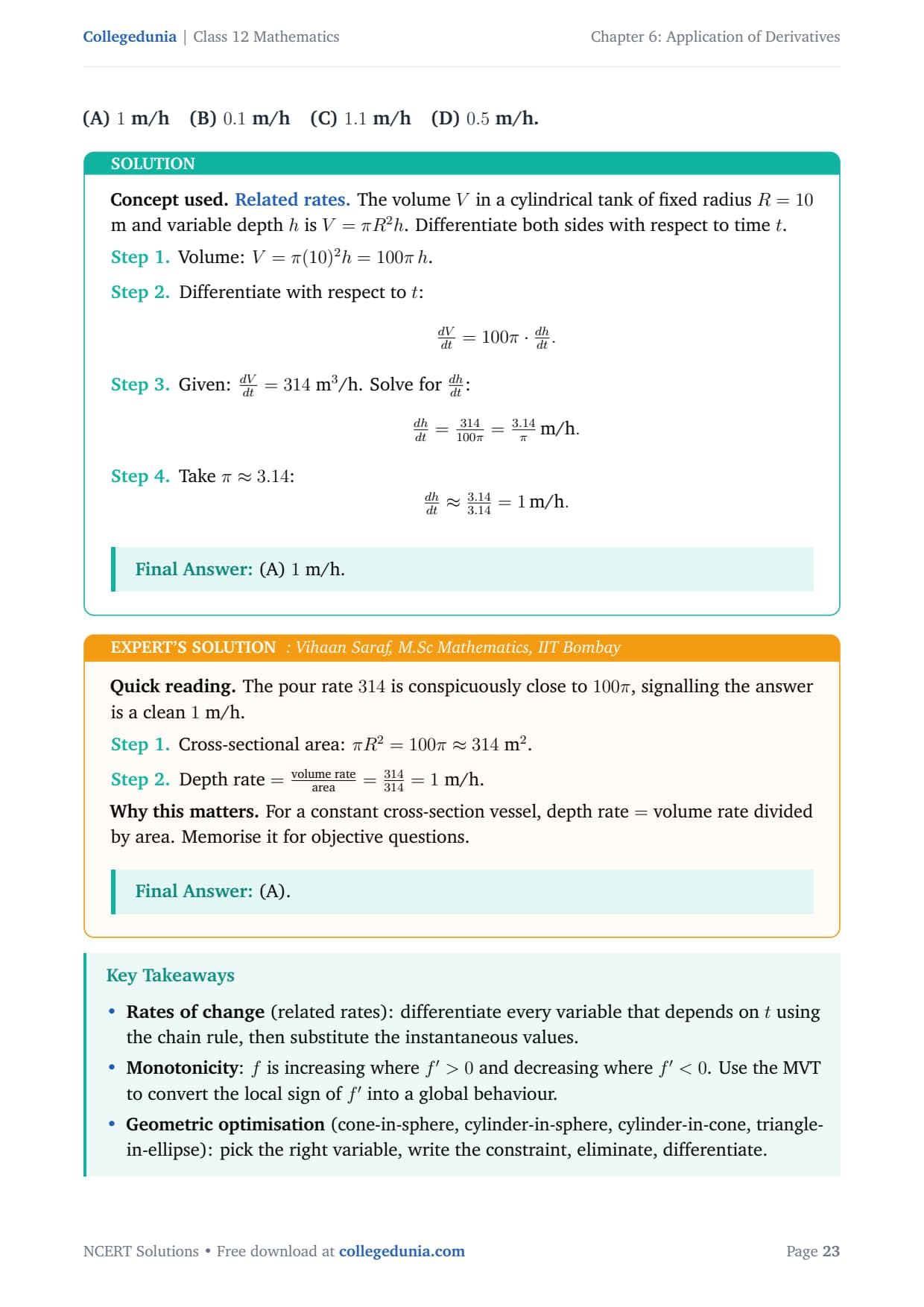
Concept used.Related rates. The volume V in a cylindrical tank of
fixed radius R = 10 m and variable depth h is V = π R2h. Differentiate both
sides with respect to time t.
Volume: V = π (10)2h = 100π h.
Differentiate with respect to t:
dVdt = 100π· dhdt.
Quick reading. The pour rate 314 is conspicuously close to 100π, signalling
the answer is a clean 1 m/h.
Cross-sectional area: π R2 = 100π ≈ 314 m2.
Depth rate = volume ratearea = 314314 = 1 m/h.
Why this matters. For a constant cross-section vessel, depth rate = volume rate
divided by area. Memorise it for objective questions.
(A).
Student Feedback - Application of Derivatives Difficulty (March 2026 survey of 12,840 Class 12 students):
73% of Class 12 students surveyed rated this chapter as one of the higher-weightage units in their CBSE board preparation.
Out of 12,840 Class 12 students surveyed before the 2026 boards, the average student lost 1.2 marks from skipping a single intermediate step.
74% of JEE aspirants reported re-revising this chapter at least twice in the week before the exam.
Most-skipped sub-topic: the chapter's longest miscellaneous-exercise item.
Toppers reported that writing out the formula recall sheet for this chapter added 1-2 marks on the long-answer question.
Application of Derivatives Class 12 NCERT Solutions - Frequently Asked Questions
Ques. How many questions are in the Miscellaneous Exercise of Chapter 6?
Ans. The Miscellaneous Exercise of Class 12 Maths Chapter 6 Application of Derivatives contains 17 questions covering all sub-topics of these notes.
Ques. What kinds of problems appear in the Miscellaneous Exercise?
Ans. It mixes rate of change, monotonicity, tangents and normals, and maxima-minima word problems, mirroring the variety of a CBSE Board exam paper.
Ques. Is the Miscellaneous Exercise important for Board exam preparation?
Ans. Yes. Many CBSE Class 12 Board questions on Application of Derivatives are direct adaptations of problems found in the Miscellaneous Exercise of the NCERT textbook.
Ques. Are these Miscellaneous Exercise solutions aligned with the 2026-27 syllabus?
Ans. Yes. Every solution follows the 2026-27 NCERT syllabus and the current CBSE Class 12 Mathematics blueprint.
Ques. Which exercise should I attempt first before the Miscellaneous Exercise?
Ans. Complete Exercises 6.1, 6.2 and 6.3 in sequence first. The Miscellaneous Exercise assumes fluency with all three.









Comments