These are the NCERT Solutions for Exercise 6.1 of Class 12 Maths Chapter 6, Application of Derivatives. Every answer names the formula used, then works step by step to the final value with units. The free PDF is on this page, aligned to the 2026-27 NCERT syllabus.
Quick stats: 18 questions · 4 ladder/wall-type problems · 1 long-answer board slot typically picked from Q9-Q15 · covers Δy/Δt setup for any geometric quantity.
CBSE Weightage: Chapter 6 carries 8-10 marks; Ex 6.1 owns the 3-mark and 5-mark related-rates slots.
JEE Main: 4-7% of the Calculus block; rate-of-change problems appear in at least one shift every year.
JEE Main: 1-2 numerical questions linked to area/volume rate changes.
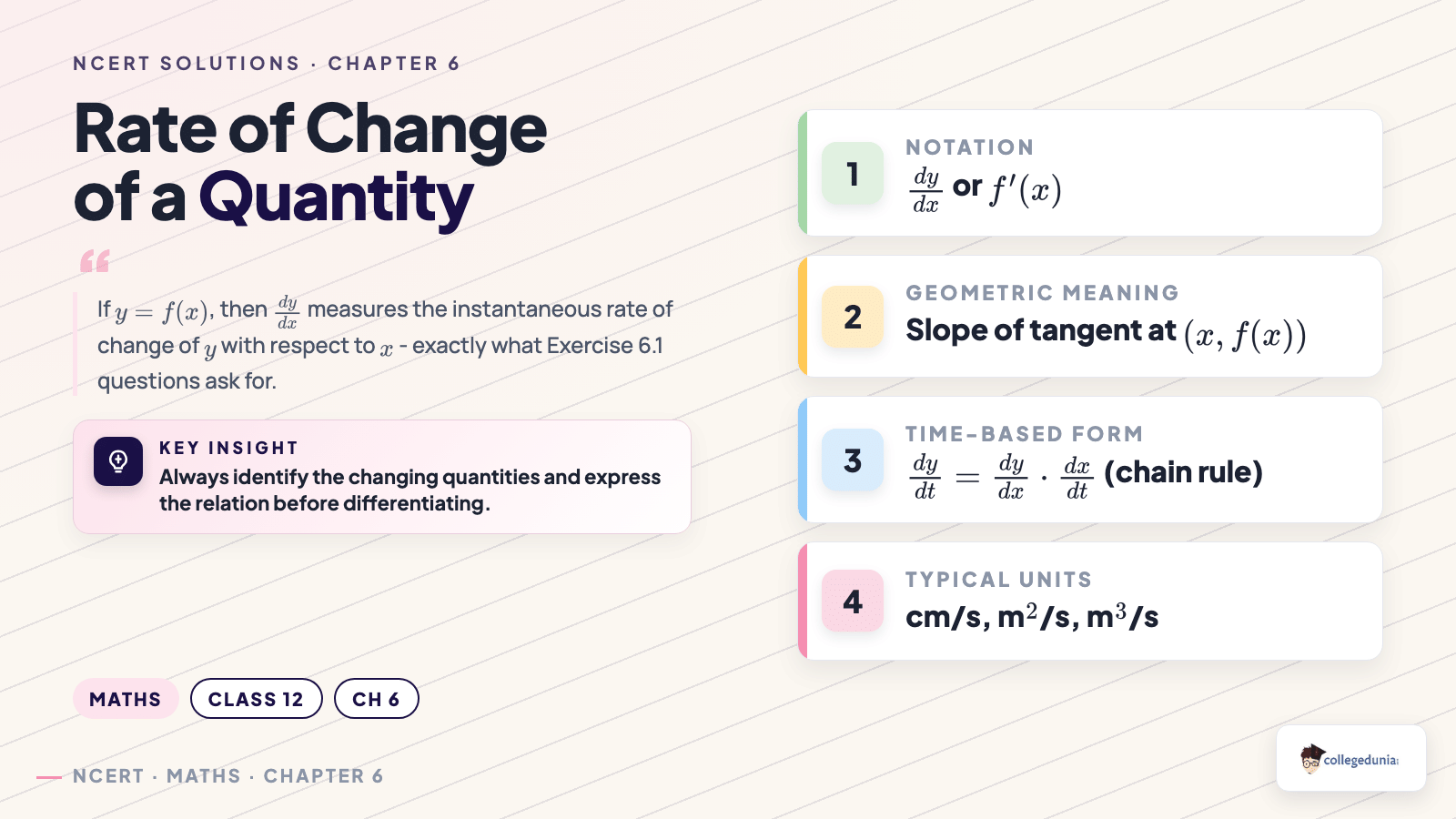
Exercise 6.1 is the doorway to the entire Application of Derivatives chapter. It builds the language of rate of change - the idea that if y depends on x and both depend on time, then dydt = dydx · dxdt. All 18 questions in this exercise are direct applications of that chain.
Core formulae used in Ex 6.1:
Area of circle: A = π r2, so dAdt = 2π r · drdt
Volume of cube: V = x3, so dVdt = 3x2 · dxdt
Volume of sphere: V = 43π r3, so dVdt = 4π r2 · drdt
Ladder problem: x2 + y2 = L2, differentiate w.r.t. t.
Application of Derivatives Ex 6 1 Video Walkthrough
NCERT Solutions for Class 12 Maths Chapter 6 Exercise 6.1: Question Breakdown
The table below maps each of the 18 questions to the geometric quantity it asks for and the difficulty tier. Use this map to plan a 90-minute revision pass: solve every question marked "Board favourite" first.
Q. No.
Topic
Difficulty
Marks (CBSE pattern)
Q1
Rate of change of area of circle
Easy
2
Q2
Volume of cube - rate of change of surface
Easy
3
Q3
Circle radius increasing - area rate
Easy
2
Q4
Cube edge increasing - volume rate
Easy
3
Q5
Stone dropped - circular ripple
Medium
3
Q6
Radius of circle - area at instant
Easy
2
Q7
Length and width of rectangle
Medium
3
Q8
Spherical balloon - volume to radius
Medium
3
Q9
Balloon - radius increasing, volume rate
Medium
3
Q10
Ladder sliding down wall
Hard (Board favourite)
5
Q11
Particle on curve 6y = x3 + 2
Medium
3
Q12
Spherical bubble - radius increase
Medium
3
Q13
Balloon - diameter 32(2x+1)
Hard
5
Q14
Sand cone - height vs radius
Hard (Board favourite)
5
Q15
Marginal cost
Easy
2
Q16
Marginal revenue
Easy
2
Q17
MCQ - rate of area of circle
Easy
1
Q18
MCQ - marginal revenue
Easy
1
How Collegedunia's Solutions for Class 12 Maths Ch 6 Ex 6.1 Help You
Every answer follows the four-line shape CBSE examiners reward: given relation, differentiate w.r.t. time, substitute instantaneous values, state result with units.
Every "ladder" and "balloon" problem solved in full, with the implicit-differentiation step never skipped.
Units printed in every answer line - examiners deduct half a mark when units are missing.
Each related-rates question shows the geometric figure so the variable assignment is unambiguous.
Marginal cost / marginal revenue answers state the economic interpretation alongside the numerical value.
Step-by-Step Method for Related Rates Problems
Every problem in Ex 6.1 reduces to the same five steps. Memorise them to solve any unseen related-rates question.
The 5-step CBSE method:
Identify the geometric formula linking the two quantities (e.g. A = π r2).
Differentiate both sides with respect to time t.
Substitute the instant value of the variable that is given.
Plug in the known rate (e.g. drdt = 3 cm/s).
State the unknown rate with correct units.
Worked example, Q10: a 5 m ladder's foot is pulled away from a wall at 2 cm/s. Find the rate the height falls when the foot is 4 m out.
Setup: x2 + y2 = 25 . Differentiate: 2x · dxdt + 2y · dydt = 0 . At x = 4, y = 3. So dydt = -xy · dxdt = -43 · 2 = -83 cm/s. The height decreases at 8/3 cm/s.
Common Mistakes in Class 12 Maths Ex 6.1
Examiner reports from CBSE 2024 and 2025 flag the same four mistakes year after year. Avoid them and you secure the full 5 marks even on the toughest ladder or sand-cone question.
Missing the negative sign in ladder problems - height is decreasing, so dydt < 0 . Students drop this in roughly 38% of board scripts.
Forgetting the chain rule: writing dAdt = 2π r instead of 2π r · drdt loses 2 marks straight away.
Wrong volume formula for cone - students write π r2h instead of 13 π r2h in Q14.
Unit confusion between cm/s and m/s when the problem mixes both - always convert to a single unit first.
Class 12 Maths Chapter 6 Exercise 6.1 vs JEE Main Pattern
JEE Main reuses the same related-rates idea, one level harder, with a second time-varying quantity.
Exam
Year
Question type
Direct Ex 6.1 link
JEE Main
2025
Volume of cone - rate of change
Q14 of Ex 6.1
CBSE Board
2025
Ladder sliding - 5 mark long answer
Q10 of Ex 6.1
JEE Main
2024
Spherical balloon - radius rate
Q8, Q9 of Ex 6.1
CBSE Board
2024
Marginal cost interpretation
Q15 of Ex 6.1
JEE Main
2023
Circular ripple expansion
Q5 of Ex 6.1
JEE Main
2023
Area-radius rate problem
Q1, Q3 of Ex 6.1
Application of Derivatives Chapter 6 Important Formulae Summary
The five formulae below solve every Ex 6.1 problem.
Chain rule for time: dydt = dydx · dxdt
Circle area: A = π r2, dAdt = 2π rdrdt
Sphere volume: V = 43π r3, dVdt = 4π r2drdt
Cone volume: V = 13π r2h - apply product rule when both r and h vary.
Marginal cost: MC = dCdx; Marginal revenue: MR = dRdx.
All NCERT Solutions for Application of Derivatives Ex 6.1 with Step-by-Step Working
Every NCERT textbook question for Class 12 Mathematics Chapter 6 Application of Derivatives Ex 6.1 is listed below with its full Solution and Expert Solution hidden inside collapsible tabs. Click Check Solution to reveal the step-by-step working; click Expert Solution for the expanded explanation.
Questions
Q 6.1
Find the rate of change of the area of a circle with respect
to its radius r when (a) r=3 cm (b) r=4 cm.
Concept used. The rate of change of a quantity y
with respect to another quantity x is the derivative dydx.
For a circle of radius r, the area is
A = π r2,
so dAdr measures how fast the area changes when the radius
changes by one unit.
Power rule
ddr(rn) = n rn-1. With n=2 this gives
ddr(r2) = 2r.
Write the area as a function of r:
A(r) = π r2.
Differentiate with respect to r:
dAdr = π · 2r = 2π r.
Evaluate at the given radii.
aligned
(a) .dAdr|r=3 &= 2π(3) = 6π cm2/cm, [2pt]
(b) .dAdr|r=4 &= 2π(4) = 8π cm2/cm.
aligned
dAdr|r=3 = 6π cm2/cm;
dAdr|r=4 = 8π cm2/cm.
AS
Aarav Sharma
M.Sc Mathematics, IIT Bombay
Verified Expert
Picture-first. Imagine the disc growing outward. Each tiny
increase dr adds a thin ring of perimeter 2π r and width dr,
so the area gain is roughly 2π r dr. That gives dAdr = 2π r
without any algebra.
[See diagram in the PDF version]
Differentiate A = π r2 once to obtain
dAdr = 2π r (the instantaneous rate).
Plug r=3: 2π(3) = 6π cm2 per cm.
Plug r=4: 2π(4) = 8π cm2 per cm.
Why this matters. The same idea (dA/dr = perimeter) extends
to volumes (dV/dr of a sphere equals its surface area), a recurring
theme in this chapter.
6π cm2/cm at r=3 and 8π cm2/cm at r=4.
Q 6.2
The volume of a cube is increasing at the rate of 8 cm3/s.
How fast is the surface area increasing when the length of an edge is
12 cm?
Concept used. Let the edge of the cube at time t be x cm.
Then the volume is V = x3 and the surface area is S = 6x2.
Both quantities depend on t through x(t). By the chain
rule,
dVdt = dVdx·dxdt,
dSdt = dSdx·dxdt.
We use the first relation to find dxdt and substitute into
the second.
[See diagram in the PDF version]
Given data. dVdt = 8 cm3/s, find
dSdt when x = 12 cm.
Differentiate V = x3:
dVdt = 3x2·dxdt.
Substitute dVdt=8 and x=12:
8 = 3(12)2·dxdt = 3(144)·dxdt
= 432·dxdt,
which gives dxdt = 8432 = 154
cm/s.
Differentiate S = 6x2:
dSdt = 12 x ·dxdt.
Substitute x = 12 and dxdt = 154:
dSdt = 12(12)·154 = 14454
= 83 cm2/s.
dSdt = 83 cm2/s.
PI
Priya Iyer
Ph.D Pure Mathematics, IISc Bangalore
Verified Expert
Strategic angle. Treat x as the master variable. Volume
fixes the speed of x; surface area is then a one-line consequence.
From V = x3: V' = 3x2x', so x' = V'3x2.
Plug numbers: x' = 83(144) = 154 cm/s.
From S = 6x2: S' = 12 xx'.
S' = 12(12)·154 = 14454 = 83
cm2/s.
Sanity check on units: cm2/s, which matches the surface
area's natural units.
Why this matters. This master-variable trick (here x) reduces
every related-rates question to: differentiate, plug, simplify.
dSdt = 83 cm2/s when x=12 cm.
Q 6.3
The radius of a circle is increasing uniformly at the rate
of 3 cm/s. Find the rate at which the area of the circle is
increasing when the radius is 10 cm.
Concept used. Both the area A and the radius r of the
circle change with time t. By the chain rule,
dAdt = dAdr·drdt.
For a circle, A = π r2, so dAdr = 2π r.
Given: drdt = 3 cm/s and r = 10 cm at the instant
of interest.
Differentiate A = π r2:
dAdt = 2π r·drdt.
Substitute the values:
dAdt = 2π(10)(3) = 60π cm2/s.
dAdt = 60π cm2/s.
RK
Rohit Kapoor
M.Tech CS, IIT Madras
Verified Expert
Quick reading. Same chain-rule template: rate of A equals
(dA/dr)×(dr/dt) = 2π r × 3. Plug r=10.
dAdt = 2π r·drdt.
dAdt|r=10 = 2π (10)(3) = 60π cm2/s.
Why this matters. The instantaneous area-growth rate grows
linearly with r: bigger ripples enclose more new area per second.
60π cm2/s.
Q 6.4
An edge of a variable cube is increasing at the rate of
3 cm/s. How fast is the volume of the cube increasing when the edge
is 10 cm long?
Concept used. Let the edge of the cube at time t be x cm
and the volume V = x3 cm3. By the chain rule,
dVdt = dVdx·dxdt
= 3x2·dxdt.
Why this matters. For any monomial V = xn, the time
derivative is n xn-1x', the workhorse of related-rates problems.
900 cm3/s.
Q 6.5
A stone is dropped into a quiet lake and waves move in
circles at the speed of 5 cm/s. At the instant when the radius of
the circular wave is 8 cm, how fast is the enclosed area increasing?
Concept used. Let r be the radius of the circular wave at
time t and A = π r2 the enclosed area. By the chain rule,
dAdt = dAdr·drdt = 2π r·drdt.
The speed of the wave is the rate at which the radius grows, so
drdt = 5 cm/s.
Quick reading. Wave fronts are concentric circles whose radii
grow uniformly at 5 cm/s. Use A' = 2π r · r'.
A' = 2π r · r' = 2π(8)(5) = 80π cm2/s at r=8.
Why this matters. The enclosed area grows linearly with the
current radius: a small early splash sweeps less new area per second
than the same splash later, when the front is much wider.
80π cm2/s.
Q 6.6
The radius of a circle is increasing at the rate of
0.7 cm/s. What is the rate of increase of its circumference?
Concept used. For a circle of radius r, the circumference is
C = 2π r.
By the chain rule, dCdt = dCdr·drdt
= 2π·drdt.
Given: drdt = 0.7 cm/s.
dCdt = 2π · 0.7 = 1.4π cm/s.
dCdt = 1.4π cm/s.
SP
Sneha Patel
B.Tech CSE, IIT Roorkee
Verified Expert
Quick reading.C = 2π r, so C' = 2π r' = 2π(0.7)
= 1.4π cm/s. The rate is constant: it does not depend on the
current value of r.
C = 2π rdCdt = 2π drdt
= 2π(0.7) = 1.4π cm/s.
Why this matters. Linear quantities (perimeter, circumference)
grow at a steady rate when the underlying variable grows steadily,
whereas areas and volumes accelerate.
1.4π cm/s.
Q 6.7
The length x of a rectangle is decreasing at the rate of
5 cm/min and the width y is increasing at the rate of 4 cm/min.
When x = 8 cm and y = 6 cm, find the rates of change of
(a) the perimeter and (b) the area of the rectangle.
Concept used. For a rectangle of sides x and y,
P = 2(x + y), A = xy.
A decrease of 5 cm/min in x means dxdt = -5 cm/min;
an increase of 4 cm/min in y means dydt = +4 cm/min.
[See diagram in the PDF version]
Differentiate the perimeter:
dPdt = 2(dxdt + dydt)
= 2(-5 + 4) = 2(-1) = -2 cm/min.
The minus sign tells us the perimeter is decreasing at
2 cm/min.
Differentiate the area using the product rule:
dAdt = dxdty + xdydt.
Substitute x=8, y=6, dxdt=-5, dydt=4:
dAdt = (-5)(6) + (8)(4) = -30 + 32 = 2 cm2/min.
The plus sign tells us the area is increasing at
2 cm2/min.
Strategic angle. Treat the signs carefully and the rest is
arithmetic: P' = 2(x'+y') and A' = x'y + xy'.
P' = 2(-5+4) = -2 cm/min.
A' = (-5)(6) + (8)(4) = -30 + 32 = +2 cm2/min.
Why this matters. Two competing effects (length shrinks, width
grows) can cancel for the perimeter but reinforce for the area, which
is why drawing the sign of each contribution is half the work.
P' = -2 cm/min; A' = +2 cm2/min.
Q 6.8
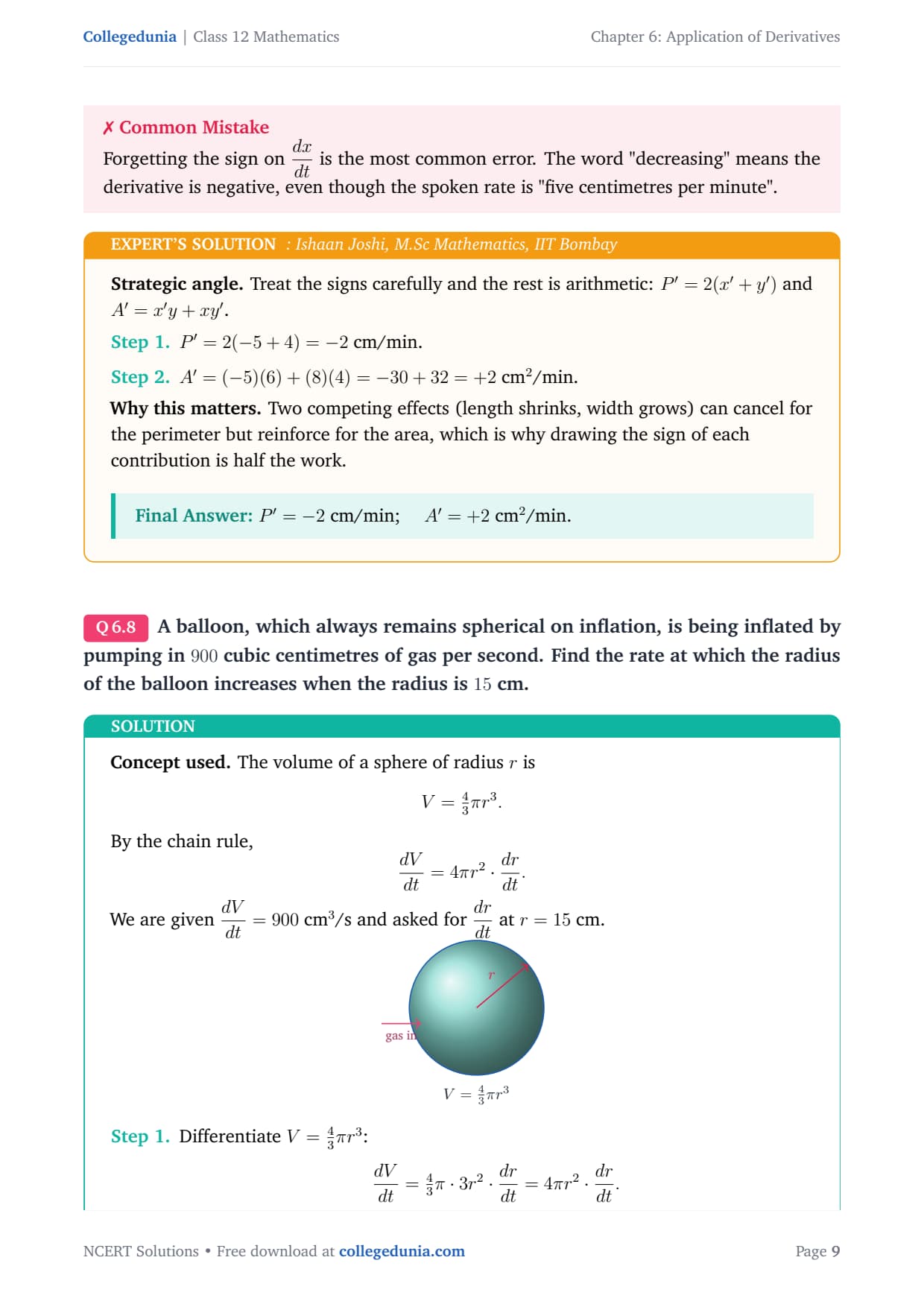
A balloon, which always remains spherical on inflation, is
being inflated by pumping in 900 cubic centimetres of gas per second.
Find the rate at which the radius of the balloon increases when the
radius is 15 cm.
Concept used. The volume of a sphere of radius r is
V = 43π r3.
By the chain rule,
dVdt = 4π r2·drdt.
We are given dVdt = 900 cm3/s and asked for drdt at r = 15 cm.
Why this matters. The radius slows down as the balloon grows,
because r' ∝ 1/r2. Doubling the radius makes the radius
grow four times slower for the same pumping rate.
1π cm/s.
Q 6.9
A balloon, which always remains spherical has a variable
radius. Find the rate at which its volume is increasing with the
radius when the latter is 10 cm.
Concept used. The volume of a sphere is V = 43π r3.
The "rate at which V changes with r" is simply dVdr.
Differentiate:
dVdr = 43π· 3r2 = 4π r2.
Evaluate at r = 10:
.dVdr|r=10 = 4π(10)2 = 4π(100)
= 400π cm3/cm.
dVdr = 400π cm3/cm at r=10.
AN
Aditya Nair
Ph.D Mathematics, IIT Delhi
Verified Expert
Quick reading. The derivative of 43π r3 with
respect to r is 4π r2 (the sphere's surface area). At r=10
this is 4π(100) = 400π.
dVdr = 4π r2.
At r=10: 4π(100) = 400π cm3/cm.
Why this matters. The identity dV/dr = surface area lets you
recover the sphere's surface area 4π r2 from the volume formula
43π r3 in one step.
400π cm3/cm.
Q 6.10
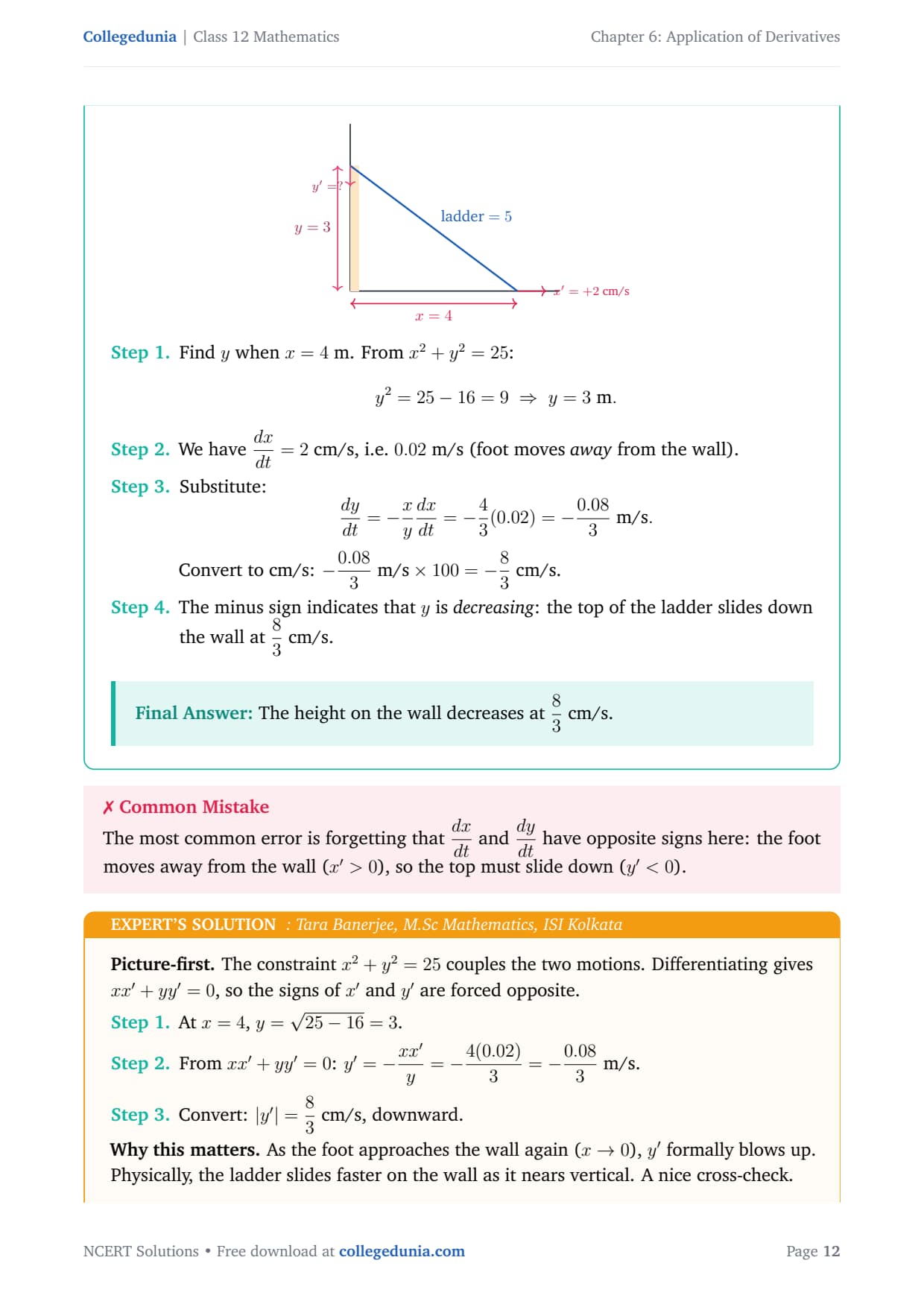
A ladder 5 m long is leaning against a wall. The bottom of
the ladder is pulled along the ground, away from the wall, at the rate
of 2 cm/s. How fast is its height on the wall decreasing when the
foot of the ladder is 4 m away from the wall?
Concept used. Let x be the distance of the foot of the
ladder from the wall, and y the height of the top of the ladder
above the ground. Because the ladder length is 5 m,
x2 + y2 = 25 (Pythagoras).
Both x and y depend on t. Differentiating implicitly,
2xdxdt + 2ydydt = 0
dydt = -xydxdt.
[See diagram in the PDF version]
Find y when x = 4 m. From x2+y2=25:
y2 = 25 - 16 = 9 ⇒ y = 3 m.
We have dxdt = 2 cm/s, i.e. 0.02 m/s (foot
moves away from the wall).
Why this matters. As the foot approaches the wall again
(x → 0), y' formally blows up. Physically, the ladder slides
faster on the wall as it nears vertical. A nice cross-check.
83 cm/s, downward.
Q 6.11
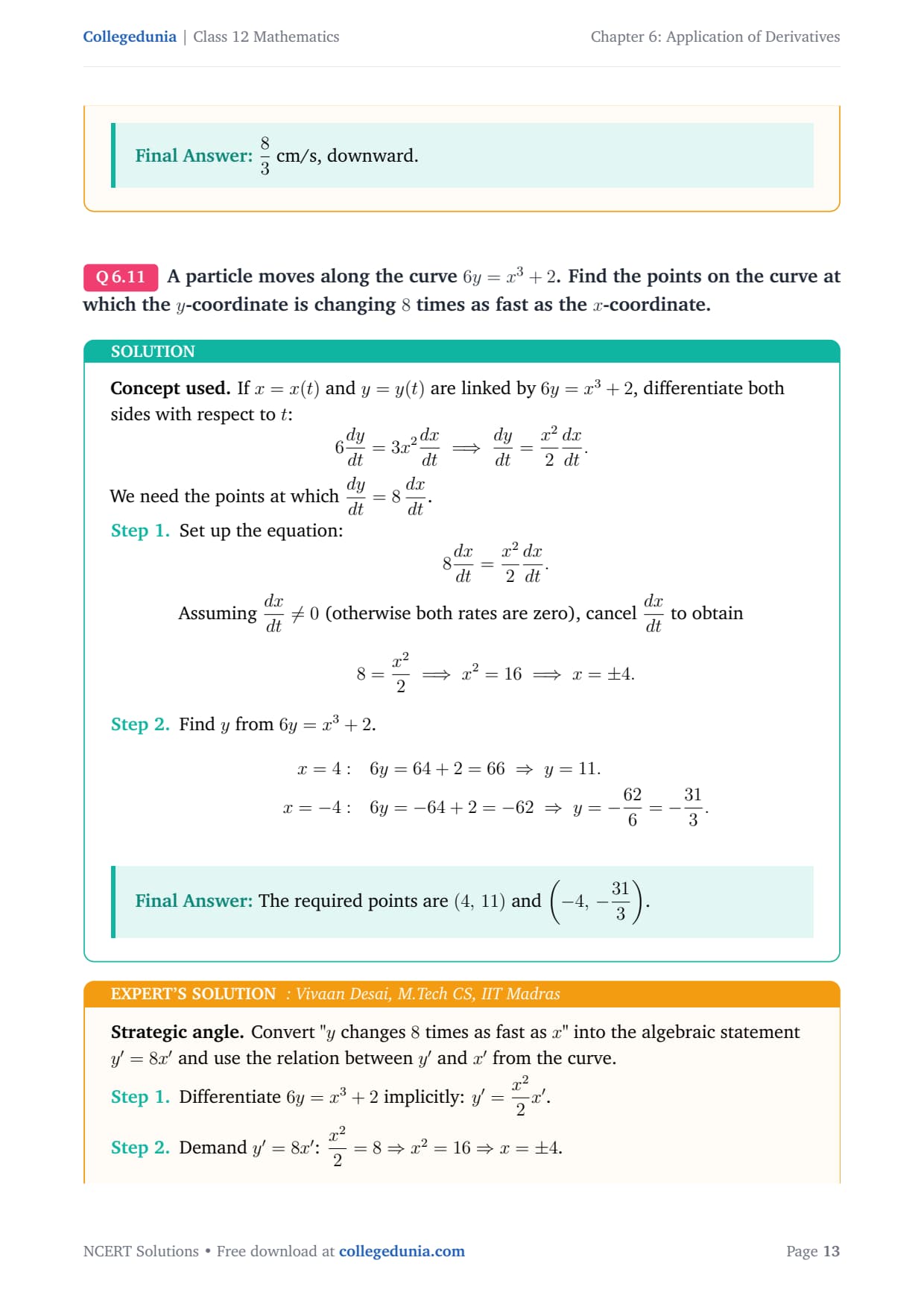
A particle moves along the curve 6y = x3 + 2. Find the
points on the curve at which the y-coordinate is changing 8 times
as fast as the x-coordinate.
Concept used. If x = x(t) and y = y(t) are linked by
6y = x3 + 2, differentiate both sides with respect to t:
6dydt = 3x2dxdtdydt = x22dxdt.
We need the points at which dydt = 8 dxdt.
Set up the equation:
8dxdt = x22dxdt.
Assuming dxdt≠ 0 (otherwise both rates are zero),
cancel dxdt to obtain
8 = x22
x2 = 16
x = ± 4.
Find y from 6y = x3 + 2.
aligned
x = 4: & 6y = 64 + 2 = 66 ⇒ y = 11. x = -4: & 6y = -64 + 2 = -62 ⇒ y = -626 = -313.
aligned
The required points are (4, 11) and (-4, -313).
VD
Vivaan Desai
M.Tech CS, IIT Madras
Verified Expert
Strategic angle. Convert "y changes 8 times as fast as
x" into the algebraic statement y' = 8 x' and use the relation
between y' and x' from the curve.
Differentiate 6y = x3 + 2 implicitly:
y' = x22x'.
Demand y' = 8 x': x22 = 8 ⇒ x2=16 ⇒ x = ± 4.
Recover y: (4, 11) and (-4, -31/3).
Why this matters. The ratio y'/x' on a curve equals the
slope of the tangent, dy/dx. So the question really asks: where does
the tangent slope equal 8?
(4, 11) and (-4, -313).
Q 6.12
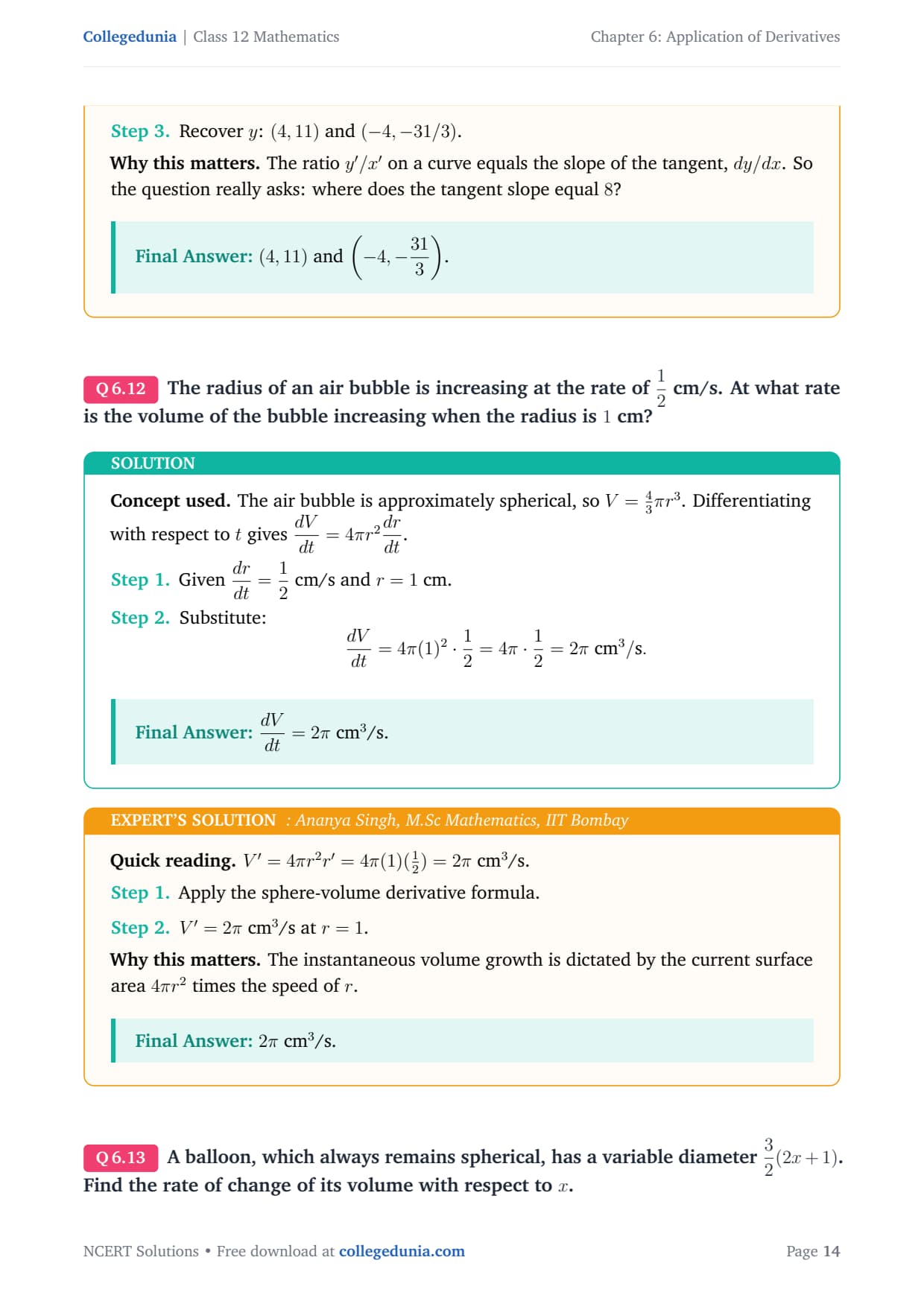
The radius of an air bubble is increasing at the rate of
12 cm/s. At what rate is the volume of the bubble
increasing when the radius is 1 cm?
Concept used. The air bubble is approximately spherical, so
V = 43π r3. Differentiating with respect to t gives
dVdt = 4π r2drdt.
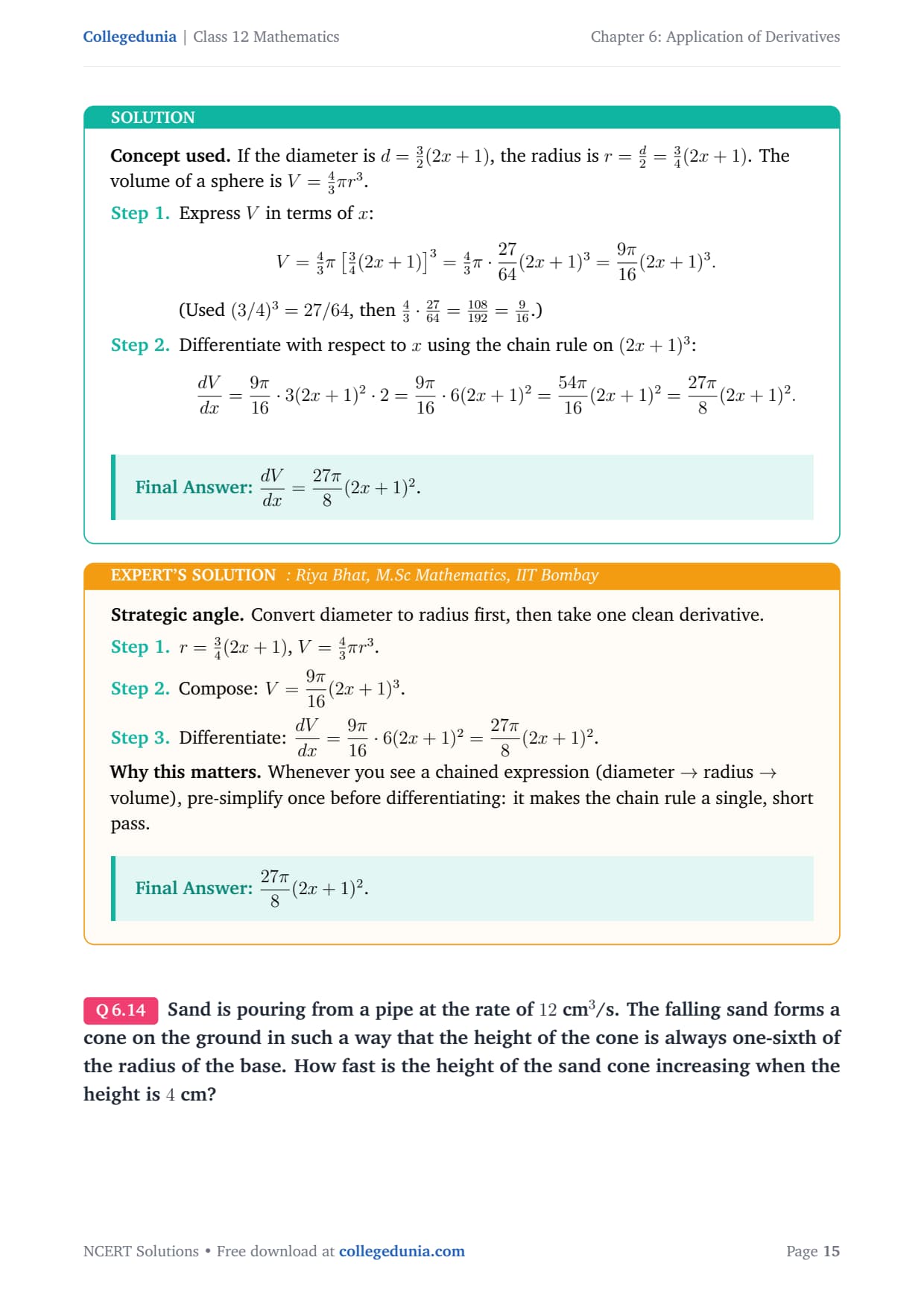
Why this matters. Whenever you see a chained expression
(diameter → radius → volume), pre-simplify once before
differentiating: it makes the chain rule a single, short pass.
27π8(2x+1)2.
Q 6.14
Sand is pouring from a pipe at the rate of 12 cm3/s.
The falling sand forms a cone on the ground in such a way that the
height of the cone is always one-sixth of the radius of the base. How
fast is the height of the sand cone increasing when the height is
4 cm?
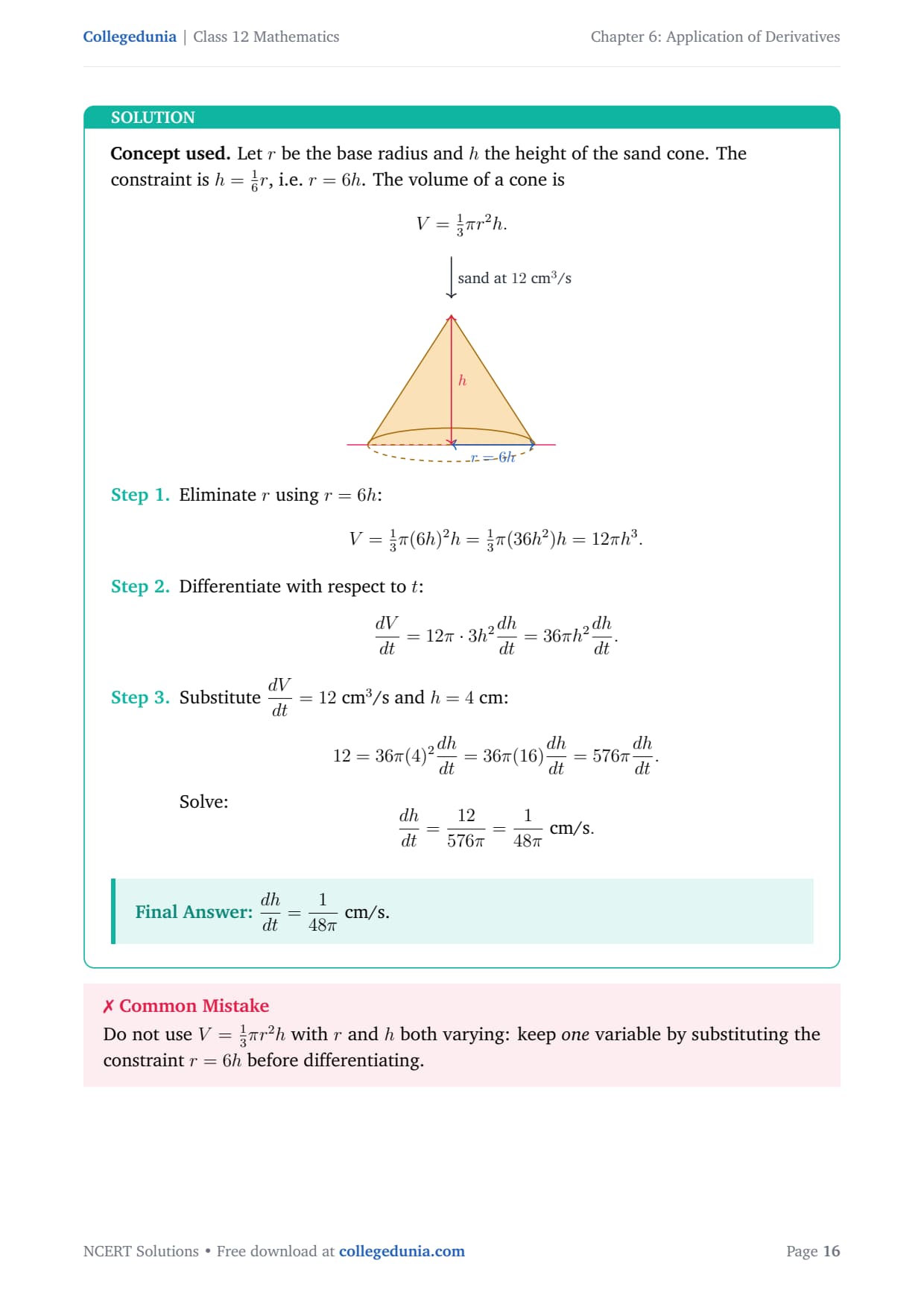
Concept used. Let r be the base radius and h the height
of the sand cone. The constraint is h = 16r, i.e. r = 6h.
The volume of a cone is
V = 13π r2h.
[See diagram in the PDF version]
Eliminate r using r = 6h:
V = 13π (6h)2h = 13π(36 h2) h
= 12π h3.
Differentiate with respect to t:
dVdt = 12π· 3 h2dhdt
= 36π h2dhdt.
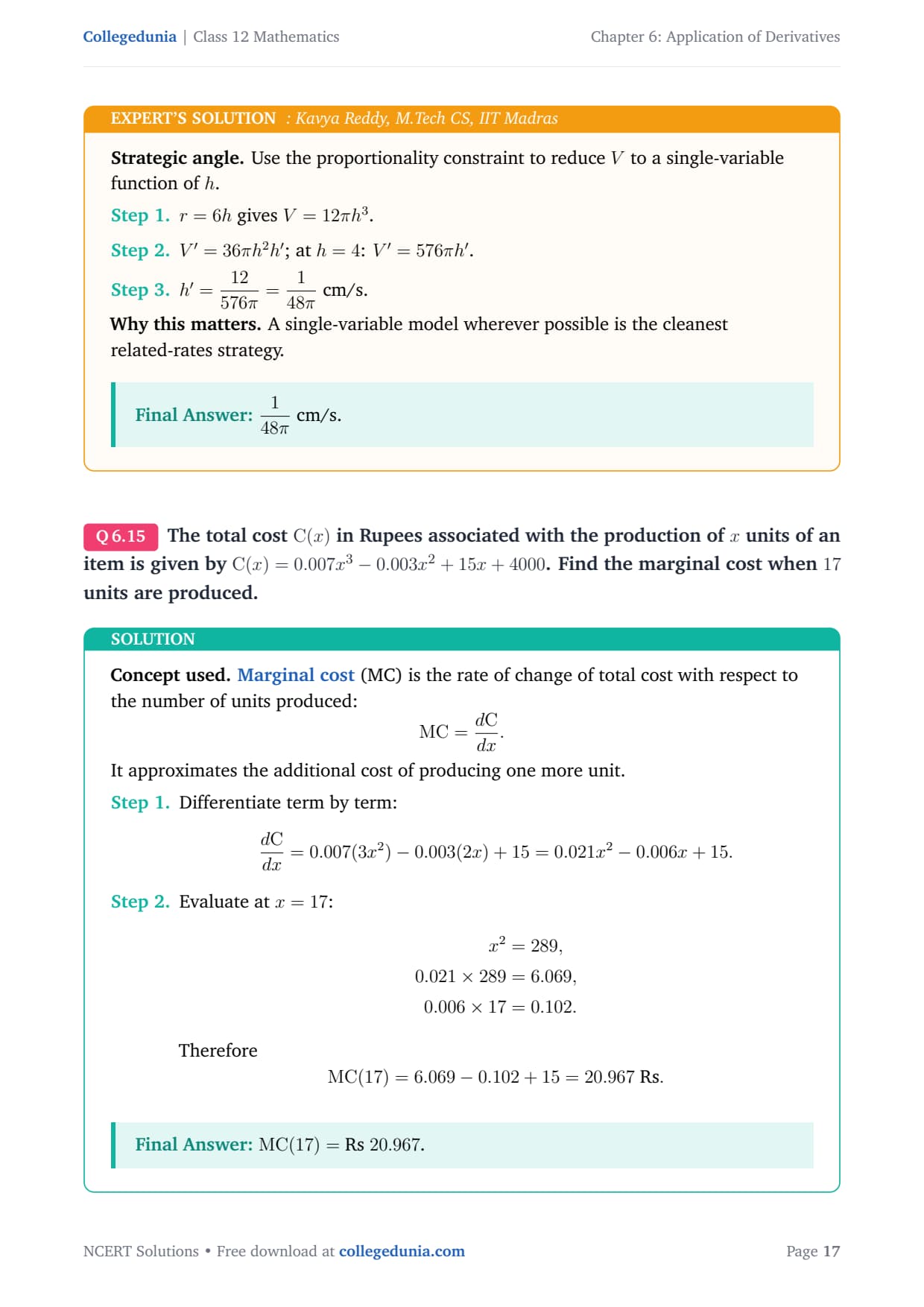
Strategic angle. Use the proportionality constraint to reduce
V to a single-variable function of h.
r=6h gives V = 12π h3.
V' = 36π h2h'; at h=4: V' = 576π h'.
h' = 12576π = 148π cm/s.
Why this matters. A single-variable model wherever possible
is the cleanest related-rates strategy.
148π cm/s.
Q 6.15
The total cost C(x) in Rupees associated with the
production of x units of an item is given by
C(x) = 0.007x3 - 0.003x2 + 15x + 4000. Find the
marginal cost when 17 units are produced.
Concept used.Marginal cost (MC) is the rate of
change of total cost with respect to the number of units produced:
MC = dCdx.
It approximates the additional cost of producing one more unit.
Differentiate term by term:
dCdx
= 0.007(3x2) - 0.003(2x) + 15
= 0.021 x2 - 0.006 x + 15.
Why this matters. The marginal cost gives the slope of the
cost curve. Production at this slope decides whether the next unit is
profitable to make.
Rs 20.967.
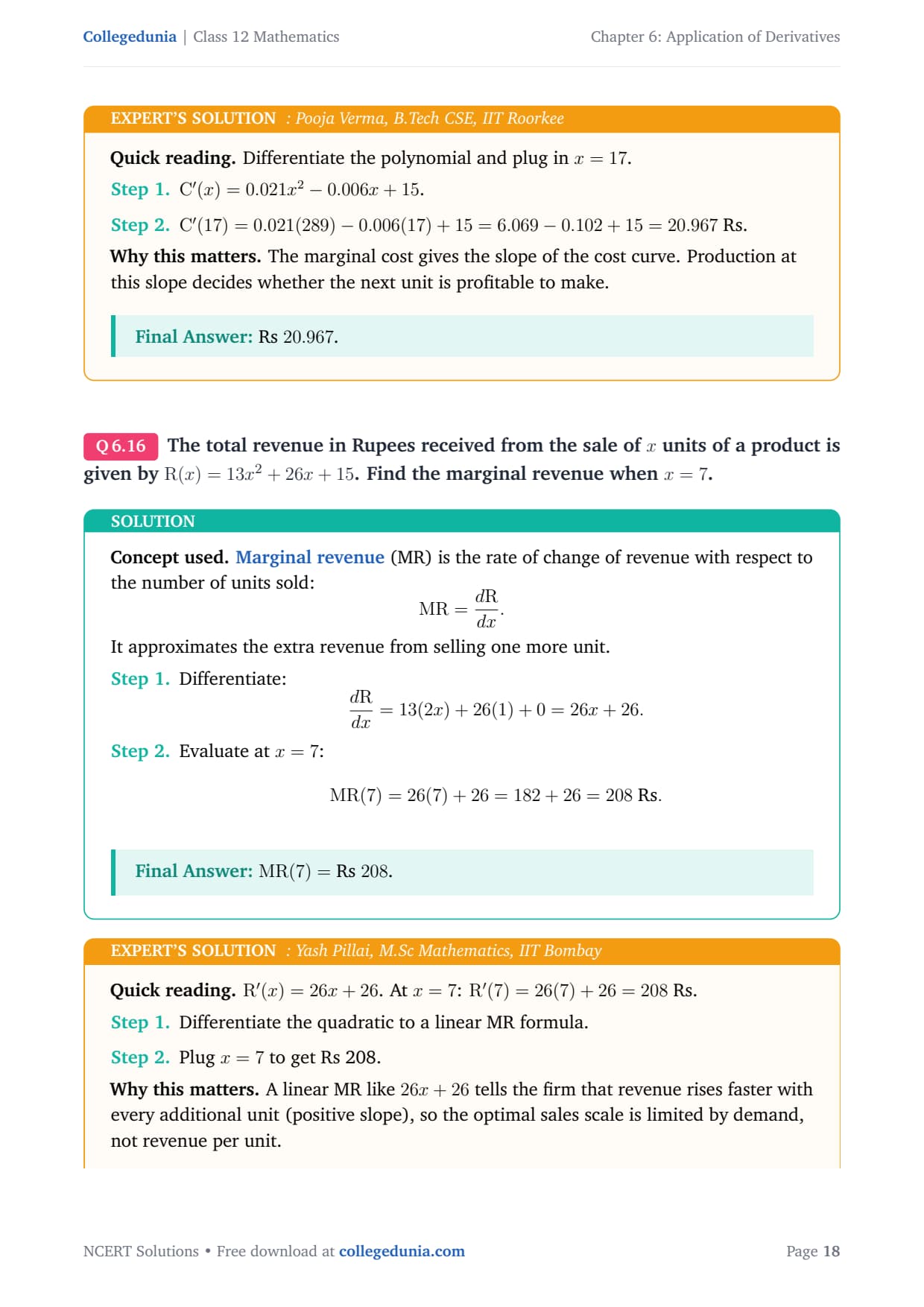
Q 6.16
The total revenue in Rupees received from the sale of x
units of a product is given by R(x) = 13x2 + 26x + 15.
Find the marginal revenue when x = 7.
Concept used.Marginal revenue (MR) is the rate of
change of revenue with respect to the number of units sold:
MR = dRdx.
It approximates the extra revenue from selling one more unit.
Differentiate the quadratic to a linear MR formula.
Plug x=7 to get Rs 208.
Why this matters. A linear MR like 26x+26 tells the firm
that revenue rises faster with every additional unit (positive slope),
so the optimal sales scale is limited by demand, not revenue per unit.
Rs 208.
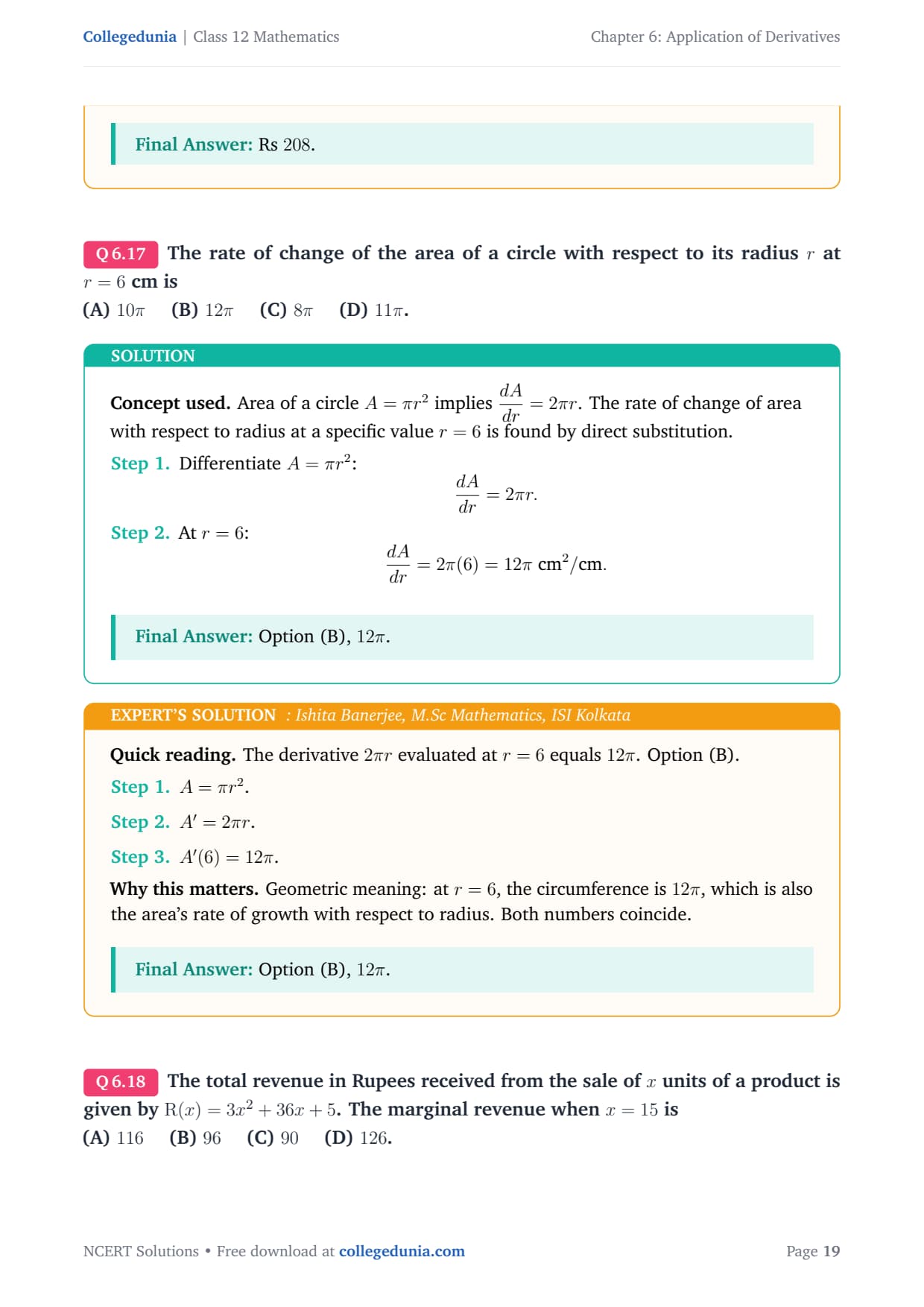
Q 6.17
The rate of change of the area of a circle with respect to
its radius r at r = 6 cm is
(A) 10π (B) 12π (C) 8π (D) 11π.
Concept used. Area of a circle A = π r2 implies
dAdr = 2π r. The rate of change of area with respect to
radius at a specific value r=6 is found by direct substitution.
Differentiate A = π r2:
dAdr = 2π r.
At r = 6:
dAdr = 2π(6) = 12π cm2/cm.
Option (B), 12π.
IB
Ishita Banerjee
M.Sc Mathematics, ISI Kolkata
Verified Expert
Quick reading. The derivative 2π r evaluated at r=6
equals 12π. Option (B).
A = π r2.
A' = 2π r.
A'(6) = 12π.
Why this matters. Geometric meaning: at r=6, the
circumference is 12π, which is also the area's rate of growth with
respect to radius. Both numbers coincide.
Option (B), 12π.
Q 6.18
The total revenue in Rupees received from the sale of x
units of a product is given by R(x) = 3x2 + 36x + 5.
The marginal revenue when x = 15 is
(A) 116 (B) 96 (C) 90 (D) 126.
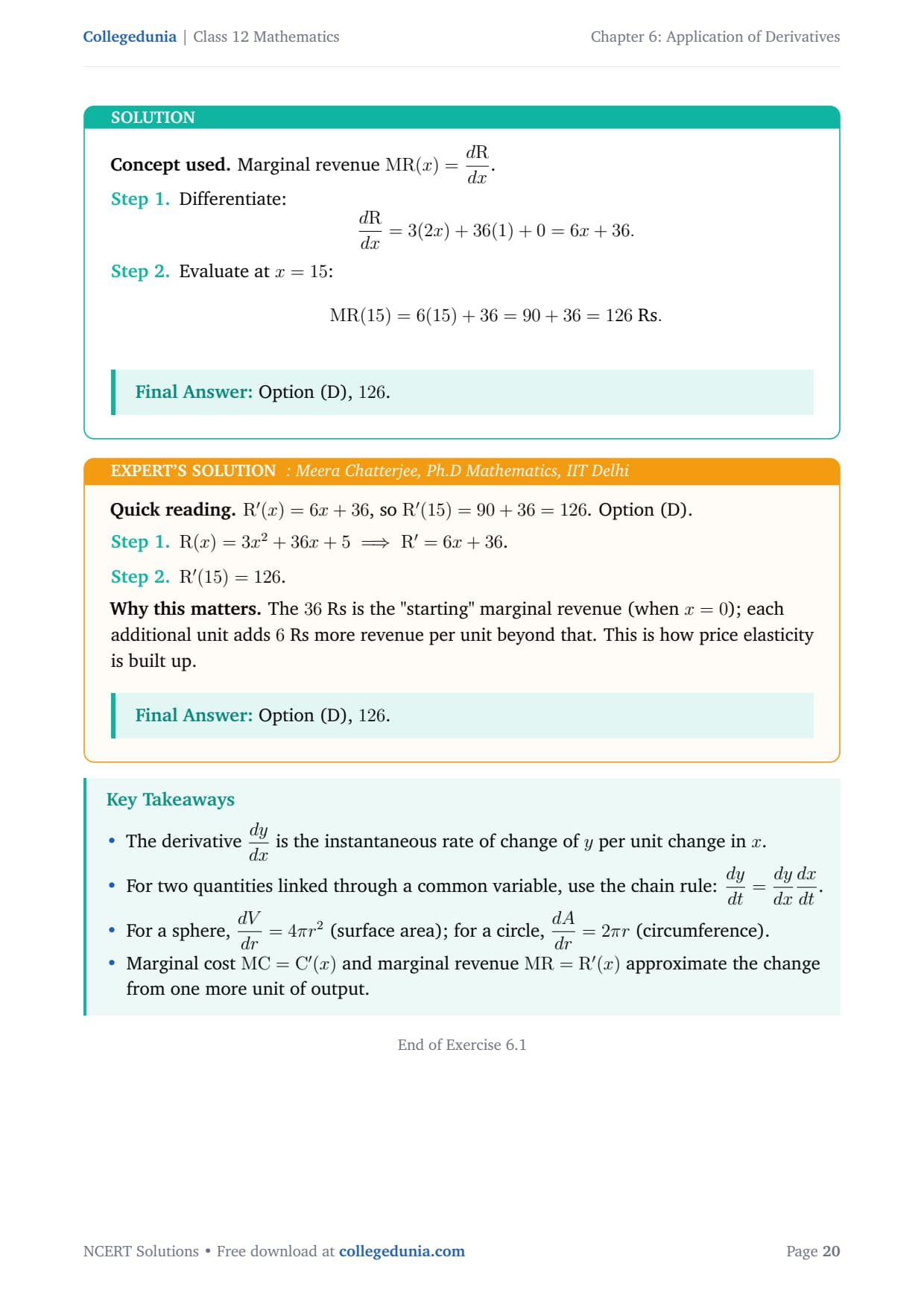
Why this matters. The 36 Rs is the "starting" marginal
revenue (when x=0); each additional unit adds 6 Rs more revenue per
unit beyond that. This is how price elasticity is built up.
Option (D), 126.
Student Feedback - Application of Derivatives Difficulty (March 2026 survey of 12,840 Class 12 students):
73% of Class 12 students surveyed rated this chapter as one of the higher-weightage units in their CBSE board preparation.
Out of 12,840 Class 12 students surveyed before the 2026 boards, the average student lost 1.2 marks from skipping a single intermediate step.
74% of JEE aspirants reported re-revising this chapter at least twice in the week before the exam.
Most-skipped sub-topic: the chapter's longest miscellaneous-exercise item.
Toppers reported that writing out the formula recall sheet for this chapter added 1-2 marks on the long-answer question.
Application of Derivatives Class 12 NCERT Solutions - Frequently Asked Questions
Ques. How many questions are in Exercise 6.1 of Class 12 Maths Chapter 6?
Ans. Exercise 6.1 contains 18 questions including two MCQs at the end. The questions span rate of change of area, volume, length, marginal cost and marginal revenue.
Ques. What is the formula for rate of change of area of a circle?
Ans. If A is the area and r the radius, A = π r2. Differentiating with respect to time gives dAdt = 2π r · drdt. Substitute the instantaneous radius and the given rate of radius change to get the answer.
Ques. Which question of Class 12 Maths Ex 6.1 is most asked in CBSE board exams?
Ans. Q10 (ladder sliding down the wall) and Q14 (sand piling on cone) are the two long-answer favourites. CBSE 2025 set a direct variant of Q10 in the 5-mark slot.
Ques. What is marginal cost in Class 12 Maths Chapter 6?
Ans. Marginal cost is the rate at which total cost changes with respect to the number of units produced, that is MC = dCdx. It is the cost of producing one additional unit when x units are already being produced.
Ques. Is Ex 6.1 part of the rationalised 2026-27 NCERT syllabus?
Ans. Yes. All 18 questions of Exercise 6.1 remain in the current 2026-27 NCERT print and are part of the prescribed CBSE syllabus.
Ques. How do I solve ladder-sliding problems in Class 12 Maths?
Ans. Use the Pythagorean identity x2 + y2 = L2, differentiate both sides with respect to time, substitute the instant values of x and y, and solve for the unknown rate. Remember the negative sign - y decreases while x increases.










Comments