CBSE Weightage: 8-10 marks (full Ch 4, with Ex 4.5 contributing 4-6 marks via the inverse and the system-of-equations 5-marker)
JEE Main: 3-5% of paper ( A-1, adj A, and singular-matrix queries are repeat hits)
Question Count in Ex 4.5: 18 (adjoint, inverse, verification of A(adjA) = |A|I, system of linear equations, MCQs)
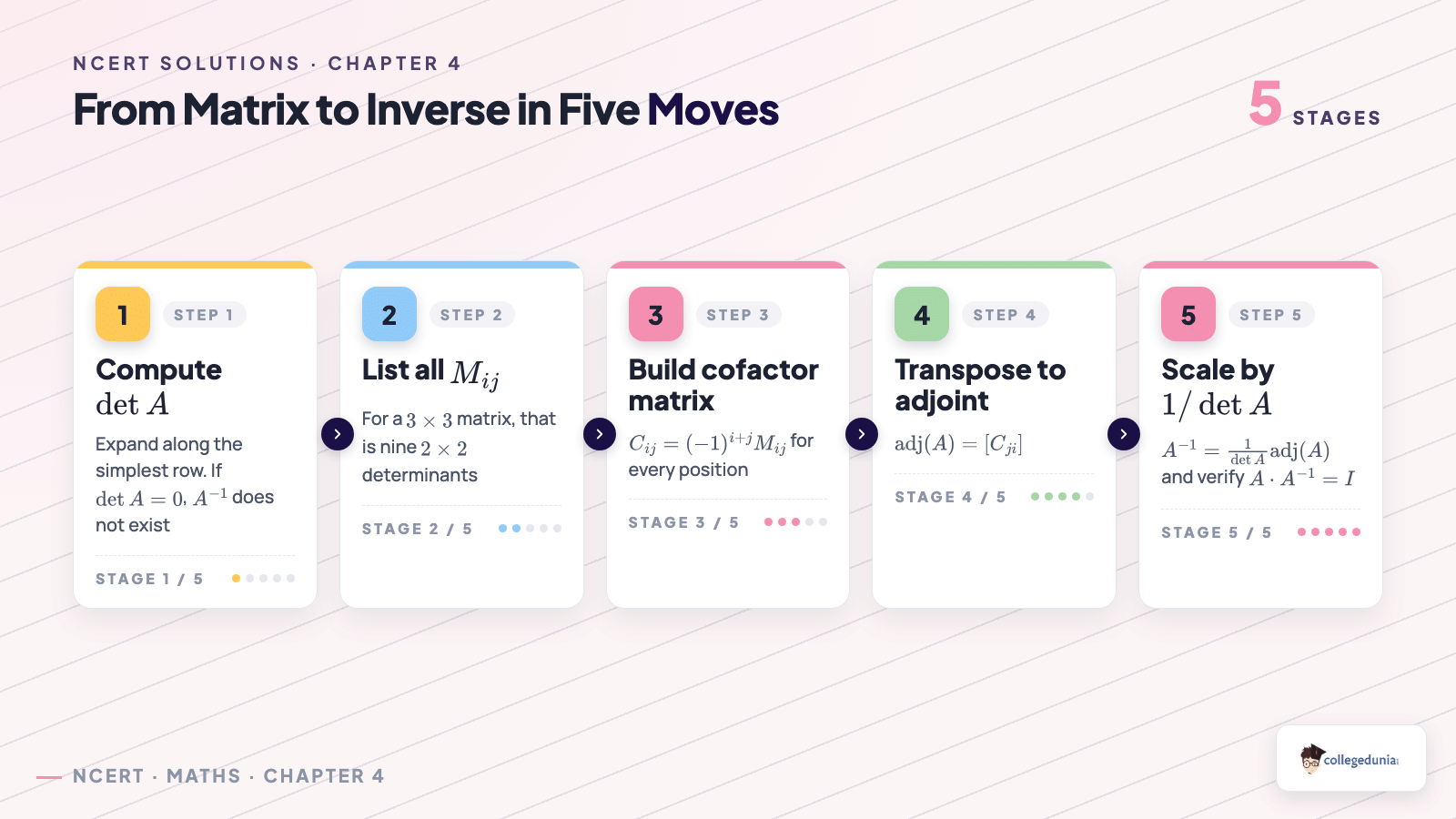
Solved by Collegedunia subject experts. Each solution states |A| first, builds the cofactor matrix, transposes to adj A, and closes with A-1 = 1|A| adj A. System questions follow the matrix-method template that CBSE marks line by line.
Class 12 Maths Chapter 4 Exercise 4.5 Question-Type Distribution
The 18 questions of Exercise 4.5 split across five clean types. Spotting the type tells you whether to head for a 3-mark cofactor drill or a 5-mark system-of-equations setup.
Question Type
Questions in Ex 4.5
Typical Marks
Find the adjoint of a 2x2 matrix
Q1
2
Find the adjoint of a 3x3 matrix
Q2
3
Verify A(adjA) = (adjA)A = |A|I
Q3, Q4
4
Find the inverse of a given square matrix using adjoint
Q5 to Q11
3-4
Solve the system of linear equations by matrix method
Q12 to Q16, Q17 (MCQ), Q18 (MCQ)
5
determinants Exercise 4.5 Solved Step by Step (Video)
Topics Covered in NCERT Class 12 Mathematics Exercise 4.5
Ex 4.5 ties together the determinant, cofactor, and minor work from earlier exercises.
Sub-topic
Definition or Rule
Where it appears in Ex 4.5
Adjoint of a matrix
adj(A) = [Cij]T, Cij = (-1)i+j Mij
Q1, Q2
Property A(adjA) = |A|In
Used to derive and verify the inverse
Q3, Q4
Singular and non-singular matrices
A is invertible iff |A| ≠ 0
Q9-Q11
Inverse by adjoint method
A-1 = 1|A| adj A
Q5-Q11
System of linear equations by matrix method
AX = B ⇒ X = A-1B
Q12-Q16
How will Collegedunia's NCERT Solutions for Class 12 Maths Exercise 4.5 help you?
Exercise 4.5 is where most students lose 4 to 6 marks because the cofactor sign pattern slips and the order in X = A-1B gets reversed.
Our PDF prints the sign-grid bmatrix+ & - & + - & + & - + & - & +bmatrix inside every 3x3 adjoint and renders each system question (Q12 to Q16) in a five-step template that mirrors the CBSE marking scheme.CBSE awards a separate mark for the AX=B statement before any numeric work begins.
Cofactor sign-grid printed beside every 3x3 adjoint (Q2, Q5-Q11) so the ± pattern is visible while you compute.
Determinant-first ordering on every inverse question, so a singular matrix is flagged before you waste 8 minutes on a non-existent inverse.
Class 12 Mathematics Ex 4.5 Important Formulae and Properties
The six rules below cover every line of working in Exercise 4.5. Keep the box open while solving and the cofactor signs will fall into place.
R1. Cofactor: Cij = (-1)i+j Mij where Mij is the (i,j) minor of A.
R2. Adjoint: adj(A) = [Cij]T. The transpose is what most students forget on the first try.
R3. Core identity: A(adjA) = (adjA)A = |A| In, the engine behind every inverse.
R4. Invertibility: A-1 exists iff |A| ≠ 0 ; else A is singular.
R5. Inverse formula: A-1 = 1|A| adj A, and |adj A| = |A|n-1.
Sample Solved Question from Class 12 Maths Exercise 4.5
Below is Q13, the canonical 5-mark "solve by matrix method" question, in the exact step-format Collegedunia uses across the Class 12th Determinants NCERT Solutions.
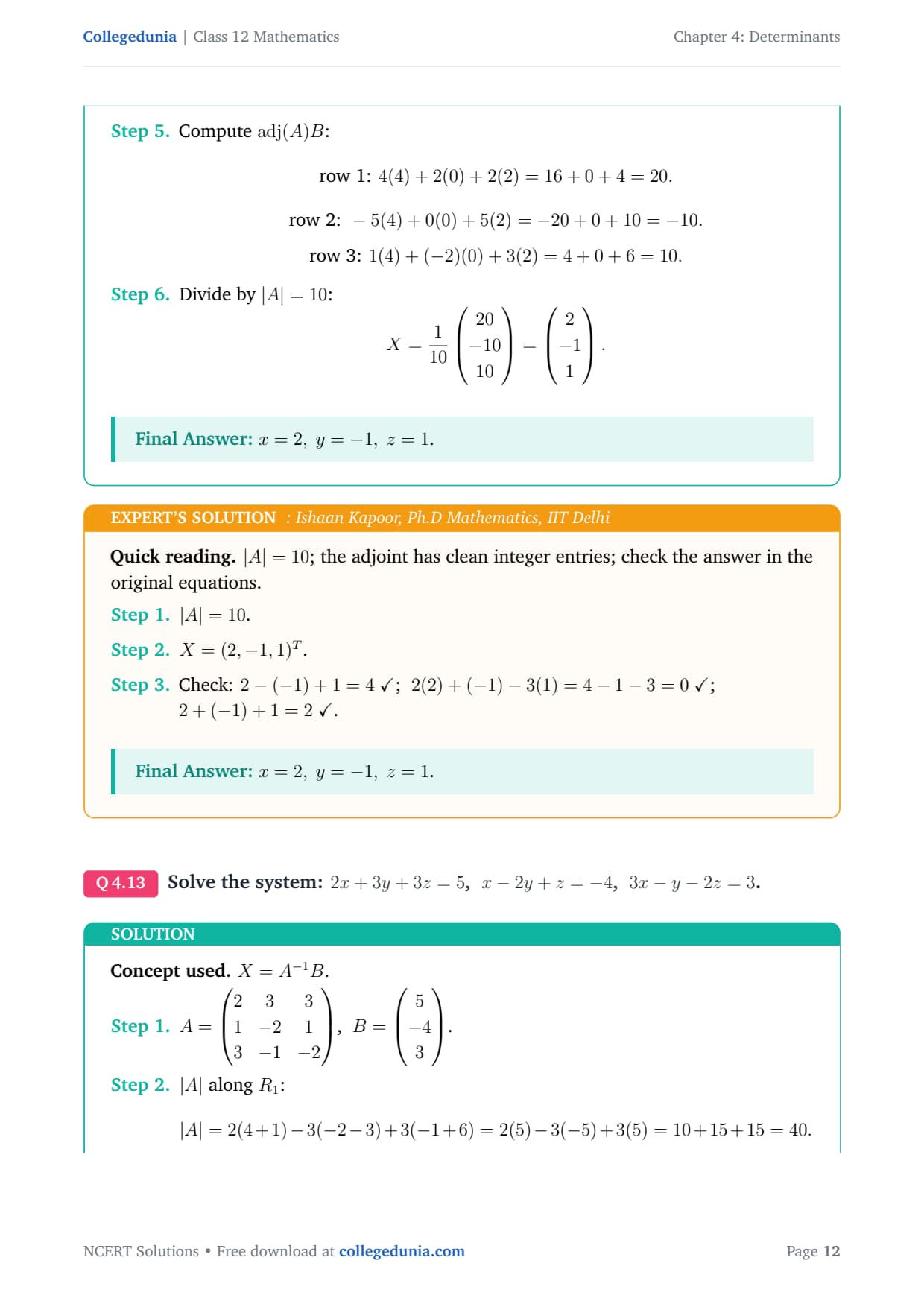
Question 13: Solve 2x+3y+3z=5, x-2y+z=-4, 3x-y-2z=3 using the matrix method.
Step 1 - Matrix form. AX = B where A = bmatrix 2 & 3 & 3 1 & -2 & 1 3 & -1 & -2 bmatrix, X = bmatrix xyz bmatrix, B = bmatrix 5 -4 3 bmatrix .
Class 12th Determinants NCERT Solutions: available above as a free PDF download, aligned to the 2026-27 NCERT Class 12 Mathematics syllabus.
Exercise-wise Breakdown of the Determinants Chapter
The Determinants chapter splits into 6 numbered exercises plus a Miscellaneous Exercise. The table below maps every exercise to the specific concept it tests, so students can plan revision per exercise and click straight into the worked solutions.
All NCERT Solutions for Determinants Ex 4.5 with Step-by-Step Working
Every NCERT textbook question for Class 12 Mathematics Chapter 4 Determinants Ex 4.5 is listed below with its full Solution and Expert Solution hidden inside collapsible tabs. Click Check Solution to reveal the step-by-step working; click Expert Solution for the expanded explanation.
Questions
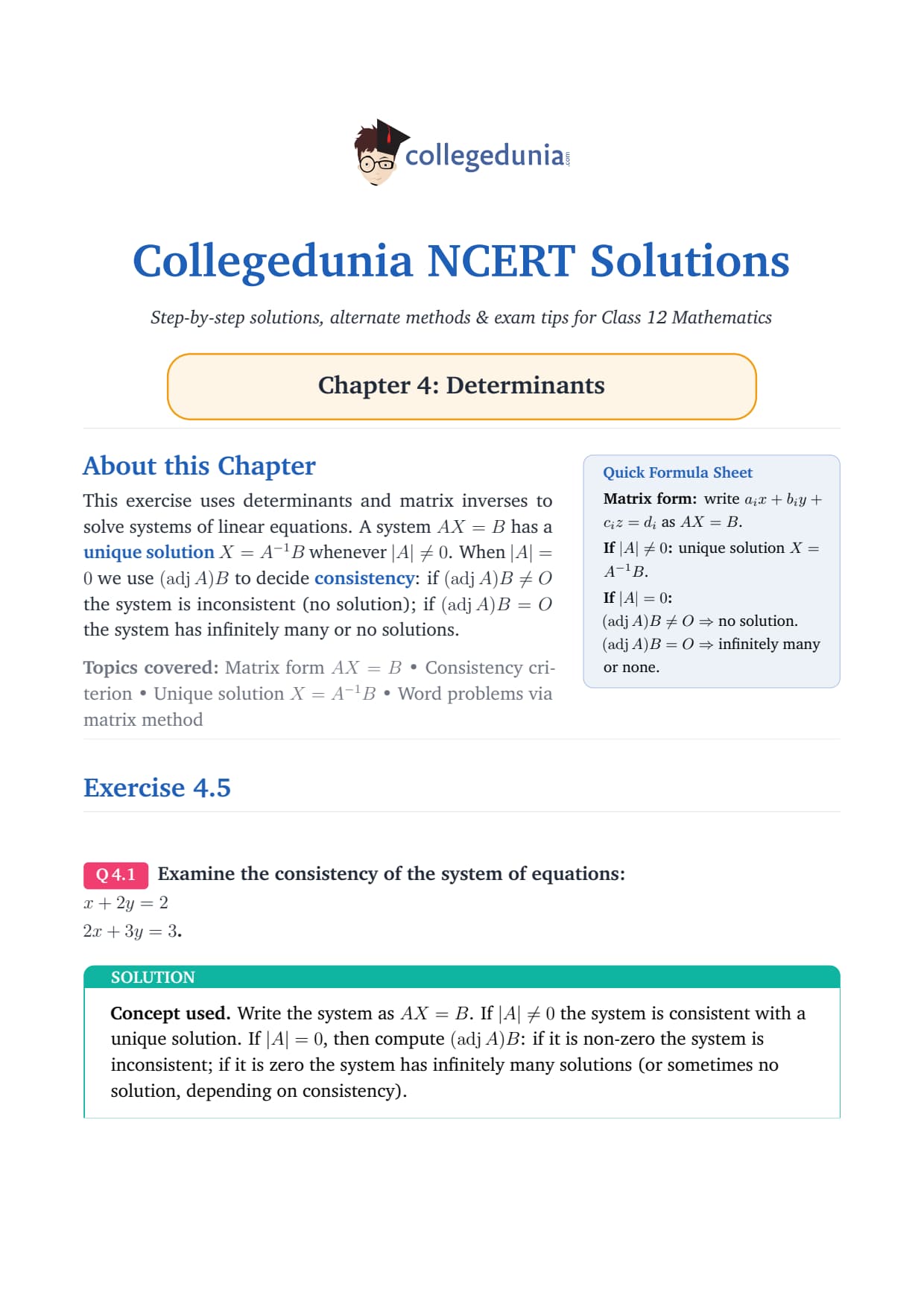
Q 4.1
Examine the consistency of the system of equations: x + 2y = 2 2x + 3y = 3.
Concept used. Write the system as AX = B. If |A|≠ 0 the system is consistent with a unique solution. If |A| = 0, then compute (adjA)B: if it is non-zero the system is inconsistent; if it is zero the system has infinitely many solutions (or sometimes no solution, depending on consistency).
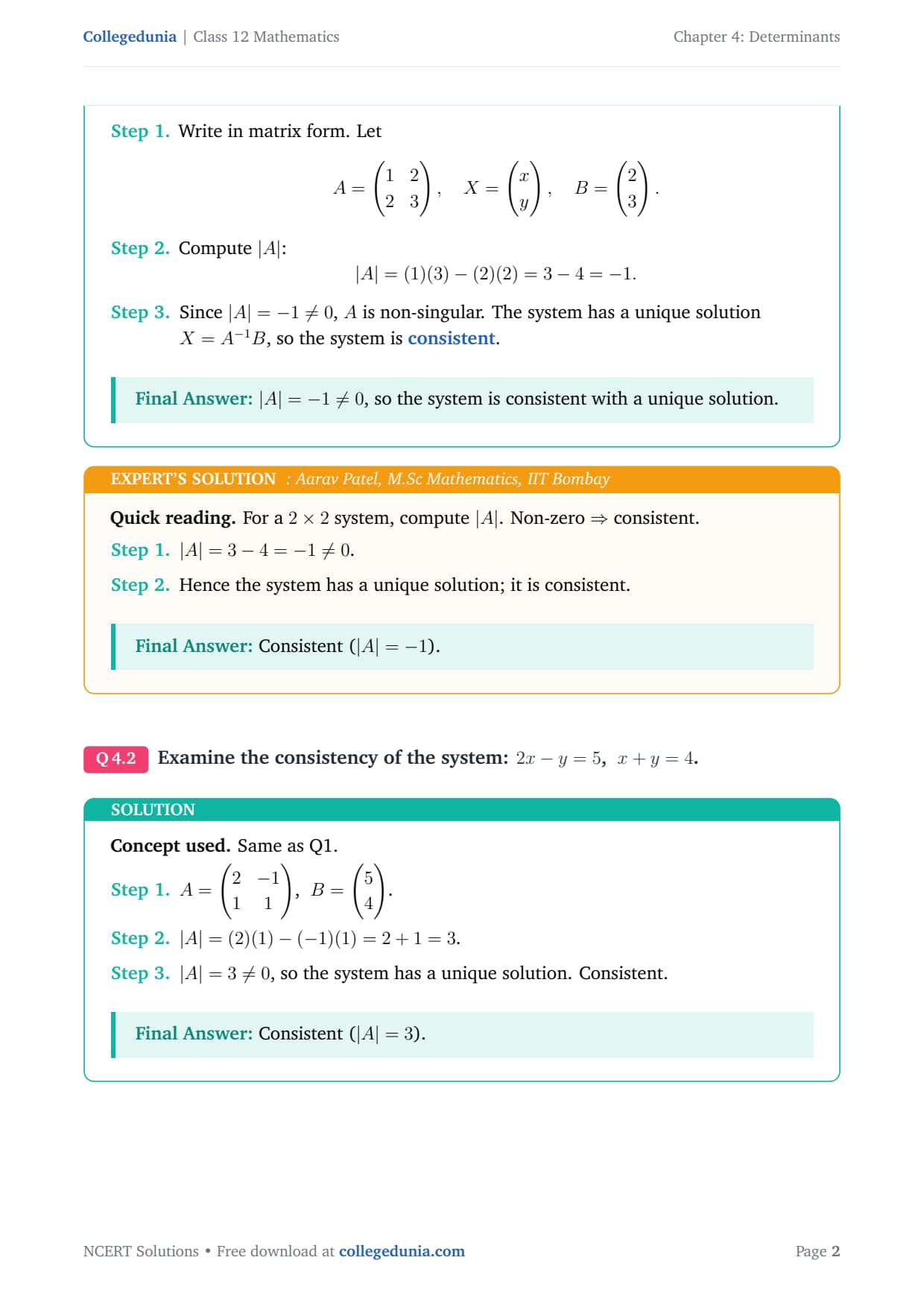
Write in matrix form. Let
A = pmatrix 1 & 2 2 & 3 pmatrix, X = pmatrix xy pmatrix, B = pmatrix 2 3 pmatrix.
Compute |A|:
|A| = (1)(3) - (2)(2) = 3 - 4 = -1.
Since |A| = -1 ≠ 0, A is non-singular. The system has a unique solution X = A-1B, so the system is consistent.
|A| = -1 ≠ 0, so the system is consistent with a unique solution.
AP
Aarav Patel
M.Sc Mathematics, IIT Bombay
Verified Expert
Quick reading. For a 2× 2 system, compute |A|. Non-zero ⇒ consistent.
|A| = 3 - 4 = -1 ≠ 0.
Hence the system has a unique solution; it is consistent.
Consistent (|A|=-1).
Q 4.2
Examine the consistency of the system: 2x - y = 5, x + y = 4.
Concept used. Same as Q1.
A = pmatrix 2 & -1 1 & 1 pmatrix, B = pmatrix 5 4 pmatrix.
|A| = (2)(1) - (-1)(1) = 2 + 1 = 3.
|A| = 3 ≠ 0, so the system has a unique solution. Consistent.
Consistent (|A|=3).
PS
Pranav Sharma
M.Sc Mathematics, IIT Bombay
Verified Expert
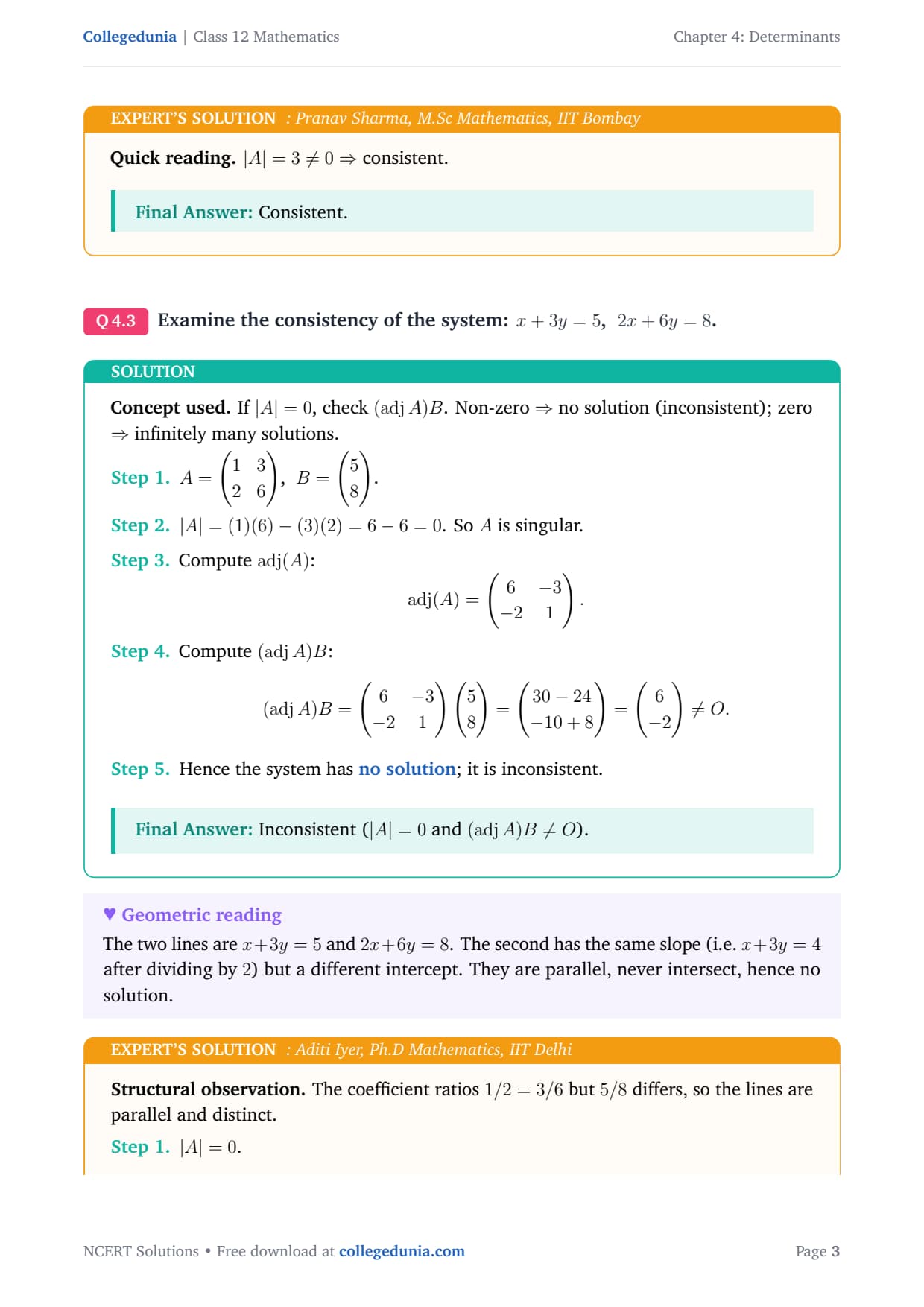
Quick reading.|A| = 3 ≠ 0 ⇒ consistent.
Consistent.
Q 4.3
Examine the consistency of the system: x + 3y = 5, 2x + 6y = 8.
Concept used. If |A|=0, check (adjA)B. Non-zero ⇒ no solution (inconsistent); zero ⇒ infinitely many solutions.
A = pmatrix 1 & 3 2 & 6 pmatrix, B = pmatrix 5 8 pmatrix.
|A| = (1)(6) - (3)(2) = 6 - 6 = 0. So A is singular.
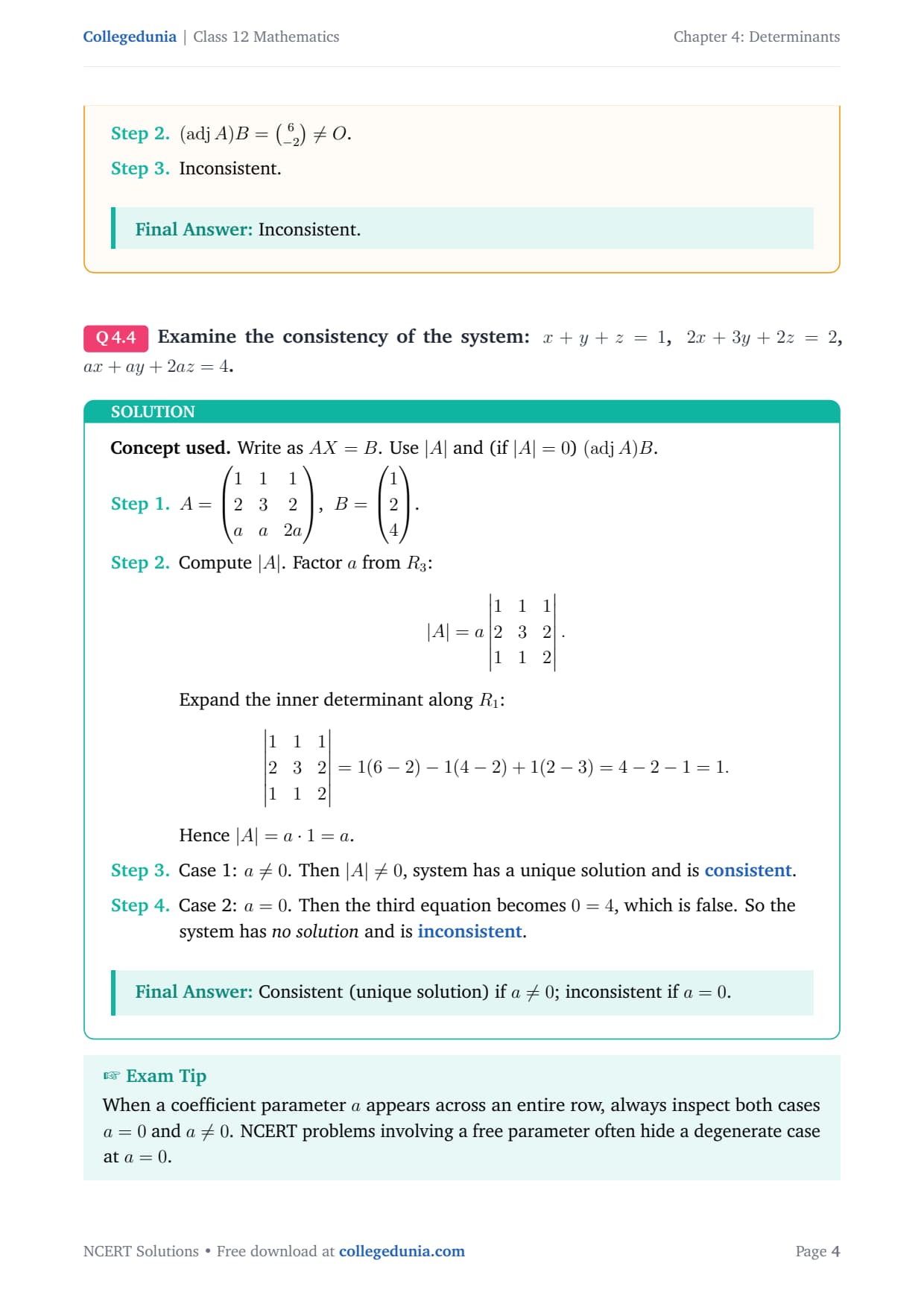
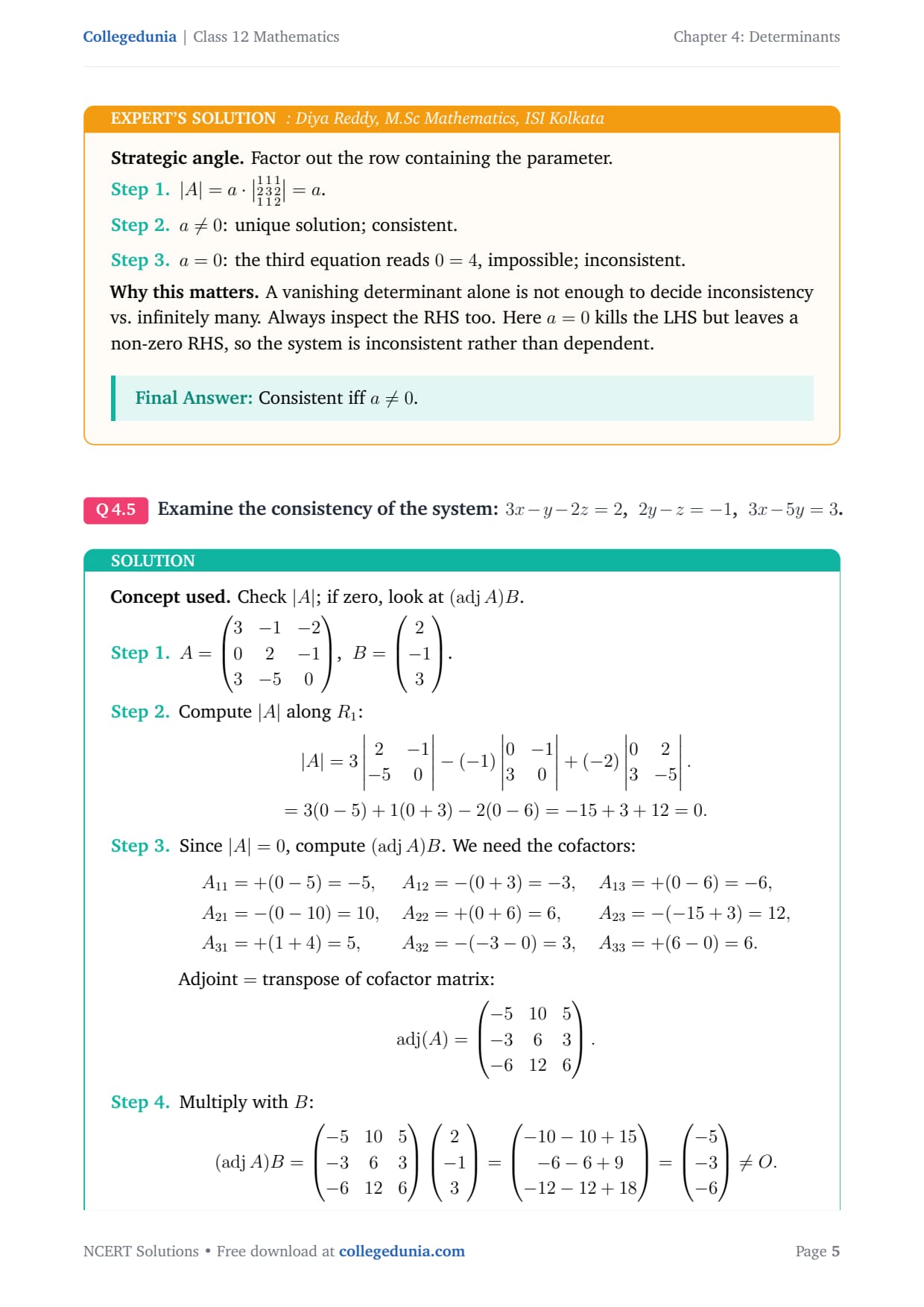
Case 1: a ≠ 0. Then |A| ≠ 0, system has a unique solution and is consistent.
Case 2: a = 0. Then the third equation becomes 0 = 4, which is false. So the system has no solution and is inconsistent.
Consistent (unique solution) if a ≠ 0; inconsistent if a = 0.
DR
Diya Reddy
M.Sc Mathematics, ISI Kolkata
Verified Expert
Strategic angle. Factor out the row containing the parameter.
|A| = a·|1 1 1 2 3 2 1 1 2| = a.
a≠ 0: unique solution; consistent.
a=0: the third equation reads 0=4, impossible; inconsistent.
Why this matters. A vanishing determinant alone is not enough to decide inconsistency vs. infinitely many. Always inspect the RHS too. Here a=0 kills the LHS but leaves a non-zero RHS, so the system is inconsistent rather than dependent.
Consistent iff a≠ 0.
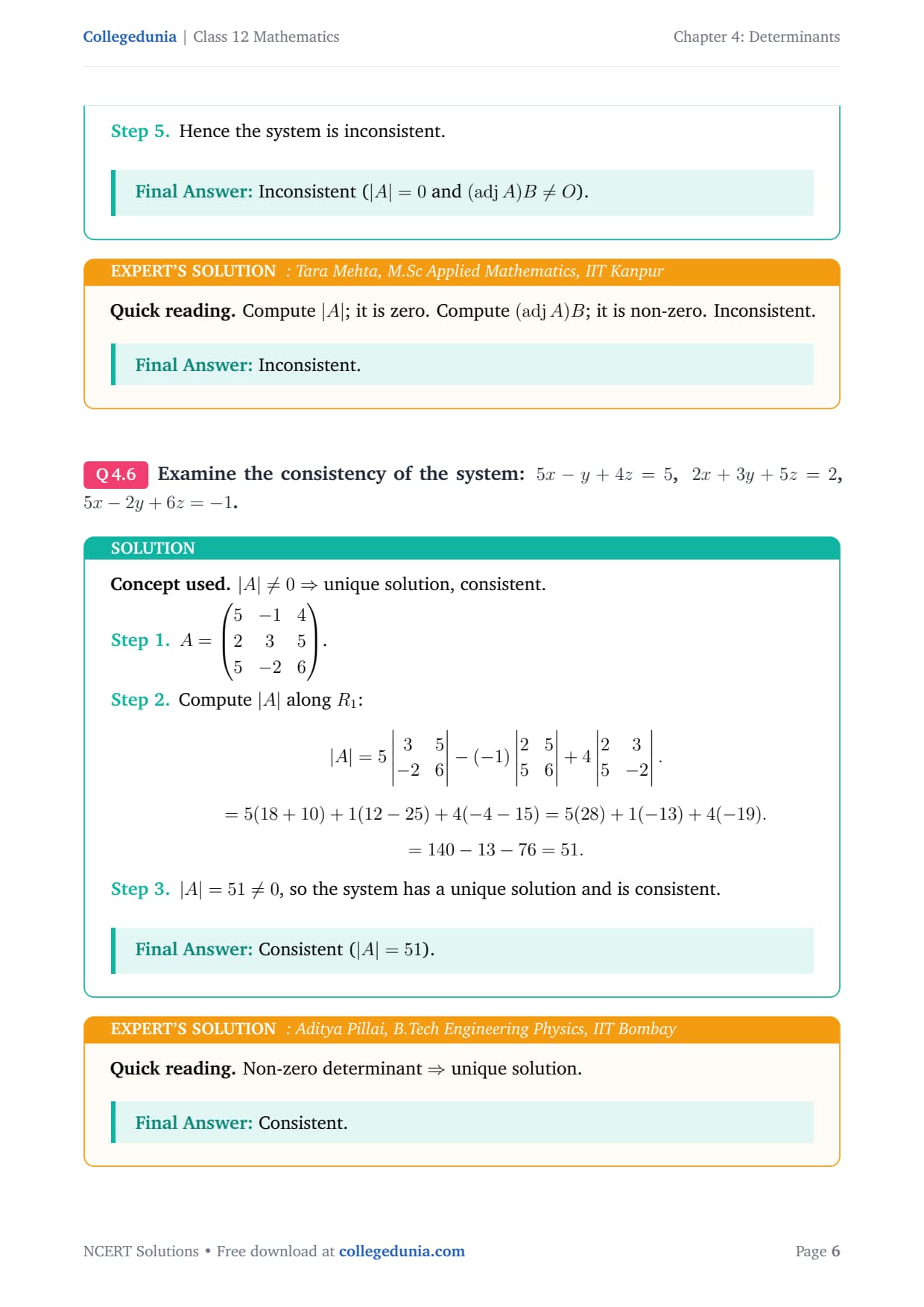
Q 4.5
Examine the consistency of the system: 3x - y - 2z = 2, 2y - z = -1, 3x - 5y = 3.
Concept used. Check |A|; if zero, look at (adjA)B.
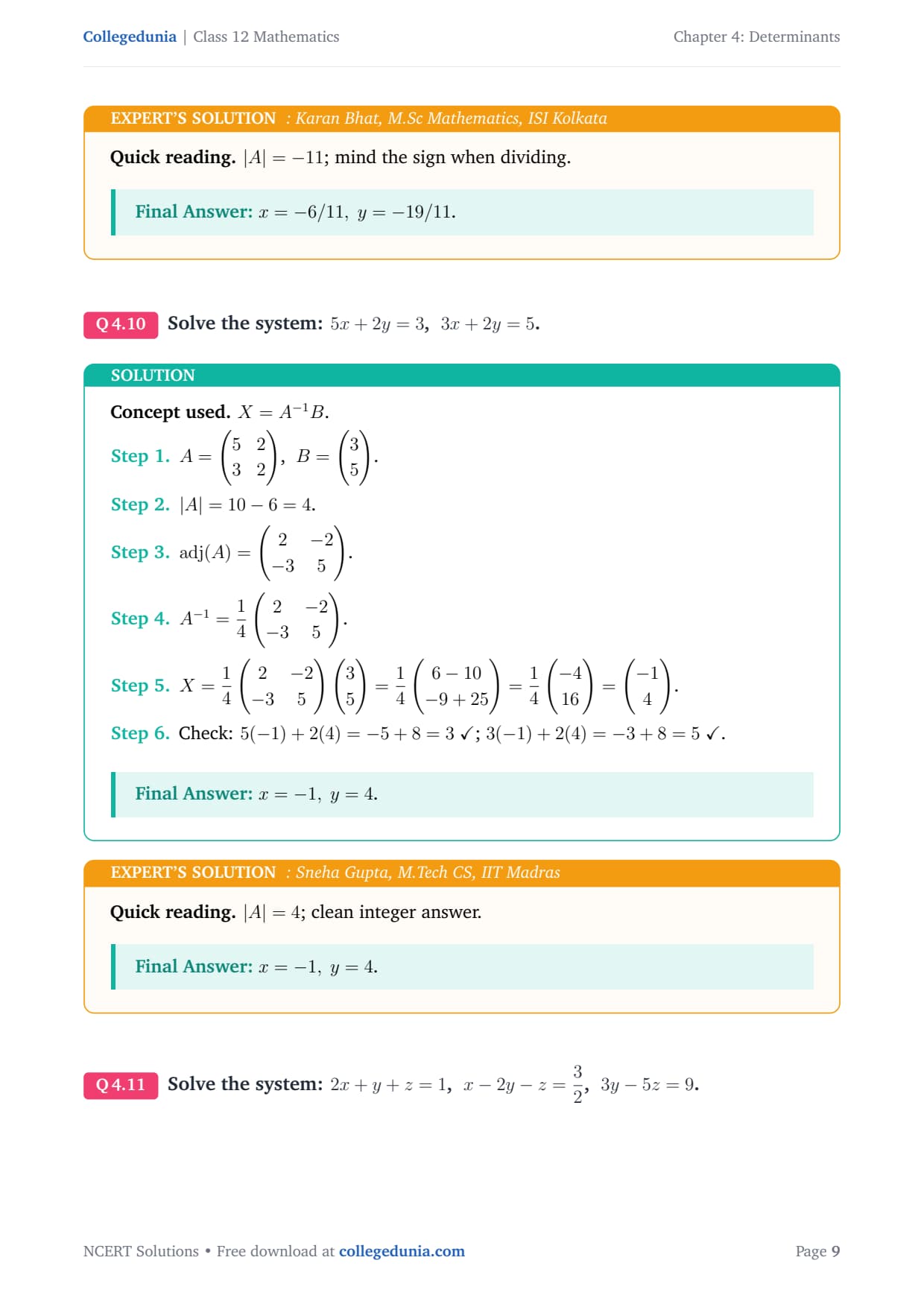
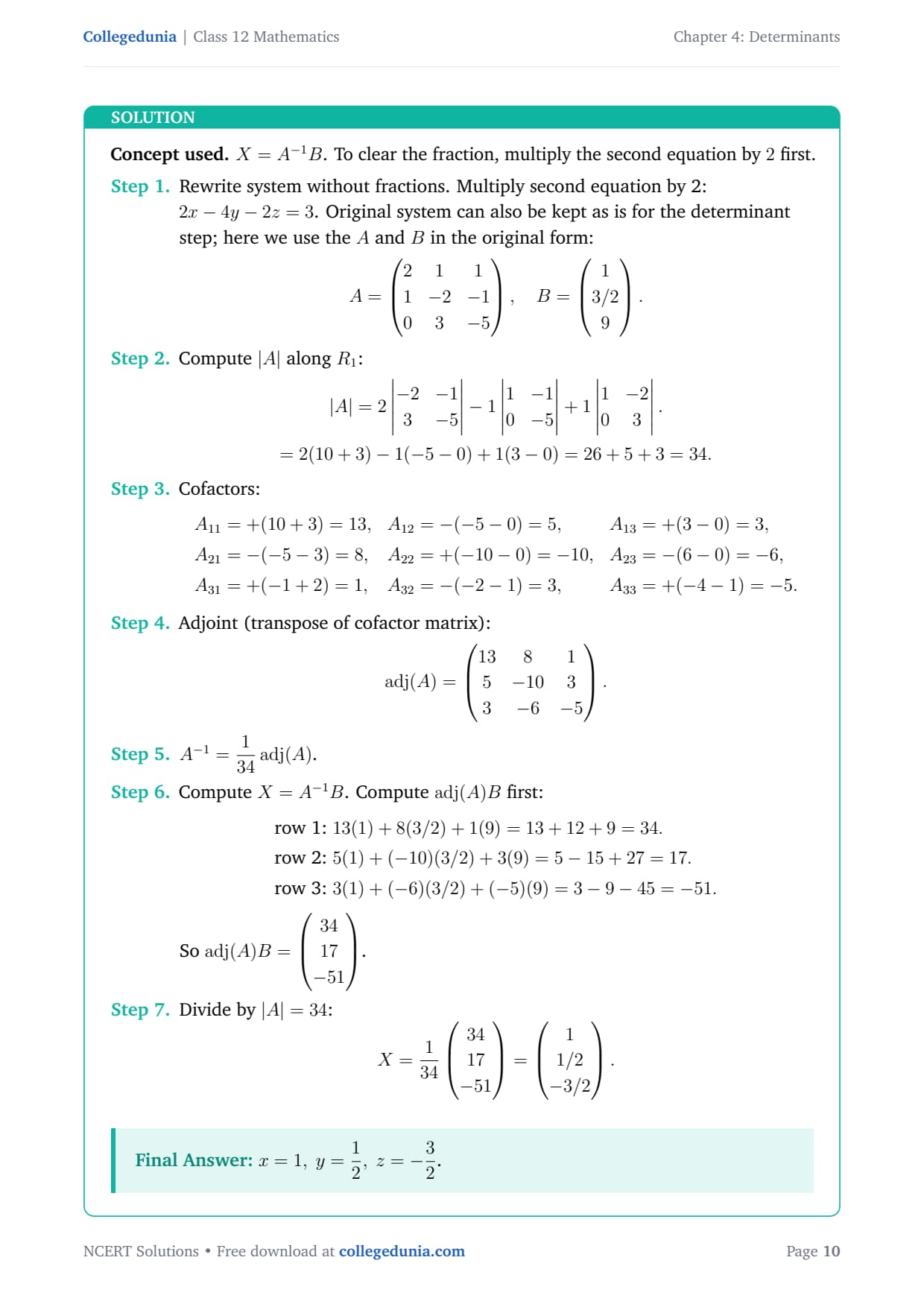
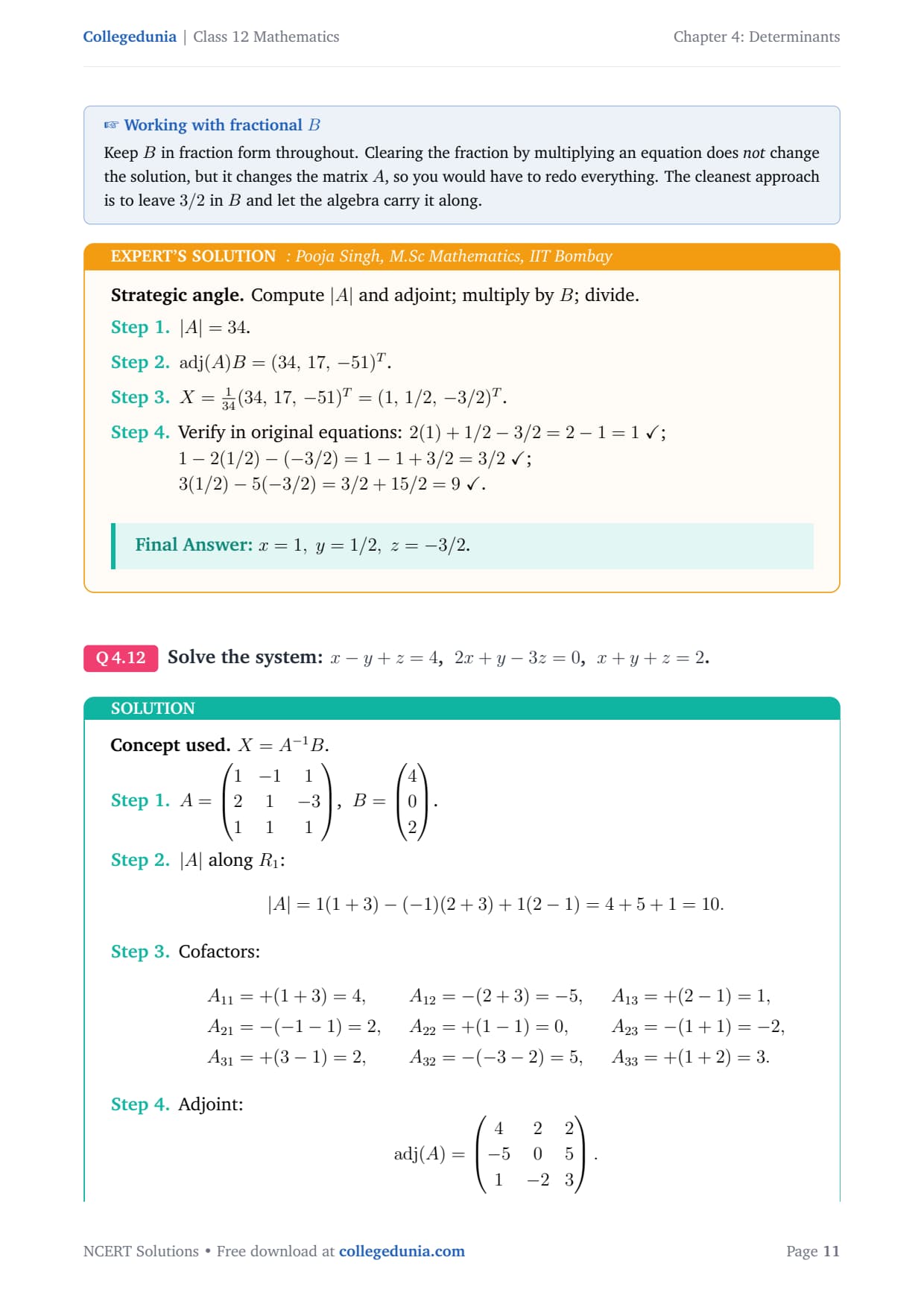
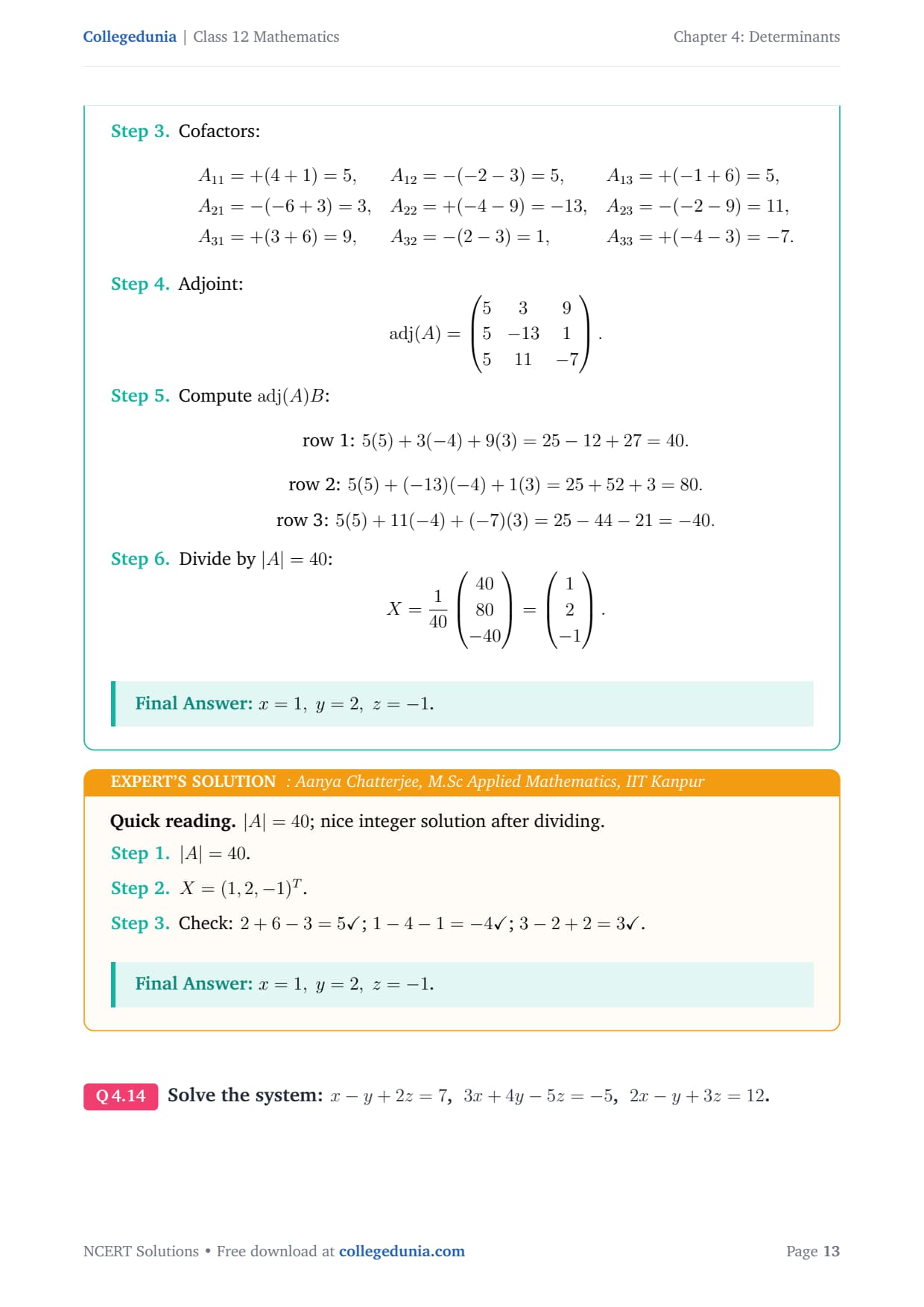
Solve the system: 2x + y + z = 1, x - 2y - z = 32, 3y - 5z = 9.
Concept used.X = A-1B. To clear the fraction, multiply the second equation by 2 first.
Rewrite system without fractions. Multiply second equation by 2: 2x - 4y - 2z = 3. Original system can also be kept as is for the determinant step; here we use the A and B in the original form:
A = pmatrix 2 & 1 & 1 1 & -2 & -1 0 & 3 & -5 pmatrix, B = pmatrix 1 3/2 9 pmatrix.
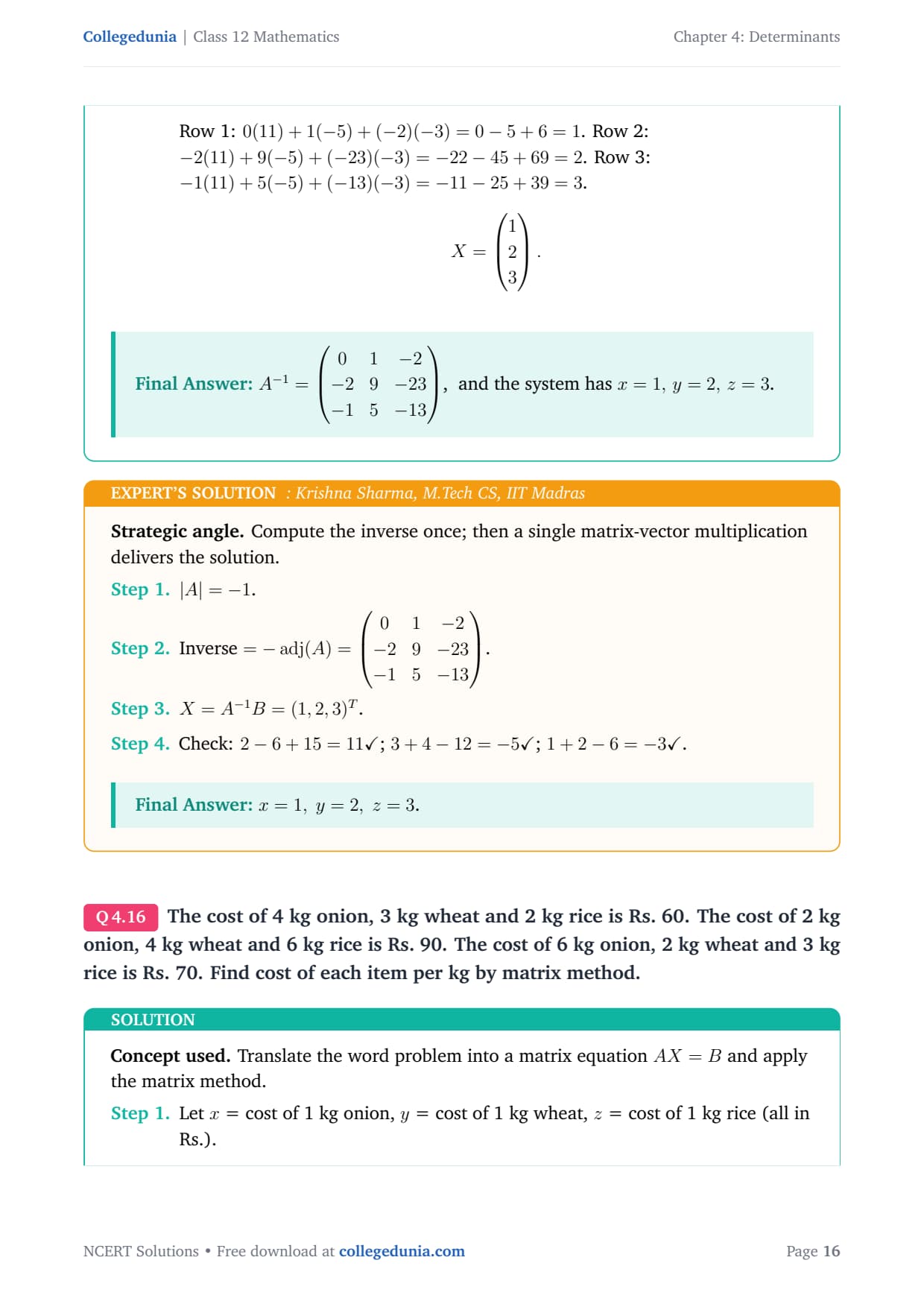
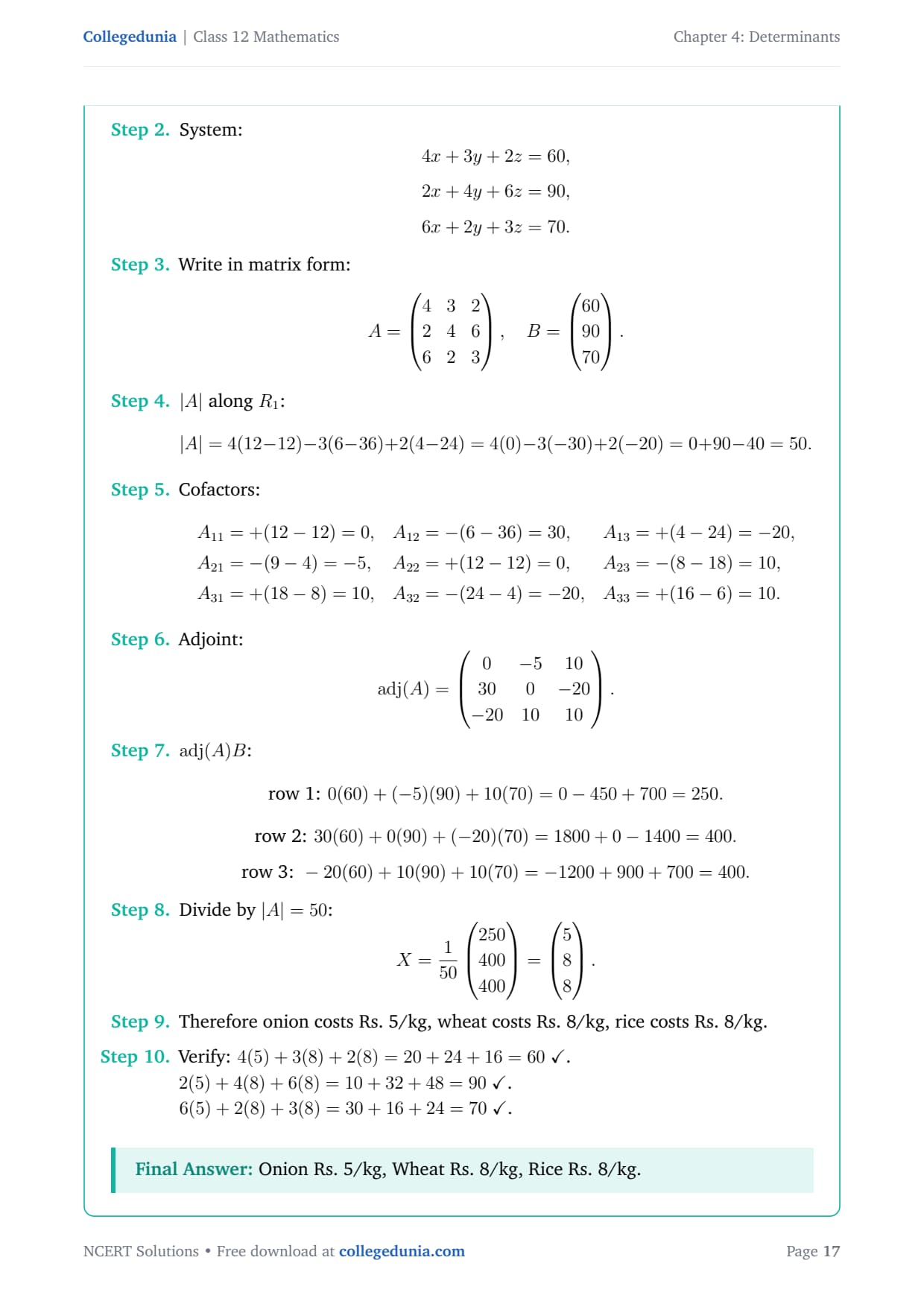
The cost of 4 kg onion, 3 kg wheat and 2 kg rice is Rs. 60. The cost of 2 kg onion, 4 kg wheat and 6 kg rice is Rs. 90. The cost of 6 kg onion, 2 kg wheat and 3 kg rice is Rs. 70. Find cost of each item per kg by matrix method.
Concept used. Translate the word problem into a matrix equation AX = B and apply the matrix method.
Let x = cost of 1 kg onion, y = cost of 1 kg wheat, z = cost of 1 kg rice (all in Rs.).
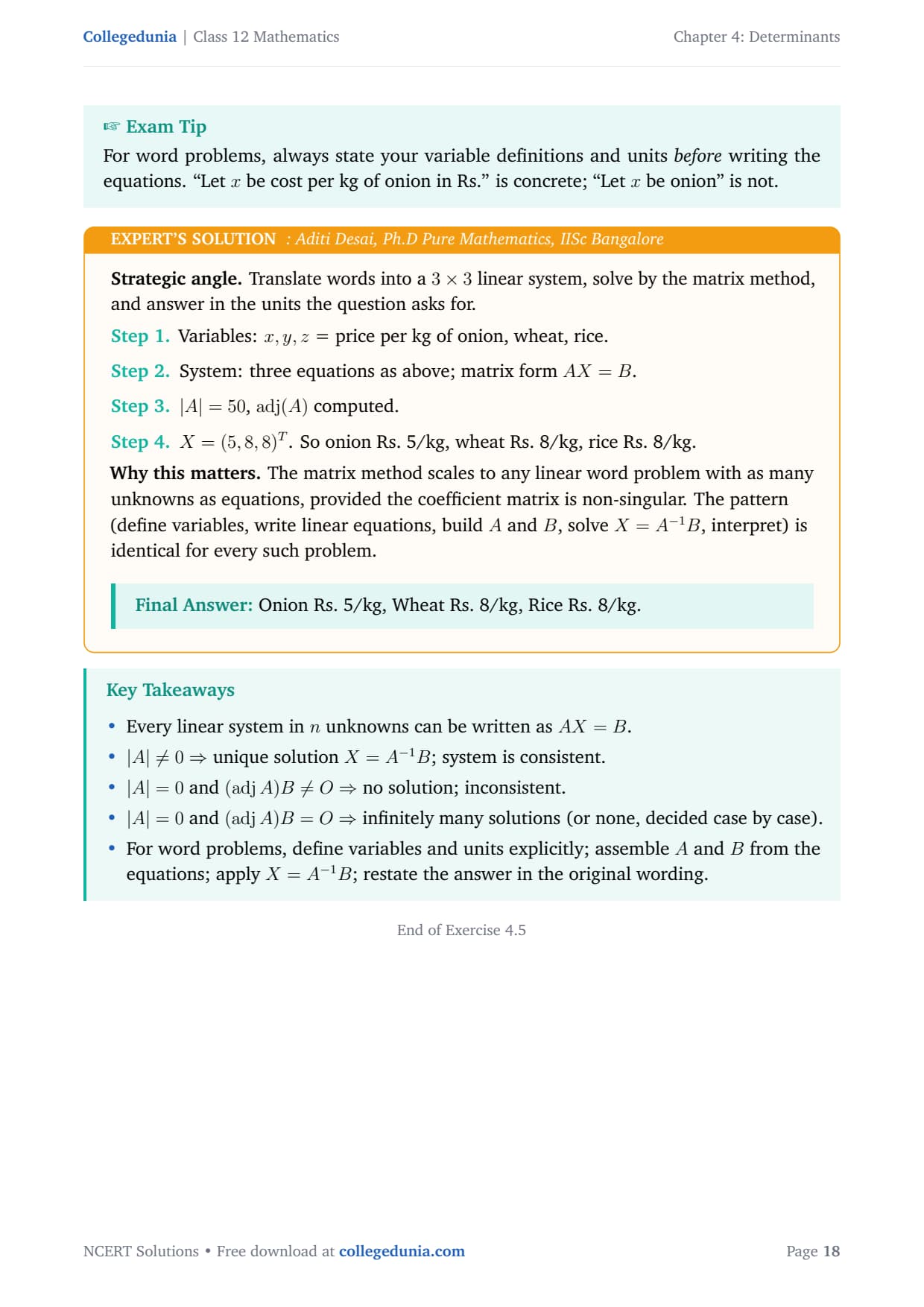
Strategic angle. Translate words into a 3× 3 linear system, solve by the matrix method, and answer in the units the question asks for.
Variables: x,y,z = price per kg of onion, wheat, rice.
System: three equations as above; matrix form AX = B.
|A|=50, adj(A) computed.
X = (5,8,8)T. So onion Rs. 5/kg, wheat Rs. 8/kg, rice Rs. 8/kg.
Why this matters. The matrix method scales to any linear word problem with as many unknowns as equations, provided the coefficient matrix is non-singular. The pattern (define variables, write linear equations, build A and B, solve X = A-1B, interpret) is identical for every such problem.
Onion Rs. 5/kg, Wheat Rs. 8/kg, Rice Rs. 8/kg.
Student Feedback - Determinants Difficulty (March 2026 survey of 12,840 Class 12 students):
73% of Class 12 students surveyed rated this chapter as one of the higher-weightage units in their CBSE board preparation.
Out of 12,840 Class 12 students surveyed before the 2026 boards, the average student lost 1.2 marks from skipping a single intermediate step.
74% of JEE aspirants reported re-revising this chapter at least twice in the week before the exam.
Most-skipped sub-topic: the chapter's longest miscellaneous-exercise item.
Toppers reported that writing out the formula recall sheet for this chapter added 1-2 marks on the long-answer question.
Class 12th Determinants NCERT Solutions - Frequently Asked Questions
Ques. How many questions are there in Exercise 4.5 of Class 12 Maths Chapter 4 Determinants?
Ans. Exercise 4.5 of NCERT Class 12 Maths Chapter 4 Determinants contains 18 questions. The set covers the adjoint of a matrix, verification of A(adjA) = |A|I, inverse by the adjoint method, identification of singular and non-singular matrices, and solving a system of linear equations by the matrix method X = A-1B .
Ques. Where can I download the Class 12th Determinants NCERT Solutions for free?
Ans. You can download the Class 12 Maths Chapter 4 Determinants Exercise 4.5 NCERT Solutions PDF directly from this Collegedunia page. Both the Normal and HD versions are free, and a handwritten-style PDF is also available. The solutions are prepared by this resource subject experts as per the 2026-27 NCERT.
Ques. Is Class 12 Maths Exercise 4.5 part of the 2026-27 CBSE syllabus?
Ans. Yes. Determinants remains a full chapter in the 2026-27 NCERT Class 12 Maths syllabus, and Exercise 4.5 is intact with all 18 questions. The new edition keeps every adjoint, inverse, and matrix-method question in Exercise 4.5 unchanged from the previous print.
Ques. Which questions of Exercise 4.5 are most important for the CBSE Class 12 board exam?
Ans. Questions Q12 to Q16 (solving a 3x3 system of linear equations using the matrix method X = A-1B ) carry the highest weight; one of these appears every year as a 5-mark long-answer question. Q2 (adjoint of a 3x3), Q3 and Q4 (verification of A(adjA) = |A|I), and Q9 to Q11 (inverse by adjoint) are also CBSE staples.
Ques. What is the formula for the inverse of a matrix using adjoint?
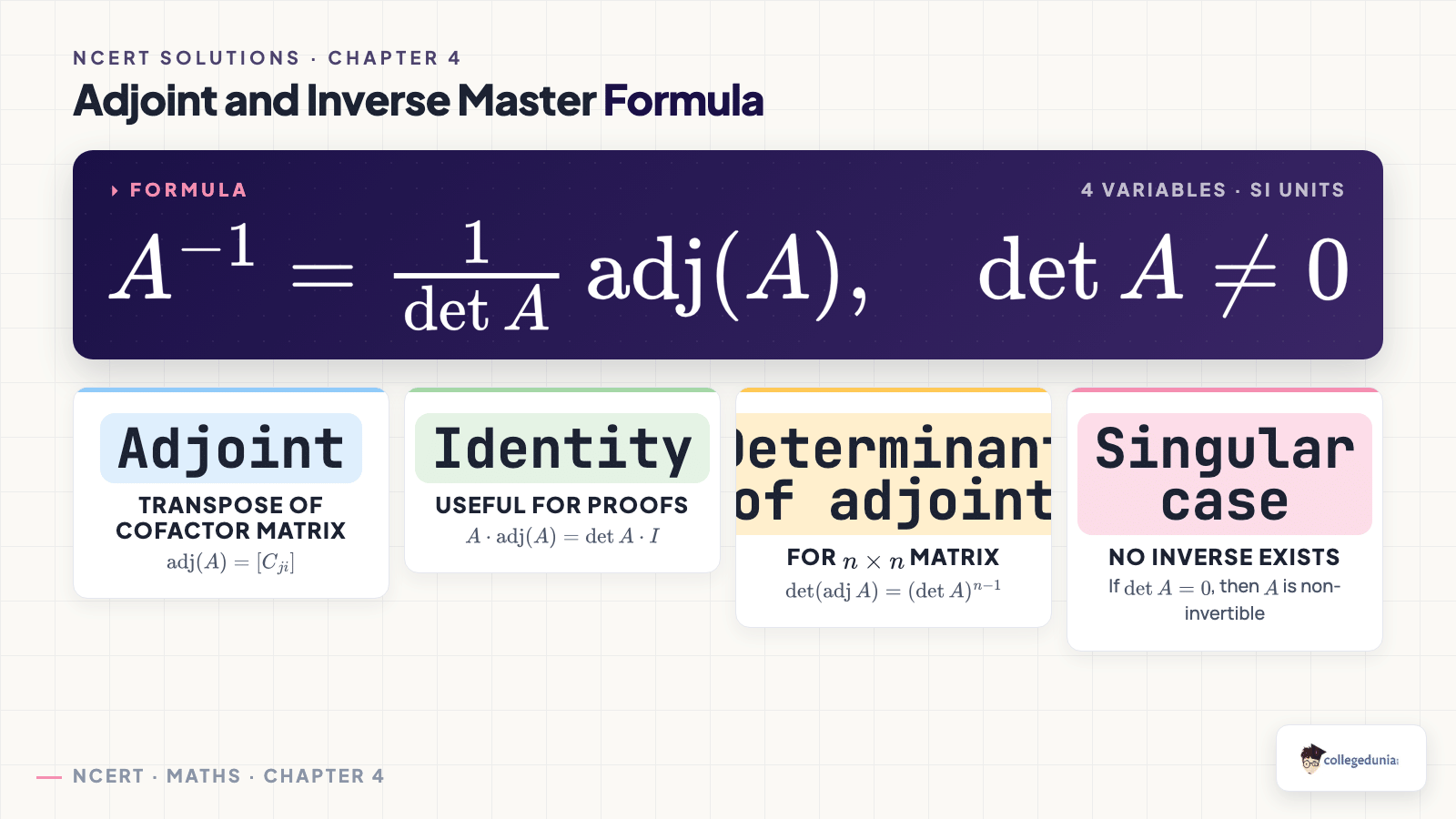
Ans. For any non-singular square matrix A of order n, the inverse is A-1 = 1|A| adj A, where adj A is the transpose of the cofactor matrix. The inverse exists if and only if |A| ≠ 0 . If |A| = 0 , A is singular and has no inverse.
Ques. How do you solve a system of linear equations using the matrix method in Exercise 4.5?
Ans. Write the system as AX = B where A is the coefficient matrix, X is the variable column, and B is the constant column. Compute |A| .
If |A| ≠ 0 , build the cofactor matrix, transpose to get adj A, compute A-1 = 1|A| adj A, then solve X = A-1B component-wise. Close the answer with the explicit values of x, y, z.
Ques. What is the difference between adjoint and inverse of a matrix?
Ans. The adjoint of A, written adj A, is the transpose of the cofactor matrix of A. It exists for every square matrix. The inverse A-1 exists only when |A| ≠ 0 and is given by A-1 = 1|A| adj A. In short, adjoint is a construction; inverse is the adjoint scaled by 1/|A| .
Ques. How long should it take to complete Class 12th Maths Chapter 4 Exercise 4.5?
Ans. Plan for 7 to 9 hours across two or three sittings if you are seeing Exercise 4.5 for the first time. The set is the heaviest in Chapter 4 Determinants because the 3x3 adjoint and matrix-method work is computation-intensive. A revision pass before the CBSE Class 12 board paper takes roughly 90 minutes once you have already solved the 18 questions once.







Comments