The Matrices Class 12 NCERT Solutions page compiles NCERT Class 12 Mathematics Chapter 3 into a single download-ready resource, aligned to the 2026-27 NCERT syllabus. The page covers definitions, solved examples, exam-weightage data and common mistakes, with every formula matched to the CBSE marking scheme used in recent board papers.
CBSE Weightage: 3-5 marks from Ex 3.3 (full Chapter 3: 8-10 marks)
JEE Main: 1-2 questions per paper from transpose / symmetric properties
Question Count in Ex 3.3: 12 (mechanical + verifications + symmetric decomposition)
Solved by Collegedunia subject experts, matched to the CBSE marking scheme.
Why Class 12 Maths Exercise 3.3 Matters for Boards and JEE Main
Exercise 3.3 tests three ideas: writing AT, checking if a matrix is symmetric or skew-symmetric, and proving any square matrix splits into a symmetric and a skew-symmetric part.
CBSE has asked the decomposition question in five of the last six board papers.A student solid on Ex 3.3 alone secures 4 marks without touching the rest of the chapter.
Why this set is a marks bank: Q10-Q12 each carry 4-5 marks and use the same algorithm. Lock the template once and score full marks every time.
How the Matrices Class 12 NCERT Solutions on the Matrices Class 12 NCERT Solutions Help You
The transpose and symmetric-matrix problems are mechanical: marks come from clean indexing, not insight. Our PDF tags every answer with the property used and the step where students typically slip.
2026-27 NCERT alignment: All 12 questions match the current NCERT print.
Property-named steps: Each line names the exact transpose property used, so the marker can score every step.
Decomposition template: The Q10-Q12 5-mark proof is shown as one reusable 4-line template (see the toolkit below).
Verification shortcuts: Q4 to Q7 are scored by a single transpose computation, shown without redundant arithmetic.
Class 12th Maths Chapter 3 Exercise 3.3 Question-Type Distribution
The 12 problems split into four types: mechanical (Q1-Q3), verifications (Q4-Q7), identification (Q8-Q9), and decomposition (Q10-Q12).
Q No.
Type
Property / Concept Tested
Typical Marks
Q1
Find transpose
Direct AT of a 2 × 3 matrix
1
Q2
Verify
(A + B)T = AT + BT and (A - B)T = AT - BT
2
Q3
Verify
(A')' = A, (kA)' = k(A')
2
Q4
Verify
(A + B)' = A' + B' with 3 × 3 matrices
3
Q5
Verify
(AB)' = B'A' for 2 × 2 case
3
Q6
Find
If A = [cosα sinα; -sinα cosα] , verify A'A = I
3
Q7
Show
A is symmetric or skew-symmetric (identification on 3 × 3 )
2
Q8
Show
For a square matrix A, A + A' is symmetric and A - A' is skew-symmetric
2
Q9
Find
12(A + A') and 12(A - A') for given A
3
Q10
Express
2 × 2 matrix as sum of symmetric and skew-symmetric
4
Q11
Express
3 × 3 matrix as sum of symmetric and skew-symmetric
5
Q12
MCQ
If A,B are symmetric, when is AB symmetric?
1
Exercise 3.3 Class 12 Maths: Transpose and Symmetric-Matrix Toolkit
Every question of Ex 3.3 reduces to one of these eight identities. Keep this micro-sheet open while solving.
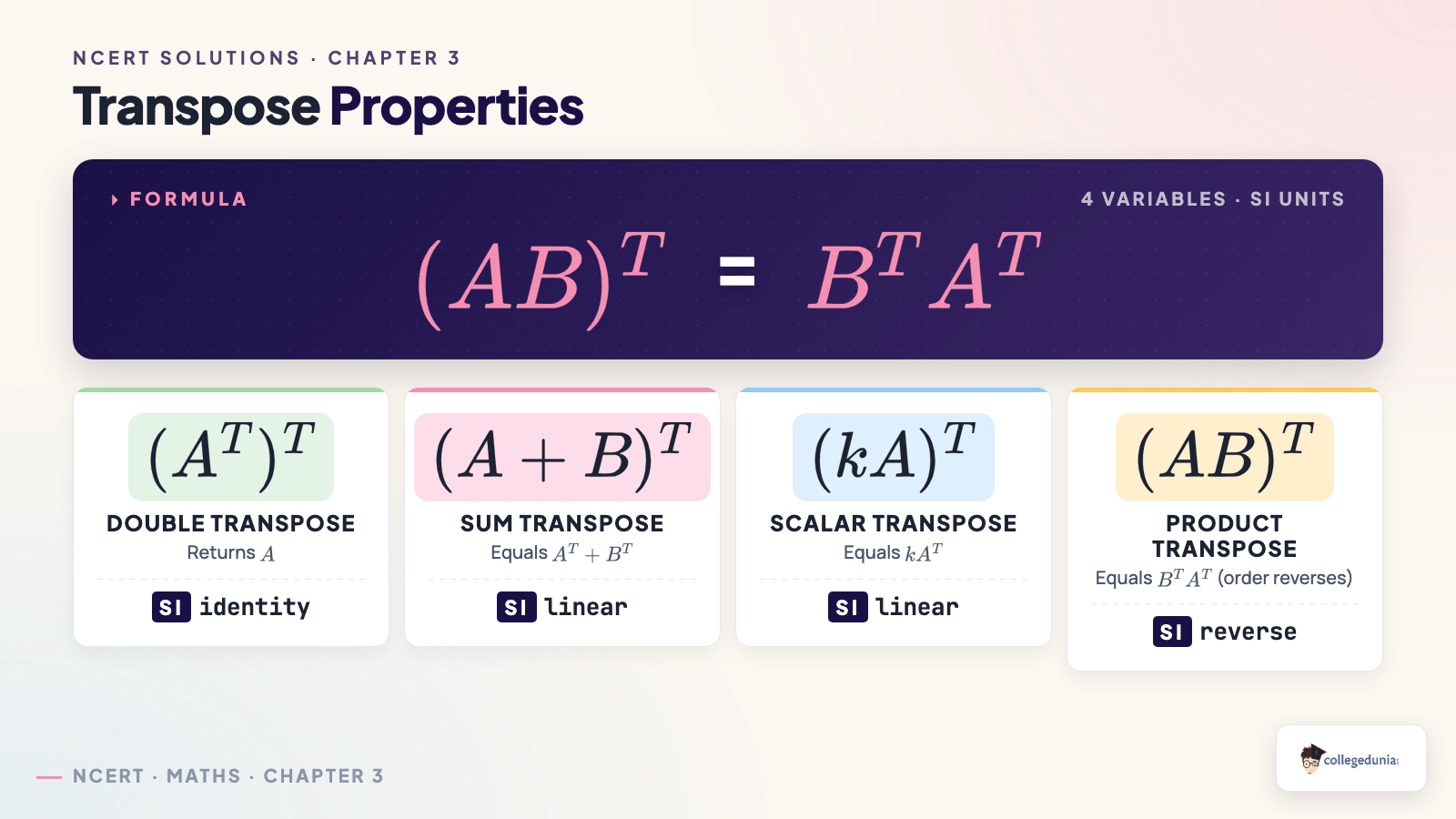
T1. (AT)ij = Aji. Rows of A become columns of AT.
T2. (AT)T = A (involution).
T3. (A ± B)T = AT ± BT.
T4. (kA)T = k AT for scalar k.
T5. (AB)T = BT AT (order reverses).
T6. Symmetric: AT = A, i.e. aij = aji.
T7. Skew-symmetric: AT = -A, diagonal is zero.
T8. Decomposition: A = 12(A + AT) + 12(A - AT) .
Sample Solved Question from Class 12 Maths Exercise 3.3
Q11 carries the highest marks in the set. Here is the working in brief.
Question 11 (5 marks): Express A = pmatrix 3 & -2 & -4 3 & -2 & -5 -1 & 1 & 2 pmatrix as the sum of a symmetric and a skew-symmetric matrix.
Step 4:A = P + Q. Final answer: A equals the sum of P and Q above.
Common Mistakes Students Make in Class 12 Maths Ex 3.3
After scanning CBSE answer scripts for Chapter 3 Matrices, these five errors cost the most marks in Exercise 3.3. The decomposition problems alone account for two of them.
Reversing the order in (AB)T. Correct: (AB)T = BT AT, not AT BT. Lose 2 marks instantly on Q5.
Forgetting the 12 factor in decomposition. Writing P = A + AT without halving breaks P + Q = A in Q10, Q11.
Computing AT wrong on 3 × 3 matrices. A typo here propagates through every later step.
Not verifying PT = P and QT = -Q. CBSE gives 1 mark just for this line.
Confusing "symmetric" with "skew-symmetric". Symmetric: aij = aji. Skew-symmetric: aij = -aji, zero diagonal.
NCERT Solutions for Class 12 Maths Chapter 3 Matrices - All Exercises
Exercise 3.3 is the third of four exercise sets in Chapter 3.
All NCERT Solutions for Matrices Ex 3.3 with Step-by-Step Working
Every question of Matrices Ex 3.3 is listed below with its full Solution and Expert Solution inside collapsible tabs.
Questions
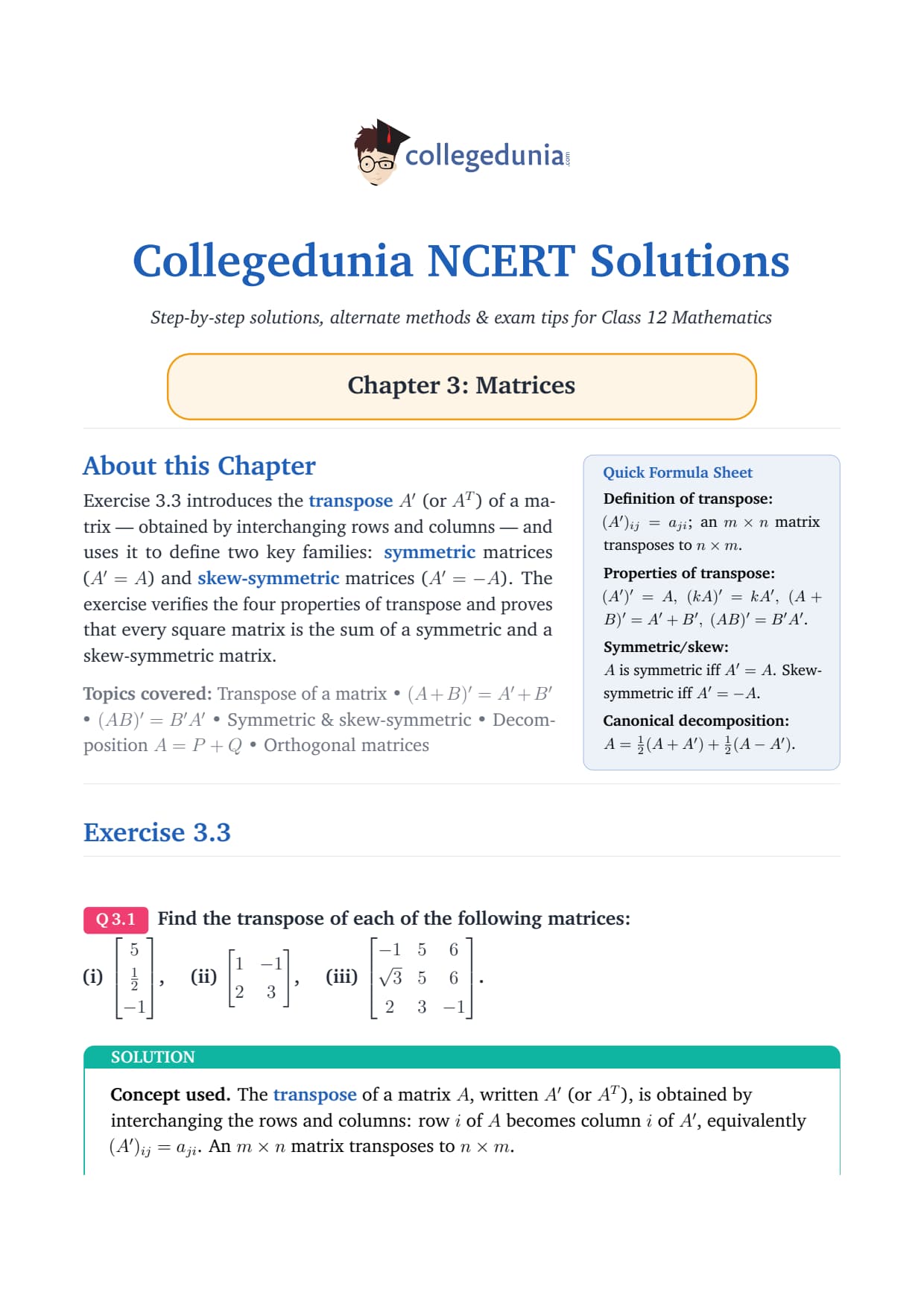
Q 3.1
Find the transpose of each of the following matrices:
(i) bmatrix 5 12 -1 bmatrix,
(ii) bmatrix 1 & -1 2 & 3 bmatrix,
(iii) bmatrix -1 & 5 & 6 √3 & 5 & 6 2 & 3 & -1 bmatrix.
Concept used. The transpose of a matrix A,
written A' (or AT), is obtained by interchanging the rows and
columns: row i of A becomes column i of A', equivalently
(A')ij=aji. An m× n matrix transposes to n× m.
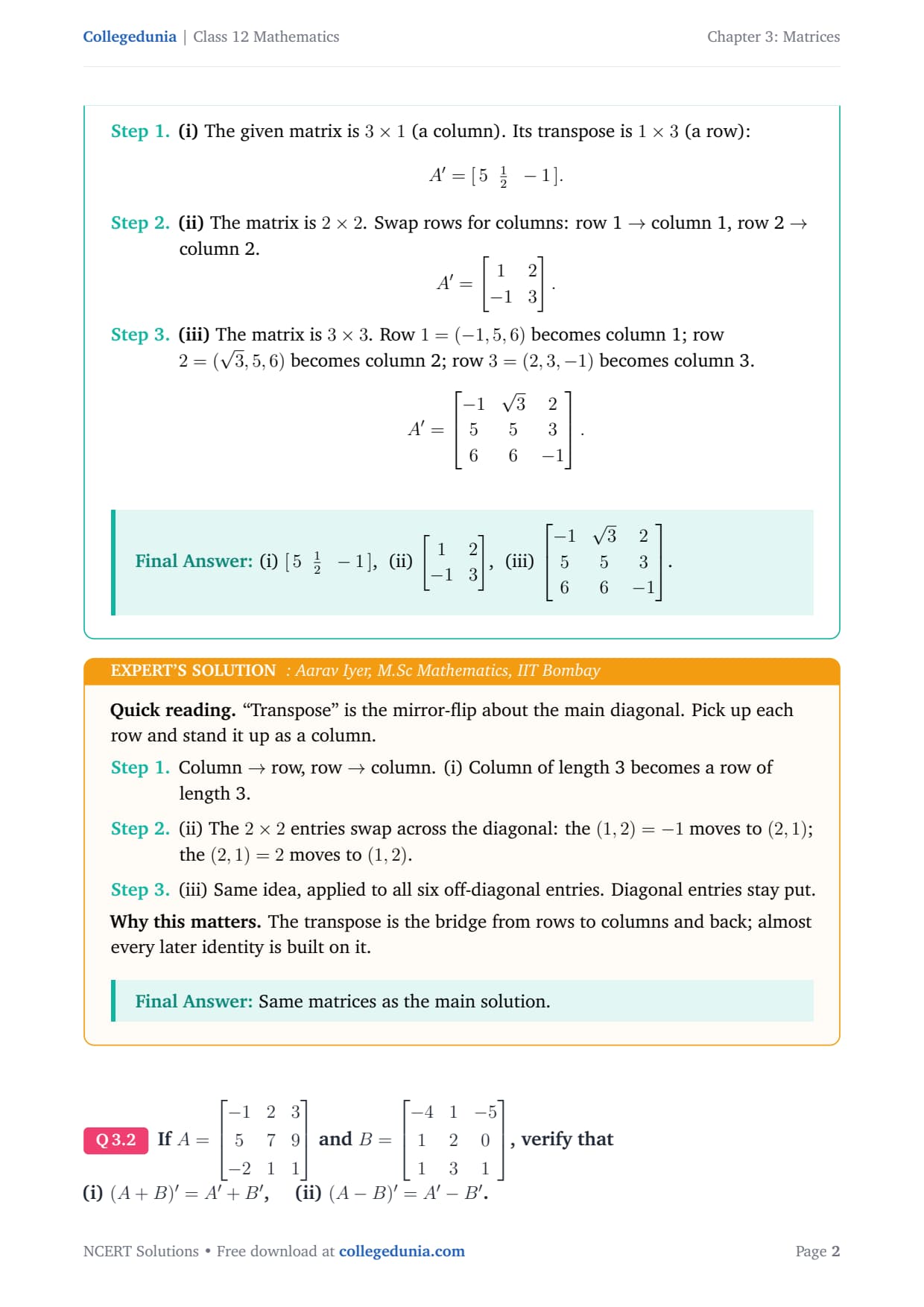
(i) The given matrix is 3× 1 (a column).
Its transpose is 1× 3 (a row):
A'=[ 5 12 -1 ].
(ii) The matrix is 2× 2. Swap rows for columns:
row 1 → column 1, row 2 → column 2.
A'=bmatrix 1 & 2 -1 & 3 bmatrix.
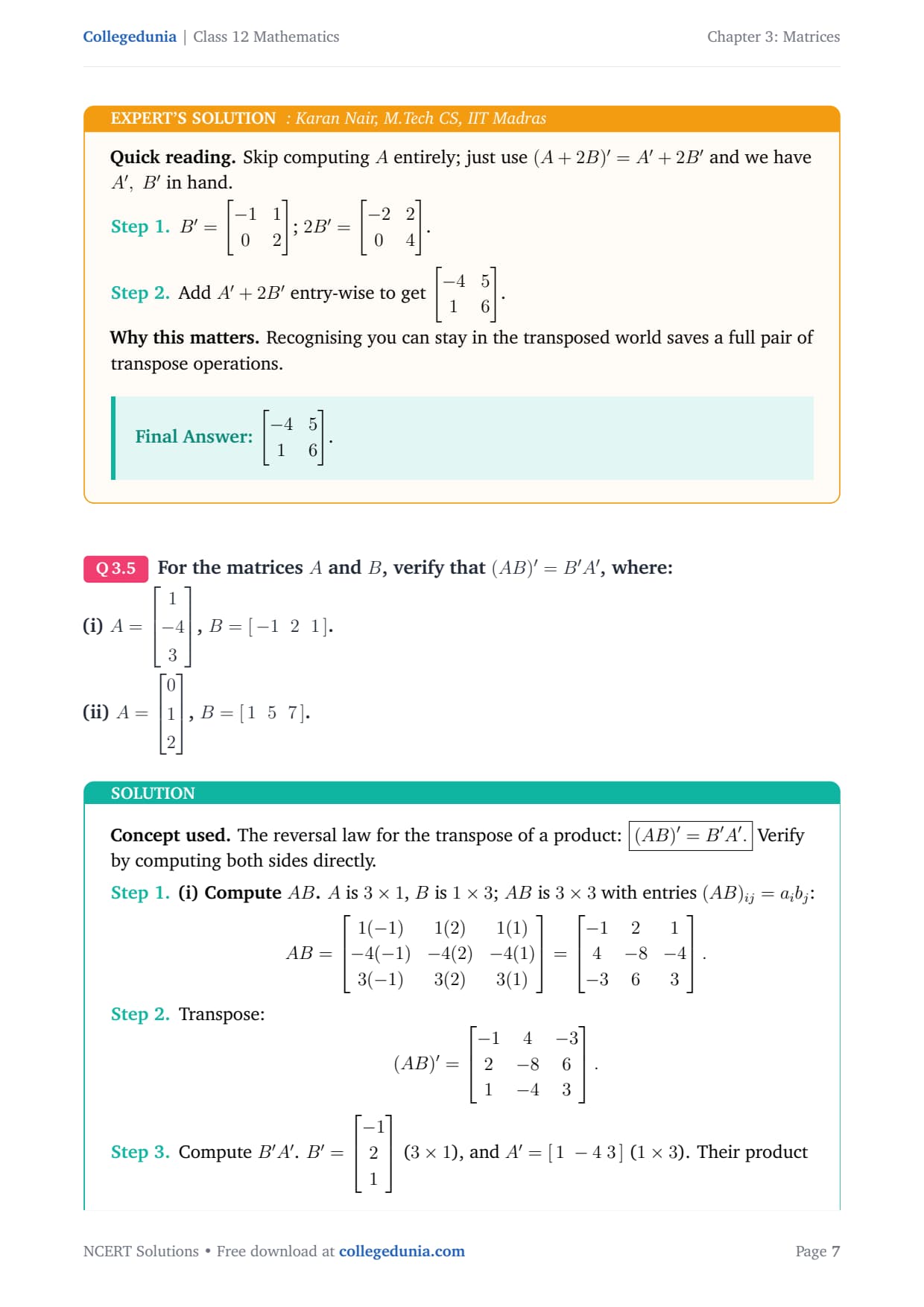
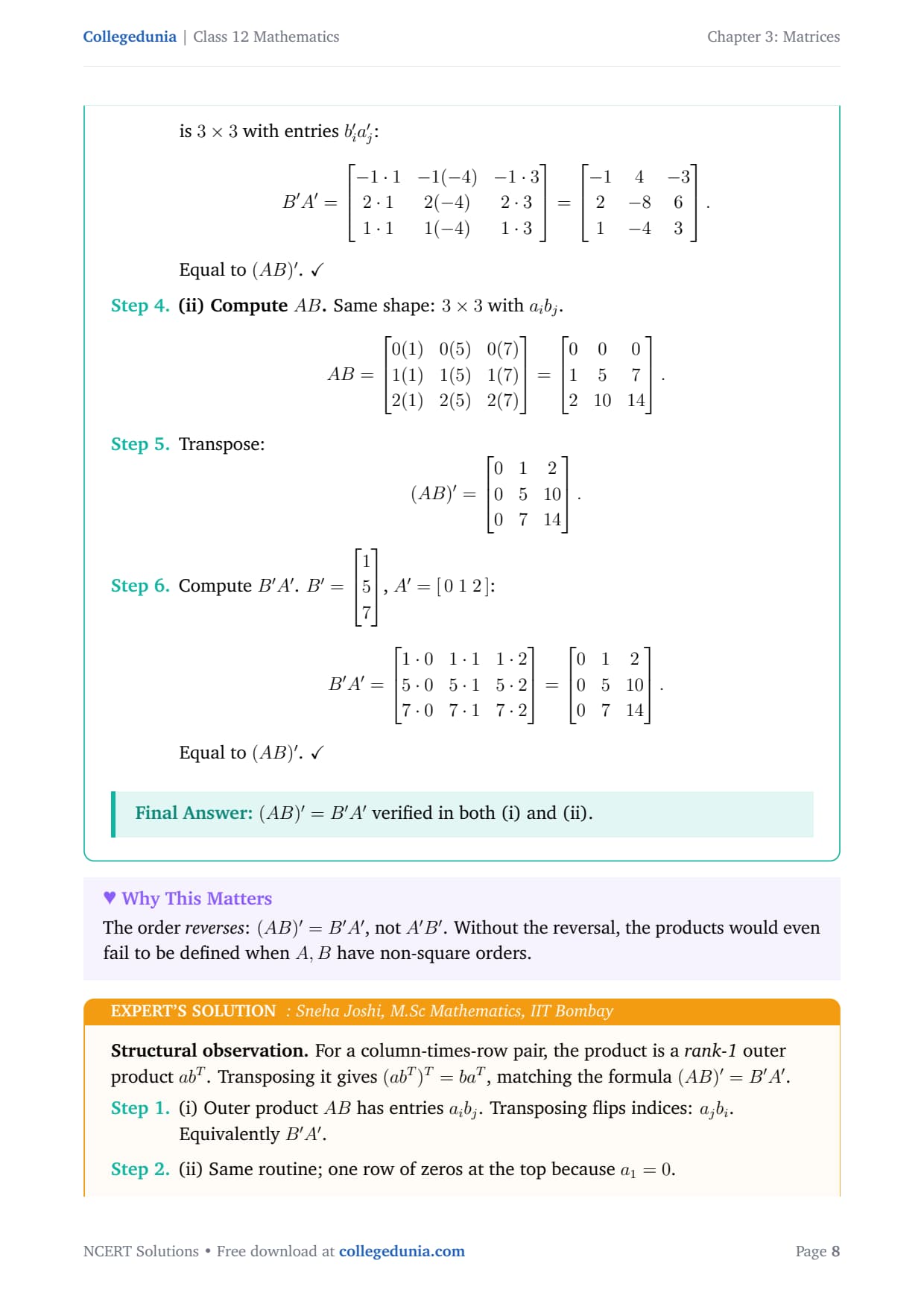
Structural observation. For a column-times-row pair, the
product is a rank-1 outer product a bT. Transposing it gives
(abT)T=b aT, matching the formula (AB)'=B'A'.
(i) Outer product AB has entries ai bj. Transposing flips
indices: aj bi. Equivalently B'A'.
(ii) Same routine; one row of zeros at the top because
a1=0.
Why this matters. Outer products abT are everywhere in
linear algebra (rank-1 updates, gradient outer products in ML, dyadics
in mechanics). The transpose law makes their algebra easy.
Both sides agree in (i) and (ii).
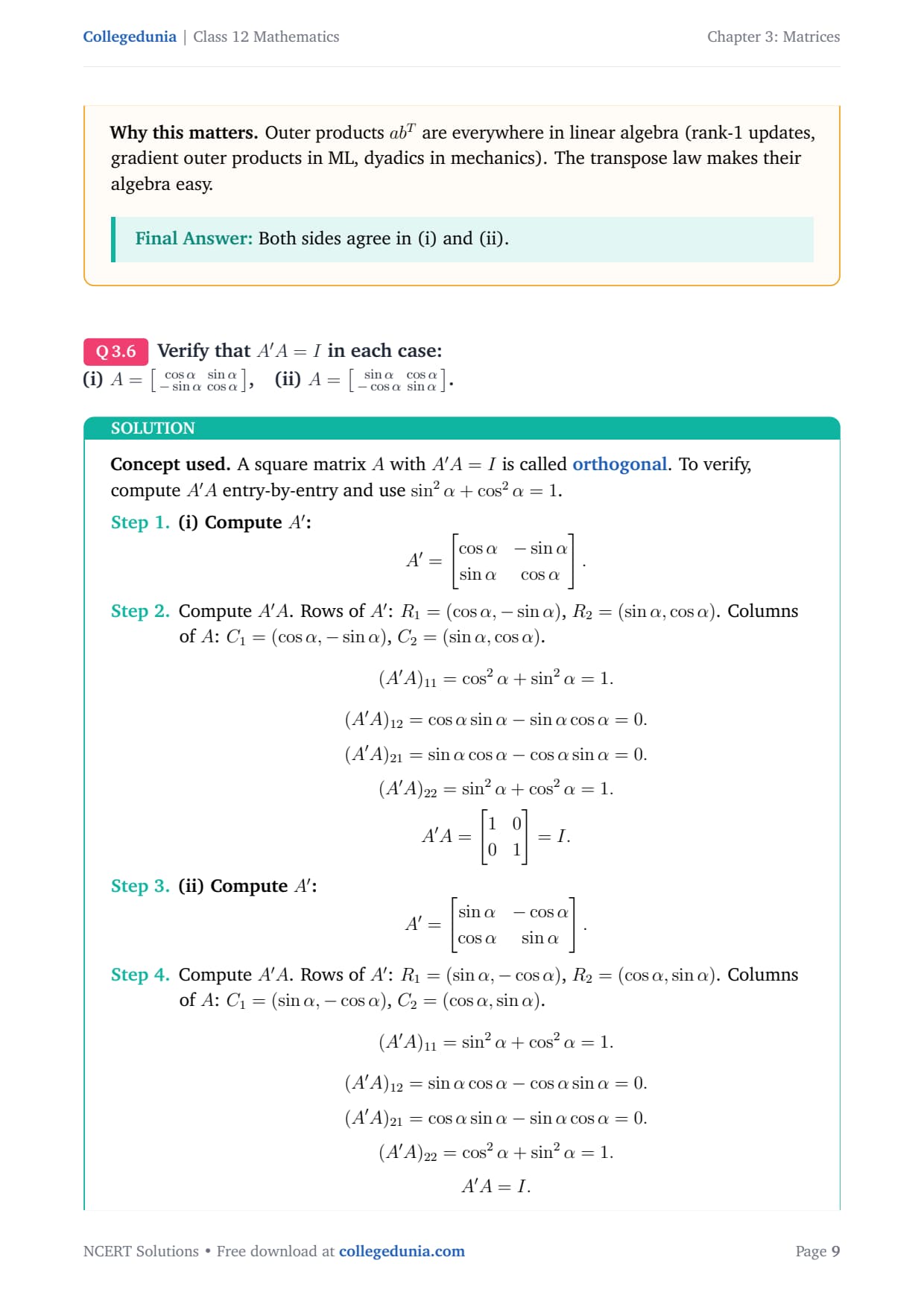
Q 3.6
Verify that A'A=I in each case:
(i)A=[smallmatrix cosα & sinα -sinα & cosα smallmatrix],
(ii)A=[smallmatrix sinα & cosα -cosα & sinα smallmatrix].
Concept used. A square matrix A with A'A=I is called
orthogonal. To verify, compute A'A entry-by-entry and use
sin2α+cos2α=1.
Compute A'A. Rows of A':
R1=(cosα,-sinα), R2=(sinα,cosα).
Columns of A:
C1=(cosα,-sinα), C2=(sinα,cosα).
(A'A)11=cos2α+sin2α=1. (A'A)12=cosα-sinα=0. (A'A)21=sinα-cosα=0. (A'A)22=sin2α+cos2α=1. A'A=bmatrix1&0 0&1bmatrix=I.
(ii) Compute A':A'=bmatrix sinα & -cosα cosα & sinα bmatrix.
Compute A'A. Rows of A':
R1=(sinα,-cosα), R2=(cosα,sinα).
Columns of A:
C1=(sinα,-cosα), C2=(cosα,sinα).
(A'A)11=sin2α+cos2α=1. (A'A)12=sinα-cosα=0. (A'A)21=cosα-sinα=0. (A'A)22=cos2α+sin2α=1. A'A=I.
In both (i) and (ii), A'A=I: the matrices are orthogonal.
RK
Rohit Kapoor
Ph.D Mathematics, IIT Delhi
Verified Expert
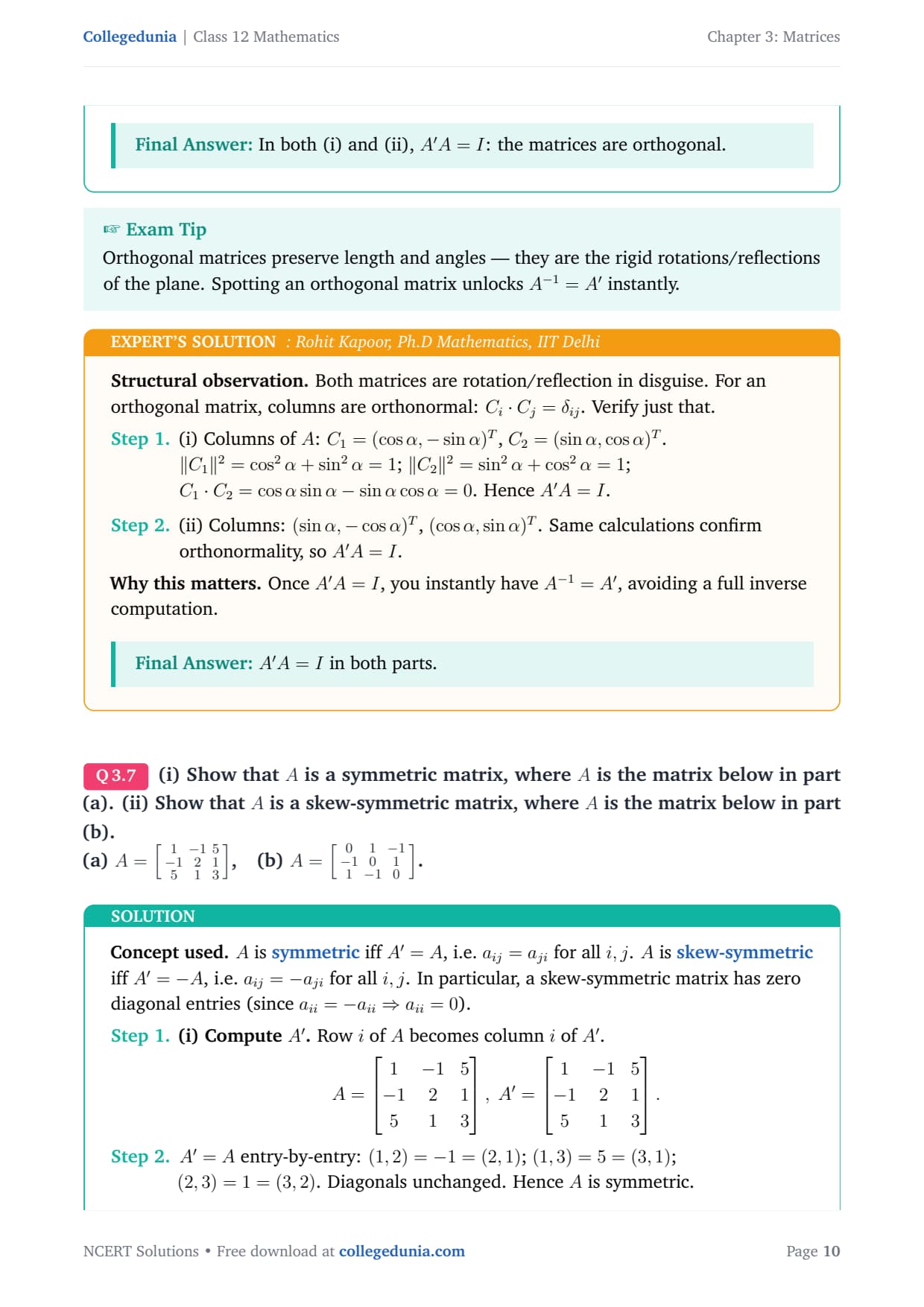
Structural observation. Both matrices are rotation/reflection
in disguise. For an orthogonal matrix, columns are orthonormal:
Ci· Cj=ij. Verify just that.
(ii) Columns: (sinα,-cosα)T,
(cosα,sinα)T. Same calculations confirm
orthonormality, so A'A=I.
Why this matters. Once A'A=I, you instantly have
A-1=A', avoiding a full inverse computation.
A'A=I in both parts.
Q 3.7
(i) Show that A is a symmetric matrix, where A is the matrix below in part (a). (ii) Show that A is a skew-symmetric matrix, where A is the matrix below in part (b).
(a)A=[smallmatrix 1 & -1 & 5 -1 & 2 & 1 5 & 1 & 3 smallmatrix],
(b)A=[smallmatrix 0 & 1 & -1 -1 & 0 & 1 1 & -1 & 0 smallmatrix].
Concept used.A is symmetric iff A'=A, i.e.
aij=aji for all i,j. A is skew-symmetric iff
A'=-A, i.e. aij=-aji for all i,j. In particular, a
skew-symmetric matrix has zero diagonal entries (since aii=-aii⇒ aii=0).
(i) Compute A'. Row i of A becomes column i of A'.
A=bmatrix1&-1&5 -1&2&1 5&1&3bmatrix,
A'=bmatrix1&-1&5 -1&2&1 5&1&3bmatrix.
A'=A entry-by-entry: (1,2)=-1=(2,1);
(1,3)=5=(3,1); (2,3)=1=(3,2). Diagonals unchanged.
Hence A is symmetric.
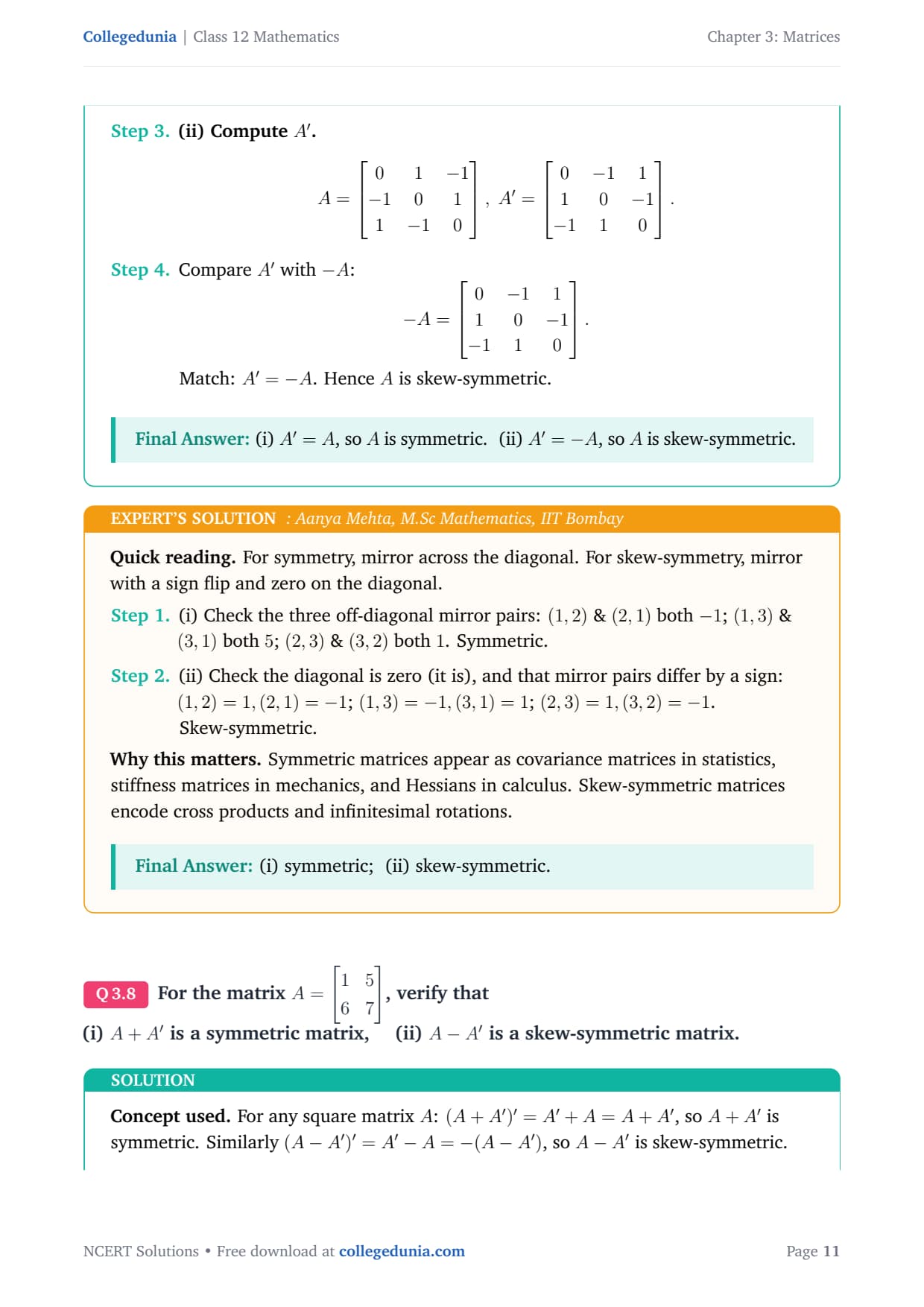
(ii) Compute A'.A=bmatrix0&1&-1 -1&0&1 1&-1&0bmatrix,
A'=bmatrix0&-1&1 1&0&-1 -1&1&0bmatrix.
Compare A' with -A:
-A=bmatrix0&-1&1 1&0&-1 -1&1&0bmatrix.
Match: A'=-A. Hence A is skew-symmetric.
(i) A'=A, so A is symmetric. (ii) A'=-A, so A is skew-symmetric.
AM
Aanya Mehta
M.Sc Mathematics, IIT Bombay
Verified Expert
Quick reading. For symmetry, mirror across the diagonal. For
skew-symmetry, mirror with a sign flip and zero on the diagonal.
(i) Check the three off-diagonal mirror pairs:
(1,2) & (2,1) both -1; (1,3) & (3,1) both 5;
(2,3) & (3,2) both 1. Symmetric.
(ii) Check the diagonal is zero (it is), and that mirror pairs
differ by a sign: (1,2)=1, (2,1)=-1; (1,3)=-1, (3,1)=1;
(2,3)=1, (3,2)=-1. Skew-symmetric.
Why this matters. Symmetric matrices appear as covariance
matrices in statistics, stiffness matrices in mechanics, and Hessians
in calculus. Skew-symmetric matrices encode cross products and
infinitesimal rotations.
(i) symmetric; (ii) skew-symmetric.
Q 3.8
For the matrix A=bmatrix 1 & 5 6 & 7 bmatrix, verify that
(i) A+A' is a symmetric matrix, (ii) A-A' is a skew-symmetric matrix.
Concept used. For any square matrix A:
(A+A')'=A'+A=A+A', so A+A' is symmetric. Similarly
(A-A')'=A'-A=-(A-A'), so A-A' is skew-symmetric.
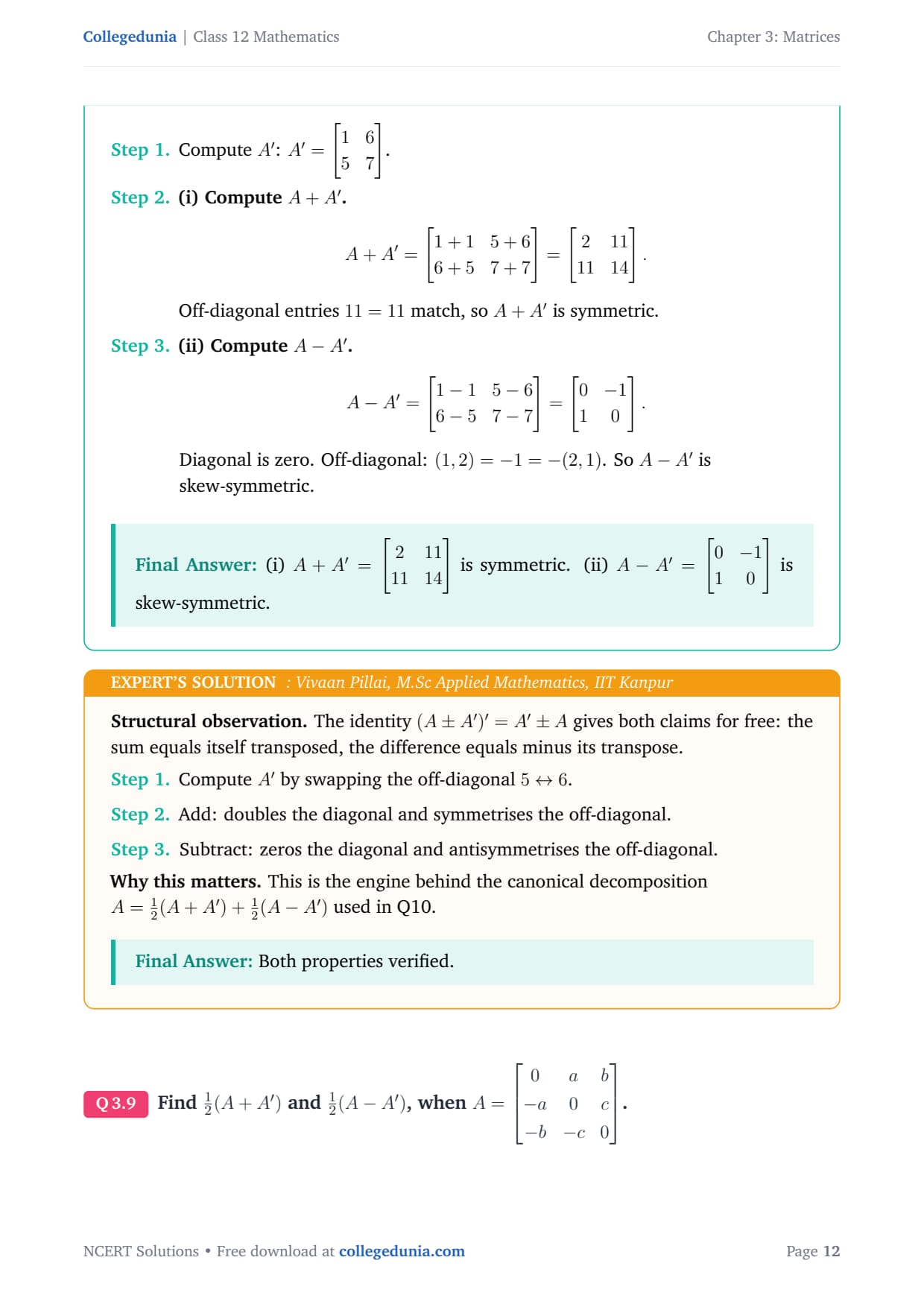
Compute A': A'=bmatrix1&6 5&7bmatrix.
(i) Compute A+A'.A+A'=bmatrix1+1 & 5+6 6+5 & 7+7bmatrix=bmatrix2&11 11&14bmatrix.
Off-diagonal entries 11=11 match, so A+A' is symmetric.
(ii) Compute A-A'.A-A'=bmatrix1-1 & 5-6 6-5 & 7-7bmatrix=bmatrix0&-1 1&0bmatrix.
Diagonal is zero. Off-diagonal: (1,2)=-1=-(2,1). So A-A'
is skew-symmetric.
(i) A+A'=bmatrix2&11 11&14bmatrix is symmetric. (ii) A-A'=bmatrix0&-1 1&0bmatrix is skew-symmetric.
VP
Vivaan Pillai
M.Sc Applied Mathematics, IIT Kanpur
Verified Expert
Structural observation. The identity (A± A')'=A'± A
gives both claims for free: the sum equals itself transposed,
the difference equals minus its transpose.
Compute A' by swapping the off-diagonal 5↔ 6.
Add: doubles the diagonal and symmetrises the off-diagonal.
Subtract: zeros the diagonal and antisymmetrises the
off-diagonal.
Why this matters. This is the engine behind the canonical
decomposition A=12(A+A')+12(A-A') used in Q10.
Both properties verified.
Q 3.9
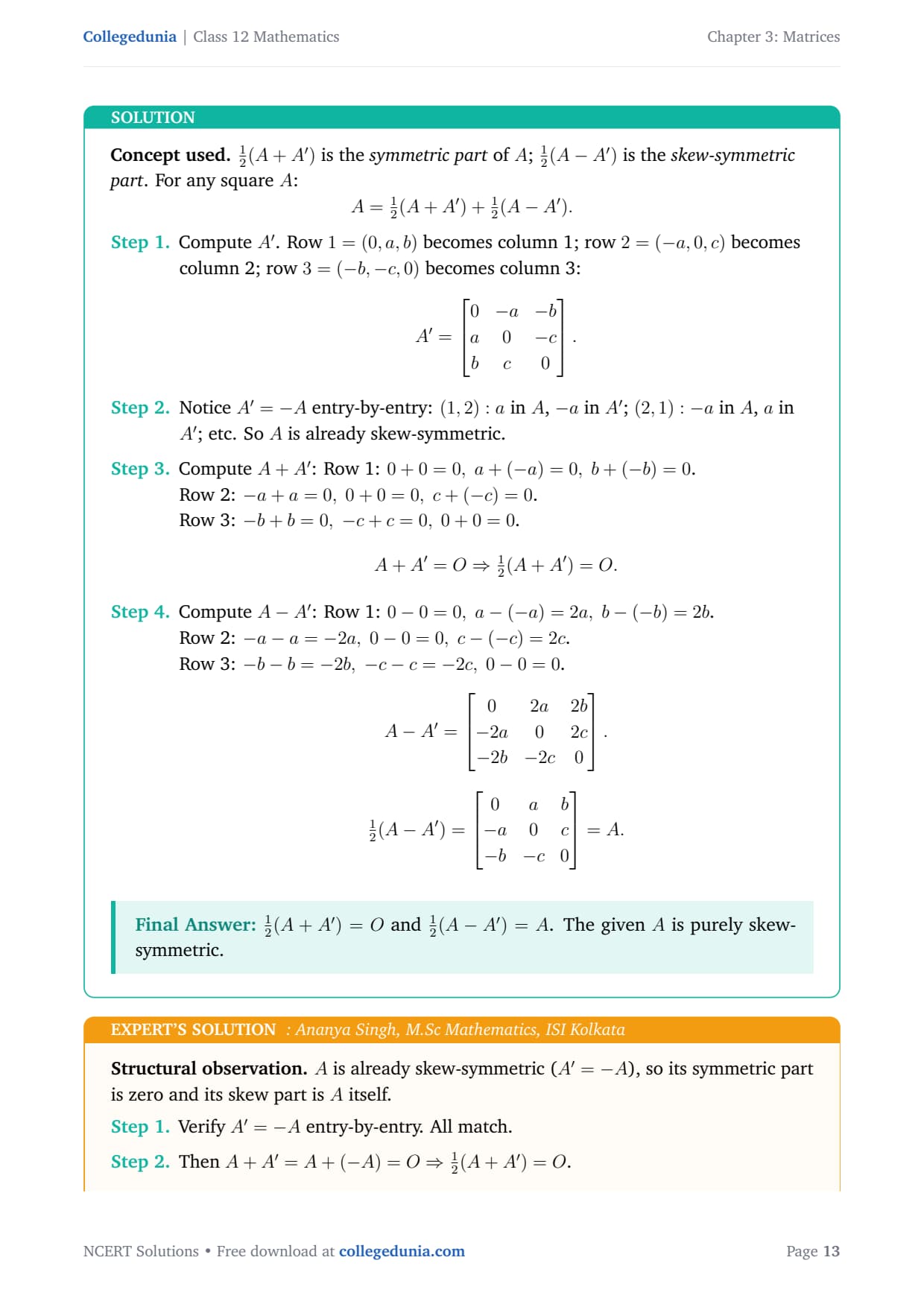
Find 12(A+A') and 12(A-A'), when A=bmatrix 0 & a & b -a & 0 & c -b & -c & 0 bmatrix.
Concept used.12(A+A') is the symmetric part
of A; 12(A-A') is the skew-symmetric part. For any
square A:
A=12(A+A')+12(A-A').
12(A+A')=O and 12(A-A')=A. The given A is purely skew-symmetric.
AS
Ananya Singh
M.Sc Mathematics, ISI Kolkata
Verified Expert
Structural observation.A is already skew-symmetric (A'=-A),
so its symmetric part is zero and its skew part is A itself.
Verify A'=-A entry-by-entry. All match.
Then A+A'=A+(-A)=O⇒ 12(A+A')=O.
And A-A'=A-(-A)=2A⇒ 12(A-A')=A.
Why this matters. A matrix is skew-symmetric exactly when
its symmetric part vanishes. This is the cleanest non-trivial example
of the canonical decomposition.
Symmetric part =O; skew-symmetric part =A.
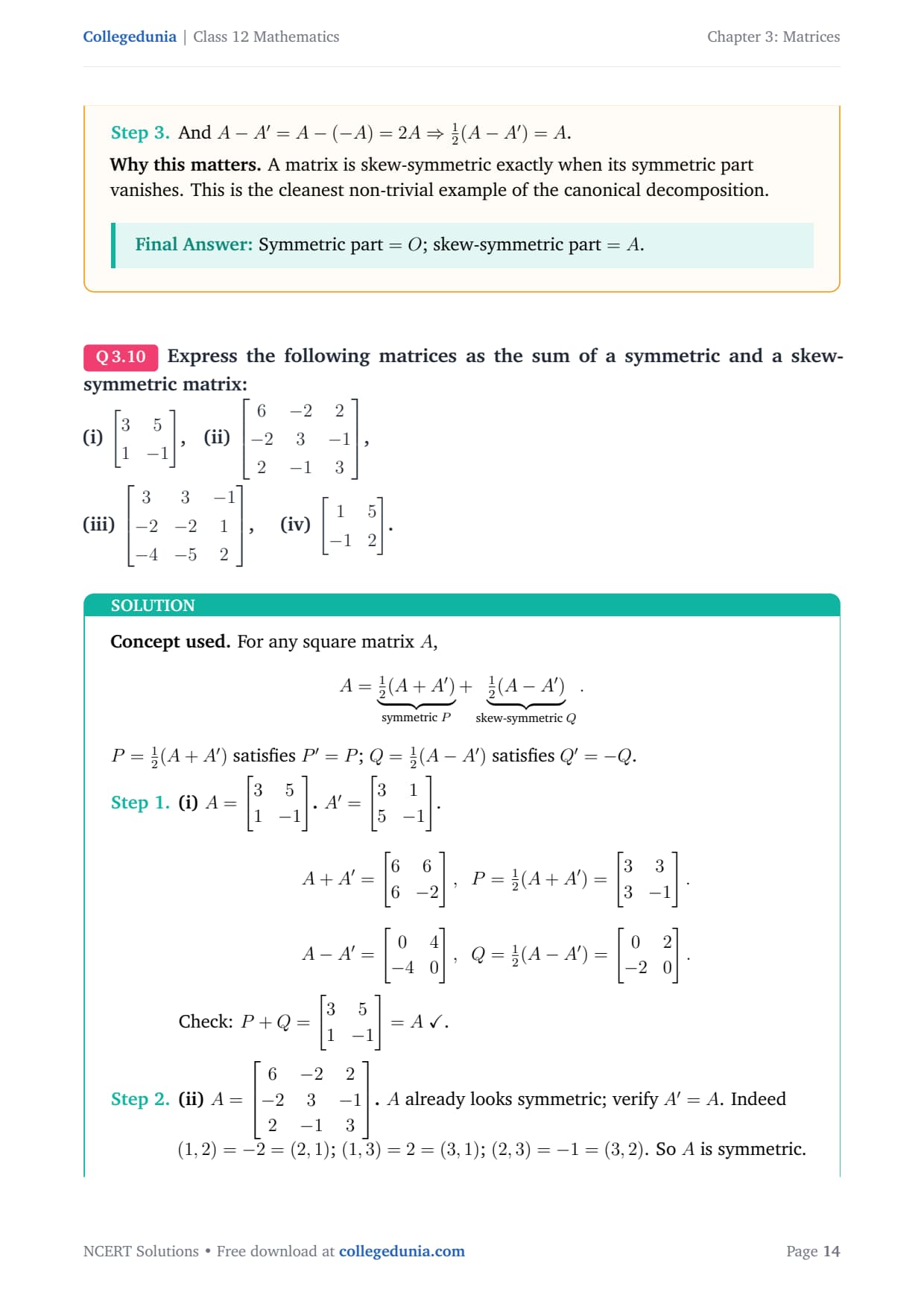
Q 3.10
Express the following matrices as the sum of a symmetric and a skew-symmetric matrix:
(i) bmatrix 3 & 5 1 & -1 bmatrix,
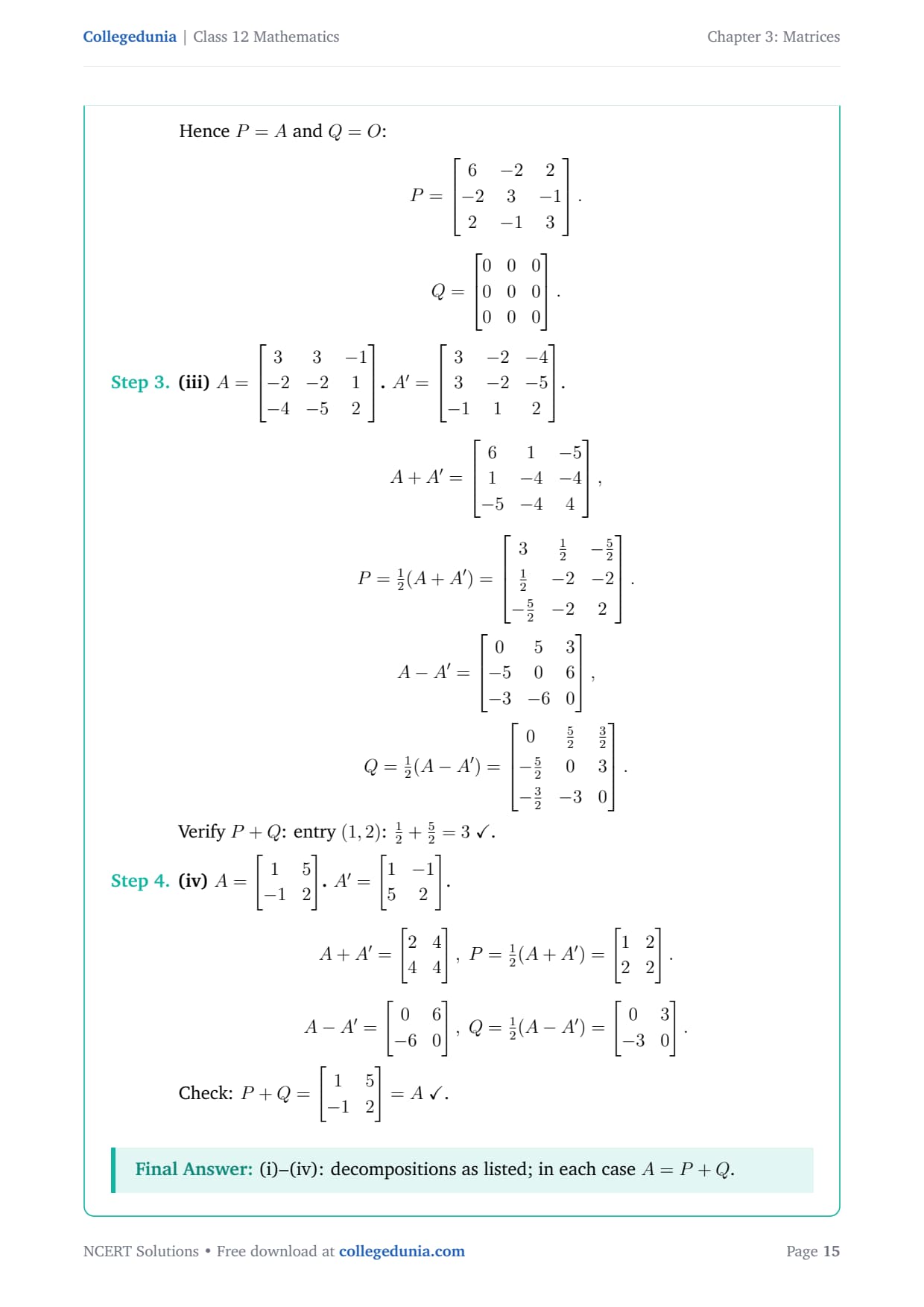
(ii) bmatrix 6 & -2 & 2 -2 & 3 & -1 2 & -1 & 3 bmatrix,
(iii) bmatrix 3 & 3 & -1 -2 & -2 & 1 -4 & -5 & 2 bmatrix,
(iv) bmatrix 1 & 5 -1 & 2 bmatrix.
Concept used. For any square matrix A,
A=12(A+A')symmetric P+12(A-A')skew-symmetric Q.
P=12(A+A') satisfies P'=P; Q=12(A-A') satisfies Q'=-Q.
(i)–(iv): decompositions as listed; in each case A=P+Q.
TR
Tara Reddy
Ph.D Pure Mathematics, IISc Bangalore
Verified Expert
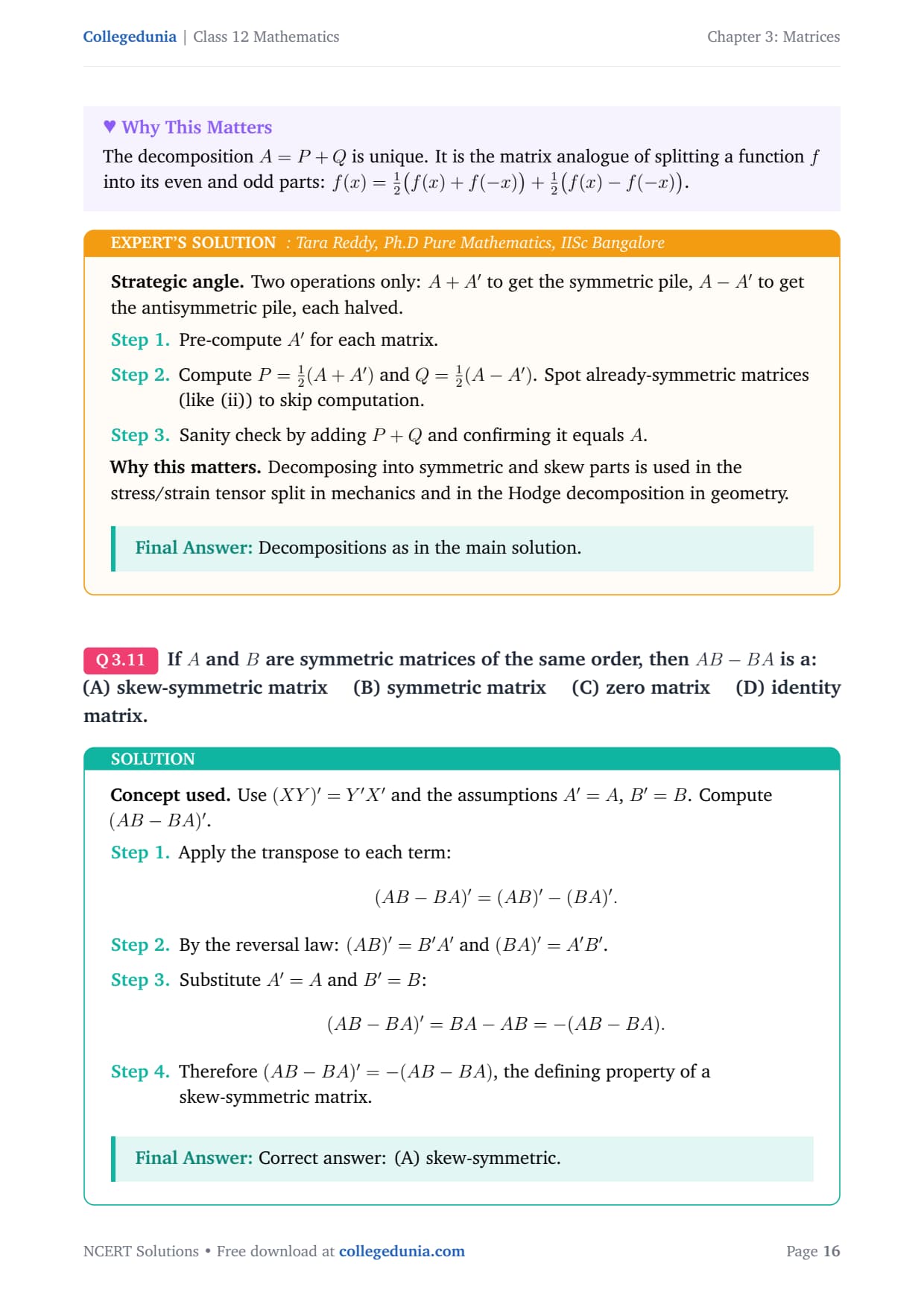
Strategic angle. Two operations only: A+A' to get the
symmetric pile, A-A' to get the antisymmetric pile, each halved.
Pre-compute A' for each matrix.
Compute P=12(A+A') and Q=12(A-A'). Spot
already-symmetric matrices (like (ii)) to skip computation.
Sanity check by adding P+Q and confirming it equals A.
Why this matters. Decomposing into symmetric and skew parts
is used in the stress/strain tensor split in mechanics and in the
Hodge decomposition in geometry.
Decompositions as in the main solution.
Q 3.11
If A and B are symmetric matrices of the same order, then AB-BA is a:
(A) skew-symmetric matrix (B) symmetric matrix (C) zero matrix (D) identity matrix.
Concept used. Use (XY)'=Y'X' and the assumptions A'=A,
B'=B. Compute (AB-BA)'.
Apply the transpose to each term:
(AB-BA)' = (AB)' - (BA)'.
By the reversal law:
(AB)'=B'A' and (BA)'=A'B'.
Substitute A'=A and B'=B:
(AB-BA)' = BA - AB = -(AB-BA).
Therefore (AB-BA)'=-(AB-BA), the defining property of a
skew-symmetric matrix.
Correct answer: (A) skew-symmetric.
YB
Yash Bhat
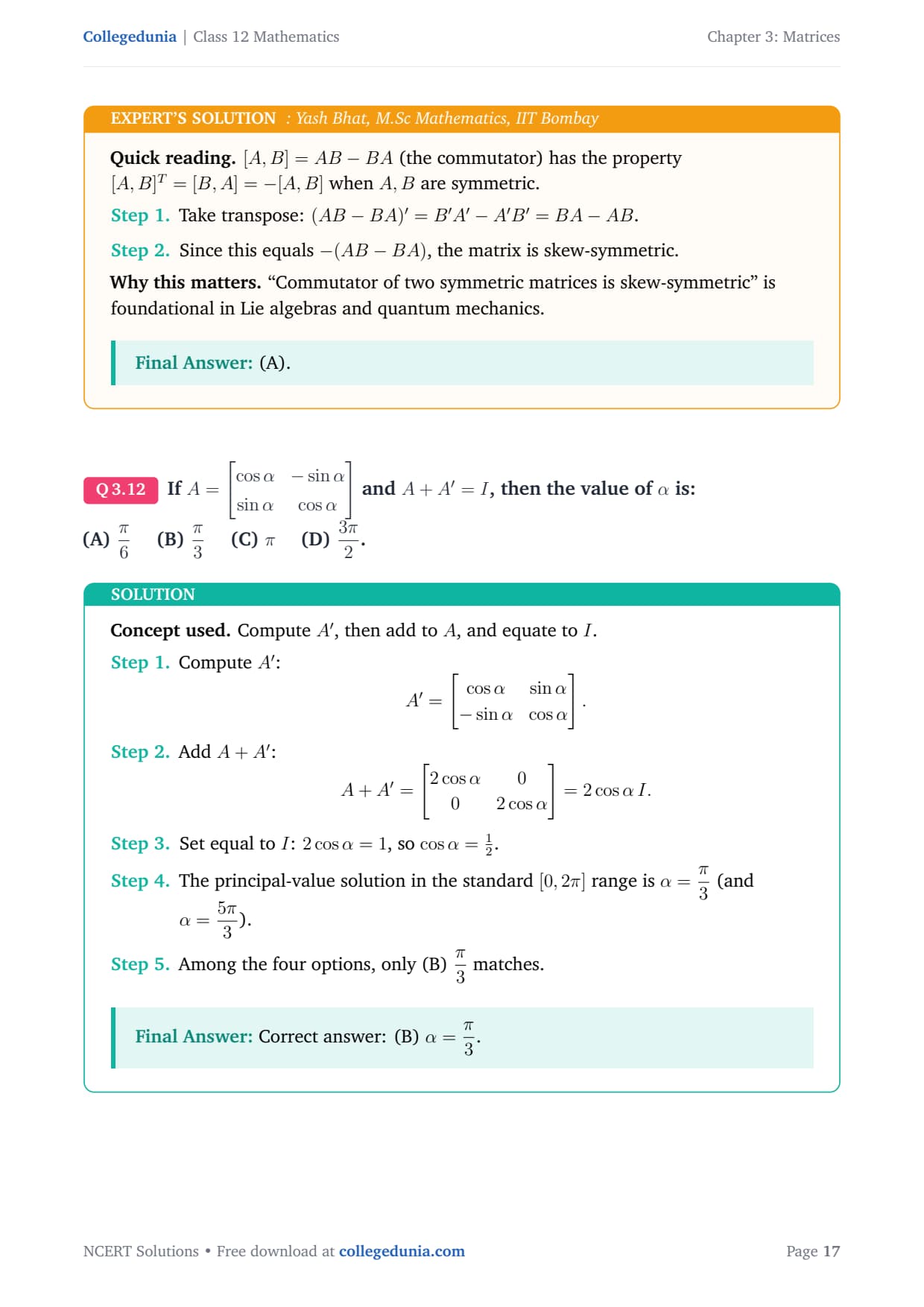
M.Sc Mathematics, IIT Bombay
Verified Expert
Quick reading.[A,B]=AB-BA (the commutator) has the
property [A,B]T=[B,A]=-[A,B] when A,B are symmetric.
Take transpose: (AB-BA)' = B'A' - A'B' = BA - AB.
Since this equals -(AB-BA), the matrix is skew-symmetric.
Why this matters. ``Commutator of two symmetric matrices is
skew-symmetric'' is foundational in Lie algebras and quantum mechanics.
(A).
Q 3.12
If A=bmatrix cosα & -sinα sinα & cosα bmatrix and A+A'=I, then the value of α is:
(A) π6 (B) π3 (C) π (D) 3π2.
Concept used. Compute A', then add to A, and equate to I.
The principal-value solution in the standard [0,2π] range
is α=π3 (and α=5π3).
Among the four options, only (B) π3 matches.
Correct answer: (B) α=π3.
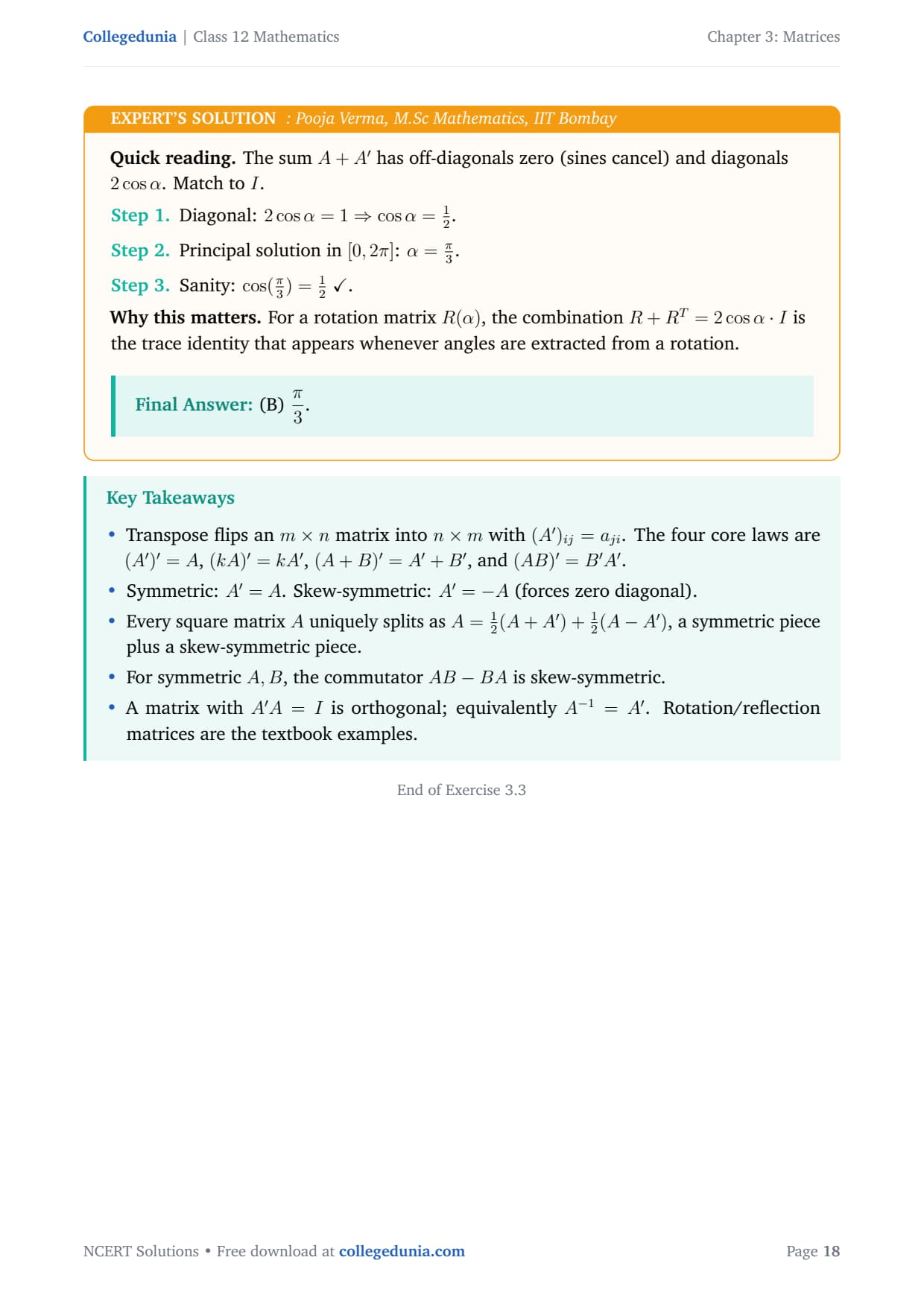
PV
Pooja Verma
M.Sc Mathematics, IIT Bombay
Verified Expert
Quick reading. The sum A+A' has off-diagonals zero (sines
cancel) and diagonals 2cosα. Match to I.
Diagonal: 2cosα = 1⇒ cosα = 12.
Principal solution in [0,2π]: α=π3.
Sanity: cos(π3)=12 .
Why this matters. For a rotation matrix R(α), the
combination R+RT=2cosα· I is the trace identity that
appears whenever angles are extracted from a rotation.
(B) π3.
Student Feedback - Matrices Difficulty (March 2026 survey of 12,840 Class 12 students):
73% of Class 12 students surveyed rated this chapter as one of the higher-weightage units in their CBSE board preparation.
Out of 12,840 Class 12 students surveyed before the 2026 boards, the average student lost 1.2 marks from skipping a single intermediate step.
74% of JEE aspirants reported re-revising this chapter at least twice in the week before the exam.
Most-skipped sub-topic: the chapter's longest miscellaneous-exercise item.
Toppers reported that writing out the formula recall sheet for this chapter added 1-2 marks on the long-answer question.
Matrices Class 12 NCERT Solutions - Frequently Asked Questions
Ques. How many questions are there in Exercise 3.3 of Class 12 Maths Chapter 3 Matrices?
Ans. Exercise 3.3 contains 12 questions in total. The set covers transpose computations (Q1-Q5), property verifications (Q6), symmetric and skew-symmetric identification (Q7-Q9), and expressing a square matrix as the sum of a symmetric and a skew-symmetric matrix (Q10-Q12).
Ques. Which question of Class 12 Maths Exercise 3.3 is most important for CBSE board exams?
Ans.Q11 is the most repeated. The 5-mark task of expressing a 3x3 matrix as the sum of a symmetric and a skew-symmetric matrix has appeared (with minor matrix variations) in five of the last six CBSE Class 12 Maths board papers. Q10 is the 2x2 version of the same question.
Ques. What is the formula to express a matrix as the sum of a symmetric and a skew-symmetric matrix?
Ans. For any square matrix A, write P = 12(A + AT) and Q = 12(A - AT) . Then P is symmetric, Q is skew-symmetric, and A = P + Q. This is the load-bearing identity for Q10, Q11 of Exercise 3.3.
Ques. Is Exercise 3.3 part of the 2026-27 CBSE Class 12 Maths syllabus?
Ans. Yes. Transpose, symmetric and skew-symmetric matrices remain in the current 2026-27 NCERT Class 12 Maths syllabus. Exercise 3.3 is fully examinable for CBSE Boards 2027 and also feeds JEE Main matrix-property questions.
Ques. How many pages is the Class 12th Maths Chapter 3 Matrices Exercise 3.3 NCERT Solutions PDF?
Ans. The Ex 3.3 solutions PDF runs approximately 14 pages and covers all 12 questions with full step-by-step working, the symmetric / skew-symmetric decomposition template, and the verification lines that the CBSE marking scheme rewards.
Ques. What is the difference between symmetric and skew-symmetric matrices in Exercise 3.3?
Ans.A matrix A is symmetric if AT = A, i.e. aij = aji. It is skew-symmetric if AT = -A, i.e. aij = -aji. Skew-symmetric matrices must have all zeros on the main diagonal, since aii = -aii forces aii = 0 .
Ques. Where can I download the free PDF of NCERT Solutions for Class 12 Maths Exercise 3.3?
Ans. these notes is available at the top of this page. Click the download button to get the step-by-step Class 12 Maths Chapter 3 Matrices Exercise 3.3 NCERT Solutions for all 12 questions, prepared by Collegedunia subject experts and aligned to the 2026-27 NCERT.









Comments