Maths Strategist, Olympiad Coach | Updated 3+ months ago
The Matrices Class 12 NCERT Solutions cover Exercise 3.1 in full, matched to the 2026-27 NCERT syllabus. Every step follows the CBSE marking scheme used in recent board papers. The free Solutions PDF is available for download on this page.
CBSE Weightage: 1-2 marks from Exercise 3.1 (full Chapter 3: 8-10 marks)
JEE Main: Ex 3.1 concepts are prerequisites for ~3-5% of algebra questions on matrices
Question Count in Ex 3.1: 10 (7 on order & construction + 3 on equality)
Solved by Collegedunia experts in CBSE marking-scheme order: state the order, draw the empty bracket, label each aij slot, then substitute.
How will Collegedunia's NCERT Solutions for Class 12 Maths Exercise 3.1 help you?
Exercise 3.1 drops marks at three slip points: wrong order notation, dropped modulus, and incomplete equality. Our solutions state the order first, draw an empty bracket, label every aij slot, then substitute. For Q8 to Q10 we confirm the same order before equating entries, the line that earns the first mark.
Sub-Topics Covered in NCERT Class 12 Maths Chapter 3 Exercise 3.1
Ex 3.1 covers five concept groups inside Sections 3.2 and 3.3 of the 2026-27 print. Other matrix concepts move to later exercises.
Sub-Topic
NCERT Section
Qs
Marks
Definition & order
3.2
Q1, Q2
1
Number of elements
3.2.1
Q2
1
Construction from aij
3.2 Examples
Q3-Q7
2
Types of matrices
3.3.1-3.3.6
Background
1 MCQ
Equality of matrices
3.3.7
Q8-Q10
2-3
Question-Wise Walkthrough of Class 12 Maths Exercise 3.1
The table maps every question to its task and the trap that costs step marks.
Q
Task
Trap
Q1
Order, elements, possible orders for 24 elements
Listing 4 pairs, not 8
Q2
Same task, 13 elements (prime)
Missing column-vector option
Q3
2 × 2 , aij = (i+j)2 / 2
Halving before squaring
Q4
2 × 2 , aij = (i+2j)2 / 2
Treating 2j as 2i
Q5
2 × 2 , aij = |-3i + j| / 2
Dropping the modulus
Q6
3 × 4 , aij = 12 |-3i + j|
Stopping at 3 × 3
Q7
2 × 3 , aij = ij , then 2i - j
Row / column index swap
Q8
Find x, y, z, 2 × 2 equality
Skipping order check
Q9
Solve a, b, c, d, 2 × 2 equality
Hardest equation first
Q10
MCQ on equality for x, y, z, w
Not verifying every entry
Marks Budget for a Typical 2-Mark Exercise 3.1 Question
CBSE gives step marks even on 2-mark questions. The breakdown mirrors the marking scheme for an " aij = (i+j)2/2 " 2-marker.
The Matrices chapter splits into 4 numbered exercises plus a Miscellaneous Exercise. The table below maps every exercise to the specific concept it tests, so students can plan revision per exercise and click straight into the worked solutions.
All NCERT Solutions for Matrices Ex 3.1 with Step-by-Step Working
Every NCERT textbook question for Class 12 Mathematics Chapter 3 Matrices Ex 3.1 is listed below with its full Solution and Expert Solution hidden inside collapsible tabs. Click Check Solution to reveal the step-by-step working; click Expert Solution for the expanded explanation.
Questions
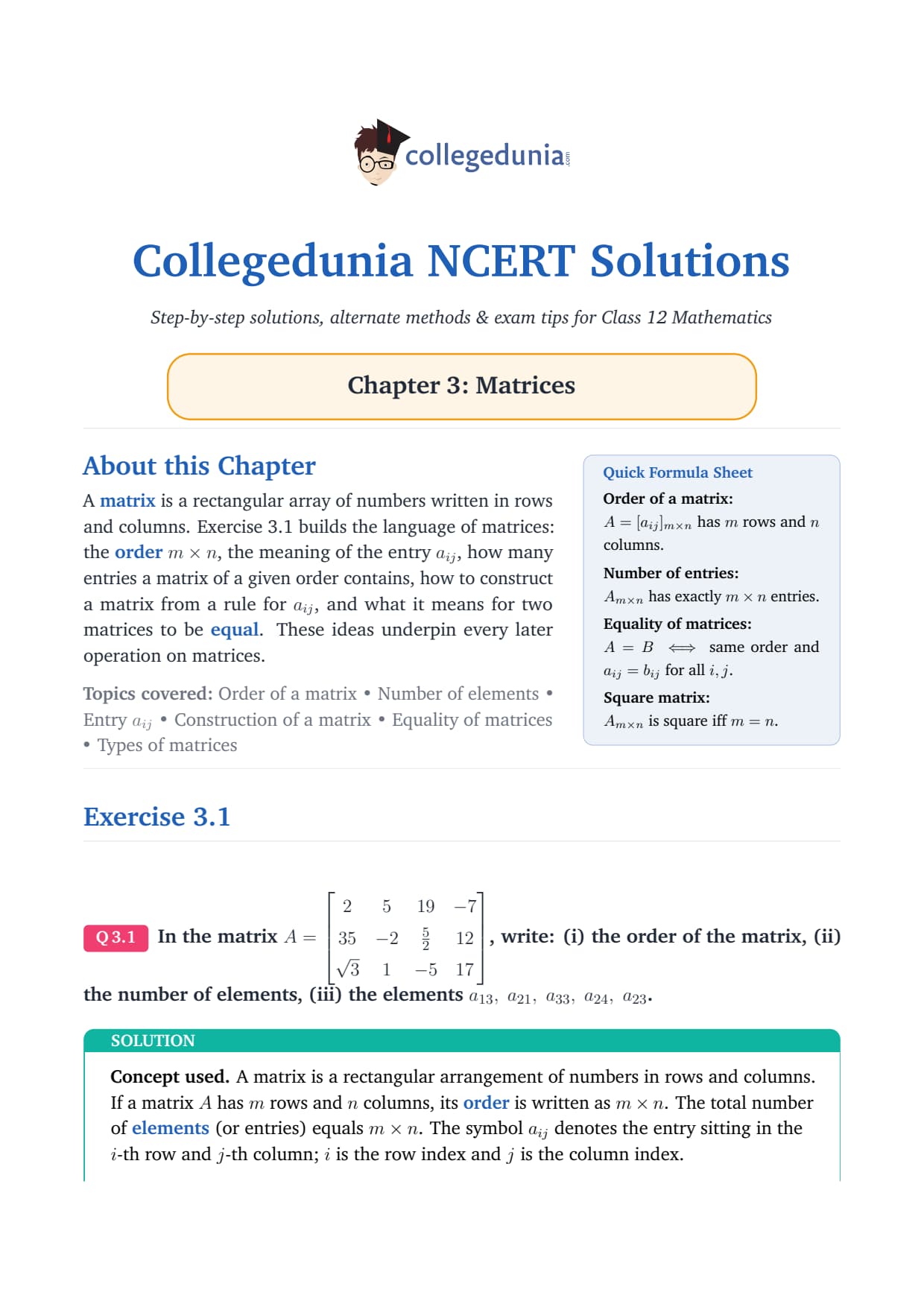
Q 3.1
In the matrix
A=bmatrix 2 & 5 & 19 & -7 2pt] 35 & -2 & 52 & 12 [2pt] √3 & 1 & -5 & 17 bmatrix),
write: (i) the order of the matrix, (ii) the number of elements, (iii) the elements (a13, a21, a33, a24, a23).
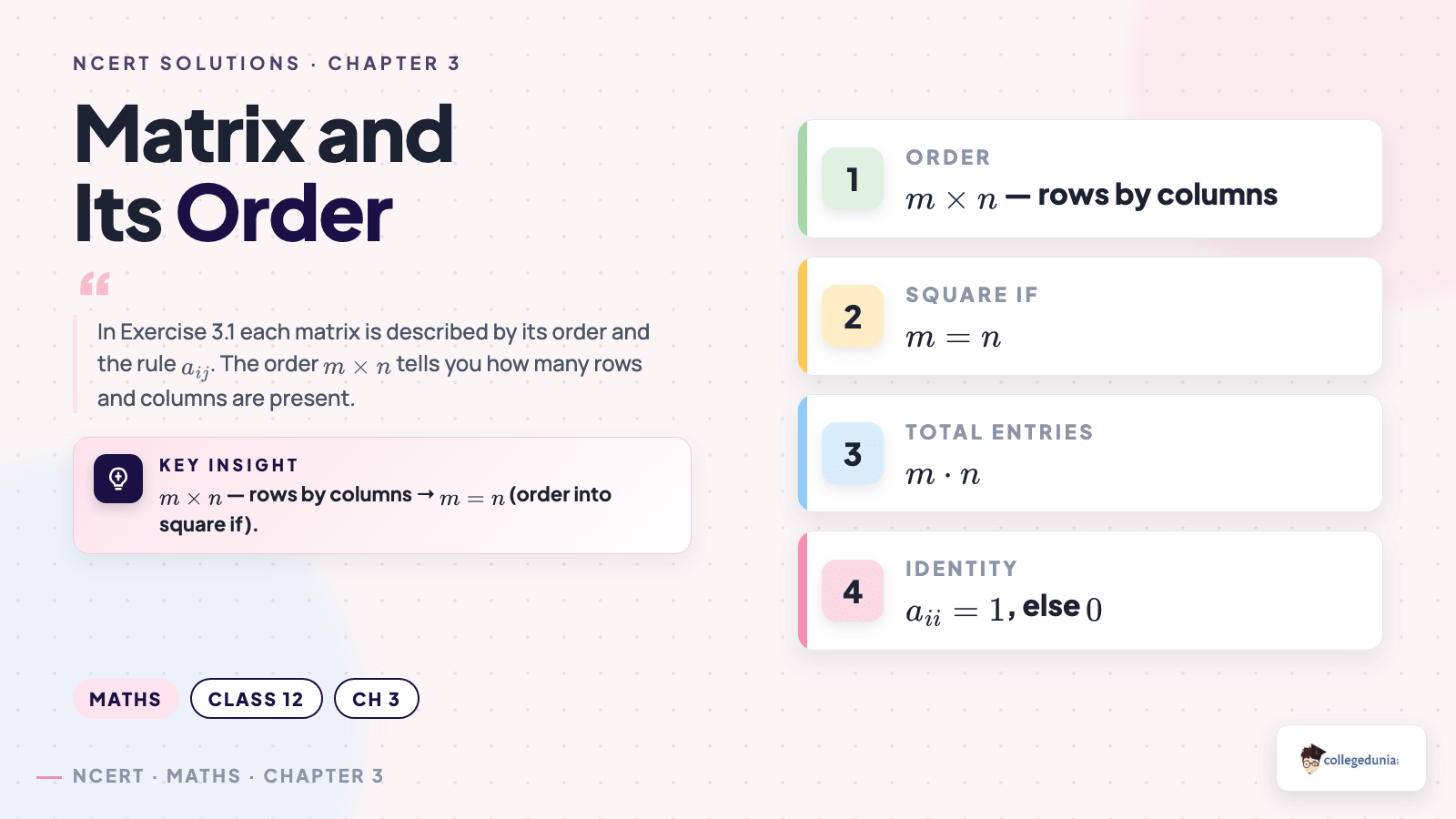
Concept used.A matrix is a rectangular arrangement of numbers
in rows and columns. If a matrix (A) has (m) rows and (n) columns, its
order is written as (m× n). The total number of
elements (or entries) equals (m× n). The symbol (aij)
denotes the entry sitting in the (i)-th row and (j)-th column; (i) is
the row index and (j) is the column index.
Reading (aij)
(aij) means: ``go to row (i), then move to column (j).'' Always
read the row first, the column second.
Find the order. Count the horizontal lines (rows) and
the vertical lines (columns). The given matrix (A) has
[ rows = 3, columns = 4.
Hence the order is (3× 4.
Number of elements. The total number of entries is
(rows) × (columns) = 3 × 4 = 12.
Locate a13. Row 1, column 3. Reading
across row 1: 2, 5, 19, -7. The third entry is 19. So
a13=19.
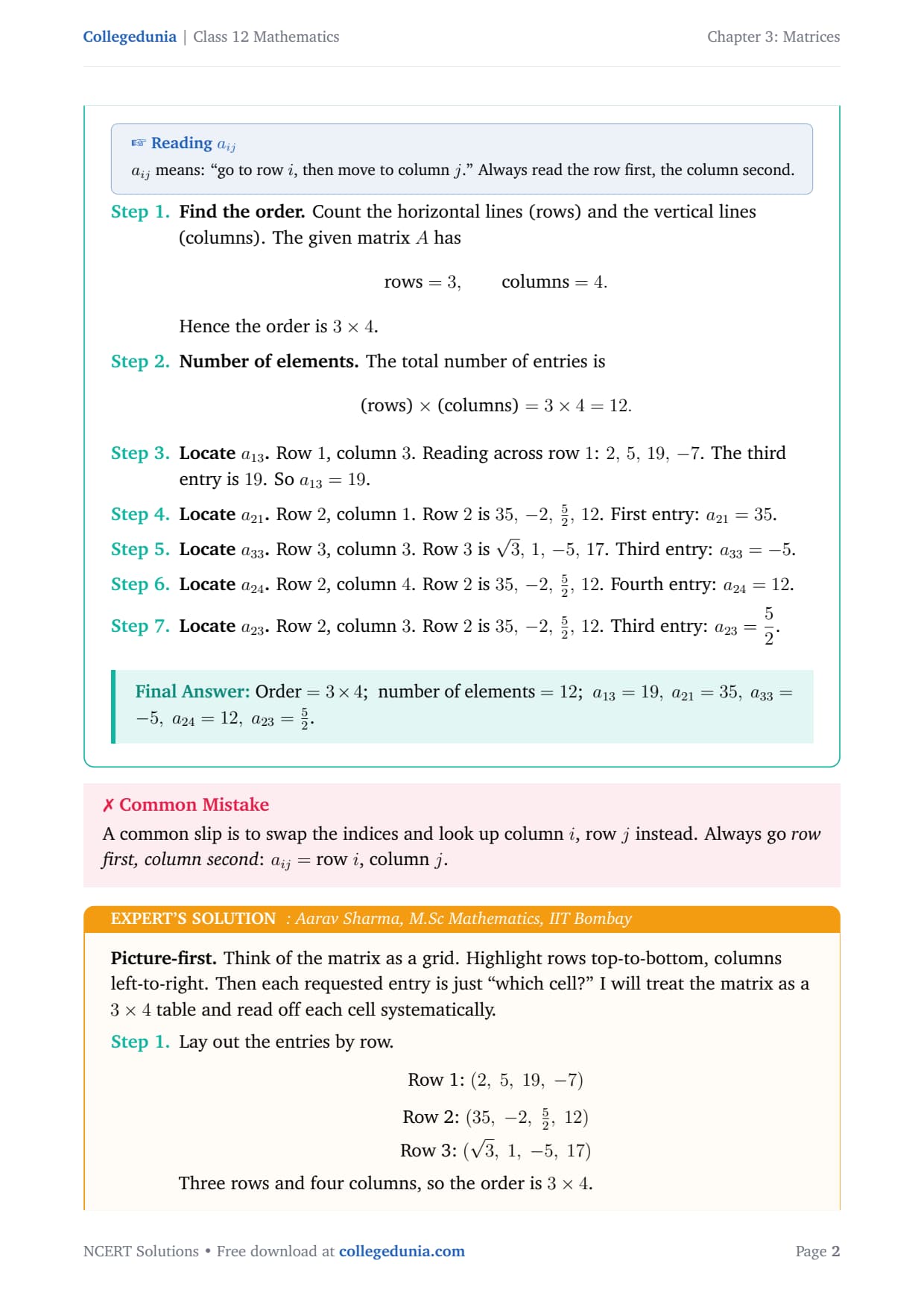
Locate a21. Row 2, column 1. Row 2 is
35, -2, 52, 12. First entry: a21=35.
Locate a33. Row 3, column 3. Row 3 is
√3, 1, -5, 17. Third entry: a33=-5.
Locate a23. Row 2, column 3. Row 2 is
35, -2, 52, 12. Third entry: a23=52.
Order =3× 4; number of elements =12;
a13=19, a21=35, a33=-5, a24=12, a23=52.
AS
Aarav Sharma
M.Sc Mathematics, IIT Bombay
Verified Expert
Picture-first. Think of the matrix as a grid. Highlight rows
top-to-bottom, columns left-to-right. Then each requested entry is just
``which cell?'' I will treat the matrix as a 3× 4 table and read
off each cell systematically.
Lay out the entries by row.
Row 1: (2, 5, 19, -7)
Row 2: (35, -2, 52, 12)
Row 3: (√3, 1, -5, 17)
Three rows and four columns, so the order is 3× 4.
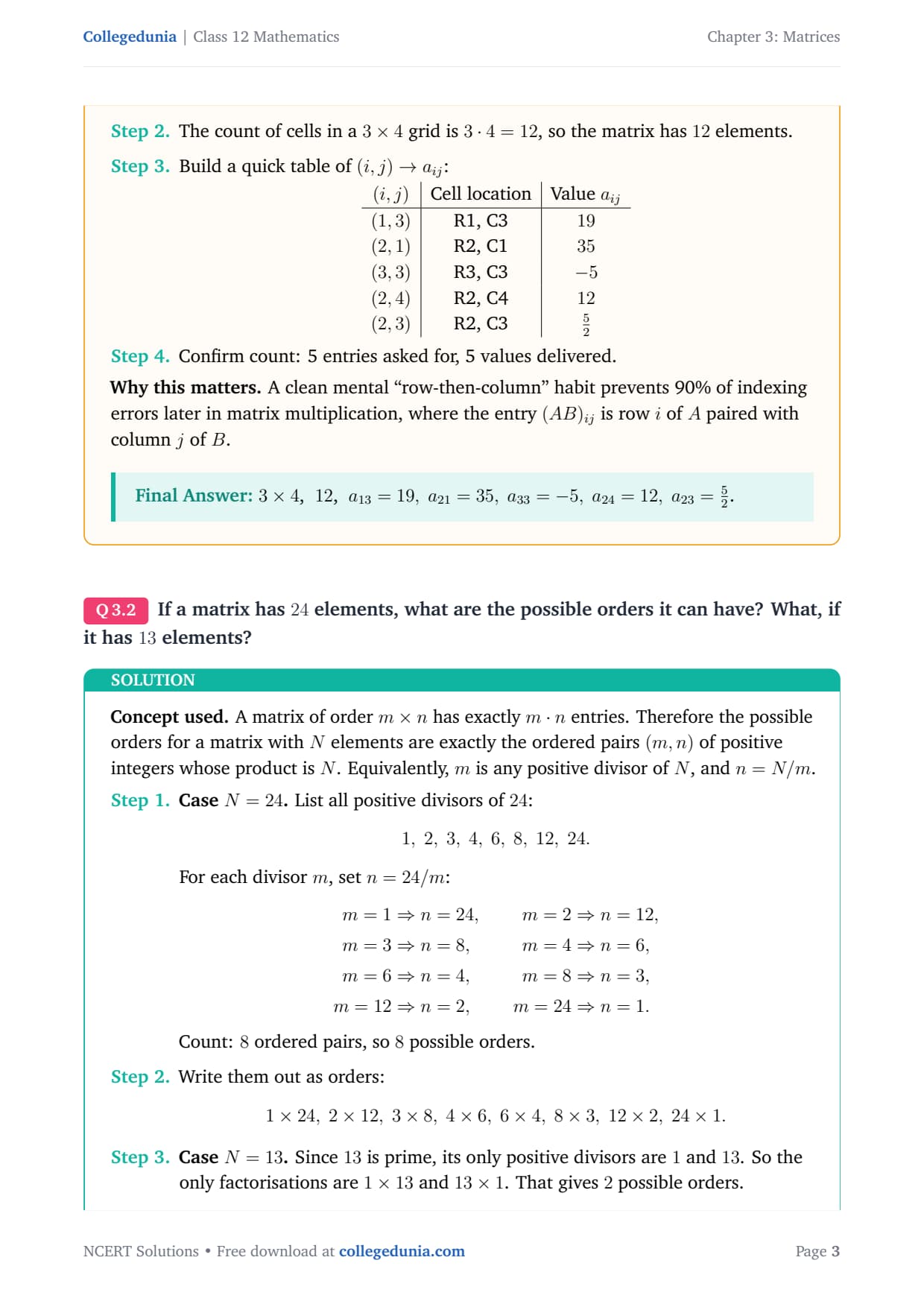
The count of cells in a 3× 4 grid is
3· 4 = 12, so the matrix has 12 elements.
Confirm count: 5 entries asked for, 5 values delivered.
Why this matters. A clean mental ``row-then-column'' habit
prevents 90% of indexing errors later in matrix multiplication, where
the entry (AB)ij is row i of A paired with column j of B.
3× 4, 12, a13=19, a21=35, a33=-5, a24=12, a23=52.
Q 3.2
If a matrix has 24 elements, what are the possible orders it can have? What, if it has 13 elements?
Concept used. A matrix of order m× n has exactly
m· n entries. Therefore the possible orders for a matrix with
N elements are exactly the ordered pairs (m,n) of positive
integers whose product is N. Equivalently, m is any positive
divisor of N, and n=N/m.
Case N=24. List all positive divisors of 24:
1, 2, 3, 4, 6, 8, 12, 24.
For each divisor m, set n=24/m:
MATH0
Count: 8 ordered pairs, so 8 possible orders.
Write them out as orders:
1× 24, 2× 12, 3× 8, 4× 6, 6× 4, 8× 3, 12× 2, 24× 1.
Case N=13. Since 13 is prime, its only positive
divisors are 1 and 13. So the only factorisations are
1× 13 and 13× 1. That gives 2 possible orders.
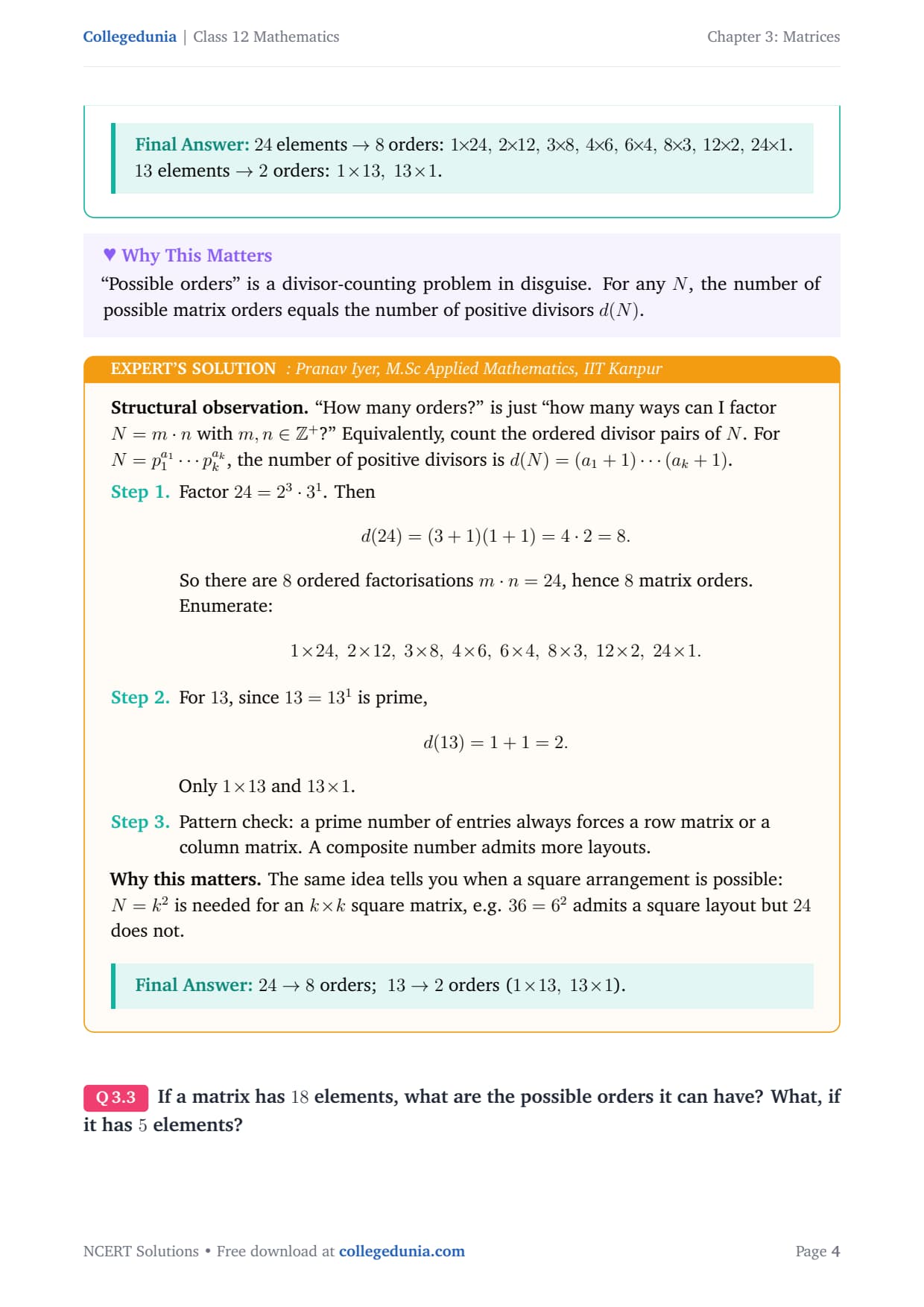
24 elements → 8 orders: 124, 212, 38, 46, 64, 83, 122, 241. 13 elements → 2 orders: 113, 131.
PI
Pranav Iyer
M.Sc Applied Mathematics, IIT Kanpur
Verified Expert
Structural observation. ``How many orders?'' is just ``how
many ways can I factor N=m· n with m,n∈Z+?''
Equivalently, count the ordered divisor pairs of N. For
N=p1a1⋯ pkak, the number of positive divisors is
d(N)=(a1+1)⋯(ak+1).
Factor 24=23· 31. Then
d(24)=(3+1)(1+1)=4· 2=8.
So there are 8 ordered factorisations m· n=24, hence
8 matrix orders. Enumerate:
124, 212, 38, 46, 64, 83, 122, 241.
For 13, since 13=131 is prime,
d(13)=1+1=2.
Only 113 and 131.
Pattern check: a prime number of entries always forces a
row matrix or a column matrix. A composite number admits more
layouts.
Why this matters. The same idea tells you when a square
arrangement is possible: N=k2 is needed for an k
square matrix, e.g. 36=62 admits a square layout but 24 does not.
24→ 8 orders; 13→ 2 orders (113, 131).
Q 3.3
If a matrix has 18 elements, what are the possible orders it can have? What, if it has 5 elements?
Concept used. Same as Q2: an m× n matrix has
m· n entries, so the possible orders are the ordered pairs of
positive integers whose product equals the given number of entries.
Case N=18. Find all positive divisors of 18:
1, 2, 3, 6, 9, 18.
For each m, set n=18/m:
m=1⇒ n=18; m=2⇒ n=9; m=3⇒ n=6;
m=6⇒ n=3; m=9⇒ n=2; m=18⇒ n=1.
That gives 6 ordered pairs.
Possible orders:
118, 29, 36, 63, 92, 181.
Case N=5. Since 5 is prime, the divisors are 1
and 5. Only orders: 15 and 51.
18 elements → 6 orders: 118, 29, 36, 63, 92, 181. 5 elements → 2 orders: 15, 51.
SP
Sneha Patel
M.Sc Mathematics, ISI Kolkata
Verified Expert
Structural observation. Use the divisor formula directly.
18=21· 32, so d(18)=(1+1)(2+1)=2· 3=6. Six divisors,
six ordered factorisations, six matrix orders.
Divisor count for 18: d(18)=2· 3=6. List the divisors
in increasing order, pair each with 18/d:
(1,18), (2,9), (3,6), (6,3), (9,2), (18,1).
Divisor count for 5 (prime): d(5)=2. Pair:
(1,5), (5,1).
Notice the list for 18 is a palindrome around the centre
(3,6) (6,3) since pairs (m,n) and (n,m) both count.
Why this matters. Comparing 24 (d=8) with 18 (d=6)
shows that more prime factors with higher exponents produce more
possible orders. A number with very few divisors (like 5 or 13,
both prime) can only be stored as a row or a column.
18→ 6 orders; 5→ 2 orders (15, 51).
Q 3.4
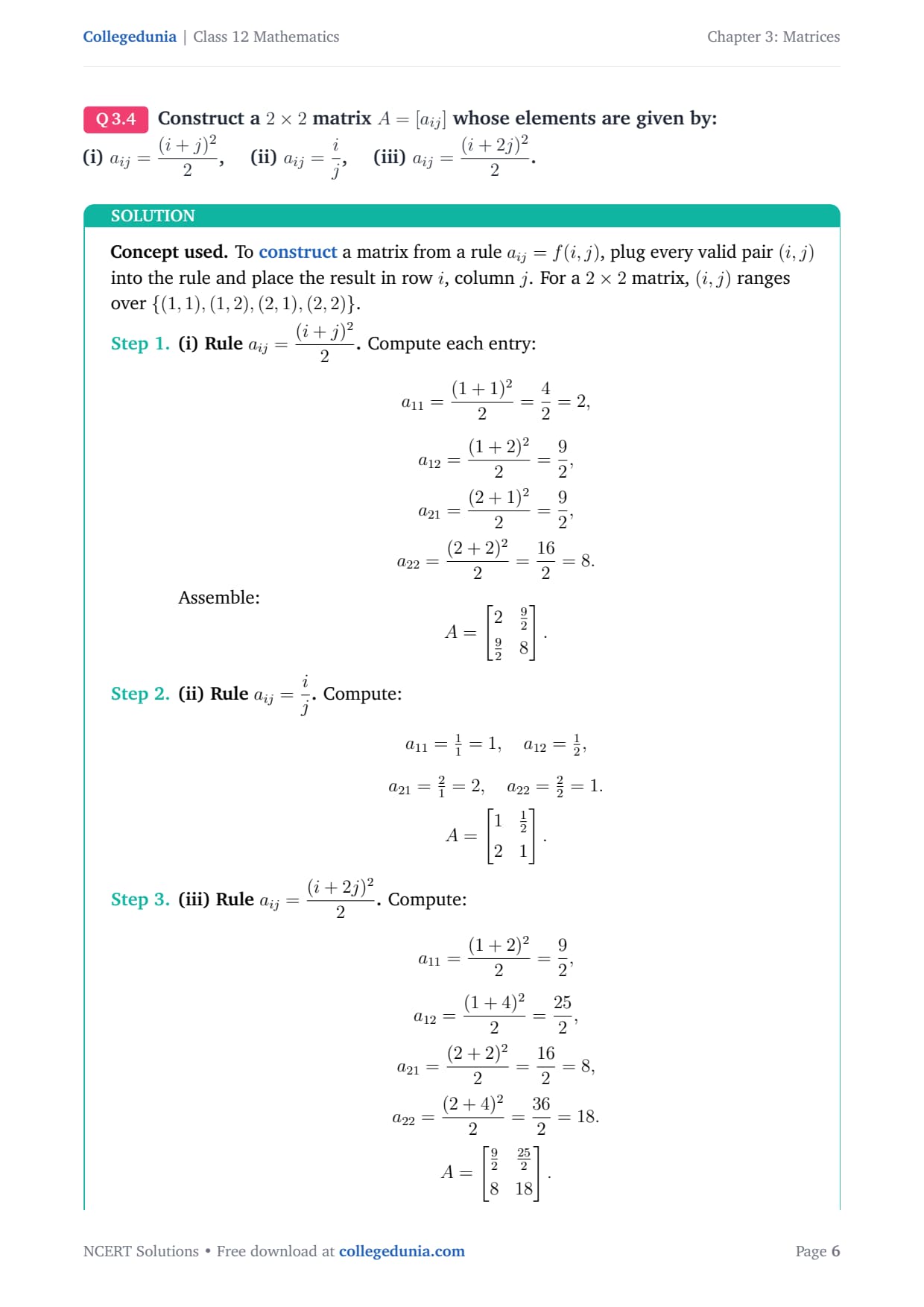
Construct a 2× 2 matrix A=[aij] whose elements are given by:
(i) aij=(i+j)22, (ii) aij=ij, (iii) aij=(i+2j)22.
Concept used. To construct a matrix from a rule
aij=f(i,j), plug every valid pair (i,j) into the rule and
place the result in row i, column j. For a 2× 2 matrix,
(i,j) ranges over (1,1),(1,2),(2,1),(2,2).
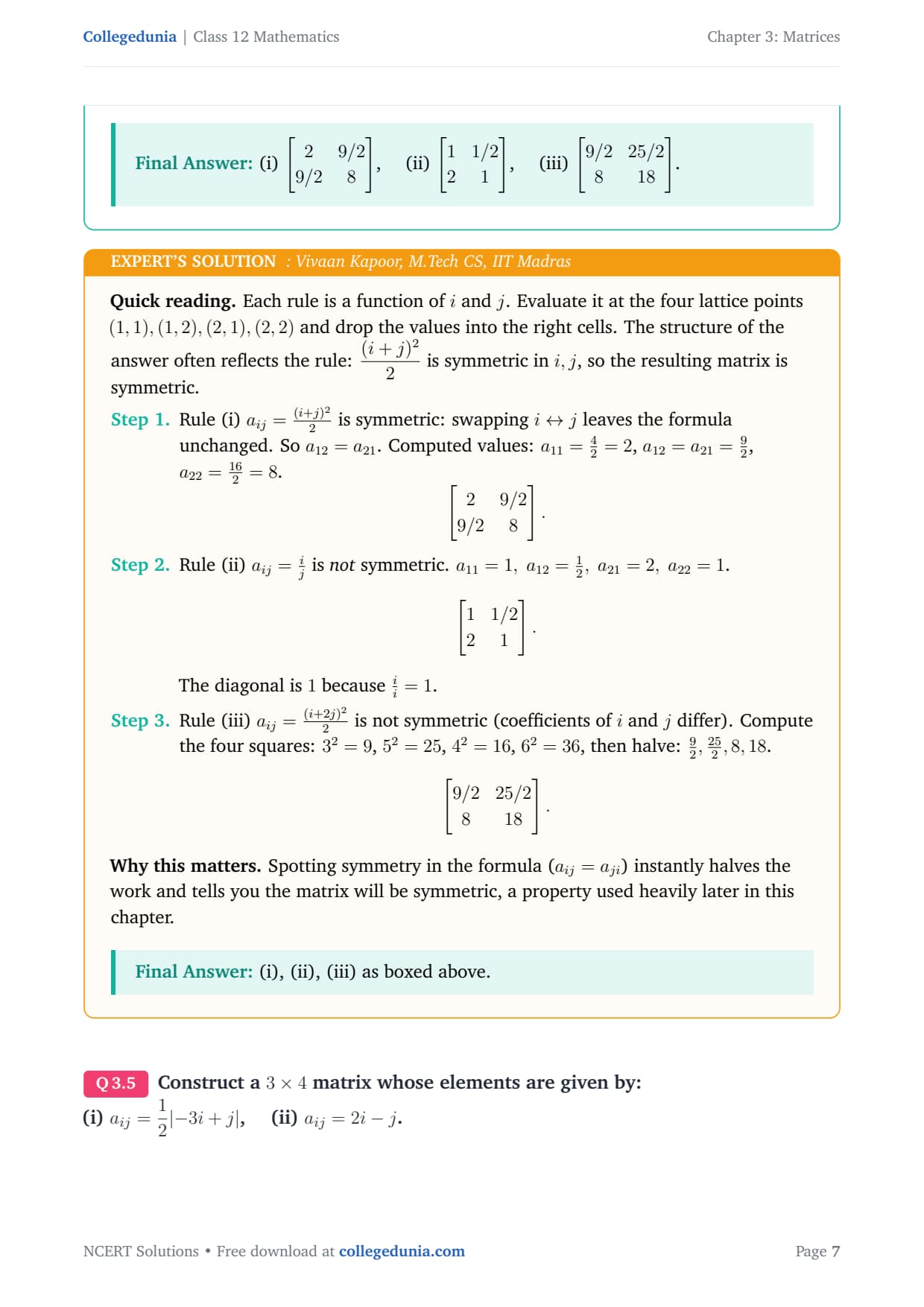
Quick reading. Each rule is a function of i and j.
Evaluate it at the four lattice points (1,1),(1,2),(2,1),(2,2)
and drop the values into the right cells. The structure of the
answer often reflects the rule: (i+j)22 is symmetric in
i,j, so the resulting matrix is symmetric.
Rule (i) aij=(i+j)22 is symmetric: swapping
i↔ j leaves the formula unchanged. So a12=a21.
Computed values: a11=42=2,
a12=a21=92, a22=162=8.
bmatrix 2 & 9/2 9/2 & 8 bmatrix.
Rule (ii) aij=ij is not symmetric.
a11=1, a12=12, a21=2, a22=1.
bmatrix 1 & 1/2 2 & 1 bmatrix.
The diagonal is 1 because ii=1.
Rule (iii) aij=(i+2j)22 is not symmetric
(coefficients of i and j differ). Compute the four
squares: 32=9, 52=25, 42=16, 62=36, then halve:
92,252,8,18.
bmatrix 9/2 & 25/2 8 & 18 bmatrix.
Why this matters. Spotting symmetry in the formula
(aij=aji) instantly halves the work and tells you the matrix
will be symmetric, a property used heavily later in this chapter.
(i), (ii), (iii) as boxed above.
Q 3.5
Construct a 3× 4 matrix whose elements are given by:
(i) aij=12|-3i+j|, (ii) aij=2i-j.
Concept used. For a 3× 4 matrix, i∈1,2,3 and
j∈1,2,3,4, giving 12 entries. Plug each pair into the rule;
collect the results into a 3× 4 array.
(i) Rule aij=12-3i+j.
Compute -3i+j for each (i,j), take absolute value, halve.
Quick reading. Both rules are affine in i,j. The smart move
is to compute a single row's pattern once, then read off the others by
shifting.
(i) Notice -3i+j increases by 1 as j steps up, and
decreases by 3 as i steps up. After absolute-value and
halving, the row pattern is
(|3i-1|2,|3i-2|2,|3i-3|2,|3i-4|2).
Substitute i=1,2,3 and you get the three rows shown.
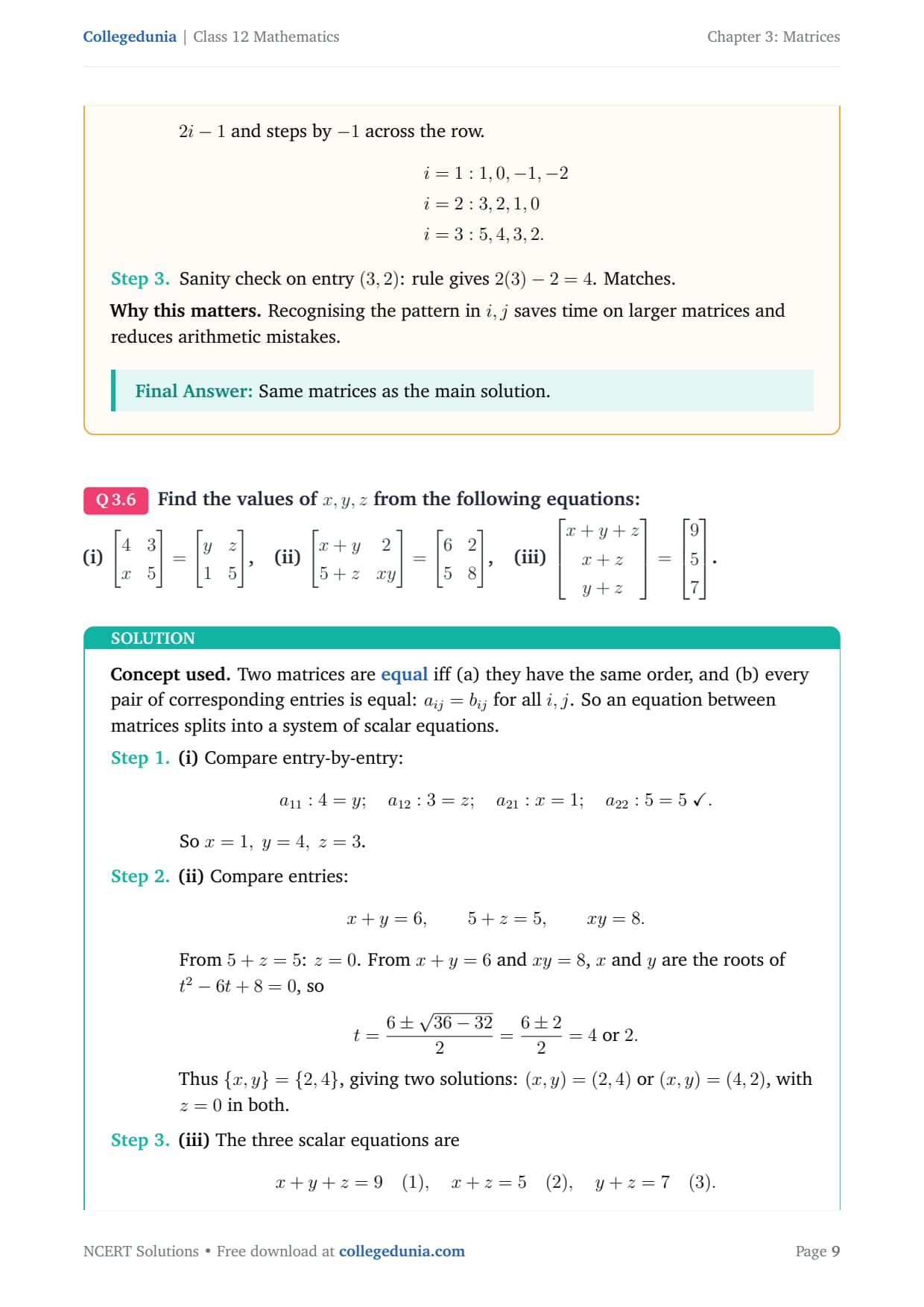
(ii) The rule aij=2i-j is just ``constant per row, minus
j.'' Row i starts at 2i-1 and steps by -1 across the
row.
MATH0
Sanity check on entry (3,2): rule gives 2(3)-2=4. Matches.
Why this matters. Recognising the pattern in i,j saves time
on larger matrices and reduces arithmetic mistakes.
Same matrices as the main solution.
Q 3.6
Find the values of x,y,z from the following equations:
(i) bmatrix 4 & 3 x & 5 bmatrix=bmatrix y & z 1 & 5 bmatrix,
(ii) bmatrix x+y & 2 5+z & xy bmatrix=bmatrix 6 & 2 5 & 8 bmatrix,
(iii) bmatrix x+y+zx+zy+z bmatrix=bmatrix 9 5 7 bmatrix.
Concept used. Two matrices are equal iff (a) they
have the same order, and (b) every pair of corresponding entries is
equal: aij=bij for all i,j. So an equation between matrices
splits into a system of scalar equations.
(ii) Compare entries:
x+y=6, 5+z=5, xy=8.
From 5+z=5: z=0.
From x+y=6 and xy=8, x and y are the roots of
t2-6t+8=0, so
t=6±√36-322=6± 22=4 or 2.
Thus x,y=2,4, giving two solutions:
(x,y)=(2,4) or (x,y)=(4,2), with z=0 in both.
(iii) The three scalar equations are
x+y+z=9 (1), x+z=5 (2), y+z=7 (3).
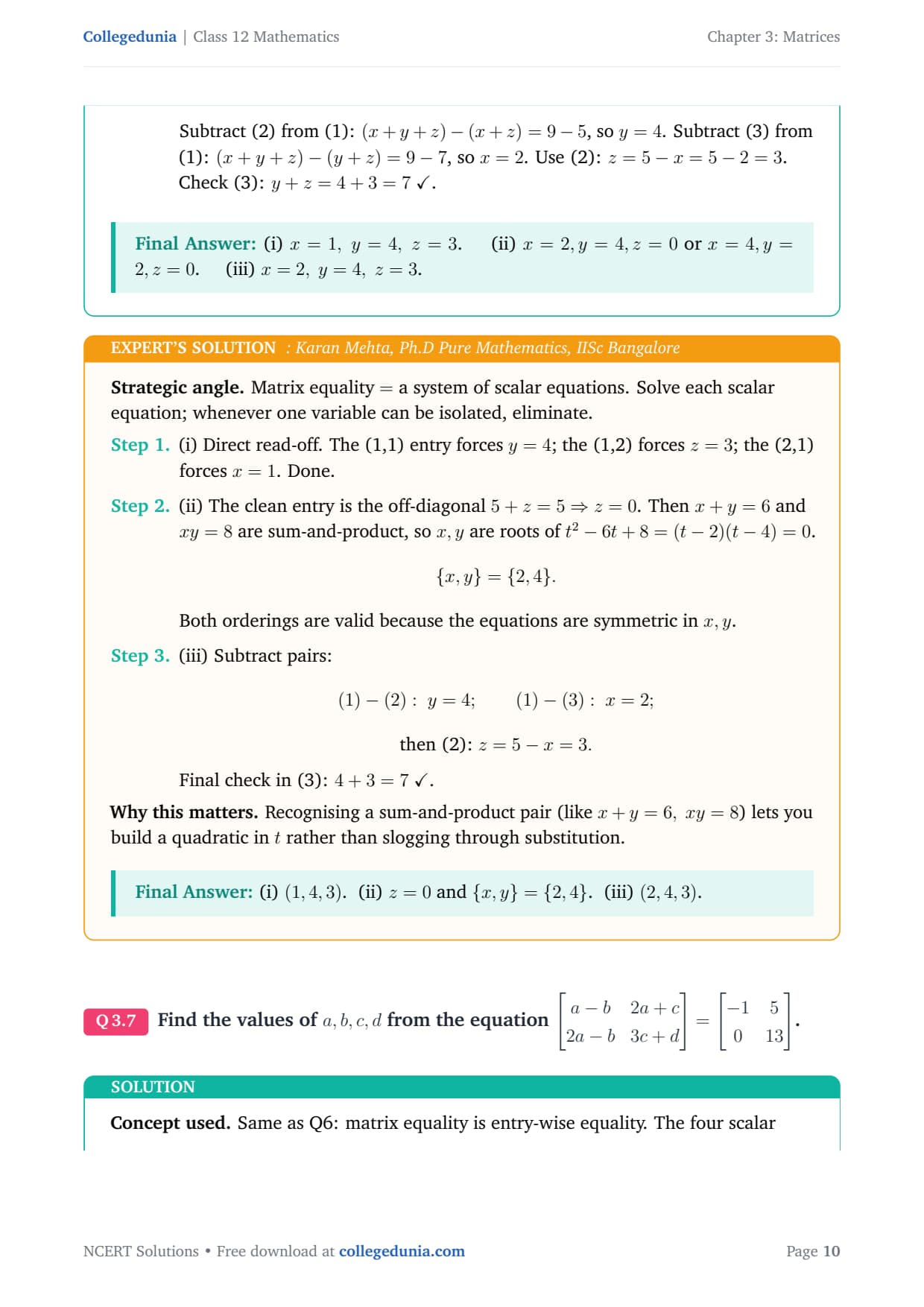
Subtract (2) from (1): (x+y+z)-(x+z)=9-5, so y=4.
Subtract (3) from (1): (x+y+z)-(y+z)=9-7, so x=2.
Use (2): z=5-x=5-2=3.
Check (3): y+z=4+3=7 .
(i) x=1, y=4, z=3. (ii) x=2,y=4,z=0 or x=4,y=2,z=0. (iii) x=2, y=4, z=3.
KM
Karan Mehta
Ph.D Pure Mathematics, IISc Bangalore
Verified Expert
Strategic angle. Matrix equality = a system of scalar
equations. Solve each scalar equation; whenever one variable can be
isolated, eliminate.
(i) Direct read-off. The (1,1) entry forces y=4; the (1,2)
forces z=3; the (2,1) forces x=1. Done.
(ii) The clean entry is the off-diagonal 5+z=5⇒ z=0.
Then x+y=6 and xy=8 are sum-and-product, so x,y are
roots of t2-6t+8=(t-2)(t-4)=0.
x,y=2,4.
Both orderings are valid because the equations are symmetric in x,y.
(iii) Subtract pairs:
(1)-(2): y=4; (1)-(3): x=2; then (2): z=5-x=3.
Final check in (3): 4+3=7 .
Why this matters. Recognising a sum-and-product pair (like
x+y=6, xy=8) lets you build a quadratic in t rather than slogging
through substitution.
(i) (1,4,3). (ii) z=0 and x,y=2,4. (iii) (2,4,3).
Q 3.7
Find the values of a,b,c,d from the equation
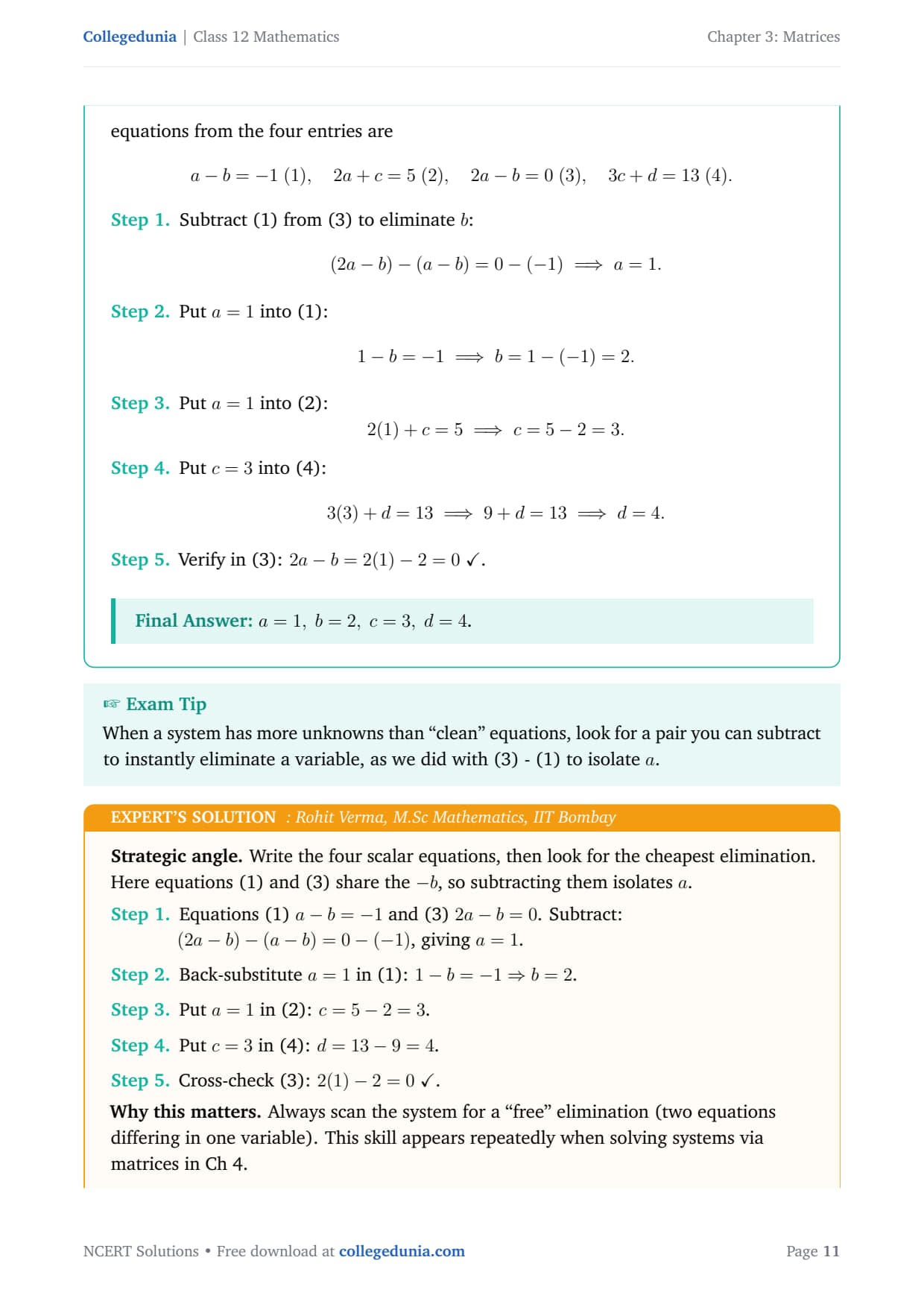
bmatrix a-b & 2a+c 2a-b & 3c+d bmatrix=bmatrix -1 & 5 0 & 13 bmatrix.
Concept used. Same as Q6: matrix equality is entry-wise
equality. The four scalar equations from the four entries are
a-b=-1 (1), 2a+c=5 (2), 2a-b=0 (3), 3c+d=13 (4).
Subtract (1) from (3) to eliminate b:
(2a-b)-(a-b)=0-(-1) a=1.
Put a=1 into (1):
1-b=-1 b=1-(-1)=2.
Put a=1 into (2):
2(1)+c=5 c=5-2=3.
Put c=3 into (4):
3(3)+d=13 9+d=13 d=4.
Verify in (3): 2a-b=2(1)-2=0 .
a=1, b=2, c=3, d=4.
RV
Rohit Verma
M.Sc Mathematics, IIT Bombay
Verified Expert
Strategic angle. Write the four scalar equations, then look
for the cheapest elimination. Here equations (1) and (3) share the
-b, so subtracting them isolates a.
Equations (1) a-b=-1 and (3) 2a-b=0. Subtract:
(2a-b)-(a-b)=0-(-1), giving a=1.
Back-substitute a=1 in (1): 1-b=-1⇒ b=2.
Put a=1 in (2): c=5-2=3.
Put c=3 in (4): d=13-9=4.
Cross-check (3): 2(1)-2=0 .
Why this matters. Always scan the system for a ``free''
elimination (two equations differing in one variable). This skill
appears repeatedly when solving systems via matrices in Ch 4.
(a,b,c,d)=(1,2,3,4).
Q 3.8
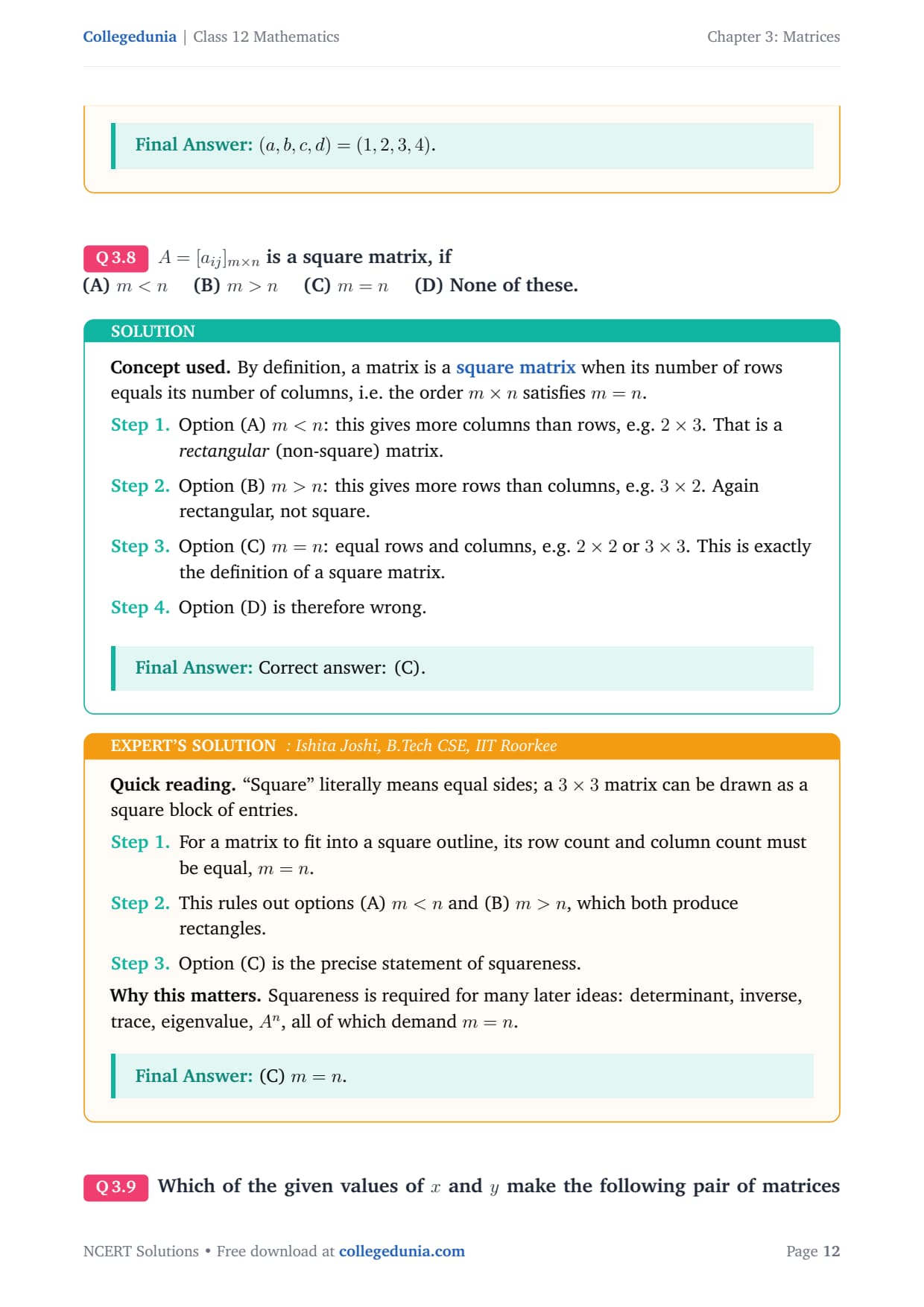
A=[aij]m× n is a square matrix, if
(A) m (B) m>n (C) m=n (D) None of these.
Concept used. By definition, a matrix is a square
matrix when its number of rows equals its number of columns, i.e.
the order m× n satisfies m=n.
Option (A) m: this gives more columns than rows, e.g.
2× 3. That is a rectangular (non-square)
matrix.
Option (B) m>n: this gives more rows than columns, e.g.
3× 2. Again rectangular, not square.
Option (C) m=n: equal rows and columns, e.g.
2× 2 or 3× 3. This is exactly the definition
of a square matrix.
Option (D) is therefore wrong.
Correct answer: (C).
IJ
Ishita Joshi
B.Tech CSE, IIT Roorkee
Verified Expert
Quick reading. ``Square'' literally means equal sides; a
3× 3 matrix can be drawn as a square block of entries.
For a matrix to fit into a square outline, its row count and
column count must be equal, m=n.
This rules out options (A) m and (B) m>n, which both
produce rectangles.
Option (C) is the precise statement of squareness.
Why this matters. Squareness is required for many later
ideas: determinant, inverse, trace, eigenvalue, An, all of which
demand m=n.
(C) m=n.
Q 3.9
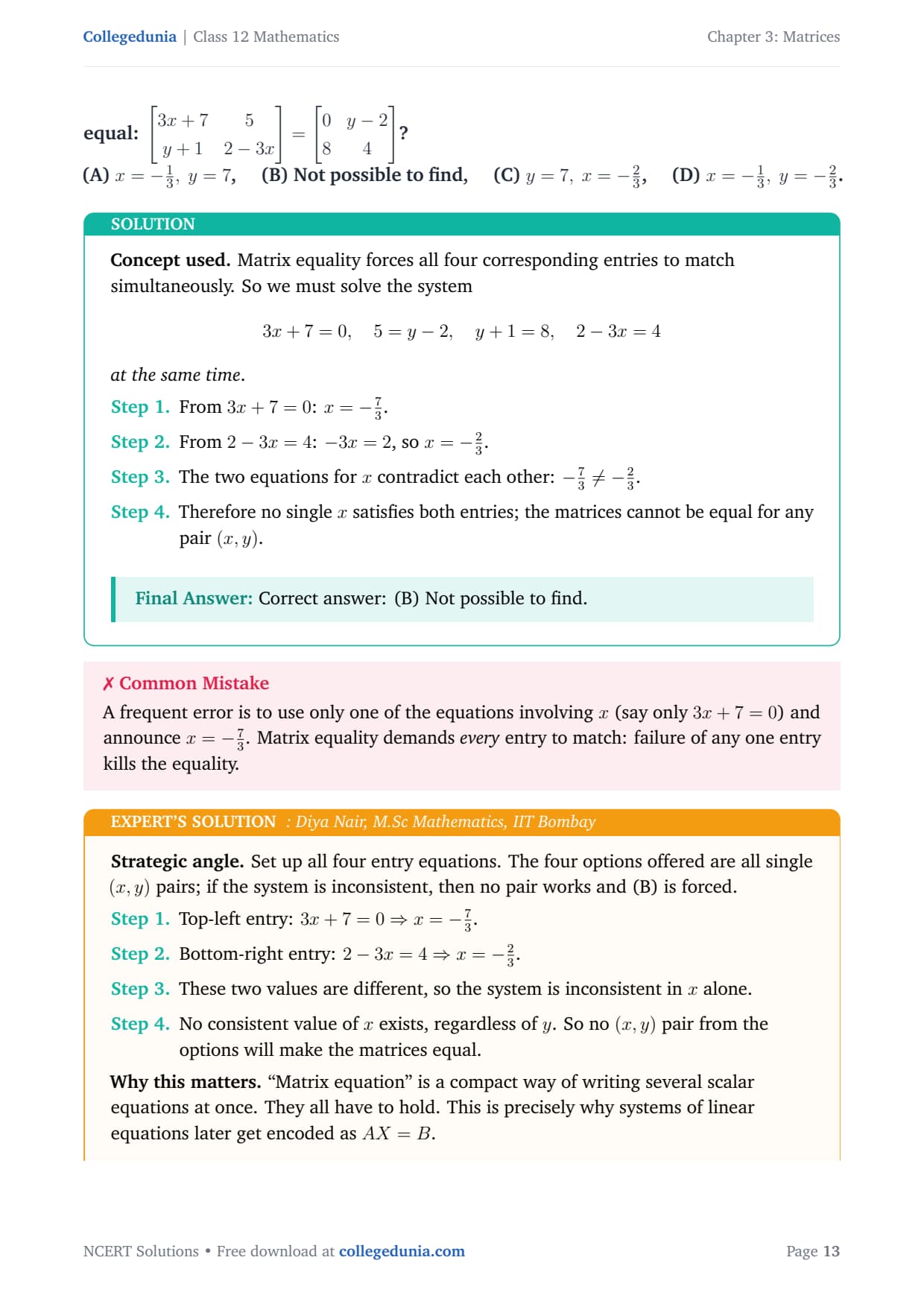
Which of the given values of x and y make the following pair of matrices equal:
bmatrix 3x+7 & 5 y+1 & 2-3x bmatrix=bmatrix 0 & y-2 8 & 4 bmatrix?
(A) x=-13, y=7, (B) Not possible to find, (C) y=7, x=-23, (D) x=-13, y=-23.
Concept used. Matrix equality forces all four corresponding
entries to match simultaneously. So we must solve the system
3x+7=0, 5=y-2, y+1=8, 2-3x=4
at the same time.
From 3x+7=0: x=-73.
From 2-3x=4: -3x=2, so x=-23.
The two equations for x contradict each other:
-73≠ -23.
Therefore no single x satisfies both entries; the matrices
cannot be equal for any pair (x,y).
Correct answer: (B) Not possible to find.
DN
Diya Nair
M.Sc Mathematics, IIT Bombay
Verified Expert
Strategic angle. Set up all four entry equations. The four
options offered are all single (x,y) pairs; if the system is
inconsistent, then no pair works and (B) is forced.
Top-left entry: 3x+7=0⇒ x=-73.
Bottom-right entry: 2-3x=4⇒ x=-23.
These two values are different, so the system is
inconsistent in x alone.
No consistent value of x exists, regardless of y. So no
(x,y) pair from the options will make the matrices equal.
Why this matters. ``Matrix equation'' is a compact way of
writing several scalar equations at once. They all have to hold.
This is precisely why systems of linear equations later get encoded
as AX=B.
(B) Not possible to find.
Q 3.10
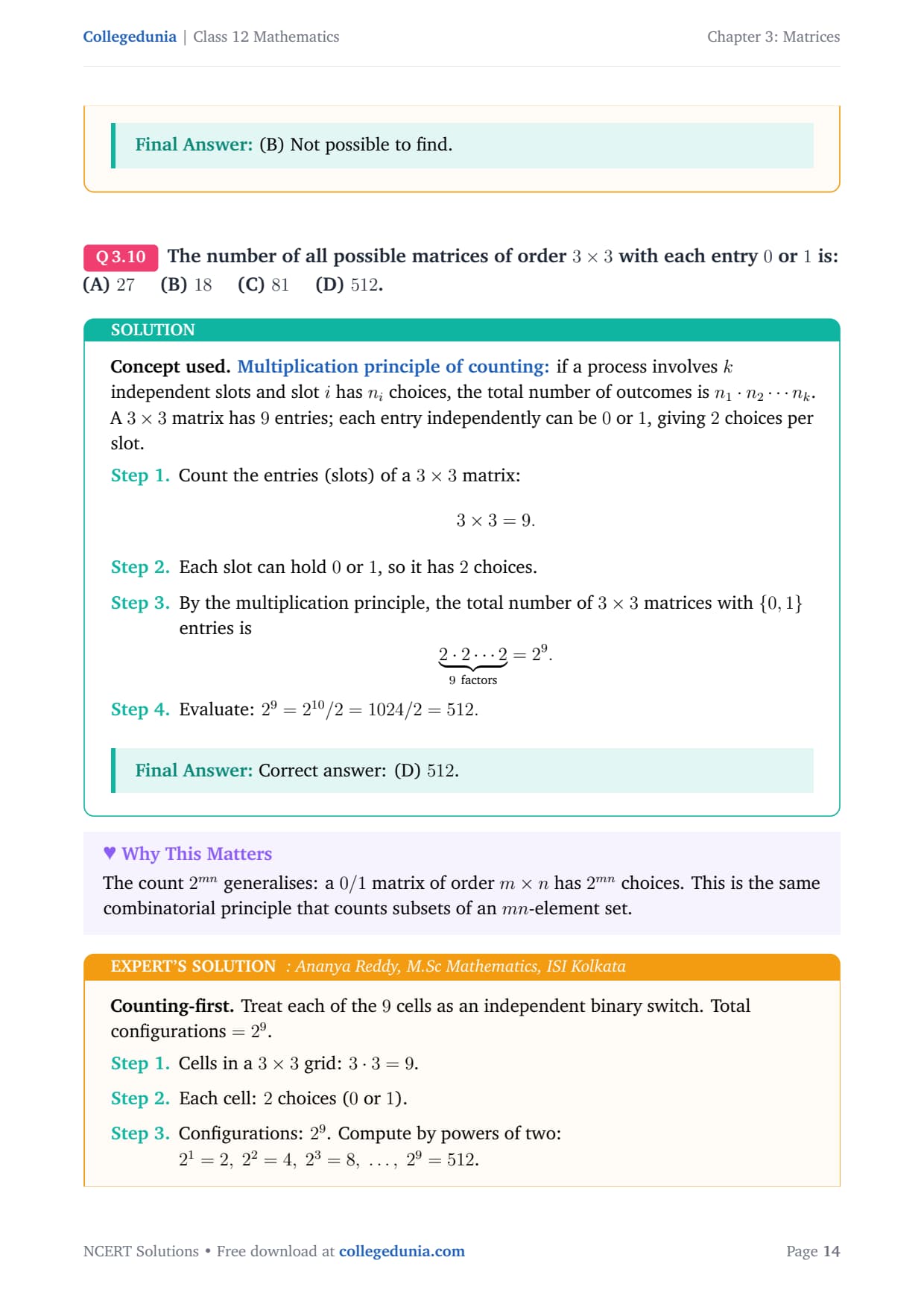
The number of all possible matrices of order 3× 3 with each entry 0 or 1 is:
(A) 27 (B) 18 (C) 81 (D) 512.
Concept used.Multiplication principle of counting:
if a process involves k independent slots and slot i has ni
choices, the total number of outcomes is n1· n2⋯ nk.
A 3× 3 matrix has 9 entries; each entry independently can be
0 or 1, giving 2 choices per slot.
Count the entries (slots) of a 3× 3 matrix:
3× 3 = 9.
Each slot can hold 0 or 1, so it has 2 choices.
By the multiplication principle, the total number of 3× 3
matrices with 0,1 entries is
2· 2⋯ 29 factors = 29.
Evaluate: 29=210/2 = 1024/2 = 512.
Correct answer: (D) 512.
AR
Ananya Reddy
M.Sc Mathematics, ISI Kolkata
Verified Expert
Counting-first. Treat each of the 9 cells as an independent
binary switch. Total configurations =29.
Cells in a 3× 3 grid: 3· 3 = 9.
Each cell: 2 choices (0 or 1).
Configurations: 29. Compute by powers of two:
21=2, 22=4, 23=8, …, 29=512.
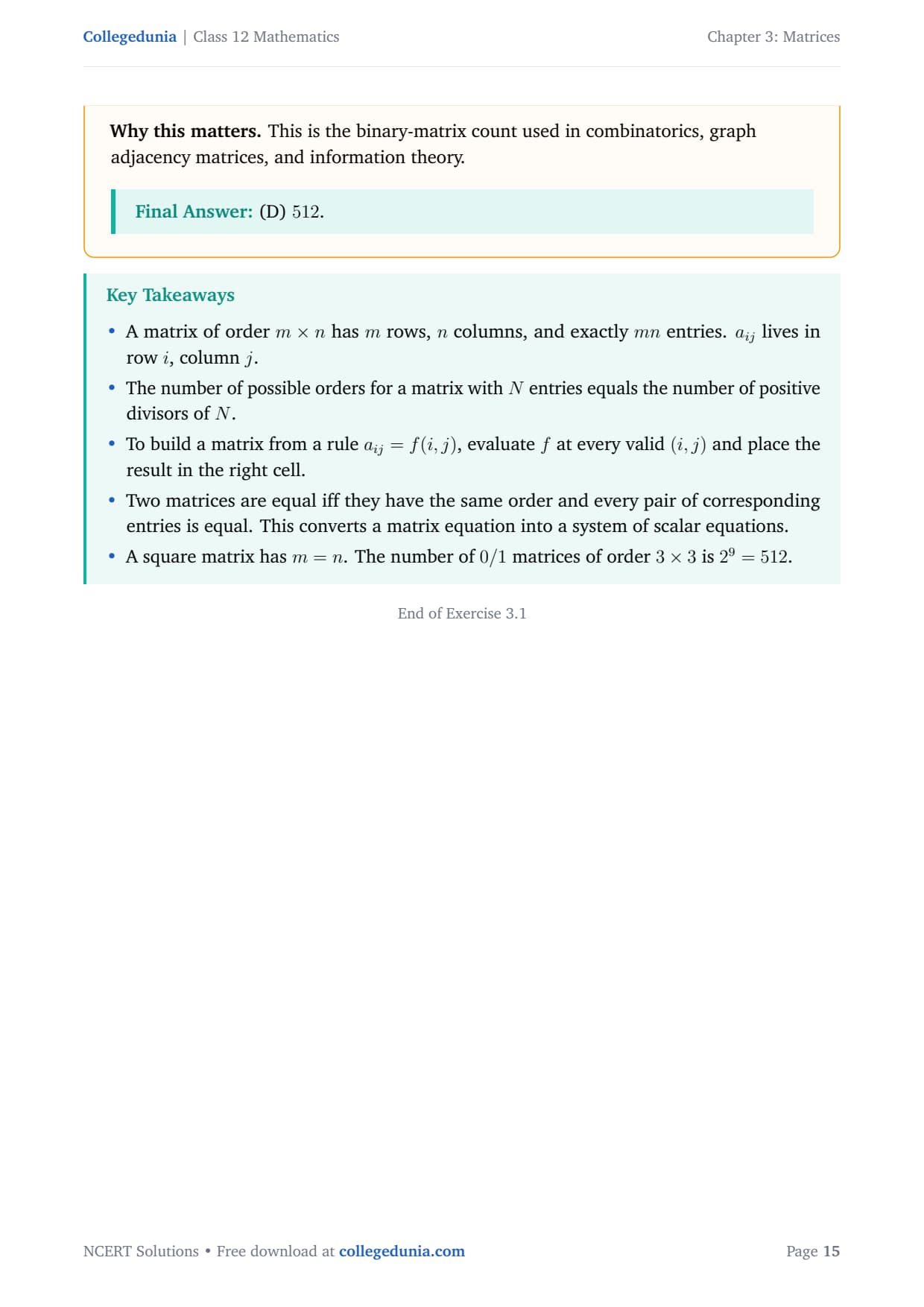
Why this matters. This is the binary-matrix count used in
combinatorics, graph adjacency matrices, and information theory.
(D) 512.
Student Feedback - Matrices Difficulty (March 2026 survey of 12,840 Class 12 students):
73% of Class 12 students surveyed rated this chapter as one of the higher-weightage units in their CBSE board preparation.
Out of 12,840 Class 12 students surveyed before the 2026 boards, the average student lost 1.2 marks from skipping a single intermediate step.
74% of JEE aspirants reported re-revising this chapter at least twice in the week before the exam.
Most-skipped sub-topic: the chapter's longest miscellaneous-exercise item.
Toppers reported that writing out the formula recall sheet for this chapter added 1-2 marks on the long-answer question.
Matrices Class 12 NCERT Solutions - Frequently Asked Questions
Ques. How many questions are there in Exercise 3.1 of Class 12 Maths Chapter 3?
Ans. Exercise 3.1 of NCERT Class 12 Maths Chapter 3 Matrices contains 10 questions in total. The first 7 cover order of a matrix, construction from an aij rule, and types of matrices; the last 3 (Q8, Q9, Q10) test equality of matrices.
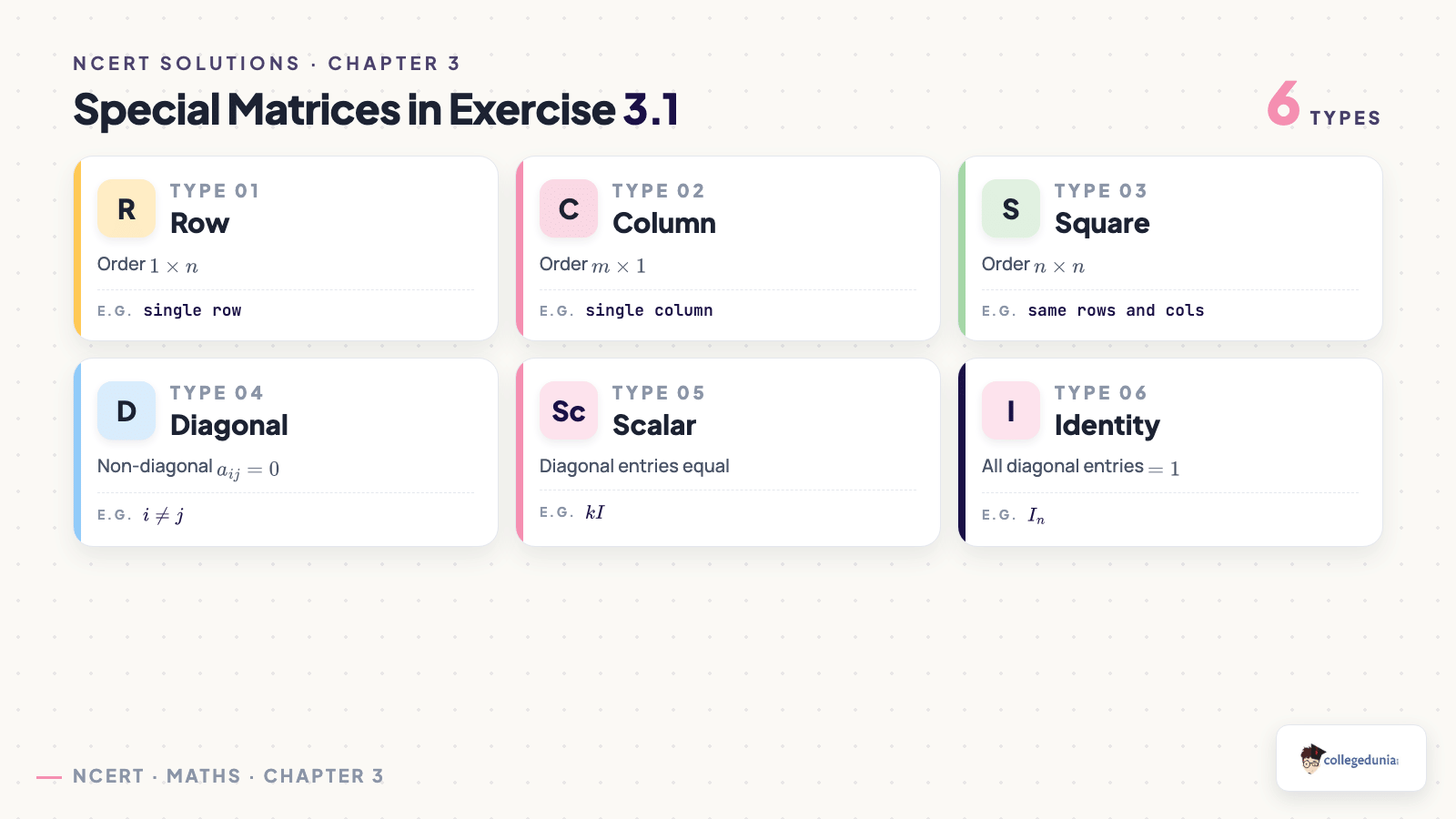
Ques. What is the difference between a scalar matrix and an identity matrix in Class 12 Maths Ex 3.1?
Ans.A scalar matrix is a diagonal matrix in which every diagonal entry is the same non-zero number, while all off-diagonal entries are zero. An identity matrix is a special scalar matrix in which that diagonal entry is exactly 1. Every identity matrix is scalar, but not every scalar matrix is identity.
Ques. How do you find the order of a matrix in NCERT Class 12 Maths Exercise 3.1?
Ans. The order of a matrix is written as m × n, where m is the number of rows and n is the number of columns.
Count the horizontal entries to get m and the vertical entries to get n. The number of elements equals mn ; for example, a 3 × 4 matrix has 12 elements.
Ques. How do I construct a 2x2 matrix where a_ij = (i+j)^2 / 2 in Class 12 Maths Chapter 3?
Ans. Draw an empty 2 × 2 bracket and label the four slots a11, a12, a21, a22. Substitute (i, j) = (1,1), (1,2), (2,1), (2,2) one at a time into (i+j)2 / 2 .
You get a11 = 2, a12 = 9/2, a21 = 9/2, a22 = 8 , giving A = bmatrix 2 & 9/2 9/2 & 8 bmatrix .
Ques. How do you solve equality of matrices problems in Exercise 3.1 of Class 12 Maths?
Ans.First confirm both matrices have the same order. Then set each corresponding element on the left equal to the same position on the right. This gives a system of simultaneous equations in the unknowns (often x, y, z, w). Solve the simplest equation first and substitute upward to find the rest.
Ques. Is Exercise 3.1 of Class 12 Maths Chapter 3 Matrices important for CBSE Boards 2026?
Ans. Yes. Exercise 3.1 has appeared in five of the last six CBSE Class 12 Maths board papers, typically as a 1-mark MCQ on order or types of matrices, or as a 2 to 3-mark equality problem. It is also a foundational chapter for Exercises 3.2, 3.3, 3.4 and the Miscellaneous Exercise.
Ques. What does a_ij mean in Class 12 Maths Chapter 3 Matrices?
Ans.The symbol aij denotes the entry of a matrix A sitting in row i and column j. The row index always comes first; reading it as column-then-row gives a transposed (and wrong) matrix. For example, in A = [aij]2 × 2, the entry a21 sits in row 2, column 1.
Ques. Can I download the Class 12 Maths Chapter 3 Exercise 3.1 NCERT Solutions PDF for free?
Ans. Yes, the this chapter is available at the top of these notes. Click the download button to get the step-by-step Collegedunia solutions for all 10 questions of Exercise 3.1, prepared by subject experts as per the 2026-27 NCERT print and the latest CBSE marking scheme.










Comments