The Inverse Trigonometric Functions Class 12 NCERT Solutions for Exercise 2.1 include detailed solutions for 14 questions included in the textbook. The solutions PDF on this page is cross-verified by the official source and prepared by the Collegedunia senior subject matter experts.
The page covers definitions, solved examples, exam-weightage and common mistakes, every formula aligned with the CBSE marking scheme.
CBSE Weightage: 4-6 marks (full Ch 2)
JEE Main: 2-4% of the entire paper
Question Count in Ex 2.1: 14 (12 direct principal-value + 2 mixed/MCQ)
Solved by Collegedunia experts. Every principal value is computed using the NCERT 2026-27 print, with the reference angle, the correct branch range, and the final value written out separately so step marks are not lost in the CBSE marking scheme.
How will Collegedunia's NCERT Solutions for Class 12 Maths Exercise 2.1 help you?
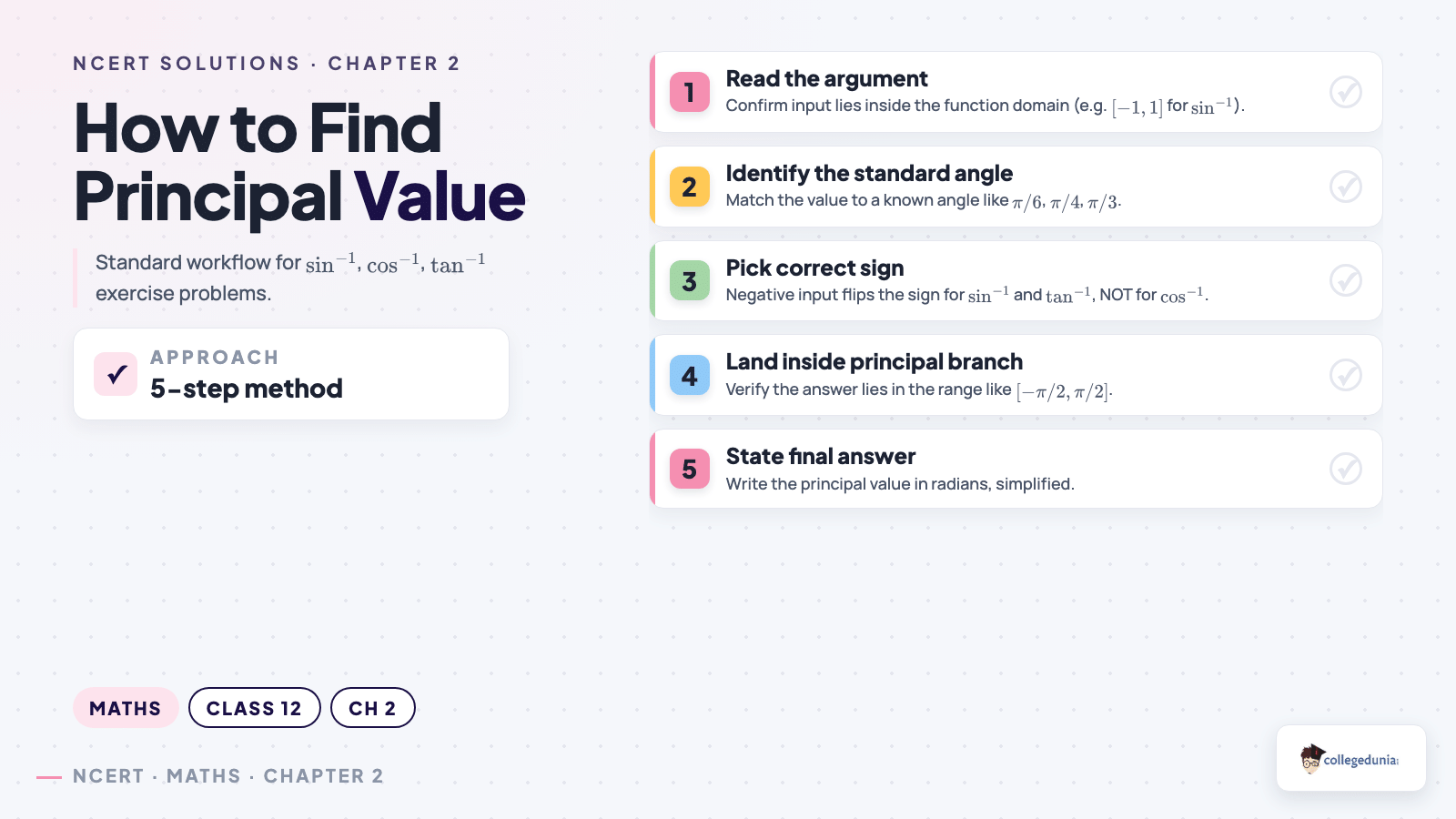
Exercise 2.1 looks deceptively simple - "find the principal value" - but most marks are lost at one specific step: picking the wrong branch. Our solutions force you to state the principal-value range first, then reduce the angle into that range, and only then write the answer. By Q5 you will stop confusing the cos-inverse range [0, π] with the sin-inverse range [-π/2, π/2].
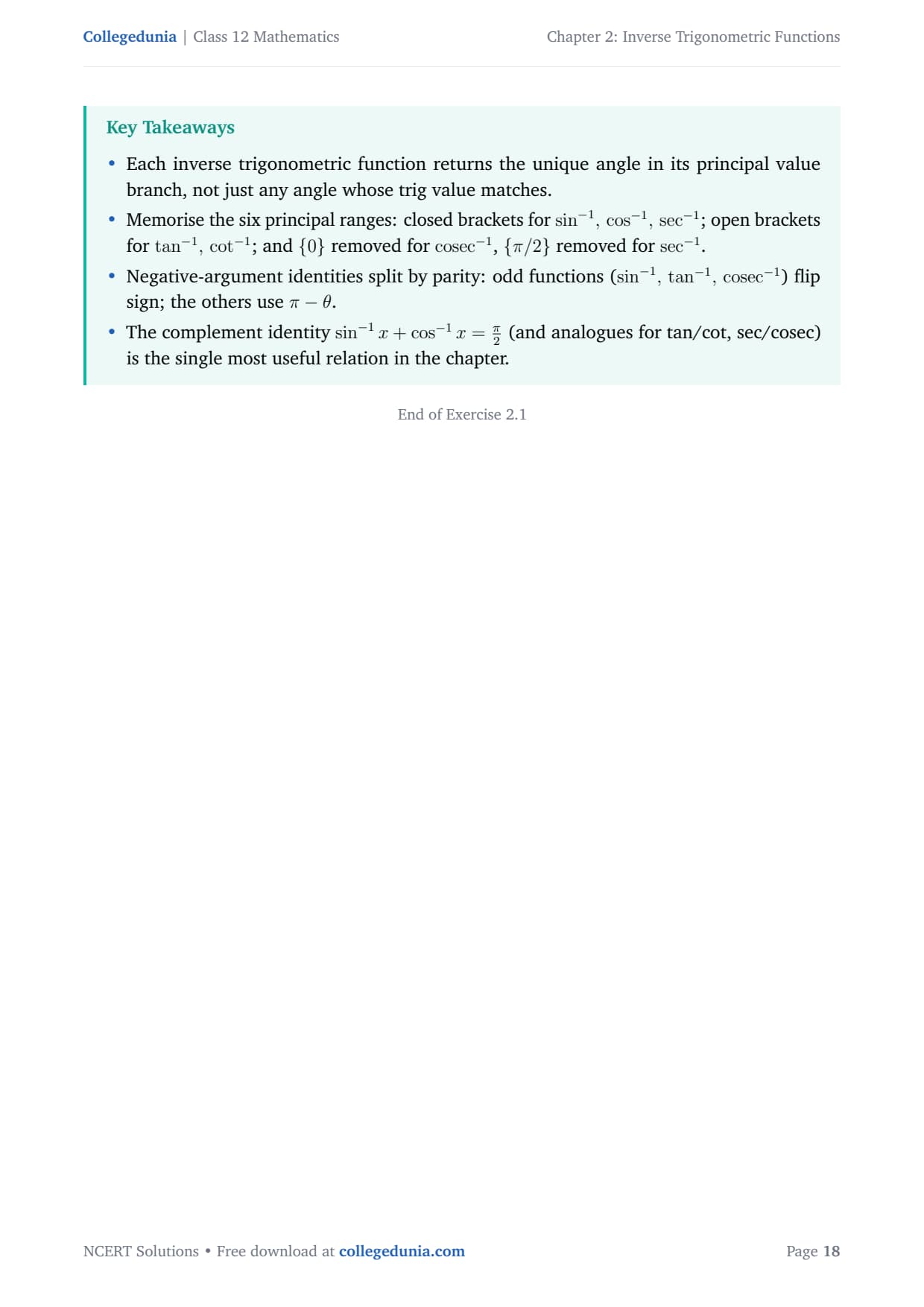
For the negative-argument problems (questions 2, 4, 6, 8, 10), we apply the standard identities sin-1(-x) = -sin-1x and cos-1(-x) = π - cos-1x explicitly, instead of guessing the sign. That distinction is exactly what the 2026 marking scheme rewards with the second step mark.
Inverse Trigonometric Functions Ex 2.1 Solved Step by Step (Video)
Principal Value Branches Used in Class 12 Maths Exercise 2.1
Function
Domain
Principal Value Branch (Range)
Questions in Ex 2.1
sin-1x
[-1, 1]
[-π/2, π/2]
Q1, Q2, Q11
cos-1x
[-1, 1]
[0, π]
Q3, Q4, Q9, Q12
tan-1x
R
(-π/2, π/2)
Q7, Q8, Q13
cosec-1x
R - (-1, 1)
[-π/2, π/2] - 0
Q5, Q6
sec-1x
R - (-1, 1)
[0, π] - π/2
Q9, Q12
cot-1x
R
(0, π)
Q10
Question-Wise Breakdown of NCERT Class 12 Maths Exercise 2.1
The 14 questions split into three difficulty tiers. The last two (Q13 and Q14) are MCQs that combine inverse functions; the rest are direct principal-value problems with one or two well-known reference angles.
Q No.
Expression
Concept Tested
Principal Value
Difficulty
Q1
sin-1(-1/2)
Negative sin-inverse
-π/6
Easy
Q2
cos-1(√3/2)
Standard cos-inverse
π/6
Easy
Q3
cosec-1(2)
Direct cosec-inverse
π/6
Easy
Q4
tan-1(-√3)
Negative tan-inverse
-π/3
Easy
Q5
cos-1(-1/2)
Negative cos-inverse; uses π - cos-1x identity
2π/3
Medium
Q6
tan-1(-1)
Negative tan-inverse
-π/4
Easy
Q7
sec-1(2/√3)
Direct sec-inverse
π/6
Medium
Q8
cot-1(√3)
Direct cot-inverse
π/6
Easy
Q9
cos-1(-1/√2)
Negative cos-inverse
3π/4
Medium
Q10
cosec-1(-√2)
Negative cosec-inverse
-π/4
Medium
Q11
tan-1(1) + cos-1(-1/2) + sin-1(-1/2)
Sum of three inverse values
3π/4
Hard
Q12
cos-1(1/2) + 2sin-1(1/2)
Linear combination
2π/3
Hard
Q13
MCQ: sin-1x = y gives
Range of sin-inverse
Option (B) -π/2 ≤ y ≤ π/2
Easy
Q14
MCQ: tan-1√3 - sec-1(-2) equals
Combined inverse-trig MCQ
Option (B) -π/3
Hard
Important Identities Used in Class 12 Maths Ex 2.1
Common pitfall: sin-1x ≠ (sin x)-1. The first is an inverse function; the second is the reciprocal 1/sin x.
Sample Solved Question from Exercise 2.1
Question 5: Find the principal value of cos-1(-12) .
Step 1 - State the principal value branch. The principal value branch of cos-1 is [0, π] .
Step 2 - Let the answer be y. Let y = cos-1(-1/2) . Then cos y = -1/2 , where y ∈ [0, π] .
Step 3 - Find the reference angle. We know cos(π/3) = 1/2 . So the reference angle is π/3 .
Step 4 - Use the supplementary identity. cos(π - π/3) = -cos(π/3) = -1/2 . Hence cos(2π/3) = -1/2 .
Step 5 - Verify the branch. Is 2π/3 ∈ [0, π] ? Yes. So y = 2π/3 .
Conclusion: The principal value of cos-1(-1/2) is 2π3.
Common Mistakes Students Make in Class 12 Maths Ex 2.1
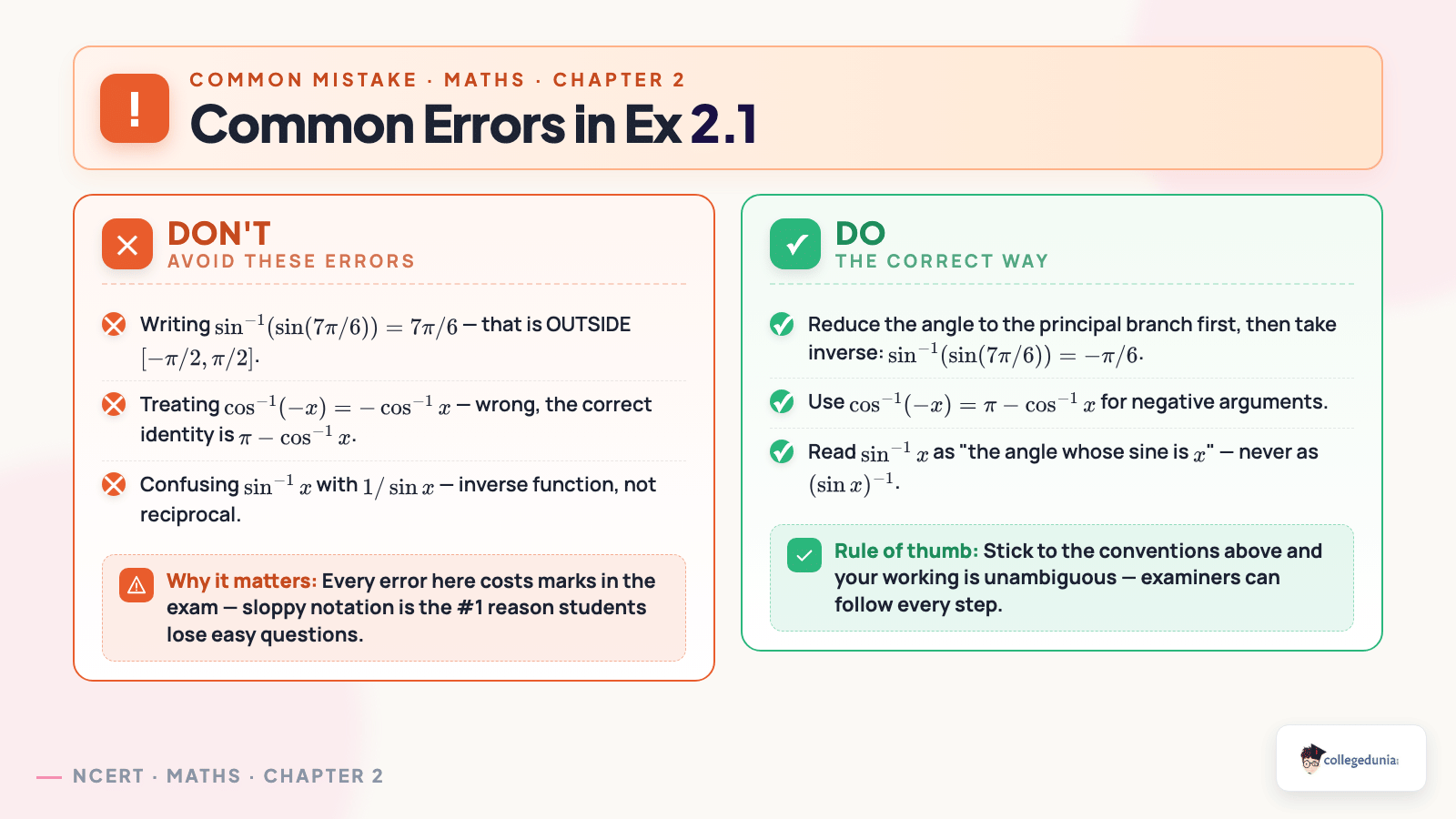
Wrong branch picked. Writing cos-1(-1/2) = -π/3 is wrong - the cos-inverse range is [0, π], it cannot be negative. The correct answer is 2π/3 . This single error costs 2 marks per question.
Confusing sin-1(-x) with cos-1(-x) . Sin-inverse and tan-inverse are odd functions; cos-inverse, sec-inverse, cot-inverse use the supplementary identity instead. Mixing them up is the #1 cause of wrong final values.
Reading sin-1x as 1/sin x. The "-1" is functional notation, not an exponent. Misreading this turns the question into nonsense.
Skipping Step 1. The first mark in each answer is for stating the principal value branch. Students work through the value and lose it.
Forgetting the cosec/sec domain exclusions. cosec-1 is undefined on (-1, 1); sec-1 is undefined on (-1, 1). Always check the input lies in the domain first.
Computing in degrees and forgetting to convert. NCERT answers must be in radians. Writing 30 instead of π/6 loses the final mark.
Exercise-wise Breakdown of the Inverse Trigonometric Functions Chapter
The Inverse Trigonometric Functions chapter splits into 2 numbered exercises plus a Miscellaneous Exercise. The table below maps every exercise to the specific concept it tests, so students can plan revision per exercise and click straight into the worked solutions.
All NCERT Solutions for Inverse Trigonometric Functions Ex 2.1 with Step-by-Step Working
Every NCERT textbook question for Class 12 Mathematics Chapter 2 Inverse Trigonometric Functions Ex 2.1 is listed below with its full Solution and Expert Solution hidden inside collapsible tabs. Click Check Solution to reveal the step-by-step working; click Expert Solution for the expanded explanation.
Questions
Q 2.1
Find the principal value of sin-1(-12).
Concept used. The inverse sine function sin-1 takes a real number a ∈ [-1,1] and returns the unique angle y in the principal value branch [-π2,π2] such that sin y = a. We write sin-1(a) = y sin y = a, y ∈ [-π2,π2]. For a negative argument we also use the odd-function identity sin-1(-x) = -sin-1(x), valid for every x ∈ [-1,1], because sine itself is an odd function: sin(-θ) = -sinθ.
Reference angle
The standard reference value here is sin(π6) = 12.
Set y = sin-1(-12). By the definition of sin-1, this means sin y = -12, y ∈ [-π2,π2].
Use the odd-function rule to pull the minus sign out: sin-1(-12) = -sin-1(12).
Find sin-1(12). We need the angle θ ∈ [-π2,π2] with sinθ = 12. The standard value sin(π6) = 12 and π6 ∈ [-π2,π2], so sin-1(12) = π6.
Substitute back: y = -sin-1(12) = -π6.
Check membership in the principal range: -π6 lies in [-π2,π2] ; and sin(-π6) = -sin(π6) = -12 .
sin-1(-12) = -π6
AS
Aarav Sharma
M.Sc Mathematics, IIT Bombay
Verified Expert
Picture-first. The graph of y = sin-1x is the dark portion of the sine curve reflected across y = x, with x on [-1,1] and y on [-π2,π2]. We just read off the height -12 on the x-axis and lift it to the curve.
[See diagram in the PDF version]
Concept used. The graph of sin-1 on [-1,1] passes through the points (12,π6) and, by symmetry of the odd function through the origin, also through (-12,-π6).
Mark x = -12 on the x-axis. The graph value at this point is the y we want.
Symmetry of sin-1 across the origin sends (12,π6) ↦ (-12,-π6).
Why this matters. Visualising the graph makes the principal range a feature you can see (the curve never leaves the horizontal strip -π2 ≤ y ≤ π2), so you never accidentally pick a stray-quadrant angle.
-π6
Q 2.2
Find the principal value of cos-1(√32).
Concept used. The inverse cosine function cos-1 takes a ∈ [-1,1] and returns the unique angle y in the principal value branch [0,π] with cos y = a. Formally, cos-1(a) = y cos y = a, y ∈ [0,π]. The principal range [0,π] covers exactly the first and second quadrants where cosine is positive, then zero, then negative.
Reference angle
Standard reference: cos(π6) = √32.
Set y = cos-1(√32). By definition this means cos y = √32, y ∈ [0,π].
Recall the standard value cos(π6) = √32. This is a memorised result from the special triangle with angles 30∘, 60∘, 90∘ and side ratios 1 : √3 : 2.
Check that π6 lies in the principal range: 0 ≤ π6 ≤ π . So y = π6.
cos-1(√32) = π6
PI
Priya Iyer
M.Sc Mathematics, ISI Kolkata
Verified Expert
Quick reading. Cosine is positive only in the first quadrant of the principal range [0,π], so the answer must be an acute angle. We just match the value √32 against the 30∘-60∘-90∘ triangle.
Concept used. The acute angle with cosine = √32 is 30∘, i.e. π6 radian.
In a 30-60-90 triangle, the side opposite 30∘ has length 1, opposite 60∘ has length √3, and the hypotenuse is 2.
cos 30∘ = adjacenthypotenuse = √32.
Convert to radians: 30∘ = π6. Verify π6 ∈ [0,π] .
Why this matters. Knowing the three first-quadrant reference angles π6, π4, π3 and their sine/cosine values handles roughly 80% of principal-value computations in this exercise.
π6
Q 2.3
Find the principal value of -1(2).
Concept used. The inverse cosecant function takes a ∈ R(-1,1) and returns the unique angle y in the principal value branch [-π2,π2]0 with y = a. Equivalently, using θ = 1sinθ, -1(a) = y sin y = 1a, y ∈ [-π2,π2]0.
Set y = -1(2), so y = 2 sin y = 12, y ∈ [-π2,π2]0.
The standard value sin(π6) = 12 gives a candidate y = π6.
Check membership in the principal range: π6 ∈ [-π2,π2] and π6 ≠ 0 .
Verify: (π6) = 1sin(π/6) = 11/2 = 2 .
-1(2) = π6
VG
Vivaan Gupta
M.Tech CS, IIT Madras
Verified Expert
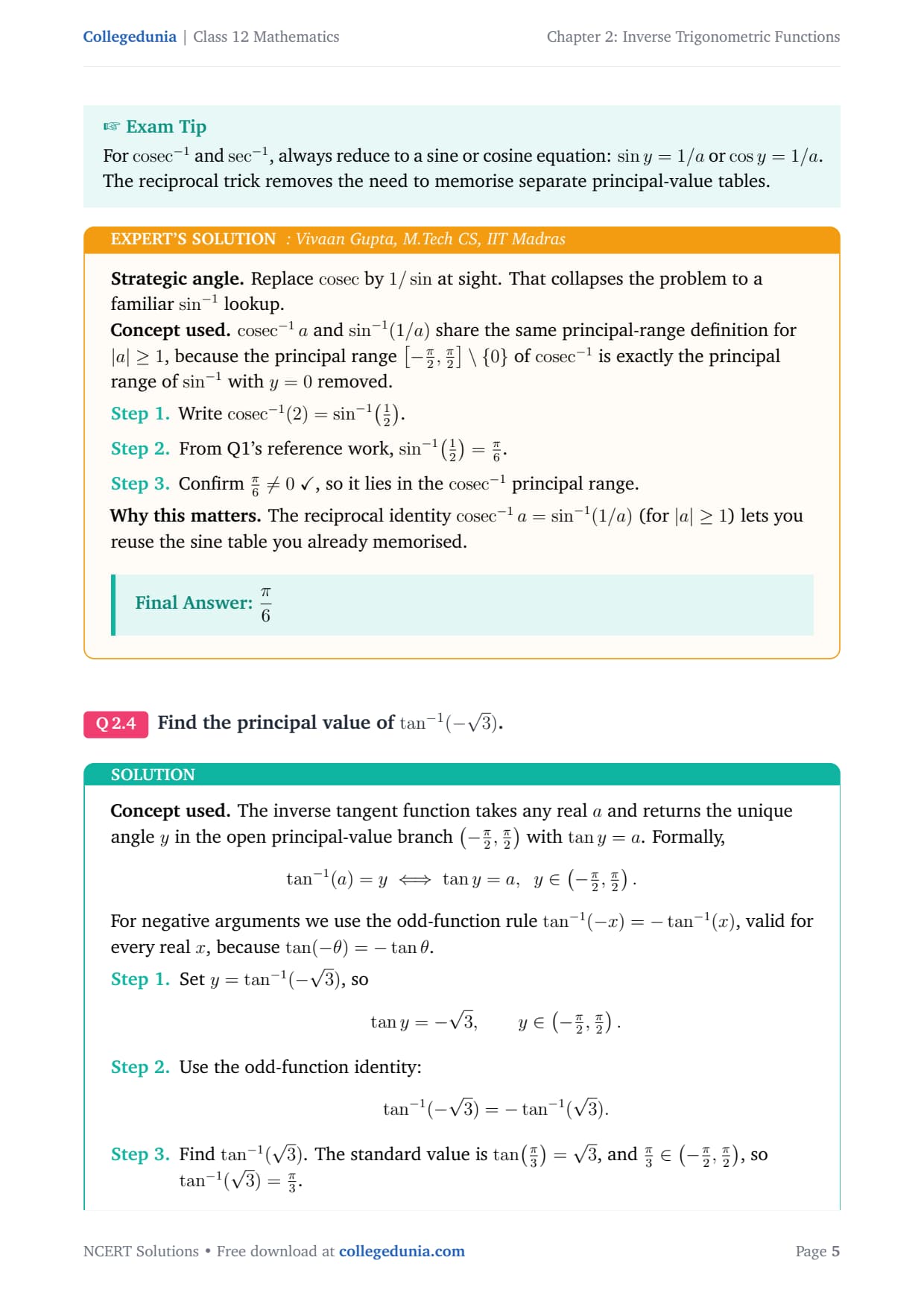
Strategic angle. Replace by 1/sin at sight. That collapses the problem to a familiar sin-1 lookup.
Concept used.-1a and sin-1(1/a) share the same principal-range definition for |a| ≥ 1, because the principal range [-π2,π2]0 of -1 is exactly the principal range of sin-1 with y=0 removed.
Write -1(2) = sin-1(12).
From Q1's reference work, sin-1(12) = π6.
Confirm π6 ≠ 0 , so it lies in the -1 principal range.
Why this matters. The reciprocal identity -1a = sin-1(1/a) (for |a| ≥ 1) lets you reuse the sine table you already memorised.
π6
Q 2.4
Find the principal value of tan-1(-√3).
Concept used. The inverse tangent function takes any real a and returns the unique angle y in the open principal-value branch (-π2,π2) with tan y = a. Formally, tan-1(a) = y tan y = a, y ∈ (-π2,π2). For negative arguments we use the odd-function rule tan-1(-x) = -tan-1(x), valid for every real x, because tan(-θ) = -tanθ.
Set y = tan-1(-√3), so tan y = -√3, y ∈ (-π2,π2).
Use the odd-function identity: tan-1(-√3) = -tan-1(√3).
Find tan-1(√3). The standard value is tan(π3) = √3, and π3 ∈ (-π2,π2), so tan-1(√3) = π3.
Substitute back to get y = -tan-1(√3) = -π3.
Check: -π3 lies in (-π2,π2) , and tan(-π3) = -tan(π3) = -√3 .
tan-1(-√3) = -π3
AM
Arjun Mehta
Ph.D Mathematics, IIT Delhi
Verified Expert
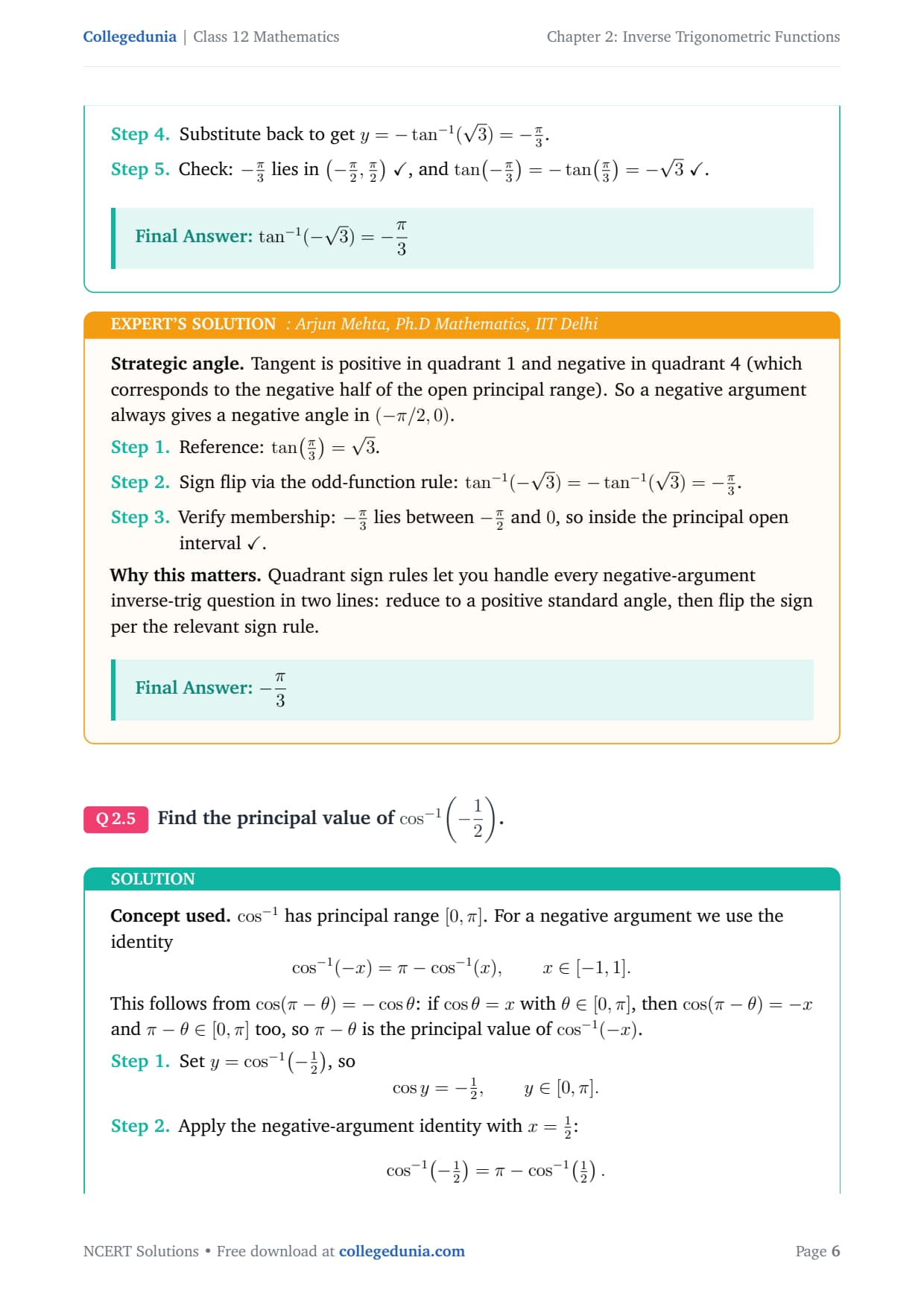
Strategic angle. Tangent is positive in quadrant 1 and negative in quadrant 4 (which corresponds to the negative half of the open principal range). So a negative argument always gives a negative angle in (-π/2, 0).
Reference: tan(π3) = √3.
Sign flip via the odd-function rule: tan-1(-√3) = -tan-1(√3) = -π3.
Verify membership: -π3 lies between -π2 and 0, so inside the principal open interval .
Why this matters. Quadrant sign rules let you handle every negative-argument inverse-trig question in two lines: reduce to a positive standard angle, then flip the sign per the relevant sign rule.
-π3
Q 2.5
Find the principal value of cos-1(-12).
Concept used.cos-1 has principal range [0,π]. For a negative argument we use the identity cos-1(-x) = π - cos-1(x), x ∈ [-1,1]. This follows from cos(π - θ) = -cosθ: if cosθ = x with θ ∈ [0,π], then cos(π - θ) = -x and π - θ ∈ [0,π] too, so π - θ is the principal value of cos-1(-x).
Set y = cos-1(-12), so cos y = -12, y ∈ [0,π].
Apply the negative-argument identity with x = 12: cos-1(-12) = π - cos-1(12).
Compute cos-1(12). We know cos(π3) = 12 and π3 ∈ [0,π], so cos-1(12) = π3.
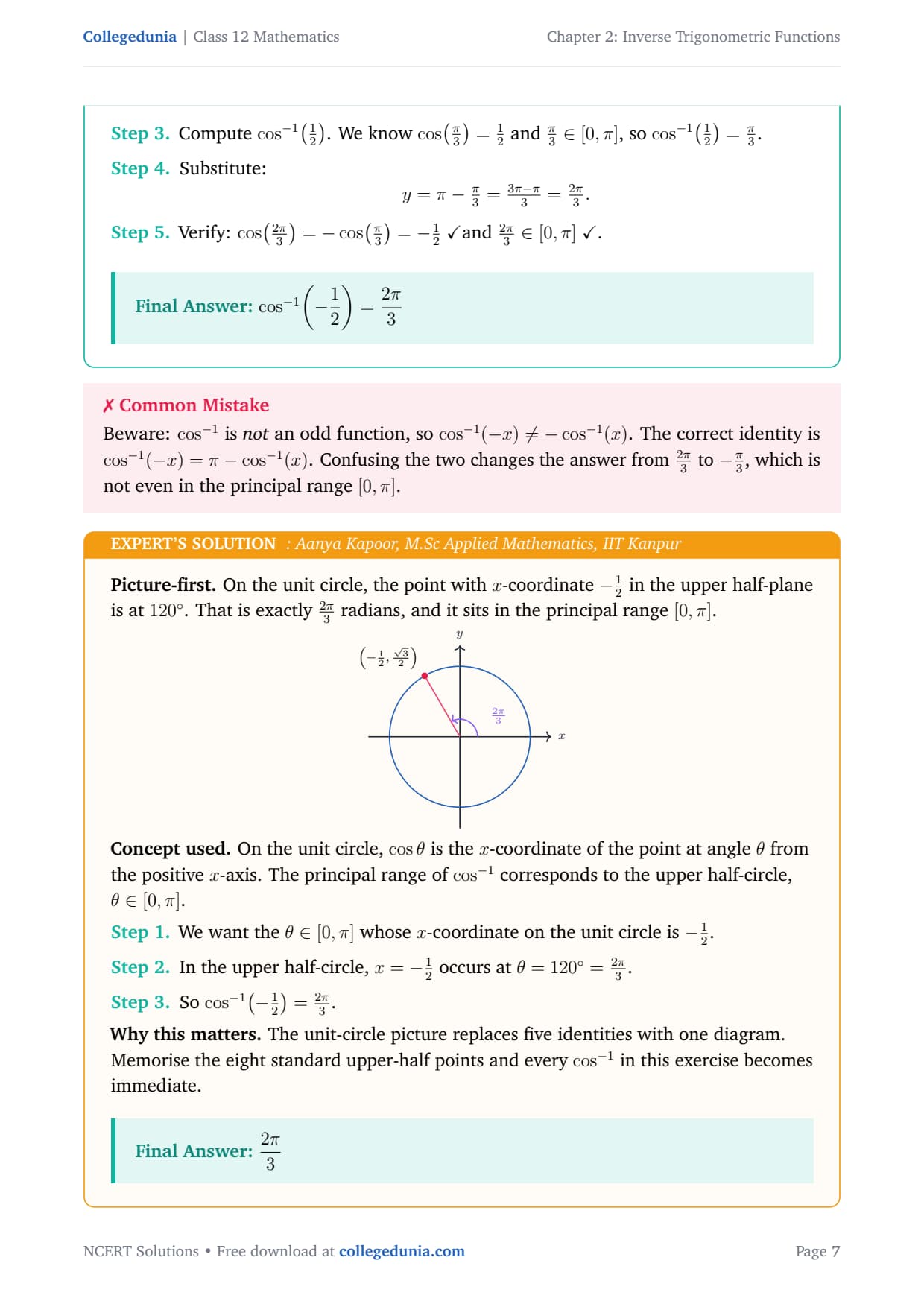
Picture-first. On the unit circle, the point with x-coordinate -12 in the upper half-plane is at 120∘. That is exactly 2π3 radians, and it sits in the principal range [0,π].
[See diagram in the PDF version]
Concept used. On the unit circle, cosθ is the x-coordinate of the point at angle θ from the positive x-axis. The principal range of cos-1 corresponds to the upper half-circle, θ ∈ [0,π].
We want the θ ∈ [0,π] whose x-coordinate on the unit circle is -12.
In the upper half-circle, x = -12 occurs at θ = 120∘ = 2π3.
So cos-1(-12) = 2π3.
Why this matters. The unit-circle picture replaces five identities with one diagram. Memorise the eight standard upper-half points and every cos-1 in this exercise becomes immediate.
2π3
Q 2.6
Find the principal value of tan-1(-1).
Concept used.tan-1 has principal range (-π2,π2) and is an odd function: tan-1(-x) = -tan-1(x).
Set y = tan-1(-1), so tan y = -1, y ∈ (-π2,π2).
Use the odd-function rule: tan-1(-1) = -tan-1(1).
Reference value: tan(π4) = 1, and π4 ∈ (-π2,π2), so tan-1(1) = π4.
Hence y = -π4. Verify tan(-π4) = -1 and -π4 ∈ (-π2,π2) .
tan-1(-1) = -π4
RN
Riya Nair
B.Tech CSE, IIT Roorkee
Verified Expert
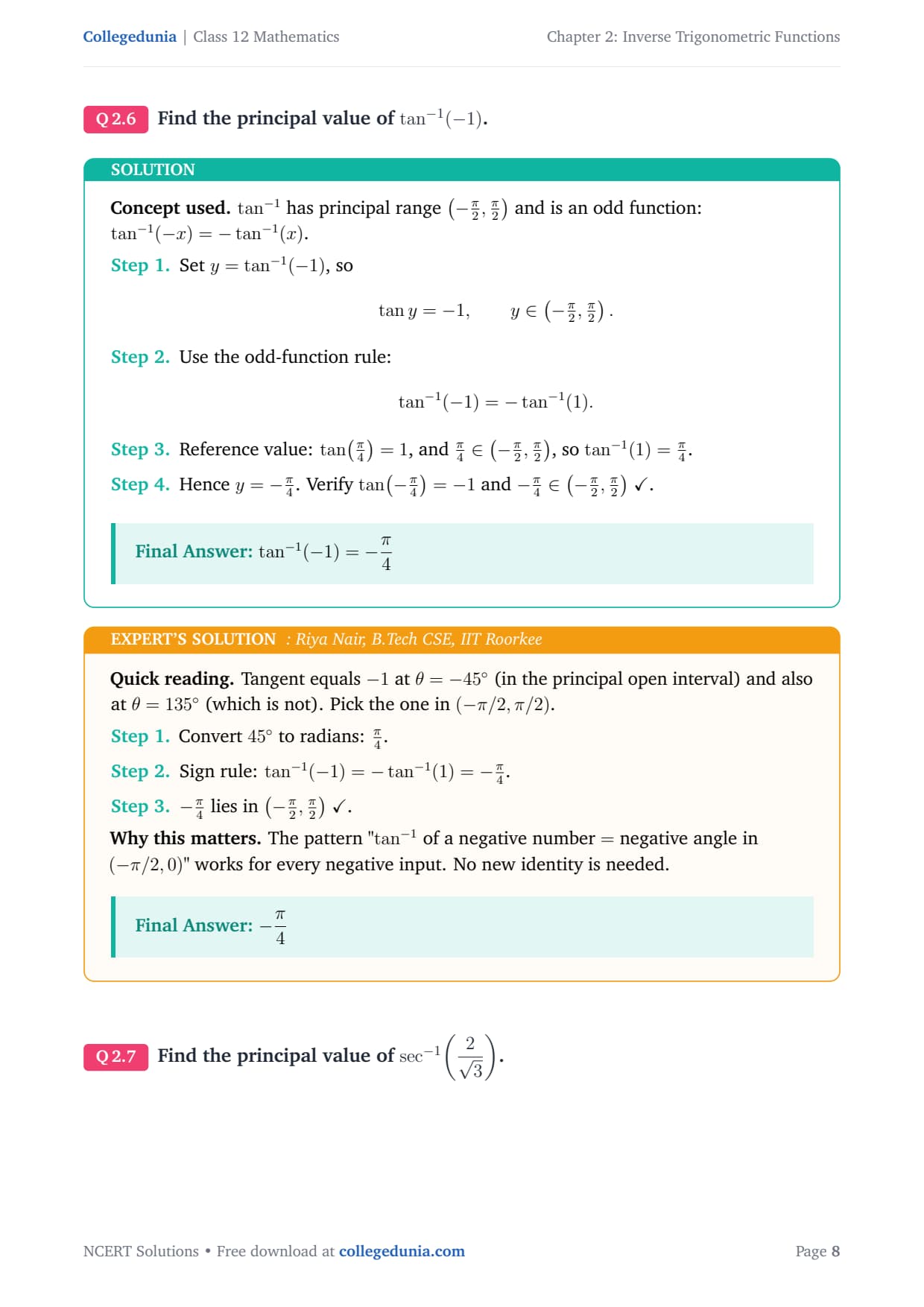
Quick reading. Tangent equals -1 at θ = -45∘ (in the principal open interval) and also at θ = 135∘ (which is not). Pick the one in (-π/2,π/2).
Convert 45∘ to radians: π4.
Sign rule: tan-1(-1) = -tan-1(1) = -π4.
-π4 lies in (-π2,π2) .
Why this matters. The pattern "tan-1 of a negative number = negative angle in (-π/2,0)" works for every negative input. No new identity is needed.
-π4
Q 2.7
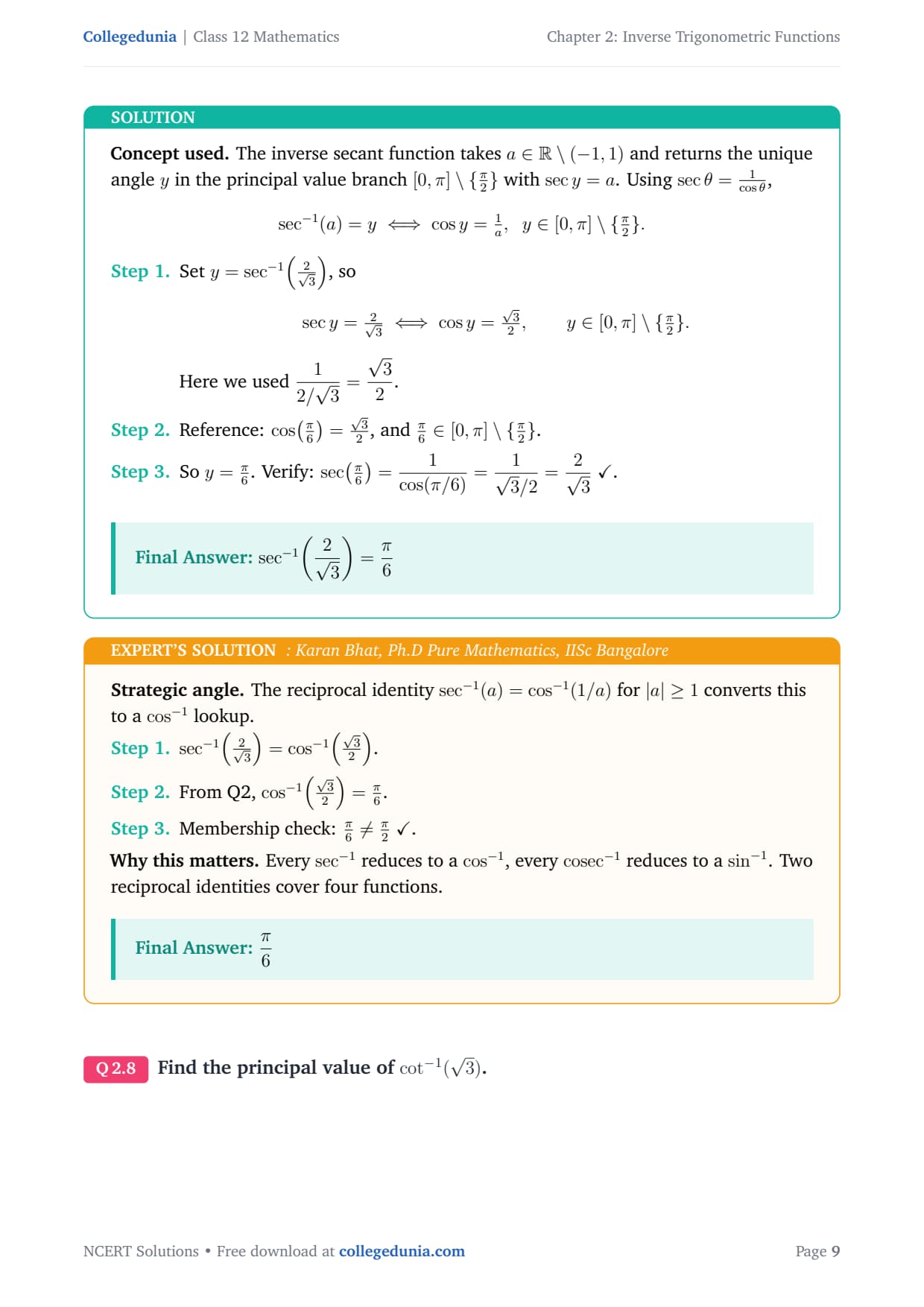
Find the principal value of sec-1(2√3).
Concept used. The inverse secant function takes a ∈ R(-1,1) and returns the unique angle y in the principal value branch [0,π]π2 with sec y = a. Using secθ = 1cosθ, sec-1(a) = y cos y = 1a, y ∈ [0,π]π2.
Set y = sec-1(2√3), so sec y = 2√3 cos y = √32, y ∈ [0,π]π2. Here we used 12/√3 = √32.
Reference: cos(π6) = √32, and π6 ∈ [0,π]π2.
So y = π6. Verify: sec(π6) = 1cos(π/6) = 1√3/2 = 2√3 .
sec-1(2√3) = π6
KB
Karan Bhat
Ph.D Pure Mathematics, IISc Bangalore
Verified Expert
Strategic angle. The reciprocal identity sec-1(a) = cos-1(1/a) for |a| ≥ 1 converts this to a cos-1 lookup.
sec-1(2√3) = cos-1(√32).
From Q2, cos-1(√32) = π6.
Membership check: π6 ≠ π2 .
Why this matters. Every sec-1 reduces to a cos-1, every -1 reduces to a sin-1. Two reciprocal identities cover four functions.
π6
Q 2.8
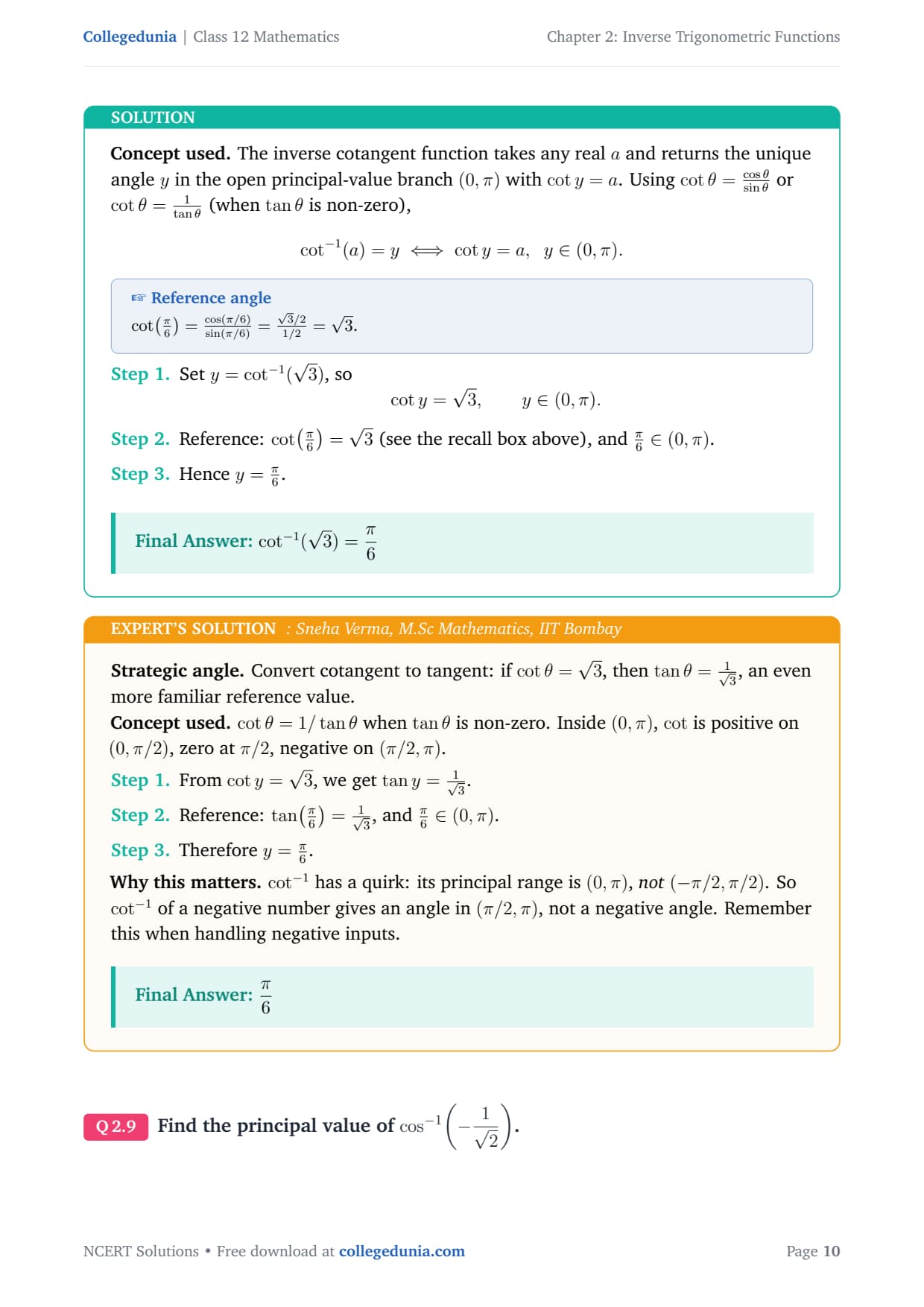
Find the principal value of cot-1(√3).
Concept used. The inverse cotangent function takes any real a and returns the unique angle y in the open principal-value branch (0,π) with cot y = a. Using cotθ = cosθsinθ or cotθ = 1tanθ (when tanθ is non-zero), cot-1(a) = y cot y = a, y ∈ (0,π).
Reference angle
cot(π6) = cos(π/6)sin(π/6) = √3/21/2 = √3.
Set y = cot-1(√3), so cot y = √3, y ∈ (0,π).
Reference: cot(π6) = √3 (see the recall box above), and π6 ∈ (0,π).
Hence y = π6.
cot-1(√3) = π6
SV
Sneha Verma
M.Sc Mathematics, IIT Bombay
Verified Expert
Strategic angle. Convert cotangent to tangent: if cotθ = √3, then tanθ = 1√3, an even more familiar reference value.
Concept used.cotθ = 1/tanθ when tanθ is non-zero. Inside (0,π), cot is positive on (0,π/2), zero at π/2, negative on (π/2,π).
From cot y = √3, we get tan y = 1√3.
Reference: tan(π6) = 1√3, and π6 ∈ (0,π).
Therefore y = π6.
Why this matters.cot-1 has a quirk: its principal range is (0,π), not(-π/2,π/2). So cot-1 of a negative number gives an angle in (π/2,π), not a negative angle. Remember this when handling negative inputs.
π6
Q 2.9
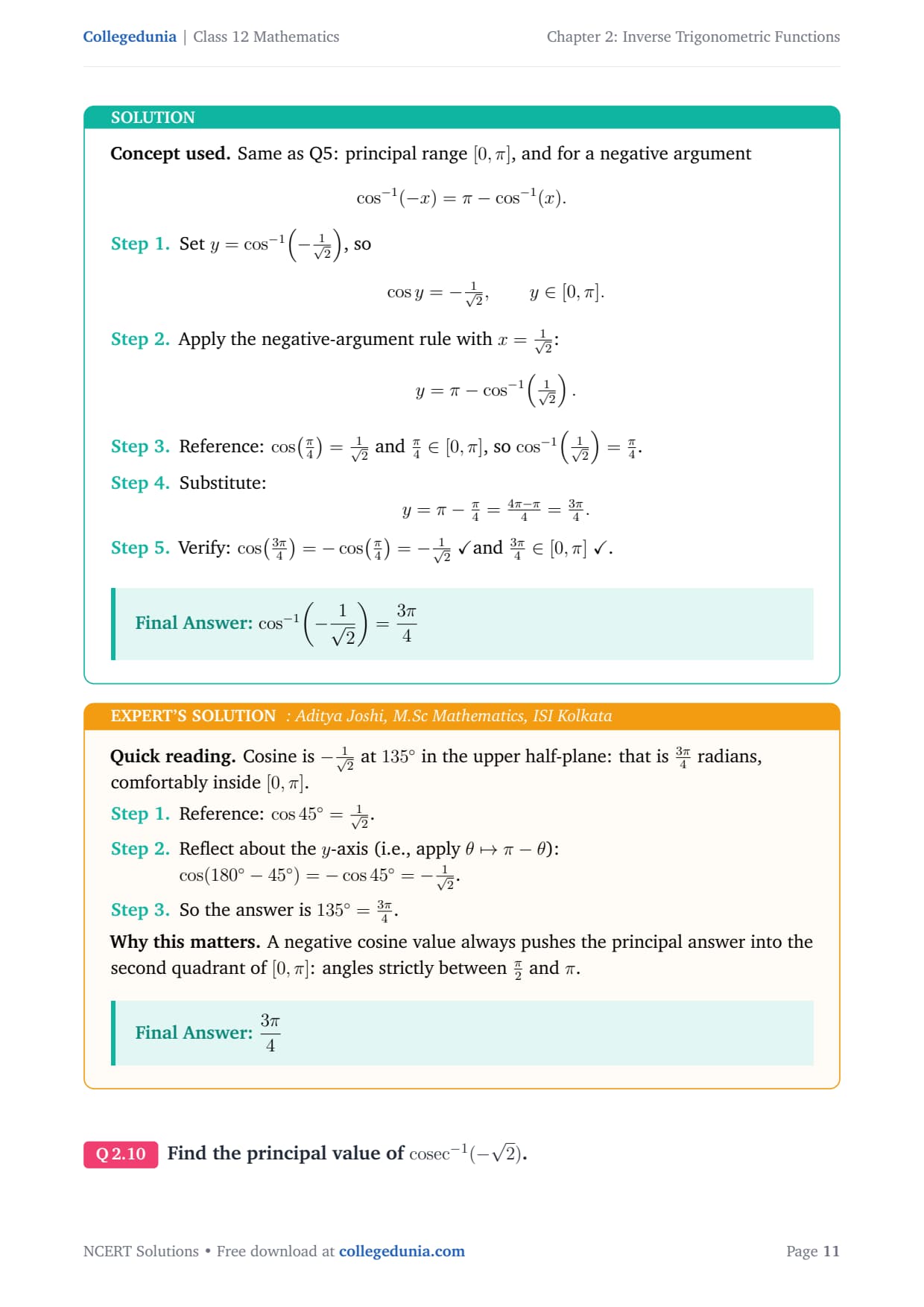
Find the principal value of cos-1(-1√2).
Concept used. Same as Q5: principal range [0,π], and for a negative argument cos-1(-x) = π - cos-1(x).
Set y = cos-1(-1√2), so cos y = -1√2, y ∈ [0,π].
Apply the negative-argument rule with x = 1√2: y = π - cos-1(1√2).
Reference: cos(π4) = 1√2 and π4 ∈ [0,π], so cos-1(1√2) = π4.
Quick reading. Cosine is -1√2 at 135∘ in the upper half-plane: that is 3π4 radians, comfortably inside [0,π].
Reference: cos 45∘ = 1√2.
Reflect about the y-axis (i.e., apply θ ↦ π - θ): cos(180∘ - 45∘) = -cos 45∘ = -1√2.
So the answer is 135∘ = 3π4.
Why this matters. A negative cosine value always pushes the principal answer into the second quadrant of [0,π]: angles strictly between π2 and π.
3π4
Q 2.10
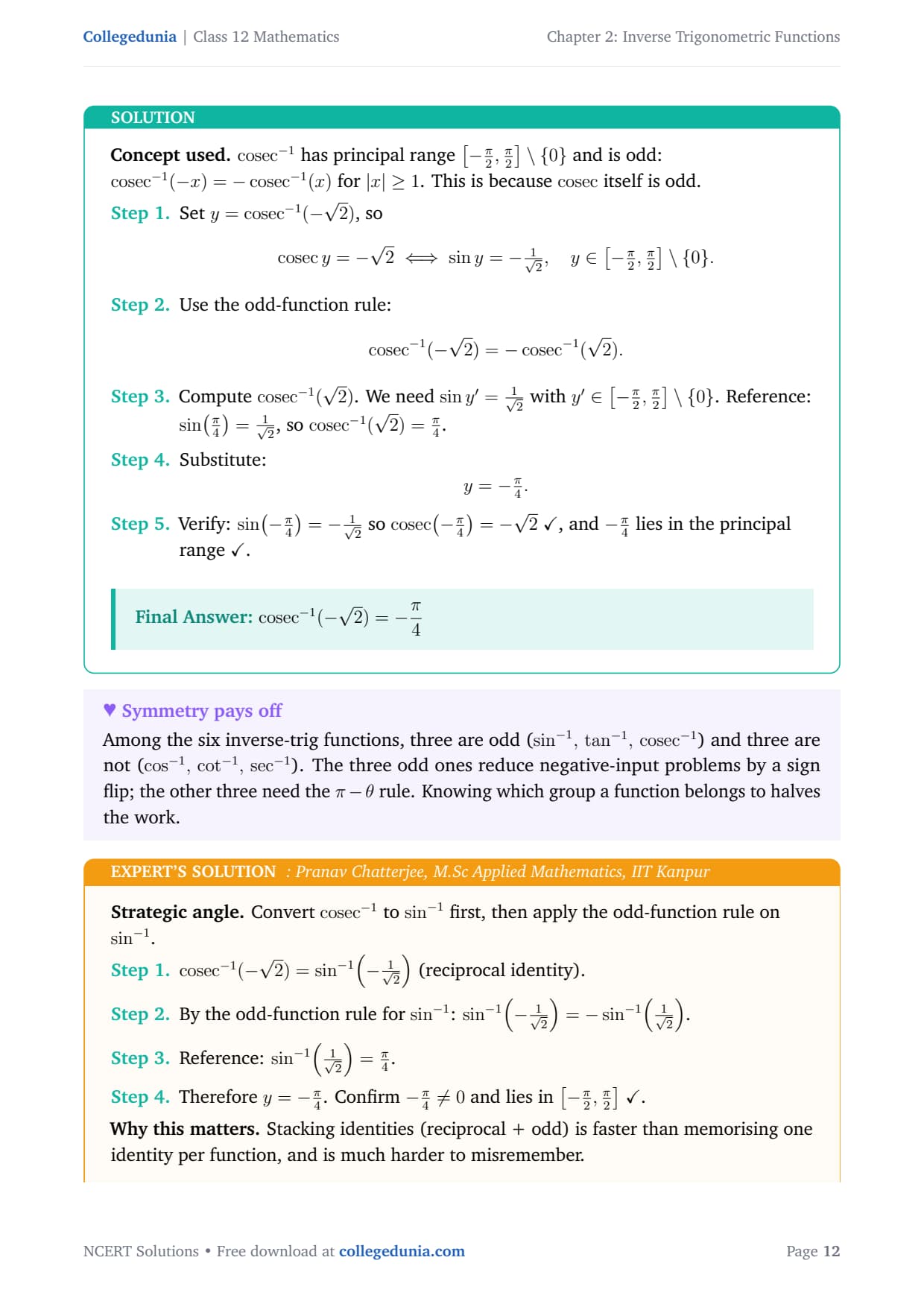
Find the principal value of -1(-√2).
Concept used.-1 has principal range [-π2,π2]0 and is odd: -1(-x) = --1(x) for |x| ≥ 1. This is because itself is odd.
Set y = -1(-√2), so y = -√2 sin y = -1√2, y ∈ [-π2,π2]0.
Use the odd-function rule: -1(-√2) = --1(√2).
Compute -1(√2). We need sin y' = 1√2 with y' ∈ [-π2,π2]0. Reference: sin(π4) = 1√2, so -1(√2) = π4.
Substitute: y = -π4.
Verify: sin(-π4) = -1√2 so (-π4) = -√2 , and -π4 lies in the principal range .
-1(-√2) = -π4
PC
Pranav Chatterjee
M.Sc Applied Mathematics, IIT Kanpur
Verified Expert
Strategic angle. Convert -1 to sin-1 first, then apply the odd-function rule on sin-1.
-1(-√2) = sin-1(-1√2) (reciprocal identity).
By the odd-function rule for sin-1: sin-1(-1√2) = -sin-1(1√2).
Reference: sin-1(1√2) = π4.
Therefore y = -π4. Confirm -π4 ≠ 0 and lies in [-π2,π2] .
Why this matters. Stacking identities (reciprocal + odd) is faster than memorising one identity per function, and is much harder to misremember.
-π4
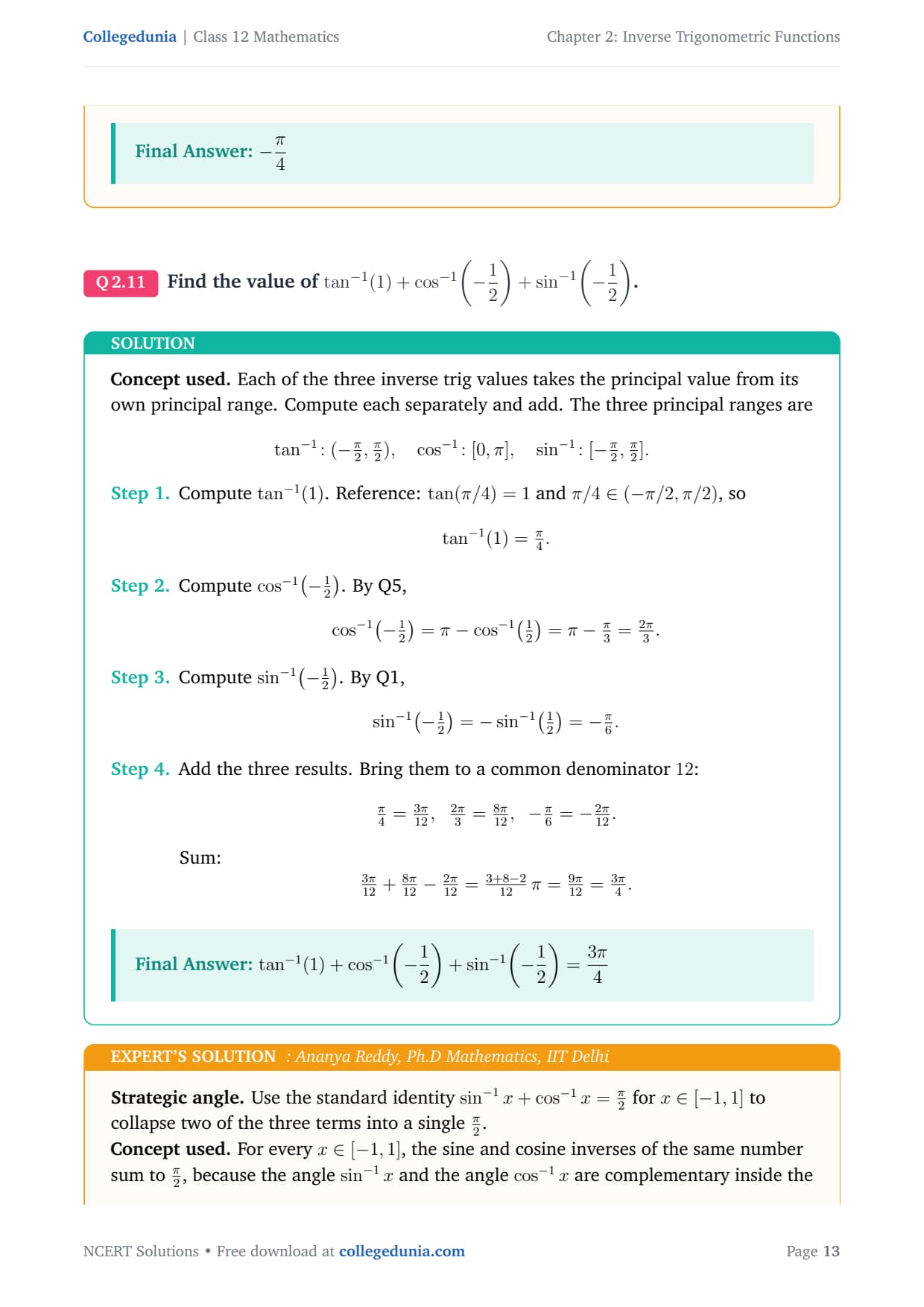
Q 2.11
Find the value of tan-1(1) + cos-1(-12) + sin-1(-12).
Concept used. Each of the three inverse trig values takes the principal value from its own principal range. Compute each separately and add. The three principal ranges are tan-1:(-π2,π2), cos-1:[0,π], sin-1:[-π2,π2].
Compute tan-1(1). Reference: tan(π/4) = 1 and π/4 ∈ (-π/2,π/2), so tan-1(1) = π4.
Compute sin-1(-12). By Q1, sin-1(-12) = -sin-1(12) = -π6.
Add the three results. Bring them to a common denominator 12: π4 = 3π12, 2π3 = 8π12, -π6 = -2π12. Sum: 3π12 + 8π12 - 2π12 = 3 + 8 - 212 π = 9π12 = 3π4.
tan-1(1) + cos-1(-12) + sin-1(-12) = 3π4
AR
Ananya Reddy
Ph.D Mathematics, IIT Delhi
Verified Expert
Strategic angle. Use the standard identity sin-1x + cos-1x = π2 for x ∈ [-1,1] to collapse two of the three terms into a single π2.
Concept used. For every x ∈ [-1,1], the sine and cosine inverses of the same number sum to π2, because the angle sin-1x and the angle cos-1x are complementary inside the unit-circle picture.
Group cleverly: keep tan-1(1) aside, then cos-1(-12) + sin-1(-12) = π2 (complement identity with x = -12).
Compute tan-1(1) = π4.
Add: total = π4 + π2 = π4 + 2π4 = 3π4.
Why this matters. Spotting the complement pair sin-1x + cos-1x saves two reference-angle lookups and one common-denominator addition. This identity is one of the four major inverse-trig "complement identities" you should keep at the front of your mind: sin-1x + cos-1x = tan-1x + cot-1x = sec-1x + -1x = π2.
3π4
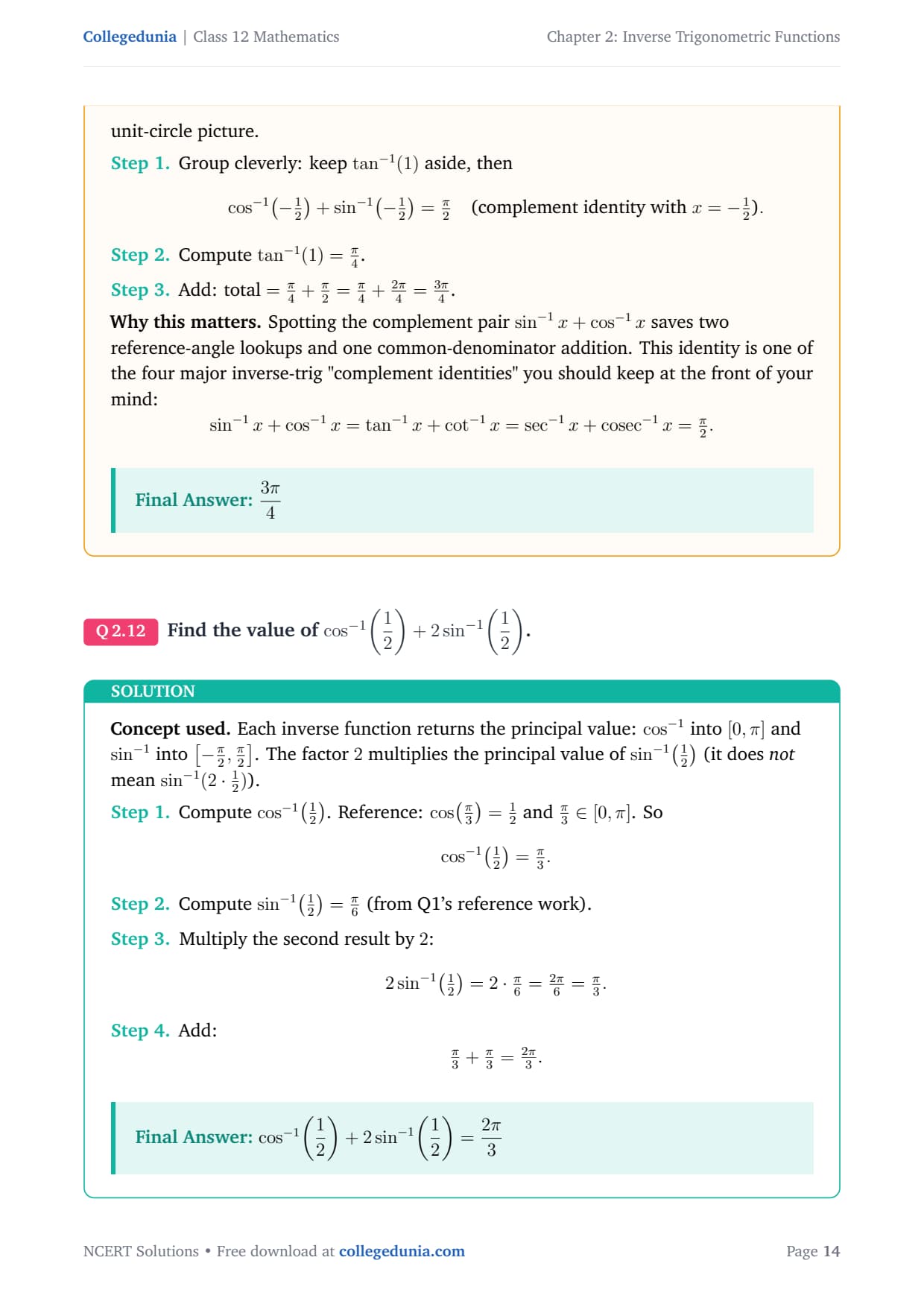
Q 2.12
Find the value of cos-1(12) + 2sin-1(12).
Concept used. Each inverse function returns the principal value: cos-1 into [0,π] and sin-1 into [-π2,π2]. The factor 2 multiplies the principal value of sin-1(12) (it does not mean sin-1(2·12)).
Compute cos-1(12). Reference: cos(π3) = 12 and π3 ∈ [0,π]. So cos-1(12) = π3.
Multiply the second result by 2: 2sin-1(12) = 2 · π6 = 2π6 = π3.
Add: π3 + π3 = 2π3.
cos-1(12) + 2sin-1(12) = 2π3
YS
Yash Singh
M.Tech CS, IIT Madras
Verified Expert
Structural observation. The expression equals cos-1x + 2sin-1x at x = 12. Using sin-1x + cos-1x = π2, this rewrites as π2 + sin-1x, which is faster than evaluating each term separately.
Why this matters. The same complement identity sin-1x + cos-1x = π2 keeps paying off. Algebra before substitution is usually the fastest path.
2π3
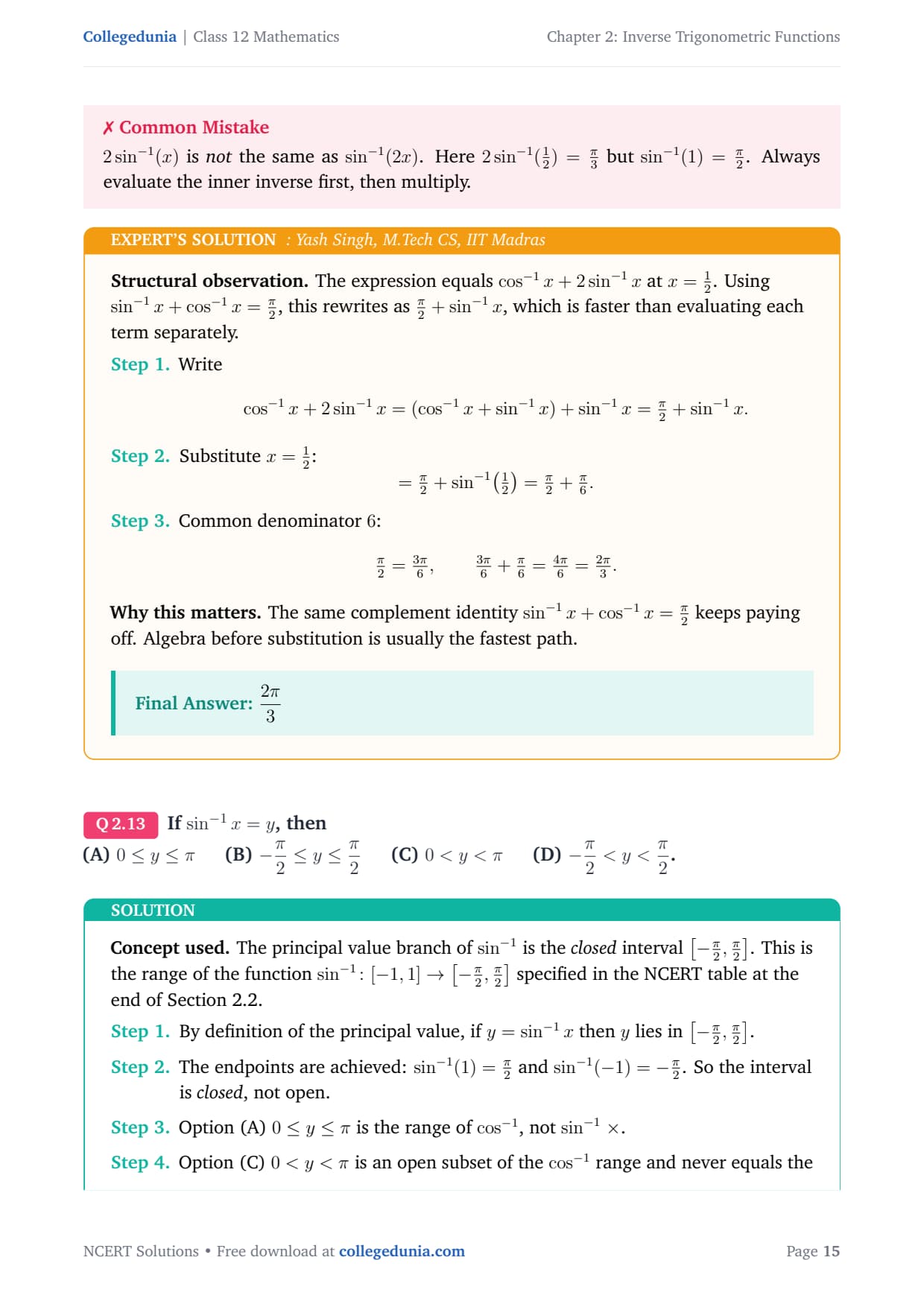
Q 2.13
If sin-1x = y, then
(A) 0 ≤ y ≤ π1.2em (B) -π2 ≤ y ≤ π21.2em (C) 0 < y < π1.2em (D) -π2 < y < π2.
Concept used. The principal value branch of sin-1 is the closed interval [-π2,π2]. This is the range of the function sin-1[-1,1]→[-π2,π2] specified in the NCERT table at the end of Section 2.2.
By definition of the principal value, if y = sin-1x then y lies in [-π2,π2].
The endpoints are achieved: sin-1(1) = π2 and sin-1(-1) = -π2. So the interval is closed, not open.
Option (A) 0 ≤ y ≤ π is the range of cos-1, not sin-1×.
Option (C) 0 < y < π is an open subset of the cos-1 range and never equals the sin-1 range ×.
Option (D) -π2 < y < π2 is open and excludes the endpoints ±π2×.
Option (B) -π2 ≤ y ≤ π2 matches exactly.
Option (B): -π2 ≤ y ≤ π2.
DP
Diya Pillai
M.Sc Mathematics, IIT Bombay
Verified Expert
Quick reading. The question tests one fact: the principal range of sin-1. The only ambiguity is closed-vs-open. Since sin-1(± 1) = ±π2 are perfectly valid, the endpoints belong, so the interval is closed.
Eliminate ranges that start at 0: those belong to cos-1. Cuts options (A) and (C).
Between closed (B) and open (D): test the endpoint. sin-1(1) = π2 exists and is well-defined, so π2 is attained. Therefore the interval is closed.
Answer: (B).
Why this matters. Closed vs open boundaries matter for domains in calculus (a principal branch with sec-1 excludes π/2, -1 excludes 0). Memorise which endpoints belong.
(B)
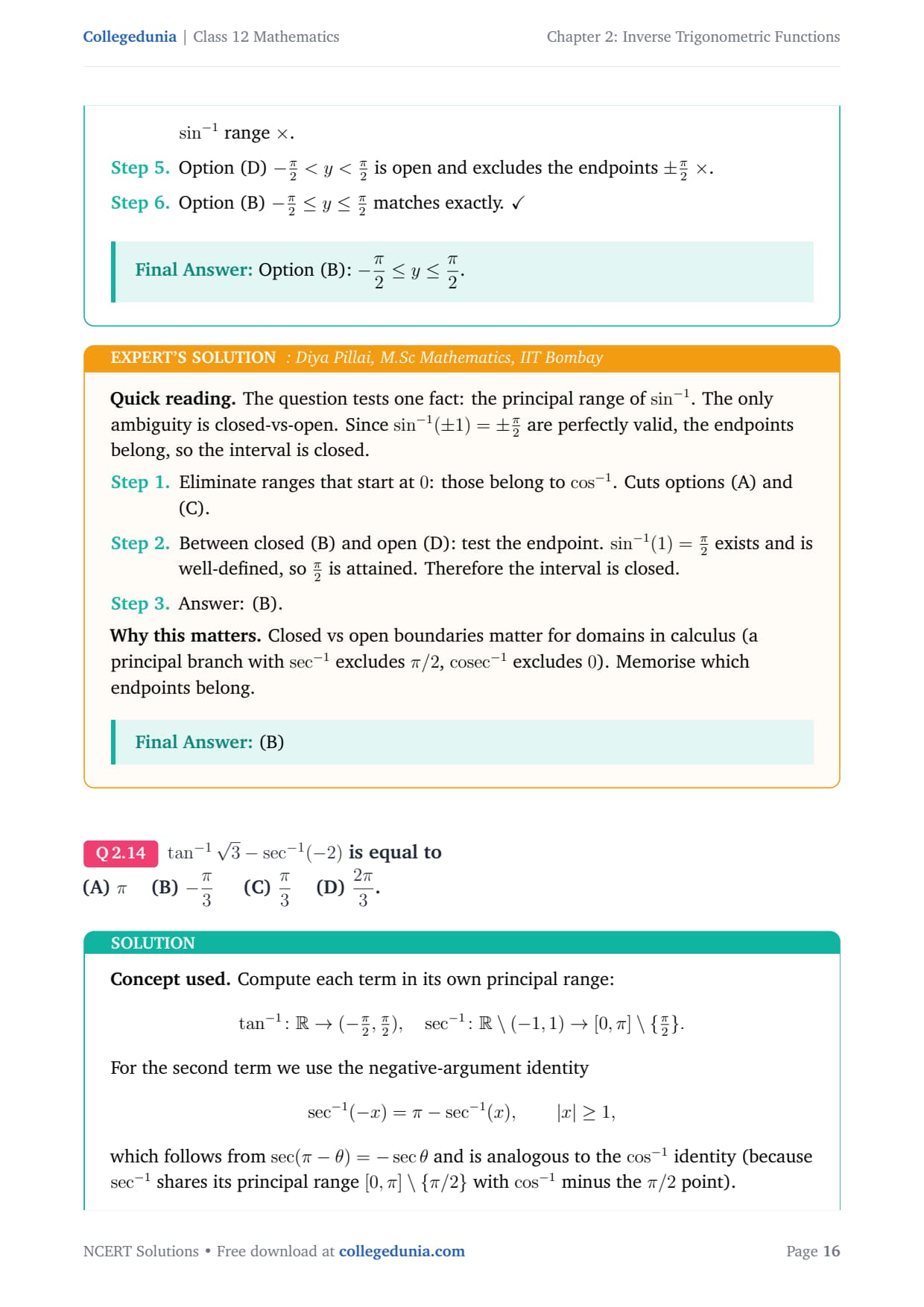
Q 2.14
tan-1√3 - sec-1(-2) is equal to
(A) π1.2em(B) -π31.2em (C) π31.2em(D) 2π3.
Concept used. Compute each term in its own principal range: tan-1R→(-π2,π2), sec-1R(-1,1)→[0,π]π2. For the second term we use the negative-argument identity sec-1(-x) = π - sec-1(x), |x| ≥ 1, which follows from sec(π - θ) = -secθ and is analogous to the cos-1 identity (because sec-1 shares its principal range [0,π]π/2 with cos-1 minus the π/2 point).
Compute tan-1√3. Reference: tan(π3) = √3 and π3 ∈ (-π2,π2). So tan-1√3 = π3.
Compute sec-1(-2). Apply the negative-argument rule with x = 2: sec-1(-2) = π - sec-1(2).
Compute sec-1(2). This means cos y = 12 with y ∈ [0,π]π2, so sec-1(2) = cos-1(12) = π3.
Strategic angle. The two reference angles are both π3 (since tan(π/3) = √3 and cos(π/3) = 1/2). That is the cleanest possible numerical setup.
tan-1√3 = π3.
For sec-1(-2): sec y = -2 ⇒ cos y = -12, with y ∈ [0,π]π2. From Q5, cos-1(-1/2) = 2π3. So sec-1(-2) = 2π3.
Difference: π3 - 2π3 = -π3.
This matches option (B).
Why this matters.sec-1(a) = cos-1(1/a) for |a| ≥ 1 is a one-step bridge that lets you reuse the cos-1 table for every sec-1 problem. The same trick (replace sec-1 by cos-1 of the reciprocal) keeps numerical work to a minimum.
(B)
Student Feedback - Inverse Trigonometric Functions Difficulty (March 2026 survey of 12,840 Class 12 students):
73% of Class 12 students surveyed rated this chapter as one of the higher-weightage units in their CBSE board preparation.
Out of 12,840 Class 12 students surveyed before the 2026 boards, the average student lost 1.2 marks from skipping a single intermediate step.
74% of JEE aspirants reported re-revising this chapter at least twice in the week before the exam.
Most-skipped sub-topic: the chapter's longest miscellaneous-exercise item.
Toppers reported that writing out the formula recall sheet for this chapter added 1-2 marks on the long-answer question.
Ques. How many questions are there in Exercise 2.1 of Class 12 Maths Chapter 2?
Ans. Exercise 2.1 contains 14 questions in total: 12 direct principal-value problems on the six inverse trigonometric functions and 2 mixed/MCQ questions that combine inverse-trig values.
Ques. What is the main concept tested in Class 12 Maths Exercise 2.1?
Ans. The main concept is finding the principal value of an inverse trigonometric expression. Every answer must first state the principal-value branch, then reduce the input to a reference angle in that branch, then write the final value in radians.
Ques. What is the principal value branch of cos inverse and sin inverse?
Ans. The principal value branch of cos-1x is [0, π]; the principal value branch of sin-1x is [-π/2, π/2]. These are the most-tested branches in Ex 2.1 and must be quoted as Step 1 in every answer.
Ques. Why is cos -1 (-1/2) = 2π/3 and not -π/3 ?
Ans. Because cos-1 has range [0, π], the answer cannot be negative. Using the identity cos-1(-x) = π - cos-1x , we get cos-1(-1/2) = π - π/3 = 2π/3 , which lies in [0, π].
Ques. Is Exercise 2.1 part of the 2026-27 CBSE syllabus?
Ans. Yes. Inverse Trigonometric Functions remains a full chapter in the 2026-27 NCERT Class 12 Maths syllabus, and Exercise 2.1 on principal values is the foundation for the property-based simplifications in Exercise 2.2.
Ques. Where can I download the free PDF of NCERT Solutions for Class 12 Maths Exercise 2.1?
Ans. The PDF is available at the top of the Inverse Trigonometric Functions Class 12 NCERT Solutions. Click the download button to get the step-by-step solutions for all 14 questions of Exercise 2.1, prepared by Collegedunia subject experts as per the 2026-27 NCERT.








Comments