Junior-Class Mentor, TFI Fellow | Updated 3+ months ago
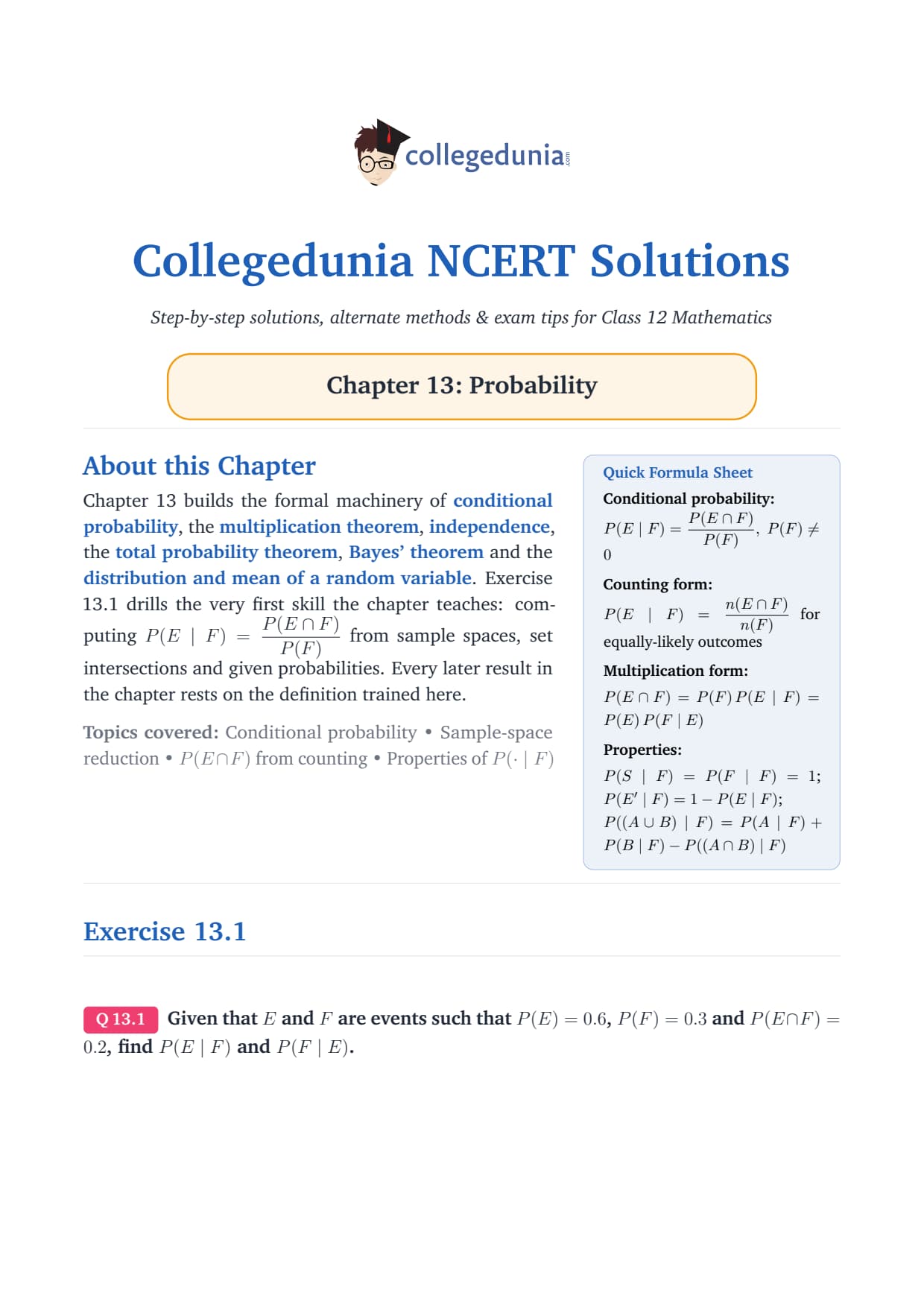
NCERT Solutions for Class 12 Maths Chapter 13 Probability Exercise 13.1 cover all 17 conditional-probability questions from the 2026-27 NCERT textbook. Each answer states the formula first, substitutes the values, then simplifies the answer on a separate line. The free solutions PDF for Exercise 13.1 is available to download on this page.
CBSE Weightage: Conditional probability carries 4 to 6 marks in the Class 12 board paper, usually a 3-mark short answer plus a 1-mark MCQ.
JEE Main: One question per session builds on the conditional-probability set-up trained in Exercise 13.1.
CUET Mathematics: 2 to 3 MCQs come from probability, mostly on the P(E|F) definition.
Probability Class 12 NCERT Solutions Exercise 13.1: Question-Wise Answer Map
The 17 problems in this exercise cluster into four families. The map below names the method and the final answer for each, so you can use it as a self-check after a first attempt.
Coin tossed three times; P(head on third | head on first two)
Sample space reduction
1/2
7
Two coins; P(both heads | at least one head)
Sample space reduction
1/3
8
Pair of dice; P(sum>9 | black die shows 5)
Reduced sample space size 6
1/3
9
Pair of dice; P(sum=8 | red die shows below 4)
Reduced sample space size 18
1/9
10
Die thrown twice; six conditional sub-parts
Reduced sample space
Varies per part
11
Die thrown twice; E = sum is 8, F = 4 appears at least once
Reduced sample space
2/11 and 2/5
12
E = {1,3,5}, F = {2,3} on fair die
Set intersection
1/2 and 1/3
13
Family-of-two with at least one boy; P(both boys)
Sample space reduction
1/3
14
Instructor selects question; P(easy MCQ | MCQ)
Two-way table
5/9
15
Family-of-two; both girls given youngest/at least one girl
Sample space reduction
1/2 and 1/3
16
If P(A)=1/2, P(B)=0, then P(A|B) equals
Definition; P(B)=0
Not defined (option C)
17
If P(A|B) = P(B|A), pick the correct option
Manipulate definition
P(A) = P(B) (option D)
Questions 6 to 15 form the highest-value block: list the reduced sample space F first, then count outcomes inside it that also lie in E. Questions 16 and 17 are MCQs.
Important Formulas Used in Exercise 13.1 of Chapter 13
Three formulas carry this whole exercise, in this order.
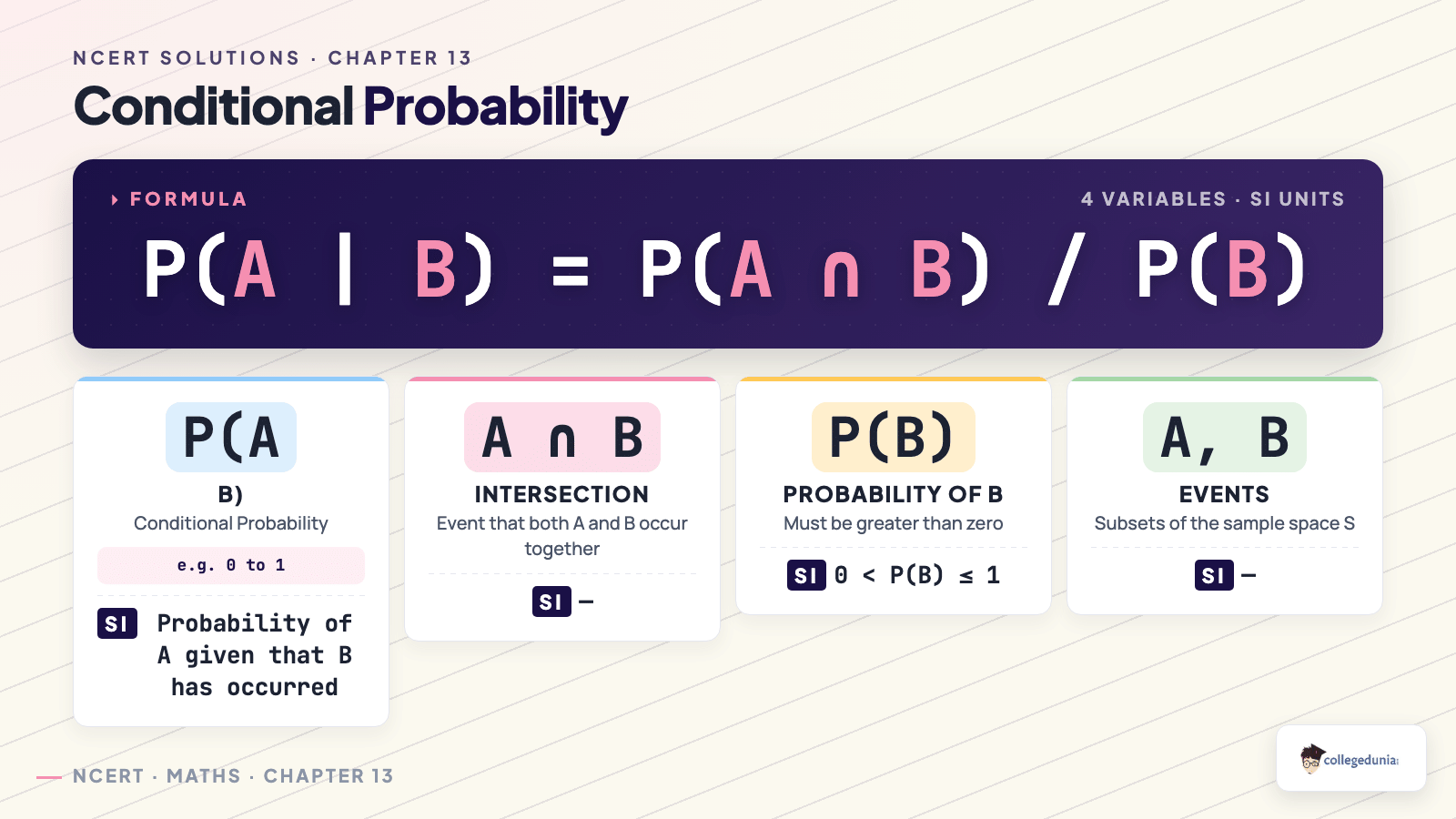
Conditional probability (definition): P(E|F) = P(E∩F)/P(F), P(F)≠0
Counting form: P(E|F) = n(E∩F)/n(F) when outcomes are equally likely. Q6 to Q15 use this form.
Multiplication theorem: P(E∩F) = P(F)·P(E|F) = P(E)·P(F|E) . Q3 and Q4 use this to recover the intersection.
Inclusion-exclusion: P(A∪B) = P(A) + P(B) - P(A∩B) . Needed in Q4 and Q5 to bridge the given union with the required intersection.
See the Formula Sheet under Other Resources for independence, the total probability theorem and Bayes' theorem.
Sample Solved Problem: Family-of-Two Question from Exercise 13.1
Question 15 is one of the most-asked CBSE problems from this exercise. The answer below follows the same six-step rhythm every reduced-sample-space solution on this page uses.
Q15. Assume that each born child is equally likely to be a boy or a girl. If a family has two children, find the conditional probability that both are girls given that (i) the youngest is a girl, (ii) at least one is a girl.
Sample space S = {BB, BG, GB, GG} , second letter is the youngest child. Each outcome has probability 1/4 .
Let A be "both girls", so A = {GG} , P(A) = 1/4 .
Part (i): Let B be "youngest is a girl", so B = {BG, GG} , P(B) = 1/2 . Then A∩B = {GG} , P(A∩B) = 1/4 .
Apply the definition: P(A|B) = (1/4)/(1/2) = 1/2 .
Part (ii): Let C be "at least one girl", so C = {BG, GB, GG} , P(C) = 3/4 . Then A∩C = {GG} , P(A∩C) = 1/4 .
P(A|C) = (1/4)/(3/4) = 1/3 .
The answers are 1/2 for part (i) and 1/3 for part (ii). Knowing the youngest is a girl is stronger information than knowing at least one is a girl, so the conditional probability is higher.
Common Mistakes in Class 12 Maths Chapter 13 Exercise 13.1
These four pitfalls cost the most marks in CBSE 2022 to 2025 board papers.
Common Mistake: Computing P(E|F) as P(E)·P(F) when E and F are not given as independent. Conditional probability is P(E∩F)/P(F) ; the product rule only applies after independence is proved.
Confusing P(E|F) with P(F|E): the denominator is always the event being conditioned on. Q1 and Q11 test both directions.
Forgetting the reduced sample space: in Q8 the sample space drops from 36 to 6 once "black die shows 5" is given. Using 36 in the denominator loses 2 marks.
Treating P(B)=0 as computable: Q16's correct option is "not defined". Picking "0" or "1" is the most common MCQ trap.
Listing the family-of-two sample space as size 3: in Q13 and Q15, students often miss {GB}. Outcomes are ordered by birth, so BG and GB are distinct.
Probability Weightage Compared Across Class 12 Maths Chapters
Probability is consistently a top-three scorer. The table places Chapter 13 against every other Class 12 Maths chapter.
Chapter
Topic
Avg CBSE Marks
Ch 1
Relations and Functions
5 marks
Ch 2
Inverse Trigonometric Functions
3 marks
Ch 3
Matrices
6 marks
Ch 4
Determinants
6 marks
Ch 5
Continuity and Differentiability
8 marks
Ch 6
Application of Derivatives
6 marks
Ch 7
Integrals
9 marks
Ch 8
Application of Integrals
5 marks
Ch 9
Differential Equations
5 marks
Ch 10
Vector Algebra
5 marks
Ch 11
Three Dimensional Geometry
6 marks
Ch 12
Linear Programming
5 marks
Ch 13
Probability
8 marks
Probability is an 8-mark chapter across the last five board papers; Exercise 13.1 alone accounts for 4 to 6 of those marks.
Other Resources for Class 12 Maths Chapter 13 Probability
Pair the Exercise 13.1 solutions with the rest of the Chapter 13 resource library for complete preparation.
All NCERT Solutions for Probability Exercise 13.1 with Step-by-Step Working
Every NCERT textbook question for Class 12 Mathematics Chapter 13 Probability Exercise 13.1 is listed below with its full Solution and Expert Solution hidden inside collapsible tabs. Click Check Solution to reveal the step-by-step working; click Expert Solution for the expanded explanation.
Questions
Q 13.1
Given that \(E\) and \(F\) are events such that \(P(E)=0.6\), \(P(F)=0.3\) and \(P(E\cap F)=0.2\), find \(P(E\mid F)\) and \(P(F\mid E)\).
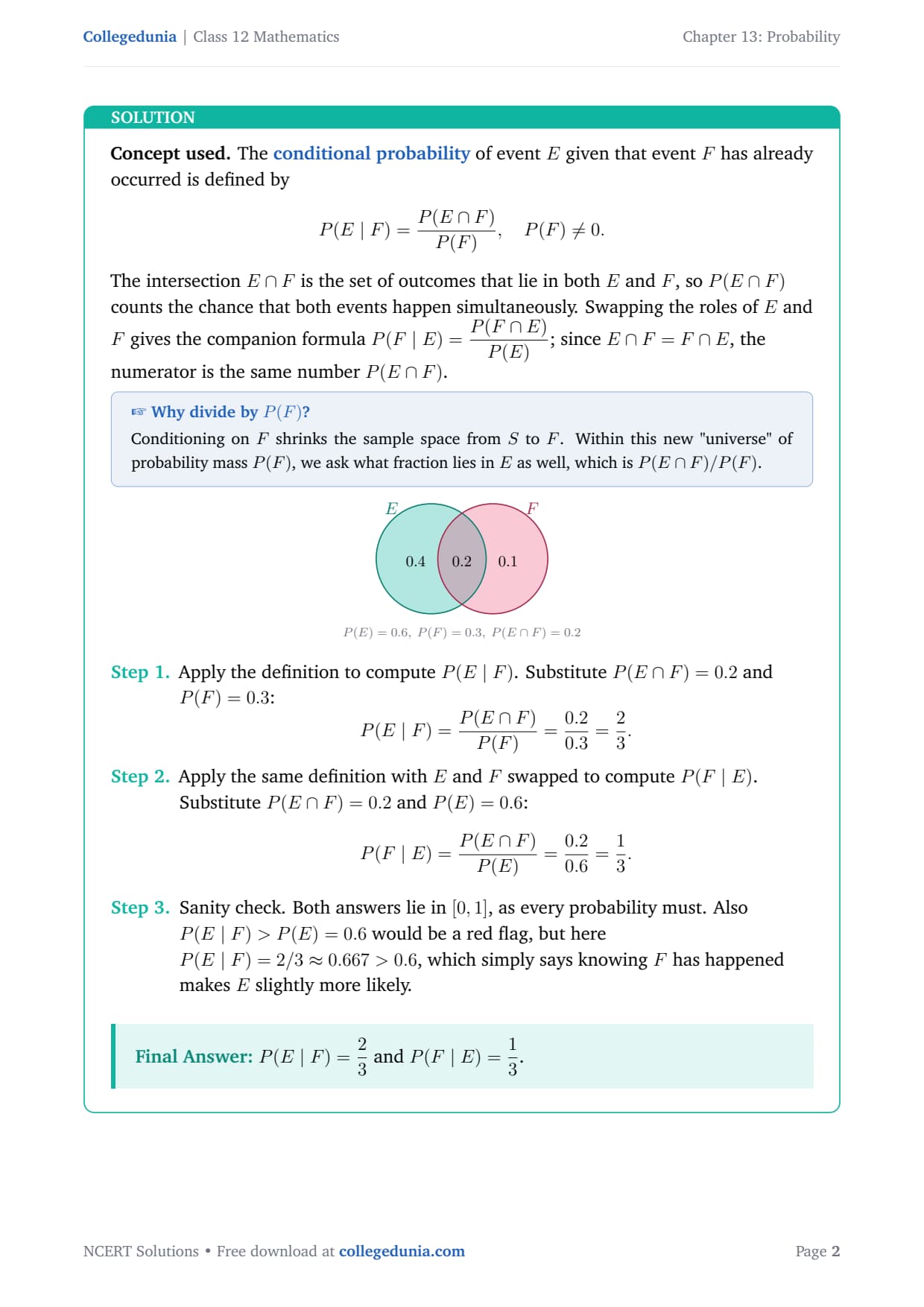
Concept used. The conditional probability of event \(E\) given that event \(F\) has already occurred is defined by
\[ P(E\mid F)=\dfrac{P(E\cap F)}{P(F)},\quad P(F)\ne 0. \]
The intersection \(E\cap F\) is the set of outcomes that lie in both \(E\) and \(F\), so \(P(E\cap F)\) counts the chance that both events happen simultaneously. Swapping the roles of \(E\) and \(F\) gives the companion formula \(P(F\mid E)=\dfrac{P(F\cap E)}{P(E)}\); since \(E\cap F=F\cap E\), the numerator is the same number \(P(E\cap F)\).
Why divide by \(P(F)\)?
Conditioning on \(F\) shrinks the sample space from \(S\) to \(F\). Within this new "universe" of probability mass \(P(F)\), we ask what fraction lies in \(E\) as well, which is \(P(E\cap F)/P(F)\).
[See diagram in the PDF version]
Apply the definition to compute \(P(E\mid F)\). Substitute \(P(E\cap F)=0.2\) and \(P(F)=0.3\):
\[ P(E\mid F)=\dfrac{P(E\cap F)}{P(F)}=\dfrac{0.2}{0.3}=\dfrac{2}{3}. \]
Apply the same definition with \(E\) and \(F\) swapped to compute \(P(F\mid E)\). Substitute \(P(E\cap F)=0.2\) and \(P(E)=0.6\):
\[ P(F\mid E)=\dfrac{P(E\cap F)}{P(E)}=\dfrac{0.2}{0.6}=\dfrac{1}{3}. \]
Sanity check. Both answers lie in \([0,1]\), as every probability must. Also \(P(E\mid F)>P(E)=0.6\) would be a red flag, but here \(P(E\mid F)=2/3\approx 0.667>0.6\), which simply says knowing \(F\) has happened makes \(E\) slightly more likely.
\(P(E\mid F)=\dfrac{2}{3}\) and \(P(F\mid E)=\dfrac{1}{3}\).
AS
Aarav Sharma
M.Sc Mathematics, IIT Bombay
Verified Expert
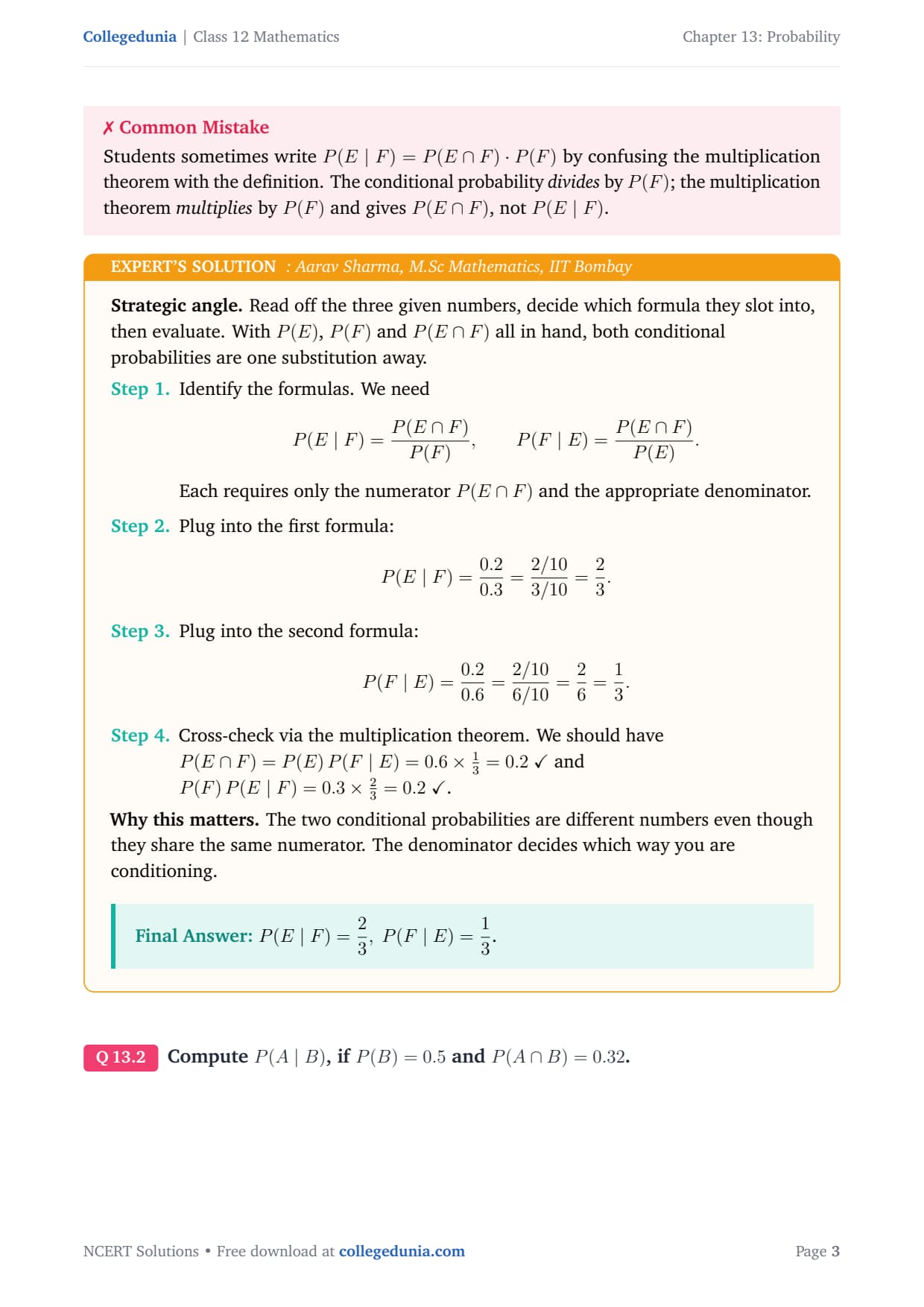
Strategic angle. Read off the three given numbers, decide which formula they slot into, then evaluate. With \(P(E)\), \(P(F)\) and \(P(E\cap F)\) all in hand, both conditional probabilities are one substitution away.
Identify the formulas. We need
\[ P(E\mid F)=\frac{P(E\cap F)}{P(F)},\qquad P(F\mid E)=\frac{P(E\cap F)}{P(E)}. \]
Each requires only the numerator \(P(E\cap F)\) and the appropriate denominator.
Plug into the first formula:
\[ P(E\mid F)=\frac{0.2}{0.3}=\frac{2/10}{3/10}=\frac{2}{3}. \]
Plug into the second formula:
\[ P(F\mid E)=\frac{0.2}{0.6}=\frac{2/10}{6/10}=\frac{2}{6}=\frac{1}{3}. \]
Cross-check via the multiplication theorem. We should have \(P(E\cap F)=P(E)\,P(F\mid E)=0.6\times \tfrac{1}{3}=0.2\) and \(P(F)\,P(E\mid F)=0.3\times \tfrac{2}{3}=0.2\) .
Why this matters. The two conditional probabilities are different numbers even though they share the same numerator. The denominator decides which way you are conditioning.
Compute \(P(A\mid B)\), if \(P(B)=0.5\) and \(P(A\cap B)=0.32\).
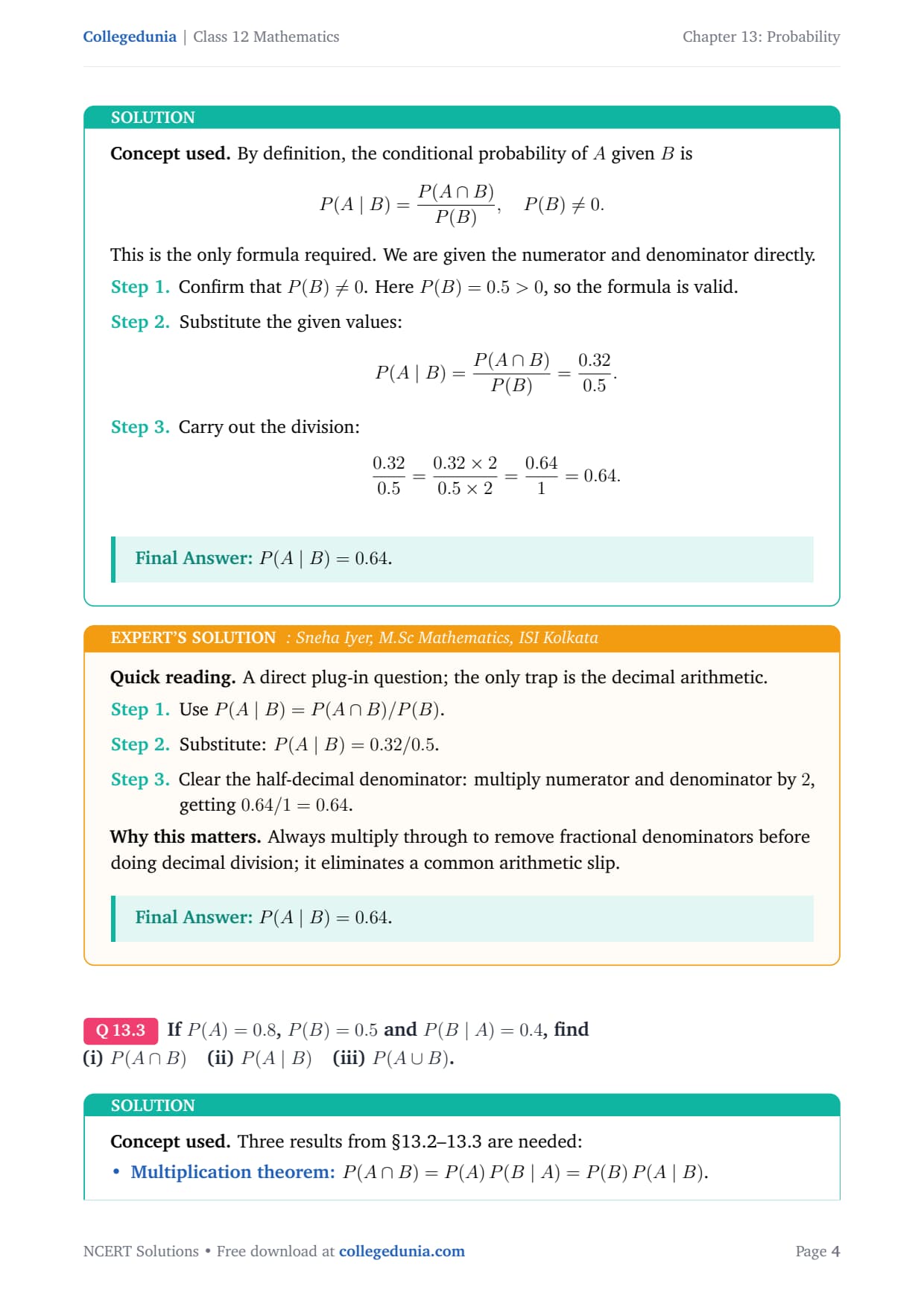
Concept used. By definition, the conditional probability of \(A\) given \(B\) is
\[ P(A\mid B)=\dfrac{P(A\cap B)}{P(B)},\quad P(B)\ne 0. \]
This is the only formula required. We are given the numerator and denominator directly.
Confirm that \(P(B)\ne 0\). Here \(P(B)=0.5>0\), so the formula is valid.
Substitute the given values:
\[ P(A\mid B)=\dfrac{P(A\cap B)}{P(B)}=\dfrac{0.32}{0.5}. \]
Carry out the division:
\[ \dfrac{0.32}{0.5}=\dfrac{0.32\times 2}{0.5\times 2}=\dfrac{0.64}{1}=0.64. \]
\(P(A\mid B)=0.64\).
SI
Sneha Iyer
M.Sc Mathematics, ISI Kolkata
Verified Expert
Quick reading. A direct plug-in question; the only trap is the decimal arithmetic.
Use \(P(A\mid B)=P(A\cap B)/P(B)\).
Substitute: \(P(A\mid B)=0.32/0.5\).
Clear the half-decimal denominator: multiply numerator and denominator by \(2\), getting \(0.64/1=0.64\).
Why this matters. Always multiply through to remove fractional denominators before doing decimal division; it eliminates a common arithmetic slip.
\(P(A\mid B)=0.64\).
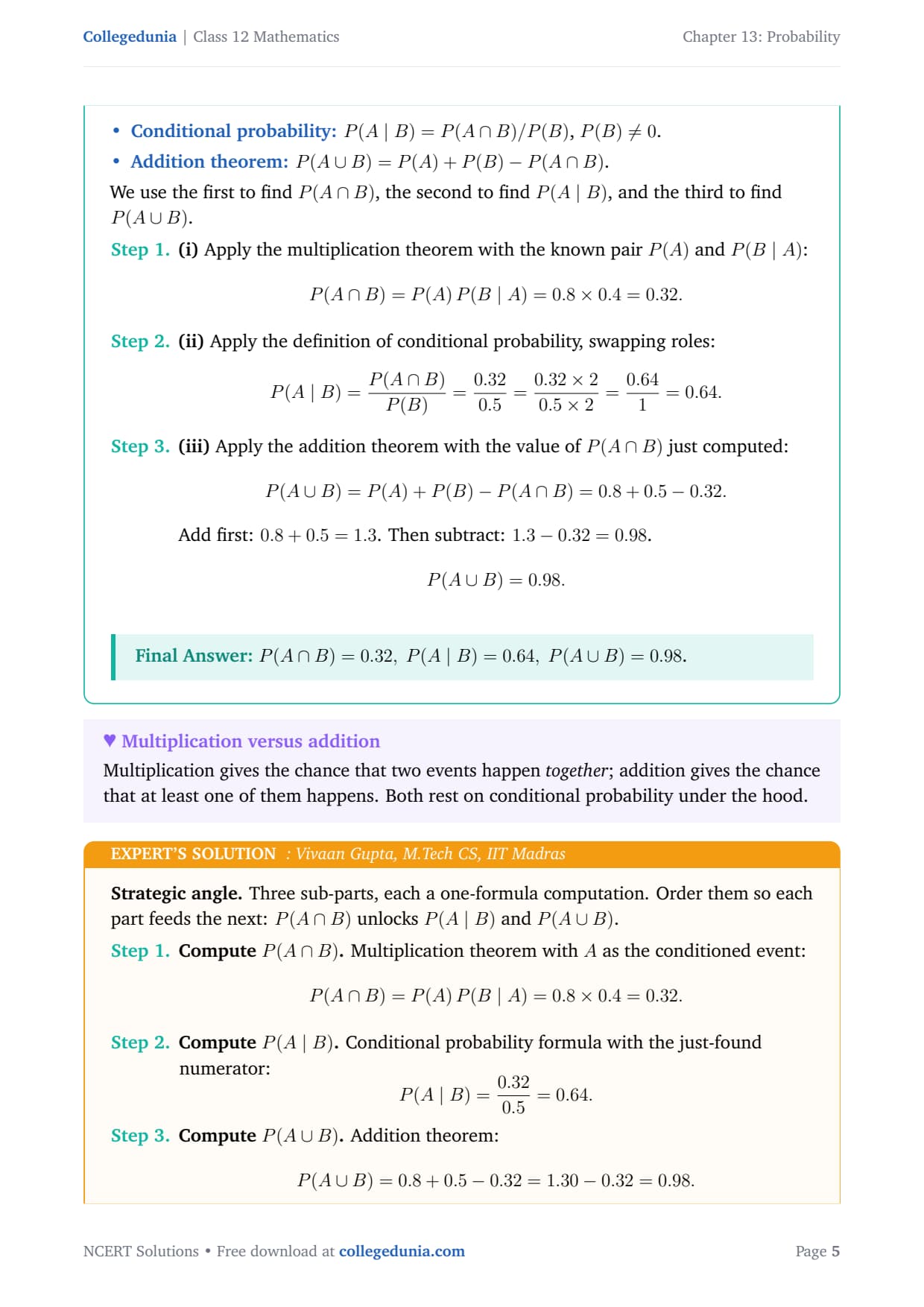
Q 13.3
If \(P(A)=0.8\), \(P(B)=0.5\) and \(P(B\mid A)=0.4\), find
(i) \(P(A\cap B)\) (ii) \(P(A\mid B)\) (iii) \(P(A\cup B)\).
Concept used. Three results from 13.2–13.3 are needed:
We use the first to find \(P(A\cap B)\), the second to find \(P(A\mid B)\), and the third to find \(P(A\cup B)\).
(i) Apply the multiplication theorem with the known pair \(P(A)\) and \(P(B\mid A)\):
\[ P(A\cap B)=P(A)\,P(B\mid A)=0.8\times 0.4=0.32. \]
(ii) Apply the definition of conditional probability, swapping roles:
\[ P(A\mid B)=\dfrac{P(A\cap B)}{P(B)}=\dfrac{0.32}{0.5}=\dfrac{0.32\times 2}{0.5\times 2}=\dfrac{0.64}{1}=0.64. \]
(iii) Apply the addition theorem with the value of \(P(A\cap B)\) just computed:
\[ P(A\cup B)=P(A)+P(B)-P(A\cap B)=0.8+0.5-0.32. \]
Add first: \(0.8+0.5=1.3\). Then subtract: \(1.3-0.32=0.98\).
\[ P(A\cup B)=0.98. \]
Strategic angle. Three sub-parts, each a one-formula computation. Order them so each part feeds the next: \(P(A\cap B)\) unlocks \(P(A\mid B)\) and \(P(A\cup B)\).
Compute \(P(A\cap B)\). Multiplication theorem with \(A\) as the conditioned event:
\[ P(A\cap B)=P(A)\,P(B\mid A)=0.8\times 0.4=0.32. \]
Compute \(P(A\mid B)\). Conditional probability formula with the just-found numerator:
\[ P(A\mid B)=\dfrac{0.32}{0.5}=0.64. \]
Why this matters. The three quantities are linked: once any two of \(\{P(A\cap B), P(A\mid B), P(B\mid A)\}\) are known together with \(P(A)\) and \(P(B)\), everything else follows mechanically.
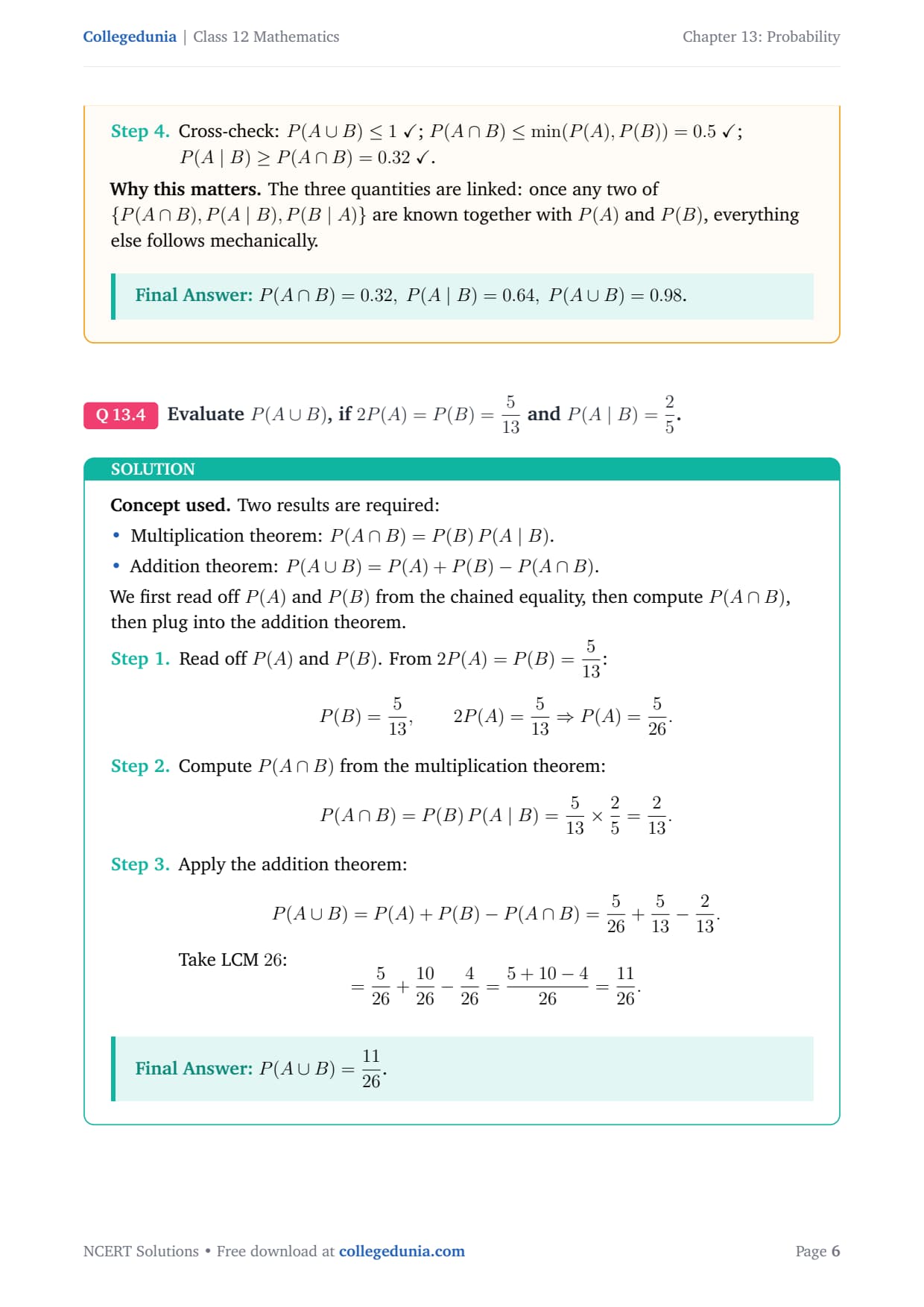
We first read off \(P(A)\) and \(P(B)\) from the chained equality, then compute \(P(A\cap B)\), then plug into the addition theorem.
Read off \(P(A)\) and \(P(B)\). From \(2P(A)=P(B)=\dfrac{5}{13}\):
\[ P(B)=\dfrac{5}{13},\qquad 2P(A)=\dfrac{5}{13}\Rightarrow P(A)=\dfrac{5}{26}. \]
Compute \(P(A\cap B)\) from the multiplication theorem:
\[ P(A\cap B)=P(B)\,P(A\mid B)=\dfrac{5}{13}\times \dfrac{2}{5}=\dfrac{2}{13}. \]
Apply the addition theorem:
\[ P(A\cup B)=P(A)+P(B)-P(A\cap B)=\dfrac{5}{26}+\dfrac{5}{13}-\dfrac{2}{13}. \]
Take LCM \(26\):
\[ =\dfrac{5}{26}+\dfrac{10}{26}-\dfrac{4}{26}=\dfrac{5+10-4}{26}=\dfrac{11}{26}. \]
\(P(A\cup B)=\dfrac{11}{26}\).
PM
Pranav Mehta
M.Sc Applied Mathematics, IIT Kanpur
Verified Expert
Structural observation. The chained equality \(2P(A)=P(B)=\tfrac{5}{13}\) packages two facts in one line. Unpack it before doing anything else.
Unpack: \(P(B)=\tfrac{5}{13}\) and \(P(A)=\tfrac{1}{2}\cdot \tfrac{5}{13}=\tfrac{5}{26}\).
Use \(P(A\cap B)=P(B)P(A\mid B)=\tfrac{5}{13}\cdot \tfrac{2}{5}=\tfrac{2}{13}\).
Use \(P(A\cup B)=P(A)+P(B)-P(A\cap B)=\tfrac{5}{26}+\tfrac{10}{26}-\tfrac{4}{26}=\tfrac{11}{26}\).
Check: \(\tfrac{11}{26}<1\) and \(\tfrac{11}{26}\ge P(B)=\tfrac{10}{26}\) .
Why this matters. A chained equality is just a shorthand. Always split it into individual equations first; this prevents algebraic mistakes downstream.
\(P(A\cup B)=\dfrac{11}{26}\).
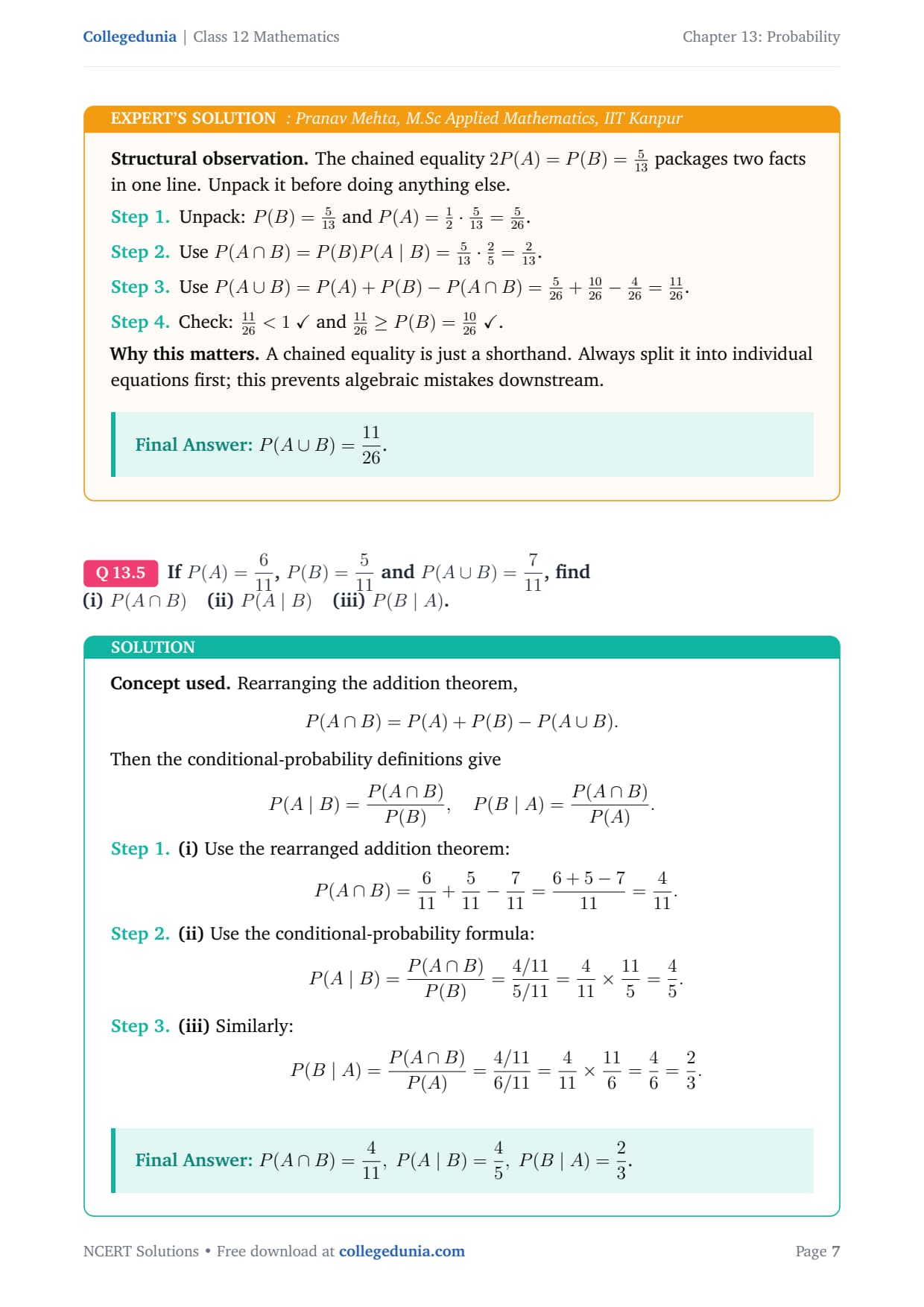
Q 13.5
If \(P(A)=\dfrac{6}{11}\), \(P(B)=\dfrac{5}{11}\) and \(P(A\cup B)=\dfrac{7}{11}\), find
(i) \(P(A\cap B)\) (ii) \(P(A\mid B)\) (iii) \(P(B\mid A)\).
Concept used. Rearranging the addition theorem,
\[ P(A\cap B)=P(A)+P(B)-P(A\cup B). \]
Then the conditional-probability definitions give
\[ P(A\mid B)=\dfrac{P(A\cap B)}{P(B)},\quad P(B\mid A)=\dfrac{P(A\cap B)}{P(A)}. \]
(i) Use the rearranged addition theorem:
\[ P(A\cap B)=\dfrac{6}{11}+\dfrac{5}{11}-\dfrac{7}{11}=\dfrac{6+5-7}{11}=\dfrac{4}{11}. \]
(ii) Use the conditional-probability formula:
\[ P(A\mid B)=\dfrac{P(A\cap B)}{P(B)}=\dfrac{4/11}{5/11}=\dfrac{4}{11}\times \dfrac{11}{5}=\dfrac{4}{5}. \]
Why this matters. The same intersection probability \(\tfrac{4}{11}\) feeds both conditional probabilities; the difference in answers comes purely from the denominators.
\(\dfrac{4}{11},\ \dfrac{4}{5},\ \dfrac{2}{3}\).
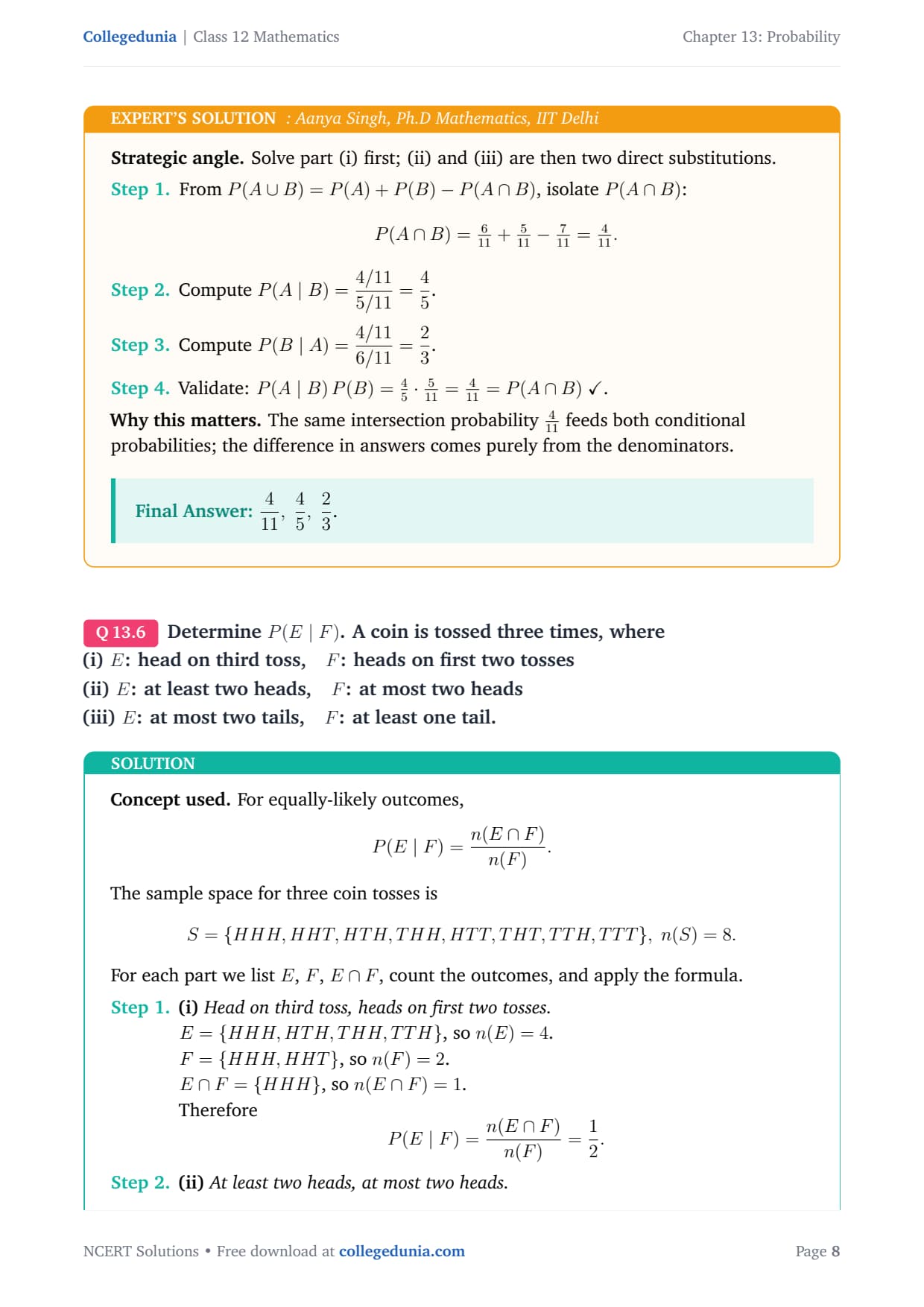
Q 13.6
Determine \(P(E\mid F)\). A coin is tossed three times, where
(i) \(E\): head on third toss, \(F\): heads on first two tosses
(ii) \(E\): at least two heads, \(F\): at most two heads
(iii) \(E\): at most two tails, \(F\): at least one tail.
Concept used. For equally-likely outcomes,
\[ P(E\mid F)=\dfrac{n(E\cap F)}{n(F)}. \]
The sample space for three coin tosses is
\[ S=\{HHH,HHT,HTH,THH,HTT,THT,TTH,TTT\},\ n(S)=8. \]
For each part we list \(E\), \(F\), \(E\cap F\), count the outcomes, and apply the formula.
(i)Head on third toss, heads on first two tosses.
\(E=\{HHH,HTH,THH,TTH\}\), so \(n(E)=4\).
\(F=\{HHH,HHT\}\), so \(n(F)=2\).
\(E\cap F=\{HHH\}\), so \(n(E\cap F)=1\).
Therefore
\[ P(E\mid F)=\dfrac{n(E\cap F)}{n(F)}=\dfrac{1}{2}. \]
(ii)At least two heads, at most two heads.
At least two heads: \(E=\{HHH,HHT,HTH,THH\}\), \(n(E)=4\).
At most two heads (i.e. \(\le 2\) heads, equivalently not \(HHH\)): \(F=\{HHT,HTH,THH,HTT,THT,TTH,TTT\}\), \(n(F)=7\).
\(E\cap F=\{HHT,HTH,THH\}\), \(n(E\cap F)=3\).
\[ P(E\mid F)=\dfrac{3}{7}. \]
(iii)At most two tails, at least one tail.
At most two tails (\(\le 2\) tails, equivalently not \(TTT\)): \(E=\{HHH,HHT,HTH,THH,HTT,THT,TTH\}\), \(n(E)=7\).
At least one tail (\(\ge 1\) tail, equivalently not \(HHH\)): \(F=\{HHT,HTH,THH,HTT,THT,TTH,TTT\}\), \(n(F)=7\).
\(E\cap F=\{HHT,HTH,THH,HTT,THT,TTH\}\), \(n(E\cap F)=6\).
\[ P(E\mid F)=\dfrac{6}{7}. \]
(i) \(\dfrac{1}{2}\) (ii) \(\dfrac{3}{7}\) (iii) \(\dfrac{6}{7}\).
AR
Arjun Reddy
M.Sc Mathematics, IIT Bombay
Verified Expert
Picture-first. For each part, draw the tree of \(8\) outcomes once, then highlight the cells that belong to \(E\), \(F\), and \(E\cap F\).
[See diagram in the PDF version]
(i) \(F=\{HHH,HHT\}\), of which only \(HHH\) has a head on toss 3.
\(\Rightarrow P(E\mid F)=1/2\).
(ii) \(F\) excludes only \(HHH\), so \(n(F)=7\). Of these, \(E\) keeps the three two-head outcomes \(HHT,HTH,THH\). \(\Rightarrow 3/7\).
(iii) \(F\) excludes only \(HHH\), \(n(F)=7\). Of these, \(E\) (at most two tails) keeps everything except \(TTT\), leaving \(6\) outcomes. \(\Rightarrow 6/7\).
Why this matters. For small sample spaces, listing outcomes is faster and less error-prone than juggling formulas.
\(\dfrac{1}{2},\ \dfrac{3}{7},\ \dfrac{6}{7}\).
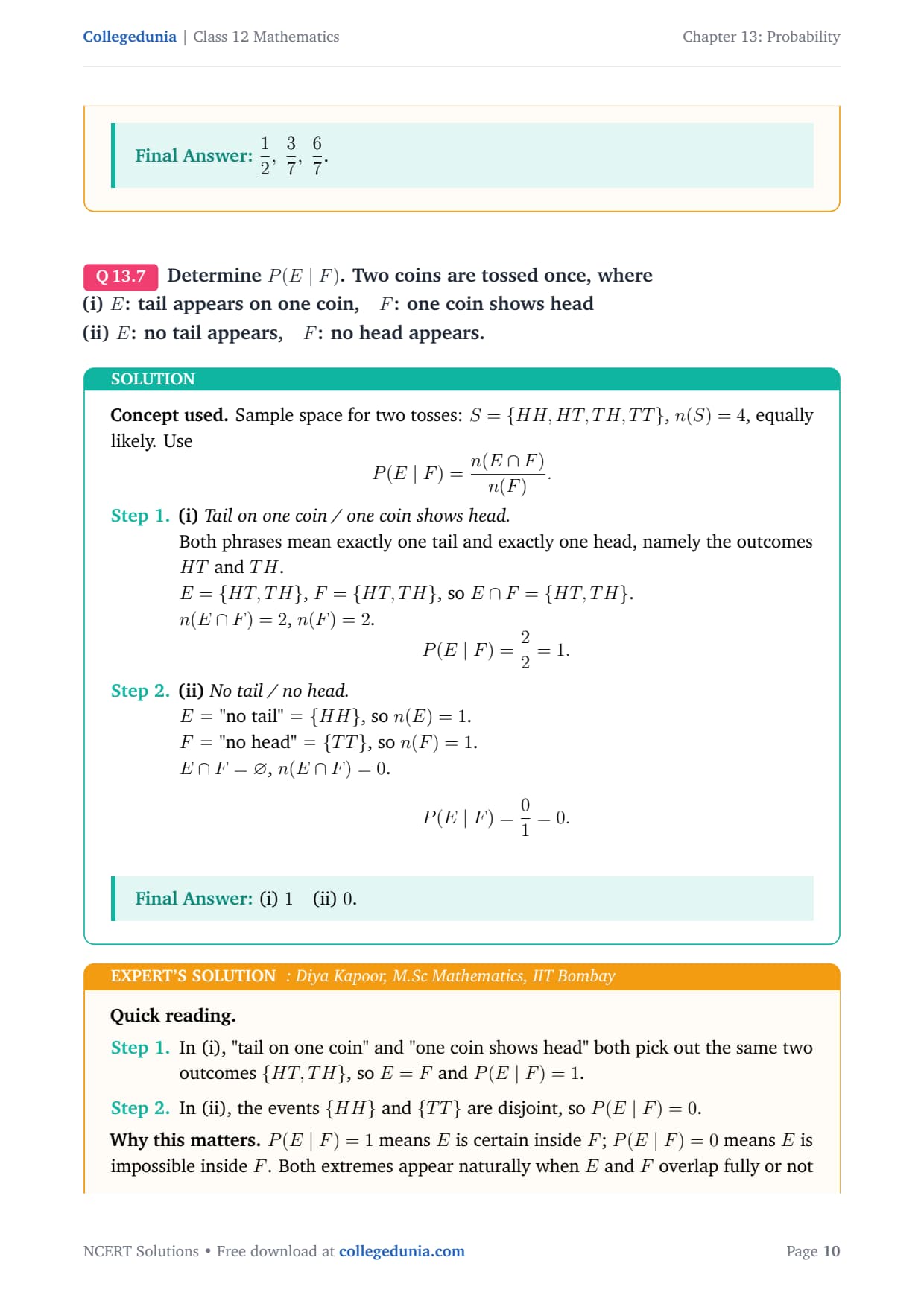
Q 13.7
Determine \(P(E\mid F)\). Two coins are tossed once, where
(i) \(E\): tail appears on one coin, \(F\): one coin shows head
(ii) \(E\): no tail appears, \(F\): no head appears.
Concept used. Sample space for two tosses: \(S=\{HH,HT,TH,TT\}\), \(n(S)=4\), equally likely. Use
\[ P(E\mid F)=\dfrac{n(E\cap F)}{n(F)}. \]
(i)Tail on one coin / one coin shows head.
Both phrases mean exactly one tail and exactly one head, namely the outcomes \(HT\) and \(TH\).
\(E=\{HT,TH\}\), \(F=\{HT,TH\}\), so \(E\cap F=\{HT,TH\}\).
\(n(E\cap F)=2\), \(n(F)=2\).
\[ P(E\mid F)=\dfrac{2}{2}=1. \]
(ii)No tail / no head.
\(E\) = "no tail" = \(\{HH\}\), so \(n(E)=1\).
\(F\) = "no head" = \(\{TT\}\), so \(n(F)=1\).
\(E\cap F=\varnothing\), \(n(E\cap F)=0\).
\[ P(E\mid F)=\dfrac{0}{1}=0. \]
(i) \(1\) (ii) \(0\).
DK
Diya Kapoor
M.Sc Mathematics, IIT Bombay
Verified Expert
Quick reading.
In (i), "tail on one coin" and "one coin shows head" both pick out the same two outcomes \(\{HT,TH\}\), so \(E=F\) and \(P(E\mid F)=1\).
In (ii), the events \(\{HH\}\) and \(\{TT\}\) are disjoint, so \(P(E\mid F)=0\).
Why this matters. \(P(E\mid F)=1\) means \(E\) is certain inside \(F\); \(P(E\mid F)=0\) means \(E\) is impossible inside \(F\). Both extremes appear naturally when \(E\) and \(F\) overlap fully or not at all.
\(1\) and \(0\).
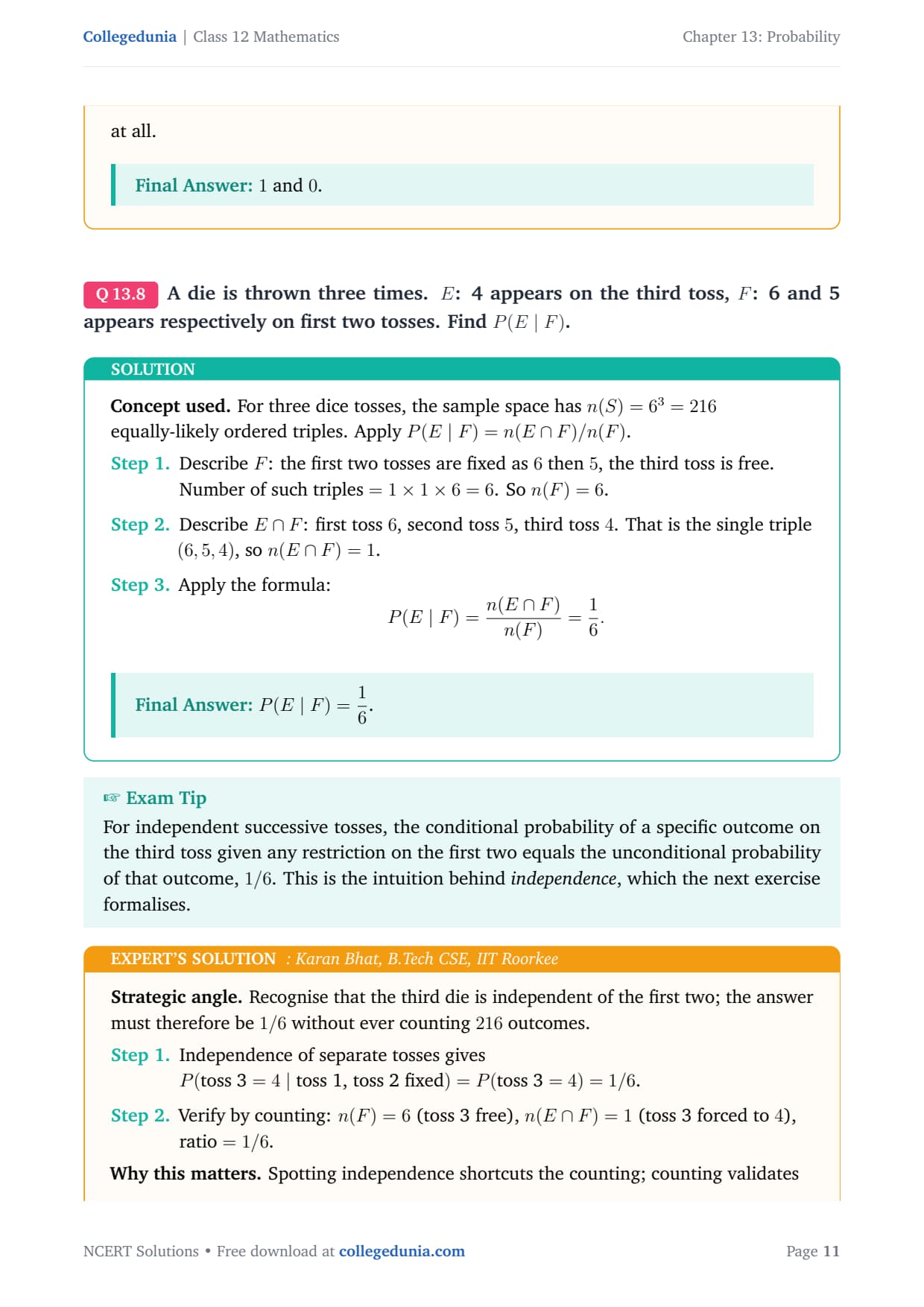
Q 13.8
A die is thrown three times. \(E\): 4 appears on the third toss, \(F\): 6 and 5 appears respectively on first two tosses. Find \(P(E\mid F)\).
Concept used. For three dice tosses, the sample space has \(n(S)=6^3=216\) equally-likely ordered triples. Apply \(P(E\mid F)=n(E\cap F)/n(F)\).
Describe \(F\): the first two tosses are fixed as \(6\) then \(5\), the third toss is free.
Number of such triples \(=1\times 1\times 6=6\). So \(n(F)=6\).
Describe \(E\cap F\): first toss \(6\), second toss \(5\), third toss \(4\). That is the single triple \((6,5,4)\), so \(n(E\cap F)=1\).
Apply the formula:
\[ P(E\mid F)=\dfrac{n(E\cap F)}{n(F)}=\dfrac{1}{6}. \]
\(P(E\mid F)=\dfrac{1}{6}\).
KB
Karan Bhat
B.Tech CSE, IIT Roorkee
Verified Expert
Strategic angle. Recognise that the third die is independent of the first two; the answer must therefore be \(1/6\) without ever counting \(216\) outcomes.
Independence of separate tosses gives \(P(\text{toss 3}=4\mid \text{toss 1, toss 2 fixed})=P(\text{toss 3}=4)=1/6\).
Verify by counting: \(n(F)=6\) (toss 3 free), \(n(E\cap F)=1\) (toss 3 forced to \(4\)), ratio \(=1/6\).
Why this matters. Spotting independence shortcuts the counting; counting validates the shortcut.
\(\dfrac{1}{6}\).
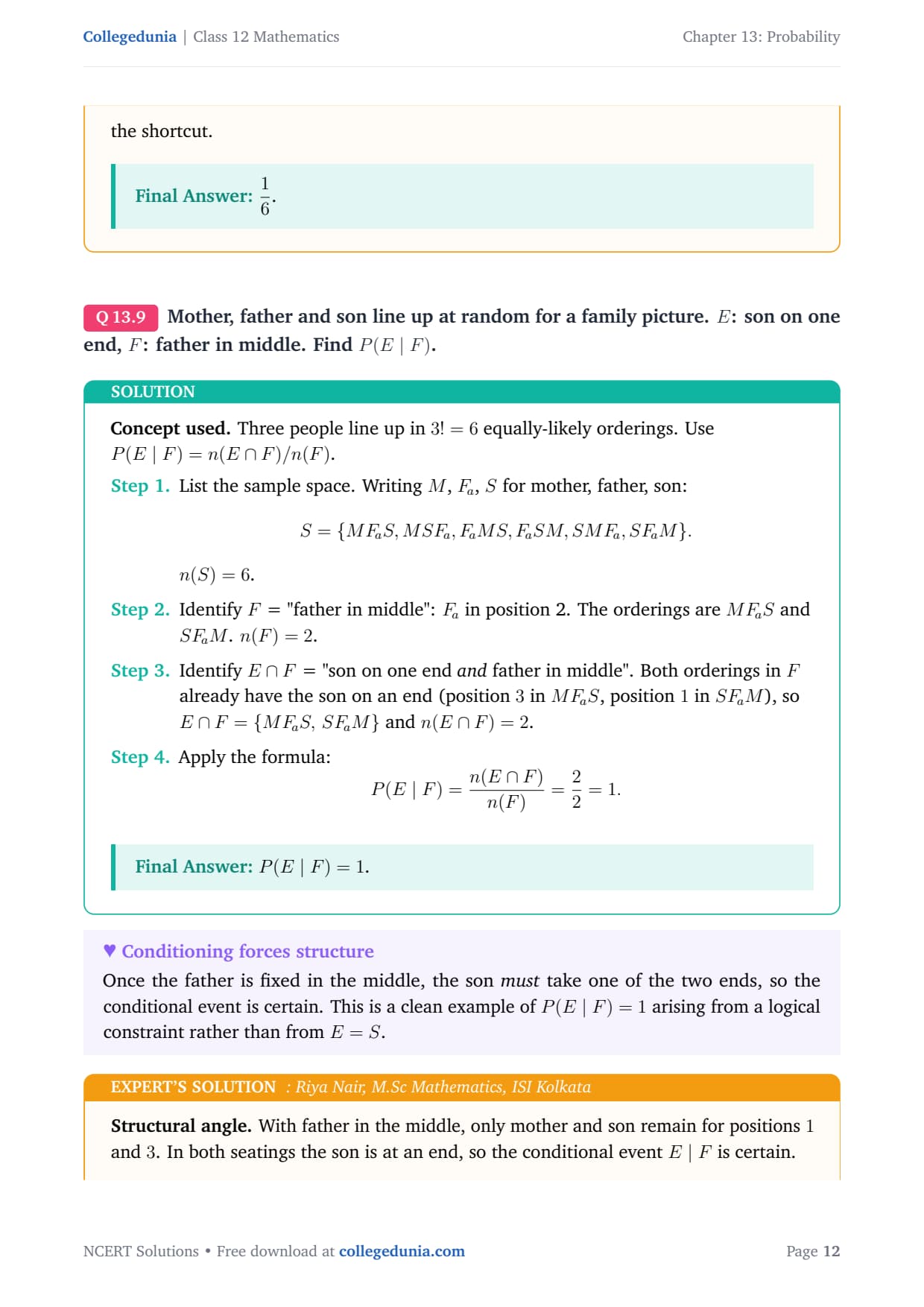
Q 13.9
Mother, father and son line up at random for a family picture. \(E\): son on one end, \(F\): father in middle. Find \(P(E\mid F)\).
Concept used. Three people line up in \(3!=6\) equally-likely orderings. Use \(P(E\mid F)=n(E\cap F)/n(F)\).
List the sample space. Writing \(M\), \(F_{\!a}\), \(S\) for mother, father, son:
\[ S=\{MF_{\!a}S,MSF_{\!a},F_{\!a}MS,F_{\!a}SM,SMF_{\!a},SF_{\!a}M\}. \]
\(n(S)=6\).
Identify \(F\) = "father in middle": \(F_{\!a}\) in position 2. The orderings are
\(MF_{\!a}S\) and \(SF_{\!a}M\). \(n(F)=2\).
Identify \(E\cap F\) = "son on one end and father in middle". Both orderings in \(F\) already have the son on an end (position \(3\) in \(MF_{\!a}S\), position \(1\) in \(SF_{\!a}M\)), so \(E\cap F=\{MF_{\!a}S,\,SF_{\!a}M\}\) and \(n(E\cap F)=2\).
Apply the formula:
\[ P(E\mid F)=\dfrac{n(E\cap F)}{n(F)}=\dfrac{2}{2}=1. \]
\(P(E\mid F)=1\).
RN
Riya Nair
M.Sc Mathematics, ISI Kolkata
Verified Expert
Structural angle. With father in the middle, only mother and son remain for positions \(1\) and \(3\). In both seatings the son is at an end, so the conditional event \(E\mid F\) is certain.
Father at position 2 fixes the layout to (? \(F_{\!a}\) ?), with mother and son filling the two ends in some order.
In each of the two such orderings the son occupies one end. So \(P(E\mid F)=1\).
Why this matters. Conditioning often turns a probabilistic question into a deterministic one once the conditioning event is rich enough.
\(1\).
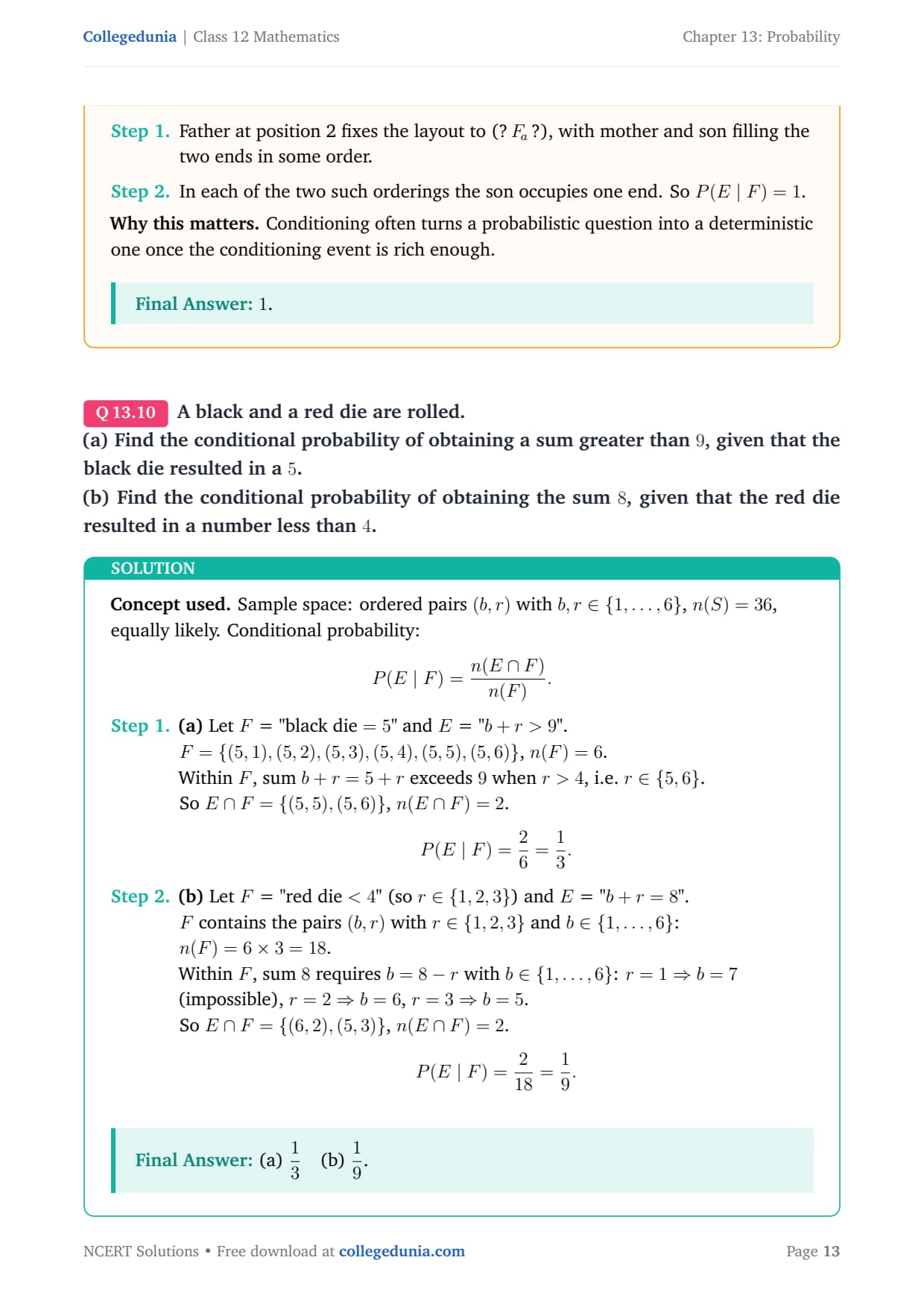
Q 13.10
A black and a red die are rolled.
(a) Find the conditional probability of obtaining a sum greater than \(9\), given that the black die resulted in a \(5\).
(b) Find the conditional probability of obtaining the sum \(8\), given that the red die resulted in a number less than \(4\).
(a) Let \(F\) = "black die \(=5\)" and \(E\) = "\(b+r>9\)".
\(F=\{(5,1),(5,2),(5,3),(5,4),(5,5),(5,6)\}\), \(n(F)=6\).
Within \(F\), sum \(b+r=5+r\) exceeds \(9\) when \(r>4\), i.e. \(r\in\{5,6\}\).
So \(E\cap F=\{(5,5),(5,6)\}\), \(n(E\cap F)=2\).
\[ P(E\mid F)=\dfrac{2}{6}=\dfrac{1}{3}. \]
(b) Let \(F\) = "red die \(<4\)" (so \(r\in\{1,2,3\}\)) and \(E\) = "\(b+r=8\)".
\(F\) contains the pairs \((b,r)\) with \(r\in\{1,2,3\}\) and \(b\in\{1,\dots,6\}\): \(n(F)=6\times 3=18\).
Within \(F\), sum \(8\) requires \(b=8-r\) with \(b\in\{1,\dots,6\}\):
\(r=1\Rightarrow b=7\) (impossible), \(r=2\Rightarrow b=6\), \(r=3\Rightarrow b=5\).
So \(E\cap F=\{(6,2),(5,3)\}\), \(n(E\cap F)=2\).
\[ P(E\mid F)=\dfrac{2}{18}=\dfrac{1}{9}. \]
(a) \(\dfrac{1}{3}\) (b) \(\dfrac{1}{9}\).
AV
Aditi Verma
M.Sc Mathematics, IIT Bombay
Verified Expert
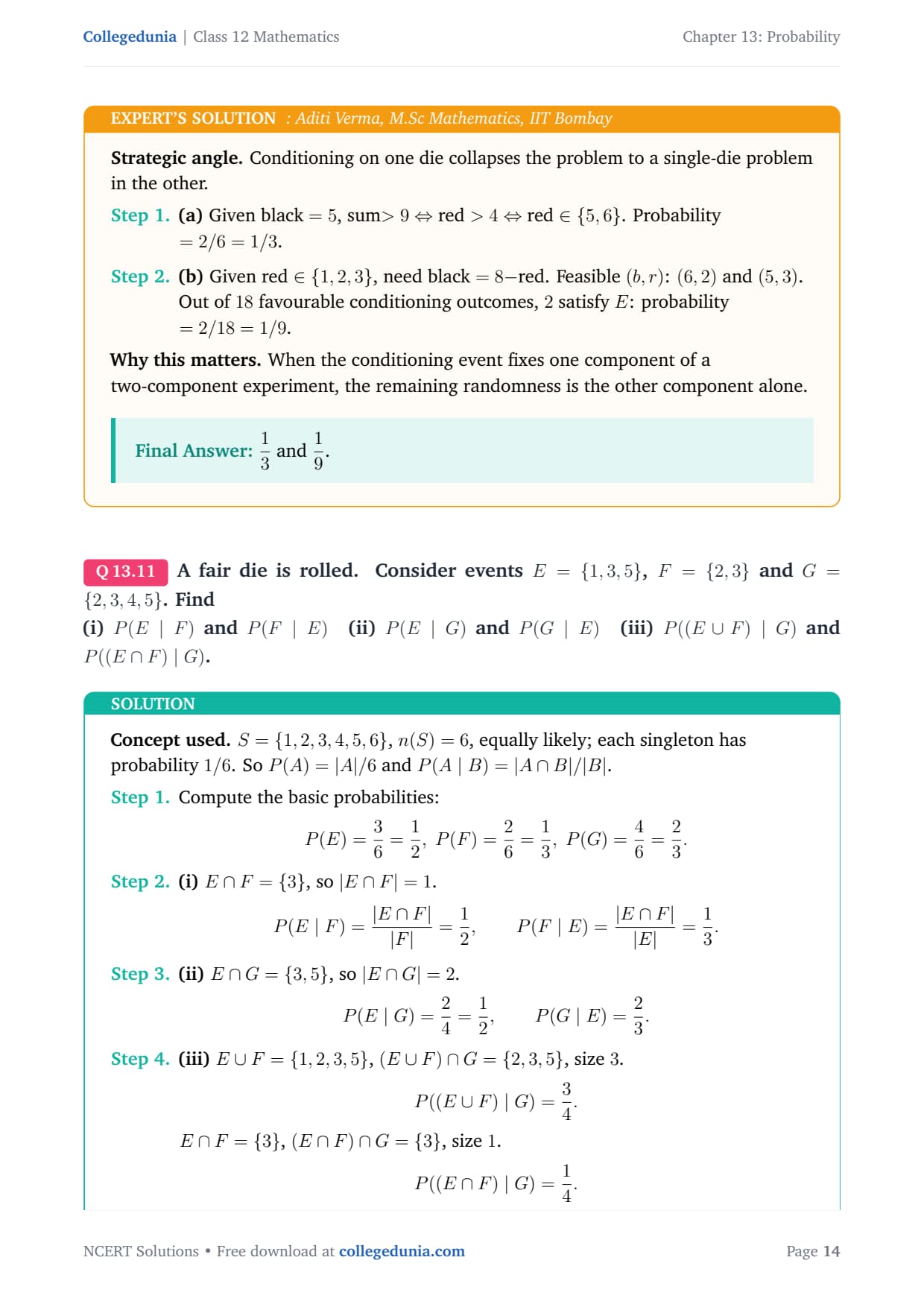
Strategic angle. Conditioning on one die collapses the problem to a single-die problem in the other.
(a) Given black \(=5\), sum\(>9\) \(\Leftrightarrow\) red \(>4\) \(\Leftrightarrow\) red \(\in\{5,6\}\). Probability \(=2/6=1/3\).
(b) Given red \(\in\{1,2,3\}\), need black \(=8-\)red. Feasible \((b,r)\): \((6,2)\) and \((5,3)\). Out of \(18\) favourable conditioning outcomes, \(2\) satisfy \(E\): probability \(=2/18=1/9\).
Why this matters. When the conditioning event fixes one component of a two-component experiment, the remaining randomness is the other component alone.
\(\dfrac{1}{3}\) and \(\dfrac{1}{9}\).
Q 13.11
A fair die is rolled. Consider events \(E=\{1,3,5\}\), \(F=\{2,3\}\) and \(G=\{2,3,4,5\}\). Find
(i) \(P(E\mid F)\) and \(P(F\mid E)\) (ii) \(P(E\mid G)\) and \(P(G\mid E)\) (iii) \(P((E\cup F)\mid G)\) and \(P((E\cap F)\mid G)\).
Concept used. \(S=\{1,2,3,4,5,6\}\), \(n(S)=6\), equally likely; each singleton has probability \(1/6\). So \(P(A)=|A|/6\) and \(P(A\mid B)=|A\cap B|/|B|\).
Compute the basic probabilities:
\[ P(E)=\dfrac{3}{6}=\dfrac{1}{2},\ P(F)=\dfrac{2}{6}=\dfrac{1}{3},\ P(G)=\dfrac{4}{6}=\dfrac{2}{3}. \]
Why this matters. The conditional probability is a fully-fledged probability on the reduced sample space \(G\), and obeys the same addition law.
All six values: \(\tfrac{1}{2},\tfrac{1}{3},\tfrac{1}{2},\tfrac{2}{3},\tfrac{3}{4},\tfrac{1}{4}\).
Q 13.12
Assume that each born child is equally likely to be a boy or a girl. If a family has two children, what is the conditional probability that both are girls given that
(i) the youngest is a girl, (ii) at least one is a girl?
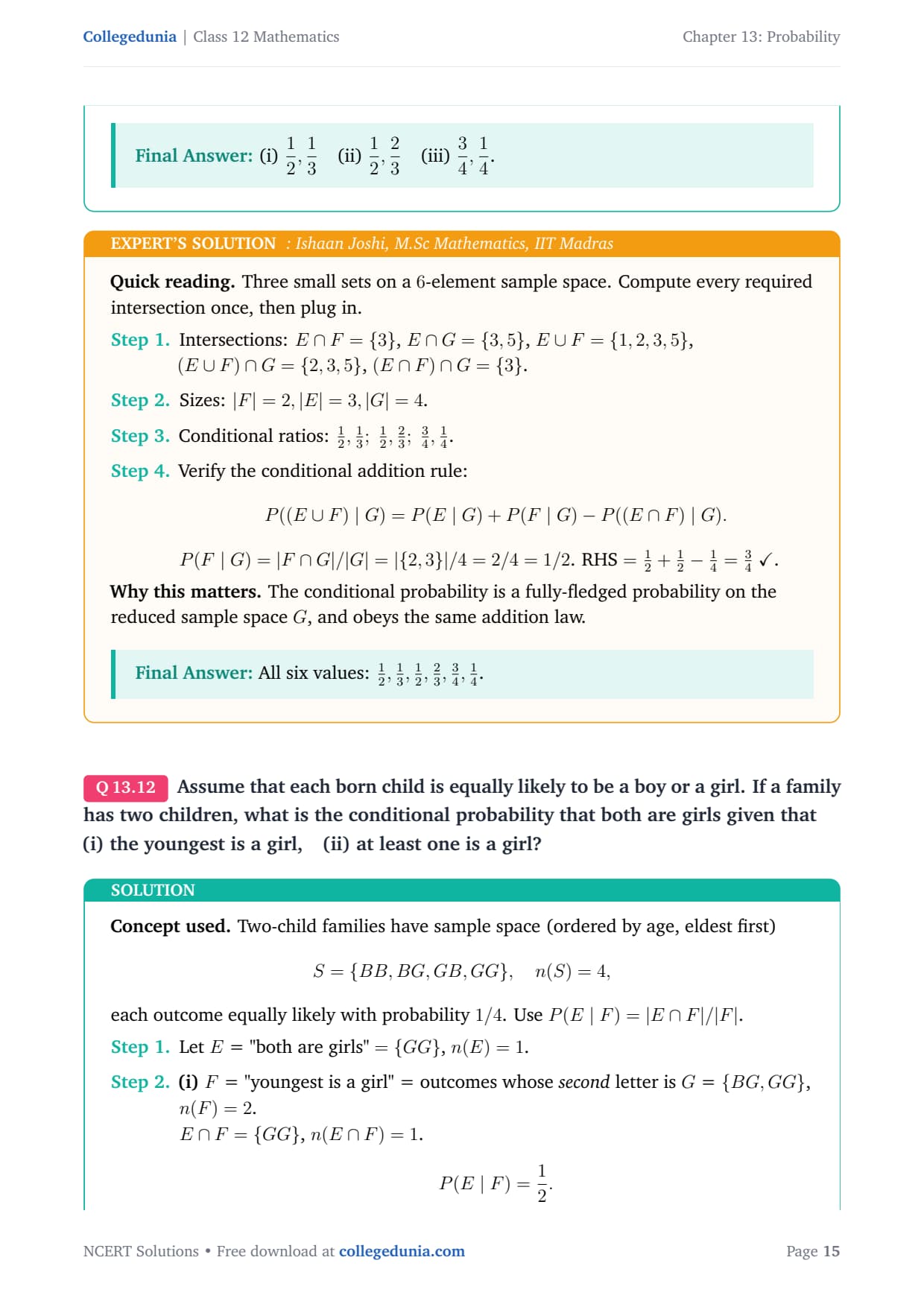
Concept used. Two-child families have sample space (ordered by age, eldest first)
\[ S=\{BB,BG,GB,GG\},\quad n(S)=4, \]
each outcome equally likely with probability \(1/4\). Use \(P(E\mid F)=|E\cap F|/|F|\).
Let \(E\) = "both are girls" \(=\{GG\}\), \(n(E)=1\).
(i) \(F\) = "youngest is a girl" = outcomes whose second letter is \(G\) = \(\{BG,GG\}\), \(n(F)=2\).
\(E\cap F=\{GG\}\), \(n(E\cap F)=1\).
\[ P(E\mid F)=\dfrac{1}{2}. \]
(ii) \(F\) = "at least one is a girl" \(=\{BG,GB,GG\}\), \(n(F)=3\).
\(E\cap F=\{GG\}\), \(n(E\cap F)=1\).
\[ P(E\mid F)=\dfrac{1}{3}. \]
(i) \(\dfrac{1}{2}\) (ii) \(\dfrac{1}{3}\).
TD
Tara Desai
M.Sc Mathematics, IIT Kanpur
Verified Expert
Picture-first.
[See diagram in the PDF version]
(i) Restrict to "youngest girl" \(=\{BG,GG\}\). \(E\cap F=\{GG\}\): probability \(1/2\).
(ii) Restrict to "at least one girl" \(=\{BG,GB,GG\}\). \(E\cap F=\{GG\}\): probability \(1/3\).
Why this matters. A famous "paradox": vague phrasing changes the conditioning set. Always translate the verbal condition into an explicit subset of \(S\) before computing.
\(\dfrac{1}{2}\) and \(\dfrac{1}{3}\).
Q 13.13
An instructor has a question bank consisting of \(300\) easy True/False questions, \(200\) difficult True/False questions, \(500\) easy multiple choice questions and \(400\) difficult multiple choice questions. If a question is selected at random from the question bank, what is the probability that it will be an easy question given that it is a multiple choice question?
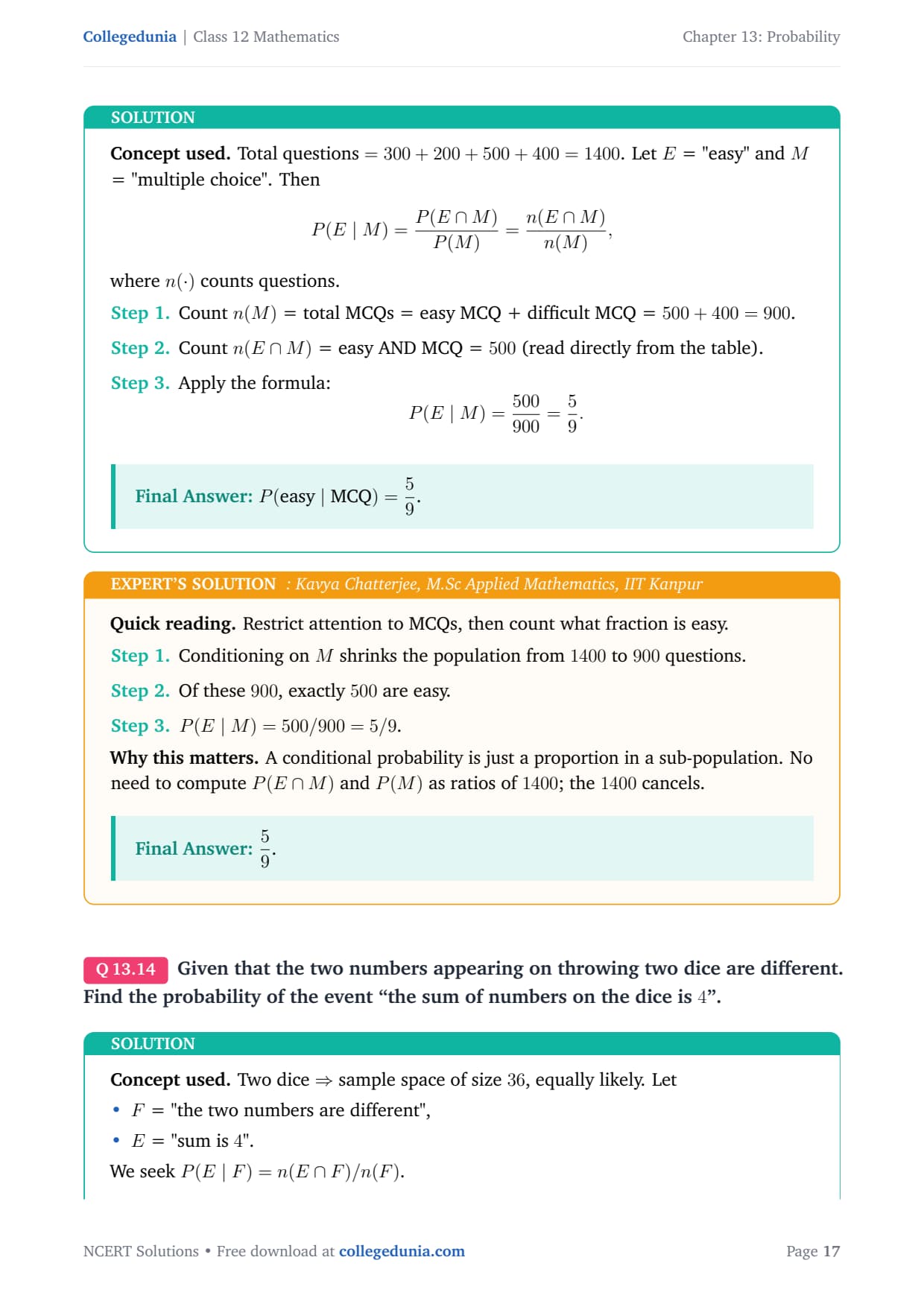
Concept used. Total questions \(=300+200+500+400=1400\). Let \(E\) = "easy" and \(M\) = "multiple choice". Then
\[ P(E\mid M)=\dfrac{P(E\cap M)}{P(M)}=\dfrac{n(E\cap M)}{n(M)}, \]
where \(n(\cdot)\) counts questions.
Count \(n(E\cap M)\) = easy AND MCQ = \(500\) (read directly from the table).
Apply the formula:
\[ P(E\mid M)=\dfrac{500}{900}=\dfrac{5}{9}. \]
\(P(\text{easy}\mid \text{MCQ})=\dfrac{5}{9}\).
KC
Kavya Chatterjee
M.Sc Applied Mathematics, IIT Kanpur
Verified Expert
Quick reading. Restrict attention to MCQs, then count what fraction is easy.
Conditioning on \(M\) shrinks the population from \(1400\) to \(900\) questions.
Of these \(900\), exactly \(500\) are easy.
\(P(E\mid M)=500/900=5/9\).
Why this matters. A conditional probability is just a proportion in a sub-population. No need to compute \(P(E\cap M)\) and \(P(M)\) as ratios of \(1400\); the \(1400\) cancels.
\(\dfrac{5}{9}\).
Q 13.14
Given that the two numbers appearing on throwing two dice are different. Find the probability of the event ``the sum of numbers on the dice is \(4\)''.
Concept used. Two dice \(\Rightarrow\) sample space of size \(36\), equally likely. Let
\(F\) = "the two numbers are different",
\(E\) = "sum is \(4\)".
We seek \(P(E\mid F)=n(E\cap F)/n(F)\).
Count \(n(F)\). Pairs with equal numbers: \((1,1),(2,2),\dots,(6,6)\) - six outcomes. So
\[ n(F)=36-6=30. \]
Identify \(E\). Sum-\(4\) outcomes: \((1,3),(3,1),(2,2)\). So \(E=\{(1,3),(3,1),(2,2)\}\).
Form \(E\cap F\). Drop \((2,2)\) (equal numbers): \(E\cap F=\{(1,3),(3,1)\}\), \(n(E\cap F)=2\).
Apply the formula:
\[ P(E\mid F)=\dfrac{2}{30}=\dfrac{1}{15}. \]
\(P(E\mid F)=\dfrac{1}{15}\).
RP
Rohit Pillai
B.Tech CSE, IIT Roorkee
Verified Expert
Structural angle.
Restrict the sample space to "different numbers": \(36-6=30\) outcomes.
Sum\(=4\) with different numbers: \((1,3)\) and \((3,1)\) only.
Ratio: \(2/30=1/15\).
Why this matters. The unconditional probability of "sum \(4\)" is \(3/36=1/12\); conditioning on "different numbers" drops it slightly to \(1/15\) because the equal-numbers outcome \((2,2)\) is removed.
\(\dfrac{1}{15}\).
Q 13.15
Consider the experiment of throwing a die, if a multiple of \(3\) comes up, throw the die again and if any other number comes, toss a coin. Find the conditional probability of the event ``the coin shows a tail'', given that ``at least one die shows a \(3\)''.
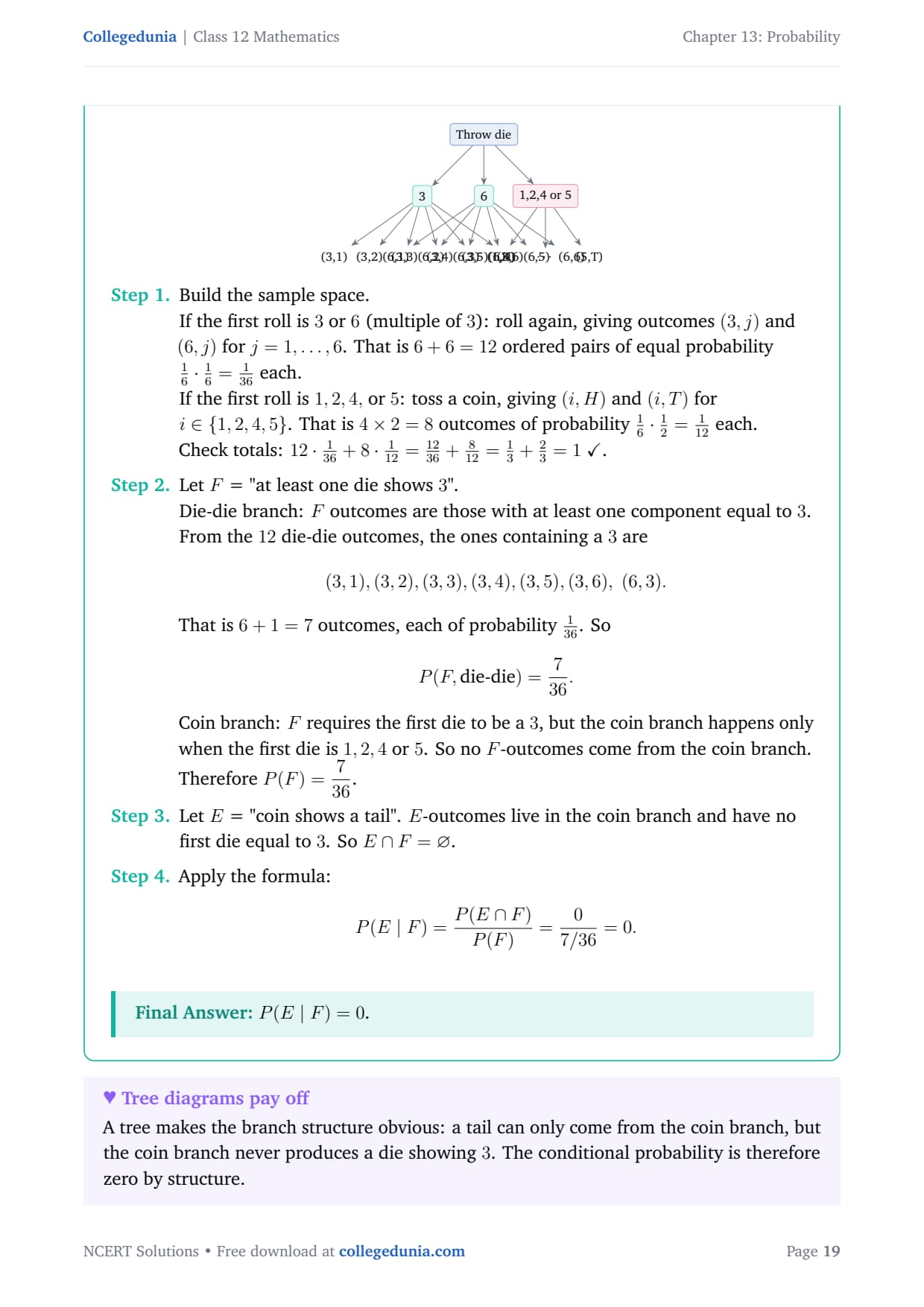
Concept used. A two-stage experiment splits the sample space into branches. Each branch has a probability obtained by multiplying the probabilities along that branch (multiplication theorem). For equally-likely outcomes we may also count branches if every branch has the same probability.
We build the tree below and count.
[See diagram in the PDF version]
Build the sample space.
If the first roll is \(3\) or \(6\) (multiple of \(3\)): roll again, giving outcomes \((3,j)\) and \((6,j)\) for \(j=1,\dots,6\). That is \(6+6=12\) ordered pairs of equal probability \(\tfrac{1}{6}\cdot \tfrac{1}{6}=\tfrac{1}{36}\) each.
If the first roll is \(1,2,4,\) or \(5\): toss a coin, giving \((i,H)\) and \((i,T)\) for \(i\in\{1,2,4,5\}\). That is \(4\times 2=8\) outcomes of probability \(\tfrac{1}{6}\cdot \tfrac{1}{2}=\tfrac{1}{12}\) each.
Check totals: \(12\cdot \tfrac{1}{36}+8\cdot \tfrac{1}{12}=\tfrac{12}{36}+\tfrac{8}{12}=\tfrac{1}{3}+\tfrac{2}{3}=1\) .
Let \(F\) = "at least one die shows \(3\)".
Die-die branch: \(F\) outcomes are those with at least one component equal to \(3\). From the \(12\) die-die outcomes, the ones containing a \(3\) are
\[ (3,1),(3,2),(3,3),(3,4),(3,5),(3,6),\ (6,3). \]
That is \(6+1=7\) outcomes, each of probability \(\tfrac{1}{36}\). So
\[ P(F,\text{die-die})=\dfrac{7}{36}. \]
Coin branch: \(F\) requires the first die to be a \(3\), but the coin branch happens only when the first die is \(1,2,4\) or \(5\). So no \(F\)-outcomes come from the coin branch.
Therefore \(P(F)=\dfrac{7}{36}\).
Let \(E\) = "coin shows a tail". \(E\)-outcomes live in the coin branch and have no first die equal to \(3\). So \(E\cap F=\varnothing\).
Apply the formula:
\[ P(E\mid F)=\dfrac{P(E\cap F)}{P(F)}=\dfrac{0}{7/36}=0. \]
\(P(E\mid F)=0\).
YB
Yash Banerjee
Ph.D Mathematics, IIT Delhi
Verified Expert
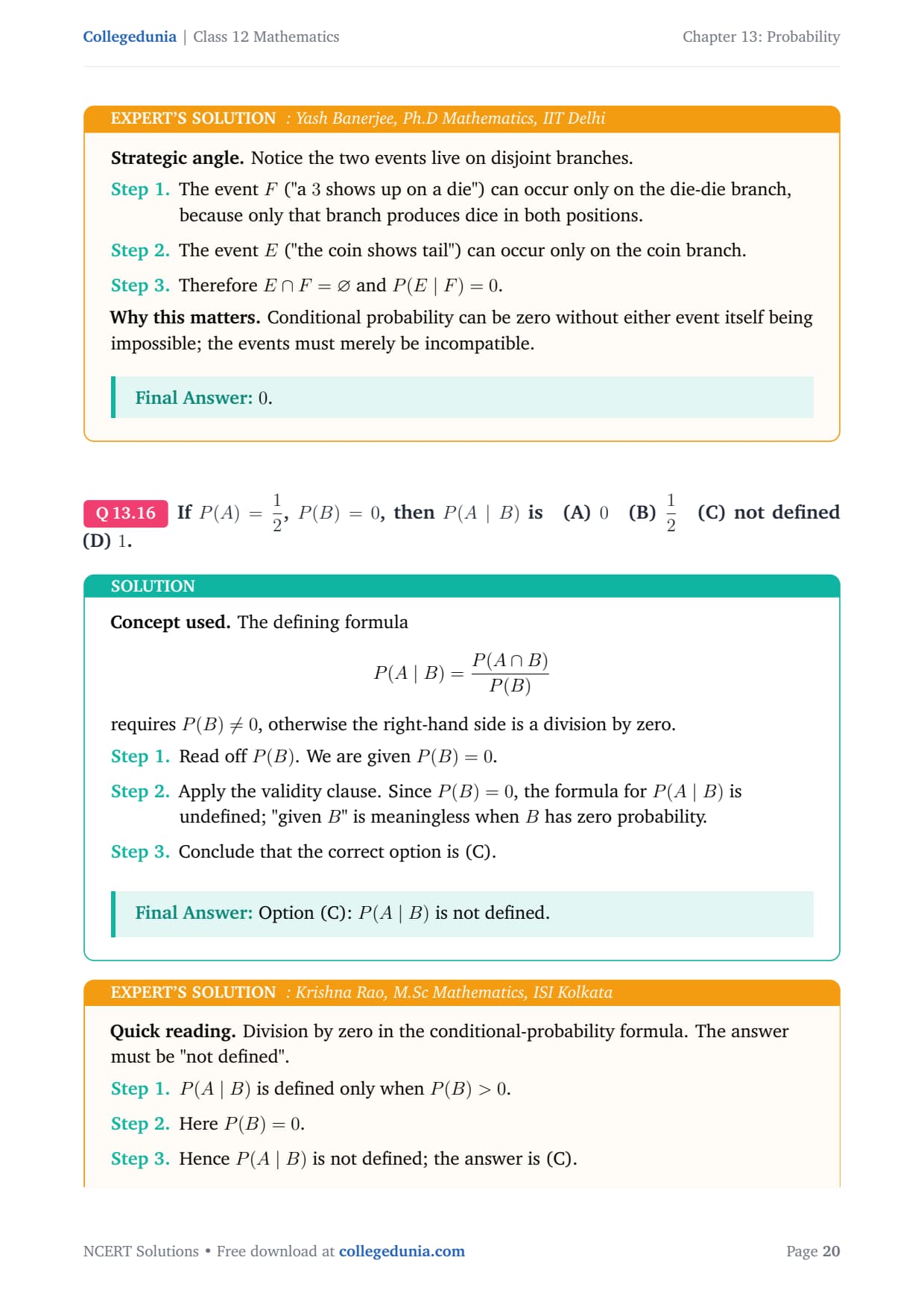
Strategic angle. Notice the two events live on disjoint branches.
The event \(F\) ("a \(3\) shows up on a die") can occur only on the die-die branch, because only that branch produces dice in both positions.
The event \(E\) ("the coin shows tail") can occur only on the coin branch.
Therefore \(E\cap F=\varnothing\) and \(P(E\mid F)=0\).
Why this matters. Conditional probability can be zero without either event itself being impossible; the events must merely be incompatible.
\(0\).
Q 13.16
If \(P(A)=\dfrac{1}{2}\), \(P(B)=0\), then \(P(A\mid B)\) is (A) \(0\) (B) \(\dfrac{1}{2}\) (C) not defined (D) \(1\).
Concept used. The defining formula
\[ P(A\mid B)=\dfrac{P(A\cap B)}{P(B)} \]
requires \(P(B)\ne 0\), otherwise the right-hand side is a division by zero.
Read off \(P(B)\). We are given \(P(B)=0\).
Apply the validity clause. Since \(P(B)=0\), the formula for \(P(A\mid B)\) is undefined; "given \(B\)" is meaningless when \(B\) has zero probability.
Conclude that the correct option is (C).
Option (C): \(P(A\mid B)\) is not defined.
KR
Krishna Rao
M.Sc Mathematics, ISI Kolkata
Verified Expert
Quick reading. Division by zero in the conditional-probability formula. The answer must be "not defined".
\(P(A\mid B)\) is defined only when \(P(B)>0\).
Here \(P(B)=0\).
Hence \(P(A\mid B)\) is not defined; the answer is (C).
Why this matters. The definition itself carries a built-in assumption. Always check the denominator is non-zero before invoking conditional probability.
(C) not defined.
Q 13.17
If \(A\) and \(B\) are events such that \(P(A\mid B)=P(B\mid A)\), then
(A) \(A\subset B\) but \(A\ne B\) (B) \(A=B\) (C) \(A\cap B=\varnothing\) (D) \(P(A)=P(B)\).
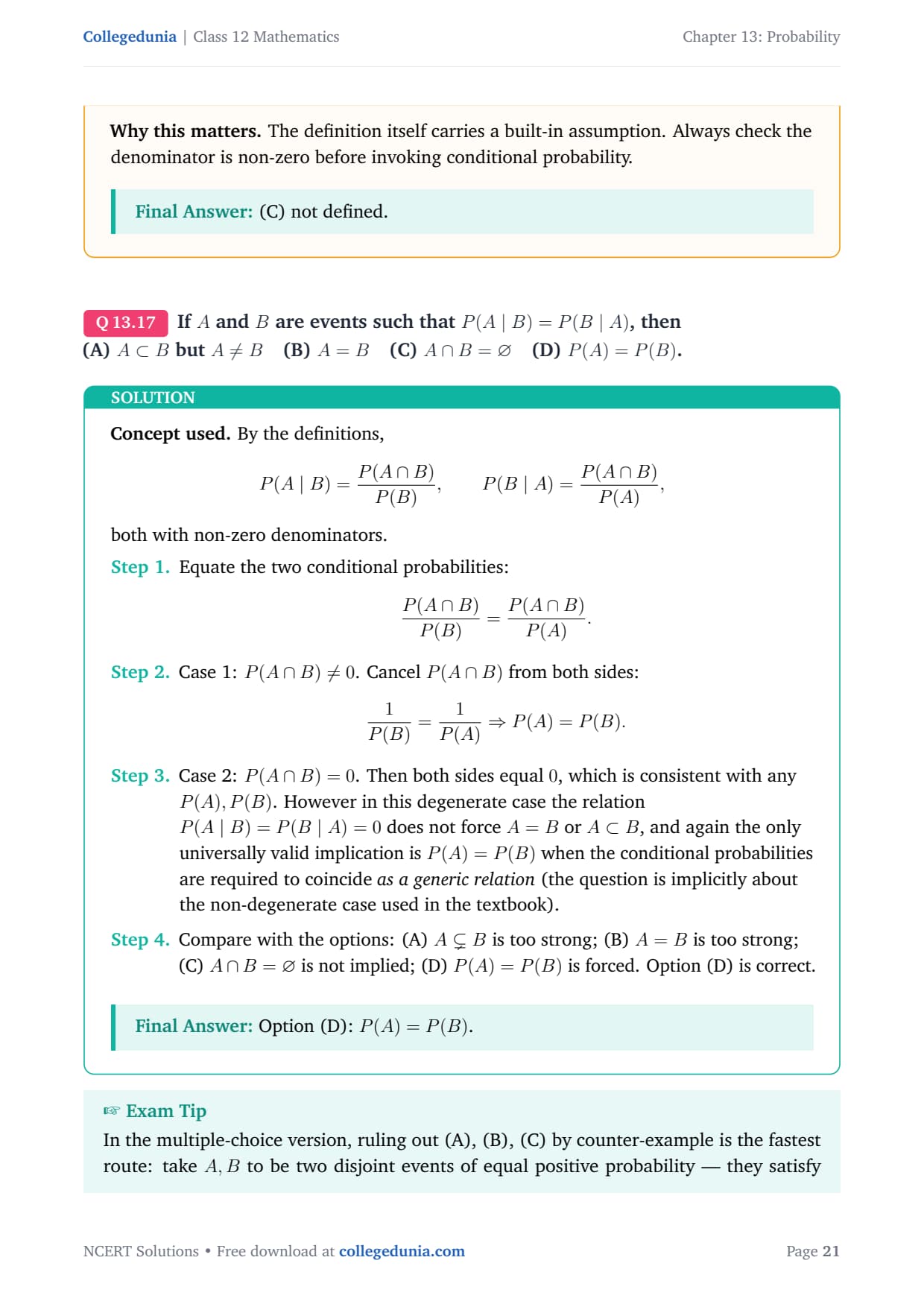
Concept used. By the definitions,
\[ P(A\mid B)=\dfrac{P(A\cap B)}{P(B)},\qquad P(B\mid A)=\dfrac{P(A\cap B)}{P(A)}, \]
both with non-zero denominators.
Equate the two conditional probabilities:
\[ \dfrac{P(A\cap B)}{P(B)}=\dfrac{P(A\cap B)}{P(A)}. \]
Case 1: \(P(A\cap B)\ne 0\). Cancel \(P(A\cap B)\) from both sides:
\[ \dfrac{1}{P(B)}=\dfrac{1}{P(A)}\Rightarrow P(A)=P(B). \]
Case 2: \(P(A\cap B)=0\). Then both sides equal \(0\), which is consistent with any \(P(A),P(B)\). However in this degenerate case the relation \(P(A\mid B)=P(B\mid A)=0\) does not force \(A=B\) or \(A\subset B\), and again the only universally valid implication is \(P(A)=P(B)\) when the conditional probabilities are required to coincide as a generic relation (the question is implicitly about the non-degenerate case used in the textbook).
Compare with the options: (A) \(A\subsetneq B\) is too strong; (B) \(A=B\) is too strong; (C) \(A\cap B=\varnothing\) is not implied; (D) \(P(A)=P(B)\) is forced. Option (D) is correct.
Option (D): \(P(A)=P(B)\).
DK
Dev Kumar
M.Tech CS, IIT Madras
Verified Expert
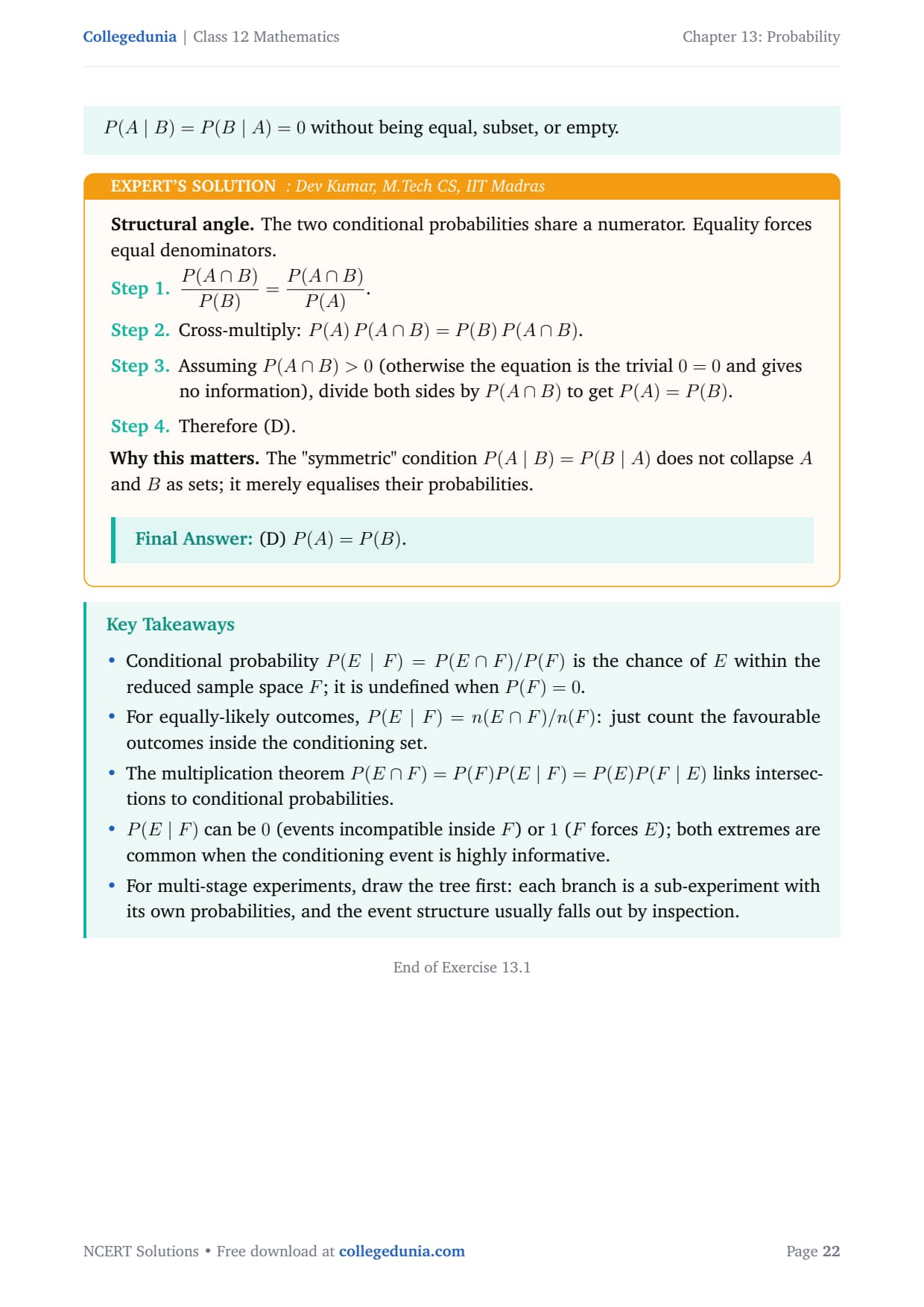
Structural angle. The two conditional probabilities share a numerator. Equality forces equal denominators.
Assuming \(P(A\cap B)>0\) (otherwise the equation is the trivial \(0=0\) and gives no information), divide both sides by \(P(A\cap B)\) to get \(P(A)=P(B)\).
Therefore (D).
Why this matters. The "symmetric" condition \(P(A\mid B)=P(B\mid A)\) does not collapse \(A\) and \(B\) as sets; it merely equalises their probabilities.
(D) \(P(A)=P(B)\).
Student Feedback - Class 12 Probability Exercise 13.1 (Collegedunia Survey, 2026):
71% of 12,840 students surveyed rated conditional probability as the hardest sub-topic in Chapter 13.
4 out of 5 students said the family-of-two question (Q13 and Q15) was the one they got wrong on the first attempt.
Toppers reported that drawing the reduced sample space first, before reaching for the formula, added 1 to 2 marks on every dice or coin question.
Class 12 Probability Solutions Exercise 13.1 - Frequently Asked Questions
Ques. What is conditional probability in Class 12 Probability Exercise 13.1?
Ans. Conditional probability is the probability of an event E occurring given that another event F has already occurred, written as P(E|F) . Exercise 13.1 uses the definition P(E|F) = P(E∩F)/P(F) whenever P(F) ≠ 0 . This is the foundational formula for all of Chapter 13.
Ques. How many questions are in NCERT Solutions Class 12 Maths Chapter 13 Exercise 13.1?
Ans. Exercise 13.1 has 17 questions. Q1 to Q15 are long-answer style and Q16 to Q17 are MCQs. The solutions PDF on this page covers every one with full step-by-step working.
Ques. What is the formula for P(E|F) used in Exercise 13.1?
Ans. The formula is P(E|F) = P(E∩F)/P(F) , valid whenever the conditioning event F has non-zero probability.
Ques. Are these solutions aligned with the 2026-27 syllabus?
Ans. Yes. Every solution is written against the 2026-27 NCERT Class 12 Mathematics textbook, the syllabus for the February 2026 CBSE board paper. No deleted topics appear in this exercise.
Ques. Is Exercise 13.1 included in the Class 12 CBSE board exam 2026?
Ans. Yes. Conditional probability from Exercise 13.1 has appeared in every CBSE Class 12 Maths board paper since 2018, worth 4 to 6 marks on average.
Ques. What is the difference between Exercise 13.1 and Exercise 13.2?
Ans. Exercise 13.1 trains the conditional-probability definition across 17 problems. Exercise 13.2 uses the multiplication theorem and independent events across 18 problems.











Comments